
Quick answer: A trademark portfolio manager spends most of the day on deadline triage, correspondence, maintenance filings, data validation, and conflict review, not on “strategy.” A realistic day in the life of a trademark portfolio manager is roughly 20% office actions and correspondence, 15% renewals and maintenance, 15% data cleanup, 15% client reporting, and the rest split across watch notices, ownership changes, and special projects.
At 8:42 a.m., a trademark portfolio manager already has fourteen tabs open. One shows the USPTO status page. Another shows a docketing report with three deadlines in red. A third holds an email from a client who “just needs a quick update” on a mark filed in six countries. Nobody told this person the day would begin at full speed. It simply does.

If you want an honest day in the life trademark portfolio manager view, this guide walks through the full workday, hour by hour. It also shows where the time really goes, which mistakes quietly burn the most hours, and how law firms and corporate IP teams can protect their portfolios without burning out their people.
A note on method: The schedule below is a composite built from common trademark portfolio workflows, not a single person’s diary. Times and percentages are illustrative. Your portfolio size, jurisdictions, and tools will shift them. Always confirm deadlines against current official sources, and treat this article as general information, not legal advice.
What Does a Trademark Portfolio Manager Actually Do?
Definition: A trademark portfolio manager is the person (or team) responsible for keeping a company’s or client’s trademark assets alive, accurate, and enforceable across every relevant jurisdiction. In practice, that means tracking deadlines, coordinating filings, monitoring conflicts, maintaining records, and reporting status to attorneys and business stakeholders.
The title sounds strategic, and parts of the job are. However, the daily reality leans operational. A portfolio can hold dozens or thousands of records. Every record carries its own clock.
Here is what the role typically covers:
- Docket management: tracking response dates, renewal windows, and statutory deadlines
- Prosecution support: preparing responses to office actions, statements of use, and amendments
- Maintenance: Section 8 declarations, renewals, and international renewals
- Monitoring: reviewing watch notices and flagging conflicting marks
- Ownership records: assignments, name changes, and chain of title
- Data integrity: making sure every field in the docket matches the official record
- Reporting: giving attorneys, general counsel, and finance a clear picture of status and cost
If you want a deeper look at the strategic layer, Teak IP’s guide to effective trademark portfolio management covers key components, challenges, and best practices. This article focuses on the other half: the hands-on workday.
Who Hires a Trademark Portfolio Manager?
Three groups usually need this role:
- Corporate IP departments that hold many marks across product lines and countries
- Law firms that manage trademark dockets for dozens of clients
- Brand owners and startups that have grown past what a spreadsheet can safely handle
Each group experiences the day differently. A corporate manager worries about budget and business alignment. A firm paralegal worries about volume and billable accuracy. Still, the core clock-watching work is the same.
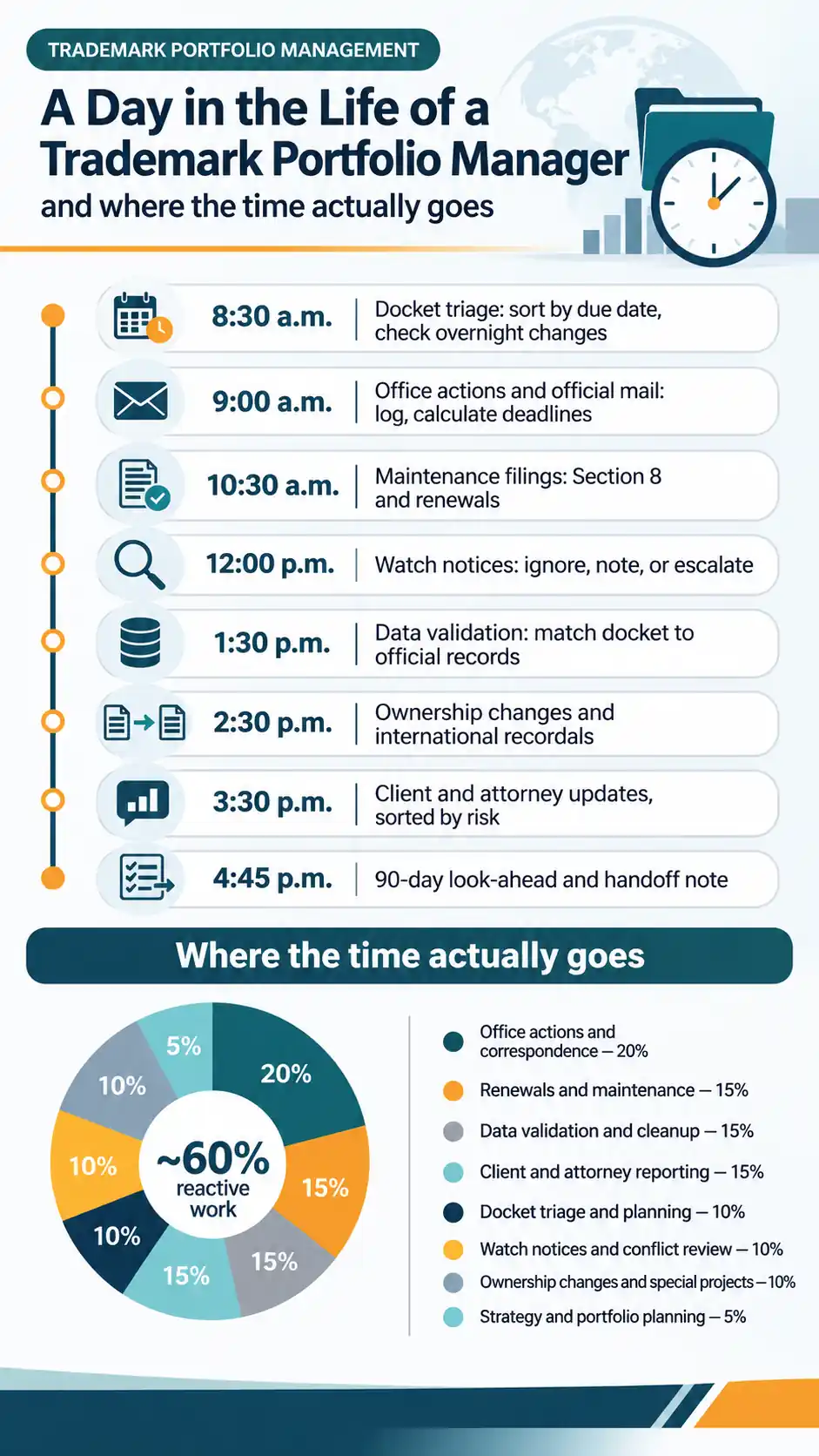
A Day in the Life of a Trademark Portfolio Manager: Hour by Hour
Let’s follow one composite portfolio manager, call her Priya, through a typical Wednesday. Priya manages roughly 600 active trademark records across the United States, the European Union, India, and several Madrid Protocol designations.
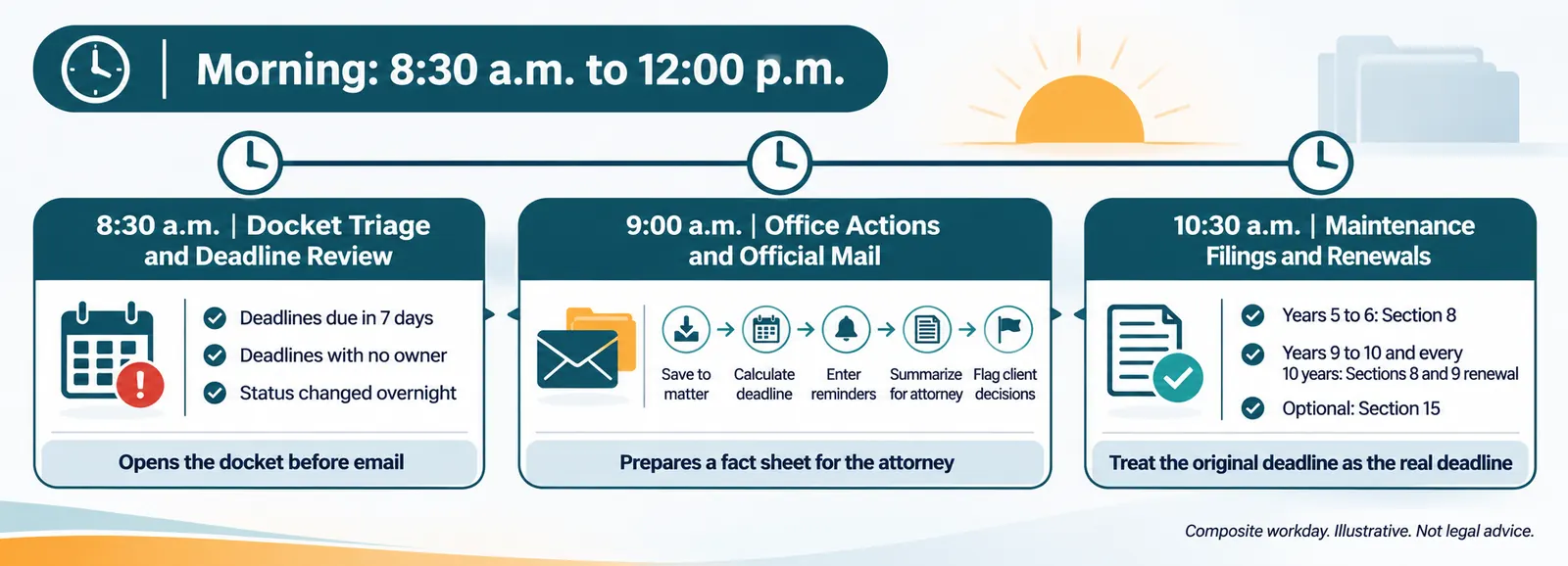
8:30 a.m. – Docket Triage and Deadline Review
Priya does not check email first. Instead, she opens the docket and sorts by due date.
She looks for three things:
- Deadlines due in the next seven days
- Deadlines that have no assigned owner
- Records where the status changed overnight
This first thirty minutes sets the tone for everything else. A missed deadline in a trademark portfolio rarely announces itself. It sits quietly until the registration is cancelled or the application is abandoned. Therefore, a disciplined morning triage matters more than any clever tool.
For a closer look at why docketing sits at the center of this job, see Teak IP’s complete guide to trademark docketing systems. It explains how a docket becomes the command center for the entire portfolio.
9:00 a.m. – New Office Actions and Official Correspondence
By nine, the overnight mail has landed. Priya finds two new office actions, one notice of allowance, and a post-registration audit letter.
Each item triggers a chain of small tasks:
- Download and save the correspondence to the correct matter
- Calculate the response deadline
- Enter the deadline and a reminder schedule in the docket
- Summarize the issue for the supervising attorney
- Flag any item that needs a client decision
The calculation step deserves care. For example, the USPTO currently gives applicants three months to respond to most office actions, with one three-month extension available for a fee. Priya checks the official USPTO trademark maintenance and filing guidance and the Trademark Manual of Examining Procedure (TMEP) whenever a rule looks unfamiliar, because response periods and fees can change.
Meanwhile, one of the office actions cites a likelihood-of-confusion refusal. Priya does not draft the legal argument herself, since that belongs to the attorney. Instead, she pulls the cited registration, checks its status, and prepares a short fact sheet. That fact sheet saves the attorney twenty minutes.
If you are curious where the line sits between paralegal support and legal advice, Teak IP’s article on what tasks a trademark paralegal can do without unauthorized practice of law draws that line clearly.
10:30 a.m. – Maintenance Filings and Renewals
Mid-morning belongs to maintenance. This is the least glamorous and most valuable work in the portfolio.
A U.S. trademark registration is not a permanent asset. It needs ongoing proof of use. The key milestones look like this:
- Between years 5 and 6: file a Section 8 declaration of use
- Between years 9 and 10, and every 10 years after: file a combined Section 8 and Section 9 renewal
- Optional: file a Section 15 declaration of incontestability once eligibility requirements are met
A six-month grace period usually exists after the deadline, with a surcharge. Nevertheless, relying on the grace period is a risky habit. Priya treats the original deadline as the real deadline.
Today she is preparing a Section 8 filing for a mark used on only two of the five listed goods. She confirms with the client which goods are still in use, collects a specimen, and deletes the unused goods before filing. This detail matters because a declaration of use must be accurate. Claiming use on goods that are not in use creates real risk.
International renewals add another layer. Marks registered through the Madrid System are renewed through WIPO, and national offices follow their own rules. The WIPO Madrid System overview explains how international registration and renewal work. For a broader look at managing renewals across countries, see Teak IP’s guide on trademark IP management best practices for multi-jurisdiction brand protection.
12:00 p.m. – Watch Notices and Conflict Review
Before lunch, Priya works through the weekly watch report. A watch service scans new filings and flags marks that look similar to the client’s marks.
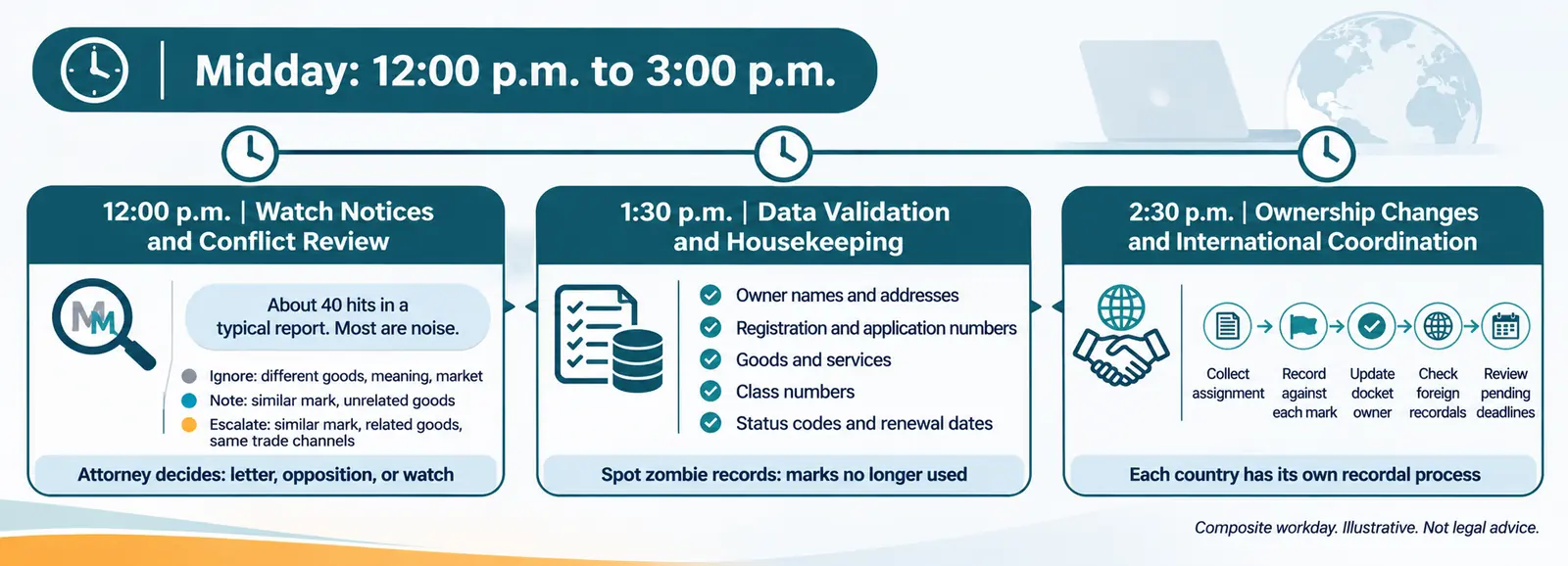
A typical report holds forty hits. Most are noise. A handful matter.
Priya sorts each hit using a simple method:
- Ignore: different goods, different meaning, different market
- Note: similar mark, unrelated goods; record it and move on
- Escalate: similar mark, related goods, same channels of trade
Two hits move into the escalate pile today. One is a new application for a nearly identical name in a related class. She prepares a summary with filing date, owner, goods, and publication status. The attorney will decide whether to send a letter, file an opposition, or simply watch.
People often confuse searching and monitoring. If you want a clean explanation, read Teak IP’s article on the difference between a trademark search and trademark monitoring. In short, a search looks backward at what already exists. Monitoring looks forward at what gets filed next.
1:30 p.m. – Data Validation and Housekeeping
After lunch comes the work nobody sees. Priya compares docket records with official records.
She checks:
- Owner names and addresses
- Registration and application numbers
- Goods and services descriptions
- Class numbers
- Status codes and renewal dates
Small errors compound. A wrong owner name can derail a renewal. A wrong class can send a response to the wrong place. An outdated address can mean a missed official notice.
This is also where a manager spots “zombie records.” These are marks that the business no longer uses, yet keep generating annual costs. Cleaning them up is a core part of portfolio rationalization, and it often funds the rest of the program.
2:30 p.m. – Ownership Changes, Assignments, and International Coordination
The mid-afternoon block handles the unusual items. Today, a client acquired a smaller brand. That means:
- Collecting the assignment agreement
- Recording the assignment against each affected mark
- Updating the docket owner field
- Confirming whether foreign marks need separate recordals
- Checking whether any pending deadlines now point to the wrong party
Each country has its own recordal process. In the European Union, filings run through the EUIPO, while India, the U.S., and Madrid designations each use their own systems and forms. As a result, Priya keeps a country-by-country checklist rather than trusting memory.
3:30 p.m. – Client Communication and Attorney Updates
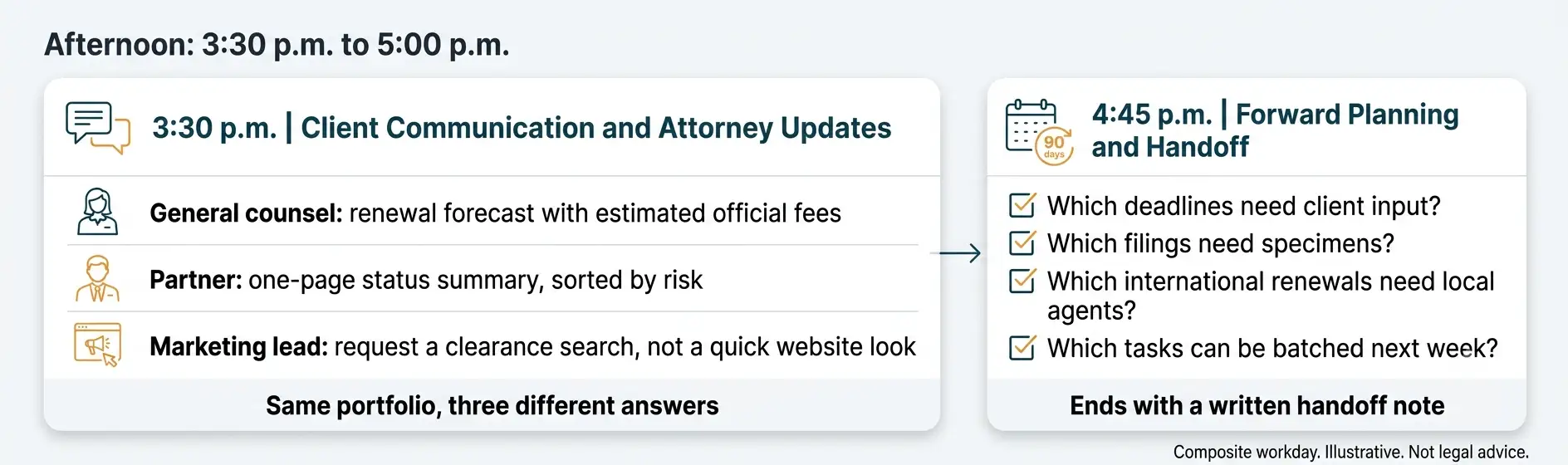
By now, three people have asked for updates. A general counsel wants to know how many marks renew next quarter. A partner wants a status list for a board meeting. A marketing lead wants to know if a new product name is “safe.”
Priya answers each one differently:
- General counsel: a renewal forecast with estimated official fees
- Partner: a one-page status summary, sorted by risk
- Marketing lead: a polite note explaining that she will request a clearance search, since a quick look on a website is not a clearance
That last answer protects the company. A pre-filing review is more detailed than most people expect. Teak IP explains what happens in a pre-filing trademark clearance search, and the contents of a comprehensive trademark search report show what a thorough result looks like.
4:45 p.m. – Forward Planning and Handoff
Priya ends the day by looking ahead. She scans the next ninety days and asks a few questions:
- Which deadlines need client input soon?
- Which filings need specimens or evidence of use?
- Which international renewals need local agents?
- Which tasks can be batched next week?
Then she writes a short handoff note. If she is out tomorrow, a colleague can pick up the thread without guessing. This habit alone prevents a surprising number of errors.
Where the Time Actually Goes: A Realistic Breakdown
Most people assume a portfolio manager spends the bulk of the day on strategy. In reality, strategy is a small slice. The table below shows an illustrative allocation for a mid-sized portfolio.
| Activity | Typical Share of the Day | What It Includes |
|---|---|---|
| Office actions and official correspondence | 20% | Intake, deadline calculation, fact sheets, response support |
| Renewals and maintenance filings | 15% | Section 8, Section 9, Madrid renewals, specimen collection |
| Data validation and docket cleanup | 15% | Record checks, status updates, error correction |
| Client and attorney reporting | 15% | Status lists, forecasts, ad hoc questions |
| Docket triage and deadline planning | 10% | Daily review, reminder setup, handoffs |
| Watch notices and conflict review | 10% | Report review, escalation summaries |
| Ownership changes and special projects | 10% | Assignments, acquisitions, audits |
| Strategy and portfolio planning | 5% | Rationalization, gap analysis, budgeting |

What the Numbers Tell Us
Three takeaways stand out:
- Roughly 60% of the day is reactive. Mail arrives, deadlines approach, and clients ask questions.
- Data work is the biggest hidden cost. Cleanup takes time because errors compound quietly.
- Strategy gets squeezed. The less time spent on planning, the more fires appear later.
Consequently, the best teams do not just work faster. They remove entire categories of work through better intake, cleaner data, and clearer processes.
The Hidden Time Sinks Nobody Budgets For
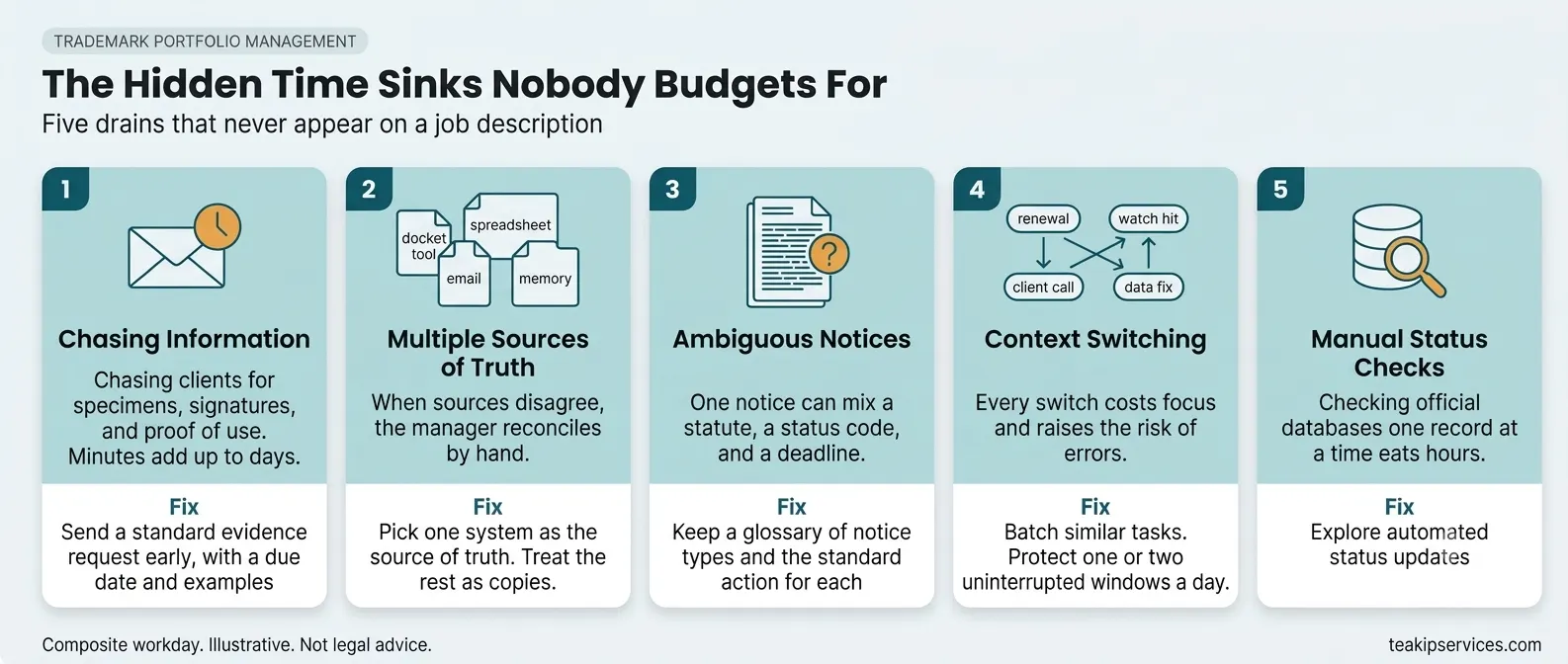
Some of the biggest drains never appear on a job description. Here are the ones portfolio managers mention most often.
Chasing Information
A deadline is only as good as the information behind it. Often, the manager must chase a client for a specimen, a signature, or confirmation of use. Each chase takes a few minutes. Across a quarter, those minutes add up to days.
Fix: send a standard evidence request early, with a clear due date and examples of acceptable specimens.
Reconciling Multiple Sources of Truth
Many teams keep data in a docketing tool, a spreadsheet, an email thread, and someone’s memory. When these sources disagree, the manager must reconcile them manually.
Fix: pick one system as the source of truth and treat everything else as a copy.
Interpreting Ambiguous Notices
Official notices are not always written plainly. A notice might mention a statutory section, a status code, and a deadline in one dense paragraph. Interpreting it correctly takes experience.
Fix: keep a short internal glossary of notice types and the standard action each one triggers.
Context Switching
A single hour can include a renewal, a watch hit, a client call, and a data fix. Each switch costs focus. Studies of knowledge work consistently show that interruptions slow output and raise error rates, which is a serious problem in deadline-driven work.
Fix: batch similar tasks into blocks and protect one or two uninterrupted windows per day.
Manual Status Checks
Checking official databases one record at a time eats hours. Therefore, many teams explore automated status updates. Teak IP’s article on whether an external docketing service can handle USPTO status scraping automatically explains what automation can and cannot do.
Step-by-Step: How to Run a Daily Docket Triage
A repeatable morning routine is the best defense against missed deadlines. Here is a simple process any portfolio manager can adopt.
How to run a daily trademark docket triage:
- Open the docket sorted by due date. Start with the next 7 days, then the next 30.
- Review overnight changes. Check new status updates, new correspondence, and watch alerts.
- Confirm every deadline has an owner. An unassigned deadline is a risk.
- Verify the deadline calculation. Re-check any date that came from a new notice.
- Flag items needing client input. Send requests today, not on the due date.
- Prioritize by consequence. Rank tasks by what happens if they are missed.
- Schedule focused work blocks. Assign time for filings, not just reminders.
- Write the handoff note. Record what is pending and who owns it.
A Sample Priority Matrix
| Priority | Type of Task | Example | Action |
|---|---|---|---|
| 1 – Critical | Statutory deadline within 7 days | Office action response due Friday | Work today |
| 2 – High | Deadline within 30 days, input needed | Section 8 needing specimen | Request evidence now |
| 3 – Medium | Watch hit with related goods | Similar mark in same class | Prepare summary |
| 4 – Routine | Data corrections, record updates | Address change | Batch weekly |
| 5 – Planned | Portfolio audit, rationalization | Review unused marks | Schedule quarterly |
Common Mistakes That Cost Portfolio Managers Hours (and Money)
Even experienced teams repeat a few predictable errors. Avoid these and you will win back real time.
1. Treating the Grace Period as Extra Time
A grace period exists for emergencies. Using it as a plan adds surcharges and risk. Set internal deadlines well ahead of the official date.
2. Skipping Evidence Checks Before Filing a Declaration of Use
Filing a declaration without verifying actual use on every listed good can create problems later. Confirm each good or service first, and remove anything not in use.
3. Letting Data Drift
When owner names, addresses, and status codes slowly fall out of sync, errors multiply. Schedule recurring data audits instead of waiting for a problem.
4. Confusing Search With Monitoring
A one-time search does not protect a brand after filing. Monitoring does. Both are needed, but for different reasons.
5. Relying on Memory Instead of Process
Experienced managers remember many details. Yet memory fails on busy days. Checklists protect the portfolio when people are sick, on leave, or leaving the company.
6. Ignoring International Differences
A deadline rule in one country does not apply in another. For instance, Madrid System renewals and national renewals run on separate tracks. Build a country-by-country reference and update it regularly.
7. Choosing a Vendor Without Due Diligence
Outsourcing can help, but a poorly vetted vendor can put an entire portfolio at risk. Teak IP’s IP vendor due diligence checklist offers a practical framework for evaluating providers.
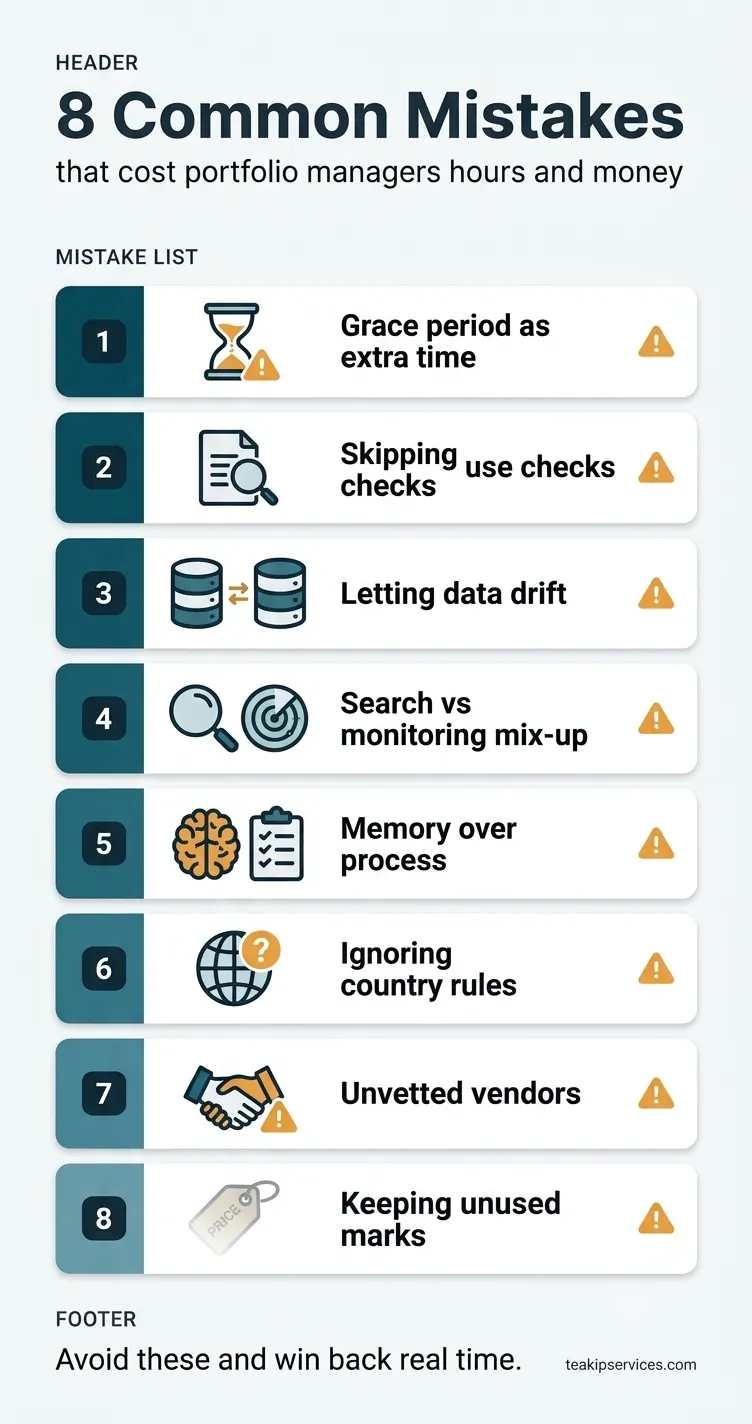
8. Keeping Marks Nobody Uses
Every unused registration costs money and attention. Review the portfolio regularly and retire marks that no longer serve the business.
Expert Tips to Reclaim Your Day
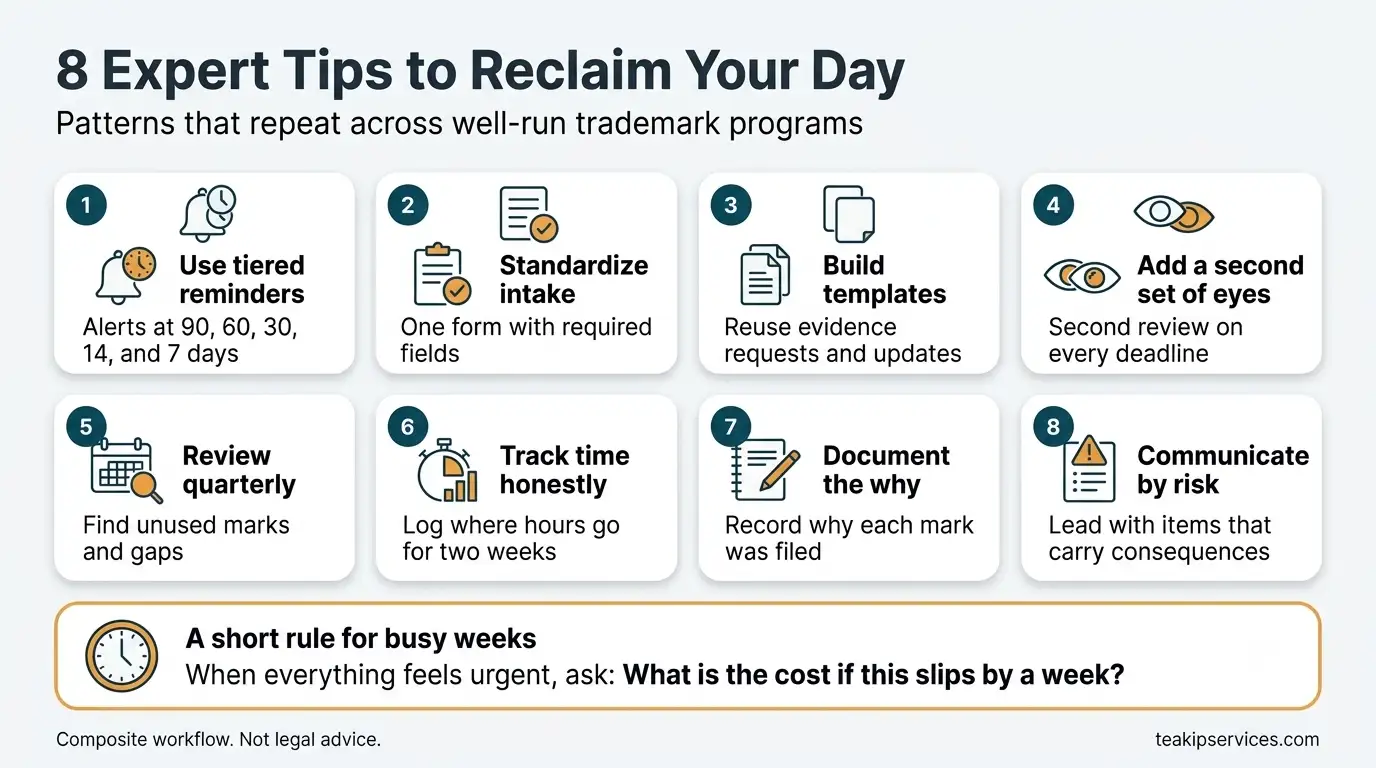
These practices come from patterns that repeat across well-run trademark programs.
- Use tiered reminders. Set alerts at 90, 60, 30, 14, and 7 days. Each alert should name the task, not just the date.
- Standardize intake. Use a single form for new matters, with required fields for owner, goods, classes, and countries.
- Build templates. Reuse evidence requests, status summaries, and client update emails.
- Add a second set of eyes. A second reviewer on every deadline calculation catches errors before they matter. See how a multi-layered quality control workflow reduces single-point failures.
- Review the portfolio quarterly. Look for unused marks, coverage gaps, and upcoming renewals.
- Track time honestly. Log where hours go for two weeks. The pattern often surprises even veterans.
- Document the “why.” Record why a mark was filed in a given class or country. Future managers will thank you.
- Communicate by risk. Lead updates with the items that carry consequences, not the longest list.
A Short Rule for Busy Weeks
When everything feels urgent, ask one question: “What is the cost if this slips by a week?” The answer usually sorts the list in seconds.
In-House, Software, or Managed Service: How the Options Compare
Teams often wonder whether to build the function in-house, rely on software, or bring in a managed service. The honest answer is that each fits a different situation.
| Factor | In-house Team Only | Docketing Software Only | Hybrid Managed Service |
|---|---|---|---|
| Deadline reliability | Depends on people and process | Strong reminders, weak data entry control | Strong with layered review |
| Data accuracy | Varies by staff experience | Only as good as the inputs | Validation built into workflow |
| Scalability | Hiring takes time | Scales licenses, not judgment | Scales with demand |
| International coverage | Often uneven | Depends on integrations | Usually includes local expertise |
| Cost structure | Fixed salaries and benefits | License and setup fees | Flexible, often per task or hour |
| Best for | Small, stable portfolios | Teams with strong internal discipline | Growing or global portfolios |
For a deeper comparison of providers and pricing models, see Teak IP’s guide to the best trademark portfolio management services.
When Does Outsourcing Make Sense?
Consider outside support when you notice any of these signs:
- Deadlines are tight and docket entries pile up
- Your team spends more time on data entry than on analysis
- You are adding countries or acquiring brands
- Staff turnover has created gaps in knowledge
- Leadership wants reporting you cannot easily produce
A hybrid model blends U.S. oversight with offshore capacity, which can improve turnaround and control costs. If you are weighing remote support, these articles help:
- How to hire a remote trademark paralegal with international portfolio experience
- Best virtual trademark paralegal companies and how to choose the right partner
- Which companies provide trained TTAB paralegal support services
Teak IP’s own trademark services include portfolio management, docket management, renewals, statements of use, data validation, and paralegal support, all backed by U.S. attorney oversight.
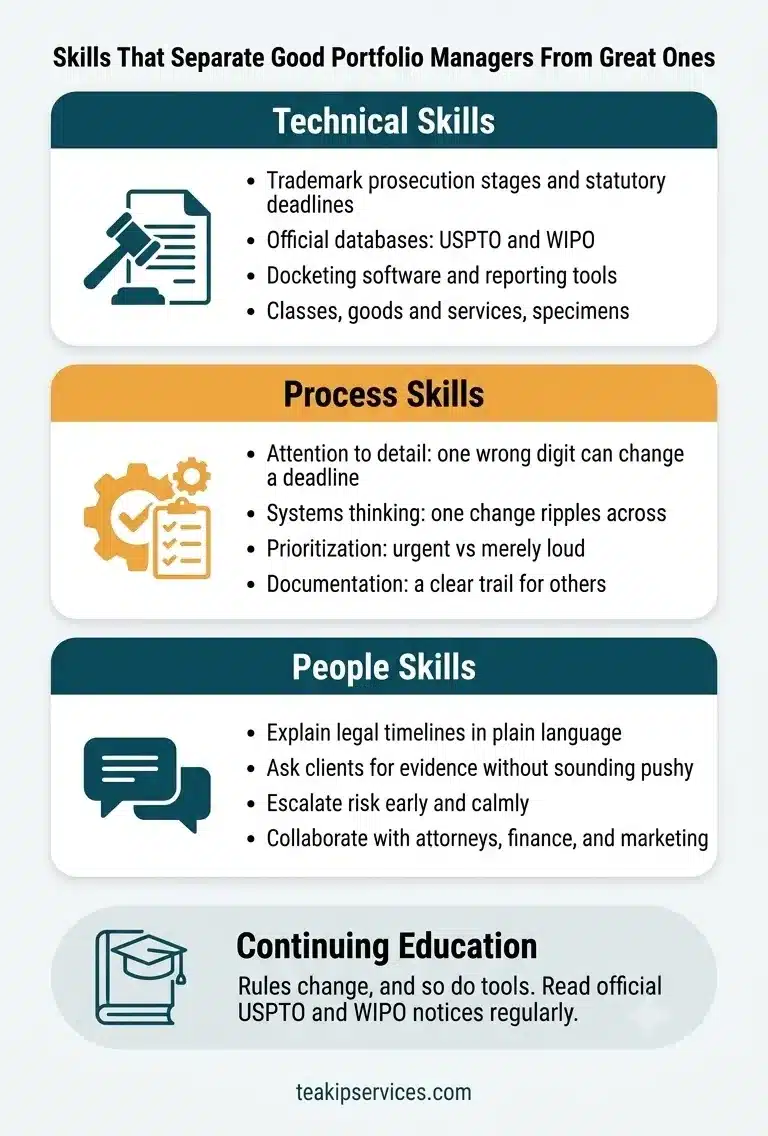
Skills That Separate Good Portfolio Managers From Great Ones
Technical knowledge matters. Yet the best portfolio managers share a few habits that goo beyond the rulebook
Technical Skills
- Strong knowledge of trademark prosecution stages and statutory deadlines
- Comfort with official databases such as the USPTO and WIPO systems
- Familiarity with docketing software and reporting tools
- Understanding of classification, goods and services descriptions, and specimens
Process Skills
- Attention to detail: one wrong digit can change a deadline
- Systems thinking: seeing how one change ripples across records
- Prioritization: separating urgent from merely loud
- Documentation: leaving a clear trail for others
People Skills
- Explaining legal timelines in plain language
- Asking clients for evidence without sounding pushy
- Escalating risk early and calmly
- Collaborating with attorneys, finance, and marketing
Continuing Education
Rules change, and so do tools. Professional bodies such as the International Trademark Association (INTA) publish resources and host events that help practitioners stay current. Reading official notices from the USPTO and WIPO regularly is also worthwhile.
Metrics Worth Tracking in a Trademark Portfolio
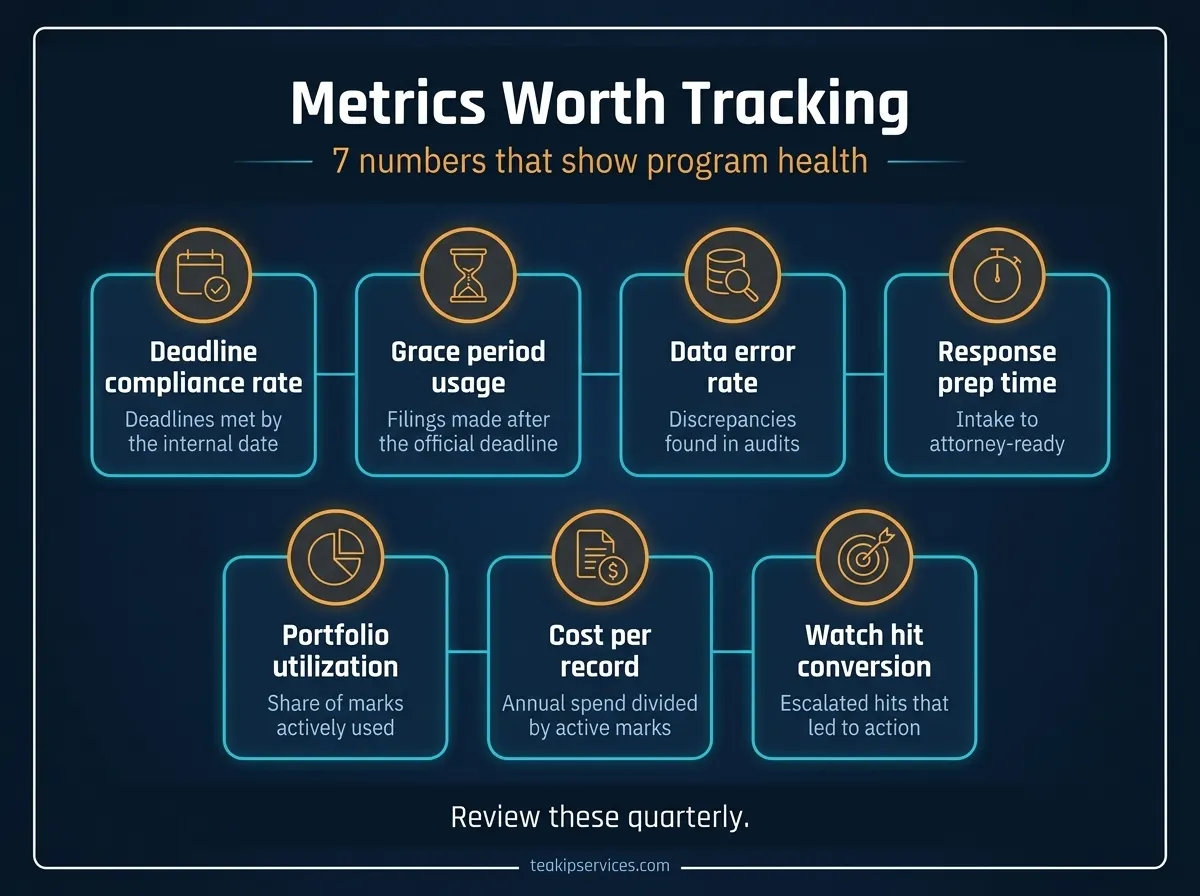
You cannot improve what you do not measure. These metrics give a clear view of program health.
- Deadline compliance rate: percentage of deadlines met on or before the internal date
- Grace period usage: number of filings made after the official deadline
- Data error rate: discrepancies found during audits
- Average response preparation time: how long an office action takes from intake to attorney-ready
- Portfolio utilization: share of registered marks that are actively used
- Cost per record: annual spend divided by active marks
- Watch hit conversion: number of escalated hits that led to action
Review these quarterly. Over time, they show whether process changes actually help.
Frequently Asked Questions
What does a day in the life of a trademark portfolio manager look like?
A typical day starts with docket triage, followed by new office actions and correspondence, maintenance filings, watch notice review, data validation, ownership updates, and client reporting. The day ends with forward planning and a handoff note. Most of the work is deadline-driven and reactive, which is why process matters more than speed.
What does a trademark portfolio manager do?
A trademark portfolio manager keeps a set of trademarks active, accurate, and protected across jurisdictions. Core duties include docketing, filing support, renewals, monitoring, record maintenance, and reporting. Attorneys handle legal judgment, while the manager supports them with organized facts, timelines, and documents.
How much of the job is strategy versus administration?
In most portfolios, administration and reactive work take up the large majority of the day. Strategy, such as portfolio rationalization and gap analysis, often fits into a small share of time unless the team protects it. Better data and clearer processes free more time for planning.
What are the most important deadlines a trademark portfolio manager tracks?
Key U.S. deadlines include office action responses, statements of use after a notice of allowance, Section 8 declarations between years five and six, and combined Section 8 and 9 renewals every ten years. International marks add Madrid and national renewal dates. Always verify current rules with the USPTO and WIPO.
Can a trademark paralegal manage a portfolio without an attorney?
A paralegal can handle many portfolio tasks, such as docketing, data entry, status checks, and preparing documents, under attorney supervision. However, giving legal advice or making legal judgments belongs to a licensed attorney. See Teak IP’s article on paralegal tasks and unauthorized practice of law for details.
When should a company outsource trademark portfolio management?
Outsourcing helps when deadlines pile up, the portfolio expands internationally, staff turnover creates knowledge gaps, or leadership needs better reporting. Evaluate vendors carefully, and use a structured checklist before sharing sensitive portfolio data.
What tools do trademark portfolio managers use?
Most rely on a docketing platform, official office databases, a watch service, and a document management system. Reporting tools and checklists complete the toolkit. Tools help, but disciplined process and second-level review prevent most errors.
Conclusion: What the Day Really Teaches
A day in the life of a trademark portfolio manager is less about dramatic legal battles and more about steady, careful work. Deadlines arrive daily. Data needs constant care. Clients ask for updates at the worst possible moment. Yet this quiet work protects some of a company’s most valuable assets.

Here are the main lessons from the day we followed:
- Start with triage. The first thirty minutes shape the whole day.
- Protect the data. Clean records prevent costly mistakes.
- Treat deadlines as firm. Grace periods are a safety net, not a plan.
- Separate search from monitoring. Each solves a different problem.
- Document everything. Handoff notes and checklists keep the program steady.
- Measure and adjust. Metrics show where time and money really go.
If your own day looks like Priya’s, with too many tabs, too many red dates, and too little time for planning, you do not have to carry that load alone. Teak IP supports law firms and corporate IP teams with docketing, portfolio management, renewals, and paralegal support, all led by U.S. IP attorneys. Explore the trademark portfolio management services or contact the Teak IP team to talk through your portfolio.
Your Trademark Portfolio Deserves Better Management.
From accurate docketing and renewal tracking to ongoing portfolio support, Teak IP helps law firms and corporate IP teams manage their trademark responsibilities with confidence. Let our team help simplify your workload.

