
Trademark IP Management In an increasingly interconnected global marketplace, protecting your brand across multiple jurisdictions is no longer optional – it is a strategic imperative. Whether you are a startup scaling internationally or an established enterprise managing a global portfolio, effective Trademark IP Management is the cornerstone of long-term brand equity and competitive advantage.
This comprehensive guide covers the essential best practices for multi-jurisdiction trademark protection, helping you build a robust, enforceable, and future-proof IP strategy.
Organizations looking to implement these practices with expert support can benefit from dedicated IP Management Services that bring the structure, systems, and specialist oversight needed to protect trademark rights consistently across every jurisdiction.

1. Understanding the Multi-Jurisdiction Trademark Landscape
Trademarks are territorial by nature – a registration in one country provides no protection in another. This fundamental principle makes multi-jurisdiction Trademark IP Management complex but critically important for any brand operating across borders.
Why Multi-Jurisdiction Protection Matters (Trademark IP Management)
- Market Presence: You need protection in every country where you sell, manufacture, or distribute.
- Preventing Squatting: Bad actors register well-known foreign trademarks locally before the legitimate owner enters the market.
- Licensing & Investment: A clean, global trademark portfolio increases brand valuation and attractiveness to investors and licensees.
- Enforcement: Customs seizures, domain disputes, and infringement actions require jurisdiction-specific registrations.
Key Jurisdictional Differences to Understand
| Aspect | Variation Across Jurisdictions |
| First-to-File vs. First-to-Use | US & Philippines follow first-to-use; most of the world is first-to-file |
| Use Requirements | Some countries (US, Canada) require proof of use; others do not |
| Non-Use Cancellation | Periods range from 3 to 5 years of non-use |
| Nice Classification | Most countries follow Nice Classification (12th ed.) but local sub-classes vary |
| Absolute/Relative Grounds | What is registrable in one country may be refused in another |
| Opposition Windows | Range from 30 days to 3 months post-publication |
2. Building a Trademark IP Management Framework
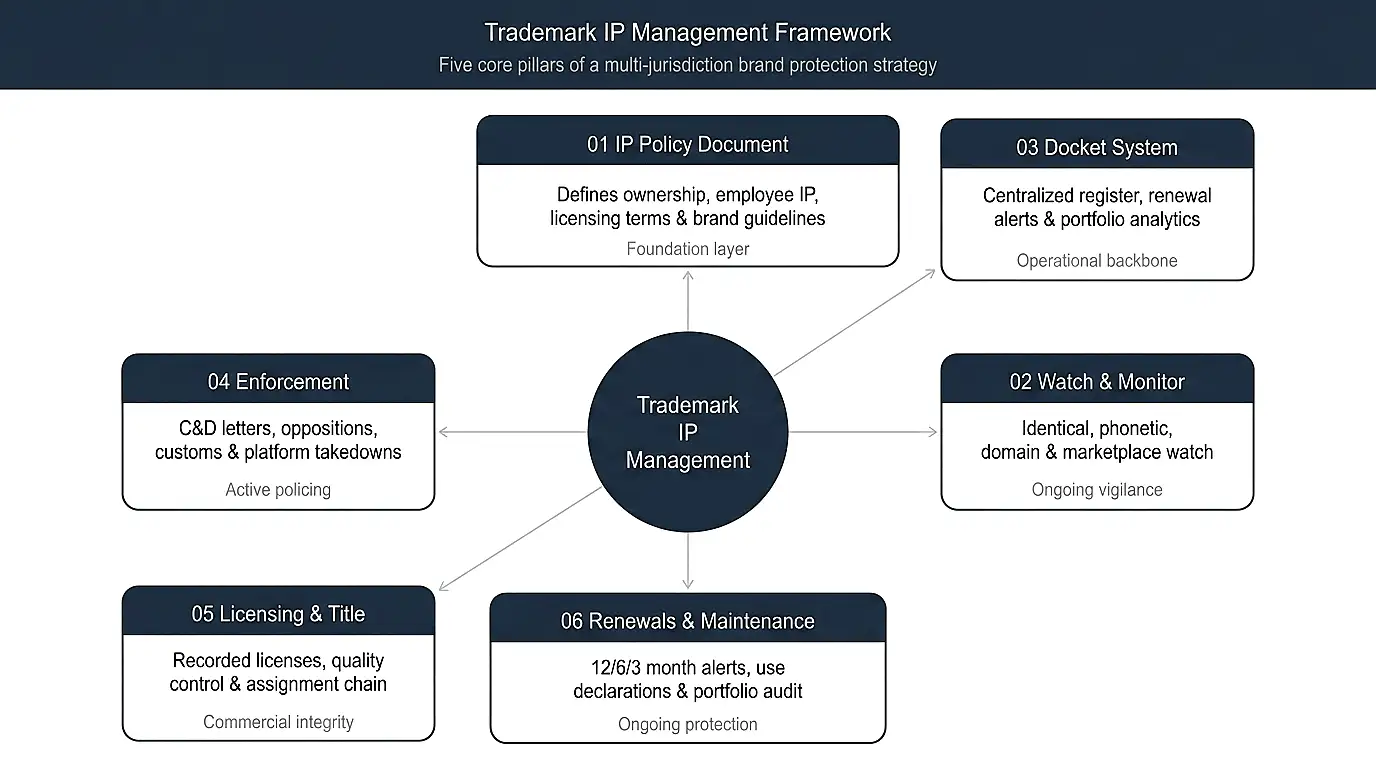
A structured Trademark IP Management framework ensures no filing deadline is missed, no renewal lapses, and no enforcement opportunity is overlooked. The framework should be documented, auditable, and scalable.
Core Components of the Framework
- IP Policy Document: Define what constitutes a trademark asset, who owns IP created by employees/contractors, and licensing terms.
- Trademark Register/Docket: Maintain a centralized docket with filing dates, renewal deadlines, classes, jurisdictions, and status.
- Ownership Structure: Clearly establish whether the IP holding entity is the operating company, a parent company, or an IP holding vehicle.
- Budget & Forecasting: Project maintenance, renewal, and litigation budgets by jurisdiction and portfolio tier.
- Roles & Responsibilities: Assign internal IP managers, external counsel, and escalation paths for disputes.
| 🏗️ Framework Essentials — Quick Checklist |
| ✔ Centralized docket system (cloud-based, with alerts) |
| ✔ IP ownership policy clearly documented |
| ✔ Defined filing priority criteria (Tier 1, 2, 3 markets) |
| ✔ Regular portfolio audits (at least annually) |
| ✔ Budget tracking per jurisdiction and per mark |
| ✔ Defined escalation and enforcement protocols |
3. Clearance Searches: The Foundation of Smart Filing
Before filing in any jurisdiction, a comprehensive clearance search is non-negotiable. Filing without clearing risks rejection, opposition, and costly litigation down the line.
Types of Trademark Searches
- Identical Mark Search: Direct matches of the exact mark in the relevant classes.
- Phonetic/Similarity Search: Identifies confusingly similar marks based on sound, appearance, and meaning.
- Common Law Search: In first-to-use jurisdictions, unregistered marks may have priority rights.
- Domain Name & Social Media Search: Ensures consistency in digital brand presence.
- Trade Name / Corporate Name Search: Many jurisdictions extend protection to trade names and company names.
Clearance Search Best Practices
- Always conduct searches in the local language and script (e.g., Chinese characters for China, Devanagari for India).
- Search in all relevant Nice classes plus adjacent classes that examiners may cite.
- Engage local counsel for final clearance opinions – they understand how local examiners apply similarity standards.
- Document the search scope and opinion in writing for future reference.
- Re-run searches if filing is delayed by more than 6 months (new conflicting marks may have been filed).
Also, Read: Why Your IP Firm Needs a Dedicated Trademark Docketing Specialist?
4. Strategic Filing Routes: Madrid Protocol, National & Regional Systems
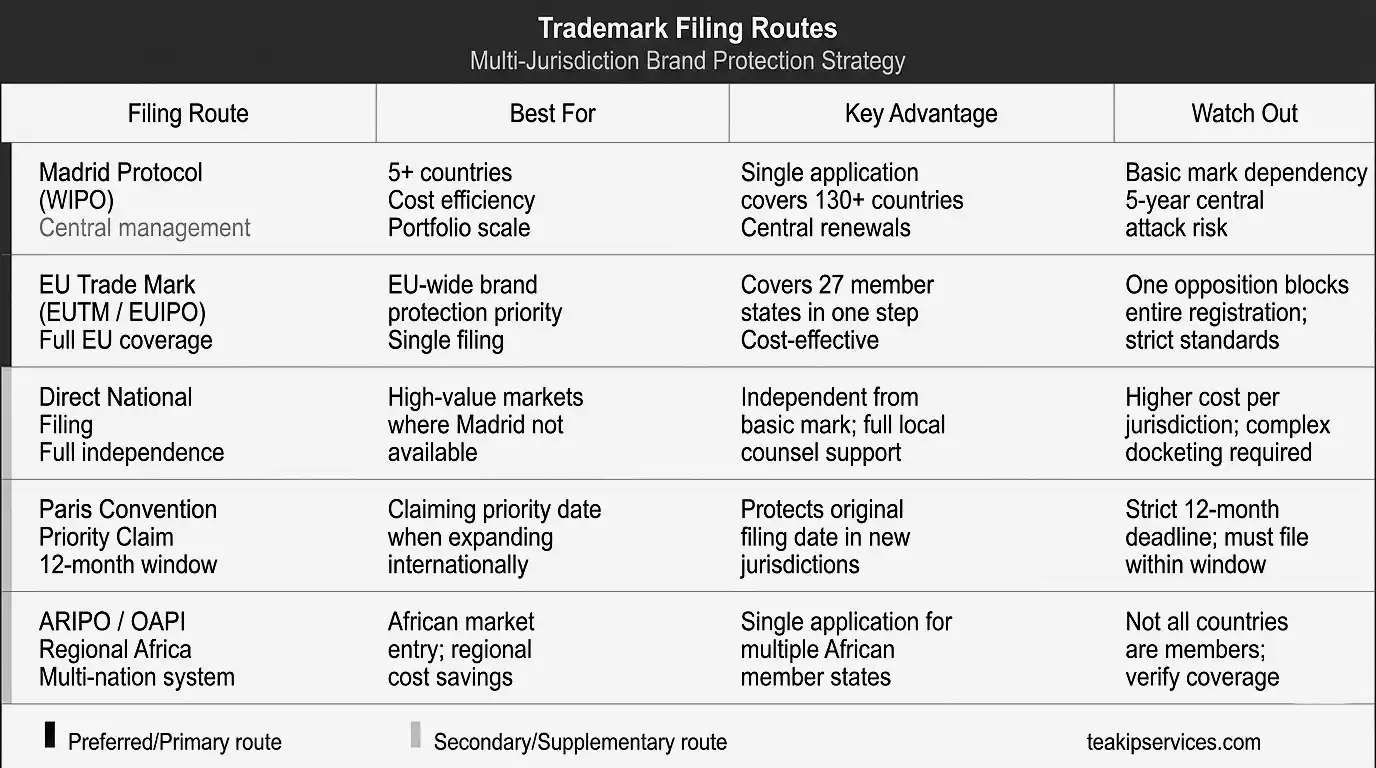
Choosing the right filing route is one of the most consequential decisions in multi-jurisdiction Trademark IP Management. The wrong route wastes budget and can jeopardize protection.
Filing Route Comparison
Madrid Protocol – Key Best Practices
- Basic Mark Dependency: The international registration depends on the basic national/regional mark for 5 years. Ensure the basic mark is solid.
- Class Alignment: International classes must match or be narrower than the basic mark – plan accordingly.
- Subsequent Designations: Add new countries later without refiling from scratch.
- Holder of Record: Maintain accurate ownership details at WIPO – changes require a formal recordal.
- National Phase: If refused in a designated country, request transformation to a national application within 3 months.
5. Prosecution Best Practices Across Jurisdictions (Trademark IP Management)
Prosecution – the process of obtaining trademark registration after filing – involves responding to office actions, overcoming refusals, and managing opposition proceedings. Each jurisdiction has unique procedural rules.
General Prosecution Best Practices
- Set internal deadlines at least 4 weeks before official deadlines to allow counsel response time.
- Maintain a clear record of all communications with trademark offices.
- Respond to office actions strategically – sometimes narrowing the specification is preferable to a lengthy legal argument.
- In opposition proceedings, assess the cost-benefit of defending vs. negotiating a coexistence agreement.
- Consider Letters of Consent or Coexistence Agreements where there is a genuine basis for co-existence.
Jurisdiction-Specific Prosecution Tips
| Jurisdiction | Key Prosecution Tip |
| United States (USPTO) | File a Statement of Use or Extension Request before the 6-month deadline post-Notice of Allowance |
| European Union (EUIPO) | Descriptiveness and distinctiveness standards are strictly applied; prepare strong arguments early |
| China (CNIPA) | File early — China is first-to-file; file in both Chinese and Latin characters |
| India (TMR) | Hearing-based system; prepare for in-person or virtual hearings before the Registrar |
| UAE / GCC | Arabic transliteration is critical; file in Arabic script alongside Latin characters |
| Brazil (INPI) | Long prosecution times (3-5 years); file early and monitor actively |
6. Portfolio Monitoring & Watch Services (Trademark IP Management)
Obtaining a registration is only the beginning. Vigilant monitoring is what keeps your brand protected. Unmonitored portfolios are regularly diluted by third-party filings that go unchallenged.
Types of Watch Services
- Identical Mark Watch: Alerts for exact matches in specified jurisdictions.
- Similarity/Phonetic Watch: Broader monitoring for confusingly similar marks – essential for strong brand owners.
- WIPO Watch: Monitors new international registrations designating your countries of interest.
- Domain Watch: Monitors new domain registrations incorporating your brand name (especially new gTLDs).
- Social Media Watch: Tracks unauthorized brand use on major social platforms.
- Marketplace Watch: Monitors platforms like Amazon, Alibaba, Flipkart for counterfeit or infringing listings.
Watch Service Best Practices
- Cover all jurisdictions where you are registered AND jurisdictions where you plan to expand.
- Set watch scope to include all relevant Nice classes plus adjacent classes.
- Establish a triage process – not every watch hit warrants an opposition; assess risk level before acting.
- Document your enforcement decisions consistently to demonstrate active policing of your mark.
- Review watch reports within 2 weeks of receipt – opposition windows are tight in many jurisdictions.
7. Enforcement Strategies in Multi-Jurisdiction Contexts
Even the best trademark registration provides no value unless it is enforced. Multi-jurisdiction enforcement requires a tiered, risk-proportionate strategy.
Enforcement Toolkit
- Cease & Desist Letters: First line of action – cost-effective and often sufficient for straightforward infringements.
- Trademark Office Opposition/Cancellation: Challenge infringing registrations at the trademark registry level before they become entrenched.
- Border/Customs Recordation: Record your trademarks with customs authorities to intercept counterfeit goods at the point of import/export.
- Civil Litigation: Reserved for high-value or persistent infringements; can result in injunctions, damages, and account of profits.
- Criminal Enforcement: In many jurisdictions (China, India, UAE), counterfeiting is a criminal offense – law enforcement partnerships are valuable.
- Platform Takedowns: Amazon Brand Registry, Alibaba IPP, Google Ads Trademark Policy, Meta Brand Rights Protection.
- UDRP / Domain Dispute: WIPO Arbitration Center handles domain disputes for gTLDs rapidly and cost-effectively.
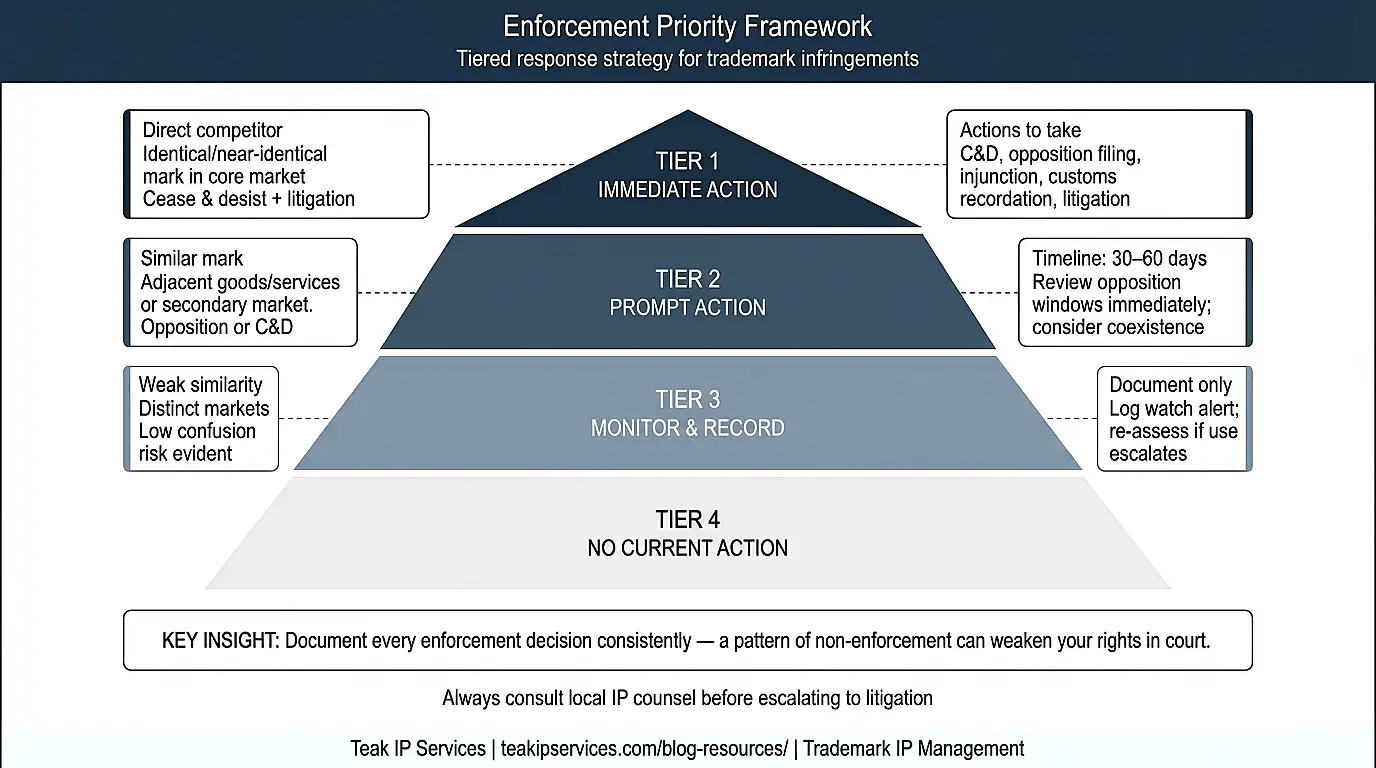
| ⚖️ Enforcement Priority Framework |
| ✔ Tier 1 – Immediate action: Direct competitors using identical/near-identical marks in core markets |
| ✔ Tier 2 – Prompt action: Similar marks in adjacent goods/services or secondary markets |
| ✔ Tier 3 – Monitor & record: Weak similarity; document for future reference if infringement escalates |
| ✔ Tier 4 – No action warranted: Clearly distinct markets, no likelihood of confusion |
8. Trademark Renewals & Maintenance
Trademark rights must be actively maintained. Missed renewals result in lapsed registrations — and once lapsed, a trademark can be claimed by third parties.
Renewal Best Practices
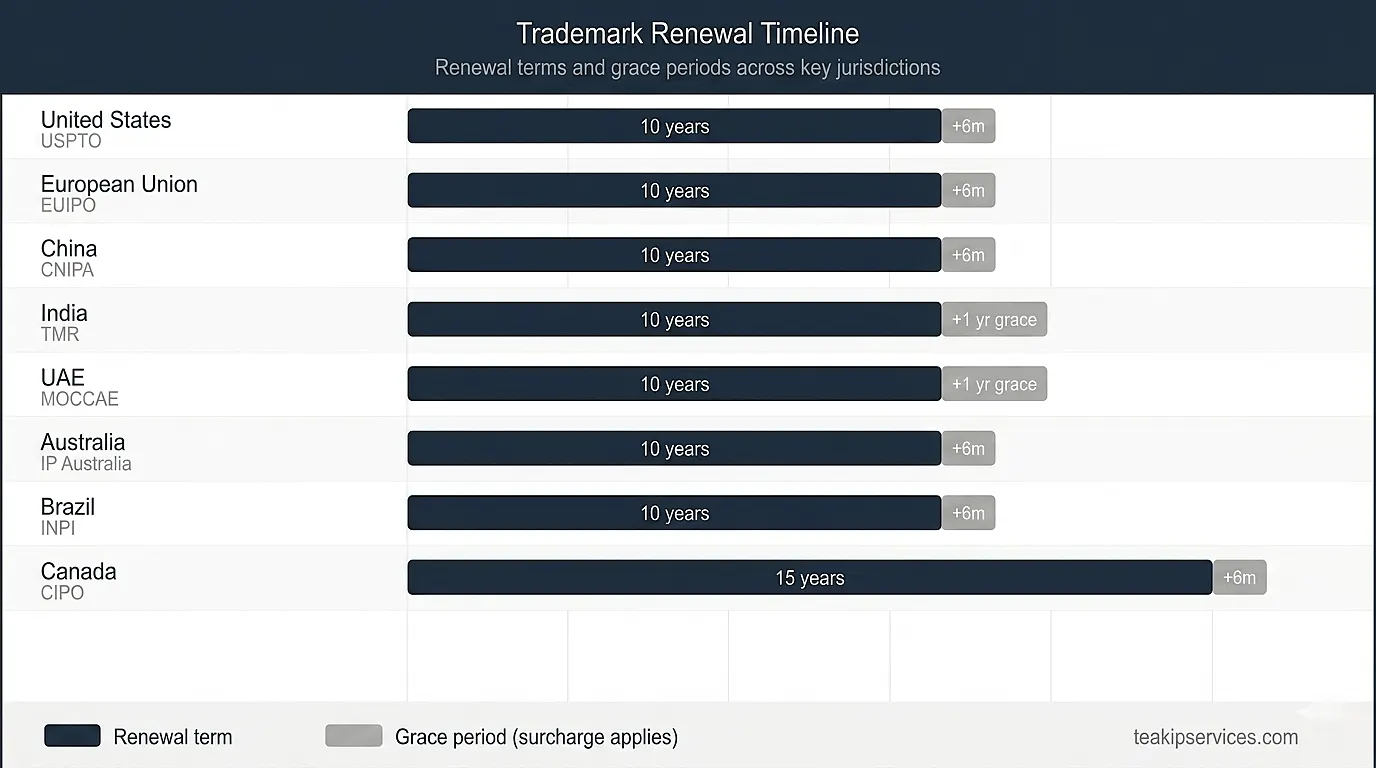
- Build a Renewal Calendar: Track renewal deadlines across all jurisdictions in your docket system with automated alerts 12, 6, and 3 months in advance.
- Grace Periods: Many jurisdictions offer a 6-month grace period with a surcharge, but do not rely on this as standard practice.
- Use Requirements: In use-based systems (US, Canada, Philippines), renewal often requires a declaration of use. Prepare evidence of use proactively.
- Declutter at Renewal: Renewals are an opportunity to audit – do not renew marks for goods/services you no longer use unless strategically important.
- Power of Attorney Updates: Ensure your local agents still hold valid POAs to file renewal documents on your behalf.
Renewal Timeline Reference
9. Managing Licensing, Assignments & Chain of Title
In multi-jurisdiction portfolios, ownership changes, licensing deals, and corporate restructurings must be carefully managed to ensure IP rights remain valid and enforceable.
Licensing Best Practices
- Record Licenses: In many jurisdictions (China, India, UAE), unrecorded licenses may be unenforceable against third parties.
- Quality Control: Trademark licenses must include quality control provisions – a bare license (without quality control) can invalidate the mark in some jurisdictions.
- Exclusive vs. Non-Exclusive: Define exclusivity by geography, class, and channel to avoid conflicts in your global network.
- Sublicensing Rights: Specify whether the licensee can sublicense and under what conditions.
- Termination Clauses: Include clear termination triggers, especially for quality failures or insolvency of the licensee.
Assignment & Chain of Title (Trademark IP Management)
- Record all trademark assignments with the relevant IP offices promptly – delays in recording can create vulnerability windows.
- In an M&A context, conduct thorough IP due diligence including title searches and review of all license agreements.
- Maintain a complete assignment history document for each mark – especially important for portfolio financing.
- Ensure goodwill is transferred alongside the mark in common law jurisdictions – an assignment without goodwill may be invalid.
Also, Read: Effective Trademark Portfolio Management: Key Components, Challenges & Practices
10. Technology & Tools for Trademark IP Management
Modern Trademark IP Management demands technology. Manual spreadsheet-based docketing is a liability at scale.
Essential Technology Categories
- IP Management Software: Platforms like CPA Global, Dennemeyer DIAMS, Questel Orbit, or Anaqua provide docketing, deadline tracking, portfolio analytics, and billing.
- Trademark Search Platforms: Corsearch, Compumark, TrademarkNow, and WIPO Global Brand Database enable rapid multi-jurisdiction clearance searches.
- Watch Services: Automated monitoring via platforms like Clarivate, Corsearch Watch, and Dennemeyer Trademark Watch.
- AI-Powered Tools: AI is increasingly used for similarity assessment, risk scoring, and prosecution analytics – adopt tools that provide explainable outputs.
- Blockchain for IP Records: Emerging use of blockchain for immutable IP ownership records and anti-counterfeiting.
Key Features to Look for in IP Docketing Software
- Automated deadline alerts with configurable lead times
- Multi-currency billing and budget tracking
- Integration with national IP office databases (auto-status updates)
- Audit trail and user access controls
- Reporting dashboards by region, class, counsel, and spend
- API integration with external watch and search services
Also, Read: Outsource Trademark Docketing: Strong Reasons to Consider
11. Common Mistakes in Multi-Jurisdiction Trademark Management
Learning from common pitfalls saves significant time, money, and brand equity. Here are the most frequent mistakes organizations make:
| ⚠️ Common Mistakes to Avoid |
| ✔ Filing in a single jurisdiction and assuming global protection |
| ✔ Neglecting to register in key manufacturing/sourcing countries (especially China – file early) |
| ✔ Missing use requirements and failing to file declarations of use (particularly in the US) |
| ✔ Not recording licenses and assignments with local trademark offices |
| ✔ Ignoring local script requirements (Arabic, Chinese, Hindi) – transliterations matter |
| ✔ Failing to monitor and police the mark – a pattern of non-enforcement can weaken rights |
| ✔ Allowing marks to expire due to poor docketing – renewal deadlines missed |
| ✔ Not including IP provisions in employment, contractor, and distributor agreements |
| ✔ Underestimating prosecution timelines – some jurisdictions take 3-5 years to register |
| ✔ Using a one-size-fits-all filing strategy without local counsel input |
Also, Read: What is a Docketing System? Complete A to Z Guide
12. Key Takeaways & Action Checklist (Trademark IP Management)
Effective multi-jurisdiction Trademark IP Management is a continuous process, not a one-time filing event. Use the following action checklist to audit and strengthen your program:
| ✔ ACTION ITEM |
| □ Conduct a global portfolio audit – identify gaps in key markets |
| □ Establish or upgrade your IP docketing system with automated alerts |
| □ Run clearance searches before any new brand launch or entry into a new market |
| □ Review and update your IP ownership and assignment records |
| □ Record all existing licenses with relevant trademark offices |
| □ Set up watch services covering all registered jurisdictions |
| □ Create a renewal calendar with 12/6/3-month alerts for every mark |
| □ Establish a tiered enforcement protocol with clear escalation thresholds |
| □ Brief sales, marketing, and product teams on correct trademark usage guidelines |
| □ Engage local counsel in Tier 1 markets for prosecution and enforcement support |
| □ Review IP clauses in all key commercial agreements (distribution, licensing, M&A) |
| □ Assess use of technology platforms to improve efficiency and reduce risk |
Also, Read: Outsource Patent Docketing: Key Reasons to Consider
Trademark IP Management
Trademark IP Management in a multi-jurisdiction environment demands strategic thinking, procedural precision, and proactive vigilance. The stakes are high – your brand is one of your most valuable assets, and protecting it globally is a long-term investment that pays dividends in customer trust, revenue protection, and competitive positioning.
At Teak IP Services, we specialize in helping businesses of all sizes design and execute robust multi-jurisdiction trademark strategies. From initial clearance searches and strategic filing to enforcement and portfolio management, our team brings deep expertise and local counsel networks across major IP jurisdictions worldwide.
Our Services: Explore IP Management Services

