
The operational backbone of a serious trademark practice isn’t the software. It’s a dedicated trademark docketing specialist who manages it and knows the risks if a single date is missed.
One Missed Deadline. One Abandoned Mark. One Malpractice Claim.
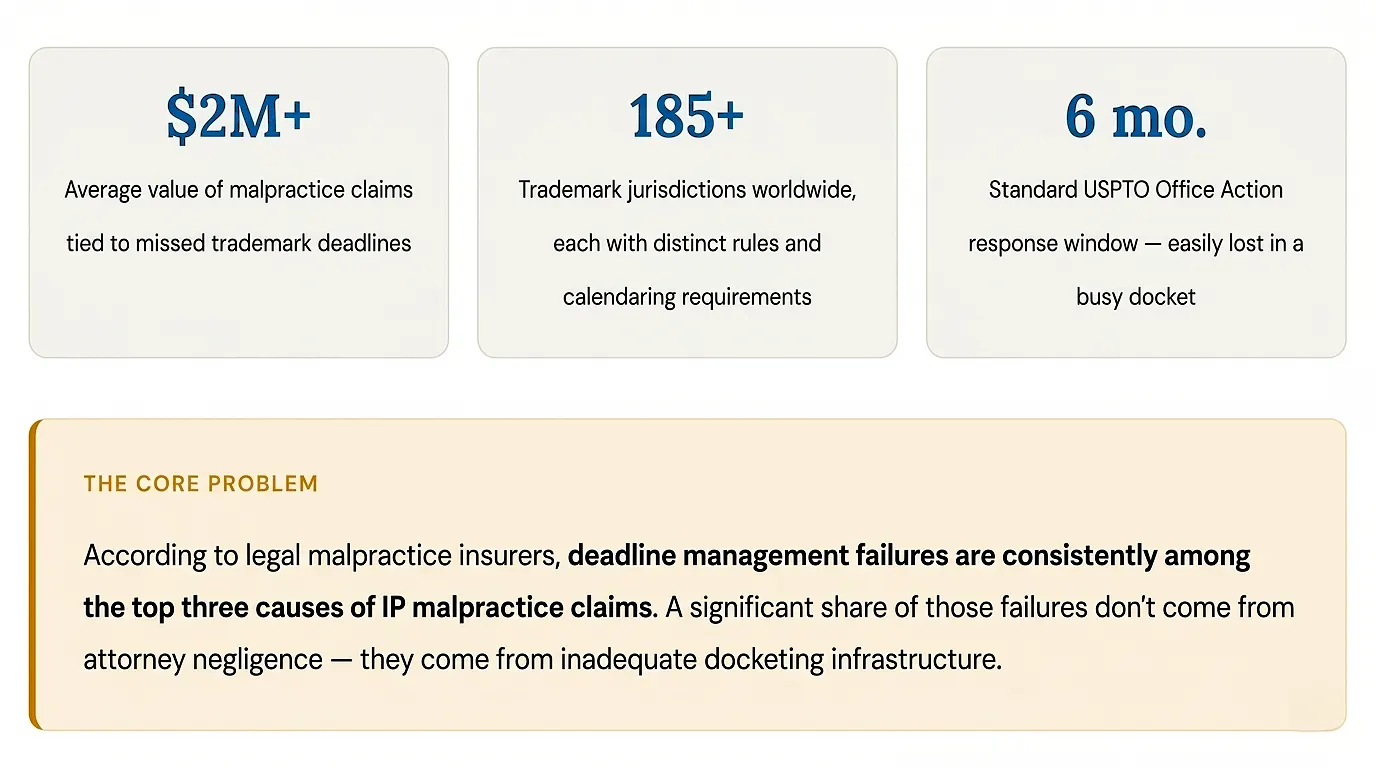
In trademark law, the calendar is not an administrative convenience – it is a legal instrument. Every Office Action response window, every Section 8 affidavit deadline, every renewal cycle, every Madrid Protocol designation carries real legal consequences. When those dates are missed, the damage is often irreversible.
And yet, many IP firms – from solo practitioners to mid-sized boutiques – continue to assign trademark docketing to general paralegals who are already stretched across billing, correspondence drafting, client communication, and file management. This isn’t a criticism of paralegals. It’s a structural problem: docketing is being treated as a task, when it is actually a discipline.

The rise of global trademark portfolios, multi-class filings, Madrid System registrations, and USPTO digitization has exponentially increased the complexity of trademark docketing. What was manageable in a 50-mark portfolio with one jurisdiction is operationally dangerous in a 500-mark portfolio spanning 20+ countries – especially without a professional whose entire role is built around protecting that docket. For firms that recognize this need but lack the internal capacity to hire a full-time specialist, outsourcing to professional trademark docketing services provides the same depth of expertise and risk management without the overhead of a dedicated in-house hire.
This post makes the case – in depth and with specifics – for why your IP firm needs a dedicated trademark docketing specialist, not just a paralegal who dockets on the side.
What Is a Dedicated Trademark Docketing Specialist?
A dedicated trademark docketing specialist is a trained IP professional whose singular focus is the management, accuracy, integrity, and proactive oversight of a law firm’s or corporate legal department’s trademark docket. This is not a data entry role. It is a systems ownership role.
Unlike a general paralegal who includes docketing among many responsibilities, a docketing specialist:
- Owns the entire docketing lifecycle – from intake of a new matter to final expiration or abandonment, including all intermediary deadlines
- Has deep, jurisdiction-specific knowledge of USPTO, EUIPO, WIPO Madrid System, and national trademark offices worldwide
- Proactively audits the docket rather than simply responding to deadline alerts – catching discrepancies, anomalies, and systemic errors before they escalate
- Administers docketing software (Foundation IP, Dennemeyer Anaqua, Corsearch, CPi, and others) with expert-level configuration knowledge
- Builds and enforces firm-wide docketing protocols, intake forms, and deadline calculation rules
- Trains attorneys, associates, and paralegals on proper docket procedures and escalation paths
- Coordinates with foreign associates on multi-jurisdiction filings, reconciling conflicting deadline communications
- Produces structured client reporting -portfolio status summaries, deadline calendars, renewal notices – to a professional standard
In short: a dedicated trademark docketing specialist is the person at your firm who ensures the docket never fails. Not as a secondary responsibility. As a primary professional identity.
Also, Read: Trademark IP Management Best Practices for Multi-Jurisdiction Brand Protection
Paralegal vs. Dedicated Trademark Docketing Specialist: An Honest Comparison
This is not about which role is more important or more skilled. Paralegals are essential to IP practice operations. The distinction is about focus, training, and accountability. When docketing is one task among many, it receives the attention of one task among many. When docketing is the entire job, it receives the attention the job deserves.
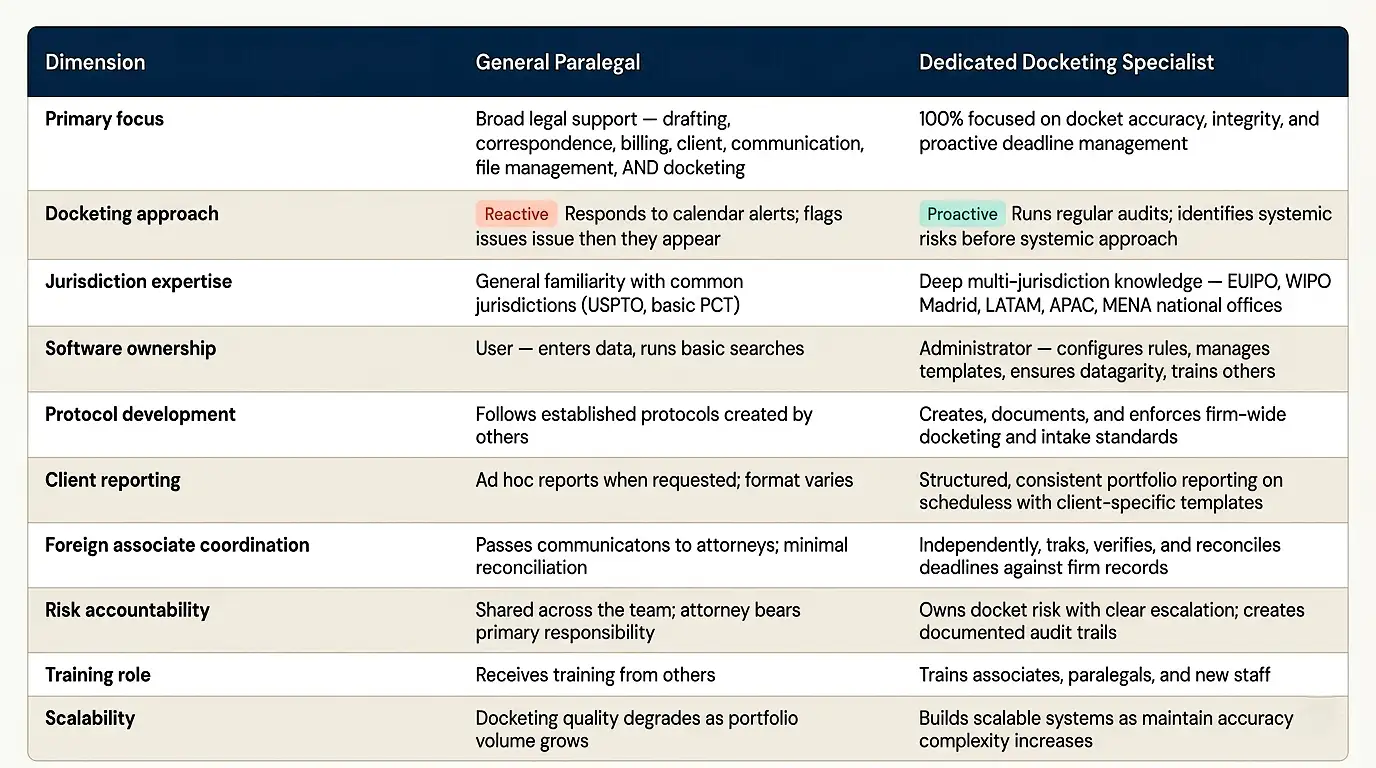
“A paralegal is an excellent executor of defined legal tasks. A dedicated trademark docketing specialist is the architect and guardian of your firm’s deadline infrastructure – a fundamentally different kind of professional accountability.”
The Jurisdictional Complexity Problem Most Firms Underestimate
Here’s a fact that should give every IP firm managing international portfolios pause: there is no universal trademark maintenance schedule. Every jurisdiction has its own rules – and those rules change. A dedicated trademark docketing specialist stays current on all of them. A multitasking paralegal typically does not have the bandwidth to.
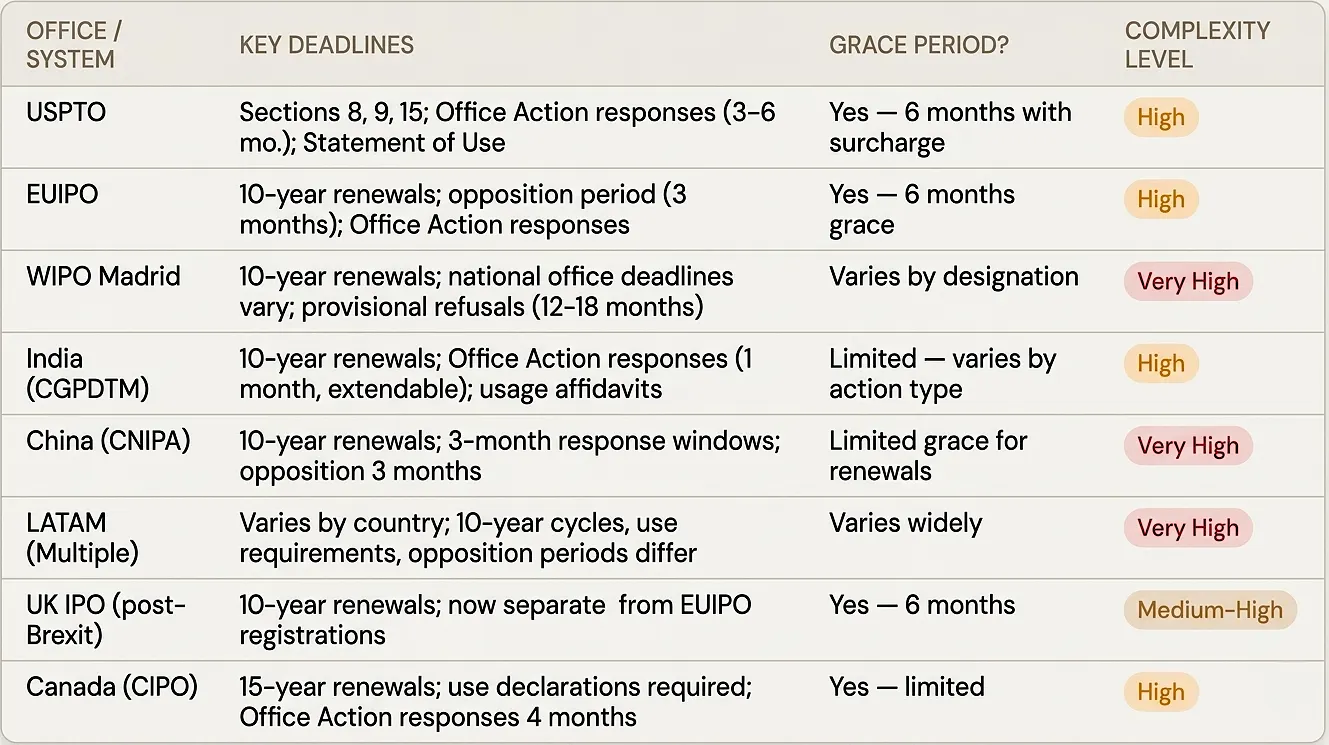
Each row in that table represents a distinct set of deadline rules – rules that interact with each other when a single brand is protected across multiple jurisdictions. A dedicated trademark docketing specialist doesn’t just know these rules; they build the intake and calendaring logic in your docketing system to enforce them automatically.
10 Reasons Your IP Firm Needs a Dedicated Trademark Docketing Specialist
1. Docketing Is a Full-Time Responsibility — Not a Side Task
- Trademark docketing is a full-time discipline, not a part-time responsibility Managing a trademark portfolio with integrity requires constant vigilance – daily docket reviews, proactive status monitoring, system audits, and ongoing coordination with clients and foreign associates. Assigning this to someone who also handles billing, client calls, and correspondence drafting guarantees that docketing will receive whatever attention is left over. That is not a risk posture – it is a liability.
2. Why Docket Errors Are So Dangerous
- Docket errors are silent until they are catastrophic Unlike billing errors or drafting mistakes, missed trademark deadlines often go unnoticed until it’s too late to remedy them. A lapsed renewal, an unanswered Office Action, or a missed Statement of Use deadline doesn’t send an automatic alert – it simply results in abandonment. By the time an attorney or client notices, the mark is gone. Proactive specialists audit the docket before deadlines expire, not after.
3. Software Alone Doesn’t Prevent Mistakes
- Your docketing software is only as reliable as the person configuring it Foundation IP, Dennemeyer Anaqua, Corsearch, and CPi are powerful tools – but they require expert configuration. Deadline calculation templates, intake rules, jurisdiction-specific logic, and data integrity protocols must be built and maintained by someone who understands trademark law at a procedural level. A specialist owns the software, not just the data entry within it. This is the difference between a tool that catches errors and one that gives you false confidence.
4. Portfolio Growth Increases Risk Exponentially
- Portfolio growth multiplies risk non-linearly A 50-mark, single-jurisdiction portfolio is challenging but manageable with shared docketing responsibilities. A 500-mark portfolio across 25 countries is not. The risk doesn’t scale proportionally – it scales exponentially, because each jurisdiction adds its own deadline logic, each matter adds its own status lifecycle, and each foreign associate adds their own communication layer. Specialists build scalable systems. Paralegal-managed dockets do not scale safely.
5. Attorneys Should Focus on Billable Legal Work
- Attorneys should be practicing law – not managing a calendar Every hour an attorney spends cross-referencing renewal spreadsheets, chasing foreign associate confirmations, or manually auditing the docket is an hour not spent on strategy, prosecution, client counsel, or business development. Firms with dedicated docketing specialists consistently report recovering 5–8 billable hours per attorney per month – revenue that directly funds the specialist role and then some.
6. Rising Client Expectations for Docketing Systems
- Enterprise clients now expect operational sophistication Large corporate clients – in tech, pharma, FMCG, and luxury goods – regularly audit their outside counsel’s docketing infrastructure. They expect real-time docket visibility, proactive deadline alerts, structured portfolio reporting, and documented risk management procedures. A specialist can deliver all of this consistently. A paralegal managing docketing as one of many tasks cannot.
7. The Hidden Risk of Staff Turnover
- Staff turnover is a docketing crisis waiting to happen When docketing knowledge lives in one paralegal’s head — undocumented, informally maintained – and that paralegal leaves, the firm loses institutional knowledge that may take months to reconstruct. A dedicated specialist builds documented protocols, auditable systems, and onboarding procedures that survive personnel changes. The docket lives in the system, not in a single employee’s memory.
8. Prevention Is Cheaper Than Malpractice
- Malpractice prevention is always cheaper than malpractice defense The fully-loaded cost of a dedicated docketing specialist – whether in-house or outsourced – is a fraction of a single E&O claim. Malpractice premiums are also directly influenced by documented risk management practices. Firms that can demonstrate structured docketing protocols and dedicated oversight often negotiate better coverage terms. The specialist is not overhead – they are risk management infrastructure.
9. Managing Foreign Associates Requires Dedicated Oversight
- Foreign associate coordination requires a dedicated point of contact Multi-jurisdiction portfolios involve ongoing communication with foreign law firms and IP offices – provisional refusals, local deadline calculations, use requirements, and renewal instructions that may conflict with what’s in your central docketing system. A specialist manages these relationships, reconciles conflicting information, and maintains a single source of truth. Without this central coordination, discrepancies compound silently.
10. Regulatory Changes Demand Continuous Monitoring
- Regulatory and office procedure changes require active monitoring USPTO fee schedules, Madrid System rule amendments, EUIPO procedural updates, national office digitization – the trademark regulatory environment is not static. A dedicated specialist actively monitors regulatory changes and updates docketing system templates accordingly. A paralegal handling multiple responsibilities rarely has the bandwidth to stay current on procedural rule changes across 10+ jurisdictions.
A Day in the Life of a Dedicated Trademark Docketing Specialist
Understanding the role in the abstract is one thing. Understanding what a specialist actually does on a Tuesday morning makes the case far more concrete. Here’s a representative daily workflow:
8:00 AM – Morning Docket Review
Full 30/60/90-day deadline audit
The specialist begins each day by running a full docket audit across all upcoming deadlines within 30, 60, and 90-day windows – not just reviewing calendar alerts. Any deadline flagged as approaching a critical threshold is escalated to the responsible attorney with a structured status memo before the morning standup.
9:00 AM – USPTO / Office Action Monitoring
Live status checks on all active applications
The specialist queries USPTO TSDR, EUIPO online status tools, and WIPO Global Brand Database for all active applications, checking for Office Actions, suspension notices, or status changes that may not have yet been communicated through attorney channels. Early detection is the entire point.
10:00 AM – New Matter Intake
Setting up new filings with full deadline logic
New trademark filings from the previous day are entered into the docketing system with complete intake data – filing date, international classes, jurisdiction, first-action deadline, attorney assignment, and applicable calculation rules for subsequent deadlines. No matter is marked “live” in the system until the specialist has verified intake completeness.
11:30 AM – Foreign Associate Coordination
Reconciling international deadline communications
The specialist reviews communications from foreign associates in open matters, cross-references local deadline communications against what’s in the central docketing system, and flags any discrepancies for attorney review. Conflicting deadline information from foreign offices is one of the most common sources of docketing errors – this reconciliation step is critical.
1:30 PM – Client Portfolio Reports
Structured reporting against each client’s preferences
For clients with scheduled reporting cadences, the specialist generates and quality-controls docket status reports, renewal notices, and deadline calendars in client-specific formats – whether weekly digests, quarterly summaries, or on-demand extracts. Reports are reviewed for accuracy before attorney sign-off and delivery.
3:00 PM – Secondary Deadline Verification
Cross-checking all critical near-term deadlines
For every deadline falling within 14 days, the specialist runs a secondary verification – confirming that the docketing system, the attorney’s calendar, and any client communications are aligned. For critical deadlines (Section 8/15 combined filings, Statement of Use, renewal cutoffs), a formal sign-off chain is initiated before close of business.
4:30 PM – System Administration & Audit Trails
Data integrity and documentation
End-of-day system tasks: updating matter statuses, documenting action completions, reviewing any data integrity flags generated by the docketing system, and logging all escalations made during the day. The audit trail produced by this daily process is the foundation of the firm’s malpractice defense if any question about deadline management ever arises.
The key insight
Notice that none of the above tasks are “add a date to a calendar.” Each is a systems-level activity requiring trademark procedural knowledge, software expertise, and professional judgment about escalation. This is why the role cannot be absorbed into a paralegal’s existing workload without something giving way.
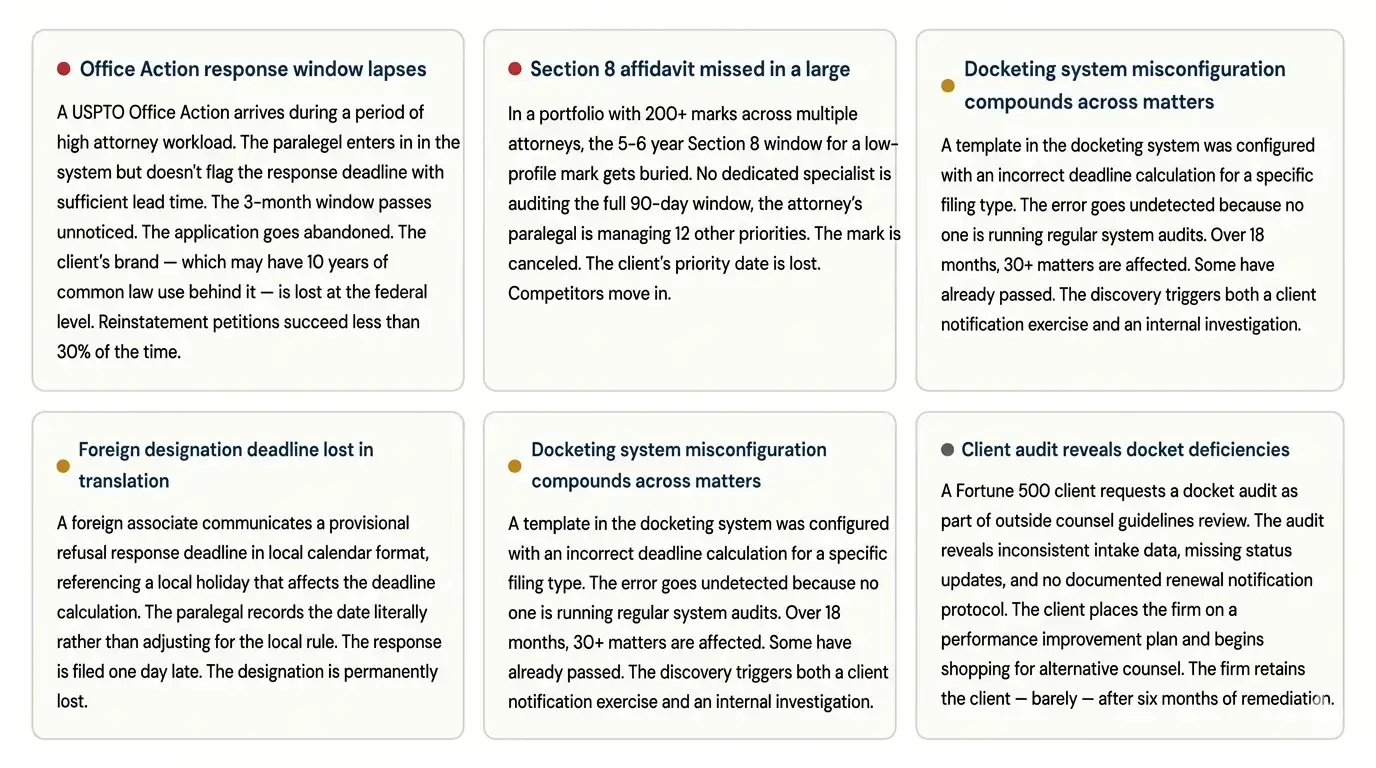
The Real Risks of Not Having a Dedicated Trademark Docketing Specialist
Let’s be specific about what goes wrong when trademark docketing is managed informally. These aren’t hypothetical scenarios – they are patterns that IP malpractice insurers and bar disciplinary committees see regularly.
10 Warning Signs Your Firm Has Outgrown Shared Docketing
Use this as a diagnostic. If three or more of these describe your current situation, the transition to dedicated docketing oversight is overdue – not aspirational.
Attorneys maintain personal deadline calendars or spreadsheets alongside the official docketing system – because they don’t fully trust the system alone- Your firm has had at least one “close call” deadline in the past 12 months that wasn’t caught until it was within 1–2 weeks of expiration
- Your docketing system contains matters with missing data fields, outdated status entries, or duplicate records that no one has had time to clean up
- The person responsible for docketing has never received formal training in trademark procedural rules or docketing system administration
- Client portfolio reporting is ad hoc – generated when a client asks, in whatever format the attorney prefers, with no consistent delivery schedule
- Your active trademark portfolio has grown beyond 250–300 matters across more than five jurisdictions in the past three years
- Foreign associate deadline communications are handled informally – tracked in email threads or individual attorney notes rather than a centralized system
- Your firm has no documented docketing protocol – no written intake procedure, no deadline calculation standards, no escalation path for at-risk deadlines
- Docketing quality visibly degrades during periods of high workload – when the team is busy, the docket gets less attention
- If the person who manages your docket were to leave tomorrow, you would not be confident in your ability to reconstruct their workflow without significant risk
Be honest in this assessment
Three or more matches means your firm’s docket risk is structurally elevated. Five or more means you likely have docket errors already accumulated that haven’t surfaced yet. The question isn’t whether to make this change — it’s how quickly.
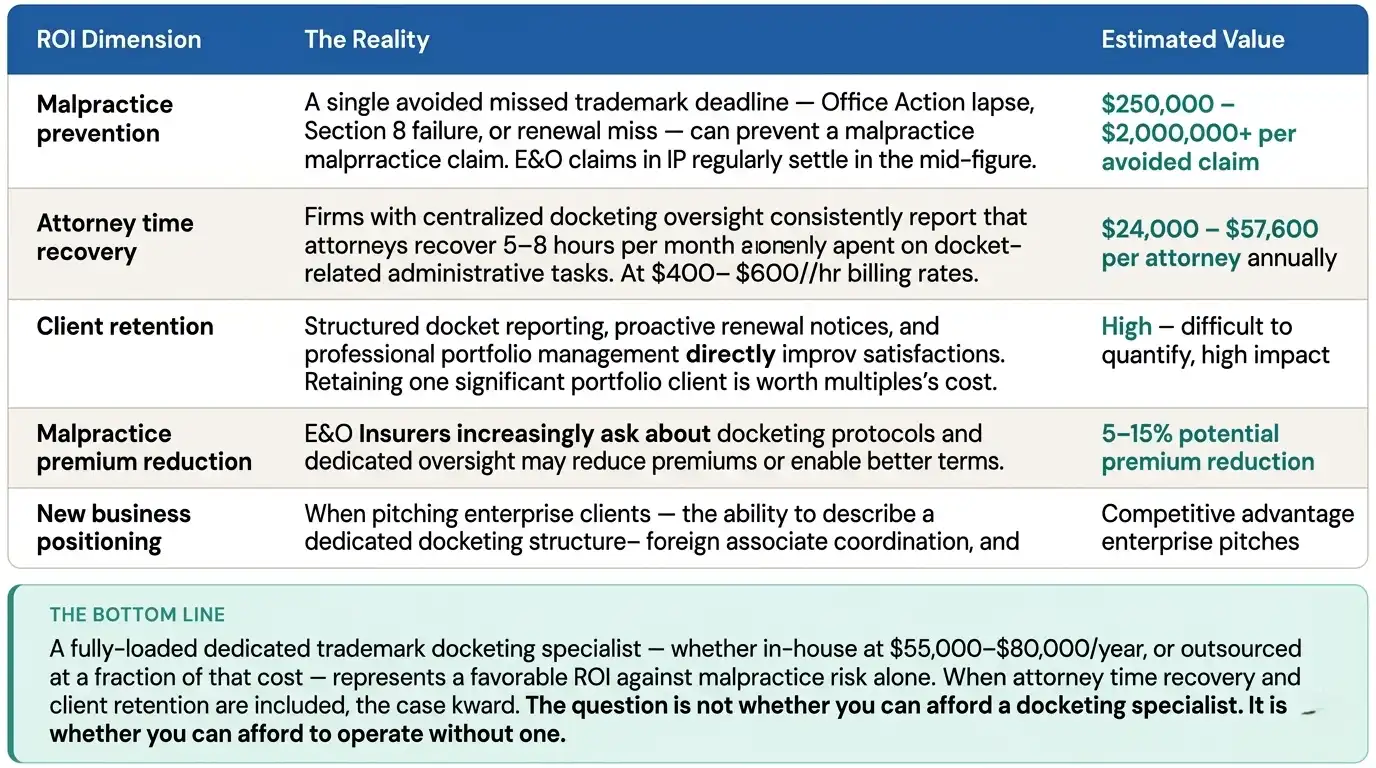
The ROI of a Dedicated Trademark Docketing Specialist
IP firm partners often frame this as a cost question. It is actually a revenue and risk question. Here’s how the financial case breaks down across five dimensions:
In-House Hire vs. Outsourced Docketing: How to Choose
Once the strategic decision is made, the implementation question is: hire an in-house dedicated docketing specialist, or engage an outsourced docketing service? Both can work. The right choice depends on your firm’s portfolio size, jurisdictional complexity, budget, and growth trajectory.
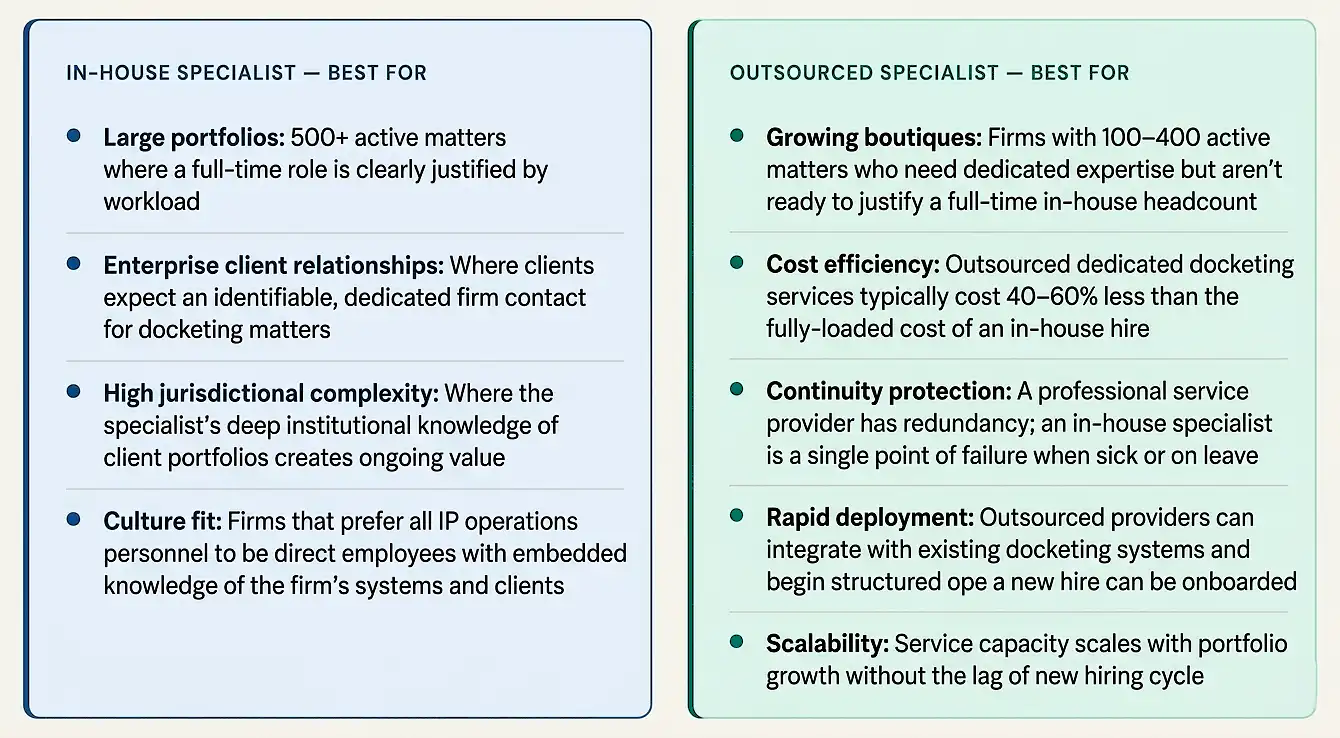
A critical caveat on outsourcing: not all outsourced docketing services are created equal. The distinction between a general IP staffing company that provides docketing “support” and a dedicated provider that assigns a specialist who owns your docket is the same distinction we’ve been making throughout this post. Verify that your outsourced provider assigns a dedicated specialist, not a rotating pool of generalists, and that they have documented expertise in trademark-specific deadline logic – not just general IP operations.
What to Look for When Hiring a Dedicated Trademark Docketing Specialist
Whether hiring in-house or evaluating an outsourced provider, use this checklist to assess whether you’re dealing with a genuine trademark docketing specialist – not a general paralegal with docketing experience bolted on.
Dedicated Trademark Docketing Specialist – Evaluation Checklist
- Can explain, without prompting, the Section 8 and 9 timeline and the consequence of late filing vs. grace period filing
- Has hands-on administrator-level experience with at least one major trademark docketing platform (Foundation IP, Dennemeyer Anaqua, Corsearch, or CPi)
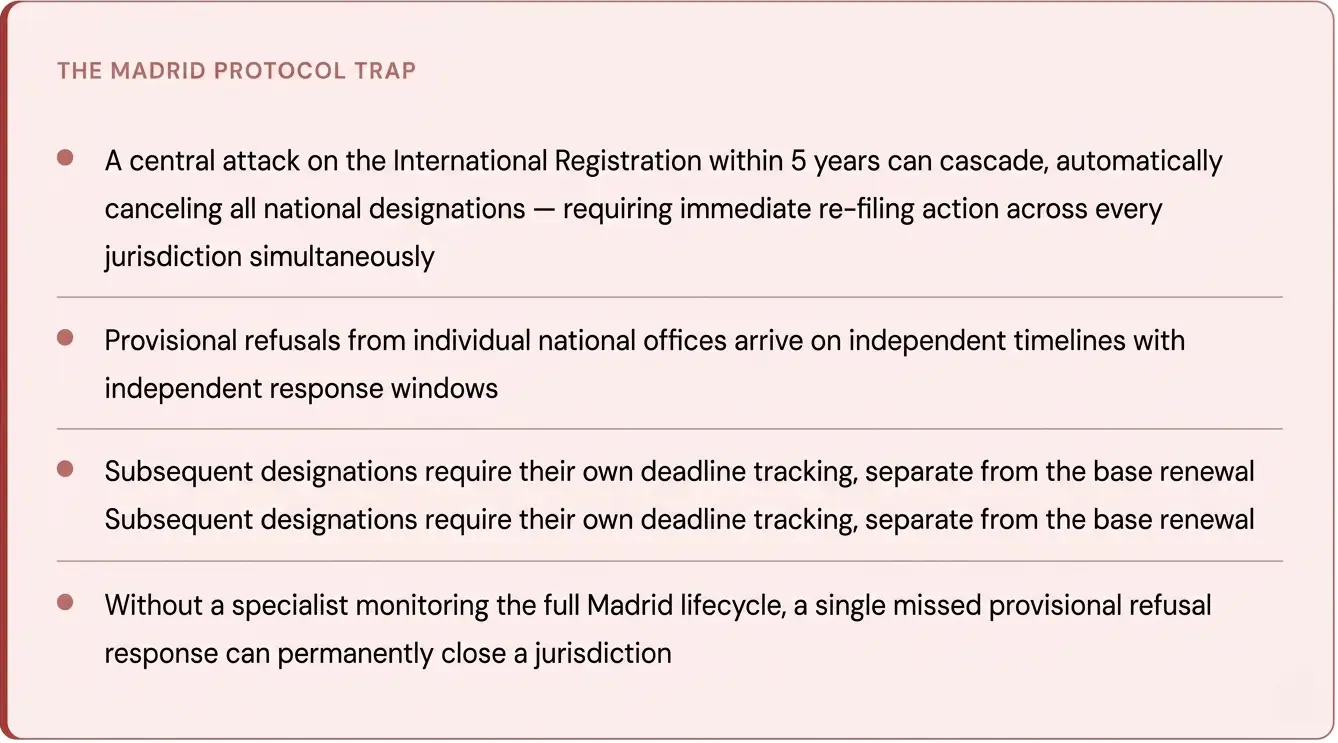
- Can describe how they would configure a new matter intake for a Madrid Protocol international registration with multiple national designations
- Has experience reconciling conflicting deadline information from foreign associates and can describe their reconciliation process
- Can describe their proactive audit process – not just calendar monitoring, but active docket integrity checks
- Has documented or developed docketing protocols at a previous firm and can describe what those protocols covered
- Understands the current USPTO fee schedule, examination timelines, and common Office Action response scenarios
- Has experience generating structured client portfolio reports and can show sample report formats
- Can describe how they would train a new attorney or paralegal on the firm’s docketing procedures
- Understands data integrity issues in docketing systems and has experience identifying and correcting them
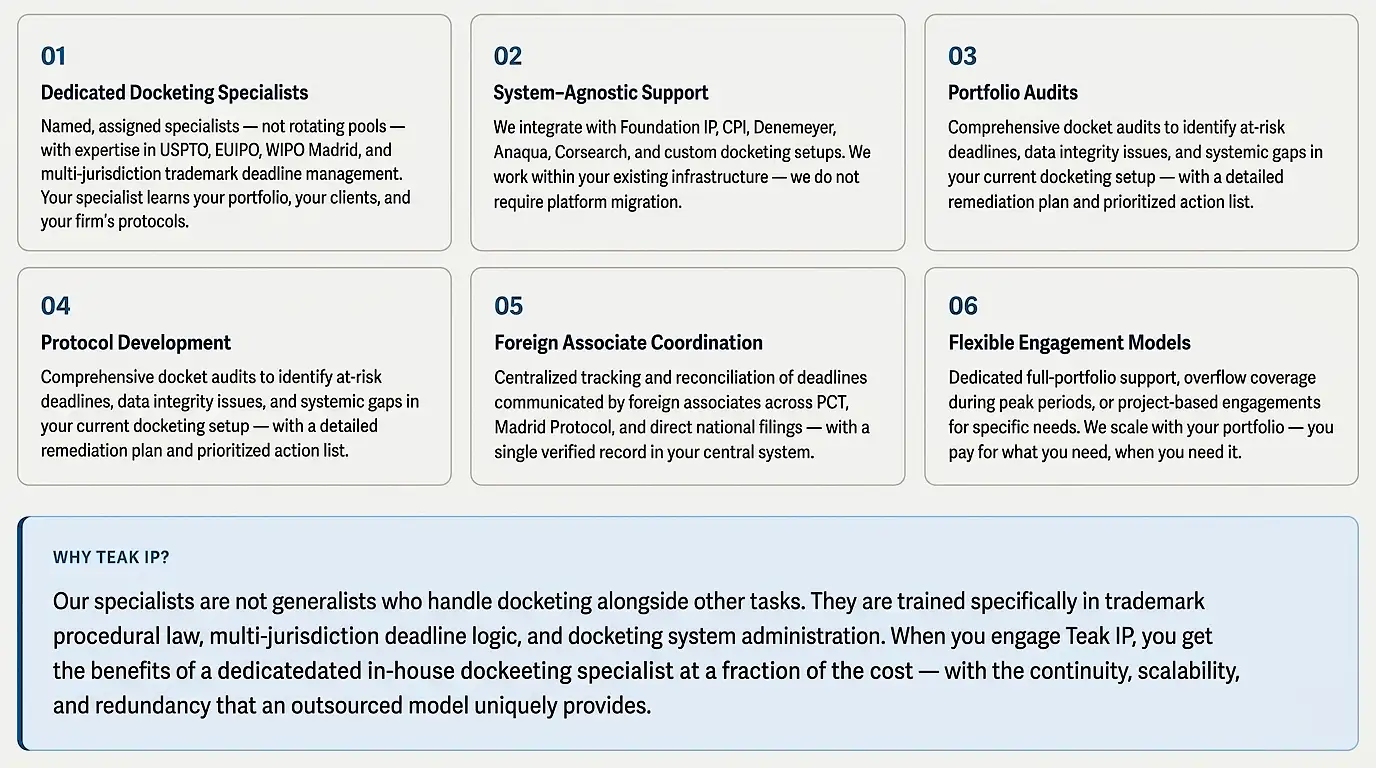
Dedicated Trademark Docketing Support from Teak IP Services
At Teak IP Services, dedicated trademark docketing is not a service line we added — it is a core capability we were built around. We provide IP firms of all sizes with docketing specialists who own your docket the way you need it to be owned: proactively, systematically, and with the depth of trademark procedural knowledge that the role requires.
FAQs: Dedicated Trademark Docketing Specialists
What exactly distinguishes a dedicated trademark docketing specialist from a trademark paralegal who handles docketing?
The distinction is about focus and accountability. A trademark paralegal is a skilled professional whose role encompasses drafting, client communication, billing support, file management, and docketing as one among many responsibilities. A dedicated trademark docketing specialist’s entire professional role is built around owning the docket – from system configuration and protocol development to proactive auditing, foreign associate coordination, and client reporting. The specialist is not doing docketing tasks; they are responsible for the docketing system as a whole. This difference in accountability structure is what makes a specialist structurally less likely to miss deadlines, and far more capable of catching systemic risks before they become crises.
At what portfolio size or firm size does a dedicated docketing specialist become necessary?
There is no hard threshold, but as a practical guide: firms managing more than 200–300 active trademark matters across more than five jurisdictions, or any firm that has experienced a near-miss deadline in the past 12 months, or any firm whose docketing is handled by a paralegal who spends less than 60% of their time on docketing specifically, should treat this as an immediate priority. Volume isn’t the only factor – jurisdictional complexity, client sophistication, and the firm’s documented docketing protocols all matter equally. A boutique with 150 matters across 20 countries may need a specialist more urgently than a larger firm with 400 matters in a single jurisdiction.
Can an outsourced trademark docketing service deliver the same value as an in-house dedicated specialist?
Yes – when the outsourced provider assigns a dedicated specialist (not a rotating pool), integrates directly with your docketing system, has documented expertise in trademark-specific deadline logic, and operates with defined SLAs and escalation protocols. The key differentiator is whether the outsourced model is genuinely dedicated or merely supportive. A dedicated outsourced model provides an additional benefit: built-in redundancy for sick leave, vacation, and personnel changes – which an in-house specialist, as a single point of failure, cannot provide.
What docketing software platforms do most IP firms use, and does it matter?
The most widely used platforms in trademark-focused practices include Foundation IP, Dennemeyer Anaqua, Corsearch, and CPi. Each has different strengths in multi-jurisdiction deadline management, client reporting, and system integration. Platform selection matters significantly – but only to the extent that your firm has someone with administrator-level expertise who configures and maintains it properly. A sophisticated platform configured incorrectly is more dangerous than a simpler platform owned by a specialist who understands its logic completely.
How does a dedicated docketing specialist interact with attorneys without creating workflow duplication?
In a well-structured model, the specialist owns the docket infrastructure while attorneys retain responsibility for legal judgment – prosecution strategy, Office Action responses, client counsel, and final sign-off on filings. The specialist acts as an early warning system and operational backbone: escalating deadline risk, providing daily status visibility, producing client-facing reports for attorney review and delivery, and managing all administrative deadline tracking so attorneys can focus on legal work. Duplication risk is eliminated by clear protocol documentation that defines exactly what the specialist owns versus what requires attorney involvement.
What’s the first step if our firm wants to move to a dedicated docketing model?
Start with a docket audit. Before hiring or engaging a specialist, you need to understand the current state of your docket – where the data integrity gaps are, which matters are at elevated deadline risk, what your current intake and calendaring protocols look like, and where the most significant structural vulnerabilities exist. A professional docket audit gives you both an honest baseline and a remediation roadmap. Teak IP offers portfolio audits as a standalone engagement specifically for firms at this stage of the evaluation process.
Does having a dedicated docketing specialist actually reduce malpractice insurance premiums?
In many cases, yes. E&O underwriters for IP firms increasingly evaluate the quality of docketing infrastructure during the underwriting process. Firms that can document a dedicated specialist role, formal docketing protocols, regular audit procedures, and a defined escalation path for at-risk deadlines present a meaningfully lower risk profile than firms that cannot. The impact varies by carrier and coverage structure, but a reduction of 5–15% in premium costs is within the range regularly cited by IP-focused insurance brokers. More importantly, documented docketing discipline reduces the likelihood of the claim that would trigger the premium impact in the first place.
Is Your Docket Built on a Solid Foundation?
Teak IP provides dedicated trademark docketing specialists to IP firms. They understand the difference between managing deadlines and owning the docket. Start with a portfolio audit or explore our full-service docketing support model.
Our Services: trademark docketing services

