
A trademark deadline never cares how busy your team is. An Office Action arrives, a Section 8 window opens, and a TTAB schedule shifts, all in the same week. If your bench is thin, something slips.
That pressure explains why virtual trademark paralegal companies now sit on so many shortlists. Law firms and corporate brand teams want experienced help without adding a full-time salary, a desk, and months of training. Yet the market is crowded, and the labels are confusing. Some providers are true IP specialists. Others are general legal outsourcers who learned trademark work last year.

This guide gives you a clear way to sort them out. You will learn what these companies do, where the compliance lines sit, how the main provider models compare, and which questions expose weak vendors fast.
Quick answer: The best virtual trademark paralegal company for your team is one that (1) works under U.S. attorney supervision, (2) specializes in trademark procedure rather than general legal support, (3) runs a documented multi-step quality control process, and (4) offers pricing that matches your actual volume. Judge providers on those four points before you look at anything else.
What Are Virtual Trademark Paralegal Companies?
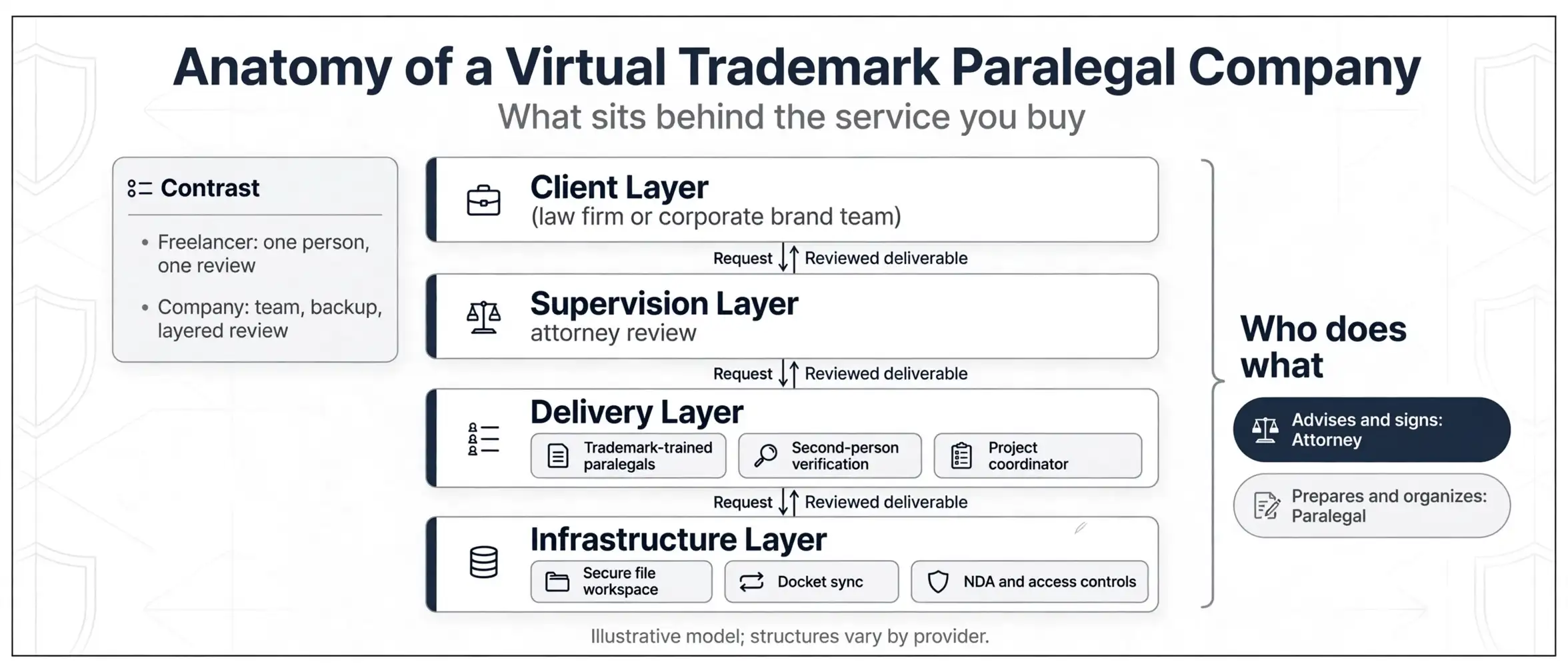
Virtual trademark paralegal companies are service providers that supply remote, trademark-trained paralegal support to law firms, in-house legal departments, and brand teams. Their staff work under attorney supervision. They handle the procedural side of trademark practice, such as filings, docketing, search support, Office Action preparation, and post-registration maintenance.
In simple terms, you get the output of a trademark paralegal without hiring one employee.
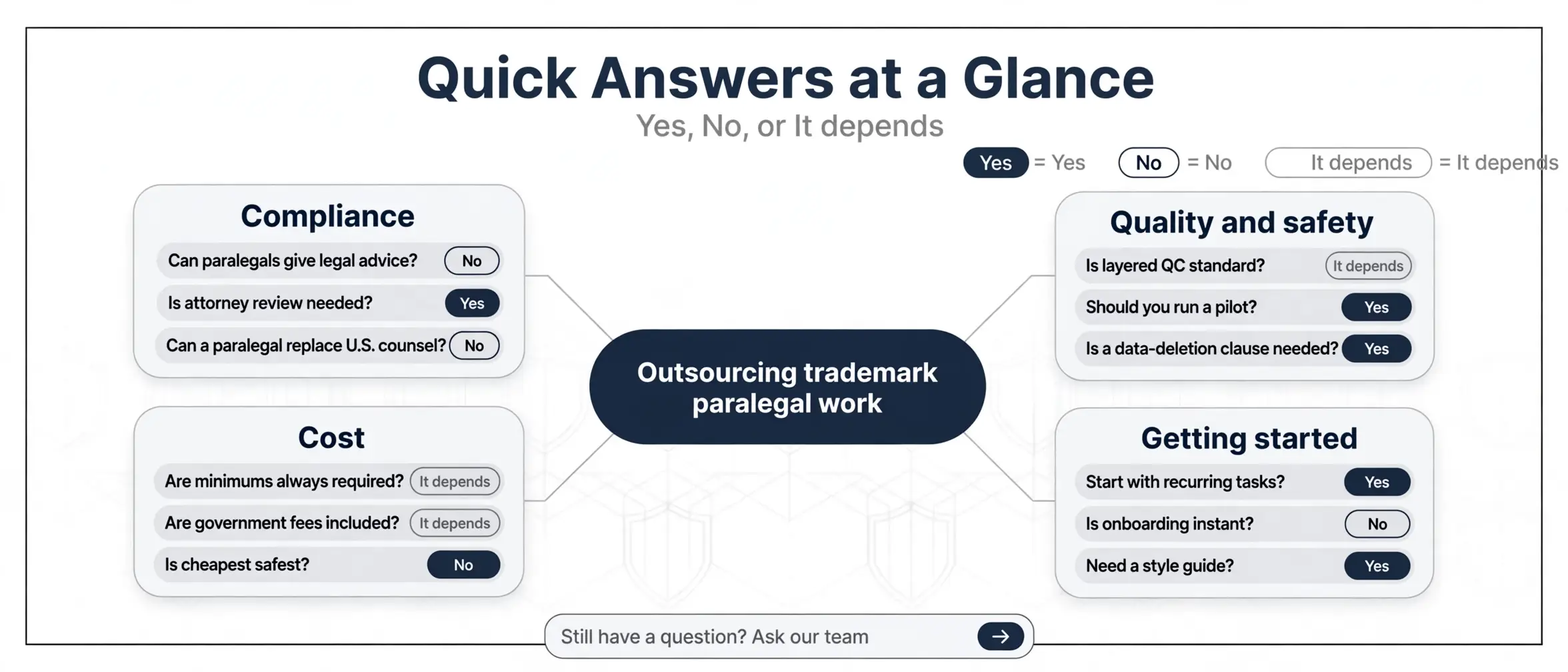
Here is how the term breaks down:
- Virtual: The team works remotely and connects to your systems, email, and shared folders.
- Trademark: The work covers the full trademark lifecycle, from clearance through renewal.
- Paralegal: The staff support attorneys. They do not give legal advice, sign as counsel, or make strategic decisions.
- Company: You contract with an organization that has managers, reviewers, and continuity plans, not a single individual.
That last point matters more than it first appears. A company can cover vacations, absorb volume spikes, and apply a second review. A lone freelancer cannot always do those things.
Virtual Trademark Paralegal vs. Freelance Paralegal vs. In-House Hire
| Factor | Virtual Trademark Paralegal Company | Freelance Paralegal | In-House Paralegal |
|---|---|---|---|
| Coverage during absences | Team backup | Usually none | Depends on team size |
| Quality control | Built-in multi-step review | Self-review | Attorney review only |
| Scalability | Fast up or down | Limited | Slow (hiring cycle) |
| Trademark specialization | Varies, so verify | Varies | Depends on hire |
| Cost structure | Variable or subscription | Hourly | Fixed salary plus overhead |
| Management burden | Low to moderate | Moderate | High |
Why Firms and Brand Teams Are Turning to Virtual Trademark Paralegals
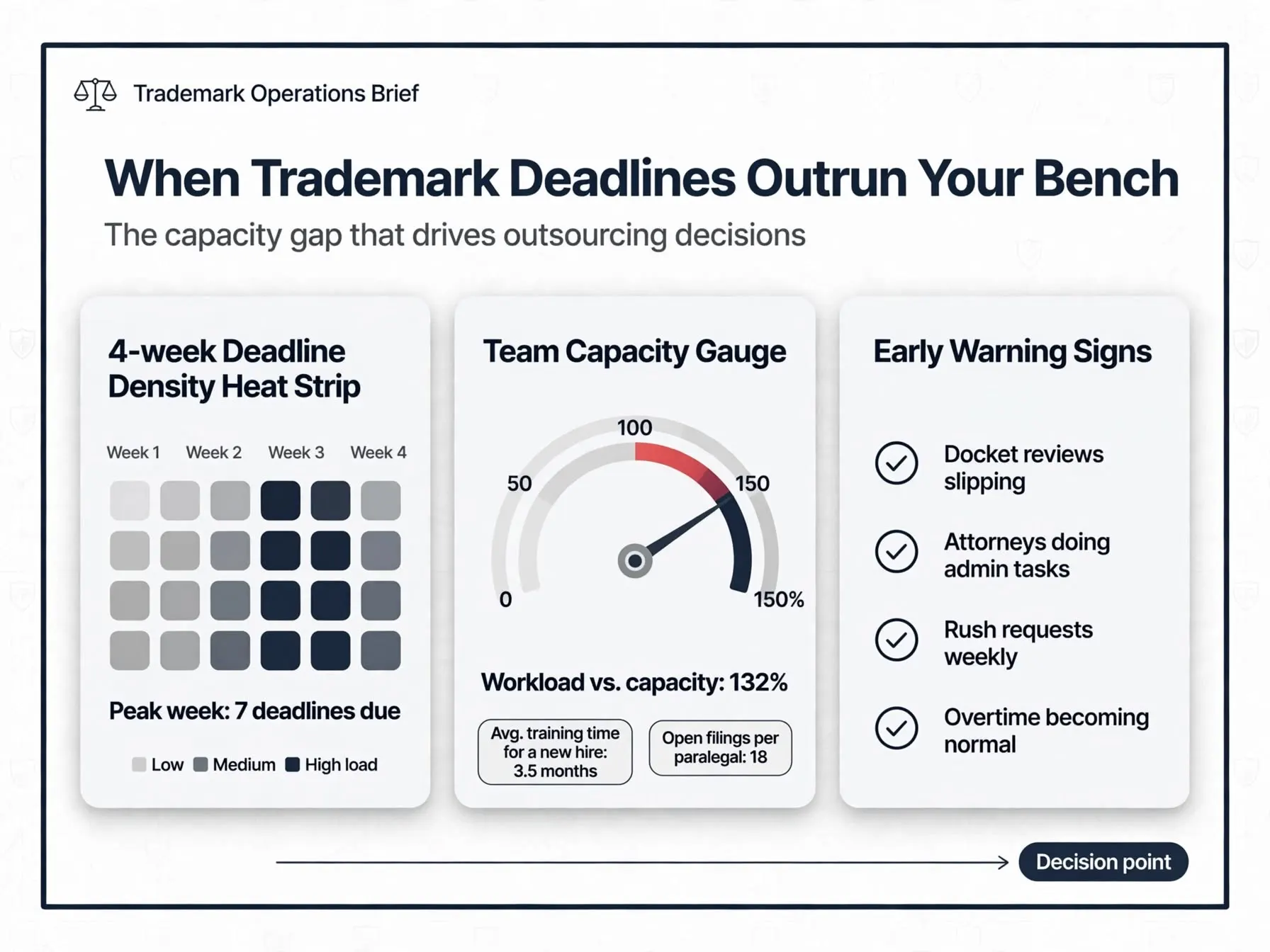
Trademark portfolios grow quietly. Every new brand adds filings, then maintenance, then monitoring. Meanwhile, headcount rarely grows at the same pace.
Consider the pressures that push teams toward a virtual model:
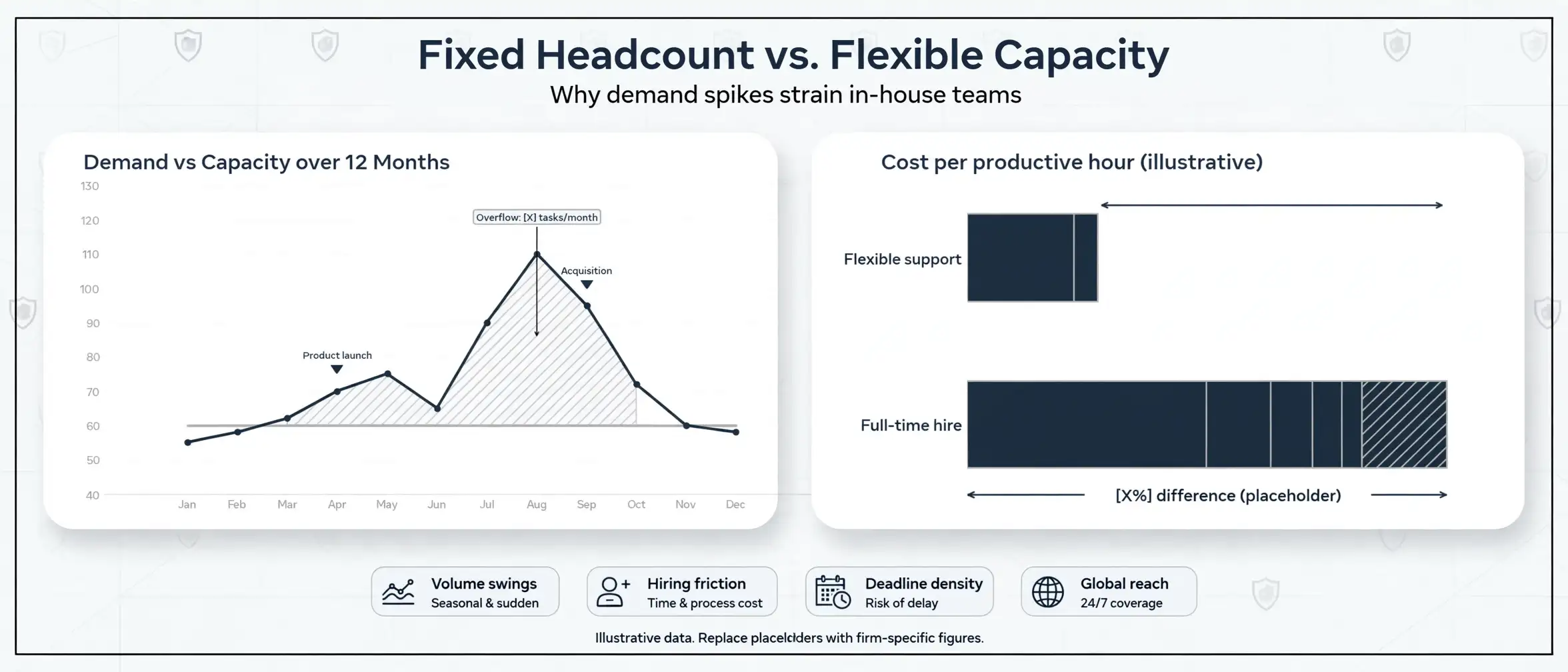
- Volume swings. A product launch or acquisition can triple filing work for a quarter, then drop back.
- Deadline density. Office Action responses, Statements of Use, Section 8 declarations, and renewals all run on separate clocks.
- Hiring friction. Experienced trademark paralegals are hard to find, and training a new one takes months.
- Cost control. Salary, benefits, software seats, and management time add up quickly.
- International reach. Corporate teams often manage marks across many jurisdictions and need consistent tracking.
Moreover, attorneys want to spend their hours on advice, strategy, and client relationships. Routine procedural work eats that time when the team is short-staffed.
If you are weighing this decision for a smaller practice, our article on IP support services for boutique IP law firms explains how lean firms use outsourced support without losing control of client work.
What a Virtual Trademark Paralegal Actually Does
Before you compare vendors, get specific about scope. A good provider covers the entire lifecycle. A weak one covers only the easy parts.
The Trademark Lifecycle in Six Stages
- Pre-filing: Clearance search support, search report organization, and conflict flagging.
- Application: Preparing and formatting applications, identifications of goods and services, specimens, and filing-ready packets for attorney approval.
- Examination: Reviewing Office Actions, calendaring deadlines, gathering evidence, and drafting response materials for attorney review.
- Publication and opposition window: Monitoring publication, tracking opposition periods, and preparing extension requests.
- Registration and post-registration: Statements of Use, Section 8 and Section 9 filings, assignments, and record updates.
- Portfolio management: Docketing, watch notices, renewal reminders, and status reporting.
Task Map: Who Does What
| Task | Paralegal Role | Attorney Role |
|---|---|---|
| Clearance search | Runs searches, organizes results | Interprets risk, advises client |
| Application filing | Drafts and prepares the filing | Reviews, approves, signs |
| Office Action response | Compiles evidence, drafts sections | Sets legal arguments, finalizes |
| Docketing | Enters and verifies deadlines | Spot checks, owns compliance |
| Section 8 / renewal | Prepares declaration and specimens | Reviews use claims, signs |
| Assignment recordation | Prepares cover sheet and documents | Confirms chain of title |
| Watch notice review | Screens and flags conflicts | Decides on action |
| TTAB matters | Tracks schedules, prepares exhibits | Directs strategy, files briefs |
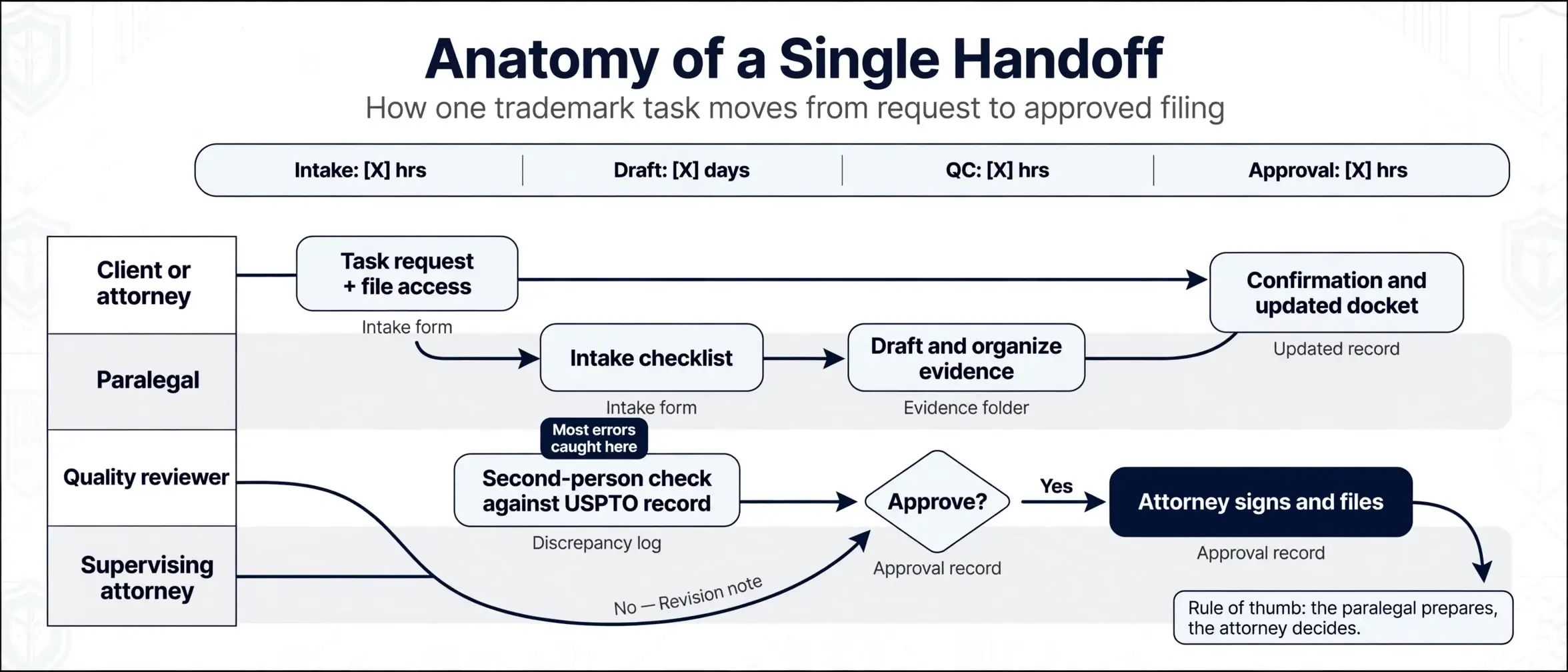
Notice the pattern. The paralegal prepares and organizes. The attorney decides and signs. That division is not just polite. It is the core of a compliant model.
For a deeper look at those boundaries, read our guide on what tasks a trademark paralegal can do without unauthorized practice of law.
Compliance First: Supervision, UPL, and Foreign Domicile Rules
Compliance is where many buyers get burned. A cheap provider that blurs professional lines can expose your firm or client to real risk. Therefore, screen for compliance before you discuss price.
Attorney Supervision Is Not Optional
Attorneys remain responsible for the work their nonlawyer assistants produce. The American Bar Association’s Model Rule 5.3 on responsibilities regarding nonlawyer assistance makes this point clearly. Lawyers must take reasonable steps to make sure a nonlawyer’s conduct fits their professional obligations. That includes outsourced staff.
In practice, this means you need to know:
- Who reviews the paralegal’s work before it reaches you
- How the provider trains staff on confidentiality and ethics
- How the provider documents its process
Who May Represent Others Before the USPTO
The USPTO regulates who can practice before it. Its rules appear in 37 CFR Part 11, which covers representation of others before the Office. Paralegals support licensed attorneys, but they do not appear as the attorney of record, sign as counsel, or provide legal advice to end clients.
A trustworthy provider states this boundary plainly on its website and in its contract. If a vendor promises to “handle everything for your client directly,” walk away.
The Foreign-Domicile Attorney Requirement
Since August 2019, the USPTO has required applicants, registrants, and parties whose permanent residence or principal place of business is outside the United States to use a U.S.-licensed attorney in trademark matters. The agency explains the change in its announcement of the foreign-domiciled applicant rule.
This rule affects virtual providers in two ways:
- If your client is foreign-domiciled, your U.S. attorney must stay in the chain. A paralegal company cannot replace counsel.
- If the provider itself operates offshore, confirm that U.S. attorneys review and file the work.
Data Security and Confidentiality
Trademark files often contain unreleased brand names, launch plans, and client business details. Before you share anything, ask about:
- Non-disclosure agreements signed by every team member
- Access controls and file-sharing practices
- Data retention and deletion at the end of the engagement
- Whether subcontractors ever touch your files
Our IP vendor due diligence checklist for law firms and corporate legal teams walks through these questions in a printable format.
Four Types of Virtual Trademark Paralegal Providers
Not every provider that claims to offer virtual trademark paralegal services works the same way. Most fall into one of four groups. Knowing which group you are talking to helps you predict quality, cost, and risk.
1. Freelance Marketplace Paralegals
These are individuals listed on freelance platforms. Some are excellent, particularly former in-house paralegals who now work independently.
Strengths:
- Low hourly rates
- Fast to start
- Flexible for one-off projects
Weaknesses:
- No built-in backup when they are unavailable
- Quality depends entirely on one person
- Limited process documentation
- Harder to vet confidentiality practices
2. General Legal Process Outsourcers
These companies serve many practice areas, such as litigation support, contracts, and document review. Trademark work is one line among many.
Strengths:
- Large teams and broad capacity
- Strong project management systems
Weaknesses:
- Staff may lack deep USPTO and TTAB experience
- Training on trademark procedure can lag
- Communication often runs through account managers instead of the actual paralegal
3. Technology-Led Trademark Platforms
These vendors lead with software: automated searches, dashboards, and workflow tools. Human review may be lighter.
Strengths:
- Fast reporting
- Clear dashboards
- Good for high-volume, low-complexity tasks
Weaknesses:
- Automation can miss nuance in similarity and goods and services analysis
- Complex Office Actions still need human judgment
- Software fees can stack on top of service fees
If you are deciding between software and human oversight for deadline tracking, this comparison of managed trademark docketing versus software lays out the tradeoffs.
4. IP-Specialized Managed Paralegal Firms
These providers focus on patents and trademarks only. Teams are trained on IP procedure. Attorneys review output. Quality control is part of the process.
Strengths:
- Deep trademark procedural knowledge
- Attorney oversight built in
- Consistent team assignments and documented workflows
- Coverage across the full lifecycle
Weaknesses:
- May cost more than freelancers for small tasks
- Onboarding takes some setup time
Comparison Table: Provider Types at a Glance
| Criteria | Freelance Marketplace | General Legal Outsourcer | Tech-Led Platform | IP-Specialized Managed Firm |
|---|---|---|---|---|
| Trademark depth | Varies widely | Often shallow | Moderate | Deep |
| Attorney oversight | Rare | Sometimes | Rare | Common |
| Multi-layer QC | No | Sometimes | Automated checks | Yes, human review |
| Backup coverage | No | Yes | Yes | Yes |
| Best for | Simple one-off tasks | Mixed legal workloads | High-volume routine tasks | Ongoing trademark support |
| Typical risk | Single point of failure | Learning curve on TM rules | Missed nuance | Higher minimums (varies) |
10 Criteria for Evaluating Virtual Trademark Paralegal Companies
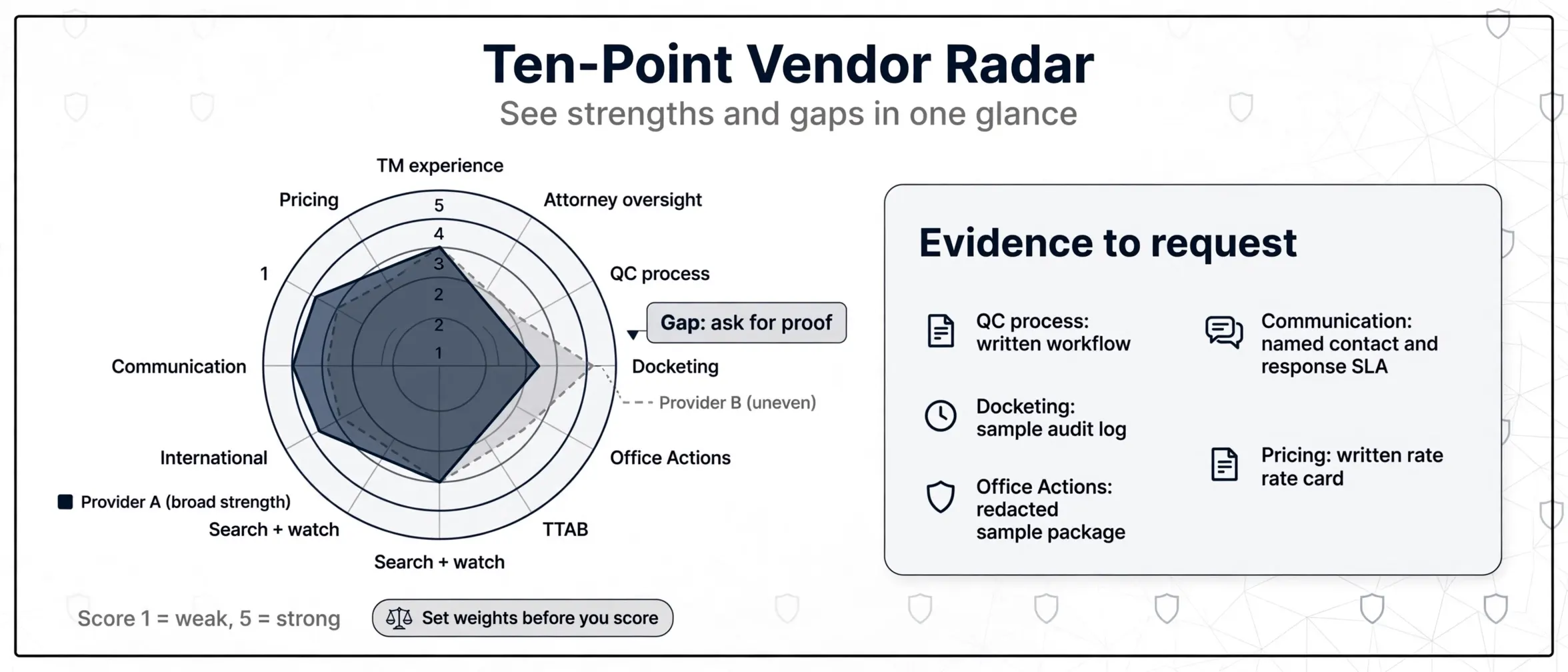
Use these ten criteria as a scorecard. Rate each provider from 1 to 5 on every line, then compare totals. This approach keeps the decision grounded in evidence rather than sales polish.
1. Trademark-Specific Training and Experience
Ask how many years of trademark experience the assigned paralegals hold. Ask what they have handled: Section 2(d) refusals, specimen refusals, identification of goods and services issues, extensions of time, and post-registration audits.
Generic answers signal generic experience.
2. Attorney Oversight Model
Find out who reviews the work and when. The best setups include a supervising attorney who checks deliverables before they reach the client.
3. Quality Control Process
Ask for the process in writing. A strong provider describes multiple layers, for example: preparer review, second-person verification, and final attorney or senior review. One check is a gamble. Layered checks are a system.
Our breakdown of the best multi-layered quality control approach for docketing shows how a layered workflow catches errors that single-pass review misses. Although that article focuses on patents, the same logic applies to trademark deadlines.
4. Docketing Accuracy and Deadline Discipline
Trademark deadlines are unforgiving. An Office Action response has a fixed window. Post-registration filings must land inside statutory periods. A registration can be lost by a missed maintenance date.
Ask how the provider dockets deadlines, who verifies each entry, and what happens when a status changes at the USPTO.
5. Coverage of Office Action Work
Many providers can file a simple application. Fewer can build a solid Office Action response package. Ask for a sample workflow. You can also review our guide to the best Office Action response support services for patent and trademark firms to see what strong support looks like.
6. TTAB Readiness
Oppositions, cancellations, and appeals follow strict schedules with discovery and trial periods. If you expect contested work, ask about TTAB-trained staff. Our article on companies that provide trained TTAB paralegal support services explains what to look for.
7. Search and Monitoring Support
Clearance and watch services are separate tasks with different goals. Confirm the provider understands both. The article on the difference between a trademark search and trademark monitoring is a helpful primer if your team mixes the two up.
8. International Portfolio Experience
If your portfolio crosses borders, ask whether the provider tracks foreign deadlines, coordinates with foreign associates, and understands the Madrid system administered by WIPO. Global renewals cause more silent losses than almost any other task. See our guide on managing corporate trademark renewals globally for a workable process.
9. Communication and Time Zone Overlap
A virtual team should feel present. Check for:
- A named point of contact
- Overlap with your business hours
- Response time commitments
- Clear escalation steps for urgent deadlines
10. Pricing Transparency and Flexibility
Look for clear rates, no hidden setup fees, and terms that match your volume. Rigid minimums can hurt boutique firms. Vague pricing can hurt everyone.
Sample Evaluation Scorecard
| Criterion | Weight | Provider A (1–5) | Provider B (1–5) | Provider C (1–5) |
|---|---|---|---|---|
| Trademark-specific experience | 15% | |||
| Attorney oversight | 15% | |||
| Quality control process | 15% | |||
| Docketing accuracy | 15% | |||
| Office Action capability | 10% | |||
| TTAB readiness | 5% | |||
| Search and monitoring | 5% | |||
| International experience | 5% | |||
| Communication | 10% | |||
| Pricing flexibility | 5% | |||
| Weighted total | 100% |
Adjust the weights to match your practice. A corporate team with a global portfolio might raise international experience to 15%. A boutique firm handling mostly U.S. filings might raise pricing flexibility.
How to Choose: A Step-by-Step Selection Process
Follow these seven steps to move from a long list of virtual trademark paralegal companies to a confident choice.
- Define your scope. List the tasks you want to hand off. Separate recurring work (docketing, renewals) from project work (Office Actions, portfolio audits).
- Estimate your volume. Count how many filings, responses, and maintenance actions you handle in a typical quarter. Include peaks.
- Set compliance requirements. Decide your non-negotiables: attorney supervision, NDAs, data handling, and U.S. attorney involvement for foreign clients.
- Build a shortlist of three to five providers. Mix provider types so you can compare models.
- Run a structured interview. Ask every provider the same questions from the scorecard above. Request written answers.
- Test with a pilot. Assign a small, real task, such as an Office Action response package or a docket audit for one client. Measure accuracy, speed, and communication.
- Review the pilot and decide. Score each provider. Then negotiate terms, including turnaround time, revision policy, and exit terms.
For teams with international portfolios, our step-by-step piece on how to hire a remote trademark paralegal with international portfolio experience adds hiring questions specific to cross-border work.
Questions to Ask Every Provider
Use this list in your interviews:
- Who supervises the paralegal, and what is that person’s bar status?
- What is your quality control process, step by step?
- How do you handle a deadline that falls within 48 hours?
- What happens if a paralegal is unavailable?
- How do you protect client confidentiality?
- Can I speak with the paralegal who will do my work?
- What is your revision policy if a deliverable misses the mark?
- How do you report status and errors?
- What does offboarding look like if we part ways?
Notice that the last question matters. A provider confident in its work will answer it without hesitation.
Pricing Models Compared
Pricing structure shapes your budget more than the headline rate does. Here are the four models you will see most often.
| Pricing Model | How It Works | Best For | Watch Out For |
|---|---|---|---|
| Hourly | You pay for time spent | Irregular, small tasks | Unpredictable totals, scope creep |
| Flat fee per task | Fixed price per filing or response | Predictable filings | Exclusions for complex issues |
| Monthly retainer | Set monthly fee for a block of support | Steady, ongoing volume | Paying for unused hours |
| À la carte | Pay only for the services used, no minimums | Variable or growing workloads | Confirm rate cards up front |
A flexible à la carte structure often suits smaller firms and growing teams because you avoid paying for capacity you do not use. Larger departments with steady volume may prefer a retainer for predictability.
Whatever model you choose, ask these questions:
- Are revisions included?
- Are rush requests charged at a premium?
- Are government fees passed through at cost?
- Is there a minimum commitment or term?
- What is the notice period for ending the agreement?
Also remember to count the hidden costs of cheaper options. A missed deadline, a rejected specimen, or a poorly organized docket can cost far more than the savings.
Common Mistakes When Hiring a Virtual Trademark Paralegal Provider
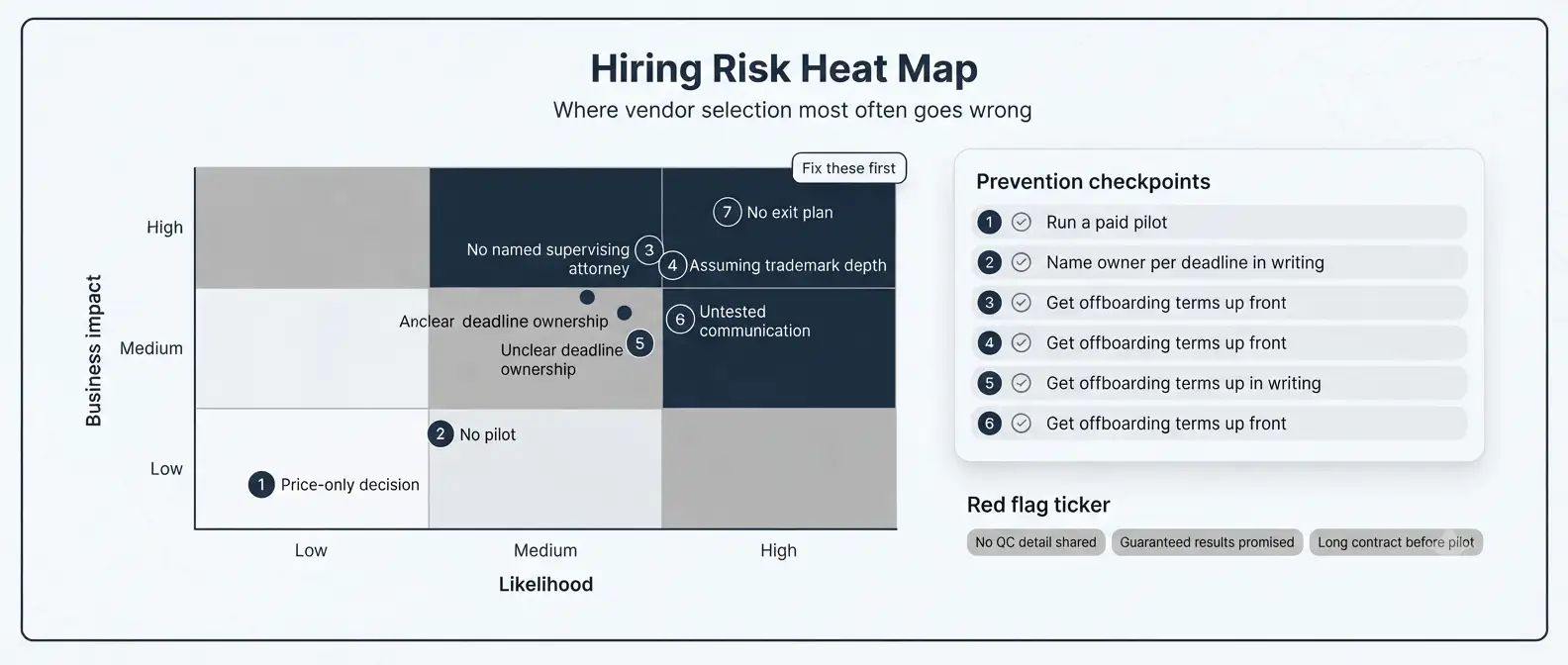
Buyers repeat the same errors. Avoid these seven.
- Choosing on price alone. The lowest quote often reflects thin review and junior staff.
- Skipping the pilot. A sales call reveals promises. A pilot reveals performance.
- Ignoring the supervision question. If no attorney reviews the work, you carry all the risk.
- Assuming all paralegals have trademark depth. A patent or litigation paralegal may not know specimen practice or Section 8 rules.
- Overlooking docketing ownership. Confusion over who owns each deadline leads to missed dates. Define ownership in writing.
- Not testing communication. Slow replies during onboarding predict slow replies during a crisis.
- Failing to plan the exit. If you cannot retrieve your data cleanly, you are locked in.
Red Flags in a Provider’s Pitch
Watch for these warning signs:
- Promises of “guaranteed registration”
- Refusal to describe the QC process
- No named supervising attorney
- Claims that paralegals will advise your clients directly
- Pressure to sign a long-term contract before a pilot
- Vague answers on data security
If you notice two or more, keep looking.
Which Model Fits Your Team?
Different teams need different setups. Consider these three common profiles.
The Solo Practitioner or Boutique Firm
Typical need: Overflow support, docket backup, and help with Office Actions without a full-time hire.
Best fit: An IP-specialized managed firm with à la carte pricing and no minimums. You get trained support when work spikes, and you pay nothing during quiet weeks.
Watch for: Providers that require large monthly commitments.
The Mid-Size IP Firm
Typical need: Consistent capacity across multiple attorneys and clients, plus quality control that scales.
Best fit: An IP-specialized firm with a dedicated team, a defined review process, and reporting you can share with partners.
Watch for: Rotating staff that forces your attorneys to re-explain preferences each time.
The Corporate Brand or IP Team
Typical need: Portfolio visibility, global renewals, watch notice triage, and reliable deadline management.
Best fit: A provider that pairs docketing discipline with international experience and offers clear reporting.
Watch for: Tools that generate alerts without human triage, which can bury the real issues.
The right answer is rarely the cheapest or the largest. Instead, it is the provider whose model matches your workflow.
Where Teak IP Fits
Teak IP Services provides paralegal and IP support to law firms, corporate departments, and IP professionals. Our trademark support connects directly to the criteria above.
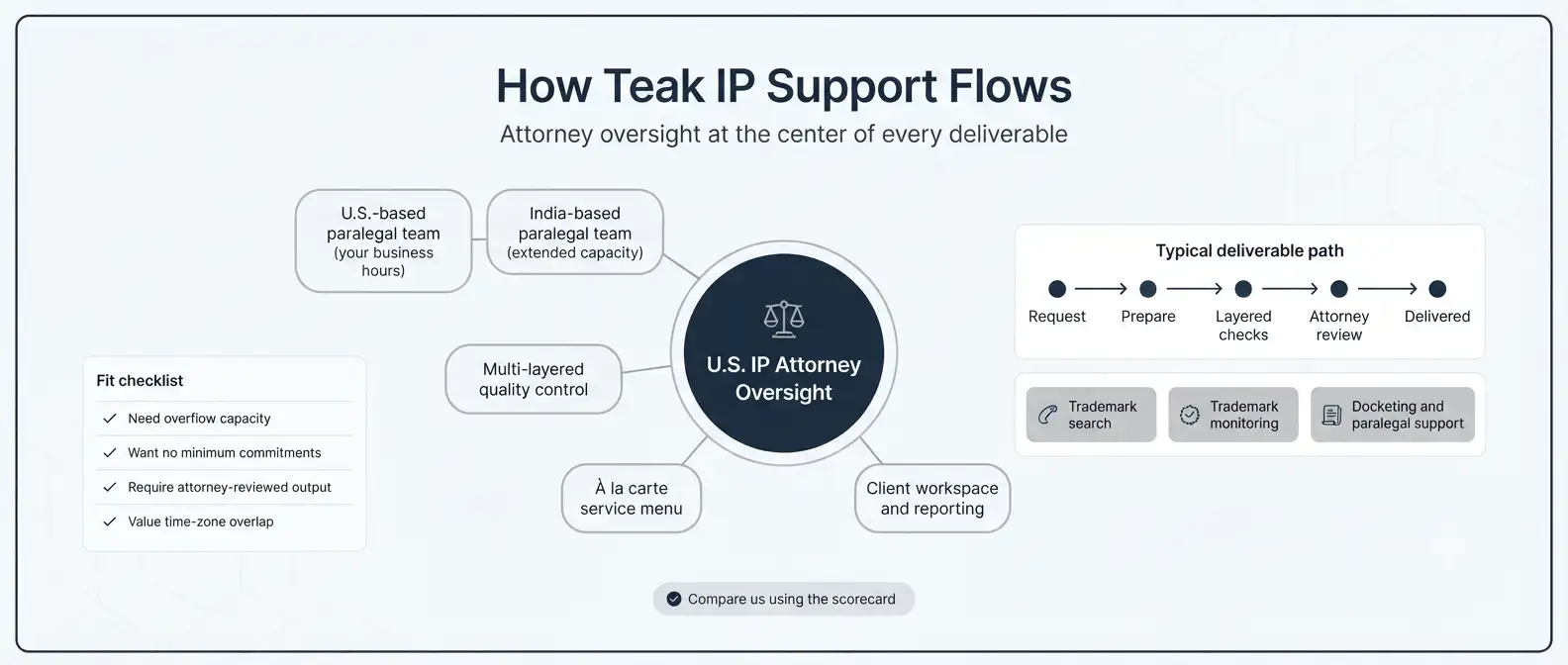
Here is how the Teak model maps to your scorecard:
- U.S. attorney led. Teak is led by U.S. IP attorneys. Every deliverable undergoes review by those attorneys, which supports the supervision standard discussed earlier.
- Multi-layered quality control. Our process uses multiple checks for document processing, docketing, and deadline management.
- Flexible, à la carte pricing. You pay only for the services you need, with no minimum commitments.
- Deep paralegal experience. Our team brings more than 70 years of combined paralegal experience across patents, trademarks, and complex IP portfolios.
- U.S. and India teams. You can reach a U.S.-based paralegal during your business hours while benefiting from experienced offshore resources. That mix supports faster turnaround and competitive rates.
- Full lifecycle coverage. Support spans trademark services, including trademark search and trademark monitoring, along with docketing, Office Action support, and post-registration work through our IP paralegal services.
We also recommend you compare us with any other provider using the scorecard above. A confident vendor welcomes that comparison.
If you want to see who would work on your files, visit the Teak IP USA team page or review our About page.
Expert Tips From Day-to-Day Trademark Workflows
These tips come from the kinds of problems trademark teams run into again and again.
- Start with a docket audit. Before you hand off new work, ask the provider to verify every open deadline against USPTO records. This step often uncovers stale dates.
- Standardize your instructions. Create a one-page style guide covering signature blocks, identification language preferences, specimen standards, and client-specific notes.
- Use a shared status view. A single tracker prevents duplicate work and unclear ownership.
- Separate urgent from routine. Agree on a rush protocol so a two-day deadline never sits in a general queue.
- Ask for evidence organization, not only drafts. In Office Actions, well-organized exhibits save attorney time.
- Review the first ten deliverables closely. Early feedback shapes long-term quality. Afterward, you can move to sampling.
- Confirm assignment and ownership records. Chain-of-title gaps cause trouble during renewals and transactions. Our walkthrough on recording a trademark assignment with the USPTO shows why clean records matter.
- Run clearance before you file. A weak clearance step creates expensive problems later. Learn what a pre-filing trademark clearance search involves so you can specify the depth you need.
- Verify search tools yourself once. The USPTO’s official trademark search system is free. Spot-check a provider’s findings against it so you understand their method.
Deadlines to Track (Reference Table)
Always confirm current deadlines and fees on the USPTO trademarks website before acting. The table below gives general reference points.
| Event | General Timing | Why It Matters |
|---|---|---|
| Office Action response | Typically three months, with an available extension for a fee | Missing it can abandon the application |
| Opposition period | Thirty days after publication, extendable | Opens a window for third-party challenges |
| Statement of Use | Within six months of a Notice of Allowance, with extensions available | Required to complete an intent-to-use registration |
| Section 8 declaration | Between the fifth and sixth year after registration | Keeps the registration alive |
| Renewal (Sections 8 and 9) | Every ten years | Maintains long-term rights |
| Grace periods | Available for certain maintenance filings, with a surcharge | A safety net, not a plan |
Your First 90 Days With a Virtual Trademark Paralegal Team
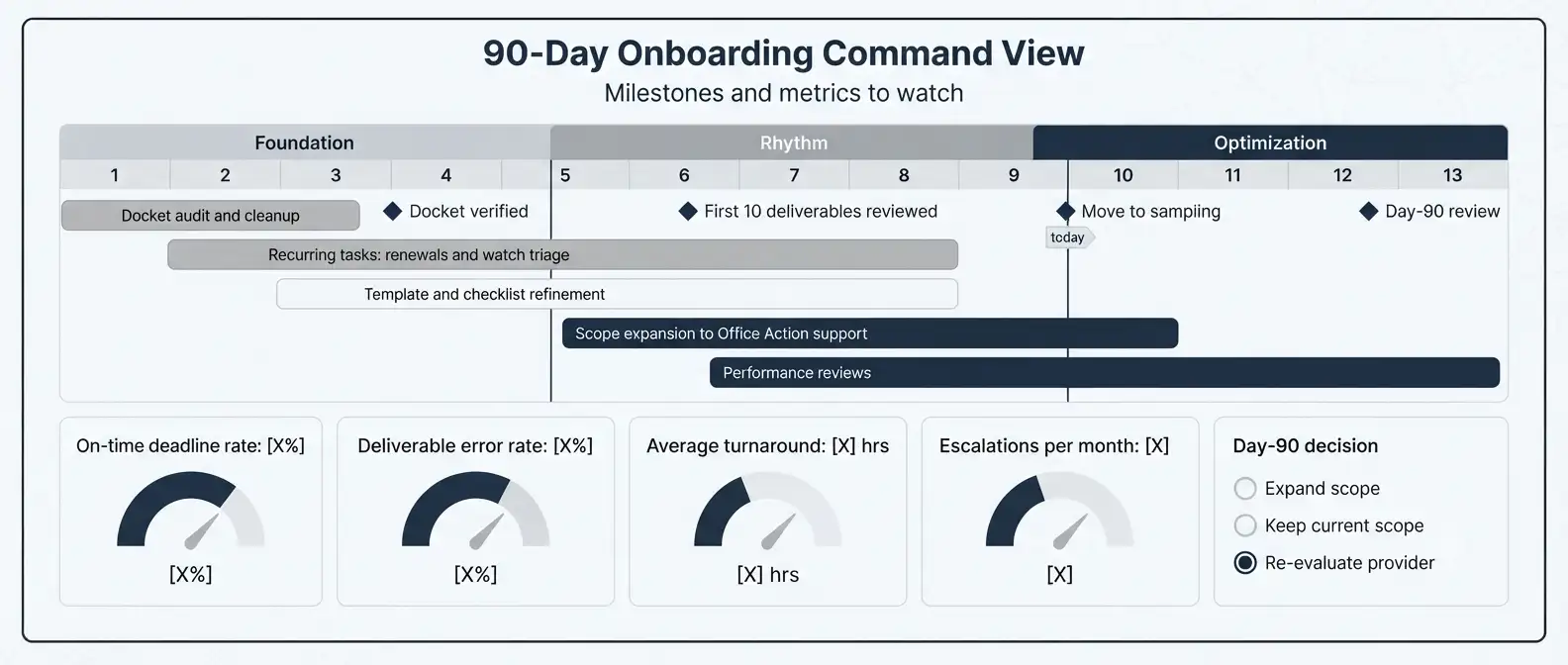
A clear onboarding plan protects your investment. Here is a simple 90-day roadmap.
1st: Days 1–30: Set the Foundation
- Sign the NDA and service agreement
- Share your docket, active files, and style preferences
- Run the docket audit and correct discrepancies
- Name points of contact on both sides
- Agree on turnaround times and escalation rules
2nd: Days 31–60: Build Rhythm
- Assign recurring tasks such as renewals, watch notices, and status reports
- Review early deliverables in detail
- Refine templates and checklists
- Track error rates and response times
3rd: Days 61–90: Optimize
- Move from full review to targeted sampling
- Expand scope to Office Action drafting or portfolio cleanup
- Hold a review meeting to compare results with your scorecard
- Decide on long-term structure: retainer, à la carte, or blended
By day 90, you should know whether the partnership is saving time, reducing risk, and improving visibility.
Frequently Asked Questions
What are virtual trademark paralegal companies?
Virtual trademark paralegal companies supply remote, trademark-trained paralegals who support attorneys and legal teams. They handle procedural work such as filings, docketing, search support, Office Action preparation, and maintenance filings under attorney supervision.
How do I choose the best virtual trademark paralegal company?
Evaluate providers on four essentials: attorney oversight, trademark-specific experience, documented quality control, and flexible pricing. Then run a small paid pilot before you commit. A pilot exposes real accuracy and communication levels.
Can a virtual trademark paralegal give legal advice?
No. Paralegals support attorneys. They prepare documents, organize evidence, and track deadlines, but a licensed attorney must provide legal advice, sign as counsel, and make strategic decisions.
Is it safe to outsource trademark docketing?
It can be safe when the provider uses multi-step verification, clear ownership rules, and strong data security. Ask how deadlines are verified, who checks them, and how the provider responds when USPTO status changes.
How much do virtual trademark paralegal services cost?
Costs vary by provider type and pricing model. Common structures include hourly rates, flat fees per task, monthly retainers, and à la carte pricing. Request a written rate card and confirm how revisions, rush work, and government fees are handled.
Do I need a U.S. attorney if my client is based outside the United States?
Yes. The USPTO requires foreign-domiciled applicants, registrants, and TTAB parties to be represented by a U.S.-licensed attorney. A paralegal company can support that attorney, but it cannot replace one.
What is the difference between a virtual trademark paralegal and a freelance paralegal?
A company offers team backup, layered review, and continuity. A freelancer offers flexibility and often lower rates but usually lacks built-in coverage or second-level quality control.
How long does onboarding usually take?
Most onboarding plans run about 30 days for setup and calibration, then improve over the next 60 days as templates and preferences settle. Complex portfolios may take longer.
Which tasks should I outsource first?
Start with recurring, rules-based work such as docketing verification, renewals, assignment recordation, and watch notice screening. Then add Office Action support once you trust the process.
What should I ask before signing a contract?
Ask about supervising attorneys, quality control steps, confidentiality practices, rush protocols, pricing exclusions, revision policy, and exit terms. Also ask to speak with the paralegal who will handle your files.
Conclusion
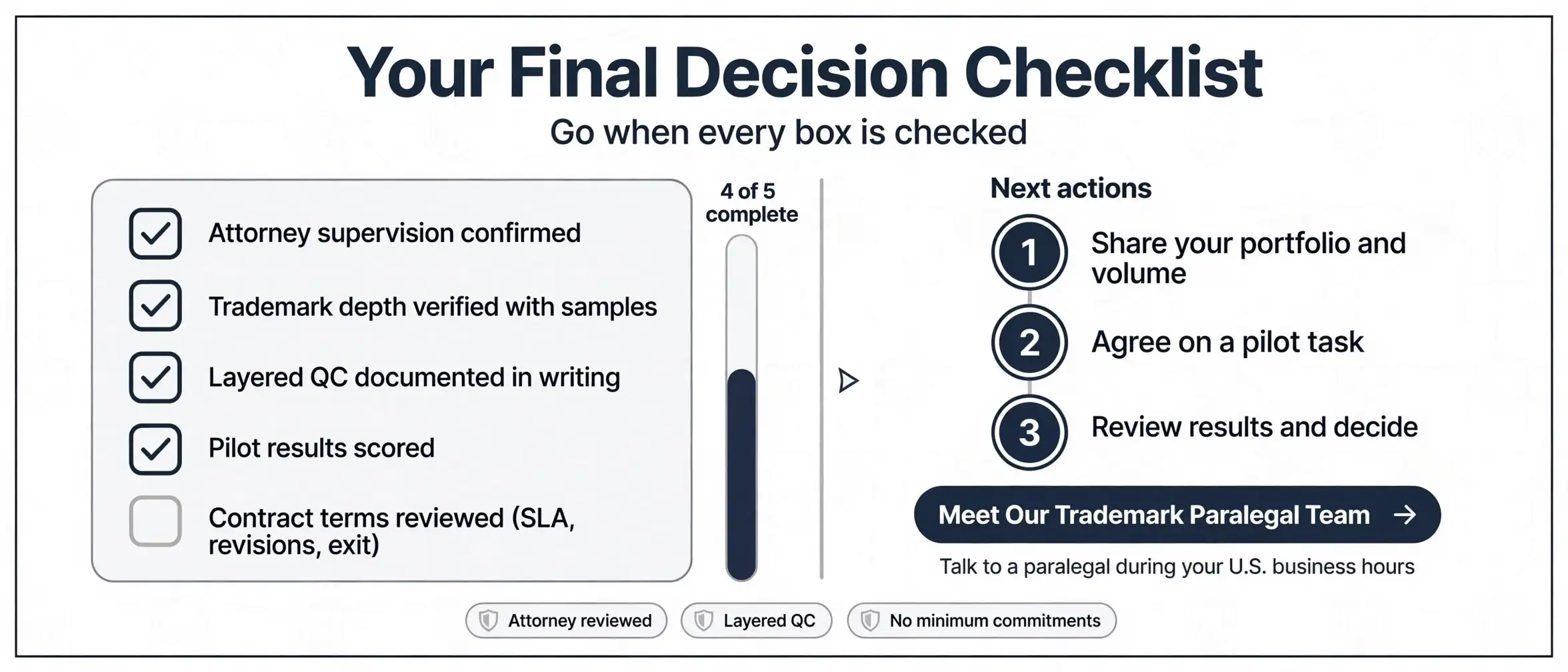
Choosing among virtual trademark paralegal companies comes down to disciplined evaluation. Start with compliance and supervision. Next, confirm real trademark depth. Then test the provider’s quality control and communication with a small pilot.
Price matters, but it should not lead the decision. A missed deadline or a sloppy filing can cost far more than any rate difference.
Use the scorecard in this guide, ask the tough questions, and insist on documented process. If a provider meets those standards, you gain reliable capacity, cleaner dockets, and more attorney time for the work that clients value most.
If you want a partner that pairs U.S. attorney oversight with layered quality control and flexible pricing, we would be glad to talk.


One Response