
A trademark is only as strong as the paper trail behind it. When a brand changes hands, whether through a merger, an asset sale, or a simple change of business name, the new owner’s rights are not fully protected until the transfer is on record with the federal government. That is why so many IP professionals ask the same practical question: how do you record a trademark assignment with the USPTO?

The short answer is that you file a cover sheet and supporting documentation through the Electronic Trademark Assignment System (ETAS), pay the required fee, and wait for the Assignment Recordation Branch to process it. The longer answer, and the one that actually protects your client’s rights, involves a lot more nuance. Missing a single required field, submitting the wrong document type, or misunderstanding the difference between recordation and ownership updates can create real legal exposure.
In this guide, we will walk through exactly how to record a trademark assignment with the USPTO, the documents you need, the fees involved, the most common mistakes paralegals and attorneys make, and practical tips drawn from years of docketing experience. Whether you are handling your first assignment or managing a high-volume portfolio, this article is built to be your reference point.
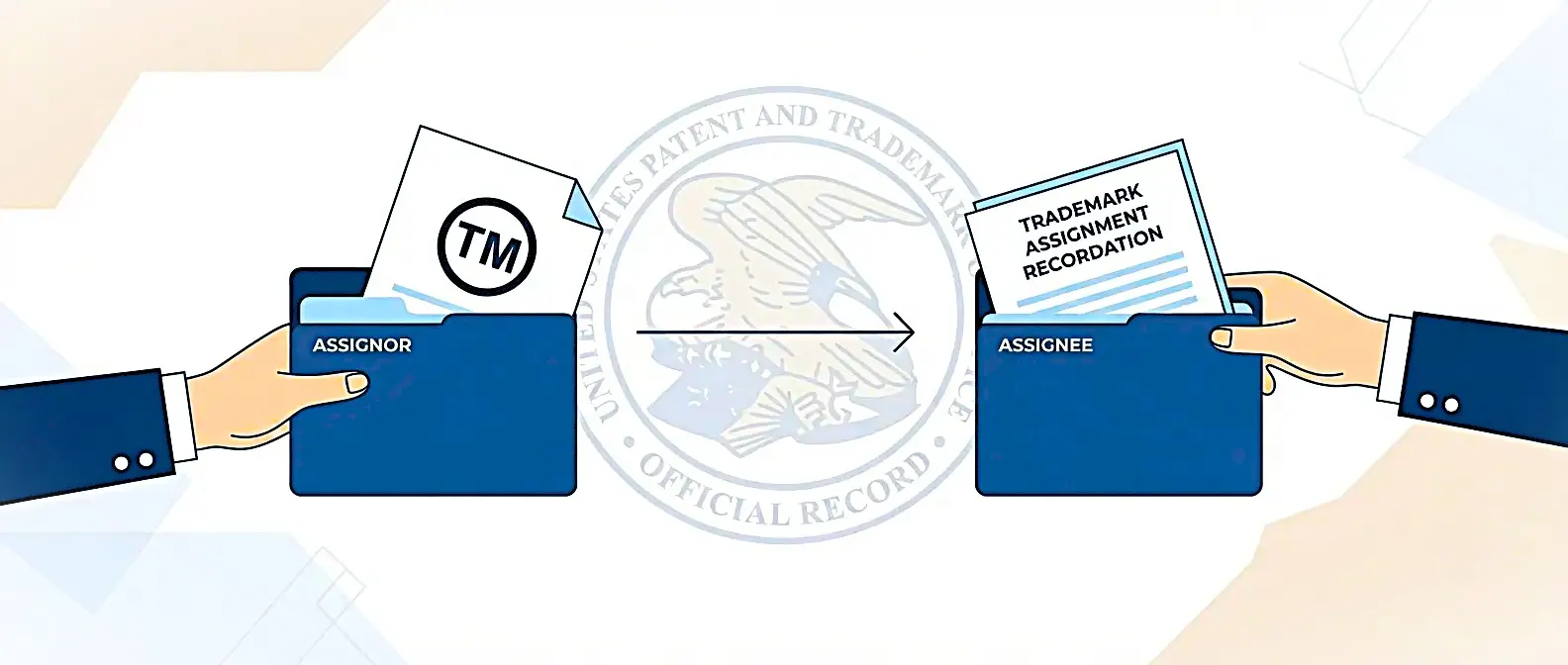
What is a Trademark Assignment, and Why Does Recordation Matter?
A trademark assignment is the legal transfer of ownership rights in a mark from one party (the assignor) to another (the assignee). This can happen for many reasons, including:
- A company sale or acquisition
- A merger between two businesses
- A change in corporate structure or name
- A licensing arrangement that converts into full ownership
- An estate transfer or bankruptcy proceeding
Recording that assignment with the USPTO is not technically mandatory in every case, but skipping it creates serious risk. Under Section 10 of the Trademark Act, an assignment that is not recorded within three months of its execution, or before a subsequent purchaser acquires the mark, can be void against that later purchaser who paid valuable consideration without notice of the earlier transfer.
In plain terms, recordation protects the assignee’s priority. If you do not record a trademark assignment with the USPTO in a timely manner, someone else could later claim superior rights to the same mark, and your client could lose the fight.
Quick Definition
Recording a trademark assignment with the USPTO means submitting a cover sheet and the underlying transfer document (such as a purchase agreement, merger document, or assignment agreement) to the Assignment Recordation Branch so that the change of ownership becomes part of the public record.
The Legal Basis for Recording a Trademark Assignment with the USPTO
Before diving into the mechanics, it helps to understand why this process exists in the first place. The authority of the United States Patent and Trademark Office (USPTO) to record trademark assignment documents is established under 15 U.S.C. §§ 1057 and 1060. These provisions authorize the recordation of trademark ownership and title-transfer documents, including assignments, mergers, licenses, security interests, liens, and other transactions affecting ownership. They also permit individuals, corporations, federal agencies, and government-owned or government-controlled entities to submit these documents for official recordation. For more information, see the USPTO – Trademark Assignments: Transferring Ownership or Changing Your Name
In practical terms, this means the recordation system is not limited to simple sale-and-purchase transactions. It covers a wide range of ownership and interest changes, including:
- Outright assignments of an entire trademark portfolio
- Partial assignments limited to specific goods or classes
- Corporate name changes that do not involve a change in the underlying owner
- Mergers and corporate restructurings
- Security interests, such as when a mark is pledged as collateral for a loan
- Licenses that a party chooses to record for public notice purposes
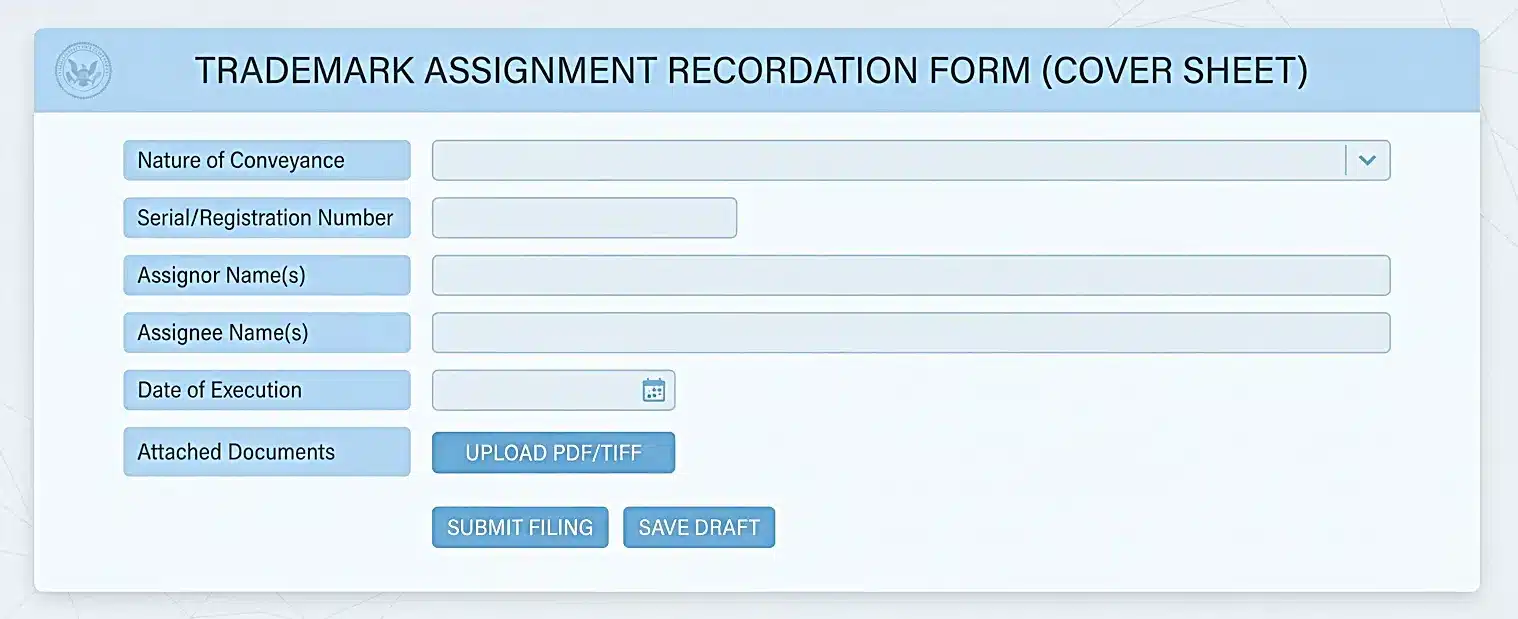
Each of these transaction types is designated on the cover sheet under the “Nature of Conveyance” field, so selecting the correct category matters just as much as filling in the right serial numbers.
Who Handles Trademark Assignment Recordation at the USPTO?
The Assignment Recordation Branch, part of the USPTO’s Public Records Division, is responsible for processing and recording both patent and trademark ownership documents. This branch handles assignment documents for both patent and trademark properties
(Source: USPTO – Transferring Ownership/Assignments FAQs).
The rules governing this process live in 37 C.F.R. Part 3, and they set out exactly what information must be submitted, how it must be formatted, and what fees apply.
The recordation rules generally require submitters to specify the minimum information about the transaction, submit that information on a separate cover sheet, ensure the submission is legible and processable, and pay the correct recording fee. Copies of the underlying documents are acceptable; originals are neither required nor returned
(Source: USPTO – Transferring Ownership/Assignments FAQs).
If your firm regularly handles trademark portfolios, understanding how this office operates is just as important as understanding the filing steps themselves, especially if you also manage related deadlines. For a broader look at keeping ownership records and deadlines aligned across a full portfolio, see our guide on how to manage an international trademark portfolio.
Step-by-Step: How to Record a Trademark Assignment with the USPTO
Recording an assignment is a structured process. Here is the step-by-step breakdown.
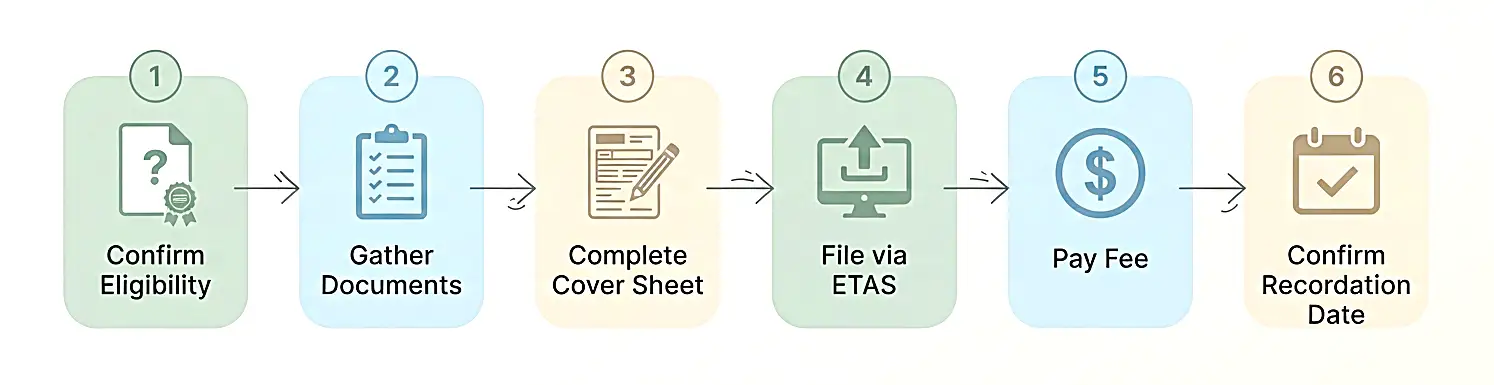
Step 1: Confirm the Assignment Is Eligible for Recordation
Before filing, confirm that the underlying transaction actually qualifies. Most assignments of registered marks or filed applications are eligible. However, there are exceptions:
- Intent-to-use applications generally cannot be assigned before an amendment to allege use or a statement of use is filed, except to a successor to the business.
- Assignments of extensions of protection under the Madrid Protocol (Section 66(a) applications) follow different rules and must first be recorded with the International Bureau, not directly with the USPTO.
Confirming eligibility upfront prevents wasted filing fees and rejected submissions later.
Step 2: Gather the Required Documentation
You will need:
- The conveyance document – the assignment agreement, merger document, or other instrument that shows the transfer of ownership.
- A completed cover sheet – either the USPTO’s standard Trademark Assignment Recordation Form or an equivalent that meets the regulatory requirements.
- Identifying numbers – every application serial number or registration number the assignment affects.
- Party information – full legal names and addresses of both the assignor and the assignee.
Under 37 C.F.R. § 3.31, a cover sheet must include a description of the interest conveyed or the type of transaction being recorded, such as an assignment, license, change of name, merger, or security agreement (Source: eCFR – 37 C.F.R. § 3.31). It must also list the application serial number or registration number for each affected mark. If that number is unknown, the submitter must provide a copy of the application or a reproduction of the mark together with the estimated filing date (Source: eCFR – 37 C.F.R. § 3.31).
Step 3: Complete the Cover Sheet
Every document submitted for recording must be accompanied by a cover sheet meeting the requirements of 37 C.F.R. §3.31, and only one set of documents and cover sheets should be filed per submission. The cover sheet must also identify the party to whom correspondence about the recordation should be sent, and it must be signed by the party submitting the document.
For electronic filings, the signer must either place a symbol made of letters, numbers, or punctuation marks between forward slashes in the signature block, or use another approved form of electronic signature.
Step 4: File Through ETAS (Recommended) or by Mail
New owners are encouraged to file recordation requests electronically through ETAS on the USPTO website because documents filed electronically are recorded much faster than paper submissions. Through ETAS, a party creates a Trademark Assignment Recordation Coversheet using online web forms and attaches the supporting legal documentation as a black-and-white TIFF or PDF file for submission over the internet.
If you prefer, or if circumstances require, paper filing is still an option, though it is slower. As of the USPTO’s modernization update, paper and fax assignment requests are now redirected to the EPAS and ETAS storefronts for digital submission, which means electronic filing has effectively become the standard path for most submitters.
Step 5: Pay the Recordation Fee
The official filing fee for recording a trademark assignment is $40.00 for the first application or registration covered, and $25.00 for each additional trademark owned by the same party in that submission. Fee schedules can change, so always confirm the current amount on the USPTO’s official fee page before filing.
Step 6: Confirm the Recordation Date and Review the Record
The recordation date is the date the USPTO actually receives a document that meets all the requirements for recording, and a document that fails to meet the identification requirements will not be recorded at all. If the USPTO returns your documents for correction, the recordation date shifts to the date the corrected version is received, provided it is resubmitted within the deadline stated in the deficiency letter.
Once processed, confirm the assignment appears correctly in the Assignment database, and if applicable, that the ownership field in the trademark record itself has updated.
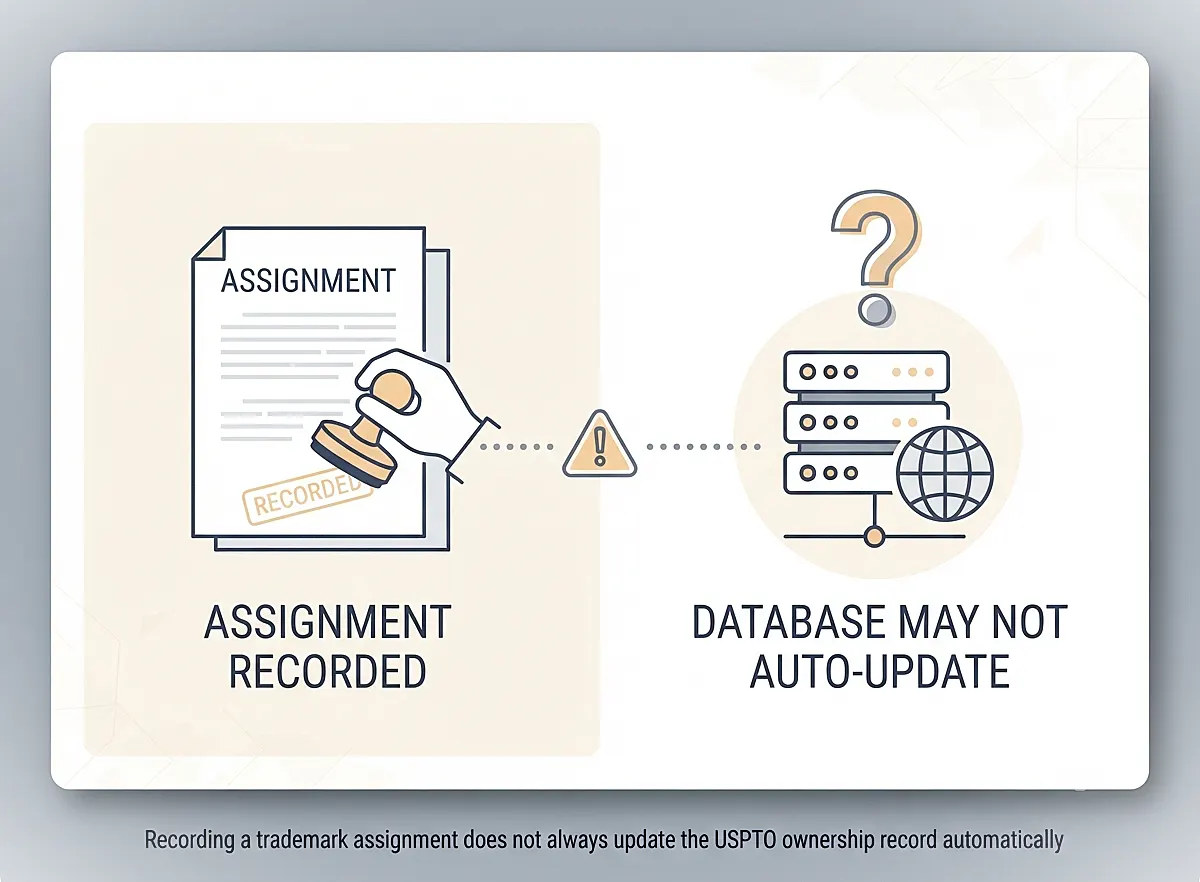
Important: Recordation Does Not Automatically Update Ownership
This is one of the most misunderstood aspects of the process. Recording a document with the Assignment Recordation Branch does not necessarily change or update the ownership of record shown in the Trademark database. There are specific circumstances in which the database updates automatically upon recordation of an assignment, change of name, or other title-transferring document, but it is not guaranteed in every case.
For active applications and registrations, it is smart practice to verify the owner field in the Trademark Status and Document Retrieval (TSDR) system after recordation, and to follow up with a request to update ownership if the change does not appear automatically.
Trademark Assignment Recordation at a Glance
| Item | Detail |
|---|---|
| Governing regulation | 37 C.F.R. Part 3 |
| Filing system | Electronic Trademark Assignment System (ETAS) |
| Filing fee (first mark) | $40.00 |
| Filing fee (each additional mark, same submission) | $25.00 |
| Deadline for priority protection | Within 3 months of execution, or before a later bona fide purchaser records |
| Processing office | Assignment Recordation Branch, Public Records Division |
| Accepted file formats | TIFF or PDF |
| Ownership update | Not automatic in all cases; must be verified separately |
Special Situations: Security Interests, Mergers, and International Marks
Not every filing is a straightforward sale of a mark from one company to another. A few special situations come up often enough that they deserve their own discussion.
Recording a Security Interest
When a trademark is pledged as collateral, lenders often want that security interest recorded to establish public notice of their claim. This is not technically an assignment of ownership, but the same Assignment Recordation Branch processes it, and the cover sheet’s “Nature of Conveyance” field should reflect a security agreement rather than an assignment. Getting this designation wrong can create confusion about who actually owns the mark versus who merely holds a lien against it.
Recording a Merger or Corporate Name Change
When two companies merge, or when a single company simply changes its legal name without any actual sale of assets, the underlying trademark ownership may need to be updated to reflect the surviving or renamed entity. These filings still go through the Assignment Recordation Branch, but the supporting documentation looks different. Instead of a purchase agreement,
filers typically submit:
- Articles of merger or a certificate of merger from the relevant state
- A certificate of name change from the secretary of state
- A board resolution confirming the corporate action, if requested
Assignments Involving International Registrations
The USPTO will only record assignments or other title documents for §66(a) applications and registered extensions of protection if that same change has already been recorded with the International Register, since Section 10 of the Trademark Act and 37 C.F.R. Part 3 do not apply directly to assignments of an international registration. This means that for marks obtained through the Madrid Protocol, the recordation sequence is reversed compared to a purely domestic filing: the change must go through the International Bureau first, and only then can it be reflected in the USPTO’s own records. Firms that manage global trademark portfolios need to build this extra step into their workflow, or ownership records can quickly fall out of sync across jurisdictions. Our guide on managing an international trademark portfolio goes into more detail on keeping multi-country filings aligned.
Electronic vs. Paper Filing: A Comparison
| Factor | Electronic Filing (ETAS) | Paper Filing |
|---|---|---|
| Processing speed | Faster, typically recorded within days | Slower, can take weeks |
| Format required | TIFF or PDF upload | Legible paper copy |
| Availability | Available 24/7 online | Now routed through EPAS/ETAS storefronts |
| Error correction | Easier to resubmit corrected files | Requires new mailed submission |
| Recommended for | Nearly all filers | Rare exceptions only |
Common Mistakes When Recording a Trademark Assignment
Even experienced filers make errors that delay recordation. Watch for these pitfalls.
- Missing or incorrect serial/registration numbers. If the number is wrong or missing and unknown, the USPTO requires a copy of the application or mark reproduction plus a filing date estimate, which slows everything down.
- Submitting an unsigned or improperly signed cover sheet. Electronic filings require the correct electronic signature format; a scanned wet signature alone will not suffice.
- Assuming ownership updates automatically. As noted above, this is not always true, and failing to confirm it can leave stale ownership data on the public record.
- Filing intent-to-use assignments too early. Assigning an ITU application before the required use-based filings, outside of a permitted successor-in-business transfer, can jeopardize the underlying application.
- Bundling unrelated transactions on one cover sheet. Each distinct transaction generally needs its own properly completed cover sheet to avoid processing rejections.
- Ignoring the three-month recordation window. Waiting too long exposes the assignee to the risk of losing priority to a later bona fide purchaser.
Expert Tips for a Smooth Trademark Assignment Recordation
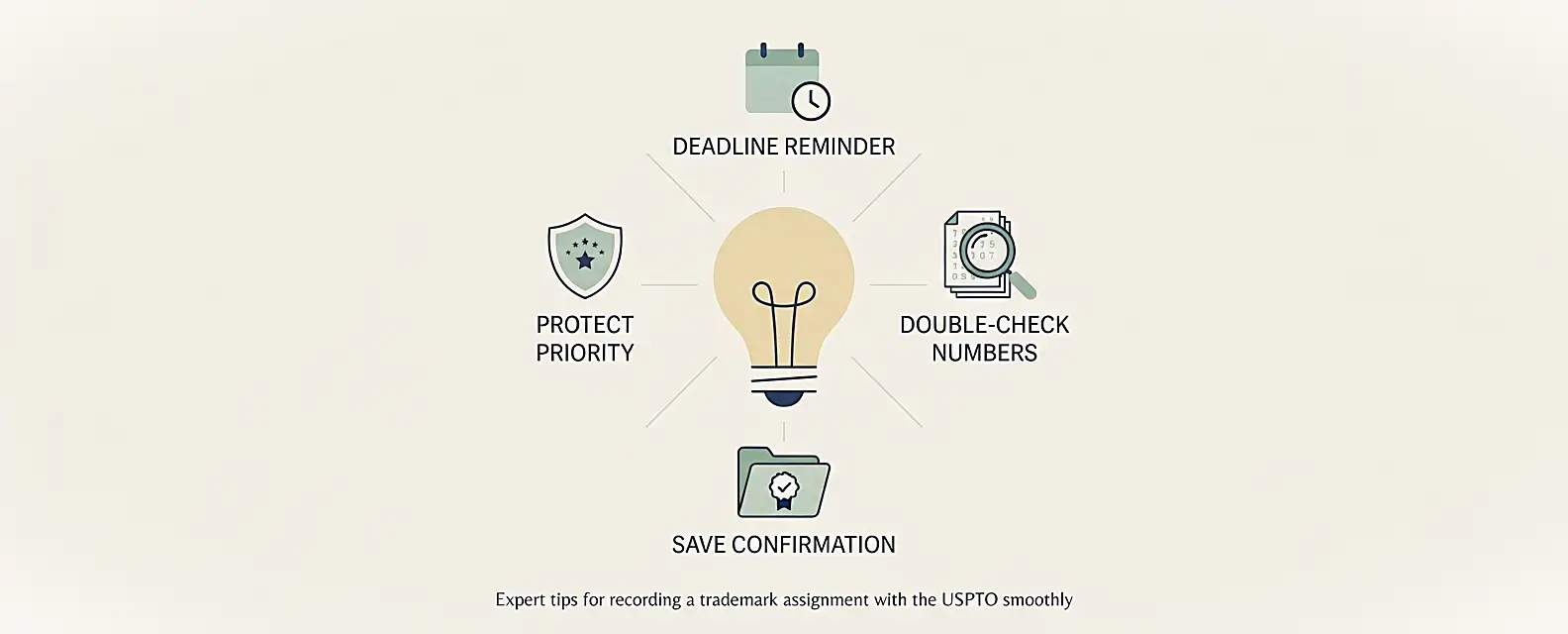
- File electronically whenever possible. ETAS is faster and reduces the risk of illegibility rejections.
- Double-check every serial and registration number before submission. A single typo can trigger a deficiency notice.
- Keep a docketed reminder for the three-month recordation window so priority protection is never at risk.
- Save the recordation confirmation and reel/frame number. You will need these for any future corrective filings.
- Verify TSDR ownership data after recordation. Do not assume the database updated automatically.
- Coordinate recordation with renewal and maintenance deadlines. An assignment recorded late can complicate Section 8 or Section 71 filings down the line. If you need a refresher on those deadlines, our article on when to file a trademark Section 8 and 15 affidavit covers the timing in detail.
- If an error occurs before recordation completes, act quickly. It may be possible to contact the Assignment Division to suspend recordation if the filing has not yet been processed. However, once an assignment is actually recorded, it generally will not be cancelled except in cases of USPTO error.
Correcting an Already-Recorded Assignment
Mistakes happen even after recordation. The USPTO does allow corrective filings. If corrective documents are filed electronically through ETAS, the filer should check the “Corrective Assignment” box in the Nature of Conveyance field and provide the identification of the parts needing correction, the reel and frame number of the original cover sheet, and the nature of the originally recorded conveyance.
Keep in mind that a corrective filing is not the same as a brand-new assignment. It is meant to fix clerical or documentation errors in an already-recorded transaction, not to reverse the underlying transfer of rights.
A Practical Walkthrough: Recording an Assignment After an Acquisition
To see how these rules apply in practice, consider a common scenario. A mid-size consumer products company acquires a smaller competitor, and that acquisition includes twelve registered trademarks and three pending applications. Here is how the recordation process typically unfolds:
- Due diligence confirms the trademark schedule. Before closing, the buyer’s counsel compiles a full list of every mark, along with its serial or registration number, class, and current owner of record.
- The asset purchase agreement includes an assignment clause. Rather than drafting fifteen separate assignment documents, many deals rely on the underlying purchase agreement itself, or a short-form trademark assignment exhibit, as the conveyance document.
- A single cover sheet lists all affected marks where possible. Because all fifteen marks are transferring from the same assignor to the same assignee in one transaction, they can often be recorded together, which reduces the per-mark fee to $25.00 after the first.
- The filing goes through ETAS. The paralegal handling the matter uploads the purchase agreement’s assignment exhibit as a PDF and completes the online cover sheet with each serial and registration number.
- The team docket a follow-up review. Two to three weeks after filing, someone checks TSDR to confirm the owner of record has updated for each mark, and flags any that have not for manual follow-up with the Assignment Recordation Branch.
This kind of coordinated approach, where the recordation filing is planned alongside the broader transaction timeline, is exactly where experienced trademark paralegal support pays for itself. A single missed serial number or an incorrectly dated purchase agreement can delay recordation by weeks, which matters if a competing claim or a licensing dispute is on the horizon.
Why Timely Recordation Matters for Portfolio Health
Trademark assignment recordation is rarely an isolated task. It sits alongside a broader set of docketing and portfolio management responsibilities, and treating it as an afterthought creates downstream problems. A few examples:
- Renewal filings depend on accurate ownership data. Section 8 and Section 71 declarations of use must be filed by the actual current owner. If the USPTO’s records still show the previous owner, this can create complications or require additional documentation to resolve.
- Office Action responses reference the applicant or registrant of record. If ownership has changed but was never recorded, responses may need to address the discrepancy before substantive issues can even be reached.
- Licensing and enforcement actions rely on a clean chain of title. A gap in the public record, where an assignment was never recorded, can complicate efforts to enforce the mark against infringers or to license it to third parties with confidence.
- Portfolio audits take longer when ownership records are inconsistent. Every unrecorded or incorrectly recorded assignment adds time and cost to any future audit, sale, or licensing review.
Building trademark assignment recordation into a firm’s standard docketing checklist, right alongside renewal deadlines and Office Action due dates, keeps portfolios clean and avoids these downstream headaches.
Who Should Handle Trademark Assignment Recordation?
Many law firms and corporate legal departments outsource this work to experienced trademark paralegals who file assignments daily and know exactly how the Assignment Recordation Branch reviews submissions. This reduces the risk of costly rejections and keeps ownership records accurate across large portfolios. If your team is weighing whether to build this capacity in-house or bring in outside support, our comparison of in-house versus virtual patent paralegal support walks through the tradeoffs, and the same logic applies well to trademark-side staffing decisions.
For portfolios with frequent ownership changes, pairing assignment recordation with strong trademark docketing practices ensures that the three-month recordation window, renewal deadlines, and Office Action responses never conflict with each other.
Staying Current as USPTO Processes Evolve
The USPTO periodically updates how it accepts and processes assignment filings. The agency has moved toward accepting all Assignment Recordation and Examination requests through its online EPAS and ETAS storefronts, with paper and fax requests redirected to those same digital portals. This kind of modernization generally makes the process faster and more consistent, but it also means that filers who are used to older paper-based workflows need to adjust.
For firms managing large or fast-moving portfolios, the safest approach is to treat trademark assignment recordation as a living process rather than a one-time checklist. That means:
- Reviewing the USPTO’s official assignment resources periodically for procedural updates
- Training new paralegals on the current ETAS interface rather than outdated screenshots
- Keeping a running log of reel and frame numbers for every recorded transaction, so corrective filings are easy to locate later
- Confirming fee amounts before every submission, since USPTO fee schedules are subject to change
A little diligence here goes a long way toward avoiding rejected filings, wasted fees, and delayed ownership updates.
Frequently Asked Questions
How do you record a trademark assignment with the USPTO?
You record a trademark assignment with the USPTO by submitting a completed cover sheet along with the underlying conveyance document through ETAS, then paying the applicable recordation fee. The Assignment Recordation Branch reviews the submission and records it once all identification requirements are met.
How much does it cost to record a trademark assignment with the USPTO?
The official fee is $40.00 for the first application or registration and $25.00 for each additional mark owned by the same party submitted at the same time. Always confirm current fees on the USPTO’s official site before filing, since fee schedules can be updated.
How long does it take to record a trademark assignment with the USPTO?
Electronic filings through ETAS are typically processed much faster than paper submissions, often within days, while paper filings can take significantly longer.
Does recording a trademark assignment automatically change the owner of record?
Not always. Recordation and the database’s ownership field are handled separately in some circumstances, so it is important to verify the owner field in TSDR after filing and follow up if it has not updated.
What happens if I do not record a trademark assignment with the USPTO?
An unrecorded assignment can be voided against a later bona fide purchaser who acquires the mark without notice of the earlier transfer, if that later purchaser records first. Recording promptly within the required window protects the assignee’s priority.
Can I correct a mistake after the assignment has already been recorded?
Yes. You can file a corrective assignment through ETAS, referencing the reel and frame number of the original recordation and identifying exactly what needs to be fixed.
Conclusion
Learning how to record a trademark assignment with the USPTO comes down to preparation, precision, and timing. Gather the right documents, complete the cover sheet correctly, file electronically through ETAS, pay the correct fee, and confirm that both the recordation and the ownership record reflect the change accurately. Skipping any of these steps, or waiting too long to record a trademark assignment with the USPTO, can put a client’s brand rights at risk.
For firms and IP departments managing high volumes of ownership changes, renewals, and Office Actions at once, having an experienced team handle trademark assignment recordation can make the difference between a clean record and a costly dispute. Teak IP Services works alongside attorneys and corporate IP departments every day to keep portfolios accurate, deadlines docketed, and filings error-free.

