
Missing a single trademark deadline can cost your client their registration, open a brand to infringement, or trigger costly legal disputes. For IP professionals, the stakes of poor docketing management are never abstract. They translate directly into lost rights and damaged trust. That is why knowing how to prevent missed deadlines in trademark docketing is not a nice-to-have skill; it is a core professional responsibility. Whether you manage a boutique IP practice or a large firm with thousands of active marks, the principles remain the same: strong systems, consistent processes, and the right technology working together.

In this guide, we walk you through every proven strategy, common pitfall, and practical tool you need to keep your trademark docket airtight.
Why Missed Trademark Deadlines Are So Dangerous
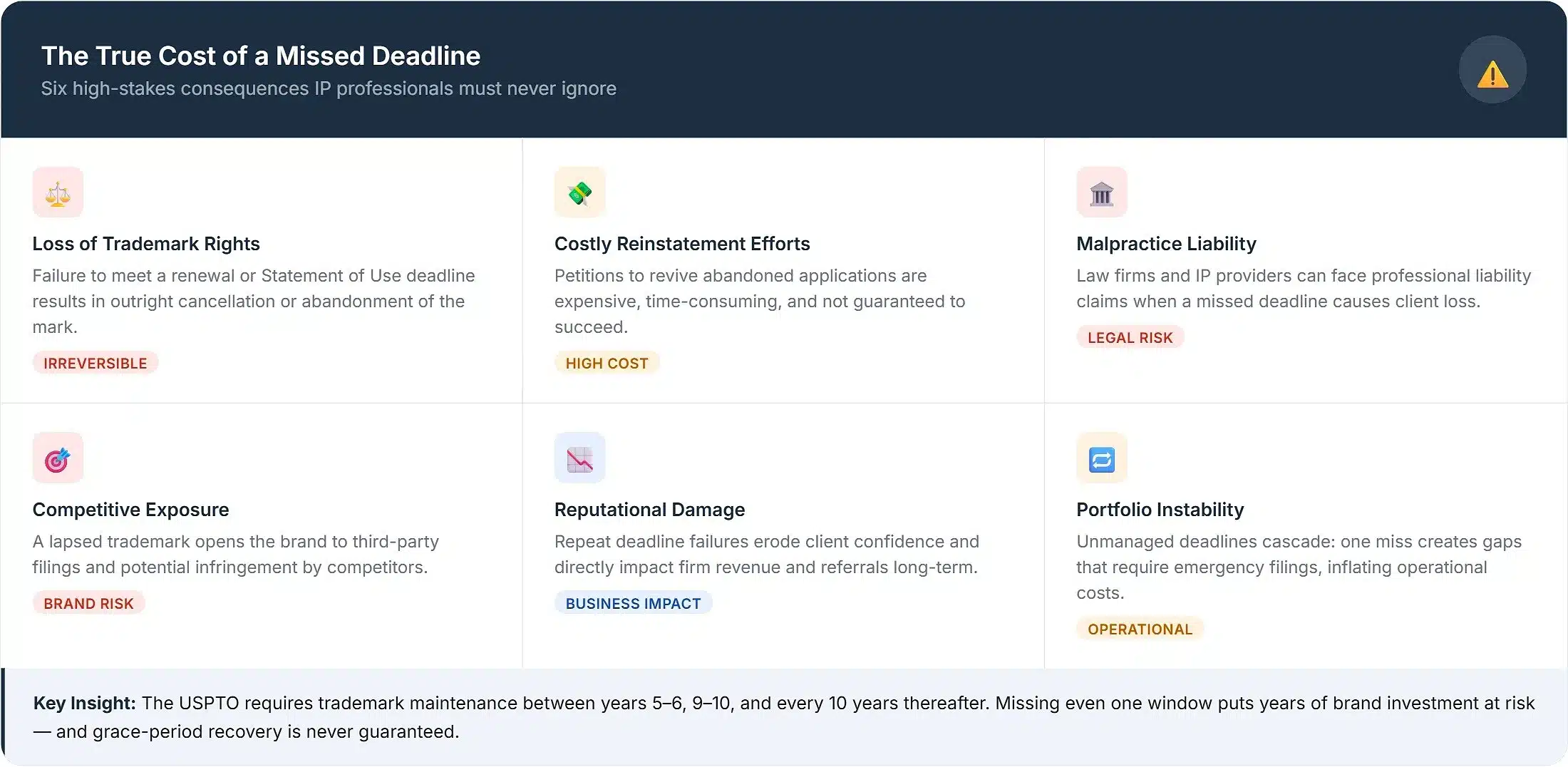
Before exploring solutions, it helps to understand the full cost of a missed deadline. The consequences go well beyond a simple administrative error.
Key risks of a missed trademark deadline include:
- Loss of trademark rights: Missing a renewal or Statement of Use deadline can result in the cancellation or abandonment of a mark entirely.
- Costly reinstatement efforts: Petitions to revive an abandoned application are expensive and not always successful.
- Client liability: Law firms and IP service providers can face malpractice claims if a missed deadline causes a client to lose trademark protection.
- Competitive exposure: A lapsed trademark can leave a brand vulnerable to third-party filings and infringement.
- Damage to professional reputation: Repeat deadline failures erode client confidence and can affect firm revenue long-term.
According to the United States Patent and Trademark Office (USPTO), trademark owners must meet specific maintenance and renewal deadlines between the 5th and 6th year, the 9th and 10th year, and every 10 years thereafter. Missing any of these windows puts a registration at serious risk.
The Most Common Causes of Missed Deadlines in Trademark Docketing
Understanding why deadlines get missed is the first step toward preventing them. Most deadline failures come down to a handful of recurring problems.
1. Manual and Outdated Docketing Systems
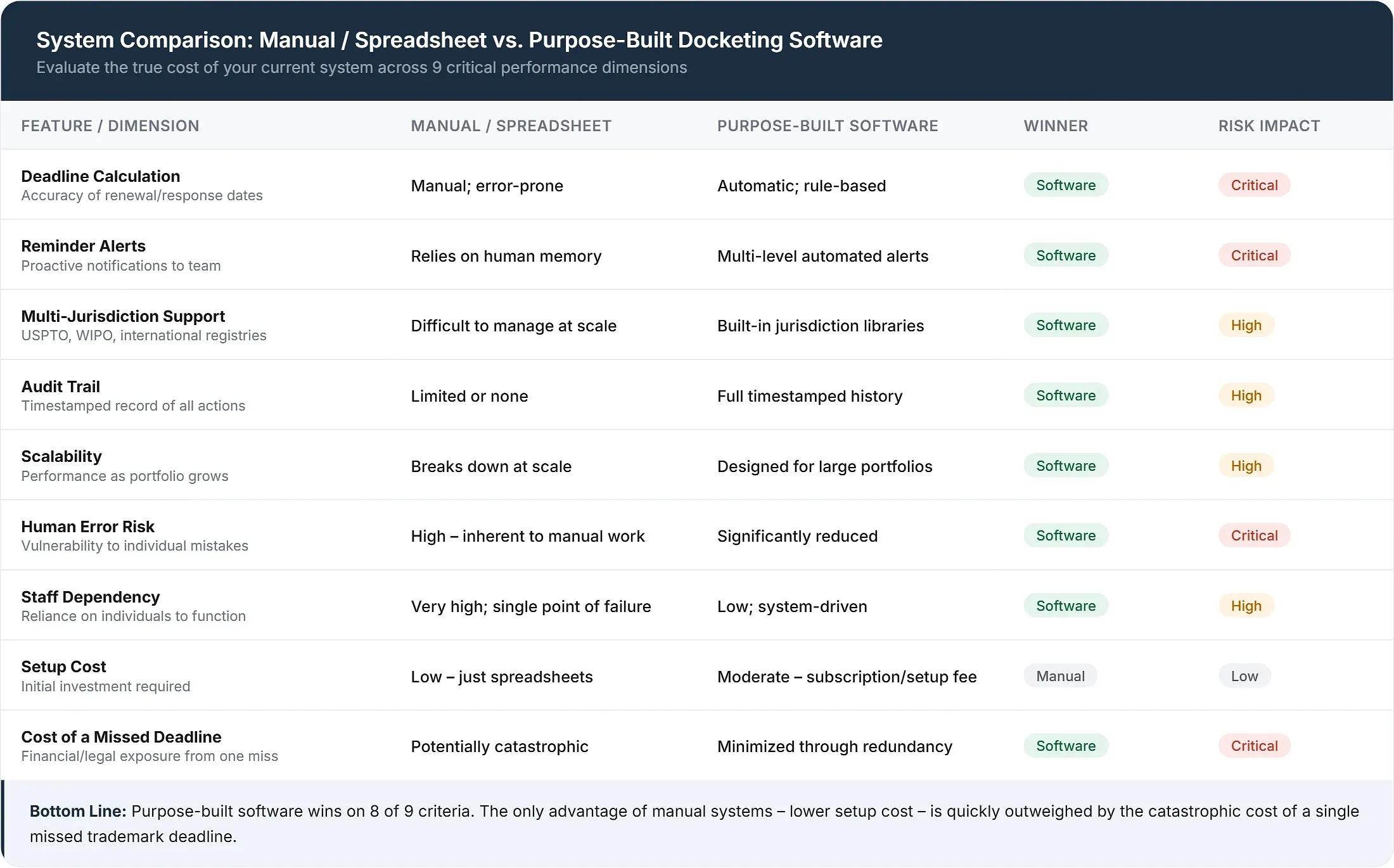
Many firms still rely on spreadsheets or basic calendar tools to track trademark deadlines. These systems lack automated alerts, are prone to human error, and do not scale well as a portfolio grows.
2. Poor Communication Between Team Members
When multiple attorneys or paralegals share a docket without clear ownership, critical deadlines can fall through the cracks. No one assumes responsibility, and no one notices the gap in time.
3. Inadequate Redundancy
A single-point-of-failure system is dangerous. If the one person who manages a docket is unavailable due to illness, travel, or departure, deadlines can be missed before anyone realizes what has happened.
4. Incomplete or Inaccurate Data Entry
Incorrect filing dates, wrong jurisdiction codes, or missing matter numbers can cause automated systems to generate wrong reminder dates, rendering even sophisticated software ineffective.
5. Lack of a Formal Deadline Review Process
Without a structured review routine, no one is regularly auditing the docket to catch upcoming deadlines before they become urgent.
For a deeper look at how docketing systems function and where they break down, the complete trademark docketing guide from Teak IP is an excellent starting point.
Proven Strategies to Prevent Missed Deadlines in Trademark Docketing
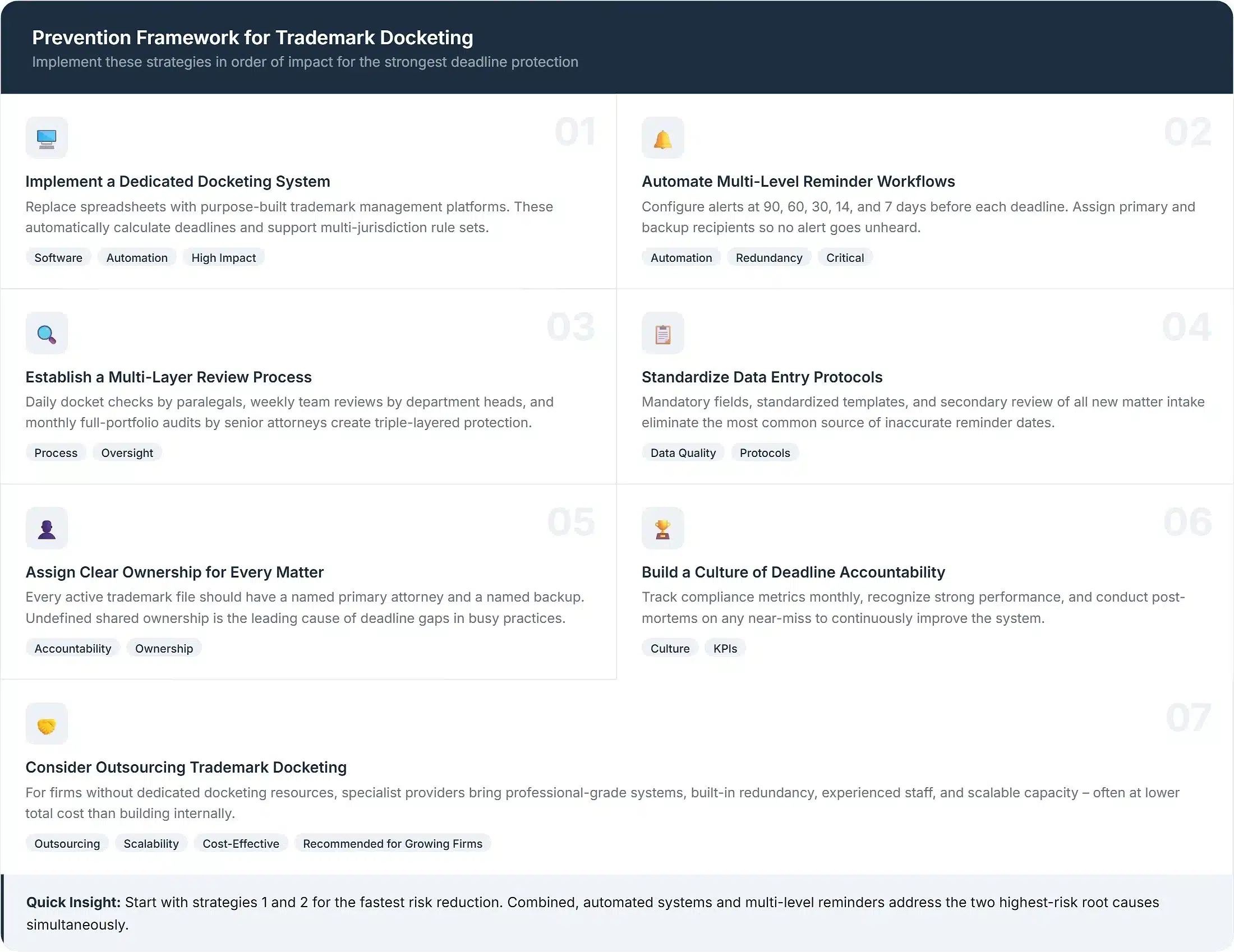
Now that we have identified the root causes, here are the most effective strategies IP professionals use to prevent trademark deadline failures.
Strategy 1: Implement a Dedicated Trademark Docketing System
The most impactful change any IP firm can make is moving away from manual tracking to a purpose-built trademark docketing system. These platforms are designed specifically to manage the complex lifecycle of trademark rights, including multi-jurisdiction timelines, renewal windows, and office action deadlines.
Core features to look for in a docketing system:
- Automatic deadline calculation based on filing dates and jurisdiction rules
- Multi-level reminder alerts (90 days, 60 days, 30 days, 7 days before a deadline)
- Integration with USPTO, WIPO, and other official trademark databases
- Audit trails for every action taken on a matter
- Role-based access so the right people receive the right alerts
Strategy 2: Automate Your Reminder Workflows
Automation is one of the most powerful tools available to prevent missed deadlines in trademark docketing. Rather than relying on someone to remember to check the docket, automated workflows push reminders to attorneys, paralegals, and clients at pre-set intervals.
According to WIPO’s trademark administration guidance, many trademark deadlines under international registration systems carry strict timelines with limited grace periods. Automation removes the risk of human forgetfulness from this equation.
Learn more about how automated trademark docketing can transform deadline management for your practice.
Benefits of automated reminders:
- Consistent alerts regardless of staff availability
- Multi-channel notifications via email, SMS, or in-platform alerts
- Escalation protocols when primary contacts do not respond
- Time-stamped records for compliance and audit purposes
Strategy 3: Establish a Multi-Layer Review Process
Even the best automated system needs human oversight. A multi-layer review process ensures that no deadline slips past unnoticed.
A practical three-tier review model:
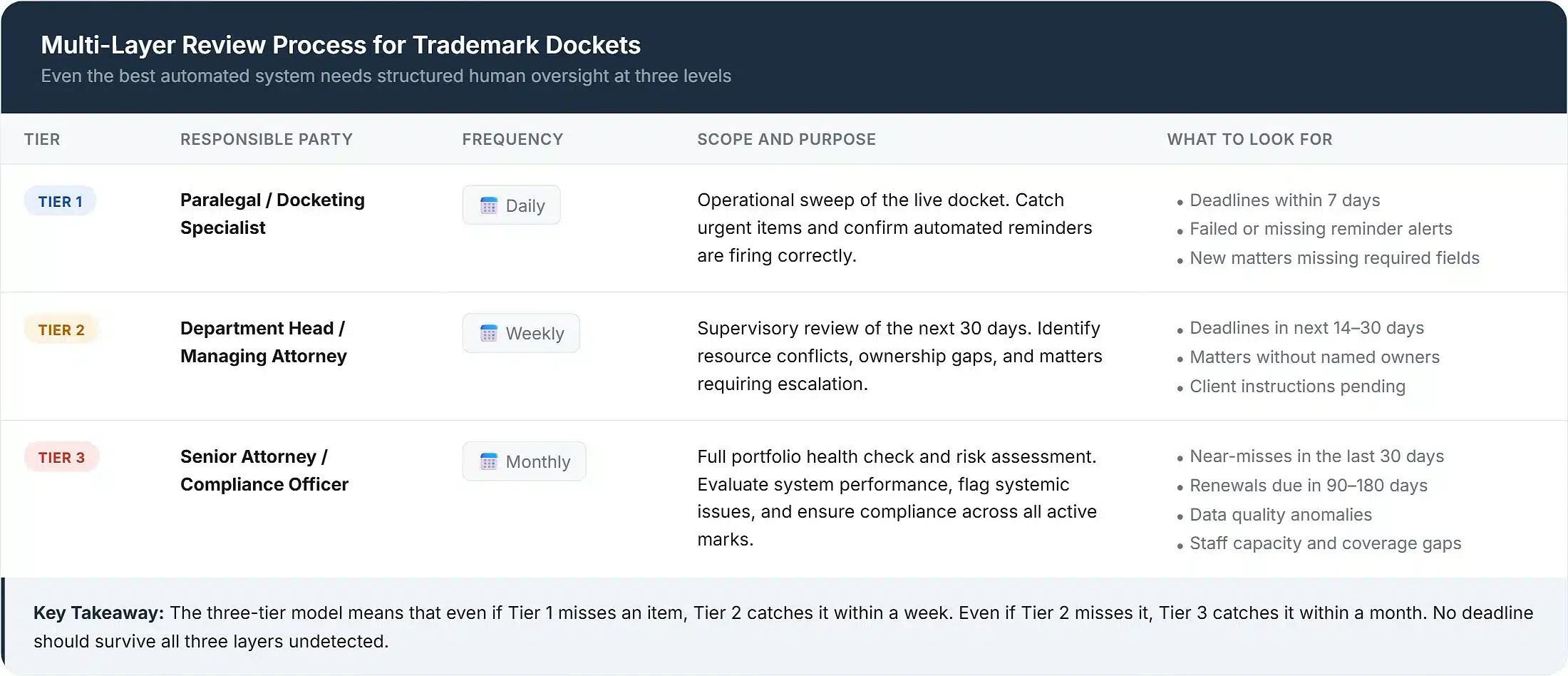
This layered model means that even if one tier misses something, another tier is positioned to catch it before the deadline arrives.
Strategy 4: Standardize Data Entry Protocols
Garbage in, garbage out: if data is entered incorrectly, your docketing system will generate incorrect reminders. Standardizing how your team enters and verifies data is critical.
Best practices for data entry in trademark docketing:
- Use standardized templates for every new matter
- Require mandatory fields for filing date, renewal date, and jurisdiction
- Implement a secondary review step for all new matter intake
- Cross-reference entries against official USPTO or WIPO records
- Conduct regular data quality audits at least quarterly
For a structured approach to data integrity and workflow design, review the legal docketing workflow guide developed for IP and trademark professionals.
Strategy 5: Assign Clear Ownership for Every Matter
Every trademark matter should have a named responsible attorney and a named responsible docketing professional. Shared ownership without defined accountability is a recipe for overlooked deadlines.
Ownership best practices include:
- Assign a primary and a backup contact for every active matter
- Document ownership in your docketing system so it is visible to the whole team
- Update ownership records immediately when staff changes occur
- Ensure backup contacts receive all the same deadline reminders as primary contacts
Strategy 6: Create a Culture of Deadline Accountability
Systems and processes only work if the people using them take deadlines seriously. Building a culture of accountability means making deadline compliance a visible priority at every level of the organization.
Ways to reinforce deadline accountability:
- Track and report on deadline compliance metrics monthly
- Recognize and reward consistent deadline performance
- Conduct post-mortems on any near-miss or actual miss to identify root causes
- Make deadline training part of onboarding for new legal staff
For broader best practices in managing IP portfolios, the IP docketing best practices guide offers a comprehensive framework.
Strategy 7: Consider Outsourcing Your Trademark Docketing
For firms that lack dedicated docketing resources, outsourcing can be an effective way to ensure professional-grade deadline management without the overhead of building an internal team.
Specialized docketing service providers bring:
- Deep expertise in trademark lifecycle management
- Purpose-built systems already configured for USPTO and international deadlines
- Scalable capacity that adjusts to your portfolio size
- Continuity coverage during staff transitions or vacations
If your firm is evaluating this option, the detailed resource on reasons to outsource trademark docketing outlines the key factors to weigh.
Trademark Docketing Deadline Comparison: Manual vs. Automated Systems
How Large Firms Manage Trademark Docketing at Scale
Large IP practices face unique challenges around deadline management because their portfolios can span hundreds or thousands of active marks across multiple jurisdictions. The strategies that work for a small boutique firm need significant reinforcement at enterprise scale.
Key approaches used by large firms include:
- Centralized docketing teams: Dedicated docketing specialists who do nothing but manage IP deadlines across the firm’s portfolio.
- Enterprise docketing platforms: Purpose-built software with multi-office functionality, role-based access, and global jurisdiction rule sets.
- Client portal integration: Real-time visibility for clients so they can see their trademark status without calling the firm.
- Regular technology audits: Ensuring the docketing system is configured correctly and updated to reflect any changes in trademark law or procedure.
For more detail on how large IP practices structure their docketing operations, see the guide on patent and trademark docketing for large firms.
Step-by-Step: Setting Up a Deadline Prevention System for Your Practice
Whether you are starting from scratch or improving an existing system, follow these steps to build a robust deadline prevention framework.
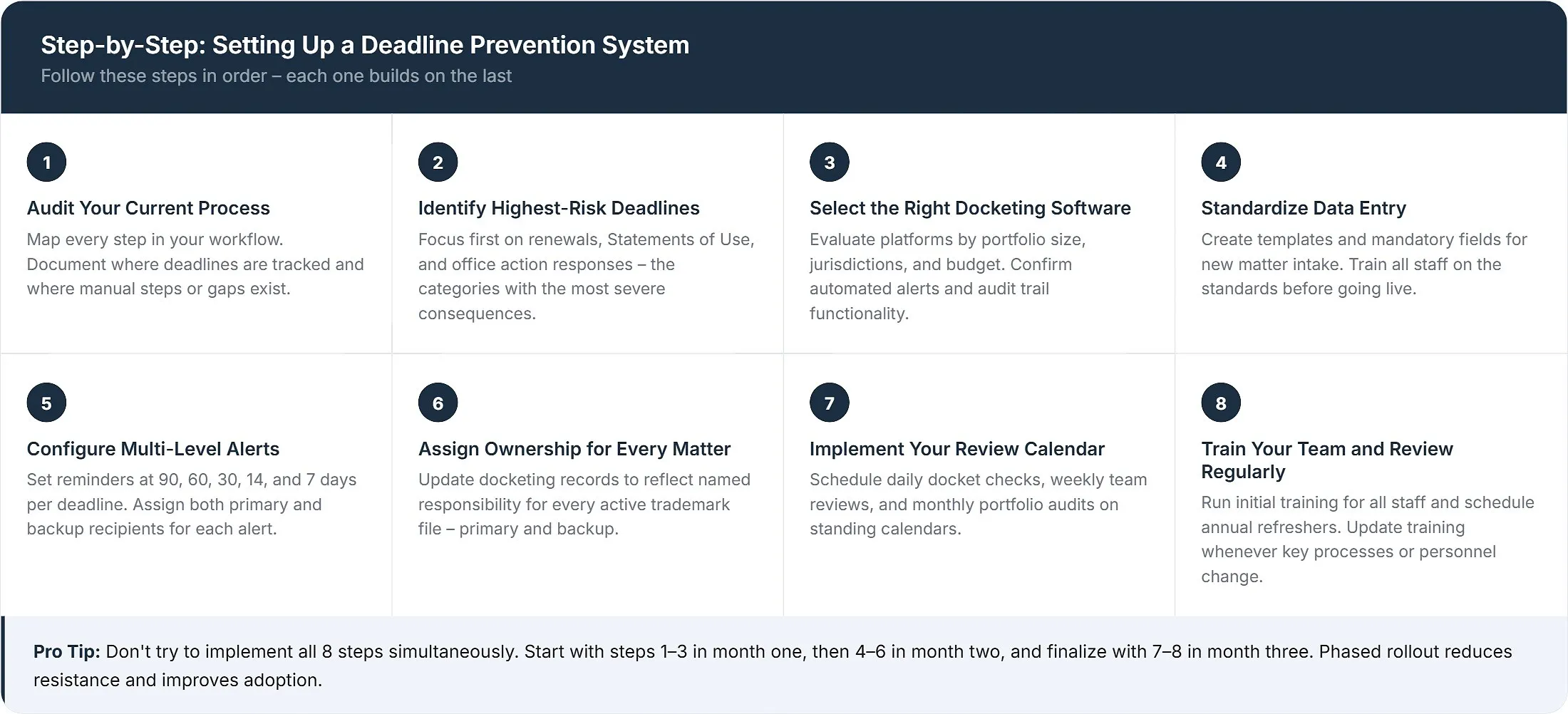
Step 1: Audit your current docketing process. Document every step in your current workflow, identify where deadlines are tracked, and note where gaps or manual steps exist.
Step 2: Identify your highest-risk deadline categories. Focus first on renewal deadlines, Statements of Use, and response deadlines to office actions, as these carry the most severe consequences when missed.
Step 3: Select the right docketing software. Evaluate platforms based on your portfolio size, jurisdictions, and budget. Ensure the system supports automated reminders and audit trails.
Step 4: Standardize your data entry process. Create templates and required fields for new matter intake. Train all staff on the standards before going live.
Step 5: Configure multi-level reminder alerts. Set reminders at 90, 60, 30, 14, and 7 days before each critical deadline. Assign both a primary and a backup recipient for each alert.
Step 6: Assign ownership for every matter. Update your docketing records to reflect named responsibility for every active trademark file.
Step 7: Implement your review calendar. Schedule daily docket checks, weekly team reviews, and monthly portfolio audits. Put these on standing calendars for the whole team.
Step 8: Train your team and review regularly. Conduct initial training on all new processes and schedule refresher training annually or whenever key staff changes occur.
For a broader framework covering intellectual property docketing across your entire practice, the intellectual property docketing guide provides an excellent reference.
Common Mistakes That Lead to Missed Trademark Deadlines
Even well-organized teams make predictable mistakes. Knowing these patterns helps you design systems that prevent them.
- Relying on client reminders: Never assume a client will remember to prompt you about an upcoming deadline. The responsibility belongs to the professional managing the docket.
- Failing to update records after staff changes: When a paralegal or attorney leaves, their matters must be immediately reassigned and all docketing records updated.
- Using deadline buffers as actual deadlines: Building in a buffer is smart, but treating a buffer date as the final deadline can create false confidence. Always track the true statutory deadline alongside any internal buffer.
- Ignoring grace periods as a safety net: Grace periods exist as a last resort, not as planned workflow stages. USPTO guidance makes clear that reliance on grace periods increases risk and cost significantly.
- Not verifying official records: Docketing entries should always be cross-checked against official database records. Errors in internal records that contradict official filings can cause serious problems.
Expert Tips from IP Docketing Professionals
Professionals who specialize in trademark docketing have developed practical wisdom that goes beyond standard best practices.
- “Set your earliest possible reminder, not your latest.” Starting reminders at 90 days gives you room to handle complications without panic.
- “Treat every deadline as if there is no grace period.” This mindset eliminates complacency and ensures every deadline receives full attention.
- “Review your docket before and after every holiday period.” Deadlines that fall near holidays are frequently missed because teams are distracted. A pre-holiday audit is a simple but powerful safeguard.
- “Document every decision, not just every action.” If you decide to extend a deadline or take a different approach, record the reasoning. Audit trails protect you in malpractice situations.
- “Test your reminder system with real deadlines during onboarding.” Do not assume new software is configured correctly. Verify that alerts are actually being sent and received.
A Proactive Approach to Prevent Missed Deadlines in Trademark Docketing
The most effective way to prevent missed deadlines in trademark docketing is to treat deadline management as a system, not an individual effort. No single person, no matter how experienced, should be the sole guardian of a firm’s trademark compliance.
Strong systems combine purpose-built docketing technology, standardized processes, clear ownership, and a culture of accountability. When these elements work together, missed deadlines become the exception rather than an ever-present risk.
The good news is that the tools and strategies described in this guide are accessible to practices of every size. Whether you manage 20 marks or 20,000, the same core principles apply: automate where you can, document everything, review regularly, and never rely on memory alone.
For firms ready to take their docketing practice to the next level, exploring a complete docketing system guide is a productive next step.
Frequently Asked Questions: Prevent Missed Deadlines in Trademark Docketing
Q1: What is the most common reason IP firms miss trademark deadlines?
The most common reason is reliance on manual tracking systems such as spreadsheets or basic calendars, which are prone to human error and do not scale with portfolio growth. Without automated reminders and structured review processes, critical deadlines can easily be overlooked.
Q2: How can I prevent missed deadlines in trademark docketing for a large portfolio?
For large portfolios, the most effective approach is a dedicated docketing platform with automated multi-level reminders, a centralized docketing team, and a tiered review process. Enterprise-grade systems are designed to handle thousands of active marks across multiple jurisdictions simultaneously.
Q3: What deadlines in trademark docketing are most critical to track?
The most critical deadlines include the Section 8 Declaration of Use (between years 5 and 6), Section 9 Renewal (at the 10-year mark), Statement of Use deadlines after a Notice of Allowance, and response deadlines for USPTO office actions. Missing any of these can result in cancellation or abandonment of a mark.
Q4: Can outsourcing trademark docketing help prevent missed deadlines?
Yes. Outsourcing to a specialized docketing provider gives you access to professional-grade systems, experienced staff, and built-in redundancy. It is especially effective for firms that do not have the resources to build a dedicated internal docketing team.
Q5: How many reminder alerts should be set for a trademark deadline?
Best practice is to set reminders at multiple intervals: 90 days, 60 days, 30 days, 14 days, and 7 days before the deadline. Each reminder should go to both a primary and a backup contact to ensure coverage if one recipient is unavailable.
Q6: What role does data quality play in preventing missed trademark deadlines?
Data quality is fundamental. If filing dates, renewal dates, or jurisdiction codes are entered incorrectly, even the best docketing software will generate wrong reminders. Standardized data entry protocols, mandatory field requirements, and regular audits are essential for maintaining accurate records.
Q7: Is it possible to recover from a missed trademark deadline?
In some cases, yes: USPTO provides petition processes to revive abandoned applications, but these are expensive, time-consuming, and not guaranteed to succeed. Prevention is always far more cost-effective than recovery. Additionally, not all jurisdictions offer revival options, so the consequences of missing a deadline can be permanent.
Q8: How often should a trademark docket be audited?
At a minimum, a daily check for urgent items, a weekly review of the next 30 days of deadlines, and a comprehensive monthly portfolio audit are recommended. For large portfolios or firms operating in multiple jurisdictions, more frequent review cycles may be appropriate.
Take the Next Step: Protect Your Trademark Portfolio with Teak IP
Deadline management should never be a source of stress for your practice or your clients. At Teak IP, we specialize in professional trademark docketing services designed to eliminate missed deadlines, reduce risk, and give IP professionals complete confidence in their portfolio management.
Whether you need a full docketing solution, expert support for a growing portfolio, or guidance on implementing better systems, our team is ready to help.
Contact Teak IP today to learn how we can support your trademark docketing needs and help you build a deadline-proof practice.
Professional Docketing & IP Management Services for Law Firms and Corporate IP Teams

