
Discover everything you need to know about trademark docketing systems – what they are, how they work, key features to look for, and how to choose the right system for your IP practice. A complete guide by Teak IP Services.
Every year, thousands of trademark applications lapse, renewals are missed, and valuable brand rights are lost – not because attorneys didn’t care, but because the deadlines simply slipped through the cracks of an overwhelmed manual process.
In today’s fast-paced intellectual property landscape, managing trademarks across multiple jurisdictions, clients, and deadlines has become extraordinarily complex. For IP practices looking to eliminate missed deadlines and streamline portfolio oversight, professional trademark docketing services offer a proven alternative to managing complex docketing obligations in-house.

Whether you run a solo IP practice, a mid-sized law firm, or an in-house legal team managing a global brand portfolio, the right trademark docketing system is no longer optional – it’s mission-critical infrastructure.
This guide walks you through everything you need to know: what trademark docketing systems are, why they matter, what features to prioritize, how leading platforms compare, and how to implement one effectively in your practice.
What is a Trademark Docketing Systems?
A trademark docketing systems is a specialized software platform – or structured process – designed to track, manage, and organize all deadlines, filings, correspondence, and status updates associated with trademark applications and registrations.
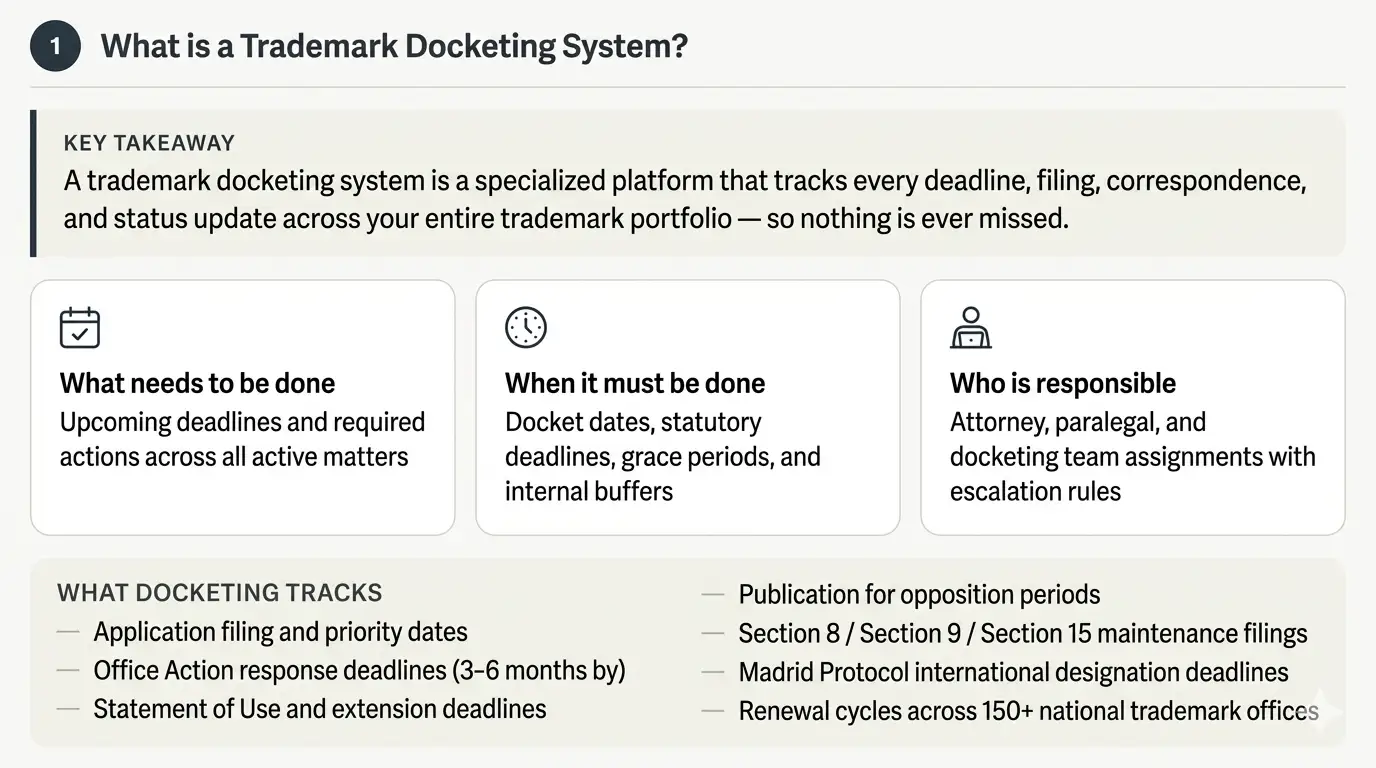
Think of it as the command center for your entire trademark portfolio. It captures critical information about each mark, generates deadline alerts, stores prosecution history, and ensures nothing falls through the cracks.
At its core, a trademark docketing system answers three essential questions at all times:
- What needs to be done? (upcoming deadlines, required actions)
- When does it need to be done? (docket dates, grace periods, statutory deadlines)
- Who is responsible for it? (attorney, paralegal, docketing team)
What Does “Docketing” Actually Mean in the Trademark Context?
In intellectual property, “docketing” refers to the systematic recording of legal events, deadlines, and required actions arising from the prosecution and maintenance of IP rights. For trademarks specifically, this includes:
- Application filing dates and priority dates
- Office Action response deadlines (typically 3 or 6 months from the date of the action, depending on jurisdiction)
- Statement of Use (SOU) / Extension of Time deadlines
- Publication for opposition periods
- Opposition and cancellation proceeding deadlines
- Renewal deadlines (Section 8 Declarations, Section 9 Renewals in the U.S.; national renewal cycles internationally)
- Section 15 Incontestability filings
- Madrid Protocol designation deadlines
- Proof of use requirements across various jurisdictions
Each of these events carries its own deadline, often with multiple internal and external due dates – making manual management both error-prone and unsustainable.
Also, Read: Legal Docketing Workflow: The Complete Guide for IP, Patent & Trademark Professionals
Why Trademark Docketing Systems Are Essential
Missing a trademark deadline is not a minor administrative error. It can have severe, often irreversible consequences:
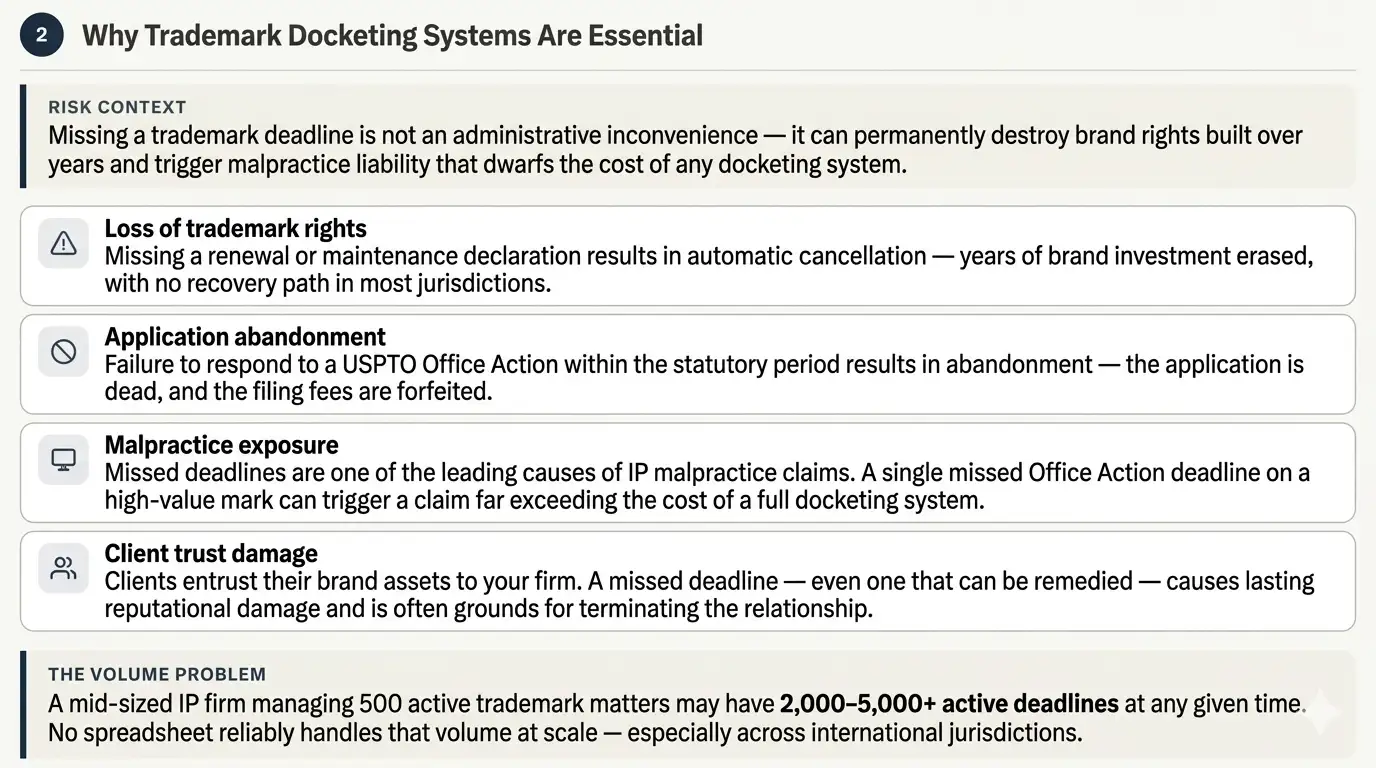
The Stakes Are High
- Loss of trademark rights: Missing a renewal or use deadline can result in cancellation of the registration – wiping out years of brand investment.
- Loss of priority claims: A missed response to a USPTO Office Action means abandonment of the application.
- Malpractice liability: For law firms, missed deadlines represent one of the most common sources of malpractice claims in IP practice.
- Loss of opposition windows: Failing to monitor and act within opposition periods can allow conflicting marks to register unchallenged.
- Client relationship damage: Missed deadlines erode client trust, sometimes irreparably.
The Volume Problem
Consider a mid-sized IP firm managing 500 active trademark matters. Each matter may have:
- 3–5 prosecution deadlines during the application phase
- Annual or biennial maintenance windows post-registration
- Monitoring watch deadlines
- International filing deadlines tied to U.S. applications
That’s potentially 2,000–5,000+ active deadlines at any given time. No spreadsheet, no matter how sophisticated, can reliably manage that volume at scale without significant risk.
The Multi-Jurisdictional Complexity
Trademark rights are territorial. A global brand must maintain registrations in every market where protection is desired. Each country has:
- Its own filing system and procedures
- Its own renewal cycle (ranging from 7 to 15 years depending on the country)
- Its own use requirements and maintenance obligations
- Different grace period rules
A robust trademark docketing system handles this complexity systematically, ensuring country-specific rules are applied correctly to every matter.
Also, Read: Outsource Trademark Docketing: Strong Reasons to Consider
Key Challenges Without a Dedicated Trademark Docketing Systems
Before investing in a docketing system, many IP teams rely on a patchwork of tools – spreadsheets, calendar reminders, email folders, and manual checklists. Here’s why that approach breaks down:
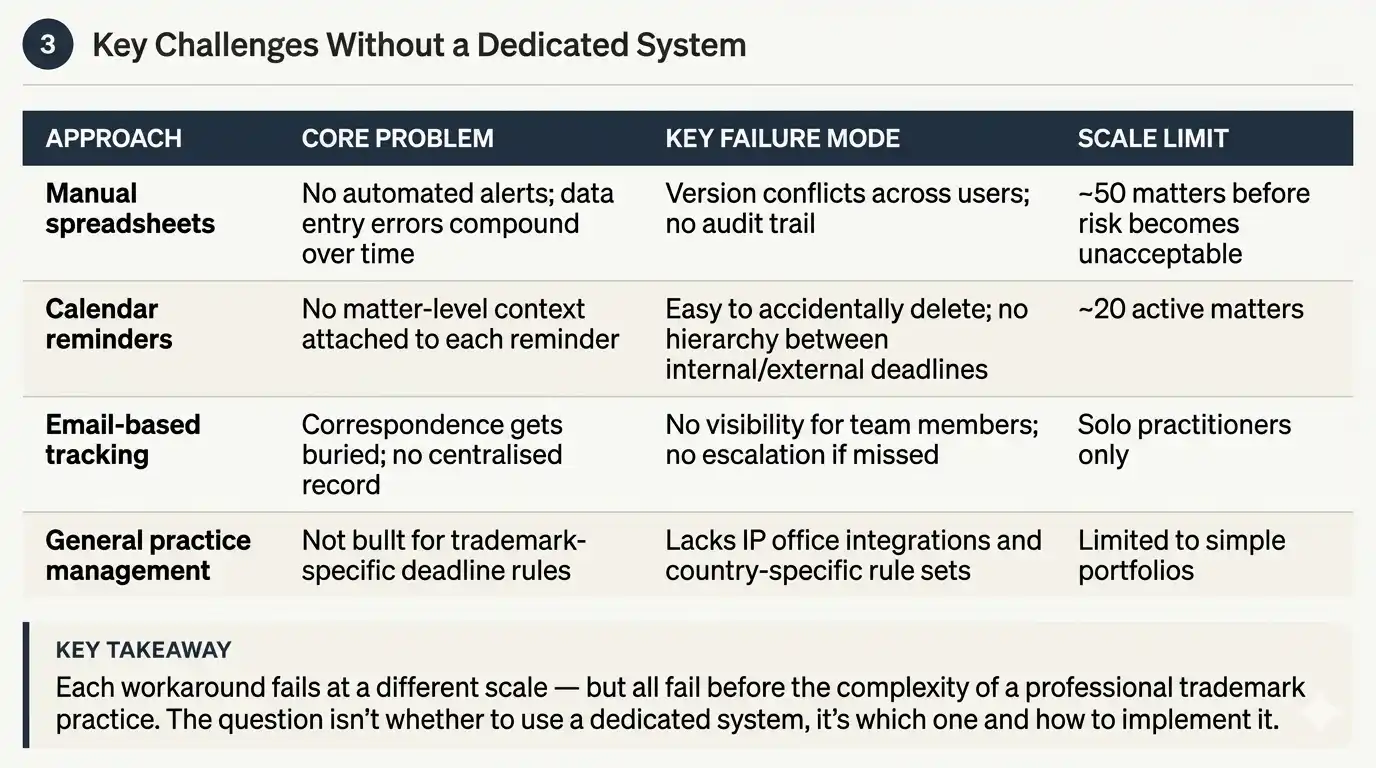
Manual Spreadsheets
- Prone to data entry errors
- No automated alerts or reminders
- Difficult to scale beyond a small portfolio
- No audit trail
- Version control issues when multiple users access the same file
- Cannot integrate with USPTO or WIPO databases
Calendar-Only Systems
- No matter-level context attached to reminders
- Easy to accidentally delete or skip entries
- No hierarchy between internal and external deadlines
- Cannot handle complex date calculation rules (e.g., “6 months from the date of the Office Action, plus a 3-month grace period”)
Email-Based Tracking
- Correspondence gets buried in inboxes
- No centralized record of actions taken
- No visibility for other team members
- No escalation workflow if a deadline is approaching
General Practice Management Software
- Not built for the specific deadline rules of trademark prosecution
- Lacks integration with IP office databases (USPTO TSDR, EUIPO, WIPO)
- Cannot automatically calculate trademark-specific deadlines
- Missing country-specific rule sets
Also, Read: Patent and Trademark Docketing for Large Firms
Core Features of an Effective Trademark Docketing Systems
Not all trademark docketing systems are created equal. When evaluating platforms, look for the following essential features:
1. Automated Deadline Calculation and Alerts
This is the foundation of any docketing system. The platform should:
- Automatically calculate deadlines based on jurisdiction-specific rules
- Generate multi-tier alerts (e.g., 90 days out, 60 days out, 30 days out, 7 days out)
- Send alerts to the responsible attorney, paralegal, and docketing team simultaneously
- Distinguish between external deadlines (set by the IP office) and internal deadlines (internal buffers set by the firm)
- Account for weekends, holidays, and grace period rules
Why it matters: A single missed alert on a high-value mark can trigger a malpractice claim worth far more than the cost of the entire docketing system.
2. Comprehensive Matter Management
Each trademark matter record should capture:
- Mark name and logo/image
- Application number and registration number
- Filing date, registration date, and priority date
- Goods and services (with class numbers)
- Owner information and attorney of record
- Prosecution history and correspondence log
- Status (pending, registered, abandoned, cancelled)
- Notes and internal comments
Why it matters: Complete matter records eliminate the need to search multiple systems for basic information and provide a full audit trail.
3. Multi-Jurisdictional Support
The system must handle:
- USPTO filings (including TEAS forms, Sections 8, 9, 15, and 71 requirements)
- Madrid Protocol international filings and designations
- EU trademark (EUIPO) prosecution timelines
- Country-specific national trademark deadlines for key markets (UK, Canada, China, India, Australia, etc.)
- Jurisdiction-specific renewal cycles and use requirements
Why it matters: A system that only handles U.S. deadlines is insufficient for any firm or in-house team managing international brand portfolios.
4. USPTO / IP Office Integration
Top-tier systems integrate directly with:
- USPTO TSDR (Trademark Status and Document Retrieval) for automatic status updates
- WIPO ROMARIN / Madrid Monitor for international registrations
- EUIPO databases for EU trademark status
This integration allows the system to automatically update matter status when the IP office takes action, reducing manual data entry and ensuring real-time accuracy.
Why it matters: Manual status checks across hundreds of matters are time-consuming and error-prone. Automated syncing ensures your docket reflects current IP office status at all times.
5. Robust Reporting and Portfolio Analytics
A strong docketing system provides:
- Upcoming deadline reports (filtered by attorney, client, date range, jurisdiction)
- Portfolio summary reports (total active marks by jurisdiction, status, class)
- Renewal forecast reports (showing upcoming renewal costs and deadlines over 1–5 years)
- Abandonment risk reports
- Custom report builder for client presentations
Why it matters: Reporting capabilities transform your docketing system from a reactive reminder tool into a proactive portfolio management platform.
6. Client Portal and Communication Tools
Leading systems offer:
- Secure client portals for real-time portfolio visibility
- Automated client status update emails
- Deadline approval workflows (e.g., client must approve renewal before action is taken)
- Billing integration for deadline-triggered invoicing
Why it matters: Transparent client communication differentiates your firm and reduces the back-and-forth overhead of status update requests.
7. User Roles, Access Control, and Audit Trails
Enterprise-grade systems provide:
- Granular user roles (administrator, attorney, paralegal, billing, read-only)
- Complete audit logs of every action taken in the system
- Two-factor authentication
- Data encryption at rest and in transit
Why it matters: For law firms, malpractice defense often hinges on demonstrating that a proper process was followed. A complete audit trail is your documentation.
8. Document Management Integration
The system should:
- Store and organize trademark-related documents (applications, Office Actions, specimens, responses)
- Integrate with document management systems (NetDocuments, iManage, SharePoint)
- Link documents directly to the relevant matter and deadline event
Why it matters: Having documents and deadlines in a unified view eliminates the need to toggle between systems during prosecution.
Also, Read: Trademark IP Management Best Practices for Multi-Jurisdiction Brand Protection
Types of Trademark Docketing Systems
Trademark docketing solutions generally fall into three categories:
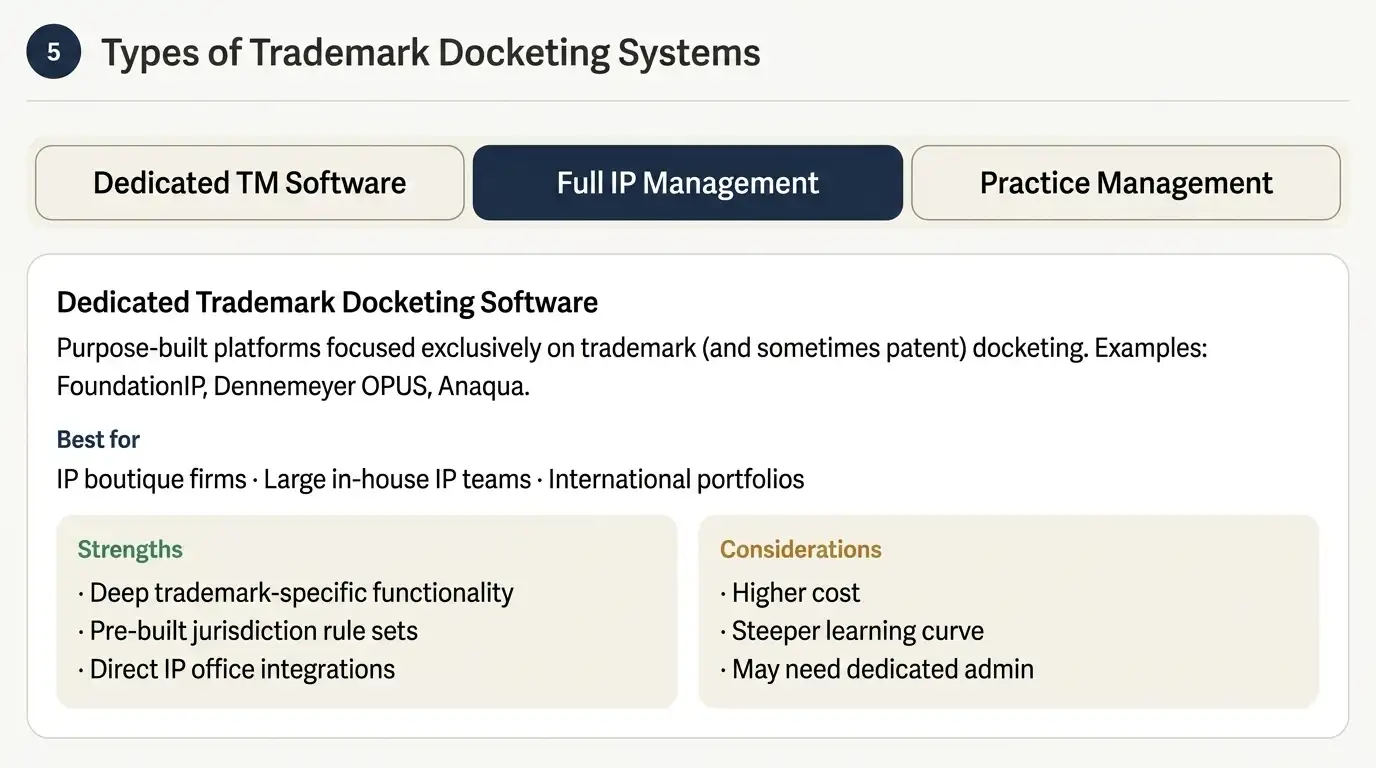
A. Dedicated Trademark Docketing Software
Purpose-built platforms focused exclusively on trademark (and sometimes patent) docketing. Examples include FoundationIP, Dennemeyer OPUS, and Anaqua.
Best for: IP boutique firms, large in-house IP teams, and firms managing large international portfolios.
Pros:
- Deep trademark-specific functionality
- Pre-built deadline rule sets for major jurisdictions
- IP office database integrations
Cons:
- Higher cost
- Steeper learning curve
- May require dedicated administrator
B. Full-Service IP Management Platforms
Broader platforms that combine docketing with matter management, billing, and client relationship management. Examples include Clarivate’s CPA Global, Anaqua, and Roper Technologies’ FoundationIP.
Best for: Large law firms and enterprise in-house teams managing both patents and trademarks.
Pros:
- Single platform for all IP management needs
- Strong reporting and analytics
- Enterprise-grade security
Cons:
- Expensive for smaller firms
- May include features that are unnecessary for trademark-only practices
C. Practice Management Software with Docketing Modules
General legal practice management platforms (e.g., Clio, MyCase) with add-on or built-in docketing features.
Best for: Small firms or solo practitioners with limited trademark portfolios.
Pros:
- Lower cost
- Easier to implement
- Combined billing and matter management
Cons:
- Trademark-specific deadline rule sets are often incomplete
- No direct IP office integration
- Not designed for high-volume portfolio management
Top Trademark Docketing Platforms (Overview)
Here is a high-level overview of leading trademark docketing systems used in the industry:
| Platform | Best For | Key Strengths |
|---|---|---|
| Anaqua | Large law firms, enterprise in-house | Full lifecycle management, analytics, client portal |
| FoundationIP | Mid-to-large IP firms | Strong trademark module, USPTO integration |
| Dennemeyer OPUS | International portfolios | Excellent multi-jurisdictional support |
| CPA Global (Clarivate) | Global enterprise | Managed services + software combined |
| Docketrak | Small-to-mid firms | Cost-effective, user-friendly |
| TM Cloud | Boutique trademark firms | Affordable, cloud-based, trademark-focused |
| Clio (with IP add-ons) | Solo/small generalist firms | Low cost, easy setup, limited TM depth |
Note: The right system depends entirely on your portfolio size, jurisdictional complexity, budget, and team structure. Always request a demo and pilot period before committing.
Also, Read: Effective Trademark Portfolio Management: Key Components, Challenges & Practices
How to Choose the Right Trademark Docketing Systems
Selecting a trademark docketing system is a significant decision. Use this framework to evaluate your options:
Step 1: Audit Your Current Portfolio and Process
Before evaluating any system, answer:
- How many active trademark matters are you managing?
- How many jurisdictions are represented in your portfolio?
- What is your current deadline miss rate (if measurable)?
- What systems are you currently using, and where are they failing?
- Who on your team will use the system, and what are their technical comfort levels?
Step 2: Define Your Must-Have Features
Based on your audit, create a prioritized list of required features. Separate “must-haves” from “nice-to-haves.” Typical must-haves for most firms include:
- Automated multi-tier deadline alerts
- USPTO integration for automatic status updates
- Multi-jurisdictional deadline rule sets
- Role-based access control
- Comprehensive reporting
Step 3: Evaluate Integration Requirements
Identify what other systems the docketing platform must integrate with:
- Practice management software
- Document management system
- Billing and accounting software
- Email platform (Outlook, Gmail)
- Client portals
Step 4: Assess Total Cost of Ownership
Pricing models vary widely. Look beyond the subscription fee to assess:
- Implementation and data migration costs
- Training costs
- Ongoing support fees
- Per-matter or per-user pricing (which can escalate quickly with portfolio growth)
- Cost of customization for your specific workflow
Step 5: Evaluate Vendor Stability and Support
A docketing system is long-term infrastructure. Consider:
- How long has the vendor been in business?
- What is their uptime guarantee and SLA?
- What does their customer support model look like?
- Do they have an active user community or knowledge base?
- How frequently do they update jurisdiction-specific deadline rule sets?
Step 6: Run a Pilot
Always pilot a system with a representative sample of your actual matters before full deployment. Test:
- Accuracy of automatically calculated deadlines
- Quality and timeliness of alert notifications
- Ease of data entry and retrieval
- Report quality and customizability
Also, Read: What is a Docketing System? Complete A to Z Guide
Best Practices for Implementing a Trademark Docketing Systems
Even the best software fails without a strong implementation process. Follow these best practices:
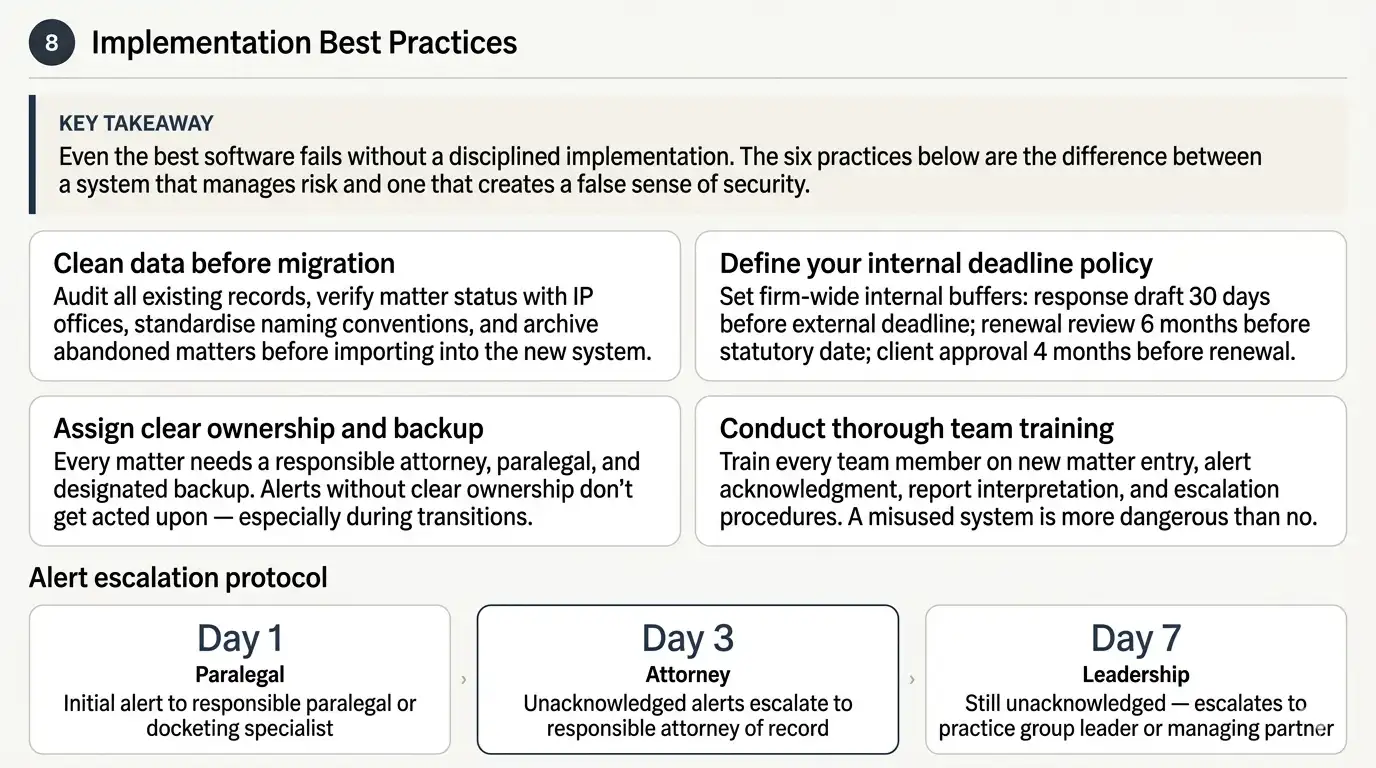
1. Clean Your Data Before Migration
Garbage in, garbage out. Before migrating existing matter data into a new system:
- Audit all existing records for accuracy
- Verify current status of all matters with the relevant IP offices
- Standardize naming conventions and data formats
- Archive or close out abandoned or expired matters
2. Define Your Internal Deadline Policy
Decide – as a firm or team – what internal deadlines will be set ahead of external deadlines. For example:
- Internal response draft deadline: 30 days before the external Office Action deadline
- Internal renewal review: 6 months before the statutory renewal date
- Internal client approval: 4 months before renewal
Document this policy and build it into the system configuration.
3. Assign Clear Ownership
For every matter in the system, there should be a clearly designated:
- Responsible attorney
- Responsible paralegal or docketing specialist
- Backup responsible party (for vacations, departures, etc.)
Alerts without clear ownership don’t get acted upon.
4. Conduct Thorough Team Training
Don’t skip training. A system that isn’t used correctly is worse than no system at all – because it creates a false sense of security. Train every team member on:
- How to enter a new matter correctly
- How to respond to and close out deadline alerts
- How to run and interpret standard reports
- What to do when a deadline is in dispute or unclear
5. Schedule Regular Docket Audits
Even automated systems require human oversight. Schedule regular docket review meetings (weekly is ideal, monthly at minimum) to:
- Review all upcoming deadlines for the next 30–90 days
- Flag any matters with missing information
- Identify matters at risk of abandonment
- Discuss workload distribution among team members
6. Establish an Alert Escalation Protocol
Define what happens if a deadline alert is not acknowledged within a set timeframe. For example:
- Day 1: Alert sent to responsible paralegal
- Day 3: If unacknowledged, alert escalates to responsible attorney
- Day 7: If still unacknowledged, alert escalates to practice group leader or managing partner
This escalation protocol is a crucial safety net and should be documented in your firm’s risk management policy.
Trademark Docketing for Global Portfolios
International trademark management adds significant complexity. Here’s what your docketing system must handle for global portfolios:
Madrid Protocol Filings
International registrations through the Madrid System involve:
- Central attack vulnerability (first 5 years)
- Renewal through WIPO every 10 years
- Individual designation status for each member country
- Potential provisional refusals from national offices requiring responses
Your system must track the international registration number, all individual country designations, and the status of each separately.
Country-Specific Renewal Cycles
Each jurisdiction has its own renewal term and renewal deadline rules:
| Jurisdiction | Renewal Term | Renewal Deadline |
|---|---|---|
| United States | 10 years (+ Section 8) | Between years 9–10 |
| European Union | 10 years | Before expiration |
| United Kingdom | 10 years | Before expiration |
| China | 10 years | Before expiration |
| India | 10 years | Before expiration |
| Canada | 15 years | Before expiration |
| Australia | 10 years | Before expiration |
| Japan | 10 years | Before expiration |
A global docketing system must apply the correct renewal rule to each registration based on its jurisdiction – automatically.
Proof of Use Requirements
Many countries require periodic proof of use to maintain trademark rights. Unlike the U.S. (which requires Section 8 Declarations), many countries have use-it-or-lose-it provisions that are enforced only in cancellation proceedings. However, some jurisdictions (like the U.S.) have mandatory maintenance filings that require use evidence on a set schedule.
Your docketing system should flag these requirements proactively, not reactively.
The Role of Automation and AI in Trademark Docketing
The next generation of trademark docketing systems is increasingly powered by automation and artificial intelligence. Here’s how these technologies are reshaping the field:
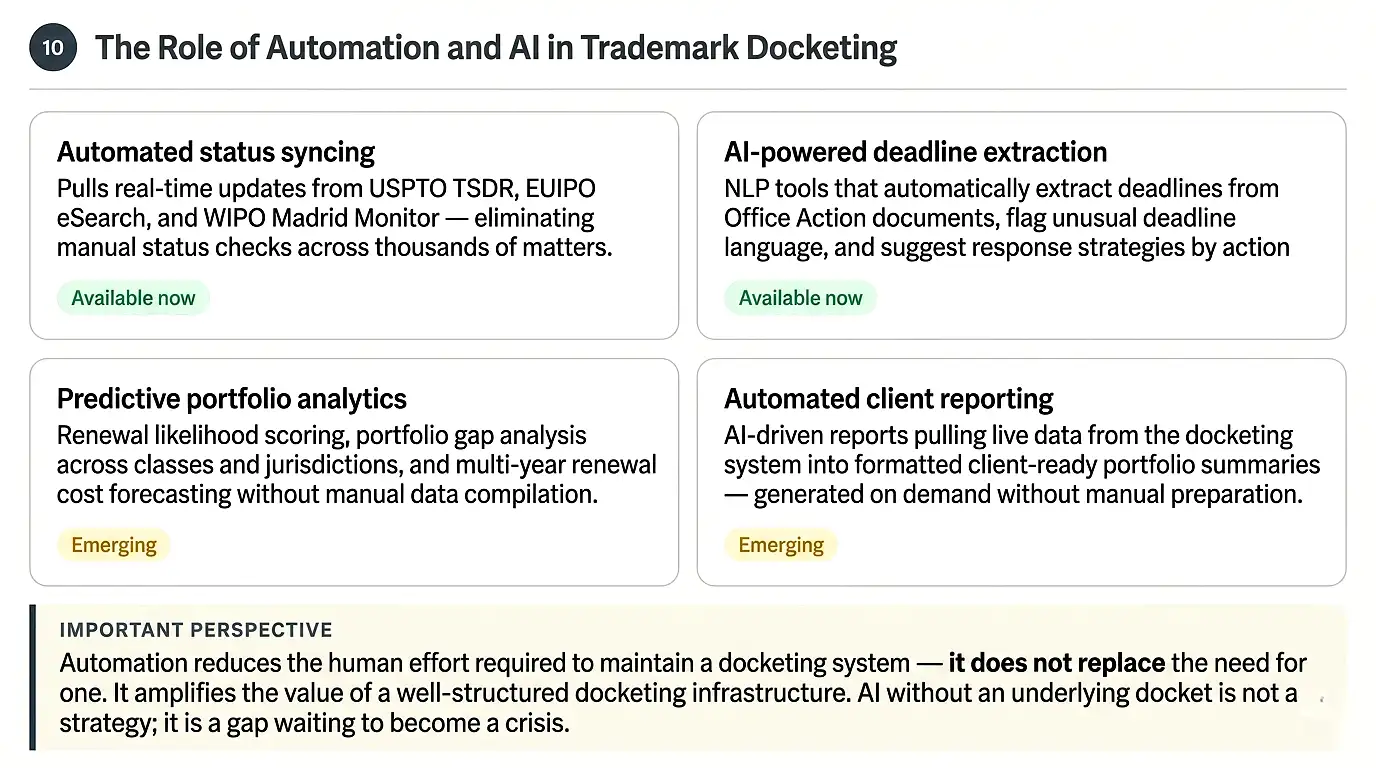
Automated Status Syncing
Modern systems pull status updates directly from USPTO TSDR, EUIPO’s eSearch, and WIPO’s Madrid Monitor – eliminating the need for manual status checks across thousands of matters.
AI-Powered Deadline Extraction
Some emerging platforms use natural language processing (NLP) to:
- Automatically extract deadlines from Office Action documents
- Flag unusual or non-standard deadline language
- Suggest appropriate response strategies based on the type of Office Action
Predictive Analytics
Advanced platforms are beginning to offer:
- Renewal likelihood scoring (predicting which clients are likely to let marks lapse)
- Portfolio gap analysis (identifying unprotected goods/services classes or jurisdictions)
- Cost forecasting for multi-year renewal planning
Automated Client Reporting
AI-driven reporting tools can generate client-ready portfolio summary reports automatically – pulling live data from the docketing system and formatting it for client consumption without manual intervention.
The key takeaway: Automation reduces the human effort required to maintain a docketing system, but it doesn’t replace the need for a system. It amplifies the value of having a well-structured docketing infrastructure.
Outsourcing Trademark Docketing: When and Why It Makes Sense
For many firms and in-house teams, managing a trademark docketing system in-house isn’t the most efficient use of resources. Outsourcing trademark docketing to a specialized IP services provider offers significant advantages.
When to Consider Outsourcing
Outsourcing trademark docketing makes strong sense when:
- Your portfolio has grown beyond your team’s capacity to manage deadlines reliably
- You’re experiencing staff turnover in docketing roles and losing institutional knowledge
- Your docketing accuracy has suffered despite investments in software
- You need 24/7 coverage across international time zones
- You want to free your attorneys and paralegals from administrative docketing tasks to focus on higher-value work
Benefits of Outsourced Trademark Docketing
- Specialized expertise: Dedicated docketing professionals who do this exclusively
- Redundancy and coverage: No single point of failure; backup staff always available
- System access: Many outsourced providers use enterprise-grade systems you might not be able to afford independently
- Scalability: Easily scale up during periods of high volume without hiring permanent staff
- Cost efficiency: Often less expensive than the fully loaded cost of an in-house docketing specialist
What to Look for in a Trademark Docketing Outsourcing Partner
- Demonstrated experience with trademark-specific deadline rules
- Clearly defined SLAs for deadline entry and alert management
- Robust quality control and audit processes
- Seamless integration with your existing matter management system
- Data security certifications and confidentiality protocols
- Transparent pricing with no hidden per-matter fees
Teak IP Services provides professional trademark docketing and IP management services to law firms and corporate IP departments. Our docketing team manages deadline-critical trademark matters across U.S. and international jurisdictions, ensuring nothing falls through the cracks. Learn more about our Docketing & IP Management Services →
Also, Read: Automated Trademark Docketing: The Complete Guide
Common Mistakes to Avoid in Trademark Docketing
Even firms with docketing systems in place make avoidable errors. Here are the most common pitfalls:
Mistake 1: Relying Solely on Automated Alerts Without Human Review
Automated alerts are essential, but they are not infallible. System glitches, data entry errors, or incorrect matter setup can cause alerts to fail. Always layer automated alerts with periodic human docket reviews.
Mistake 2: Not Setting Internal Deadlines Ahead of External Deadlines
External deadlines are the hard stop. Internal deadlines give your team time to prepare, obtain client approvals, gather specimens, and handle the unexpected. Skipping internal deadlines is a disaster waiting to happen.
Mistake 3: Incomplete Matter Setup
A docketing system is only as good as the data in it. If matters are entered incompletely – missing filing dates, incorrect status, wrong owner information – the deadlines it generates will be wrong. Invest in a thorough onboarding checklist for every new matter.
Mistake 4: Ignoring Maintenance Filings Between Renewals
Many trademark owners focus on renewal deadlines but forget that the U.S. requires maintenance filings between renewals:
- Section 8 Declaration: Due between years 5–6 after registration
- Section 15 Incontestability Claim: Optional but advisable, same window
- Section 8 & 9 Combined Filing: Due between years 9–10, then every 10 years
Missing the Section 8 declaration results in cancellation of the registration – even if the 10-year renewal is current.
Mistake 5: No Backup Responsible Party Assigned
When the attorney or paralegal assigned to a matter goes on vacation, takes medical leave, or leaves the firm, who is responsible for their docket? Without a clearly designated backup, deadlines can be missed during transitions.
Mistake 6: Treating Docketing as an Administrative Function Only
Trademark docketing is not merely administrative – it is risk management. Firms that treat docketing as a back-office function rather than a frontline risk control often underinvest in it until a crisis occurs.
Also, Read: Intellectual Property Docketing: A Complete Guide
Why Trademark Docketing Systems Are Critical for Modern IP Management
Trademark docketing systems are the backbone of effective intellectual property management. In an environment where a single missed deadline can cost a client their trademark rights – and a firm its reputation – having a robust, well-implemented docketing system is not a luxury. It is a professional obligation.
The right trademark docketing system should:
- Automate deadline calculation and multi-tier alerts
- Integrate with USPTO and international IP office databases
- Support multi-jurisdictional portfolios with country-specific rule sets
- Provide comprehensive reporting for internal management and client communication
- Include audit trails for malpractice protection
- Scale with your practice as your portfolio grows
Whether you choose a dedicated IP docketing platform, a full-service IP management suite, or a hybrid approach that includes outsourced docketing support, the investment will pay dividends in reduced risk, improved efficiency, and stronger client relationships.
Also, Read: Legal Docketing Workflow: A Step‑by‑Step Framework
How Teak IP Can Help with Trademark Docketing Systems
At Teak IP Services, we specialize in providing professional, reliable trademark docketing support to IP law firms and corporate legal departments. Our experienced docketing team handles:
- Entry and management of trademark deadlines across U.S. and international jurisdictions
- USPTO status monitoring and docket updates
- Madrid Protocol international registration tracking
- Renewal calendaring and client notification workflows
- Integration support with leading docketing platforms
If your team is struggling to keep up with a growing trademark portfolio – or if you’re concerned about the reliability of your current docketing process – we’re here to help.
Contact Teak IP Services today to learn how our trademark docketing services can reduce your risk and free your team to focus on what matters most.
Also, Read: IP Docketing Best Practices: A Practical Guide for IP Firms & Attorneys
Frequently Asked Questions (FAQ)
Q: What is the difference between trademark docketing and trademark monitoring?
A: Trademark docketing tracks the internal deadlines and prosecution milestones associated with your own trademark portfolio. Trademark monitoring (or trademark watch) involves watching the market and new trademark filings for potentially conflicting marks that could infringe on your rights. Both are essential components of a complete trademark management strategy.
Q: How much does a trademark docketing system cost?
A: Costs vary widely based on portfolio size and platform. Basic cloud-based systems can start at a few hundred dollars per month for small portfolios. Enterprise platforms for large firms can cost tens of thousands of dollars annually. Outsourced docketing services often represent a cost-effective alternative for small-to-mid-sized practices.
Q: Can I use a patent docketing system for trademarks?
A: Not effectively. Patent and trademark prosecution have fundamentally different deadline structures, maintenance requirements, and office action workflows. Using a patent-focused system for trademarks – or a generic calendar tool – creates significant risk of missed trademark-specific deadlines.
Q: How often should I audit my trademark docket?
A: At minimum, conduct a comprehensive docket audit quarterly. Weekly or bi-weekly docket review meetings for upcoming 30–60 day deadlines are considered best practice for active practices.
Q: What happens if I miss a trademark renewal deadline?
A: In the United States, there is typically a 6-month grace period for Section 9 renewals (with a surcharge). However, missing the Section 8 maintenance declaration within the years 5–6 window results in automatic cancellation without a grace period. In other jurisdictions, rules vary – some offer grace periods, others do not. Always check the specific rules for each jurisdiction.
Our Services: Learn More About Trademark Docketing Services

