
Discover the essential IP docketing best practices every law firm needs. From deadline management to software selection, this guide helps you protect IP assets and eliminate costly errors. For firms that want to implement these best practices without overhauling their internal structure, outsourcing to expert IP docketing services offers an efficient path to reducing risk and improving docketing accuracy from day one.

IP Docketing Best Practices – A brief introduction
Every missed patent deadline tells the same story – not negligence, but a system failure.
In intellectual property law, a single missed deadline can mean the permanent loss of patent rights, trademark registrations, or the ability to enforce a client’s most valuable assets. The stakes couldn’t be higher, and yet most IP firms operate with docketing systems that were designed for a fraction of today’s workload.
IP docketing best practices aren’t optional housekeeping. They are the structural foundation upon which IP portfolios are built, maintained, and defended.
Whether you manage a boutique patent firm, a corporate IP department, or a large multinational practice, this guide walks you through the critical best practices that separate high-performing IP docketing operations from those perpetually one missed deadline away from a malpractice claim.
What is IP Docketing – And Why Does It Matter?
IP docketing is the systematic process of recording, tracking, and managing critical dates, deadlines, and actions associated with intellectual property assets – including patents, trademarks, copyrights, and trade secrets. Here you can read our detailed resource on what is intellectual property docketing and how it is all about?
Think of it as the central nervous system of an IP practice. Without a healthy, well-managed docketing system, the entire practice is operating blind.
Key functions IP docketing covers:
- Tracking filing deadlines (national, regional, international)
- Managing maintenance fee schedules and annuity payments
- Recording prosecution milestones (Office Actions, responses, appeals)
- Monitoring trademark renewals and use requirements
- Coordinating PCT national phase entries across jurisdictions
- Flagging abandonment risks and status changes
- Generating deadline reports for attorneys and clients
The consequences of poor IP docketing range from missed maintenance fees (causing patent lapses) to fatal prosecution bars that eliminate clients’ rights entirely. Courts and bar associations have found firms liable for malpractice specifically due to docketing failures – making best practices not just operationally important but legally essential.
Also, Read: Legal Docketing Workflow: The Complete Guide for IP, Patent & Trademark Professionals
Building the Foundation – Core IP Docketing Best Practices
1. Implement a Dual-Docketing System
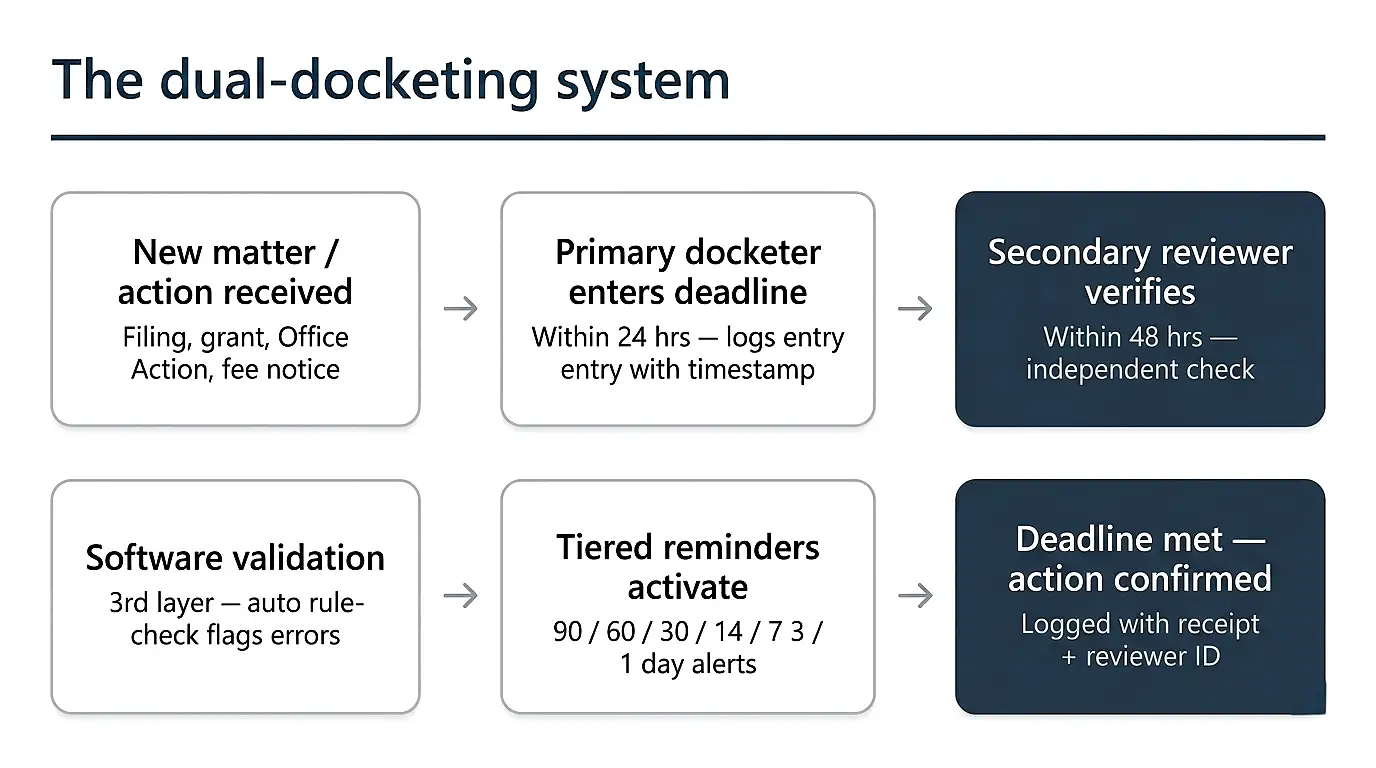
This is the single most important IP docketing best practice.
A dual-docketing system means that every critical deadline is entered and verified by at least two independent people or systems. One person enters the deadline; another independently checks and confirms it.
Why it works:
- Catches data entry errors before they become missed deadlines
- Creates accountability at multiple levels
- Provides an audit trail for every docketed action
- Reduces reliance on any single point of failure
Best practice implementation:
- Assign a primary docketer for initial entry
- Assign a secondary reviewer (attorney or senior paralegal) to verify within 24–48 hours
- Use software validation rules as a third layer of verification
- Log every confirmation with a timestamp and reviewer identity
2. Establish Tiered Deadline Reminders
Not all deadlines carry equal risk, but all deadlines deserve structured reminders. Implement a tiered reminder system based on the severity and proximity of each deadline:
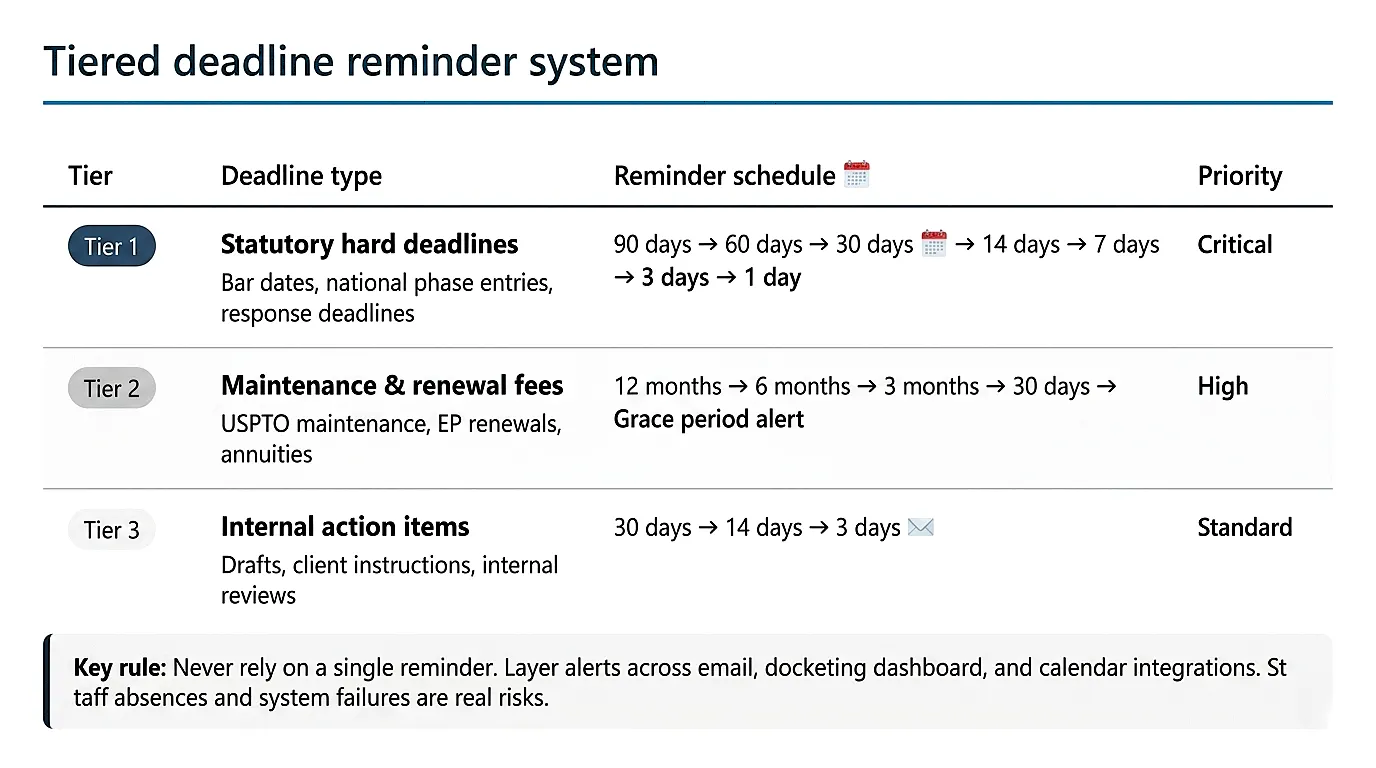
1st Tier Statutory Hard Deadlines (e.g., bar dates, national phase entries, response deadlines):
- Reminder at 90 days
- Reminder at 60 days
- Reminder at 30 days
- Reminder at 14 days
- Reminder at 7 days
- Final alert at 3 days and 1 day
2nd Tier Maintenance and Renewal Fees:
- Reminder at 12 months before due
- Reminder at 6 months before due
- Reminder at 3 months before due
- Reminder at 30 days before due
- Grace period alert if payment not confirmed
3rd Tier Internal Action Items:
- Reminder at 30 days
- Reminder at 14 days
- Reminder at 3 days
Critical rule: Never rely on a single reminder. Systems fail, emails get missed, and staff go on leave. Layer your reminders across multiple channels (email, docketing software dashboard, calendar integrations).
3. Standardize Data Entry Protocols
Inconsistent data entry is the silent killer of docketing accuracy. If different staff members enter dates, client names, or matter identifiers in different formats, your docketing database becomes unreliable and unsearchable.
Standard protocols to implement:
- Date format standardization: Use one universal format (e.g., YYYY-MM-DD or MM/DD/YYYY) – never mix formats
- Client/matter identifier conventions: Define naming rules and enforce them at the system level
- Jurisdiction codes: Use standardized ISO country codes for all international matters
- Attorney name formatting: Consistent last name, first name or full name conventions
- Deadline categorization: Map every deadline type to a predefined category in your system
Consider creating a Docketing Style Guide – a written document every staff member references during onboarding and ongoing practice. This document should cover every common entry scenario with examples.
4. Conduct Regular Docket Audits
A docketing system you never audit is a docketing system you don’t actually trust. Regular audits catch:
- Errors introduced during data entry
- Deadlines that were entered but never verified
- Matters that fell through the cracks due to attorney transitions or staff turnover
- Software or system glitches that caused data loss or miscalculation
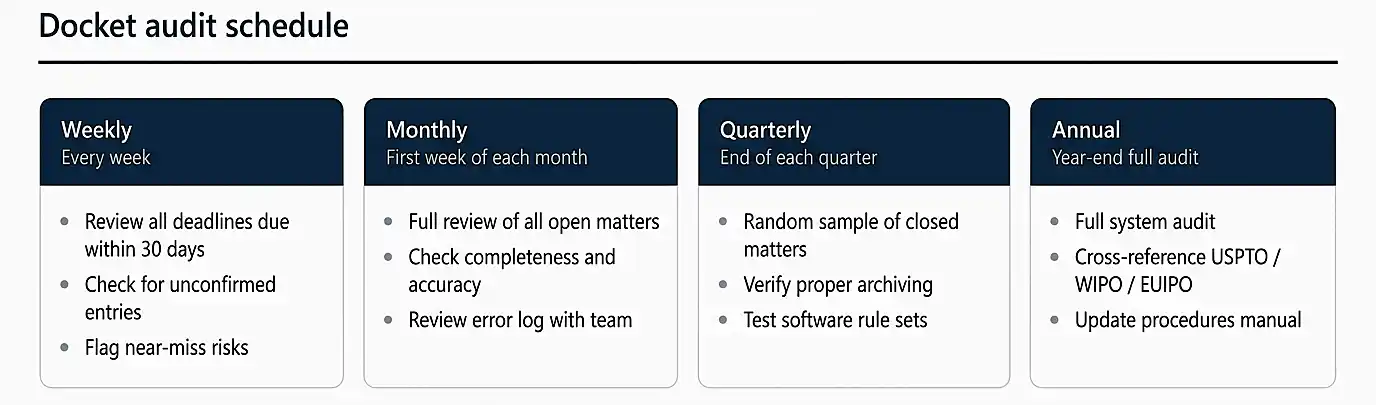
Recommended audit schedule:
- Weekly: Review all deadlines due within the next 30 days
- Monthly: Full review of open matters for completeness and accuracy
- Quarterly: Spot-check random sample of closed matters for proper archiving
- Annually: Full system audit with cross-reference against USPTO/WIPO/EUIPO records
Assign audit responsibility to a senior docketing professional or practice group manager – not the same person who performs daily entry.
Also, Read: Outsource Trademark Docketing: Strong Reasons to Consider
Choosing and Configuring Your IP Docketing Software
1. Select Purpose-Built IP Docketing Software
Generic calendar tools, spreadsheets, or practice management software designed for general legal work are not adequate for IP docketing. The complexity and jurisdiction-specific nature of IP deadlines demands purpose-built solutions.
Required features in IP docketing software
| Feature | Why it matters | Priority |
|---|---|---|
| ✓ Built-in jurisdiction rule sets | Automatic deadline calculation for USPTO, EPO, WIPO, and national offices | Must-have |
| ✓ Automatic deadline calculation | Reduces human error from manual date math; updates when rules change | Must-have |
| ✓ Multi-channel reminder workflows | Email, dashboard, and calendar alerts across all reminder tiers | Must-have |
| ✓ USPTO / EPO / WIPO integration | Syncs matter status directly from patent office records automatically | Must-have |
| ✓ Audit log functionality | Tracks every entry, edit, and confirmation with timestamps and user identity | Must-have |
| ✓ Role-based access control | Protects sensitive client data; enforces separation of entry and review roles | Must-have |
| ✓ Reporting and analytics | Portfolio overviews, upcoming deadline dashboards, attorney matter reports | Important |
| ✓ Cloud redundancy and backup | Protects against data loss, server failure, and ransomware | Must-have |
Key features to require in IP docketing software:
- Built-in rule sets for USPTO, EPO, WIPO, and major national jurisdictions
- Automatic deadline calculation based on filing dates and jurisdiction rules
- Customizable reminder workflows with multiple notification channels
- Integration capabilities with USPTO PAIR/Patent Center, TSDR, and EPO systems
- Reporting and analytics for matter status, upcoming deadlines, and portfolio overviews
- Role-based access control to protect sensitive client data
- Audit log functionality tracking all entries, edits, and confirmations
- Cloud-based redundancy with data backup and disaster recovery
2. Configure Jurisdiction-Specific Rule Sets
One of the most dangerous assumptions in IP docketing is that deadline rules are universal. They are not. Every jurisdiction has its own requirements, grace periods, and procedural nuances.
Key jurisdiction-specific deadline rules
| Jurisdiction | Deadline type | Key rule | Grace period |
|---|---|---|---|
| USPTO | Maintenance fees | Due at 3.5, 7.5, and 11.5 years from grant date | 6 months |
| EPO | Annual renewal fees | Due before each anniversary of filing date; varies by year | 6 months + surcharge |
| PCT | National phase entry | 30 months from earliest priority date (most countries) | Limited — varies by country |
| PCT Ch. II | IPEA demand | 3 months from ISR / 22 months from priority — whichever is later | None |
| USPTO | Trademark renewal | Section 8: years 5–6; Section 9: every 10 years | 6-month grace + fee |
| EUIPO | EU trademark renewal | Every 10 years from filing date | 6 months after expiry |
Important: Rules change. Subscribe to official USPTO, EPO, and WIPO notifications and ensure your docketing software vendor commits to timely rule set updates.
Examples of jurisdiction-specific rules to configure:
- USPTO maintenance fees are due at 3.5, 7.5, and 11.5 years from grant, with 6-month grace periods
- European Patent Office (EPO) renewal fees vary by year and must be paid before the anniversary date
- PCT Chapter II deadlines (IPEA selection) differ from Chapter I timelines
- Many national phase deadlines run from the PCT international filing date, not from priority date
- Trademark renewal periods differ between the USPTO (between years 5–6, and every 10 years) and other jurisdictions
Work with your docketing software vendor to ensure all active jurisdiction rule sets are loaded, updated, and validated. When entering a new jurisdiction, never rely on memory – verify the rules against official sources.
3. Maintain Software and Rule Set Updates
IP docketing rules change. Legislatures amend patent acts. Patent offices update their fee schedules. Grace period rules evolve. Your docketing software must stay current with these changes.
Best practices for staying current:
- Subscribe to official USPTO, EPO, and WIPO rule change notifications
- Ensure your software vendor commits to timely rule set updates
- Designate one staff member as the “Rules Owner” responsible for monitoring changes
- Conduct a rules verification review whenever you add a new jurisdiction to your practice
- Never assume last year’s rules still apply – always verify
Also, Read: Trademark IP Management Best Practices for Multi-Jurisdiction Brand Protection
Staffing, Training, and Accountability
1. Define Clear Roles and Responsibilities
IP docketing breakdowns most frequently occur when it isn’t clear who is responsible for what. Every docketing function needs an assigned owner.
Core docketing roles and responsibilities
| Role | Primary responsibilities | Key accountability | Required in |
|---|---|---|---|
| Primary docketer | Initial data entry for all new matters and actions; timestamp logging | Accuracy of entered data within 24 hours of receipt | All sizes |
| Reviewing verifier | Independent review and confirmation of all entries (dual-docketing) | Catches errors before they become missed deadlines | All sizes |
| Matter supervisor | Attorney or senior paralegal accountable for assigned matters | Final sign-off on all irreversible client actions | All sizes |
| Docketing manager | Oversees system, audits, software management, workflow, and training | Operational health of the entire docketing system | Mid / large |
| Rules owner | Monitors and communicates changes in docketing rules across all active jurisdictions | Rule set currency and compliance | Mid / large |
Core roles in a docketing operation:
- Primary Docketer: Responsible for initial data entry of all new matters and actions
- Docketing Reviewer/Verifier: Independently reviews and confirms entries (dual-docketing)
- Matter Supervisor (Attorney or Senior Paralegal): Accountable for the accuracy of their assigned matters
- Docketing Manager/Administrator: Oversees the overall system, audits, software management, and workflow
- Rules Owner: Monitors and communicates changes in docketing rules and jurisdiction requirements
In smaller firms where one person wears multiple hats, document which roles they hold and ensure cross-training exists for each function.
2. Invest in Ongoing Docketing Training
IP rules, software features, and docketing best practices evolve continuously. Staff who were trained three years ago may be applying outdated methods without realizing it.
Training best practices:
- Conduct formal docketing onboarding for all new hires before they touch live matters
- Schedule annual refresher training for all docketing staff
- Provide training whenever new software features are deployed or rules change
- Use real (anonymized) error cases from your own practice as training examples – they resonate more than hypotheticals
- Encourage CLE participation in IP practice management and docketing sessions
- Document all training in employee records
3. Create a Docketing Policies and Procedures Manual
Your docketing operation should be documentable, repeatable, and survivable. If your most experienced docketer left tomorrow, could your operation continue without chaos?
Your Docketing Manual should include:
- Step-by-step procedures for opening new matters
- Data entry standards for every field type
- Deadline calculation guidance for your core jurisdictions
- Escalation procedures when a deadline is at risk
- Emergency protocols for potential missed deadlines
- Software system administration basics
- Vendor contact information and support procedures
- Audit procedures and schedules
Review and update the manual at least annually and whenever significant changes occur.
Also, Read: Outsource Patent Docketing: Key Reasons to Consider
Managing High-Risk Docketing Scenarios
1. Attorney and Staff Transitions
Attorney departures are one of the highest-risk events in IP practice management. When an attorney leaves, their portfolio of matters can easily fall through the cracks if docketing protocols don’t specifically address transitions.
Consequences of poor IP docketing
| Failure type | Consequence | Severity | Recoverable? |
|---|---|---|---|
| Missed maintenance fee | Patent lapses; rights lost in that jurisdiction | Critical | Sometimes — revival with surcharge (time-limited) |
| Missed national phase entry | Permanent loss of patent rights in that country | Critical | Rarely — very limited reinstatement options |
| Missed Office Action response | Application abandoned; prosecution history impacted | Critical | Petitions to revive available (delay restrictions apply) |
| Missed trademark renewal | Registration cancelled; brand protection lost | Critical | Grace period exists; after expiry — new application required |
| Wrong priority date entered | All downstream deadlines miscalculated; cascading errors | Critical | Depends on how early error is caught |
| Missed PCT Chapter II demand | Loss of Chapter II rights; national phase unaffected | High | No — hard bar |
| Attorney transition gap | Matters unmonitored; deadlines missed during handover | High | Depends on what deadlines were missed |
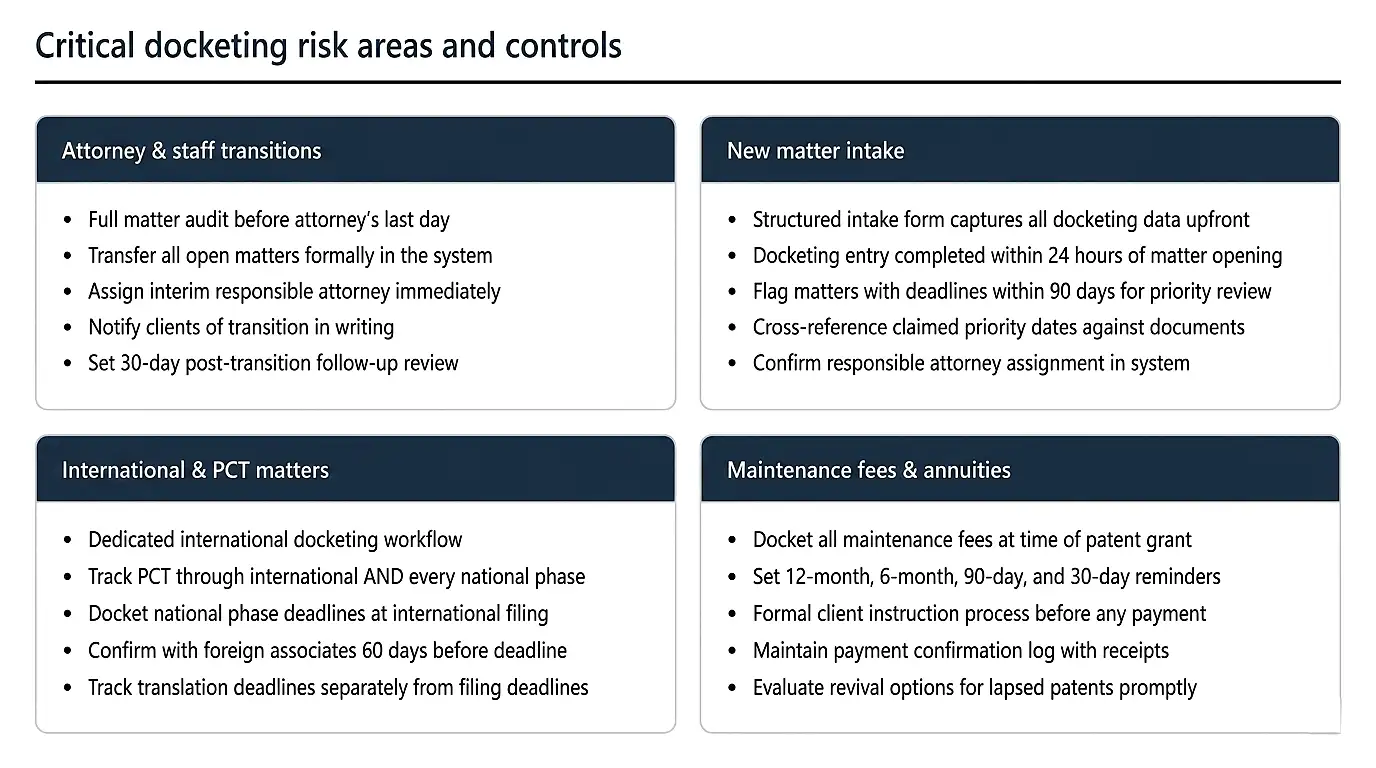
Transition best practices:
- Conduct a full matter audit for every departing attorney before their last day
- Transfer all open matters formally in the docketing system – with confirmed deadlines reviewed
- Assign an interim responsible attorney for every matter and update the docket immediately
- Notify clients of the transition and confirm matter responsibility in writing
- Set a special docketing review alert 30 days post-transition to catch anything missed
2. New Matter Intake
The docketing clock often starts at intake. Errors at intake – wrong filing dates, incorrect priority claims, missed foreign filing deadlines – can have irreversible consequences.
Intake best practices:
- Establish a structured intake form that captures all docketing-relevant information upfront
- Require a docketing entry to be completed within 24 hours of matter opening
- Flag all matters with upcoming deadlines (within 90 days) for immediate priority review
- Cross-reference all claimed priority dates against provided priority documents
- Never open a matter without confirming the responsible attorney assignment in the system
3. The International and PCT Matters
International IP matters add significant docketing complexity due to overlapping national deadlines, translation requirements, and local agent coordination.
International docketing best practices:
- Use a dedicated international docketing workflow separate from domestic procedures
- Track PCT matters through both the international phase and every national phase entry
- Docket national phase deadlines as soon as the international filing date is confirmed — don’t wait
- Maintain a correspondence log with all foreign associates, including instructions given and confirmations received
- Confirm national phase entries with foreign associates 60 days before the deadline, not 7 days
- Track translation deadlines separately from filing deadlines – they frequently differ
4. Maintenance Fees and Annuities
Maintenance fee and annuity management is a high-volume, recurring docketing challenge. For large portfolios, the operational complexity requires its own dedicated workflow.
Maintenance fee best practices:
- Docket all maintenance fee due dates at the time of patent grant – immediately
- Set reminders well ahead of the due date (12 months, 6 months, 90 days, 30 days) to allow for client instructions, budget approvals, and payment processing
- Create a formal client instruction process: confirm with the client whether they wish to maintain each patent before any payment is made
- Maintain a payment confirmation log – every payment should be confirmed with a receipt or docket record
- For lapsed patents, evaluate revival options and document the analysis in the matter record
Quality Control and Continuous Improvement
1. Track and Analyze Docketing Errors
Every docketing error is a lesson. Firms that systematically track, analyze, and address errors improve continuously. Firms that treat errors as isolated incidents repeat them.
Error tracking best practices:
- Log every identified error in a docketing error register, regardless of whether it caused a missed deadline
- For each error, record: what happened, when it was caught, why it occurred, and what was done to prevent recurrence
- Review the error log in monthly docketing team meetings
- Identify patterns – if the same error type appears multiple times, there is a systemic problem, not a personnel problem
- Use error data to inform training, procedure updates, and software configuration improvements
2. Implement a “Near Miss” Protocol
The most valuable docketing metric many firms overlook is the near miss – a deadline that was almost missed but was caught in time. Near misses are early warning signals that something in your system is weakening.
Near miss protocol:
- Define a “near miss” threshold (e.g., deadline caught with fewer than 7 days remaining through a non-standard escalation)
- Log every near miss and conduct a root cause analysis within one week
- Escalate to the docketing manager and managing partner – these are serious operational signals
- Treat every near miss as a near-malpractice event worthy of process review
3. Benchmark Against Industry Standards
IP docketing best practices aren’t static. The profession continually evolves, and the bar for what constitutes an acceptable docketing system rises as technology and workflows improve.
Benchmarking activities:
- Participate in AIPLA, LES, INTA, and other professional association discussions on practice management
- Request case studies or process audits from your docketing software vendor
- Consider third-party docketing audits from specialized consultants every 2–3 years
- Engage with peer firms (without sharing client-confidential data) to share process improvements
- Review published malpractice cases related to docketing failures and update your protocols accordingly
Also, Read: Effective Trademark Portfolio Management: Key Components, Challenges & Practices
Technology, Automation, and the Future of IP Docketing
1. Leverage Automation Strategically
Automation is not a replacement for human oversight in IP docketing — it is a force multiplier that allows your team to focus on judgment-intensive tasks.
High-value automation opportunities:
- Automatic deadline calculation from entered filing/grant dates
- Automated reminder generation and escalation emails
- USPTO/EPO/WIPO data feed integration to automatically update matter status
- Maintenance fee payment processing through authorized annuity payment services
- Portfolio reporting generation for client portfolio reviews
Automation limits to respect:
- Never fully automate deadline verification without a human confirmation step
- Always require human sign-off on client instructions before any irreversible action
- Periodically test automated rules to confirm they calculate correctly after rule set updates
2. Cloud-Based Docketing and Disaster Recovery
On-premise docketing systems pose serious business continuity risks. A server failure, office disaster, or ransomware attack that takes down your docketing database can be catastrophic.
Cloud and disaster recovery best practices:
- Use cloud-based docketing software with verified data redundancy and backup schedules
- Confirm your vendor’s Recovery Time Objective (RTO) and Recovery Point Objective (RPO)
- Maintain an offline backup of critical upcoming deadlines (exportable report saved securely off-system)
- Test your disaster recovery plan at least annually
- Ensure your data security and privacy practices comply with applicable bar association rules and data protection regulations
3. Considering Outsourced IP Docketing
For firms of all sizes, outsourcing some or all docketing functions to a specialized IP docketing services provider is increasingly common – and often improves quality while reducing cost.
When outsourcing makes sense:
- When internal docketing volume exceeds staff capacity without room to hire
- When your firm lacks specialized expertise in certain jurisdictions (e.g., PCT, European prosecution)
- When you want a dedicated team focused exclusively on docketing accuracy rather than splitting attention with other tasks
- When you want to access specialized docketing software without the cost of full system ownership
What to look for in a docketing services partner:
- Demonstrated experience in IP-specific docketing (not general legal docketing)
- Clear SLAs covering data entry turnaround times, error rates, and escalation procedures
- Dual-docketing protocols as part of their standard service
- Transparent reporting on all docketed matters
- Secure data handling practices
- References from firms with similar practice profile and volume
Also, Read: What is a Docketing System? Complete A to Z Guide
Quick-Reference IP Docketing Best Practices Checklist
Use this checklist to evaluate your current docketing operation:
Foundation
- Dual-docketing system in place and actively used
- Tiered reminder system configured for all deadline types
- Standardized data entry protocols documented and followed
- Regular docket audits scheduled and conducted
High-Risk Scenarios
- Formal attorney transition protocol documented
- Structured matter intake form in use
- Dedicated international docketing workflow operational
- Maintenance fee client instruction process formalized
Technology
- Purpose-built IP docketing software in use
- Jurisdiction-specific rule sets configured and current
- Automated reminders active across multiple channels
- Cloud backup and disaster recovery verified
Quality Control
- Docketing error register in use
- Near miss protocol defined and followed
- Monthly error review meetings conducted
- Benchmarking activities conducted at least annually
Staffing and Training
- Roles and responsibilities clearly defined in writing
- All docketing staff formally trained and documented
- Docketing Policies and Procedures Manual exists and is current
- Succession plan for key docketing personnel
Outsourcing (if applicable)
- Partner has IP-specific docketing expertise (not general legal)
- Clear SLAs covering turnaround times and error rates
- Partner uses dual-docketing as standard practice
- Transparent reporting on all docketed matters
- Secure data handling and privacy compliance confirmed
Also, Read: Comprehensive Guide to Patent Docketing Systems
IP Docketing Best Practices as a Competitive Advantage
Exceptional IP docketing isn’t just about avoiding malpractice – it’s a competitive advantage.
Firms and departments that master IP docketing best practices build deeper client trust, handle larger and more complex portfolios without proportional staff increases, and reduce the operational anxiety that comes from operating without confidence in your deadline management systems.
The practices outlined in this guide – dual-docketing, tiered reminders, standardized entry protocols, regular audits, specialized software, and continuous quality improvement – aren’t aspirational ideals. They are achievable operational standards that leading IP practices maintain today.
Start with your highest-risk gaps. If you don’t have a dual-docketing system, implement one first. If your reminder system depends on a single email notification, build redundancy immediately. From there, work systematically through each area.
At Teak IP Services, we specialize in IP docketing and portfolio management support that helps firms of all sizes implement these best practices – without the overhead of building a full in-house docketing operation. From patent and trademark docketing to international matter management, our team brings the expertise, systems, and discipline that leading IP practices rely on.
Also, Read: Intellectual Property Docketing: A Complete Guide
Frequently Asked Questions (FAQ)
What is IP docketing? IP docketing is the process of recording, tracking, and managing all critical dates, deadlines, and procedural actions associated with intellectual property assets including patents, trademarks, copyrights, and trade secrets.
Why is dual-docketing considered the most important IP docketing best practice? Dual-docketing ensures that every critical deadline is verified by at least two independent parties, dramatically reducing the risk of data entry errors causing missed deadlines. It creates accountability, an audit trail, and redundancy that single-entry systems cannot provide.
How often should IP docket audits be conducted? At minimum: weekly reviews of near-term deadlines, monthly full open matter reviews, quarterly spot-checks, and annual full system audits cross-referenced against official patent office records.
Can small IP firms implement effective docketing best practices? Absolutely. Many best practices – including dual-docketing, tiered reminders, and data entry standards – are scalable to firms of any size. Outsourced IP docketing services can also provide small firms access to enterprise-quality docketing systems and expertise without full in-house investment.
What is the difference between IP docketing software and general practice management software? Purpose-built IP docketing software contains jurisdiction-specific rule sets, automated deadline calculations based on IP procedural law, and integrations with patent/trademark office databases. General legal practice management software typically lacks these specialized features, making it inadequate for IP deadline management.
Our Services: Reliable IP Docketing Services

