
Patent and Trademark Docketing for Large Firms is far more than just an administrative task. For large law firms and in-house IP departments handling hundreds – or even thousands – of active matters, it serves as the operational backbone of the entire intellectual property function.
A single missed deadline in patent prosecution can result in the permanent loss of a client’s rights. Similarly, a lapsed trademark renewal can wipe out years of brand value almost overnight. At this scale, there is virtually no room for error.
As portfolios expand across multiple jurisdictions, technologies, and legal teams, docketing becomes significantly more complex. Large firms must deal with challenges that smaller practices rarely encounter – including high matter volumes, multi-jurisdictional compliance requirements, cross-team coordination, demanding client reporting expectations, and constant exposure to malpractice risk.

This guide covers everything large IP practices need to know about patent and trademark docketing – from core fundamentals to advanced operational strategies – helping your firm safeguard every deadline, every asset, and every client relationship. Large IP practices managing multi-jurisdictional portfolios can significantly reduce operational risk by partnering with specialized docketing and IP management services designed to handle high matter volumes, cross-team coordination, and demanding client reporting requirements.
What is Patent and Trademark Docketing?
Docketing in the IP context refers to the systematic tracking and management of critical deadlines, correspondence, filings, and procedural requirements across a portfolio of patent and trademark matters.
At its core, docketing answers three questions at any given moment:
- What needs to be done?
- By whom?
- By when?
Patent Docketing
Patent docketing covers the full lifecycle of a patent application and granted patent, including:
- Filing deadlines (provisional, non-provisional, PCT national phase entries)
- Prosecution deadlines (Office Action responses, Requests for Continued Examination)
- Annuity/maintenance fee payments (domestic and international)
- Appeal and inter partes review (IPR) deadlines
- Patent term adjustments and expiry tracking
Trademark Docketing
Trademark docketing manages brand protection timelines, including:
- Use-in-commerce and Statement of Use (SOU) deadlines
- Opposition and cancellation proceeding deadlines
- Section 8 (Declaration of Use) and Section 15 (Incontestability) filings
- Renewal deadlines (Section 8 & 9 combined filings)
- International trademark deadlines under the Madrid Protocol
- Trademark watch and monitoring action follow-ups
Also, Read: Legal Docketing Workflow: The Complete Guide for IP, Patent & Trademark Professionals
Why Docketing is Especially Critical for Large Firms
When it comes to Patent and Trademark Docketing for Large Firms, the scale at which these organizations operate significantly magnifies the risks of even minor errors. What might be manageable in a smaller practice can quickly turn into a serious issue at scale.
That’s exactly why docketing isn’t something that can be treated as a routine administrative task- it requires consistent oversight and attention at a senior level within large IP practices.
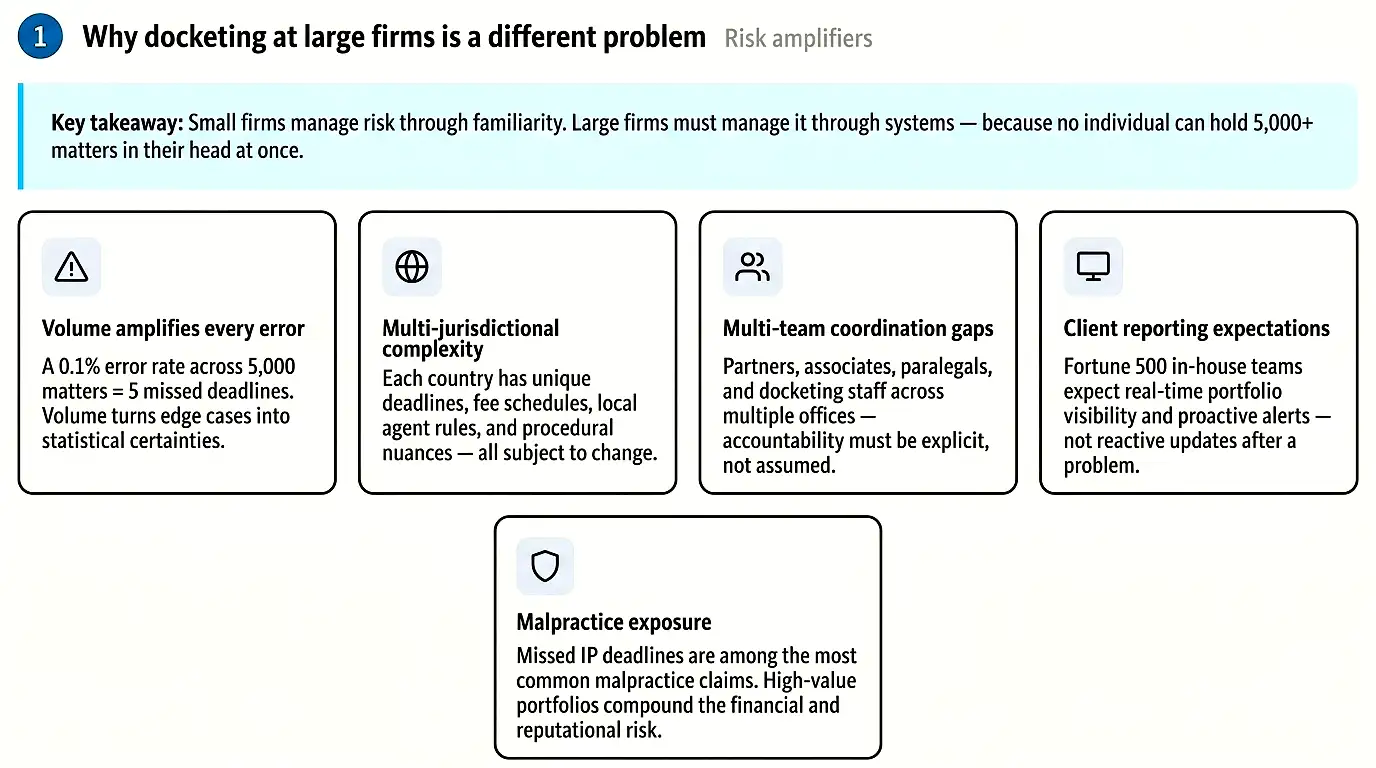
1. Volume Amplifies Risk
A firm managing 5,000+ active matters across dozens of attorneys faces exponentially more deadline events per day than a small boutique. Even a 0.1% error rate translates to real-world deadline misses with serious consequences.
2. Multi-Jurisdictional Complexity
Large clients routinely seek IP protection in 30, 40, or even 100+ countries. Each jurisdiction has its own:
- Statutory deadlines
- Official fee structures (which change periodically)
- Local agent requirements
- Language and translation requirements
- Procedural nuances that affect docketing logic
3. Multiple Attorneys and Practice Groups
In a large firm, a single matter may involve partners, associates, paralegals, and docketing specialists – sometimes across multiple offices. Without clear ownership and workflow accountability, deadlines can fall through coordination gaps.
4. Client Reporting Obligations
Sophisticated clients – particularly Fortune 500 in-house legal teams – expect real-time portfolio visibility, regular docket reports, and proactive deadline notifications. The docketing system must support client-facing reporting without creating additional manual workload.
5. Malpractice Exposure
Missing a patent or trademark deadline is among the most common sources of IP malpractice claims. The financial and reputational consequences for a large firm can be severe, particularly when high-value patent portfolios are involved.
Also, Read: Outsource Trademark Docketing: Strong Reasons to Consider
Key Components of an Effective Docketing System for Large Firms
An effective docketing system is at the core of Patent and Trademark Docketing for Large Firms. At this scale, it’s not just about tracking deadlines – it’s about ensuring accuracy, accountability, and seamless coordination across teams and jurisdictions. The right system helps reduce risk and keeps every critical task on track.
✅ Centralized Docket Database
All matters – patent and trademark, domestic and international – must live in a single, unified docketing platform. Siloed spreadsheets, practice group-specific tools, or attorney-level personal calendars are fundamentally incompatible with large-firm docketing requirements.
What a centralized database must include:
- Matter identification and client matter numbers
- Filing dates, priority dates, and all derived deadlines
- Attorney and paralegal assignments
- Status tracking (pending, responded, closed)
- Correspondence and document linkage
- Fee payment records and docketing notes
✅ Dual Docketing System
Industry best practice – and increasingly a professional responsibility expectation – requires a dual docketing system for large firms. This means every critical deadline is entered and tracked in two independent systems or through two independent verification steps.
Why dual docketing matters:
- Catches data entry errors before they become missed deadlines
- Provides a redundant safety net when one system has a technical issue
- Demonstrates reasonable care in malpractice defense contexts
- Creates an audit trail for internal quality control
✅ Automated Deadline Calculation
Manual deadline calculation is the single greatest source of docketing error. Large firms must use docketing software that automatically calculates:
- Response deadlines from Office Action issue dates
- PCT national phase entry windows
- Maintenance fee due dates and grace periods
- Trademark renewal windows based on registration dates
- Reminder alerts (typically at 6-month, 3-month, and 1-month intervals)
The system should also automatically adjust for weekends, holidays (including international holidays), and USPTO/national office closures.
✅ Role-Based Access and Workflow Routing
Every docketing event should be automatically routed to the correct team member based on:
- Matter type (patent vs. trademark, prosecution vs. litigation)
- Jurisdiction
- Attorney/paralegal assignment
- Deadline urgency
This eliminates the need for manual task distribution and ensures accountability is always clearly assigned.
✅ Integration with USPTO, EPO, and National IP Office Data
Modern docketing platforms for large firms integrate directly with:
- USPTO Patent Center and TSDR (Trademark Status and Document Retrieval)
- European Patent Office (EPO) online services
- WIPO (for PCT and Madrid Protocol matters)
- National patent office APIs (where available)
This enables automatic import of official communications, reducing manual data entry and the errors it introduces.
Also, Read: Trademark IP Management Best Practices for Multi-Jurisdiction Brand Protection
Patent Docketing Best Practices for Large Firms
When it comes to Patent and Trademark Docketing for Large Firms, patent matters require especially careful attention due to their complexity and long lifecycle. From managing priority dates to tracking international deadlines and maintenance fees, even small oversights can have significant consequences. Following structured best practices helps ensure accuracy, consistency, and complete control over every stage of the patent process. Firms seeking to enforce these best practices consistently across all matters can rely on our patent docketing services to manage priority date tracking, prosecution deadlines, and annuity payments with systematic accuracy.
Priority Date Management
- Track all priority dates meticulously – domestic filing date, PCT filing date, and all national phase entry dates
- Use automated alerts for the 12-month Paris Convention priority window from provisional filing
- Maintain a priority chain diagram for complex patent families spanning multiple applications
Prosecution Deadline Tracking
- Docket every Office Action response deadline immediately upon receipt – never wait
- Track both the statutory deadline and the extended deadline (with extension fees where applicable)
- Flag matters approaching the final deadline (no further extension available) for immediate escalation
Maintenance Fee Management
- Maintain a rolling 18-month forward view of upcoming annuities across all jurisdictions
- Track the grace period separately from the primary due date for each country
- Confirm payment receipt from foreign associates and document in the docket record
- Flag any fee schedule changes from national offices promptly
International Patent Docketing
- Maintain a jurisdiction-specific rule set for each country in which clients seek protection
- Track national phase entry deadlines (typically 30 months from earliest priority, but varies by country)
- Monitor foreign associate instruction deadlines separately from official filing deadlines to allow for processing time
Also, Read: Outsource Patent Docketing: Key Reasons to Consider
Trademark Docketing Best Practices for Large Firms
In Patent and Trademark Docketing for Large Firms, trademark matters come with their own set of critical timelines and procedural requirements. From prosecution deadlines to renewals and international filings, consistent tracking is essential to protect brand rights and avoid costly lapses. A structured approach ensures that every obligation is handled proactively and without risk. To implement these practices at scale, large firms can engage our trademark docketing services to ensure SOU deadlines, renewal cycles, and international registration obligations are never overlooked.
Application and Prosecution Tracking
- Docket Office Action response deadlines immediately upon receipt from the USPTO or national trademark office
- Track extensions of time to respond – and the limits on those extensions
- Monitor publication for opposition periods and set reminders for clients who need to review published marks
Use-in-Commerce and SOU Management
- Track Statement of Use (SOU) deadlines from the date of Notice of Allowance
- Docket all approved extensions of time to file an SOU (up to five 6-month extensions in the US)
- Proactively notify clients of approaching SOU deadlines well in advance – these are commonly missed
Maintenance and Renewal Deadlines
- Track Section 8 Declaration of Use deadlines (between 5th and 6th year after registration)
- Track Section 9 Renewal deadlines (every 10 years from registration)
- Many firms combine these filings – ensure the docket reflects the combined Section 8 & 9 deadline
- Maintain a grace period alert (6 months after the due date, with surcharge) as a secondary safety net
International Trademark Docketing (Madrid Protocol)
- Track designation-specific deadlines for each country in an international registration
- Monitor provisional refusal periods from each designated office
- Track renewal deadlines for the international registration separately from individual country deadlines
Also, Read: Effective Trademark Portfolio Management: Key Components, Challenges & Practices
Technology: Choosing the Right Docketing Software for Large Firms
When it comes to Patent and Trademark Docketing for Large Firms, choosing the right technology is a critical decision. Not every docketing platform is designed to handle enterprise-scale IP operations, especially when dealing with high volumes, multiple jurisdictions, and complex workflows. That’s why large firms need to evaluate software carefully against a set of essential criteria to ensure reliability, scalability, and long-term efficiency.
Essential Features
- Automated deadline generation with jurisdiction-specific rule sets for both patents and trademarks
- Dual docketing support with independent verification workflows
- Bulk matter management – the ability to update, report on, and manage thousands of matters efficiently
- Custom reporting for client portfolio reviews, partner dashboards, and compliance audits
- Integration capabilities with USPTO, EPO, WIPO, and major docketing data providers (CPI, Dennemeyer, etc.)
- Role-based security with granular permission controls
- Audit trail for every deadline entry, modification, and user action
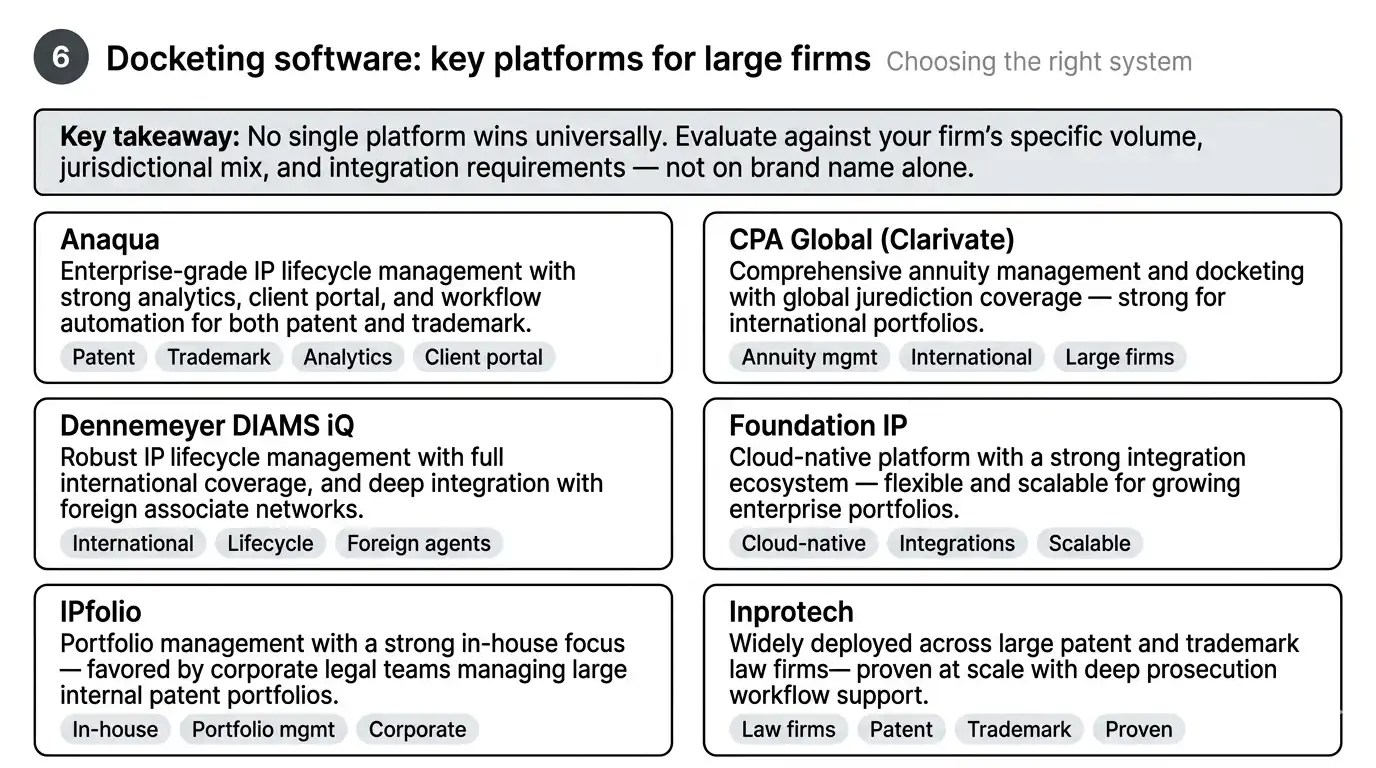
Leading Platforms Used by Large Firms
- Anaqua – Enterprise-grade IP management with strong analytics and client portal capabilities
- CPA Global (Clarivate) – Comprehensive annuity management and global docketing coverage
- Dennemeyer DIAMS iQ – Robust international IP lifecycle management
- Foundation IP – Cloud-native platform with strong integration ecosystem
- IPfolio – Scalable portfolio management with in-house focus
- Inprotech – Widely used across large patent and trademark practices
Note: No single platform is universally superior. The right choice depends on your firm’s volume, jurisdictional mix, practice area balance, and integration requirements.
Also, Read: What is a Docketing System? Complete A to Z Guide
Staffing and Organizational Structure for Large-Firm Docketing
In Patent and Trademark Docketing for Large Firms, having the right technology is only part of the equation. Strong processes need to be backed by a well-structured team with clearly defined roles, responsibilities, and escalation protocols. A solid organizational setup ensures that deadlines are managed efficiently, risks are minimized, and nothing falls through the cracks-even at scale.
| Protocol area | Trigger condition | Escalation path | Response time |
|---|---|---|---|
| Approaching critical deadline | Less than 30 days to non-extendable deadline | Senior specialist → Manager → Partner | Immediate |
| Missed internal action date | Attorney or paralegal missed internal due date | Docketing Manager → Practice Group Leader | Same day |
| Ambiguous deadline information | Foreign associate communication unclear | Senior specialist → Manager + Associate counsel | Within 24h |
| System outage | Docketing platform unavailable | Manager activates backup system; IT alerted | Immediate |
| Data integrity concern | Inconsistency found during audit or QC check | Manager review; correction documented in audit trail | Within 24h |
Dedicated Docketing Department
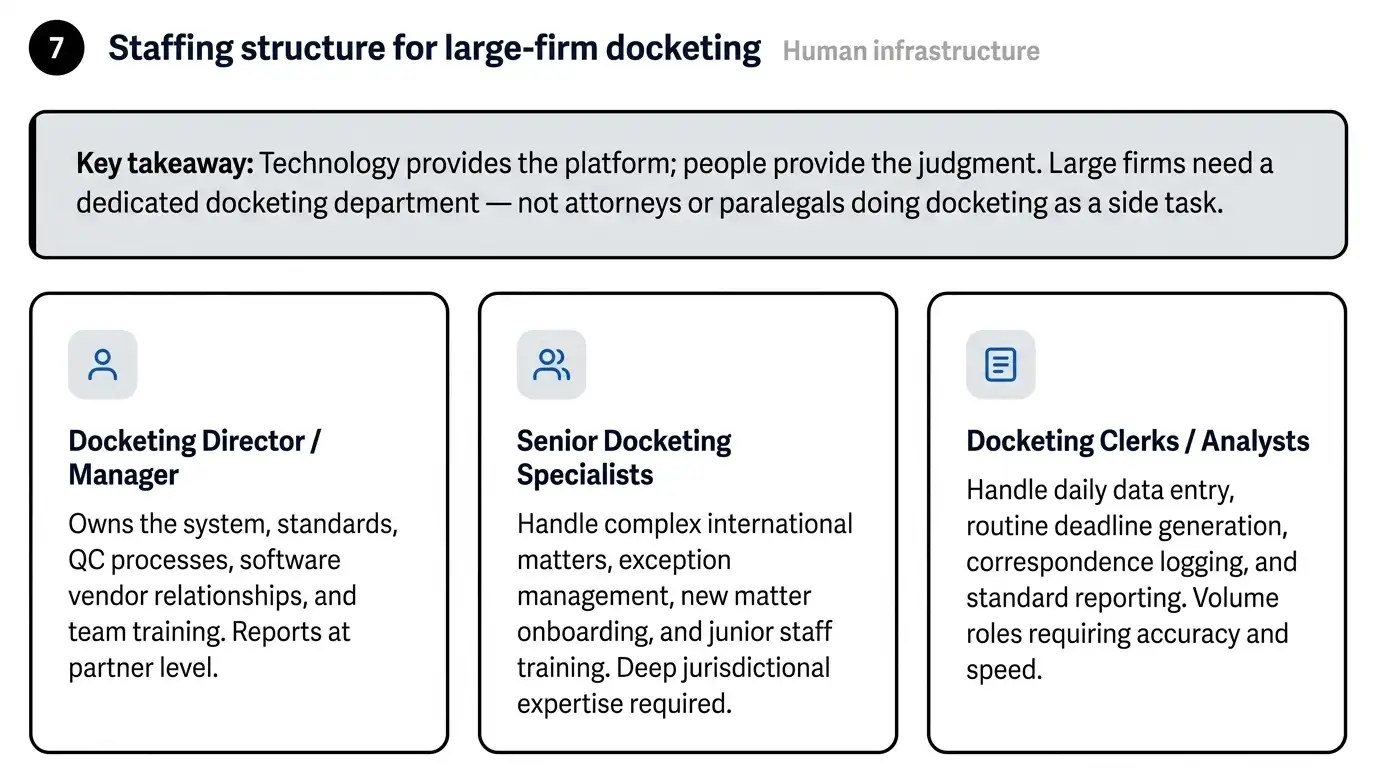
Large firms should maintain a dedicated docketing team – separate from paralegals and attorneys – whose exclusive function is deadline management. This team should include:
- Docketing Manager/Director – owns the system, standards, and QC processes
- Senior Docketing Specialists – handle complex international matters, exception management, and training
- Docketing Clerks/Analysts – handle data entry, routine deadline generation, and reporting
Clear Escalation Protocols
Define clear protocols for:
- Approaching critical deadlines (less than 30 days, especially for non-extendable deadlines)
- Missed internal action dates (internal due dates before the statutory deadline)
- Conflicting or ambiguous deadline information from foreign associates or official correspondence
- System outages or data integrity concerns
Continuous Training
IP procedural rules change. Docketing specialists must receive:
- Regular updates on USPTO rule changes
- Training on international procedural updates (especially PCT rules and national phase changes)
- Docketing software refresher training
- Participation in AIPLA, INTA, and ILTA educational programming
Outsourcing Docketing Support: A Strategic Option for Large Firms
Many large firms – particularly those experiencing rapid portfolio growth or staffing gaps – are turning to specialized Intellectual Property Docketing service providers to supplement or manage their docketing operations.
Outsourcing docketing support: when and how Strategic extension of your team
Key takeaway: Outsourcing is not a cost-cutting measure – it’s a scale strategy. The best outsourcing partners act as a seamless extension of your team, not a vendor processing tickets in the background.
| Scenario | In-house only | Outsourced support | Best approach |
|---|---|---|---|
| Steady-state, predictable volume | Fully manageable | Optional supplement | In-house primary |
| Rapid portfolio growth (M&A, new client) | Risk of gaps during ramp-up | Immediate scalability without hiring lag | Outsource surge |
| Staff vacancy or turnover | Deadline risk during gap | Continuity without interruption | Outsource bridge |
| New jurisdiction expansion | Knowledge gap on local rules | Specialist jurisdiction expertise available immediately | Outsource specialist |
| After-hours coverage requirements | Expensive or impractical in-house | Global team provides natural timezone coverage | Outsource coverage |
| Complex international annuity management | High risk without dedicated expertise | Purpose-built workflows and associate networks | Outsource specialist |
What to require from any outsourcing partner
Proven large-firm portfolio track record · Dual verification QC process · Platform familiarity (Anaqua, CPA, Foundation IP) · Clear SLAs and escalation protocols · Robust confidentiality and data security agreements · Transparent reporting and communication.
Red flags to watch for
No dual verification process · Unfamiliarity with your docketing software · Vague SLAs or no penalty for missed deadlines · No dedicated point of contact · Cannot provide client references from comparable firms.
Benefits of Outsourcing Docketing to a Specialist Partner
- Immediate scalability during portfolio surges without the delay of hiring and training
- Access to specialized expertise across multiple jurisdictions and matter types
- Cost efficiency compared to maintaining a fully in-house team at scale
- Business continuity – no single points of failure due to staff turnover or absence
- Quality control processes that are purpose-built for docketing accuracy
What to Look for in a Docketing Service Partner
- Proven track record with large-firm and in-house legal team portfolios
- Deep expertise in both patent and trademark docketing
- Familiarity with major docketing platforms (Anaqua, CPA Global, Foundation IP, etc.)
- Robust QC and dual-verification processes
- Clear SLAs, security protocols, and confidentiality agreements
- Transparent communication and reporting
Teak IP Services specializes in IP docketing and management support for law firms and in-house legal teams of all sizes. Our experienced team brings deep expertise in both patent and trademark docketing across major jurisdictions – acting as a seamless extension of your docketing operation.
Common Docketing Mistakes Large Firms Must Avoid
Key takeaway: Most docketing failures are process failures, not software failures. The patterns below repeat across firms of every size but at large-firm scale, the consequences are severe.
| ❌ Relying on attorney personal calendars as the primary docket Personal calendars have no redundancy, audit trails, or institutional visibility. When the attorney is out, the deadline disappears. This is a single point of failure no large firm can tolerate. |
| ❌ Delayed docketing of new matters and correspondence Every hour between receipt and docketing is unnecessary exposure. The rule must be same-day entry – without exception, without waiting for attorney review. |
| ❌ Inadequate foreign associate follow-up Instructing a foreign agent is not the same as confirming action was taken. Build payment confirmation workflows into every international instruction – assume nothing until confirmed in writing. |
| ❌ Using grace periods as a planning tool Grace periods are emergency provisions – not planning targets. A firm that routinely files in grace periods is one processing error away from a permanent loss of rights and an indefensible malpractice claim. |
| ❌ Failing to formally close abandoned or transferred matters “Zombie” open matters pollute the docket with false deadline alerts, waste review time, and can cause genuine deadlines to be overlooked. Every closure must be formally recorded. |
| ❌ No periodic docket audits Without regular audits, data quality degrades silently. Large firms must conduct quarterly spot audits and annual comprehensive reviews – docket accuracy is not a set-and-forget function. |
Also, Read: Comprehensive Guide to Patent Docketing Systems
Key Performance Indicators (KPIs) for Large-Firm Docketing
In Patent and Trademark Docketing for Large Firms, performance isn’t just about managing deadlines – it’s about consistently measuring and improving how effectively the system operates. Clear KPIs help firms identify gaps, maintain accuracy at scale, and ensure that every process meets the highest standards of reliability and accountability.
| Audit type | Frequency | Scope | Action trigger |
|---|---|---|---|
| Spot audit | Quarterly | Random sample — 50–100 matters | Any error rate above 0.5% |
| Comprehensive review | Annual | Full open portfolio review | Any systematic errors identified |
| New matter audit | Rolling — first 30 days | All matters opened in the past month | Any incorrect initial docketing |
| International portfolio audit | Bi-annual | All foreign annuity and renewal matters | Any unconfirmed payments or lapsed matters |
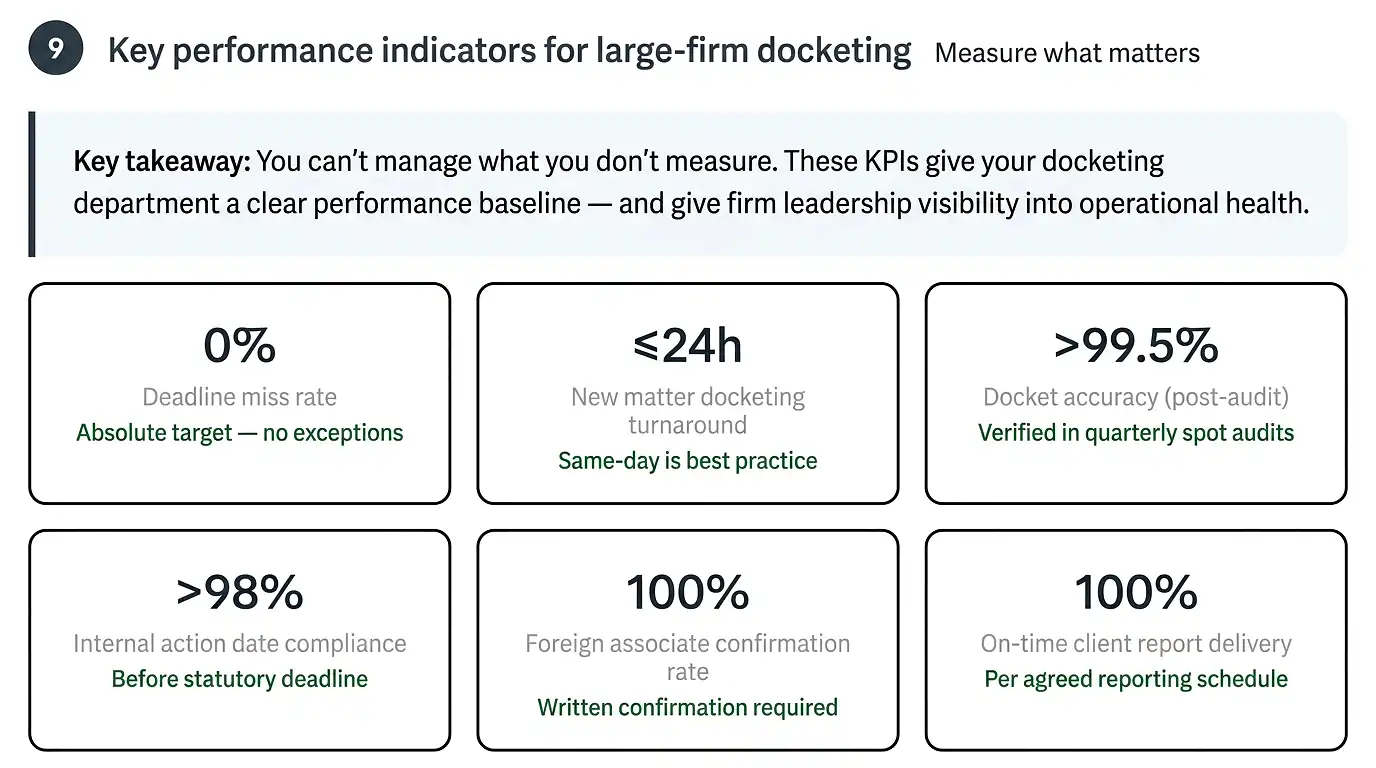
| KPI | Target Benchmark |
|---|---|
| Deadline miss rate | 0% (absolute target) |
| Docketing turnaround time (new matters) | Same-day or ≤24 hours |
| Docketing turnaround time (incoming correspondence) | Same-day |
| Open matter accuracy rate (after audits) | >99.5% |
| Internal action date compliance | >98% |
| Foreign associate confirmation rate | 100% |
| Client report delivery on time | 100% |
Also, Read: The Complete Patent Docketing Guide
Docketing is a Competitive Differentiator for Large Firms
In a landscape where clients have more choices than ever and the consequences of IP errors are severe, how a large firm manages its docketing function is not just an operational detail – it is a signal of professional excellence.
Firms that invest in best-in-class docketing technology, expert staffing, rigorous quality controls, and strategic outsourcing partnerships position themselves to:
- Protect every client asset across every jurisdiction
- Eliminate malpractice exposure from procedural deadline misses
- Scale efficiently without proportionally scaling administrative headcount
- Deliver a client experience that builds long-term loyalty and trust
Whether your firm manages 500 matters or 50,000, the principles of excellent patent and trademark docketing remain the same: systematic, redundant, proactive, and accountable.
Our Services: Discover Docketing / IP Management Services

