
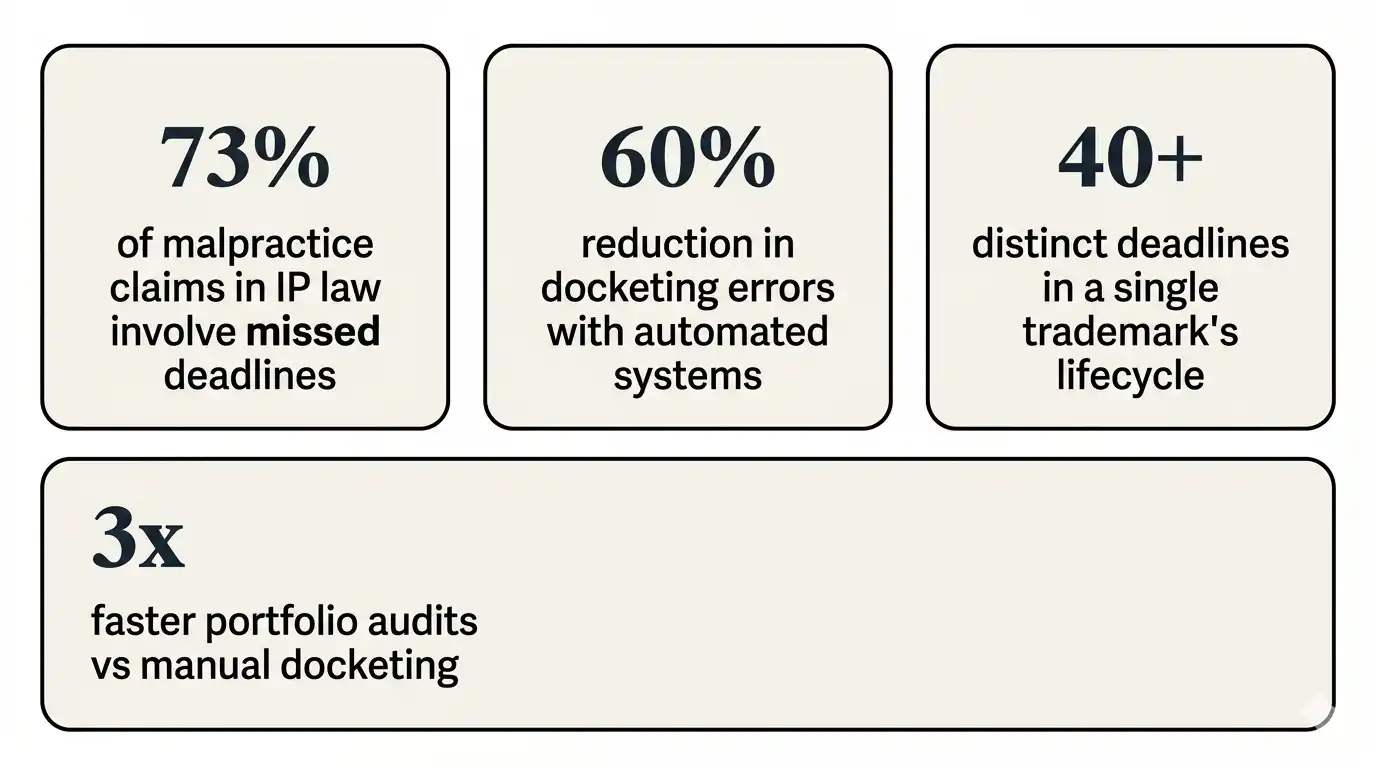
Automated Trademark Docketing is rapidly becoming an essential system for modern IP professionals who need to manage complex trademark portfolios with accuracy and confidence. In today’s fast-moving global landscape, where trademarks are filed, examined, and maintained across multiple jurisdictions, keeping track of critical deadlines manually is no longer reliable A single missed deadline – whether for an Office Action response, a Statement of Use, or a renewal filing – can result in irreversible loss of valuable trademark rights.
This is where automated trademark docketing transforms the process. By leveraging intelligent software and real-time data integration with official trademark offices, it ensures that every deadline is accurately calculated, continuously monitored, and proactively managed. Instead of relying on human memory or manual entries, firms can operate with a structured, system-driven approach that reduces risk, improves efficiency, and enhances client trust.

In this article, we will explore how automated trademark docketing works, why traditional manual systems fall short, and how adopting the right technology can help safeguard your clients’ most valuable intellectual property assets throughout their entire lifecycle – from filing to long-term renewal. For firms ready to make this transition, our trademark docketing services combine intelligent automation with expert oversight to ensure every deadline is tracked, calculated, and actioned without fail.
What is Automated Trademark Docketing?
Automated trademark docketing is the use of software and workflow systems to systematically track, schedule, and manage all critical deadlines across the trademark lifecycle – from the initial filing through maintenance, renewal, and abandonment prevention – without relying solely on manual data entry or spreadsheet-based calendaring.
Think of it this way: every trademark has a life story. It starts with a filing, moves through examination, publication, and registration, and then requires periodic maintenance to stay alive. Along the way, there are dozens of deadlines – many of them strict statutory cutoffs with no grace period. If you miss even one, you can permanently lose rights to a mark your client has spent years and significant money building.
Automated trademark docketing systems solve this by pulling data directly from official trademark offices – including the USPTO, EUIPO, WIPO, and various national registries – and automatically calculating every response window, maintenance window, and renewal period that applies to each mark. They then trigger multi-stage reminder alerts and escalate overdue actions before they become irreversible.
Unlike a shared team calendar or a manually updated spreadsheet, an automated docketing system does not depend on a person remembering to add a deadline. The system detects what happened (a filing was made, an Office Action was issued, a registration was granted) and immediately generates all the follow-on deadlines that flow from that event – without anyone having to instruct it to do so.
In plain terms: Automated trademark docketing ensures that no deadline – whether a Statement of Use, an Office Action response, a Section 8 filing, or a 10-year renewal – slips through the cracks, regardless of workload, staffing changes, or portfolio size.
Also, Read: Legal Docketing Workflow: The Complete Guide for IP, Patent & Trademark Professionals
Why Manual Docketing is No Longer Sufficient
For many years, trademark professionals managed their dockets with a combination of spreadsheets, shared calendars, sticky notes, and paper-based tickler files. For a small, stable portfolio of 10 to 20 marks, all filed in a single jurisdiction, this approach was just about workable. But the trademark landscape has changed dramatically. Even small and mid-sized businesses now operate with multi-jurisdictional portfolios spanning many classes and multiple countries. The manual approach simply cannot keep up.
The problem is not that attorneys and paralegals are careless – it is that the volume and complexity of trademark deadline management has grown far beyond what any human system can reliably handle alone. One missed entry, one overlooked Office Action, or one team member who leaves without properly handing over their docket can cascade into a lost trademark registration that took years and thousands of dollars to obtain.
Critical risks of manual trademark docketing
Human entry error:
A single transposed date, an incorrect deadline calculation, or a missed jurisdiction can result in abandonment of a mark worth millions. When deadlines are entered by hand, there is always a margin for error – and trademark law rarely forgives mistakes.
Staff turnover gaps:
When a docketing specialist or attorney leaves the firm, the institutional knowledge they held about pending deadlines, client preferences, and special instructions often leaves with them. Without a system that holds this information, the next person in that role starts from scratch – and critical items get missed during the transition.
No cross-jurisdiction awareness:
Manual systems rarely account for the very different rules, grace periods, response windows, and acceptable filing formats that exist across USPTO, EUIPO, IP Australia, CIPO (Canada), and dozens of other national trademark offices. A single rule that applies in the US may not apply elsewhere, and vice versa.
Reactive, not proactive:
A shared calendar might send one reminder the day before a deadline. Automated systems send escalating reminders at 90, 60, 30, 14, and 7-day intervals – and they automatically escalate to a senior attorney if no action is recorded within a set window.
Audit-unfriendly records:
If a client questions whether a deadline was handled correctly, or if a malpractice claim is made, proving your diligence with a spreadsheet is extremely difficult. Automated docketing systems maintain a timestamped, immutable audit trail of every entry, change, and action taken.
No automatic Office Action monitoring:
Manual systems rely entirely on someone checking the USPTO’s TSDR or equivalent database. Automated platforms poll these databases continuously and immediately flag any new Office Actions, examination refusals, or status changes – so nothing is missed between manual checks.
Scalability ceiling:
A talented docketing professional can competently manage a few hundred active matters by hand. Beyond that, errors become statistically inevitable. Automated docketing scales to thousands of marks without any corresponding increase in error rate.
High priority alert: Failure to respond to a USPTO Office Action within the statutory deadline (3 months from issuance, extendable to 6 months with a fee) results in abandonment. There are no extensions beyond 6 months, no excuses accepted, and in most cases no path to revival. At this scale of consequence, automated docketing is not a luxury – it is a professional obligation.
Also, Read: Outsource Trademark Docketing: Strong Reasons to Consider
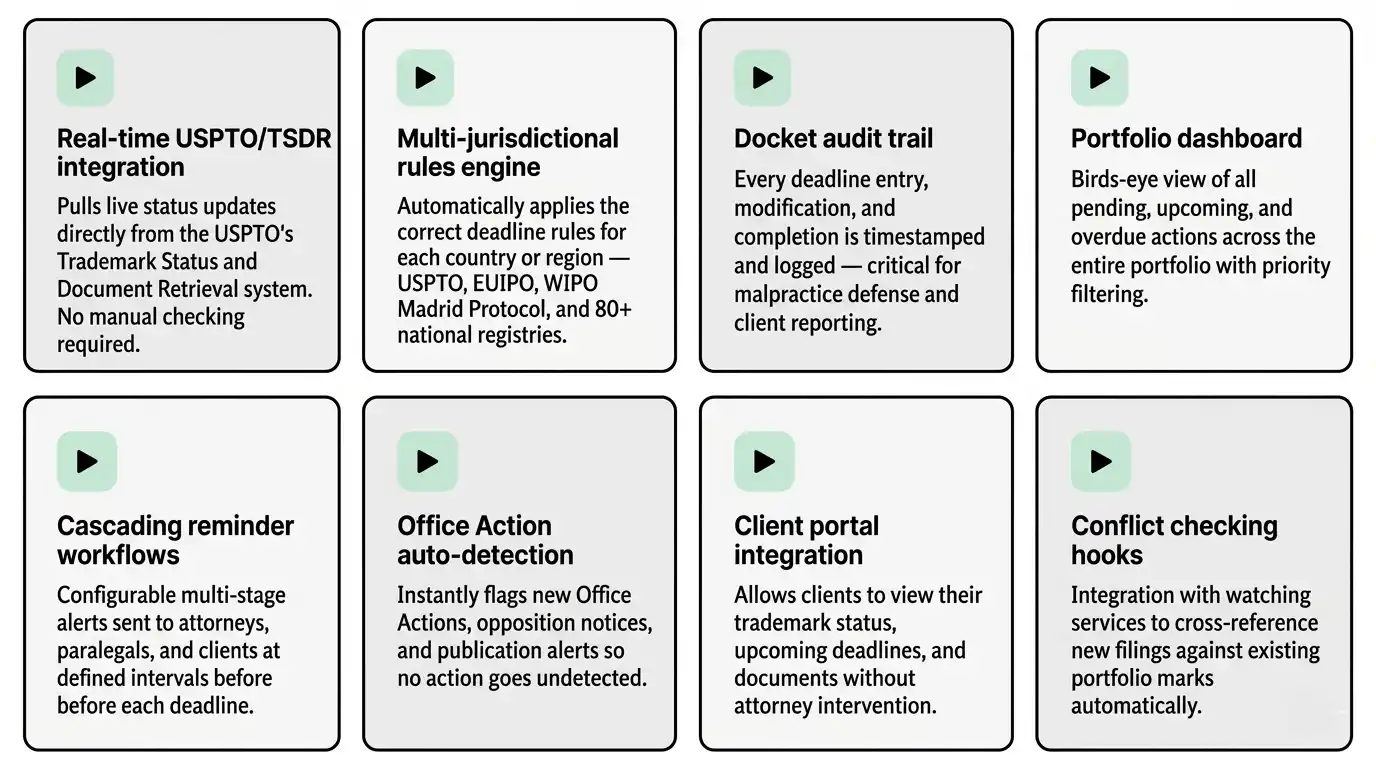
Key Features of an Automated Trademark Docketing System
Not all docketing software is created equal. There is a significant difference between a basic calendar reminder tool and a purpose-built, enterprise-grade automated trademark docketing platform. Below are the features that truly distinguish the best systems from the rest. When evaluating any platform, use this list as your minimum checklist.
Also, Read: Patent and Trademark Docketing for Large Firms
Priority Deadlines Every Automated System Must Capture
This is the heart of any trademark docketing system. The deadlines below are non-negotiable – missing any single one can mean the permanent loss of trademark rights with no possibility of recovery. Your automated docketing platform must track all of them with precision, and your reminder schedule must give attorneys enough runway to take meaningful action before each cutoff.
Pre-registration deadlines
Response to Office Action
At the USPTO, applicants have 3 months from the date an Office Action is issued to respond. This can be extended to a maximum of 6 months (in total) by paying an extension fee for each additional month. No extension beyond 6 months is permitted. An Office Action can raise a range of issues – likelihood of confusion with existing marks, descriptiveness refusals, specimen issues, identification of goods/services problems, and more. Each issue must be addressed clearly and completely within the deadline.
Statement of Use (SOU) / Extension of Time requests
For applications filed on an Intent-to-Use (ITU) basis, the USPTO issues a Notice of Allowance once the mark passes examination. The applicant then has 6 months to either file a Statement of Use (showing the mark is now in use in commerce) or file an extension request. Extensions can be granted in 6-month increments, up to a maximum of 5 extensions – giving applicants up to 36 months total from the Notice of Allowance. Each extension has its own separate deadline, and each must be docketed individually.
Response to opposition or cancellation proceedings
After a trademark application is approved for publication in the USPTO’s Official Gazette, a 30-day opposition window opens. Any third party who believes they would be harmed by registration of the mark can file an opposition during this period. If an opposition is filed, the applicant must respond within the TTAB’s scheduling deadlines. This is a high-stakes litigation-adjacent proceeding and requires immediate attention when detected.
Priority claim under the Paris Convention
If a trademark was first filed in a Paris Convention member country, the applicant has 6 months from that first filing date to file in the United States (or another Convention country) and claim priority back to the original filing date. Missing this window does not bar filing, but the applicant loses the benefit of the earlier priority date – which can be critical if competing marks are filed in the interim.
Madrid Protocol designation responses
When a trademark owner files an international application through WIPO under the Madrid Protocol, the designated national offices have 18 months (or up to 7 years in some cases) to issue a provisional refusal. Each designated jurisdiction may issue different objections under local law, and each requires a separate local response coordinated through the relevant national attorney or associate.
Post-registration maintenance deadlines
Section 8 Declaration of Continued Use (between years 5 and 6)
Every USPTO trademark registration must be maintained by filing a Declaration of Continued Use between the 5th and 6th year anniversaries of the registration date. This filing must include a specimen showing the mark is still being used in commerce for the registered goods or services. Missing this window – even by one day outside the grace period – results in the automatic cancellation of the registration with no possibility of revival.
Section 15 Declaration of Incontestability
This optional filing can be made concurrently with the Section 8 Declaration, after 5 continuous years of use in commerce following registration. An incontestable registration is substantially harder to challenge on grounds like descriptiveness, and the Section 15 filing is one of the most powerful tools available for strengthening a trademark’s legal standing. It is not mandatory, but it should be discussed with every client whose mark qualifies.
10-year renewal (Section 9)
USPTO registrations must be renewed every 10 years by filing a Section 9 Renewal Application. This application must be filed during the year before each 10-year anniversary (i.e., between years 9 and 10, 19 and 20, and so on). A 6-month grace period is available after the anniversary date, but a surcharge applies. Failing to renew within the grace period results in cancellation of the registration.
Combined Section 8 and 9 filing at the 10-year mark
At the 10-year anniversary, both the Section 8 continued-use declaration and the Section 9 renewal must be filed together in a single combined application. These two filings cannot be separated. Automated docketing systems must recognize this as a single combined event, not two independent ones, to avoid any confusion about what is required.
EU / EUIPO and Madrid renewal cycles
EUIPO trademark registrations are valid for 10 years from the filing date and must be renewed for additional 10-year terms. Renewal can be filed during the 6-month period before expiry, or within a 6-month grace period after expiry with a surcharge. For Madrid Protocol marks, renewal is filed centrally with WIPO and covers all designated jurisdictions simultaneously – making it critical that the WIPO renewal deadline is docketed and that all jurisdiction-specific requirements are confirmed before the filing is submitted.
Automation priority tip: Set primary reminders at 180, 90, 60, 30, and 14 days before each deadline. Escalate to a supervising attorney automatically at the 7-day mark if no completed action is recorded. For Section 8 filings specifically, set an anchor reminder at the 5-year registration anniversary and add a hard-stop warning 30 days before the end of the 6-year window to account for the grace period.primary reminders at 180, 90, 60, 30, and 14 days before each deadline – and escalate to senior attorneys at 7 days. For Section 8 filings, set a reminder at the 5-year registration anniversary plus a hard warning 30 days before the 6-year cutoff.
Step-by-Step Implementation Guide
Transitioning from manual to automated trademark docketing is a significant operational change, and it needs to be done carefully. Cutting corners during implementation is one of the most common reasons firms continue to experience docketing problems even after switching to a new platform. The following four-phase roadmap reflects how leading IP services firms make this transition successfully.
1st Phase – Portfolio audit and data migration
- Export all existing trademark records from your current spreadsheets, legacy software, or paper files into a standardized format such as CSV or XML. Take time to verify that each record is complete – missing filing dates, registration numbers, or owner details will create gaps in your new system.
- Cross-reference every mark against USPTO TSDR, EUIPO eSearch, WIPO Global Brand Database, and any relevant national registries to verify current status. Do not assume your internal records are correct – official databases are the only authoritative source.
- Immediately flag any deadlines falling within the next 90 days across your entire portfolio. These require urgent manual review and confirmation before migration begins. Do not let impending deadlines get caught in a system transition gap.
- Assign a unique matter number to each trademark application and registration. Consistent matter numbering is the backbone of a well-organized docketing system and makes future searching, reporting, and auditing far easier.
- Document all non-standard arrangements – client-specific reminder preferences, unusual extension histories, foreign associate instructions, and any active proceedings (oppositions, cancellations, appeals) that require special handling.
2nd Phase – System configuration
- Configure jurisdiction-specific deadline rules for every country in your portfolio. Do not rely on generic default templates – verify each rule against current USPTO, EUIPO, and WIPO official guidance, and make note of when you performed the verification so you can re-check if regulations change.
- Set up user roles and access controls: docketing specialist, supervising attorney, billing team, and client portal access. Restrict who can create, modify, or delete deadline records to prevent unauthorized changes.
- Build reminder workflow templates for each deadline type. Define which deadlines get which notification cadences, who is notified at each stage, and what the escalation path looks like when a deadline approaches without a recorded action.
- Enable live API integrations with USPTO TSDR, EUIPO eSearch, and WIPO Global Brand Database. Test each integration to confirm that status updates are being pulled correctly and that Office Action alerts are triggering as expected.
3rd Phase – Testing and validation
- Run parallel docketing for 30 to 60 days – maintain your old system alongside the new one during the transition period. Compare the deadlines generated by each system daily. Any discrepancy must be investigated and resolved before go-live.
- Conduct a deadline stress test by manually auditing a random 20% sample of your portfolio and comparing the results against the automated system’s output. If you find errors in this sample, expand the audit until you are confident in the system’s accuracy.
- Test all reminder workflows end-to-end – send test reminders, confirm email deliverability, and verify that escalation paths trigger correctly when no action is recorded within the defined window.
- Document all configuration decisions in a firm-specific docketing procedures manual. This document becomes the training resource for new staff and the reference point for future system audits.
4th Phase – Go-live and ongoing maintenance
- Designate a docketing administrator who is responsible for system oversight, new matter entry protocols, quality checks, and rule updates. This person is the owner of your docketing integrity.
- Schedule quarterly docket audits as a standing, recurring task. Run automated reconciliation reports that compare your system’s records against current USPTO and EUIPO database entries for all active matters.
- Update jurisdiction rules promptly whenever any trademark office amends its deadline regulations, fee structures, or acceptable filing formats. Subscribe to official notices from USPTO, EUIPO, and WIPO to stay ahead of changes.
- Train all staff on matter entry protocols before they are given permission to create or edit docketing records. Even the best automated system will produce errors if the underlying data entered by users is wrong.
Also, Read: Trademark IP Management Best Practices for Multi-Jurisdiction Brand Protection
Choosing the Right Automated Trademark Docketing Software
The market now offers several purpose-built platforms for trademark docketing, each with different strengths depending on your firm’s size, jurisdictional focus, and budget. Before committing to any platform, evaluate it carefully against the criteria below. A wrong choice at this stage is expensive to undo
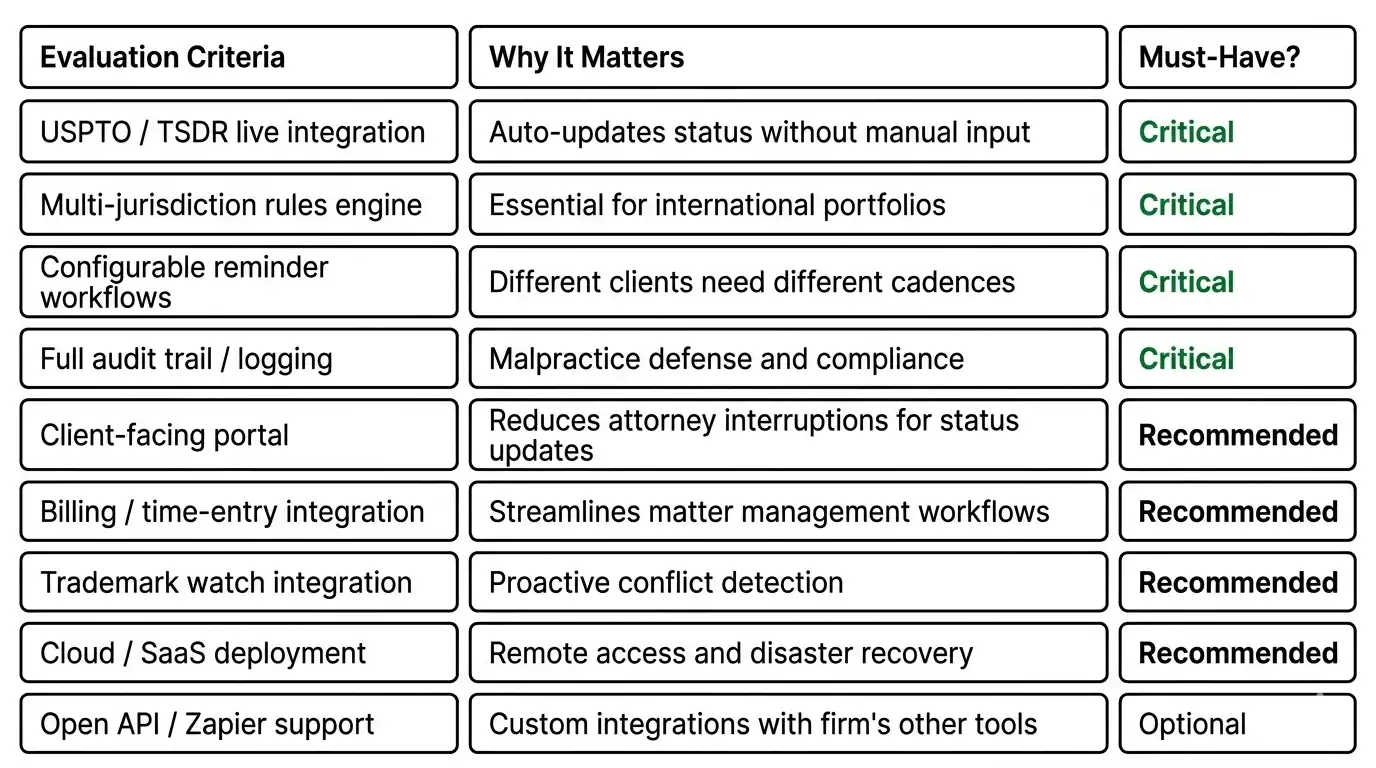
Leading platforms in the trademark docketing space include FoundationIP, Dennemeyer ANAQUA, CPA Global Inprotech, Questel Orbit Intelligence, and TM Cloud – each with varying strengths depending on portfolio size and jurisdictional focus. Request a live demo with your own data before making a final decision, and ask specifically how the system handles Office Action detection and multi-stage reminder workflows.
Also, Read: Outsource Patent Docketing: Key Reasons to Consider
Common Pitfalls and How to Avoid Them
Even firms that invest in excellent docketing software can run into serious problems if the system is not implemented and maintained correctly. The following are the most common pitfalls encountered when transitioning to or operating an automated trademark docketing system – along with practical steps to avoid each one.
Treating implementation as a one-time event.
Many firms invest heavily in setting up an automated system and then assume it will run perfectly forever with no further attention. In reality, trademark office rules change, new jurisdictions are added to portfolios, and software updates can alter how rules are applied. Dedicate a recurring budget and time allocation to quarterly audits, annual rule reviews, and system health checks. Automated docketing is a continuous process, not a one-time project.
Over-relying on automation without human review.
Automation is extraordinarily good at eliminating data entry errors and ensuring no deadline is forgotten. It is not designed to replace attorney judgment. Every auto-generated deadline should have a named responsible attorney who receives the reminder, reviews the matter, and makes the strategic decision about how to respond. The system reminds; the attorney decides.
Failing to account for jurisdiction-specific quirks.
USPTO, EUIPO, IPO (UK post-Brexit), CIPO (Canada), IP Australia, and dozens of other national offices each have their own rules about what constitutes a valid response, what grace periods apply, and what fees are required. A system configured with generic rules will generate incorrect deadlines for many international matters. Always verify jurisdiction-specific settings against the official guidelines of each trademark office.
Neglecting to docket foreign associate communications promptly.
For international portfolios managed through local associates in each country, your automated docketing system is only as effective as your intake process for information coming in from those associates. When a foreign associate sends a deadline notice or status update, it must be entered into your central docketing system the same day it is received – not whenever someone gets around to it.
Poor data migration from legacy systems.
Errors in your old spreadsheets or legacy software carry forward into the new system if data is migrated without proper verification. Before go-live, manually verify every mark with an upcoming deadline within the next 12 months against official registry records. This extra step prevents historical mistakes from becoming future liability.
No escalation protocol for unacknowledged reminders.
A reminder that is sent but never acted upon provides no protection. If a reminder is issued and no completed action is logged within 48 hours, the system must automatically escalate to a supervising attorney. Silent reminders that go unacknowledged are functionally the same as having no reminder at all.
Insufficient training for new team members.
When a new paralegal, docketing specialist, or attorney joins the team, they may begin entering records in the system before they fully understand the protocols. One incorrect entry can generate a cascade of wrong deadlines across a matter. Make formal docketing training a required part of onboarding = before new hires are given write access to the system.
Also, Read: Effective Trademark Portfolio Management: Key Components, Challenges & Practices
The full trademark lifecycle at a glance
To understand why automated docketing is so important, it helps to see the full picture of what a trademark goes through from the moment it is filed to the point where it either becomes a permanent, maintained asset or is lost. Each stage generates one or more deadlines, and each deadline requires a specific action within a defined window.
(Filing) Application submitted
The trademark application is filed at the USPTO (or relevant national office). Filing date is established. For ITU applications, no use is required yet. For use-based applications, a specimen of use must be included. The application enters the examination queue – typically 3 to 4 months before an examiner reviews it.
(Examination) USPTO examination and potential Office Action
The USPTO examiner reviews the application for compliance with all legal requirements. If issues are found – likelihood of confusion, descriptiveness, specimen problems – an Office Action is issued. The 3-month response clock starts the moment the Office Action is mailed. This is one of the most critical deadline windows in the entire process.
(Publication) Publication for opposition in the Official Gazette
If the application passes examination (or after a successful Office Action response), the mark is published in the Official Gazette. A 30-day opposition window opens. Third parties who believe the mark would harm their existing rights can file an opposition. If no opposition is filed, the application moves forward.
(Allowance / Registration) Notice of Allowance or Registration Certificate
For use-based applications: a Registration Certificate is issued directly. For ITU applications: a Notice of Allowance is issued, triggering the 6-month SOU window For use-based marks, registration sets the clock for the Section 8 (year 5-6) and Section 9 (year 9-10) maintenance filings.
(Year 5–6) Section 8 Declaration of Continued Use
Between the 5th and 6th year after registration, the owner must file a Declaration of Continued Use with a current specimen. This is a mandatory maintenance filing. A 6-month grace period is available after the 6-year anniversary, with a surcharge. Missing the grace period results in automatic cancellation of the registration.
(Year 9–10) Combined Section 8 and 9 Renewal
Between years 9 and 10 (and every 10 years thereafter), the owner must file a combined Section 8 continued-use declaration and Section 9 renewal application. Both filings must include a current specimen and the applicable government fees. A 6-month grace period applies, with a surcharge for late filing.
(Ongoing) Perpetual 10-year renewal cycle
As long as the mark remains in use and renewals are filed on time, the registration can be maintained indefinitely. A trademark that is properly maintained can remain on the register for 50, 100, or even more years – protecting a brand’s identity across generations.
Also, Read: What is a Docketing System? Complete A to Z Guide
Automated docketing for international trademark portfolios
Managing a trademark in a single jurisdiction is relatively straightforward. Managing a brand across 10, 20, or 50 countries simultaneously is an entirely different challenge – one that manual docketing systems are almost entirely unable to handle reliably. This is where automated docketing systems deliver their most significant value.
International trademark portfolios introduce complexity at every level. Different countries have different renewal cycles, different response windows for examination objections, different rules about what constitutes valid use, and different procedures for handling oppositions and cancellations. An automated docketing system designed for international portfolios must account for all of these variables simultaneously.
Key considerations for international automated docketing
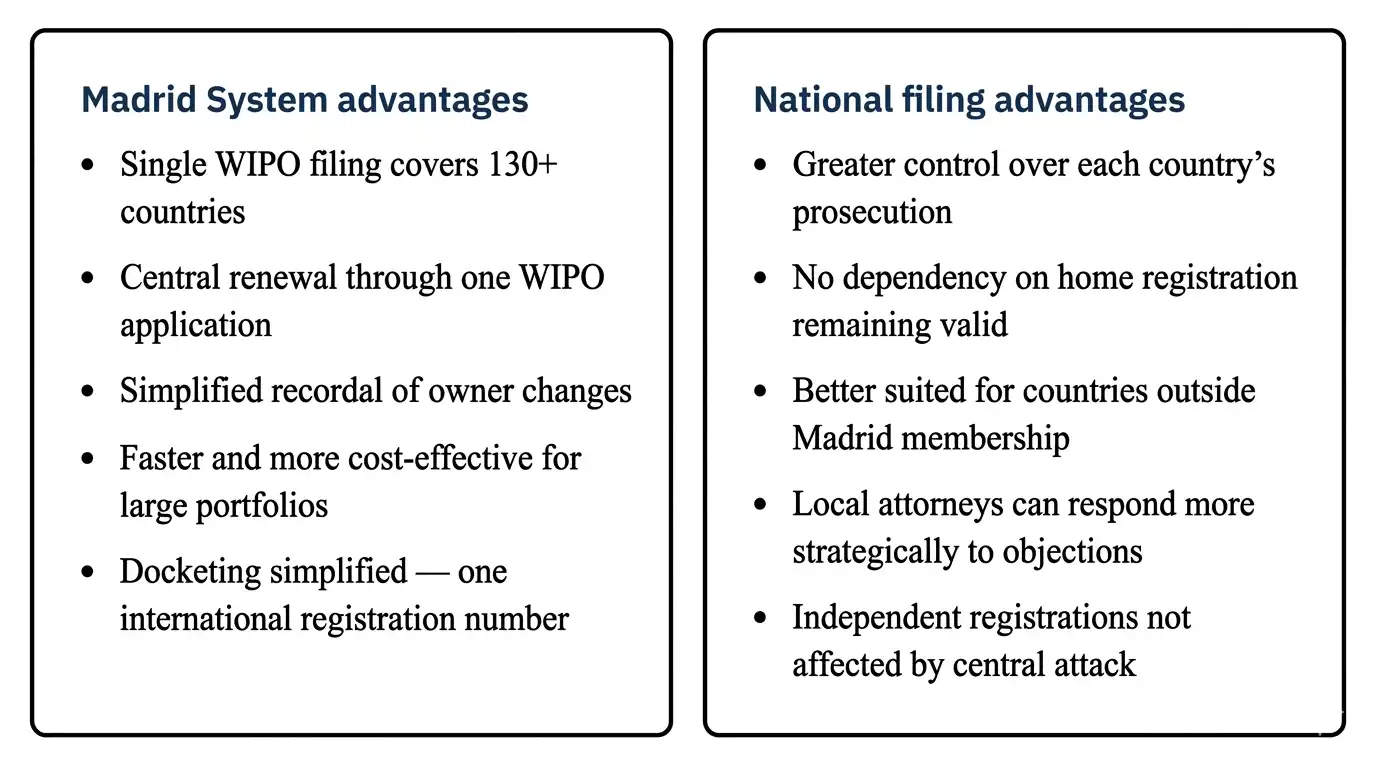
- Madrid Protocol centralized management: The Madrid System allows trademark owners to file a single international application through WIPO that covers up to 130+ member countries simultaneously. Your docketing system must be configured to track the WIPO central renewal deadline (every 10 years from the international registration date) as well as individual national examination deadlines for each designated country, which vary in length and process.
- Foreign associate workflow integration: For countries not covered by the Madrid System (or where national filings are preferred), work is handled through local associate attorneys in each country. Your docketing system must include a structured process for receiving deadline notifications from these associates, entering them into your central system promptly, and tracking the associate’s filing confirmations as evidence of completion.
- Currency of jurisdiction rules: Trademark laws change. Countries update their examination procedures, modify renewal periods, and introduce new filing requirements. Your docketing platform must have a defined process for monitoring and incorporating these changes – ideally maintained by the software vendor, with your docketing administrator responsible for verifying that changes have been applied correctly.
- Cross-portfolio consistency: When a brand owner has the same mark filed in 20 countries, there should be consistent naming conventions, matter numbering, and deadline categorization across all jurisdictions in the docketing system. Inconsistent record-keeping across jurisdictions makes auditing nearly impossible and increases the risk of deadlines being missed or double-counted.
- National phase entry for PCT applications: For trademark matters that intersect with patent portfolios (for clients who manage both), some firms also docket PCT national phase entry deadlines through the same system. Confirm that your platform can handle both if this is relevant to your practice.
Frequently asked questions about automated trademark docketing
Here are answers to the questions IP professionals and business owners most commonly ask when they are evaluating or implementing automated trademark docketing for the first time.
What is the difference between docketing software and a practice management system?
A practice management system is a broad platform for managing all aspects of a law firm or IP firm – billing, time tracking, client records, documents, and calendaring. A dedicated docketing system is specifically built around the logic of intellectual property deadlines – it understands the rules of trademark law, calculates response windows correctly, and integrates with official trademark databases. Many firms use both together, with the docketing system feeding deadline information into the practice management platform.
Can automated docketing systems make mistakes?
Yes – no system is perfect, which is why human oversight remains essential. The most common sources of automated docketing errors are outdated jurisdiction rules within the software, incorrect data entered during matter creation, and missed updates when trademark office regulations change. This is why quarterly docket audits, regular rule verification, and strict data entry protocols are so important even when using the best available software.
How long does it take to implement an automated trademark docketing system?
For a small to mid-sized portfolio (under 500 active matters), implementation typically takes 4 to 8 weeks when done carefully – including data migration, system configuration, parallel testing, and staff training. Larger portfolios with hundreds or thousands of international matters can take 3 to 6 months to implement properly. Rushing implementation is one of the top causes of ongoing docketing errors after go-live.
Do I still need a docketing specialist if I use automated software?
Yes. Automated docketing reduces the manual work involved in tracking and calculating deadlines enormously, but it does not eliminate the need for a human administrator. Someone must ensure new matters are entered correctly, monitor the system for anomalies, update jurisdiction rules as they change, manage foreign associate communications, and conduct regular audits. The role of a docketing specialist evolves from manual tracking to system management and quality control – which is a higher-value, more strategic function.
How does automated docketing help with client communication?
Most modern docketing platforms include client-facing features such as status portals, automated deadline summary emails, and renewal cost forecasting reports. These tools allow clients to stay informed about their trademark portfolio without needing to contact their attorney for routine updates. This saves attorney time, improves client satisfaction, and demonstrates a high standard of portfolio management that builds long-term trust.
Is automated docketing only for large law firms?
Not at all. Small boutique IP firms and solo practitioners managing even modest portfolios benefit significantly from automated docketing. The risk of a missed deadline does not scale with firm size – a small firm that loses a client’s trademark registration faces the same professional and financial consequences as a large firm. Many cloud-based docketing platforms are specifically designed to be affordable and practical for smaller practices.
What happens if a deadline is missed despite using an automated system?
If a deadline is missed, the first step is to assess whether any revival or petition options are available. For USPTO matters, a Petition to Revive is available in limited circumstances (such as unintentional abandonment), but success is not guaranteed and fees apply. The audit trail generated by your docketing system will be critical in understanding exactly what happened and demonstrating your firm’s diligence. In any case, the client must be notified immediately and the matter escalated to senior counsel.
Also, Read: Comprehensive Guide to Patent Docketing Systems
How Teak IP Handles Automated Trademark Docketing
At Teak IP Services, automated trademark docketing is not just a software feature – it is a core operational pillar of how we protect our clients’ IP portfolios. Our approach deliberately combines the efficiency and accuracy of best-in-class docketing technology with structured human oversight at every critical stage of the trademark lifecycle.
We believe that automation is most powerful when it is paired with accountability. Our system generates the deadlines and sends the reminders, but a named attorney is responsible for every single action that results. This combination – technology-driven efficiency with human judgment – is what makes our docketing reliable for clients ranging from individual brand owners to enterprise-level multinationals.
What we do differently at Teak IP
Multi-layer deadline verification:
Every deadline auto-generated by our system is cross-checked against live official USPTO and international registry data before any reminder is sent to a client. We do not rely on a single source – we verify.
Proactive Office Action monitoring:
We monitor USPTO TSDR daily for status changes across all active matters. Clients are notified within 24 hours of any new Office Action, and the response timeline is docketed immediately upon detection.
Client-transparent docketing:
Every client has on-demand access to a real-time view of their trademark portfolio – upcoming deadlines, current status, filed documents, and the full action history for each mark. There are no surprises.
International coordination with verified associates:
Our system handles Madrid Protocol designations, EUIPO filings, and foreign associate management through integrated deadline tracking across 80+ jurisdictions. We work exclusively with vetted local associates and have structured intake protocols for every communication we receive from them.
Renewal lifecycle management starting at 18 months:
We begin renewal outreach 18 months before each registration anniversary – giving clients time to make informed decisions about their portfolio strategy, budget for upcoming costs, and address any use or coverage issues before the renewal deadline arrives.
Escalation protocols with zero tolerance for silence:
If a reminder is acknowledged but no completed action is logged within 48 hours, the matter is automatically escalated to a supervising attorney. No reminder goes unresponded to without human follow-up.
Annual portfolio health reports:
Each client receives an annual trademark portfolio health report generated directly from our docketing system – showing all active marks, their current status, upcoming deadlines for the next 18 months, and a projected cost schedule for maintenance and renewals.
Whether you manage 5 trademarks or 5,000, automated trademark docketing is the foundation of a defensible, scalable, and professional IP practice. The question is not whether to automate – it is how quickly and carefully you can make the transition without letting anything fall through during the process.s.
Also, Read: The Complete Patent Docketing Guide
Key Takeaways
- Automated trademark docketing eliminates the single largest source of IP malpractice risk: missed deadlines at any stage of the trademark lifecycle.
- Priority deadlines – Office Actions, Statements of Use, Section 8 continued-use declarations, and 10-year renewals – must be tracked with cascading, multi-stage reminders, not single alerts.
- A successful implementation requires a thorough portfolio audit, careful system configuration, parallel testing for at least 30 days, and an ongoing quarterly reconciliation schedule.
- The best systems combine live USPTO and EUIPO API integration with configurable reminder workflows, multi-jurisdiction rules engines, and a complete audit trail.
- International portfolios require additional layers of automation – Madrid Protocol tracking, foreign associate workflow management, and jurisdiction-specific rule verification.
- Human oversight remains essential at every stage – automation supports and empowers attorney decision-making but does not replace professional judgment.
- Teak IP’s automated docketing approach ensures every client trademark is monitored, protected, and renewed on time – with complete transparency at every step.
Our Services: See Trademark Docketing Services Overview

