
A client calls with a new brand name they are excited about. Before anyone files an application, someone has to check whether that name is actually available. Later, after the mark is registered, someone has to keep watching the register so a confusingly similar mark does not slip through unnoticed. These are two separate jobs, and mixing them up is one of the most common mistakes junior attorneys and solo practitioners make when they are still building their trademark workflow.

Understanding the difference between a trademark search and trademark monitoring is not just a vocabulary exercise. It shapes how a firm advises clients, prices its services, and avoids malpractice exposure. A trademark search is a one-time investigative snapshot taken before an application is filed. Trademark monitoring is an ongoing surveillance process that continues for as long as the mark matters to the client. One looks backward at what already exists; the other looks forward at what might appear next.
This guide breaks down both concepts in plain, procedural language, so a junior attorney, in-house counsel, or solo practitioner can explain the difference confidently to a client, build a compliant workflow, and know exactly when paralegal support or outsourced help makes sense.
Quick Answer: Trademark Search vs Trademark Monitoring
A trademark search is a pre-filing investigation used to determine whether a proposed mark is available for use and registration. A trademark monitoring service (also called a trademark watch) is a recurring, post-registration process that scans new applications and marketplace activity to detect potential infringement or conflicting filings.
In short:
- A trademark search happens once, before filing.
- Trademark monitoring happens continuously, after registration.
- A search protects a client from filing on top of someone else’s rights.
- Monitoring protects a client’s own rights from being diluted or infringed by someone else.
What is a Trademark Search?
A trademark search is a due-diligence exercise conducted before a client files a trademark application. Its purpose is to identify existing marks, whether registered, pending, or established through common law use, that could conflict with the proposed mark. The goal is to assess the risk of refusal by the examining attorney and the risk of a future infringement claim from a third party.
Search results feed directly into a legal opinion. An attorney reviews the findings and advises the client on whether the mark is clear to file, needs modification, or should be abandoned before any money is spent on an application.
Types of Trademark Searches
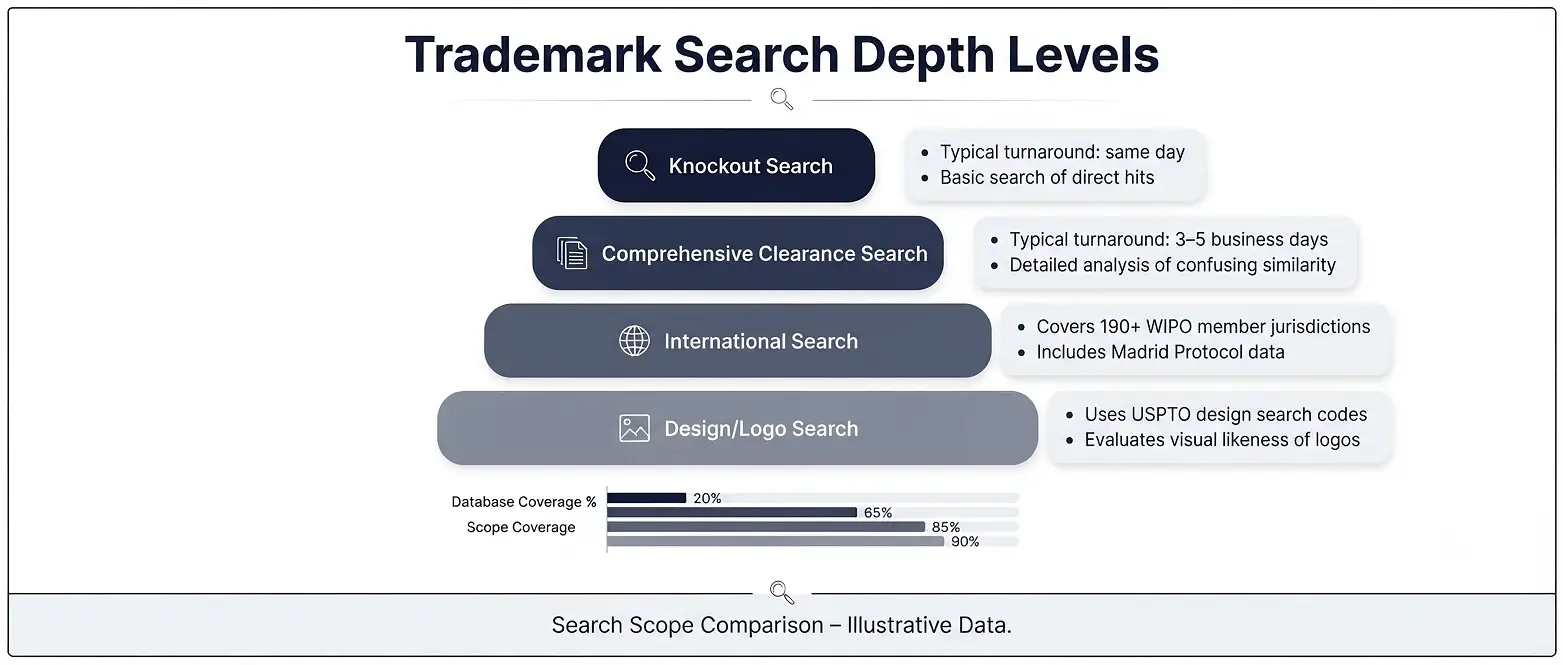
Not every search is the same depth or scope. Firms typically offer a tiered structure depending on budget, risk tolerance, and how far along the client is in brand development.
- Knockout Search (Preliminary Search): A quick check of the USPTO Trademark Search database for identical or near-identical marks in the relevant class. This is fast and inexpensive, but it only catches obvious conflicts.
- Comprehensive Clearance Search: A full-scope search that covers federal registrations, state registrations, common law sources (business directories, domain names, social media handles), and phonetic or visual equivalents. Our internal guide on what a pre-filing trademark clearance search involves walks through this process step by step.
- International Search: For clients planning to expand abroad, a search across foreign trademark registries or the WIPO Global Brand Database helps flag conflicts before a Madrid Protocol filing.
- Design or Logo Search: For marks that include a design element, searchers use USPTO design search codes to locate visually similar logos that a word-only search would miss.
Why a Trademark Search Matters Before Filing
Skipping a proper search, or relying only on a quick knockout check, creates real exposure. Consequently, attorneys who cut corners here often end up dealing with costly office actions, opposition proceedings, or rebranding projects later. A thorough search:
- Reduces the likelihood of a USPTO refusal under Section 2(d) for likelihood of confusion.
- Surfaces common law users who are not visible in any federal database.
- Gives the attorney a documented basis for the clearance opinion, which matters for malpractice defense.
- Saves the client from spending on branding, packaging, and marketing for a name they cannot legally keep.
What is Trademark Monitoring?
Trademark monitoring is the ongoing process of watching trademark registries, marketplaces, and the internet for new activity that could threaten an existing registered or pending mark. Unlike a search, which is a single point-in-time snapshot, monitoring is continuous. It typically runs for the entire life of the registration.
The purpose of monitoring is enforcement, not clearance. A trademark owner who does not monitor the register risks losing the ability to oppose a confusingly similar mark within the statutory window, and over time, an unenforced mark can weaken through dilution or genericization.
Types of Trademark Monitoring Services
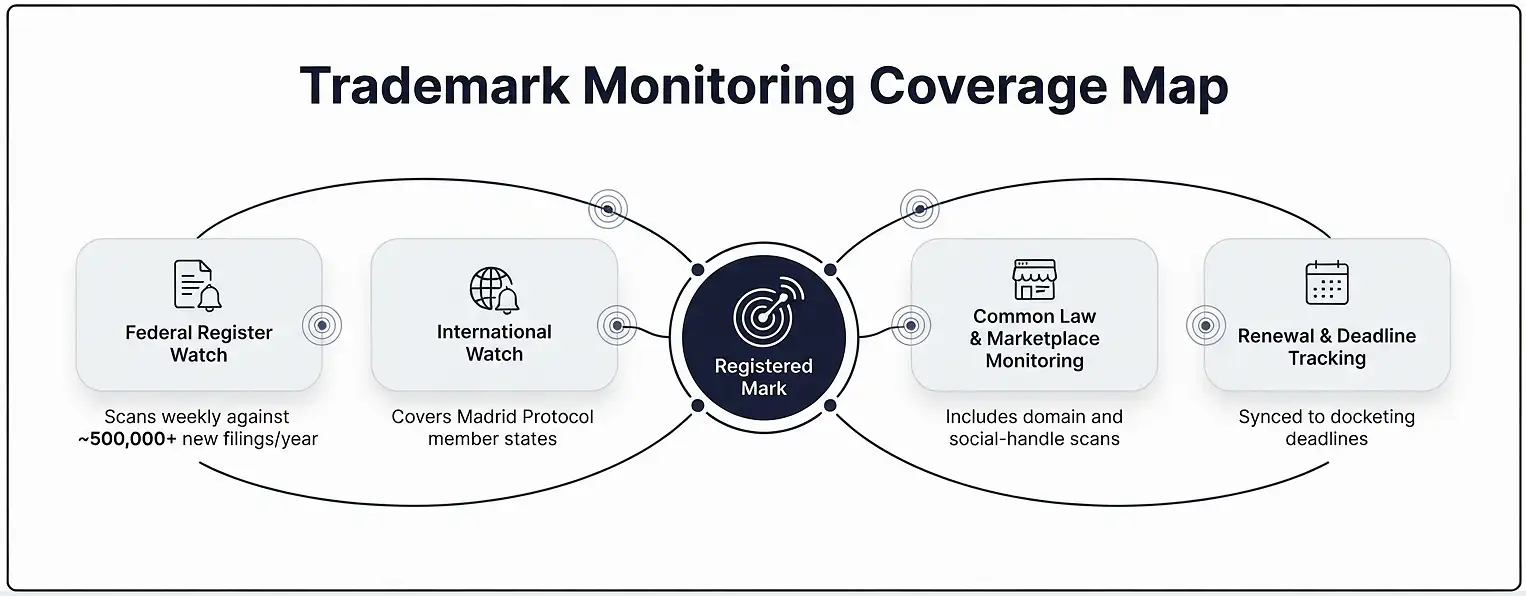
- Federal Register Watch: Automated alerts whenever a new application is filed with the USPTO that is identical or similar to the client’s mark, in the same or related classes.
- International Watch: Monitoring foreign trademark offices and the WIPO Madrid Monitor for filings that could conflict with an internationally registered mark.
- Common Law and Marketplace Monitoring: Scanning domain name registrations, e-commerce listings, social media handles, and business name filings for unauthorized use of the mark.
- Renewal and Deadline Monitoring: While technically closer to docketing, many firms bundle renewal deadline tracking with watch services since both protect the same underlying registration. Our article on how firms manage corporate trademark renewals globally covers this in more depth.
Why Trademark Monitoring Matters After Registration
A registration certificate does not enforce itself. The USPTO does not notify a trademark owner when someone else files a similar mark; that responsibility sits entirely with the owner and their counsel. As a result, monitoring:
- Preserves the client’s opposition window at the Trademark Trial and Appeal Board, since an opposition must generally be filed within 30 days of publication.
- Provides an evidentiary trail showing the mark owner actively polices the mark, which matters if dilution or abandonment is ever raised as a defense.
- Catches marketplace infringement early, before a competitor builds meaningful brand recognition around a conflicting name.
- Supports portfolio-wide brand strategy for clients managing dozens or hundreds of marks across jurisdictions.
The Legal Standard Behind Both Services
Both a trademark search and trademark monitoring exist to serve the same underlying legal test: likelihood of confusion. Under the Lanham Act, the federal statute governing U.S. trademark law, a mark can be refused registration or challenged in court if it is likely to cause confusion with an existing mark. The Lanham Act, codified at 15 U.S.C. § 1052, specifically bars registration of a mark that so resembles a registered mark that it is likely to cause confusion, mistake, or deception.
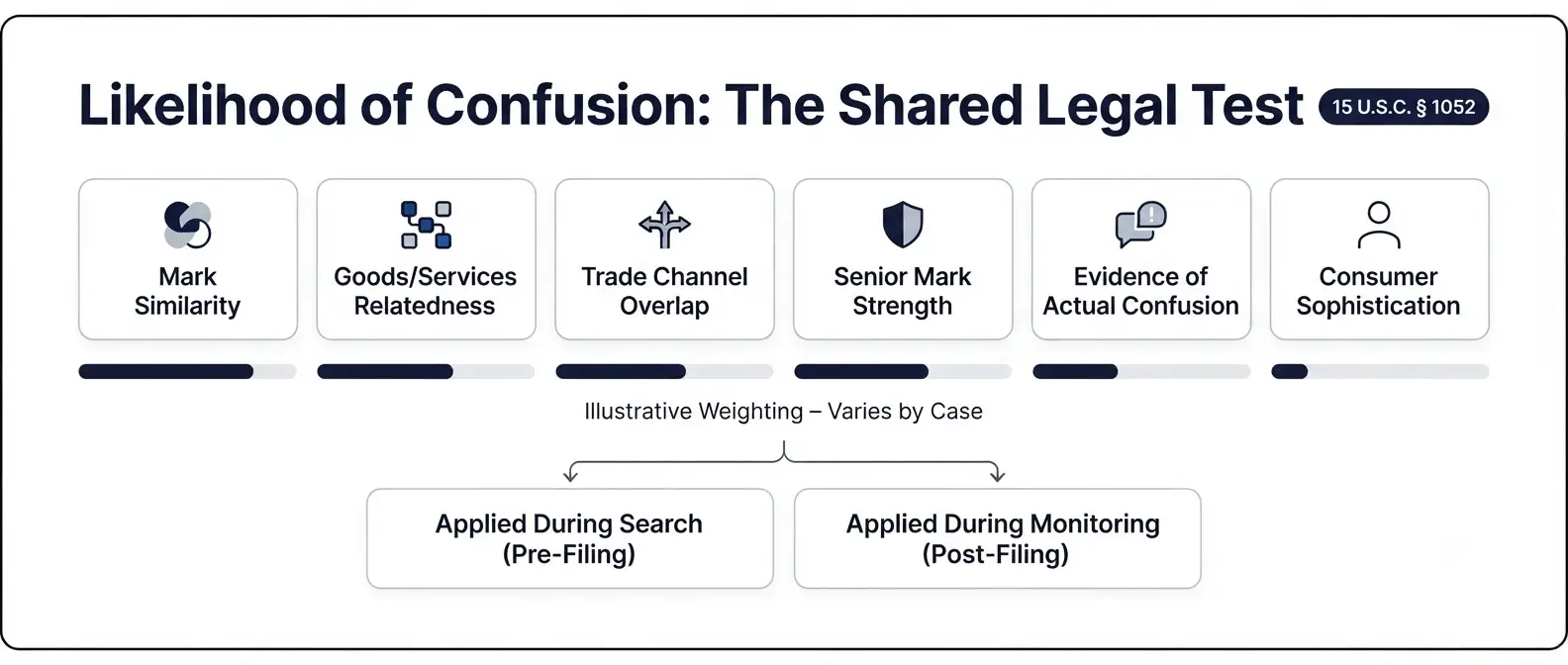
A trademark search is the tool used to test a new mark against that standard before filing. Trademark monitoring is the tool used to test other people’s new marks against the client’s existing rights, continuously, after registration. Because the legal standard never changes, the difference between a trademark search and trademark monitoring is really a difference in direction and timing, not in the underlying legal question being asked.
This is also why neither service can be treated as a purely mechanical, one-and-done task. The USPTO examining attorney applies a multi-factor analysis, weighing the similarity of the marks, the relatedness of the goods or services, the strength of the senior mark, and evidence of actual confusion, among other factors. A search or monitoring alert only surfaces the raw data; the legal judgment about whether a real conflict exists still requires an attorney’s analysis.
What a Trademark Search and Monitoring Program Typically Costs
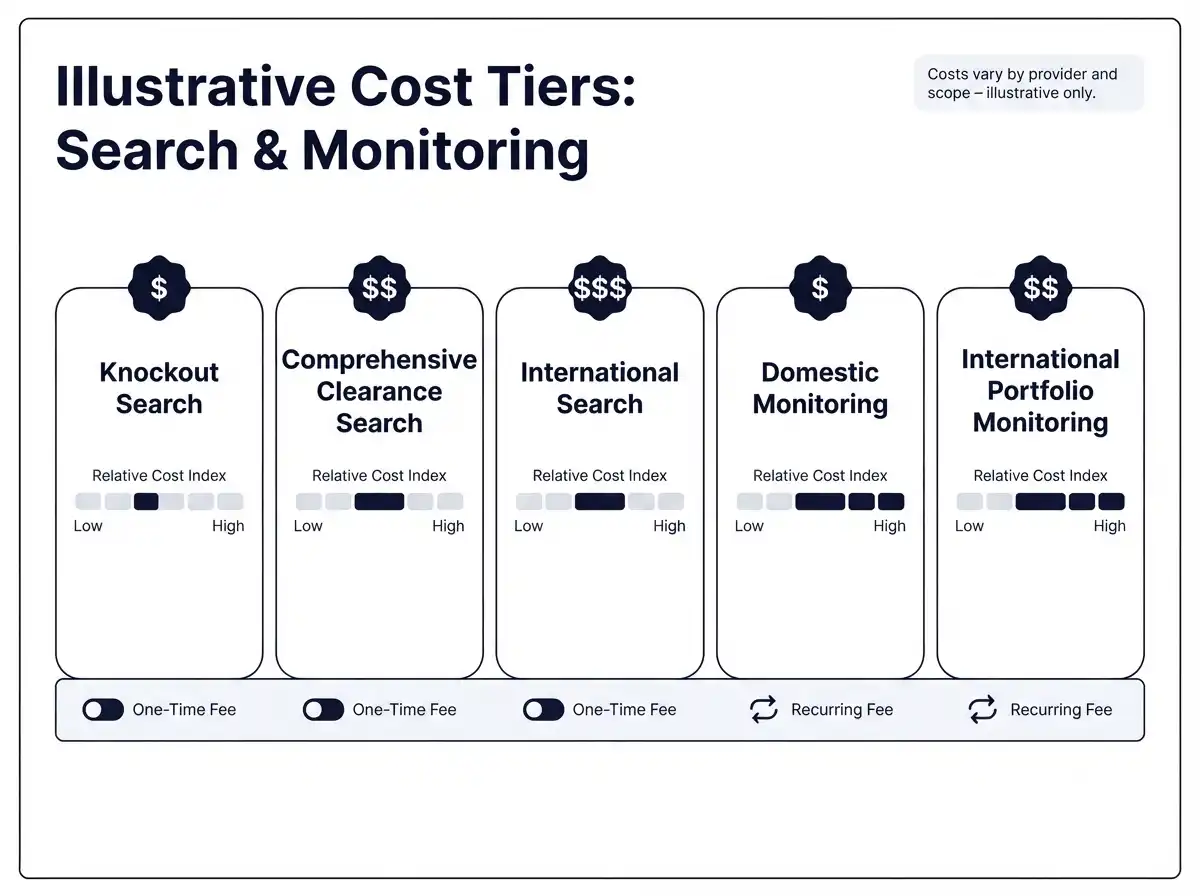
Budget is often the deciding factor for a solo practitioner or a startup client, so it helps to set expectations early. Costs vary by provider and scope, but the following ranges are common in the industry.
| Service | Typical Scope | Relative Cost |
|---|---|---|
| Knockout search | USPTO database only, single mark | Low ($) |
| Comprehensive clearance search | Federal, state, common law, and phonetic variants | Moderate ($$) |
| International search | Multiple foreign registries or WIPO database | Moderate to high ($$–$$$) |
| Domestic monitoring (single mark) | Ongoing federal register watch | Low recurring fee ($ per month or per year) |
| International monitoring (portfolio) | Multiple countries, multiple marks | Higher recurring fee ($$–$$$ per year) |
Because monitoring is a recurring cost, many firms bundle it into a flat annual IP maintenance fee alongside renewal docketing, so the client sees one predictable number rather than a surprise invoice every time an alert requires attorney review.
A Practical Scenario: Search and Monitoring in Action
Consider a typical fact pattern that a junior attorney might encounter in the first few months of trademark practice.
A client, a small food and beverage startup, wants to launch a new energy drink under the name “SparkWave.” Before filing, the attorney’s team runs a comprehensive clearance search. The search turns up no identical mark in Class 32 (non-alcoholic beverages), but it does find a similarly spelled mark, “SparkWav,” registered for a music streaming app in Class 9. Because the goods are unrelated, the attorney concludes the risk of confusion is low and advises the client to proceed with the application.
Eighteen months later, the mark is registered. If the firm has not set up monitoring, nobody would notice when a competing beverage company files an application for “Sparkwve” in the same beverage class two years later. With monitoring active, however, the watch service flags the new filing within days of publication in the Official Gazette. The paralegal reviews the alert, confirms the goods overlap directly with the client’s registration, and escalates it to the attorney well within the 30-day opposition window. The firm files a notice of opposition at the Trademark Trial and Appeal Board, and the conflict is resolved before the competing mark ever reaches the marketplace.
This scenario illustrates exactly why the two services cannot substitute for one another. The search cleared the mark for filing at one moment in time. Only ongoing monitoring caught the new threat that emerged two years later, long after the original search results had gone stale.
Search and Monitoring Across a Growing IP Portfolio
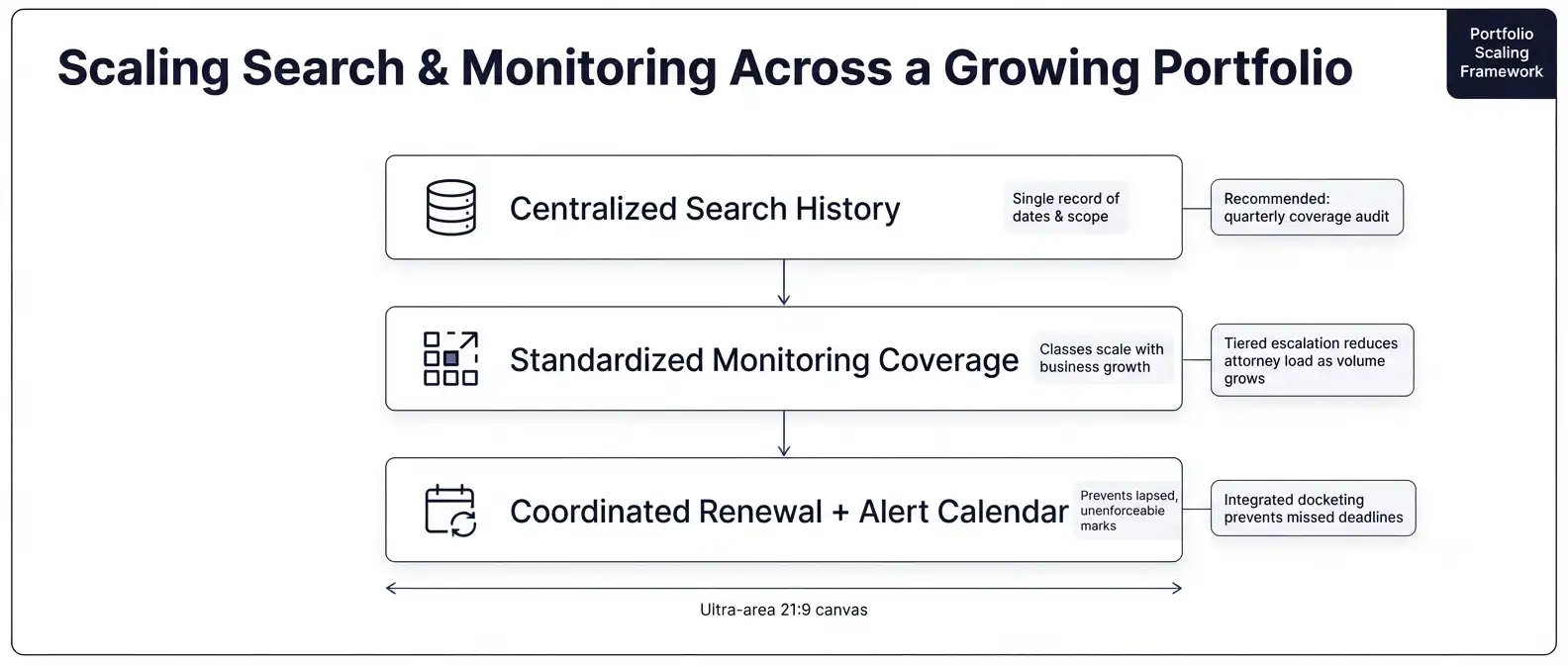
For solo practitioners, the search-and-monitoring workflow described above is usually manageable mark by mark. For firms managing larger portfolios, corporate legal departments, or clients expanding into multiple product lines and countries, the same workflow needs to scale without losing accuracy.
A few practical scaling considerations:
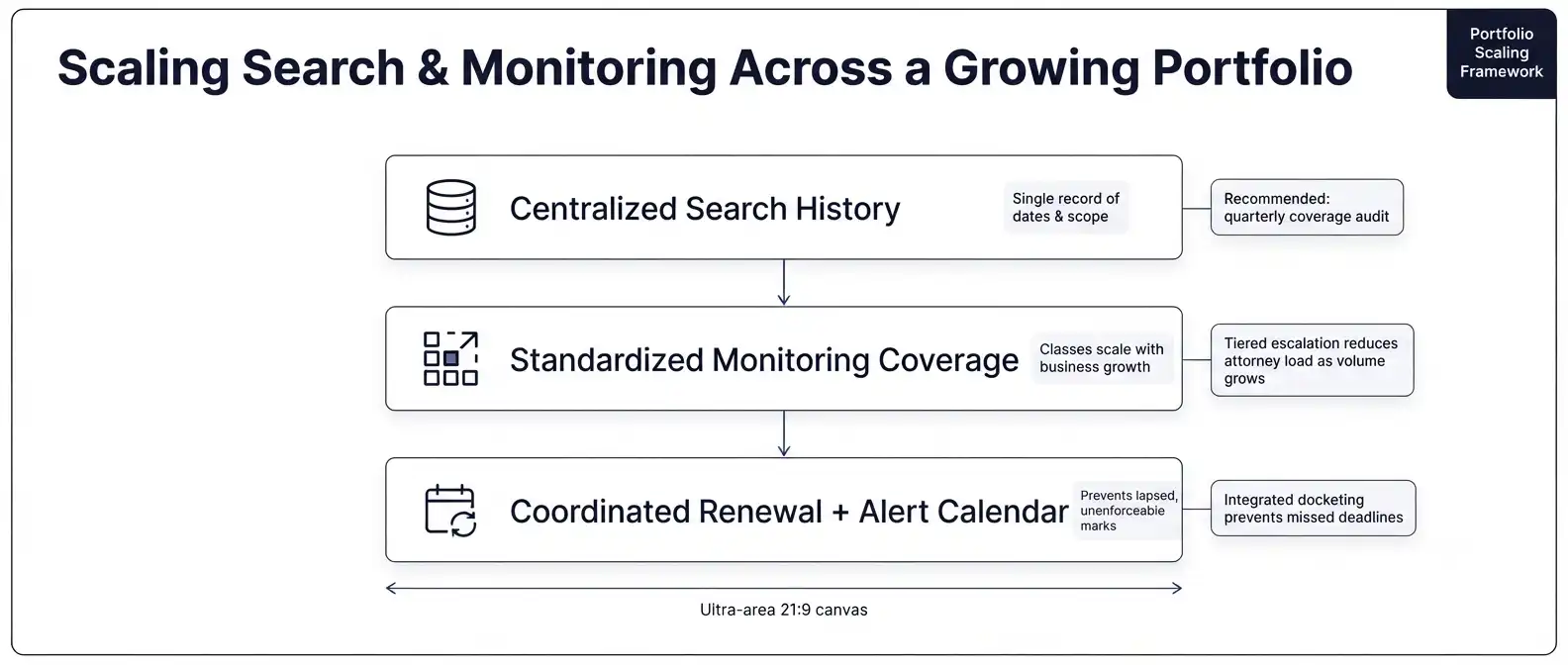
- Centralize search history. Every mark that has been searched, along with the date and scope of that search, should live in a single record the whole team can reference, rather than in individual attorneys’ email inboxes.
- Standardize monitoring class coverage. As a client’s business grows, the classes covered by their monitoring program need to grow with it; a watch service still configured for the client’s original two classes will miss conflicts in the five new classes they have since expanded into.
- Coordinate monitoring with renewal deadlines. A lapsed registration cannot be enforced through opposition, so renewal tracking and monitoring should sit in the same system rather than being managed separately.
- Build escalation tiers. Not every monitoring alert needs the same attorney’s immediate attention; a tiered review process, where a paralegal screens for relevance before escalating, keeps the volume manageable as the portfolio grows.
DIY vs Outsourced: Who Should Handle Search and Monitoring?
Solo practitioners and small firms often start out running searches and monitoring alerts themselves. That approach works at a small scale, but it tends to break down as caseloads grow. A few signs it may be time to bring in dedicated paralegal support or an outsourced provider:
- Searches are being delayed because no one on the team has bandwidth to run them promptly.
- Monitoring alerts are piling up unread, or worse, being missed entirely.
- The firm is turning away new trademark clients because search and monitoring administration is consuming too much attorney time.
- Clients with international portfolios need coverage the firm does not currently have the tools or staff to provide in-house.
Outsourcing these tasks to a trained paralegal team does not remove the attorney from the process. It simply moves the repetitive, detail-heavy work, running the search, screening the alert, compiling the memo, off the attorney’s desk, while the actual legal judgment on clearance and enforcement stays exactly where it belongs.
Trademark Search vs Trademark Monitoring: Side-by-Side Comparison
The table below summarizes the core difference between a trademark search and trademark monitoring across the factors that matter most to a practicing attorney.
| Factor | Trademark Search | Trademark Monitoring |
|---|---|---|
| Timing | Before filing an application | After registration (or after filing) |
| Frequency | One-time event | Ongoing, typically monthly or continuous |
| Purpose | Clear a mark for use and registration | Detect and enforce against conflicting marks |
| Scope | Existing marks, at a fixed point in time | New filings and marketplace activity going forward |
| Output | A clearance opinion or risk memo | Recurring alerts and enforcement recommendations |
| Who Orders It | The applicant, before spending on a brand | The registrant, to protect an owned asset |
| Typical Cost Structure | Flat fee per search | Subscription or recurring fee |
| Risk If Skipped | Refusal, opposition, forced rebrand | Loss of enforcement rights, dilution, unnoticed infringement |
When Do You Need a Search vs When Do You Need Monitoring?
Because these services solve different problems, the right one depends entirely on where the client sits in the trademark lifecycle. The comparison below maps common client situations to the correct service.
| Client Situation | Recommended Service |
|---|---|
| Client wants to launch a new product name | Comprehensive clearance search |
| Client is rebranding an existing business | Comprehensive clearance search, plus a review of the old mark’s monitoring status |
| Client just received a Notice of Allowance or registration | Set up ongoing monitoring immediately |
| Client suspects a competitor is using a similar name | Both: a targeted search to document current use, then monitoring going forward |
| Client manages an international portfolio | Monitoring across all jurisdictions of registration, tied to renewal docketing |
| Client is a startup with a limited budget | A knockout search first, followed by a comprehensive search before filing |
How a Trademark Search Works: Step-by-Step
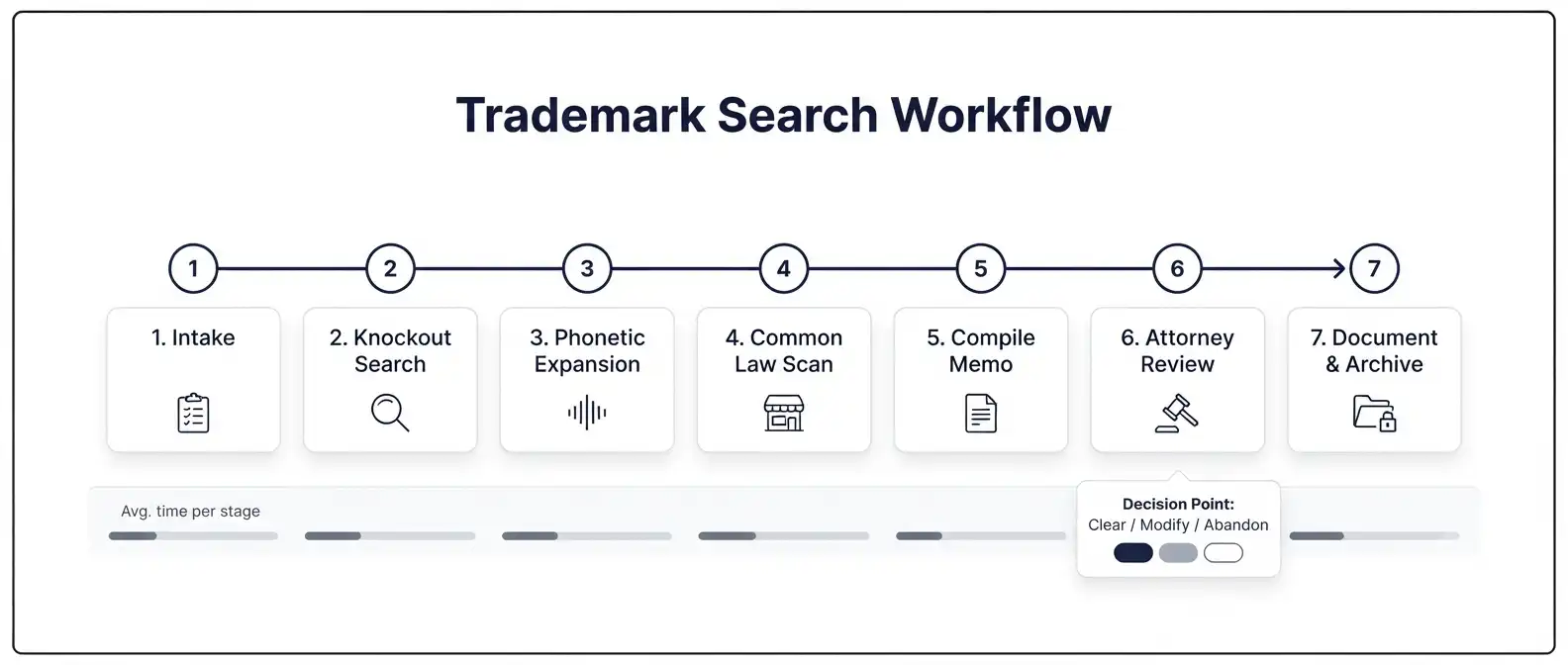
For attorneys building a standard operating procedure, here is a practical sequence a paralegal or associate can follow.
- Intake the proposed mark and goods/services description. Get the exact wording, any stylization, and the precise goods or services the client intends to offer.
- Run a knockout search on the USPTO Trademark Search system for identical or near-identical marks in the relevant international class.
- Expand to phonetic and visual equivalents. Search misspellings, homophones, and marks with similar sound or appearance, since likelihood of confusion does not require an exact match.
- Search common law sources. Check state trademark registers, domain name availability, business entity filings, and major social media platforms.
- Compile findings into a clearance memo. Organize conflicts by risk level: identical marks in the same class, similar marks in related classes, and lower-risk peripheral hits.
- Route the memo to the supervising attorney for a legal opinion on whether the mark is clear, needs modification, or should be abandoned.
- Document the search date and scope. This record matters later if the clearance decision is ever questioned.
How Trademark Monitoring Works: Step-by-Step
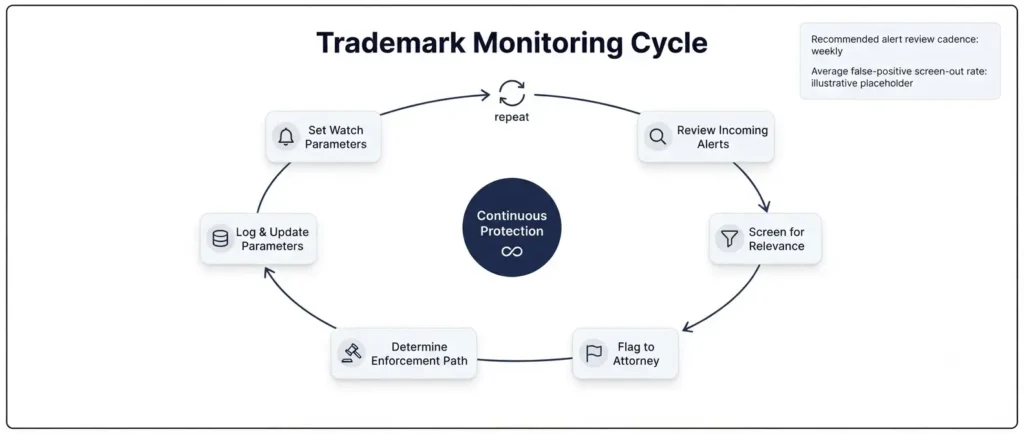
- Set up the watch parameters immediately after filing or registration, defined by the exact mark, phonetic variants, and relevant classes.
- Configure the frequency of alerts, typically weekly or monthly, depending on how aggressively the client wants to enforce the mark.
- Review each alert for relevance. Not every hit is a real conflict; a paralegal or associate screens out false positives before escalating.
- Flag genuine conflicts to the attorney with a short summary of the competing mark, its filing date, class, and owner.
- Decide on an enforcement path, which might include a cease-and-desist letter, a Trademark Trial and Appeal Board opposition, or simply continued monitoring if the risk is low.
- Log every alert and decision in the client’s docket, since this record demonstrates active policing of the mark.
- Renew the watch parameters whenever the client adds new marks, enters new classes, or expands into new countries.
Common Mistakes Firms Make With Search and Monitoring
Even experienced practitioners fall into a few predictable traps. Recognizing them early prevents costly corrections later.
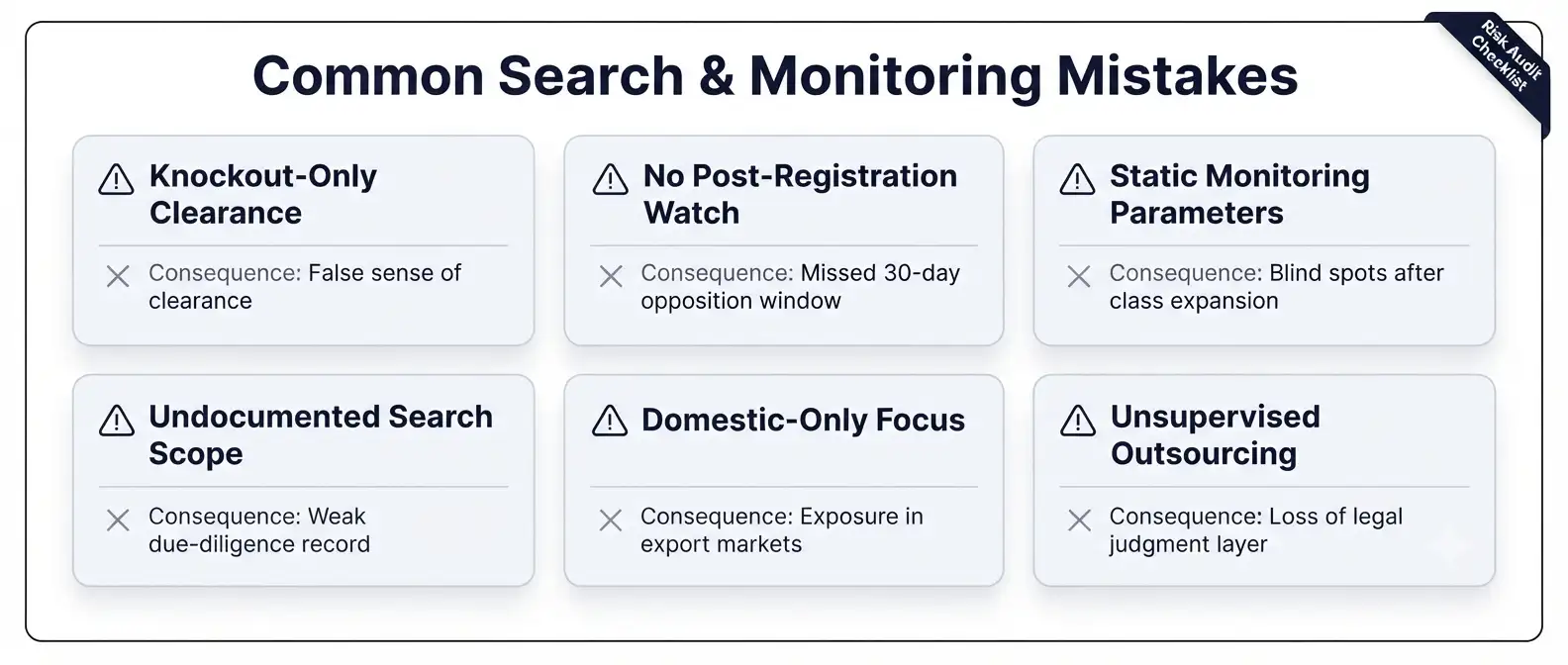
- Treating a knockout search as sufficient clearance. A quick USPTO-only search misses common law users and often leads to a false sense of security.
- Forgetting to set up monitoring after registration. Many firms focus entirely on getting the mark registered and never activate a watch service, leaving the client exposed the moment the certificate issues.
- Failing to update monitoring parameters after a rebrand or class expansion. A watch service configured for the original filing will not catch conflicts in a newly added class.
- Not documenting search scope and date. Without a clear record, it becomes difficult to demonstrate reasonable due diligence if a dispute arises later.
- Ignoring international exposure. A client that only monitors the U.S. register can still lose meaningful rights abroad if a competitor registers a similar mark in a key export market.
- Outsourcing without oversight. Handing search or monitoring tasks to a vendor without attorney review of the final opinion removes the legal judgment that actually protects the client.
Expert Tips for Building a Reliable Workflow
- Bundle search and monitoring into a single client engagement letter so there is no gap between clearance and enforcement.
- Use a standardized intake form for every new mark so the paralegal team captures consistent data for both searches and future monitoring.
- Set calendar reminders tied to the docketing system, not just the watch service’s own alerts, so nothing depends on a single point of failure.
- Review monitoring alerts on a fixed schedule, even if nothing appears urgent, to avoid alert fatigue causing a missed opposition deadline.
- Escalate every published application that even loosely resembles the client’s mark to the attorney before the 30-day opposition window narrows.
- Revisit search scope for high-value marks periodically, even years after registration, since new common law users can emerge over time.
The Role of a Trademark Paralegal in Search and Monitoring
Much of this workflow, running searches, screening monitoring alerts, compiling clearance memos, and tracking opposition deadlines, is exactly the kind of high-volume, detail-heavy work that a trained trademark paralegal is built to handle. For a solo practitioner or a lean firm, that support often makes the difference between a search-and-monitoring program that runs consistently and one that quietly lapses when the caseload gets heavy.
Firms that scale this work often turn to dedicated support for trademark portfolio management or bring in trained TTAB paralegal support when a monitoring alert turns into an actual opposition proceeding. Others rely on outsourced trademark paralegal services to keep both searches and watch alerts moving without adding full-time headcount.
Frequently Asked Questions
What is the main difference between a trademark search and trademark monitoring?
The main difference between a trademark search and trademark monitoring is timing and purpose. A search is a one-time check performed before filing to confirm a mark is available. Monitoring is an ongoing service performed after registration to catch new conflicting marks as they appear.
Do I need both a trademark search and trademark monitoring?
Yes. A search protects a client before they invest in a brand, while monitoring protects the registered mark for as long as the client owns it. Skipping either step leaves a gap in protection.
How often should trademark monitoring run?
Most firms configure monitoring alerts weekly or monthly. Marks in fast-moving industries, or marks with a history of infringement attempts, may warrant more frequent review.
Can a trademark search guarantee a mark will be approved?
No search can guarantee approval. A comprehensive search significantly reduces risk by identifying likely conflicts, but the final decision rests with the USPTO examining attorney, and new conflicting applications can still be filed after the search date, which is exactly why monitoring picks up where a search leaves off.
Who typically performs trademark searches and monitoring: attorneys or paralegals?
Paralegals frequently run the actual searches and screen monitoring alerts, while attorneys review the findings and issue the legal opinion. This division of labor is a major reason firms use dedicated IP paralegal support for these recurring tasks.
What happens if a firm skips trademark monitoring after registration?
Without monitoring, a firm may miss the 30-day window to oppose a confusingly similar published application. Over time, unmonitored marks are also more vulnerable to dilution and can weaken the client’s ability to enforce their rights later.
Conclusion
The difference between a trademark search and trademark monitoring comes down to one question: is the client trying to clear a new mark, or protect one they already own? A trademark search is the pre-filing due diligence that confirms a name is safe to use and register. Trademark monitoring is the ongoing surveillance that keeps that registration enforceable for years to come. Junior attorneys and solo practitioners who build both steps into a standard workflow, supported by trained paralegal resources where needed, give their clients real, lasting brand protection rather than a one-time checkbox.
If your firm needs dependable support running comprehensive clearance searches or setting up a monitoring program that never misses an opposition deadline, Teak IP’s trademark services team is ready to help. Contact Teak IP today to build a search and monitoring workflow your clients can rely on.


One Response