
A single overlooked renewal or a mismanaged multi-jurisdiction filing can quietly erode years of brand equity. That is exactly why so many trademark attorneys and brand managers are searching for the best trademark portfolio management services instead of trying to stretch an already thin in-house team across hundreds, or thousands, of active marks. Choosing the right vendor is not a back-office decision; it is a strategic one that touches revenue, risk, and reputation in equal measure.

This guide explains what trademark portfolio management services include, compares the different provider models available in 2026, highlights the features that distinguish reliable partners from risky ones, and provides a step-by-step framework for choosing the right service provider. If you’d like to refresh your understanding of the fundamentals before comparing vendors, read our guide on effective trademark portfolio management, which covers the key components, common challenges, and best practices for managing a trademark portfolio.
What Are Trademark Portfolio Management Services?
Trademark portfolio management services are outsourced or software-enabled solutions that handle the ongoing administration of a company’s or law firm’s trademark assets. This typically includes docketing deadlines, tracking renewals, monitoring for conflicting marks, coordinating filings across jurisdictions, and generating portfolio-level reporting for stakeholders.
In short, these services take the operational burden of keeping trademarks alive and enforceable off the shoulders of attorneys, so legal teams can focus on strategy, prosecution, and enforcement decisions rather than spreadsheet maintenance.
Put simply, the best trademark portfolio management services combine three things:
People
Paralegals, docketers, and attorneys who understand jurisdiction-specific rules
Process
A repeatable, audited workflow for deadlines and filings
Platform
Software that centralizes data and produces reliable reporting
It is worth noting that “trademark portfolio management” is broader than any single task. A provider might handle only docketing, only watch services, or a full end-to-end package that spans clearance searches, filing coordination, renewal tracking, licensing records, and enforcement support. Consequently, one of the first things to clarify with any vendor is exactly which slice of the portfolio lifecycle they cover, and which pieces you will still need to handle internally or through outside counsel.
For firms and brand owners with modest portfolios, this distinction may seem academic. However, once a portfolio crosses roughly 50 to 100 active marks across multiple classes and countries, the difference between a narrow docketing vendor and a full portfolio management partner becomes very real, very quickly. That gap is precisely where most missed deadlines and compliance failures originate.
Why Attorneys and Brand Managers Need Professional Trademark Portfolio Management
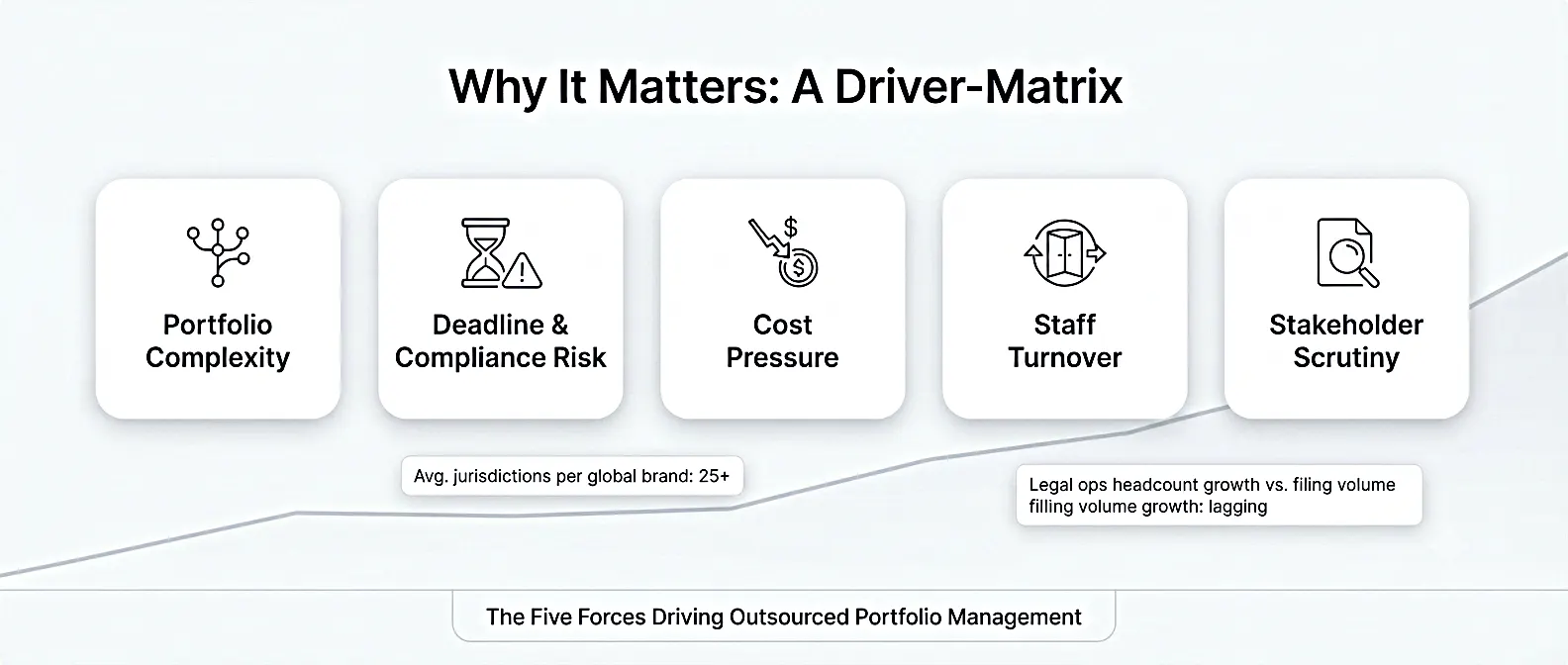
Portfolios rarely stay simple for long. As a brand expands into new markets, launches new product lines, or acquires other companies, the number of marks, classes, and jurisdictions multiplies quickly. Consequently, the administrative burden grows far faster than most legal departments’ headcount does.
Growing Portfolio Complexity
International brands often manage trademarks across 20, 50, or even 100+ jurisdictions, each with its own renewal deadlines, use requirements, and local counsel relationships. To learn how to coordinate and protect a global portfolio efficiently, read our guide on how to manage an international trademark portfolio.
Deadline and Compliance Risk
Missing a Section 8 or Section 15 filing, a trademark renewal deadline, or a foreign maintenance requirement can result in the loss of valuable trademark rights. As explained in the USPTO’s official trademark maintenance guidance, trademark owners must file specific maintenance documents between the fifth and sixth year after registration and at each subsequent renewal period to keep their registrations active. Since these filing windows are strictly enforced and generally cannot be recovered once missed, effective deadline management is essential. For a detailed explanation of these requirements, read our guide on when to file a Section 8 and 15 affidavit.
Cost Pressure on In-House Teams
Budget planning often raises an important question: is it more cost-effective to expand your in-house team or outsource trademark portfolio administration to a specialized provider? Hiring additional staff comes with fixed costs such as salaries, benefits, training, and turnover, while outsourced portfolio management services typically offer a more flexible, scalable pricing model based on actual workload. If you’re evaluating the financial impact of both approaches, our guide on IP portfolio management outsourcing cost, process, and ROI provides a detailed comparison of costs, implementation, and long-term return on investment.
Staff Turnover and Institutional Knowledge Loss
Every legal team eventually experiences staff turnover, and when a paralegal who managed portfolio deadlines for years leaves, institutional knowledge often leaves with them. A dedicated portfolio management provider mitigates this risk because the workflow, not a single employee’s memory, is what keeps the docket accurate. This continuity becomes especially valuable for firms managing multi-generational client relationships, where portfolio history spans decades.
Increasing Scrutiny From Clients and Stakeholders
Corporate clients and brand executives increasingly expect transparent, auditable reporting on how their trademark assets are being protected. Consequently, firms that still rely on manual spreadsheets are at a competitive disadvantage compared to those using providers who can produce portfolio dashboards, budget forecasts, and renewal calendars on demand. This expectation alone is pushing many mid-size firms toward outsourced or hybrid portfolio management models.
Types of Trademark Portfolio Management Service Providers
Not all providers operate the same way. Before comparing specific vendors, it helps to understand the four broad categories available today.
1. Full-Service IP Law Firms
Traditional law firms often bundle portfolio management with prosecution and enforcement work. This model offers deep legal expertise, direct attorney access, and a single point of accountability for both strategy and administration. However, it can be expensive for high-volume, low-complexity administrative tasks like routine docketing, since attorney or senior paralegal billing rates are applied even to repetitive maintenance work that does not strictly require that level of expertise.
2. Dedicated Trademark Docketing and Paralegal Outsourcing Firms
These providers focus on the operational aspects of trademark portfolio management, including docketing, renewals, watch services, deadline tracking, and reporting. Rather than replacing your outside or in-house counsel, they work alongside your legal team, allowing attorneys to focus on strategic legal decisions while routine, deadline-driven administrative tasks are handled efficiently by specialists. Because they manage high volumes of trademark matters across multiple clients and jurisdictions, these providers often build deeper operational expertise and more standardized workflows than a single in-house team. To learn more about this service model, see our guide to the best trademark paralegal services for law firms.
3. IP Management Software Platforms (SaaS)
Platforms such as docketing software give firms self-service tools to track deadlines and manage data internally. They reduce manual errors and centralize data in one place, but they still require trained staff to operate them correctly, configure jurisdictional rule sets, and catch exceptions, which is where many under-resourced teams get stuck. In other words, software alone rarely solves the portfolio management problem; it simply changes where the manual effort is required.
4. Hybrid Managed Services Providers
Hybrid providers combine trained paralegal staff with proprietary or licensed software, offering both the technology and the human oversight needed to run it reliably. Typically, this model layers dual-docketing verification, attorney review, and portfolio-level reporting on top of a purpose-built platform, so clients get the benefits of automation without losing the judgment that only trained professionals provide. Many of the best trademark portfolio management services today fall into this hybrid category because it balances cost, accuracy, and scalability better than either a pure software product or a traditional law firm retainer.
Comparison Table: Provider Models at a Glance
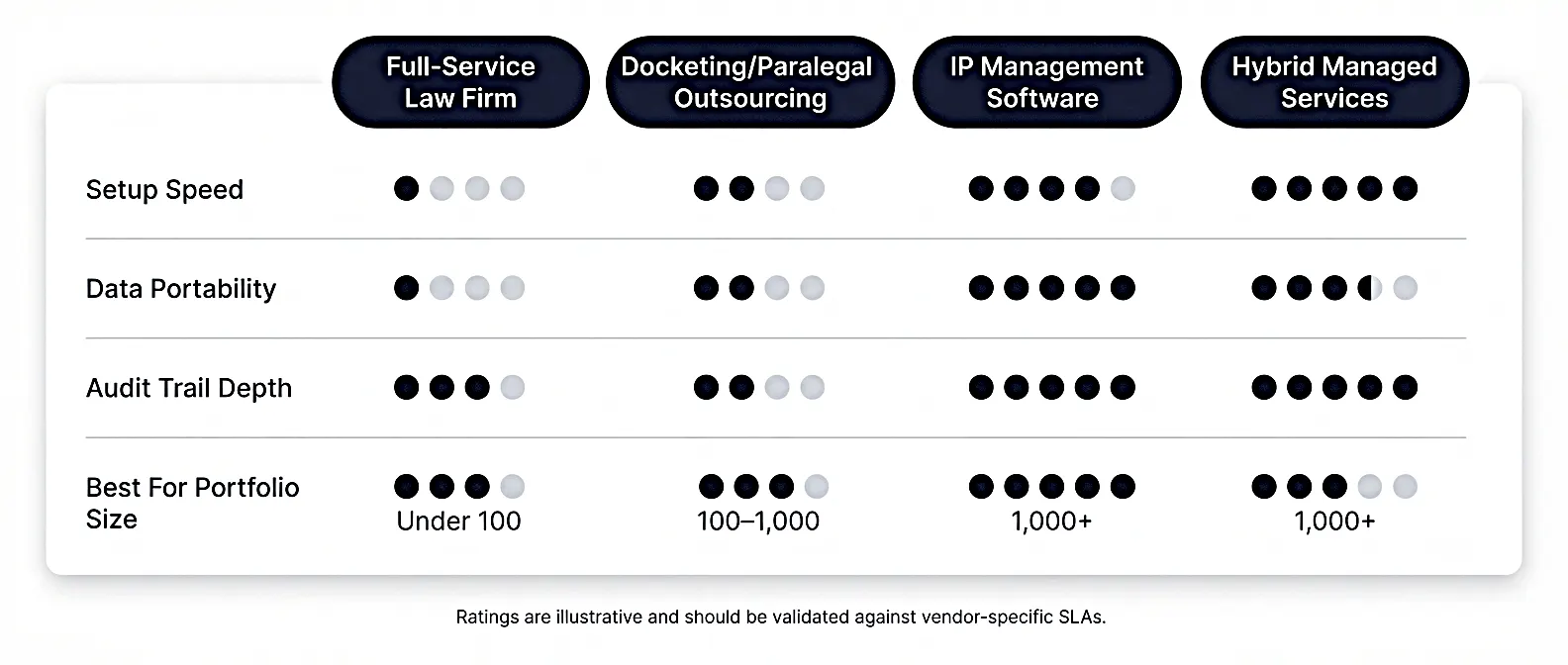
| Provider Model | Best For | Typical Cost | Attorney Oversight | Scalability |
|---|---|---|---|---|
| Full-service IP law firm | Complex prosecution plus administration | High | Built in | Moderate |
| Docketing/paralegal outsourcing firm | High-volume administrative work | Low to moderate | Available on request | High |
| IP management software (SaaS) | Teams with in-house staff to run it | Moderate (licensing) | Not included | High |
| Hybrid managed services provider | Firms wanting both people and platform | Moderate | Built in | High |
Key Features to Look For in the Best Trademark Portfolio Management Services
Before signing with any provider, evaluate them against the features that actually reduce risk and save time. The strongest vendors typically offer:
- Jurisdiction-specific deadline calculation that automatically accounts for local rules rather than relying on generic templates.
- Dual docketing or independent verification workflows, so no single point of failure can cause a missed deadline.
- Trademark watch and monitoring services…that identify potentially conflicting trademarks before they develop into formal disputes. Many providers also cross-reference new filings against the WIPO Global Brand Database, which consolidates trademark records from national and international registries around the world, helping detect potential conflicts at an early stage.
- Attorney-reviewed deliverables, not just paralegal-only output, particularly for filings with legal consequences.
- Transparent, à la carte, or tiered pricing rather than opaque flat retainers that punish smaller portfolios.
- Bulk matter management and reporting for portfolio audits, budget reviews, and partner dashboards.
- Data security and confidentiality protocols, since portfolio data often includes sensitive business strategy.
- Proven turnaround times, ideally backed by service-level agreements rather than informal promises.
If managing trademark deadlines is your biggest challenge, explore our guide on how to prevent missed deadlines in trademark docketing for practical strategies to reduce filing risks, along with our complete guide to automated trademark docketing to learn how automation improves accuracy, compliance, and deadline management.
How to Choose the Best Trademark Portfolio Management Service Provider: A Step-by-Step Framework
Selecting a provider does not need to be complicated if you follow a structured evaluation process. Here is a practical, six-step approach.
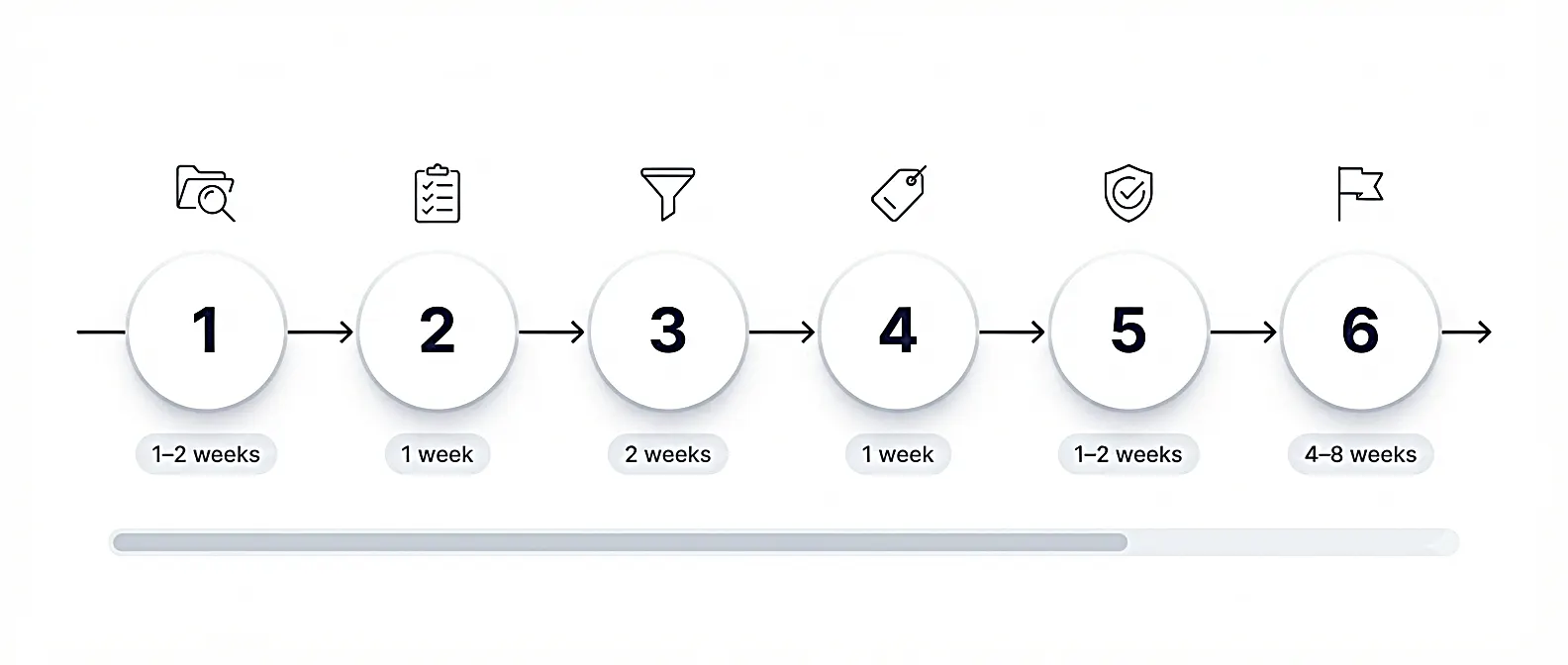
Step 1: Audit Your Current Portfolio
Before reaching out to any vendor, document your total mark count, jurisdictions, upcoming deadlines, and current pain points. This audit becomes the basis for every conversation that follows.
Step 2: Define Your Must-Have Features
Separate genuine requirements, such as multi-jurisdiction support or dual docketing, from nice-to-have extras. This prevents you from overpaying for capabilities you will not use.
Step 3: Shortlist Providers by Model
Using the provider categories above, decide whether a pure outsourcing partner, a software platform, or a hybrid model fits your team’s structure and in-house capacity best.
Step 4: Request Detailed Pricing
Ask each shortlisted provider to provide a detailed breakdown of pricing by service type, including docketing, renewals, watch services, reporting, and any additional fees. Comparing itemized quotes makes it easier to identify hidden costs and evaluate overall value. For pricing benchmarks and the key factors that influence outsourcing fees, see our guide to trademark docketing outsourcing costs.
Step 5: Verify Attorney Oversight and Quality Control
Ask specifically how errors are caught before a deadline is missed or a filing is submitted incorrectly. A vendor without a documented quality-control process is a red flag.
Step 6: Pilot Before You Commit
Request a trial period, sample docket migration, or limited-scope pilot project. This lets you validate accuracy and turnaround time with real data before signing a long-term agreement.
In-House vs Outsourced Trademark Portfolio Management
One of the most common questions attorneys and IP managers ask is whether to keep portfolio management in-house or hand it to an external provider. The right answer depends on portfolio size, budget, and available staff expertise.
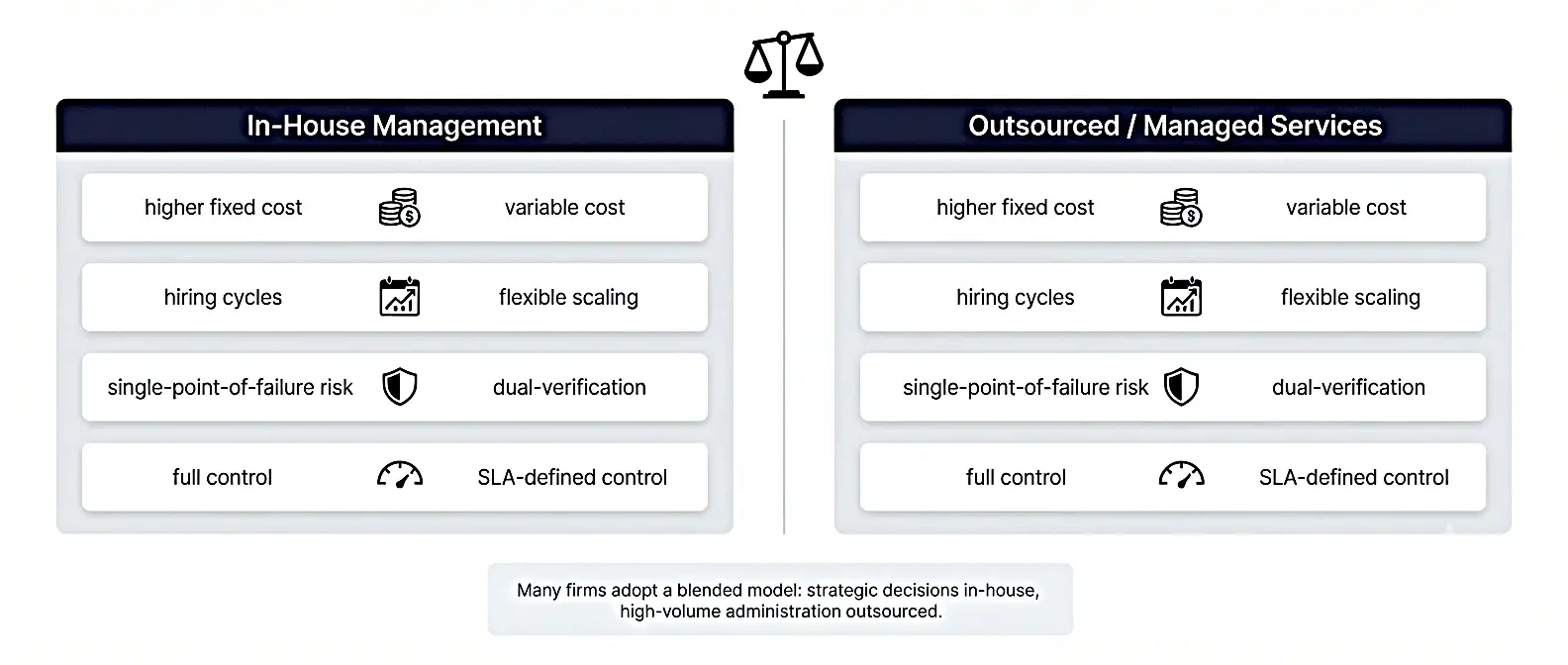
Many firms land on a hybrid approach: keeping strategic decisions in-house while outsourcing high-volume administrative tasks such as docketing, renewals, and reporting.
Common Mistakes When Selecting a Trademark Portfolio Management Service
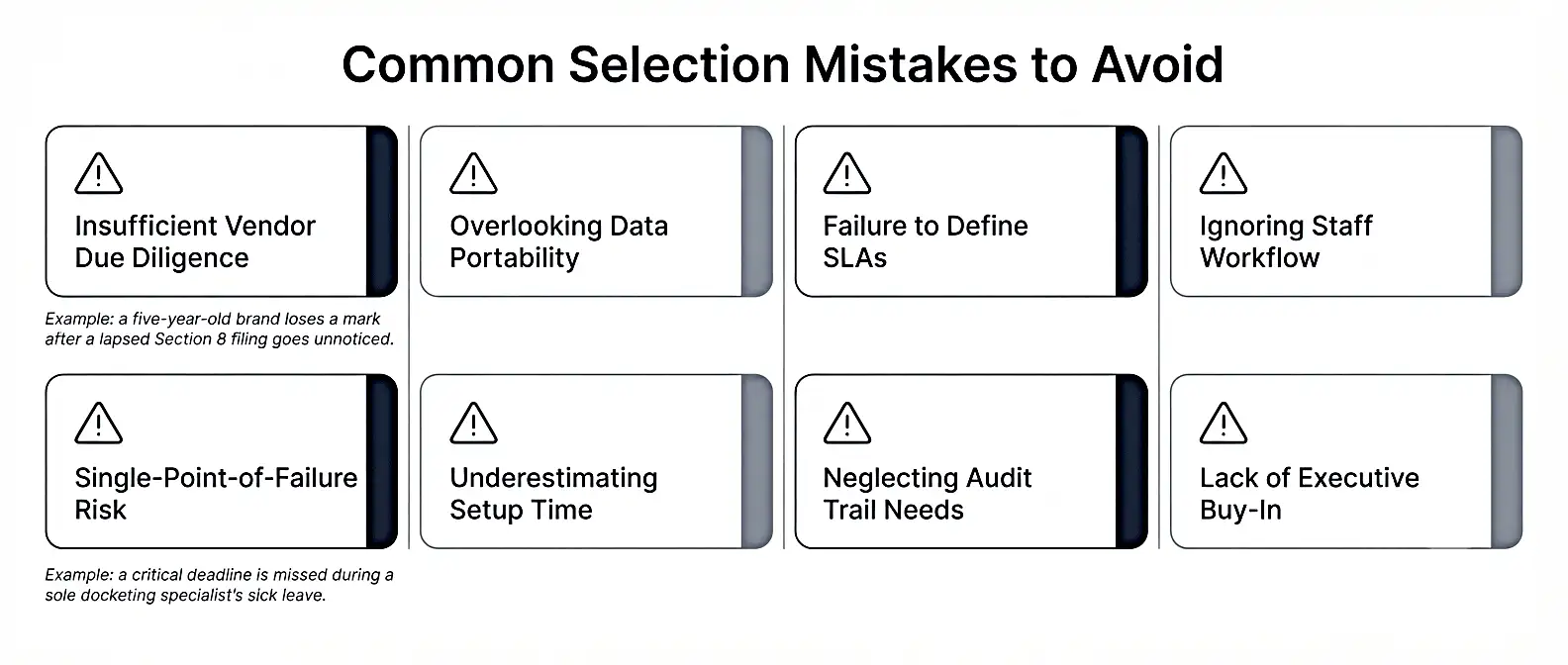
Even experienced legal teams make avoidable errors during vendor selection. Watch out for these common pitfalls:
Mistake 1: Choosing on price alone.
The cheapest provider often lacks dual docketing or attorney oversight, which increases long-term risk. A slightly higher fee that includes independent verification is usually cheaper than the cost of a single missed deadline.
Mistake 2: Ignoring data migration complexity.
Moving thousands of matters into a new system without a clear migration plan can create gaps, particularly around historical deadlines that have already passed but remain relevant for audit purposes.
Mistake 3: Skipping the reference check.
Always ask for references from firms with a similar portfolio size and jurisdictional footprint, since a provider’s experience with small domestic portfolios does not necessarily translate to large international ones.
Mistake 4: Overlooking integration capability.
If the provider’s software cannot integrate with your existing case management tools, expect duplicate data entry, which introduces exactly the kind of manual error the provider was supposed to eliminate.
Mistake 5: Failing to clarify escalation procedures.
Know exactly who to contact, and how quickly, if a deadline issue arises outside normal business hours, especially for firms operating across multiple time zones.
Mistake 6: Underestimating onboarding time.
A rushed transition increases the odds of a missed deadline during the handover period, so build in buffer time before any critical filing dates.
Mistake 7: Assuming all attorney oversight is equal.
Some providers offer only nominal attorney review, while others build substantive legal checks into every deliverable. Clarify exactly what “attorney reviewed” means for each vendor.
Mistake 8: Neglecting to plan for portfolio growth.
A provider that works well for 300 marks may struggle at 3,000. Ask directly how the provider’s process and pricing scale as your portfolio expands.
Expert Tips for Getting the Most Out of Your Trademark Portfolio Management Service
- Schedule quarterly portfolio reviews with your provider rather than waiting for an annual check-in, so small issues get caught before they compound.
- Ask for a written escalation matrix so everyone knows who handles urgent deadline issues after hours, and confirm it is updated whenever staff changes occur on either side.
- Request sample reports before onboarding to confirm the format matches what your partners or executives expect, rather than discovering formatting gaps after the first quarterly review.
- Combine watch services with portfolio management so conflicting marks are flagged in the same workflow, not a separate silo that requires manual cross-referencing.
- Revisit your provider relationship annually as your portfolio grows, since the right vendor for 200 marks may not be the right one for 2,000.
- Keep a backup export of your full docket on a regular schedule, independent of your provider’s system, as a safeguard against any platform migration or service disruption.
- Involve your provider early when planning acquisitions or brand expansions, since new marks entering the portfolio are far easier to onboard correctly from day one than to correct later.
Understanding Trademark Portfolio Management Pricing Models
Pricing structures vary more than most first-time buyers expect, and understanding the differences upfront prevents unpleasant surprises later.
| Pricing Model | How It Works | Best Fit |
|---|---|---|
| Flat annual retainer | Fixed fee regardless of matter volume | Large, stable portfolios with predictable activity |
| Per-matter or per-task pricing | Pay only for services rendered, such as a single renewal filing | Smaller firms or fluctuating portfolios |
| Tiered subscription | Set price bands based on portfolio size ranges | Growing firms that want predictable scaling |
| À la carte pricing | Individual services priced separately, combined as needed | Firms wanting maximum control over spend |
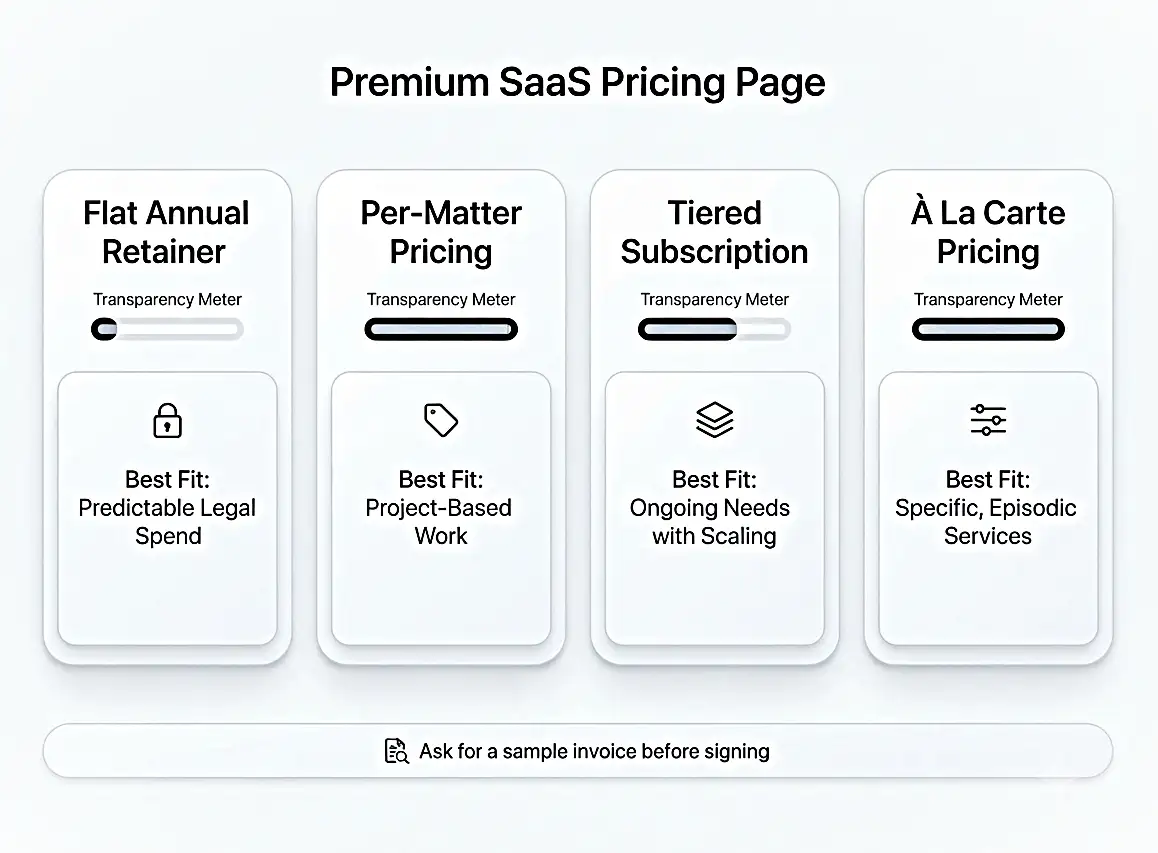
Generally speaking, à la carte and per-matter pricing models offer the most transparency, since firms can clearly see what they are paying for and adjust services as the portfolio changes. Flat retainers can be cost-effective for very large, stable portfolios, but they sometimes obscure whether a firm is overpaying relative to actual matter volume. Before signing any agreement, request a sample invoice or pricing breakdown so there are no surprises once the relationship is underway.
It is also worth asking providers whether pricing changes as the relationship matures. Some vendors offer discounted onboarding rates that increase substantially after the first year, so clarifying the full multi-year cost picture during negotiations protects your budget down the road.
Trademark Portfolio Management Trends to Watch in 2026
The tools and expectations around trademark portfolio management continue to evolve. A few trends are shaping how the best providers operate today.
Trend 1: AI-assisted similarity screening.
Providers increasingly use AI tools to flag potentially conflicting marks earlier in the clearance process, though human review remains essential for legal judgment calls.
Trend 2: Consolidated global dashboards.
Brand owners with multi-country portfolios now expect a single dashboard view rather than separate reports from each local counsel.
Trend 3: Outcome-based reporting.
Clients are asking providers for renewal-rate and deadline-accuracy metrics, not just activity logs, to demonstrate measurable portfolio health.
Trend 4: Flexible, à la carte pricing.
Flat annual retainers are giving way to modular pricing, where firms pay only for the specific services, such as docketing, watch monitoring, or renewal filing, that they actually need.
Trend 5: Tighter integration with docketing systems.
Portfolio management providers are increasingly expected to integrate directly with existing case management software rather than requiring duplicate data entry.
These shifts do not eliminate the fundamentals of good portfolio management; they simply raise the bar for what “good” looks like. A provider that cannot speak to at least a few of these trends may be relying on outdated processes that leave gaps as your portfolio scales.
Questions to Ask Before Hiring a Trademark Portfolio Management Provider
Use this checklist during vendor calls to keep the conversation focused on what actually matters:
- How do you calculate jurisdiction-specific deadlines, and how often are your rule sets updated?
- What does your dual-verification or quality-control process look like in practice?
- Can you provide references from firms with a similar portfolio size to ours?
- What does onboarding and data migration typically involve, and how long does it take?
- How is pricing structured, and what happens if our portfolio grows mid-contract?
- Who do we contact if a deadline issue arises outside normal business hours?
- Does your reporting integrate with our existing case management or docketing software?
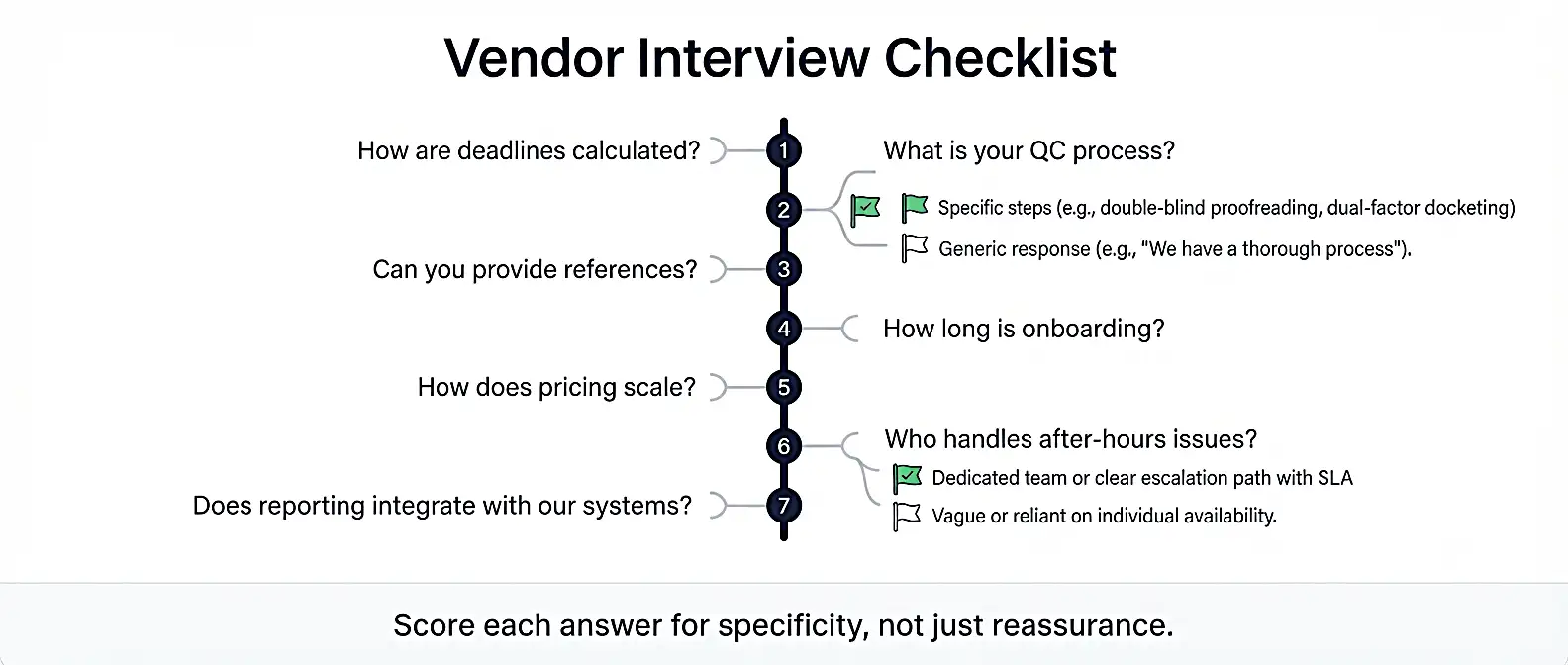
A provider that responds to these questions with clear, specific answers is generally a more reliable long-term partner than one that relies on broad assurances or generic sales claims. If you’d like to refresh your understanding of trademark fundamentals before evaluating vendors, the International Trademark Association’s trademark basics resource provides a trusted, non-promotional overview.
Frequently Asked Questions About the Best Trademark Portfolio Management Services
What are trademark portfolio management services?
Trademark portfolio management services handle the ongoing administration of trademark assets, including deadline docketing, renewals, monitoring, and reporting, so legal teams can focus on strategic and enforcement decisions.
How much do trademark portfolio management services cost?
Costs vary widely based on portfolio size, jurisdictional complexity, and provider model, ranging from pay-per-matter pricing with outsourcing firms to flat licensing fees for software platforms. Request itemized quotes to compare accurately.
What is the difference between trademark docketing and trademark portfolio management?
Docketing refers specifically to tracking deadlines, while portfolio management is the broader discipline that includes docketing, watch services, renewals, reporting, and portfolio auditing as a whole.
Are the best trademark portfolio management services only for large corporations?
No. Many providers offer à la carte or tiered pricing models designed specifically for small firms and growing portfolios, not just enterprise-scale clients.
Can a trademark portfolio management provider replace outside counsel?
Generally, no. Most reputable providers work alongside your attorneys to handle administrative and operational tasks, while legal strategy and prosecution decisions remain with counsel.
How do I switch providers without risking missed deadlines?
Choose a provider with a documented migration and dual-verification process, and request a transition timeline that includes a manual deadline audit before cutover.
Do trademark portfolio management services include international filings?
Many do, either directly or through a network of local counsel relationships, but coverage varies by provider. Confirm which jurisdictions are supported natively versus through a third-party network before signing an agreement.
How long does onboarding with a new trademark portfolio management provider usually take?
Onboarding timelines vary with portfolio size, but most providers complete data migration and a full deadline audit within four to eight weeks for a mid-size portfolio, with larger portfolios sometimes requiring a phased transition.
Making the Right Choice for Your Trademark Portfolio
Ultimately, the best trademark portfolio management services are the ones that match your portfolio’s size, complexity, and risk tolerance, not simply the vendor with the flashiest platform. By auditing your current portfolio, defining must-have features, and piloting a provider before committing long term, you can significantly reduce the risk of missed deadlines while freeing your legal team to focus on higher-value strategic work.
At Teak IP Services, our attorney-led team combines U.S. oversight with a global delivery model to provide accurate, scalable trademark management services for law firms, corporate legal departments, and brand owners. Every matter undergoes a multi-layered quality control process before delivery, ensuring consistency, accuracy, and compliance. With our flexible à la carte pricing model, you pay only for the services your portfolio requires, making it easy to scale support as your trademark portfolio grows.
Because our paralegal and docketing teams work across both U.S. business hours and a global support structure, clients get faster turnaround on time-sensitive filings without sacrificing the direct attorney access that complex matters require. Whether your priority is preventing missed renewal deadlines, tightening up an international docket, or simply gaining clearer portfolio-level reporting for stakeholders, our team can design a scope of work around your specific pain points rather than forcing your portfolio into a generic package.
If you are ready to see how a dedicated portfolio management partner can strengthen your brand protection strategy, Request a Portfolio Management Consultation with our team today.

