
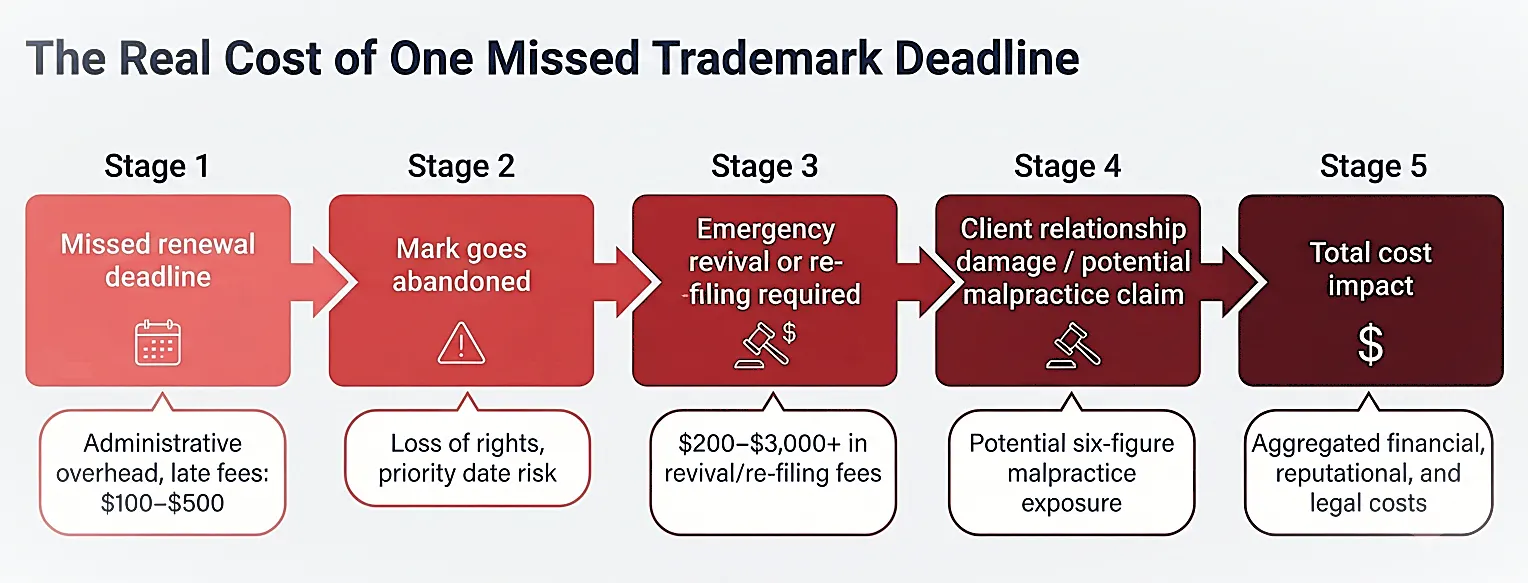
A single missed renewal deadline can cost a client its brand. That is the reality every trademark attorney and IP director lives with, and it is exactly why so many firms are re-examining their docketing budgets Understanding the true trademark docketing outsourcing cost is no longer a back-office question; it is a strategic decision that touches malpractice risk, staffing, and client retention all at once.

If you have started pricing out vendors, you already know the numbers are all over the place. Per-mark fees, flat monthly retainers, per-docket-entry billing, hybrid models – the variation can make an apples-to-apples comparison feel impossible. This guide breaks down exactly what drives trademark docketing outsourcing cost, what you should expect to pay at each firm size, and how to avoid the hidden fees that quietly inflate a “cheap” quote into an expensive mistake.
By the end, you will have a clear framework for budgeting, negotiating, and comparing vendors, plus the specific questions to ask before you sign a service agreement.
What is Trademark Docketing Outsourcing?
Trademark docketing outsourcing means handing the calendaring, deadline tracking, and portfolio management functions of your trademark practice to a third-party provider instead of keeping that work fully in-house.
A docketing partner typically manages:
- USPTO and international filing deadlines, including Statement of Use and Section 8/15 windows
- Renewal and maintenance date tracking across jurisdictions
- Office action response deadlines
- Opposition and cancellation proceeding calendars
- Data entry, quality control, and audit trails for the firm’s docketing system
Firms outsource this function for one core reason: docketing errors are one of the leading causes of legal malpractice claims in IP practice, and specialized vendors reduce that exposure while freeing paralegal time for higher-value work.
Why Trademark Docketing Outsourcing Cost Varies So Widely
Before comparing quotes, it helps to understand why pricing differs so much between providers. Consequently, two firms with similar portfolios can receive quotes that differ by thousands of dollars per year.
Portfolio Size and Complexity
A solo practitioner with 40 active marks pays differently than a 200-attorney firm managing 15,000 records across 60 countries. Larger, multi-jurisdictional portfolios require more docketing entries, more currency and language handling, and more quality-control review – all of which raise cost.
Docketing Software Requirements
Some vendors work inside your existing platform (Anaqua, CPI, FoundationIP, Clarivate); others require migration to their preferred system. Migration projects add a one-time setup fee that can range from a few hundred to several thousand dollars depending on data volume.
Service Depth
Basic date-calendaring is priced lower than full-service docketing that includes data audits, conflict checks, client reporting, and direct communication with foreign associates. As a result, “docketing” from one vendor might mean something entirely different from “docketing” at another.
Geographic Delivery Model
Providers using a blended U.S./offshore staffing model (attorney oversight in the U.S. with data processing support abroad) generally offer lower trademark docketing outsourcing cost than fully domestic, U.S.-only teams, without necessarily sacrificing accuracy, since attorney review remains constant.
Contract Structure
Month-to-month agreements typically cost more per unit than annual contracts. Providers reward volume commitment with lower per-mark or per-entry rates.
Trademark Docketing Outsourcing Cost: Pricing Models Explained
Vendors generally price trademark docketing services using one of four structures. Understanding each model helps you compare quotes on equal footing.
1. Per-Mark / Per-Matter Pricing
You pay a flat fee per trademark record under management, usually billed monthly or annually. This model is popular because it scales predictably with portfolio size.
2. Per-Docket-Entry Pricing
You pay for each individual deadline entered or updated (a new filing, a renewal, an office action deadline). This works well for firms with lower matter counts but frequent activity.
3. Flat Monthly Retainer
A fixed monthly fee covers docketing for an agreed portfolio range (for example, up to 500 active marks). Overages beyond the cap are billed separately. Retainers give budgeting certainty but can be less cost-efficient for smaller portfolios.
4. À La Carte / Hybrid Pricing
You pay only for the specific services used each month – docket entry, quality audits, reminder notices – with no bundled minimums. This model suits firms that want to outsource select docketing functions while keeping others in-house.
Typical Trademark Docketing Outsourcing Cost Ranges
Exact pricing depends on the factors above, but the table below reflects typical market ranges for U.S.-based trademark practices working with established outsourced docketing providers.
| Firm Size / Portfolio | Pricing Model | Typical Monthly Cost Range | Typical Per-Mark Cost |
|---|---|---|---|
| Solo practitioner (under 50 marks) | Per-mark or à la carte | $150 – $500/month | $8 – $15/mark |
| Small firm (50 – 250 marks) | Per-mark or flat retainer | $500 – $1,800/month | $6 – $12/mark |
| Mid-size firm (250 – 1,000 marks) | Flat retainer or hybrid | $1,800 – $6,000/month | $5 – $9/mark |
| Large firm / corporate portfolio (1,000+ marks) | Enterprise retainer, custom | $6,000 – $20,000+/month | $3 – $7/mark |
These ranges assume standard U.S. and select international docketing. Complex global portfolios, rush processing, and full data migration typically carry additional fees.
In-House vs. Outsourced Trademark Docketing: A Cost Comparison
Many IP directors default to comparing outsourced pricing against a rough estimate of an in-house docketing clerk’s salary. This is a common mistake because it ignores fully loaded costs.
| Cost Factor | In-House Docketing | Outsourced Docketing |
|---|---|---|
| Base compensation | $45,000 – $70,000/year per docketing clerk | Included in service fee |
| Benefits and payroll taxes | +25–35% of salary | Included in service fee |
| Software licensing | $3,000 – $15,000+/year | Often included or discounted |
| Training and onboarding | Recurring cost with turnover | Vendor-managed |
| Backup coverage (PTO, turnover) | Additional hire or risk gap | Built into service |
| Malpractice/error exposure | Borne fully by firm | Shared via vendor QC processes |
| Scalability | Requires new hires to scale | Scales with contract adjustment |
When you account for benefits, software, training, and coverage gaps, many mid-size firms find that outsourced trademark docketing cost is comparable to, or lower than, the fully loaded cost of an in-house hire- while also reducing single-point-of-failure risk. Firms managing broader IP portfolios often see similar savings; a related read on preventing single-point-of-failure docketing errors outlines why redundancy matters regardless of practice area.
Hidden Costs That Inflate Trademark Docketing Outsourcing Cost
How Common Is Each Hidden Fee?
A low headline rate does not always mean a low total cost. Watch for these common add-on fees before signing a contract.
- Data migration and setup fees: One-time charges to move existing docket data into the vendor’s system, often $500 to $5,000 depending on volume and data quality.
- Rush or expedited entry fees: Charges for same-day or emergency deadline entry outside standard turnaround windows.
- Audit and reconciliation fees: Some vendors charge separately for periodic portfolio audits that catch discrepancies.
- Foreign associate communication fees: If the vendor coordinates directly with foreign counsel, this may be billed as an added service.
- Minimum monthly commitments: Contracts with a minimum spend regardless of actual matter volume can inflate cost for smaller portfolios.
- Termination or transition-out fees: Some agreements charge to export your data back if you switch providers.
Ask every vendor for a complete, itemized fee schedule before signing. A transparent provider will walk through each line item without hesitation.
Common Mistakes Firms Make When Budgeting for Outsourced Docketing
Comparing Quotes Without Normalizing the Pricing Model
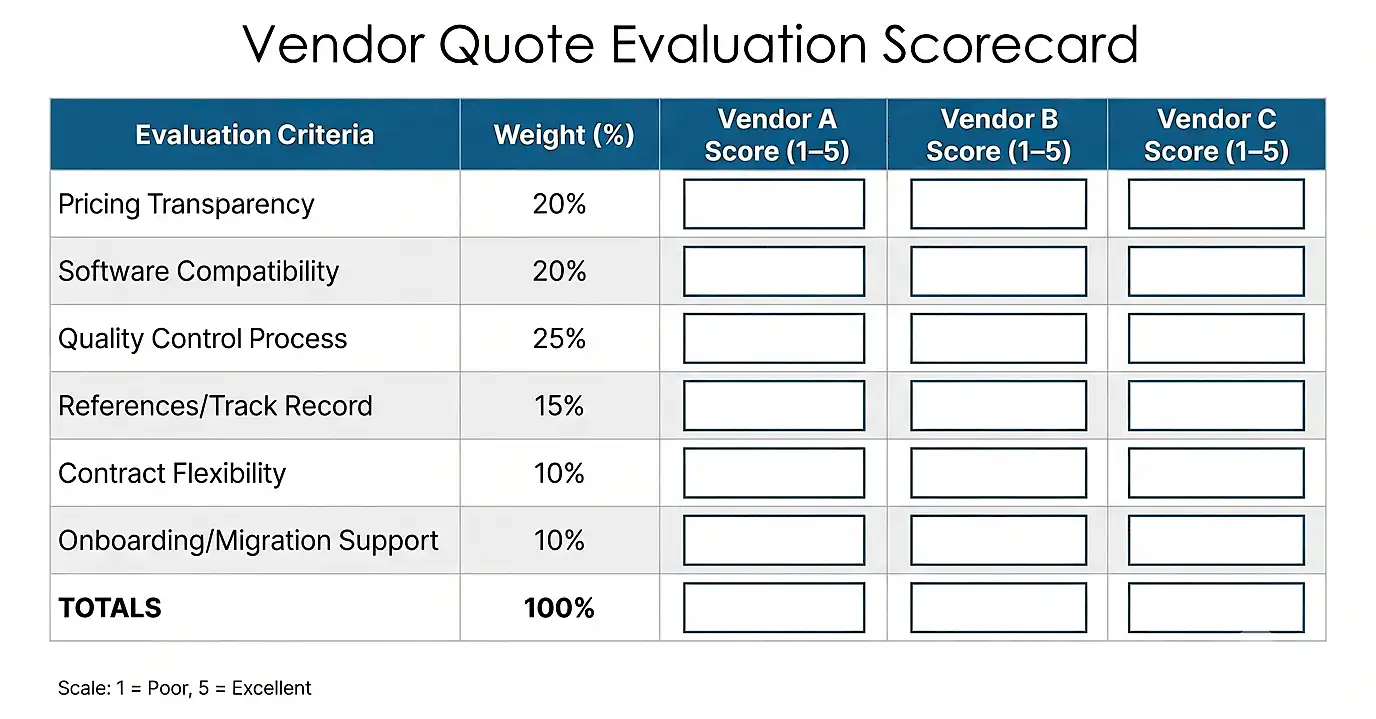
A $9 per-mark rate is not directly comparable to a $2,000 flat retainer unless you calculate the effective per-mark cost of each. Always convert quotes to the same unit before comparing.
Ignoring Software Compatibility
Choosing a vendor that cannot integrate with your existing docketing platform often triggers unplanned migration costs. Confirm compatibility with Anaqua, CPI, FoundationIP, or your platform of choice before requesting final pricing.
Underestimating Portfolio Growth
If your trademark portfolio is expected to grow, negotiate tiered pricing upfront rather than renegotiating from a weaker position later.
Overlooking Quality Control Standards
The cheapest vendor is not a bargain if docketing errors lead to missed deadlines. Ask specifically how each candidate performs quality audits and who reviews entries before they go live. Firms weighing this tradeoff may find it useful to review guidance on preventing missed deadlines in trademark docketing for the quality benchmarks worth demanding from any provider.
Treating Docketing and Paralegal Support as Interchangeable
Docketing is a distinct function from broader paralegal support, and vendors price them separately. Understanding the difference between an IP paralegal and a trademark paralegal helps clarify exactly which tasks a docketing fee does and does not cover.
Expert Tips for Getting the Best Trademark Docketing Outsourcing Cost
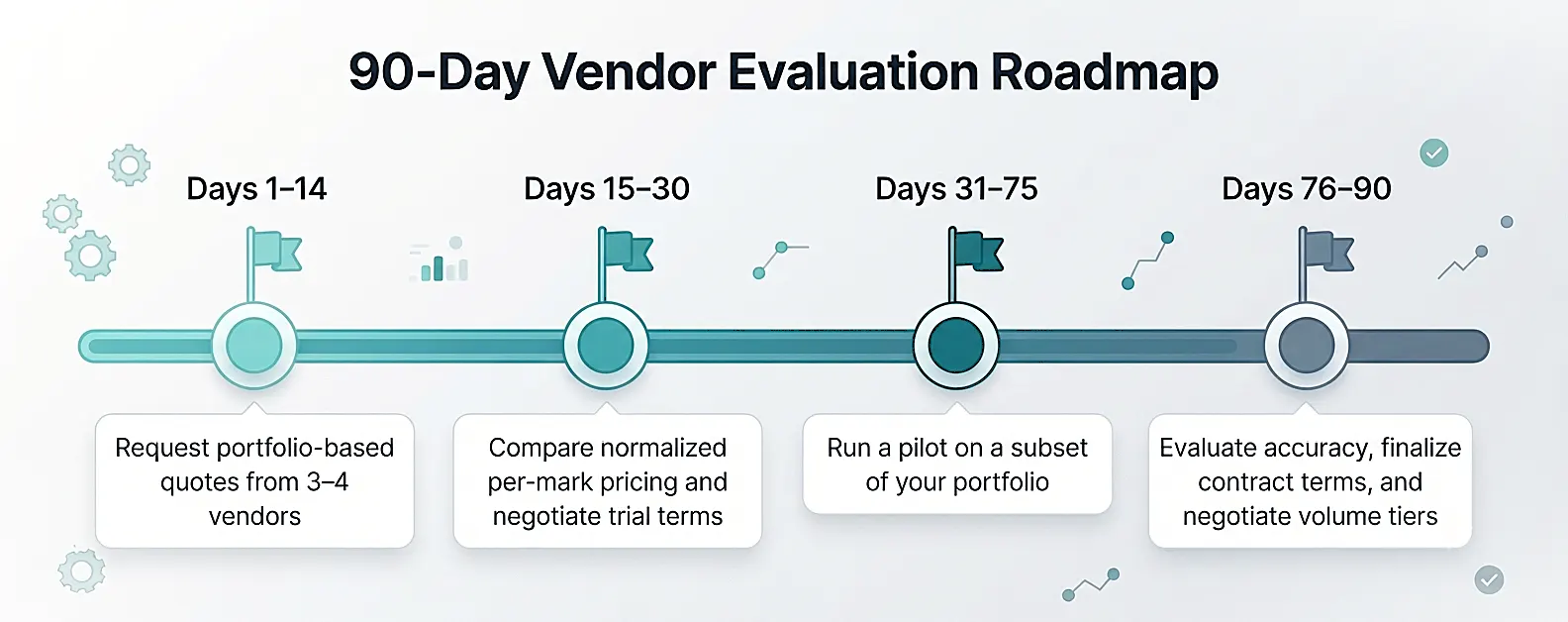
- Request a portfolio-based quote, not a generic rate card. Send an anonymized sample of your matter count and jurisdiction mix so the vendor prices your actual workload.
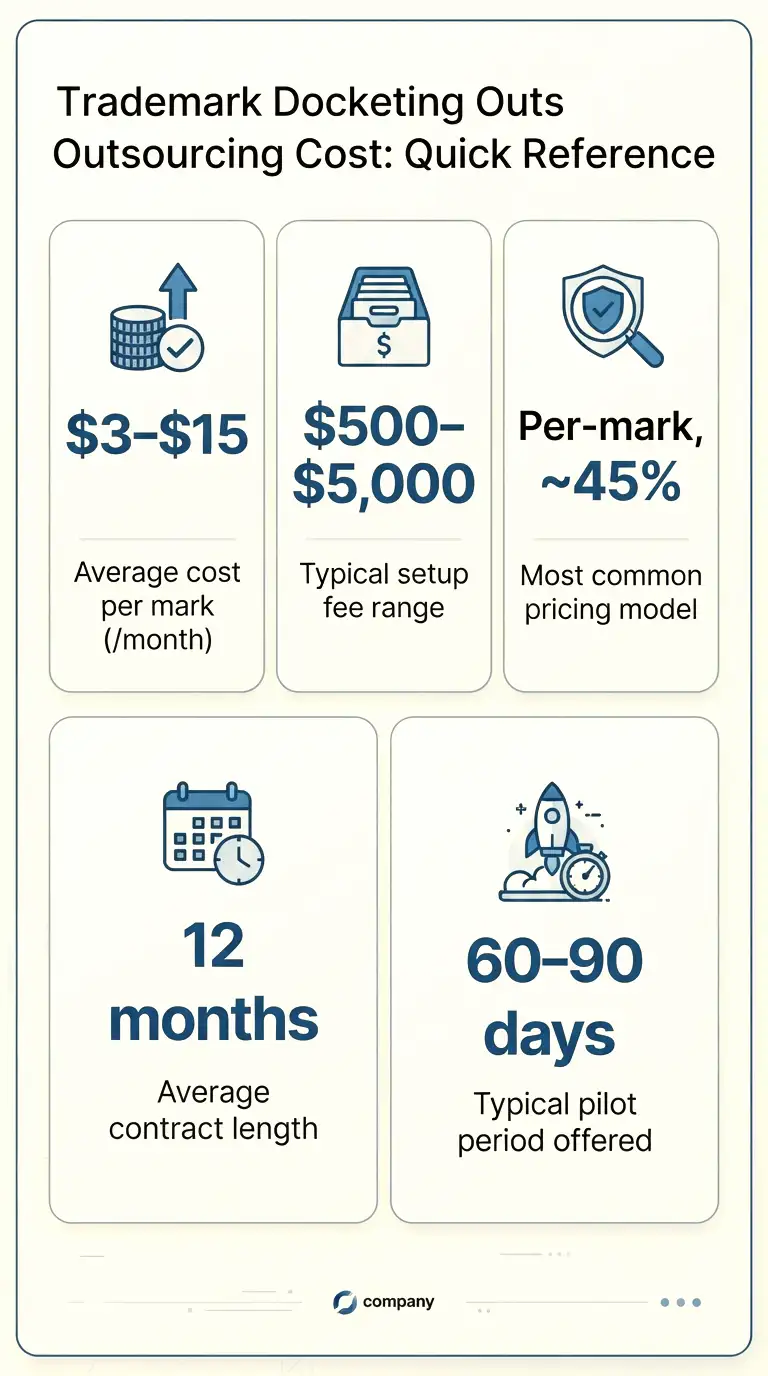
- Negotiate a trial period. A 60- to 90-day pilot on a subset of your portfolio lets you validate accuracy before committing to a full contract.
- Ask about attorney oversight. Firms that pair offshore data processing with U.S. attorney review often deliver stronger accuracy at a comparable price point to purely domestic teams.
- Bundle strategically. If you also need office action support or paralegal services, bundled pricing can lower your overall trademark docketing outsourcing cost. Reviewing whether a trademark paralegal can file an office action response is a useful starting point for scoping a bundled service.
- Clarify international docketing scope early. If you manage marks abroad, confirm whether the quoted price includes coordination for managing an international trademark portfolio, since foreign deadline tracking is frequently priced as an add-on.
- Build maintenance filings into your cost model. Section 8 and 15 affidavits carry their own deadlines and fees; confirm whether the vendor proactively flags these, as outlined in guidance on when to file a Section 8 and 15 affidavit.
Step-by-Step: How to Request an Accurate Trademark Docketing Outsourcing Quote
- Inventory your portfolio. Count active marks, jurisdictions, and average monthly filing volume.
- Identify your current pain points. Missed deadlines, staffing gaps, or software limitations should shape what you ask vendors to solve.
- Request itemized pricing. Ask for a breakdown by service type rather than a single bundled number.
- Confirm software compatibility. Verify integration with your existing docketing system to avoid migration surprises.
- Ask for references. A reputable vendor should connect you with existing clients of similar portfolio size.
- Compare total cost of ownership. Add setup fees, minimums, and add-ons to the base rate for a true annual figure.
- Pilot before committing. Test the vendor on a portion of your docket before migrating the full portfolio.
How Outsourced Trademark Docketing Fits Into Broader IP Management
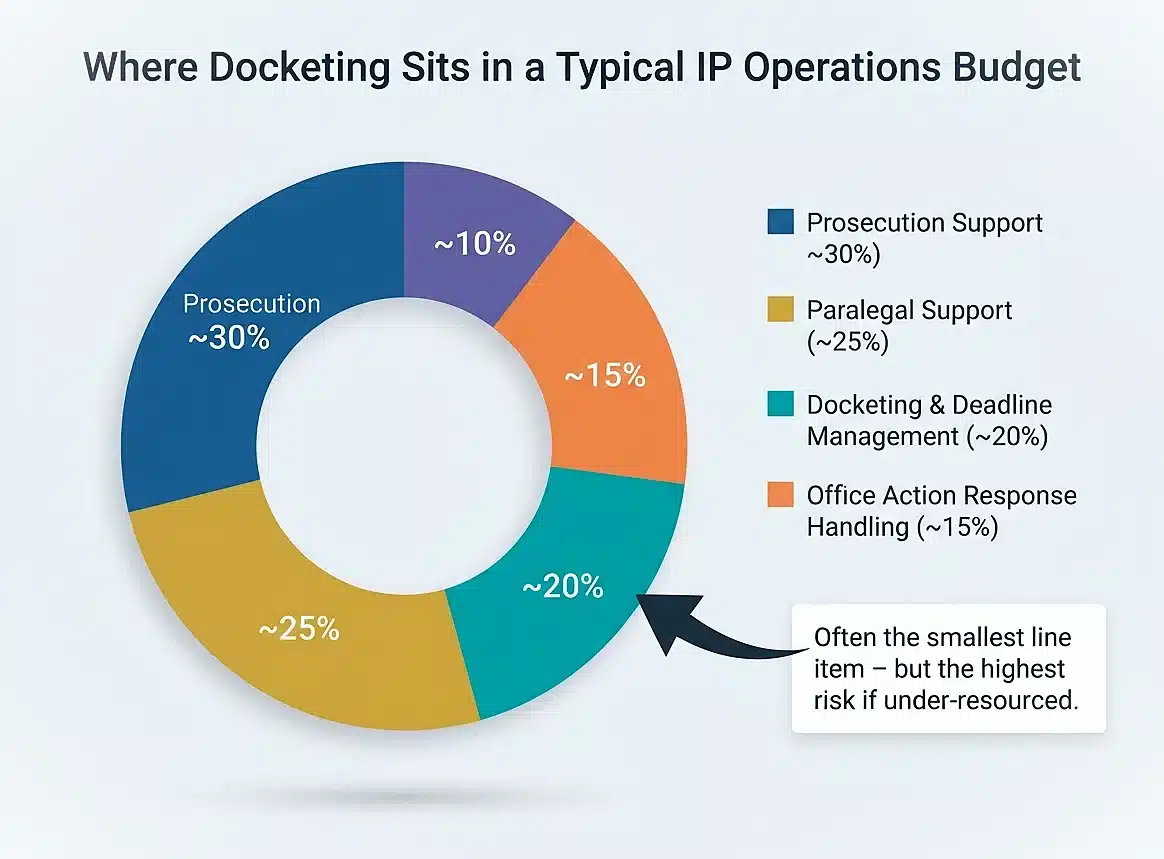
Docketing rarely exists in isolation. It is one function inside a firm’s larger intellectual property management strategy, alongside prosecution support, paralegal work, and portfolio strategy. Firms that treat docketing cost as part of a holistic IP operations budget-rather than an isolated line item-typically make more sustainable outsourcing decisions.
Intellectual Property Management Guide:
Patent-heavy practices evaluating similar decisions may also find it useful to compare docketing structures across practice areas; the considerations outlined for patent docketing services for small firms mirror many of the same cost drivers relevant to trademark portfolios.
Patent Docketing Services for Small Firms:
Trademark Docketing Outsourcing Cost by Provider Type
| Provider Type | Relative Cost | Best Fit |
|---|---|---|
| Fully domestic U.S. docketing firm | Highest | Firms requiring 100% onshore staff for policy or client reasons |
| Blended U.S./offshore model with attorney oversight | Moderate | Most small-to-mid-size firms balancing cost and quality |
| Offshore-only, no U.S. oversight | Lowest | Firms with strong internal QC and low-risk tolerance for errors |
| Software-only (self-service platform) | Low (plus internal labor) | Firms wanting full control but not full outsourcing |
For most trademark attorneys and IP directors, a blended model that pairs U.S. attorney oversight with cost-efficient offshore data processing delivers the strongest balance between accuracy and trademark docketing outsourcing cost.
Frequently Asked Questions
What is the average trademark docketing outsourcing cost per mark?
Most U.S. providers charge between $3 and $15 per mark per month, depending on portfolio size, service depth, and pricing model. Larger portfolios generally receive lower per-mark rates.
Is outsourced trademark docketing cheaper than hiring in-house staff?
When you account for salary, benefits, software licensing, training, and turnover risk, outsourced trademark docketing cost is often comparable to or lower than a fully loaded in-house hire, particularly for firms with fewer than 1,000 active marks.
Do outsourced docketing providers charge setup fees?
Many providers charge a one-time data migration or setup fee, typically ranging from $500 to $5,000 depending on portfolio size and the complexity of the data being transferred.
Can I outsource only part of my trademark docketing function?
Yes. À la carte pricing models allow firms to outsource specific tasks, such as renewal tracking or quality audits, while keeping other docketing functions in-house.
How do I know if a docketing quote is competitive?
Convert every quote to a consistent unit, such as cost per mark per month, and compare against the ranges in this guide. Also confirm what is included versus billed separately, since bundled versus à la carte pricing significantly affects the real total.
Does outsourcing trademark docketing increase malpractice risk?
When managed by a qualified provider with documented quality-control processes and attorney oversight, outsourcing typically reduces malpractice exposure by adding redundancy and specialized review that many in-house teams lack the bandwidth to maintain.
Making an Informed Trademark Docketing Outsourcing Cost Decision
Trademark docketing outsourcing cost is not a single number; it is a function of your portfolio size, the pricing model you choose, and the depth of service you need. Firms that compare quotes using a normalized per-mark cost, account for hidden fees, and prioritize quality control alongside price consistently make better long-term outsourcing decisions than those chasing the lowest headline rate.
Before you commit to a vendor, request a portfolio-specific quote so you can see exactly how the numbers apply to your practice rather than relying on industry averages alone.
Docketing & IP Management Services for Law Firms and Corporate IP Teams

