
One missed 60-day window can erase up to five years of exclusivity on a drug that earns billions. That single fact explains why pharma patent docketing has more deadlines than any other industry, and why life sciences IP teams treat the docket as a revenue-protection system instead of an administrative chore.
In most technology fields, a patent follows one main track: file, prosecute, issue, then pay maintenance fees. Pharmaceutical patents follow that track and several others at the same time. A single drug can sit inside a patent family, an FDA regulatory file, a generic-challenge timeline, a term-extension filing and a global set of national deadlines. Each track has its own authority, its own rules and its own penalties.

This guide breaks down every layer. You will see which deadlines apply, how they interact, where docketing teams most often slip, and how to build a workflow that catches problems early. You will also find tables, a step-by-step setup process, a visual plan for the article and a FAQ you can use as a quick reference.
Quick Answer: Why Pharma Patent Docketing Has More Deadlines
Pharma patent docketing has more deadlines because each drug product answers to two legal systems at once: patent law and drug regulatory law. Their clocks start at different moments, run for different lengths and often trigger each other. Add global filings, biologic-specific rules and litigation windows written into statute, and one product can carry a very large docket of dated events over its life.
Here is the short version:
- Dual clocks: patent office deadlines and FDA (or EMA) deadlines run in parallel.
- Short, unforgiving windows: for example, 60 days to apply for patent term extension after FDA approval.
- Statutory litigation clocks: 45 days to sue after a Paragraph IV notice, followed by a 30-month stay.
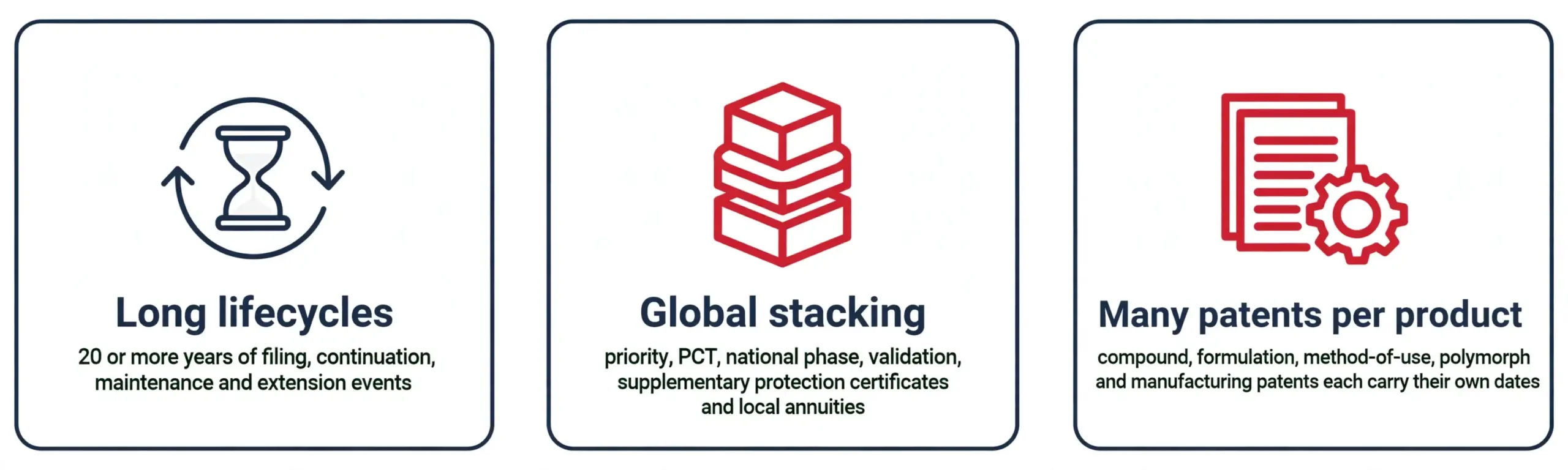
- Long lifecycles: 20 or more years of filing, continuation, maintenance and extension events.
- Global stacking: priority, PCT, national phase, validation, supplementary protection certificates and local annuities.
- Many patents per product: compound, formulation, method-of-use, polymorph and manufacturing patents each carry their own dates.
What is Pharma Patent Docketing?
Pharma patent docketing is the process of identifying, calendaring, monitoring and completing every legal deadline attached to pharmaceutical and biotechnology patents. That includes deadlines imposed by patent offices, by drug regulators and by generic-competition statutes such as the Hatch-Waxman Act.
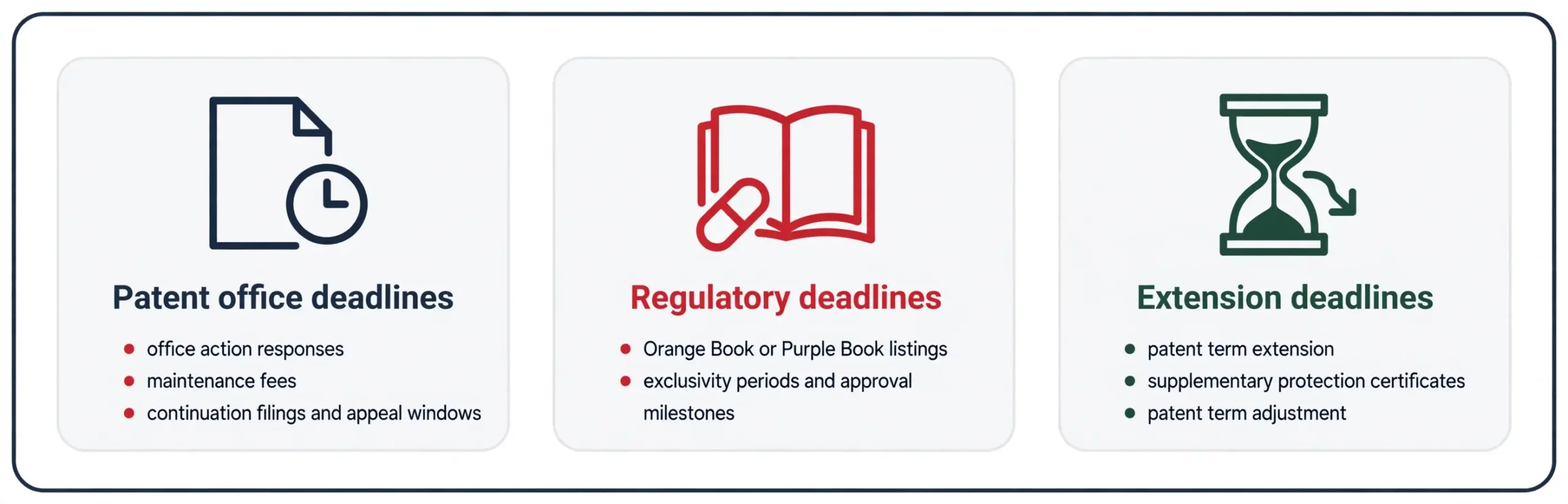
A complete pharma docket typically tracks:
- Patent office deadlines: office action responses, maintenance fees, continuation filings and appeal windows
- Regulatory deadlines: Orange Book or Purple Book listings, exclusivity periods and approval milestones
- Extension deadlines: patent term extension (PTE), supplementary protection certificates (SPCs) and patent term adjustment (PTA)
- Litigation deadlines: notice letters, infringement suits and inter partes review (IPR) bars
- Foreign deadlines: Paris priority, PCT national phase, European validation and local annuities
In our experience supporting life sciences docketing, the hardest part is rarely the date math. The harder question is which date applies, which event triggers it and who owns the next action. If you are new to the discipline, start with our guide to IP docketing best practices and our overview of a step-by-step legal docketing workflow.
The Six Deadline Layers Behind Pharma Patent Docketing
To see why pharma patent docketing has more deadlines, separate the docket into layers. Most industries live in the first two layers. Pharmaceutical portfolios live in all six, and the layers interact.
| Layer | Governing authority | Example deadlines | Risk if missed |
|---|---|---|---|
| 1. Patent prosecution | USPTO, EPO, JPO and other offices | Office action responses, information disclosure statements, continuation filings before the parent issues | Abandonment; lost family members |
| 2. Maintenance and annuities | National patent offices | US fees at 3.5, 7.5 and 11.5 years; yearly renewal fees abroad | Patent expires |
| 3. Regulatory listing and exclusivity | FDA, EMA and other regulators | Orange Book listing after issuance; 5-year NCE exclusivity; 6-month pediatric add-on | Lost leverage against generics |
| 4. Term extensions | USPTO with FDA; national offices | PTE application within 60 days of approval; SPC filing within 6 months; PTA calculations | Years of lost term |
| 5. Litigation and challenges | Federal courts, PTAB | 45-day suit window after a Paragraph IV notice; 30-month stay; one-year IPR bar | Lost stay or lost claims |
| 6. Global protection | WIPO, EPO, national offices | 12-month priority; 30-month PCT national phase; European validation | Lost territory |

As a result, a single product can generate dated events in layers three through five that no mechanical or software patent ever faces. Meanwhile, layers one, two and six multiply because pharma families are larger and more global.
Why Pharma Patent Docketing Has More Deadlines Than Mechanical or Software Patents
The comparison below shows where the extra deadlines come from.
| Factor | Typical mechanical or software portfolio | Typical pharma or biotech portfolio |
|---|---|---|
| Regulatory clock | None | FDA or EMA review, exclusivities and listings |
| Term extension | Patent term adjustment only | PTE, SPC, PTA and pediatric exclusivity |
| Patents per product | One to a few | Often a dozen or more across compound, formulation and use |
| Litigation timing | Set by the court and the parties | Partly set by statute (45 days, 30 months) |
| Jurisdictions | A handful of key markets | Many markets, each with local extension rules |
| Pre-launch period | Short | Often a decade or more of development |
| Cost of one missed date | One patent weakens | Market exclusivity for the whole product can shift |
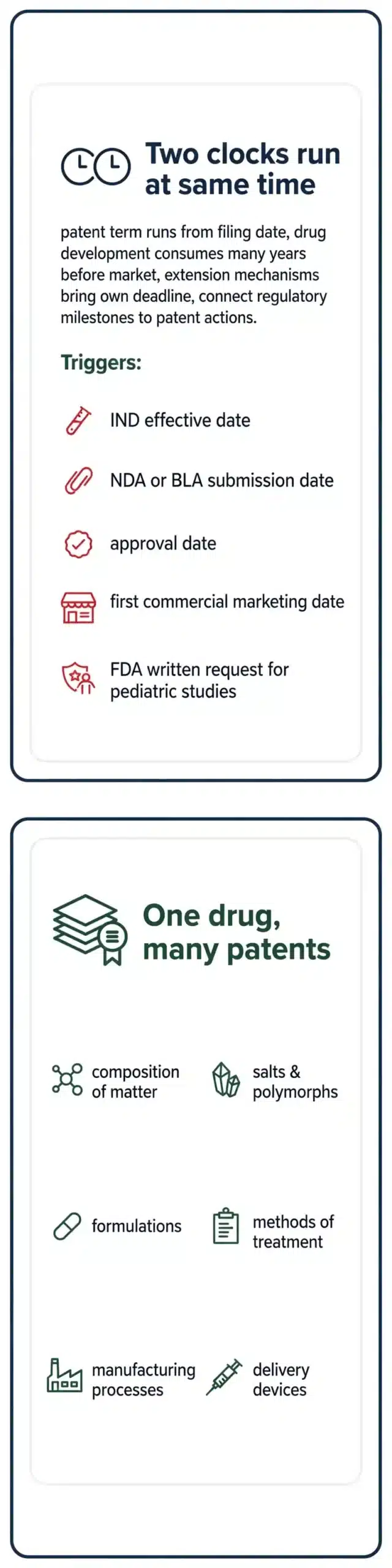
Reason 1: Two clocks run at the same time
A patent term runs from the filing date. Drug development, however, can consume many years before the product reaches the market. By the time FDA approves a drug, a large share of the patent term has often passed.
The law responds with extension mechanisms, and each mechanism brings its own deadline. Your docket must therefore connect regulatory milestones to patent actions.
Common trigger events include:
- IND effective date
- NDA or BLA submission date
- Approval date
- First commercial marketing date
- FDA Written Request for pediatric studies
If the regulatory team does not tell the docketing team about one of these events, the patent team may never learn that a clock has started.
Reason 2: One drug, many patents
A pharmaceutical product rarely rests on one patent. Instead, a brand company typically builds a portfolio around the product:
- Composition of matter (the active ingredient)
- Salts, polymorphs and crystalline forms
- Formulations and dosage forms
- Methods of treatment and new indications
- Manufacturing processes
- Delivery devices and combinations
Each patent carries its own prosecution file, maintenance schedule and foreign counterparts. FDA rules also decide which of them belong in the Orange Book.
According to a Congressional Research Service overview of Orange Book listing, drug substance, drug product and method-of-use patents can be listed, while process, drug-delivery device and packaging patents generally should not be. That sorting exercise alone creates more docket decisions than most industries face.
Reason 3: Litigation timelines come built into the statute
In most fields, a patent owner decides when to sue. In small-molecule pharma, the Hatch-Waxman framework sets key dates for you. A generic applicant’s Paragraph IV certification starts a notice process, and the brand’s response window is short.
If the brand sues in time, FDA generally cannot approve the generic application for 30 months unless the court resolves the dispute earlier.
Biologics follow a different statute with its own sequence of exchanges. Either way, the docket has to hold litigation dates that start from someone else’s action.
Reason 4: Global filing multiplies every date
Pharmaceutical companies sell their products in markets worldwide, which means they often need to file and maintain patent applications across multiple countries and jurisdictions. Each country adds its own prosecution deadlines, annuity payments, renewal requirements and local extension rules that must be tracked and managed separately.
A European SPC, for example, follows a different test and timeline from a US patent term extension. These differences mean that the same patent family can have multiple deadlines and obligations depending on the countries where protection is sought or maintained.
Because of this, a portfolio with 30 patent families can easily produce thousands of future dates across jurisdictions. Managing these dates requires careful coordination to ensure that country-specific requirements, filing deadlines and maintenance obligations are not overlooked.
Our guide to patent lifecycle management outsourcing explains how teams manage that volume.
Reason 5: Long lifecycles and continuation strategies
Brand owners protect a product for decades. They file continuations to cover new embodiments, divisionals to respond to restriction requirements and new applications for follow-on inventions. Each filing must happen while a parent is still pending, so copendency becomes a hard deadline.
To understand the choices involved, read our explanation of the difference between an RCE and a continuation application. The short version: the wrong procedural choice at the wrong time can end a family that took years to build.
Hatch-Waxman Deadlines: The Core of Small-Molecule Pharma Docketing
The Hatch-Waxman framework creates the most visible deadlines in the industry. It balances brand incentives against generic entry, and it does so with short, fixed windows. Docketers need to understand each one.
Orange Book listing deadlines
When a company seeks approval of a new drug, it submits patent information to FDA with the application. FDA publishes the listed patents in the Orange Book. A generic applicant must then address every listed patent.
For patents that issue after approval, FDA regulations set a 30-day window to submit the patent information. Late listing can weaken a brand’s position against a generic filer, so many teams treat this as a priority deadline. Verify the current rule in 21 CFR 314.53 for each matter.
Paragraph IV, the 45-day window and the 30-month stay
A generic applicant can challenge a listed patent through a Paragraph IV certification. The certification states that the patent is invalid or will not be infringed. After the generic company sends notice, the brand owner has 45 days to file suit if it wants the automatic stay.
The stay matters because it blocks final approval of the generic application for up to 30 months, unless the court resolves the dispute sooner. As the Congressional Research Service explains, the stay applies when the brand timely sues after a Paragraph IV certification. Miss the 45-day window, and the brand loses that automatic protection.
NCE-1 and the exclusivity calendar
FDA also grants regulatory exclusivities that run alongside patents. According to FDA’s patents and exclusivity FAQ:
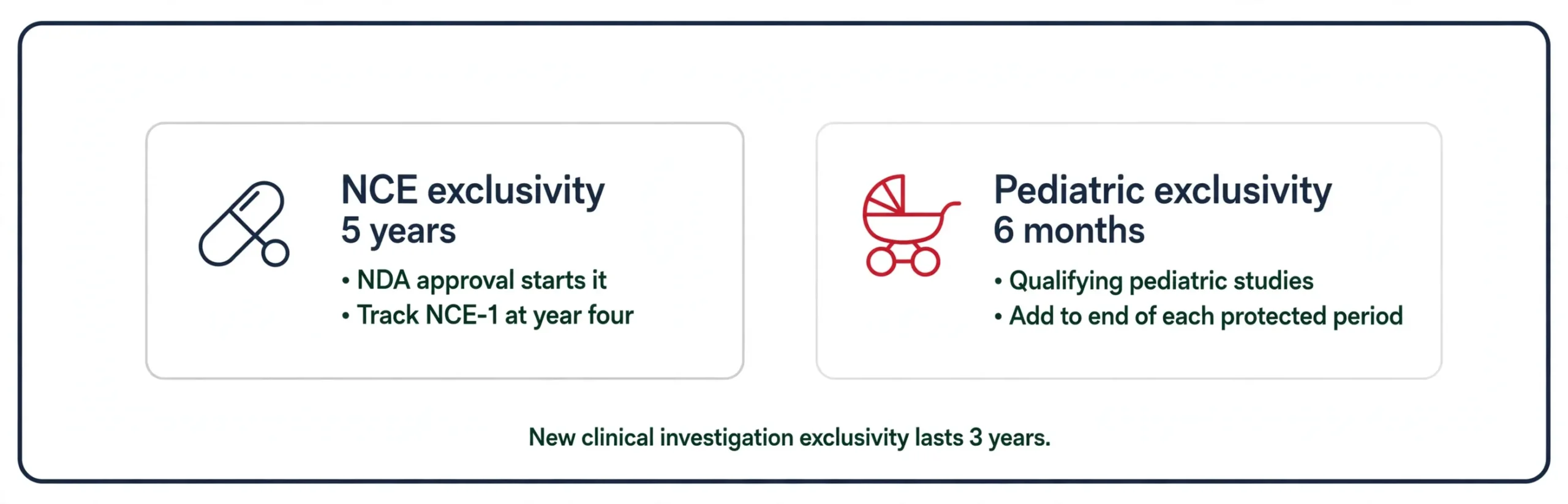
- New chemical entity (NCE) exclusivity lasts 5 years.
- NCE-1 allows a Paragraph IV application to be submitted at the four-year mark when the NDA has listed patents.
- New clinical investigation exclusivity lasts 3 years for qualifying changes such as new indications.
- Pediatric exclusivity adds 6 months to listed patents and exclusivities.
Note that the NCE-1 date starts a whole new cycle of docket events. The brand should expect a possible challenge, so counsel can prepare litigation and notice monitoring before the filing arrives.
Hatch-Waxman deadline cheat sheet
| Event | Window or length | What starts it | Docket action |
|---|---|---|---|
| Orange Book submission for later-issued patents | 30 days | Patent issuance | Set a short reminder chain and name an owner |
| Suit after Paragraph IV notice | 45 days | Receipt of notice letter | Open a litigation hold and calendar day 30, 40 and 45 |
| 30-month stay | 30 months | Timely suit | Calendar expiry and key court dates |
| NCE exclusivity | 5 years | NDA approval | Track NCE-1 at year four |
| Pediatric exclusivity | 6 months | Qualifying pediatric studies | Add to the end of each protected period |
Patent Term Extension, SPCs and PTA: The Highest-Stakes Dates
Extension filings carry the most value per day of any task in the docket. Yet they also come with some of the shortest windows.
US patent term extension (PTE)
Under 35 U.S.C. 156, a patent owner can apply to restore part of the term lost during regulatory review. The rules are strict:
- The application window is 60 days. It begins on the date the product receives permission for commercial marketing.
- The maximum extension is five years for most modern patents.
- The post-approval term is capped at 14 years. The extension shrinks if the remaining term plus the extension would exceed that cap.
- Only one patent can be extended for the same regulatory review period of a product.
Because only one patent can win the extension, the team must also choose which patent to extend. Often that decision requires input from counsel, the business and regulatory affairs, and it must happen inside 60 days.
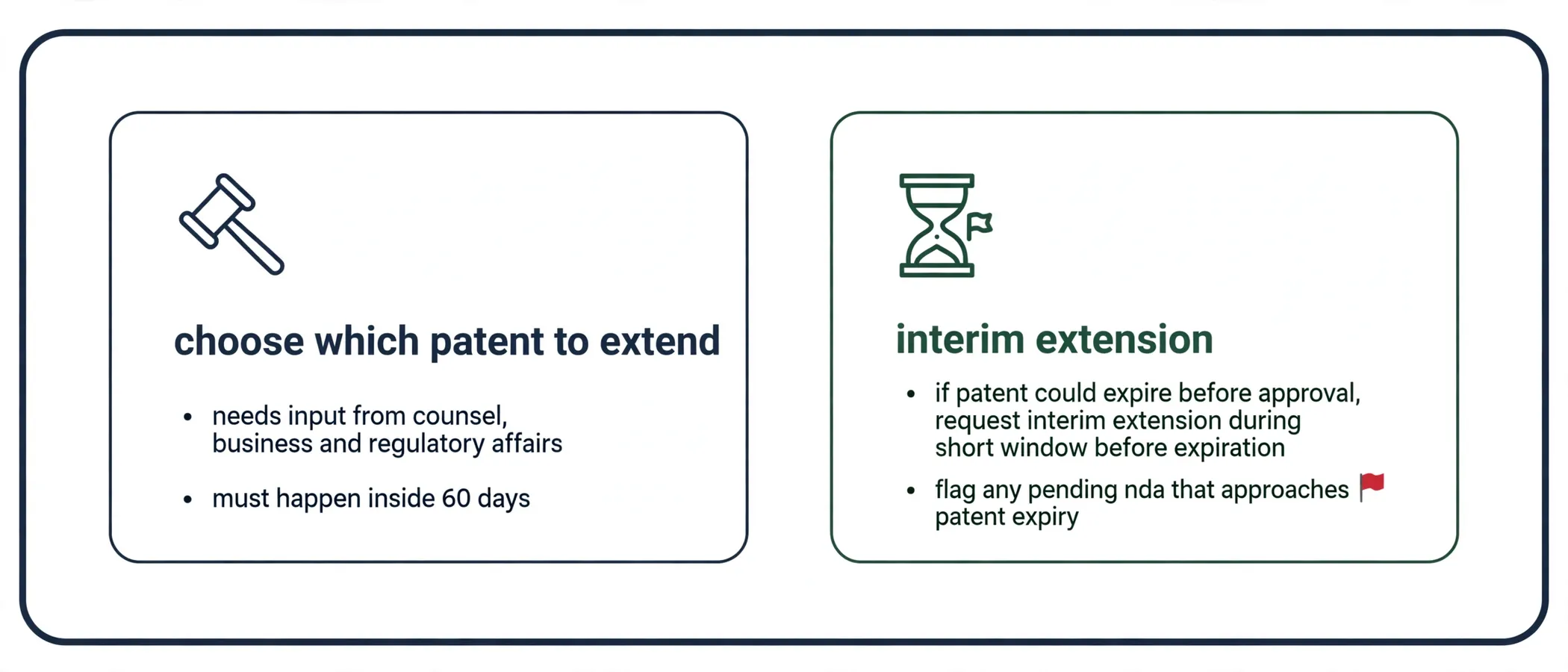
Interim extensions add another date. If a patent could expire before approval, the owner may need to request an interim extension during a short window before expiration. As a result, docketers should flag any pending NDA that approaches a patent expiry date.
Patent term adjustment (PTA)
PTA compensates for certain USPTO delays under 35 U.S.C. 154(b). It differs from PTE because it relates to office delay, not FDA review. Nevertheless, it affects the expiry date that every extension calculation depends on. After issuance, a patent owner who disagrees with the PTA calculation has only a short window to ask for reconsideration. Terminal disclaimers can also cap the benefit.
Supplementary protection certificates in Europe
European SPCs serve a similar goal. Under Regulation (EC) No 469/2009, an applicant generally files within six months of the marketing authorization or the patent grant, whichever is later. The certificate can add up to five years of protection, and total market exclusivity is capped at 15 years from the first EU authorization. A pediatric extension can add six months.
Because each country examines its own SPC application, one product can create a separate SPC filing in every member state. Docketers then need a country-by-country schedule, not a single regional date.
Quick answer: The three extension systems protect the same commercial interest, but they run on different clocks. PTE depends on FDA approval, PTA depends on USPTO delay and SPCs depend on European marketing authorizations.
Biologics Add a Second Rulebook to Pharma Patent Docketing
Biologic drugs follow the Biologics Price Competition and Innovation Act (BPCIA) instead of Hatch-Waxman. The statute grants a 12-year reference product exclusivity period and bars biosimilar applications for the first four years. In addition, it sets up a staged exchange of information between the reference product sponsor and the biosimilar applicant, often called the patent dance.
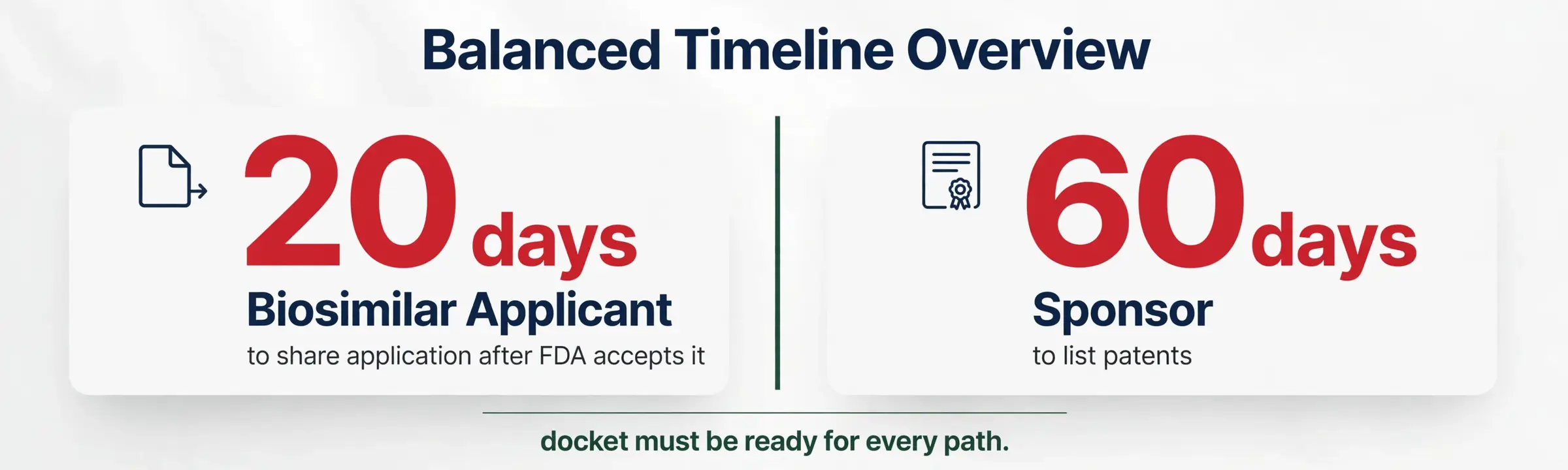
The exchange uses fixed windows that count in days, such as 20 days for the biosimilar applicant to share its application after FDA accepts it, and 60 days for the sponsor to list patents it believes the product infringes. Courts have held that some steps are optional, so strategy varies by case. Even so, the docket must be ready for every path.
Because of this, a company with both small molecules and biologics maintains two parallel deadline systems. Biologic patents also tend to cover manufacturing processes, cell lines and formulations. Those categories add yet more families to track.
The Global Deadline Stack in Pharma Patent Docketing
Priority and national-phase dates feed every foreign filing, and pharma companies file in many markets. The table shows how quickly one invention creates parallel clocks.
| Stage | Typical window | Notes for docketing |
|---|---|---|
| Paris Convention priority | 12 months from first filing | Missing it can destroy foreign rights |
| PCT national phase entry | 30 months from priority in many offices | Offices differ, so confirm each country; see WIPO’s PCT overview |
| European validation | Generally 3 months after grant, with a 1-month window for a unitary effect request | Translations and local agents may apply |
| US maintenance fees | 3.5, 7.5 and 11.5 years after issue | See the USPTO maintenance fee guidance |
| US extension (PTE) | 60 days from approval | One patent per product |
| European SPC | 6 months from authorization or grant | Filed country by country |
For example, the USPTO notes that payment cannot be made early, and that failing to pay the fee and surcharge by the end of the grace period causes the patent to expire. The patent owner, not the Office, carries responsibility for timely payment. Our guide to a comprehensive patent docketing system shows how teams automate those date rules.
Step-by-Step: How to Build a Pharma Patent Docket That Catches Every Deadline
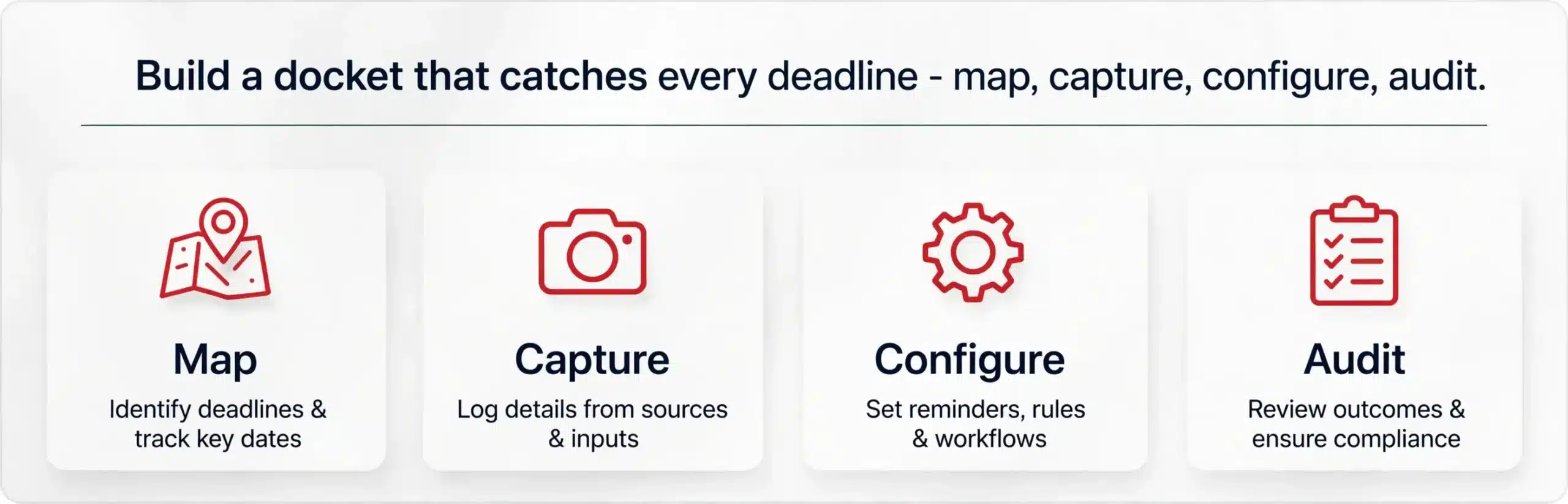
Follow this sequence when you set up or audit a pharma docket.
- Map each product to its patents. Create a product record, then link every compound, formulation, use and process patent to it.
- Capture regulatory milestones. Record IND, NDA or BLA submission and approval dates as docket events, with a named regulatory contact.
- Load statutory rules, not just dates. Configure rules for PTE, SPC, Orange Book listing and Paragraph IV response so that triggers create deadlines automatically.
- Add the foreign layer. For every family, enter priority dates and generate PCT, national phase, validation and annuity events.
- Set tiered reminders. Use at least three alerts per critical deadline, for example 60, 30 and 7 days before the due date.
- Assign two owners. Name a primary owner and a backup for every date that can cost exclusivity.
- Audit monthly. Compare docket entries against the USPTO, EPO and FDA records, and clear any discrepancy within the week.
For a more general framework, read our legal docketing workflow guide and apply its principles to the pharma-specific triggers above.
Common Mistakes in Pharma Patent Docketing
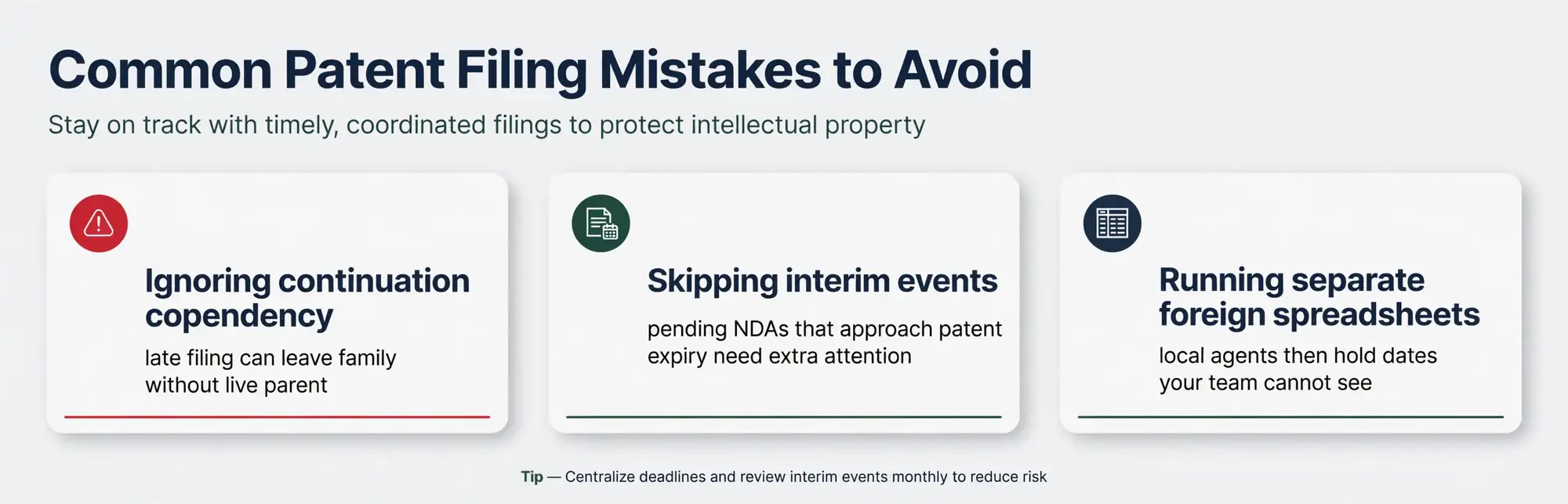
Even strong teams make predictable errors. Watch for these:
- Treating the docket as a patent-only tool. Regulatory events then never reach the patent team.
- Using a single date for a multi-step trigger. PTE, for example, depends on the approval date, not the patent issue date.
- Relying on the patent office’s reminders. The USPTO sends notices, but the owner remains responsible for payment.
- Ignoring continuation copendency. A late filing can leave a family without a live parent.
- Skipping interim events. Pending NDAs that approach patent expiry need extra attention.
- Running separate foreign spreadsheets. Local agents then hold dates your team cannot see.
- Failing to document who decides. The choice of which patent to extend needs a recorded owner and a recorded rationale.
Expert Tips for Managing Pharma Patent Deadlines
- Dock the trigger, not only the deadline. Calendar the event that starts the clock, then let the rule compute the date.
- Treat the 60-day PTE window as a project. Prepare the application package before approval so that the filing takes days, not weeks.
- Run a quarterly look-ahead. Review the next 18 months of high-value dates with counsel and regulatory affairs.
- Tag exclusivity-critical dates. Filter them from routine entries so that alerts reach senior reviewers.
- Reconcile after every transaction. Licensing, acquisitions and divestitures change ownership, and ownership changes who must act.
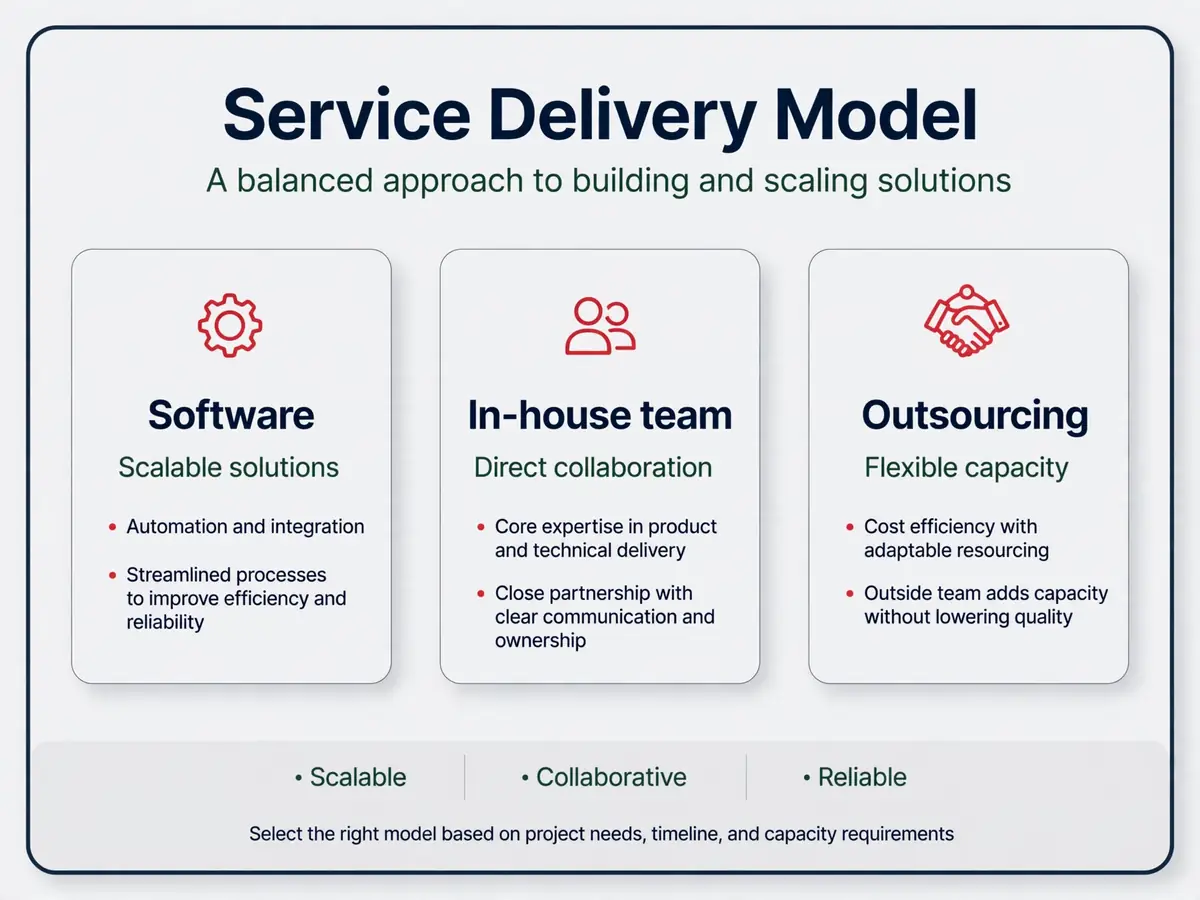
Software, In-House Teams or Outsourcing? Choosing a Docketing Approach
Pharma docketing requires a combination of rule-based software and experienced professionals to manage deadlines accurately. While software helps calculate dates, track important events and maintain records, people are responsible for determining which rules apply, reviewing jurisdiction-specific requirements and identifying exceptions that may need special attention.
Our overview of why firms outsource patent docketing explains how an outside team can provide additional capacity, support daily operations and maintain quality without compromising accuracy. Corporate departments can also compare available providers and services in our review of docketing companies for corporate IP departments.
If you want an experienced team to handle the day-to-day work, explore Teak IP’s IP docketing services to learn how dedicated support can help manage docketing activities and patent-related deadlines.
Frequently Asked Questions About Pharma Patent Docketing
Why does pharma patent docketing have more deadlines than other industries?
In short, why pharma patent docketing has more deadlines comes down to four drivers: a regulatory clock that runs beside the patent clock, many patents per product, litigation windows set by statute and a global filing footprint. Each driver adds its own dated events, and the events trigger one another.
What is the most critical deadline in pharma patent docketing?
No single date outranks the rest, but two stand out. The 60-day window to apply for US patent term extension starts at FDA approval and can decide up to five years of term. The 45-day window to sue after a Paragraph IV notice decides whether the brand secures the 30-month stay.
How many deadlines does a pharma patent have?
The number varies by product, family size and jurisdictions. A single patent can carry dozens of events over its life, and a product with many patents across many countries multiplies that total. For that reason, teams count events by product and family, not by patent alone.
What is the difference between PTE, PTA and an SPC?
PTE restores US term lost during FDA review. PTA compensates for USPTO delay during prosecution. An SPC is a European certificate that extends protection after the patent expires, based on the marketing authorization. Each has different filing rules and different limits.
Do biologics have different docketing deadlines?
Yes. Biologics follow the BPCIA, which uses a 12-year reference product exclusivity period and a staged exchange of patent information. Small molecules follow Hatch-Waxman. A company with both product types needs rules for each system.
Can docketing software manage pharma deadlines alone?
Software helps with date calculation and reminders. However, it cannot decide which patent to extend, whether a listing is appropriate or how a trigger event affects the family. Pair rule-based software with experienced docketers, as our guide to patent docketing systems describes.
What happens if a pharma patent deadline is missed?
The result depends on the deadline. Some missed dates can be revived by petition if the delay was unintentional, but statutory windows such as the 60-day PTE filing period are much harder to cure. A lapsed maintenance fee past the grace period causes the patent to expire. Always escalate a possible miss to counsel immediately.
Conclusion: Treat the Docket as Exclusivity Insurance
Why pharma patent docketing has more deadlines is no mystery once you see the structure. Patent law and drug regulation run side by side, each product carries many patents, statutes set litigation clocks and every filing repeats across borders. Consequently, a single missed date can cost far more than a single patent.
To protect your portfolio, link regulatory events to patent actions, load statutory rules into your system, assign backup owners and audit the docket every month. Strong process turns a long list of dates into a dependable calendar.
If your team needs extra capacity or specialist support, Teak IP can help. Contact Teak IP through the IP docketing services page to discuss your portfolio. You can also explore more guides on the Teak IP blog, including our resources on patent paralegal outsourcing for corporate IP departments and docketing for large firms.
Strengthen Your Pharma Patent Docketing Process
Protect critical patent deadlines, manage complex regulatory timelines and safeguard your portfolio with specialist IP docketing support. Connect with Teak IP to discuss your requirements.
INTELLECTUAL PROPERTY SERVICES
