
A final rejection lands on a Tuesday. The claims are close, but not close enough. Somewhere in your docketing system a three-month clock has already started, and the decision you make in the next few weeks will shape the cost, the term, and the commercial value of that patent for the next two decades.

At that moment, most prosecution teams face the same fork in the road. Do you keep fighting inside the same application, or do you open a new one? That is exactly the difference between an RCE and a continuation application, and although the two filings look similar on a docket report, they behave very differently in law, in fees, in patent term, and in examiner psychology.
This guide breaks down both options the way an experienced prosecution support team actually evaluates them: rule by rule, cost by cost, and deadline by deadline. Furthermore, it gives you decision frameworks, filing checklists, docketing safeguards, and the mistakes we see most often in real portfolios.
Quick Answer: The Difference Between an RCE and a Continuation Application
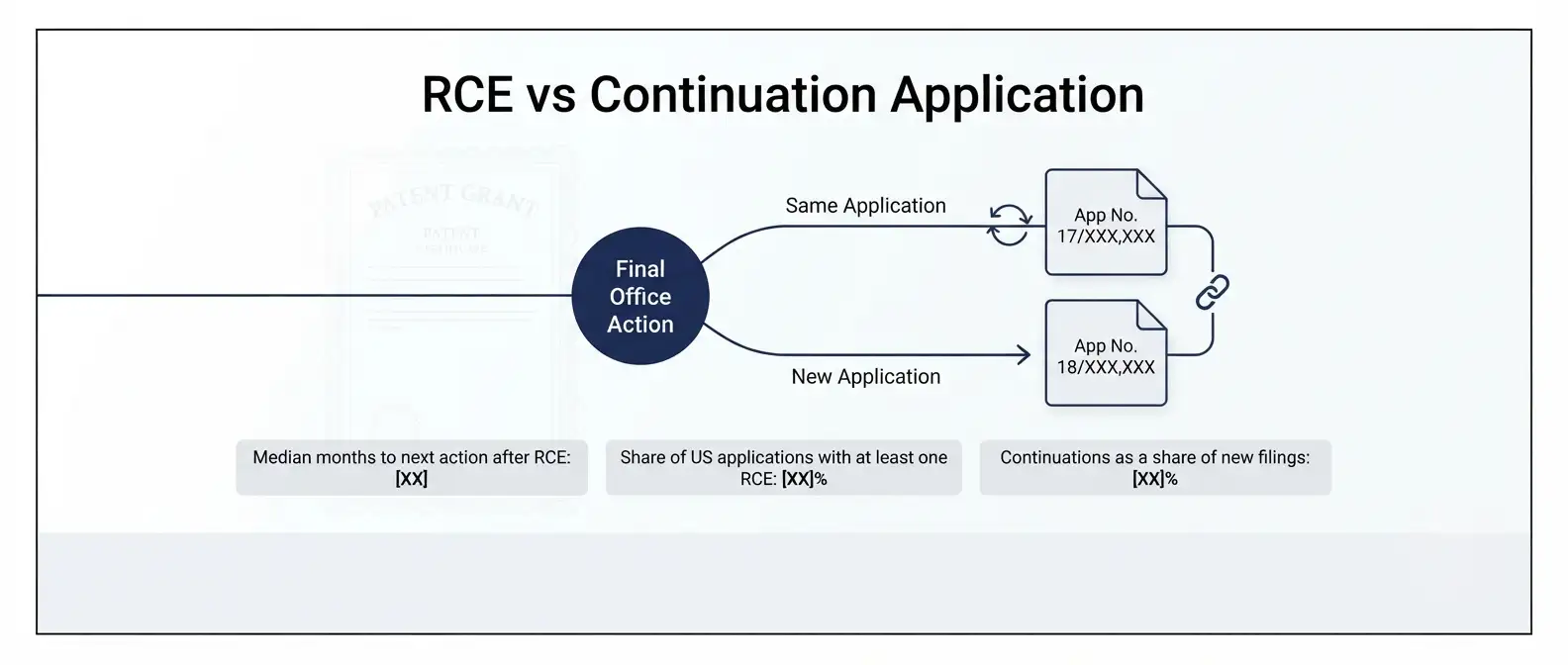
An RCE (Request for Continued Examination) reopens prosecution in the same application, while a continuation application starts a brand new application that claims the benefit of the parent’s filing date.
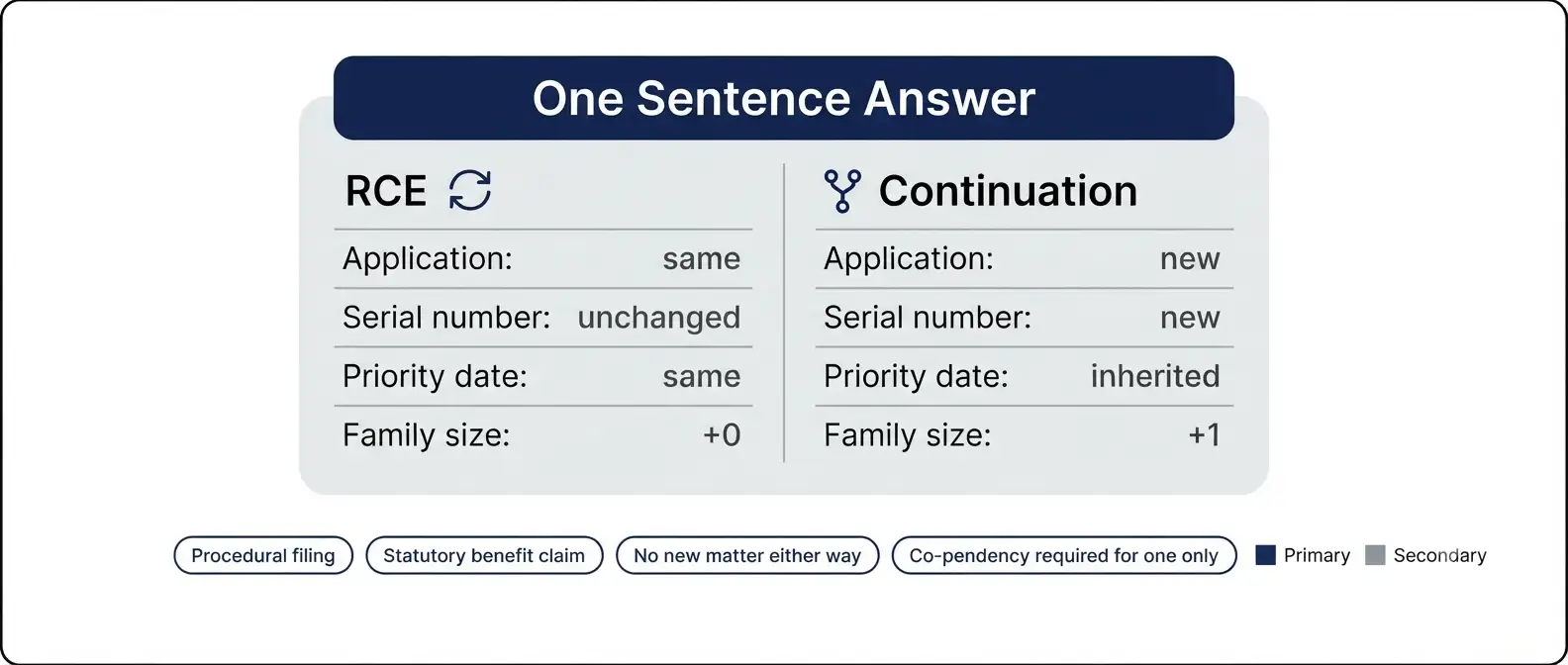
Here is the short version, in five lines:
- RCE: same application number, same file wrapper, same examiner, no new filing date, prosecution simply continues.
- Continuation: new application number, new file wrapper, new filing receipt, new term clock for adjustments, but an inherited priority date.
- RCE: cheaper up front, faster to file, and best when you are one amendment away from allowance.
- Continuation: more expensive, but it preserves a pending family member and lets you pursue different claim scope.
- Both: require co-pendency discipline and precise docketing, because a missed date cannot be undone with a phone call.
Consequently, the real question is rarely “which one is better.” It is “which one matches the position of this application, this budget, and this commercial objective right now.”
What is an RCE (Request for Continued Examination)?
A Request for Continued Examination is a procedural filing under 37 CFR 1.114 that withdraws the finality of an Office action and puts the application back into examination. It is not a new application It does not get a new serial number. It simply buys more examination in the case you already have.
When an RCE Becomes Available
Prosecution must be “closed” before you can file one. In practice, that means the application has reached one of these positions:
- A final Office action has issued.
- A Notice of Allowance has issued, and the issue fee has not yet been paid.
- An Ex parte Quayle action has issued.
- An appeal is pending, but no decision has issued.
What an RCE Must Include
An RCE without a proper submission is a wasted filing. Therefore, every RCE needs three components:
- The request itself, normally on Form PTO/SB/30 or through the Patent Center RCE interface.
- A submission, meaning an amendment, new arguments, an IDS, an affidavit, or a previously unentered after-final response.
- The fee, paid at filing, with no extensions available for the fee itself.
If you want a field-level walkthrough of the paperwork, our guide on how to prepare a Request for Continued Examination (RCE) form covers each entry, the common Patent Center pitfalls, and the certification language that trips up new paralegals.
What an RCE Cannot Do
- It cannot be filed in a provisional application.
- It cannot be filed in a design application (those use a Continued Prosecution Application instead).
- It cannot be filed after the patent issues.
- It cannot add new matter to the specification.
- It cannot revive an abandoned application by itself; you need a petition first.
What Is a Continuation Application?
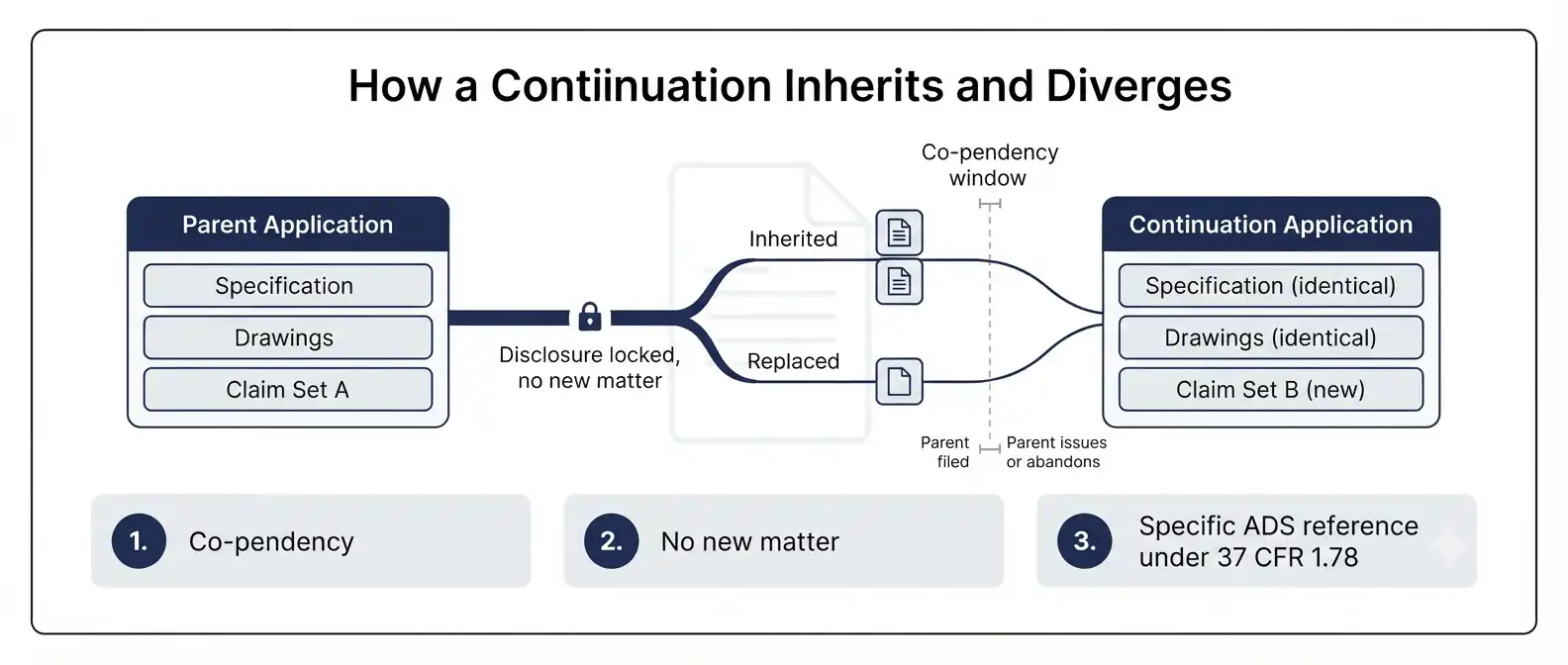
A continuation is a new nonprovisional application filed under 37 CFR 1.53(b) that contains the same disclosure as an earlier application and claims the benefit of that earlier filing date under 35 U.S.C. 120. Because the specification is identical, the only thing that genuinely changes is the claim set.
The Three Non-Negotiable Requirements
According to MPEP 211, a valid benefit claim requires all of the following:
- Co-pendency. The continuation must be filed while the parent is still pending. One day late is fatal, and there is no reliable cure.
- No new matter. The disclosure must be fully supported by the parent. Add new subject matter and you have a continuation-in-part, not a continuation.
- A specific reference. The benefit claim must appear in the ADS within the time limits of 37 CFR 1.78.
What Changes in a Continuation
- You get a fresh claim set, often broader, narrower, or aimed at a competitor’s product.
- You get a new application number and a new file wrapper.
- You get a new Patent Term Adjustment clock, which can be meaningful.
- You usually keep the same examiner and art unit, although reassignment happens.
- You must re-file your IDS obligations, which is where many firms leak fees. Our breakdown on cross-citing foreign references in an IDS explains how to manage that across an international family without duplicating spend.
RCE vs Continuation Application: Complete Comparison Table
This table is the fastest way to internalize the difference between an RCE and a continuation application.
| Factor | RCE (Request for Continued Examination) | Continuation Application |
|---|---|---|
| Legal basis | 37 CFR 1.114 | 35 U.S.C. 120 and 37 CFR 1.53(b) |
| New application? | No | Yes |
| Application number | Unchanged | New number issued |
| Filing date | Unchanged | New actual date, inherited priority date |
| Specification changes | None permitted (no new matter) | None permitted (no new matter) |
| Claim changes | Amendments to existing claims | Entirely new claim set allowed |
| Examiner | Same examiner, same file history | Usually same examiner, occasionally reassigned |
| Undiscounted government fee | $1,500 first request; $2,860 second and later | Filing, search and examination fees, roughly $2,000, plus possible surcharges |
| Small entity fee | $750 first; $1,430 second and later | Approximately $800 baseline |
| Late-filing surcharge | None | $2,700 after six years; $4,000 after nine years from earliest benefit date |
| Patent Term Adjustment | Stops accrual of “B delay” from the date of filing | New PTA clock begins |
| Patent term expiry | Measured from earliest benefit date | Also measured from earliest benefit date, so term shrinks |
| Family member preserved? | No, the family does not expand | Yes, keeps a pending continuation family alive |
| Typical time to next action | Often longer, RCEs sit on the “special” docket | Varies, new case docket |
| Terminal disclaimer likely? | No | Often, for obviousness-type double patenting |
| Best used when | Allowance is within reach | Strategy, scope, or commercial coverage must change |
Legal Foundations Side by Side
Teams that understand the underlying authority make faster decisions. Accordingly, here is the rule map.
| Topic | RCE authority | Continuation authority |
|---|---|---|
| Core rule | 37 CFR 1.114 | 37 CFR 1.53(b) |
| Statute | 35 U.S.C. 132(b) | 35 U.S.C. 120 |
| MPEP section | MPEP 706.07(h) | MPEP 201.07 and MPEP 211 |
| Benefit claim rules | Not applicable | 37 CFR 1.78 |
| Term adjustment | 35 U.S.C. 154(b)(1)(B)(i) | 35 U.S.C. 154(a)(2) |
| Fee authority | 37 CFR 1.17(e) | 37 CFR 1.16 |
The USPTO’s own discussion of after-final practice in MPEP 706.07(h) is the definitive reference, and it is worth re-reading annually because practice notes shift.
The Patent Term Question Most Teams Get Wrong
This is where the difference between an RCE and a continuation application stops being administrative and starts being financial.
How an RCE Affects Patent Term Adjustment
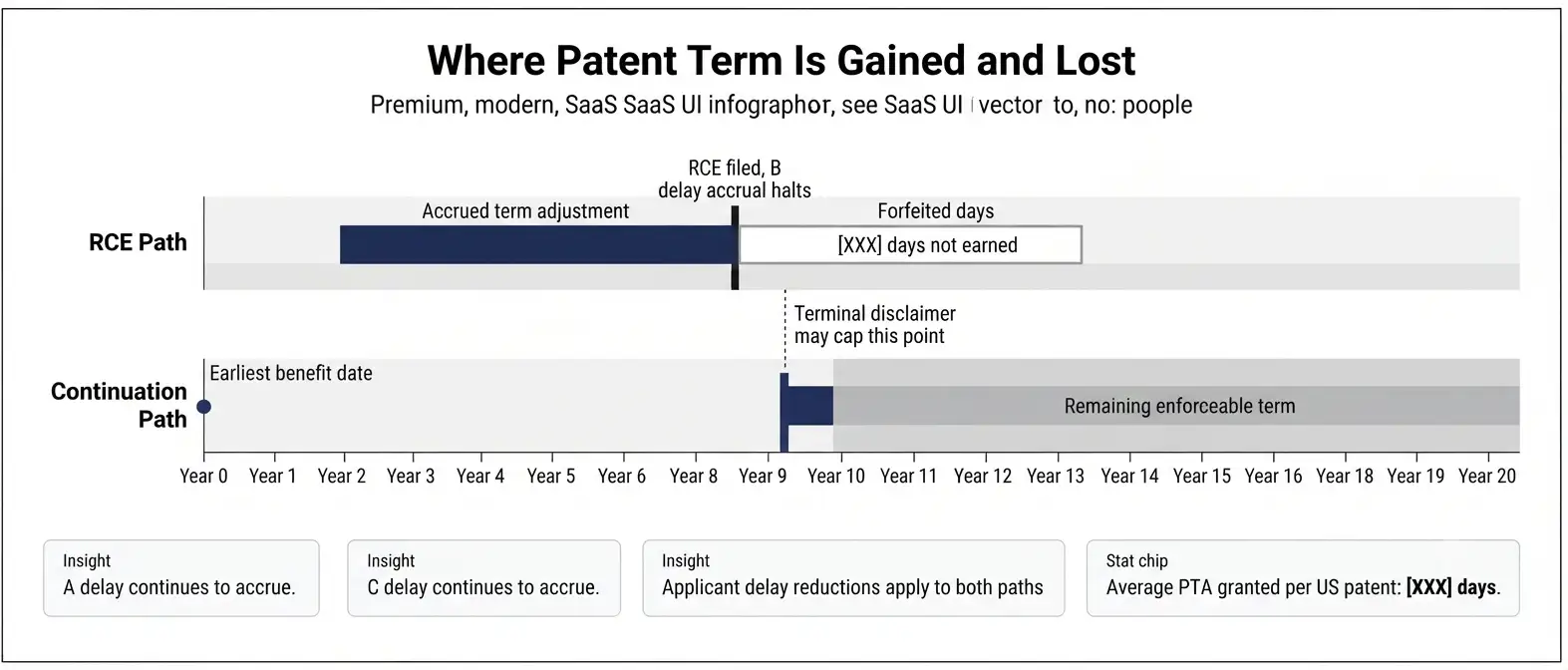
Under 35 U.S.C. 154(b)(1)(B), applicants earn day-for-day term adjustment when the USPTO takes more than three years to issue a patent. However, the statute explicitly excludes time consumed by continued examination. In plain terms:
- Filing an RCE stops the “B delay” clock from the day the RCE is filed.
- Any “A delay” and “C delay” accrual continues under its own rules.
- Multiple RCEs in a slow case can erase months or years of adjustment you had already banked.
For a case that is already three and a half years old, that single line item can be worth more than the entire prosecution budget. The USPTO explains the calculation framework in MPEP 2731.
How a Continuation Affects Patent Term
A continuation gets its own PTA clock, which sounds attractive. Nevertheless, the twenty-year term still runs from the earliest non-provisional benefit date. Therefore:
- Filing a continuation in year six leaves roughly fourteen years of term.
- Filing a continuation in year twelve leaves roughly eight years of term.
- A terminal disclaimer, if required, can cut the term back to match the parent.
Term Impact at a Glance
| Scenario | Effect on PTA | Effect on 20-year term | Net commercial impact |
|---|---|---|---|
| First RCE at year 2 | Minimal, B delay not yet accruing | None | Low risk |
| First RCE at year 4 | Stops accrued B delay | None | Moderate, can cost months |
| Third RCE at year 5 | Significant PTA loss | None | High, often the wrong tool |
| Continuation at year 3 | New PTA clock starts | Term shortened by 3 years used | Usually acceptable |
| Continuation at year 10 | New PTA clock starts | Only 10 years remain | Justify commercially first |
Cost Comparison: What Each Path Actually Costs
Government fees are only part of the picture. Attorney time, paralegal time, and IDS management all add up. The figures below reflect the undiscounted USPTO fee schedule that took effect on January 19, 2025. Always confirm current amounts on the official USPTO fee schedule before filing, because rates adjust periodically.
| Cost element | RCE | Continuation |
|---|---|---|
| First request or filing | $1,500 | Filing, search and examination totaling roughly $2,000 |
| Second request | $2,860 | Not applicable |
| Third and subsequent | $4,290 tier applies in later requests | Not applicable |
| Six-year surcharge | None | $2,700 |
| Nine-year surcharge | None | $4,000 |
| Excess claims | Only if claims are added | Recalculated from scratch |
| New IDS burden | Usually light | Full re-citation required |
| Professional time | Lower, amendment only | Higher, new ADS, declaration handling, claim drafting |
| Typical all-in range | Lower | Higher, sometimes double |
Notably, the six-year and nine-year continuation surcharges introduced in 2025 changed long-term portfolio planning. Families that once kept a continuation chain alive indefinitely now budget for escalating costs, which is one reason more teams are front-loading their continuation strategy in years one through five.
When Should You File an RCE?
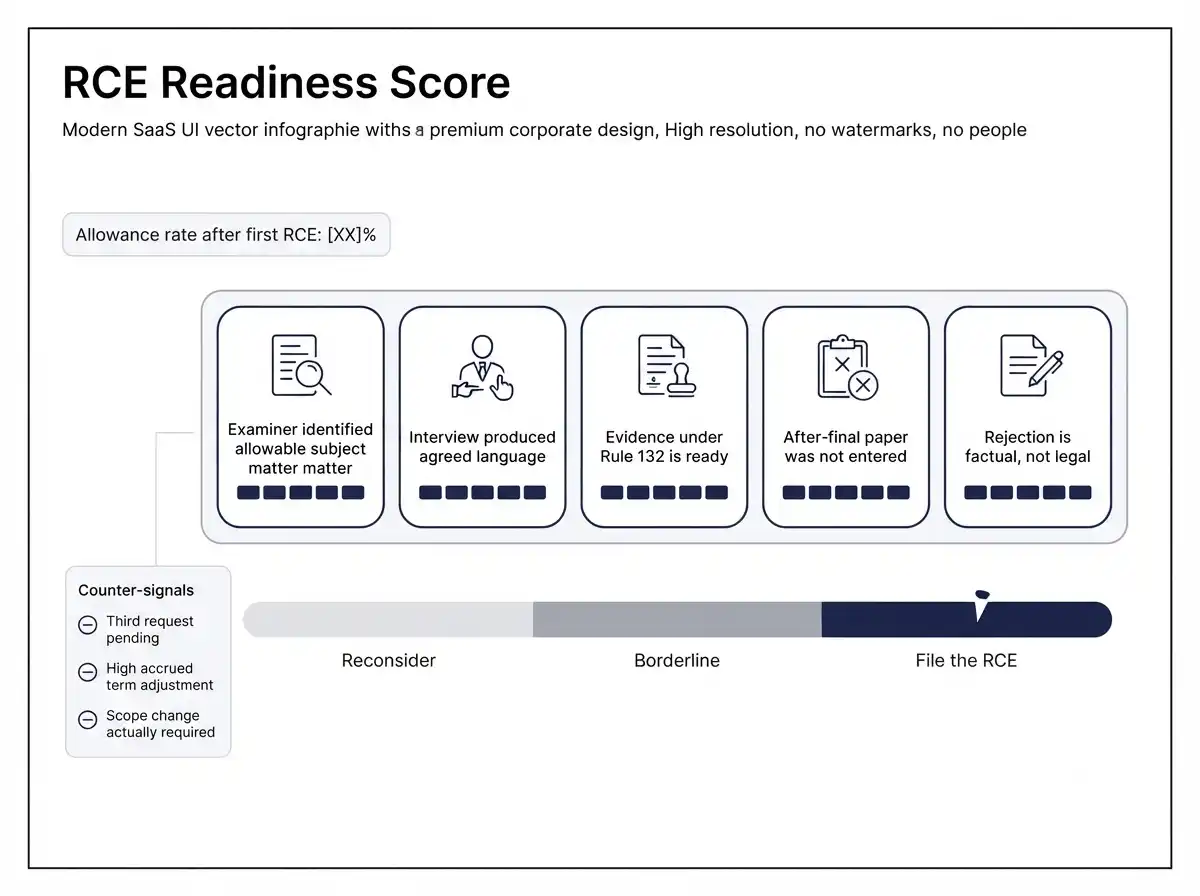
File an RCE when the examiner’s position is narrow, addressable, and the finish line is visible.
Five Situations Where an RCE Is the Right Call
- The examiner signaled allowable subject matter. A final action that identifies allowable dependent claims is practically an invitation.
- Your after-final amendment was not entered. An RCE guarantees entry of a submission the examiner refused to consider.
- You have a late-arriving reference. A material reference surfaced from a foreign counterpart and must be cited before allowance.
- A declaration or affidavit is needed. Rule 132 evidence often requires continued examination to be properly considered.
- An interview produced a clear path. The examiner agreed on language, and you simply need a vehicle to enter it.
Five Signals That an RCE Is the Wrong Tool
- You are on your third RCE and the rejection has not narrowed.
- The examiner’s position is legally wrong, not factually close. Appeal may be faster and cheaper.
- The application already carries substantial PTA you would be forfeiting.
- You want different claim scope, not the same claims with tweaks.
- Your real goal is keeping the family open for future competitor products.
Before defaulting to an RCE, evaluate the full menu of after-final options. Our walkthrough of office action response rules and process at every stage maps the alternatives, and the office action response example for patent applicants shows how a well-structured response can avoid the RCE entirely.
When Should You File a Continuation Application?
File a continuation when the objective is strategic coverage rather than incremental argument.
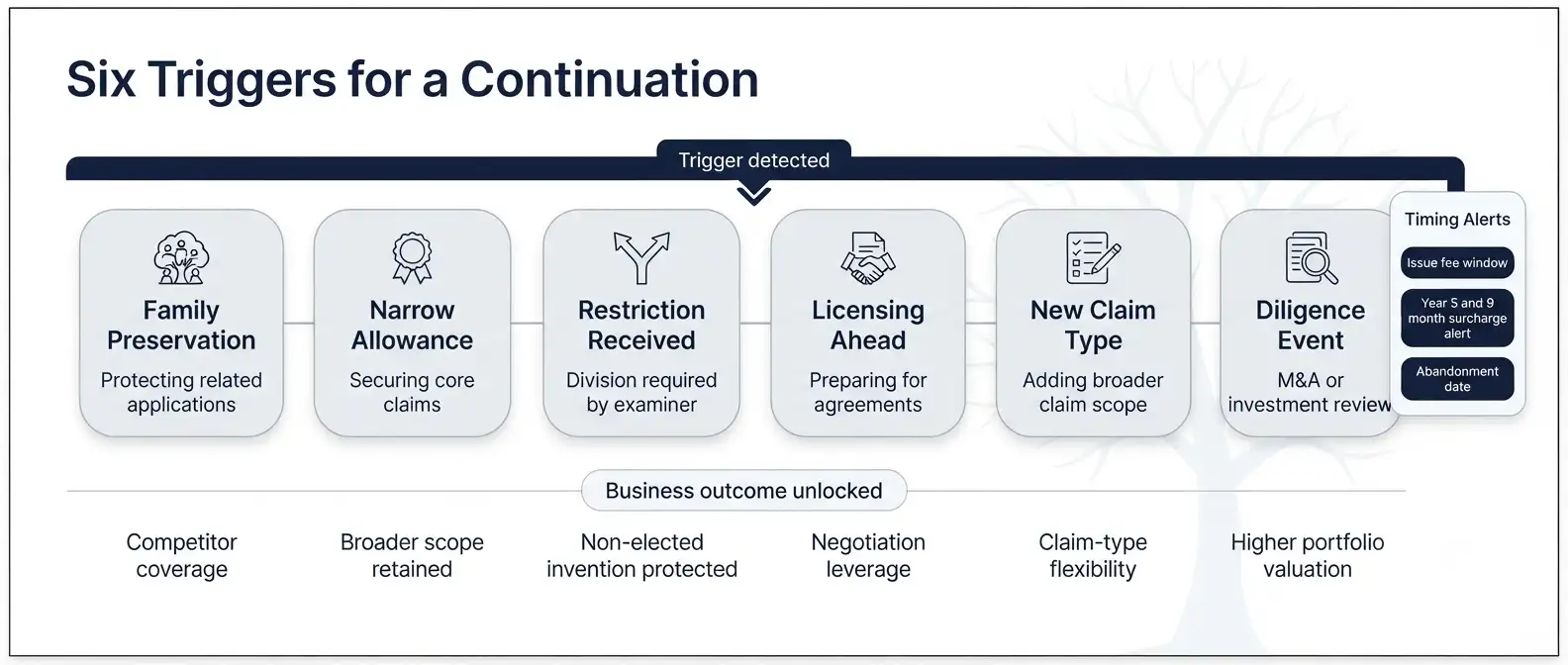
Six Situations That Justify a Continuation
- You want to keep the family pending. A live continuation lets you draft claims around a competitor’s product that has not launched yet.
- Allowed claims are narrower than the disclosure supports. Take the allowance, then pursue broader scope separately.
- The examiner issued a restriction requirement. A divisional, which is a close cousin, protects the non-elected invention.
- Licensing or litigation is on the horizon. Counsel frequently prefers an open application during negotiations.
- You need a different claim type. Method claims, system claims, or CRM claims may require a fresh set rather than an amendment.
- A due diligence event is approaching. Acquirers often value portfolios with pending continuations more highly.
The Continuation Timing Rule That Cannot Slip
Co-pendency is absolute. Specifically, if the parent issues on a Tuesday, the continuation must be filed no later than the day before issuance. Meanwhile, if the parent goes abandoned, co-pendency ends on the date of abandonment, not on the date the Notice of Abandonment arrives in the mail.
This is precisely why mature firms docket two dates: the issue date and a safety date roughly two weeks earlier. Our complete patent docketing guide explains how those reminder tiers should be structured so nobody relies on a single calendar entry.
Can You File Both? Yes, and Often You Should
Filing an RCE and a continuation are not mutually exclusive. In fact, a common professional pattern looks like this:
- Receive a Notice of Allowance on narrow claims.
- File a continuation before paying the issue fee, preserving broader scope.
- Pay the issue fee and let the parent grant.
- Prosecute the continuation independently.
Alternatively, when prosecution stalls:
- Receive a second final rejection.
- File an RCE with the strongest amendment.
- Simultaneously prepare a continuation shell in case the RCE fails.
Consequently, the question shifts from “either/or” to sequencing. Which filing goes first, and what does each one buy?
Step-by-Step: How to File an RCE Correctly
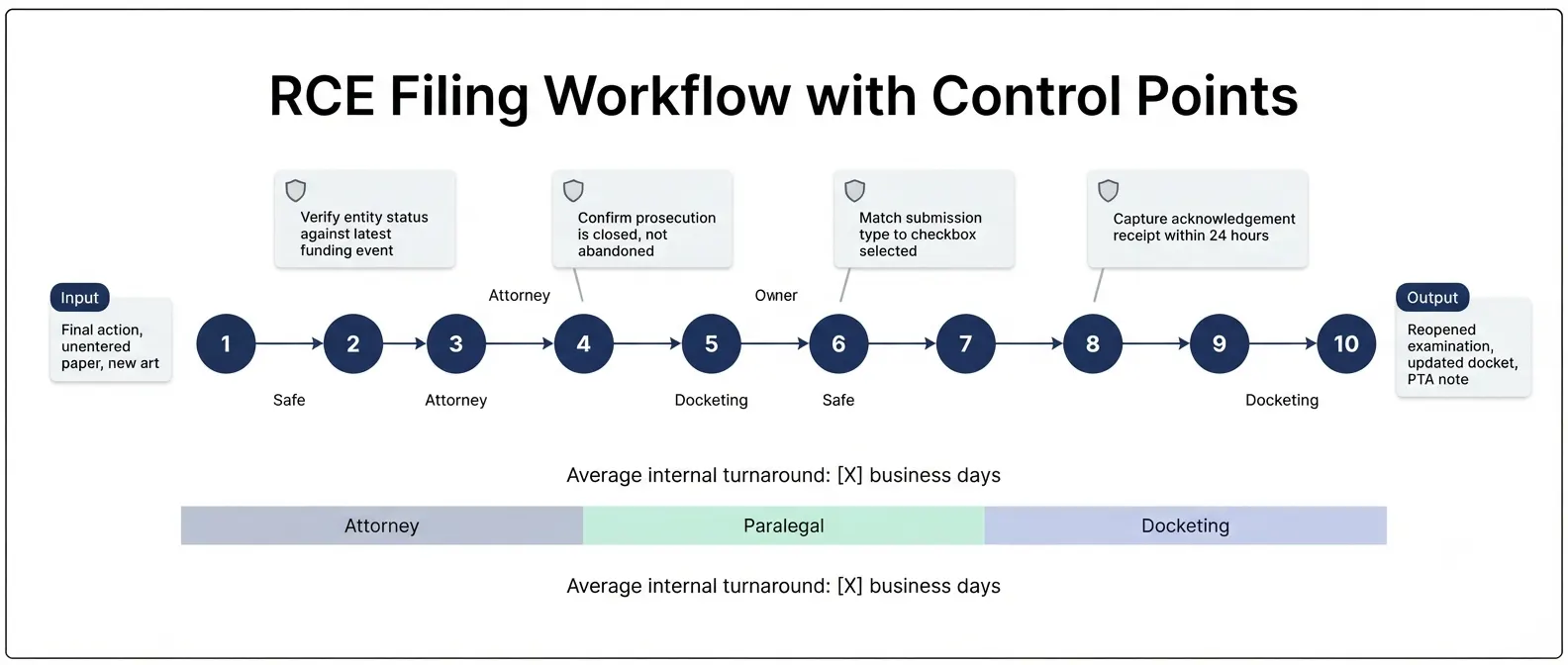
- Confirm eligibility. Verify prosecution is closed and the application is not abandoned.
- Calculate the true deadline. Three months from the final action, extendable to six months with fees.
- Prepare the submission. Amendment, remarks, IDS, or affidavit, and check that every claim has antecedent support.
- Complete Form PTO/SB/30 or the equivalent Patent Center screen, checking the correct submission boxes.
- Address any unentered after-final paper. State clearly that it should now be entered.
- Verify entity status. Small and micro entity status must be current, not assumed from years ago.
- Pay the fee at filing. RCE fees cannot be deferred through an extension of time.
- File through Patent Center and download the acknowledgement receipt immediately.
- Docket the confirmation. Record the RCE date, the PTA impact, and the expected next-action window.
- Run a post-filing audit. Confirm the RCE appears correctly in the file wrapper within a week.
Step-by-Step: How to File a Continuation Application
- Confirm the parent is pending. Check status the same day you plan to file.
- Lock the specification. It must match the parent exactly, with no added matter.
- Draft the new claims. This is the entire point of the filing, so give it real attention.
- Prepare the ADS with the specific benefit reference under 37 CFR 1.78, correctly formatted.
- Carry over inventorship or correct it deliberately, with documentation.
- Handle the declaration. A copy of the parent declaration is usually acceptable for a true continuation.
- Assemble the IDS. Every reference cited in the parent must be brought forward or properly incorporated.
- Calculate the fees. Filing, search, examination, excess claims, and any six-year or nine-year surcharge.
- File before the parent issues or abandons. Never on the same day if it can be avoided.
- Docket the new matter. New application number, new deadlines, new PTA tracking, new annuity chain.
Firms handling dozens of these each quarter build a standing checklist rather than rebuilding the process every time. If your team is stretched, the warning signs described in signs your firm needs additional patent paralegal support are worth an honest read.
Continuation, Divisional, CIP and CPA: How They Differ
The difference between an RCE and a continuation application is only one branch of the decision tree. Here is the rest of it.
| Filing type | Disclosure | Claims | Typical trigger | Priority benefit |
|---|---|---|---|---|
| RCE | Identical | Amended | Final rejection, allowance with pending changes | Not applicable, same application |
| Continuation | Identical | New scope | Preserve family, broaden or redirect | Yes, under 35 U.S.C. 120 |
| Divisional | Identical | Non-elected invention | Restriction requirement | Yes, with 35 U.S.C. 121 safe harbor |
| Continuation-in-Part | Adds new matter | Mixed support | New development mid-prosecution | Partial, claim by claim |
| CPA | Identical | Amended | Design applications only | Same application continues |
Importantly, a CPA is no longer available for utility applications. If someone on your team still files them for utility cases, that habit needs correcting immediately.
Practical Insights From Real Prosecution Files
Over years of supporting U.S. prosecution dockets, certain patterns repeat across firms of every size.
RCEs Slow Down More Than People Expect
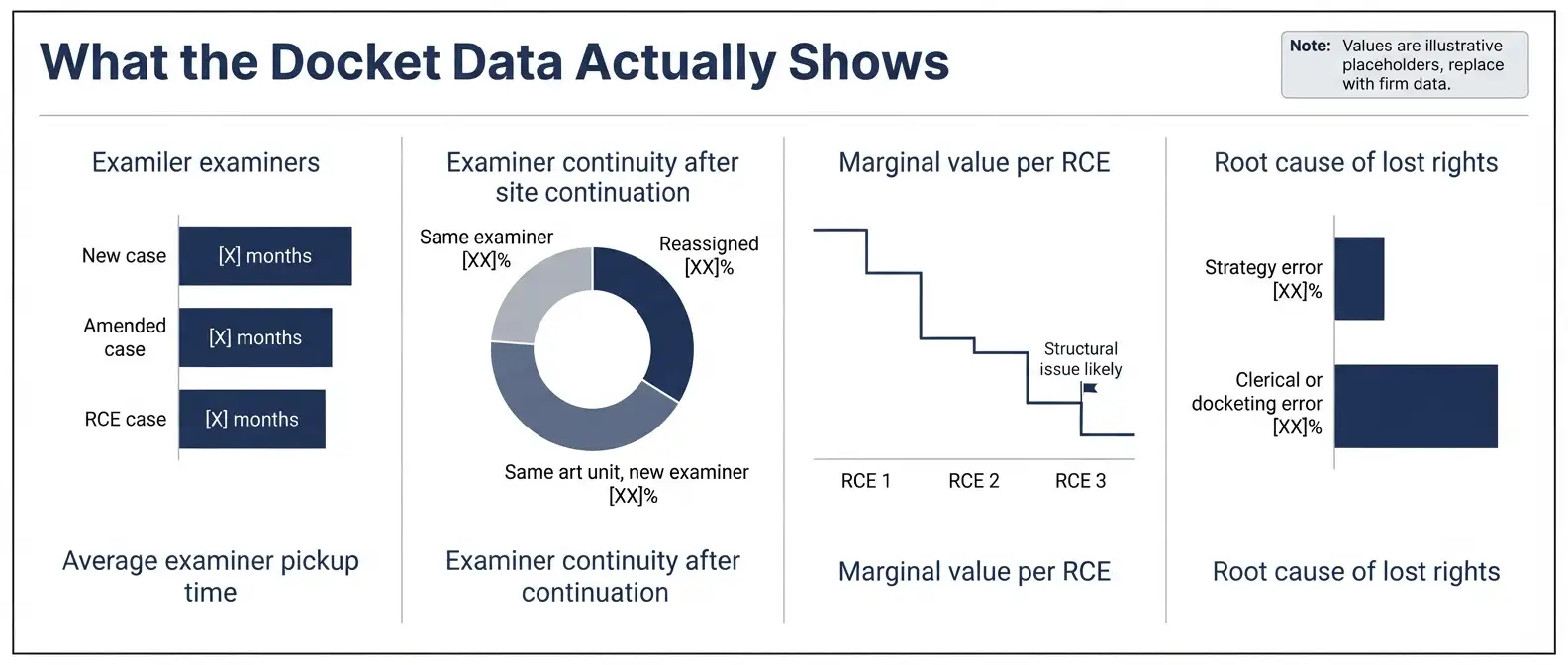
An RCE returns to the examiner’s docket, but not to the front of the queue. Examiners handle new cases, amended cases, and RCEs on different priority tracks, and RCE cases frequently wait several months for pickup. Therefore, if speed is the objective, an RCE may disappoint.
Continuations Often Land With the Same Examiner
Many applicants file a continuation hoping for a fresh perspective. In reality, the case usually routes back to the same art unit and often the same examiner, who remembers the file. Consequently, “escaping the examiner” is rarely a valid reason to file a continuation.
The Third RCE Is a Warning Sign
When a case reaches a third RCE without meaningful movement in the rejection, the problem is usually structural. Either the claims lack a real point of novelty over the art, or the argument strategy is repeating itself. At that point, an interview, a pre-appeal brief conference, or a full appeal often produces more progress than another round of continued examination. Teams pursuing that route should review how to manage timelines for patent appeal briefs before committing.
Docketing Errors Cause More Losses Than Strategy Errors
The most expensive mistakes we see are not bad strategic choices. They are clerical: a continuation filed one day after issuance, an RCE fee paid with lapsed small entity status, or a benefit claim omitted from the ADS. Those failures are preventable with layered review, which is the entire premise behind a multi-layered quality control workflow for patent docketing.
Common Mistakes When Choosing Between an RCE and a Continuation
Avoid these, and you will already be ahead of most filers.
- Treating the RCE as a default. Reflexively filing an RCE after every final rejection wastes fees and burns term adjustment.
- Missing co-pendency by a single day. The most unforgivable error in the entire process.
- Forgetting the ADS benefit claim. An otherwise perfect continuation loses its priority date without it.
- Adding new matter to a “continuation.” That creates a CIP, with different priority consequences for each claim.
- Ignoring the six-year and nine-year surcharges. Budget surprises damage client relationships.
- Assuming entity status never changes. Funding rounds and acquisitions frequently destroy small entity eligibility.
- Filing an RCE without a proper submission. A bare request accomplishes nothing and may be held non-compliant.
- Overlooking terminal disclaimer consequences. Disclaiming term you did not need to disclaim is a permanent loss.
- Failing to re-file IDS references. The duty of disclosure follows into the continuation.
- Neglecting the second reminder. Single-entry docketing is how firms end up filing petitions instead of applications.
- Paying the issue fee before deciding. Once the issue fee is paid, your continuation window narrows sharply.
- Not documenting the reasoning. Six months later, nobody remembers why the RCE was chosen, and the file has no record.
Expert Tips for Getting the Decision Right
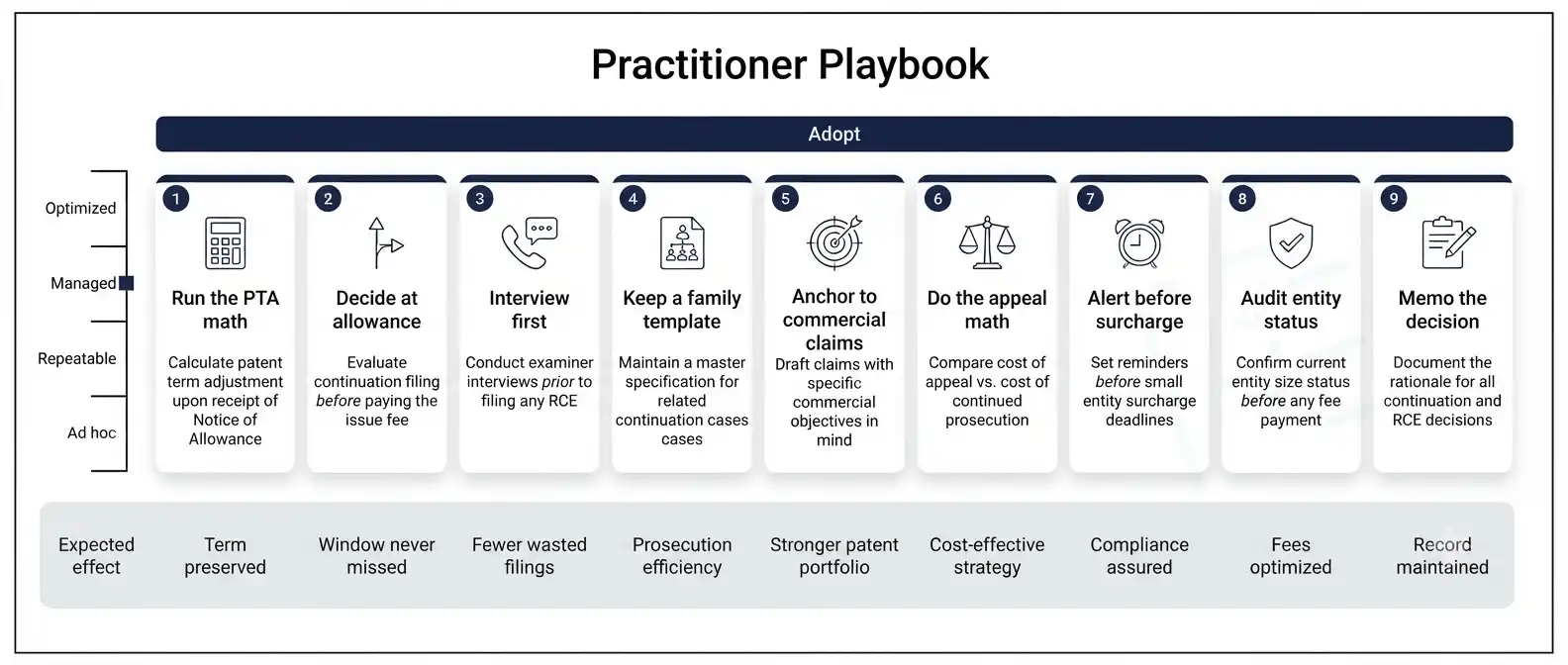
- Run a PTA check before every RCE. If the application is past the three-year mark, quantify what you are giving up in days.
- Decide the continuation question at the Notice of Allowance, not after. That is the natural decision point, and it should be a docketed task.
- Interview before you file. A thirty-minute examiner interview frequently reveals whether an RCE will actually work.
- Keep a continuation template per family. Specification, declaration, ADS shell, and IDS list, ready to file within 48 hours.
- Tie the decision to a commercial question. Ask what product this claim set will read on in five years, then decide.
- Consider the appeal math. Two RCEs can cost more than a pre-appeal conference that resolves the issue.
- Track surcharge thresholds in your docket. Add an alert at five years and nine months from the earliest benefit date.
- Audit entity status annually across the entire portfolio, not case by case.
- Record the strategy memo in the file. Future counsel, auditors, and acquirers will all thank you.
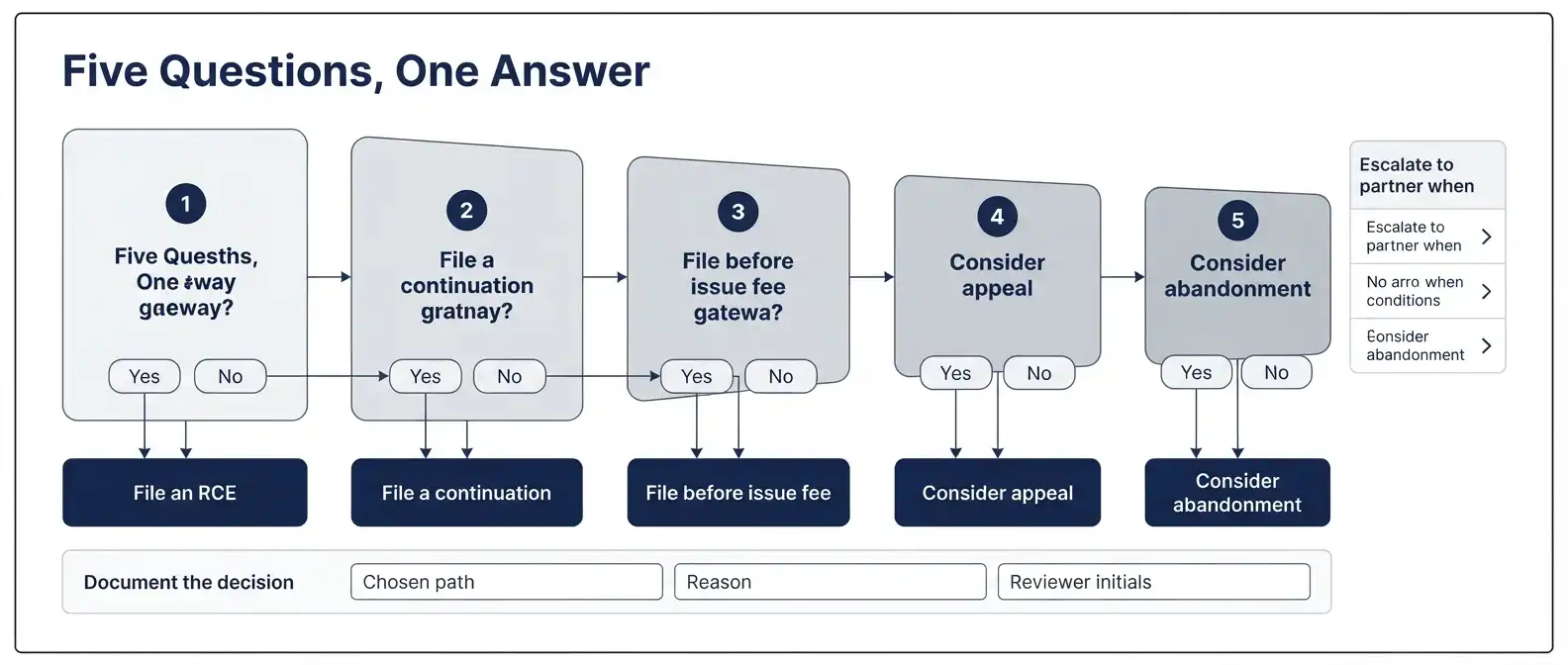
Decision Framework: A Simple Five-Question Test
Ask these in order. The first “yes” usually points to your answer.
- Is the examiner one amendment away from allowing? If yes, file an RCE.
- Do you need claims of a materially different scope? If yes, file a continuation.
- Is the parent about to issue with narrow claims? If yes, file a continuation before paying the issue fee.
- Has the same rejection survived two RCEs? If yes, consider appeal rather than either filing.
- Is there no remaining commercial reason to pursue coverage? If yes, consider abandonment and redeploy the budget.
Frequently Asked Questions About the Difference Between an RCE and a Continuation Application
What is the main difference between an RCE and a continuation application?
An RCE continues examination in the same application, keeping the same serial number and file history. A continuation creates a new application with a new serial number that inherits the parent’s priority date. In short, an RCE extends a conversation, while a continuation starts a new one on the same subject.
Is an RCE cheaper than a continuation application?
Usually yes. A first RCE costs $1,500 for an undiscounted entity, while a continuation typically triggers filing, search and examination fees of roughly $2,000, plus possible six-year or nine-year surcharges. However, a second or third RCE narrows that gap quickly.
Does filing an RCE reduce my patent term?
It does not shorten the twenty-year term, but it does stop the accrual of Patent Term Adjustment attributable to USPTO delay. For applications already past three years, that can translate into a meaningful loss of enforceable days.
Can I file a continuation after my patent issues?
No. The continuation must be filed while the parent application is still pending, meaning before the issue date. Once the patent grants, that branch of the family is closed permanently.
How many RCEs can I file in one application?
There is no statutory cap, but fees escalate with each request and the strategic value tends to decline. If a rejection has survived two RCEs without narrowing, appeal or a redirected continuation is usually the better investment.
Will a continuation application get a different examiner?
Typically not. Continuations generally route back to the same art unit and often the same examiner who handled the parent. Filing a continuation to change examiners is rarely an effective strategy.
Is a divisional the same as a continuation?
No. A divisional pursues an invention that was not elected following a restriction requirement, and it carries safe harbor protection under 35 U.S.C. 121. A continuation pursues different claim scope within the same elected invention.
Do I need to file a new IDS in a continuation application?
Yes, in practice. The duty of disclosure applies to the new application, so references from the parent must be brought forward. Managing that efficiently across a large family is a genuine cost center, which is why many firms outsource it.
What happens if I miss co-pendency by one day?
The benefit claim fails, and the later application is treated as having its own filing date. Since the parent’s publication or patent may then qualify as prior art, this error frequently destroys patentability outright.
Can I file an RCE and a continuation at the same time?
Yes, and sophisticated filers often do. A common pattern is filing a continuation to preserve broader scope while simultaneously pursuing an RCE in the parent to secure a narrower allowance.
Does an RCE require an amendment?
It requires a submission, which can be an amendment, an argument, an IDS, an affidavit, or the entry of a previously unentered after-final response. A request with no submission at all will not advance prosecution.
When should I choose an appeal instead of either option?
Choose appeal when the examiner’s rejection is legally unsound rather than factually close, when the claims are already at your target scope, and when repeated continued examination has produced no movement in the art applied.
Teak IP Services supports U.S. law firms and corporate IP departments with exactly that layer, from patent prosecution support and IDS preparation and filing to full docketing and IP management, all under U.S. attorney oversight.
Conclusion: Make the Choice Deliberately, Not Reflexively
The difference between an RCE and a continuation application comes down to a single strategic question: are you finishing the current conversation, or opening a new one?
An RCE is the efficient choice when allowance is close, the examiner’s position is narrow, and the cost of another exchange is modest. A continuation is the right choice when scope matters more than speed, when the family needs to stay alive, or when tomorrow’s competitor product demands claims that today’s application cannot support.
Both paths reward the same thing: disciplined execution. Correct forms, current entity status, clean benefit claims, accurate IDS carryover, and docketing that never depends on a single reminder. That operational layer is where portfolios are quietly won or lost.
Facing a final rejection or an approaching issue fee deadline? Contact Teak IP Services for a no-obligation review of your RCE and continuation strategy, and put a process behind the decision instead of a deadline.


One Response