
A partner glances at the docketing report on a Thursday afternoon and notices three response deadlines inside the next ten days. Two associates are out of the office. The one paralegal on staff is already buried in Information Disclosure Statements from last week. Nobody has decided when to hire a patent paralegal for backup, so the firm limps through the crunch again and quietly hopes the next quarter is calmer.

It rarely is.
Patent portfolios grow, clients expect faster turnaround, and the USPTO does not pause its deadlines while a firm figures out its staffing. If any of that sounds familiar, this article walks through the exact warning signs that indicate your firm needs additional patent paralegal support, along with practical steps to right-size your team before a missed deadline forces the decision for you.
What Does a Patent Paralegal Actually Do?
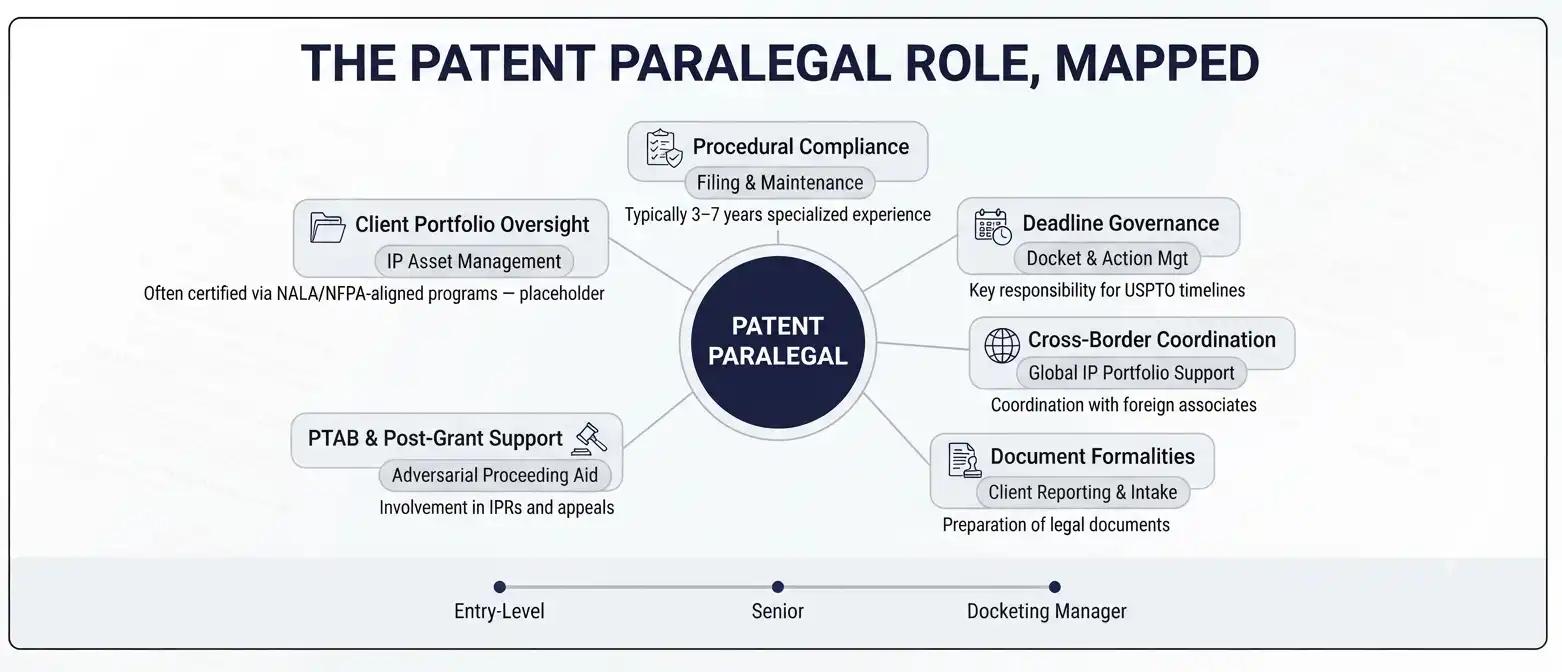
A patent paralegal manages the administrative and procedural backbone of patent prosecution so attorneys can focus on substantive legal strategy. Typical responsibilities include:
- Docketing deadlines and monitoring USPTO correspondence
- Preparing and filing Information Disclosure Statements (IDS)
- Drafting formal documents such as declarations, transmittal letters, and petitions
- Coordinating with foreign associates on international filings
- Assisting with responses to Office Actions and formalities
- Maintaining client portfolios inside docketing software
- Supporting Patent Trial and Appeal Board (PTAB) proceedings
When this workload is handled well, attorneys rarely think about it. When it is not, the cracks show up fast: missed dates, frustrated clients, and attorneys doing clerical work instead of billing for legal analysis.
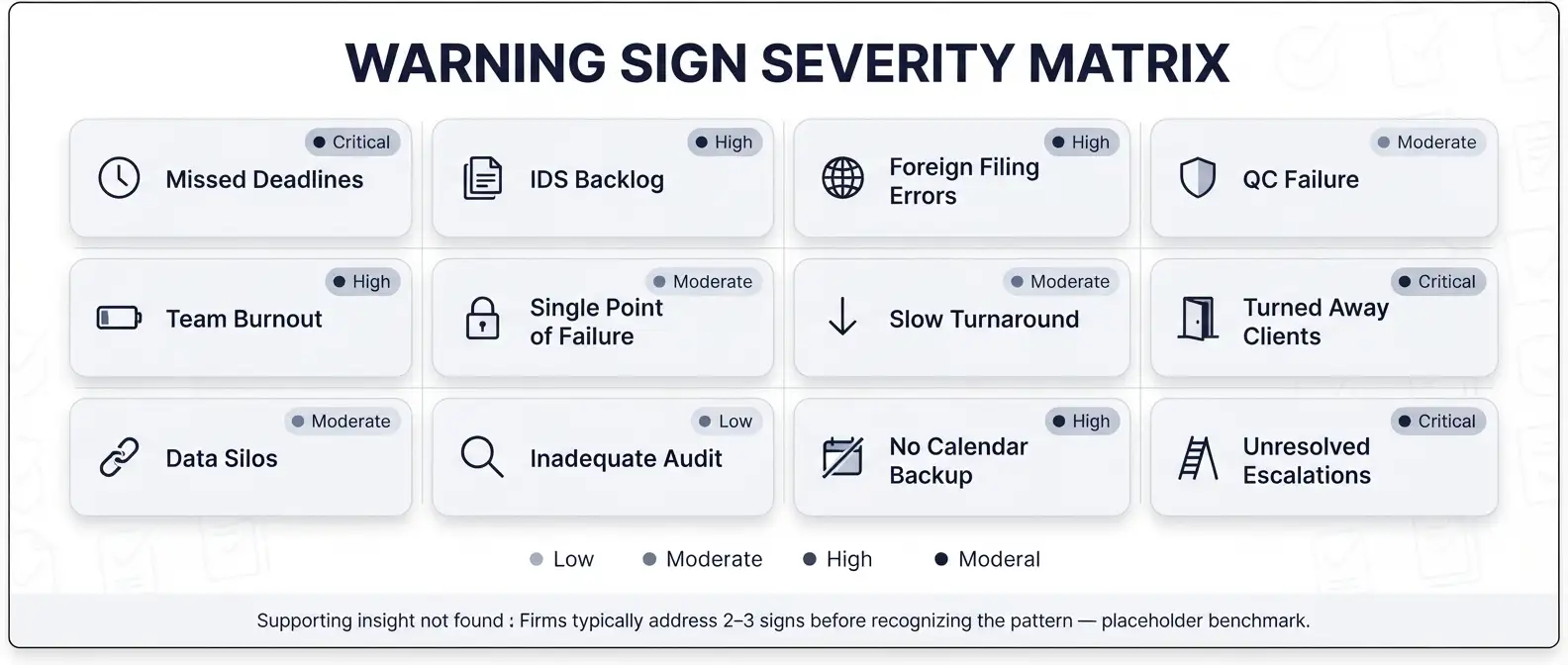
When to Hire a Patent Paralegal: 12 Warning Signs to Watch
Most firms do not wake up one day and decide they need more help. Instead, small frictions build up until the workload becomes unmanageable. Below are the most common indicators that it is time to add patent paralegal support.
1. Office Action Deadlines Keep Getting Closer to the Wire
If your team consistently files responses two or three days before the deadline instead of with a comfortable buffer, that is an early signal. A well-staffed paralegal function builds in review time, extension planning, and quality checks well before the due date arrives. When every response becomes a fire drill, the firm is operating on borrowed time.
Firms that outsource this pressure point often turn to specialized Office Action response support services so attorneys are not scrambling to meet dates that a paralegal should have flagged weeks in advance.
2. Attorneys Are Doing Paralegal-Level Work
When patent attorneys start formatting IDS forms, chasing foreign associates for status updates, or manually calculating statutory deadlines, the firm is paying a lawyer’s hourly rate for work that does not require a law degree. This is one of the clearest and most expensive signs that additional paralegal support is overdue.
Ask a simple question: how many hours did attorneys spend last month on tasks a trained paralegal could have completed? If the number surprises anyone in the room, it is time to act.
3. Docketing Errors Are Becoming More Frequent
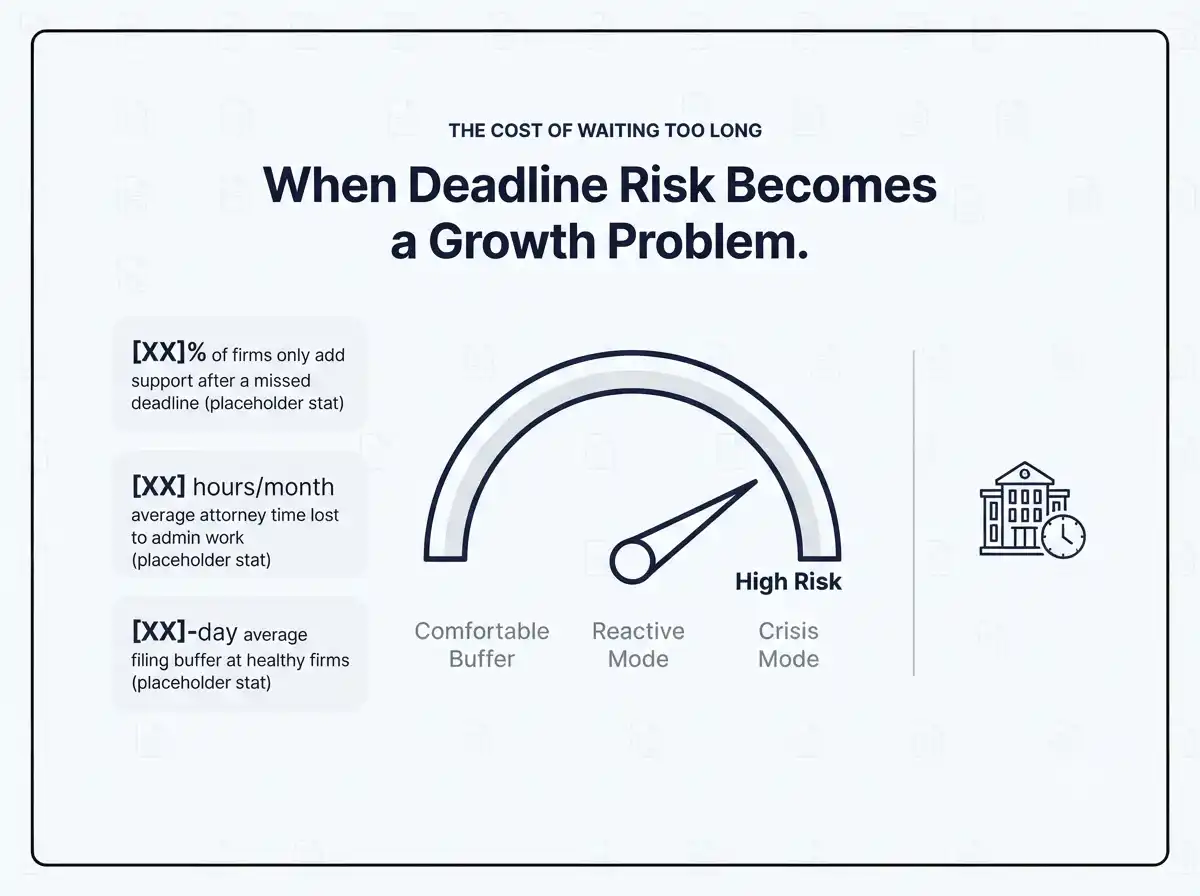
A single missed date can jeopardize patent rights permanently. If your firm has noticed:
- Duplicate entries in the docketing system
- Deadlines calculated incorrectly
- Missed reminders for statutory bars
- Confusion over which attorney owns a given matter
…then the current docketing process has outgrown its support staff. Firms managing this internally should compare their approach against the best multi-layered quality control workflow for patent docketing, since a single reviewer checking their own work is a structural risk, not a personnel problem.
4. IDS Filings Are Piling Up
Information Disclosure Statement obligations do not stop simply because staff is stretched thin. If IDS forms sit in a queue for weeks, or worse, get filed late after a first Office Action, the firm risks losing the ability to have prior art considered without extra petitions and fees. A backlog of unfiled IDS documents is a direct, measurable sign that paralegal capacity has been exceeded.
5. Foreign Filing Coordination Has Become Chaotic
International patent portfolios multiply the paperwork exponentially. Every jurisdiction has its own formalities, translation requirements, and national phase deadlines. If instructions to foreign associates are delayed, incomplete, or handled inconsistently across attorneys, the firm needs a paralegal dedicated to managing that correspondence.
6. New Client Intake Is Stalling
Growing firms sometimes hesitate to accept new patent clients, not because of a lack of legal talent, but because there is no bandwidth to onboard another portfolio into the docketing system. If business development is quietly slowing down because of administrative capacity rather than client demand, that is a revenue problem disguised as a staffing problem.
7. Overtime and Burnout Signs Among Existing Staff
Ask your current paralegal how their week actually looks. Frequent late nights, weekend catch-up sessions, and rising sick days are not signs of a strong work ethic; they are warning signs of an unsustainable workload. Losing an experienced paralegal to burnout costs far more than proactively adding support, both in institutional knowledge and in recruiting time.
8. Portfolio Growth Has Outpaced Staffing
Firms rarely add paralegal headcount at the same rate they add clients. If your active patent matter count has grown 30 percent over the past year while paralegal staffing has stayed flat, the math no longer works. A useful benchmark: many firms find that a single experienced patent paralegal can effectively manage between 150 and 250 active matters, depending on complexity, though this range varies by technology area and filing volume.
9. Quality Control Keeps Catching the Same Mistakes
If your review process regularly flags the same categories of error (formatting issues, incorrect fee calculations, missing signatures) the root cause is usually workload, not competence. Skilled paralegals under too much pressure still make mistakes. Addressing the volume problem often resolves the quality problem at the same time.
10. There Is No Backup for PTO, Illness, or Turnover
A single point of failure is dangerous in any operation, and patent prosecution is no exception. If one paralegal leaving for a two-week vacation creates a genuine risk of missed deadlines, the firm does not have adequate support; it has a fragile process. Cross-trained backup, whether in-house or outsourced, closes this gap.
11. Response Turnaround Times Are Lengthening
Clients notice when responses that used to take a week now take three. Slower turnaround is often the most visible symptom of an invisible cause: not enough hands to move matters through the pipeline. Once clients start asking about delays, the internal warning signs have already been present for months.
12. Partners Are Turning Down New Business
This is the most consequential sign on the list. When a firm has to say no to a new patent client because it cannot support another portfolio, the paralegal shortage has moved from an efficiency issue to a growth ceiling. At that point, the cost of inaction is not measured in overtime; it is measured in lost revenue.
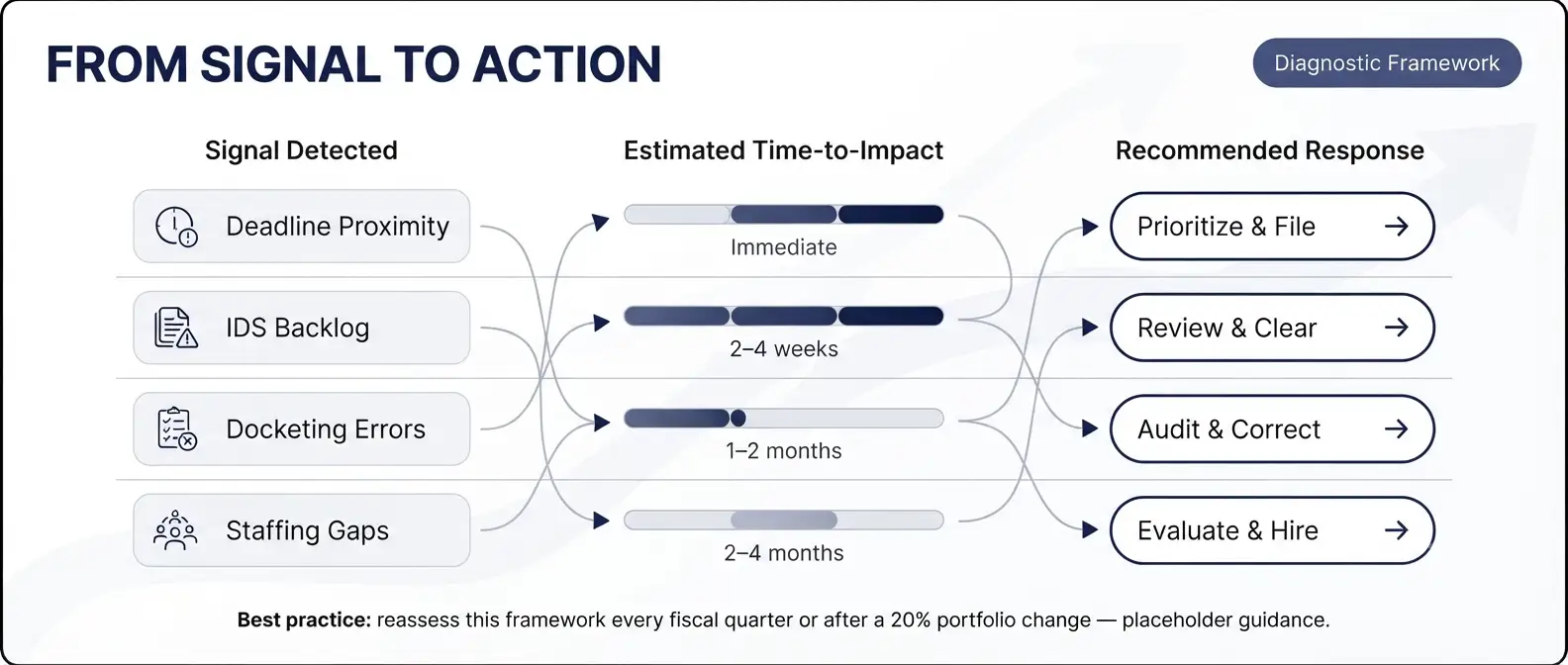
Workload Indicators and Recommended Responses
Use the table below as a quick self-diagnostic during your next staffing review.
| Warning Sign | What It Usually Means | Recommended Response |
|---|---|---|
| Responses filed within 1–2 days of deadline | Insufficient buffer time in the docketing process | Add dedicated deadline-monitoring support |
| Attorneys drafting transmittal letters or IDS forms | Paralegal capacity has been exceeded | Shift administrative tasks to paralegal or outsourced support |
| Recurring docketing errors | Single-reviewer bottleneck | Implement multi-layered quality control |
| IDS backlog over two weeks | Filing volume exceeds current staffing | Add IDS-focused paralegal capacity |
| Declining new client intake | Firm is capacity-constrained, not demand-constrained | Scale support before scaling marketing |
| No backup during PTO or leave | Single point of failure in operations | Cross-train staff or engage a flexible support partner |
In-House Hire vs Outsourced Patent Paralegal Support
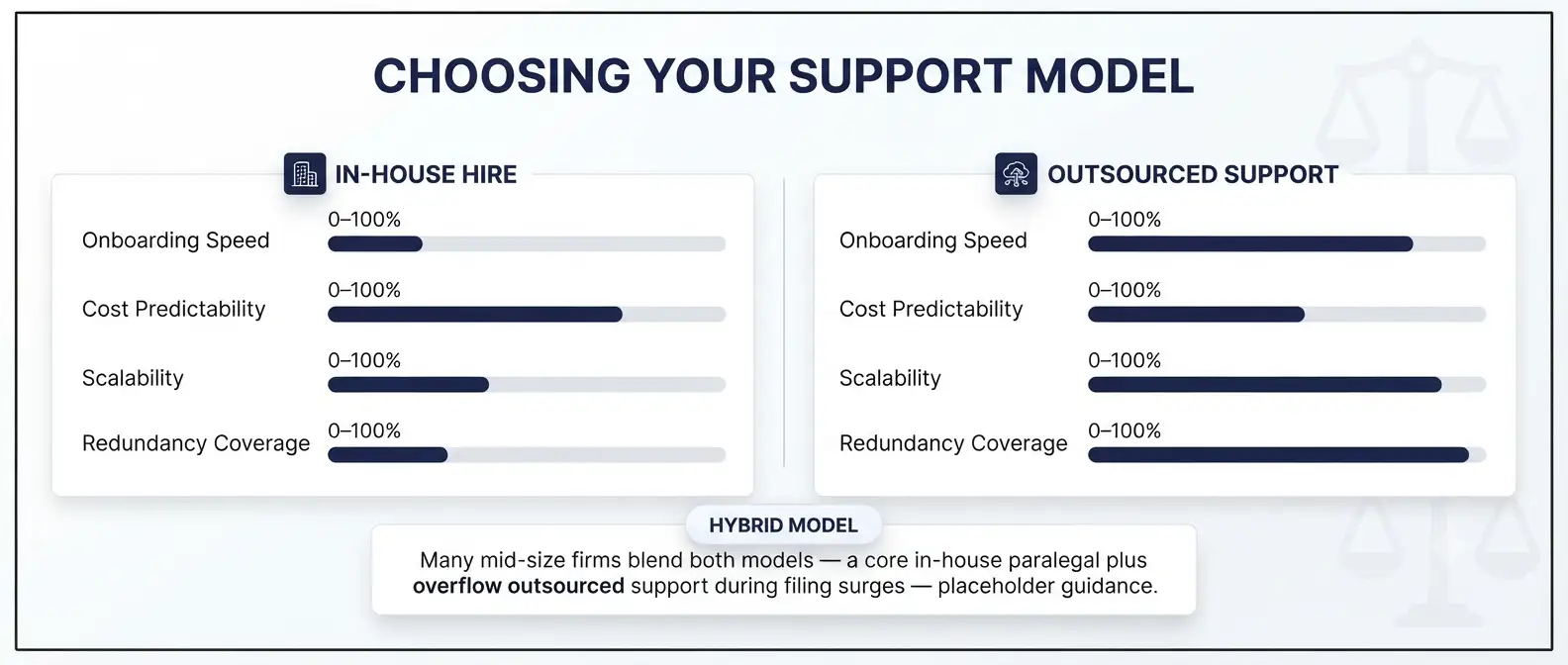
Once a firm recognizes it needs more support, the next decision is how to get it. Both paths can work; the right choice depends on budget, timeline, and how predictable your workload volume is.
| Factor | In-House Hire | Outsourced Patent Paralegal Support |
|---|---|---|
| Time to onboard | Weeks to months (recruiting, training) | Typically days to a few weeks |
| Cost structure | Fixed salary, benefits, overhead | Often pay-per-service or scalable retainer |
| Flexibility for volume swings | Limited; fixed capacity | High; scale up or down as portfolios change |
| Coverage for PTO/turnover | Requires cross-training or temp staffing | Built-in redundancy across a team |
| Institutional knowledge | Deep, firm-specific over time | Strong on process; requires clear onboarding |
| Best fit for | Firms with large, stable, predictable volume | Boutique firms, seasonal spikes, or rapid growth |
Firms weighing this decision should also review a structured IP vendor due diligence checklist before signing with any outsourced partner, since not every provider offers the same level of attorney oversight or data security.
Common Mistakes Firms Make When Assessing Paralegal Needs
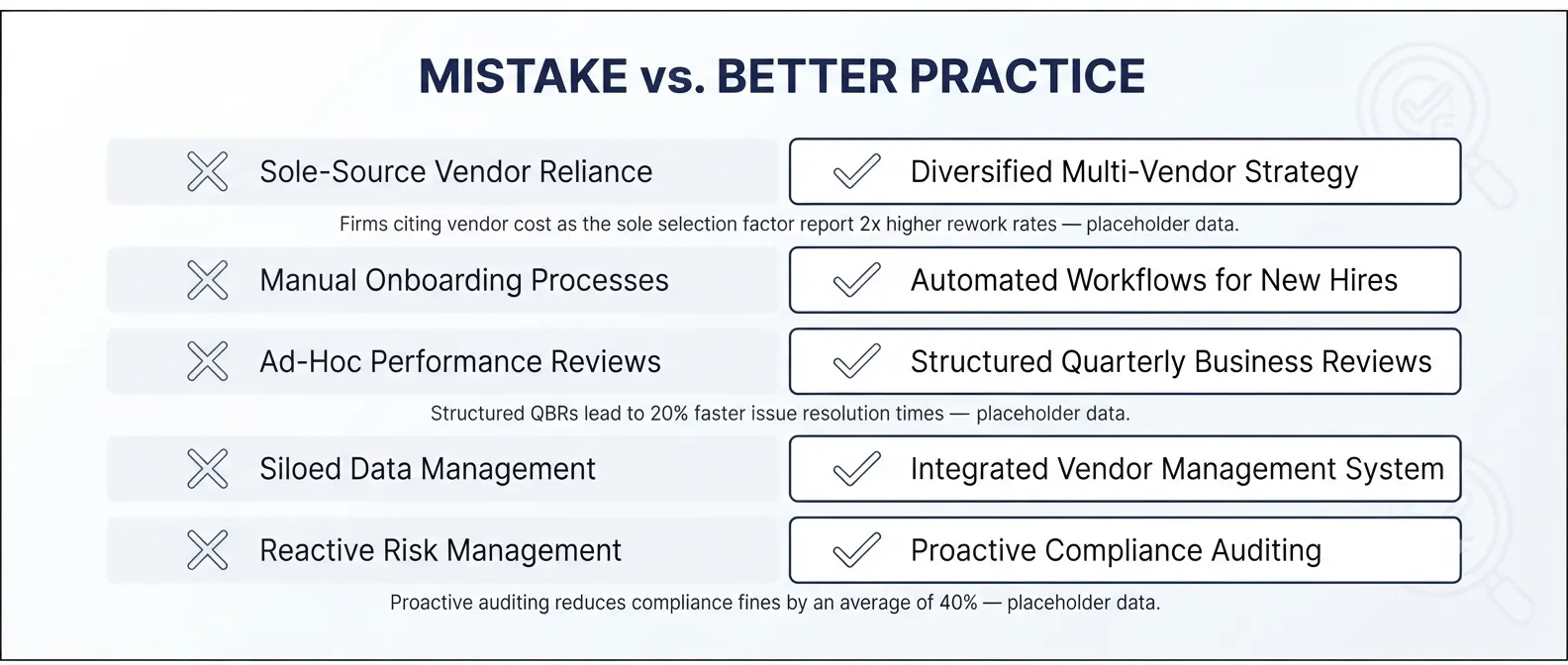
Even experienced managing partners fall into predictable traps when evaluating staffing needs. Avoid these mistakes:
- Waiting for a missed deadline to act. By the time a deadline is missed, the firm has already absorbed months of unmanaged risk.
- Measuring workload only by headcount of attorneys, not by matter complexity. A firm with fifty simple trademark-adjacent matters needs different support than one with fifty complex biotech patent families.
- Assuming outsourcing means losing control. Reputable providers offer attorney-reviewed deliverables and full visibility into every task, not a black box.
- Treating paralegal support as a cost center instead of a growth enabler. Additional support often pays for itself by freeing attorney time for billable strategic work.
- Choosing the cheapest vendor without checking compliance history. Firms should confirm any outsourced provider understands USPTO rules on client confidentiality and authorized practice, a concern addressed directly in this review of whether remote patent paralegal services are compliant with USPTO rules.
Expert Tips for Right-Sizing Your Patent Paralegal Support
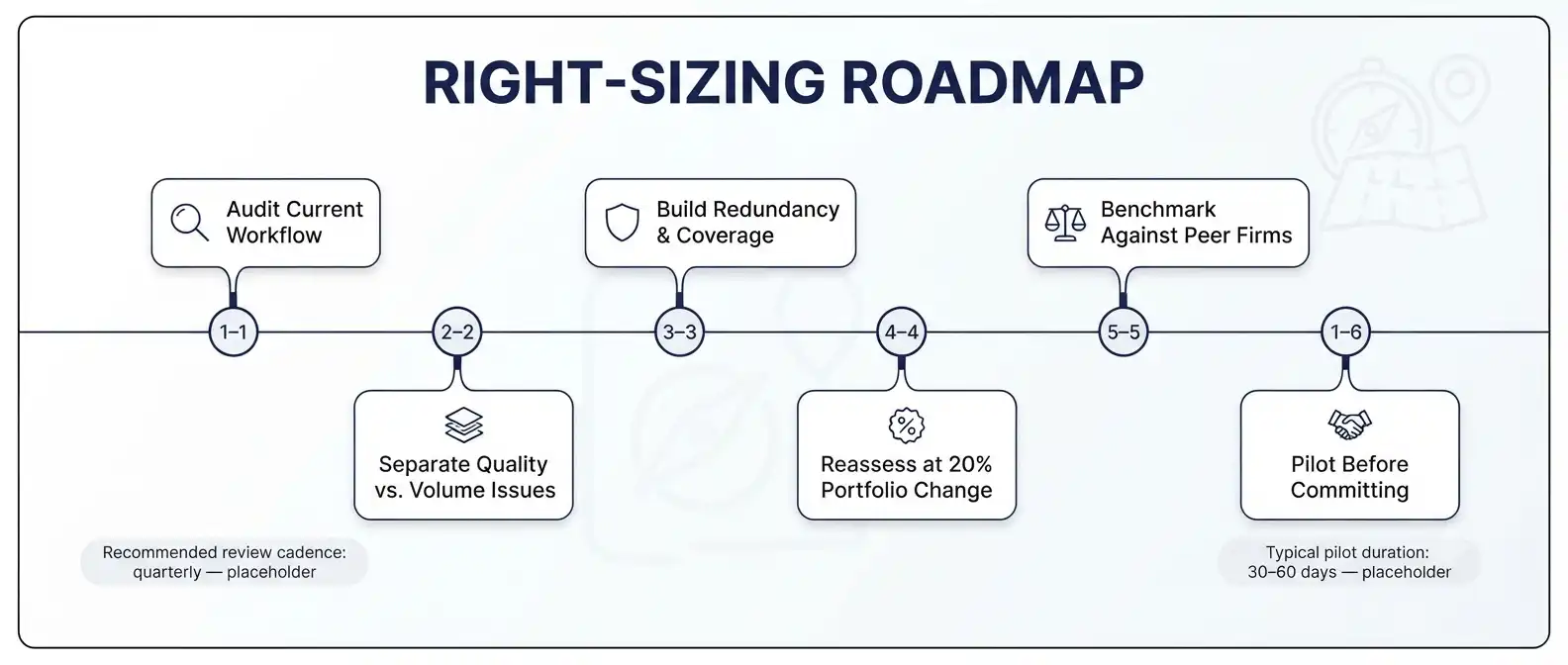
- Audit actual hours, not assumptions. Track how many hours attorneys and paralegals each spend on administrative tasks over a two-week period before deciding on staffing changes.
- Separate docketing quality issues from volume issues. A quality problem needs process fixes; a volume problem needs more hands.
- Build in redundancy from day one. Never let a single person’s availability determine whether a deadline gets met.
- Reassess every time portfolio size changes by 20 percent or more. Growth and attrition both shift the math quickly.
- Compare providers the same way you would compare co-counsel. Look at experience, USPTO familiarity, and how they handle quality control workflows for patent docketing before committing.
- Pilot before you commit. A short trial period on a defined batch of matters reveals more about fit than any sales conversation.
Step-by-Step: How to Evaluate Your Firm’s Paralegal Workload
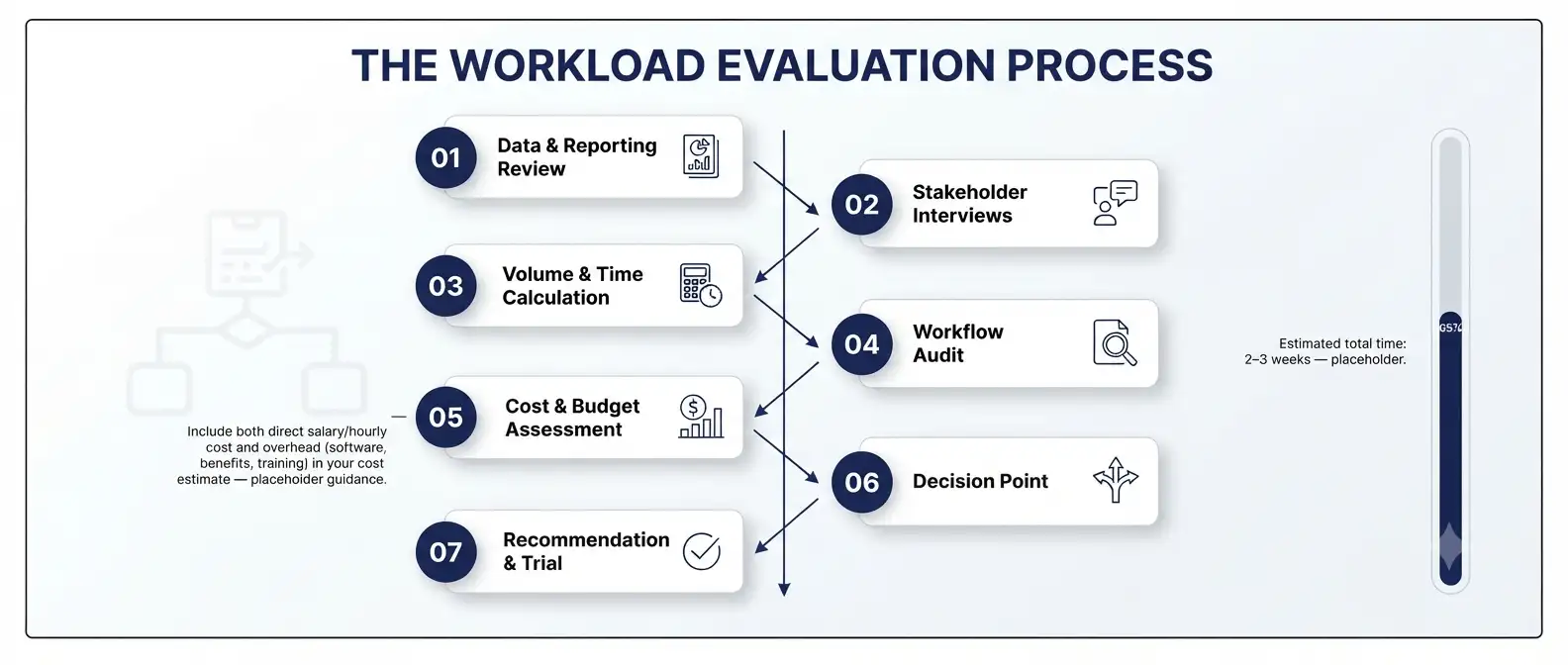
- Pull a 90-day docketing report. Identify how many responses were filed within five business days of a deadline.
- Interview your current paralegal staff. Ask directly where they feel overextended and where errors tend to happen.
- Calculate matters per paralegal. Compare your ratio against industry benchmarks for your technology area.
- Flag recurring quality control issues. Document the last quarter’s mistakes and categorize them by root cause.
- Estimate the cost of inaction. Multiply average attorney hourly rate by hours spent on administrative tasks per month.
- Decide between in-house hiring, outsourcing, or a hybrid model. Use the comparison table above as a starting framework.
- Run a trial engagement or onboard a new hire on a defined batch of matters. Measure results before scaling firm-wide.
If your firm is still deciding between growing the internal team or bringing in outside help, it is worth reviewing how to evaluate and compare IP outsourcing companies before making a final call, since vendor quality varies significantly across the market.
A Note for Boutique and Growing Firms
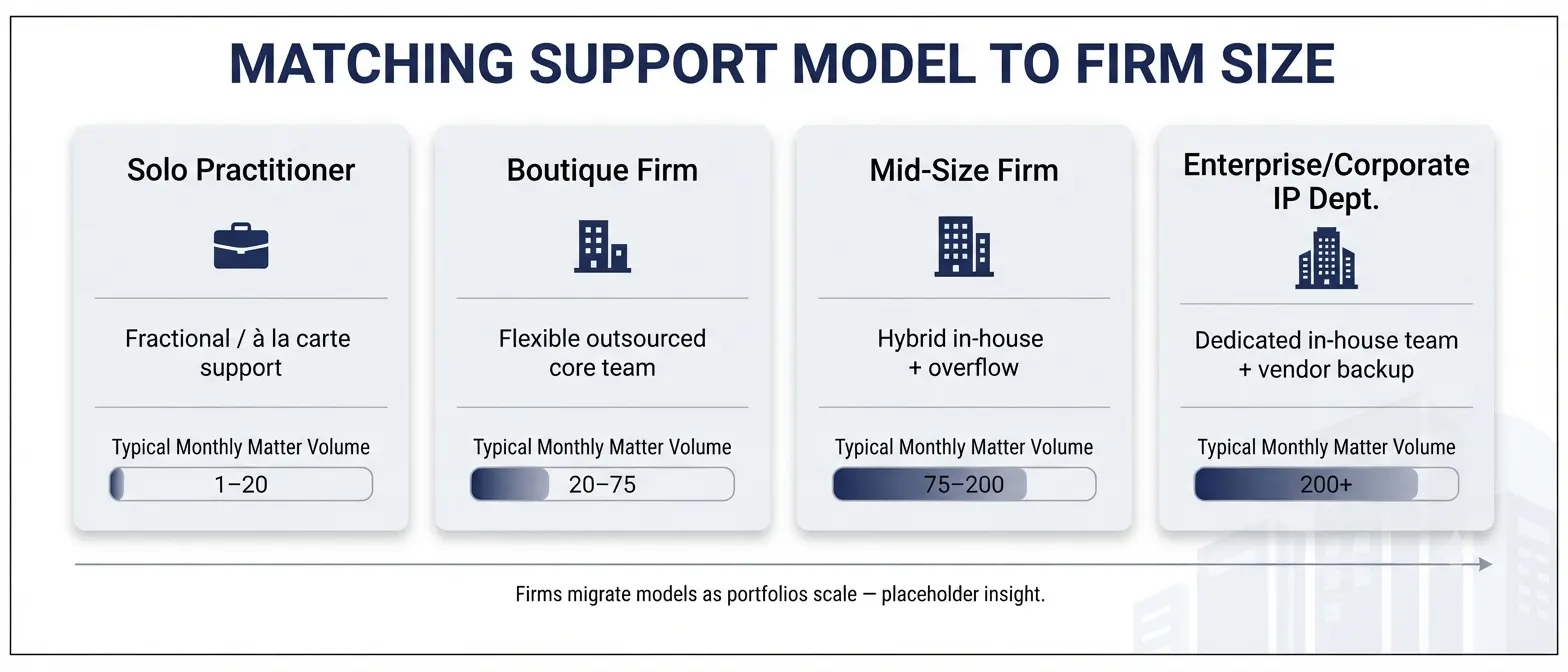
Smaller and boutique IP firms face a particular version of this problem. There is often no room in the budget for a full-time senior paralegal, yet the deadline risk is identical to that of a larger firm with a bigger team. This gap is exactly why many boutique practices turn to flexible, à la carte paralegal support rather than a rigid full-time hire. For a deeper look at staffing models built specifically around smaller teams, see this guide to IP support services for boutique IP law firms.
Firms managing large docketing volumes should also consider how technology fits into the staffing question. Automated tools can reduce some manual burden, but they do not replace judgment on formalities or exceptions. This distinction is explored further in an analysis of whether an external docketing service can handle USPTO PAIR scraping automatically.
How Much Does Insufficient Paralegal Support Actually Cost?
It helps to put a number on the risk. According to USPTO data, total patent pendency (from filing to final disposition) has historically run into the tens of months, which means every matter carries a long tail of deadlines that must be tracked without a single lapse. You can review current pendency figures directly on the USPTO Patents Dashboard.
On the staffing side, the U.S. Bureau of Labor Statistics reports that the median annual wage for paralegals and legal assistants nationally was $62,890 in May 2025, according to the Occupational Outlook Handbook. That figure is a useful anchor when comparing the fixed cost of an in-house hire against the flexible cost of outsourced support, especially for firms unsure whether their volume justifies a full-time salary.
Professional standards bodies such as the American Bar Association’s paralegal resources also underscore that paralegal work directly supports the delivery of competent legal services, reinforcing that this is not a discretionary support function; it is core infrastructure for a functioning patent practice.
Frequently Asked Questions
When should a firm hire a patent paralegal instead of relying on attorneys?
A firm should hire a patent paralegal as soon as attorneys are regularly spending billable hours on administrative tasks like docketing, IDS preparation, or formality checks. If that pattern has lasted more than a single busy month, it has become a structural gap rather than a temporary spike.
What is the clearest sign that a firm needs additional patent paralegal support?
Missed or nearly missed deadlines are the clearest sign. If responses are consistently filed within a day or two of the due date, the firm is operating without a safety margin, and that margin should be restored before it fails.
How many patent matters can one paralegal manage?
This varies by complexity and technology area, but many firms find a workable range of 150 to 250 active matters per experienced paralegal. Complex biotech or software portfolios typically sit at the lower end of that range.
Is outsourced patent paralegal support compliant with USPTO rules?
Yes, when structured correctly. Outsourced paralegals perform administrative and procedural work under attorney supervision, similar to in-house staff. Firms should confirm compliance details directly with any provider before engaging them.
Should a small or boutique firm hire a full-time patent paralegal?
Not always. Many boutique firms find better value in flexible or à la carte support that scales with matter volume, rather than committing to a full-time salary before the workload consistently justifies it.
What is the fastest way to know if my firm needs more paralegal support right now?
Pull the last 90 days of docketing data and count how many responses were filed within five business days of the deadline. If that number is climbing, the decision about when to hire a patent paralegal has already been made for you by your workload.
Conclusion
Deciding when to hire a patent paralegal rarely comes down to a single dramatic event. It comes down to a pattern: tighter deadlines, attorneys doing clerical work, a docketing report that causes more anxiety than confidence. Each sign on its own might seem manageable. Together, they point to a firm that has outgrown its current support structure.
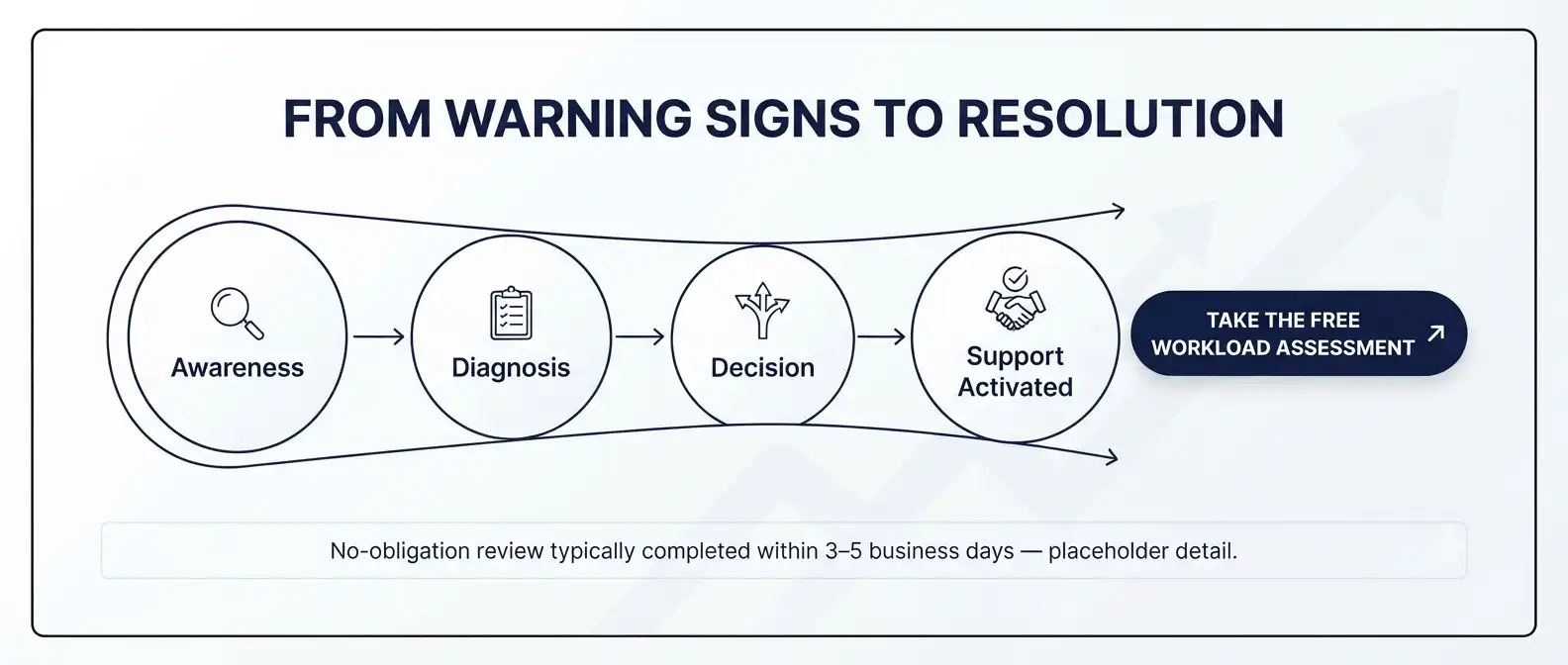
The good news is that this problem is solvable without a lengthy hiring process. Whether the right move for your firm is an in-house hire, a hybrid model, or outsourced patent paralegal support, the first step is an honest look at where your team is actually spending its time.
Ready to see where your firm stands? get a clear picture of whether it is time to add patent paralegal support, backed by attorney-led review from a team with decades of combined IP experience.


One Response