
Office Action Response Example: Receiving an Office Action from the USPTO can feel like a gut punch -especially if you’re a first-time patent applicant who has spent months investing effort, legal fees, and hope into your application. The good news, however, is that an Office Action is not a final rejection – it’s part of an ongoing conversation with the examiner. Understanding how to respond to that conversation, using the right arguments, thoughtful claim amendments, and a professional tone, can make the difference between securing a granted patent and facing an abandoned application. For patent applicants who want expert guidance at this stage, our office action response drafting services provide professional support for preparing persuasive, well-structured responses that maximize your chances of approval.

In this detailed walkthrough, Teak IP Services shares a real-world office action response example to help you clearly understand what an effective response looks like, how it is structured, and – most importantly – the strategies experienced patent practitioners use to overcome common rejections.
Whether you are a solo inventor, a startup founder, or an in-house IP professional, this guide is designed to simplify the response process and give you the confidence to move forward strategically..
What is an Office Action? (Office Action Response Example)
What is an Office Action: Before diving into a real-world example, let’s set the foundation.
In simple terms, an Office Action (OA) is an official communication that a USPTO patent examiner issues after reviewing your patent application. It then outlines the examiner’s objections, rejections, or requirements that you must address before your patent can be granted.
Types of Office Actions
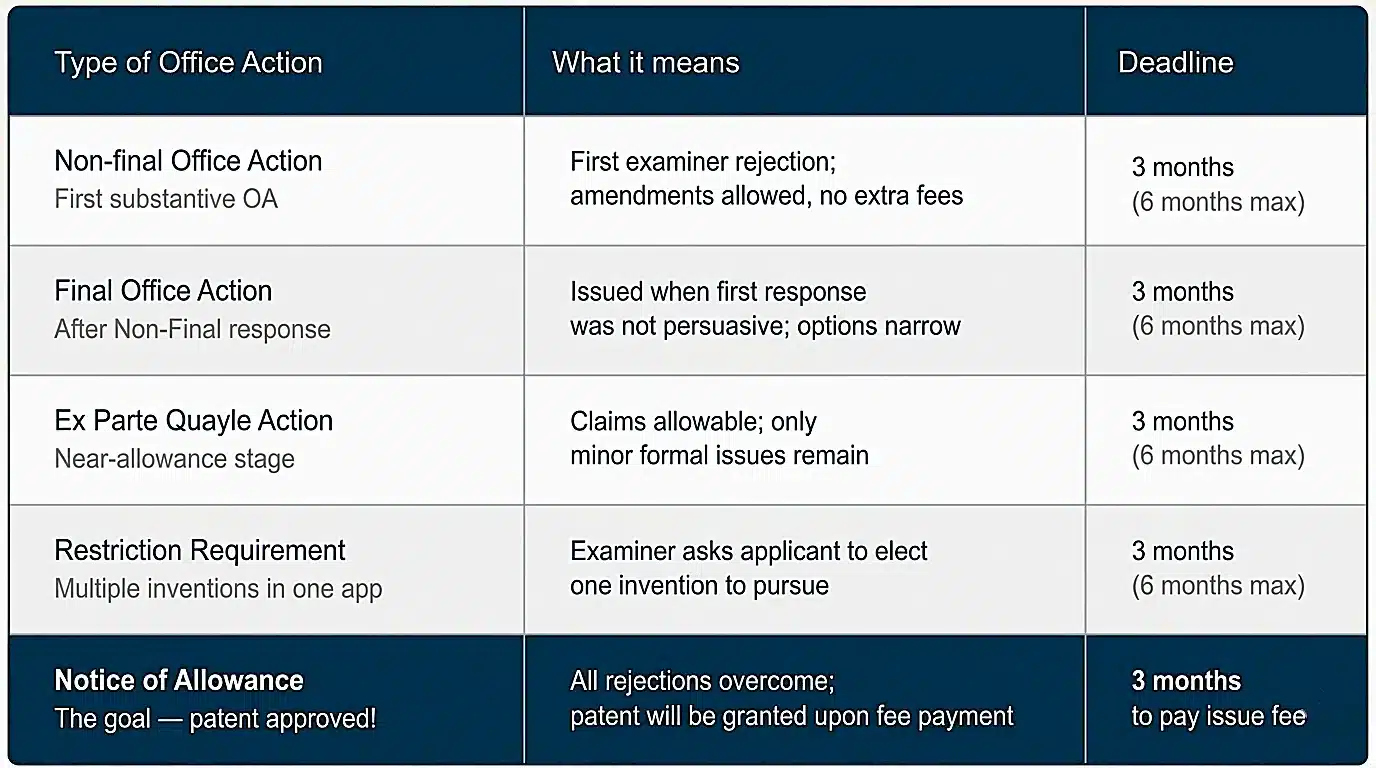
| ⏱ Key Deadline: You typically have 3 months to respond to an Office Action without paying extension fees, and up to 6 months with extension fees. Missing the deadline results in abandonment of your application. |
Anatomy of an Office Action Response
A well-drafted Office Action response follows a predictable and professional structure. here is the standard framework that Teak IP Services and most registered patent practitioners use:
- Cover page / header identifying the application
- Preliminary statement (amendments are reflected in the specification or claims)
- Amendments to the claims (if any)
- Remarks section – the heart of the response
- Conclusion / request for reconsideration
The Remarks Section Explained
The Remarks section is where you make your legal and technical arguments. It typically addresses:
- Each rejection raised by the examiner, one by one
- The basis for overcoming each rejection (e.g., prior art distinction, claim amendment)
- Support for amendments found in the original specification
- A polite but confident request for allowance
Also, Read: Office Action Response Trademark: How to Handle USPTO Refusals and Keep Your Mark Alive
Real-World Office Action Response Example (Step-by-Step)
Let’s walk through a fictional but realistic scenario that mirrors the types of cases Teak IP Services handles regularly.
The Scenario
| 📋 Application Details: Applicant: NovaTech Innovations LLC Application No.: 17/XXX,XXX Title: Smart Thermal Management System for Wearable Devices Examiner: John M. Smith Art Unit: 2621 Office Action Type: Non-Final Office Action |
Summary of Rejections in the Office Action
The examiner issued the following rejections:
- 35 U.S.C. § 102 (Anticipation) – Claims 1–5 rejected over U.S. Patent No. 9,876,543 (Prior Art Reference A – “Johnson”)
- 35 U.S.C. § 103 (Obviousness) – Claims 6–10 rejected over Johnson in view of U.S. Patent No. 8,765,432 (Prior Art Reference B – “Kim”)
- 35 U.S.C. § 112(b) (Indefiniteness) – Claims 3 and 7 found indefinite due to unclear claim language
Drafting the Response: Section by Section
Part 1: The Header and Identification Block
| IN THE UNITED STATES PATENT AND TRADEMARK OFFICE Application No.: 17/XXX,XXX Filing Date: January 15, 2023 Title: Smart Thermal Management System for Wearable Devices Examiner: John M. Smith Art Unit: 2621 RESPONSE TO NON-FINAL OFFICE ACTION |
Part 2: Amendments to the Claims
The applicant chose to amend Claims 1, 3, and 7 to overcome the § 102 rejection and the § 112(b) indefiniteness rejections. Here is how Claim 1 was amended:
Original Claim 1 (Before Amendment):
| Claim 1. A wearable device comprising: a processor configured to manage thermal output; a thermal sensor operably connected to the processor. |
Amended Claim 1 (After Amendment):
| Claim 1. (Amended) A wearable device comprising: a processor configured to dynamically manage thermal output based on real-time biosensor feedback; a multi-point thermal sensor array operably connected to the processor, wherein the thermal sensor array continuously monitors localized skin temperature at three or more anatomically distinct locations simultaneously. |
| ✅ Why This Amendment Works: The original claim was broad and read directly on Johnson’s patent. The amendment introduces two distinguishing features – (1) ‘real-time biosensor feedback’ and (2) ‘multi-point thermal sensor array monitoring three or more anatomically distinct locations’ – neither of which is disclosed in Johnson or Kim. The support for these added limitations is found at paragraphs [0023]–[0025] and [0041] of the original specification. |
Part 3: The Remarks Section – Responding to Each Rejection
Response to § 102 Rejection (Anticipation) – Claims 1–5
Below is a condensed version of the remarks drafted by Teak IP Services:
| REMARKS I. Rejection Under 35 U.S.C. § 102 – Claims 1–5 The Examiner rejected Claims 1–5 as being anticipated by Johnson (U.S. Patent No. 9,876,543), asserting that Johnson discloses all claimed elements. Applicant respectfully traverses this rejection. Claims 1–5 have been amended to clarify and narrow the scope of the claimed invention. As amended, independent Claim 1 now recites a ‘multi-point thermal sensor array… continuously monitors localized skin temperature at three or more anatomically distinct locations simultaneously.’ Johnson does not teach or suggest this feature. Specifically, Johnson discloses a single-point temperature sensor (see Johnson, col. 4, lines 22–31) that measures ambient temperature of the device housing – not localized skin temperature at distinct anatomical locations. The distinction is both structural and functional. Therefore, Claims 1–5, as amended, are not anticipated by Johnson. Applicant respectfully requests that the rejection under § 102 be withdrawn. |
Response to § 103 Rejection (Obviousness) – Claims 6–10
| Claims 6–10 have been rejected under 35 U.S.C. § 103 as obvious over Johnson in view of Kim (U.S. Patent No. 8,765,432). Applicant respectfully disagrees. First, the Examiner’s reasoning for combining Johnson and Kim is flawed. Kim’s biosensor system is designed for static medical diagnostic equipment (see Abstract and col. 2, lines 10–18), whereas the claimed invention relates to a dynamic, real-time system for wearable consumer devices. A person of ordinary skill in the art would not be motivated to combine references from distinct technical fields with differing design goals. Second, even if combined, Johnson and Kim fail to disclose “real-time biosensor feedback” integrated with a “multi-point thermal sensor array” as claimed. Therefore, Claims 6–10 are not obvious over the cited combination, and withdrawal of the § 103 rejection is respectfully requested. |
Response to § 112(b) Rejection (Indefiniteness) – Claims 3 and 7
| III. Rejection Under 35 U.S.C. § 112(b) – Claims 3 and 7 The Examiner found Claims 3 and 7 indefinite due to the phrase ‘substantially elevated temperature.’ Applicant respectfully submits that Claims 3 and 7 have been amended to replace the term with ‘a temperature exceeding a threshold of 38.5°C for a continuous period of 30 seconds or more,’ which provides a clear, objective boundary understood by a POSITA. Support for this amendment is found at paragraph [0038] of the original specification. Accordingly, the § 112(b) rejection should be withdrawn. |
Part 4: The Conclusion
| CONCLUSION In view of the foregoing amendments and remarks, Applicant respectfully submits that all pending claims are in condition for allowance and requests that the Examiner withdraw all outstanding rejections and issue a Notice of Allowance. If the Examiner believes that further discussion would be helpful to advance prosecution, the Examiner is respectfully invited to contact the undersigned for an interview. |
Key Strategies Used in This Office Action Response Example
Let’s break down the professional techniques embedded in the response above:
| Strategy | How It Was Applied |
| Claim Narrowing | Added specific technical details (multi-point array, 3+ locations) to distinguish over prior art without abandoning the invention’s core concept. |
| Point-by-Point Rebuttal | Each rejection was addressed separately and systematically, demonstrating thoroughness and professionalism to the examiner. |
| Specification Support Citations | Every amendment was anchored to specific paragraph numbers in the original specification, satisfying the written description requirement under § 112(a). |
| Attacking the Combination Rationale | For the § 103 rejection, the response challenged not just the prior art but also the examiner’s motivation to combine — a powerful and often overlooked strategy. |
| Objective Claim Language | Replaced vague terms (‘substantially elevated’) with precise, measurable values to overcome § 112(b) indefiniteness rejections. |
| Professional Tone | The response maintained a respectful, collaborative tone throughout — ‘respectfully traverses,’ ‘respectfully submits’ — which is standard and expected in USPTO practice. |
| Interview Offer | Offering an examiner interview in the conclusion signals good faith and often accelerates resolution. |
Common Mistakes to Avoid When Drafting an Office Action Response
Based on Teak IP Services’ experience handling hundreds of patent prosecution matters, here are the most frequent errors patent applicants make:
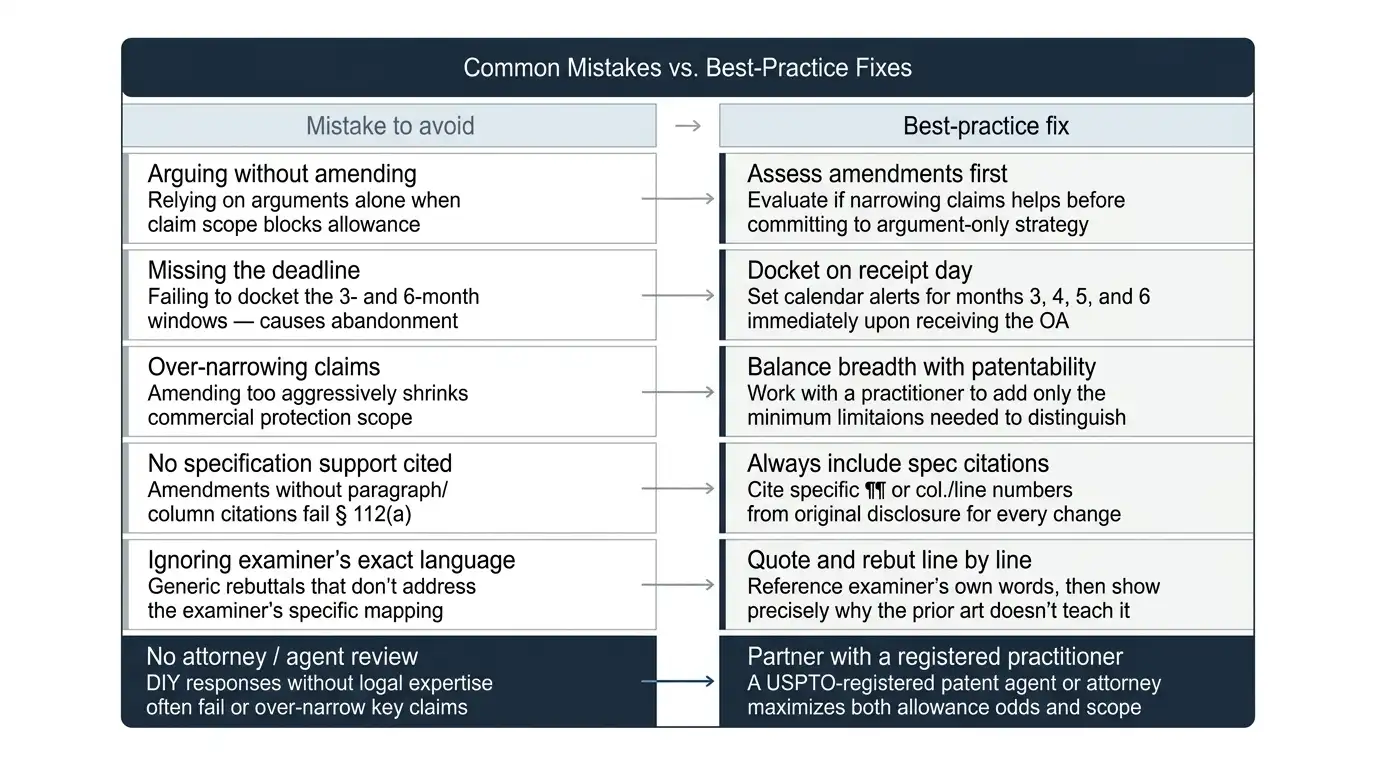
- Arguing without amending – Sometimes, amending claims is unavoidable; arguing alone without amending may not overcome a strong prior art rejection.
- Fix: Assess whether claim amendments are strategically beneficial before filing a response.
- Missing the deadline – A 3-month soft deadline and a 6-month hard deadline apply. Missing either causes abandonment.
- Fix: Docket all USPTO deadlines immediately upon receipt of an Office Action.
- Over-narrowing claims – Amending too aggressively can shrink the patent’s commercial value.
- Fix: Work with a patent practitioner to balance patentability with claim breadth.
- Failing to cite specification support – Any new limitation added to a claim must be supported by the original disclosure.
- Fix: Always include paragraph or column/line citations from the spec for every amendment.
- Ignoring the examiner’s exact language – Responses must address the examiner’s specific arguments, not generic rebuttals.
- Fix: Quote the Office Action text directly when crafting your rebuttal.
- No attorney or agent review – DIY responses without legal expertise often fail to overcome rejections.
- Fix: Partner with a registered patent practitioner like Teak IP Services.
When Should You Consider an Examiner Interview?
An examiner interview is a conference (in person, by phone, or video call) between the applicant/practitioner and the USPTO examiner to discuss the application before or after a formal response.
You Should Request an Interview When:
- The rejection seems based on a misunderstanding of the invention
- You want to test possible claim amendments informally before filing
- The examiner has raised complex or unusual grounds of rejection
- A Final Office Action has been issued and you need efficient resolution
- The application is commercially important and time-sensitive
| 💡 Teak IP Pro Tip: Request an examiner interview before filing your response to a Final Office Action. This can save significant prosecution costs and often leads to faster allowance. |
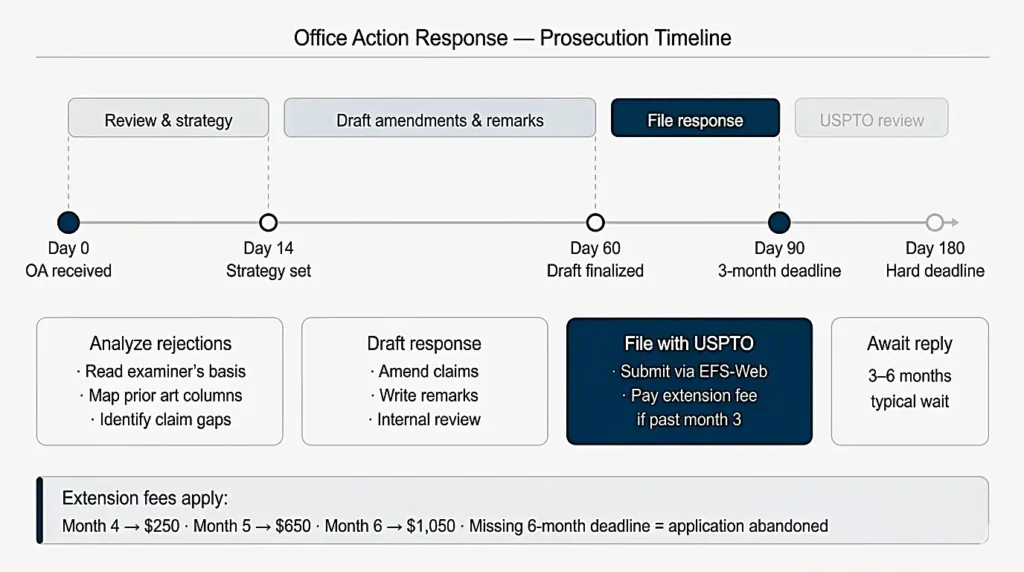
Office Action Response Timeline: What to Expect
| Timeline | Activity |
| Day 0 | Office Action received and docketed |
| Days 1–14 | Review rejections, analyze prior art, develop response strategy |
| Days 15–45 | Draft claim amendments and remarks |
| Days 46–60 | Internal review and finalization of response |
| Day 60–90 | File response with USPTO (within 3-month window to avoid extension fees) |
| 3–6 Months Later | Examiner reviews response and issues Next Action (allowance, Final OA, or interview) |
How Teak IP Services Can Help
At Teak IP Services, our team of experienced patent professionals provides end-to-end patent prosecution support, including:
- Comprehensive Office Action analysis and strategy development
- Prior art searching and claim charting to identify distinctions
- Professional drafting of claim amendments and remarks
- USPTO examiner interview coordination
- Appeal to the Patent Trial and Appeal Board (PTAB) if needed
- Portfolio-level prosecution strategy for startups and enterprises
| 🚀 Ready to Respond to Your Office Action? Don’t let a USPTO rejection stall your innovation. Contact Teak IP Services today for a free consultation and let our experienced patent practitioners craft a winning office action response for your application. Visit: teakipservices.com | Email: info@teakipservices.com |
Frequently Asked Questions (FAQ) Office Action Response Example
Q1: How long does it take the USPTO to respond after I file my office action response?
Generally, the USPTO takes 3–6 months to review your response and issue the next office action or a Notice of Allowance. This varies by art unit and examiner workload.
Q2: Can I file my own office action response without an attorney?
Yes, pro se inventors (self-represented applicants) can file their own responses. However, patent law is highly technical, and errors in drafting claims or arguments can permanently limit your patent’s scope or lead to abandonment. Working with a registered patent agent or attorney is strongly recommended.
Q3: What happens if I don’t respond to an Office Action?
If you fail to respond within the 6-month statutory deadline, your application goes abandoned. While a Petition to Revive may be possible, it is costly and not guaranteed to succeed.
Q4: What is a Final Office Action and how is it different?
A Final Office Action is issued when the examiner believes that the arguments and amendments in your Non-Final response were not persuasive. After receiving a Final OA, you have several options: filing an After Final Amendment, requesting a pre-appeal conference, filing a Request for Continued Examination (RCE), or appealing to the PTAB.
Q5: Can I add new claims in an office action response?
You may add new claims as long as they are supported by the original specification (no new matter). On the other hand, adding independent claims after a Final Office Action generally requires examiner permission or filing an RCE.
Also, Read: Office Action Response Form: How to Complete and Submit It Correctly to the USPTO
Final Thoughts: Treat Every Office Action as an Opportunity
The patent prosecution process is rarely linear. Most granted patents have gone through at least one round of Office Actions. The key is to approach each one strategically – not emotionally. A well-crafted office action response example, like the one walkthrough above, demonstrates that with the right arguments, the right amendments, and the right tone, you can turn a rejection into a granted patent.
Teak IP Services is here to guide you through every step of patent prosecution – from initial filing to final grant. We combine technical expertise with legal precision to protect what matters most: your innovation.
Our Services: View Full Office Action Response Services Details

