
Office action response form filing is a critical step after receiving an Office Action from the USPTO, which can feel overwhelming-but it’s actually a routine part of the patent or trademark application process. What matters most is how you respond. Filing an accurate, complete, and timely office action response form is not just procedural-it can determine whether your intellectual property gets approved or abandoned.

In this guide, Teak IP walks you through everything you need to know about the office action response form: what it is, how to fill it out correctly, and how to submit it to the USPTO without costly mistakes. If completing and submitting the form feels daunting, our office action response preparation services can guide you through every field, ensuring your response is accurate, complete, and filed before the USPTO deadline.
What is an Office Action?
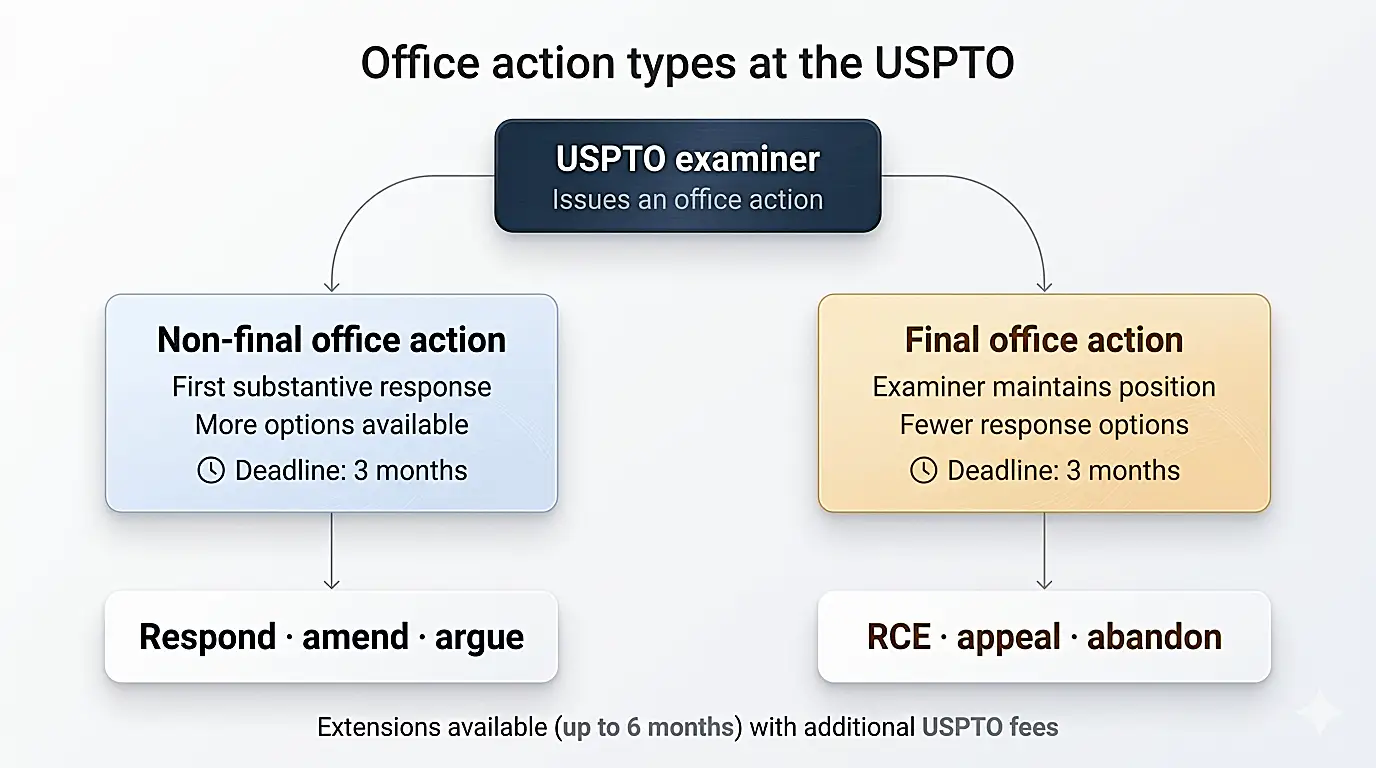
An Office Action is an official communication issued by the USPTO (United States Patent and Trademark Office) during the examination of a patent or trademark application. It outlines objections, rejections, or requirements that an examiner has identified with your application.
There are two primary types:
- Non-Final Office Action – The first substantive examination response, outlining initial objections or rejections.
- Final Office Action – Issued after a non-final response, signaling that the examiner maintains their position. Fewer options are available at this stage.
Key Takeaway: Ignoring or improperly responding to an Office Action can result in the abandonment of your application – and the loss of your filing fees and priority date.
What is an Office Action Response Form?
An office action response form is the official document (or electronic submission) filed with the USPTO to address the specific issues raised in an Office Action. It is not a generic letter – it is a structured, legal response that must:
- Directly address each objection or rejection raised by the examiner
- Include amendments to claims (for patents) or application details (for trademarks) as needed
- Provide legal arguments and supporting evidence where applicable
- Be filed within the USPTO’s strict deadlines
For trademarks, the response is filed through the Trademark Electronic Application System (TEAS) using the “Response to Office Action” form.
For patents, responses are submitted through the USPTO’s Electronic Filing System (EFS-Web / Patent Center).
Also, Read: Office Action Response Trademark: How to Handle USPTO Refusals and Keep Your Mark Alive
Why Getting Your Office Action Response Right Matters
Filing a weak, incomplete, or late response can have serious consequences:
- Application Abandonment – Miss the deadline and your application is dead.
- Prosecution History Estoppel – Arguments you make (or don’t make) now can limit your patent rights later.
- Wasted Resources – Every amendment or filing costs time and money.
- Loss of Priority Date – Your original filing date – critical for IP protection – may be forfeited.
A well-crafted office action response form is your opportunity to persuade the USPTO examiner. Don’t treat it as a formality.
Step-by-Step: How to Complete an Office Action Response Form
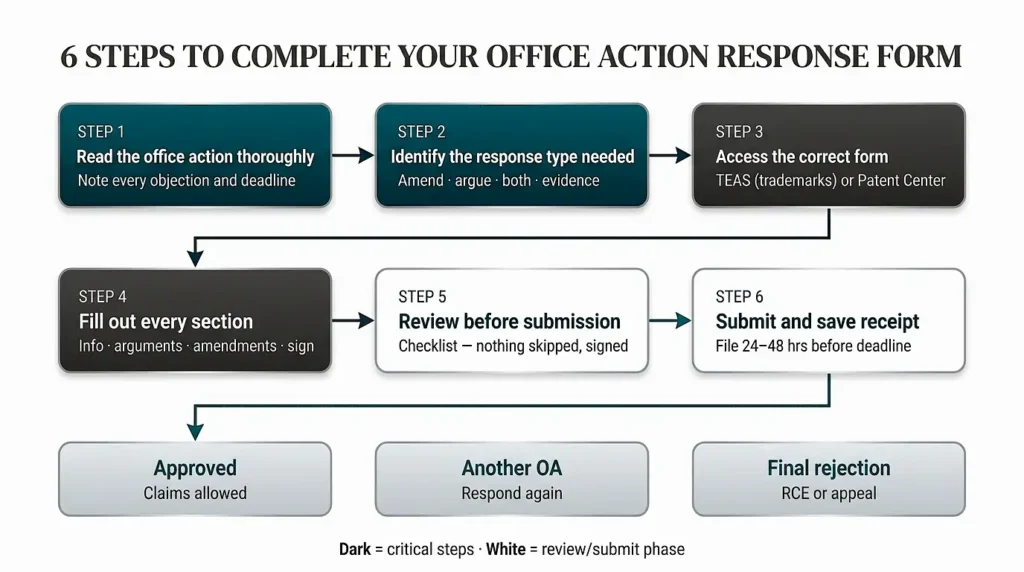
Step 1: Read the Office Action Thoroughly
Before writing a single word of your response, read the entire Office Action carefully.
Pay attention to:
- The specific rejections or objections listed (e.g., §2(d) likelihood of confusion, §101 patent eligibility, §112 indefiniteness)
- The deadlines stated – USPTO typically allows 3 months to respond to a trademark Office Action (extendable up to 6 months with a fee), and 3 months for a patent non-final OA (extendable up to 6 months)
- The examiner’s name and docket number (you’ll need these for your response form)
- Any exhibits, cited marks, or prior art the examiner references
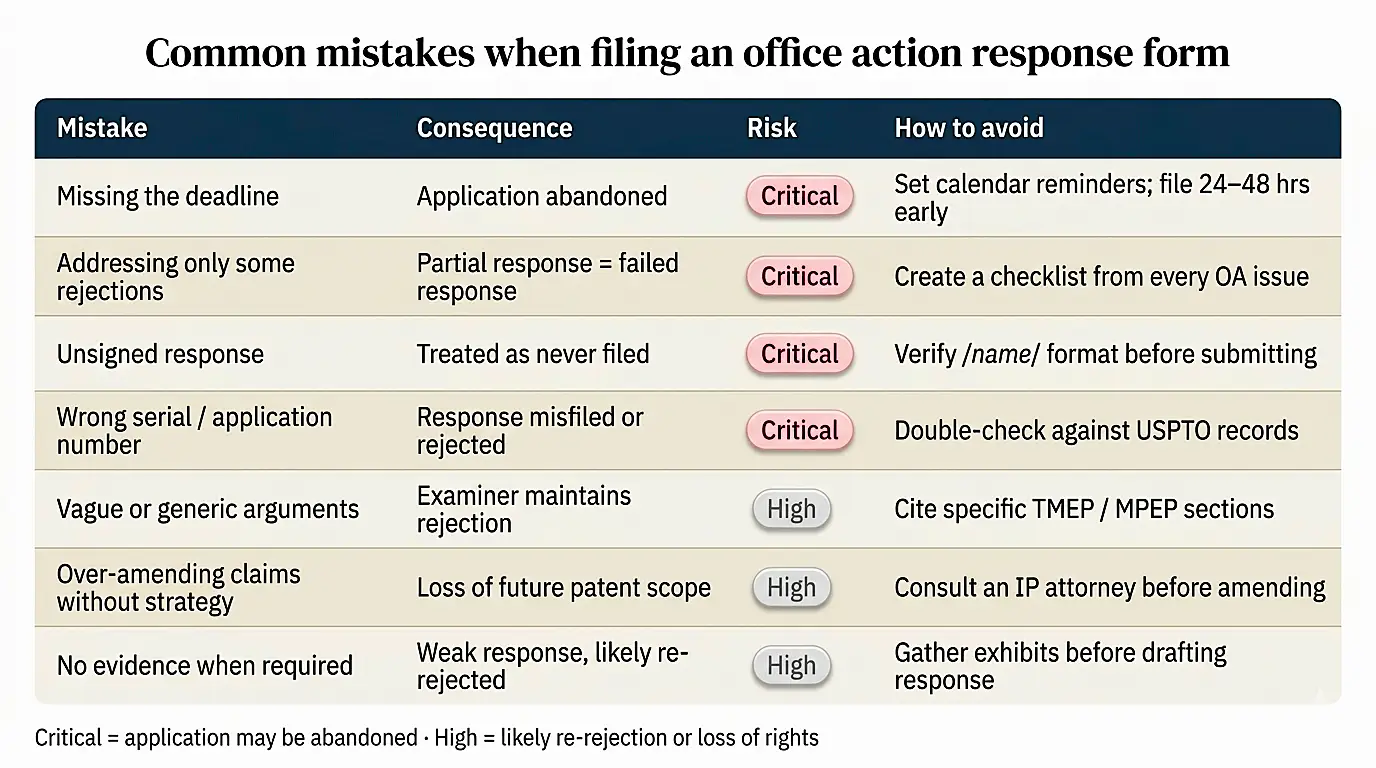
Pro Tip: Highlight every single objection. Your response must address ALL of them – failing to respond to even one issue may result in abandonment.
Step 2: Identify the Type of Response You Need
Not all Office Actions require the same type of response. Determine whether you need to:
- Amend the application (e.g., revise the description of goods/services, update specimen, modify claims)
- Argue against the examiner’s findings (e.g., no likelihood of confusion, claim is patentable)
- Do both – amend AND argue (most common and most effective strategy)
- File a declaration or evidence (e.g., affidavit of distinctiveness, prior art declarations)
Step 3: Access the Correct Response Form
For Trademarks (via TEAS):
- Go to https://www.uspto.gov/trademarks
- Navigate to TEAS (Trademark Electronic Application System)
- Select “Response to Office Action”
- Enter your Serial Number to pull up your application
- The form will auto-populate your application data
For Patents (via Patent Center):
- Go to https://patentcenter.uspto.gov
- Log into your USPTO account
- Search your application by Application Number
- Use the “Submit Documents” function to upload your response
Step 4: Fill Out the Office Action Response Form – Section by Section
Here’s what each key section of a typical response form requires:
A. Applicant & Application Information
- Serial Number / Application Number – Must match your USPTO records exactly
- Applicant Name – As listed in the application
- Mark/Invention Title – For trademarks, the exact mark; for patents, the title of invention
- Examiner’s Name – Found in the Office Action letter
- Law Office / Art Unit – Also found in the Office Action
Common Mistake: Mistyping the serial number can cause your response to be associated with the wrong application or rejected outright.
B. Response to Each Refusal or Requirement (The Core Section)
This is the most critical part of your office action response form. Structure your arguments clearly.
Best Practices:
- Address each refusal separately and specifically – don’t bundle multiple issues into vague paragraphs
- Use headers for each issue (e.g., “Response to Refusal Under Section 2(d)”)
- Cite applicable case law, TMEP sections (for trademarks), or MPEP sections (for patents)
- Keep your language professional, direct, and persuasive
- Avoid emotional language – examiners respond to legal logic and evidence
For Trademark Responses – common arguments include:
- Distinguishing your mark from the cited mark (appearance, sound, meaning, commercial impression)
- Submitting evidence of coexistence in the marketplace
- Demonstrating acquired distinctiveness under §2(f)
- Clarifying the identification of goods/services
For Patent Responses – common arguments include:
- Distinguishing claims from cited prior art
- Arguing that the invention meets §101, §102, §103, or §112 requirements
- Amending claims to add limitations that differentiate from prior art
- Submitting affidavits under Rule 131 (swearing behind prior art) or Rule 132 (expert declarations)
C. Amendments to the Application
If you are amending the application (trademark ID of goods/services, patent claims, specification, etc.):
- Clearly mark what is being deleted (strikethrough) and what is being added (underline), following USPTO format rules
- For patents: use clean and marked-up versions of amended claims
- For trademarks: use the exact TEAS format to edit the identification of goods/services
Important: Amendments that narrow your scope can limit future rights. Consult an IP professional before making changes.
D. Evidence and Exhibits (If Applicable)
Supporting documentation strengthens your response significantly.
Examples of evidence to attach:
- Internet screenshots showing your mark’s use in commerce
- Declaration of distinctiveness (§2(f) affidavit)
- Third-party registrations showing the cited mark coexists with similar marks
- Expert declarations (for patents)
- Laboratory test results, data, or technical comparisons
- Consent agreements from the owner of the cited mark
When attaching evidence:
- Label each exhibit clearly (Exhibit A, Exhibit B, etc.)
- Reference each exhibit by name within the body of your response
- Upload in PDF format (USPTO standard)
E. Signature Section
Your response must be signed to be valid.
- For TEAS (trademarks): Electronic signature using the
/name/format (e.g.,/Jane Smith/) - For Patent Center: Electronic signature in the same format, or a handwritten signature on a PDF
- If filed by an attorney: Include attorney bar number and USPTO Registration Number
- Date of signature must be on or before the response deadline
Warning: An unsigned response is treated as if it was never filed. Always double-check this section.
Step 5: Review Before Submission
Before hitting submit, perform a thorough review:
Final Checklist:
- All Office Action issues addressed (none skipped)
- Serial/Application number is correct
- Applicant name matches records
- Arguments are clear, specific, and legally grounded
- Amendments properly formatted (clean + marked versions for patents)
- All exhibits labeled and referenced
- Signature is present and correctly formatted
- Response is being submitted before the deadline
- Filing fees paid (if applicable – e.g., extensions of time, extra claims)
Step 6: Submit the Office Action Response Form
For Trademark TEAS Submissions:
- Complete all sections of the online form
- Attach exhibits
- Review the preview summary
- Pay any applicable fees
- Click “Submit”
- Save the confirmation email and receipt – this is your proof of timely filing
For Patent Center Submissions:
- Prepare your response as a PDF document
- Log into Patent Center
- Navigate to your application
- Click “Submit Documents”
- Select document type (e.g., “Non-Final Rejection Response”)
- Upload your PDF
- Complete and submit any required cover sheets
- Save the EFS receipt with timestamp
Pro Tip: Always file at least 24–48 hours before the deadline. USPTO servers can experience high traffic, and technical difficulties are not accepted as excuses for late filings.
Common Mistakes to Avoid When Filing an Office Action Response
Office Action Response Deadlines – A Quick Reference
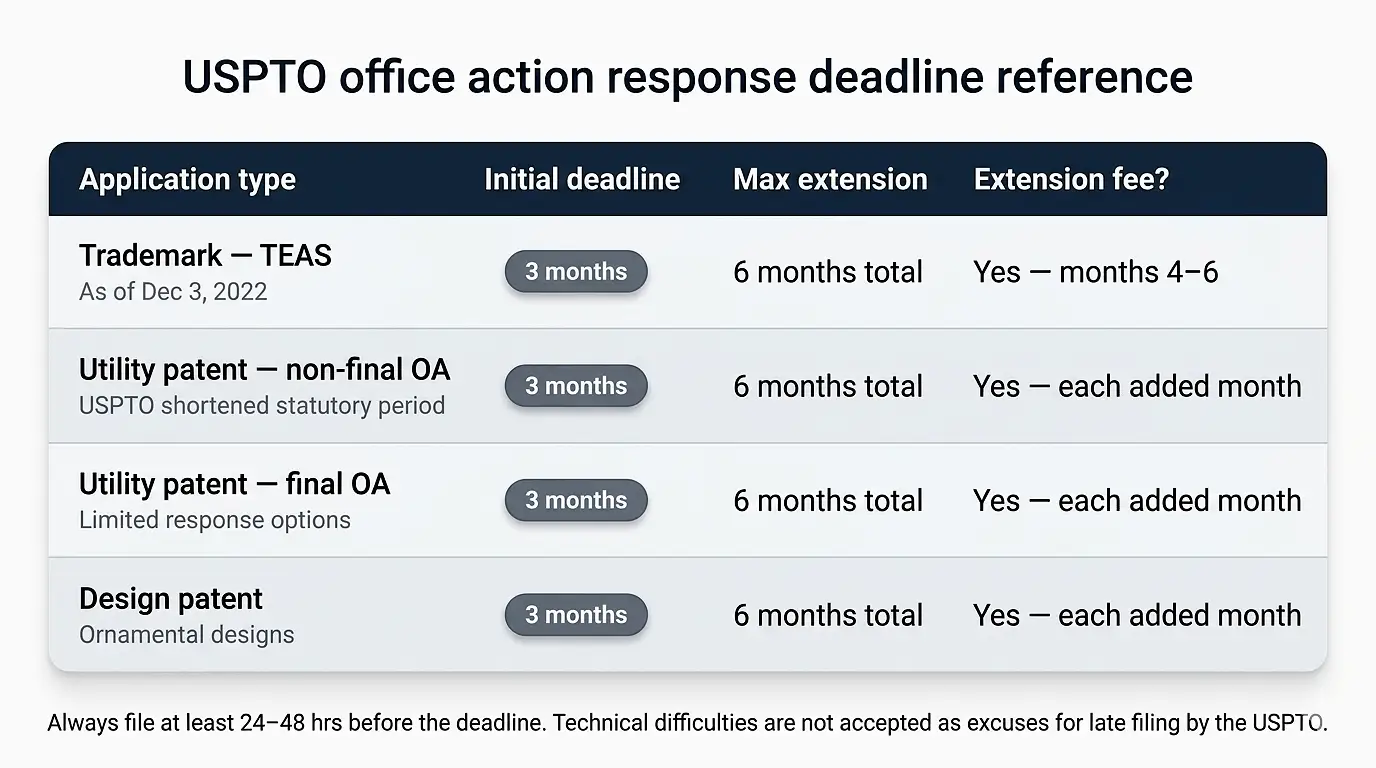
Note: For trademarks filed on or after December 3, 2022, the deadline changed from 6 months to 3 months under new USPTO rules, with paid extensions available.
Also, Read: What is an Office Action Response? A Complete Guide for Patent & Trademark Applicants
When Should You Hire an IP Professional?
While the USPTO allows applicants to respond to Office Actions pro se (on their own), there are situations where professional help is strongly recommended:
Strongly Consider an IP Attorney or Agent If:
- You received a Final Office Action – options are more limited and the strategy must be precise
- The rejection involves likelihood of confusion with a well-known mark
- You’re dealing with a §101 patent eligibility rejection (highly nuanced legal area)
- Your claims require strategic amendment that could affect future enforcement
- The examiner cited multiple prior art references (combination rejections)
- You are considering filing a Request for Continued Examination (RCE) or Appeal
At Teak IP Services, our team of experienced IP professionals helps clients craft compelling, examiner-ready office action responses. We handle both trademark and patent matters, ensuring your response is strategically sound and procedurally correct.
Also, Read: Office Action Response USPTO: Rules, Process & What to Expect at Every Stage
What Happens After You Submit Your Response?
Once your office action response form is filed, here’s what to expect:
- Confirmation – USPTO sends a filing receipt (keep this!)
- Examiner Review – The examiner reviews your arguments and amendments (can take weeks to months)
- One of Three Outcomes:
- ✅ Application Approved – Your mark is approved for publication (trademark) or your claims are allowed (patent)
- 🔄 Another Office Action Issued – Non-final or final, requiring another response
- ❌ Final Rejection Maintained – You may need to file an RCE, appeal, or consider abandonment
Possible Next Steps if Rejected Again:
- Request for Continued Examination (RCE) – Opens prosecution again (patents only)
- Appeal to the TTAB (trademarks) or PTAB (patents)
- Petition to the USPTO Director
- Ex Parte Quayle Action Response (if only formal requirements remain)
The office action response form is one of the most consequential documents in the patent or trademark process. Filing it correctly – with precise arguments, proper formatting, timely submission, and complete coverage of every examiner objection – can mean the difference between securing your IP rights and losing them entirely.
Don’t leave this to chance. Whether you’re navigating your first Office Action or responding to a final rejection, Teak IP Services is here to help.
Need Help Responding to a USPTO Office Action?
Teak IP Services specializes in crafting strategic, examiner-ready office action responses for trademarks and patents. Our team understands USPTO procedures inside and out – and we work to protect your intellectual property every step of the way.
Our Services: Explore Office Action Response Services

