
Receiving an office action response USPTO notice can feel overwhelming – especially if it’s your first time navigating the U.S. patent or trademark examination process. But understanding what it means, what the rules are, and how to respond strategically can make the difference between a granted IP right and an abandoned application.
This comprehensive guide walks you through every stage of the office action response process – from the moment you receive an office action to filing a final response and beyond.

Quick Definition
An Office Action is an official written communication from the USPTO examiner assigned to your patent or trademark application. It details any legal objections, rejections, or requirements that must be addressed before your application can be approved.
Applicants who want to navigate this process with confidence can work with our office action response services to craft well-argued, timely responses that address examiner objections and move applications toward approval.
1. What is an Office Action?
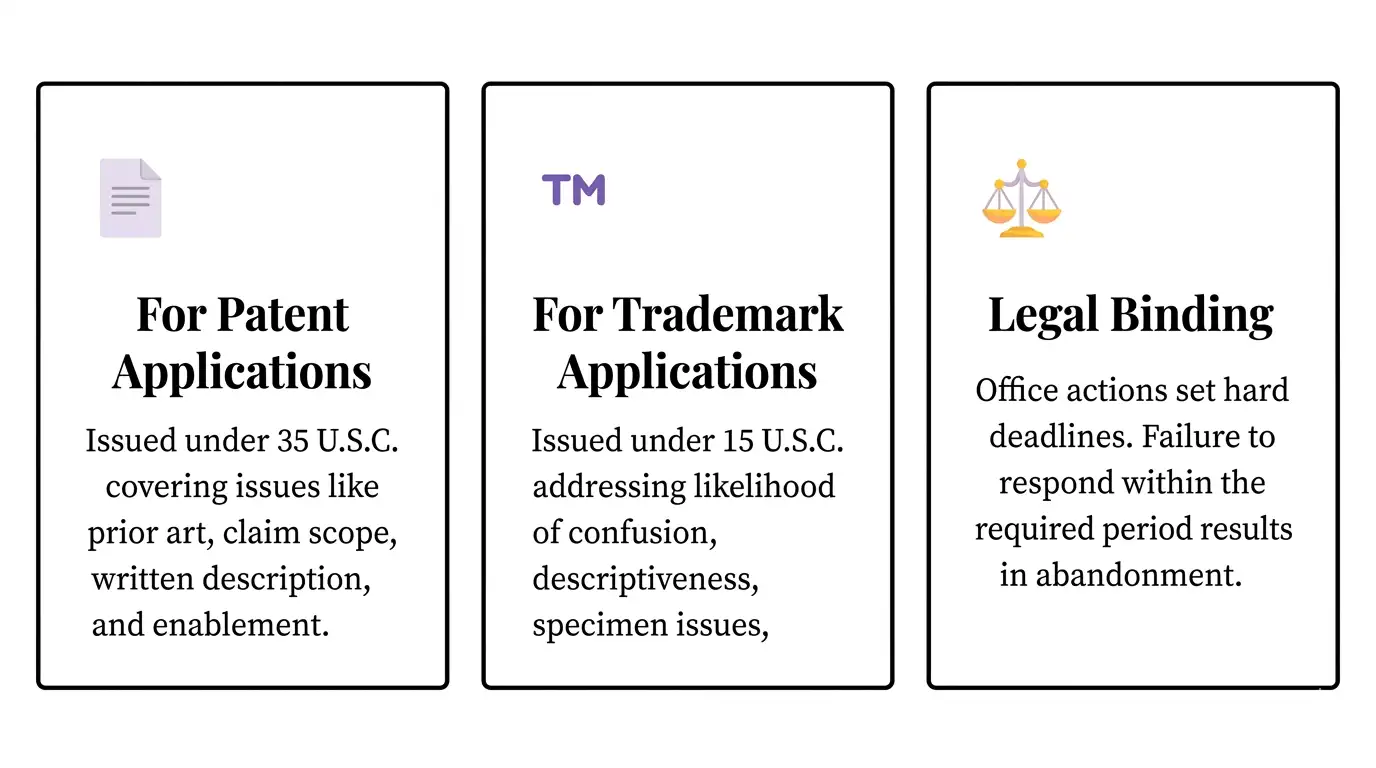
An office action response USPTO situation begins when a USPTO patent or trademark examiner reviews your application and identifies issues that prevent immediate approval. The examiner then issues a formal letter – the Office Action – outlining those concerns.
Office actions are extremely common. According to USPTO data, the majority of patent and trademark applications receive at least one office action before final disposition. Receiving one does not mean your application will be denied – it simply means the examiner has questions or objections that need to be addressed.
What is an Office Action – Office Action Response USPTO
2. Types of Office Actions
Not all office actions are the same. Understanding the type you received is critical to formulating the right response strategy.
Patent Office Action Types
- Non-Final Office Action: The first substantive rejection. You have more flexibility to amend claims, submit arguments, and add evidence. This is your best opportunity to shape the application.
- Final Office Action: Issued after the first non-final if the examiner maintains rejections. Your options narrow – you must file a response after final, Request for Continued Examination (RCE), or appeal.
- Restriction Requirement / Election of Species: The examiner determines your application covers multiple distinct inventions and requires you to elect one for prosecution.
- Advisory Action: Issued when your after-final response is deemed insufficient; it informs you of the status before the period for response expires.
- Notice of Allowance: Not a rejection – this means the examiner has approved the claims. You must pay the issue fee within 3 months.
Trademark Office Action Types
- Non-Final Office Action: Substantive issues raised for the first time. Common grounds include likelihood of confusion with existing marks, merely descriptive marks, and specimen deficiencies.
- Final Office Action: Issued when the applicant’s response fails to overcome the cited refusals. After this, you can file a Request for Reconsideration or appeal to the TTAB.
- Examiner’s Amendment: A cooperative action where the examiner proposes minor amendments to allow the mark without requiring a formal response.
- Priority Action: Issued in applications with a priority filing under Paris Convention to address critical issues early.
Important Distinction
After a Final Office Action, you cannot introduce new arguments not previously raised without special leave. Strategic planning in your non-final response stage is paramount.
Also, Read: Office Action Response Trademark: How to Handle USPTO Refusals and Keep Your Mark Alive
3. USPTO Response Timelines & Deadlines
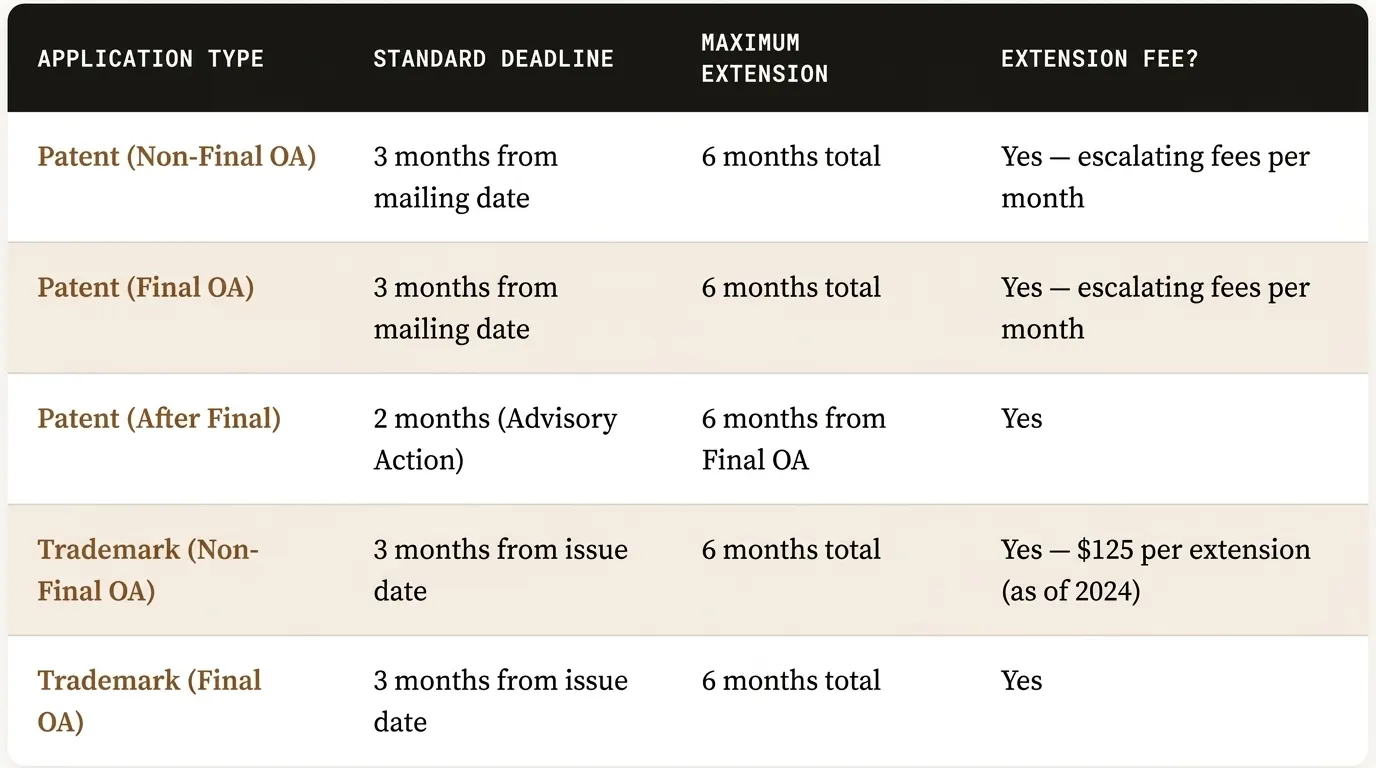
Deadlines in USPTO proceedings are strict. Missing them without an extension can result in automatic abandonment of your application – a costly and often irreversible outcome.
Deadline Alert (Office Action Response USPTO)
The USPTO mailing date – not the date you receive the office action – is the official start date for your response period. Always check the date printed on the office action itself, not the envelope postmark or the date you open it.
Extension of Time Rules
- Patent applications: Extensions can be obtained for months 4, 5, and 6 (beyond the 3-month shortened statutory period) by paying escalating fees under 37 C.F.R. § 1.136(a).
- Trademark applications: A single 3-month extension is available for $125 (per class), bringing the maximum response period to 6 months from the Office Action issue date.
- Extensions are not automatic – you must file a request and pay the required fee before the current deadline expires.
4. Key Rules & Regulations Governing Office Action Responses USPTO
The legal framework for office action responses at the USPTO is governed by specific federal statutes and USPTO regulations. Understanding the applicable rules is essential for crafting a compliant and persuasive response.
Patent-Specific Rules
- 37 C.F.R. § 1.111: Governs replies to non-final office actions. Responses must distinctly and specifically point out the supposed errors in the examiner’s action and reply to every ground of objection or rejection.
- 37 C.F.R. § 1.113: Covers replies to final office actions. Limits the scope of permissible amendments after final.
- 37 C.F.R. § 1.116: Governs amendments after final rejections. Amendments are entered as a matter of right only if they cancel claims or place the application in condition for allowance.
- 37 C.F.R. § 1.131: Allows applicants to “swear behind” a prior art reference by establishing prior invention before the reference date.
- 37 C.F.R. § 1.132: Governs affidavits and declarations used to traverse rejections – including expert declarations establishing unexpected results or commercial success.
- 35 U.S.C. § 132: Requires the USPTO to notify applicants of reasons for rejection with specific citations, giving applicants an opportunity to reply.
Trademark-Specific Rules
- 37 C.F.R. § 2.62: Requires that responses to trademark office actions respond to every point raised by the examiner.
- 15 U.S.C. § 1062(b): Authorizes the USPTO to issue office actions and sets the statutory framework for trademark examination.
- TMEP § 714: Trademark Manual of Examining Procedure section governing prosecution of trademark applications and response requirements.
- 37 C.F.R. § 2.65: Governs the consequences of failure to respond – abandonment of the application.
Pro Tip
Always cross-reference your response against the specific MPEP (Manual of Patent Examining Procedure) or TMEP section cited by the examiner. Examiners are bound by these manuals, and a well-targeted response citing the same sections often carries more weight.
5. Step-by-Step: The Office Action Response Process
Here is the complete process for responding to an office action – broken into actionable stages:
Stage 1-Receive & Review the Office Action
Download the full office action from USPTO TSDR (trademarks) or Patent Center (patents). Note the mailing date, identify every rejection and objection, and flag all statutory and regulatory citations. Never assume a rejection is insurmountable before reading it carefully.
Stage 2-Analyze Each Ground of Rejection
Break down the office action into individual issues. For patents: identify § 101, § 102, § 103, or § 112 rejections. For trademarks: identify § 2(d) (likelihood of confusion), § 2(e) (descriptiveness), specimen issues, or identification of goods/services issues. Research the prior art or cited marks thoroughly.
Stage 3-Develop a Response Strategy
Decide on your approach: argue against the rejection, amend your claims/description, submit evidence (declarations, specimens, affidavits), or some combination. For patents, determine whether claim amendments can overcome the rejection while preserving commercial value. This is the most critical strategic step.
Stage 4-Draft the Response Document
Structure your response with: (a) an introductory statement, (b) a clean copy of amended claims or mark identification (if applicable), (c) a remarks section addressing every rejection and objection individually, and (d) a conclusion requesting reconsideration and allowance. Every rejection must be addressed – silence equals concession.
Stage 5-Consider an Examiner Interview (Optional)
For complex rejections, request a telephone or in-person interview with the examiner before filing your formal response. Interviews can clarify misunderstandings, build rapport, and significantly improve the chances of allowance. Use USPTO Patent Center or TEAS to request interviews.
Stage 6-File the Response via USPTO Systems
For patents: file through Patent Center (EFS-Web successor). For trademarks: file through TEAS (Trademark Electronic Application System) using the “Response to Office Action” form. Confirm receipt and save your acknowledgment receipt. Check that all fees are paid if applicable.
Stage 7-Monitor & Await Examiner’s Review
After filing, the examiner reviews your response. USPTO target turnaround times vary by art unit and docket. Monitor your application status via Patent Center or TSDR. You may receive a Notice of Allowance, another office action, or (if after final) a notice regarding your RCE or appeal.
6. Patent vs. Trademark Office Actions: Key Differences
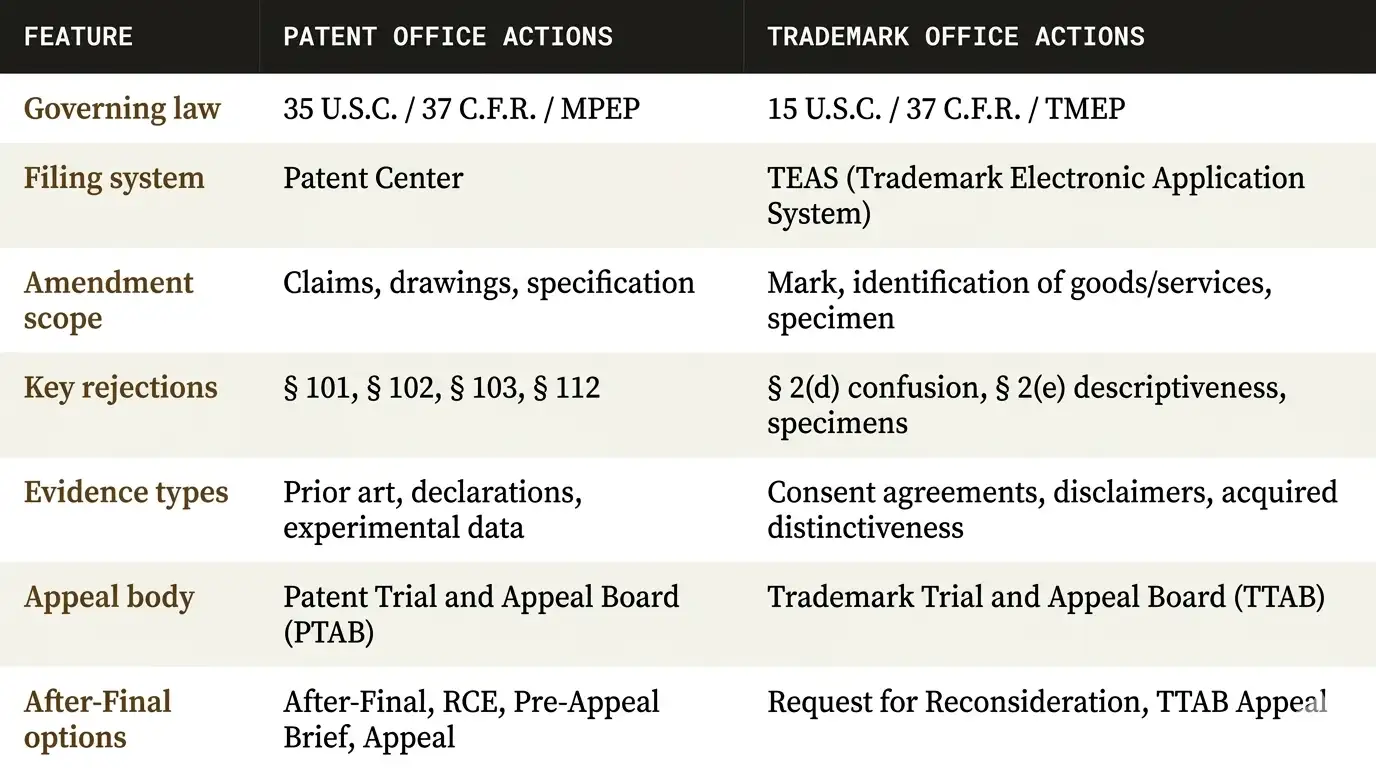
While the general framework is similar, there are important procedural and substantive differences between patent and trademark office action responses.
7. Common Rejections & How to Overcome Them
Patent Rejections
- § 102 – Anticipation (Prior Art): The examiner argues a single prior art reference discloses all elements of your claim. Response strategies: Amend claims to distinguish from the reference; argue the reference does not actually disclose the claimed element; submit a Rule 131 declaration to swear behind the reference’s date.
- § 103 – Obviousness: The examiner combines two or more references to argue the invention would have been obvious. Response strategies: Argue teaching away, unexpected results, long-felt need, commercial success, or failure of others via Rule 132 declaration; distinguish the technical teaching of combined references; argue against the motivation to combine.
- § 101 – Patent-Eligible Subject Matter: Common in software and life sciences. Response strategies: Amend claims to integrate the abstract idea into a practical application; argue the claims are directed to specific technological improvements, not just an abstract idea; demonstrate the claims recite significantly more than an abstract idea.
- § 112 – Written Description / Enablement: The examiner argues the specification does not adequately support or enable the claims. Response strategies: Narrow claims to correspond to what is actually disclosed; amend specification (before filing, via Preliminary Amendment); submit declarations from experts regarding enablement.
Trademark Rejections
- § 2(d) – Likelihood of Confusion: The examiner cites a similar existing mark in a related class. Response strategies: Distinguish marks based on appearance, sound, meaning, and commercial impression; argue the goods/services are sufficiently different; submit a consent agreement from the cited mark owner; provide evidence of coexistence in the marketplace.
- § 2(e)(1) – Merely Descriptive: The examiner argues your mark merely describes the goods/services. Response strategies: Argue the mark is suggestive, not descriptive; submit evidence of acquired distinctiveness (five years of use, consumer surveys, advertising spend); amend to the Supplemental Register if Principal Register is not achievable.
- Specimen Refusal: The submitted specimen does not show proper use of the mark in commerce. Response strategies: Submit a new, compliant specimen showing the mark as used on the goods/in connection with the services; provide a verified statement of use.
- Identification of Goods/Services Issues: The identification is too broad, indefinite, or uses unacceptable terminology. Response strategies: Amend the identification to use acceptable language from the USPTO ID Manual; narrow the scope appropriately.
“The quality of an office action response is determined not just by the legal arguments made, but by how precisely those arguments are targeted to the specific language used by the examiner.”
8. What Happens After You Respond?
Filing your response is not the end of the process. Here is what can happen next – and what each outcome means:
After-Final Options for Patents
- After-Final Amendment (37 C.F.R. § 1.116): File a narrow amendment to place the application in condition for allowance. Entry is not guaranteed but can resolve limited issues.
- Request for Continued Examination (RCE): Pay a fee to reopen prosecution and file further arguments or amendments. Effectively restarts prosecution – use strategically.
- Pre-Appeal Brief Request: A streamlined review by a panel of examiners before a full appeal. Useful for clear legal errors.
- Appeal to PTAB: File a Notice of Appeal and Brief. A panel of Administrative Patent Judges reviews the rejection independently.
- Continuation Application: File a continuation to pursue broader or different claims in a new application while keeping the original pending.
9. Expert Tips for a Stronger Office Action Response
- Read the entire office action before reacting. Examiners sometimes raise concerns in one section that they address or clarify elsewhere. Understanding the full picture prevents unnecessary amendments.
- Never leave a rejection unanswered. Every ground of rejection and every objection must receive a direct and specific response. Silence is treated as acquiescence.
- Request an examiner interview early. A 30-minute phone call with the examiner can often accomplish more than months of written correspondence. Interviews are free and underutilized.
- Use declarations and affidavits strategically. Expert declarations (Rule 132), declarations of prior invention (Rule 131), and declarations of acquired distinctiveness can be decisive evidence that written arguments alone cannot substitute.
- Preserve claim scope when amending. Every amendment creates prosecution history estoppel, which can limit your ability to assert doctrine of equivalents in future infringement actions. Amend only when necessary.
- Respond to the art, not just the rejection. If the examiner cites a prior art reference, distinguish your invention from that specific reference – not from prior art in general.
- File early, not at the last minute. Late-stage filing under extension fees costs money and limits your time to address any issues with the submission itself before the final deadline.
- Consider the prosecution record’s long-term impact. Arguments made during prosecution become part of the public record and can be used against you in future litigation. Frame arguments carefully.
Also, Read: Office Action Response Form: How to Complete and Submit It Correctly to the USPTO
10. Costly Mistakes to Avoid in Your Office Action Response
Mistake 1 – Missing the Deadline
The single most common and irreversible mistake. Always calendar the deadline the day you receive the office action. Set multiple reminders. If you need more time, file for an extension before the current period expires.
Mistake 2 – Generic or Boilerplate Arguments
Copy-paste arguments that don’t address the specific prior art or factual circumstances cited by your examiner are easily dismissed. Personalize every argument to the references and reasoning actually before you.
Mistake 3 – Unnecessary Claim Narrowing
Over-amending claims in a rush to get allowance creates estoppel that can severely limit your patent’s enforceability. Consult IP counsel before making any amendments you haven’t fully thought through.
Mistake 4 – Ignoring Dependent Claims
Applicants often focus exclusively on independent claims and neglect dependent ones. Ensuring dependent claims are properly distinguished adds fallback protection to your patent portfolio.
Mistake 5 – Not Filing Electronically
Paper submissions increase processing time and risk of loss. Always file through USPTO’s official electronic systems – Patent Center for patents, TEAS for trademarks – and save your electronic receipt.
Mistake 6 – Self-Representation in Complex Rejections
While pro se representation is legal, complex § 101 or § 103 rejections often benefit enormously from experienced patent counsel who know the nuances of current examination guidelines and PTAB precedent.
Also, Read: What is an Office Action Response? A Complete Guide for Patent & Trademark Applicants
Need Help With Your Office Action Response?
Teak IP Services provides expert patent and trademark prosecution support – from analyzing office actions to filing persuasive responses that protect your IP rights. Explore Teak IP Services →
11. Frequently Asked Questions – Office Action Response USPTO
How long do I have to respond to a USPTO office action?
For both patent and trademark applications, the standard response period is 3 months from the mailing/issue date of the office action. This can be extended up to a maximum of 6 months by paying extension fees. Failure to respond within the extended deadline results in abandonment.
What is the difference between a non-final and a final office action?
A non-final office action is typically the first substantive rejection, giving you full latitude to amend claims, introduce new arguments, and submit evidence. A final office action is issued after your first response if the examiner maintains rejections – at this point, your ability to introduce new arguments is restricted and you must consider RCE, appeal, or after-final amendments.
Can I respond to an office action myself (pro se)?
Yes. USPTO allows individuals to represent themselves (pro se) in patent and trademark proceedings. However, given the legal and strategic complexity – especially in patent prosecution – professional representation by a registered patent attorney or agent is strongly recommended, particularly for complex rejections.
What happens if I miss the office action response deadline?
Your application will be deemed abandoned. For patents, you may petition to revive an unintentionally abandoned application under 37 C.F.R. § 1.137, but this involves additional fees and is not guaranteed. Acting before every deadline is far preferable to revival proceedings.
What is a Request for Continued Examination (RCE)?
An RCE is a USPTO procedure (37 C.F.R. § 1.114) that allows patent applicants to continue prosecution after a final rejection by paying a government fee. Filing an RCE reopens prosecution, allowing you to submit new arguments and/or amendments. It is not an appeal – the same examiner continues examining the application.
How do I respond to a trademark office action for likelihood of confusion?
Responding to a § 2(d) likelihood of confusion refusal involves conducting a detailed DuPont factor analysis – comparing the similarity of marks, the relatedness of goods/services, channels of trade, the sophistication of buyers, and other factors. Strategies include arguing the differences outweigh the similarities, submitting marketplace evidence, obtaining a consent agreement from the cited mark owner, or amending the goods/services identification to avoid overlap.
Can I appeal a USPTO office action decision?
Yes. After a final rejection, patent applicants can appeal to the Patent Trial and Appeal Board (PTAB) by filing a Notice of Appeal and an Appeal Brief. Trademark applicants can appeal to the Trademark Trial and Appeal Board (TTAB). Further appeals from PTAB/TTAB decisions can be taken to the U.S. Court of Appeals for the Federal Circuit (patents) or the U.S. District Court (trademarks).
Final Thoughts – Office Action Response USPTO
Navigating the office action response USPTO process is one of the most consequential stages of your patent or trademark prosecution. A well-crafted, timely, and targeted response can be the difference between a granted IP right that protects your innovation for decades and an abandoned application that leaves your invention or brand unprotected.
Key takeaways:
- Calendar your deadline immediately upon receiving any office action.
- Read every word of the office action before forming a strategy.
- Address every rejection – never leave any point unaddressed.
- Leverage examiner interviews – they are free and highly effective.
- Think long-term: Every argument and amendment becomes permanent prosecution history.
- Seek professional guidance for complex § 101, § 103, or § 2(d) rejections.
At Teak IP Services, our experienced IP professionals are equipped to handle office action responses across patent and trademark prosecution – helping you protect what matters most.
Our Services: Learn More About Office Action Response Services

