
Every patent an organization owns moves through a predictable arc: it is drafted, filed, prosecuted, granted, maintained, and eventually renewed or allowed to lapse. For a portfolio of ten patents, an in-house team can track that arc on a spreadsheet. For a portfolio of a thousand, the same approach becomes a liability. That is precisely why patent lifecycle management outsourcing has moved from a cost-cutting tactic to a core strategic decision for corporate IP departments.

If you are an IP director staring down a budget cycle, a growing docket, and a shrinking pool of experienced paralegals, you are not alone. This guide walks through what patent lifecycle management outsourcing actually involves, why mid-size and large IP departments are adopting it, what it costs, and how to choose a partner who will protect your portfolio rather than put it at risk.
By the end, you will have a clear framework for deciding whether outsourcing fits your organization, and a step-by-step plan for making the transition without disrupting active prosecution or missing a single deadline.
What is Patent Lifecycle Management?
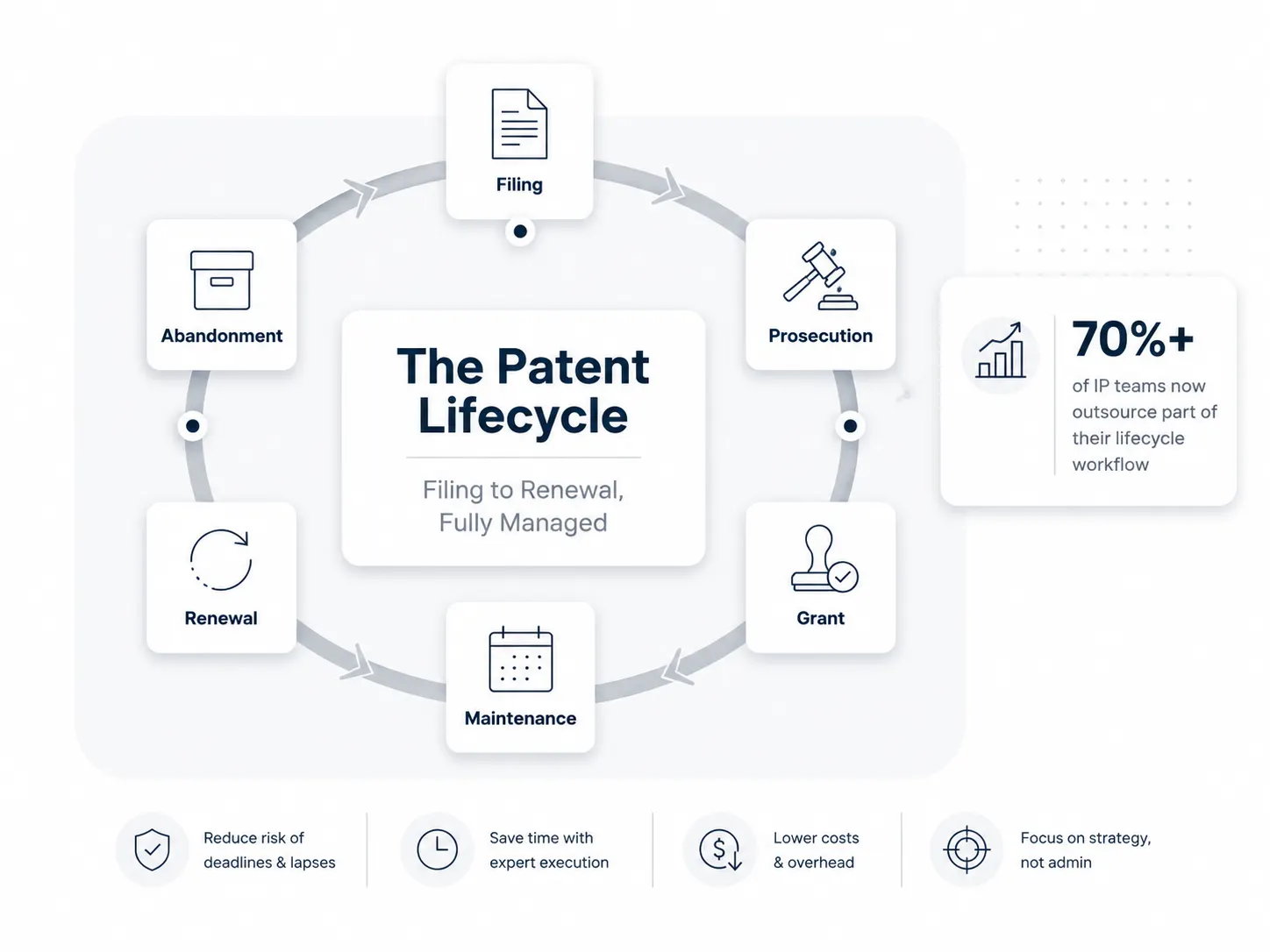
Patent lifecycle management (PLM) is the end-to-end process of tracking and administering a patent from initial filing through prosecution, grant, maintenance, renewal, and eventual abandonment or expiration.
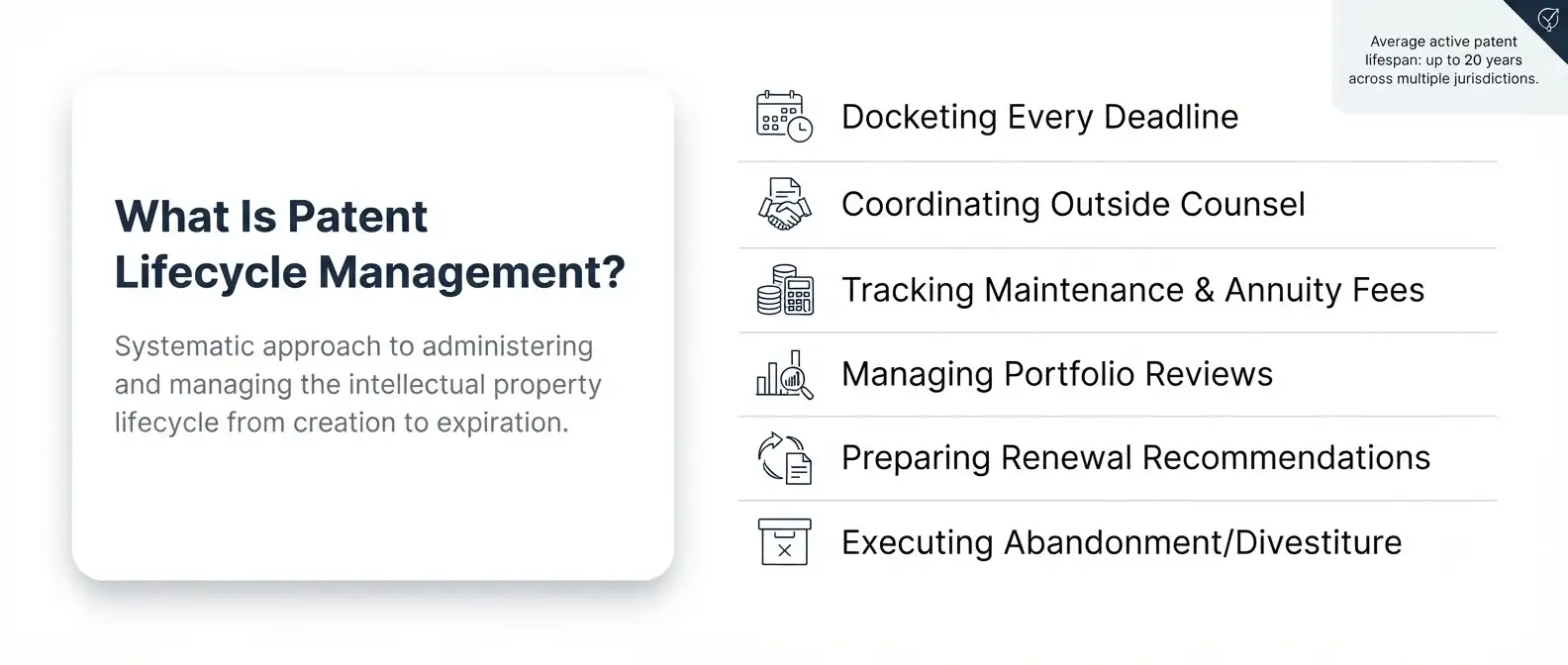
Unlike patent prosecution, which focuses narrowly on getting a single application allowed, lifecycle management covers the full ownership period of an asset, often 20 years or more. It includes:
- Docketing every statutory and internal deadline
- Coordinating with outside counsel and foreign associates
- Tracking maintenance and annuity fee obligations
- Managing portfolio reviews to decide what to keep, license, or drop
- Preparing renewal recommendations tied to business value
- Executing abandonment or divestiture when an asset no longer earns its keep
Done well, patent lifecycle management turns a portfolio from a static list of filings into a living asset that is actively managed against business strategy.
What is Patent Lifecycle Management Outsourcing?
Patent lifecycle management outsourcing is the practice of delegating some or all of these lifecycle functions, docketing, maintenance tracking, renewal analysis, and administrative prosecution support, to a specialized external provider instead of building and staffing that capacity internally.
Rather than replacing your in-house IP team, outsourcing typically supplements it. Attorneys and IP directors keep strategic decision-making in-house (which patents to file, which to license, which markets matter), while a dedicated outsourcing partner handles the operational backbone: docketing accuracy, deadline monitoring, fee payment coordination, and reporting.
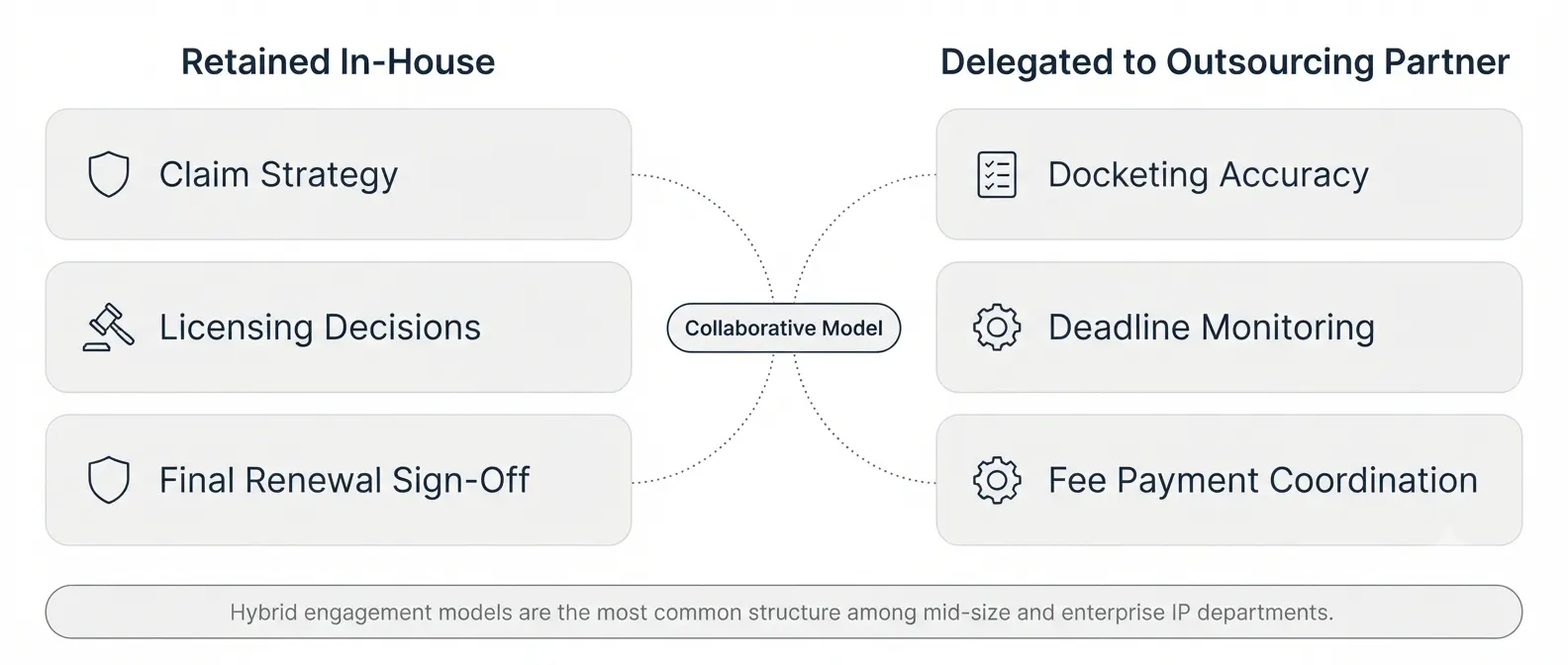
This distinction matters. Patent lifecycle management outsourcing is not about surrendering control of your portfolio. It is about freeing your team from repetitive administrative work so they can focus on the judgment calls that actually require a law degree.
Why Corporate IP Departments Are Outsourcing Patent Lifecycle Management
Three forces are pushing corporate IP departments toward outsourcing at the same time, and together they explain why this has become a board-level conversation rather than a back-office decision.
Rising Portfolio Complexity
Global filing volume keeps climbing, and with it, the number of jurisdictions, currencies, and local counsel relationships a single portfolio touches. According to the World Intellectual Property Organization, international patent filings under the Patent Cooperation Treaty have grown steadily for over a decade, which means more IP departments are now managing multi-jurisdictional dockets that a single in-house docketing clerk simply cannot cover reliably.
Budget Pressure and Cost Predictability
Finance teams increasingly want IP operations to behave like any other cost center: predictable, benchmarked, and scalable up or down with business need. Outsourcing converts fixed headcount costs into variable, often per-matter, pricing that is easier to forecast and defend during budget season.
Talent Shortages in Docketing and Paralegal Support
Experienced patent paralegals and docketing specialists are difficult to hire and expensive to retain, particularly for departments outside major metro hubs. Outsourcing solves this by tapping into a deeper, already-trained talent pool without the overhead of recruiting, training, and retaining specialized staff in-house.
Furthermore, turnover in docketing roles is especially disruptive because so much institutional knowledge, jurisdiction-specific quirks, internal escalation habits, historical portfolio context, lives with the individual rather than the system. When that person leaves, the risk of a missed deadline spikes immediately. A dedicated outsourcing partner spreads that knowledge across a team, so a single departure does not leave a portfolio exposed.
Rising Portfolio Complexity
International filings up year-over-year
Budget Pressure & Cost Predictability
IP ops budgets shifting toward variable cost models
Talent Shortages
Docketing specialist roles remain among the hardest legal-ops hires to fill
Signs Your IP Department Should Consider Outsourcing
Not every department needs to outsource immediately, but certain warning signs tend to appear before a missed deadline does. Consider outsourcing if your team recognizes several of the following:
- Docketing errors or near-misses have increased over the past twelve months.
- A single person’s absence would create a coverage gap for critical deadlines.
- Your portfolio has grown faster than your administrative headcount.
- Finance is asking for more predictable, benchmarked IP operating costs.
- Attorneys are spending measurable time each week on administrative docketing tasks instead of substantive legal work.
- Recent acquisitions or divestitures have left your docket fragmented across multiple systems.
If two or more of these apply, it is worth at least running a pilot audit with an outsourcing partner to see what an external review surfaces.
The Complete Patent Lifecycle: Stage-by-Stage Breakdown
Understanding where outsourcing fits requires understanding every stage of the lifecycle itself. Here is the full arc, stage by stage.
1. Filing and Prosecution
This stage begins with the initial application and continues through office actions, responses, and examiner interviews until the patent is allowed or abandoned. Deadlines here are statutory and unforgiving; missing one can mean losing the application entirely.
During prosecution, an IP department also coordinates Information Disclosure Statements, claim amendments, and, for international filings, entry into national phase under the Patent Cooperation Treaty. Each of these sub-tasks carries its own deadline, and each deadline needs to be cross-checked against the parent application and any related family members. This is precisely where a dedicated docketing specialist adds the most value, since a single overlooked national-phase deadline can eliminate protection in an entire country.
2. Grant and Docketing
Once a patent grants, it must be entered into a docketing system with every future deadline calculated correctly, including maintenance fee windows, foreign filing deadlines, and any co-pending family member obligations.
Accuracy at this stage sets the tone for everything downstream. If a grant date, priority date, or family relationship is entered incorrectly, every subsequent deadline calculation inherits that error. Consequently, many outsourcing providers build a secondary, independent audit into their onboarding process specifically to catch mistakes before they compound over the following two decades.
3. Maintenance and Annuity Payments
Most jurisdictions require periodic fees to keep a patent alive. In the United States, this means maintenance fees due at 3.5, 7.5, and 11.5 years after grant. Internationally, annuity payments are often due annually, and missing one payment window can permanently extinguish the right. The USPTO’s maintenance fee schedule outlines the exact windows and surcharge periods that apply.
Because annuity schedules vary so widely by country, some due six months before the anniversary date and others due on it, this stage is one of the most common places where in-house teams without dedicated global docketing support run into trouble. An outsourcing partner with established foreign associate networks can track these variances automatically rather than relying on manual country-by-country research.
4. Portfolio Review and Pruning
Periodically, a business needs to ask which patents still serve a strategic or commercial purpose. This stage involves cross-referencing each asset against current product lines, licensing revenue, and competitive positioning.
A thorough review typically layers in remaining patent term, current litigation or licensing activity, and whether a competitor has designed around the claims. Larger portfolios benefit from running this review annually rather than only during a budget crunch, since a proactive review consistently identifies more low-value patents to prune than a reactive one does.
5. Renewal Decisions
Renewal is not automatic. It is a business decision informed by legal status, commercial relevance, litigation exposure, and remaining term. A structured renewal workflow prevents both accidental lapses and unnecessary spend on patents with no ongoing value.
Best-in-class renewal workflows assign each matter a simple score, combining commercial relevance, remaining term, and maintenance cost, so decision-makers can quickly triage a large docket instead of reviewing every asset individually every cycle.
6. Abandonment and Divestiture
When a patent no longer justifies its maintenance cost, formal abandonment, licensing, or sale becomes the final stage. Handling this properly avoids wasted annuity spend while preserving optionality where a sale or license might still generate value.
Before abandoning any asset, it is worth checking whether it holds value to a third party even if it no longer fits current product lines. A brief marketplace check or broker consultation can sometimes recover meaningful value from a patent that would otherwise simply lapse.
Prosecution
Docketing
+30 days
& Annuity Payments
Review & Pruning
Decisions
& Divestiture
What Functions Can Be Outsourced Across the Patent Lifecycle?
Not every function needs to move outside the organization. The table below breaks down what is commonly outsourced versus what typically stays in-house.
| Lifecycle Stage | Commonly Outsourced | Typically Kept In-House |
|---|---|---|
| Filing & Prosecution | IDS preparation, formal filing, drawing preparation | Claim strategy, examiner interviews |
| Docketing | Deadline calculation, database entry, audits | Docketing system selection and policy |
| Maintenance & Annuities | Fee payment coordination, deadline tracking | Final go/no-go renewal decisions |
| Portfolio Review | Data compilation, reporting, analytics | Strategic value assessments |
| Renewal | Recommendation reports, cost modeling | Final renewal sign-off |
| Abandonment | Documentation, formal filings | Business justification and approval |
For a deeper look at where docketing fits specifically, our guide on what double-docketing is in patent law explains how redundant tracking systems protect against missed deadlines during this stage.
In-House vs. Outsourced Patent Lifecycle Management
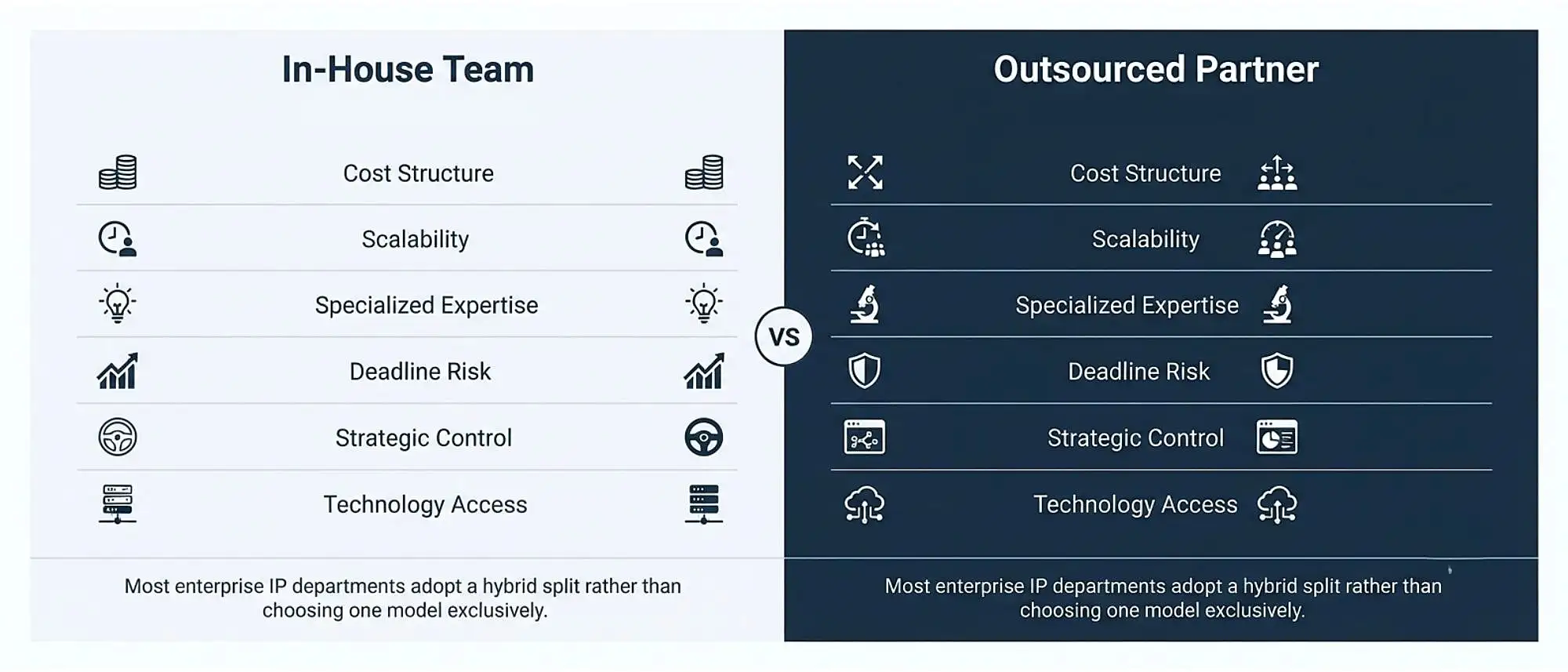
The decision between building internal capacity and outsourcing usually comes down to five factors: cost, scalability, expertise depth, risk exposure, and control. Here is how they compare.
| Factor | In-House Team | Outsourced Partner |
|---|---|---|
| Cost Structure | Fixed salaries, benefits, training, software | Variable, per-matter or subscription pricing |
| Scalability | Slow, tied to hiring cycles | Fast, scales with portfolio size |
| Specialized Expertise | Limited to hires available locally | Access to a deeper, cross-jurisdictional talent pool |
| Deadline Risk | Concentrated in a small team | Distributed across trained specialists with redundancy checks |
| Strategic Control | Full, but time-constrained by administrative load | Retained for decisions, delegated for execution |
| Technology Access | Requires internal investment | Often included as part of the service |
Notably, this is not an all-or-nothing choice. Most corporate IP departments land on a hybrid model, similar to what we outline in our article on IP portfolio management outsourcing cost, process, and ROI, where in-house attorneys retain strategic authority and the outsourced partner handles execution.
Key Benefits of Patent Lifecycle Management Outsourcing
Corporate IP departments that outsource lifecycle management consistently report the following advantages.
- Predictable, scalable costs. Instead of adding headcount for every portfolio increase, departments pay for capacity as needed.
- Reduced deadline risk. Specialized providers use dedicated docketing software, redundant audits, and dual-review processes that a lean in-house team often cannot replicate.
- Faster onboarding of new matters. Experienced outsourcing partners can absorb acquired portfolios or new filing volume without a hiring lag.
- Access to global expertise. A single partner can often coordinate across dozens of jurisdictions, reducing the number of foreign associate relationships an in-house team must manage directly.
- Freed-up attorney time. When administrative tasks move off an attorney’s desk, that attorney can spend more time on claim strategy, licensing, and litigation support.
- Better data for renewal decisions. Many outsourcing partners provide portfolio analytics that make renewal and abandonment decisions more defensible to finance and leadership.
Taken together, these benefits explain why industry surveys, including reporting from the American Intellectual Property Law Association, have consistently shown corporate IP budgets shifting a larger share of operational spend toward external service providers rather than expanding in-house administrative headcount. The pattern reflects a broader trend across legal operations: strategic work stays internal, while high-volume, process-driven work moves to specialized partners built to handle it at scale.
Common Mistakes When Outsourcing Patent Lifecycle Management
Even well-intentioned outsourcing initiatives can go wrong. Watch for these recurring mistakes.
Predictable Costs
Stable budgets with fixed-fee or retainer models.
Reduced Deadline Risk
Expert docketing and proactive management.
Faster Onboarding
Accelerated integration and process adoption.
Global Expertise Access
Instant access to specialized foreign counsel.
Freed-Up Attorney Time
Shift focus to high-value IP strategy.
Better Renewal Data
Enhanced portfolio visibility and decision-making.
- Outsourcing without a data migration plan. Moving thousands of docketed matters to a new system without a validated audit trail creates a window where deadlines can slip through unnoticed.
- Treating the provider as a black box. IP directors who do not request regular reporting lose visibility into portfolio health and cannot catch errors early.
- Underestimating the transition period. A rushed handoff, particularly around active maintenance fee windows, increases the risk of a missed payment.
- Choosing price over process maturity. The cheapest vendor is rarely the one with the strongest quality-control system; a missed deadline costs far more than the savings.
- Failing to define escalation protocols. Without clear rules for who flags a discrepancy and how quickly, small docketing errors can compound.
- Ignoring jurisdiction-specific nuance. Maintenance rules, grace periods, and surcharge structures vary significantly by country, and a generalist provider may not catch every local requirement.
Expert Tips for a Successful Outsourcing Transition
Transition Readiness Checklist
Start With an Audit
Assess current processes and data health before beginning.
Run a Parallel Period
Operate both old and new systems simultaneously to ensure accuracy.
Define Clear SLAs
Establish measurable performance metrics and expectations from day one.
Request Quarterly Reviews
Schedule regular performance check-ins with your outsourcing partner.
Keep Decision Authority Documented
Clearly outline roles for strategic and operational decisions.
Ask About Redundancy
Understand the partner’s backup systems and disaster recovery plans.
- Start with an audit. Before transferring anything, have your prospective partner audit a sample of your current docket to confirm accuracy and surface existing errors.
- Run a parallel period. For at least one full maintenance fee cycle, keep dual tracking between your legacy system and the new provider until confidence is established.
- Define clear service-level agreements (SLAs). Specify turnaround times, error tolerance, and escalation windows in writing.
- Request quarterly portfolio reviews. These reviews should tie directly into your renewal and abandonment decision cycle, not just confirm that fees were paid.
- Keep decision authority documented. Make sure it is explicit, in the engagement agreement, that final renewal and abandonment decisions remain with your legal team.
- Ask about redundancy. A strong provider should have more than one person capable of managing any given matter, so a single staff departure does not create a coverage gap.
How to Choose a Patent Lifecycle Management Outsourcing Partner
Selecting the right partner is arguably the single highest-leverage decision in this entire process. Follow this step-by-step approach.
- Define the scope. Decide upfront whether you need full lifecycle support or specific functions, such as docketing or maintenance fee tracking alone.
- Shortlist providers with attorney oversight. Providers that operate under direct attorney supervision, rather than pure clerical staff, tend to catch strategic issues earlier.
- Evaluate their quality-control process. Ask specifically how they catch and correct docketing errors, and how often internal audits occur.
- Check jurisdictional coverage. Confirm the provider has direct experience with every country where your portfolio has active matters.
- Review their technology stack. Confirm compatibility with your existing docketing software, or ask what platform they will migrate you to.
- Request references from similarly sized portfolios. A provider built for boutique firms may struggle with an enterprise-scale, multi-thousand-matter docket, and vice versa.
- Pilot before committing fully. Start with a defined subset of the portfolio, such as one product line or region, before a full migration.
- Negotiate transparent pricing. Make sure the pricing model, whether per-matter, subscription, or hourly, is fully disclosed with no hidden per-transaction fees.
For departments comparing staffing models specifically, our comparison of hiring an in-house versus a virtual patent paralegal offers additional detail relevant to this decision.
Cost Structures: What Does Patent Lifecycle Management Outsourcing Cost?
Pricing models vary by provider, but most fall into one of three categories.
- Per-matter pricing: A flat fee for each patent or application managed, useful for departments with stable, predictable portfolio sizes.
- Subscription or retainer pricing: A monthly or annual fee covering a defined scope of services, common for larger portfolios needing continuous coverage.
- À la carte pricing: Pay only for specific services used, such as docketing audits or maintenance fee coordination, without committing to a full-service package.
Costs also depend on portfolio complexity, the number of jurisdictions involved, and whether the provider handles fee payment on your behalf or only tracks deadlines for internal payment. IP directors should request an itemized quote that separates administrative fees from government fee pass-throughs to avoid surprises later. Our detailed breakdown of patent docketing services for mid-size and large IP firms includes a closer look at typical pricing structures across provider types.
Per-Matter Pricing
Fixed fee per filing or action
- Best for stable, predictable portfolios
- Simple budgeting for new applications
- Clear cost-per-action visibility
Subscription / Retainer
All-inclusive coverage for a fixed period
- Best for large, continuous-coverage portfolios
- Simplifies administrative workload
- Predictable annual IP spend
À La Carte
Select specific services as needed
- Best for targeted needs like audits only
- Flexible for ad-hoc projects
- Customized service selection
The Role of Technology in Patent Lifecycle Management Outsourcing
Technology is not a replacement for outsourced expertise, but it is what makes modern patent lifecycle management outsourcing reliable at scale. When evaluating a provider, look closely at three technology components.
- Docketing software. Most established providers use enterprise-grade docketing platforms with automated deadline calculation, redundancy checks, and audit trails. Confirm whether the provider works within your existing platform or requires a migration.
- Reporting dashboards. Real-time visibility into portfolio status, upcoming deadlines, and maintenance fee obligations should be available to your team at any time, not just during scheduled check-ins.
- Integration capability. If your organization uses an internal IP management system, confirm the provider can integrate with it or export data in a compatible format, so you are never locked into a single vendor’s ecosystem.
It is worth noting that technology alone does not prevent errors. The strongest providers pair automated deadline tracking with a human dual-review process, since software can calculate a date correctly only if the underlying data entry was accurate in the first place.
A Practical Example: Scaling After an Acquisition
Consider a mid-size technology company that acquires a smaller competitor and, almost overnight, doubles its active patent portfolio across six new jurisdictions. The in-house IP team, previously managing a stable docket of a few hundred matters, now faces thousands of deadlines spread across unfamiliar countries and legacy docketing systems inherited from the acquired company.
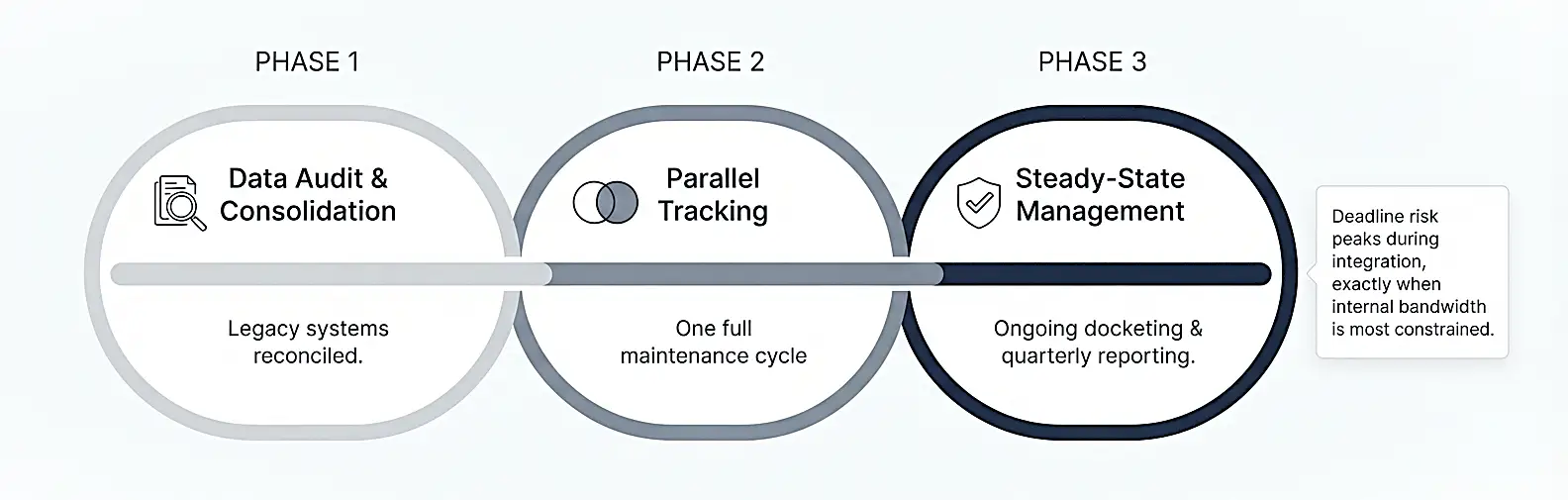
In a scenario like this, patent lifecycle management outsourcing typically unfolds in three phases:
- Data audit and consolidation. The outsourcing partner reviews both legacy docketing systems, reconciles discrepancies, and consolidates everything into a single, verified system of record.
- Parallel tracking. For one full maintenance cycle, the provider tracks deadlines alongside the in-house team to confirm accuracy before full handoff.
- Steady-state management. Once confidence is established, the provider assumes ongoing docketing, maintenance tracking, and quarterly portfolio reporting, while the in-house team focuses on integrating the acquired IP strategy into the broader business.
This kind of scenario illustrates why speed and process discipline matter as much as cost when selecting a partner: the risk of a missed deadline during a merger integration is far higher than during steady-state operations, precisely when internal bandwidth is most stretched.
Frequently Asked Questions
What is patent lifecycle management outsourcing?
Patent lifecycle management outsourcing is the practice of delegating administrative and operational patent tasks, such as docketing, maintenance fee tracking, and renewal reporting, to an external provider while retaining strategic decision-making in-house.
Is patent lifecycle management outsourcing only for large portfolios?
No. While large enterprise portfolios see the most dramatic efficiency gains, small and mid-size IP departments also benefit, particularly when they lack dedicated docketing staff or need to scale quickly after an acquisition.
Does outsourcing patent lifecycle management mean losing control of decisions?
No. A well-structured engagement keeps final decisions, such as renewal, abandonment, and claim strategy, with your internal legal team. The outsourcing partner handles execution and tracking, not judgment calls.
How long does it take to transition to an outsourced patent lifecycle management provider?
Transition timelines vary by portfolio size but typically range from four to twelve weeks, including a data audit, parallel tracking period, and full cutover.
What is the biggest risk in patent lifecycle management outsourcing?
The biggest risk is a poorly managed data migration that introduces docketing errors during the transition. This is why a parallel tracking period and an upfront audit are essential.
Can outsourcing help with international patent portfolios specifically?
Yes. Providers with established networks of foreign associates can often coordinate multi-jurisdictional maintenance and renewal obligations more efficiently than an in-house team managing dozens of separate local counsel relationships. Organizations filing under the Patent Cooperation Treaty, for example, benefit from a partner familiar with WIPO’s PCT national phase entry requirements, which vary significantly from country to country.
How do I measure ROI on patent lifecycle management outsourcing?
Most IP directors track ROI using a combination of hard and soft metrics: reduction in missed-deadline incidents, cost per matter compared to the fully loaded cost of an equivalent in-house headcount, attorney hours reclaimed from administrative work, and improved renewal decision accuracy as measured by post-decision portfolio value reviews.
What happens to my data if I switch outsourcing providers later?
A well-structured engagement agreement should guarantee full data portability, meaning your complete docketing history, deadlines, and matter files can be exported in a standard format at any time, without penalty, so you are never locked into a single provider indefinitely.
Is Patent Lifecycle Management Outsourcing Right for Your Portfolio?
Patent lifecycle management outsourcing is no longer a niche solution reserved for the largest enterprises. As portfolios grow more complex and budgets face closer scrutiny, corporate IP departments of nearly every size are finding that a hybrid model, strategic decisions in-house, operational execution outsourced, delivers both cost predictability and stronger deadline protection.
The key is choosing a partner with proven process discipline, attorney-level oversight, and transparent reporting, then structuring the engagement so your team retains the decisions that matter most. Done correctly, patent lifecycle management outsourcing does not weaken your control over the portfolio; it strengthens it by removing the administrative burden that too often causes costly mistakes.
If your department is ready to explore what a structured outsourcing engagement could look like for your specific portfolio, our team can walk through your docket and build a tailored plan.
Get a Lifecycle Management Proposal to see exactly how patent lifecycle management outsourcing could reduce your risk and administrative overhead.
About IP Management Services for Law Firms and Corporate IP Teams

