
A missed patent deadline does not arrive with a warning siren. It shows up months later as an abandoned application, a lapsed maintenance fee, or a general counsel asking why a core patent no longer exists. For corporate IP departments managing hundreds or thousands of matters across multiple jurisdictions, finding the best patent docketing companies for corporations is not a housekeeping decision. It is a risk-management decision that touches the company’s entire competitive position.

Unlike a solo practitioner or a small firm comparing docketing templates, in-house IP teams are usually evaluating vendors against enterprise procurement standards: data security audits, service-level agreements, integration with existing IP management systems, and the ability to scale as the portfolio grows through acquisitions or new filing programs. This guide breaks down exactly what separates a capable corporate patent docketing partner from a vendor that will eventually become a liability, and it gives IP directors and general counsel a practical, repeatable framework for making that call.
What is Patent Docketing, and Why Does It Matter for Corporations?
Patent docketing is the systematic tracking, calculation, and management of every deadline, filing requirement, and procedural event tied to a patent application or granted patent, from initial filing through prosecution, issuance, and maintenance.
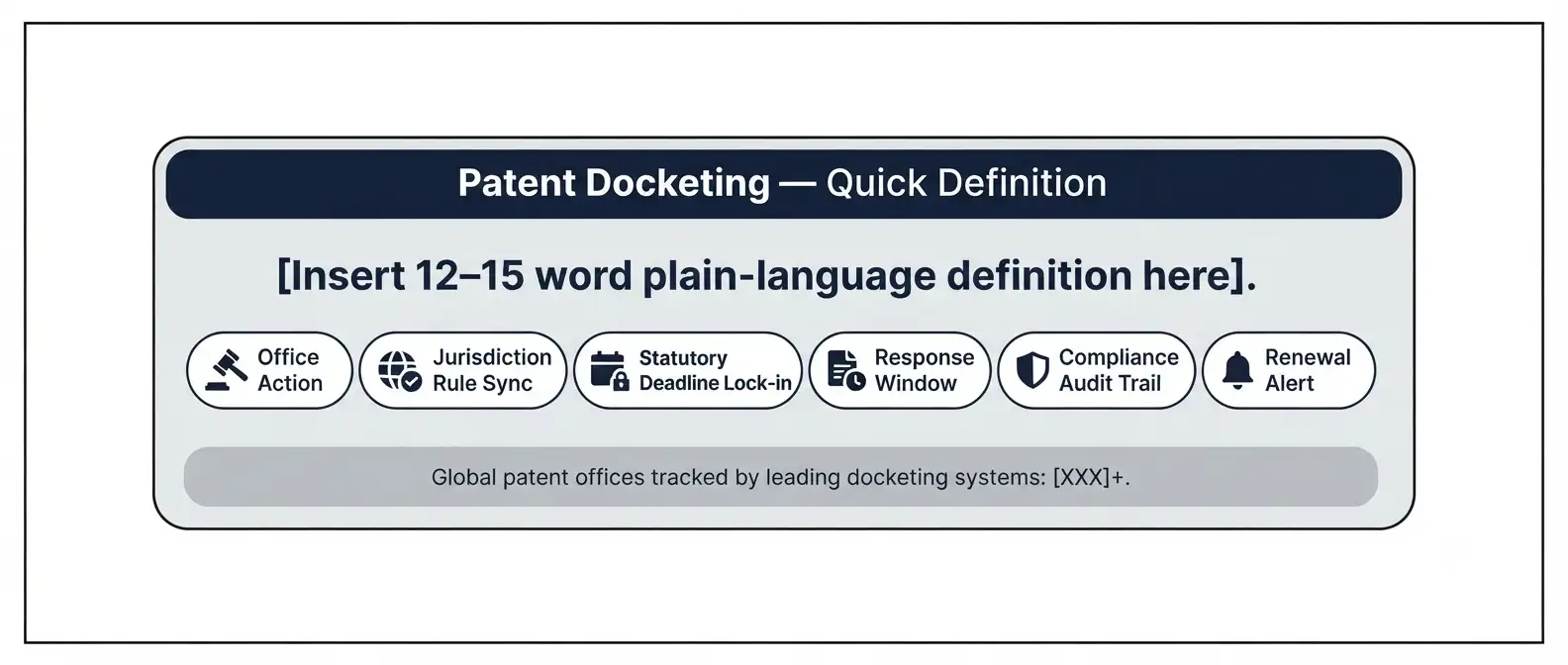
It includes:
- Calculating statutory and office-specific deadlines across jurisdictions
- Tracking Office Action response windows
- Monitoring maintenance and annuity fee due dates
- Managing PCT national phase entry timelines
- Flagging Patent Term Adjustment (PTA) and Patent Term Extension (PTE) events
- Maintaining an audit-ready record of every docketed action
For a corporate IP department, docketing is the operational backbone that keeps a patent portfolio alive. A single missed maintenance fee payment can permanently abandon a patent that took years and significant R&D investment to secure. That is why the search for best patent docketing companies for corporations consistently ranks as a high-priority, high-budget decision rather than a routine vendor swap.
Why Corporate Docketing Needs Differ From Law Firm Docketing Needs
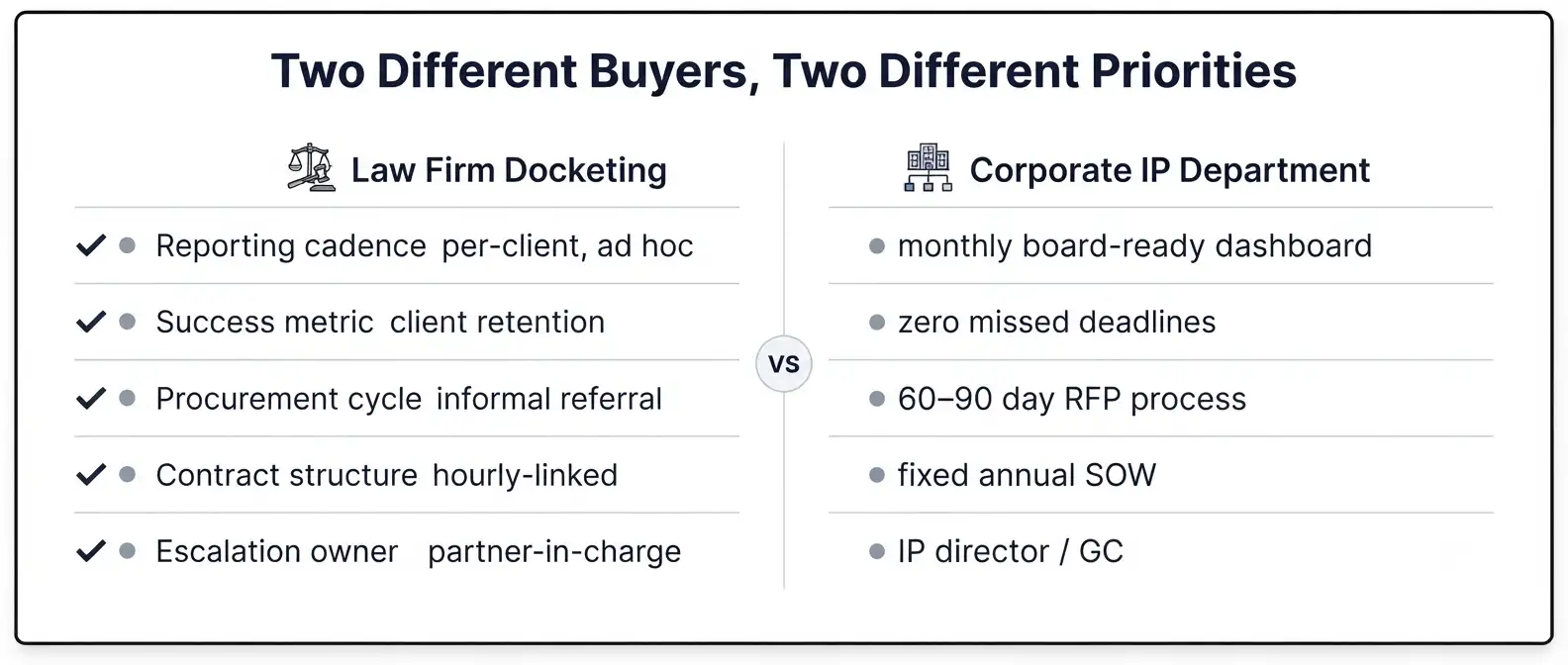
Corporate IP departments are frequently pitched the same docketing services marketed to outside counsel, but the two buyers have fundamentally different requirements. Understanding this gap is essential before evaluating any vendor.
- Portfolio ownership, not client service. A law firm dockets matters on behalf of many different corporate clients, each with separate instructions. A corporate IP department owns a single, unified portfolio, so consistency and centralized reporting matter more than client-by-client customization.
- Budget accountability to finance, not billable hours. Outside counsel docketing costs are often absorbed into hourly billing. Corporate departments answer to a fixed annual IP budget, so predictable, à la carte pricing carries far more weight in the decision.
- Integration with enterprise systems. Corporations frequently need docketing data to flow into enterprise resource planning (ERP), contract lifecycle management, or business intelligence tools used across the broader legal or finance organization, not just a standalone case management system.
- M&A and divestiture readiness. Corporate portfolios grow and shrink through acquisitions, licensing deals, and business unit sales. A docketing partner needs the capacity to absorb thousands of new matters on short notice, or cleanly transfer matters out, without disrupting existing deadlines.
- General counsel visibility. Corporate IP directors typically need portfolio-level dashboards suitable for presenting to the general counsel or board, not just matter-level detail intended for a prosecuting attorney.
These differences are precisely why searching for best patent docketing companies for corporations returns a different set of priorities than searching for docketing services aimed at small law firms.
Software vs. Managed Docketing Companies: Know the Difference First
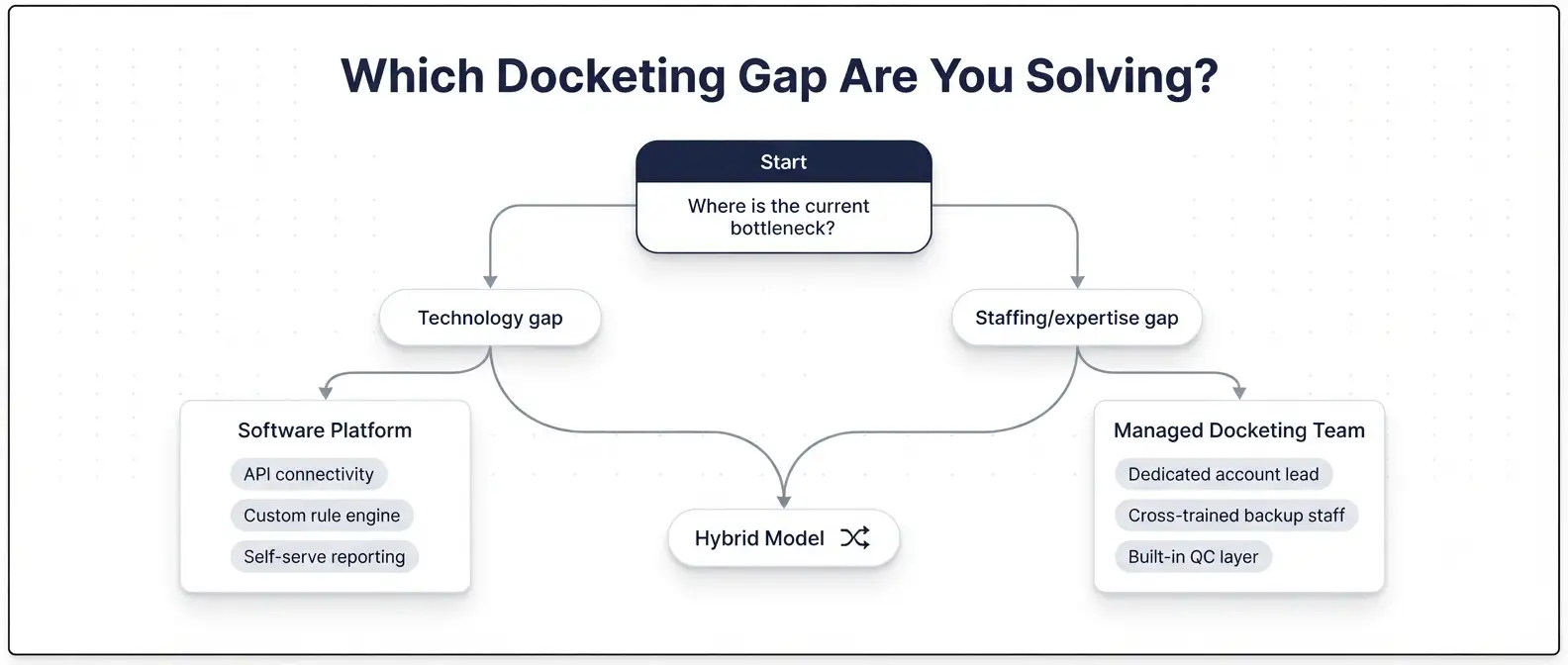
Before comparing vendors, corporate IP teams need to separate two very different categories that often get lumped together in search results.
Patent Docketing Software Platforms
These are technology platforms that corporations license and staff internally. Well-known enterprise platforms in this category include Anaqua, Clarivate’s Unycom, IPfolio, Patrix, and AppColl. They provide the system of record, automated deadline calculation engines, and reporting dashboards, but the corporation’s own paralegals and docketing clerks still perform the daily data entry, quality control, and exception handling.
Full-Service Managed Docketing Companies
These are outsourced teams of trained IP paralegals and docketing specialists who operate inside (or alongside) a docketing platform on the corporation’s behalf. Instead of hiring, training, and retaining an internal docketing staff, the company relies on a vendor’s people, processes, and quality-control layers to keep the portfolio current. Dennemeyer, Clarivate/CPA Global, Computer Packages Inc. (CPI), Foundation IP, and boutique providers such as Teak IP fall into this category.
Many corporate IP departments end up needing both: a software system of record plus a managed services partner to operate it accurately and consistently. Recognizing which gap you are actually trying to fill, a technology gap or a staffing and expertise gap, is the first step in narrowing the vendor list.
Maintenance Fees, Annuities, and the Hidden Risk in Corporate Portfolios
Deadline tracking for active prosecution tends to get the most attention, but maintenance and annuity payments quietly represent one of the largest financial exposure points in a corporate patent portfolio. Once a patent issues, most jurisdictions require periodic payments to keep it in force, and the payment schedules, grace periods, and surcharge structures vary significantly by country.
A strong docketing partner should be able to demonstrate:
- Automated annuity calendars that flag upcoming payments well before grace-period surcharges apply
- Clear escalation paths when a business decision is needed on whether to maintain, abandon, or license a specific asset
- Consolidated invoicing across jurisdictions, so finance teams are not reconciling dozens of separate foreign agent invoices
- Historical payment audit trails that satisfy both internal compliance reviews and external audits
Corporations that outsource this function well typically report fewer inadvertent abandonments and cleaner year-end portfolio audits, because the payment obligation is tracked independently of any single employee’s institutional knowledge.
Legacy Portfolio Data Migration and Digitization
Every corporate docketing vendor transition eventually runs into the same challenge: the accuracy of the new system depends entirely on the accuracy of the data moved into it. Corporations sitting on decades of paper files, scanned PDFs, or an outdated legacy docketing system need a vendor capable of clean, verified data digitization, not just deadline calculation going forward.
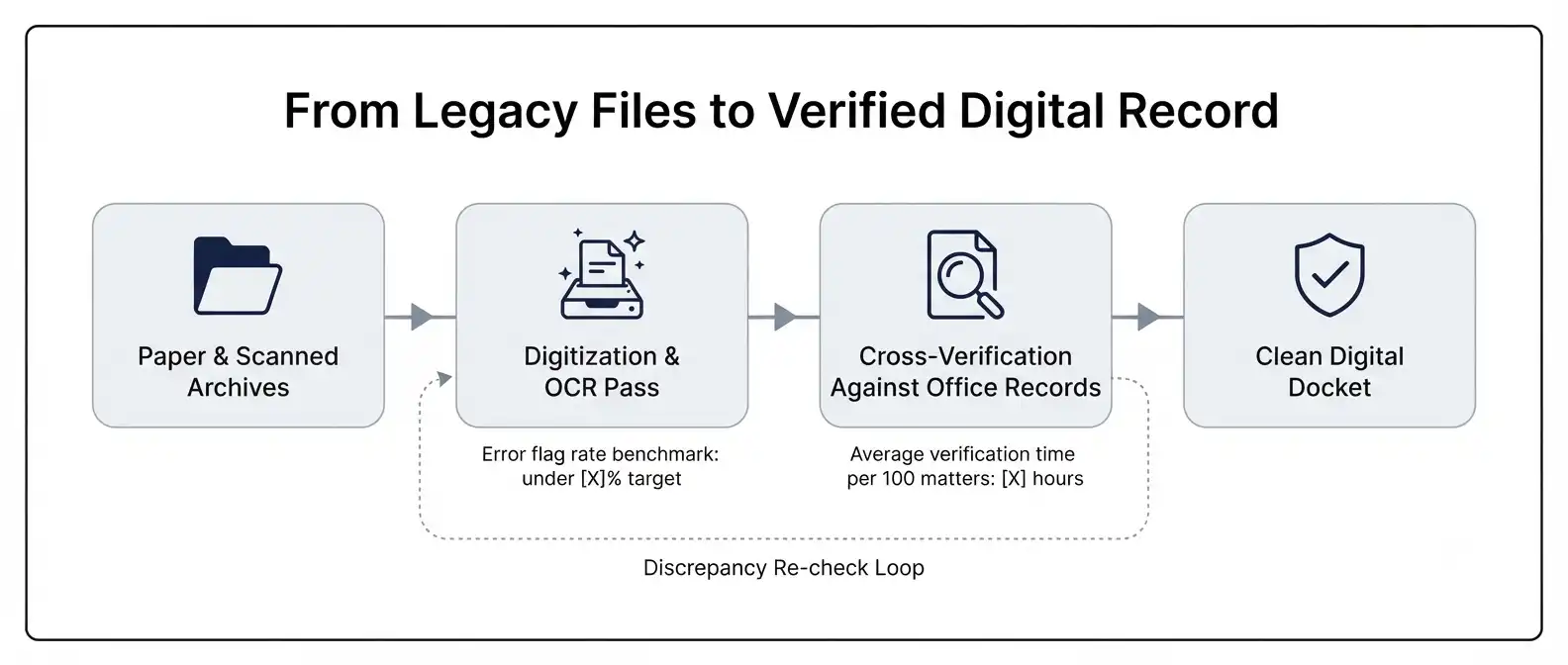
Before signing with any vendor, ask specifically how they handle:
- Legacy record digitization, converting paper prosecution histories and correspondence into searchable, docketed digital records
- Data validation, cross-checking migrated deadlines against official patent office records rather than assuming the old system was correct
- De-duplication, since portfolios built through multiple acquisitions frequently contain duplicate or conflicting matter records
- Chain-of-title verification, confirming assignment and ownership records migrate accurately alongside deadline data
Skipping this step is one of the most expensive mistakes a corporate IP department can make, because errors inherited from a poor migration often surface only when a deadline is missed months or years later.
Key Criteria for Evaluating Patent Docketing Companies
Corporate procurement teams typically score docketing vendors against a fairly consistent set of criteria. Use the table below as a starting scorecard.
| Evaluation Criteria | What to Look For | Why It Matters for Corporations |
|---|---|---|
| Global jurisdiction coverage | Coverage of USPTO, EPO, and at least 50+ national and regional offices | Multinational portfolios require accurate rules for every filing jurisdiction |
| Quality control structure | Multi-layered review, not single-reviewer sign-off | Reduces the risk of a single human error causing abandonment |
| Attorney oversight | US-licensed IP attorneys reviewing complex calculations | Adds a compliance and liability safeguard beyond paralegal review |
| Data security and compliance | SOC 2 or equivalent audit, encryption, access controls | Corporate legal and IT will require this before onboarding |
| Integration capability | Works with existing docketing software (Anaqua, IPfolio, etc.) | Avoids costly, disruptive system migrations |
| Pricing model | Transparent, à la carte, or per-matter pricing | Enables predictable budgeting for finance and procurement |
| Scalability | Ability to flex up during acquisitions or filing surges | Protects against backlog when portfolio volume spikes |
| Turnaround time | Documented SLAs for docketing new matters and updates | Keeps deadlines current in real time, not in weekly batches |
This scorecard approach mirrors the same due-diligence discipline outlined in our IP Vendor Due Diligence Checklist for Law Firms and Corporate Legal Teams IP vendor due diligence checklist, which corporate legal departments can adapt directly for docketing vendor RFPs.
Comparison Table: Docketing Company Models for Corporate IP Departments
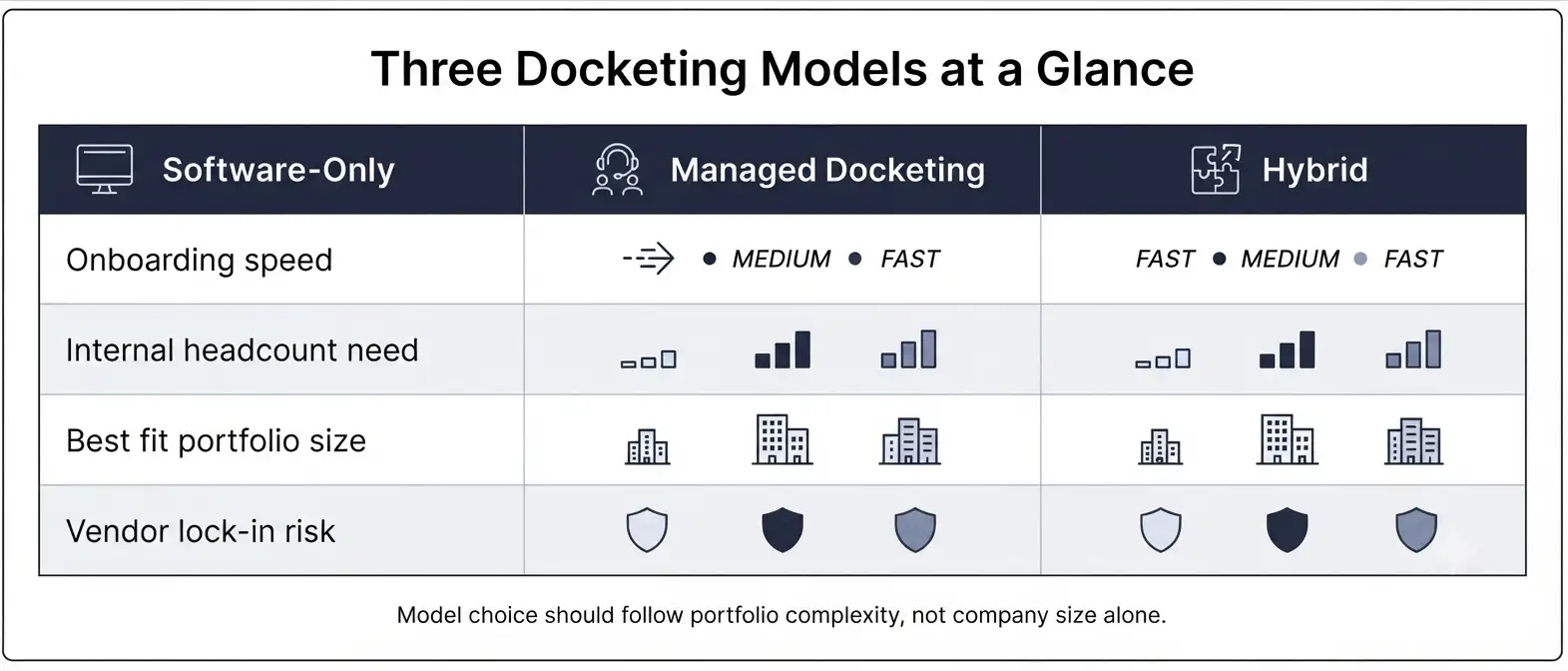
Because “best” depends heavily on portfolio size, budget, and internal staffing, the table below compares the three most common models corporations choose between.
| Model | Best For | Typical Cost Structure | Trade-Offs |
|---|---|---|---|
| In-house software only (e.g., Anaqua, IPfolio, Patrix) | Large departments with dedicated internal docketing staff | Per-user/per-matter licensing, often starting near $100–$150/user/month | Full control, but corporation bears all staffing and error-management risk |
| Full-service managed docketing (e.g., Dennemeyer, CPI, Teak IP, Foundation IP) | Mid-size to large corporate portfolios wanting outsourced accuracy and staffing flexibility | À la carte, per-matter, or subscription-based | Lower internal headcount burden, but requires strong vendor oversight and SLAs |
| Hybrid (software + staff augmentation) | Corporations mid-transition or scaling rapidly | Software license plus staffing fees | Best of both, but requires careful vendor coordination to avoid duplicated work |
Corporate IP departments comparing this decision at a strategic level often benefit from the broader framework in our guide on How to Evaluate and Compare IP Outsourcing Companies how to evaluate and compare IP outsourcing companies, which walks through the same decision at the portfolio-wide level rather than docketing alone.
Top Features the Best Patent Docketing Companies for Corporations Offer
When corporate IP directors run a request for proposal (RFP), the strongest vendors consistently offer these features:
- Multi-jurisdiction deadline automation covering both national and regional filing offices
- Redundant quality control, meaning at least two independent reviewers verify each docketed deadline before it is finalized
- Attorney-reviewed calculations for complex matters like continuations, divisionals, and Patent Term Adjustment
- Real-time reporting dashboards that give general counsel portfolio-wide visibility
- Data migration expertise, so historical portfolio data transfers accurately into any new system
- Dedicated account management, rather than a rotating pool of anonymous processors
- Flexible, transparent pricing that does not lock the corporation into rigid annual minimums
- Disaster recovery and business continuity plans, since a docketing outage during a filing deadline is unacceptable
If your organization is also weighing whether to bring these functions fully in-house or hand them to a specialized paralegal team, our article on Patent Paralegal Outsourcing for Corporate IP Departments patent paralegal outsourcing for corporate IP departments walks through that staffing trade-off in detail.
Step-by-Step: How to Choose the Right Patent Docketing Company
Selecting a docketing partner does not need to be a months-long ordeal. Follow this repeatable process:
- Audit your current portfolio pain points. Identify whether missed deadlines, slow onboarding of new matters, or poor reporting are the core problem.
- Define your must-have criteria. Use the evaluation table above to rank criteria by priority for your department.
- Shortlist three to five vendors. Include at least one pure software platform and at least one full-service managed provider for a fair comparison.
- Request references from corporations of similar size. A vendor that excels with a 200-patent portfolio may struggle at 5,000 matters, and vice versa.
- Run a data migration test. Ask the vendor to migrate a sample of your existing docket to confirm accuracy before committing to a full transition.
- Review the SLA in detail. Confirm turnaround times, escalation procedures, and what happens if a deadline is missed due to vendor error.
- Confirm security and compliance documentation. Corporate legal and IT should sign off before any live data transfers.
- Start with a pilot or phased rollout. Migrate one practice group or jurisdiction first, rather than the entire portfolio at once.
For corporations weighing the full lifecycle impact of this decision, not just docketing, but prosecution support, maintenance, and eventual portfolio pruning, our Patent Lifecycle Management Outsourcing: A Complete Guide patent lifecycle management outsourcing guide is a useful companion resource.
Data Security and Compliance Expectations for Enterprise Buyers
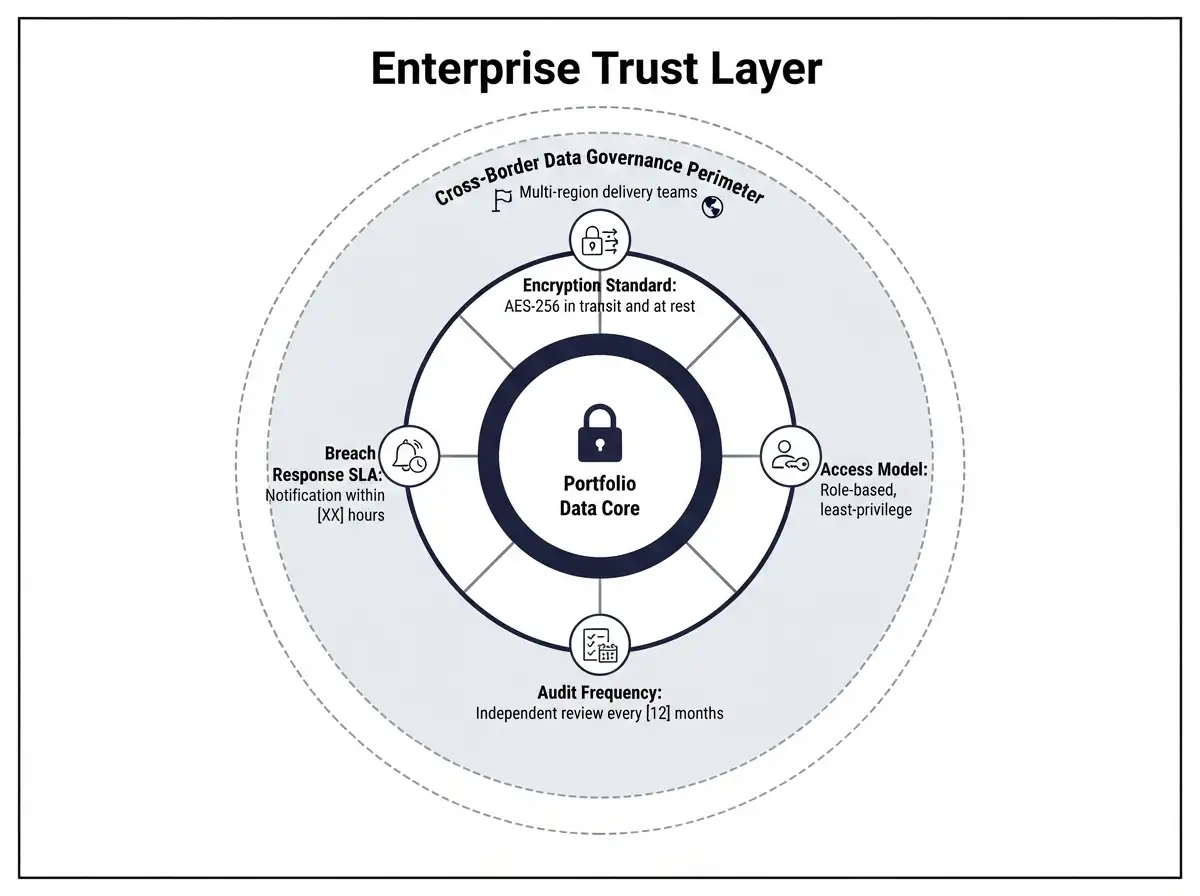
Corporate procurement and information security teams almost always require vendor due diligence beyond what a solo practitioner or small firm would ask. Before a docketing company touches a single active matter, expect your IT and security teams to request:
- Evidence of a current SOC 2 Type II report or equivalent independent security audit
- Documentation of data encryption both in transit and at rest
- A defined data breach notification protocol with specific response timelines
- Role-based access controls limiting which vendor staff can view or edit specific client portfolios
- A signed data processing agreement addressing cross-border data transfer, particularly relevant when a vendor operates delivery teams outside the United States
Corporations with especially sensitive portfolios, such as those in defense, pharmaceuticals, or semiconductors, should also confirm whether the vendor screens staff who will have access to unpublished, confidential invention disclosures.
A Practical Scenario: Evaluating Vendors During Portfolio Growth
Consider a mid-size technology company with roughly 600 active patent matters that just closed an acquisition adding another 400 matters across new jurisdictions. The in-house docketing team, previously sized for 600 matters, is now facing a 65% volume increase with no corresponding headcount approval.
This is precisely the scenario where the distinction between software-only and full-service managed docketing becomes concrete. A software platform alone will not absorb the surge, since the existing internal staff still has to enter, verify, and reconcile every new matter manually. A managed docketing partner, by contrast, can scale a delivery team to absorb the acquired portfolio, run a data validation pass against the acquired company’s prior records, and integrate everything into a single reporting structure, often faster and at lower incremental cost than hiring and training new internal staff during an already disruptive integration period.
This kind of surge capacity is one of the most underrated reasons corporations choose managed docketing partners over software alone, and it is worth testing directly in any RFP by asking vendors how quickly they can onboard a comparable volume increase.
Common Mistakes Corporate IP Departments Make When Choosing a Docketing Vendor
Even experienced IP directors run into avoidable problems during vendor selection. Watch for these common mistakes:
- Choosing based on price alone. The cheapest vendor often has the thinnest quality-control layer, which is exactly where portfolio risk hides.
- Skipping the data migration test. Corporations that skip this step frequently discover data entry errors only after a deadline is missed.
- Underestimating jurisdiction complexity. A vendor strong in US and European filings may lack depth in Asia-Pacific or Latin American procedures.
- Ignoring escalation protocols. If a docketing error is discovered, the corporation needs to know exactly who is accountable and how fast it will be corrected.
- Failing to involve IT and security early. Bringing IT in after the contract is signed often creates costly renegotiation delays.
- Treating docketing as “set and forget.” Even the best vendor relationship requires periodic internal audits to confirm accuracy.
Many of these mistakes trace back to skipping structured due diligence altogether. Corporate legal teams that want a repeatable checklist rather than an ad hoc review process should also see how the IP Portfolio Management Outsourcing: Cost, Process & ROI IP portfolio management outsourcing cost, process, and ROI guide frames total cost of ownership beyond the sticker price.
Expert Tips for a Smooth Docketing Vendor Transition
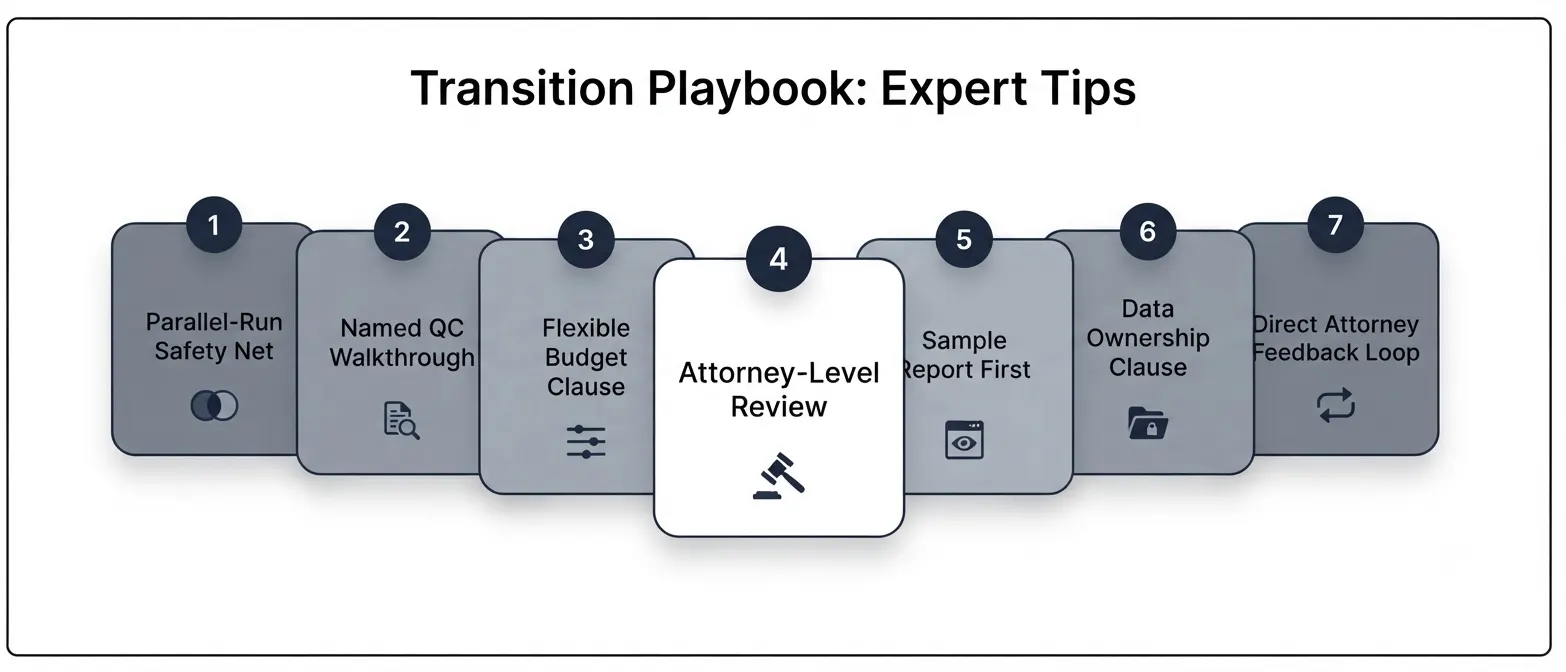
- Run parallel systems for at least one full deadline cycle. Do not turn off the old system until the new vendor has proven accuracy across a complete reporting period.
- Insist on a named quality-control process, not just a promise of accuracy. Ask the vendor to describe, step by step, how a docketed deadline is verified before it becomes final. Our breakdown of the Best Multi-Layered Quality Control Workflow for Patent Docketingbest multi-layered quality control workflow for patent docketing is a useful benchmark when comparing vendor answers.
- Negotiate à la carte pricing where possible. Corporate budgets fluctuate with filing volume, and flat annual contracts can waste spend during slower years.
- Ask whether US-licensed attorneys are involved in complex calculations, such as Patent Term Adjustment disputes or continuation chains, not just standard paralegal staff.
- Request a sample monthly report before signing. This reveals whether the vendor’s reporting will actually be useful to your general counsel and leadership team.
- Clarify who owns the data if the relationship ends. Confirm, in writing, that the corporation retains full, exportable ownership of all docketed data, so switching vendors in the future never becomes a hostage situation.
- Involve your prosecuting attorneys early in the transition. Docketing errors are often caught fastest by the attorneys actively working a matter, so give them a direct channel to flag discrepancies during the pilot phase rather than routing everything through a single internal administrator.
Understanding the True Cost of Corporate Patent Docketing
Sticker price comparisons between vendors rarely tell the full story. Corporate finance teams building a business case for outsourced docketing should weigh total cost of ownership, not just the quoted per-matter or per-user rate.
| Cost Component | In-House Team | Managed Docketing Company |
|---|---|---|
| Salaries and benefits | Full-time docketing clerks/paralegals, plus turnover and training costs | Included in service fee |
| Software licensing | Purchased and maintained separately | Often included or bundled |
| Backup coverage | Requires cross-training or temp staffing during leave | Built into vendor staffing model |
| Scaling for volume surges | Requires new hires and lead time | Absorbed within existing vendor capacity |
| Quality control layer | Dependent on internal process maturity | Multi-layered review typically built in |
| Audit and compliance reporting | Built internally, often manually | Frequently automated and included |
When corporate IP directors run this comparison honestly, including the fully loaded cost of internal headcount, turnover risk, and the cost of a single missed deadline, the total cost of a well-run managed docketing relationship is often lower than maintaining an equivalent in-house team, particularly for mid-size portfolios that are too large for a single paralegal but not large enough to justify a full internal department.
Frequently Asked Questions
What are the best patent docketing companies for corporations?
The right choice depends on portfolio size and internal staffing. Large enterprises with dedicated internal teams often prefer software platforms like Anaqua or IPfolio, while corporations seeking outsourced accuracy and reduced headcount tend to choose full-service managed docketing companies such as Dennemeyer, CPI, Foundation IP, or Teak IP.
How much does corporate patent docketing outsourcing typically cost?
Pricing varies widely by portfolio size and service model. Software-only platforms often start around $100 to $150 per user per month, while managed docketing services are frequently priced à la carte or per matter, which can be more cost-effective for fluctuating filing volumes.
Should a corporation use docketing software, a managed services company, or both?
Most mid-size to large corporate IP departments eventually use both: a software platform as the system of record, paired with a managed services team to handle data entry, quality control, and exception management.
How long does it take to switch patent docketing vendors?
A well-managed transition typically takes 60 to 120 days, including data migration testing, parallel system operation, and a phased rollout, depending on portfolio size and jurisdictional complexity.
What happens if a docketing company misses a deadline?
Reputable vendors carry professional liability coverage and outline escalation and remediation procedures in their service-level agreement. Corporations should confirm these terms in writing before signing any contract.
Do patent docketing companies handle international jurisdictions?
Leading vendors handle deadline calculation and filing support across dozens of national and regional patent offices, including the USPTO and EPO, though depth of coverage in less common jurisdictions varies significantly between providers.
Can a docketing company absorb new matters quickly after an acquisition?
A capable managed docketing partner should be able to scale delivery capacity to onboard a large volume of acquired matters within weeks, including data validation against the acquired company’s prior records, whereas a software-only setup depends entirely on the corporation’s existing internal staff capacity to absorb the surge.
What qualifications should corporate IP departments look for in docketing staff?
Look for teams that combine experienced IP paralegals with oversight from US-licensed attorneys, particularly for complex calculations involving Patent Term Adjustment, continuation chains, or PCT national phase entry, where a purely clerical review is not sufficient.
Conclusion
Choosing among the best patent docketing companies for corporations ultimately comes down to matching vendor capability to your portfolio’s actual complexity, not chasing the biggest name in the market. A corporation managing a few hundred domestic patents has very different needs than one managing thousands of matters across dozens of jurisdictions. What matters most is a documented quality-control process, transparent pricing, proven data migration accuracy, and a partner willing to be measured against clear service-level agreements.
If your IP department is currently weighing whether to bring docketing fully in-house, switch software platforms, or move to a managed services model, a structured evaluation using the criteria and process outlined above will save significant time and reduce the risk of a costly transition mistake.
Ready to see how a multi-layered, attorney-led docketing team could support your corporate portfolio? Schedule a Corporate Docketing Consultation with Teak IP today.

