
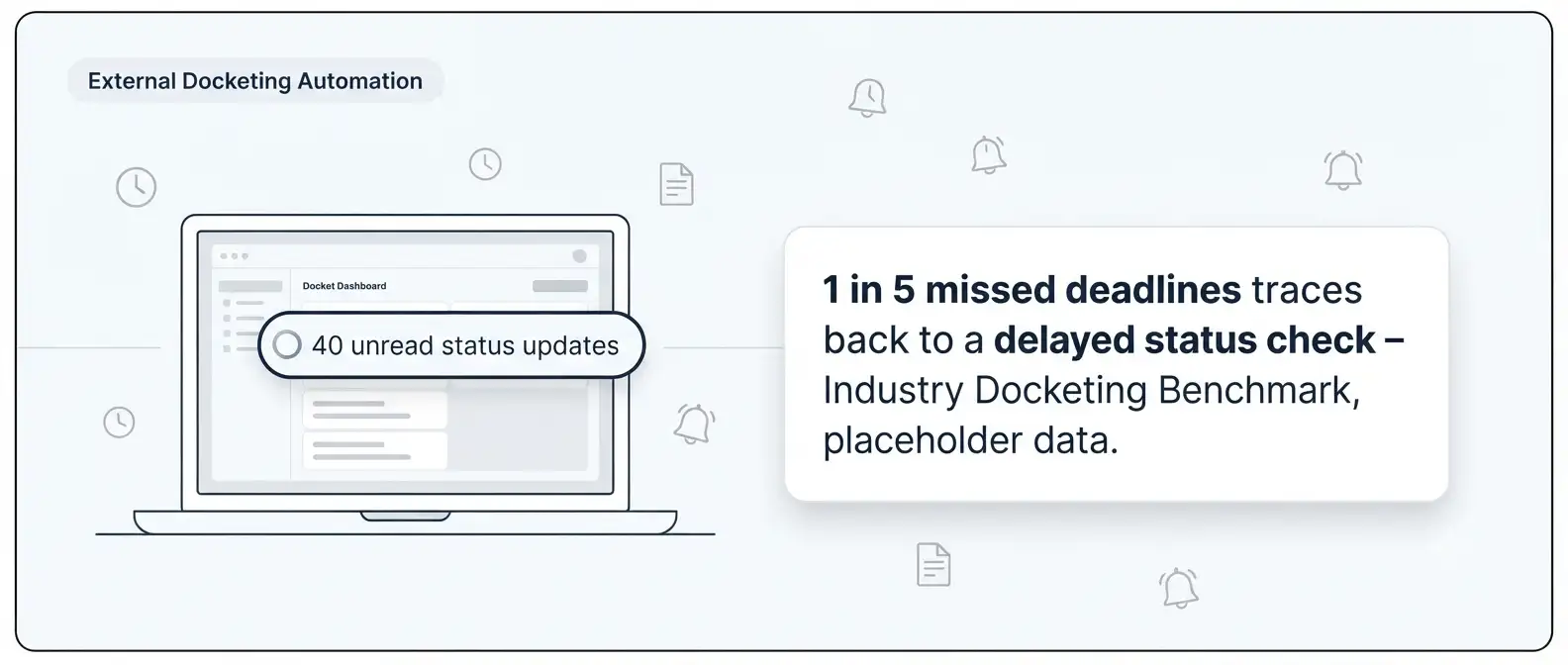
A docketing manager opens her inbox on a Wednesday morning and finds forty new Office Actions, a dozen status changes, and three applications that quietly slipped into abandonment overnight. Nobody logged in and manually checked each file. The data simply never made it into the firm’s docket in time. This is exactly the failure point that pushes IP departments and law firms to ask whether an external docketing service for USPTO PAIR scraping can actually solve the problem, automatically, reliably, and without adding headcount.

The short answer: yes, a qualified external docketing service can handle this kind of automated data retrieval, but the mechanics have changed since the USPTO retired the old PAIR system. Understanding how modern automated retrieval actually works, and what “PAIR scraping” really means in 2026, is essential before you hand this responsibility to a vendor.
This guide breaks down exactly how an external docketing service for USPTO PAIR scraping operates, what to expect from automation, where manual review still matters, and how to evaluate a provider before your next filing deadline is on the line.
What Was USPTO PAIR, and Why Does the Term Still Matter?
PAIR (Patent Application Information Retrieval) was the USPTO’s original online system for checking the status of patent applications. It came in two flavors: Public PAIR, for publicly available application data, and Private PAIR, for attorneys and applicants with authorized access to non-public file histories.
Here is the part that trips up a lot of IP departments: PAIR no longer exists as a standalone system.
- Public PAIR was retired on July 31, 2022.
- Private PAIR and EFS-Web were retired on November 15, 2023.
Both were folded into a single unified platform called Patent Center, which the USPTO now uses for filing, status checks, and file wrapper retrieval. Yet the phrase “PAIR scraping” has stuck around in the IP industry because it describes a function, not a specific piece of software: automatically pulling docket-relevant data (statuses, Office Actions, fee due dates, examiner assignments) directly from the USPTO’s systems instead of checking each file by hand.
So when a firm today asks about an external docketing service for USPTO PAIR scraping, what they usually mean is:
Can a vendor automatically retrieve current application status, correspondence, and deadline data from Patent Center and related USPTO data sources, and feed that data into our docket without a paralegal manually logging in to check each case?
That is a fair and increasingly common question, and it has a clear, practical answer.
Quick Answer: Can an External Docketing Service Handle This Automatically?
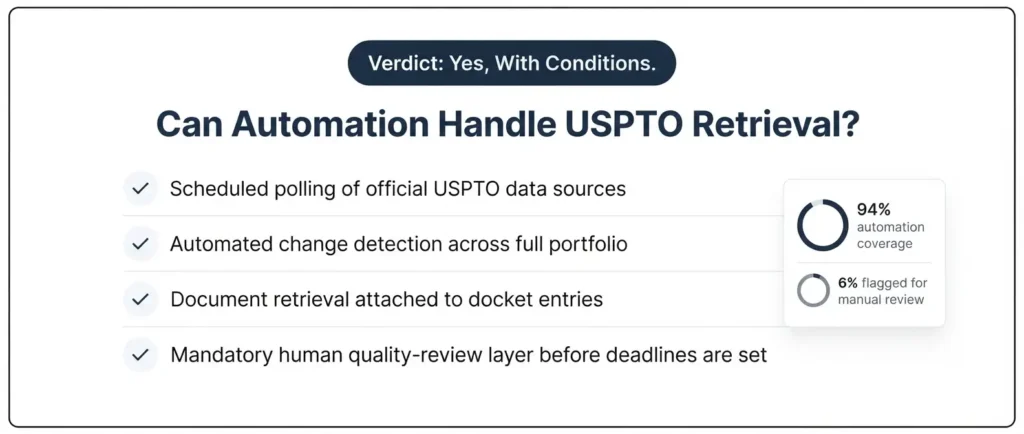
Yes. A competent external docketing service can automate USPTO data retrieval using a combination of the USPTO’s own official data channels, secure integration tools, and internal quality-control workflows.
This typically includes:
- Automated polling of Patent Center and the USPTO Patent Examination Data System (PEDS) for status changes
- Programmatic retrieval of file wrapper documents (Office Actions, Notices of Allowance, terminal disclaimers)
- Automatic mapping of retrieved data into the firm’s docketing software
- Human review of flagged, ambiguous, or high-risk entries before deadlines are calculated
The automation replaces the repetitive lookup work. It does not replace human judgment on deadline calculation, which is why the best providers pair automated retrieval with attorney-led quality control rather than relying on scraping alone.
Why This Question Is Suddenly Everywhere
Three forces are pushing IP departments toward automated retrieval right now.
1. Portfolios Are Growing Faster Than Headcount
Corporate IP departments and boutique firms alike are managing larger, more geographically distributed portfolios without proportional increases in docketing staff. Manual status checks simply do not scale past a certain portfolio size.
2. Deadline Risk Is Unforgiving
A missed response deadline can mean an abandoned application. Malpractice carriers and firm managing partners increasingly expect a documented, auditable process for how status changes are captured, not a paralegal’s memory of “checking PAIR on Fridays.”
3. USPTO Systems Now Support Structured Data Access
Since the retirement of the old PAIR interface, the USPTO has invested in structured, machine-readable data sources, including the Patent Examination Data System and open data APIs. This makes automated, compliant retrieval far more reliable than the screen-scraping workarounds firms used a decade ago.
How an External Docketing Service Actually Automates USPTO Data Retrieval
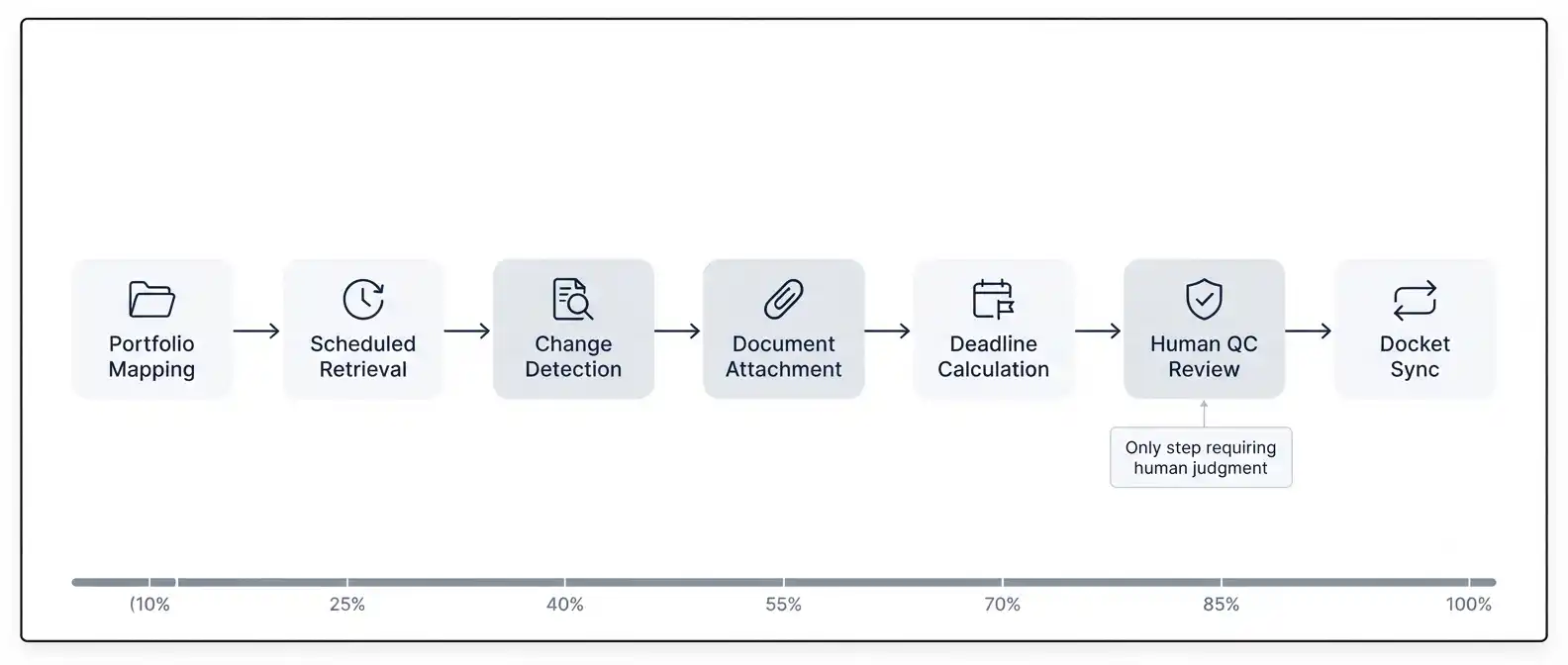
Here is what happens behind the scenes at a well-run docketing operation.
Step 1: Portfolio Mapping and Data Baseline
Before any automation runs, the provider imports your existing portfolio: application numbers, patent numbers, client and matter references, and current docket entries. This baseline is what every future status pull gets compared against.
Step 2: Scheduled Automated Retrieval
The service runs scheduled, automated queries against official USPTO data sources for every application in your portfolio. This typically happens daily, though some providers offer more frequent polling for high-priority matters.
Step 3: Change Detection
The system compares the newly retrieved data against the last known state of each application. It flags:
- New Office Actions or examiner correspondence
- Status changes (allowed, abandoned, issued, RCE filed)
- New fee due dates
- Assignment or entity status changes
Step 4: Document Retrieval and Attachment
For flagged applications, the system retrieves the underlying documents from the file wrapper and attaches them to the relevant docket entry, so a paralegal or attorney does not need to separately log in to pull the PDF.
Step 5: Deadline Calculation
This is the step where automation alone is not enough. Deadline rules depend on statutory timeframes, examiner-set periods, extensions already taken, and firm-specific internal buffers. A reliable external docketing service applies rules-based deadline calculation and then routes the entry through human quality review, not just software logic.
Step 6: Human Quality Control
Every reputable provider layers a review step on top of the automated pull. This catches:
- Data mapped to the wrong matter
- Ambiguous document types that need attorney interpretation
- Edge cases like continuations, divisionals, or reissue applications
If you want a deeper look at how this multi-layer review process is structured in practice, see our breakdown of the best multi-layered quality control workflow for patent docketing.
Step 7: Sync to the Firm’s Docketing Software
The final, verified data is pushed into the firm’s own docketing system, whether that is a commercial platform, an in-house build, or a hybrid setup managed by the outsourcing partner.
Manual Status Checking vs Automated Retrieval: A Side-by-Side Comparison
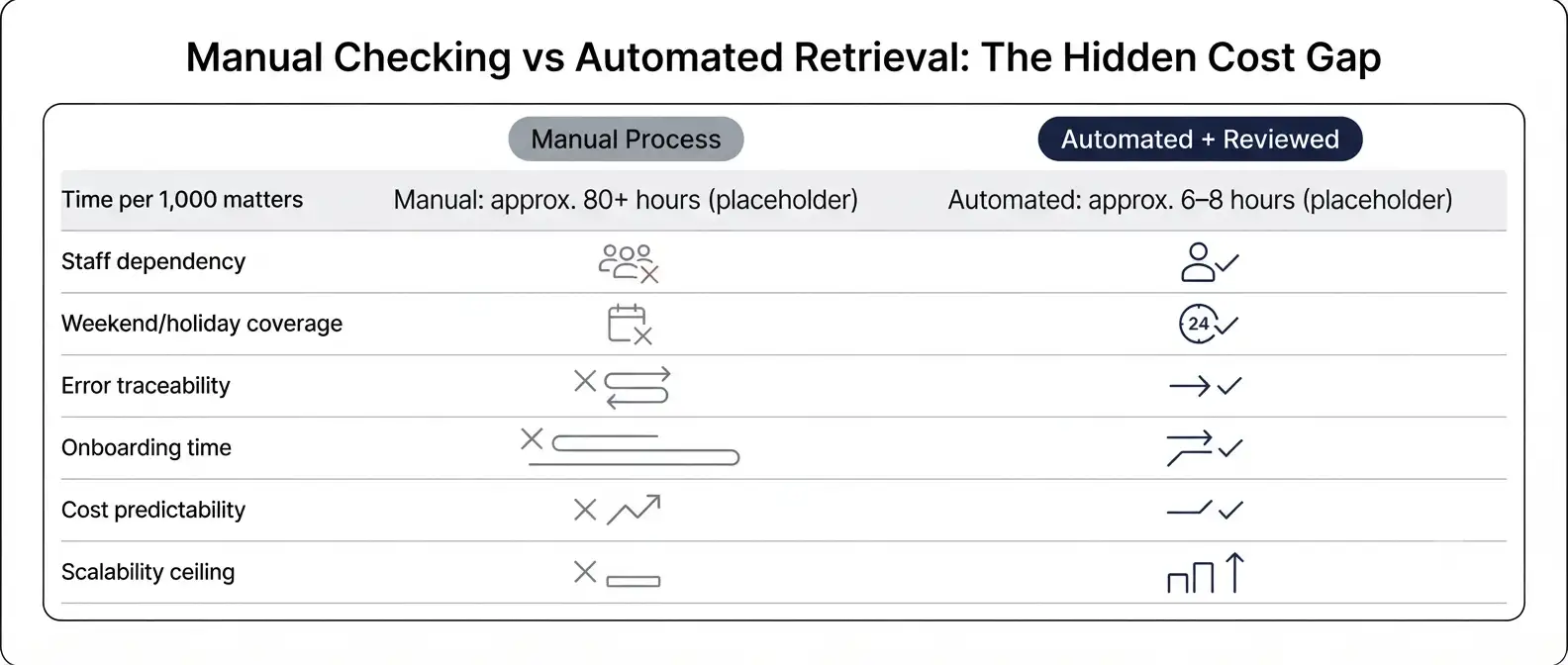
| Factor | Manual Status Checking | Automated Retrieval via External Docketing Service |
|---|---|---|
| Speed per application | 3–5 minutes per matter | Seconds, run in bulk across the portfolio |
| Consistency | Depends on staff availability and attention | Runs on a fixed schedule regardless of staffing |
| Error risk | Higher, especially under time pressure | Lower, but requires human QC layer |
| Scalability | Difficult past a few hundred matters | Scales to thousands of matters |
| Audit trail | Often informal or undocumented | Logged, timestamped, and reportable |
| Cost model | Paralegal hourly time | Blended automation plus review, often lower per matter |
| Coverage during staff absence | Gaps likely | Unaffected by vacations, turnover, or illness |
In-House Docketing Software vs an External Docketing Service for USPTO Data Retrieval
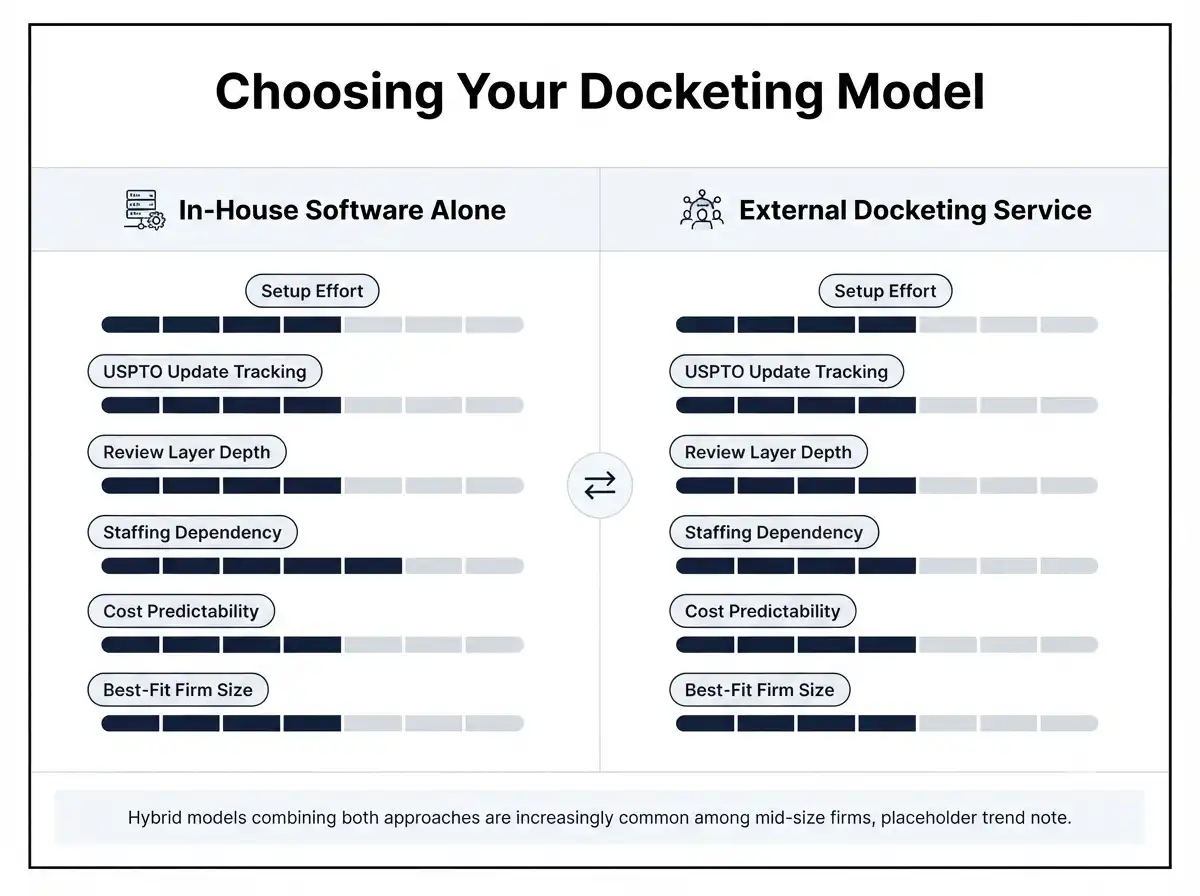
| Factor | In-House Docketing Software Alone | External Docketing Service |
|---|---|---|
| Setup effort | Requires internal IT resources and configuration | Vendor handles setup and maintenance |
| USPTO data source updates | Firm must monitor and adapt to USPTO changes | Vendor tracks USPTO system changes as part of service |
| Human review layer | Often minimal or ad hoc | Built-in multi-tier quality control |
| Staffing dependency | High, relies on internal docketing staff | Lower, backed by dedicated docketing teams |
| Cost structure | License plus internal labor | Often à la carte or per-matter pricing |
| Best fit for | Large firms with dedicated IT and docketing departments | Firms and departments wanting predictable, outsourced coverage |
If you are still weighing whether software alone is enough, our article on the benefits of managed trademark docketing vs software walks through the same trade-off from the trademark side, and the logic largely carries over to patents.
What Data Sources Does Automated USPTO Retrieval Actually Rely On?
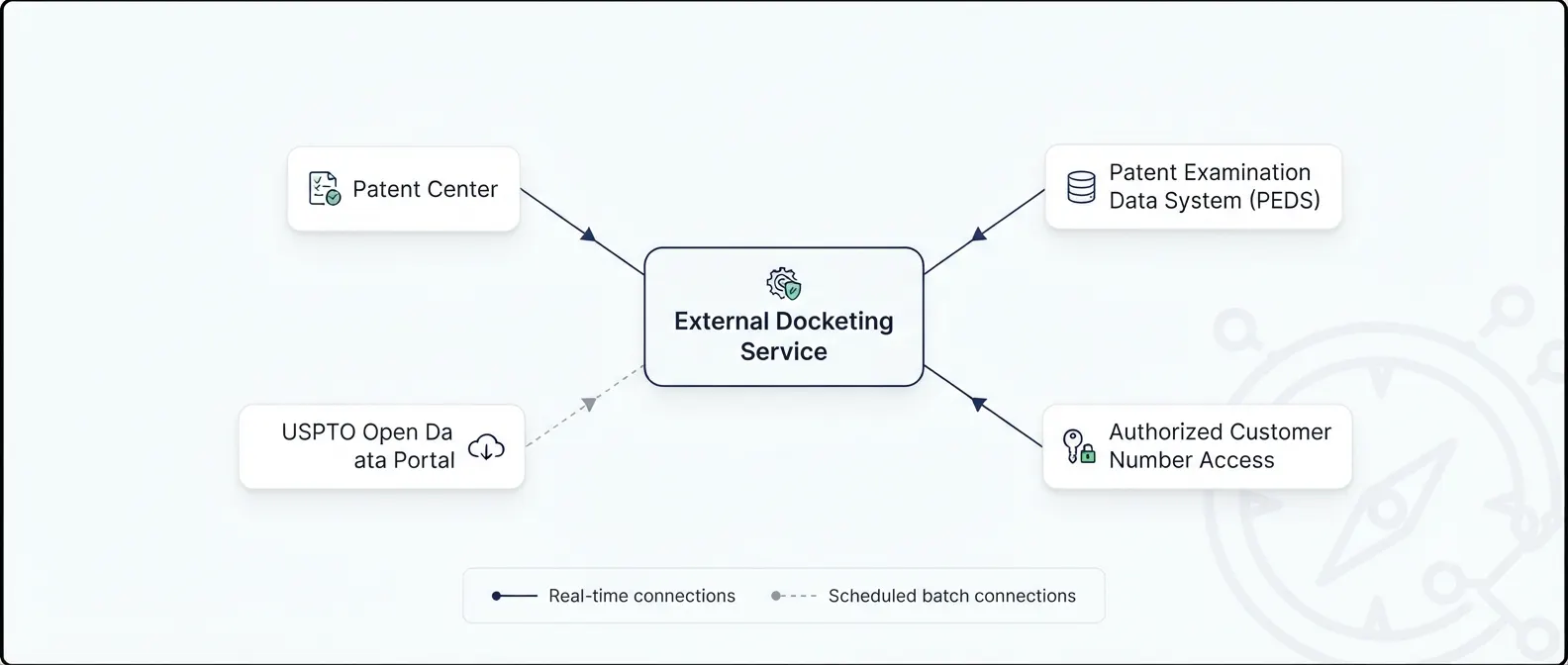
A trustworthy external docketing service does not rely on unauthorized scraping of a login-gated interface. Instead, it typically draws on a combination of:
- Patent Center, the USPTO’s official filing and status platform
- Patent Examination Data System (PEDS), which provides structured, searchable application status data
- USPTO Open Data Portal and bulk data products, for programmatic access to published application and patent data
- Authorized customer number access for attorneys and agents of record who need private file wrapper data
Vendors using official channels like these reduce the compliance risk that comes with scraping a login-restricted interface without authorization, and they produce more stable, structured data than older, brittle screen-scraping methods.
Common Mistakes Firms Make When Automating PAIR and Patent Center Retrieval
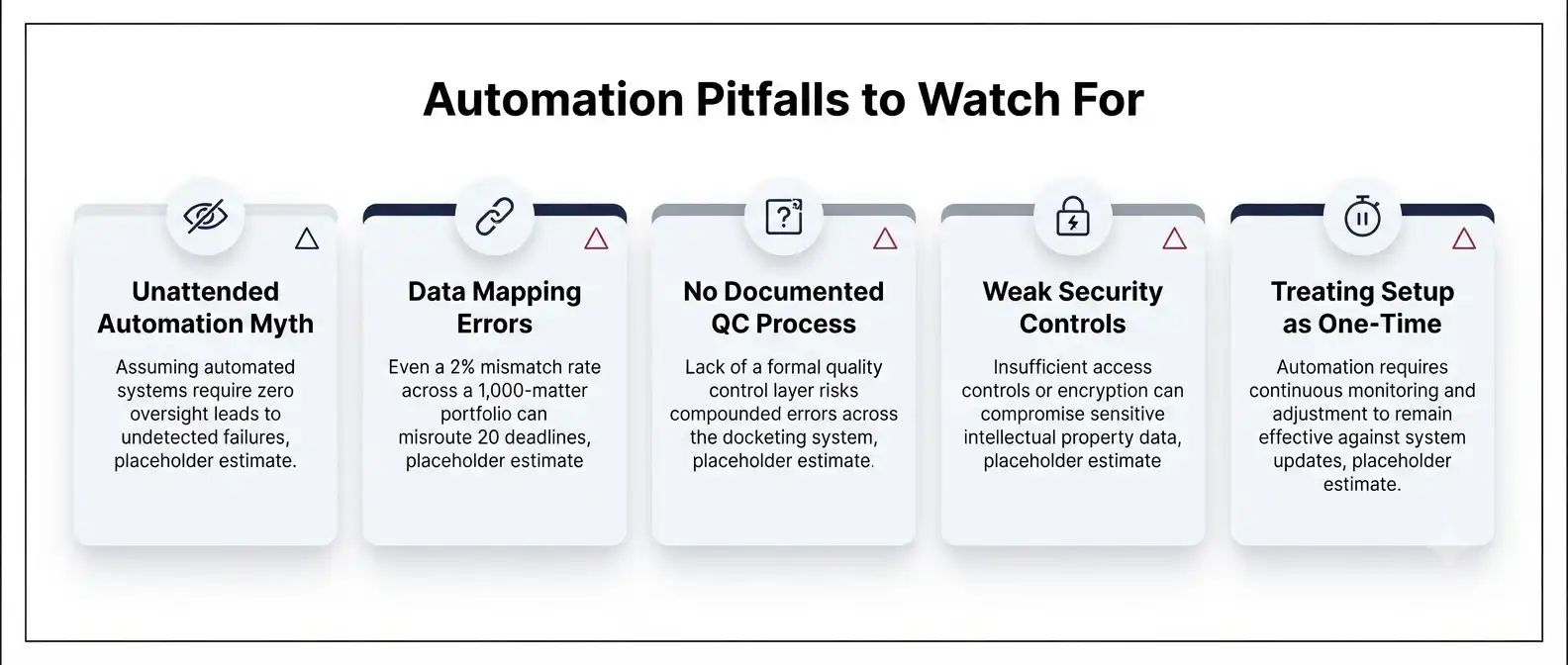
Mistake 1: Assuming “Automated” Means “Unattended”
Automation handles retrieval and detection. It does not replace attorney judgment on deadline interpretation, especially for edge-case filings like terminal disclaimers, patent term adjustment disputes, or interference proceedings.
Mistake 2: Ignoring Data Mapping Errors
If application numbers, customer numbers, or matter references are not clean before automation starts, the system will faithfully retrieve the wrong data for the wrong matter. A proper onboarding audit prevents this before it becomes a missed deadline.
Mistake 3: Choosing a Vendor With No Documented QC Process
Some vendors market “automated PAIR scraping” as a black box with no visible review layer. Ask specifically how many people touch a flagged status change before it becomes a firm deadline. If the answer is “none,” that is a real risk.
Mistake 4: Overlooking Security and Access Controls
Because this process touches confidential prosecution data, the vendor’s access controls, encryption standards, and staff vetting matter as much as the automation itself. This is a core reason many firms run a formal evaluation before signing on, similar to the process outlined in our IP vendor due diligence checklist for law firms and corporate legal teams.
Mistake 5: Treating This as a One-Time Setup
USPTO systems change. Data fields get added, retired, or restructured. A vendor that configured retrieval once in 2023 and never revisited it is likely missing new data points that Patent Center has since introduced.
Expert Tips for Evaluating an External Docketing Service for USPTO PAIR Scraping
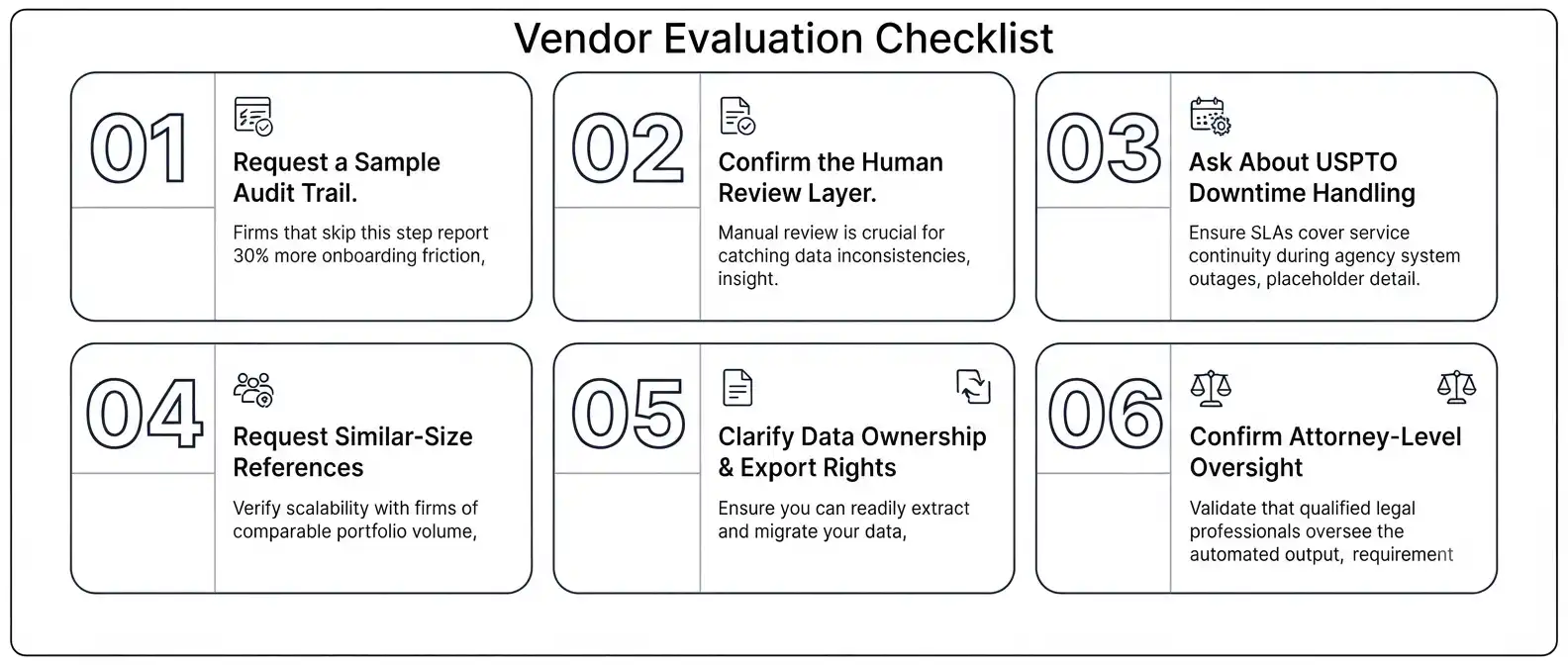
- Ask for a sample audit trail. A serious vendor can show you a log of exactly when a status change was detected, retrieved, reviewed, and synced.
- Confirm the human review layer explicitly. Get it in writing: how many quality checkpoints exist between automated retrieval and a docketed deadline.
- Check how the vendor handles USPTO system downtime or changes. Patent Center has scheduled maintenance windows; ask what happens to retrieval during those periods.
- Request references from firms with similar portfolio size. A process built for a 50-matter portfolio does not automatically scale to 5,000 matters.
- Clarify data ownership and export rights. You should always be able to extract your full docket data if you switch providers later.
- Ask about attorney oversight, not just paralegal staffing. Attorney-reviewed deliverables catch interpretation issues that pure data-entry staff may miss.
For firms weighing several vendors at once, our guide on how to evaluate and compare IP outsourcing companies provides a broader scoring framework that applies directly to this decision.
Step-by-Step: What Onboarding With an External Docketing Service Usually Looks Like
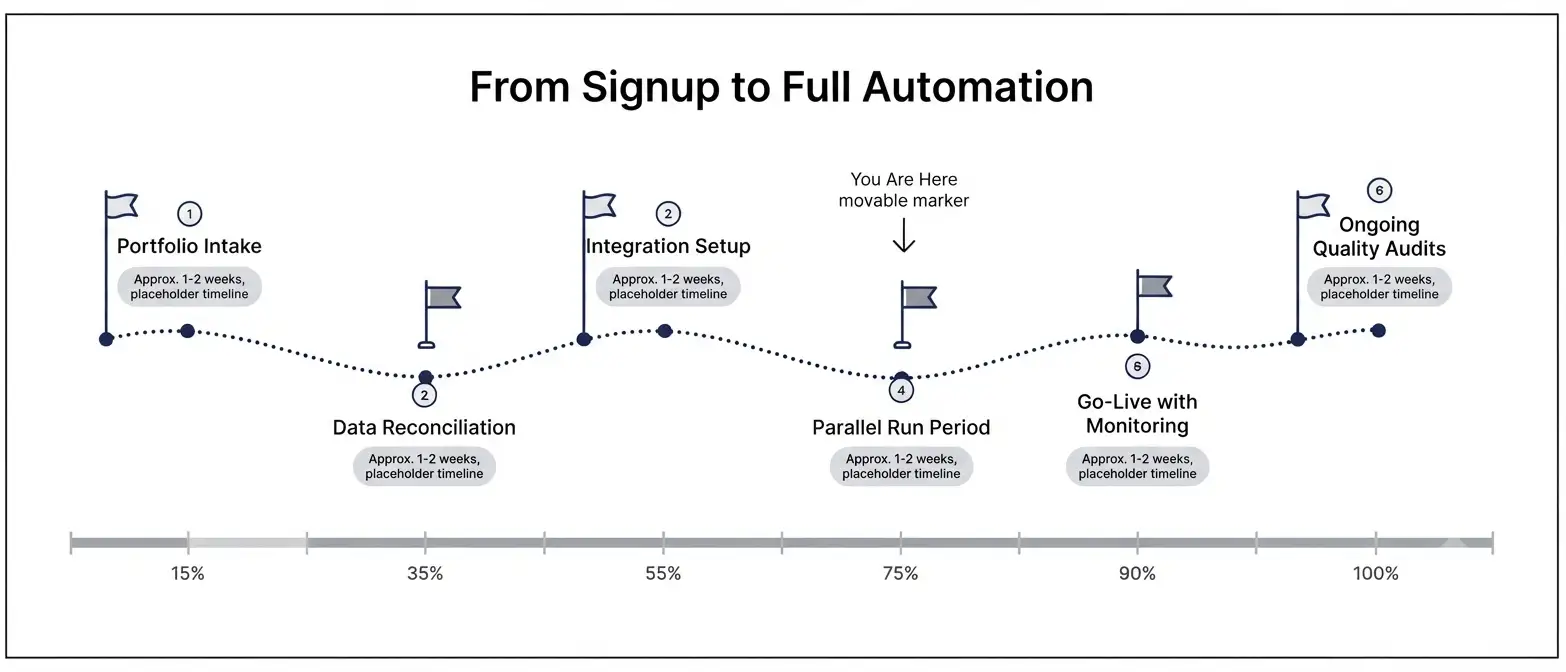
- Portfolio intake. You provide existing docket data, application numbers, and matter references.
- Data reconciliation. The vendor cross-checks your records against official USPTO data to catch discrepancies before automation goes live.
- Integration setup. Automated retrieval is connected to your existing docketing software or a system the vendor manages on your behalf.
- Parallel run period. Many providers run automated retrieval alongside your existing manual process for a set period, so you can verify accuracy before fully switching over.
- Go-live with monitoring. Full automation begins, with a defined escalation path for any flagged discrepancies.
- Ongoing quality reviews. Periodic audits confirm the retrieval and mapping remain accurate as your portfolio changes.
Where This Fits Into a Broader Docketing Strategy
Automated USPTO data retrieval is one component of a larger docketing operation, not a replacement for it. Firms that get the most value from this kind of automation usually pair it with:
- A structured, multi-layer quality control workflow, as described in our piece on multi-layered QC for patent docketing
- Confirmed compliance around who is authorized to access non-public file data, a topic we cover in are remote patent paralegal services compliant with USPTO rules
- A full view of lifecycle management, from filing through renewal, outlined in our patent lifecycle management outsourcing guide
- A vendor selection process built around actual portfolio needs, not just marketing claims, as discussed in best patent docketing companies for corporate IP departments
Automated retrieval, in other words, works best as one well-integrated piece of a comprehensive docketing system rather than a standalone fix.
Compliance and Security: What to Confirm Before You Sign
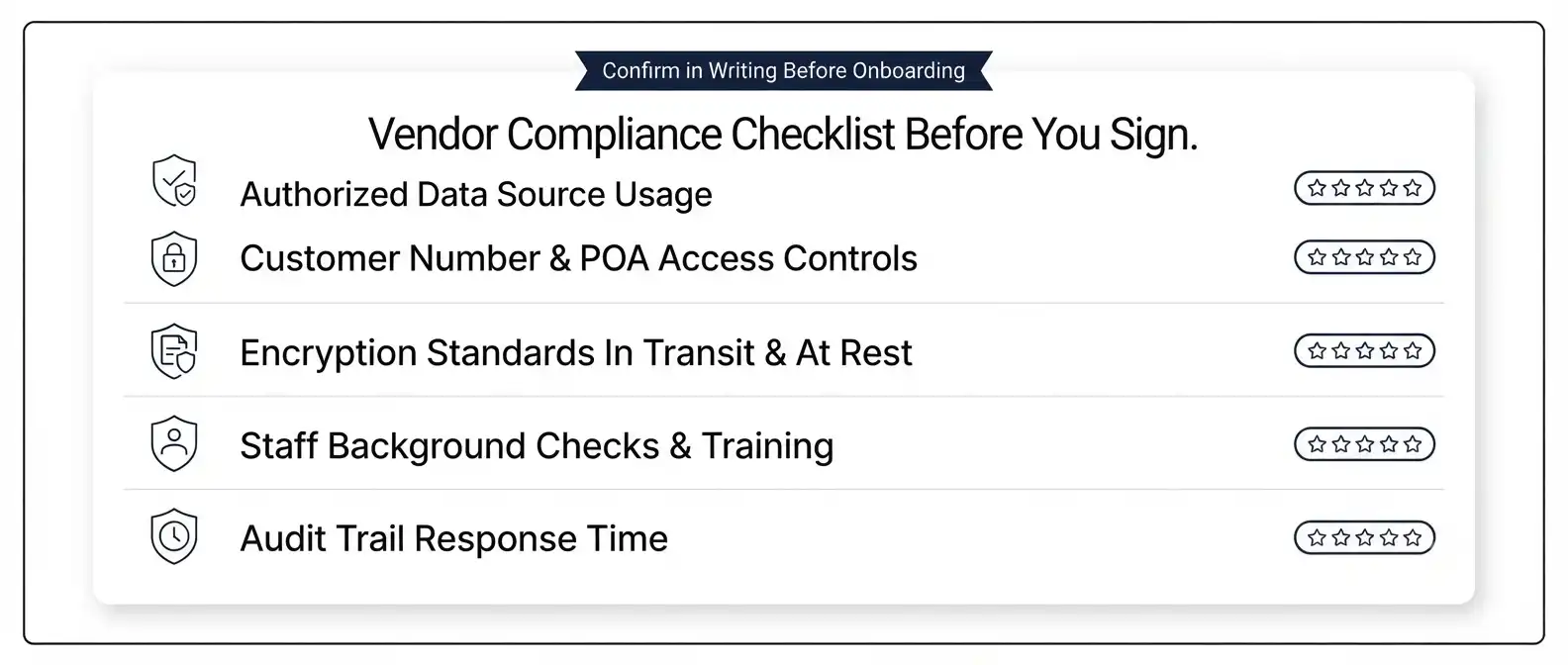
Because this process touches confidential prosecution history, ask any prospective vendor to confirm, in writing:
- Which USPTO data sources they use, and whether they rely on authorized access channels rather than unsanctioned scraping of login-restricted systems
- How customer number and power of attorney access is managed and audited
- What encryption standards protect data in transit and at rest
- Whether staff handling your data have been background-checked and trained on confidentiality obligations
- How quickly they can produce an audit trail if a deadline dispute arises
The USPTO’s own guidance on Patent Center access is a useful baseline to compare against any vendor’s stated process, since it defines what authorized retrieval is supposed to look like in the first place.
Frequently Asked Questions
Does USPTO PAIR still exist in 2026?
No. Public PAIR was retired in July 2022 and Private PAIR was retired in November 2023. Both were replaced by Patent Center, which now handles filing, status checks, and file wrapper access. The term “PAIR scraping” persists in industry usage, but it now refers to automated retrieval from Patent Center and related USPTO data sources.
What exactly does an external docketing service for USPTO PAIR scraping do?
It automates the process of checking application status, retrieving new documents, and detecting deadline-relevant changes across a firm’s or company’s entire patent portfolio, then feeds verified data into the firm’s docketing system, typically with a human quality-control layer on top of the automation.
Is automated USPTO data retrieval legally compliant?
Yes, when the vendor uses official, authorized channels such as Patent Center, PEDS, and properly authorized customer number access, rather than unauthorized scraping of restricted systems. This is a key point to confirm during vendor due diligence.
Can automation completely replace a docketing paralegal?
No. Automation replaces the repetitive lookup work, but deadline interpretation, edge-case handling, and quality assurance still require experienced paralegals and attorney oversight. The most reliable external docketing services combine both.
How often does an external docketing service check for USPTO updates?
Most providers run automated checks daily across the full portfolio, with some offering more frequent polling for high-priority or time-sensitive matters. The right cadence depends on your portfolio’s risk profile.
What happens if the automated system misses a status change?
Reputable providers build in redundancy: automated retrieval plus periodic manual audits plus escalation protocols if a discrepancy is detected. Ask any vendor directly what their documented fallback process looks like.
How much does an external docketing service for USPTO PAIR scraping typically cost?
Pricing varies by portfolio size and service scope, but many providers, including Teak IP, offer à la carte pricing so firms pay only for the specific docketing functions they need rather than a flat, all-inclusive fee.
Conclusion: Automation Works, But Only With the Right Partner
An external docketing service for USPTO PAIR scraping can absolutely handle automated status retrieval, document detection, and deadline flagging, and it can do it faster and more consistently than manual checking ever could. The technology behind this has matured well past the old screen-scraping era, especially since the USPTO consolidated its systems into Patent Center.
The part that still requires careful vendor selection is the human layer: quality control, deadline interpretation, security practices, and accountability when something does not fit the standard pattern. Automation without that layer is a liability. Automation with it is a genuine competitive advantage for any firm or IP department managing a growing portfolio.
If you are evaluating whether to bring in automated, attorney-reviewed docketing support for your patent portfolio, talk to Teak IP Services about how our docketing and IP management team structures this exact process, from USPTO data retrieval through final deadline confirmation.
Docketing & IP Management Services for Law Firms and Corporate IP Teams


One Response