
A partner glances at the docket on a Thursday afternoon and sees three response deadlines inside ten days. At a five-attorney boutique, one overloaded paralegal catches them by hand. At a 300-lawyer firm, the same deadlines pass through a docketing specialist, a prosecution paralegal, a second-pair-of-eyes reviewer and an attorney sign-off. Learning how large IP firms structure paralegal teams explains why the second firm rarely misses a date, and why the first firm keeps borrowing pieces of that design.
This guide breaks the model into its parts. You will see the layers, the specialist roles, the workflows and the quality checks. You will also see which pieces a smaller firm can copy tomorrow, and which ones it should outsource.

Quick answer: Large IP firms structure paralegal teams around specialization, not generalists. They split work into functional pods (docketing, prosecution, filings, IDS, foreign and trademark), put a lead paralegal over each pod, add a maker-checker review step and keep attorneys responsible for every delegated task. Smaller firms copy this model in a lighter form through checklists, dual review and outsourced or hybrid support.
Key Takeaways
- Large firms trade the “one paralegal does everything” model for specialized pods with clear handoffs.
- A typical structure has four layers: attorneys, paralegal managers or leads, specialist paralegals and support or data staff.
- Quality control is built into the structure through dual review, audit cycles and written checklists.
- The structure also protects ethics: lawyers stay responsible for supervising nonlawyer assistants under the USPTO’s professional conduct rules.
- Smaller firms copy the model because it lowers deadline risk and cost per task, and they can do it without hiring a full department.
What is an IP Paralegal Team Structure? (Definition)
An IP paralegal team structure is the way a firm organizes its non-attorney IP professionals: who handles which tasks, who reviews whose work, who reports to whom, and how matters move from intake to closure. In patent and trademark practice, the structure usually covers docketing, application filings, prosecution support, information disclosure statements, foreign filings, maintenance and records.
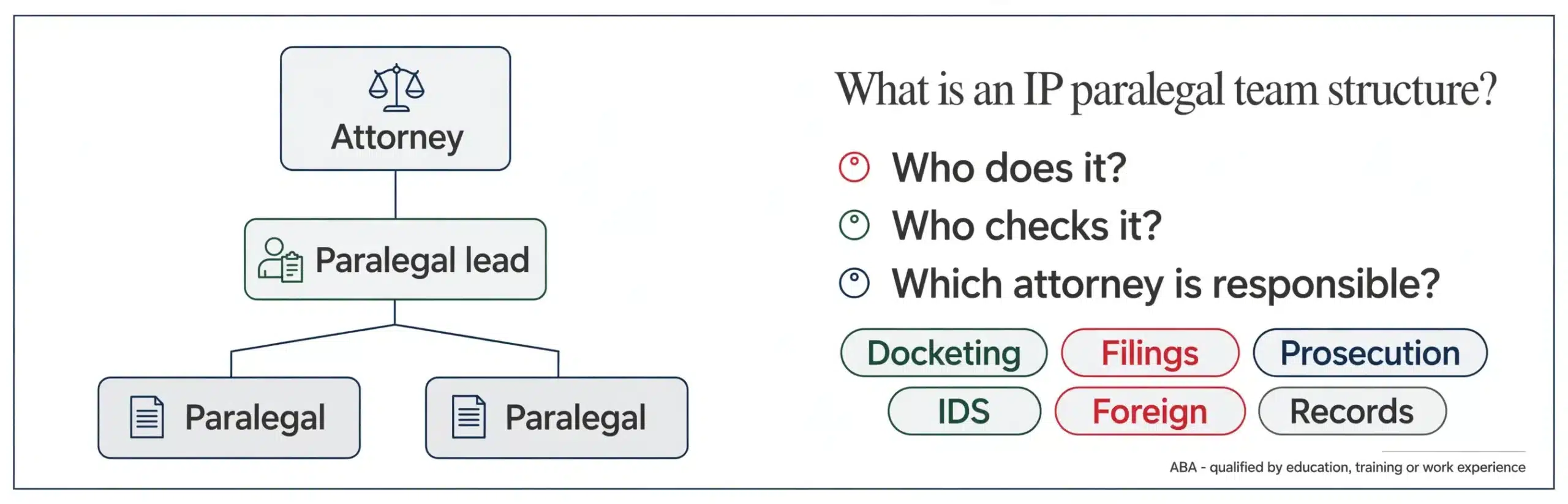
The structure is not just an org chart. It is a set of rules about specialization, handoffs and accountability. Strong structures answer three questions for every task:
- Who does it?
- Who checks it?
- Which attorney is responsible for it?
The ABA Model Guidelines for the Utilization of Paralegal Services describe a paralegal as a person qualified by education, training or work experience who performs specifically delegated substantive legal work. That definition matters here. In IP practice, “specifically delegated” is the key phrase, because every task in a well-built structure has a named owner and a named reviewer.
Why Team Structure Matters More in IP Than in Most Practice Areas
IP work runs on dates. A missed office action response, maintenance fee or priority deadline can mean an abandoned application or a lost right. Volume adds pressure, because a mid-size portfolio generates hundreds of recurring events a year.
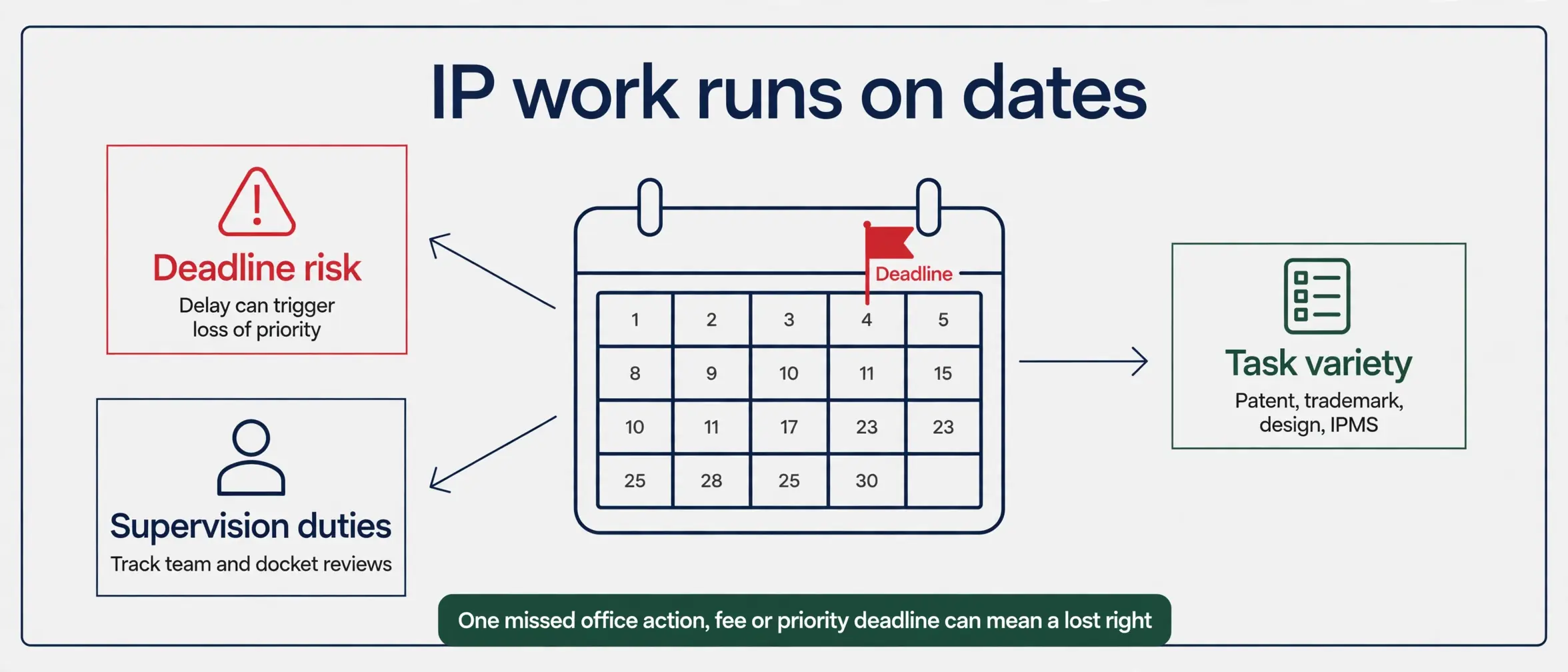
Three forces push firms toward formal structure:
- Deadline risk. One wrong entry can ripple through months of work. Teak’s piece on how data entry errors in docketing compound into missed deadlines shows how a small mistake grows.
- Task variety. Patents, trademarks, PCT and foreign filings, IDS submissions and drawings each follow different rules and calendars.
- Supervision duties. Attorneys cannot hand off responsibility, so the structure has to make oversight easy and visible.
The U.S. Bureau of Labor Statistics notes that paralegal duties vary by practice area and firm size, and that in small firms paralegals may handle a case from start to finish while in larger firms they often focus on one phase. Its Occupational Outlook Handbook entry on paralegals captures the core of the difference. Large firms specialize by phase. Small firms generalize by matter.
How Large IP Firms Structure Paralegal Teams: The Four-Layer Model
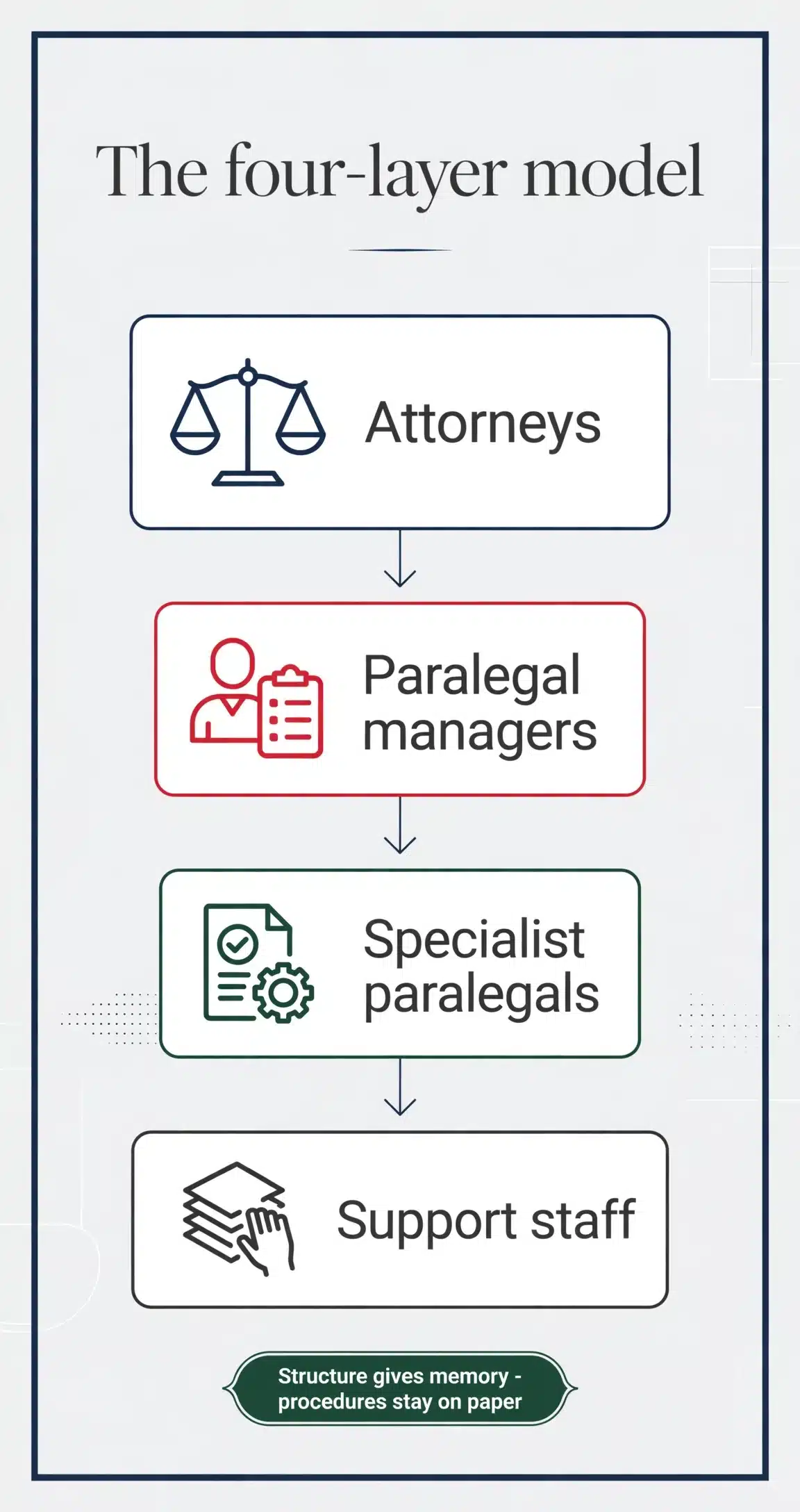
Firm cultures differ, but most large IP practices converge on the same four layers.
Layer 1: Attorneys own the matter
Partners and associates make every legal judgment. They set strategy, sign filings, give advice to clients and approve responses. They also carry supervisory responsibility. Under 37 CFR 11.503, a practitioner who holds partner or comparable managerial authority must make reasonable efforts to put firm-wide measures in place that give reasonable assurance the assistant’s conduct fits the practitioner’s professional obligations. A practitioner who directly supervises an assistant must make reasonable efforts to ensure the same.
Layer 2: Paralegal managers and team leads
The paralegal manager (or practice-group lead) sits between attorneys and the paralegal pool. This layer:
- Assigns incoming work and balances workload
- Trains new hires and keeps written procedures current
- Handles escalations when a deadline, system or client issue looks risky
- Reports metrics to firm leadership
- Acts as the first reviewer on complex or unusual matters
Large firms often treat this role as a promotion track, and it gives the structure memory. When a lead leaves, procedures stay on paper rather than in one person’s head.
Layer 3: Specialist paralegals
Specialists do the daily work, and each pod owns one function. The next section details the common pods. Specialists build deep knowledge of one area, such as post-allowance deadlines or Madrid Protocol filings, and they make fewer errors because they repeat the same task types.
Layer 4: Support, data and records staff
Support staff handle data entry, document indexing, file creation, correspondence logging and scanning. Many large firms keep this layer separate so that paralegals can spend their hours on jud
The Specialist Pods Inside a Large IP Paralegal Team
Large firms rarely ask one person to learn everything. They create pods with narrow, repeatable scopes. The table below shows the roles you will see most often.
| Pod or role | Core responsibilities | Typical deadline touchpoints |
|---|---|---|
| Docketing specialist | Enters new matters, calendars events, verifies dates against official records, audits the docket | Office action responses, post-allowance dates, maintenance fee windows, priority dates |
| Patent prosecution paralegal | Prepares response shells, assembles exhibits, formats amendments, tracks examiner interviews | Office action response periods, final action timelines, RCE decisions |
| Filings and formalities paralegal | Prepares application packages, declarations, assignments, drawings coordination, filing receipts | Filing dates, corrected filing papers, drawing objections |
| IDS and prior art paralegal | Collects references, reviews family members, prepares and files information disclosure statements | IDS timing windows around filing and allowance |
| Foreign and PCT paralegal | Coordinates with foreign associates, tracks national phase entries, manages annuities | National phase dates, foreign annuity payments |
| Trademark paralegal | Prepares applications, monitors status, handles office action drafts, maintenance filings | Office action deadlines, statements of use, renewal windows |
| Post-grant and litigation paralegal | Builds exhibit sets, manages page-limit formatting, tracks petitions and service dates | Strict proceeding deadlines |
| Quality reviewer or auditor | Second-checks entries, runs docket audits, reviews filings before they leave | Every pod, on a sampling or full-review basis |

Teak’s own IP docketing guide explains why the docketing pod usually anchors the whole structure: every other pod depends on accurate dates.
How the pods hand work to each other
Handoffs decide whether the structure works. A clean handoff has a trigger, an owner, a due date and a record. For example:
- A new matter arrives. The intake team opens a file and sends the details to docketing.
- Docketing enters the matter, verifies it against official records and sends the calendar to the prosecution pod.
- The prosecution paralegal prepares the working materials and flags the assigned attorney.
- The attorney drafts, edits and approves.
- The filings paralegal files, confirms receipt and sends the confirmation back to docketing.
- Docketing closes the event and opens the next one.
Every step produces a record. That record is what lets a manager audit the process without chasing people.
Three Structural Models Large Firms Use
Not every firm builds pods the same way. Three models dominate.
Model 1: The functional pod model
Paralegals sit in function-based pods (docketing, prosecution, filings) and serve every attorney. This model gives the most specialization and the best load balancing. The trade-off: attorneys may feel less personal service, and handoffs multiply.
Model 2: The practice-group or client-aligned model
Each partner group or major client gets a dedicated paralegal team that handles the full cycle. This gives attorneys direct access and deep client knowledge. The trade-off: quality depends on each team’s depth, and coverage gaps appear during leave or turnover.
Model 3: The hybrid model
Firms combine a central docketing and formalities pod with client-aligned prosecution paralegals. This hybrid is the most common structure at large firms because it protects the deadline-critical functions while keeping client familiarity.
Comparison table: which model fits which firm?
| Factor | Functional pods | Client-aligned teams | Hybrid |
|---|---|---|---|
| Specialization depth | Highest | Moderate | High |
| Attorney access | Shared, via request queue | Direct and dedicated | Direct for prosecution, shared for docketing |
| Deadline risk control | Strong | Depends on team | Strong |
| Coverage during absences | Strong | Weak without backups | Strong |
| Best for | High volume, standardized work | Large anchor clients | Mid-to-large portfolios |
| Main drawback | More handoffs | Uneven quality | More management overhead |
Quality Control Built Into the Structure
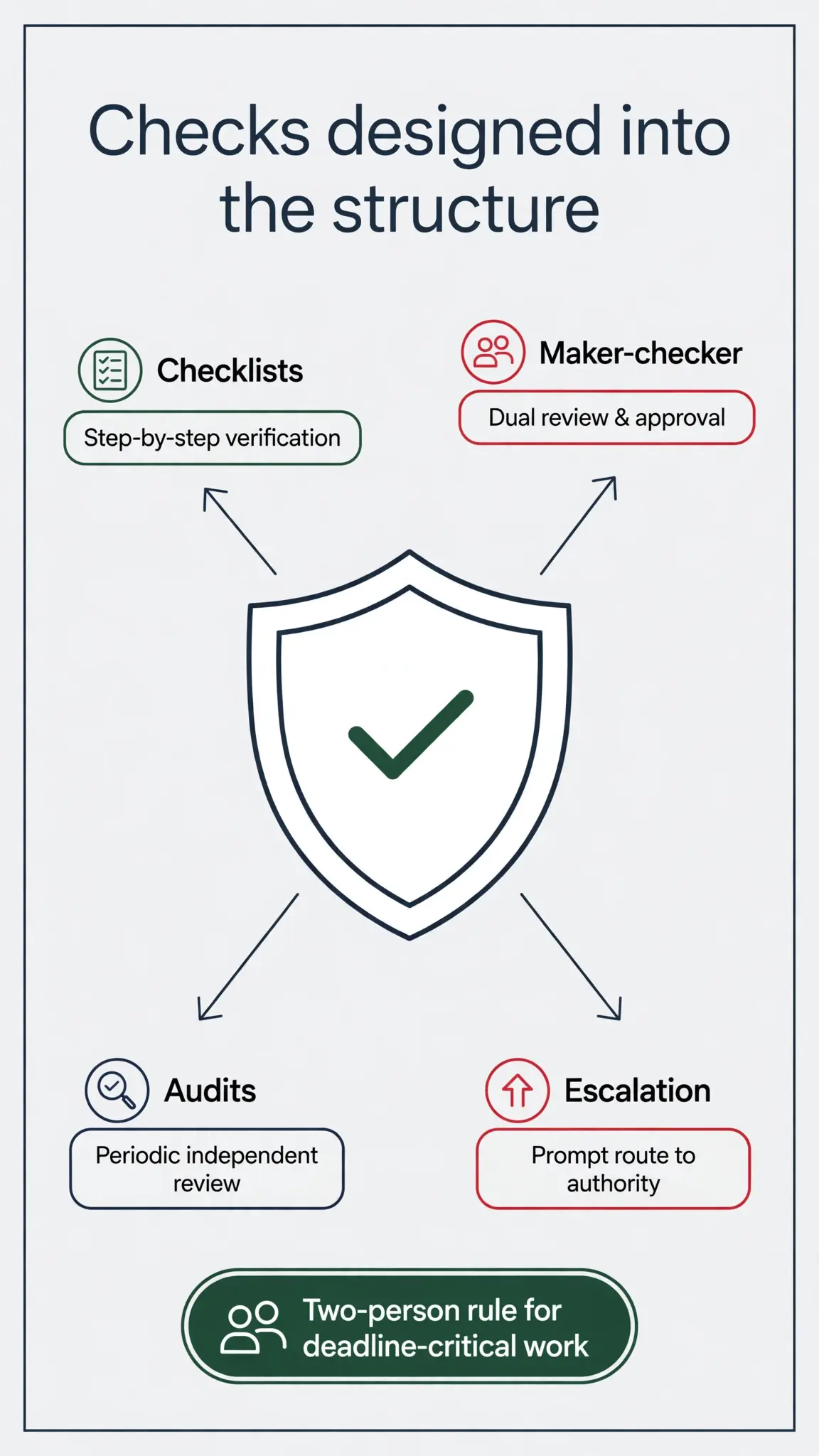
Large firms do not trust a single pair of hands for deadline-critical work. They design checks into the structure itself.
The maker-checker rule
One person enters or drafts, while a second person independently verifies the work. This two-person rule should apply to critical activities such as new matter entry, deadline calculation, IDS preparation and filing submissions. The reviewer checks details against official records to catch transposed digits, incorrect dates, missing family members and incomplete information before they create problems.
Standard operating procedures and checklists
Each pod should maintain written procedures for recurring tasks, such as opening a matter, calendaring an office action, preparing an IDS and filing an assignment. Checklists help employees follow the same steps consistently and reduce the chances of missing important details. Procedures should be updated whenever client instructions, internal workflows or patent office requirements change. This also helps new hires become productive faster.
Scheduled audits
Managers or quality reviewers should regularly sample docket entries and compare them with official records. These audits help identify incorrect dates, missing documents, incomplete updates and other data-entry issues. Recording audit findings and tracking error rates over time allows managers to identify recurring problems, provide targeted training and improve the quality of each pod’s work.
Escalation paths
Every pod should have a clearly defined escalation process for situations that require immediate attention, such as a deadline inside 48 hours, a system outage, conflicting docket information or unusual examiner communication. Paralegals should know whom to contact, what information to provide and when an issue needs attorney review. Clear escalation procedures prevent delays and ensure that critical matters receive timely attention.
Teak’s article on best patent docketing companies for corporate IP departments explains how corporate teams can evaluate these controls when selecting a docketing vendor.
Ethics and Supervision: The Rules That Shape the Structure
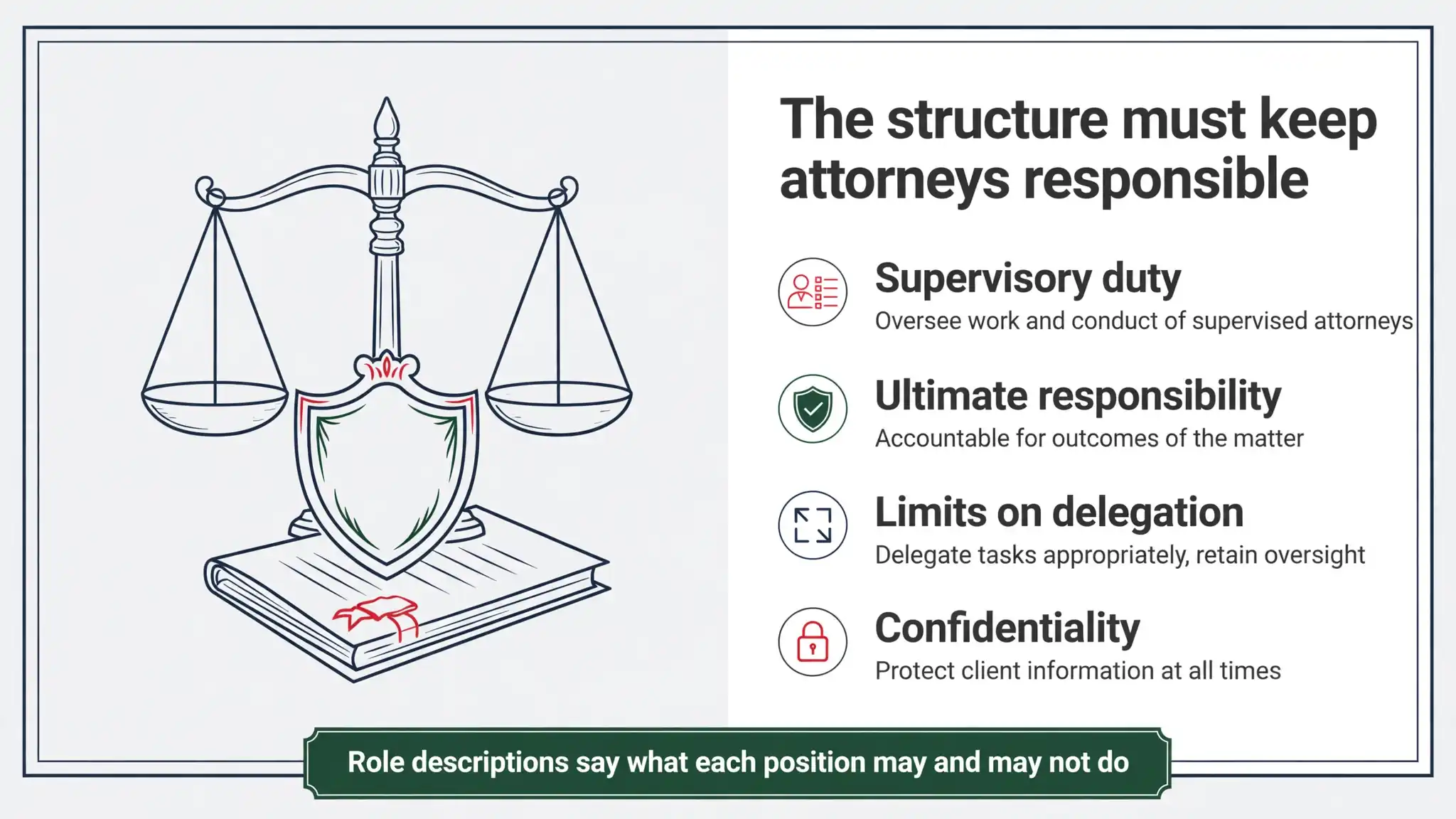
A paralegal team is not an independent unit. The structure must keep attorneys responsible and keep paralegals inside their lane.
What the rules require
- Supervisory duty. Partners and managers must make reasonable efforts to maintain firm-wide measures, and direct supervisors must make reasonable efforts to ensure compliance. See 37 CFR 11.503.
- Attorney responsibility. A practitioner is responsible for an assistant’s conduct if the practitioner orders or knowingly approves it. A partner, manager or direct supervisor who knows about the conduct while its consequences can still be avoided or reduced, and fails to take reasonable remedial action, also carries responsibility.
- Ultimate responsibility. The ABA Model Guidelines say the lawyer must assume ultimate responsibility for delegated tasks, instruct paralegals on conduct rules and review completed work.
- Limits on delegation. The same guidelines bar lawyers from delegating the establishment of the attorney-client relationship, fee setting and rendering a legal opinion to a client. Paralegals may relay a lawyer’s advice but may not interpret or expand on it.
- Clear titles. Paralegals must not hold titles that suggest they are lawyers, and clients should know the paralegal is not licensed to practice law.
- Confidentiality. Lawyers must take reasonable measures to ensure paralegals protect client confidences.
How large firms build these rules into the structure
- Role descriptions say what each position may and may not do.
- Work orders name the supervising attorney.
- Client communications that involve legal judgment route through attorneys.
- Training covers confidentiality and unauthorized practice of law each year.
For a practical view on where the line sits in trademark work, read Teak’s article on what tasks a trademark paralegal can do without unauthorized practice of law.
The IP Paralegal Career Ladder
Structure also solves a people problem: retention. Large firms define clear steps so that paralegals can grow without leaving.
| Level | Typical scope | What the firm expects |
|---|---|---|
| Junior paralegal or docketing clerk | Data entry, file setup, routine filings under close review | Accuracy, speed, willingness to follow procedure |
| Paralegal | Owns a task set in one pod, prepares filings, handles standard deadlines | Independence on routine work, clean first-pass quality |
| Senior paralegal | Handles complex matters, mentors juniors, reviews others’ work | Judgment, deadline foresight, client familiarity |
| Team lead or pod lead | Assigns work, reviews, trains, escalates | Process ownership, communication with attorneys |
| Paralegal manager | Runs the department, sets procedures, reports metrics | Staffing, budgeting, technology and quality strategy |
Certification can help but rarely decides advancement on its own. Teak’s article on whether patent paralegals need certification breaks down what firms actually ask for.
Why Smaller Firms Copy the Large-Firm Model
Small and mid-size firms face the same deadlines and rules with fewer people. That pressure makes the large-firm model attractive. Here are the main reasons smaller firms copy it.
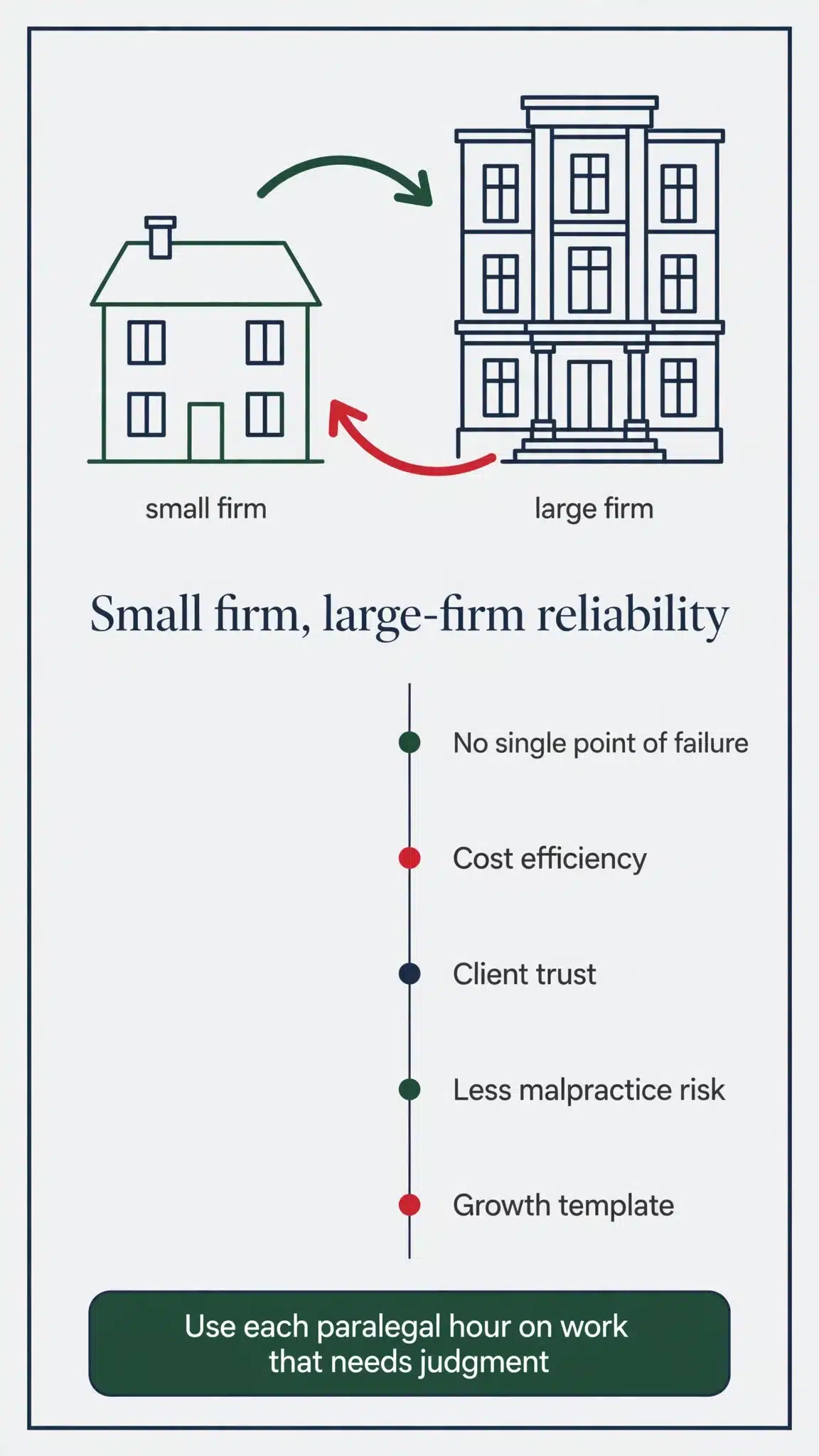
1. One person cannot be everywhere
A single paralegal who handles docketing, filings, IDS and client calls creates a single point of failure. If that person gets sick, leaves or hits a heavy week, deadlines slip. Specialization and backup coverage remove that risk.
2. Cost pressure rewards efficiency
According to the BLS, the median annual wage for paralegals and legal assistants was $62,890 in May 2025. The agency also projects little or no change in employment from 2025 to 2035 and notes that technology, including AI, may reduce demand by making these workers more efficient. For a small firm, those figures point to the same conclusion: use each paralegal hour on work that needs judgment, and automate or outsource the repetitive parts.
3. Clients expect large-firm reliability
Corporate clients compare outside counsel on responsiveness and risk control. A boutique that shows documented procedures, dual review and a clear escalation path competes on equal footing with bigger names.
4. Malpractice and insurance exposure
Missed deadlines cause claims. Written procedures and dual review reduce the chance and give the firm a record if something goes wrong.
5. Growth needs a template
A firm that wants to double its portfolio cannot double its stress. A structure with defined roles lets it add people or outsourced capacity without rewriting the process each time.
How Smaller Firms Copy the Model Without Large-Firm Headcount
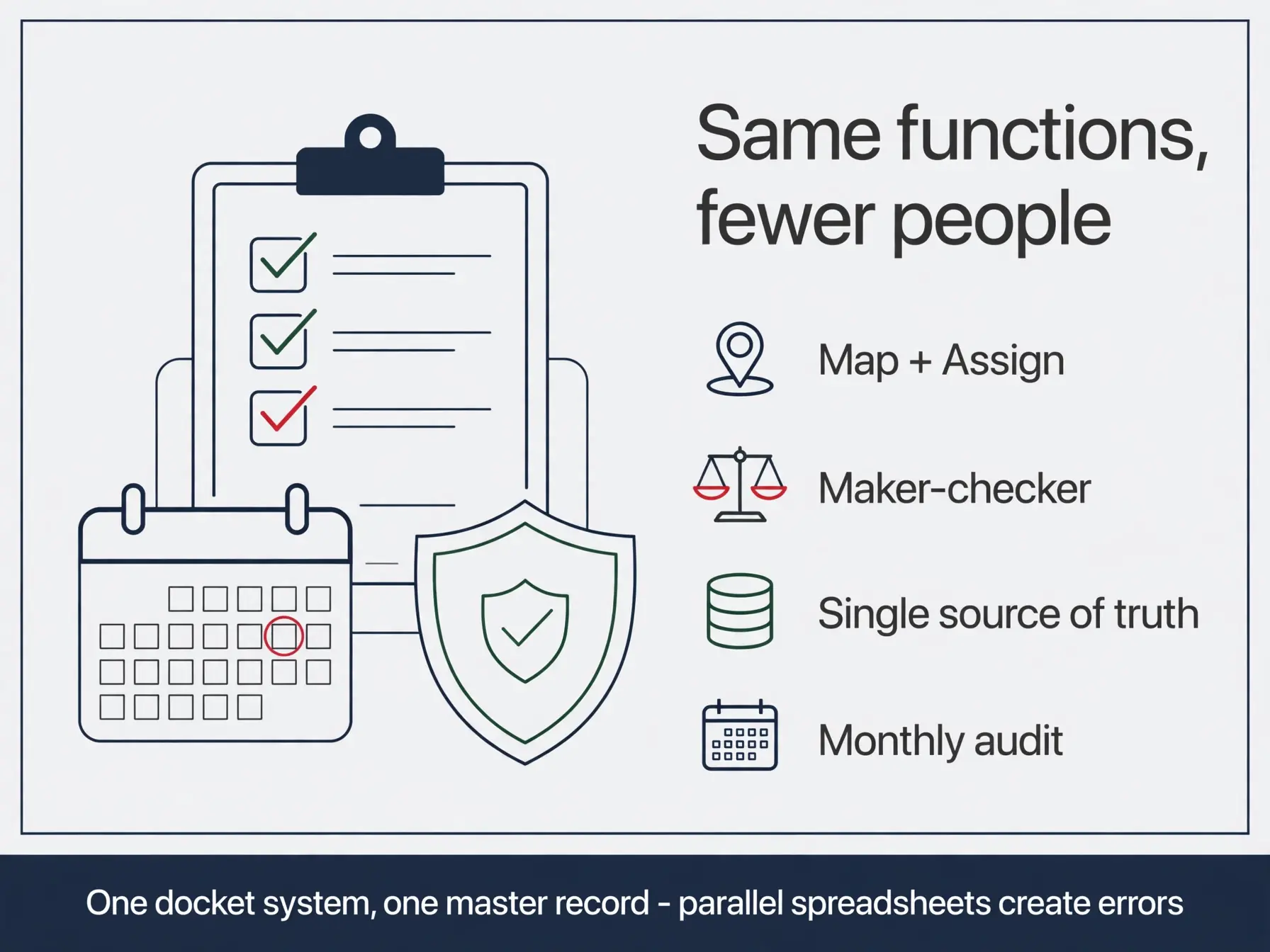
A five-attorney firm does not need eight pods. It needs the same functions, assigned to fewer people or to outside partners. Use this step-by-step approach.
- Map your functions. List every recurring task: docketing, filings, IDS, office action prep, foreign coordination, annuities, trademark maintenance and records.
- Assign an owner and a reviewer to each function. One person may own several functions, but a different person should review deadline-critical ones.
- Write the procedures down. Start with the five tasks that cause the most errors. Use short checklists, not long manuals.
- Add the maker-checker rule. Require a second review on new matter entry, deadline calculation and filings. If your firm has only one paralegal, an attorney or an outsourced reviewer can serve as the checker.
- Choose a single source of truth. Keep one docket system and one master record. Parallel spreadsheets create errors.
- Run a monthly audit. Sample ten to twenty docket entries against official records and log what you find.
- Decide what to outsource. Move repetitive, high-volume, well-defined tasks to a vendor so your people focus on judgment-heavy work.
- Define your escalation rules. Write down who gets a call when a deadline falls inside 48 hours.
Illustrative right-sizing by firm size
The table below is an illustration, not a benchmark. Ratios vary by portfolio mix, filing volume and technology.
| Firm profile | Suggested structure | What to centralize or outsource |
|---|---|---|
| Solo or 2 to 5 attorneys | One lead paralegal covers prosecution support; a second reviewer (attorney or vendor) checks deadlines | Docketing, IDS prep and drawings often suit outsourcing |
| 6 to 20 attorneys | Small docketing pod plus 2 to 4 prosecution paralegals; part-time reviewer | Annuities, foreign coordination and overflow work |
| 20+ attorneys | Full hybrid model with pod leads and a paralegal manager | Peak-load capacity and specialist tasks |
Build, Hire or Outsource? A Comparison
Smaller firms do not have to choose one path. Most settle on a hybrid.
| Factor | Build in-house | Hire additional staff | Outsource or hybrid |
|---|---|---|---|
| Speed to capacity | Slow | Moderate | Fast |
| Fixed cost | High | High | Low (per action, hourly or FTE) |
| Depth of specialization | Grows over time | Depends on the hire | Available from day one |
| Management burden | High | High | Shared with the vendor |
| Coverage during absences | Weak | Weak | Strong |
| Risk to manage | Turnover | Training time | Vendor quality and security |
Teak IP delivers its services on an hourly, per-action or full-time-equivalent basis, so firms can scale up and down without carrying fixed headcount. Its paralegal support services combine experienced U.S.-based professionals with a skilled India-based team under U.S. attorney leadership.
Questions to ask before you outsource
- Does the vendor work inside your docketing system, or does it ask you to move?
- Do U.S. attorneys oversee the work?
- How does the vendor protect confidential invention data? See Teak’s guide on why SOC 2 compliance matters when choosing an IP services vendor.
- Does the arrangement fit USPTO rules? Read Teak’s analysis of whether remote patent paralegal services are compliant with USPTO rules.
- Can the vendor scale for post-grant or other time-sensitive work? See how to hire a virtual patent paralegal experienced with USPTO post-grant proceedings.
Signs Your Firm Needs a More Structured Paralegal Team
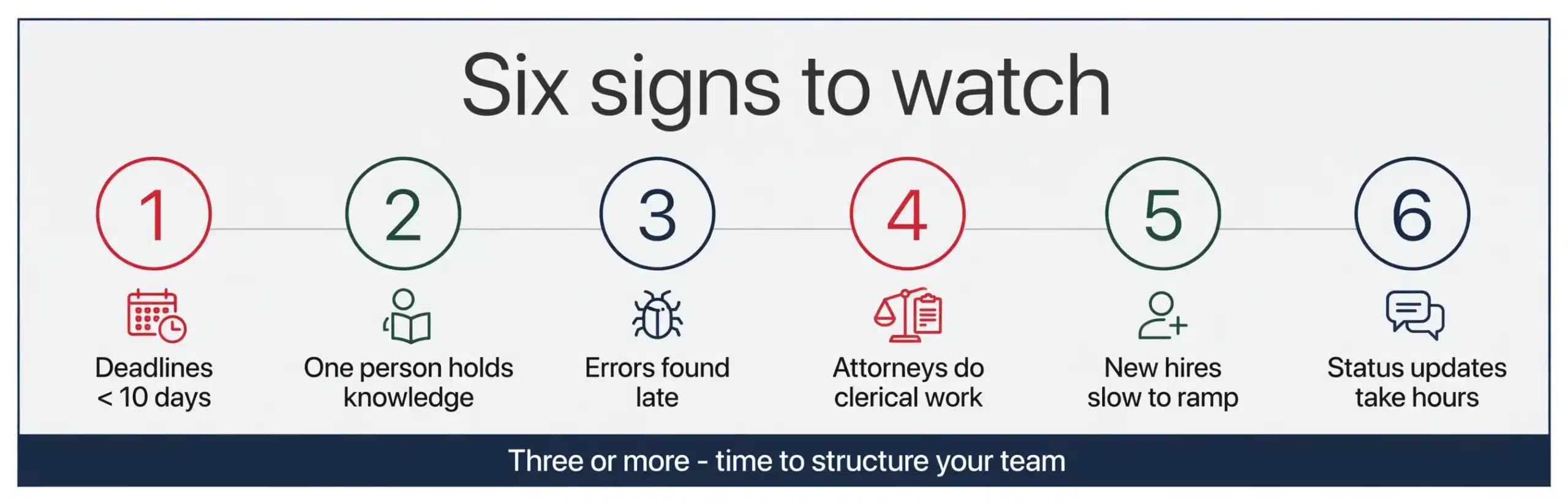
You do not need a formal reorganization to start. Watch for these signals:
- Deadlines sit inside ten days more often than anyone likes
- One paralegal holds knowledge nobody else has
- Docket errors show up after the fact instead of during review
- Attorneys do clerical work during busy weeks
- New hires take months to become productive
- Clients ask for status updates that take hours to assemble
If three or more apply, review Teak’s list of signs your firm needs additional patent paralegal support. For firms building from the ground up inside a company, the guide on how to structure a corporate IP department from scratch adds a broader roadmap.
Metrics Large Firms Track (and Smaller Firms Should Too)
Structure only works if you measure it. Large firms track a short list of indicators.
| Metric | What it tells you | Healthy direction |
|---|---|---|
| Docket accuracy rate (from audits) | Data quality in the system | Higher |
| Deadlines met without extension | Planning and workload balance | Higher |
| Turnaround time per task type | Efficiency of each pod | Stable or lower |
| Rework rate | Quality of first-pass work | Lower |
| Backlog age | Capacity versus demand | Lower |
| Escalations per month | Process gaps and risk | Lower over time |
| Paralegal utilization | Balance of load across the team | Steady, not maxed out |
Start with three: docket accuracy, deadlines met and turnaround time. Add the rest as the team matures.
Common Mistakes When Copying a Large-Firm Structure
Smaller firms sometimes copy the shape without the substance. Avoid these traps.
- Copying the org chart but not the procedures. Roles without written processes produce the same chaos under new titles.
- Skipping the second reviewer. Dual review is the most valuable control, and it costs little.
- Over-specializing too early. A three-person team that splits into five narrow roles creates idle time and fragile coverage.
- Letting paralegals drift into legal advice. Titles, scripts and routing rules should keep legal judgment with attorneys.
- Running two dockets. A shadow spreadsheet beside the official system guarantees conflicts.
- Ignoring data entry quality. Garbage in the docket produces missed dates, no matter how skilled the team is.
- Outsourcing without a handoff plan. A vendor needs clear instructions, system access and a named contact.
- Measuring nothing. Without metrics, nobody knows whether the structure helps.
Expert Tips for Building a Paralegal Structure That Lasts
These practices come from how structured IP support teams run day to day.
- Start with docketing. Every other function depends on it, so fix it first.
- Define “done” for each task. For example, a filing is not done until the confirmation is saved and the docket updated.
- Use templates for repeat work. Response shells, filing checklists and instruction letters cut time and errors.
- Cross-train for coverage. Each pod needs a backup who can handle urgent tasks.
- Hold a weekly deadline huddle. Fifteen minutes on the next 30 days of deadlines catches most surprises.
- Document what you learn. Every near miss should lead to a procedure update.
- Keep attorneys in the loop by exception. Send them what needs judgment, not every routine update.
- Review vendor and staff quality the same way. Use the same audit sample and the same metrics for everyone.
- Train on ethics every year. Include confidentiality, unauthorized practice of law and supervision duties.
- Revisit the structure each year. Volume, technology and client needs change, so the design should too.
How Teak IP Supports Firms That Want a Structured Paralegal Team
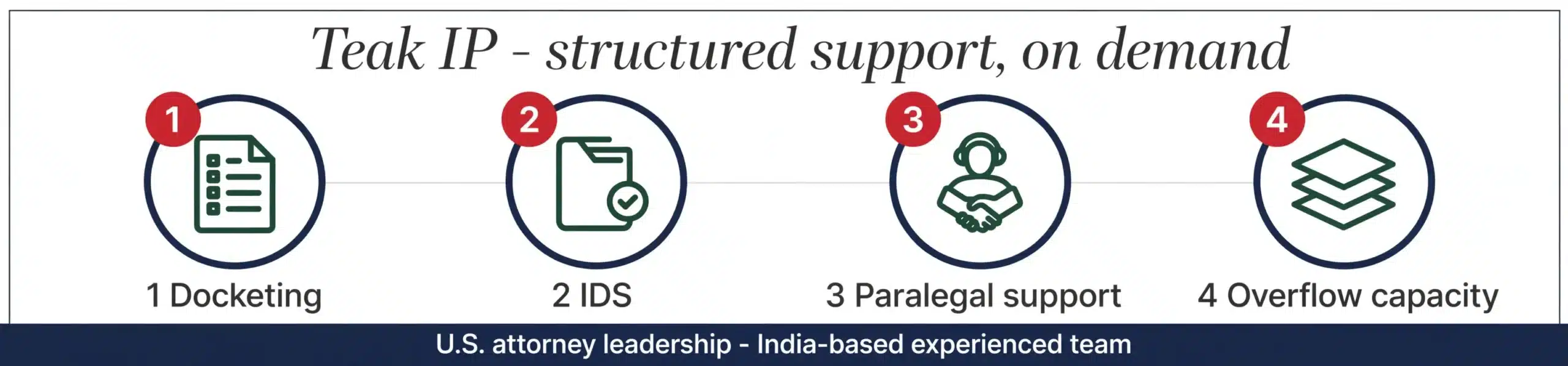
Teak IP gives firms the specialist pods without the fixed headcount. Its model blends U.S.-based professionals with an experienced India-based team, all under U.S. attorney leadership, and it works inside your existing docketing system rather than replacing it. Firms use Teak for:
- Docketing and IP management
- IDS preparation and filing
- Paralegal support across patents and trademarks
- Overflow capacity during peak filing periods
For a related look at the trademark side, see Teak’s explainer on the difference between an IP paralegal and a trademark paralegal.
Frequently Asked Questions About How Large IP Firms Structure Paralegal Teams
How do large IP firms structure paralegal teams?
Large IP firms organize paralegals into specialist pods such as docketing, prosecution, filings, IDS, foreign and trademark. A team lead or paralegal manager oversees each pod, a second person reviews deadline-critical work, and attorneys keep responsibility for every delegated task. Many firms use a hybrid: a central docketing pod plus client-aligned prosecution teams.
Why do smaller firms copy the large-firm model?
Smaller firms face the same deadlines and ethical duties with fewer people. Copying the model’s core features (specialization, written procedures, dual review and escalation paths) lowers deadline risk and improves consistency. Small firms usually adopt these features in a lighter form and often outsource part of the work.
What is the difference between a docketing specialist and a prosecution paralegal?
A docketing specialist enters matters, calculates and calendars deadlines, and audits the docket against official records. A prosecution paralegal prepares the materials for responses and filings, assembles exhibits and tracks examiner communications. The two roles work together, and the docketing specialist’s dates drive the prosecution paralegal’s schedule.
Can paralegals give legal advice or sign filings?
No. Under the ABA Model Guidelines, lawyers must keep ultimate responsibility for delegated work, and they cannot delegate legal opinions to clients, fee setting or establishing the attorney-client relationship. USPTO rules at 37 CFR 11.503 also require practitioners to supervise nonlawyer assistants. Paralegals may relay a lawyer’s advice but may not interpret or expand on it.
How many paralegals does a firm need per attorney?
No universal ratio exists. The right number depends on portfolio size, filing volume, task complexity and how much work you automate or outsource. A better method is to measure workload per function, find the bottlenecks and add capacity where deadlines or quality suffer.
Is outsourcing paralegal work compatible with USPTO rules?
Yes, when attorneys supervise the work and protect client confidentiality. The practitioner remains responsible for the assistant’s conduct, so firms should choose vendors with clear processes, security controls and attorney oversight. Review the vendor’s access rights, training and data protection before you start.
What should a small firm copy first?
Start with docketing controls: one source of truth, a second reviewer for new entries and a monthly audit. Then write short checklists for your five most error-prone tasks. These two steps give the largest drop in risk for the smallest investment.
What does the job outlook mean for firms that rely on paralegals?
The BLS projects little or no change in paralegal employment from 2025 to 2035 and says technology, including AI, may reduce demand by making workers more efficient. For IP firms, that points toward structures that use paralegal time on judgment-heavy tasks and automate or outsource routine ones.
Conclusion: Copy the Principles, Not Just the Org Chart
Understanding how large IP firms structure paralegal teams gives every firm a blueprint. The pattern is consistent: specialist pods, team leads, a second reviewer on critical work, written procedures and attorneys who own every delegated task. Large firms need this structure because of scale. Smaller firms adopt it because it protects deadlines, controls cost and earns client trust.
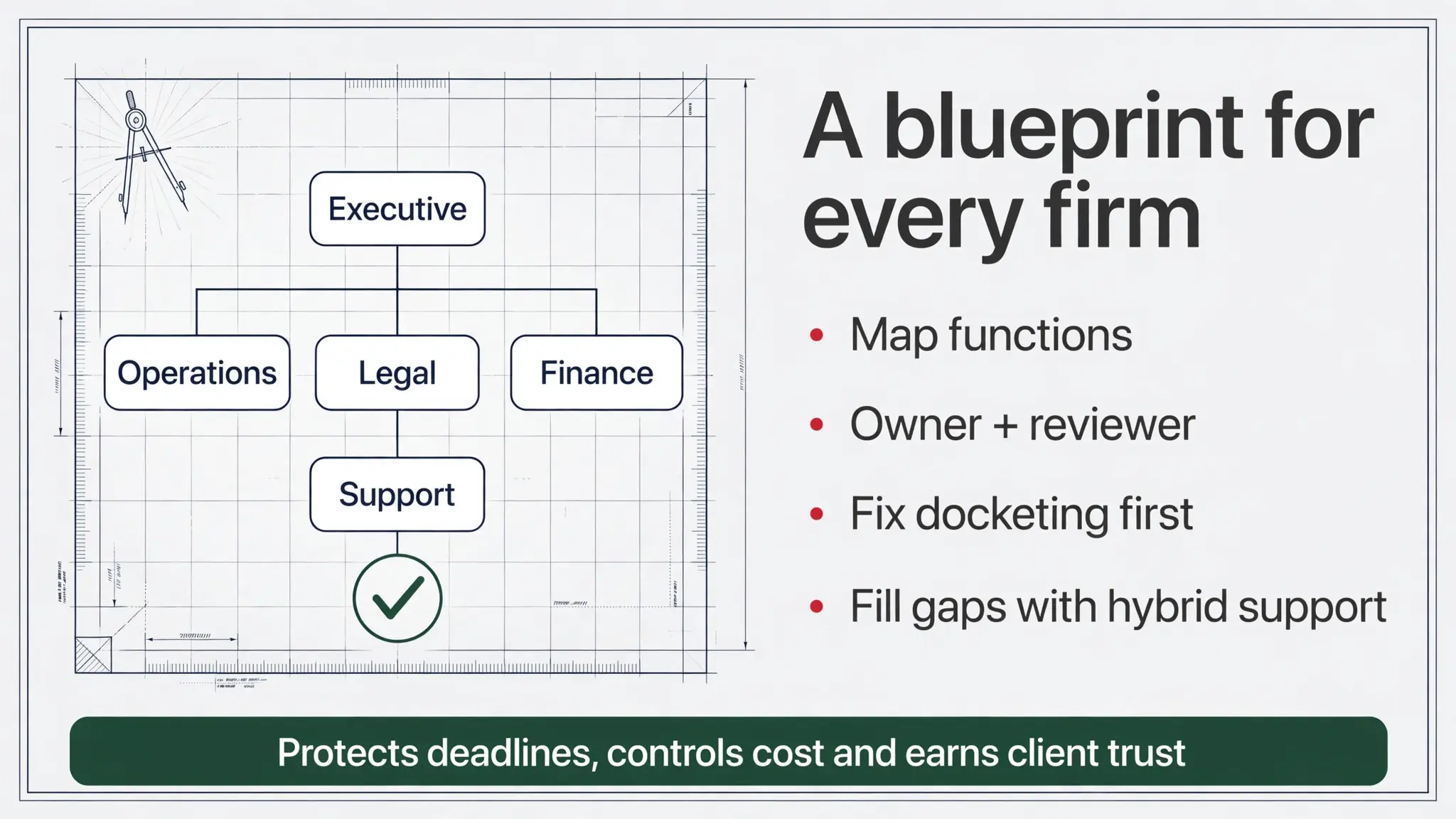
You do not need a department of fifty to benefit. Map your functions, assign an owner and a reviewer to each, fix docketing first and measure what matters. Then fill the gaps with hybrid or outsourced support.
Ready to add specialist capacity without adding fixed headcount? Talk to Teak IP about paralegal support or email info@teakipservices.com to design a structure that fits your firm.
Ready to Add Specialist Capacity Without Adding Fixed Headcount?
You do not need a department of fifty to benefit. Map your functions, assign an owner and a reviewer to each, fix docketing first and measure what matters. Then fill the gaps with hybrid or outsourced support that fits your firm.
Paralegal Support | Specialist Pods, Second Review & Docketing | For law firms & in-house teams

