
Quick answer: How data entry errors compound into missed deadlines comes down to one pattern. A small mistake enters the docket at intake, such as a wrong date, jurisdiction, or entity status. Every rule, calculation, and reminder built on that record then inherits the mistake. The error stays invisible until a deadline passes, and by then the right to respond may be gone.

A missed IP deadline almost never starts as a missed deadline. It starts as a single keystroke on an ordinary Tuesday.
Someone types a priority date with two digits swapped. The system accepts it, and the record looks fine. Months later, a reminder fires on the wrong day, or never fires at all. Nobody notices until an abandonment notice arrives.
That is how data entry errors compound into missed deadlines: quietly, mathematically, and expensively. This guide explains the mechanism, shows where errors hide, and gives you a practical process to stop them. It draws on the way professional docketing teams verify data before a deadline ever goes live.
Key Takeaways
- A docket is a chain of dependent calculations. One bad input corrupts everything downstream.
- Errors compound because each step trusts the step before it.
- Some deadlines allow recovery, while others do not. Treat every date as unrecoverable until you know otherwise.
- Verification at intake costs far less than revival petitions later.
- A second set of trained eyes, plus source-document checks, catches most errors before they spread.
Why Docketing Accuracy Matters More Than Ever
IP portfolios keep growing, and the people who manage them rarely grow at the same pace. Meanwhile, each matter carries more dates than it did a decade ago. A single patent family can span a priority claim, an international filing, several national entries, office actions, information disclosure statements, and maintenance fees across many countries.
More dates mean more data. More data means more chances for one wrong value to slip in unnoticed.
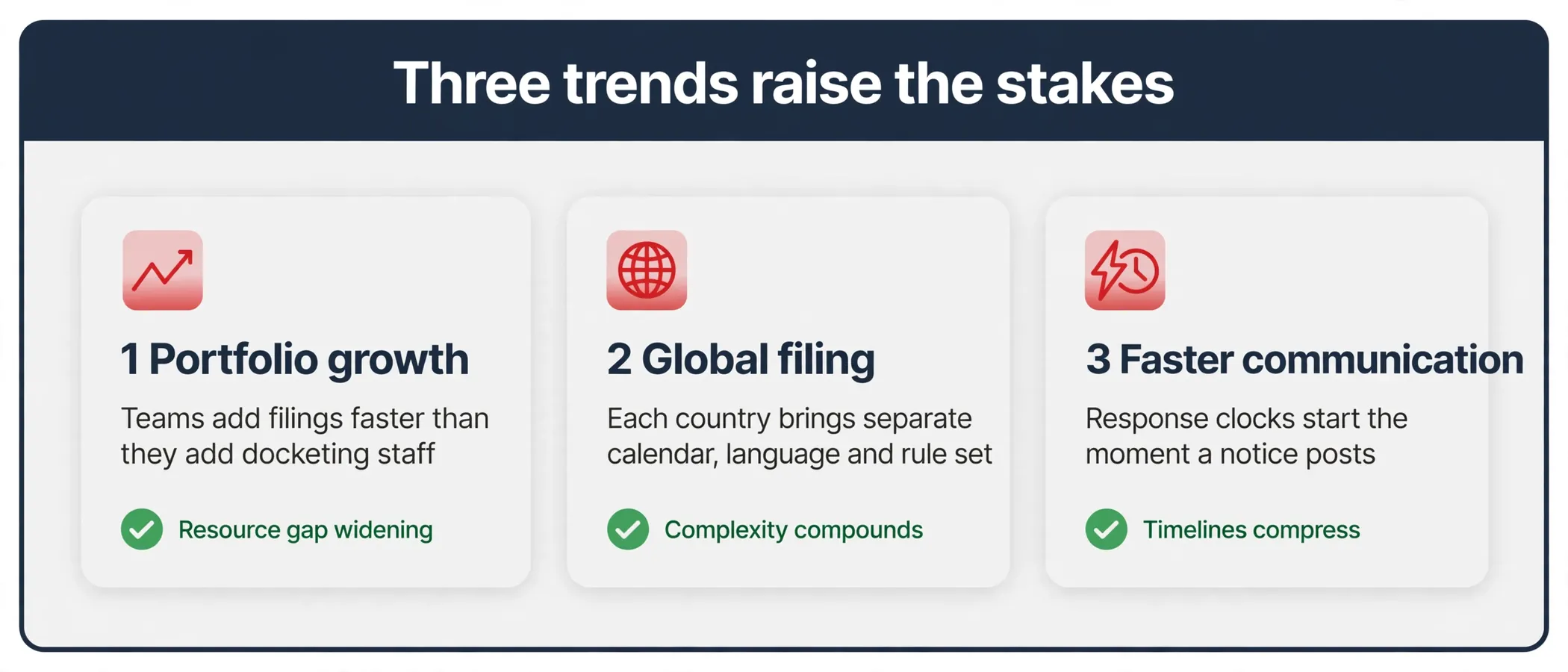
Three trends raise the stakes:
- Portfolio growth: Corporate teams add filings faster than they add docketing staff.
- Global filing: Each added country brings a separate calendar, language, and rule set.
- Faster communication: Offices send notices electronically, and response clocks start the moment a notice posts.
Because of these pressures, a docket error no longer sits quietly in a drawer. It travels through shared systems, client reports, and automated reminders. Therefore, accuracy at the point of entry has become a core risk control, not a clerical detail.
The cost of one missed date can also exceed the value of all the time saved by rushing. A lapsed patent, an abandoned application, or a lost opposition window can erase years of investment. That asymmetry explains why careful teams treat the docket as critical infrastructure.
What is a Docketing Data Entry Error?
A docketing data entry error is any incorrect, missing, or misclassified piece of information recorded in an IP docket. The error can be a typo, but it can also be a wrong assumption, such as the wrong entity status or an outdated rule set.
Docketing means recording, calculating, and monitoring the deadlines tied to patents and trademarks. The docket is only as reliable as the data behind it. If you want the full picture of the discipline itself, our IP docketing services overview explains what a managed docketing function covers.
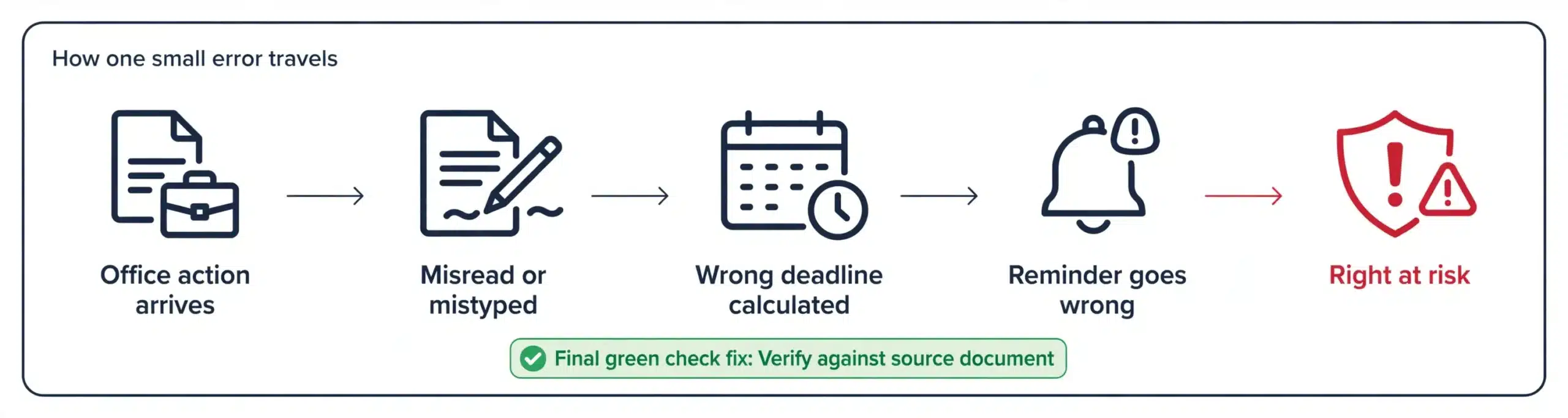
Docketing errors fall into three broad groups:
- Input errors: typos, transposed digits, wrong formats, and copy-paste slips.
- Interpretation errors: misreading an office action, a notice, or a filing receipt.
- Configuration errors: wrong jurisdiction rules, wrong entity status, or stale calculation settings.
Input errors get the most attention. However, interpretation and configuration errors often cause the largest losses, because they repeat across many records at once.
How Data Entry Errors Compound Into Missed Deadlines: The Mechanism
Compounding means the damage grows after the original mistake. A docket does not store dates in isolation. It derives them.
Think of a docket as a spreadsheet of formulas. The base date feeds the response date. The response date feeds the reminder. The reminder feeds the attorney’s calendar. Change the base date wrongly, and every cell downstream changes with it.
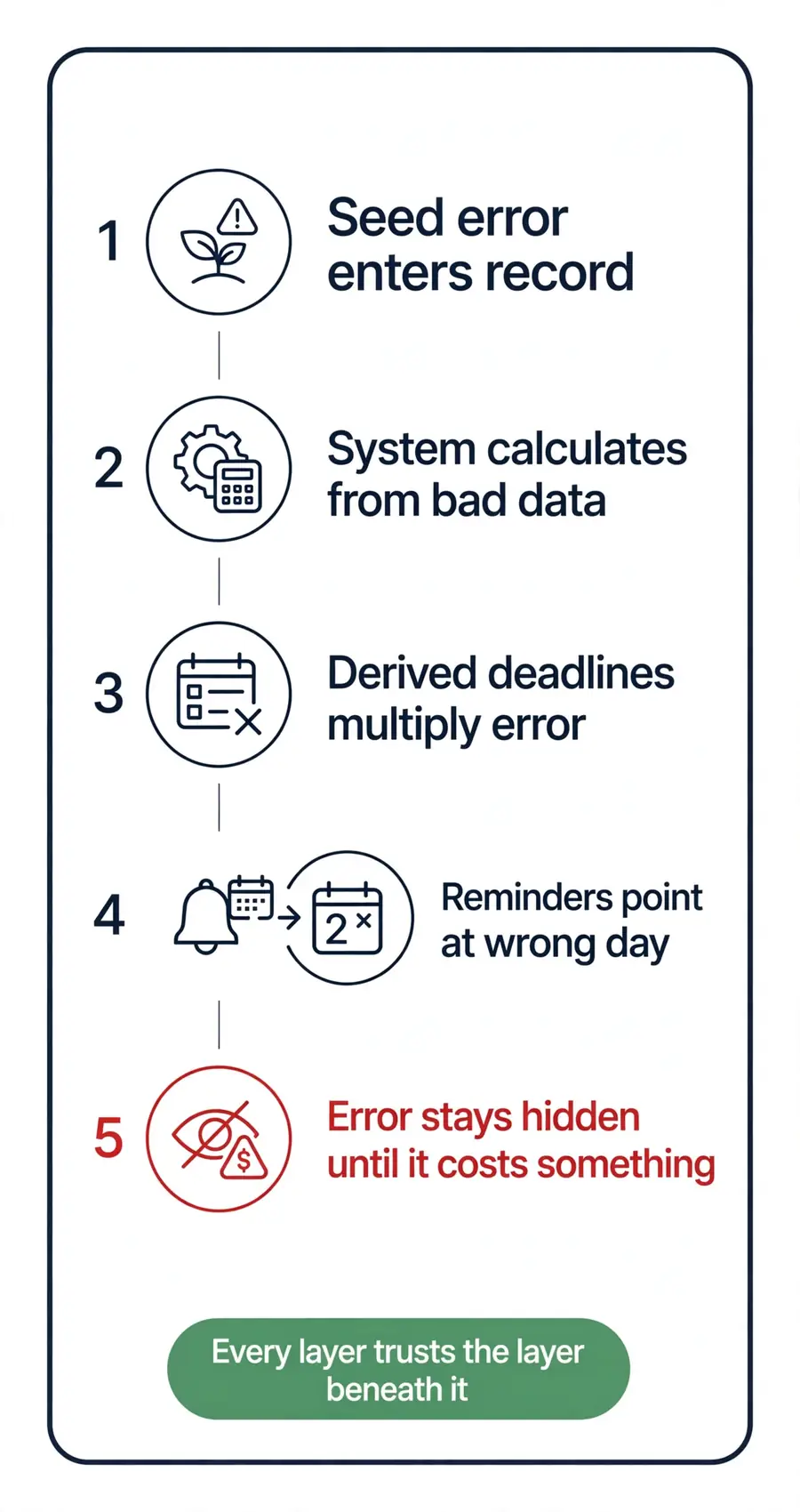
Step 1: The seed error enters the record
An incorrect value gets saved. The system rarely objects, because most fields accept any plausible date. The record looks complete, so no one reviews it again.
Step 2: The system calculates from bad data
Docketing software applies rules automatically. For example, it adds a fixed period to a mailing date to find a response deadline. The software does exactly what it was told. Therefore, a wrong input produces a confident, wrong output.
Step 3: Derived deadlines multiply the error
One event often creates several deadlines. A single office action date can drive an initial response date, extension windows, and an internal review date. One bad input now sits behind several dates.
Step 4: Reminders point at the wrong day
Reminders are the safety net, but they are also derived data. A reminder set from a wrong due date warns the team at the wrong time. In the worst case, it warns them after the real deadline has passed.
Step 5: The error stays hidden until it costs something
Nothing in the workflow flags the mistake. The team sees a green docket and assumes everything is on track. The first real signal is often a notice of abandonment, a lapsed registration, or a client call.
That sequence is the whole story of how data entry errors compound into missed deadlines. The error does not grow loudly. It grows silently, because every layer trusts the layer beneath it.
The arithmetic of small error rates
Small per-step error rates look harmless in isolation. They look very different when you multiply them across a workflow.
The table below is an illustration, not a measured industry statistic. It assumes six independent handling steps (intake, entry, calculation, review, reminder setup, and calendar sync) and shows how accuracy erodes.
| Accuracy per step | Six steps combined | Records with at least one error, per 1,000 matters |
|---|---|---|
| 99.9% | 99.4% | About 6 |
| 99% | 94.1% | About 59 |
| 98% | 88.6% | About 114 |
| 95% | 73.5% | About 265 |

Notice the pattern. A team that is “99% accurate” at each step still produces roughly 59 flawed records in every 1,000 matters. Each flawed record is a potential missed deadline. Meanwhile, the workload keeps growing.
Where Errors Start: Seven Common Entry Points
Most docketing errors cluster around a small number of risky moments. Knowing them lets you place controls where they matter.
1. New matter intake
Intake is the highest-risk moment. The team captures dates, parties, priority claims, and status from source documents, often under time pressure. A mistake here becomes the foundation of every later calculation.
2. Priority and filing dates
Priority claims drive international deadlines. A wrong priority date shifts every Paris Convention and PCT date that follows. This is one of the few places where one error can move a whole patent family’s calendar.
3. Entity status and fee data
Entity status (large, small, or micro) affects fees. A wrong status causes underpayment or overpayment. As a result, a filing may need correction and a deficiency payment instead of a clean submission.
4. Notice and office action dates
Teams must record the mailing date, the response period, and any extension rules. Reading the wrong date on a notice shifts the whole response window.
5. Jurisdiction rules
Every patent and trademark office runs its own calendar logic. A rule set that fits one country can fail in another. Therefore, configuration needs regular review as laws and office practices change.
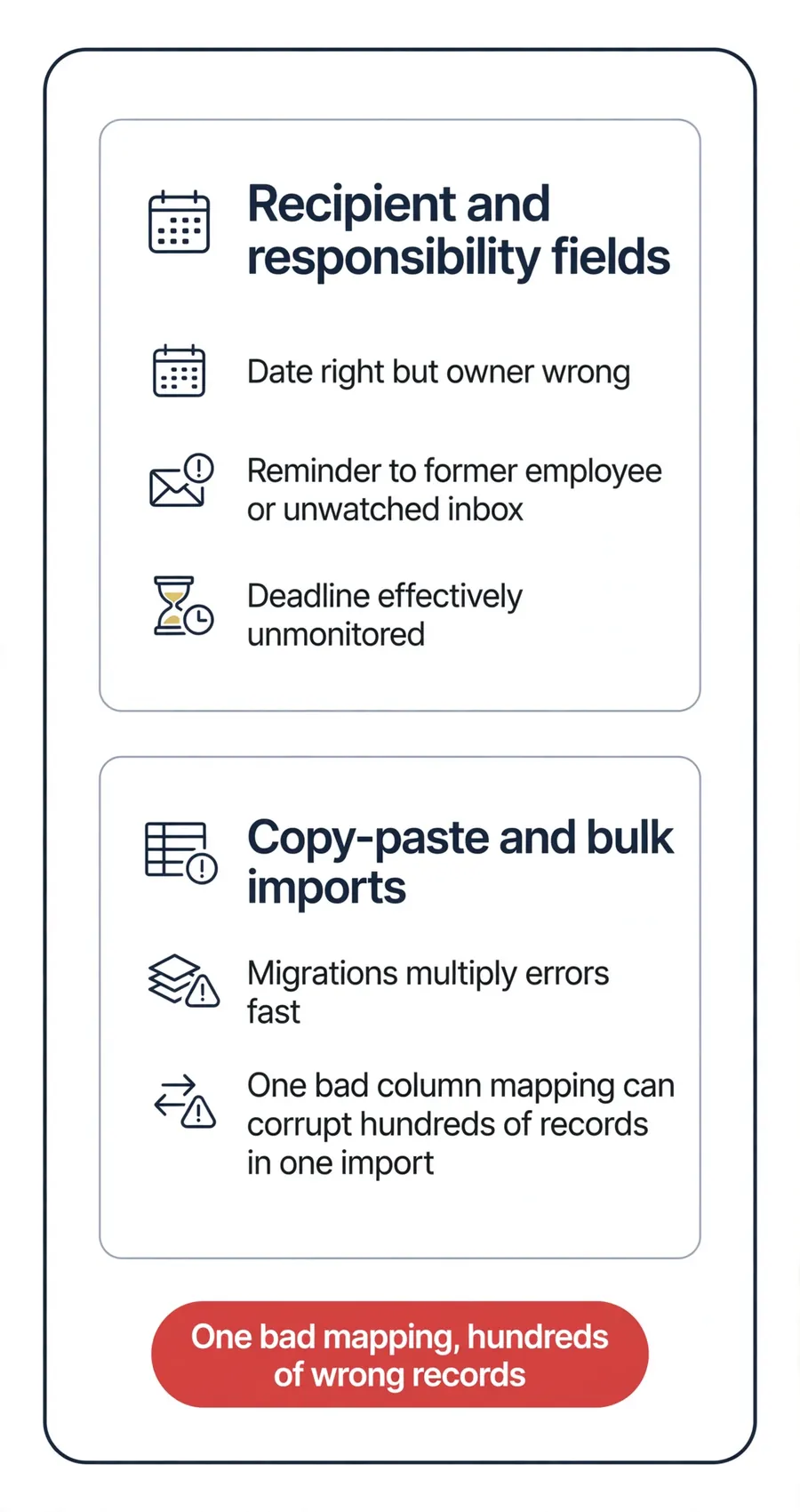
6. Recipient and responsibility fields
Sometimes the date is right but the owner is wrong. If a reminder goes to a former employee or a shared inbox no one watches, the deadline is effectively unmonitored.
7. Copy-paste and bulk imports
Migrations and bulk uploads multiply errors fast. One bad column mapping can corrupt hundreds of records in a single import.
The table below ties each entry point to a typical failure.
| Entry point | Typical error | Downstream effect |
|---|---|---|
| New matter intake | Missing or misread filing data | Every later calculation starts wrong |
| Priority date | Transposed digits | Foreign filing and PCT dates shift |
| Entity status | Wrong fee tier | Fee deficiency, correction filings |
| Office action date | Wrong mailing date | Response window miscalculated |
| Jurisdiction rules | Outdated or mismatched rule set | Systematic miscalculation across records |
| Responsible party | Departed or wrong owner | Reminders reach no one |
| Bulk import | Column mapping error | Hundreds of records corrupted at once |
Why Smart Teams Still Miss Compounding Errors
Skilled docketers can make mistakes, and the reason is rarely a lack of care or attention. The nature of the work itself creates opportunities for errors, especially when managing complex records, multiple deadlines, and detailed information across different stages. Understanding the human side of these mistakes helps you recognize where problems are most likely to occur and design better controls to prevent them.
Familiar data hides its own mistakes
Experienced people read a date and see what they expect. Therefore, a transposed digit often passes straight through a reviewer who is looking at the same screen the entry person used. Familiarity makes the brain fill in gaps automatically.
Volume and interruptions break concentration
Docketers often have to manage sudden bursts of notices, client emails, and frequent calendar changes, all while keeping track of important deadlines and records. Every interruption can break their focus and increase the chances of something being overlooked or entered incorrectly. As a result, errors tend to occur more frequently during particularly busy weeks, which are also the times when teams have the least spare capacity to review their work and catch those mistakes.
Reviewers check outputs, not inputs
Many teams look at the final deadline and ask, “Does this date seem reasonable?” That question misses the point. A wrong base date can still produce a believable response date. Instead, reviewers should compare the entered values with the source document.
Confidence in software creates blind spots
Automated calculations feel authoritative. People trust a computed date more than a typed one. However, software repeats whatever it receives. Trust without verification is exactly where how data entry errors compound into missed deadlines becomes a real operational risk.
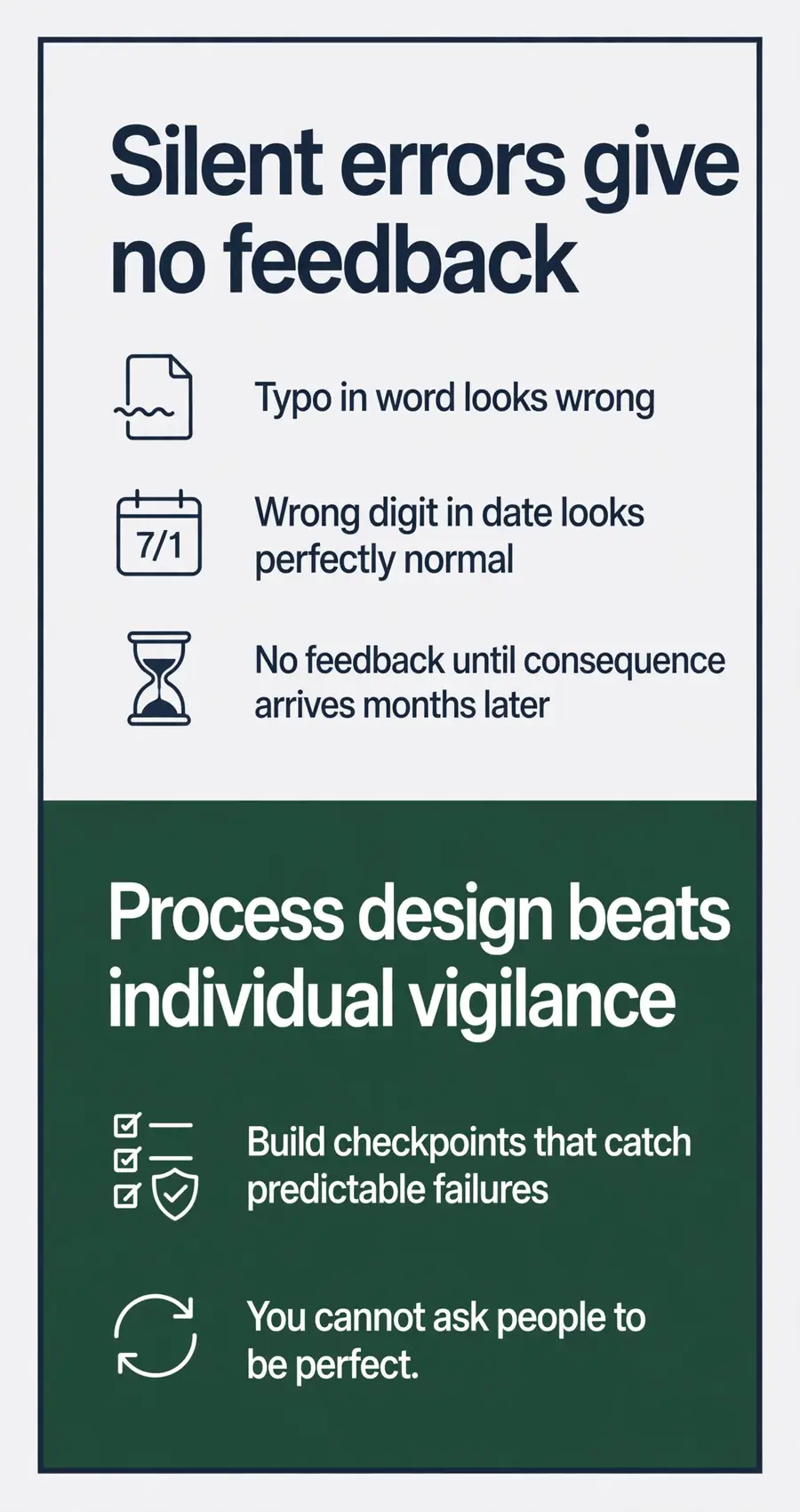
Silent errors give no feedback
A typo in a word looks wrong on the page. A wrong digit in a date looks perfectly normal. Without immediate feedback, nobody learns from the mistake until the consequence arrives, sometimes months later.
These factors explain why process design beats individual vigilance. You cannot ask people to be perfect. You can, however, build checkpoints that catch the predictable failures.
Why Some Missed Deadlines Cannot Be Recovered
Compounding errors matter because recovery is uncertain. Some offices allow late action. Others do not. Some allow it only after a petition, a fee, and a statement about why the delay happened.
The table below summarizes common deadline types and what the official sources say about missing them.
| Deadline type | What the rule says | Recovery path |
|---|---|---|
| U.S. patent maintenance fees | Due at 3.5, 7.5, and 11.5 years after grant. A six-month grace period follows, with a surcharge. | If the grace period ends unpaid, the patent expires. A petition based on unintentional delay may reinstate it. |
| Abandoned U.S. patent applications | Failing to reply to an Office action in time can lead to abandonment. | A petition under 37 CFR 1.137 can revive the application if the entire delay was unintentional. |
| PCT national phase entry | Generally 30 months from priority, and 31 months for some offices. | Remedies vary by office. Some offices allow late entry or reinstatement, and others do not. |
| TTAB filings | Board deadlines are binding. | The USPTO states that users should not expect a deadline extension because of a filing outage. |
For the U.S. maintenance schedule, the USPTO explains that you can pay without surcharge at 3 to 3.5 years, 7 to 7.5 years, and 11 to 11.5 years after issue, and that unpaid fees and surcharges at the end of the grace period cause the patent rights to lapse.
For revived applications, the USPTO describes the petition requirements for revival based on unintentional delay. A petition needs the required reply, the petition fee, and a statement that the entire delay was unintentional. The USPTO asks for additional information when the petition arrives more than two years after abandonment.
International deadlines vary even more. WIPO publishes a table of national and regional phase time limits and points applicants to each office’s national chapter for remedies. The European phase, for example, follows a 31-month limit under the EPO’s Euro-PCT guide.
The lesson is simple. Revival is a rescue, not a plan. It costs money, adds risk, and sometimes does not exist at all.
If your team manages international filings, our guides on PCT filing costs and fees and the ePCT filing process show how many dates hang on correct source data.
Patent vs. Trademark Docketing: Where Compounding Hits Hardest
Both practice areas suffer from compounding errors, but the pressure points differ. Patent matters generate long chains of dependent dates. Trademark matters generate shorter chains, yet they repeat across many marks and classes.
| Factor | Patent docketing | Trademark docketing |
|---|---|---|
| Typical chain length | Long: priority, PCT, national phase, prosecution, maintenance | Shorter: application, examination, publication, registration, renewal |
| Highest-risk input | Priority and filing dates | Filing basis, goods and services, ownership |
| Compounding pattern | One base date shifts many foreign deadlines | One ownership or status error repeats across a portfolio |
| Common trap | Wrong entity status or jurisdiction rules | Missed renewal windows and Board deadlines |
| Recovery options | Vary by office and deadline type | Often narrow once a Board deadline passes |
For trademark teams, the USPTO notes that filers should not expect a TTAB deadline extension because of a filing outage. That statement alone shows why teams must file early and docket reliably. A deadline entered a day late in the system leaves no cushion for a technical problem on the due date.
Patent teams face a different trap. A wrong priority date can shift the Paris Convention and PCT calendar for an entire family, so one entry decides dozens of later dates.
An Illustrative Scenario: One Transposed Digit
The following scenario is a composite example built from common docketing failure patterns. It is not a report on a specific client matter.
A mid-sized firm files a U.S. provisional application and enters the filing date as the 12th instead of the 21st. The docket stores the wrong priority date. The error looks trivial.
Over the next year, the effects stack up:
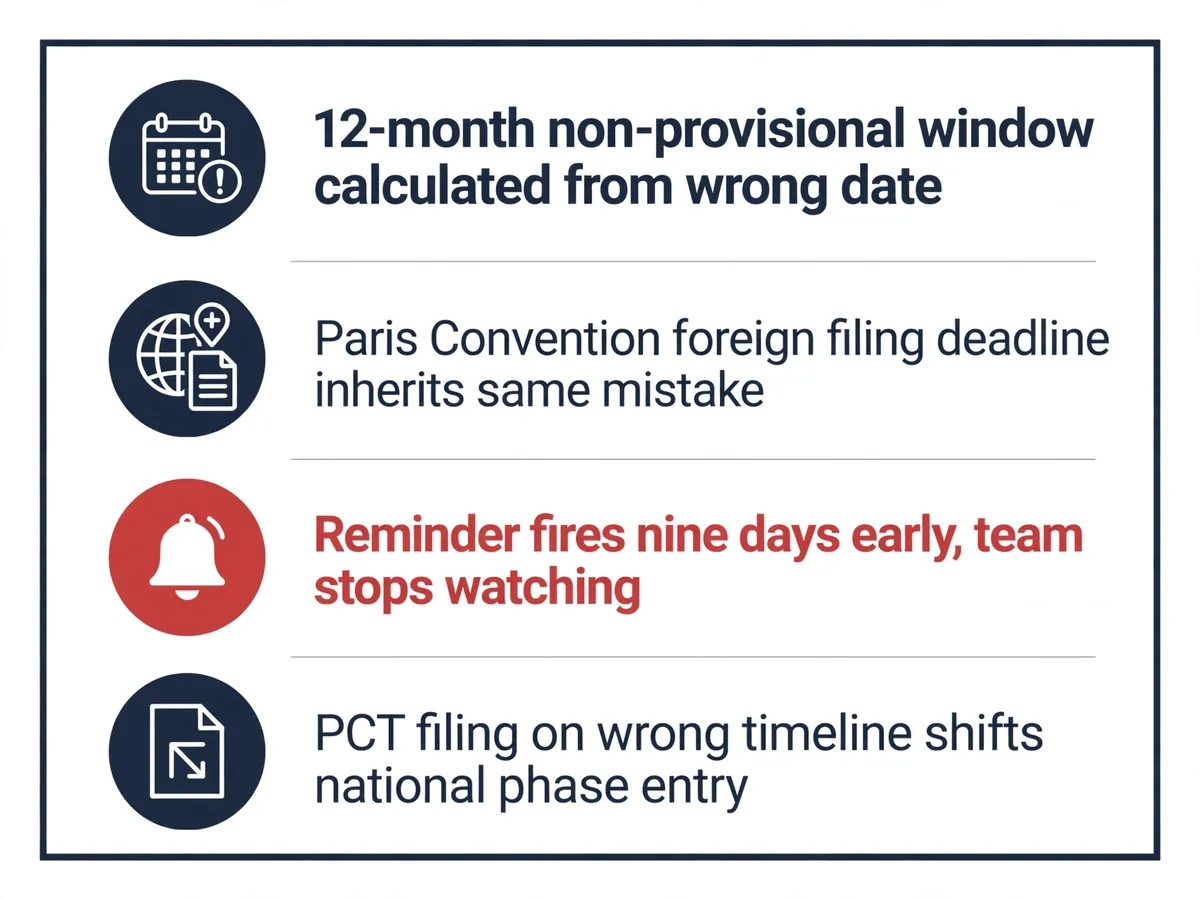
- The system calculates the 12-month non-provisional window from the wrong date.
- The Paris Convention foreign filing deadline inherits the same mistake.
- A reminder fires nine days early, so the team treats the matter as handled and stops watching.
- The PCT filing happens on the wrong timeline, which shifts the national phase entry date.
In this version, the error runs in the safe direction, and the team gets lucky. However, a digit slip in the other direction would push every date nine days late. The team would discover the problem only after the real deadline passed.
Notice what never happened. Nobody was careless. Every person trusted the record in front of them. That is exactly why compounding errors survive.
A Second Scenario: The Ownership Field That Repeated
This second example is also a composite built from common failure patterns, not a report on a real matter.
A corporate legal team merges two brand portfolios. During the data migration, an import maps the “owner” column to the wrong field. The record still shows a company name, so the import passes a quick visual check.
Several problems follow over the next year:
- Renewal reminders route to the former owner’s legal contact.
- Maintenance filings go out with outdated ownership details.
- A client report lists the wrong entity for dozens of marks.
- A deadline for one mark passes because the reminder reached an inbox no one monitors.
One mapping mistake touched hundreds of records at once. Moreover, each downstream problem looked like a separate issue, so the team spent weeks treating symptoms instead of finding the single cause.
The fix was not heroic. A sample audit that compared ten random records with source documents would have exposed the mapping error on day one. That outcome shows why bulk changes deserve the same scrutiny as new filings.
Common Mistakes Teams Make When Fighting Docketing Errors
Many teams invest in the wrong fixes. Avoid these patterns:
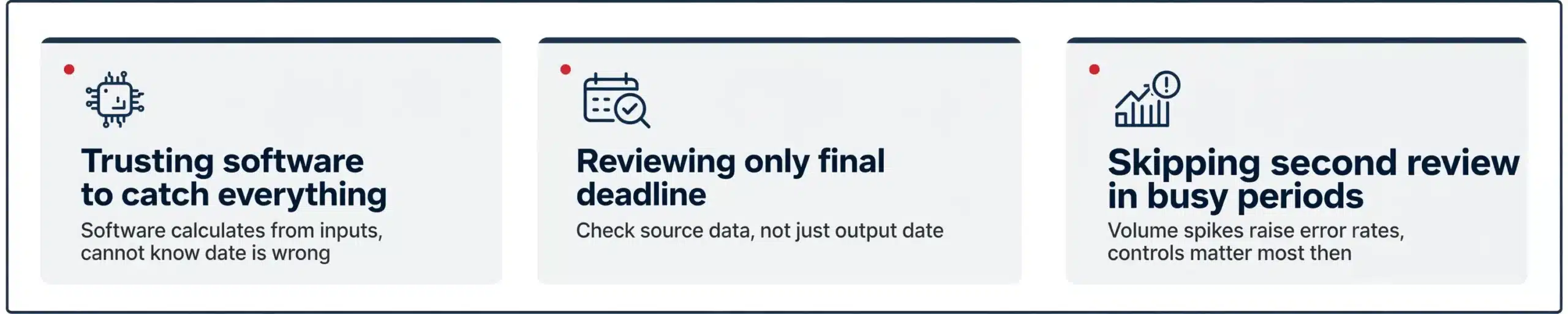
- Trusting the software to catch everything. Software calculates from the inputs you give it. It cannot know that a date is wrong.
- Reviewing only the final deadline. Check the source data, not just the output date.
- Skipping a second review during busy periods. Volume spikes raise error rates, so controls matter most when teams feel least able to afford them.
- Letting one person own intake and review. The person who entered a record rarely sees its mistakes.
- Ignoring configuration drift. Rules change, and an outdated rule set misfires across every record that uses it.
- Treating errors as individual failures. Blaming the person hides the process gap that let the error through.
- Running a one-time cleanup and stopping. Data decays, so audits must repeat.
If several of these sound familiar, you may be near a capacity limit. Our article on signs your firm needs additional patent paralegal support covers the warning signals in detail.
Step-by-Step: How to Stop Data Entry Errors From Compounding
You cannot eliminate human error. You can, however, stop it from traveling. Follow these steps in order.
- Capture data from the source document, not from memory or email summaries. Work from the filing receipt, the official notice, or the office action itself.
- Verify intake data against the official record before activating any deadline. Compare dates, parties, and priority claims with the patent or trademark office record.
- Use a second person for review. The reviewer should check the source document, not just the entered values.
- Validate calculations independently. Spot-check computed dates by hand or with an official calculator, especially for international matters.
- Standardize formats and required fields. Force one date format and make critical fields mandatory.
- Assign every deadline a named owner and a backup. A reminder without an accountable person is only a notification.
- Set tiered reminders. Use several alerts at increasing urgency, with escalation to a supervisor for high-risk dates.
- Audit on a schedule. Sample records every quarter, and run a larger portfolio audit at least yearly.
- Log every error and trace it to its source. Fix the process, not just the record.
- Review rule sets when laws or office practices change. Treat configuration as living data.
These steps map to a simple principle: verify early, verify independently, and verify repeatedly.
Manual Docketing vs. a Verified Docketing Process
The comparison below shows why process design matters more than any single tool.
| Factor | Ad hoc manual docketing | Verified docketing process |
|---|---|---|
| Source of data | Emails, memory, summaries | Official source documents |
| Review | Self-review or none | Independent second review |
| Official record check | Rare | Before deadlines activate |
| Reminder structure | Single alert | Tiered alerts with escalation |
| Ownership | Often unclear | Named owner plus backup |
| Audit frequency | Ad hoc | Scheduled and documented |
| Error tracking | Informal | Logged and traced to root cause |
| Scalability | Breaks as volume grows | Designed for portfolio growth |
Teak IP’s docketing and IP management service follows the right-hand column. Its published intake process captures dates, parties, priority claims, and status from source documents. It then verifies them against USPTO records before activating deadlines, and attorney oversight backs the multi-layer quality checks.
Expert Tips for Catching Errors Before They Spread
These practices separate resilient docket teams from fragile ones.
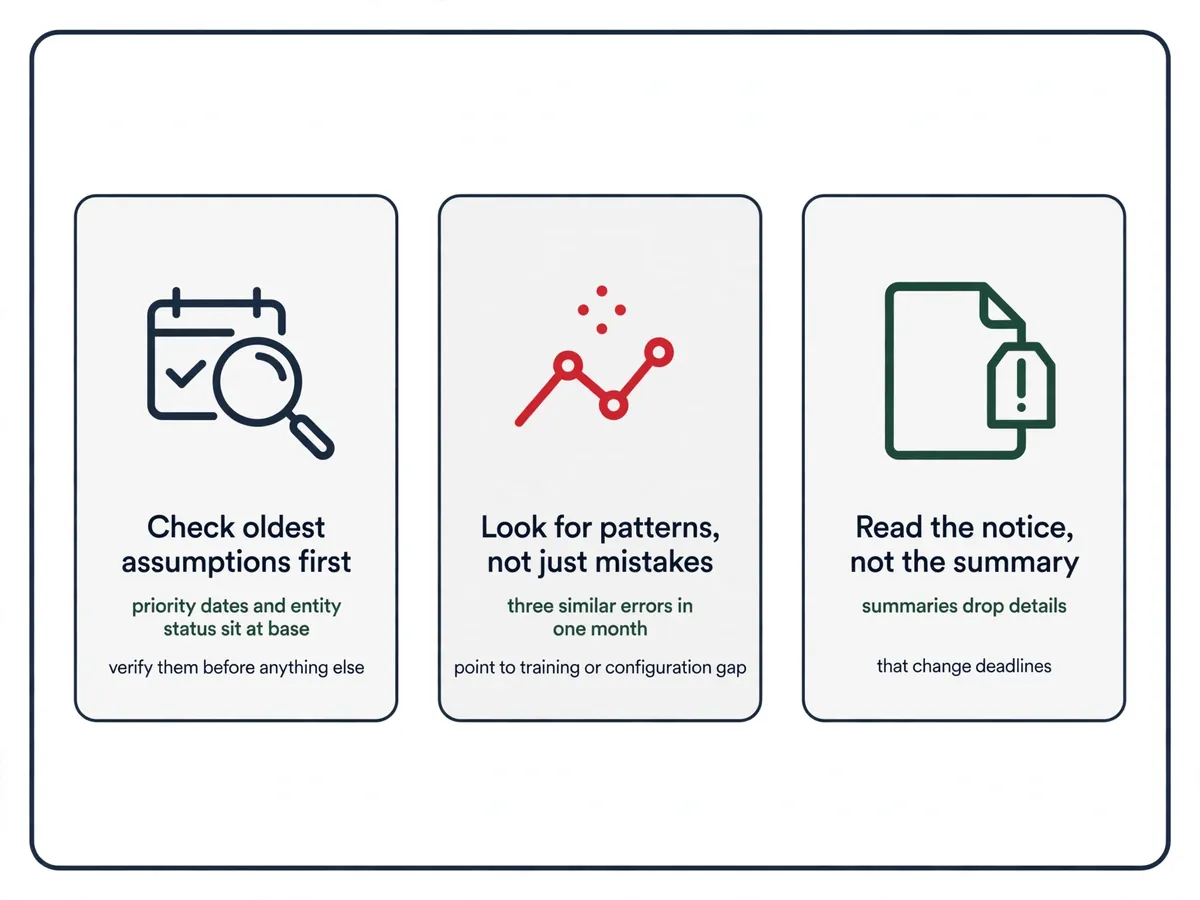
- Check the oldest assumptions first. Priority dates and entity status sit at the base of the pyramid. Verify them before anything else.
- Look for patterns, not just mistakes. Three similar errors in one month usually point to a training or configuration gap.
- Read the notice, not the summary. Summaries drop the details that change deadlines.
- Use official calculators as a cross-check. WIPO, for example, offers a PCT time limit calculator that helps validate international dates.
- Run a “what if I’m wrong” test. For each high-value matter, ask which single input would move the most dates. Then double-check that input.
- Protect the busy season. Add review capacity before filing peaks, not after errors appear.
- Keep a deadline recovery map. Know which dates allow revival and which do not, so your team can rank risk correctly.
Metrics That Show Whether Your Docket Is Healthy
You cannot manage what you do not measure. A short set of metrics tells you whether errors are shrinking or spreading.
| Metric | What it tells you | How to use it |
|---|---|---|
| Intake error rate | Share of new records that need correction after review | Spot training gaps early |
| Audit discrepancy rate | Share of sampled records that differ from source documents | Track the real state of the docket |
| Near-miss count | Errors caught before a deadline passed | Reveal weak controls that luck is covering |
| Reminder acknowledgment time | How fast owners confirm alerts | Find unmonitored inboxes |
| Rule set review date | When jurisdiction rules were last checked | Prevent configuration drift |
| Repeat error count | Same error type recurring | Show where the process, not the person, needs a fix |
Near-misses deserve special attention. Each one is a free lesson, because the error happened but did not cost anything. Teams that log and study near-misses fix problems before they turn into missed deadlines.
Importantly, review these numbers on a fixed rhythm. A monthly check for small teams and a quarterly review for larger ones keeps the signal fresh.
Build a Quarterly Docket Audit You Will Actually Run
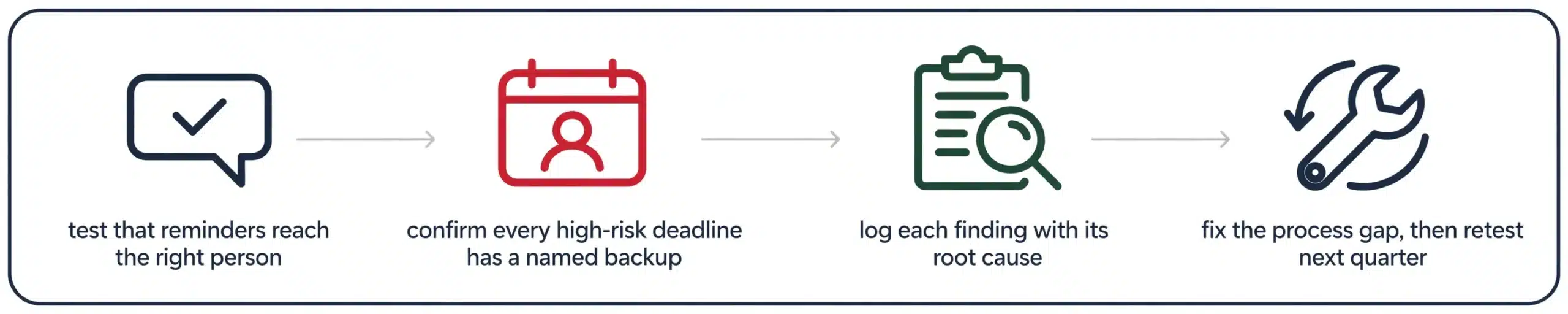
An audit does not need to be elaborate. It needs to be repeatable. Use this checklist as a starting point.
- Pull a random sample of 25 to 50 active records.
- Compare each record’s key dates with the source document.
- Confirm entity status, priority claims, and ownership fields.
- Recalculate three or four derived deadlines by hand.
- Test that reminders reach the right person.
- Confirm every high-risk deadline has a named backup.
- Log each finding with its root cause.
- Fix the process gap, then retest next quarter.
For a closer look at the people side of this work, read what a trademark portfolio manager does all day. Most of the day goes to deadline triage, correspondence, and data validation, which shows how much of the job is error control.
Handling Data Migrations Without Spreading Errors
Migrations are the most dangerous moments for a docket. A single import can create more bad records in an hour than manual entry creates in a year. Use these safeguards before, during, and after any large data move:
- Clean the source first. Remove duplicates, fix obvious gaps, and confirm status values before you export.
- Map fields in writing. Document every source column and its destination, then have a second person approve the map.
- Test with a small batch. Import 20 to 50 records, compare them with the originals, and fix the map before you load the rest.
- Reconcile counts. Confirm that record totals, deadline totals, and open-matter totals match before and after.
- Audit after go-live. Sample records again two weeks later, because some errors only appear once reminders start firing.
- Keep the old data accessible. Preserve the source system until the audit passes.
Training and Escalation: The Human Controls That Back Up Your System
Strong tools still need strong habits. Two practices make the biggest difference.
Write standard operating procedures that people actually use
A good procedure is short and specific. It tells the docketer which document to open, which fields to verify, and who reviews the entry. It also lists the common traps for each matter type. Update it whenever an error teaches you something new.
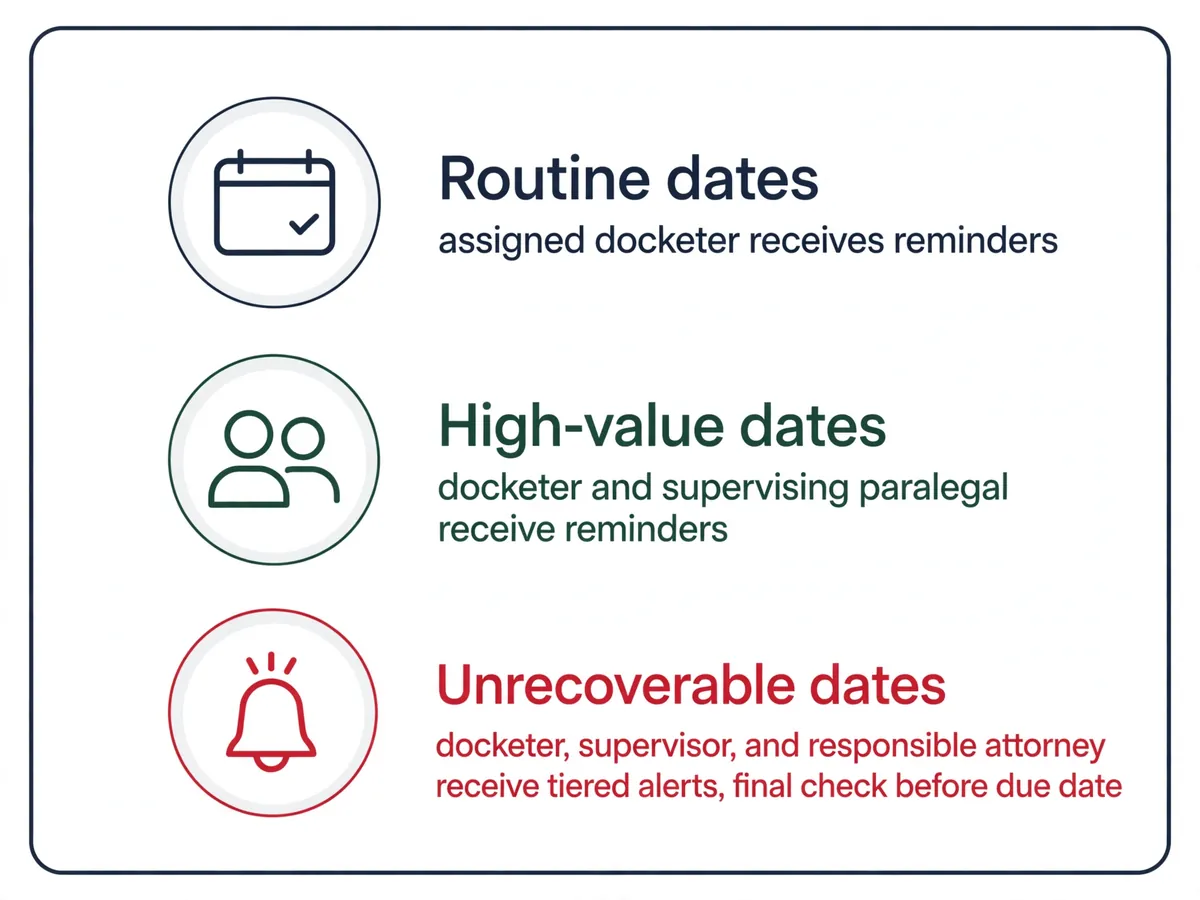
Define an escalation matrix
Not every deadline carries equal risk. An escalation matrix ranks dates by consequence and sets who receives alerts at each stage. For example:
- Routine dates: The assigned docketer receives reminders.
- High-value dates: The docketer and a supervising paralegal receive reminders.
- Unrecoverable dates: The docketer, a supervisor, and the responsible attorney receive tiered alerts, with a final check before the due date.
Because the matrix links effort to consequence, your team spends attention where the stakes are highest.
Software, Scraping, and the Limits of Automation
Automation reduces typing, and that helps. It also moves errors into new places. An automated feed can import a wrong value at scale, or a parser can misread an unusual notice format.
Therefore, treat automation as a first draft that needs review. Our post on whether an external docketing service can handle USPTO PAIR scraping automatically explores where automation helps and where human review still matters.
A strong setup combines both: machines for speed, trained people for judgment, and an independent check between them.
When Outsourced Docketing Support Makes Sense
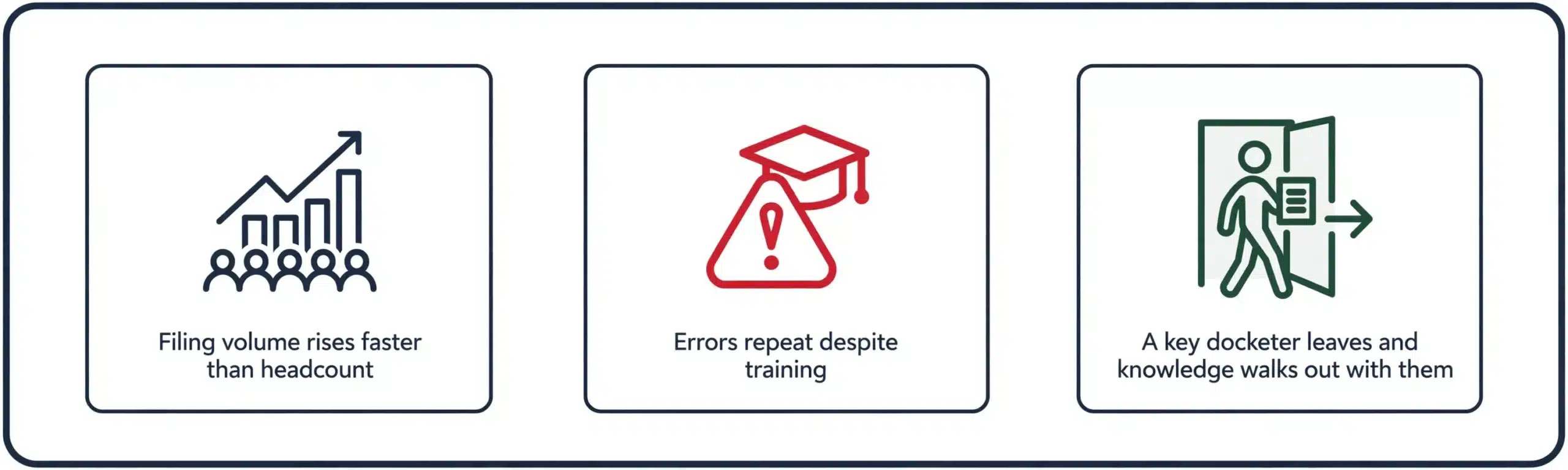
Some teams run clean dockets in house. Others hit a ceiling. Consider outside support when:
- Filing volume rises faster than headcount.
- Errors repeat despite training.
- A key docketer leaves and knowledge walks out with them.
- A migration or merger forces a large data cleanup.
- You need coverage across time zones.
Outsourcing works only when the provider brings real controls. Before you hire, use a structured review such as our IP vendor due diligence checklist. It helps you test accuracy practices, security, and escalation paths.
Corporate teams comparing options can also read our review of the best patent docketing companies for corporate IP departments. Smaller practices may prefer the guide to the best patent docketing services for small firms.
If you are building a team from the ground up, see how to structure a corporate IP department from scratch for guidance on where docketing fits.
Teak IP combines U.S. attorney oversight with a U.S. and India delivery model, and it works with your existing systems rather than replacing them. You can also pair docketing with paralegal support or office action response services when the workload demands it.
Frequently Asked Questions
How do data entry errors compound into missed deadlines?
Docket dates depend on other dates. A wrong input, such as a priority or mailing date, flows into every calculation, reminder, and calendar entry built on it. The error spreads without any warning. The team discovers it only when the real deadline has already passed.
What are the most common docketing data entry errors?
The most common errors include transposed digits in dates, wrong entity status, misread office action dates, outdated jurisdiction rules, and reminders assigned to the wrong person. Bulk imports can also corrupt many records at once.
Can a missed patent deadline be fixed?
Sometimes. The USPTO allows petitions to revive applications abandoned through unintentional delay, and a patent that expired for unpaid maintenance fees may be reinstated in some cases. However, recovery carries cost and risk, and some international deadlines allow no remedy. Prevention is far safer.
How often should we audit our IP docket?
Run a sample audit every quarter and a broader portfolio audit at least once a year. Increase frequency after migrations, staff changes, or major rule updates.
Does docketing software prevent errors?
Software prevents some input mistakes and automates calculations. It cannot confirm that your inputs match the source documents. Independent review and verification against official records remain essential to stop how data entry errors compound into missed deadlines.
What is the best way to verify a docket entry?
Compare the entered data with the original source document and the official patent or trademark office record. Then have a second person confirm it before any deadline activates.
When should a firm outsource docketing?
Consider outsourcing when volume outpaces your team, errors repeat, key staff leave, or you need after-hours coverage. Choose a provider that verifies data against official records and uses attorney oversight.
What is the difference between a data entry error and a docketing error?
A data entry error is a wrong value typed or imported into a record. A docketing error is broader. It includes entry mistakes, misread notices, wrong rule sets, and missing ownership assignments. Entry errors are one common cause of docketing errors.
Why do small docketing errors cause big problems?
Docketing systems derive many dates from a few inputs. Therefore, one wrong input changes every date built on it. The error grows with each calculation and reminder, and the team usually sees no sign until a deadline has already passed.
How can a small team reduce docketing errors without new software?
Start with three habits. Capture data from source documents, have a second person verify each new record, and run a small quarterly audit against the originals. These steps cost time rather than money, and they catch most compounding errors early.
Conclusion: How Data Entry Errors Compound Into Missed Deadlines, and How to Stop Them
Understanding how data entry errors compound into missed deadlines changes how you protect a portfolio. The danger is not one dramatic mistake. The danger is a small, invisible one that every later step trusts.
Start where the risk starts. Verify at intake, review independently, track owners and backups, and audit on a schedule. Those habits turn a fragile docket into a defensible one.
Is your docket due for a check? Contact Teak IP Services to discuss a docket review, or explore more practical guides on the Teak IP blog.
Transferring Patent Docket During Acquisition?
Ensure a smooth and secure patent docket transfer during business acquisitions. Our professional IP support helps maintain accurate records, continuity, and effective docket management throughout the transition.

