
A partner posts a job for a patent paralegal and receives forty applications. Half list a national certification. The other half list five years of USPTO docketing experience and no credential at all. Which pile deserves the first interview? That question sits behind one of the most common searches in IP staffing: do patent paralegals need certification? The short answer is no, not legally. However, the full answer is more useful than a simple “no.” Firms hire based on proof of skill, and certification is only one of several ways to show it.

This guide explains what the law requires, what the credentials actually test, and what law firms and corporate IP departments look for in practice. You will also find a step-by-step hiring checklist, a comparison table, common mistakes, and expert tips.
Quick Answer: Do Patent Paralegals Need Certification?
Short answer: No. No federal law, USPTO rule, or state licensing board requires a patent paralegal to hold a certification. Certification is voluntary. Still, some firms prefer it, and many firms value hands-on USPTO experience even more.
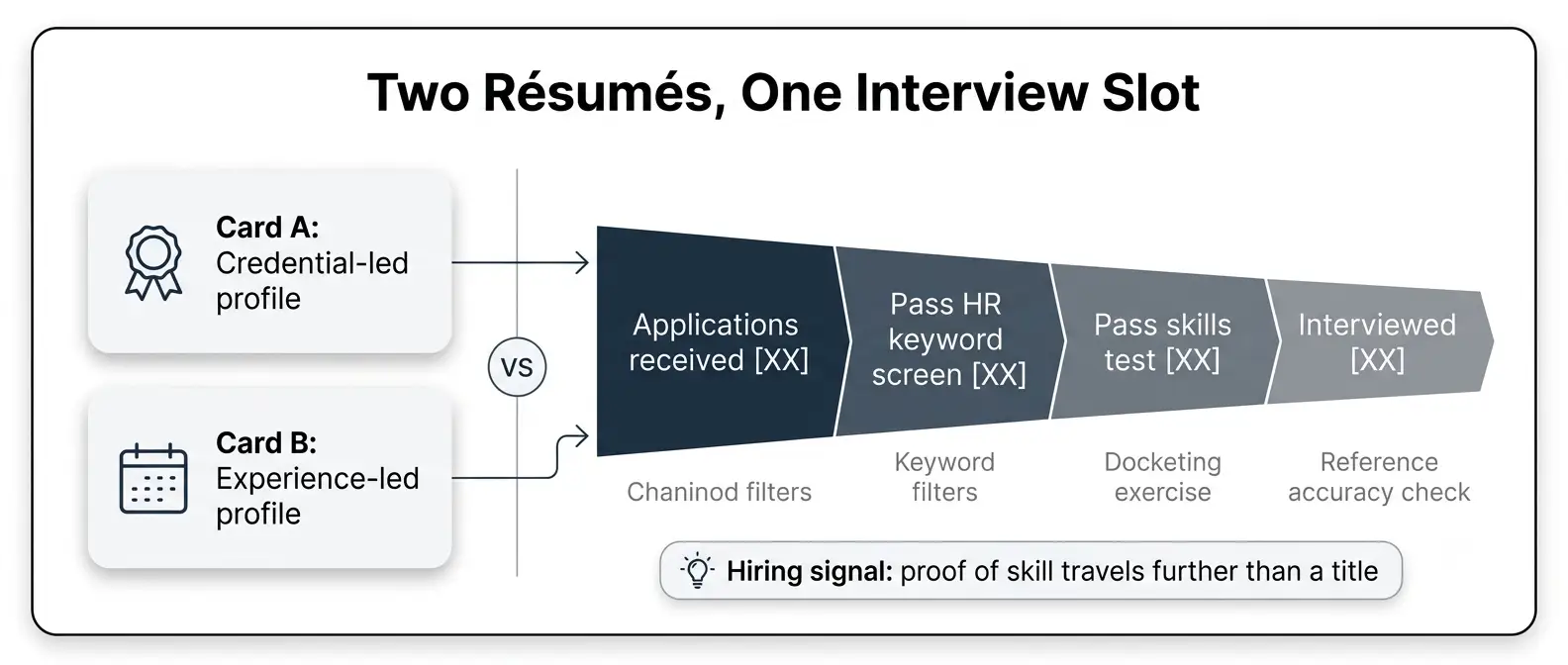
Here is the summary at a glance:
- Legal requirement: None. Paralegals do not need a license or a certificate to work in patent law.
- USPTO registration: Not available to paralegals as paralegals. Registration is for patent attorneys and patent agents.
- Common hiring preference: A paralegal degree or certificate, plus direct experience with patent filings and deadlines.
- Most valued proof: A track record of accurate docketing, formalities checks, and clean filings.
- Best strategy: Pair a general credential with documented patent prosecution skills.
What is a Patent Paralegal?
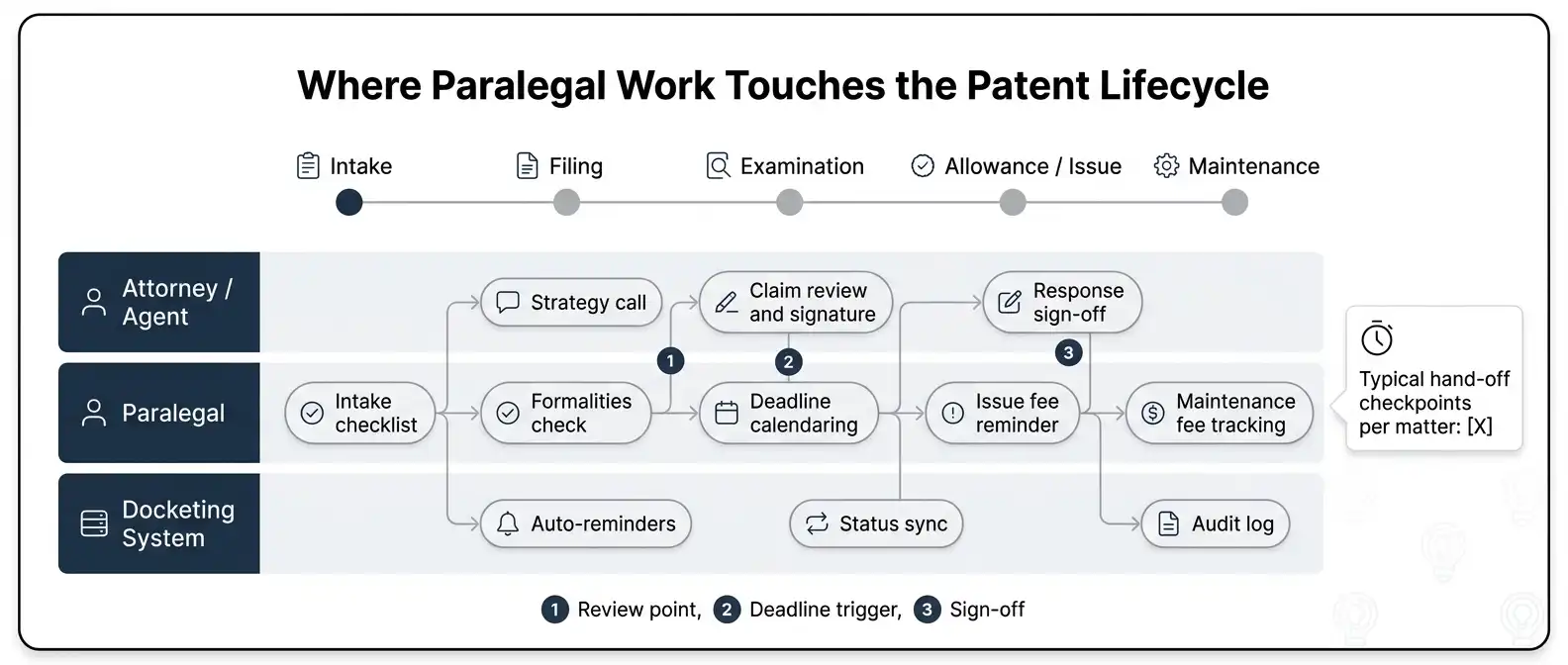
A patent paralegal is a trained legal professional who supports patent attorneys and agents with the administrative, procedural, and organizational work of getting and keeping patent rights. A patent paralegal does not give legal advice and does not represent applicants before the United States Patent and Trademark Office (USPTO).
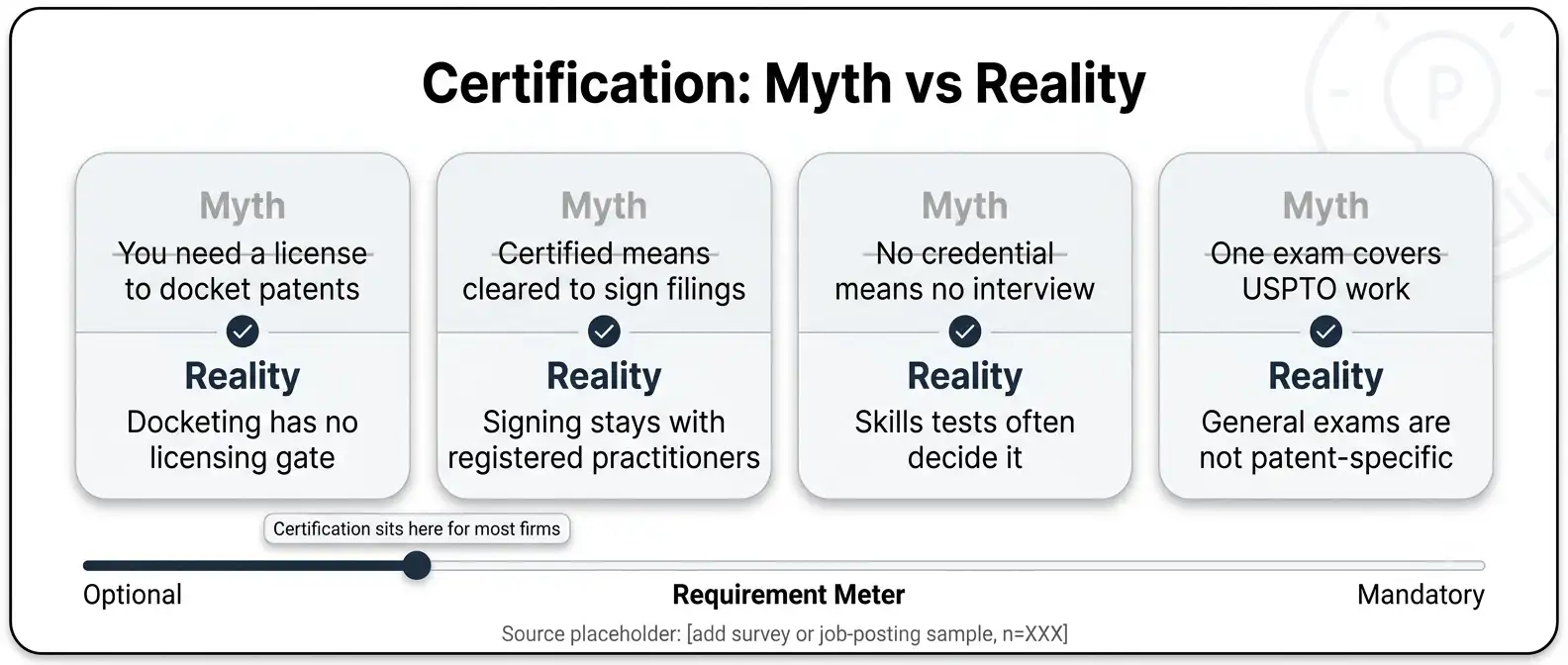
do patent paralegals need certification? Typical duties include:
- Docketing Office Action response deadlines and maintenance fee dates
- Preparing and filing Information Disclosure Statements (IDS)
- Checking application formalities before filing
- Preparing Application Data Sheets (ADS) and assignment recordation papers
- Coordinating patent drawings and sequence listings
- Managing foreign filing and PCT national phase deadlines
- Keeping client files, correspondence, and docket data accurate
In short, the patent paralegal keeps the portfolio moving while the attorney handles legal judgment, strategy, and signatures.
Patent Paralegal vs. Patent Agent vs. Patent Attorney
These three roles often get confused. The table below separates them clearly.
| Role | Can Represent Applicants Before the USPTO? | Registration Required? | Typical Work |
|---|---|---|---|
| Patent paralegal | No | No | Docketing, formalities, filings, file management |
| Patent agent | Yes, in patent matters only | Yes (USPTO registration exam) | Drafting and prosecuting applications |
| Patent attorney | Yes, in patent matters | Yes (law license plus USPTO registration) | Drafting, prosecution, opinions, litigation support |
Do Patent Paralegals Need Certification? The Legal Answer
The legal answer has two parts. First, the law does not require paralegal certification. Second, the law does restrict what paralegals may do, whether they hold a credential or not.
No Law or USPTO Rule Requires Paralegal Certification
The U.S. Bureau of Labor Statistics (BLS) states the situation plainly. According to the BLS Occupational Outlook Handbook, paralegal certification is not required, although some employers prefer or require it. The same page notes that paralegals typically enter the field with an associate’s degree or a certificate in paralegal studies. Some employers prefer a bachelor’s degree, and others hire people with a high school diploma and relevant experience.
That finding applies to paralegals generally. Patent work adds no extra mandatory credential for paralegals. Instead, the USPTO regulates who may practice before the Office.
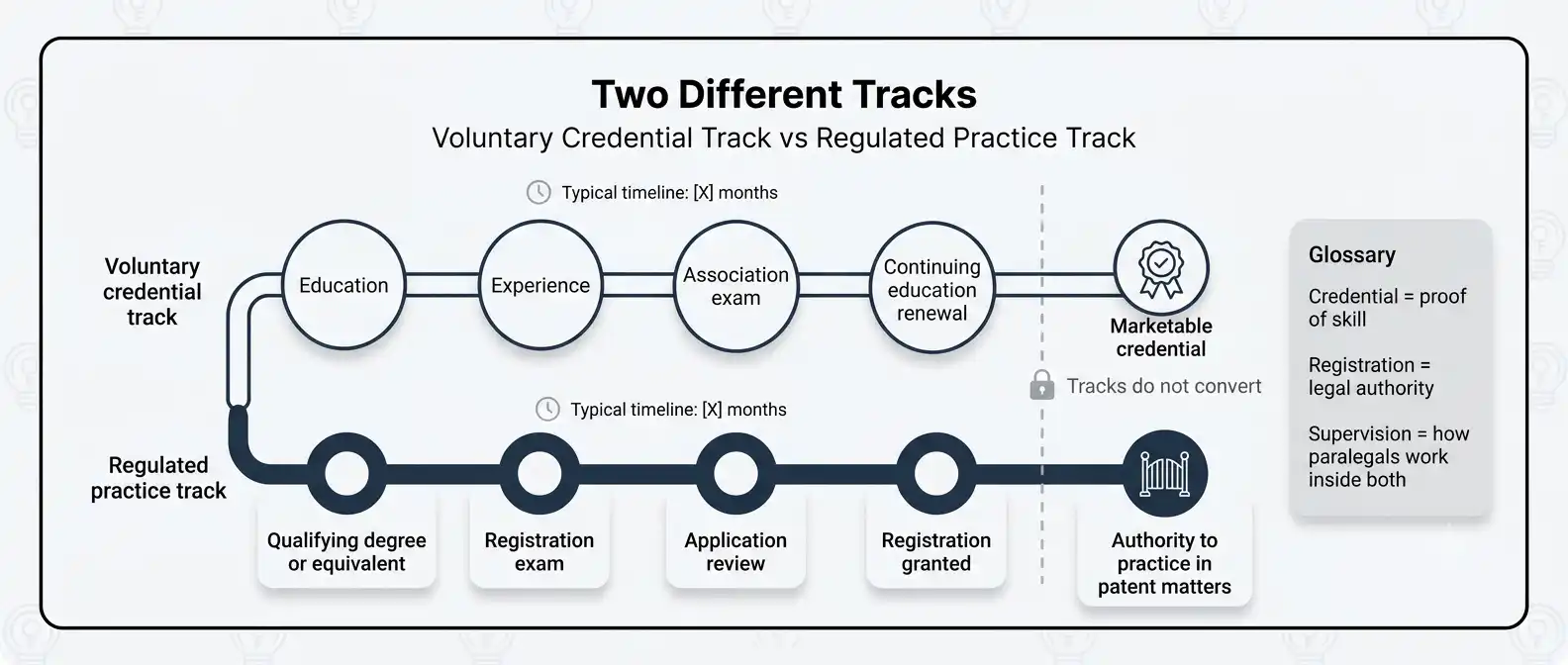
Registration Is Not Certification
Many candidates confuse “certification” with “registration.” They are different things:
- Certification is a voluntary credential from a professional association. It shows that a paralegal passed an exam and met education or experience standards.
- Registration is a USPTO authorization. It lets a patent attorney or patent agent practice before the Office in patent matters.
The USPTO explains the path to registration on its page about becoming a patent practitioner. Applicants must show legal competence by passing the registration exam, and they must also meet the scientific and technical and character requirements. A paralegal who has not completed that process cannot register simply by holding a paralegal certificate.
Under 37 CFR Part 11, Subpart B, registration entitles an individual to practice before the Office only in patent matters. Section 11.5 divides registrants into patent attorneys and patent agents. Paralegals do not appear in that structure. Consequently, no paralegal certification can substitute for registration.
Why This Distinction Matters for Hiring
Firms that mix up these terms make two costly mistakes:
- They assume a certified paralegal can handle tasks reserved for registered practitioners.
- They reject strong candidates because those candidates lack a credential that the law never demanded.
Both mistakes create risk. The first can lead to unauthorized practice of law problems. The second wastes talent.
What Does the Job Market Say About Paralegal Credentials?
Labor data helps frame how much weight certification carries. The BLS reports the following for the broader paralegal profession:
| BLS Metric (Paralegals and Legal Assistants) | Figure |
|---|---|
| Median annual pay (May 2025) | $62,890 |
| Typical entry-level education | Associate’s degree |
| Jobs in 2025 | 404,900 |
| Projected employment change, 2025 to 2035 | 0% (little or no change) |
| Projected annual openings | About 40,800 |
Source: U.S. Bureau of Labor Statistics, Occupational Outlook Handbook.
Two points stand out. First, flat growth means competition for good roles stays real. Second, the BLS expects technology, including AI, to make paralegals more efficient at research and document preparation. As a result, the paralegals who stand out will be those who handle judgment-heavy, detail-heavy work, such as deadline control and formalities review, with near-perfect accuracy.
In that environment, a credential can help a résumé get noticed. Nevertheless, a patent-specific work record usually decides the hire.
Which Paralegal Certifications Exist?
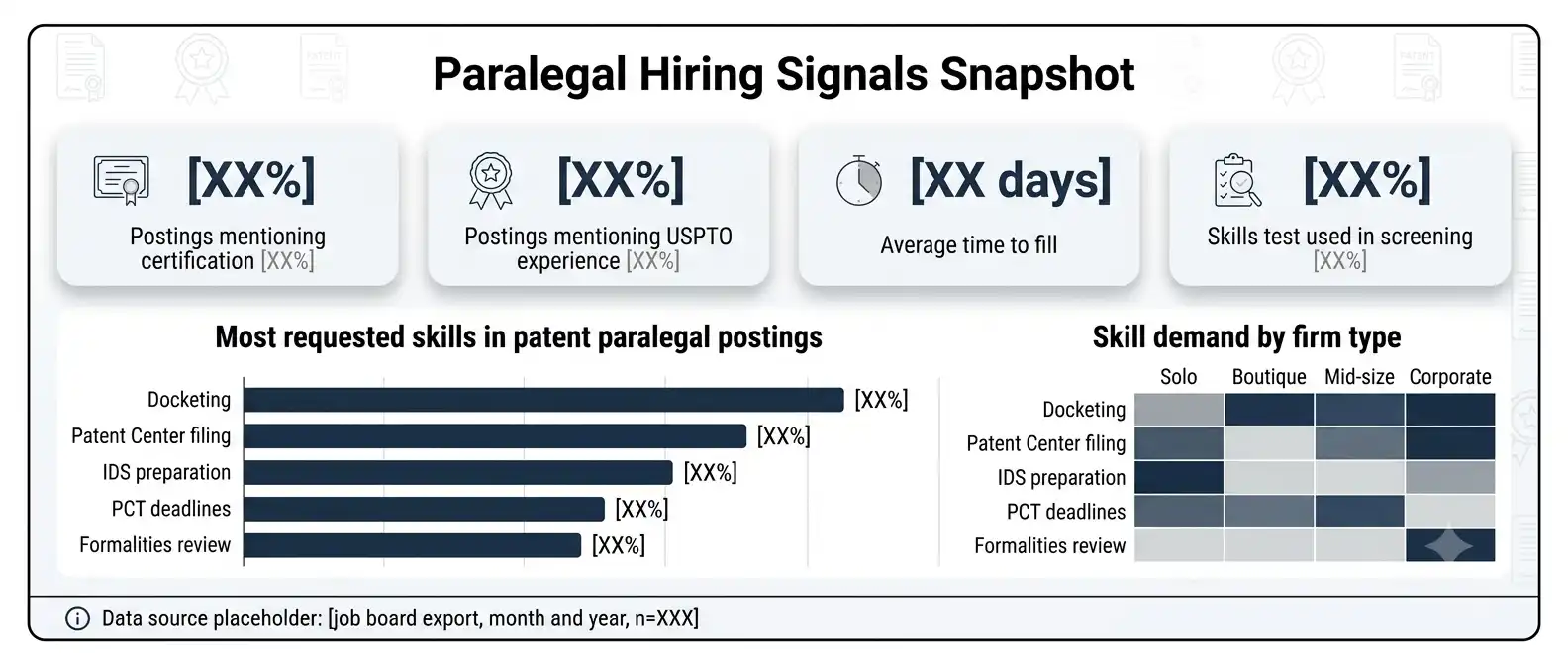
Two national organizations dominate paralegal credentialing in the United States. Neither one is specific to patents. Even so, both can strengthen a candidate’s profile.
NALA Certified Paralegal (CP)
NALA, the association for legal professionals, offers the Certified Paralegal (CP) credential. According to NALA’s CP program, the exam has two parts: a Knowledge Exam made up of multiple-choice questions, and a Skills Exam that is a written essay assignment. Candidates must pass both parts.
Eligibility follows three broad categories on the NALA eligibility requirements page:
- Category 1: Completion of a qualifying paralegal program, such as an ABA-approved program or an associate, bachelor’s, or post-baccalaureate certificate program in paralegal studies.
- Category 2: A bachelor’s degree in any field, plus either one year of paralegal experience or at least 15 semester hours of substantive paralegal courses.
- Category 3: A high school diploma, plus five years of paralegal experience and 20 hours of substantive continuing legal education.
The CP exam tests general federal law and procedure. Therefore, it signals solid legal fundamentals rather than USPTO expertise.
NFPA Credentials (RP and CRP)
The National Federation of Paralegal Associations (NFPA) offers two recognized credentials, as described on the NFPA website: the PACE Registered Paralegal (RP) credential and the CORE Registered Paralegal (CRP) credential. NFPA also publishes study materials for its PACE and PCCE exams and offers continuing legal education that counts toward renewals.
Again, these credentials measure general paralegal competence. They do not measure knowledge of MPEP procedures, USPTO filing systems, or patent deadline rules.
Credential Comparison Table
| Factor | NALA CP | NFPA RP / CRP | USPTO Registration |
|---|---|---|---|
| Issuer | NALA | NFPA | USPTO Office of Enrollment and Discipline |
| Who it is for | Paralegals | Paralegals | Patent attorneys and patent agents |
| Required by law? | No | No | Yes, to practice patent matters before the USPTO |
| Patent-specific? | No | No | Yes |
| Allows representation before the USPTO? | No | No | Yes |
| Main value to a firm | Proof of general legal skill | Proof of general legal skill | Authority to practice |
Do Patent Paralegals Need Certification to Get Hired? What Firms Actually Require
Here is where the real answer lives. Job postings vary widely, but firms tend to evaluate candidates across the same core areas. Think of them as layers.
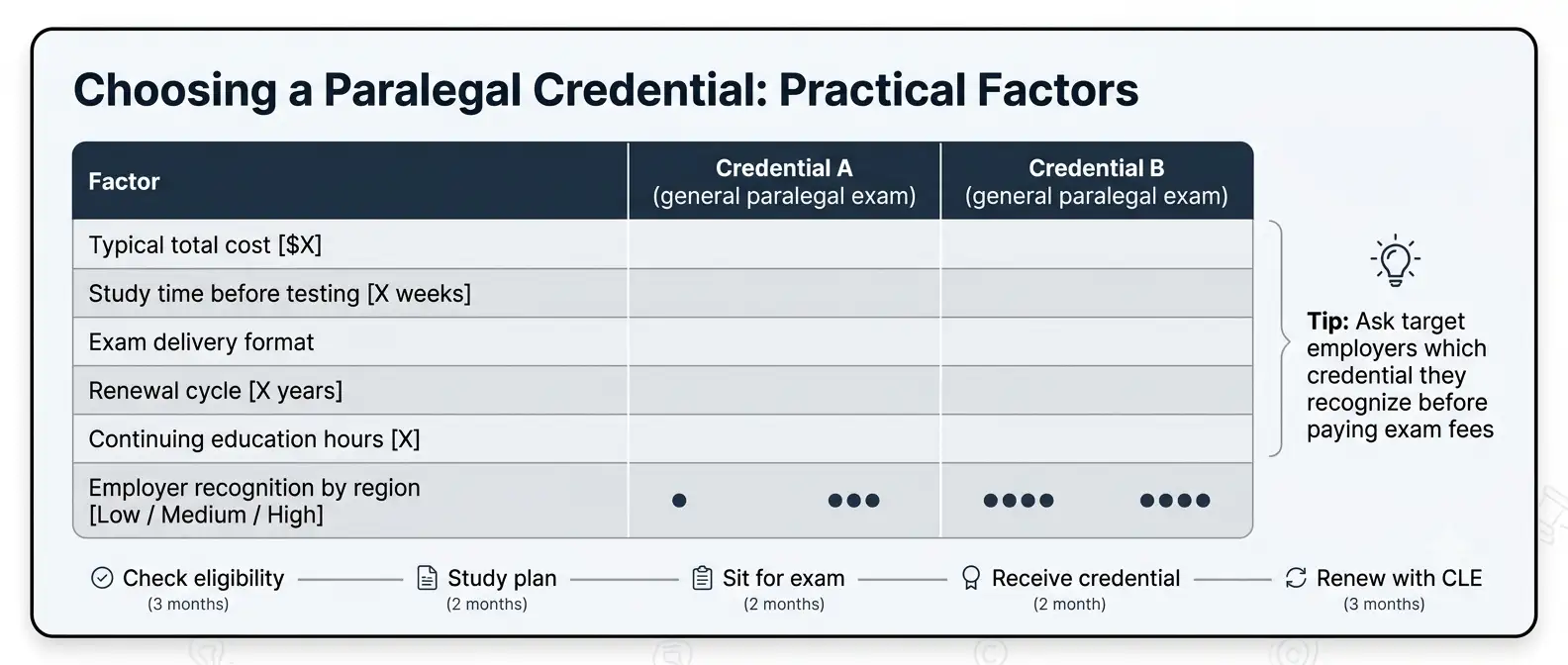
The Hiring Priority Pyramid
- Proven USPTO procedural knowledge. Firms want someone who already understands Office Action timelines, extensions of time, IDS timing, and maintenance fee windows.
- Accuracy under deadline pressure. One missed date can abandon an application. Because of that, firms weigh error-free docketing history heavily.
- Technology fluency. Patent Center, docketing platforms, and document management systems are daily tools.
- Education or training. A paralegal certificate, associate’s degree, or bachelor’s degree.
- Voluntary certification. A nice differentiator, not a gate.
What Firms Typically Require vs. Prefer
| Qualification | Usually Required | Often Preferred | Rarely Required |
|---|---|---|---|
| Patent prosecution experience | Yes, for mid-level roles | Yes | – |
| Docketing accuracy | Yes | Yes | – |
| Paralegal degree or certificate | Sometimes | Yes | – |
| NALA CP or NFPA RP/CRP | – | Sometimes | Rarely mandatory |
| Technical or science degree | – | For some practices | – |
| USPTO registration | – | – | Not for paralegal roles |
| Experience with PCT and foreign filings | – | For larger portfolios | – |
Notice the pattern. Experience and accuracy appear in the “required” column, while certification appears mostly under “preferred.”
Skills Firms Test During Interviews
Savvy hiring managers rarely rely on a credential alone. Instead, they test real tasks. Common tests include:
- Docketing a sample Office Action with the correct response due date and the final extension date
- Reviewing a mock filing packet and finding formalities errors
- Explaining the difference between a continuation and a request for continued examination
- Walking through how to prepare an IDS and what the filing deadlines look like
- Describing how to handle a conflicting docket entry
A candidate who handles these tasks smoothly earns trust quickly. A certified candidate who cannot do them does not.
Technology Skills That Matter
Modern patent paralegals work inside several systems at once. Strong candidates usually know:
- USPTO Patent Center for filing and retrieving documents
- Docketing software for deadlines, reminders, and reporting
- Document management systems for version control and file organization
- Spreadsheet tools for reconciliation and audit checks
- Secure communication tools for client and inventor correspondence
Certification vs. Experience: Which Matters More?
Neither wins in every case. The better question is: which one matters more for this specific role?
When Certification Carries More Weight
Certification helps most in these situations:
- Career changers. Someone moving from another field can use a credential to show commitment and baseline skill.
- Entry-level applicants. Without a work history, a certificate or CP credential provides at least one external benchmark.
- Large organizations with rigid HR screens. Some HR systems filter résumés by credential keywords.
- Government or corporate roles. Certain employers write credentials into job descriptions as a standard preference.
When Experience Carries More Weight
Experience usually wins in these situations:
- Small and mid-size IP boutiques. These teams need someone productive within weeks.
- Docketing-heavy roles. A clean track record beats a general exam.
- Specialized work. Post-grant proceedings, PCT national phase, and complex continuation strategies require patent-specific knowledge that general exams do not test.
For example, a paralegal supporting an Inter Partes Review (IPR) must manage exhibit lists, filing deadlines, and Patent Trial and Appeal Board (PTAB) formalities. No general paralegal exam covers that workflow in depth. You can see how specialized that role becomes in Teak IP’s guide to the paralegal’s role in an Inter Partes Review proceeding.
A Practical Rule of Thumb
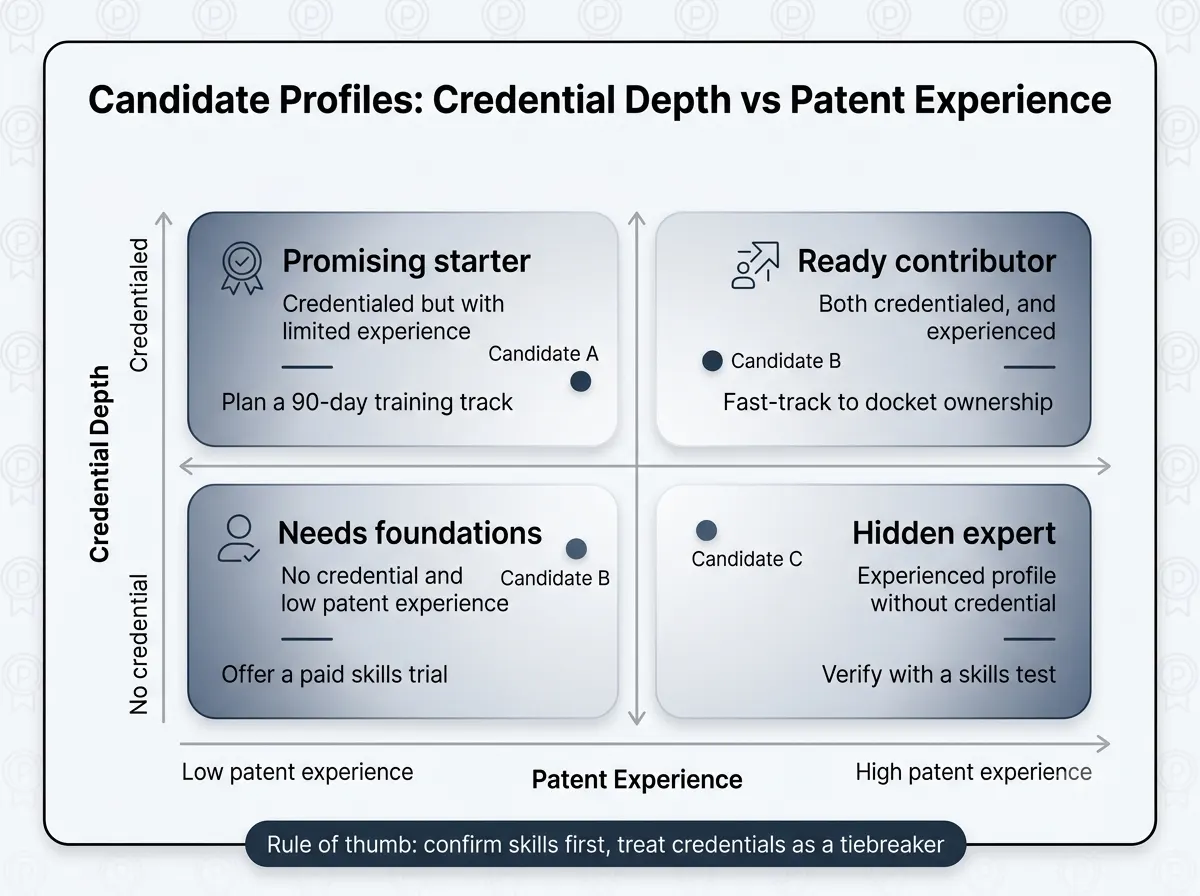
- If a candidate has no certification but strong patent experience, interview them.
- If a candidate has certification but no patent experience, plan for training time.
- If a candidate has both, you have found a strong hire.
What Patent Paralegals Can and Cannot Do
Even a certified paralegal works inside firm boundaries. Understanding those limits protects the firm, the client, and the paralegal.
Tasks Patent Paralegals Commonly Handle
- Docketing and deadline management
- Filing papers prepared and approved by a registered practitioner
- Preparing IDS forms and citing references for attorney review
- Preparing assignment documents for recordation
- Organizing prior art and prosecution histories
- Paying maintenance fees at an attorney’s direction
- Tracking foreign counterparts and PCT deadlines
Tasks That Require a Registered Practitioner
The USPTO’s rules define “practice before the Office” in patent matters to include preparing and prosecuting applications and advising clients about them. Under 37 CFR Part 11, those activities belong to registered attorneys and agents. Specifically, paralegals should not:
- Give legal advice about patentability or claim scope
- Draft or amend claims on their own authority
- Draft substantive responses to rejections without attorney supervision and sign-off
- Sign and submit substantive filings as the practitioner of record
- Decide legal strategy
USPTO materials also point out that the rules allow practitioners to use non-practitioner assistants under the practitioner’s supervision. Supervision, therefore, is the key word. A paralegal supports. The practitioner decides and signs.
The same principle applies in trademark work. Teak IP covers the topic in depth in its article on what tasks a trademark paralegal can do without unauthorized practice of law. Many of those boundaries translate directly to patent practice.
Why Certification Does Not Expand Authority
A certified paralegal still cannot sign a patent response as a practitioner. Certification measures knowledge, not legal authority. Consequently, a firm that lets a certified paralegal “just handle” a rejection without attorney review creates exposure, no matter how impressive the credential looks.
Step-by-Step: How to Build a Strong Patent Paralegal Profile
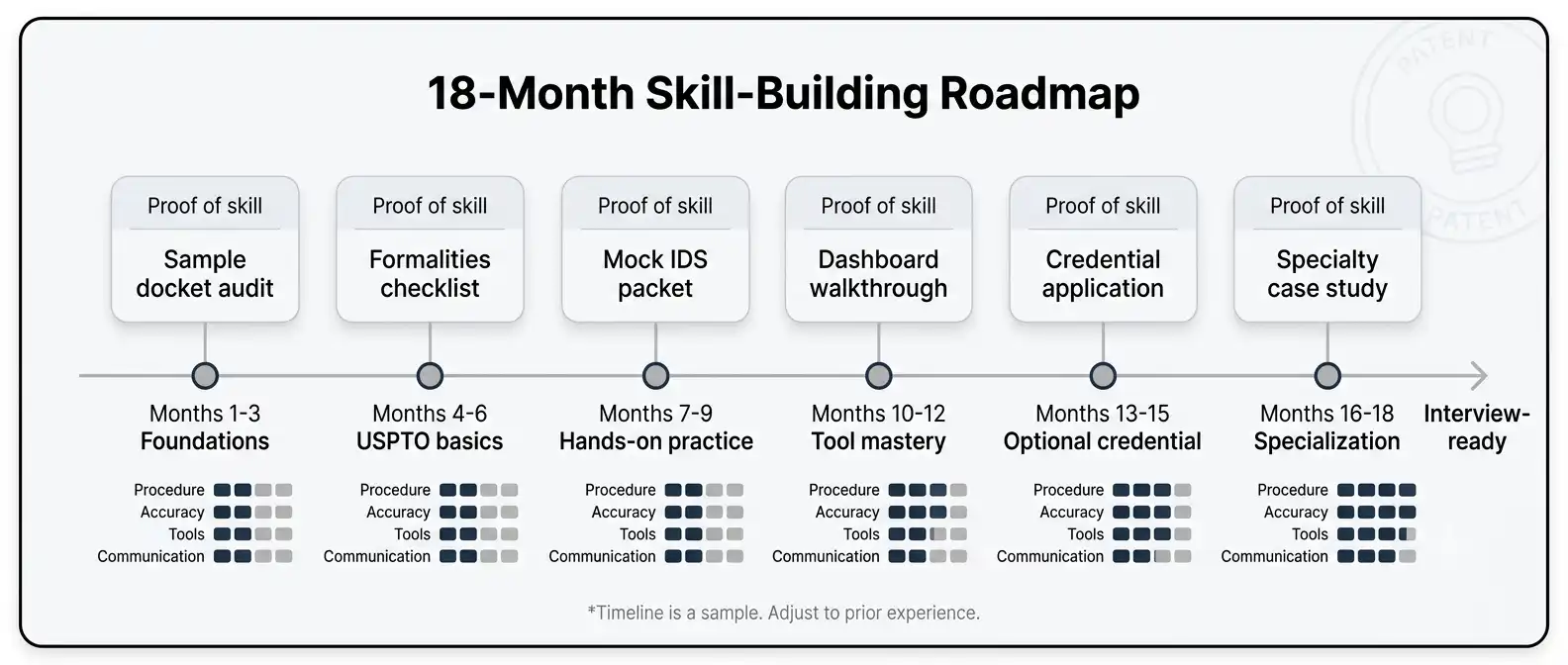
If you are a candidate wondering whether to pursue certification, follow this sequence. It builds proof of skill in the order firms care about most.
- Start with a foundation. Earn a paralegal certificate or associate’s degree. This aligns with what the BLS identifies as the typical entry path.
- Learn USPTO basics early. Study how applications move from filing to publication, examination, and issuance. Read the Manual of Patent Examining Procedure (MPEP) sections on formalities and deadlines.
- Get hands-on exposure. Seek an internship, junior docketing role, or contract role in an IP practice. Real files teach faster than textbooks.
- Document your accuracy. Keep a log of tasks handled, deadlines managed, and processes improved. Use anonymized details only.
- Master the tools. Practice with Patent Center and any docketing platform you can access.
- Add a voluntary credential if it fits your situation. Check NALA CP or NFPA eligibility. Choose the one your target employers recognize.
- Specialize. Add depth in areas such as PCT filings, IDS strategy, post-grant support, or Office Action workflow.
- Stay current. Track USPTO fee changes, rule updates, and filing system changes.
Step-by-Step: How Firms Should Evaluate Patent Paralegal Candidates
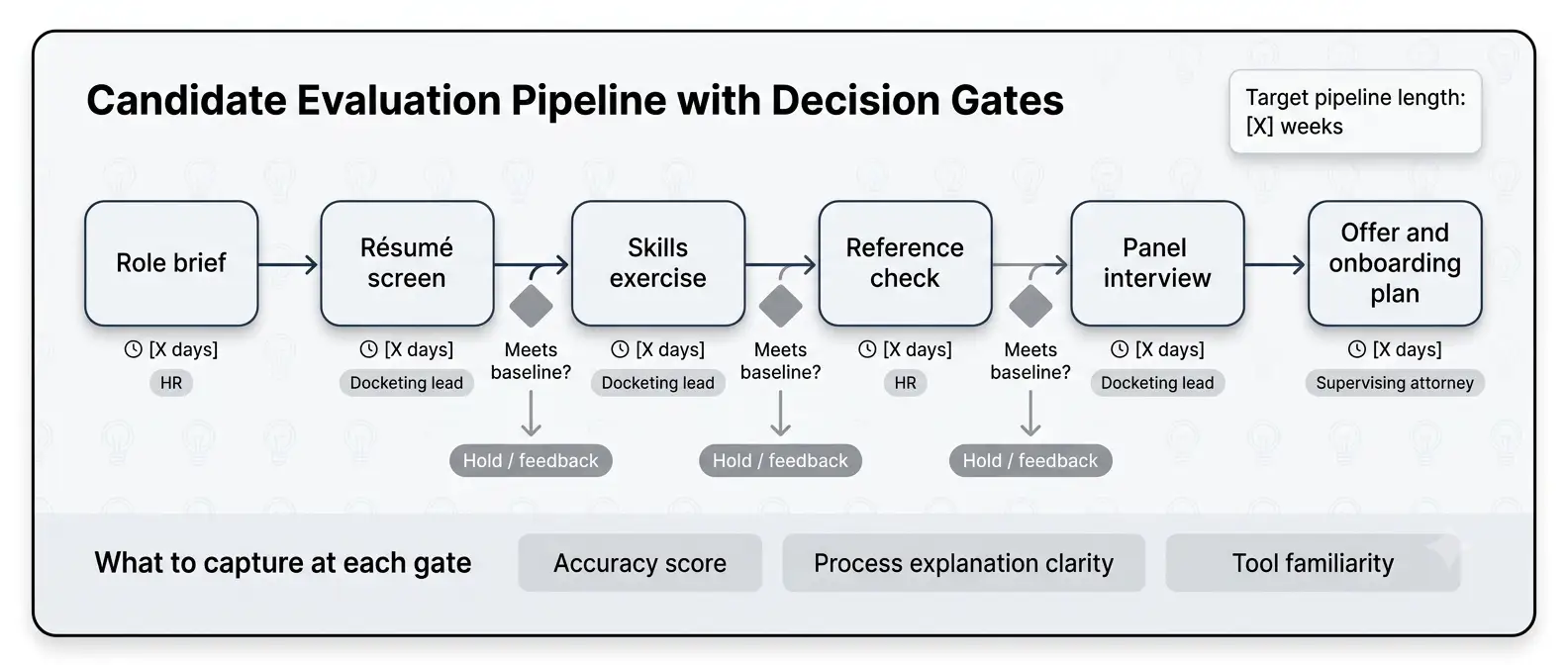
If you hire paralegals, a repeatable process reduces risk. Use this checklist.
- Define the role precisely. Decide whether you need a docketing specialist, a prosecution support paralegal, or a generalist.
- List must-have skills. Write them as observable tasks, such as “dockets Office Actions accurately” rather than “detail oriented.”
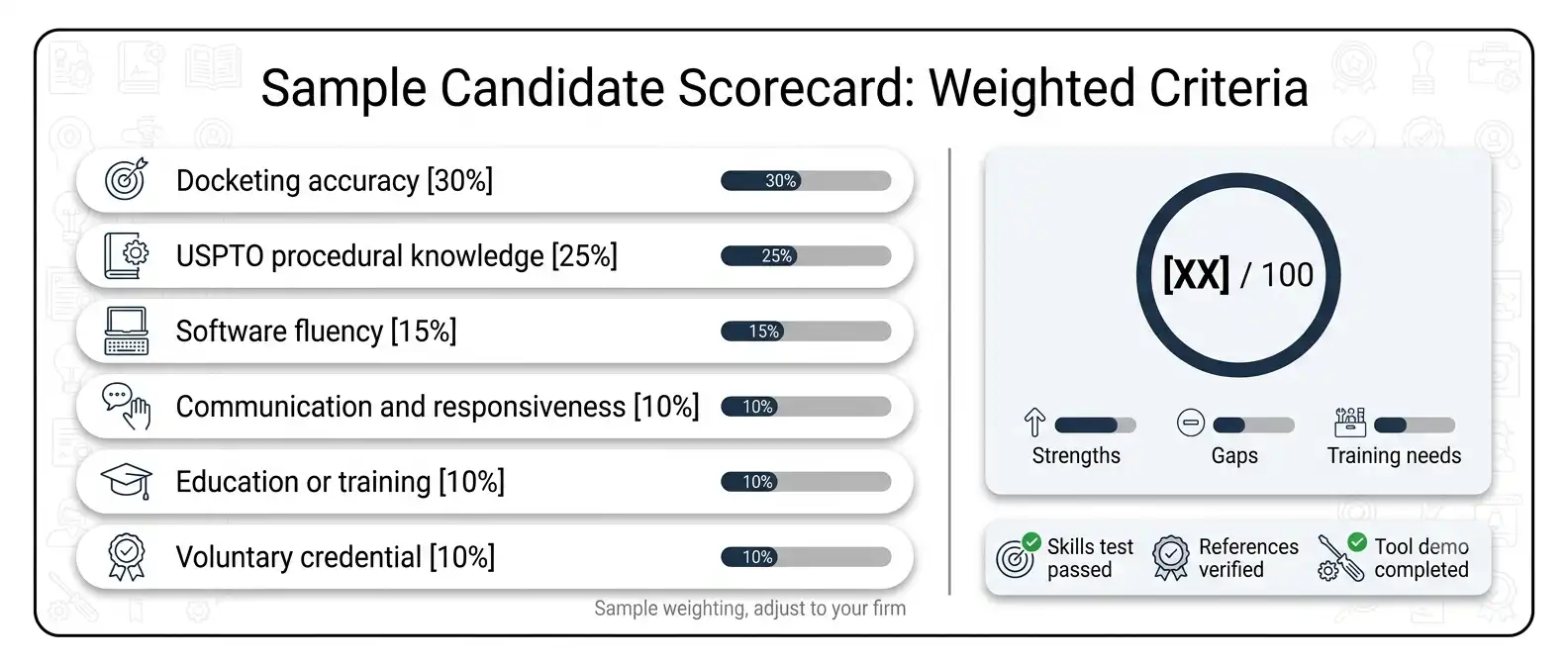
- Treat certification as a tiebreaker. List it under “preferred,” not “required,” unless your client contracts demand it.
- Run a skills test. Give a short, realistic docketing and formalities exercise.
- Check references for accuracy. Ask former supervisors about missed deadlines, error rates, and how the candidate responded to mistakes.
- Verify tool knowledge. Ask the candidate to describe how they have used Patent Center and docketing software.
- Confirm ethical awareness. Ask scenario questions about unauthorized practice and confidentiality.
- Plan onboarding. Even strong hires need a structured first 90 days with attorney feedback.
Firms that skip steps 4 and 5 often discover problems only after a deadline slips.
Common Mistakes Firms and Candidates Make
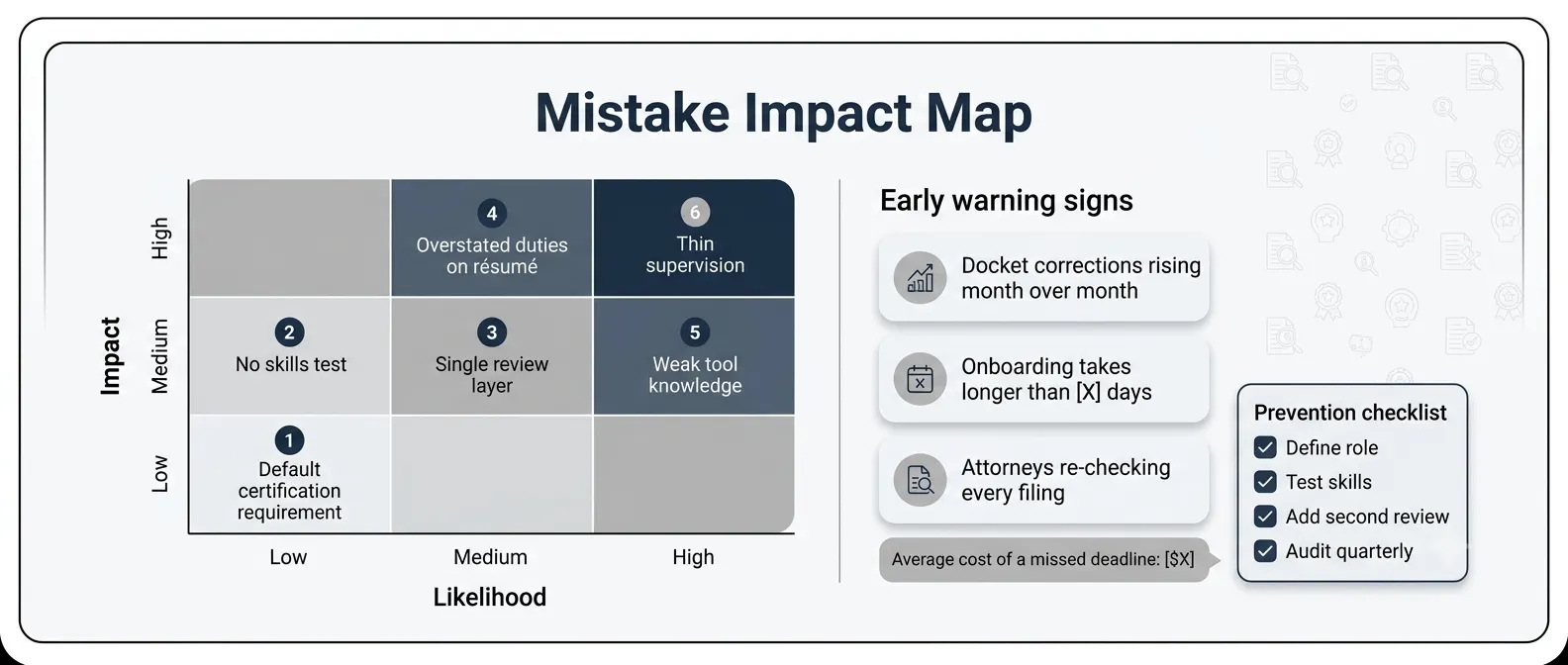
Avoiding these mistakes saves time and money.
Mistakes Firms Make
- Requiring certification by default. This filters out experienced paralegals who learned on the job.
- Ignoring patent-specific skills. A general credential does not prove docketing skill.
- Skipping skills tests. Résumés can overstate abilities.
- Mixing up registration and certification. The two serve different purposes.
- Under-supervising new hires. Supervision protects both client and paralegal.
- Relying on a single review layer. Docketing needs multiple checks. Teak IP details this approach in its post on the best multi-layered quality control workflow for patent docketing.
Mistakes Candidates Make
- Assuming certification guarantees a job. It does not.
- Spending money on the wrong credential. Check what your target employers actually value.
- Listing duties instead of results. Say “maintained a docket of 600 active matters with zero missed deadlines” only if that is true, and replace generic statements with measurable outcomes.
- Overstating authority. Claiming you “prosecuted” applications can raise unauthorized practice concerns.
- Neglecting technology skills. Many firms treat docketing software knowledge as essential.
Expert Tips for Firms and Paralegals
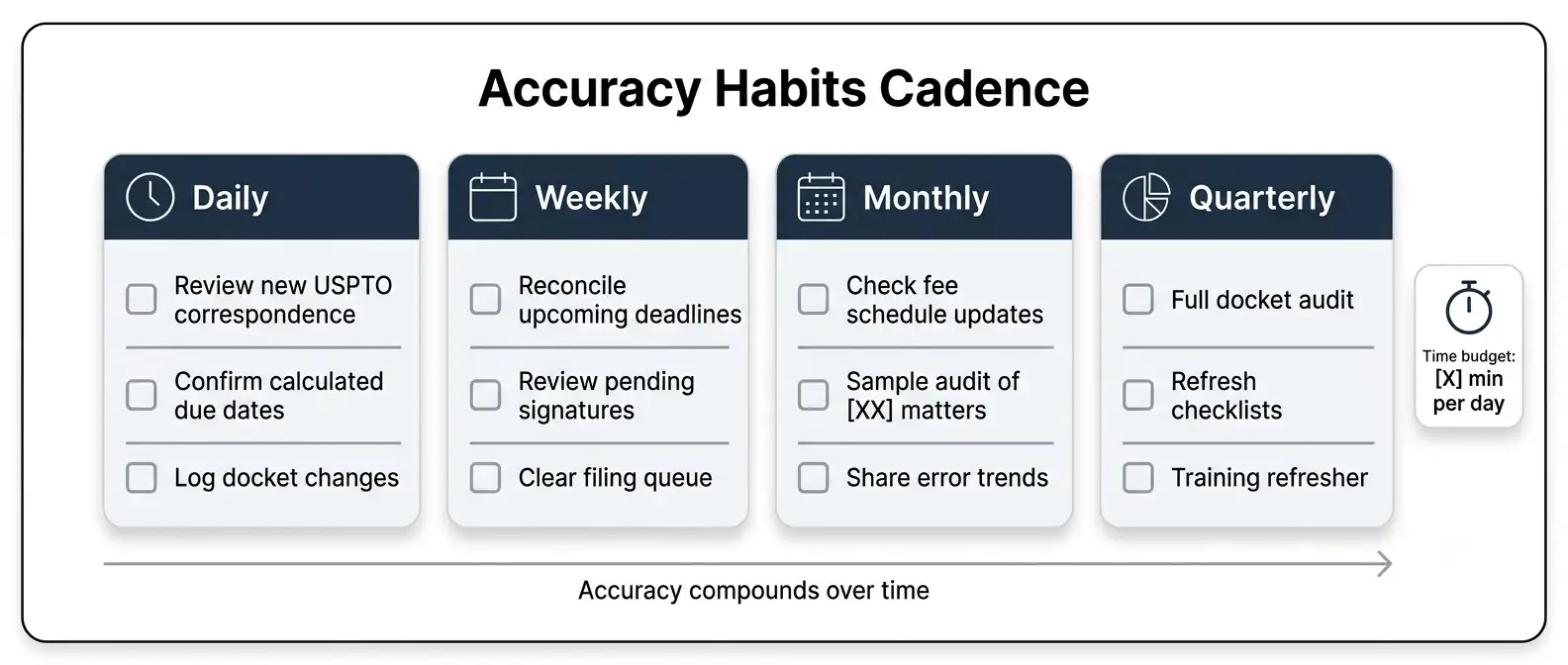
Use these practical pointers to move faster and reduce risk.
- Match the credential to the goal. If you want a general legal career, NALA or NFPA certification may help. If you want a patent-focused career, direct USPTO procedure experience helps more.
- Show your process. Describe how you verify deadlines, not just that you track them.
- Use checklists. Checklists reduce errors in repetitive tasks such as IDS preparation and formalities review.
- Build attorney trust gradually. Start with small, error-free deliverables, then take on more.
- Keep learning. For instance, understanding the difference between an RCE and a continuation helps you docket correctly. Teak IP explains it in its article on the difference between an RCE and a continuation application, and in its walkthrough on preparing a Request for Continued Examination.
- Audit regularly. A quarterly docket audit catches drift before it becomes a missed deadline.
- Document decisions. Notes on why a date was calculated a certain way protect everyone.
What About Outsourced and Remote Patent Paralegals?
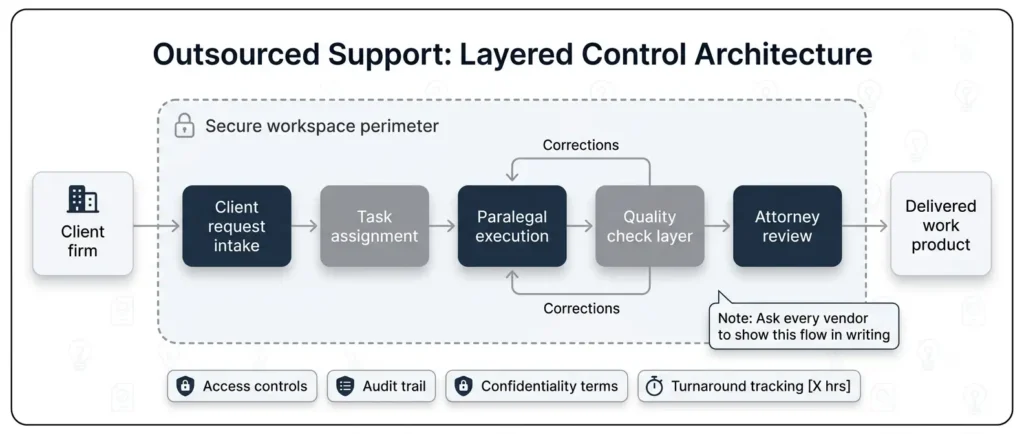
Many firms now add remote or outsourced support to handle volume spikes, docketing backlogs, or specialized tasks. In that setting, the certification question changes shape. You are no longer evaluating one person. Instead, you are evaluating a vendor’s whole system.
What to Ask a Vendor About Qualifications
When you outsource, ask these questions:
- Who supervises the paralegals, and are those supervisors registered U.S. practitioners?
- What training do paralegals receive on USPTO procedures?
- How does the vendor verify accuracy?
- How does the vendor handle confidentiality and data security?
- How does the vendor stay inside the limits of unauthorized practice rules?
Teak IP’s guide on whether remote patent paralegal services are compliant with USPTO rules walks through those compliance questions in detail. Likewise, the IP vendor due diligence checklist for law firms and corporate legal teams gives you a ready-made vetting framework.
Why Process Often Beats Individual Credentials
A vendor with attorney oversight, layered quality checks, and defined workflows can deliver more reliable results than a single credentialed individual working alone. For instance, Teak IP states that its work is led by U.S. IP attorneys and that every deliverable goes through attorney review and multi-layered quality control. That structure addresses the real risk, which is error, rather than relying on one credential to prevent it.
If you want to see how that approach works for filings, docketing, and prosecution support, explore Teak IP’s IP paralegal support services and its docketing and IP management services.
When Should a Firm Add Paralegal Support?
Certification debates often hide a bigger issue: the team may simply be stretched thin. Warning signs include:
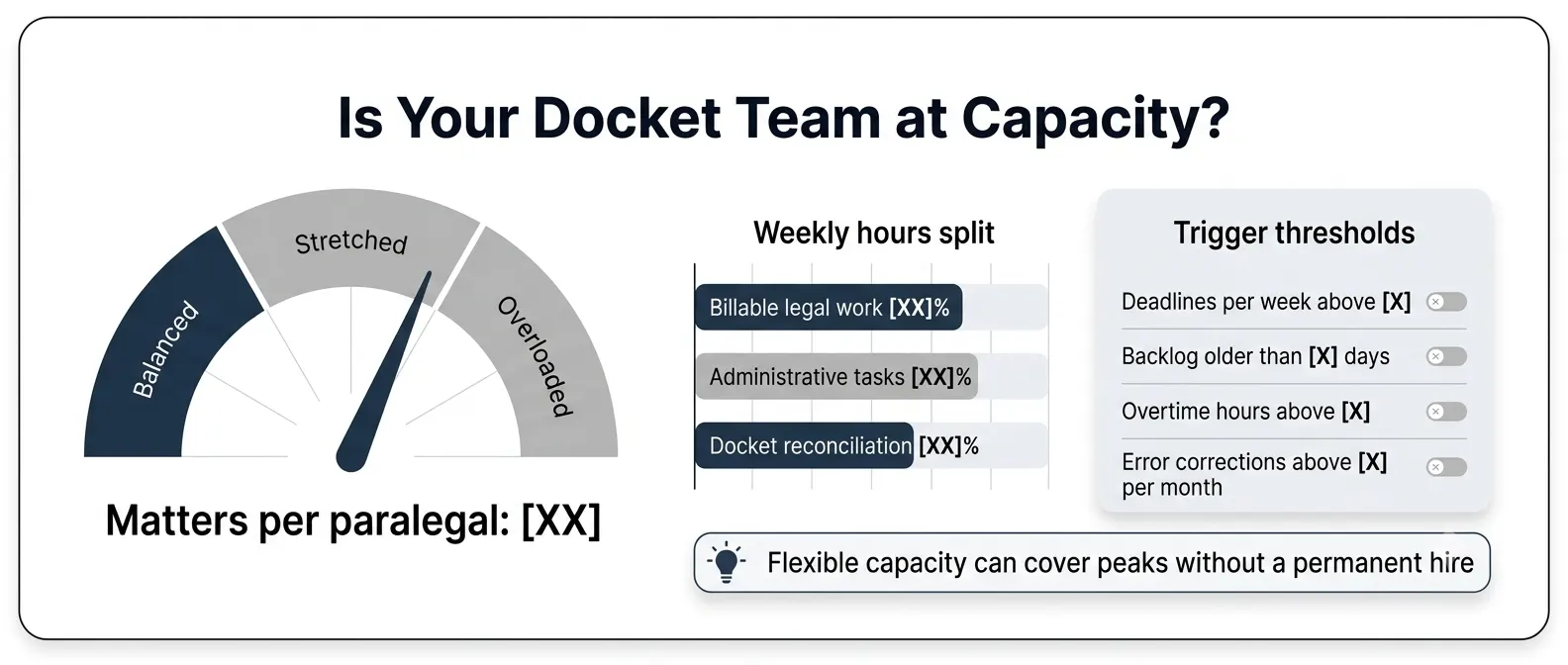
- Response deadlines clustering within days of each other
- Attorneys spending billable time on administrative tasks
- Docket reports that nobody has time to reconcile
- Rising backlog of formalities and recordation tasks
If these sound familiar, read Teak IP’s article on the signs your firm needs additional patent paralegal support. The same article helps you decide whether you need a permanent hire or flexible capacity.
For specialized needs, such as post-grant work, a targeted hire makes sense. Consider the guidance in how to hire a virtual patent paralegal experienced with USPTO post-grant proceedings.
Certification Decision Matrix: Should You Get One?
Use this table to decide quickly.
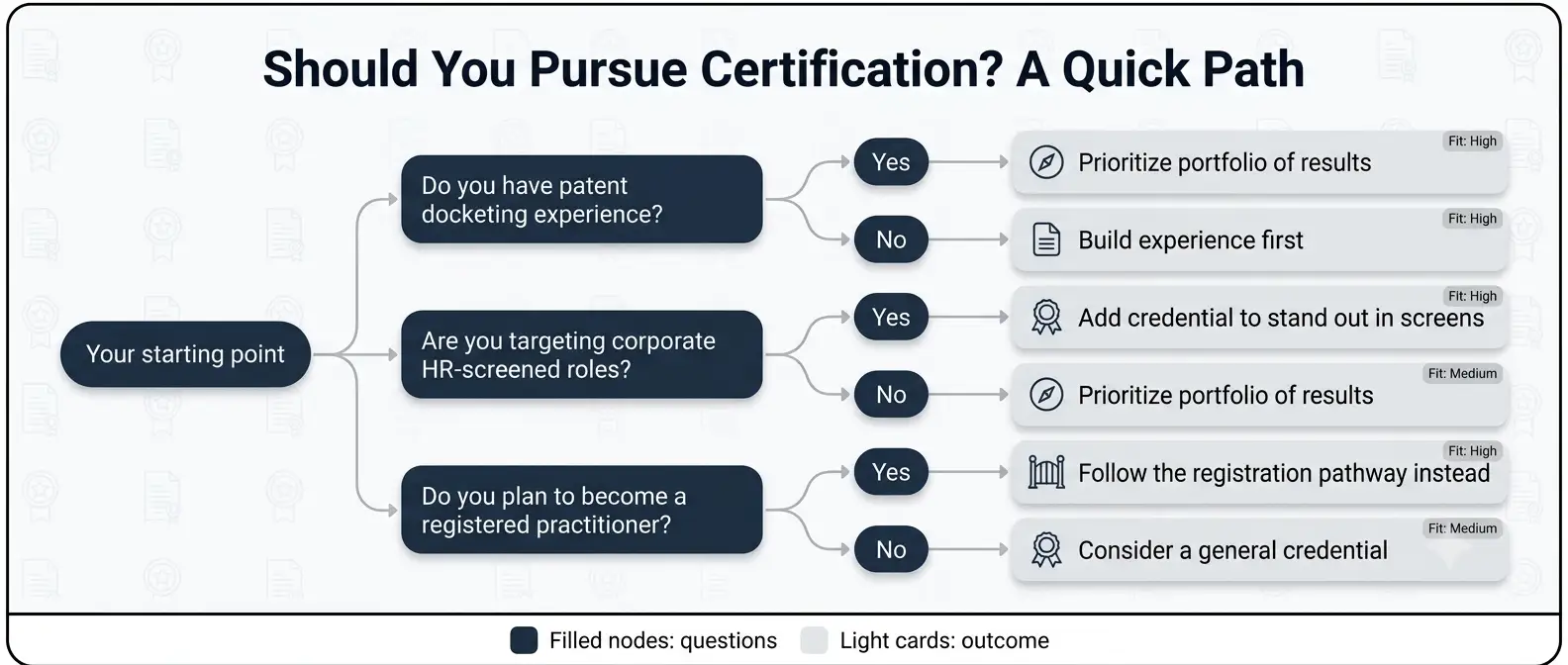
| Your Situation | Certification Worth It? | Why |
|---|---|---|
| New to the field, no experience | Often yes | It adds a credible benchmark to a thin résumé |
| Career changer from another legal area | Often yes | It shows commitment and baseline skill |
| 3+ years of patent prosecution experience | Usually optional | Your track record carries more weight |
| Targeting corporate IP departments | Sometimes helpful | HR screens may list credentials |
| Targeting IP boutiques | Rarely decisive | Hiring managers favor USPTO-specific skill |
| Planning to become a patent agent or attorney | Not the right path | You need USPTO registration, not paralegal certification |
Frequently Asked Questions
Do patent paralegals need certification to work at a law firm?
No. No law requires it. Nonetheless, some firms list certification as a preference, particularly for entry-level roles. Experience with USPTO filings and deadlines typically matters more.
Do patent paralegals need certification from the USPTO?
No. The USPTO does not certify paralegals. It registers patent attorneys and patent agents through its Office of Enrollment and Discipline. Paralegals work under the supervision of those registered practitioners.
Is NALA or NFPA certification better for a patent paralegal?
Neither is patent-specific. NALA’s CP and NFPA’s RP and CRP credentials all measure general paralegal competence. Choose the one that your target employers recognize, then add patent-specific experience.
Can a patent paralegal file documents with the USPTO?
Yes, in many cases. Paralegals commonly submit filings that a registered practitioner has prepared or approved. However, the practitioner of record remains responsible for substantive content and signatures.
Can a paralegal become a patent agent?
Yes, but through a different route. A person must meet the USPTO’s registration requirements, including the registration exam and the technical and character qualifications. Paralegal certification does not replace that process.
How much do paralegals earn?
The BLS reports a median annual wage of $62,890 for paralegals and legal assistants as of May 2025. Pay varies by employer type, region, and specialization.
What is more important than certification for a patent paralegal?
Accurate docketing, USPTO procedural knowledge, technology skills, and clear communication usually matter most. Together, they show a firm that a candidate can protect deadlines and keep files clean.
Does certification increase salary?
Possibly, but results vary. Certification can strengthen a negotiating position for entry-level and mid-level candidates. Even so, specialized patent skills often influence pay more.
Conclusion: Do Patent Paralegals Need Certification?
So, do patent paralegals need certification? Legally, no. Practically, it depends on the employer and the role. Certification from NALA or NFPA can help a candidate stand out, especially early in a career. However, firms consistently reward what protects their clients: accurate docketing, solid USPTO procedural knowledge, technology fluency, and disciplined process.
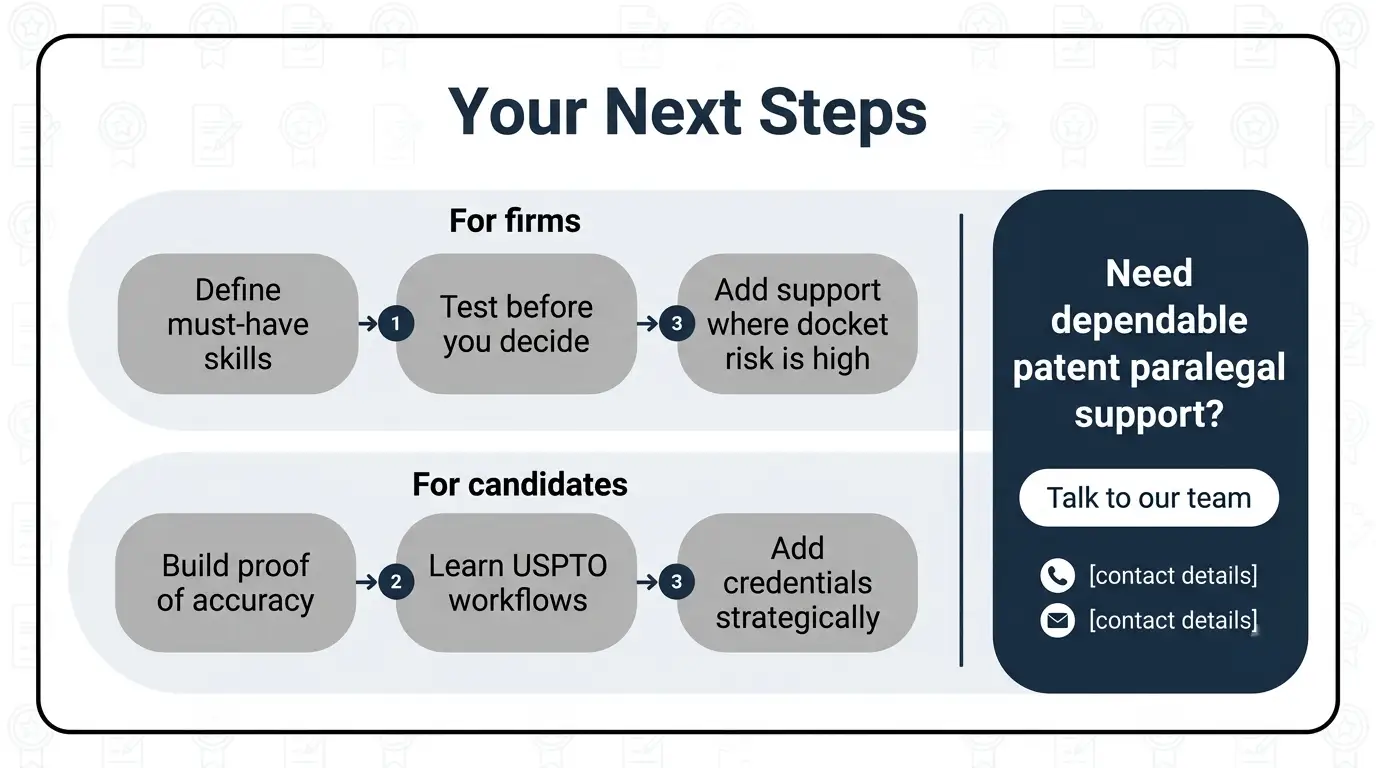
Firms should treat certification as a helpful tiebreaker rather than a hard requirement. Candidates should treat it as one tool among many, not a substitute for patent-specific experience. Both groups should remember that USPTO registration is a separate legal path, and no paralegal credential replaces it.
If your team needs reliable patent paralegal support without a long hiring cycle, Teak IP can help. Our U.S. attorney-led team provides docketing, IDS preparation, Office Action support, and more through a flexible, à la carte model. Contact Teak IP today to discuss your portfolio and get started.

