
Quick answer: To structure a corporate IP department from scratch, audit your IP assets, define the department’s mandate, choose a centralized, decentralized, or hybrid model, hire a small core team (IP counsel, IP manager, docketing and paralegal support), build repeatable workflows, select docketing technology, decide what to outsource, and track a short list of KPIs. Start lean, then scale as your portfolio grows.

Key Takeaways
- A corporate IP department protects and monetizes patents, trademarks, copyrights, trade secrets, and domain names. It also supports deals, litigation, and product launches.
- The right structure depends on portfolio size, industry, geography, and risk tolerance. No single template fits every company.
- Most new departments start with 2 to 4 people and a strong outsourcing layer for docketing, paralegal work, and drawings.
- Clear workflows (invention disclosure, filing, docketing, maintenance, enforcement) matter more than a large headcount.
- A short KPI set, reviewed quarterly, keeps the department tied to business outcomes rather than activity.
Why Most IP Departments Start by Accident
Most corporate IP departments do not begin with a plan. Instead, they grow out of a single urgent problem: a missed deadline, a surprise cease-and-desist letter, or an acquisition where nobody can say who owns what. Suddenly, the general counsel realizes that intellectual property is no longer a side task for the legal team.
If that sounds familiar, you are in the right place. This guide explains how to structure a corporate IP department in a practical, step-by-step way. You will learn which roles to hire first, how to pick an operating model, where to use outside partners, and how to measure success.
Furthermore, this article is written for general counsel, IP managers, founders, and operations leaders who must build something real with limited budget and time. Rather than theory, you will find checklists, tables, and decisions you can apply this quarter.
At Teak IP Services, we support corporate IP teams and law firms with docketing, paralegal work, patent drawings, IDS filing, and trademark services. Because we see how different departments run day to day, we have a clear view of what works and what quietly breaks. The advice below reflects those patterns, along with guidance from official sources such as the USPTO and WIPO.
What is a Corporate IP Department?
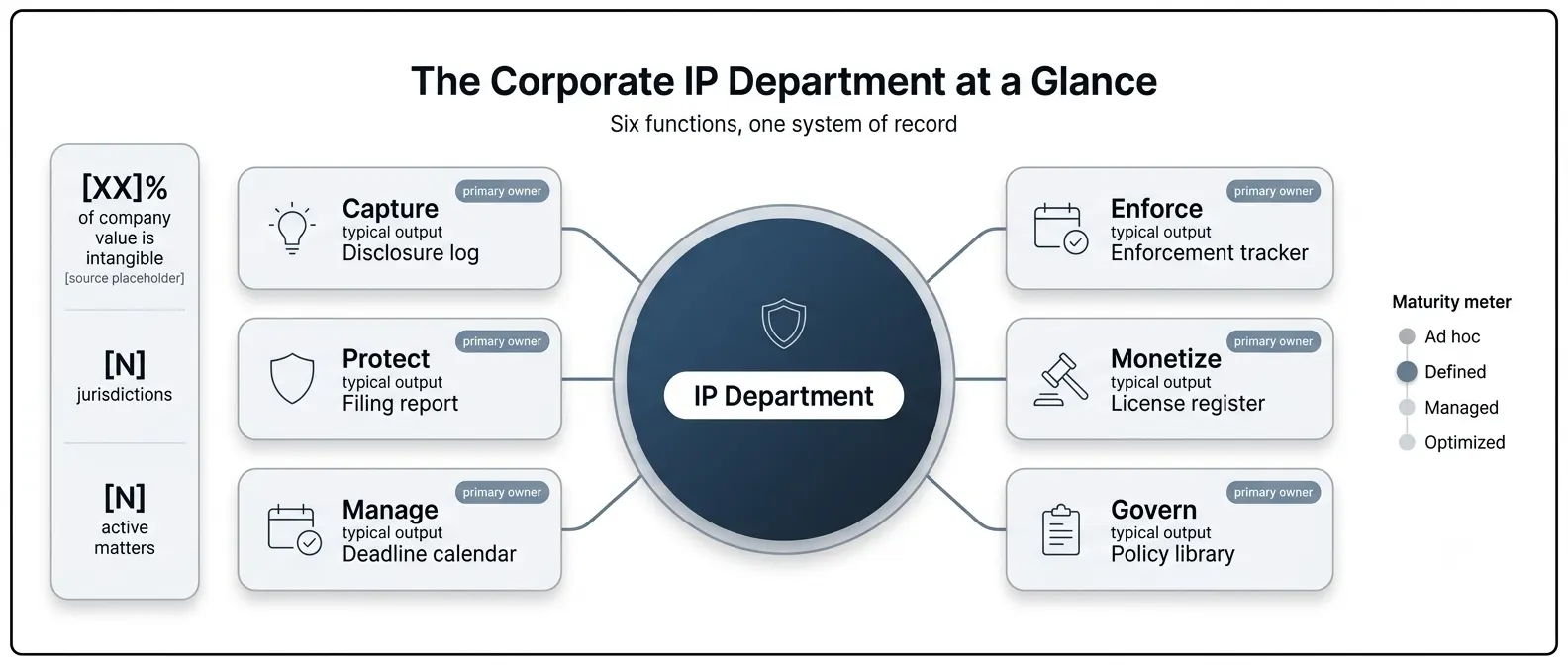
A corporate IP department is the in-house team responsible for identifying, protecting, managing, and enforcing a company’s intellectual property assets. It sits inside the business, usually within legal, and it works with engineering, product, marketing, and finance.
In short, the department handles five jobs:
- Creation and capture: collecting inventions, brands, and creative works from employees.
- Protection: filing and prosecuting patents, trademarks, and copyrights.
- Management: tracking deadlines, fees, ownership, and licenses.
- Enforcement and defense: policing infringement and responding to third-party claims.
- Value extraction: licensing, partnerships, and support for M&A and fundraising.
A department may have one person or fifty. Regardless of size, however, the five jobs stay the same. What changes is who performs each job and how much you do in-house versus through partners.
Corporate IP Department vs. Outside Law Firm
| Factor | In-House IP Department | Outside IP Law Firm |
|---|---|---|
| Business knowledge | Deep, continuous | Limited to what you share |
| Cost structure | Fixed salaries plus tools | Hourly or project fees |
| Speed of response | Immediate | Depends on firm capacity |
| Specialized expertise | Narrow, built over time | Broad, across technologies and countries |
| Control of portfolio data | Full | Shared |
| Best for | Strategy, governance, high volume | Prosecution peaks, litigation, niche jurisdictions |
Most mature companies use both. The in-house team sets strategy and controls data, while outside firms and service providers absorb peaks and specialized work.
Signs You Need a Dedicated IP Department
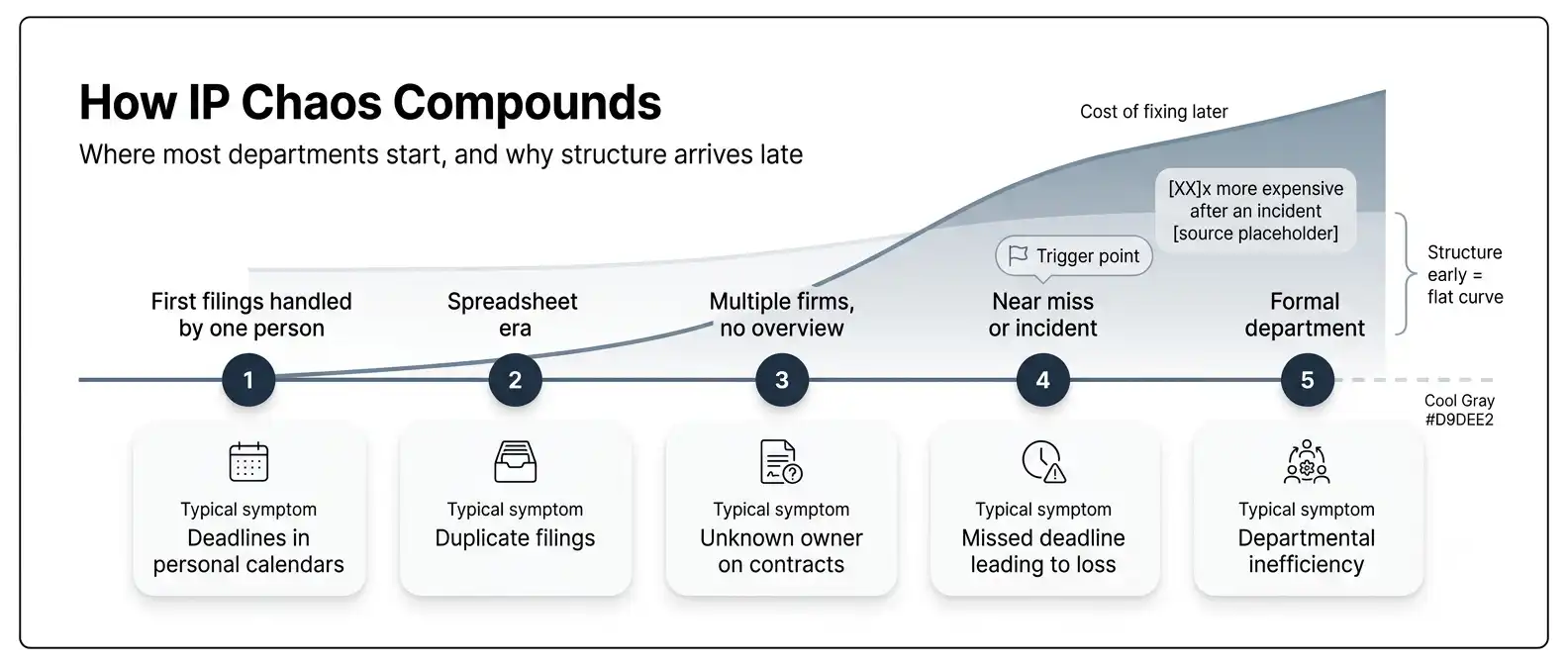
Not every company needs a full department on day one. Nevertheless, certain signals show that ad hoc IP handling has become risky or expensive.
- You file more than a handful of patent or trademark applications each year.
- Deadlines live in personal calendars or spreadsheets.
- Different business units file under different names or through different firms.
- Engineers ask legal about patents only after a product ships.
- You are preparing for funding, acquisition, or a major licensing deal.
- Outside counsel spend is rising without clear visibility into what you get.
- Your portfolio spans multiple countries, and renewals are slipping through the cracks.
If three or more of these ring true, it is time to formalize. In addition, if your docket team is already stretched thin, read our guide on the signs your firm needs additional patent paralegal support. The same warning signs apply to corporate teams.
How to Structure a Corporate IP Department: A Step-by-Step Framework
Below is the framework we recommend. Each step builds on the previous one, so follow the order if you are starting from zero.
Step 1: Audit Your Existing IP Assets
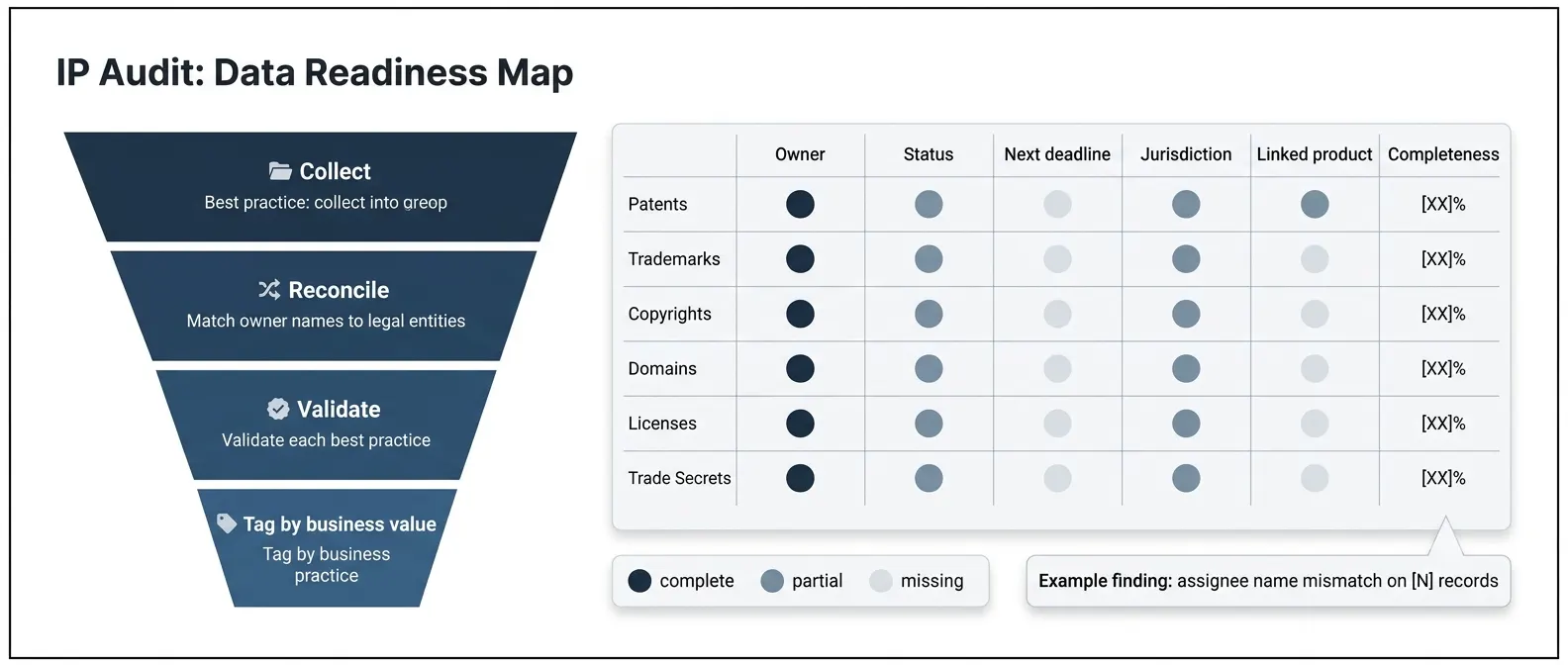
You cannot structure a department around assets you have not counted. Begin with a baseline audit.
Collect the following:
- All patents and applications, with jurisdiction, status, and next deadline
- All trademarks and applications, with classes, owners, and renewal dates
- Registered copyrights and key unregistered works (software, creative assets)
- Trade secret inventory (what it is, who has access, how you protect it)
- Domain names and social handles
- Inbound and outbound licenses, assignments, and co-development agreements
- Open disputes, oppositions, and demand letters
Then clean the data. Check that ownership names match your legal entities, because mismatched assignee names cause expensive recordal fixes later. If your records sit in paper files or old spreadsheets, consider a structured migration. Our data digitization and migration services exist for exactly this situation.
Practical insight: Teams often discover that 10 to 20 percent of their records have errors in names, dates, or status. Plan time for cleanup. It is tedious, but every later decision depends on it.
Step 2: Define the Mandate and Scope
Next, write a one-page charter. A clear mandate prevents the department from becoming a catch-all for every legal question that mentions the word “trademark.”
Answer these questions:
- Which asset types does the department own (patents, trademarks, copyrights, trade secrets, domains)?
- Does it handle only filing and maintenance, or also licensing, enforcement, and clearance?
- Who approves filing decisions and budgets?
- Which business units does it serve?
- What does it explicitly not do?
Moreover, get written sign-off from the general counsel and at least one business executive. Without executive sponsorship, the department will struggle to collect invention disclosures or enforce brand rules.
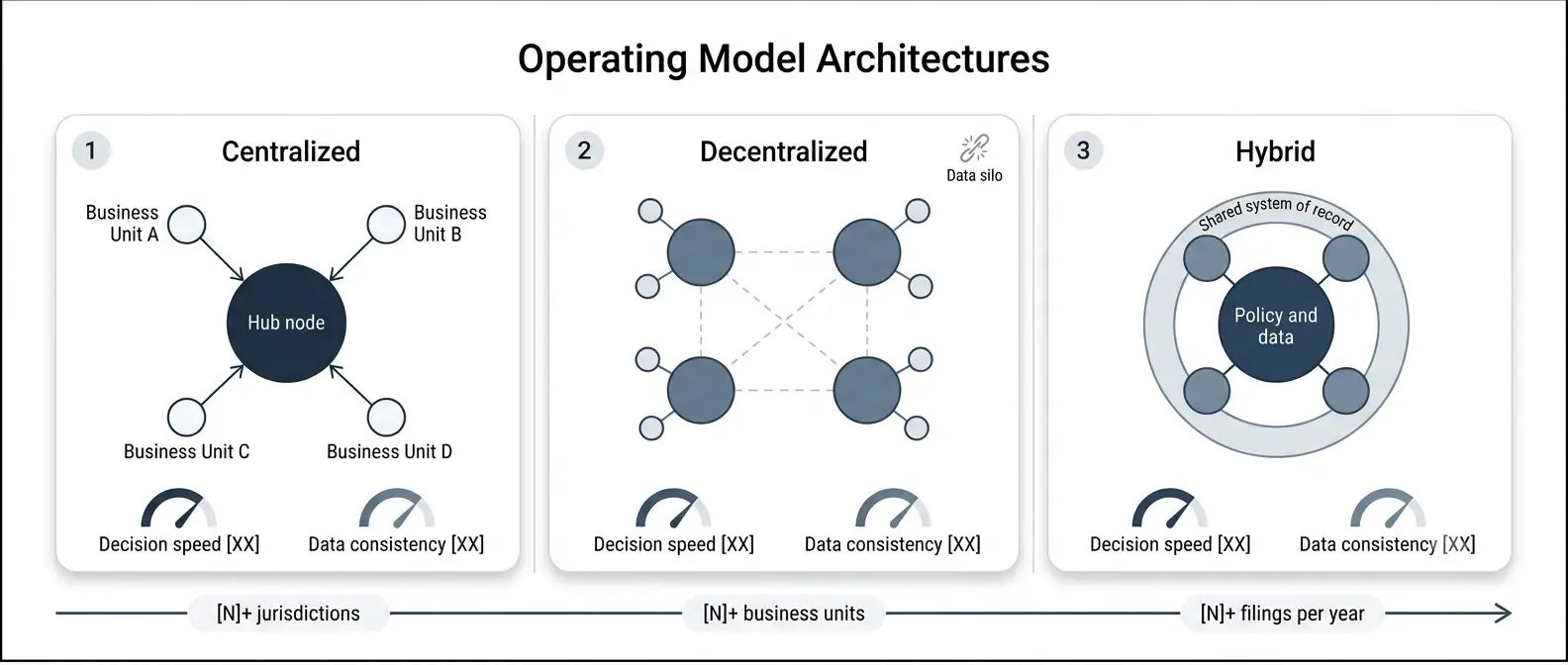
Step 3: Choose Your Operating Model
The operating model decides where decisions happen and who does the work. Three structures dominate.
Centralized Model
One team controls all IP activity. Business units submit requests and the central team decides.
- Pros: consistent quality, single source of truth, easier cost control.
- Cons: can become a bottleneck; may lack local market knowledge.
Decentralized Model
Each business unit or region runs its own IP function with light central oversight.
- Pros: fast, close to products and markets.
- Cons: duplicate effort, inconsistent filings, fragmented data.
Hybrid Model
A central team sets policy, owns the portfolio database, and manages vendors. Embedded IP liaisons or local counsel in business units handle day-to-day needs.
- Pros: balances control with speed.
- Cons: needs clear roles to avoid confusion.
| Criteria | Centralized | Decentralized | Hybrid |
|---|---|---|---|
| Best company size | Small to mid | Large conglomerates | Mid to large |
| Portfolio visibility | High | Low | High |
| Speed for business units | Moderate | High | High |
| Consistency of quality | High | Low | Moderate to high |
| Management overhead | Low | High | Moderate |
| Recommended for a new department | Yes | Rarely | Later stage |
For most companies learning how to structure a corporate IP department from scratch, we recommend starting centralized. You can move to a hybrid model once volume and geography demand it.
Step 4: Decide the Reporting Line
Where the department reports shapes its influence. Common options include:
- Under the General Counsel: the most common choice. It keeps IP aligned with legal risk and contracts.
- Under the Chief Technology Officer or R&D head: useful in patent-heavy businesses, but it can weaken independent legal judgment.
- Under the Chief Operating Officer or CFO: works when IP is treated as a financial asset, though it risks distance from legal practice.
In most cases, report to the general counsel with a dotted line to R&D and marketing. That setup keeps legal oversight intact while giving the team access to inventors and brand owners.
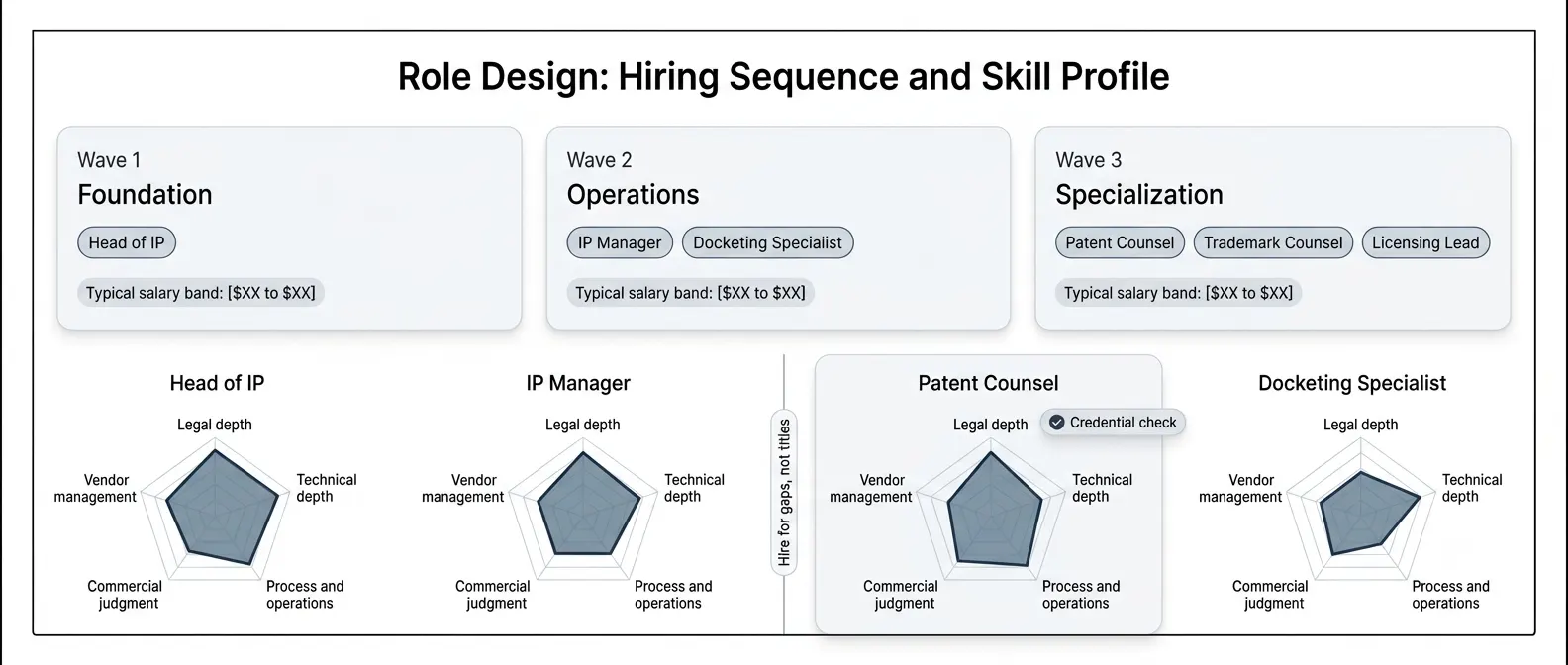
Step 5: Design the Core Roles
Hire for the work you have, not the org chart you admire. A lean department often starts with the roles below.
| Role | Core Responsibilities | When to Hire |
|---|---|---|
| Head of IP / IP Counsel | Strategy, budget, outside counsel management, risk decisions | First hire |
| IP Manager / Portfolio Manager | Portfolio data, deadlines, vendor coordination, reporting | Early (first 6 to 12 months) |
| Patent Counsel or Patent Agent | Invention intake, claim strategy, prosecution oversight | When patent filings exceed about 15 to 20 per year |
| Trademark Counsel | Clearance, filings, brand policy, enforcement | When brand portfolio spans several countries |
| IP Paralegal / Docketing Specialist | Docketing, filings support, status tracking, forms | Early or outsourced |
| IP Operations / Analyst | Metrics, invoices, tools, data quality | At scale |
| Licensing / Commercialization Lead | Out-licensing, partnerships, IP monetization | When IP generates revenue |
Importantly, you can fill some roles with outsourced partners rather than employees. For example, a virtual paralegal team can cover docketing and filing support while you hire strategic talent first. For hiring guidance, see our article on how to hire a remote trademark paralegal with international portfolio experience.
Registration note: In the United States, only registered patent attorneys and agents can practice before the USPTO in patent matters. The USPTO’s Office of Enrollment and Discipline sets those rules, so confirm credentials before you assign prosecution duties.
Step 6: Build Your Core Workflows
A department without workflows depends on heroes. A department with workflows survives turnover. Document at least these six processes.
Workflow 1: Invention Disclosure and Evaluation
- Inventor submits a disclosure form.
- IP counsel screens for novelty and business value.
- A review committee decides: file, hold as trade secret, or decline.
- The team assigns a deadline for filing.
Workflow 2: Filing and Prosecution
- Select filing route (national, PCT, Paris Convention, Madrid).
- Assign drafting to in-house or outside counsel.
- Prepare drawings, IDS, and forms.
- File and docket every deadline immediately.
- Review Office Actions and approve responses.
For international routes, review the official overviews of the Patent Cooperation Treaty and the Madrid System for trademarks before you set filing rules.
Workflow 3: Trademark Clearance and Brand Launch
- Run a clearance search before any new name launches.
- Evaluate conflicts and risk level.
- File in priority countries.
- Start watch services after registration.
Our guides on what a pre-filing trademark clearance search involves and the difference between a trademark search and trademark monitoring explain these two steps in detail.
Workflow 4: Docketing and Maintenance
- Enter every deadline with a responsible owner.
- Add reminders at 90, 60, 30, and 7 days.
- Run a second-person review on all entries.
- Pay maintenance fees and renewals before grace periods.
Quality control matters here more than anywhere else. See what a multi-layered quality control workflow for patent docketing looks like for a deeper model.
Workflow 5: Enforcement and Defense
- Monitor marketplaces, domain registrations, and new filings.
- Escalate suspected infringement to IP counsel.
- Decide on response: letter, takedown, negotiation, or litigation.
- Log outcomes for future policy decisions.
Workflow 6: Contracts and Ownership
- Use standard invention assignment clauses in employment agreements.
- Review IP terms in vendor, partner, and customer contracts.
- Record assignments with the proper offices.
- Store executed agreements in a searchable repository.
Step 7: Choose Your Technology Stack
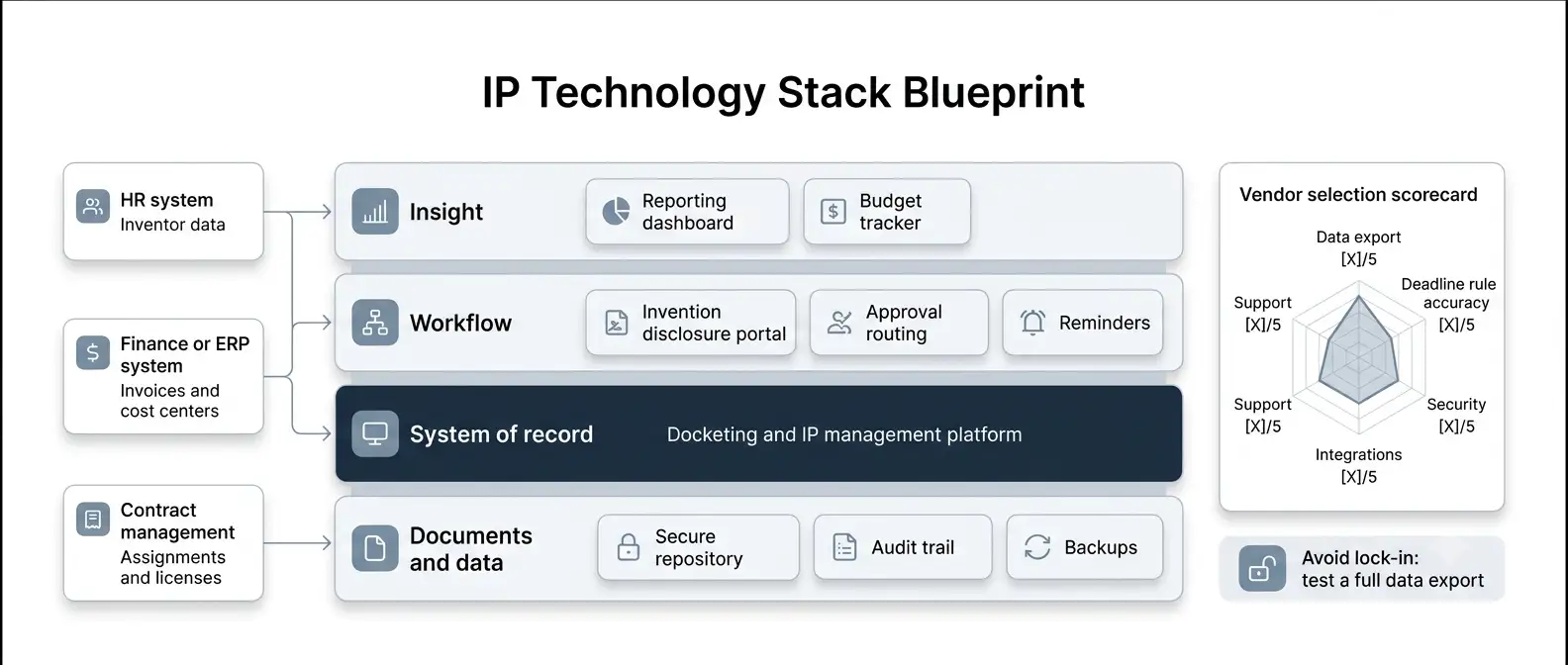
Technology should follow workflow, not lead it. Still, you need a reliable system of record from the start.
Your core stack should include:
- IP management or docketing platform: the single source of truth for deadlines, ownership, and costs.
- Document management: secure storage for filings, assignments, and correspondence.
- Invention disclosure tool: a simple form or portal inventors will actually use.
- Search and watch tools: for prior art, clearance, and brand monitoring.
- Reporting dashboard: for KPIs and budget tracking.
When you compare vendors, ask hard questions about data export, audit trails, deadline rule accuracy, and support. Our review of the best patent docketing companies for corporate IP departments walks through the criteria that matter. In addition, our article on whether an external docketing service can handle USPTO status scraping automatically explains where automation helps and where human review still matters.
Step 8: Decide What to Keep In-House and What to Outsource
Outsourcing is not a sign of weakness. Rather, it is how lean departments stay flexible. Use the table below as a starting point.
| Function | Keep In-House | Outsource | Hybrid |
|---|---|---|---|
| IP strategy and budget | Yes | No | No |
| Invention evaluation | Yes | No | Sometimes |
| Patent drafting | Sometimes | Often | Common |
| Patent drawings | No | Yes | No |
| IDS preparation and filing | No | Yes | Common |
| Docketing and data entry | Sometimes | Yes | Common |
| Office Action responses | Sometimes | Often | Common |
| Trademark searches and monitoring | No | Yes | Common |
| Litigation | No | Yes (outside counsel) | Oversight in-house |
| Portfolio analytics | Yes | Sometimes | Common |
Specialized providers can take over repeatable tasks such as docketing and IP management, IDS preparation and filing, patent drawings, and IP paralegal support. As a result, your in-house team can focus on judgment-heavy work.
Due diligence matters. Every vendor touches confidential data and deadlines. Before you sign, review the IP vendor due diligence checklist for law firms and corporate legal teams. It covers security, quality control, conflicts, and pricing transparency.
If you plan to use offshore or remote support, also check compliance expectations. Our article on whether remote patent paralegal services comply with USPTO rules clarifies what supervision and confidentiality look like in practice.
Step 9: Set Governance, Policies, and Approval Rules
Governance turns a group of people into a department. Put these policies in writing:
- IP ownership policy: who owns what, including employee and contractor inventions.
- Filing approval matrix: who approves filings at which cost thresholds.
- Brand usage guidelines: naming rules, logo use, and licensing of marks.
- Open source policy: how engineers may use and contribute to open-source code.
- Trade secret protocol: access controls, NDAs, and exit procedures.
- Outside counsel guidelines: billing, reporting, and conflict rules.
- Records retention policy: what to keep, where, and for how long.
Keep each policy short. A two-page policy people read beats a twenty-page policy nobody opens.
Step 10: Budget, KPIs, and a 12-Month Roadmap
Finally, tie the department to measurable outcomes.
Budget Categories to Plan
- Official fees (filing, maintenance, renewal)
- Outside counsel and vendor fees
- Salaries and benefits
- Software and subscriptions
- Searches, watch services, and investigations
- Training and memberships
- Contingency for disputes
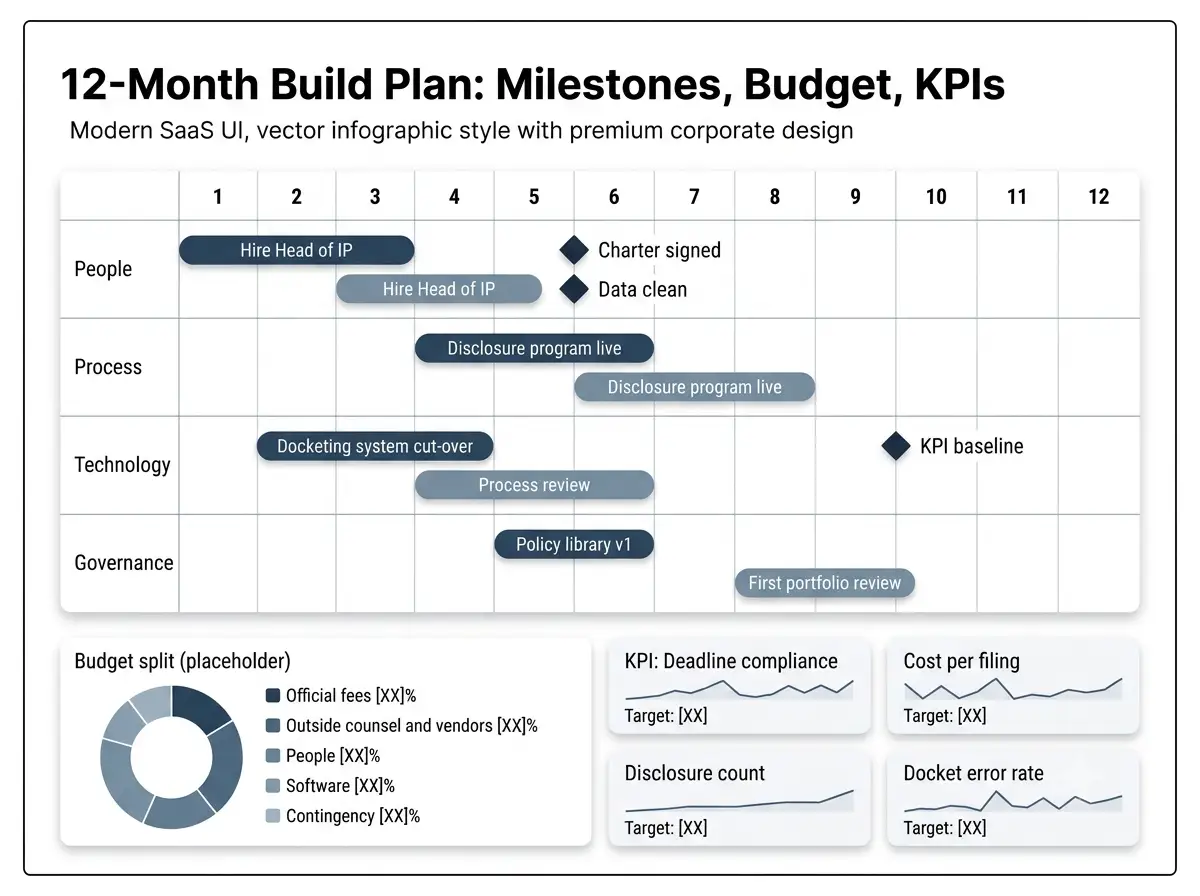
Starter KPI Set
| KPI | What It Measures | Review Cadence |
|---|---|---|
| Deadline compliance rate | Percentage of deadlines met without extension | Monthly |
| Docketing error rate | Errors found in second-person review | Monthly |
| Invention disclosures per quarter | Health of the innovation pipeline | Quarterly |
| Filing-to-grant/registration ratio | Quality of filing decisions | Annually |
| Cost per filing | Efficiency of spend and vendor choices | Quarterly |
| Time to clear a new brand | Speed of business support | Quarterly |
| Portfolio coverage by key market | Alignment with revenue geography | Annually |
| IP-related revenue or savings | Business value created | Annually |
Choose five or six at most. Too many metrics create reporting work without insight.
Sample 12-Month Roadmap
| Timeframe | Priority Actions |
|---|---|
| Days 1 to 30 | Audit assets, clean data, write charter, secure executive sponsor |
| Days 31 to 90 | Hire first lead, select docketing system, document top three workflows |
| Months 4 to 6 | Launch invention disclosure program, set vendor panel, publish core policies |
| Months 7 to 9 | Add IP manager or paralegal, introduce KPI dashboard, run first portfolio review |
| Months 10 to 12 | Review geography coverage, refine budget, plan year-two hires and training |
Recommended Team Size by Company Stage
Headcount depends on portfolio size, but the following ranges give a realistic starting point.
| Company Stage | Typical Portfolio | Suggested In-House Team | Outsourcing Level |
|---|---|---|---|
| Early-stage startup | 1 to 10 assets | 0 to 1 (founder plus fractional counsel) | Very high |
| Growth company | 10 to 100 assets | 1 to 3 | High |
| Mid-size company | 100 to 500 assets | 3 to 8 | Moderate to high |
| Large enterprise | 500 to 5,000+ assets | 8 to 30+ | Moderate |
These numbers are guidelines, not rules. A software company with ten patents and heavy brand activity may need different roles than a hardware manufacturer with ten patents and complex supply chains.
Managing Global Portfolios: Trademarks, Renewals, and Local Rules
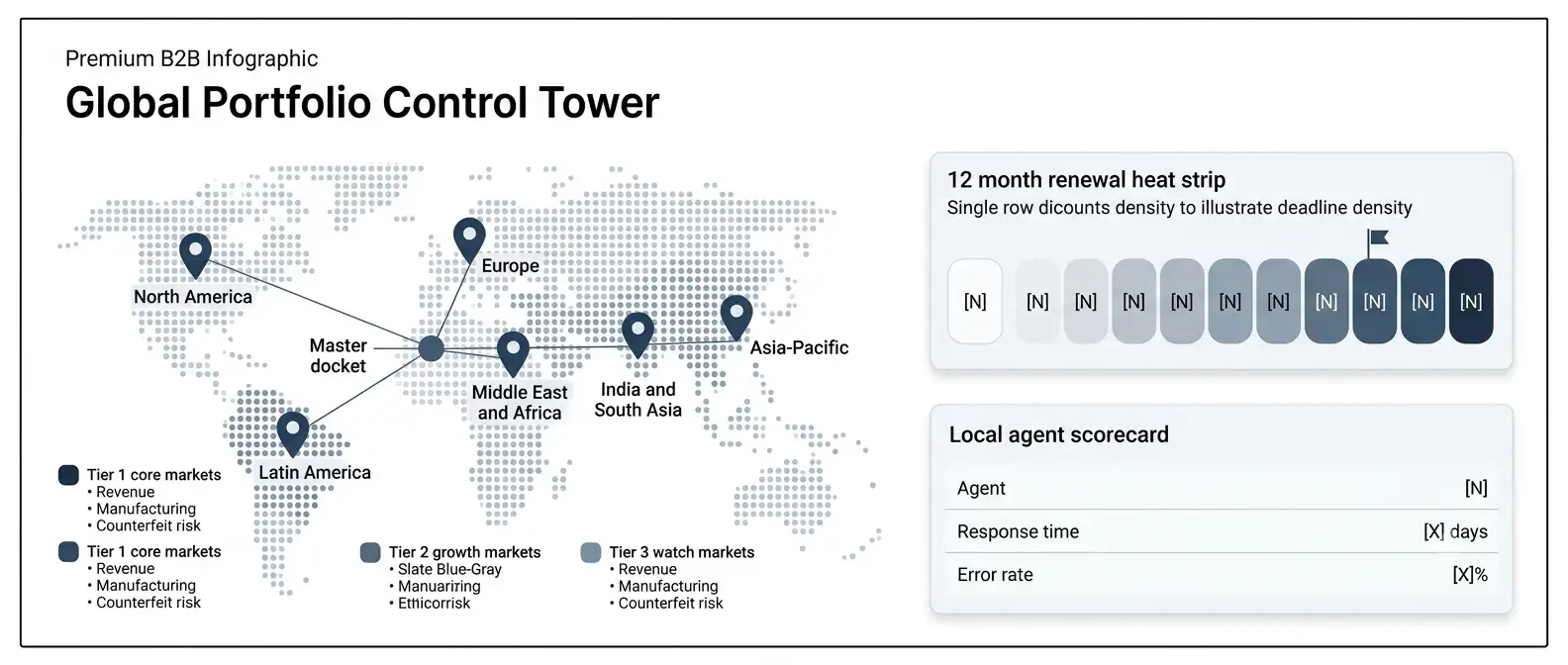
International growth adds a layer of complexity that surprises many new departments. Each country has its own deadlines, language requirements, and local-agent rules. Consequently, one missed renewal in a minor market can erase a registration you paid for years ago.
To prevent this:
- Centralize renewal tracking in one database.
- Appoint trusted local agents and review their performance.
- Use the Madrid System where it fits your target countries.
- Prioritize markets by revenue, manufacturing, and counterfeit risk.
- Review country lists annually and drop low-value filings deliberately.
For a deeper operational playbook, read our guide to managing corporate trademark renewals globally. In the United States, always confirm current requirements directly with the USPTO trademark office, since rules and fees change.
Common Mistakes When Building a Corporate IP Department
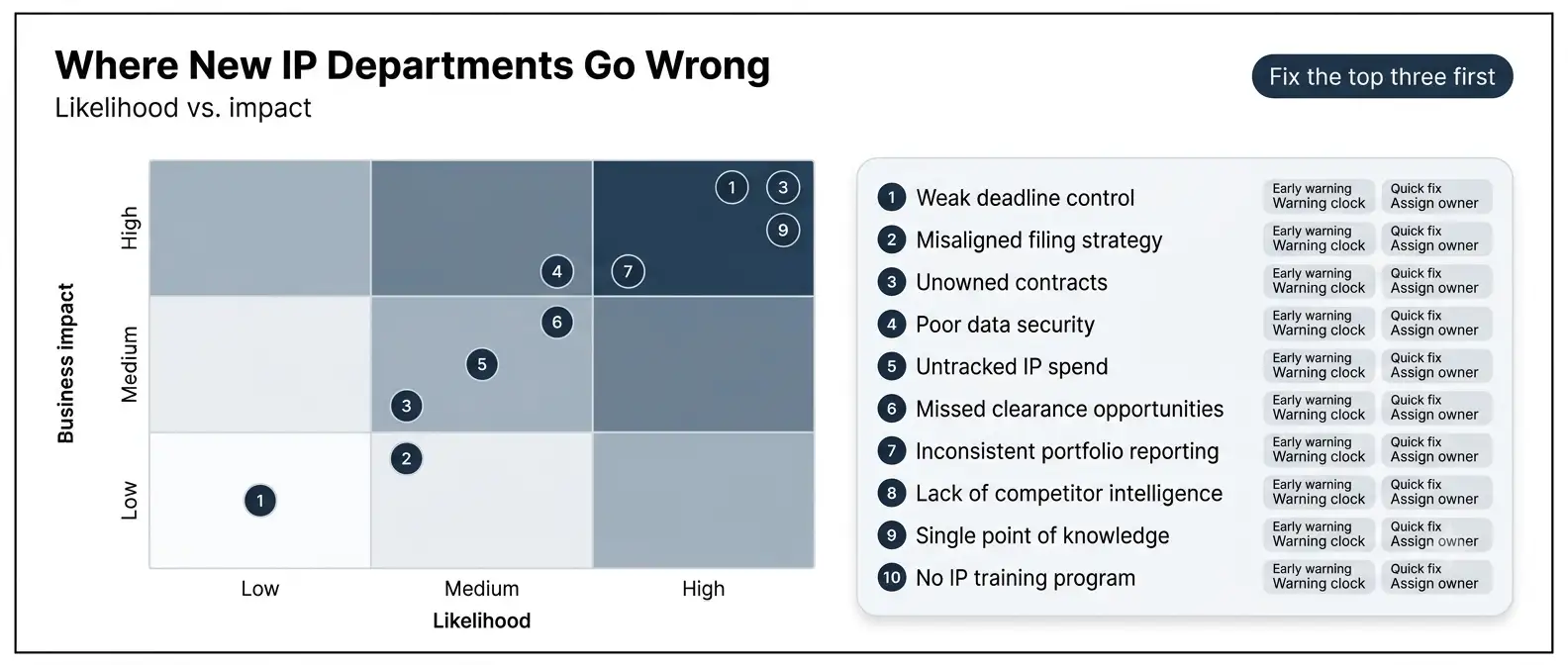
Even well-funded teams repeat the same errors. Avoid these.
- Hiring a senior lawyer before fixing the data. A brilliant strategist cannot work from a broken docket.
- Letting every business unit pick its own outside counsel. Fragmented vendors lead to inconsistent quality and higher cost.
- Treating docketing as clerical work. A missed deadline can end a patent right permanently, so deadlines deserve real quality control.
- Skipping the invention disclosure program. Without it, engineers file nothing, or they file everything.
- Ignoring trademarks until a dispute appears. Brand clearance costs far less than rebranding.
- Buying software before mapping workflows. Tools amplify good processes and bad ones equally.
- Failing to measure. If nobody tracks cost and compliance, the department cannot defend its budget.
- Overbuilding too early. A five-person team for a ten-asset portfolio wastes money that outsourcing could save.
- Neglecting contracts. Unclear IP ownership in contractor agreements causes disputes during funding or M&A.
- Not planning for turnover. If one person holds all the knowledge, the department is one resignation away from crisis.
Expert Tips for Building a Department That Lasts
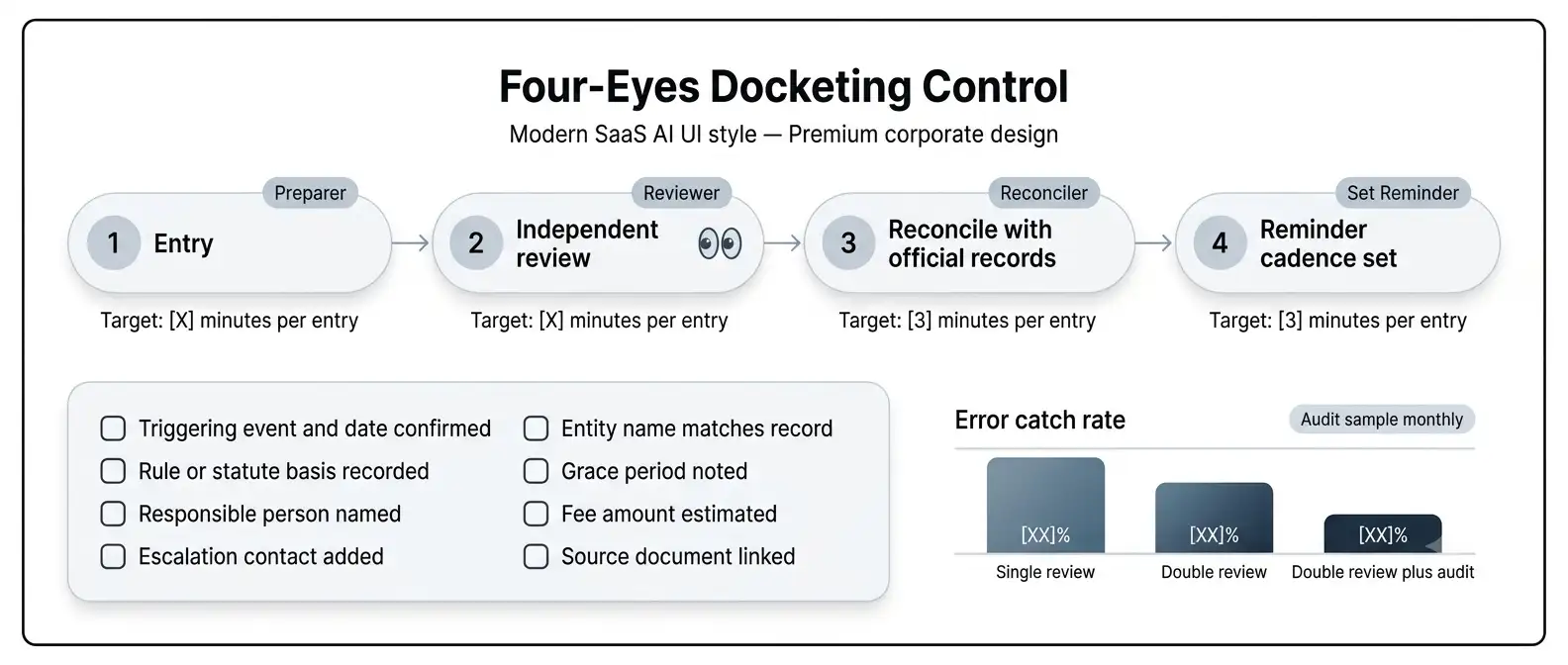
Practical lessons from the docketing and paralegal side of IP work:
- Start with deadlines. Reliable docketing earns trust faster than any strategy deck.
- Use a second set of eyes. Independent review of every docket entry catches errors before they become losses.
- Standardize naming. Consistent entity names, matter numbers, and file labels save hours every week.
- Hold a quarterly portfolio review. Ask of each asset: does it still support a product, a market, or a deal?
- Train inventors briefly but often. A 20-minute session twice a year outperforms a long annual seminar.
- Create a vendor scorecard. Rate turnaround time, accuracy, communication, and cost every quarter.
- Keep an escalation path. Define who decides when a deadline is at risk or a dispute starts.
- Document everything once. Short playbooks protect the department when people leave.
- Align with finance early. Predictable budgets and clear forecasts build credibility with the CFO.
- Plan for diligence. Assume an investor or buyer will ask for a clean IP schedule within 48 hours. Build records that make that possible.
Build vs. Buy: A Quick Decision Guide
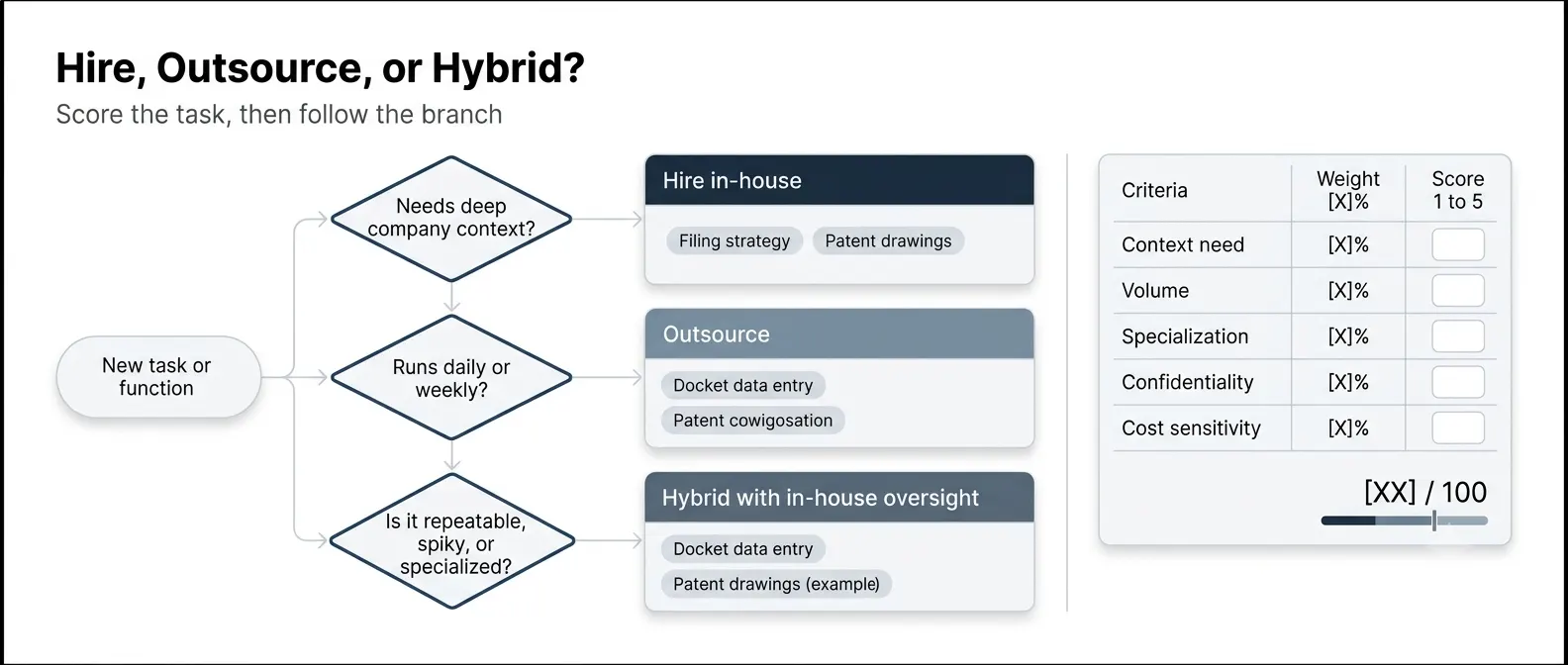
When you hesitate between hiring and outsourcing, apply this short test.
- Hire in-house when the work needs deep business context, runs daily, and affects strategy.
- Outsource when the work is repeatable, spiky, or specialized, and quality depends on process rather than company knowledge.
- Use a hybrid when you want oversight in-house but capacity elsewhere.
For example, deciding which inventions deserve a patent is a strategic call. Preparing patent drawings that meet formatting rules is a production task. If you want to see how technical the second category can be, our article on USPTO patent drawing requirements and the formatting rules examiners enforce shows why specialist support pays off.
Similarly, responding to an Office Action blends legal judgment with careful drafting and deadline control. Many departments split the work: counsel decides strategy, while trained support teams prepare drafts and manage deadlines. Learn more in our guide to the best office action response support services for patent and trademark firms.
How to Know Your IP Department Is Working
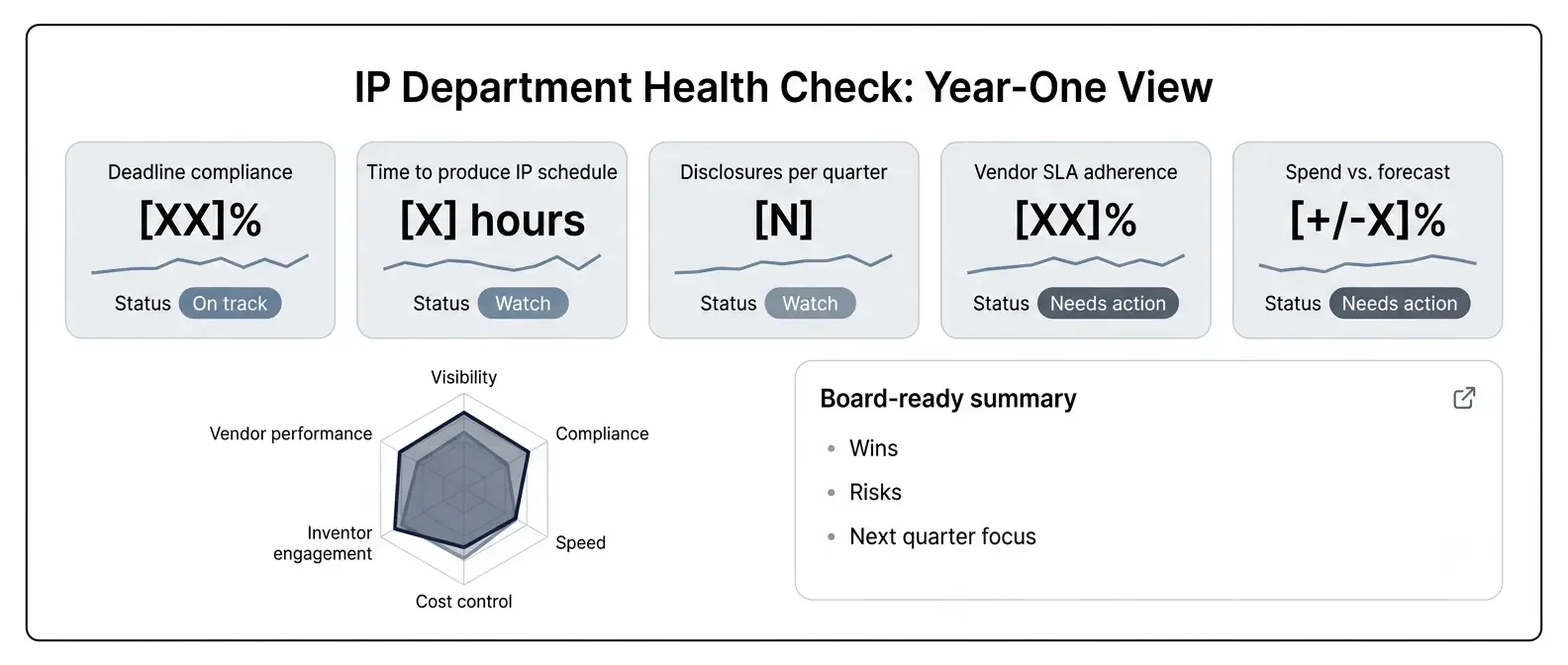
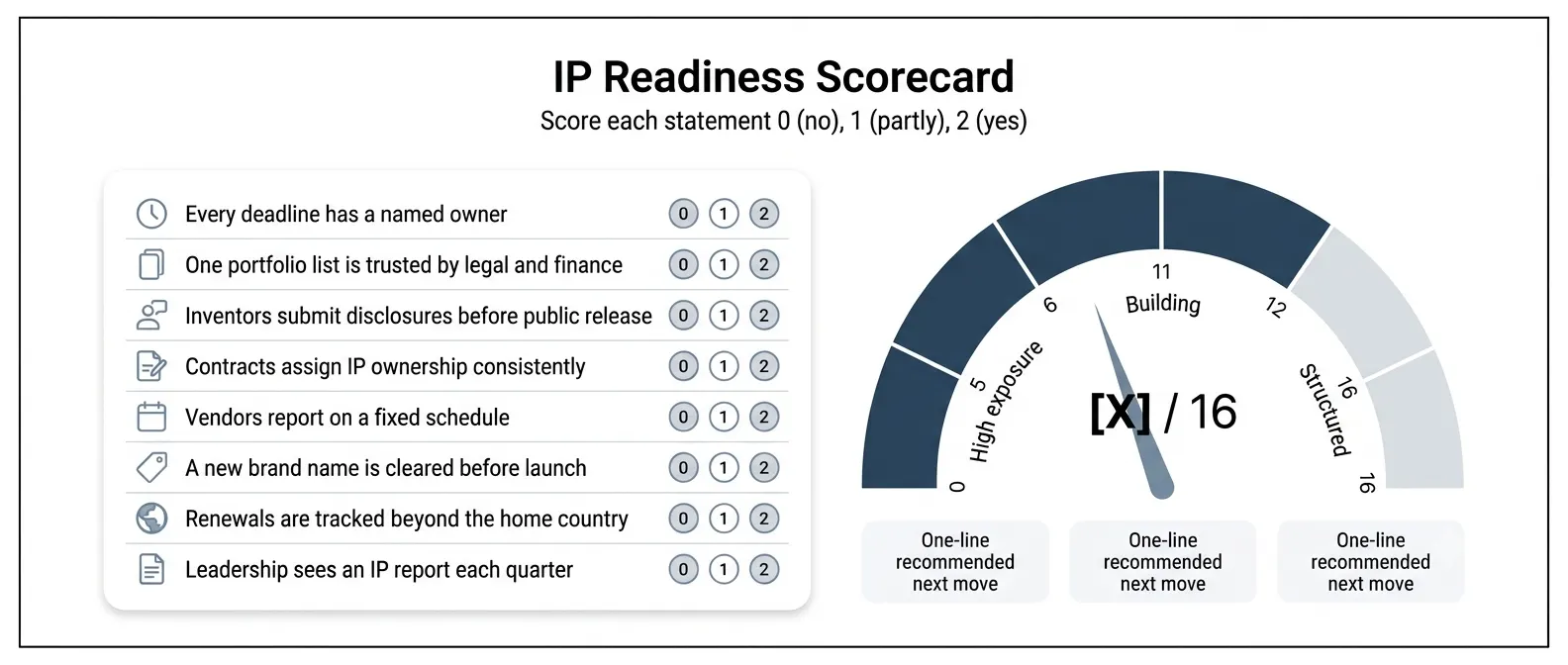
A healthy department shows clear signs within the first year:
- No missed statutory deadlines
- A current, accurate IP schedule that you can share within hours
- Inventors who submit disclosures without chasing
- Vendors who follow your guidelines and report on time
- A budget that matches forecasts within a reasonable margin
- Business leaders who ask legal for IP input before launching products
- A documented answer to “what do we own, where, and why?”
If several of these are missing after twelve months, revisit your structure. Often the fix is smaller than it seems: a clearer workflow, one extra reviewer, or a better vendor.
Frequently Asked Questions
What is the first step in how to structure a corporate IP department?
The first step is an IP asset audit. List every patent, trademark, copyright, domain, trade secret, and license, then verify ownership and deadlines. This baseline shows the real size of your portfolio and the risks that need immediate attention.
How many people does a corporate IP department need?
A growth-stage company often runs well with one to three people plus outsourced support. Larger enterprises with several hundred assets typically need three to eight staff, and very large portfolios can require far more. Portfolio size, filing volume, and geography should drive headcount.
Should a corporate IP department report to the general counsel?
In most companies, yes. Reporting to the general counsel keeps IP decisions aligned with legal risk, contracts, and compliance. Many teams add a dotted line to R&D or marketing so inventors and brand owners stay engaged.
What should a new IP department outsource first?
Start with repeatable, deadline-driven tasks: docketing, data entry, IDS preparation, patent drawings, and trademark searches. These functions benefit from specialized process and quality control, and they free your in-house team to focus on strategy.
How do I choose between a centralized and decentralized IP model?
Choose centralized if your portfolio is small to mid-sized and you want consistent quality and cost control. Choose decentralized only when business units operate almost independently. A hybrid model fits many growing companies, with central policy and local liaisons.
How much does it cost to set up a corporate IP department?
Costs vary widely. Main drivers include salaries, docketing software, official fees, outside counsel, and vendor services. Many companies control early costs by hiring one senior lead and using flexible, pay-as-you-need outsourcing for production work.
What KPIs should a corporate IP department track?
Track deadline compliance, docketing error rate, invention disclosures, cost per filing, and portfolio coverage in key markets. Add IP-related revenue or savings once licensing or enforcement becomes meaningful.
Can a startup follow the same process for how to structure a corporate IP department?
Yes, in scaled-down form. A startup can assign IP ownership to one founder or operations lead, work with a fractional IP counsel, document two or three core workflows, and outsource docketing and filings support. Then it can grow the structure as funding and portfolio size increase.
Conclusion: Build the Structure Before the Crisis
Learning how to structure a corporate IP department comes down to a few disciplined choices. First, know what you own. Second, define a clear mandate and operating model. Third, hire the right core roles and document your workflows. Finally, use technology and outside partners to scale without adding unnecessary overhead.
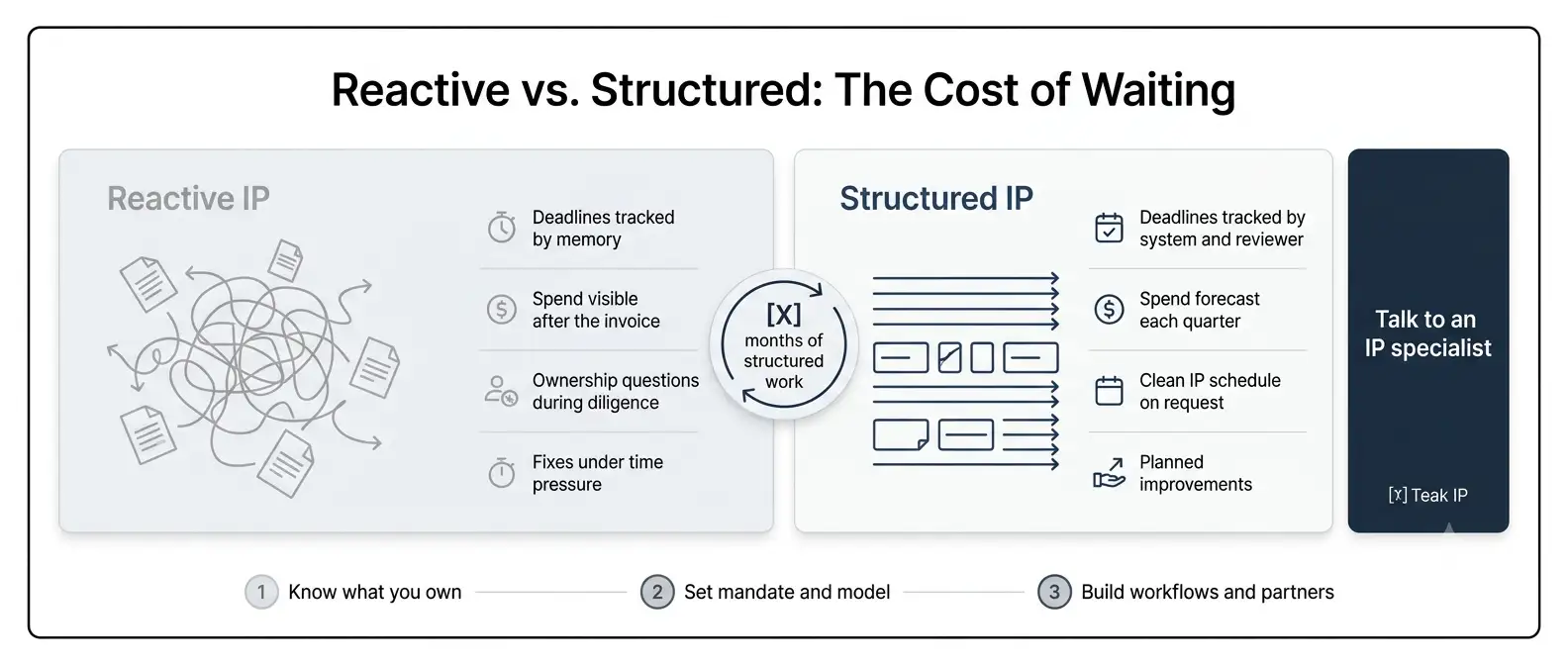
Importantly, do not wait for a missed deadline or a failed due diligence review to start. A lean, well-organized department built today costs far less than an emergency rebuild later.
At Teak IP Services, we help corporate IP teams and law firms extend their capacity with attorney-led docketing, paralegal support, IDS filing, patent drawings, and trademark services. Our à la carte model lets you pay only for what you need, while our multi-layered quality control protects your deadlines.

