
A spreadsheet never misses a deadline on purpose. It simply cannot know a deadline exists unless a person types the right date into the right cell, today and every day after.
That fragile dependency explains why multi-country IP docketing spreadsheet limits show up so quickly once a portfolio crosses a few borders. A single patent family can spawn dozens of national deadlines. Each one follows its own rules, its own calendar, and its own consequences for a miss. A grid of rows and columns was never built to carry that weight.

This guide walks through exactly where spreadsheets break, with real deadline examples from the PCT, USPTO, EPO, and Madrid systems. You will also get a comparison table, a migration plan, a list of common mistakes, and answers to the questions IP teams ask most.
Quick answer: Spreadsheets break down in multi-country docketing because they cannot apply jurisdiction-specific rules, chain dependent deadlines, enforce a second-person check, keep an audit trail, or escalate unconfirmed tasks. Small, single-country portfolios may survive on them. Global portfolios rarely do.
What is Multi-Country IP Docketing?
Multi-country IP docketing is the practice of recording, calculating, monitoring, and confirming every patent and trademark deadline across several national and regional IP offices. It sits at the core of IP docketing, and it adds a layer of complexity that single-country docketing never faces.
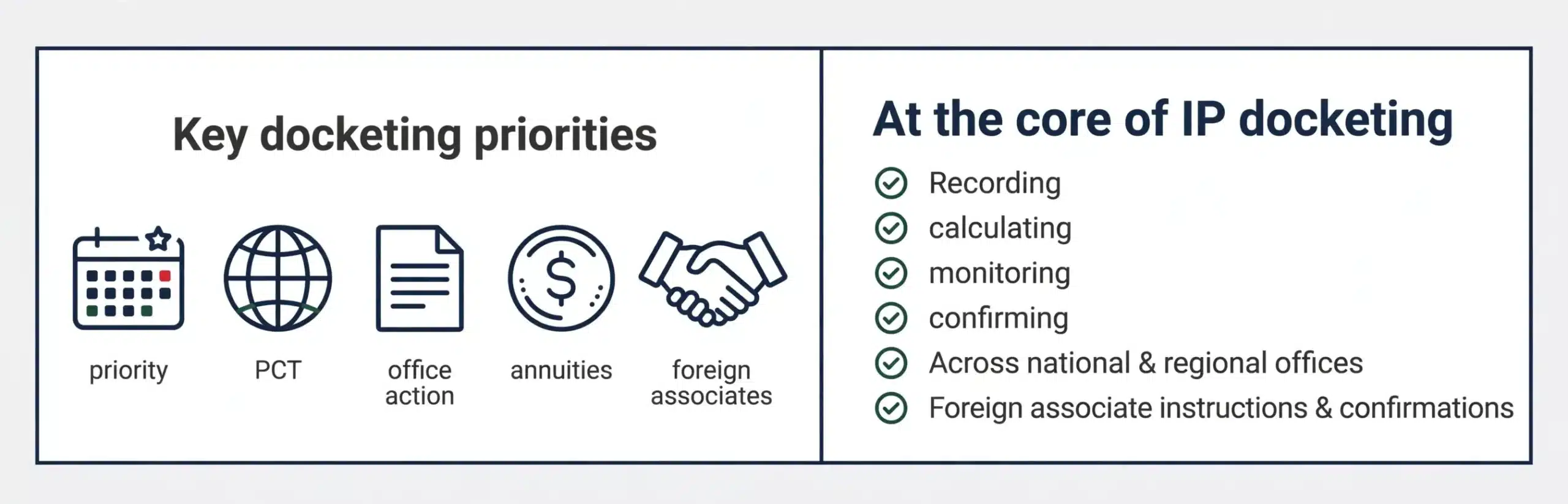
A multi-country docket typically has to handle:
- Priority and filing deadlines under the Paris Convention
- PCT international phase milestones and national phase entry dates
- Office action responses, each with a different response period
- Annuities, maintenance fees, and renewal fees
- Trademark renewals, declarations of use, and Madrid Protocol events
- Instructions to foreign associates and confirmation of their actions
Each item carries three questions: what must happen, by when, and who owns it. Those questions are easy to answer for ten matters in one country. They get hard fast at scale.
Why Teams Start With Spreadsheets (and Why It Feels Safe)
Spreadsheets earn their popularity for good reasons. They cost nothing extra, every lawyer and paralegal already knows how to use one, and a new matter takes thirty seconds to add.
For a young practice, that speed feels like efficiency. A docket of 30 matters in two countries fits comfortably on one tab.
The trouble starts gradually. First, a foreign filing adds a second tab. Next, someone adds a color code. Then a macro appears. Eventually, the file becomes a tangled system that only one person fully understands.
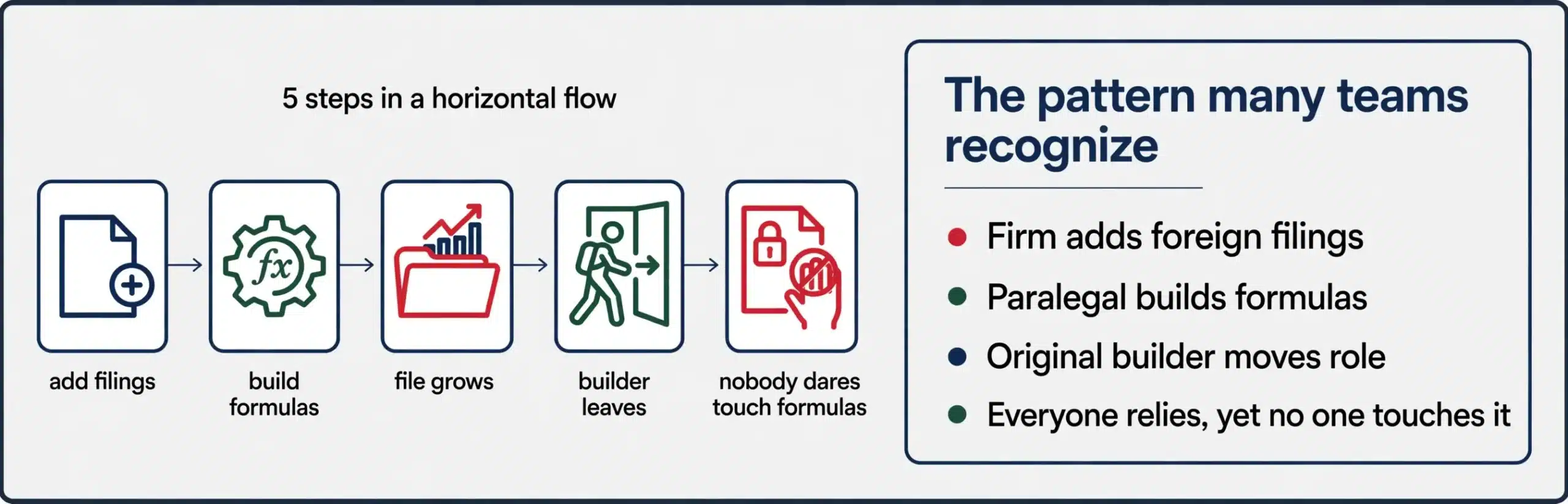
Here is the pattern many teams recognize:
- The firm adds a handful of foreign filings.
- A paralegal builds formulas to calculate common dates.
- The file grows to hundreds of rows and several tabs.
- The original builder moves to a new role.
- Nobody dares to touch the formulas, yet everyone relies on them.
At that point, the spreadsheet no longer supports the docket. It is the docket, and every risk in the file becomes a risk to your clients’ rights.
The Core Multi-Country IP Docketing Spreadsheet Limits
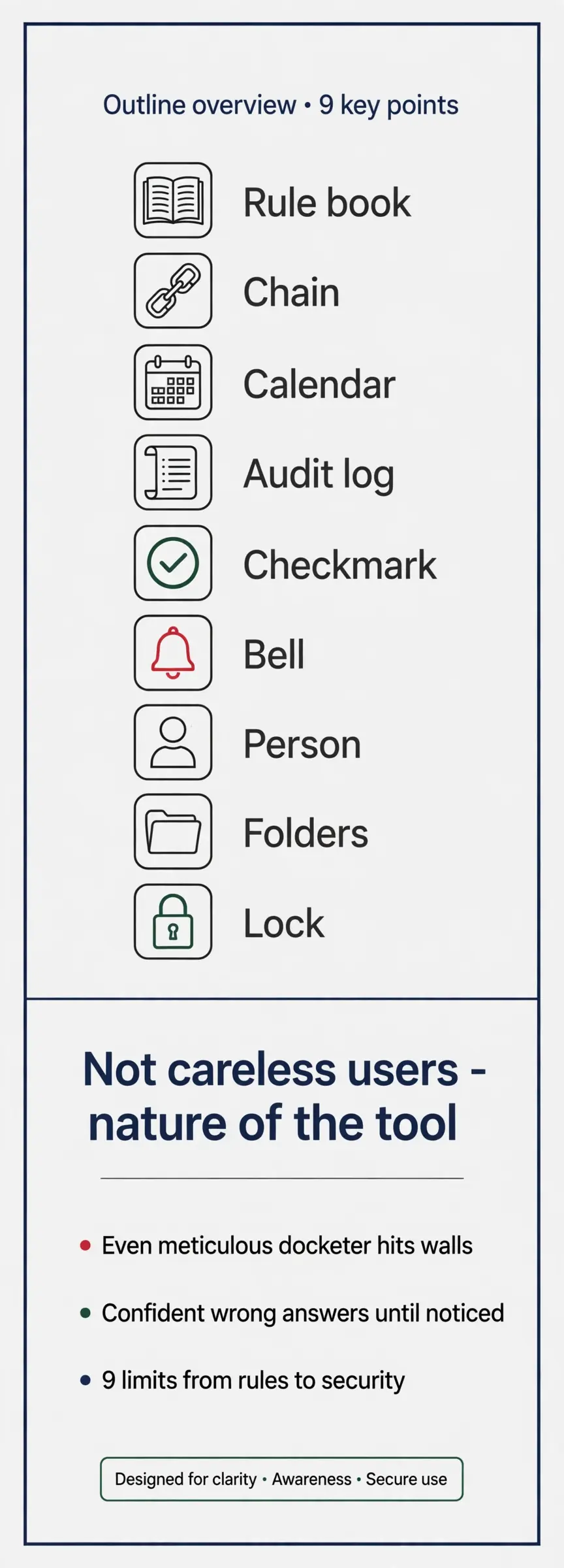
The problems below do not come from careless users. They come from the nature of the tool. Even a meticulous docketer hits these walls.
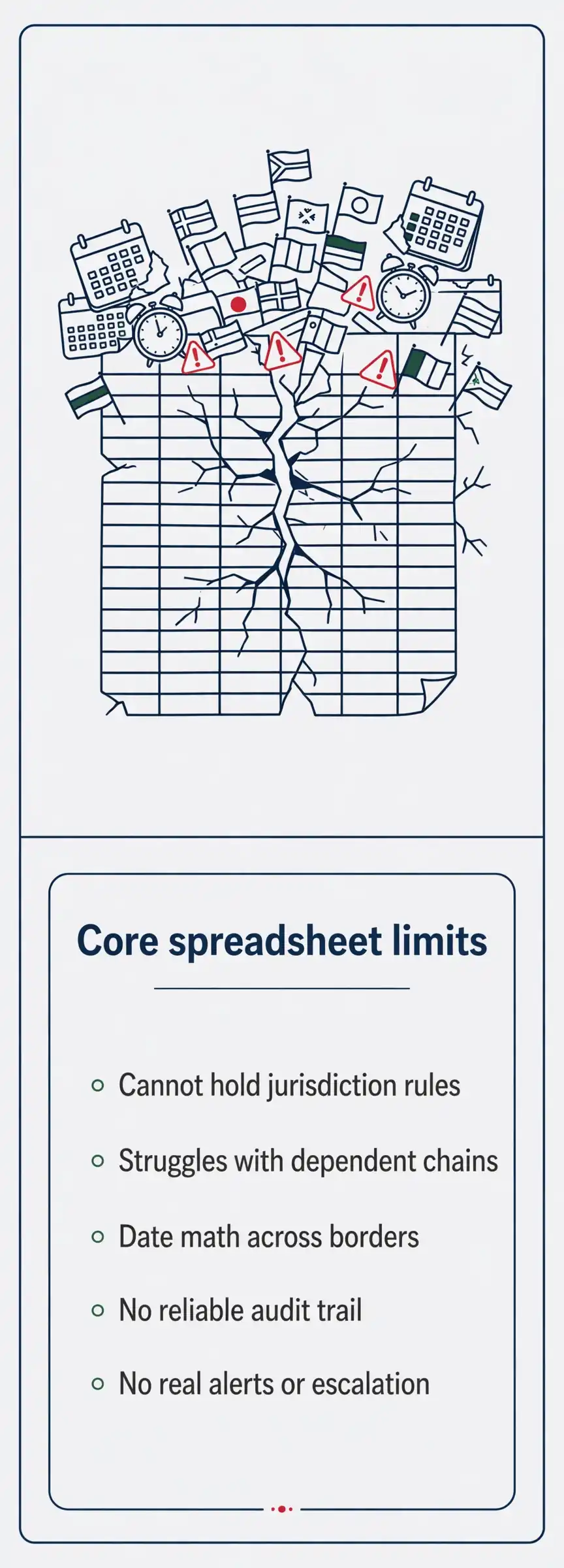
1. Spreadsheets Cannot Hold Jurisdiction-Specific Rules
A spreadsheet stores values and formulas. It does not store legal rules, and it does not update them when an office changes a procedure.
Consider how much varies between offices:
- The PCT sets 30 months from the priority date for national phase entry, but some offices allow 31 months.
- The USPTO charges maintenance fees at 3.5, 7.5, and 11.5 years after grant.
- The EPO charges annual renewal fees on pending applications, starting with the third year.
- A Madrid international registration lasts 10 years and renews on its own cycle.
Each rule needs a source, a verification date, and an owner. A formula such as =B2+EDATE(30) cannot tell you that an office changed its rule last spring. Therefore, the spreadsheet keeps producing confident, wrong answers until someone notices.
Dedicated platforms solve this with maintained rule sets. For a deeper look at how these systems work, see our overview of what a docketing system is.
2. Spreadsheets Struggle With Dependent Deadline Chains
Docketing is not a list of independent dates. It is a chain of triggers.
An office action arrives, and that one event creates a response date. A filed response may create a next action. A grant creates a fee window. A changed priority date shifts every downstream PCT and national deadline at once.
In a spreadsheet, a person must update each dependent date by hand. If you correct a priority date in one cell, the national phase date in another cell stays wrong unless a formula links them. Formulas break when someone inserts a row, sorts a column, or pastes values over a formula.
Practitioner insight: The most dangerous errors rarely come from a missed date. They come from a wrong date that looks right. A priority date typed with a transposed digit calculates a national phase deadline that can be days off, and nothing in the sheet flags it.
3. Date Math Gets Tricky Across Borders
Calculating a deadline sounds simple until you add real-world rules. Weekends and local holidays shift due dates. Some offices count to the last day of the month containing an anniversary. Others count exact days.
For example, EPO renewal fees for a pending application fall due on the last day of the month containing the anniversary of the filing date, according to the EPO Guidelines on renewal fees. For Euro-PCT applications, the third-year fee can be deferred until the 31-month period expires.
Now multiply those details across twenty countries. One misapplied convention can push a calendared date past the true deadline.
Teams also forget time zones. A filing due at midnight in Tokyo lands in the previous afternoon for a firm in Salt Lake City. A spreadsheet date field has no concept of this.
4. No Reliable Audit Trail
When a deadline goes wrong, the first question is always the same: who changed what, and when?
A spreadsheet rarely answers it. Cloud versions track edits, yet they do not capture why a change happened, who approved it, or what the old value meant. Local copies make it worse. Three versions of “Docket_Final_v7” can circulate at once.
A real audit trail matters for three reasons:
- It supports internal quality reviews.
- It protects the firm if a client questions an outcome.
- It helps insurers and auditors verify your controls.
5. Spreadsheets Cannot Enforce the Double-Check Rule
Strong docketing teams follow a simple principle: the person who enters a deadline should not be the only person who verifies it. Our complete patent docketing guide calls this the single most important practice in docketing.
A spreadsheet does not enforce that rule. It will accept any entry from anyone, and it will never insist on a second set of eyes. Teams can add a “verified by” column, but a column is a suggestion. Nothing stops a user from skipping it.
6. No Real Alerts, Escalation, or Confirmation
Reminders are where spreadsheets look most capable and fail most quietly.
You can color a cell red when a date approaches. However, color only works if someone opens the file that day. Conditional formatting cannot email a responsible attorney, nudge a paralegal, or escalate when nobody confirms action.
A mature docket needs tiered reminders:
- A first alert 3–6 months out for major events such as national phase entry
- A second alert 4–6 weeks before the due date
- A third alert 1–2 weeks before
- A final alert 3–5 business days before
- An escalation if no one has confirmed action
The WIPO PCT Newsletter makes the underlying point clearly: with so many deadlines and events in the international phase, an efficient monitoring system, often called a “docketing system,” helps applicants avoid missing any of them. You can read that guidance in WIPO’s PCT practical advice on monitoring deadlines.
7. Single-Person Dependency and Concurrent Editing
Most spreadsheet dockets depend on one champion. That person understands the layout, the shortcuts, and the quirks. When they take leave, change roles, or resign, the knowledge leaves with them.
Concurrent use creates a different risk. Two people open the same file, and one overwrites the other’s changes. Even with modern cloud editing, there is no record-level locking, no approval step, and no clean way to see which entry is final.
8. Fragmented Data and Poor Scalability
A growing portfolio splits across tabs, files, and folders. Patent data lives in one workbook. Trademark data lives in another. Foreign associate details sit in an email thread.
That fragmentation creates real costs:
- Reports require manual consolidation.
- Duplicate records drift out of sync.
- Searching across the whole portfolio takes hours instead of seconds.
- Client reporting becomes a monthly scramble.
Large practices feel this pain earliest. Our guide on patent and trademark docketing for large firms explains why dual docketing and independent verification become non-negotiable at volume.
9. Security and Access Control Gaps
Your docket holds unpublished inventions, client names, and filing strategy. A spreadsheet emailed between colleagues or saved to a personal drive exposes all of it. Dedicated platforms offer role-based access, activity logs, and secure hosting. A file on a shared drive offers little more than a password and goodwill.
Spreadsheet Failure Modes at a Glance
The table below summarizes how each limitation turns into real risk.
| Limitation | What Goes Wrong in Practice | Likely Consequence |
|---|---|---|
| No rule engine | Outdated or wrong rule applied to a country | Wrong deadline calendared |
| Manual dependency chains | A changed priority date does not update downstream dates | National phase deadline missed |
| Date math errors | Holiday, weekend, or month-end rule ignored | Due date off by days |
| Weak audit trail | Nobody can trace who changed an entry | No defense in a dispute |
| No enforced verification | One person enters and “verifies” alone | Errors pass unchecked |
| Passive alerts | Reminders depend on someone opening the file | Silent misses |
| Key-person risk | Only one person understands the file | Knowledge loss on departure |
| Fragmented data | Patents, trademarks, and associates live in separate files | Missed cross-portfolio visibility |
| Open access | Anyone with the file sees everything | Confidentiality exposure |

Where Spreadsheets Fail by Jurisdiction: Real Deadline Examples
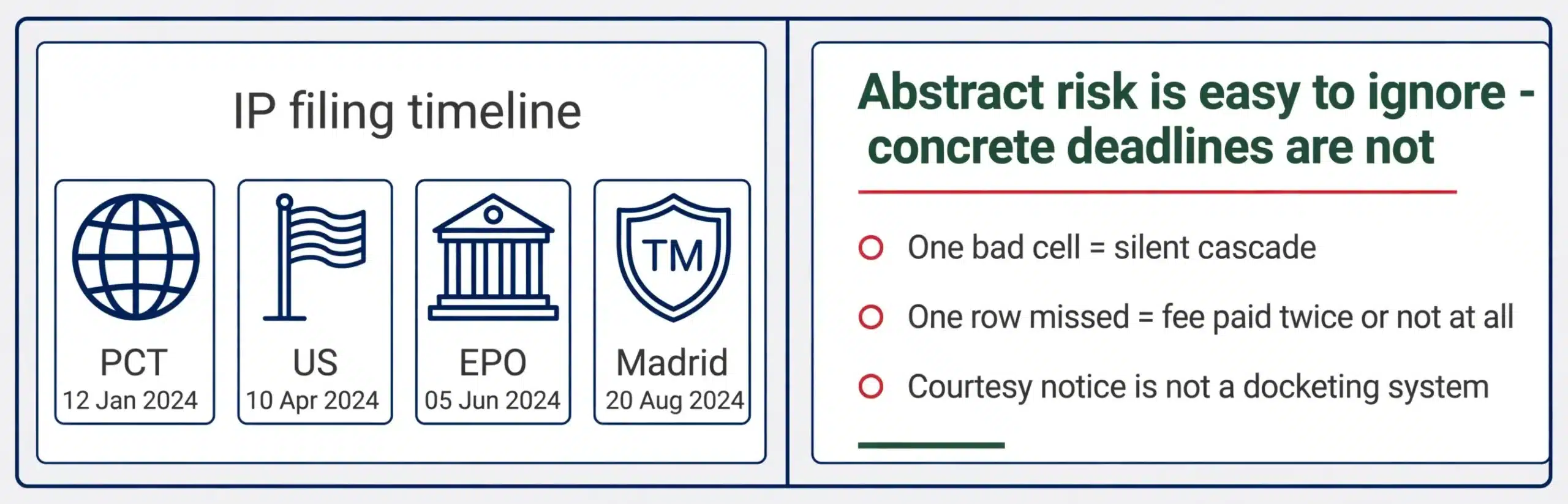
Abstract risk feels easy to ignore. Concrete deadlines do not. The examples below show how quickly the rules diverge.
PCT and National Phase Entry
The PCT timeline begins with a priority date. Applicants generally have 12 months from that date to file the international application. National phase entry then falls due at 30 months from the priority date in most offices, and at 31 months in some.
WIPO publishes the time limits applicable in each office on its PCT national phase page. A docketer must check the correct limit for every country on the family.
Here lies the spreadsheet trap. If a priority date is entered incorrectly, every calculated deadline inherits the error. Our team calls this a “silent cascade,” because one bad cell quietly corrupts a dozen others.
United States Maintenance Fees
For U.S. utility patents, maintenance fees come due at 3.5, 7.5, and 11.5 years after grant. The payment window opens six months before each due date. If the owner misses the date, a six-month grace period applies with a surcharge. After that, the patent expires. The USPTO publishes the current fee schedule and rules.
Design patents and plant patents do not carry maintenance fees. A flat spreadsheet column labeled “maintenance fee” will happily calendar a fee for a design patent unless someone remembers the exception.
EPO Renewal Fees
The EPO requires renewal fees on pending European applications, starting with the third year from filing. After grant, renewal fees become payable to the national offices in the countries where the patent is validated. The last renewal fee payable to the EPO depends on the year in which the grant is mentioned.
That handoff from one payer to many is exactly the kind of event a spreadsheet misses. Nobody updates the row, so the fee either gets paid twice or not at all.
Madrid Protocol Trademark Renewals
An international registration under the Madrid System lasts 10 years and can be renewed indefinitely. WIPO lets owners renew within a six-month grace period after expiry, with a 50% surcharge. WIPO explains the process on its Madrid renewal page, and it notes that the expiry notice it sends is unofficial.
The practical lesson is simple. A trademark team cannot treat a courtesy notice as a docketing system. It has to track the date itself.
Quick Reference: Rules That Vary by Office
| Event | Typical Rule | Why a Spreadsheet Struggles |
|---|---|---|
| PCT national phase entry | 30 months from priority (31 in some offices) | Needs per-country limit and correct priority date |
| U.S. maintenance fees | 3.5, 7.5, 11.5 years after grant; 6-month grace | Excludes design and plant patents; surcharges apply |
| EPO renewal fees (pending) | Annual, from year 3, due end of anniversary month | Euro-PCT deferral; handoff to national offices at grant |
| Madrid renewal | Every 10 years; 6-month grace with 50% surcharge | Courtesy notices are unofficial |
| Office action response | Varies by office and action type | Extensions differ by country |
A Realistic Scenario: How a Small Error Becomes a Large Loss
The following example is illustrative. It shows how a modest docket slips even when nobody is careless.
A mid-sized firm manages a client’s invention across the U.S., Europe, Japan, and India. The firm tracks everything in a shared workbook. A junior docketer enters the PCT priority date but transposes two digits.
The sheet calculates a national phase deadline that lands later than the true date. Nobody notices, because the date looks plausible. The sheet turns the cell yellow six weeks before the wrong date, and the responsible attorney is on leave.
By the time anyone catches the mistake, the real deadline has passed in one country. The firm must now scramble to find out whether that office offers any remedy for late entry. Some offices allow a late entry on request, while others treat the date as final.
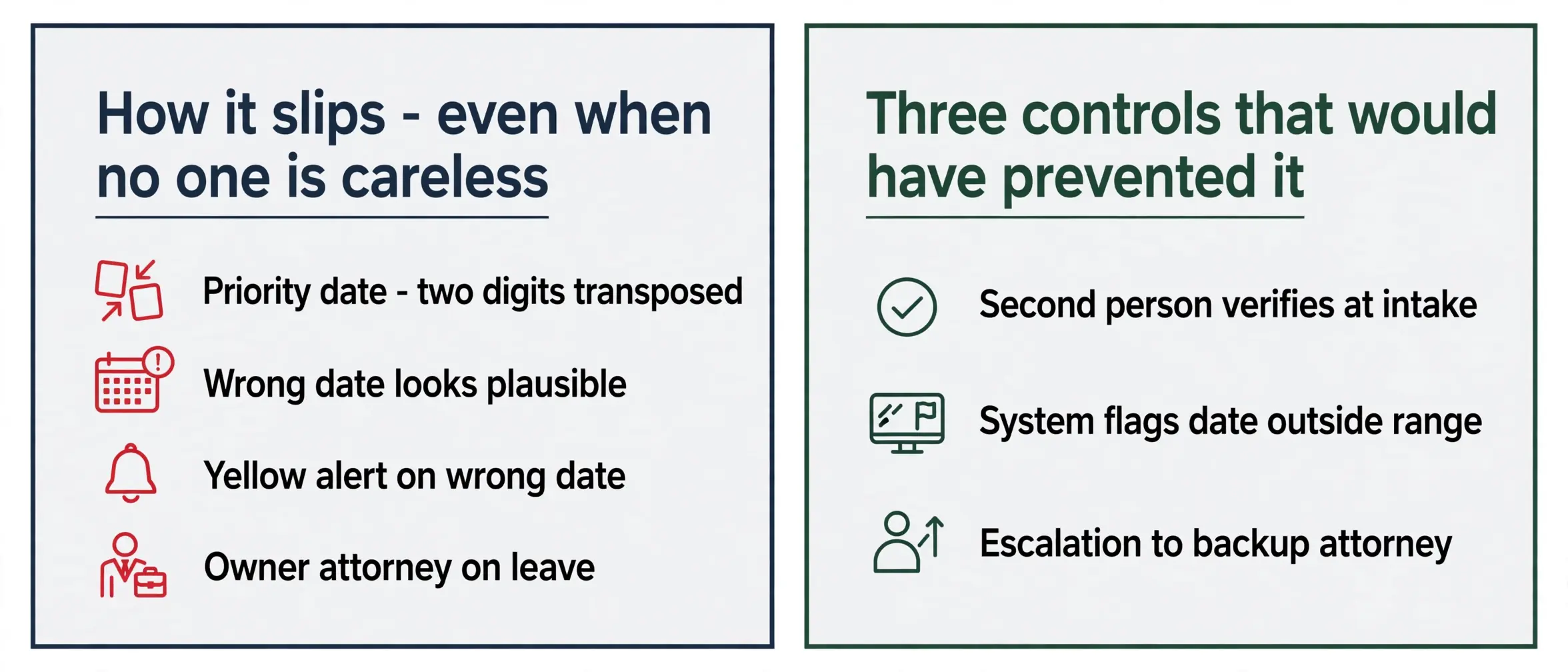
Three controls would have prevented the loss:
- A second person verifying the priority date at intake
- A system that flags a date outside expected ranges
- An escalation that reaches a backup attorney when the owner is unavailable
Spreadsheet vs Dedicated Software vs Managed Docketing
Not every team needs the same solution. The comparison below shows how the three common approaches stack up.
| Factor | Spreadsheet | Dedicated Docketing Software | Managed (Outsourced) Docketing |
|---|---|---|---|
| Upfront cost | Very low | Moderate to high | Pay per scope or engagement |
| Jurisdiction rule coverage | None built in | Maintained rule sets | Specialists apply and verify rules |
| Automated reminders | No | Yes | Yes, plus human follow-up |
| Audit trail | Minimal | Full change log | Full log plus documented review |
| Enforced second-person check | No | Possible with workflow | Built into the process |
| Scalability | Poor past a small portfolio | Good | Strong, flexes with volume |
| Key-person risk | High | Medium | Low, because a team covers |
| Best fit | Tiny, single-country dockets | Mid to large in-house teams | Firms and departments needing capacity and expertise |
Software alone does not remove human error. Rules still need review, and data entry still needs checks. Many teams therefore pair a platform with expert docketers. Our guide to patent docketing software lists the features worth demanding, and our trademark docketing systems guide covers the trademark side.
10 Signs Your Spreadsheet Docket Has Outgrown Its Purpose
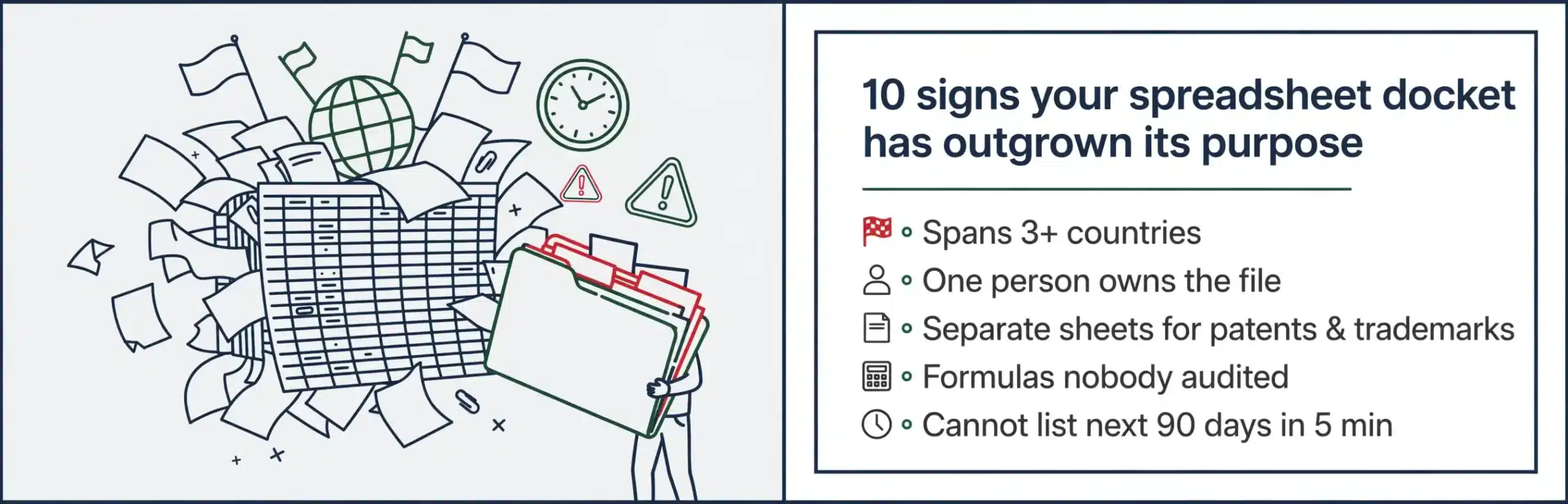
Check how many of these apply to your team today:
- Your docket spans three or more countries or regions.
- One person owns the file and nobody else fully understands it.
- You maintain separate spreadsheets for patents and trademarks.
- Deadlines rely on formulas that nobody has audited recently.
- You cannot produce a list of every deadline due in the next 90 days in under five minutes.
- Foreign associates report actions by email, and you update the sheet manually.
- You have no written record of who verified each deadline.
- A client or auditor has asked for docket reports that take hours to build.
- You have had a near miss in the last year.
- Your portfolio grows faster than your docketing headcount.
If you answered yes to three or more, the multi-country IP docketing spreadsheet limits described above likely apply to you already.
How to Move Off Spreadsheets: A Step-by-Step Plan
Migration sounds daunting, but a structured approach keeps risk low. Follow these steps.
- Freeze and copy the current docket. Save a read-only snapshot so you always have a reference point.
- Run a docket audit. Compare every active matter against the official office record. Flag missing, duplicate, and inconsistent entries.
- Clean the data. Standardize country codes, date formats, application numbers, and party names before you move anything.
- Define your rules and owners. Decide who owns each deadline type and what internal buffer dates you will apply.
- Select your platform or partner. Match features to your real workflow, not to a feature checklist. Confirm that the provider supports your key jurisdictions.
- Migrate in phases. Start with the highest-risk matters, such as upcoming national phase entries and approaching fees.
- Run both systems in parallel. Keep the spreadsheet live for one or two cycles and reconcile differences every week.
- Verify every migrated deadline twice. Use two different people, and document the check.
- Set up tiered reminders and escalations. Test them with a dummy matter before you trust them.
- Retire the spreadsheet formally. Archive it, restrict access, and record the cutover date.
Our resource on the legal docketing workflow shows how intake, verification, attorney review, and closing fit together after the move. Meanwhile, our IP docketing best practices guide offers a deeper checklist.
Common Mistakes When Replacing a Spreadsheet Docket
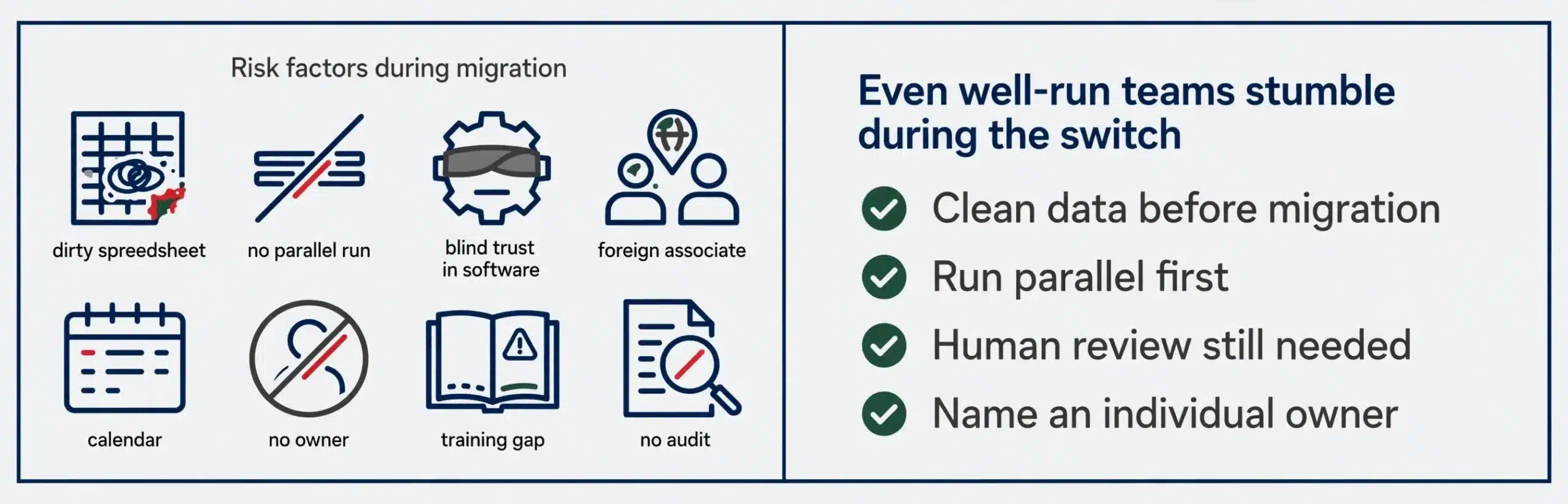
Even well-run teams stumble during the switch. Avoid these traps:
- Migrating dirty data. Bad rows in a new system still produce bad deadlines, only faster.
- Skipping the parallel run. Teams that cut over overnight often discover gaps weeks later.
- Trusting software dates blindly. A system-generated date still needs human review, because procedural rules vary by matter type.
- Ignoring foreign associates. Reporting timelines and written confirmations must come with you into the new process.
- Forgetting internal deadlines. Set action dates 30–60 days before statutory dates to leave room for review.
- Leaving no one accountable. “The team” cannot own a deadline. Name an individual.
- Under-training staff. Docketers need working knowledge of patent and trademark procedure, not just software skills.
- Failing to schedule audits. Weekly, monthly, and quarterly reviews catch drift before it becomes a miss.
Expert Tips From Day-to-Day Docketing Practice
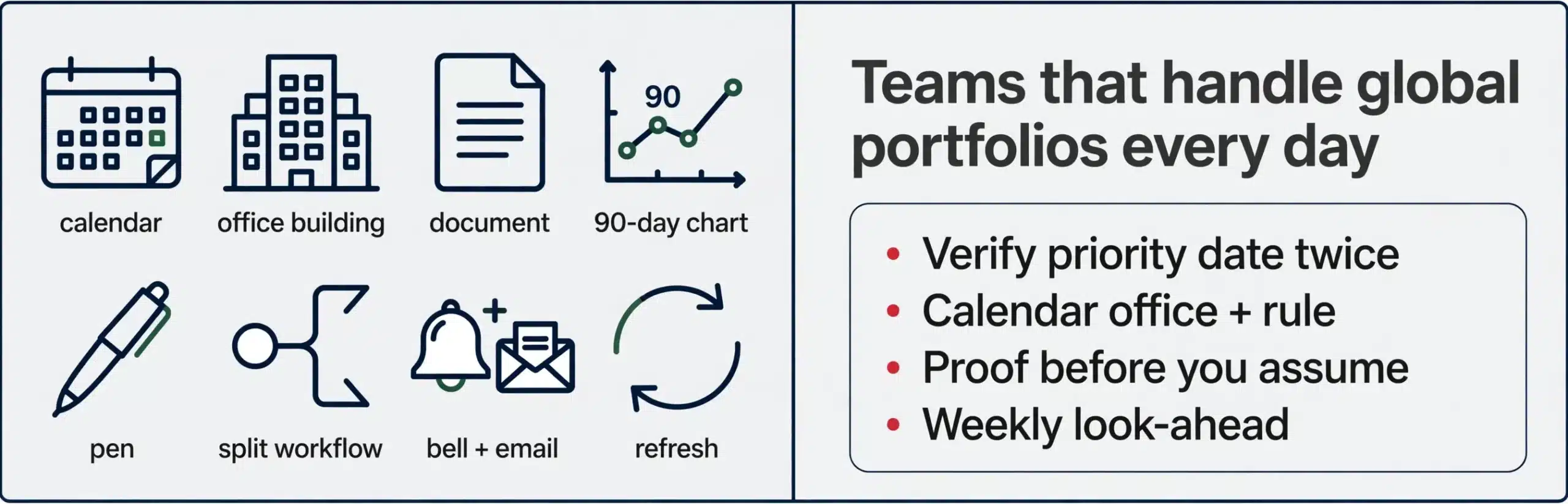
Teams that handle global portfolios every day tend to share a few habits. Use these as a starting point.
- Treat every priority date as critical data. Verify it against the filing receipt at intake and again after any change. It drives the longest and costliest chain of deadlines.
- Calendar the office, not just the date. Record which office the deadline belongs to and which rule produced it. That context speeds up reviews and audits.
- Require written confirmation from foreign associates. Do not assume action happened until you hold proof.
- Build a “next 90 days” report and review it weekly. A recurring look-ahead catches cases where no action plan exists yet.
- Document abandonment decisions. Get client instructions in writing and record them in the docket.
- Separate patent and trademark workflows, but report them together. Their rules differ, yet leadership needs one view of risk.
- Use two reminder channels. An email alone can slip into an inbox. A task assignment plus an email works better.
- Review the rule set on a schedule. Offices change fees and procedures, so assign someone to confirm your rules at least quarterly.
When Outsourcing Docketing Makes Sense
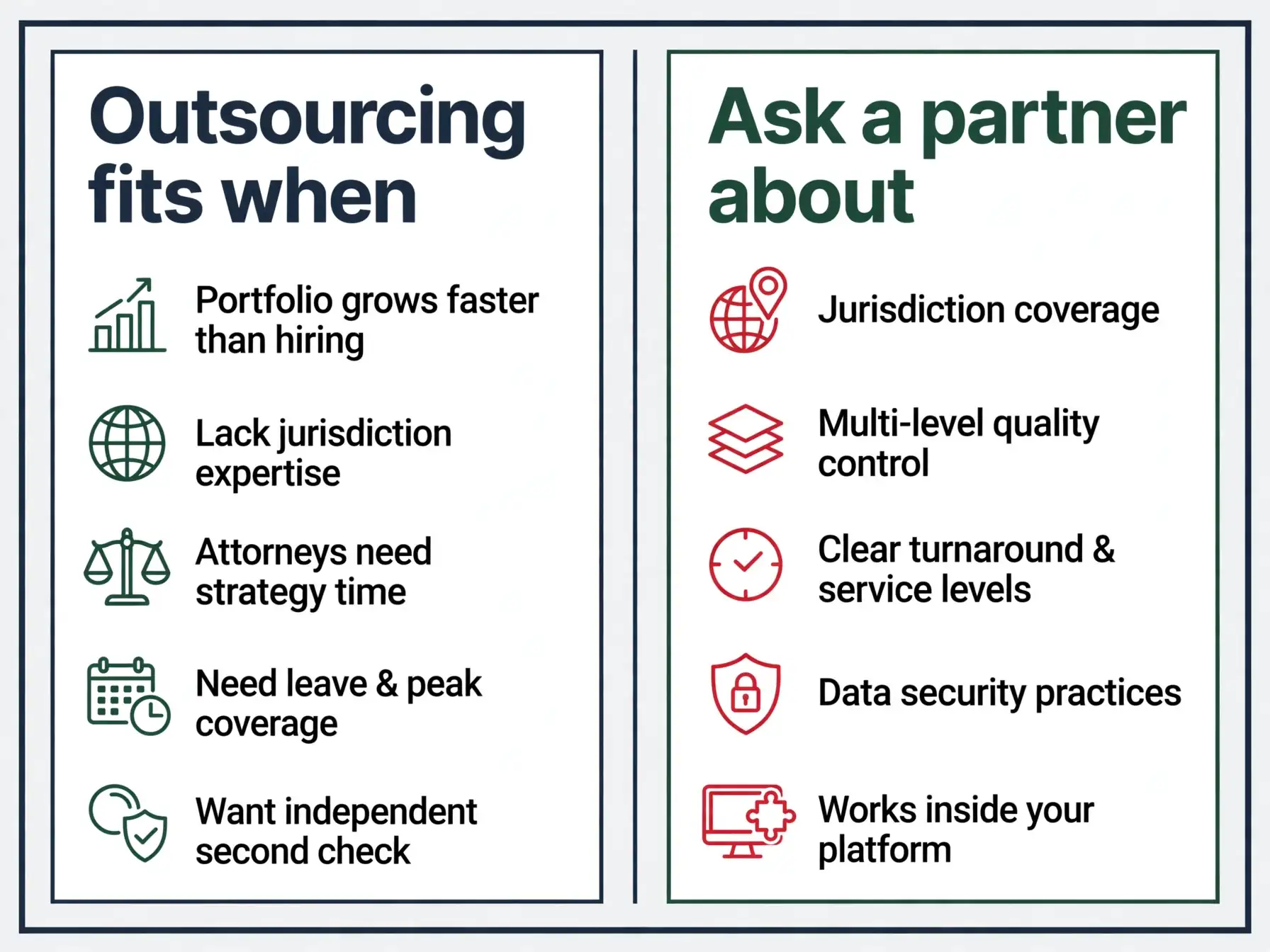
Some teams solve the problem with software. Others solve it with people. Outsourcing fits best when any of the following applies:
- Your portfolio grows faster than you can hire.
- You lack in-house expertise in certain jurisdictions.
- Docketing absorbs time your attorneys should spend on strategy.
- You need coverage during leave, peak seasons, or staff turnover.
- You want an independent second check on every deadline.
When you evaluate a partner, ask about:
- Jurisdiction coverage that matches your portfolio
- Multi-level quality control, including independent verification
- Clear turnaround times and service levels
- Data security practices
- Willingness to work inside your existing docketing platform
- Transparent reporting
Teak IP Services supports this model through its Docketing and IP Management Services, which work inside the platforms clients already use and operate under U.S. IP attorney supervision. For international filings,
the team also supports PCT application services. Readers weighing the decision can start with our articles on why to outsource patent docketing and why to outsource trademark docketing.
For brands operating across many markets, our piece on multi-jurisdiction trademark management pairs well with this guide. Likewise, effective trademark portfolio management explains how docketing supports broader portfolio decisions.
How to Judge Whether Your Docket is Healthy

You cannot manage what you do not measure. Track a few simple indicators every month:
- Verification rate: the share of deadlines checked by a second person
- Near-miss count: deadlines actioned within the last week before the due date
- Audit exceptions: discrepancies found when you compare the docket to office records
- Confirmation lag: the time between a foreign associate’s action and your written confirmation
- Report turnaround: how long a full portfolio report takes to produce
A healthy docket shows a high verification rate, few near misses, and fast reporting. If those numbers drift the wrong way, investigate before a client notices.
Frequently Asked Questions About Multi-Country IP Docketing Spreadsheet Limits
What are the main multi-country IP docketing spreadsheet limits?
The main limits include no built-in jurisdiction rules, manual handling of dependent deadlines, weak date calculation across holidays and time zones, no real audit trail, no enforced second check, passive alerts, key-person dependency, and poor scalability. Together, these gaps raise the odds of a missed or miscalculated deadline.
Can a small firm still use a spreadsheet for IP docketing?
A very small practice with a handful of matters in one country may manage for a time. Even then, the risk grows with every foreign filing. A portfolio of 20–50 active patents already produces dozens of deadlines, so most firms benefit from dedicated software or managed support well before that point.
Why are PCT national phase deadlines so risky in spreadsheets?
PCT national phase deadlines depend on the priority date, and they differ by office, typically 30 or 31 months. One wrong priority date silently corrupts every dependent deadline. A spreadsheet will not flag the mistake, whereas a rule-based system and a second-person check usually will.
Is docketing software enough to eliminate deadline errors?
No. Software improves consistency, but accuracy still depends on validated rules, clean data, and disciplined workflows. A system-generated date can be wrong if the input was wrong or the rule changed. Combine software with verification steps, regular audits, and trained docketers.
How do I move from a spreadsheet to a docketing system safely?
Audit and clean your data first. Then migrate in phases, run both systems in parallel, and verify every migrated deadline with two people. Test reminders and escalations before cutover, and archive the spreadsheet only after reconciliation succeeds.
When should I outsource IP docketing instead of buying software?
Consider outsourcing when your portfolio outgrows your team, when you need multi-jurisdiction expertise, or when you want built-in independent verification. Many organizations use both: a docketing platform for the system of record and a managed team to operate it with quality controls.
Conclusion: Retire the Spreadsheet Before It Retires Your Rights
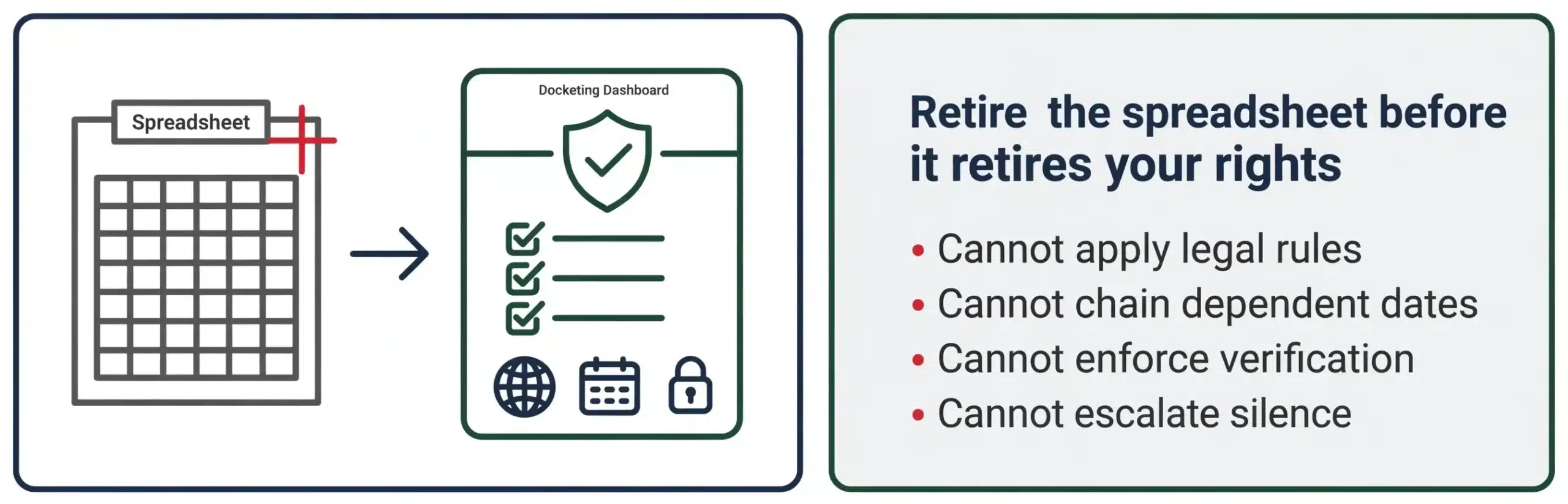
The multi-country IP docketing spreadsheet limits are not a matter of effort or intelligence. They come from a tool that cannot apply legal rules, chain dependent dates, enforce verification, or escalate silence. A global portfolio asks for all four.
If your team recognizes three or more of the warning signs above, act now. Audit your data, choose a platform or partner that fits your jurisdictions, and migrate in phases with a parallel run. The cost of a careful transition is small next to the cost of a lost patent family or a lapsed trademark.
Ready to see where your current docket stands? Talk to the Teak IP docketing team for a docket review, or browse more guides on the Teak IP blog.
Ready to See Where Your Current Docket Stands?
If your team recognizes three or more warning signs, act now. Talk to the Teak IP docketing team for a docket review and get a clear picture of your data, deadlines, and risks before a missed date costs a patent family or a trademark.
Multi-Country Docketing | Audit, Migration & Parallel Run | For law firms, in-house teams & businesses

