
Your next invention disclosure may be sitting in a vendor’s inbox right now. It could be with a docketing provider, a drawing team, or a paralegal service that supports your filings. That setup is normal in modern IP practice, but it raises a question most sales decks skip: has an independent auditor ever verified how that vendor protects your data? Choosing a SOC 2 compliance IP services vendor gives you a documented answer instead of a promise.

This guide explains what SOC 2 means, why it matters for patent and trademark work, and how to read a report like a risk professional. You will also find a step-by-step evaluation process, a scorecard, common mistakes, and expert tips you can use in your next vendor review.
Quick answer: SOC 2 compliance means an independent CPA firm has tested a vendor’s security controls against the AICPA Trust Services Criteria and issued a report. For IP work, that report is the strongest standard proof that a vendor can protect unpublished inventions, trademark strategy, and client files. It does not replace legal due diligence, but it makes that diligence far faster and more reliable.
What is SOC 2 Compliance, and Why Should IP Teams Care?
Before comparing vendors, you need a shared vocabulary. SOC 2 sounds technical, yet the core idea is simple.
Understanding SOC 2 in Simple Terms
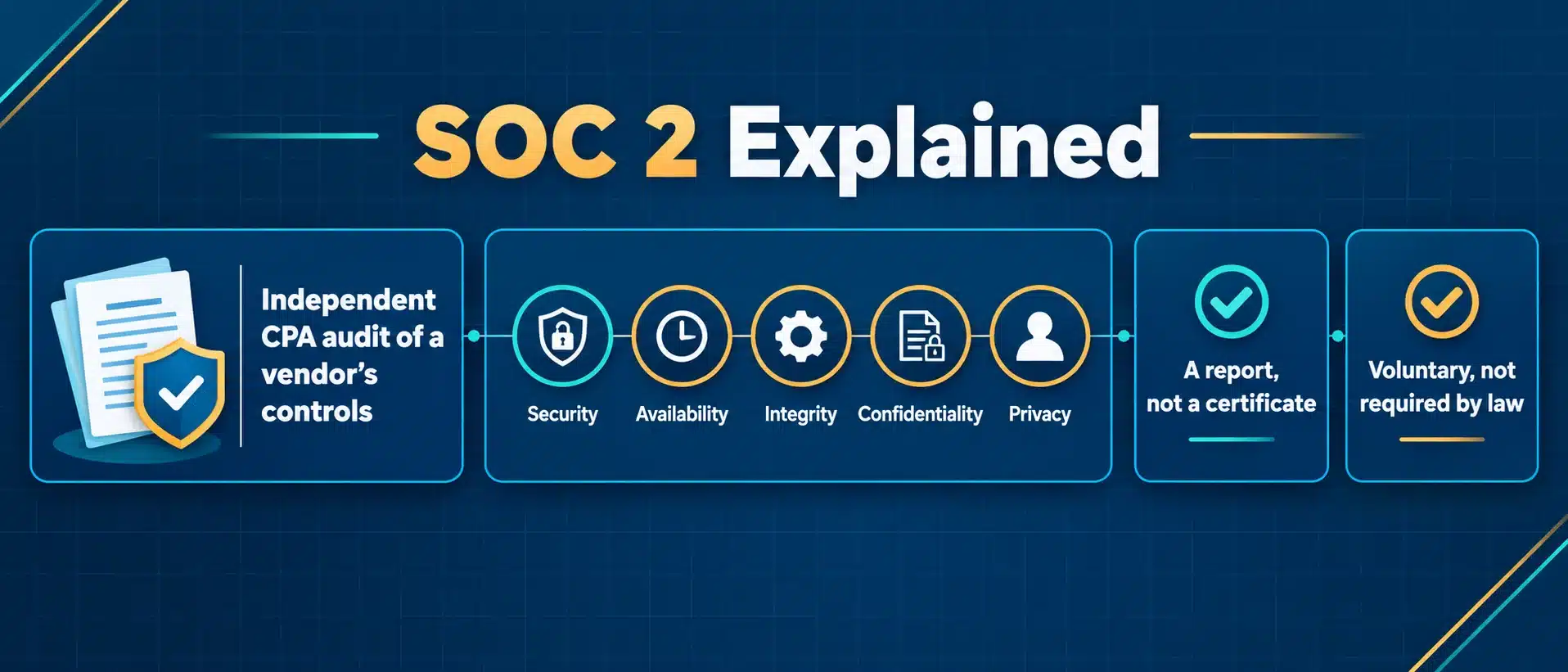
SOC 2 stands for System and Organization Controls 2. The American Institute of Certified Public Accountants (AICPA) developed it to evaluate how service organizations manage customer data. A licensed CPA firm examines the vendor’s controls and then writes an attestation report.
Here is the definition in one sentence: SOC 2 compliance is an independent audit result showing that a service provider’s controls for security, availability, processing integrity, confidentiality, and privacy meet recognized criteria.
Two clarifications help you avoid common confusion:
- SOC 2 is a report, not a certificate. Vendors who say they are “SOC 2 certified” usually mean they hold a current report with a clean opinion.
- SOC 2 is voluntary. No law forces a vendor to obtain one. Buyers ask for it because it replaces self-reported claims with evidence.
The Five Trust Services Criteria Explained
Every SOC 2 examination uses the Trust Services Criteria. The Security category is mandatory. Vendors choose which of the other four to include, based on the services they sell.
| Criterion | What It Covers | Why It Matters for IP Work |
|---|---|---|
| Security (required) | Protection against unauthorized access to systems and data. | Keeps unpublished applications, drawings, and office action drafts away from outsiders. |
| Availability | Systems stay accessible as committed. | Docketing platforms must work when a deadline is hours away. |
| Processing Integrity | Data is processed completely, accurately, and on time. | Deadline calculations and data entry errors can cost a client its rights. |
| Confidentiality | Protection of information designated confidential. | Invention disclosures, trade secrets, and pre-filing trademark strategy. |
| Privacy | Handling of personal information. | Inventor names, addresses, citizenship, and client contact details. |

For a SOC 2 compliance IP services vendor review, treat Security and Confidentiality as the minimum scope. Add Availability if the vendor runs your docketing system. Add Processing Integrity if the vendor enters or calculates deadlines for you.
SOC 2 Type I vs Type II: Which One Should You Accept?
Vendors can hold one of two report types. The difference is significant.
| Feature | Type I | Type II |
|---|---|---|
| What it tests | Whether controls are designed properly. | Whether controls worked over time. |
| Time frame | A single date. | A period, commonly several months up to a year. |
| Evidence depth | Lighter. | Heavier, with sample testing. |
| Best use | Young vendors starting their program. | Buyers who handle sensitive client data. |
| Buyer confidence | Moderate. | High. |
In practice, a Type I report tells you a vendor built the right locks. A Type II report tells you the vendor actually used them every day. For confidential IP data, ask for Type II whenever possible. If a vendor only has Type I, ask for the date of its Type II observation window and the expected report date.
Why SOC 2 Compliance Matters for an IP Services Vendor
Patent and trademark work moves valuable information across many hands. A vendor may see your claims before filing, your enforcement strategy before a dispute, or your portfolio map before an acquisition. Consequently, the cost of a weak vendor is not abstract.
The Data Your IP Vendor Touches Every Day
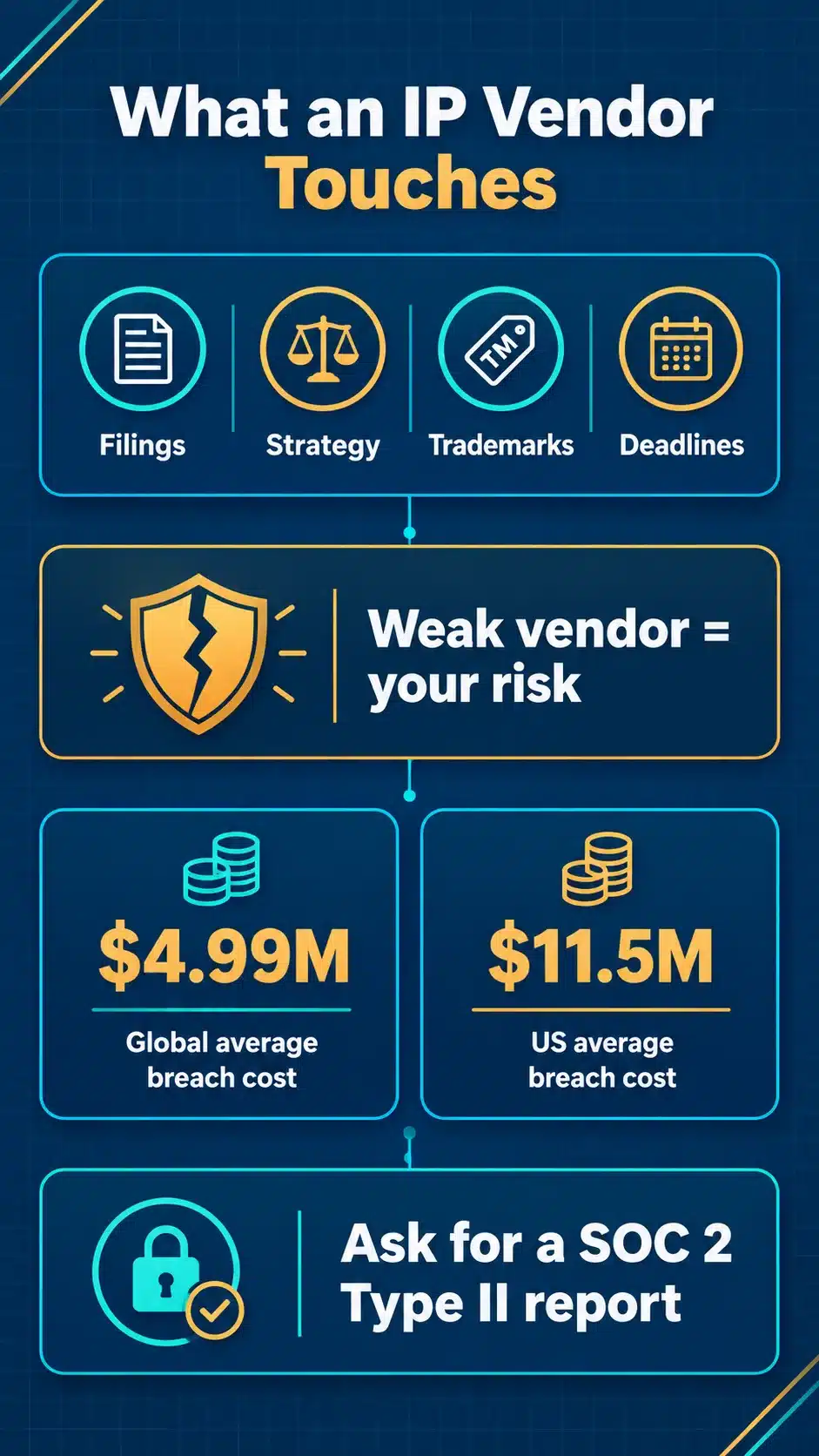
Consider what a typical engagement exposes:
- Unpublished patent applications, claim sets, and invention disclosures
- Draft office action responses and examiner interview notes
- Trademark clearance searches that reveal your future brand plans
- Docketing records showing every deadline across your portfolio
- Client names, inventor details, and billing information
- Credentials for USPTO accounts and foreign associate portals
Each item has a different failure mode. A leaked claim set can hand a competitor your roadmap. A compromised trademark search can tip off a squatter before you file. An outage in a docketing system can hide a deadline until the response window closes.
What a Breach Costs
Security incidents are expensive, and third parties add risk. IBM’s 2026 Cost of a Data Breach Report puts the global average cost of a breach at $4.99 million, with the United States averaging $11.5 million per incident. In its prior edition, IBM also found that third-party vendor and supply chain compromise averaged about $4.91 million per breach.
Those figures cover all industries, so your exposure will differ. Even so, the pattern is clear: when a vendor holds your data, their weaknesses become your liability.
A Quick Illustrative Scenario
Imagine a corporate IP manager who outsources drawings, docketing, and trademark searches to three vendors. Each vendor emails files, stores them in a shared drive, and gives several staff members access. No one has reviewed how any of those vendors remove access when an employee leaves.
Nothing goes wrong for two years. Then a departing contractor keeps a login that still works. The manager only discovers the gap during a routine audit. A SOC 2 Type II report would have tested exactly that control, namely timely removal of access, and flagged it if the vendor failed.
The Business Case: How a SOC 2 Compliance IP Services Vendor Lowers Your Risk
SOC 2 delivers value in several ways at once. Some benefits protect you from harm. Others simply save time.
- Independent verification. A CPA firm tests the vendor’s claims. You no longer rely on a vendor’s own security page.
- Faster procurement. One report can answer dozens of questionnaire items, which shortens security reviews from weeks to days.
- Consistent controls. Vendors that pass Type II audits maintain access reviews, change management, incident response, and employee training as routine habits.
- Clear accountability. The report names responsible controls, subservice providers, and exceptions. Gaps become visible.
- Stronger client assurance. If your own clients ask how you protect their data, you can point to your vendors’ attestations.
- Defensible decisions. If something goes wrong, you can show you performed reasonable diligence.
Moreover, these benefits compound. A vendor that treats compliance as an operating discipline also tends to document its processes, which supports better quality control. That connects directly to the multi-layered quality control workflow for patent docketing that serious IP teams expect.
Ethical and Regulatory Duties: You Cannot Outsource Accountability
For law firms and in-house legal teams, the argument goes beyond risk management. Professional duties shape what you must do when you hire outside help.
What ABA Rule 5.3 and Opinion 08-451 Mean in Practice
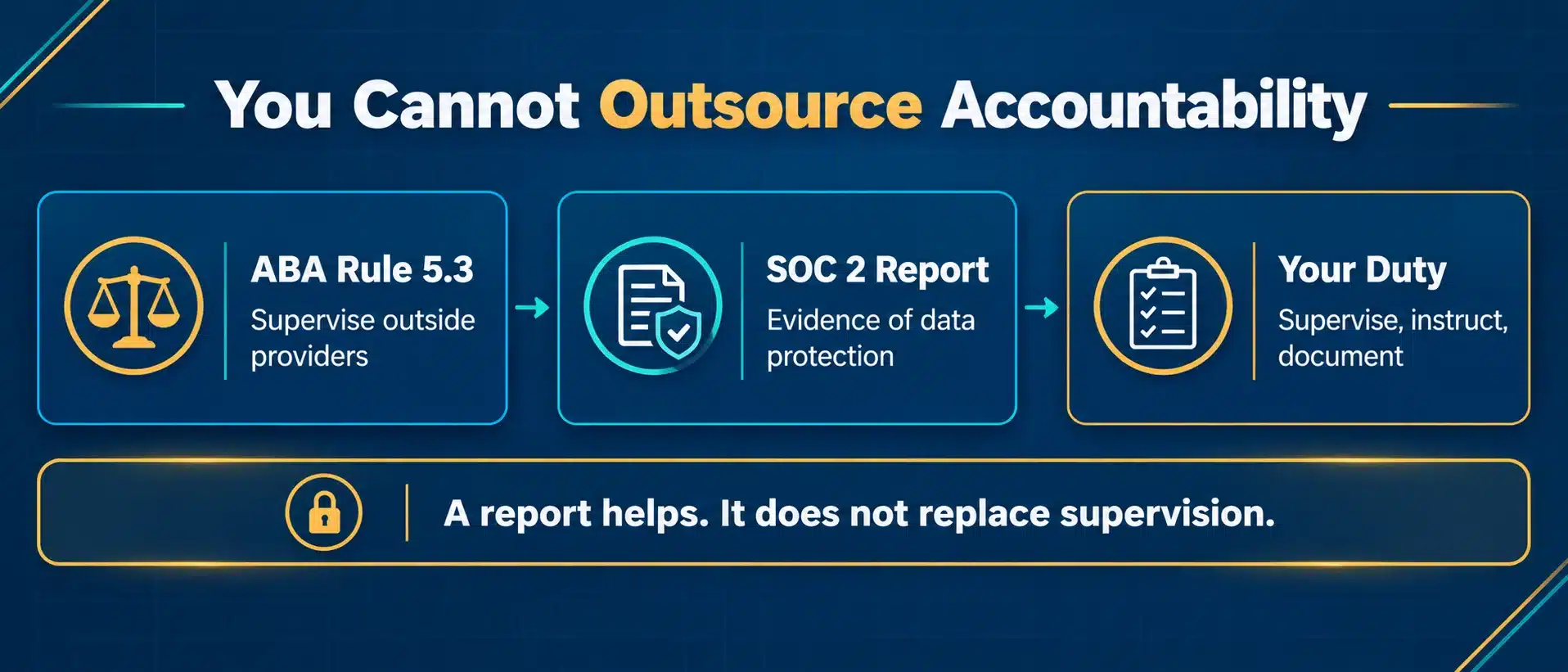
ABA Model Rule 5.3 requires lawyers to make reasonable efforts to ensure that nonlawyer assistants act consistently with the lawyer’s professional obligations. That includes outside providers, not just employees.
The ABA also addressed outsourcing directly in Formal Opinion 08-451. As the ABA Journal summarized, lawyers may outsource work, but they cannot compromise the competence requirement, and they may need client informed consent to protect confidentiality under Rule 1.6.
State bars apply these principles differently, so check your own jurisdiction. The USPTO’s Rules of Professional Conduct for practitioners, found in 37 CFR Part 11, contain parallel provisions on confidentiality and supervision of nonlawyer assistance.
Where SOC 2 Fits in a Defensible Process
The comments to Rule 5.3 explain that the level of supervision depends on factors such as the provider’s experience, the nature of the work, and the arrangements for protecting client information. A SOC 2 report speaks directly to the last factor. It offers third-party evidence of how the vendor protects information.
Note, however, that a report alone does not satisfy your duties. You still need to supervise the work, set clear instructions, and document your review. For a deeper look at supervision limits, read our guide on what tasks a trademark paralegal can do without unauthorized practice of law. Likewise, if you use remote support, review whether remote patent paralegal services comply with USPTO rules.
SOC 2 vs SOC 1 vs SOC 3 vs ISO 27001: What to Ask For
Vendors often mention several frameworks in the same breath. The table below shows how they differ, so you can ask for the right document.
| Framework | Focus | Output | Who Typically Reads It / Fit for IP Vendor Review |
|---|---|---|---|
| SOC 1 | Controls relevant to financial reporting. | CPA report. | Auditors and finance teams. Low, unless the vendor handles billing or trust accounts. |
| SOC 2 | Security, availability, processing integrity, confidentiality, privacy. | CPA attestation report. | Security, legal, and procurement teams. High |
| SOC 3 | Same criteria as SOC 2, summarized for the public. | Short general-use report. | Anyone. Medium; useful as a quick screen, but lacks detail. |
| ISO/IEC 27001 | Information security management system. | Certificate from an accredited body. | Global procurement teams. High; complements SOC 2, especially for international clients. |
SOC 2 and ISO 27001 do not compete. Some vendors hold both. If a vendor offers only a self-assessment or a vague “security statement,” treat it as a starting point rather than proof.
The NIST Cybersecurity Framework 2.0 also deserves a mention. It is a voluntary framework, not an audit, but it added a dedicated Govern function and stronger guidance on supply chain risk. Vendors that map their controls to NIST CSF show mature risk thinking, and you can use it as a conversation guide.
How to Evaluate a SOC 2 Compliance IP Services Vendor: Step-by-Step
A report only helps if you read it. Follow this process each time you onboard or renew a vendor. For a broader framework, pair it with our IP vendor due diligence checklist for law firms and corporate legal teams.
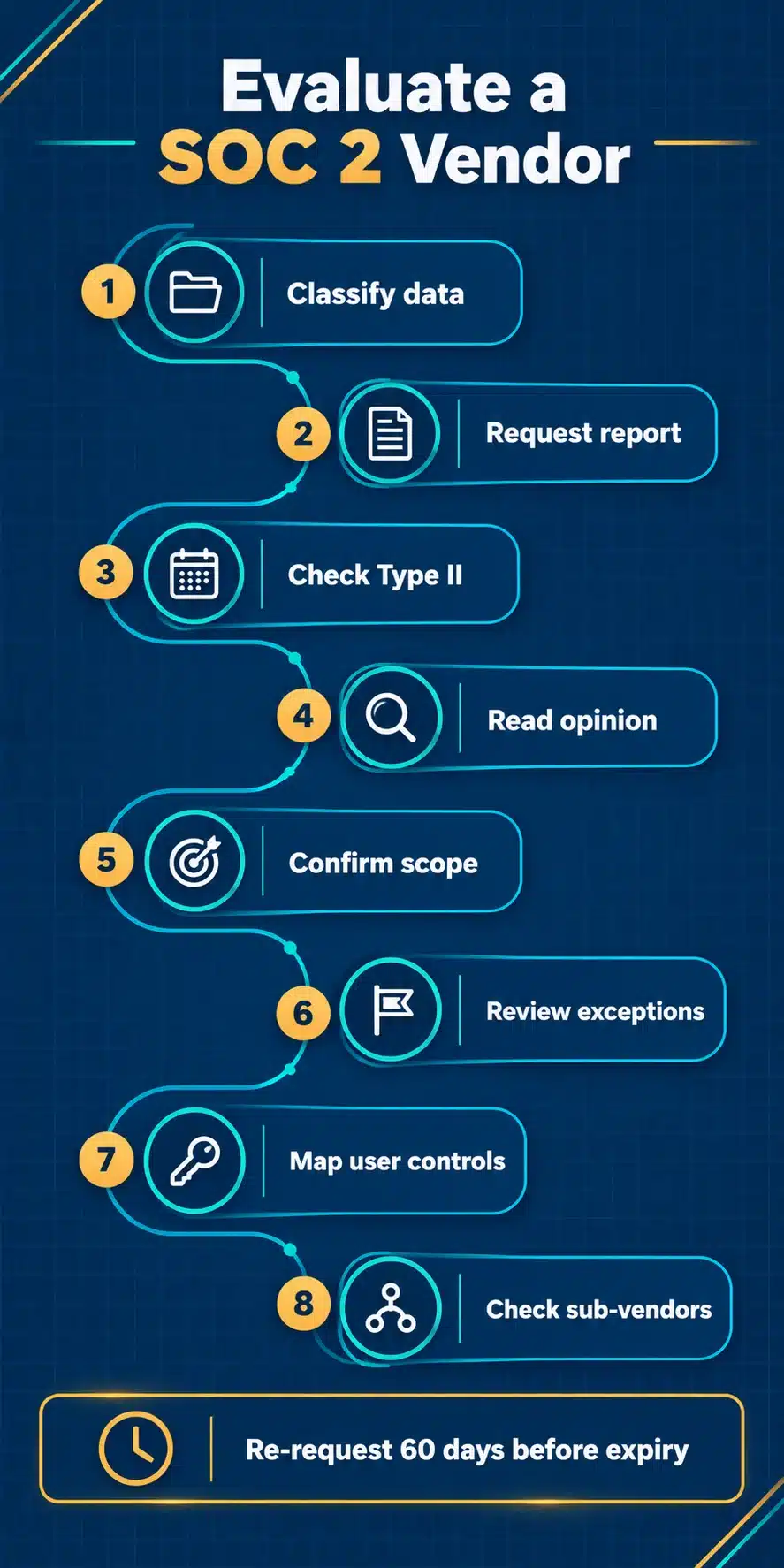
- Classify your data. List what the vendor will access: unpublished filings, trademark strategy, personal data, credentials. Rank each by sensitivity. This tells you which criteria must be in scope.
- Request the report under NDA. Vendors normally share SOC 2 Type II reports after you sign a non-disclosure agreement. Be wary of any vendor that refuses to share a report at all.
- Check the report type and period. Confirm it is Type II, that the observation window ended within the last 12 months, and that the vendor can supply a bridge letter covering the gap between the report date and today.
- Read the auditor’s opinion first. An unqualified opinion means the auditor found the controls fairly presented and effective. A qualified opinion means one or more controls failed in a meaningful way.
- Confirm the scope matches your services. Some vendors cover only one product, office, or data center. If your work runs through an unaudited system, the report tells you little.
- Review exceptions and management responses. Every report may list exceptions. Look for patterns, severity, and whether management fixed the issue.
- Map the complementary user entity controls. Reports list controls that you, the customer, must perform, such as removing your own users. Assign an owner for each one.
- Check subservice organizations. Cloud hosts, email providers, and sub-vendors may sit outside the audit. Understand whether the report includes them or carves them out, and ask how the vendor oversees them.
Pro tip: Put a calendar reminder 60 days before each report expires. Requesting the next report early avoids a gap in assurance.
How to Read the Report: Four Sections That Matter Most
SOC 2 reports can run well over 100 pages. Focus on four areas first:
- Section 1, auditor’s opinion. Look for the opinion type and any qualifications.
- Section 3, system description. Verify that the services, infrastructure, and locations match what you buy.
- Section 4, tests of controls and results. Scan for exceptions and deviations.
- Management’s response to exceptions. Judge whether the vendor owns the problem and fixes it.
Red Flags Inside a SOC 2 Report
Pause and ask follow-up questions if you see any of these:
- A qualified or adverse opinion
- A report period that ended more than 12 months ago
- Large carve-outs for key subservice providers
- Repeated exceptions in access management or change management
- A scope that excludes the product or team that serves you
- Controls described in vague language with little testing detail
Vendor Scorecard: Turn the Report into a Decision
A scorecard keeps reviews consistent across vendors and across years. Use the table below as a starting template and adjust the weights to your risk tolerance.
| Evaluation Area | What Good Looks Like | Warning Sign |
|---|---|---|
| Report type | Current SOC 2 Type II. | Type I only, or no report. |
| Trust criteria in scope | Security, Confidentiality, Availability, plus Processing Integrity for docketing. | Security only, when the vendor runs mission-critical systems. |
| Auditor opinion | Unqualified. | Qualified or adverse. |
| Exceptions | Few, minor, fixed quickly. | Repeated issues in access or change control. |
| Subservice oversight | Documented vendor management program. | No explanation of how sub-vendors are monitored. |
| Data residency and transfer | Clear map of where data lives and who accesses it. | Vague answers on cross-border access. |
| Incident response | Defined plan, tested, with customer notice timelines. | No committed notification window. |
| Contract terms | Confidentiality, audit rights, breach notice, return or deletion of data. | Generic terms with no security schedule. |
Score each area from 1 to 5, then document your rationale. Over time, the scorecard becomes evidence that you applied a consistent, reasonable process.
Questions to Ask Beyond the Report
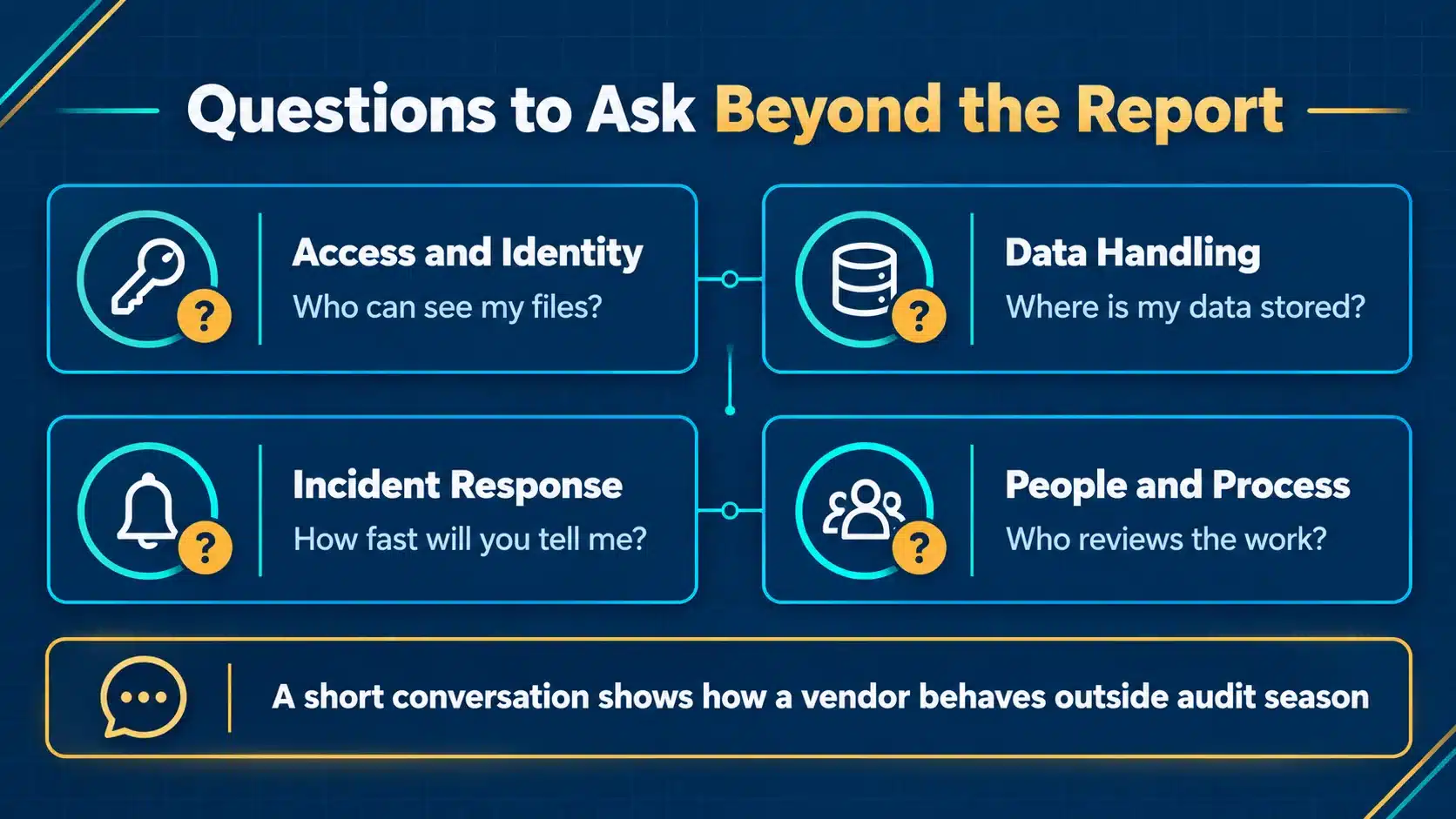
A SOC 2 report is a strong anchor. Still, a short conversation reveals how the vendor behaves outside audit season.
Access and Identity
- Who at the vendor can see my files, and how is that access approved?
- Do you require multi-factor authentication for every system that stores client data?
- How quickly do you remove access when someone changes roles or leaves?
Data Handling
- Where do you store client data, and in which countries can staff access it?
- Do you encrypt data in transit and at rest?
- How do you return or delete my data when the engagement ends?
Incident Response
- How do you detect an incident, and how fast will you tell me?
- Can I see a summary of your last tabletop exercise or incident review?
People and Process
- What background checks and confidentiality agreements apply to staff?
- How do you train employees on handling privileged and unpublished IP material?
- Which supervising attorney or manager reviews deliverables before they reach me?
These questions apply to any vendor, including ours. Teak IP states that US IP attorneys supervise its work and that deliverables pass through multi-layered quality checks. Whichever vendor you choose, ask them to show how those commitments work in daily practice.
Common Mistakes When Vetting a SOC 2 Compliance IP Services Vendor
Even careful buyers slip. Avoid these frequent errors:
- Accepting a badge instead of a report. A logo on a website is not evidence. Request the actual report.
- Ignoring the scope. A report that covers a vendor’s marketing website does not protect your docket.
- Skipping the exceptions. Many reviewers read only the opinion. The tests section often tells the real story.
- Forgetting your own controls. Complementary user entity controls assign duties to you. Missing them creates gaps no vendor can close.
- Treating SOC 2 as a one-time event. Reports expire. Vendors change systems. Annual re-review is the standard.
- Overlooking sub-vendors. Your vendor’s cloud host or e-signature provider can create fourth-party risk.
- Confusing security with quality. A vendor can have excellent security and still miss a deadline. You need both lenses.
- Letting procurement and legal work in silos. Security teams read reports well, while IP counsel understands the data’s legal sensitivity. Combine both views.
Expert Tips for IP Departments and Law Firms
These practices help you get more from every vendor relationship:
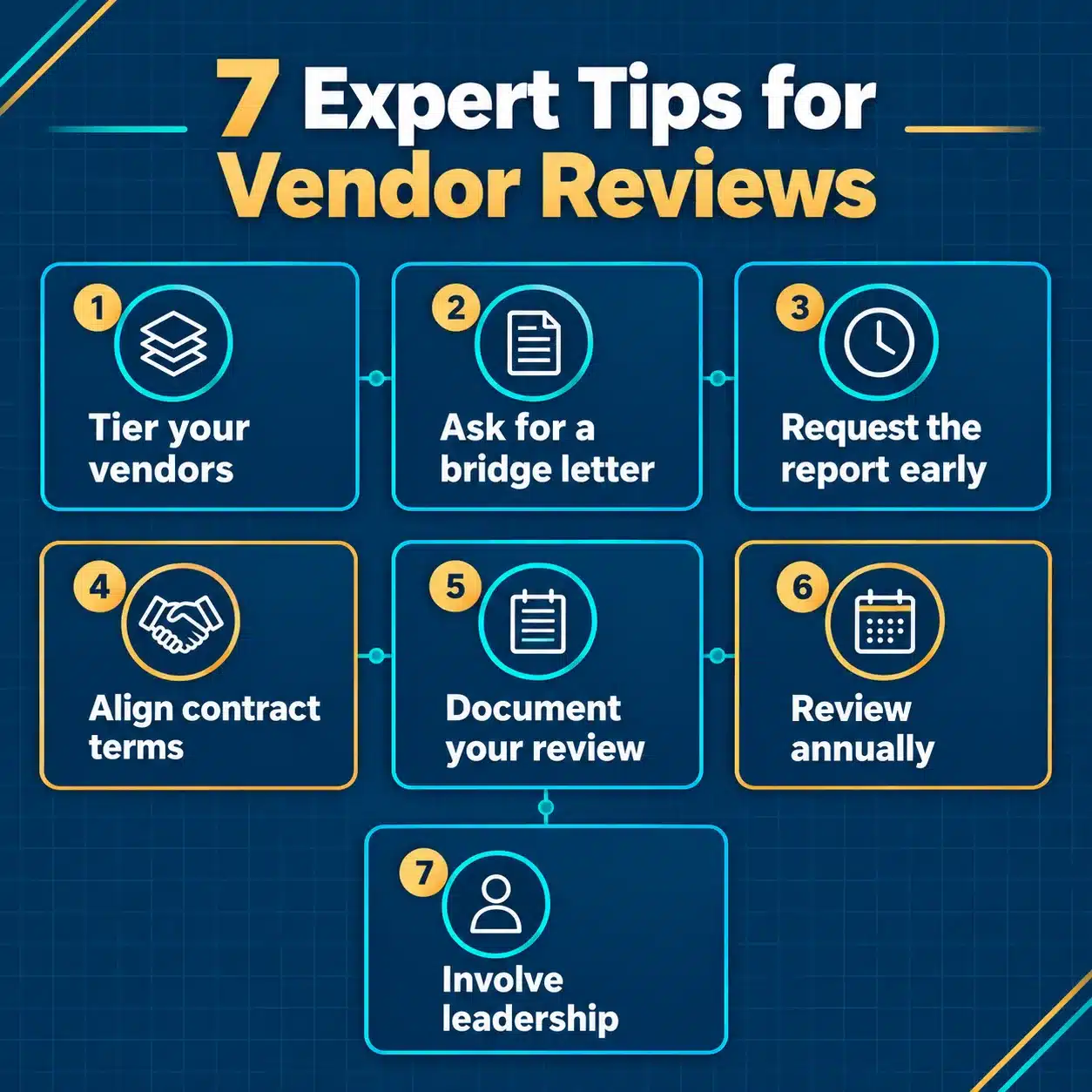
- Tier your vendors. Apply the full process to vendors that touch unpublished filings or run your docket. Use a lighter review for low-risk suppliers.
- Ask for a bridge letter. It confirms no material changes occurred since the last report period.
- Request the report early in the sales process. A vendor that responds quickly and transparently is showing you its compliance culture.
- Align contract terms with the report. Add security commitments, breach notice windows, and audit rights to your agreement so they do not live only in a PDF.
- Document your review. Keep a short memo noting the report date, scope, exceptions, and decision. That memo supports your ethical obligations.
- Review annually. Set a recurring task tied to the report expiration date.
- Involve the vendor’s leadership. Ask who owns security and compliance. Clear ownership signals maturity.
Corporate teams building a formal vendor program from scratch can also benefit from our guide on how to structure a corporate IP department from scratch, which covers governance and external provider management.
What SOC 2 Cannot Tell You About an IP Vendor
SOC 2 measures control environment, not legal skill. Treat it as one layer in a broader selection process.
A strong report does not prove that a vendor:
- Calculates patent and trademark deadlines correctly
- Understands USPTO practice and local rules
- Drafts responses that meet examiner expectations
- Stays within the boundaries of unauthorized practice of law
- Provides responsive communication during your business hours
For those questions, look at quality control systems, supervision models, and references. Our guide to the best patent docketing companies for corporate IP departments explains how to compare docketing providers on accuracy and process. Similarly, our review of the best virtual trademark paralegal companies shows how to judge trademark support beyond security. If you outsource prosecution tasks, see our overview of office action response support services.
In short, SOC 2 answers “Can this vendor protect my data?” Quality control answers “Can this vendor protect my deadlines and my work product?” You need both answers.
Offshore and Hybrid Delivery Models: Extra Questions to Ask
Many IP vendors combine onshore attorneys and paralegals with offshore teams to improve turnaround and cost. That model can work well. It also adds questions about data location and access.
When a vendor operates across the United States and India, or any other region pair, ask these questions:
- Which team members in which country can view client files?
- Does the SOC 2 scope include every office that touches client data?
- How does the vendor control remote access, devices, and file downloads?
- Which law governs the vendor’s confidentiality commitments?
- Does the vendor hold client data in a US-based environment?
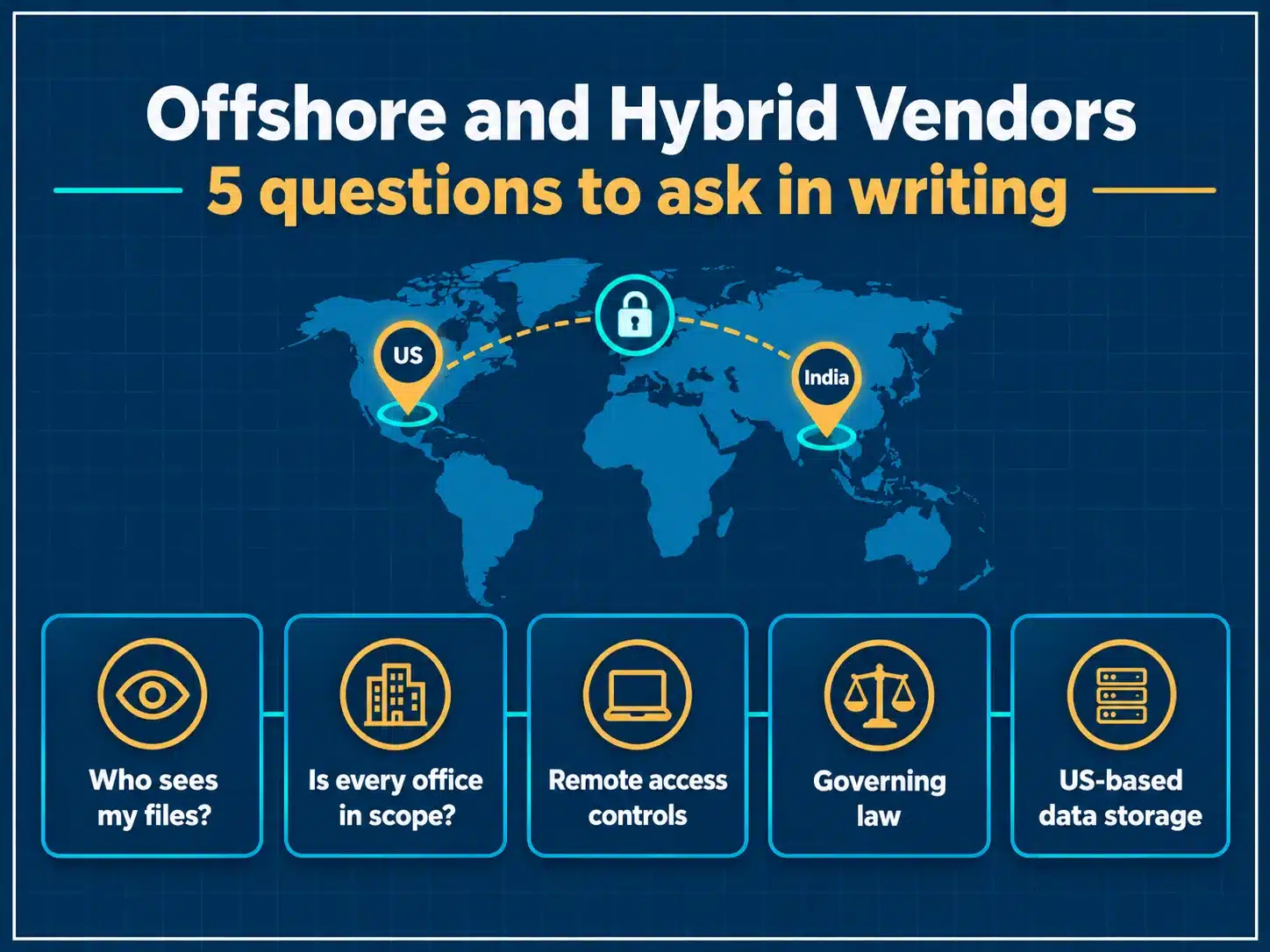
Teak IP, for example, delivers services through teams in the United States and India. Any firm evaluating a cross-border provider, Teak included, should expect and request clear answers to these questions in writing. Doing so also supports the informed consent discussion that ABA Opinion 08-451 raises for confidentiality.
Docketing automation raises its own questions. If your vendor pulls status data from USPTO systems, confirm how credentials are stored and who can access them. Our article on automated USPTO data retrieval by external docketing services covers what to check.
Contract Protections That Reinforce SOC 2
A strong report supports your decision, but a strong contract makes it enforceable. Ask your counsel to confirm these terms:
- Confidentiality and non-use. The vendor may use your data only to perform the services.
- Security schedule. The agreement lists baseline controls and ties them to the SOC 2 scope.
- Report delivery. The vendor agrees to provide each new report and bridge letter.
- Breach notification. A specific notice window, measured in hours or days, starts when the vendor discovers an incident.
- Subprocessor approval. The vendor discloses sub-vendors and notifies you of changes.
- Audit and inspection rights. You may request evidence or conduct a reasonable review.
- Return and deletion. The vendor returns or securely deletes data at the end of the engagement and certifies it did so.
- Liability and insurance. The vendor carries appropriate cyber liability coverage.
Remember that data migration projects deserve special care. If you plan to move records into a new system, review how the vendor handles files during data digitization and migration, because bulk transfers concentrate risk in a short period.
Signs Your Current Vendor Setup Needs a Security Review
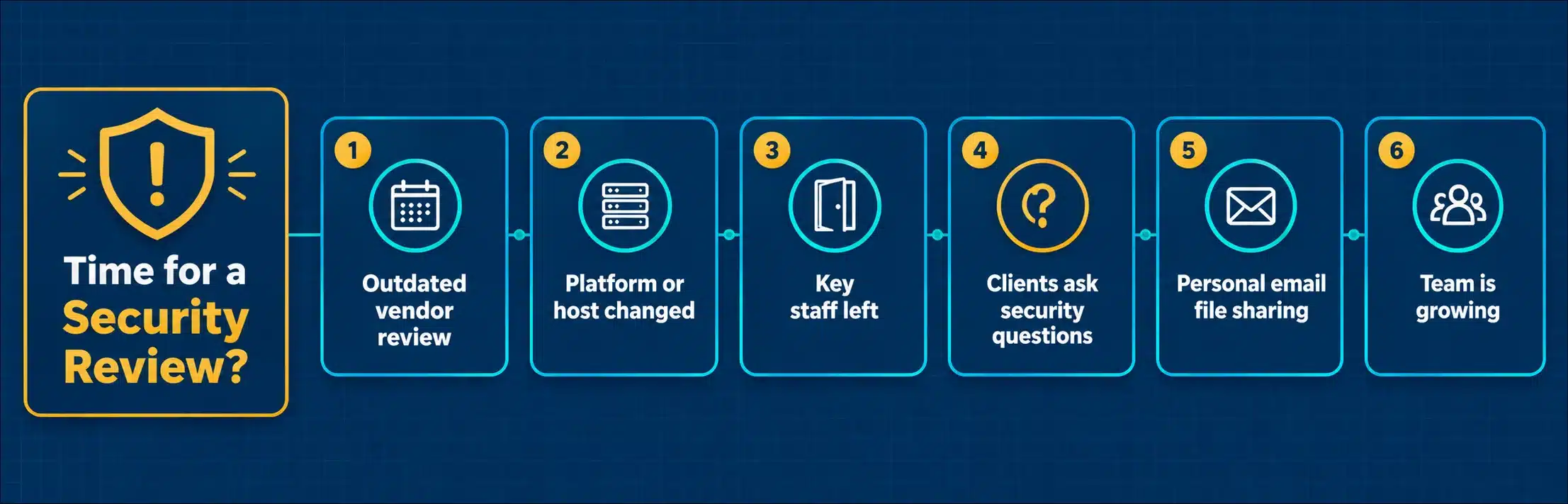
You may not need to switch vendors, but you may need to revisit them. Watch for these signals:
- You cannot remember the last time you reviewed a vendor’s security documentation
- Your vendor changed its software platform or hosting provider recently
- A vendor employee with broad access left the company
- Your clients began asking security questions in outside counsel guidelines
- You share files by personal email or unmanaged consumer tools
- Your team is growing and adding more outsourced support
Growth often drives these changes. If your caseload has outgrown your current resources, our article on the signs your firm needs additional patent paralegal support can help you decide when to expand, and how to do it with security in mind.
Frequently Asked Questions About SOC 2 and IP Vendors
What does a SOC 2 compliance IP services vendor actually prove?
It confirms that an independent CPA firm has evaluated the vendor’s security controls against the AICPA Trust Services Criteria and issued a report. The report explains how the vendor handles access, system changes, incidents, and data protection. However, it does not establish the quality of legal work or the accuracy of deadlines.
Is a SOC 2 compliance IP services vendor required by law?
No. No statute requires SOC 2. Professional rules, however, require lawyers to supervise outside providers and protect client confidentiality. Many firms and corporations use SOC 2 reports as evidence of reasonable diligence, and some outside counsel guidelines now require them.
What is the difference between SOC 2 Type I and Type II?
Type I evaluates whether controls are designed properly at a single point in time. Type II tests whether those controls operated effectively over a period, often several months to a year. For confidential IP data, Type II offers stronger assurance.
How often should I ask for an updated SOC 2 report?
Request a new report every year. Also ask for a bridge letter if the report period ended several months ago. Review sooner if the vendor changes platforms, hosting providers, or ownership.
Can a vendor be secure without a SOC 2 report?
Yes, a small vendor may maintain strong controls without a formal audit. Without a report, though, you must verify those controls yourself through questionnaires, interviews, and documents. That takes longer and provides less independent evidence.
Does SOC 2 cover cross-border data access?
Only if the audit scope includes the relevant offices, systems, and staff. Read the system description to see which locations the report covers, then ask the vendor to confirm in writing who can access your data and from where.
What should I do if a vendor’s report has exceptions?
Do not panic. Many reports contain minor exceptions. Check how severe they are, whether they repeat, and whether management fixed them. Ask the vendor to explain compensating controls, then document your risk decision.
Conclusion: Make Security Part of Your IP Vendor Standard
Choosing an IP partner involves price, expertise, turnaround, and communication. Security belongs on that list with equal weight. A SOC 2 compliance IP services vendor gives you independent evidence that confidential filings, trademark plans, and client data receive real protection, and it helps you meet your professional duties with a documented process.
To recap the essentials:
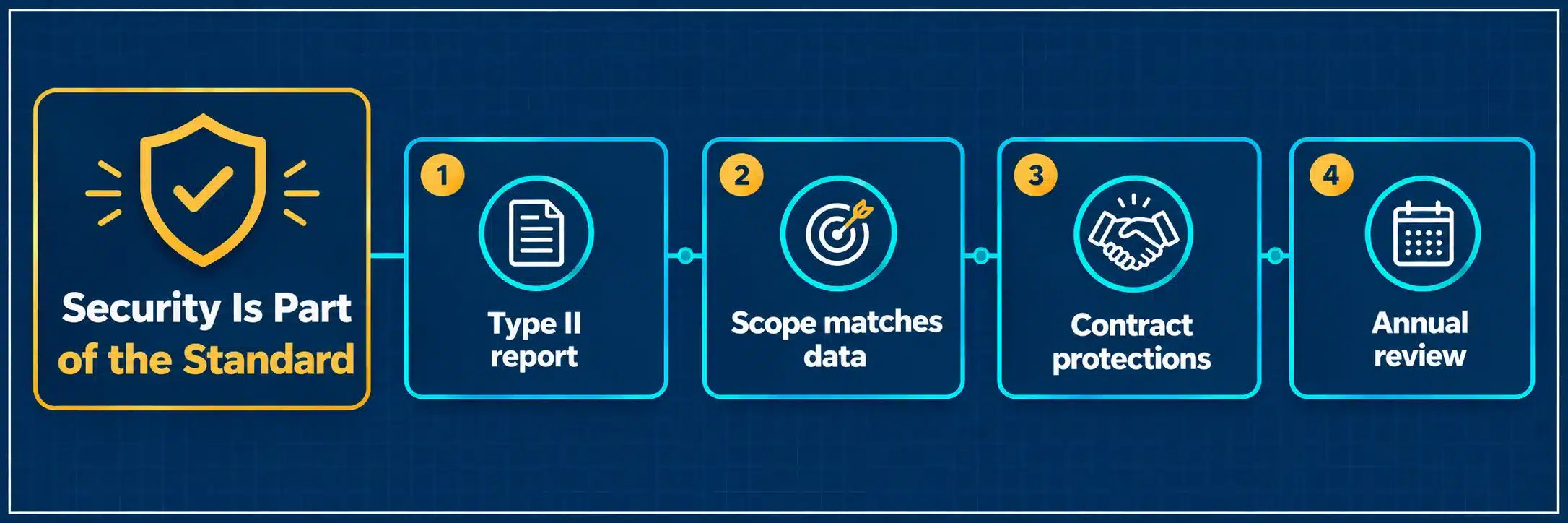
- Ask for a current SOC 2 Type II report, and read the opinion, scope, and exceptions.
- Match the criteria in scope to the data the vendor handles.
- Pair the report with contract protections, supervision, and quality control.
- Review each vendor every year, and document your decision.
Quality also matters, so evaluate both your vendor’s security posture and its work process. Teak IP’s US attorney-led model, multi-layered quality checks, and à la carte services support IP firms and corporate departments that want both. Contact the Teak IP team to discuss your security and confidentiality requirements, or explore our docketing and IP management and IP paralegal services to see how we can support your portfolio.
Need a Reliable IP Services Partner?
Protect your IP portfolio with dependable support, strong quality controls, and security-conscious processes. Connect with Teak IP to discuss your requirements.

