
Quick answer: If you are asking what is in a trademark search report, the short answer is this: a list of every identical and similar mark found across federal, state, common law, and (optionally) international sources, plus the goods and services each mark covers, the status of each record, a risk rating, and a recommendation on whether to file.

A client falls in love with a brand name, orders the packaging, and files the application the same week. Then a cease-and-desist letter arrives from a company nobody on the team had ever heard of. A proper search would have caught that conflict in days. Instead, it now costs months of lost momentum and a painful rebrand.
So, what is in a trademark search report, and how can you tell whether the one on your desk is complete? This guide walks through every section, explains what each one means, and shows you how to turn a long list of hits into a clear decision. Whether you are a trademark paralegal, an in-house counsel, or a founder about to commit to a name, you will leave with a practical reading framework.
What is in a Trademark Search Report? The Quick Answer
A trademark search report is a written record of the conflicts, risks, and findings uncovered when someone searches official registers and real-world sources for marks that look, sound, or mean something similar to a proposed brand. It documents the search method, lists the relevant marks, and explains how likely each one is to cause a problem.
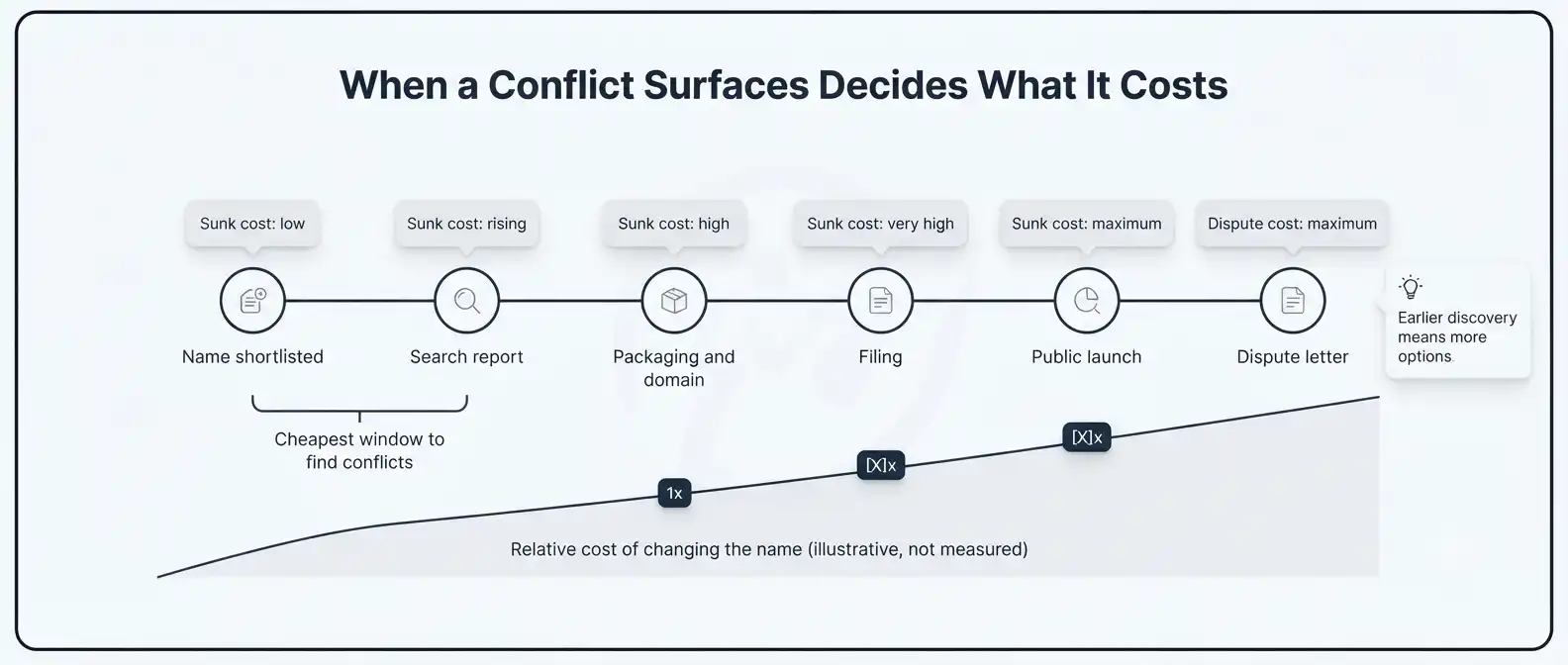
Here is what a comprehensive report typically contains:
- Cover page and search parameters: the mark searched, the goods and services, the date, and the databases used
- Executive summary: the headline findings and an overall risk level
- Federal (USPTO) results: live and dead registrations and applications
- State trademark results: registrations filed with individual state offices
- Common law results: unregistered use found in business names, websites, and marketplaces
- Domain name and social media handle findings
- International results (optional): foreign registers and the WIPO database
- Design code results: for logos and stylized marks
- Goods, services, and class analysis: how closely each hit overlaps with your business
- Risk analysis and recommendations: what to do next
Each item adds a different layer of protection. Consequently, a report that skips several of them leaves blind spots, even if it looks thick.
Why the Contents of a Trademark Search Report Matter
Many people assume the USPTO will flag any problem during examination. Unfortunately, that assumption causes real damage. The USPTO examines applications mainly against the federal register. It does not search state registers, business name filings, or unregistered brands in the marketplace.
As a result, an application can sail through examination and still face trouble later. For example, a company with earlier common law rights can oppose your application during the publication window. Alternatively, it can petition to cancel your registration after it issues. Either path is expensive.
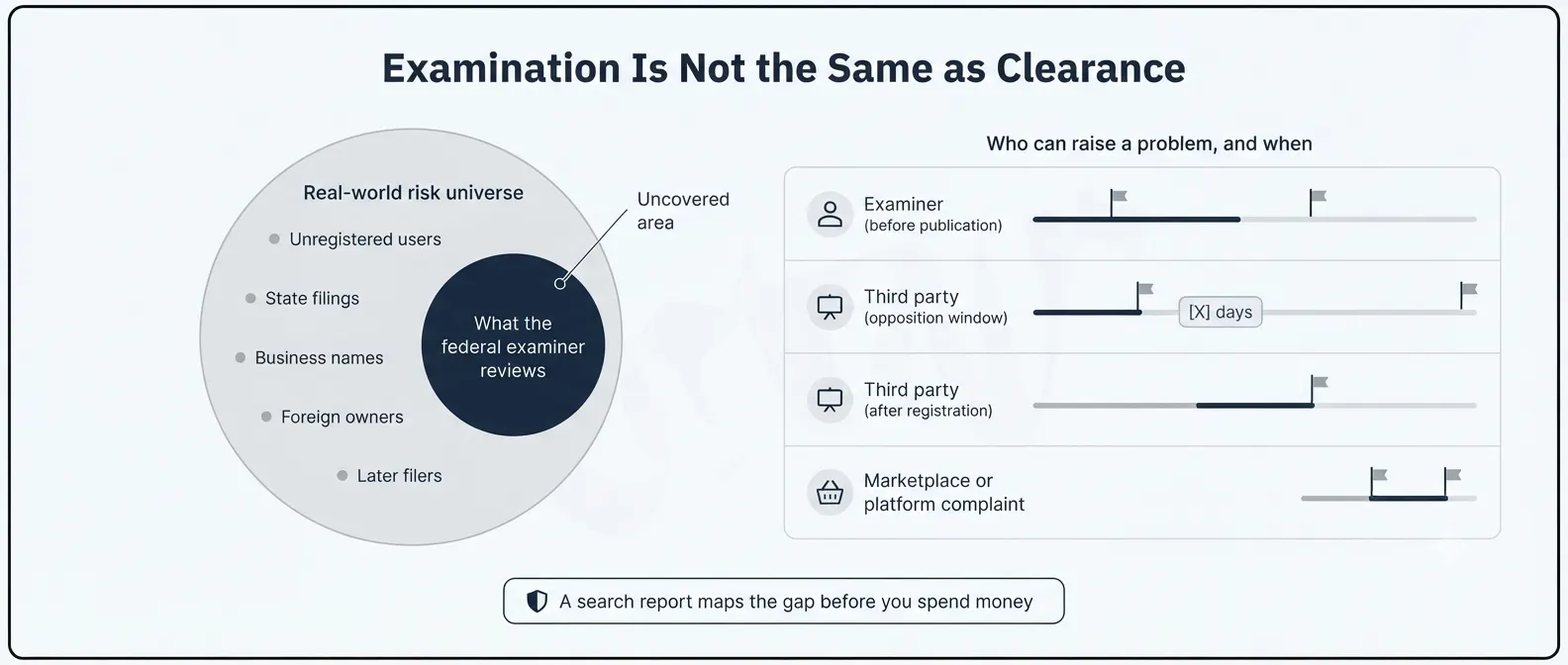
A detailed search report helps you avoid that outcome in three ways:
- It lowers financial risk. Rebranding after launch costs far more than a search ever will.
- It improves filing strategy. The report shows which classes and descriptions invite conflict, so you can draft cleaner identifications.
- It builds a record. If a dispute arises, a dated report demonstrates that you took reasonable care before adopting the mark.
For a deeper look at how this fits into the filing process, read Teak IP’s guide on what a pre-filing trademark clearance search involves.
Trademark Search Report vs. Knockout Search vs. Clearance Opinion
People often use these terms interchangeably. However, they describe three different deliverables. Mixing them up leads to wrong expectations about what you will receive.
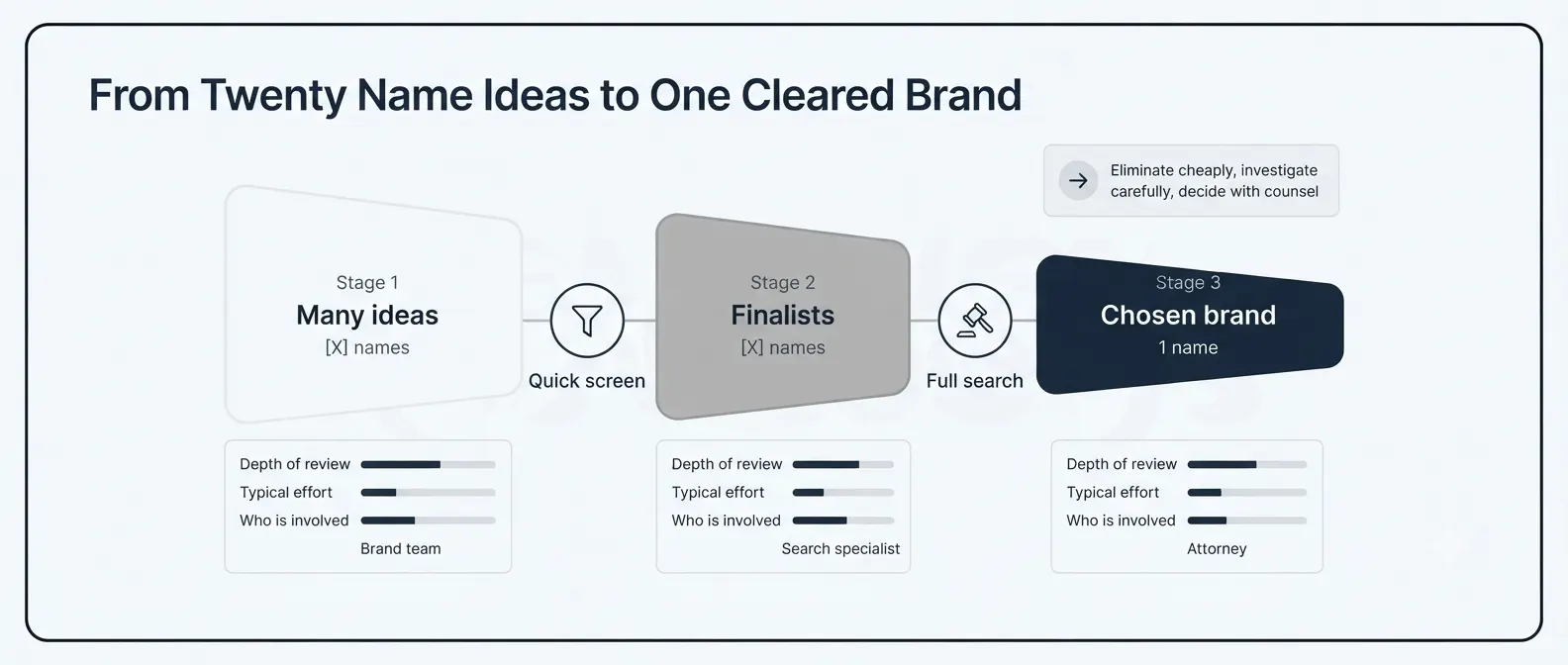
Definitions at a Glance
- Knockout search: a quick, narrow check, usually of exact and very close matches in the federal database. It eliminates obviously unavailable names fast.
- Comprehensive (full) trademark search report: a multi-source search with variants, analysis, and a risk rating.
- Clearance opinion: a legal opinion from an attorney, based on the search results, about the likelihood of registration and use without infringement.
Comparison Table
| Feature | Knockout Search | Comprehensive Search Report | Attorney Clearance Opinion |
|---|---|---|---|
| Primary goal | Quick elimination of obvious conflicts | Full picture of conflicts and risk | Legal conclusion on registrability and use |
| Typical sources | Federal database, often exact matches only | Federal, state, common law, domains, optional international | Uses the search report as its base |
| Variants searched | Few | Phonetic, visual, and conceptual variants | Reviews the report’s variants |
| Includes analysis | Rarely | Yes, with risk ratings | Yes, with legal reasoning |
| Prepared by | Anyone, including you | Trained search specialist or paralegal | Licensed attorney |
| Best used when | Screening many name ideas | Finalists, launches, and major filings | High-stakes brands and disputes |
Notice the pattern: each step builds on the one before it. Therefore, most careful brand owners run a knockout search first, order a comprehensive report on the finalists, and then ask counsel for an opinion on the winner.
Section-by-Section: What Is in a Trademark Search Report
Now for the core of the matter. The sections below follow the order in which a well-built report usually presents its findings.
1. Cover Page and Search Parameters
The cover page sets the ground rules. It states exactly what was searched, which makes the rest of the report meaningful.
Look for these details:
- The exact mark (word, phrase, or logo description)
- The goods and services the client plans to offer
- The international classes assumed in the search
- The search date, which fixes the report as a snapshot in time
- The databases and sources consulted
- The geographic scope (United States only, or additional countries)
This page matters more than most readers realize. If the description of your goods is too narrow, the whole search may miss related marks. Likewise, if the date is old, new filings may have appeared since.
2. Executive Summary and Overall Risk Level
Busy decision-makers often read only this page. A strong executive summary answers four questions in plain language:
- Did the search find identical marks?
- Did it find similar marks for related goods or services?
- How serious are the top conflicts?
- What does the searcher recommend?
Good summaries name the specific marks that drive the risk. Weak ones simply say “moderate risk” with no explanation. If you cannot tell why the report reached its conclusion, ask for clarification.
3. Federal (USPTO) Search Results
Federal results form the backbone of any report on a U.S. brand. Searchers pull these records from the USPTO’s official Trademark Search system, which replaced the older TESS tool in late 2023.
The report should separate results into clear groups:
- Live registrations: marks that currently hold federal rights
- Pending applications: earlier-filed applications that could block yours
- Dead records: abandoned, cancelled, or expired filings
Do not skip the dead records. A cancelled registration may signal that the owner stopped using the mark, but it may also mean the owner simply missed a renewal deadline while still trading under the name. A thorough searcher flags those cases for follow-up.
What Each Federal Entry Should Include
| Data Field | Why It Matters |
|---|---|
| Mark and drawing type | Standard character marks protect the words in any style, so they often carry broader reach |
| Serial and registration numbers | They let you pull the full file history quickly |
| Status and status date | They show whether the mark is live, pending, or dead |
| Owner name and address | They identify who you may need to contact or oppose |
| Filing and registration dates | They establish priority |
| Goods and services text | It is the single most important field for judging overlap |
| International class numbers | They give a quick view of category overlap |
| First-use dates | They hint at how long the owner has traded |
| Disclaimers and notes | They reveal weak or descriptive wording inside the mark |
Show Image Figure 2: An annotated federal record showing the fields a searcher reviews for each hit.
4. State Trademark Registrations
Every U.S. state runs its own trademark register. Owners who sell only within a single state sometimes register there instead of federally. These filings can still create priority rights in their home territory.
A comprehensive report should therefore include state hits, or at least confirm that the search covered them. Federal-only reports miss this layer entirely.
5. Common Law Search Results
Here is where comprehensive searches earn their keep. In the United States, trademark rights can arise from actual use, even without any registration. Those rights are called common law rights, and they can defeat a later applicant in the same trading area.
Because no single database holds common law marks, searchers combine several sources:
- Business name and assumed-name (DBA) records from state agencies
- Company websites and online marketplaces
- App stores and software repositories
- Trade directories and industry publications
- Social media pages
- General web and image searches
The report should list each relevant find with a link or screenshot, the apparent goods or services, and the location of the business. As a result, you can judge whether a small regional user is likely to matter to your launch.
6. Domain Names and Social Media Handles
Although domains and handles do not create trademark rights by themselves, they reveal real-world use and competition. A good report lists:
- Exact-match domains and their current use
- Close variants across common extensions
- Matching handles on major social platforms
Moreover, this section helps the marketing team. If the best domain is gone, you want to know before the logo goes to print.
7. International and Foreign Database Results
If you plan to sell abroad, the report should extend beyond the United States. Searchers often start with the WIPO Global Brand Database, which pulls together records from many national and international sources. For European coverage, they may also check the EUIPO’s TMview tool.
International searches vary widely in depth. Some reports simply screen a few countries for identical marks. Others dig into local-language variants, which matter because a harmless word in English can be a direct conflict elsewhere. Ask the provider exactly which countries and languages the search covered.
8. Design Code Results for Logos
Word searches cannot catch a lookalike logo. For that reason, a report on a stylized mark or design should include a design code search. The USPTO assigns numeric design codes to visual elements such as animals, stars, circles, and letters. Searchers combine those codes to find marks with similar imagery.
If your logo includes a distinctive symbol, check that the report lists the codes searched and the visually similar hits. Otherwise, you may receive a word-only report for what is really a design problem.
9. Goods, Services, and Class Analysis
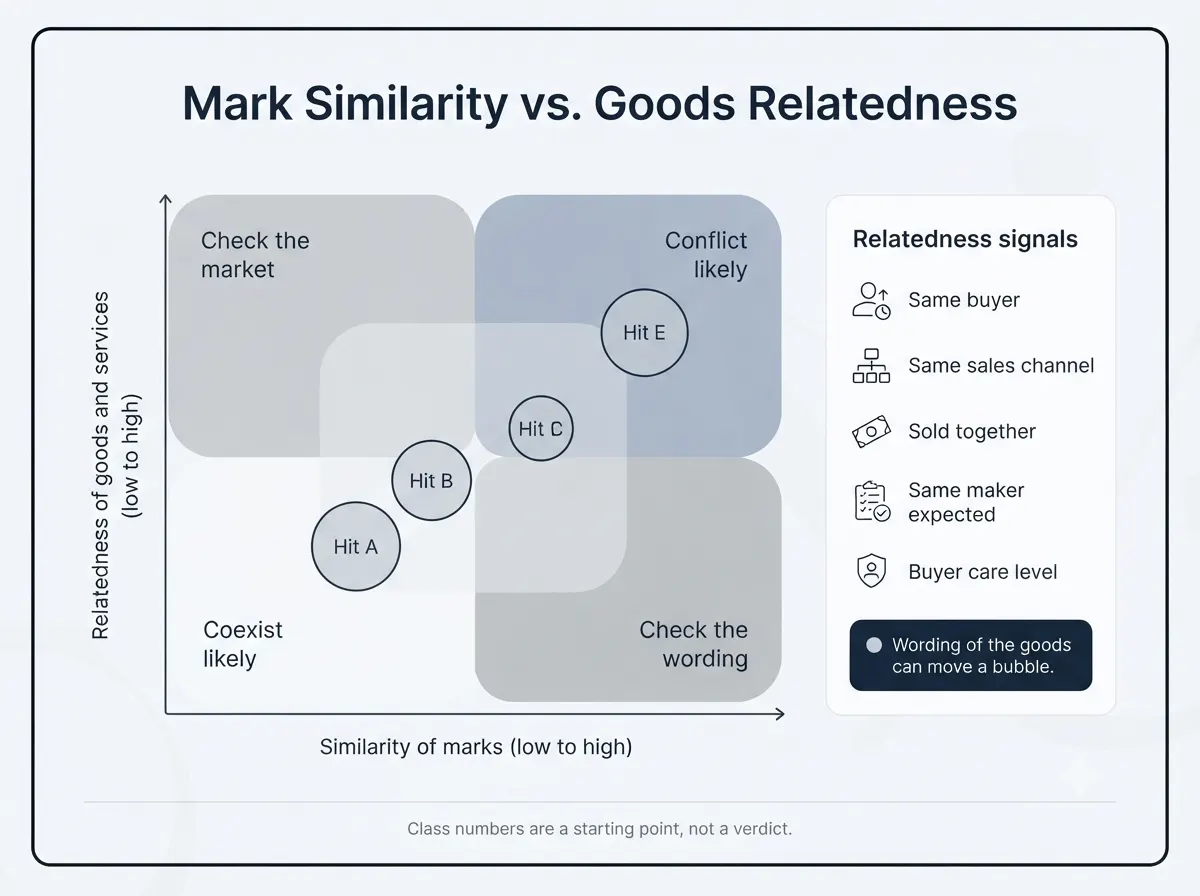
Identical names can coexist when the goods differ enough. Conversely, different names can clash when the goods overlap closely. That is why class analysis sits at the heart of the report.
A strong analysis does more than list class numbers. It compares the actual descriptions of goods and services, then considers:
- Whether customers would expect both products from one source
- Whether the goods travel through the same sales channels
- Whether the goods are complementary, such as software and related hardware
- Whether the buyers are casual consumers or careful professionals
The USPTO’s ID Manual helps searchers and applicants phrase goods and services in accepted language. The WIPO Nice Classification explains the 45-class system behind those numbers.
10. Search Strategy and Variant Analysis
Many readers overlook this section, yet it reveals the quality of the work. Similarity in trademark law is not limited to spelling. Marks can conflict because of how they sound, how they look, or what they mean.
A thorough searcher therefore tests variants such as:
- Phonetic equivalents: “Kwik” and “Quick”
- Spelling changes: added or dropped letters, plural forms, and prefixes
- Compound splits: “Sun Rise” and “Sunrise”
- Translations and synonyms: “Swift” and “Rapid” for similar goods
- Abbreviations and acronyms
If the report lists no variants at all, treat it as a red flag. An exact-match search is a knockout search in disguise.
11. Risk Analysis and Recommendations
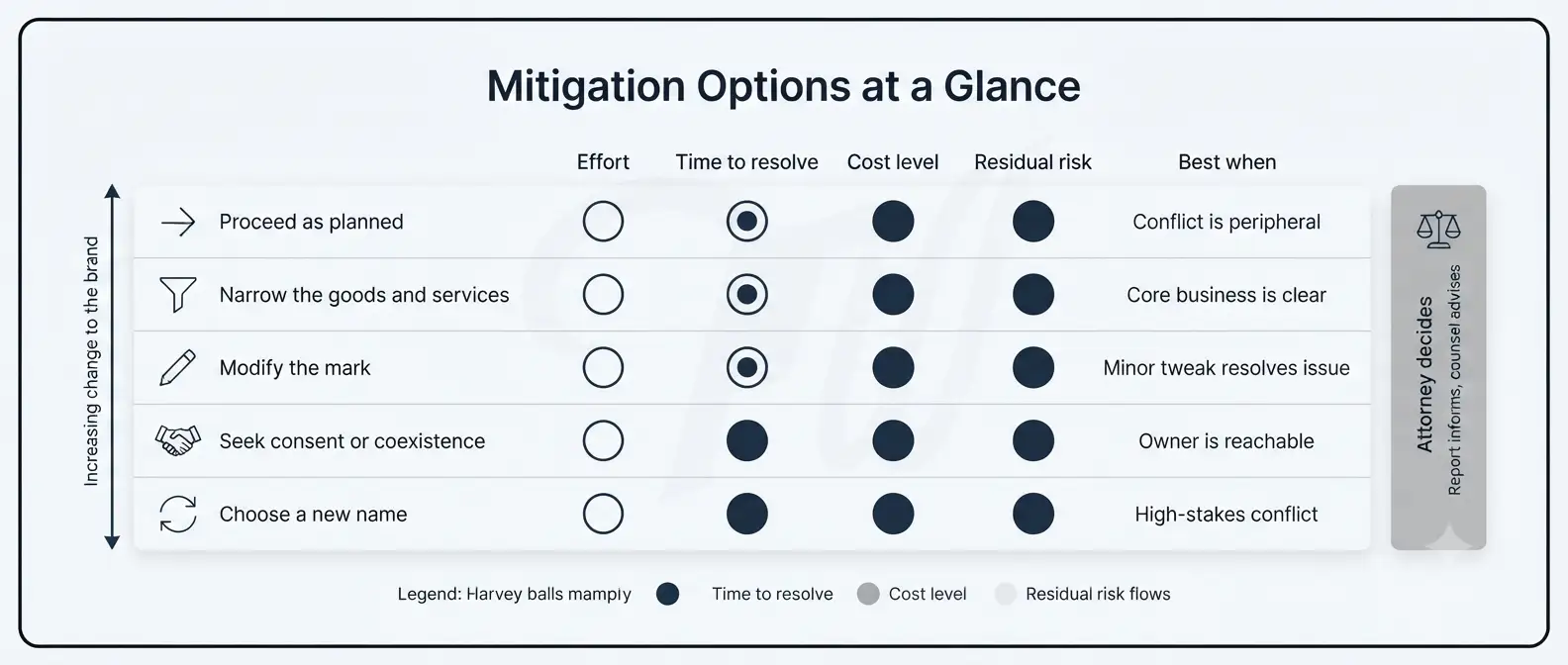
The last major section turns data into advice. A good analysis ranks the most concerning marks, explains the reasoning, and suggests options. Those options may include:
- Proceeding with the application as planned
- Narrowing the goods and services description
- Adjusting the mark or adding distinctive elements
- Seeking a consent or coexistence agreement
- Choosing a different name
Keep in mind that many providers deliver analysis as a search professional’s assessment, not formal legal advice. For a final legal call, bring in a licensed attorney.
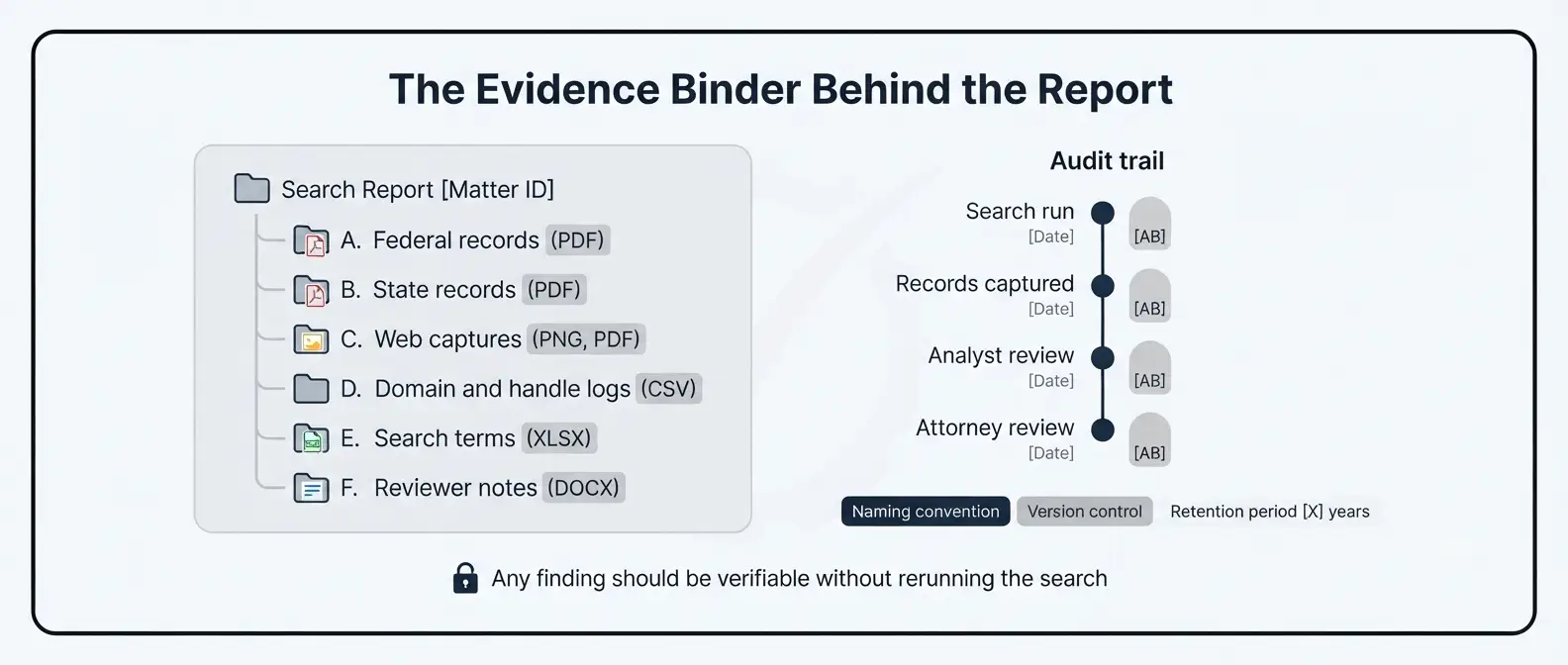
12. Appendices and Supporting Documents
Finally, the appendices hold the raw evidence. Expect to see:
- Full records for each cited mark
- Screenshots of websites and marketplace listings
- Copies of state registration details
- A list of search terms and variants used
These attachments let your attorney verify any finding without redoing the search. In other words, they make the report auditable.
How to Read a Trademark Search Report Step by Step
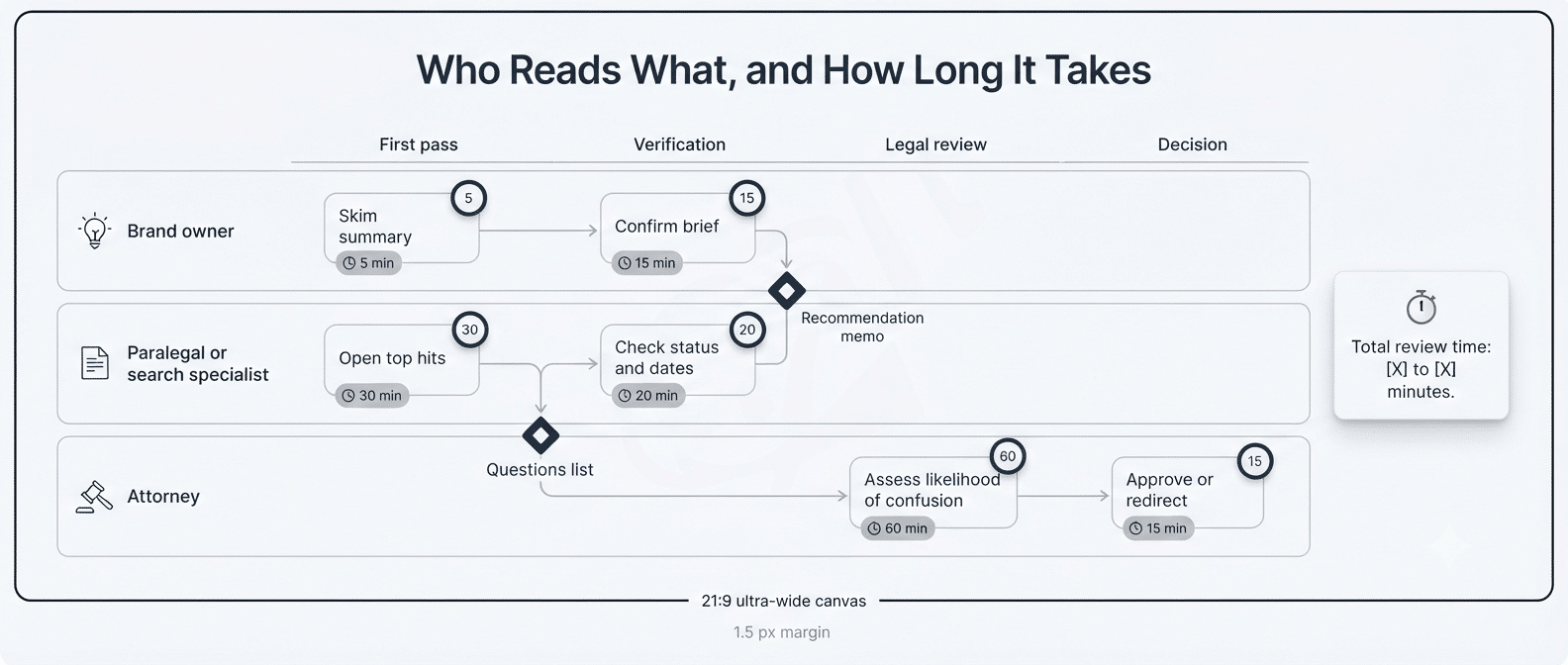
A long report can feel overwhelming. Use this sequence to stay organized.
- Confirm the basics. Check the mark, the goods and services, and the search date on the cover page. Fix any error right away.
- Read the executive summary. Note the overall risk level and the marks it names.
- Review the highest-risk hits first. Open the full records for identical and near-identical marks on related goods.
- Check the status of each key hit. Separate live registrations, pending applications, and dead records.
- Compare goods and services line by line. Overlap in the actual descriptions matters more than the class number.
- Study common law findings. Judge the size, location, and activity of each unregistered user.
- Look at the variants. Make sure the search tested sound-alikes and spelling changes.
- Read the recommendations. Decide whether the advice fits your business plan and risk appetite.
- List open questions for counsel. Bring the ambiguous hits to your attorney in one organized meeting.
- Set a follow-up. Schedule monitoring so new filings do not catch you off guard.
Understanding Risk Ratings in a Trademark Search Report
Risk ratings give decision-makers a fast signal. Providers use different labels, so always read the definitions in the report itself. Even so, most systems follow a similar logic.
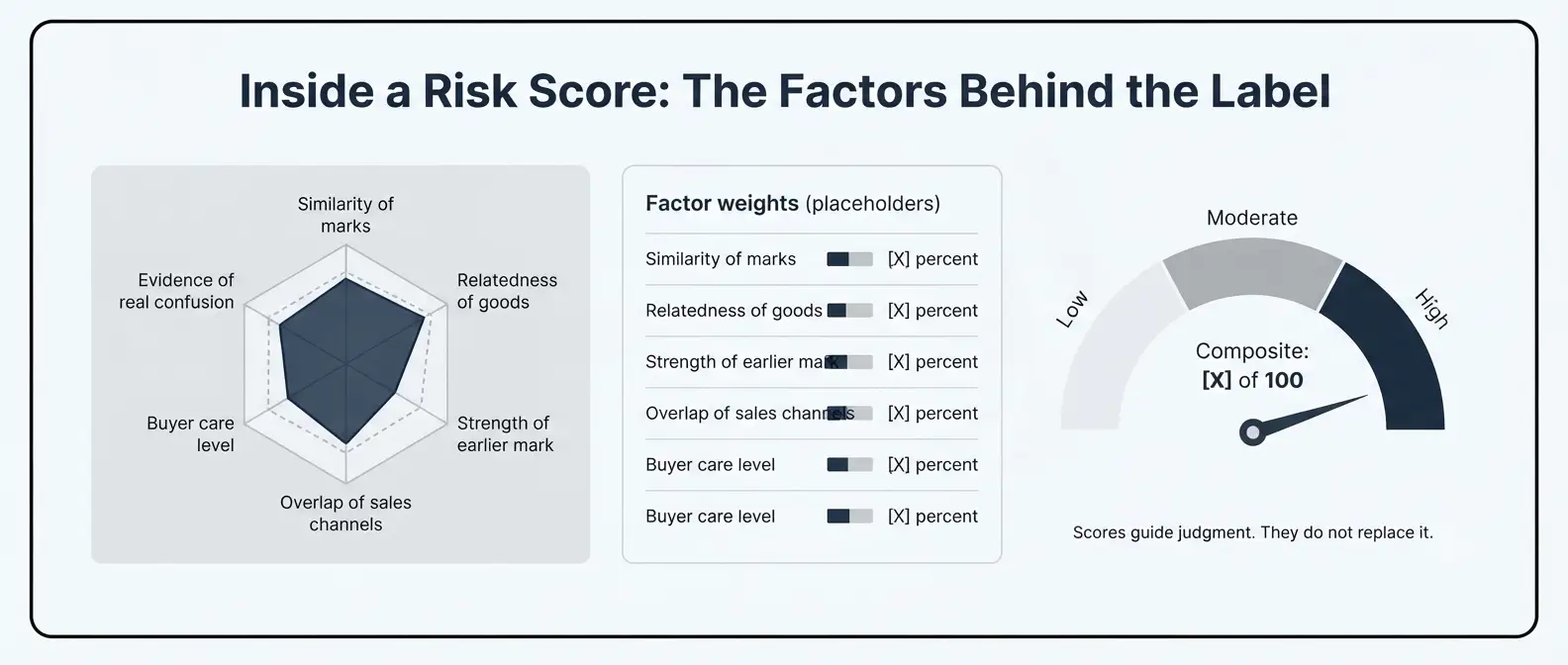
| Rating | What It Usually Signals | Typical Next Step |
|---|---|---|
| High | An identical or near-identical mark, live or pending, for the same or closely related goods | Rethink the name, seek consent, or consult counsel before spending more |
| Moderate | A similar mark with partial overlap, or a crowded field with several close neighbors | Narrow the goods, strengthen the mark, and get an attorney’s view |
| Low | No close matches on related goods; only distant or weak marks appear | Proceed with filing and set up monitoring |
Two cautions apply here. First, a low rating does not guarantee registration. Second, a high rating does not always mean the end of the road. Coexistence agreements, narrowed descriptions, and distinct branding can sometimes resolve a conflict.
U.S. examiners decide conflicts under what the USPTO calls likelihood of confusion. They weigh the similarity of the marks and the relatedness of the goods, among other factors drawn from the long-standing DuPont analysis. A good report mirrors that thinking, so you can predict how an examiner might react.
Practical Insights: An Illustrative Walkthrough
The example below is a simplified, hypothetical case. It shows how the pieces of a report fit together.
The situation. A startup wants to launch “NORTHBEAM” for rechargeable LED flashlights and camping lanterns. The team has already ordered a domain name.
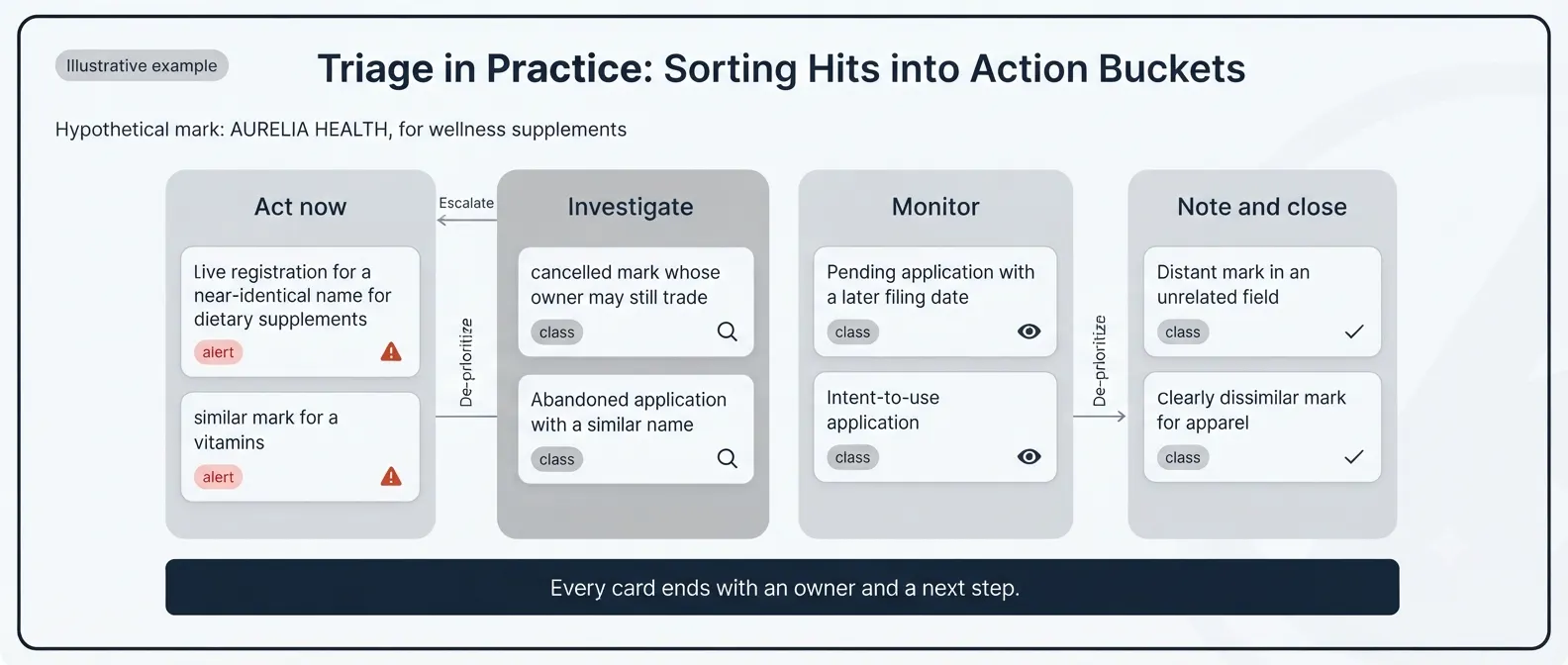
What the report finds.
- Federal: A live registration for “NORTH BEAM” in a different style covers outdoor lighting products. A separate pending application for “NORTHBEEM” covers headlamps.
- State: One state registration for “NORTHBEAM” covers a regional hardware store.
- Common law: An online retailer sells lanterns under “North Beam Outfitters.” It has no registration.
- Domains: The .com is taken, and the .net is a parked page.
- Variants: The searcher also tested “NORTHBEME,” “NORTH BEAM,” and “NORTHERN BEAM.”
How an analyst reads it.
- The federal “NORTH BEAM” registration is the biggest threat. The marks sound identical, and the goods overlap closely.
- The pending “NORTHBEEM” application may become a second citation if it has an earlier filing date.
- The state registration and the retailer matter mainly for use, not registration. They could still bring a dispute in their local markets.
- The overall rating lands at high.
What the team can do. The team could pick a more distinctive name, approach the owner of “NORTH BEAM” about a consent agreement, or narrow the product description. Whatever path they choose, they now decide with facts, not hope.
This pattern repeats across industries. The report does not make the decision for you. Instead, it shows you the full terrain before you spend money on filing fees, packaging, and advertising.
Common Mistakes When Reviewing a Search Report
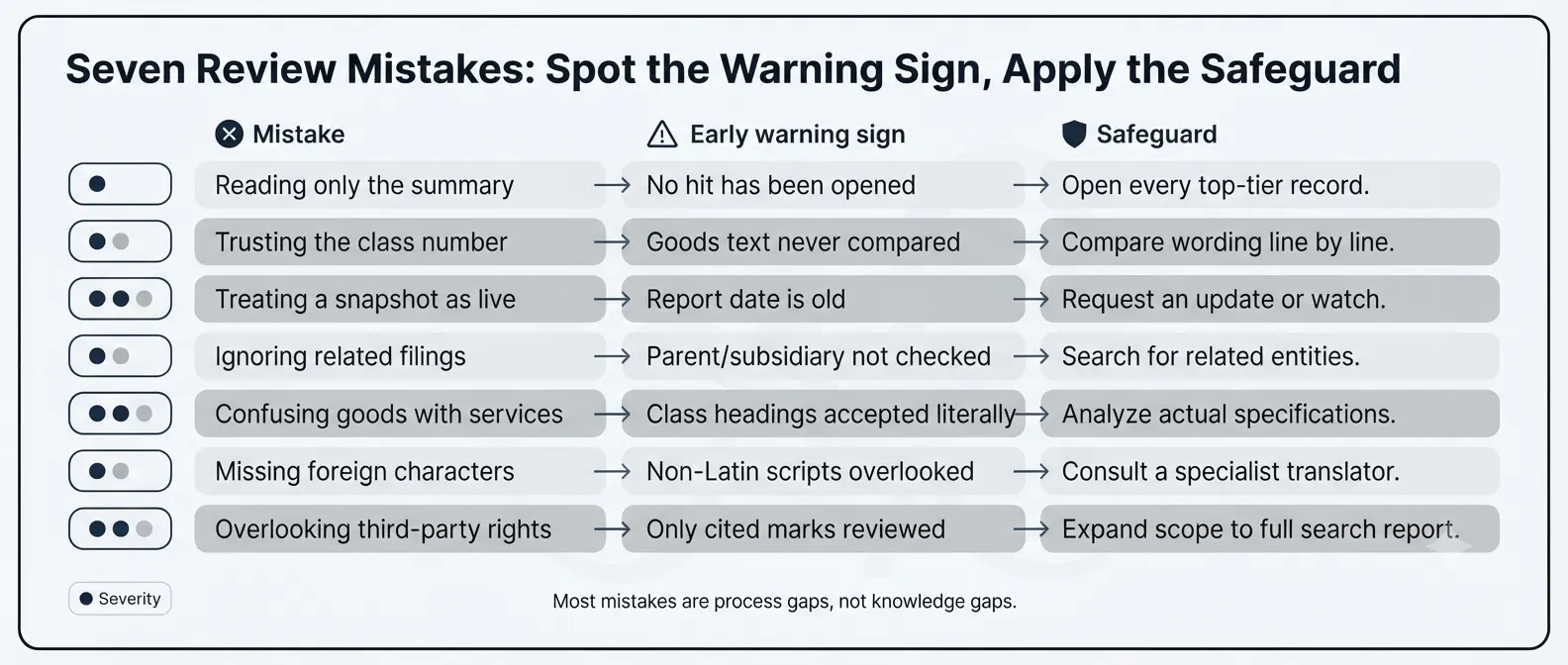
Even a good report can mislead someone who reads it carelessly. Watch for these errors:
- Treating the report as a legal opinion. A search report gathers and organizes facts. It does not replace attorney judgment.
- Ignoring dead records. Abandoned and cancelled marks sometimes belong to businesses that still use the name.
- Focusing only on identical matches. Courts and examiners care about overall impression, not just exact spelling.
- Skipping the goods and services comparison. Class numbers alone do not tell you whether two products compete.
- Dismissing common law users. Small unregistered businesses can still hold enforceable rights in their territory.
- Searching only a single country. A strong U.S. result says nothing about Europe or Asia.
- Using an outdated report. New applications arrive every day, so a report from months ago may already miss a conflict.
- Ordering the search after the branding spend. Run the search before you invest in packaging, signage, and ads.
- Describing the goods too narrowly. A tight description can hide related marks from the search.
Expert Tips for Getting More from Your Search Report
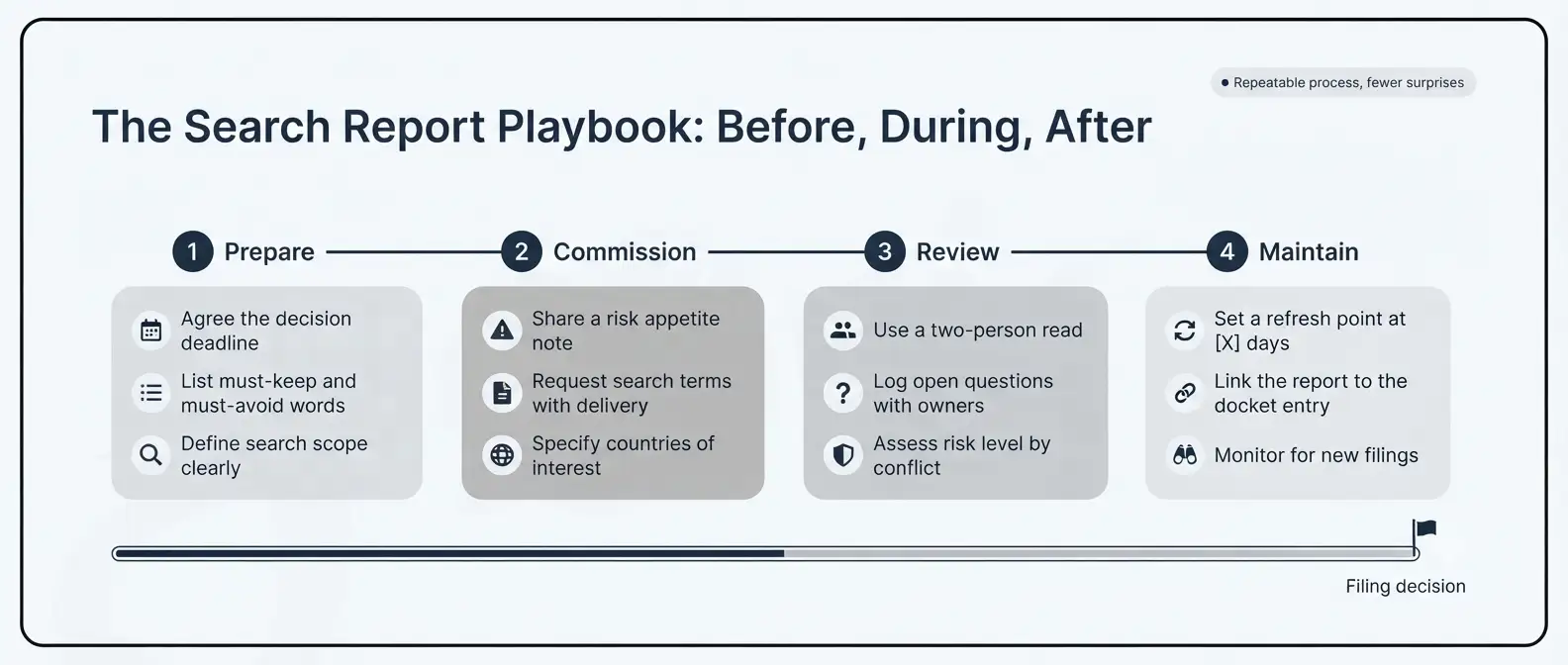
Practitioners who read many reports share a few habits that save time and reduce risk.
- Write a detailed brief. Give the searcher your full product list, target markets, and future expansion plans.
- Search finalists, not a long list. Screen early ideas with a knockout search and invest in full reports for the top two or three.
- Ask for the search terms. A transparent provider will share the variants and databases used.
- Request screenshots for common law hits. Evidence disappears when a website changes, so capture it now.
- Flag your own pending filings. If you hold related marks, tell the searcher so the report can account for them.
- Rank the hits yourself. After reading, sort the top five conflicts by threat level and compare your list with the report’s.
- Plan for the long game. Pair the search with a watch service after filing. Teak IP explains the difference in its article on trademark search versus trademark monitoring.
- Keep every report on file. Store them with your docketing records so you can reference them during any future dispute.
How to Judge the Quality of a Trademark Search Report
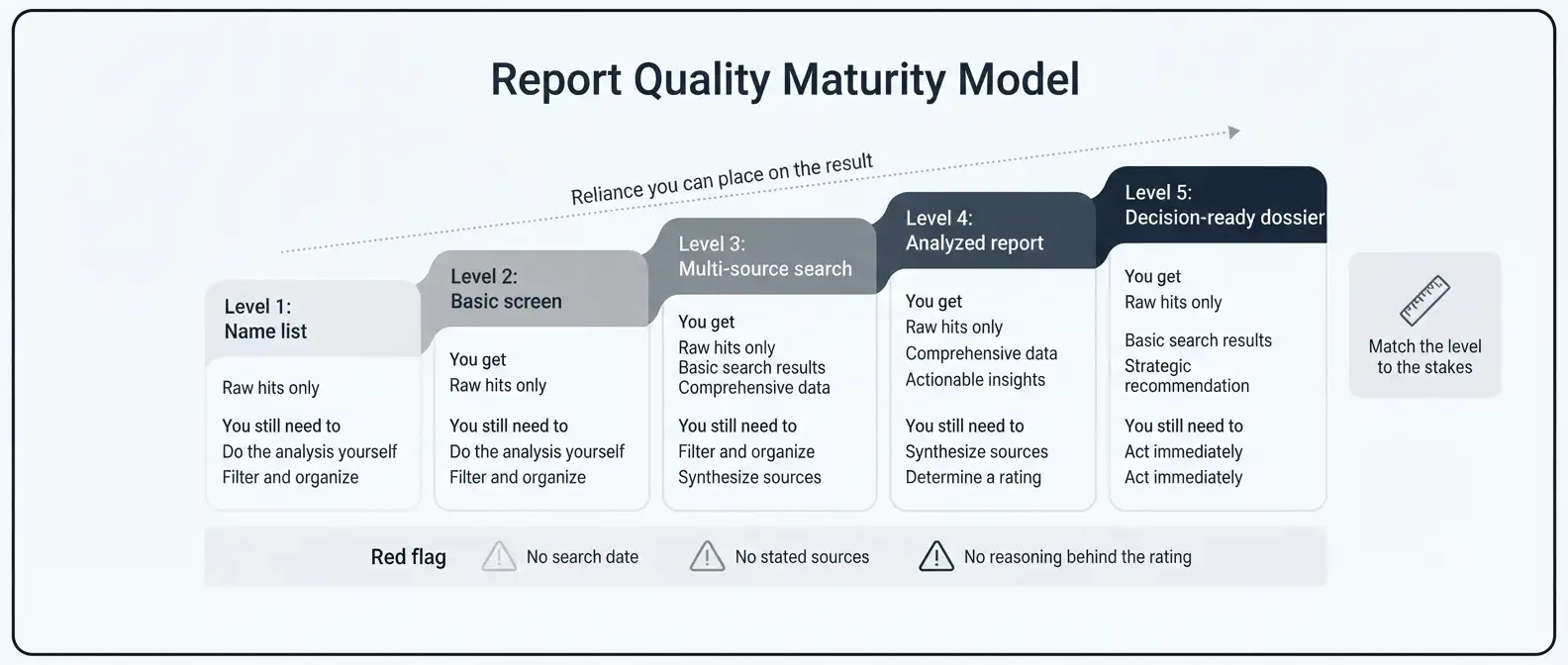
Not every report is equal. Before you rely on one, run it through this checklist.
- Scope is clear. The report states the sources, countries, and classes searched.
- Variants are documented. It shows phonetic, visual, and conceptual variations.
- Federal results are complete. It includes live, pending, and dead records.
- Common law is covered. It cites real evidence, not just a generic statement.
- Analysis is specific. It names the marks driving the risk and explains why.
- Recommendations are actionable. You can tell what to do on Monday morning.
- Dates are visible. You know when the search ran and how fresh the data is.
- A qualified person prepared it. The searcher has real trademark training, and an attorney is available to review.
If your firm outsources searches, it is wise to vet the vendor with care. Teak IP’s IP vendor due diligence checklist offers a practical framework. In addition, the guide on choosing the right virtual trademark paralegal partner covers what to look for in a service provider.
What to Do After You Receive the Report
The report is a starting point. The decisions that follow shape the future of the brand.
Step-by-Step: From Report to Decision
- Review the report with your attorney. Walk through the high and moderate risk hits together.
- Decide on the mark. Keep it, modify it, or replace it.
- Refine the goods and services. Draft a precise identification that avoids needless overlap.
- Choose your filing basis and timing. Decide whether to file based on actual use or intent to use.
- File the application. Submit with confidence that you know the major risks.
- Start monitoring. Watch for new filings that could conflict with yours.
- Calendar future deadlines. Registrations need maintenance, and missed dates can cost you the mark.
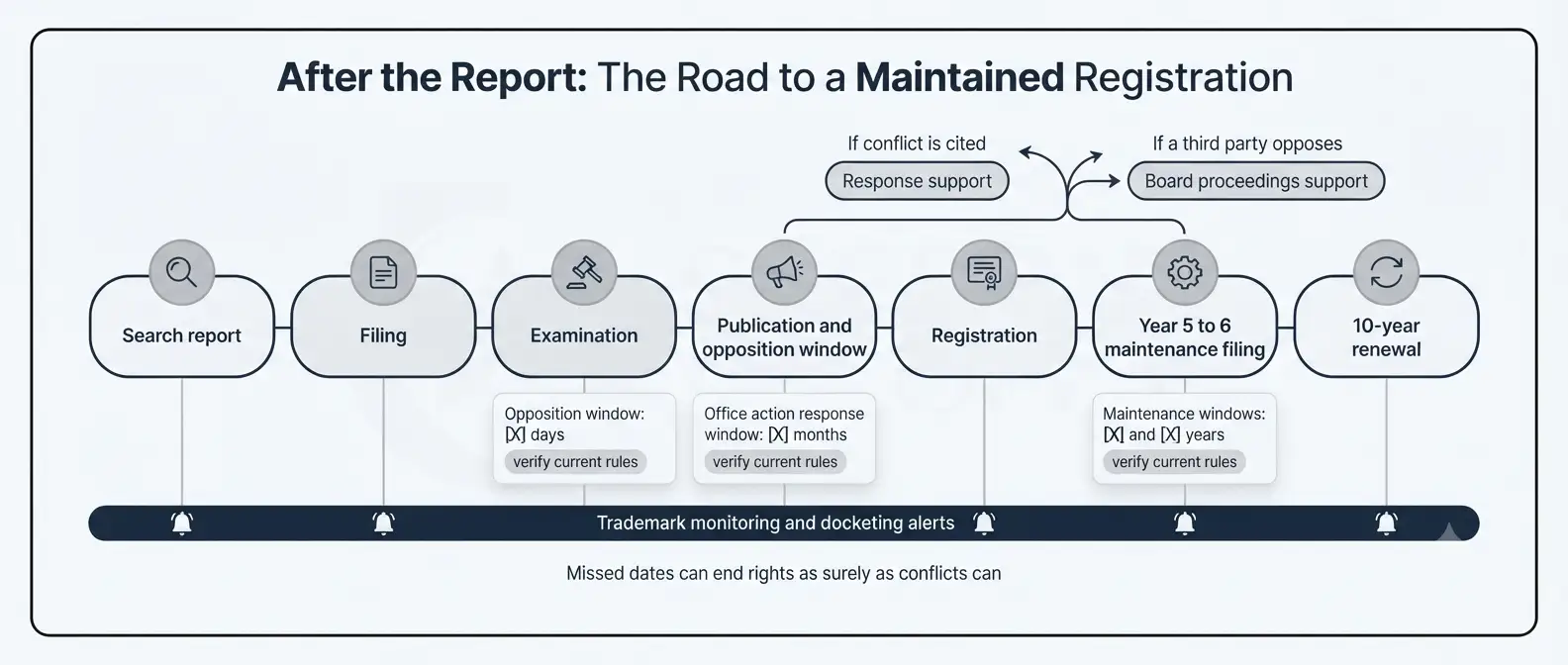
Where the Report Connects to Later Stages
A report also prepares you for what comes after filing. If an examiner cites a conflicting mark, the search findings give your team a head start on the response. Teak IP’s overview of Office Action response support services explains how firms handle these deadlines.
Similarly, if a third party opposes your application, your records will matter in proceedings before the Trademark Trial and Appeal Board. See Teak IP’s article on trained TTAB paralegal support services for a look at how that work gets done.
Finally, a registered mark needs upkeep. Missing a maintenance deadline can end your rights as surely as a conflict can. The guide on managing corporate trademark renewals globally shows how larger portfolios stay on track.
Who Does What: Paralegals and Attorneys
Many people wonder who may prepare the search and who must interpret it. In general, trained paralegals and search specialists can run searches, gather records, and organize findings under attorney supervision. Providing legal advice or opinions falls to the attorney. Teak IP’s article on what tasks a trademark paralegal can do without unauthorized practice of law draws that line clearly.
If your team needs help with this work, Teak IP offers dedicated trademark search services and ongoing trademark monitoring services.
Frequently Asked Questions
What is in a trademark search report?
A trademark search report contains the search parameters, an executive summary, federal and state trademark results, common law findings, domain and social handle checks, optional international results, design code results for logos, a goods and services comparison, a risk rating, and recommendations. Appendices hold the supporting records and screenshots.
How long does a comprehensive trademark search take?
Timing depends on the scope. A knockout search can finish quickly. A comprehensive report that covers common law sources, variants, and several countries usually takes longer because analysts must review and verify each hit. Ask your provider for a turnaround estimate based on your specific brief.
Does a clean search report guarantee my trademark will register?
No. A clean report lowers risk, but it cannot guarantee approval. Examiners may still refuse a mark for reasons unrelated to conflicts, such as descriptiveness. In addition, new applications filed after the search date will not appear in the report.
Who should read and interpret the report?
A trademark attorney should make the final legal judgment. Paralegals and search specialists can prepare the data and organize findings, and business teams should review the results for practical fit. Together, they cover both the legal and commercial sides of the decision.
How long is a trademark search report valid?
A report reflects the register on the day the search ran. Because new filings arrive constantly, it ages quickly. If you wait months to file, request an update. After filing, set up trademark monitoring to catch new conflicts.
What is the difference between a search report and a clearance opinion?
A search report gathers and analyzes the data. A clearance opinion comes from an attorney, who applies the law to those findings and gives a view on registrability and infringement risk. Many brand owners order the report first and the opinion second.
Do I need an international search?
You need one if you plan to sell, manufacture, or advertise outside the United States. Trademark rights are territorial, so a strong U.S. result does not protect you elsewhere. Start with the countries that matter most to your business plan.
Can I run my own trademark search?
Yes, you can run a basic knockout search in the free federal database. However, a full search involves variants, state and common law sources, and trained analysis. For finalist names and major launches, a professional report is the safer choice.
How much does a trademark search report cost?
Cost varies with scope, number of classes, countries, and the depth of analysis. A narrow screening costs less than a multi-country report with common law research. Contact the provider with your brief to get an accurate quote.
Conclusion
So, what is in a trademark search report? In short, it holds the map of your brand’s risk: where the search looked, which marks surfaced, how closely they overlap with your goods and services, and what the searcher recommends. The best reports pair thorough data with specific, honest analysis.
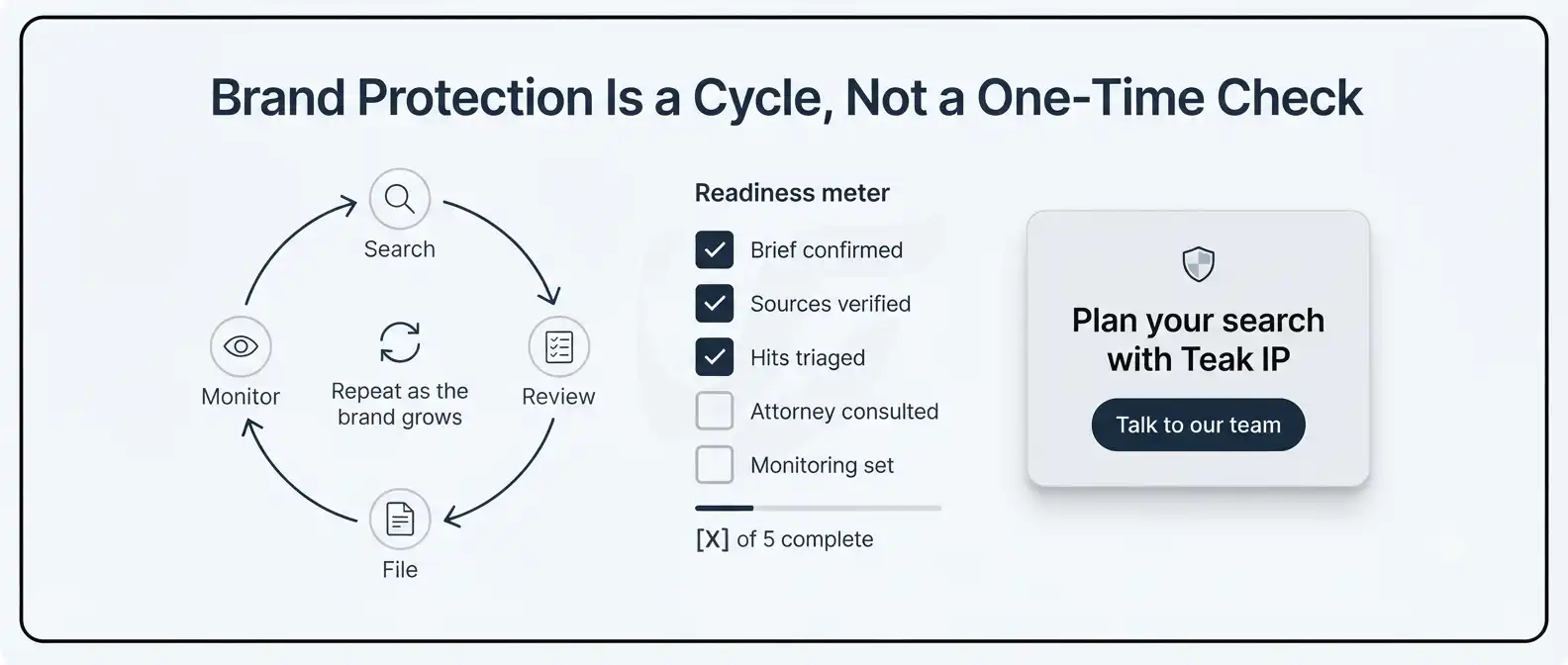
Remember these essentials:
- Federal results alone are not enough. State, common law, domain, and international checks fill the gaps.
- Variants matter. Sound, appearance, and meaning all drive conflicts.
- The analysis is the real product. Ask for clear reasoning behind every risk rating.
- A report is a snapshot, so follow it with monitoring.
- Final legal decisions belong with a qualified attorney.
If you want a search you can rely on, Teak IP’s U.S. attorney-led team can help. Explore the trademark search services page or contact the Teak IP team to discuss your brand, your markets, and the right level of search for your launch.

