
A new trademark paralegal sits down with her first Office Action on a Monday morning. The attorney is in depositions until Thursday, and the client is calling every few hours asking what it means and whether the brand name is still safe. She knows the docket, she knows the file, and she knows exactly what the examining attorney is objecting to. But there is one question she cannot answer for that client, no matter how confident she feels: what should we do next. That single line, the line between organizing the facts and telling a client what to do about them, is where trademark paralegal support ends and unauthorized practice of law begins.

What tasks can a trademark paralegal do without unauthorized practice of law? A trademark paralegal can conduct clearance searches, prepare and file applications under attorney direction, docket deadlines, draft Office Action responses for attorney review, manage renewals, and communicate on non-substantive matters, so long as the paralegal never gives legal advice, never signs documents as counsel of record, and never appears before the Trademark Trial and Appeal Board (TTAB) unsupervised. Every task a paralegal performs must sit under attorney review and control.
This guide breaks down exactly where that line sits, why it exists, and how firms and in-house teams can use trademark paralegal support aggressively and safely without ever crossing into unauthorized practice of law.
Quick Answer: The Core Rule for Trademark Paralegal Tasks
Before going deeper, here is the fast answer for anyone who needs it right now.
A trademark paralegal may perform any task that does not require independent legal judgment, does not create an attorney-client relationship, and remains subject to attorney supervision and review. The moment a paralegal exercises legal judgment on behalf of a client rather than simply gathering facts, drafting under instruction, or managing process, the task crosses into the unauthorized practice of law.
Per the American Bar Association’s Model Guidelines for the Utilization of Paralegal Services, a lawyer may delegate to a paralegal any task normally performed by the lawyer, provided the lawyer maintains responsibility for the work product, unless a statute, court rule, or professional conduct rule expressly precludes delegating that specific task to a nonlawyer. That one sentence is the foundation for almost everything discussed in this article.
What is Unauthorized Practice of Law (UPL), Exactly?
Unauthorized practice of law, commonly called UPL, refers to a nonlawyer performing tasks that are legally reserved for licensed attorneys. It is not a single, uniformly written rule. Instead, it is governed by a patchwork of state statutes, disciplinary rules, court interpretations, and, in the trademark context, federal regulations tied to the United States Patent and Trademark Office (USPTO).
Neither the ABA Model Rules of Professional Conduct nor the older Model Code actually define the phrase “practice of law” in a single, fixed sentence, leaving that definition to individual states through statute, disciplinary rule, and court interpretation. That ambiguity is exactly why so many firms feel uncertain about where paralegal responsibilities stop.
For trademark work specifically, the definition is somewhat clearer. Under USPTO regulations, practice before the Office in trademark matters includes consulting with or advising a client in contemplation of filing a trademark application, preparing or prosecuting an application, preparing amendments requiring written argument, and conducting oppositions, cancellations, or appeals before the Trademark Trial and Appeal Board. That is a useful checklist of the exact activities a paralegal must not perform independently.
Why UPL Rules Exist in the First Place
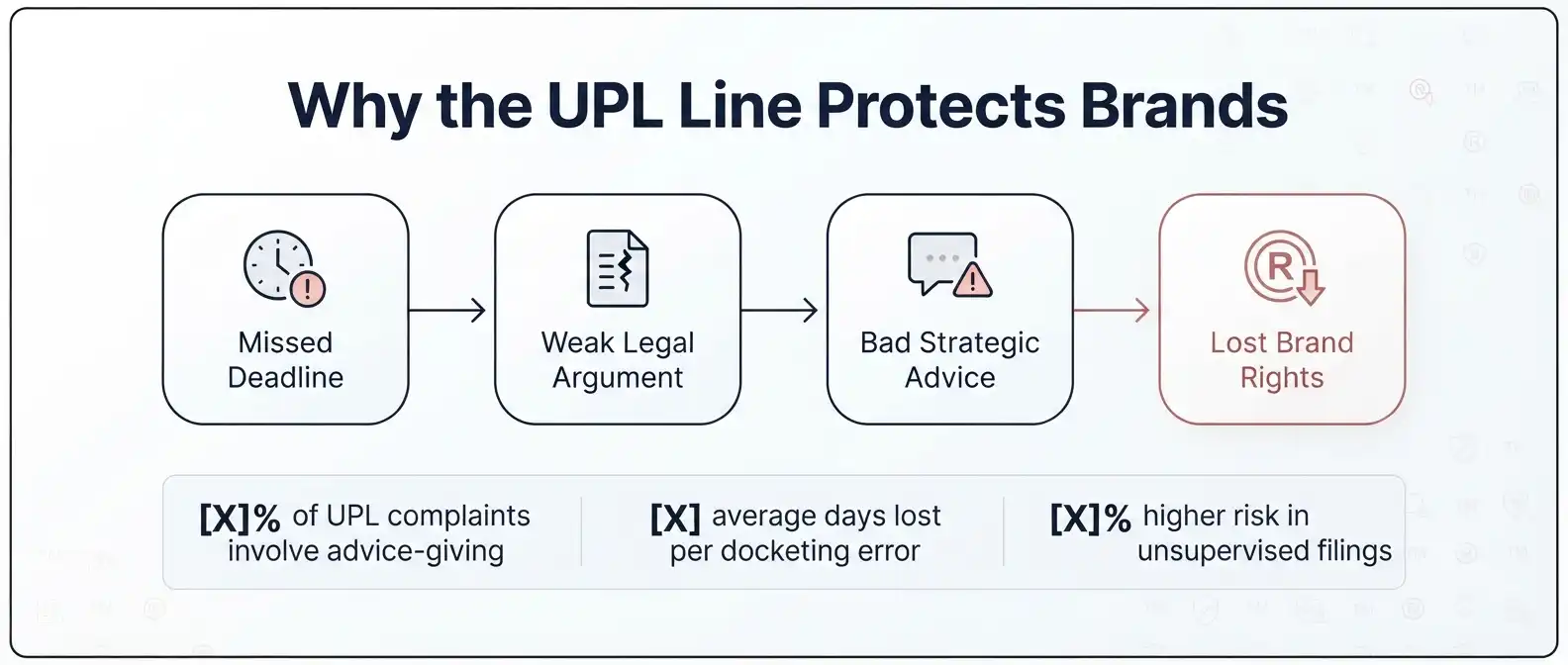
UPL rules are not bureaucratic obstacles. They exist to protect trademark applicants and registrants from unqualified guidance during a legal process where mistakes can permanently damage brand rights. A missed statutory deadline, a poorly drafted response to a likelihood-of-confusion refusal, or bad advice about abandoning a mark can cost a business its name entirely. Consequently, licensing rules ensure that someone accountable, trained, and insured is making the substantive legal calls.
Who Can Legally Represent Clients Before the USPTO?
Understanding paralegal limits starts with understanding who is authorized to represent trademark applicants in the first place.
Under 37 C.F.R. § 11.14, any individual who is an attorney, meaning an active member in good standing of the bar of the highest court of any U.S. state, may represent others before the USPTO in trademark matters, and such attorneys are not required to apply for separate registration or recognition to practice before the USPTO in trademark matters. Registration as a patent practitioner alone does not authorize someone to handle trademark matters, and non-lawyers are generally not recognized to represent parties before the Office in trademark and other non-patent matters, aside from a narrow historical exception for individuals recognized before 1957.
In short, trademark paralegals cannot become the attorney of record, cannot sign as the representative, and cannot appear on behalf of a client in a substantive capacity before the USPTO or the TTAB. Everything they do must run through, and be owned by, a licensed attorney.
What Tasks Can a Trademark Paralegal Do Without Unauthorized Practice of Law?
This is the heart of the question, and it deserves a clear, organized answer. The tasks below represent the bulk of day-to-day trademark paralegal support that firms and corporate legal departments rely on every single week.
1. Trademark Clearance and Availability Searches
A paralegal can run comprehensive clearance searches across the USPTO’s Trademark Electronic Search System (TESS), state trademark databases, common law sources, and domain registries. They can compile the results into an organized report, flag potentially conflicting marks, and highlight classes of goods and services that overlap.
What a paralegal cannot do is tell the client whether the mark is legally safe to use or register. That conclusion, the actual risk opinion, requires the application of legal judgment and must come from the attorney. For a deeper look at how this process typically works, see our related article on what a pre-filing trademark clearance search involves.
2. Preparing Trademark Applications for Attorney Review
Paralegals routinely draft new trademark applications, including:
- Entering applicant and mark information into the Trademark Electronic Application System (TEAS)
- Drafting the identification of goods and services based on attorney instruction
- Attaching specimens of use and formatting them correctly
- Calculating filing fees and confirming the correct filing basis
The application is only submitted after the supervising attorney reviews and approves the substantive content, particularly the classification strategy and legal basis for filing.
3. Docketing and Deadline Management
Docketing is one of the most valuable, lowest-risk tasks a trademark paralegal can own. This includes:
- Calendaring statutory deadlines for Office Action responses, statements of use, and renewals
- Monitoring USPTO status updates and TSDR (Trademark Status and Document Retrieval) changes
- Sending internal reminders well ahead of critical dates
- Maintaining the master IP portfolio calendar for multiple jurisdictions
Because docketing is administrative and process-driven rather than advisory, it carries essentially no UPL risk when performed accurately. If your firm is weighing in-house versus outsourced docketing support, our comparison on managed trademark docketing versus software walks through the trade-offs in detail.
4. Drafting (Not Finalizing) Office Action Responses
This is where firms most often get nervous, and rightly so. A paralegal can absolutely draft the first version of an Office Action response, including:
- Summarizing the examining attorney’s refusal or requirement
- Pulling supporting case citations and TMEP sections the attorney has identified
- Formatting arguments the attorney has already outlined
- Preparing exhibits, specimens, or evidence for submission
However, the paralegal cannot decide the legal argument, cannot finalize the substantive position, and cannot file the response without attorney sign-off. The attorney must review, revise as needed, and take ownership of the final filing.
5. Managing Trademark Renewals and Post-Registration Maintenance
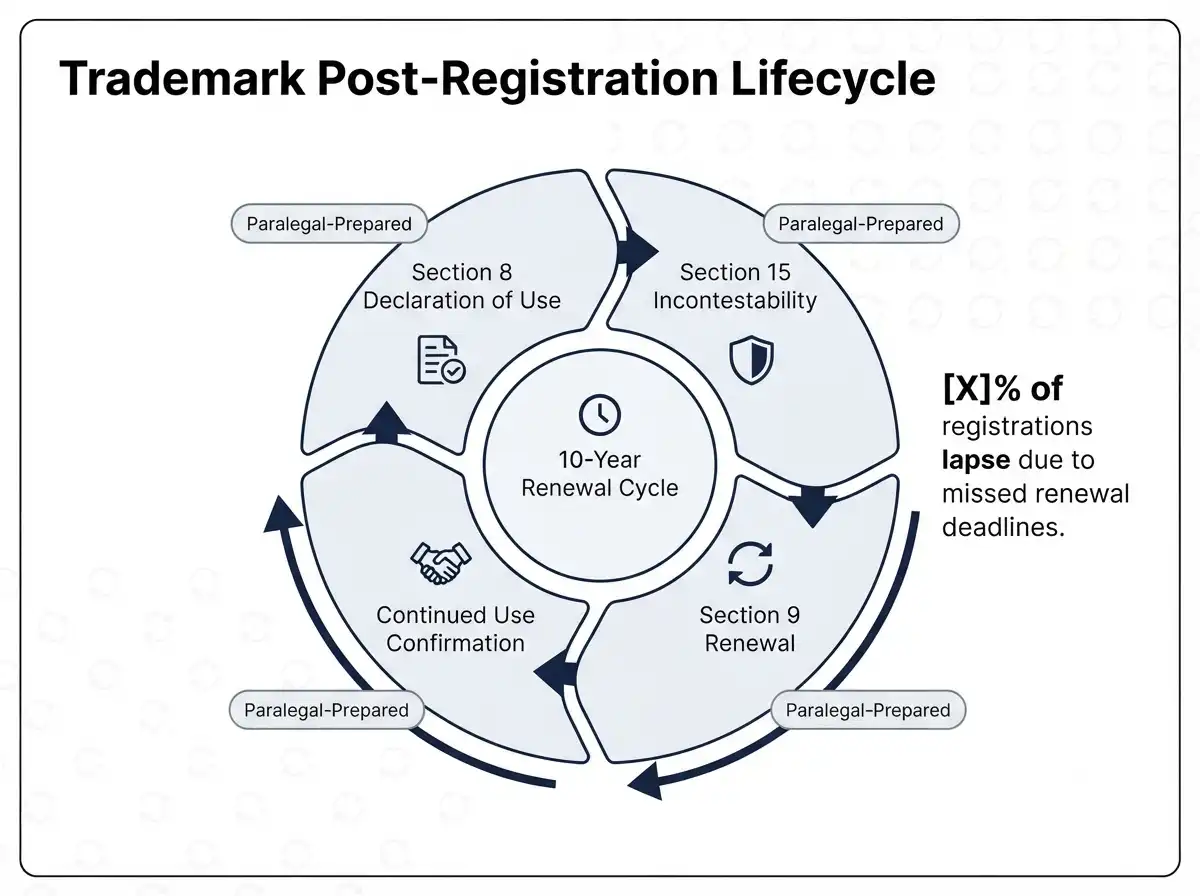
Paralegals can track and prepare Section 8 Declarations of Use, Section 15 Declarations of Incontestability, and Section 9 renewal applications, gathering the specimens and confirming continued use with the client. For a full walkthrough of how this is typically structured across large portfolios, see how to manage corporate trademark renewals globally.
6. Recording Assignments and Ownership Changes
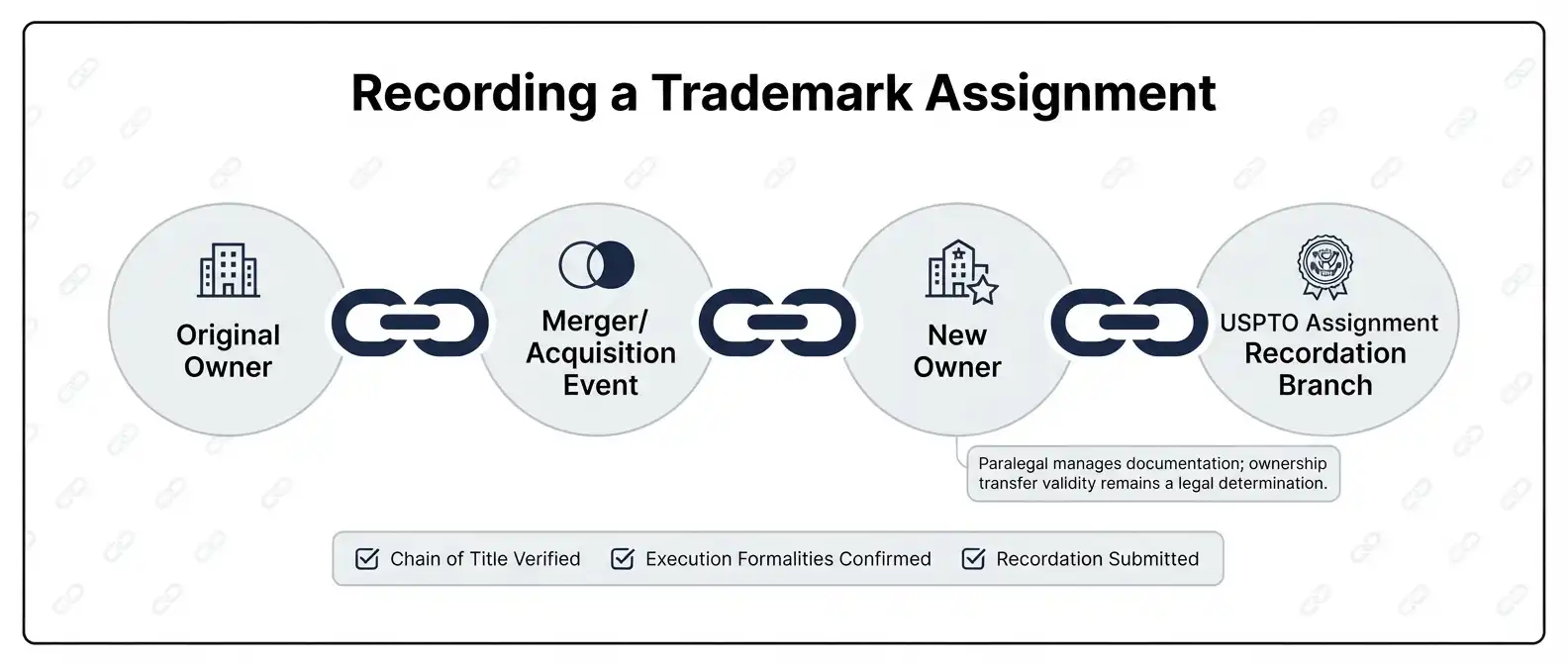
Trademark paralegals frequently prepare and submit assignment recordation documents with the USPTO’s Assignment Recordation Branch after a merger, acquisition, or corporate restructuring. They gather the chain of title, confirm execution formalities, and submit the recordation paperwork. Our related guide on how to record a trademark assignment with the USPTO covers this process step by step.
7. Supporting TTAB Proceedings (Without Appearing)
Paralegals can prepare discovery documents, organize exhibits, calendar TTAB deadlines, and format filings for oppositions and cancellations. What they cannot do is sign pleadings as the representative, argue motions, or take a deposition. For more on how this division of labor typically works, our article on companies that provide trained TTAB paralegal support is a useful next read.
8. Client Communication on Non-Substantive Matters
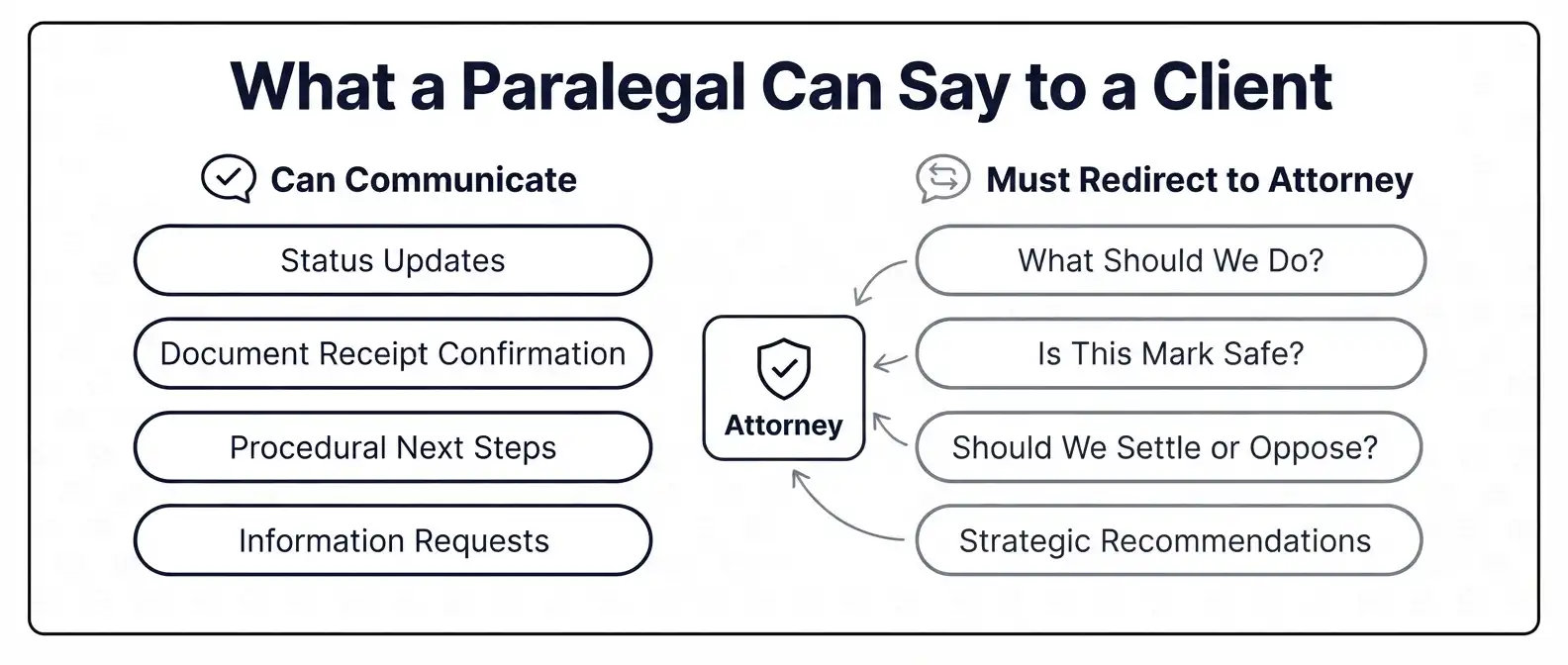
Paralegals can confirm receipt of documents, provide status updates on where a matter stands in the USPTO pipeline, request information needed for a filing, and explain procedural next steps the attorney has already decided. They cannot recommend a course of action, interpret what a refusal means for the client’s business strategy, or answer “what should we do” questions.
Permitted Trademark Paralegal Tasks vs. Attorney-Only Tasks
| Task Category | Trademark Paralegal Can Do | Attorney-Only |
|---|---|---|
| Clearance search | Run search, compile report, flag conflicts | Give legal opinion on registrability or infringement risk |
| Application filing | Draft, enter data, format, attach specimens | Approve legal strategy, sign as attorney of record |
| Office Action response | Draft based on attorney direction, cite TMEP sections attorney identifies | Decide legal argument, finalize and file response |
| Docketing | Calendar deadlines, send reminders, track status | N/A (administrative, no legal judgment required) |
| Renewals | Prepare declarations, gather specimens, confirm use | Confirm legal sufficiency and sign filing |
| TTAB proceedings | Prepare exhibits, organize discovery, calendar dates | Sign pleadings, argue motions, appear at hearings |
| Client communication | Status updates, procedural explanations | Legal advice, strategic recommendations |
| Fee and cost estimates | Calculate USPTO filing fees | Advise on litigation or dispute cost-benefit analysis |
Comparison Table: Trademark Paralegal vs. Trademark Attorney Responsibilities
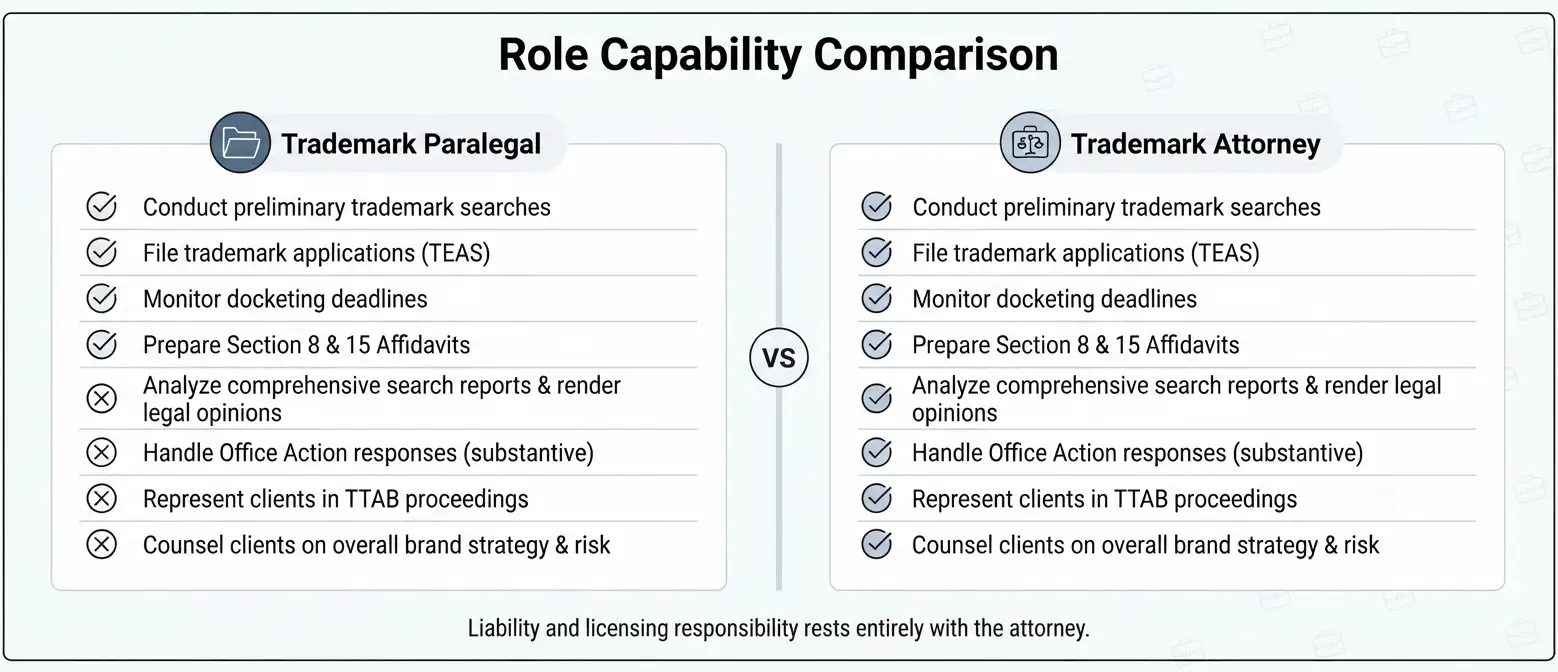
According to guidance summarized by the National Association of Legal Assistants, paralegals should not establish attorney-client relationships, set legal fees, give legal opinions or advice, or represent a client before a tribunal unless specifically authorized, nor should they engage in, encourage, or contribute to any act that could constitute the unauthorized practice of law.
How State Rules on Unauthorized Practice of Law Can Vary
Because UPL is largely a matter of state law rather than a single federal standard, the practical boundaries for trademark paralegal support can shift depending on where the supervising attorney is licensed and where the client is located. A few things to keep in mind:
- State bar guidelines differ in detail, though not in spirit. States such as Connecticut, Michigan, and Georgia have each published their own guidelines for lawyers who employ legal assistants, and while the wording varies, the underlying principle stays consistent: paralegals support, attorneys decide.
- No state currently permits paralegals to give legal advice directly to clients or to conduct depositions, regardless of how the state defines “practice of law” elsewhere in its code.
- Federal trademark practice adds another layer. Even if a paralegal’s home state has relatively permissive rules for certain nonlawyer activities, representation before the USPTO is governed separately by 37 C.F.R. Part 11, which applies nationwide regardless of state-specific UPL definitions.
- Multi-jurisdictional portfolios raise the stakes. A corporate trademark department managing marks across dozens of countries needs paralegal support that understands not just U.S. UPL boundaries, but also how foreign associates and local counsel structures affect where paralegal drafting ends and attorney decision-making begins.
Firms operating across state lines, or supporting clients with international filings, should not assume that one state’s guidance automatically applies everywhere. When in doubt, the safest approach is always the most conservative one: treat any task involving legal judgment as attorney-only, regardless of jurisdiction.
Why Properly Delegating Trademark Paralegal Tasks Benefits Everyone
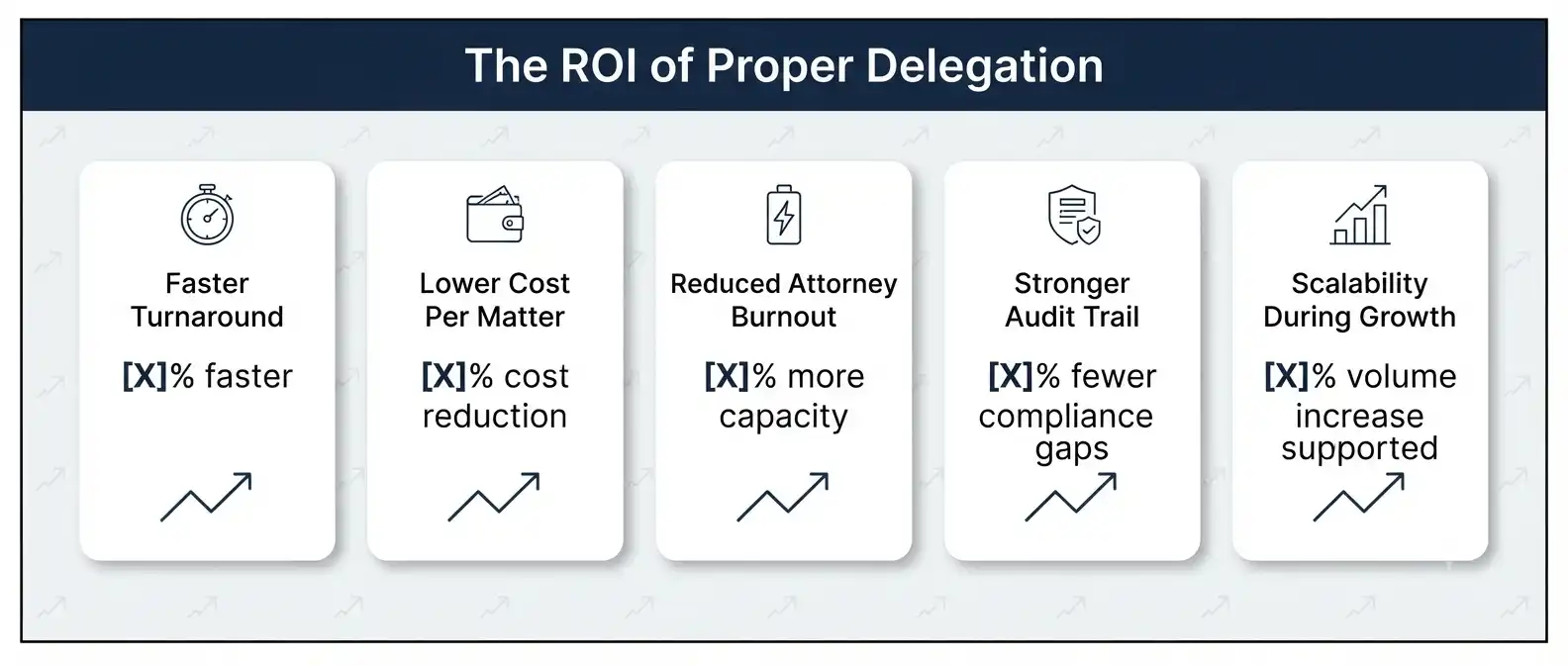
Getting the delegation model right is not just about avoiding UPL exposure. It also produces real, measurable business benefits.
- Faster turnaround on routine filings. When paralegals own docketing, drafting, and evidence-gathering, attorneys can focus their limited hours on the legal judgment calls that actually require a law license.
- Lower cost per matter for clients. Routing administrative and preparatory work to paralegals, who typically bill at a lower rate than attorneys, keeps overall trademark prosecution costs more predictable and competitive.
- Reduced burnout and better retention. Attorneys who are not buried in data entry and formatting have more bandwidth for strategic client counseling, which improves both morale and client satisfaction.
- Stronger audit trails. A firm that documents clear task boundaries between paralegals and attorneys is far better positioned to defend its practices if a UPL complaint, bar inquiry, or malpractice claim ever arises.
- Scalability during volume spikes. Portfolios that suddenly expand, whether through acquisition, new product launches, or international growth, can lean on paralegal capacity instead of forcing attorneys to absorb every incremental filing themselves.
None of these benefits require cutting corners on supervision. In fact, the opposite is true: the firms that see the biggest efficiency gains from paralegal support are usually the ones with the clearest, most disciplined delegation frameworks in place.
Common Mistakes Firms Make With Trademark Paralegal Delegation
Even well-run firms slip into UPL risk without realizing it. Watch for these recurring patterns.
- Letting a paralegal “just this once” answer a client’s strategic question when the attorney is unavailable. A quick answer to “should we file now or wait” is legal advice, regardless of urgency.
- Allowing a paralegal’s name or signature block to appear as if they are the attorney of record on correspondence or filings.
- Treating docketing software output as a substitute for attorney review of substantive deadlines tied to legal strategy, such as opposition timing decisions.
- Assuming that because a paralegal has years of experience, their judgment calls carry the same weight as an attorney’s. Experience does not substitute for licensure.
- Failing to document supervision. If a UPL complaint or malpractice claim arises, firms need a clear record showing attorney review at each substantive step.
Under ABA Model Rule 5.3, a supervising attorney must make reasonable efforts to ensure that a paralegal’s conduct is compatible with the attorney’s own professional obligations, and the attorney remains responsible for the nonlawyer’s conduct if the attorney orders it or, with knowledge, ratifies it. That supervisory duty cannot be delegated away.
Expert Tips for Structuring Trademark Paralegal Support Safely
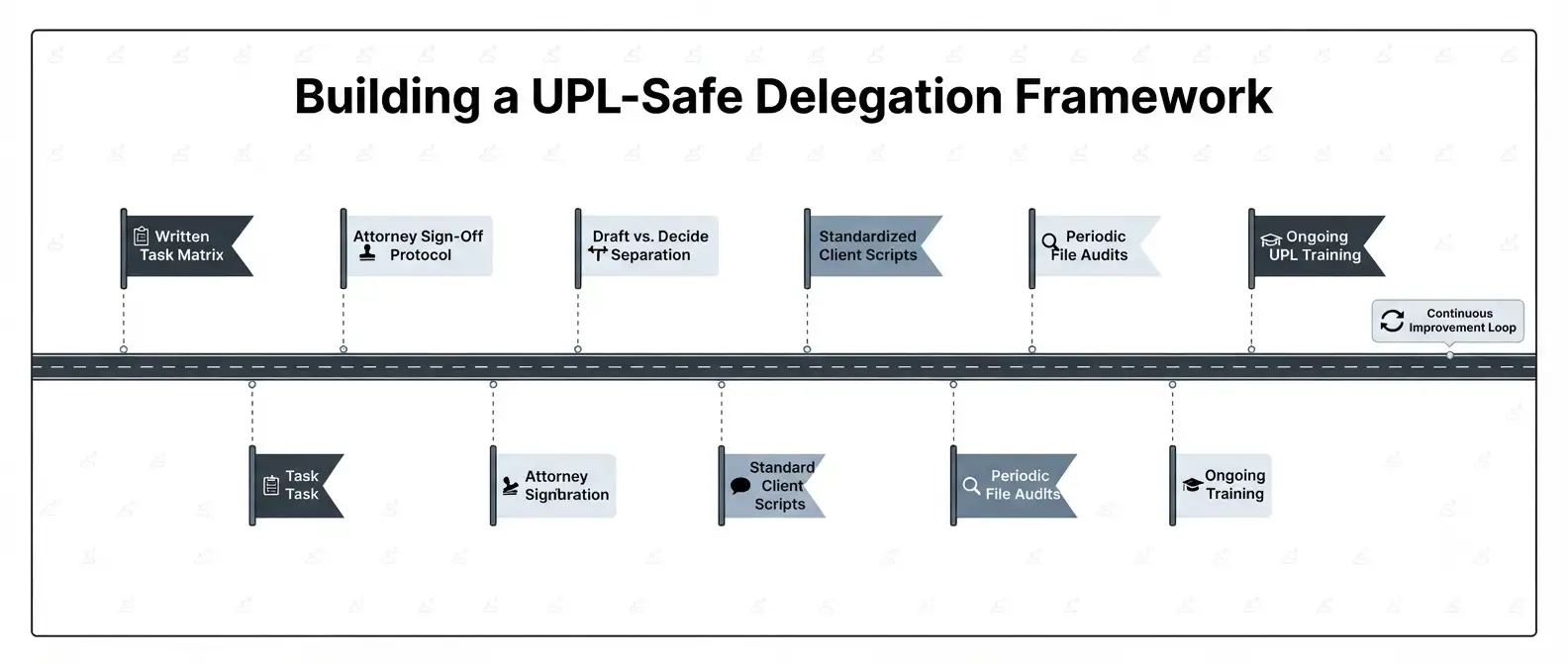
Firms and in-house teams that use trademark paralegal support well tend to follow a few consistent practices.
- Build a written task matrix that explicitly lists which tasks are paralegal-eligible and which require attorney sign-off, and revisit it whenever new team members join.
- Require attorney initials or digital sign-off on every substantive filing before it leaves the building, even for routine renewals.
- Separate “drafting” from “deciding.” Paralegals should draft language, gather facts, and organize evidence. Attorneys should decide legal positions and strategy.
- Use standardized client-facing language for paralegals to use when a client asks a legal question, such as “That’s a great question for [Attorney Name] — let me get you time on their calendar this week.”
- Audit files periodically to confirm attorney review actually happened and was documented, not just assumed.
- Invest in ongoing paralegal training on UPL boundaries specific to trademark law, since the rules differ meaningfully from litigation or patent paralegal work.
Step-by-Step: How a Compliant Trademark Filing Workflow Should Look
- Client intake and initial facts gathering – Paralegal collects the proposed mark, goods and services description, and use dates.
- Clearance search – Paralegal runs the search and compiles a factual report of potential conflicts.
- Attorney risk assessment – Attorney reviews the report and issues a legal opinion on registrability and risk.
- Application drafting – Paralegal drafts the application in TEAS based on attorney-approved classification and basis.
- Attorney review and approval – Attorney reviews the draft, confirms legal accuracy, and authorizes filing.
- Filing and docketing – Paralegal files the application (under attorney authorization) and dockets all resulting deadlines.
- Office Action handling – If a refusal issues, the paralegal drafts a response outline; the attorney determines the legal argument and finalizes it.
- Ongoing maintenance – Paralegal tracks renewal deadlines and prepares maintenance filings for attorney review and signature.
Why This Matters More Than Ever in 2026
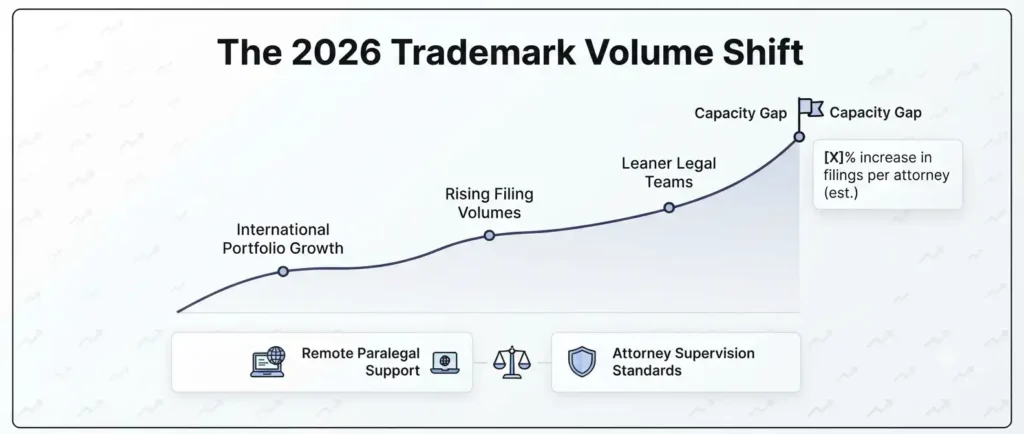
Trademark portfolios are growing internationally, docketing volumes are rising, and firms are under constant pressure to do more with lean teams. That pressure is exactly why clear delegation rules matter. A well-trained trademark paralegal, working under proper attorney supervision, dramatically increases a firm’s capacity without increasing UPL exposure. Firms that get this balance wrong risk disciplinary complaints against the supervising attorney, malpractice exposure, and reputational damage with clients who relied on advice that was never actually validated by counsel.
If your firm is scaling its trademark practice and evaluating whether current staffing can keep pace, it is worth comparing options for hiring a remote trademark paralegal with international portfolio experience, since remote and outsourced models can extend attorney capacity without compromising supervision standards.
Glossary of Key Terms
Understanding a few core terms makes the rest of this guide, and any conversation with your legal team, much easier to follow.
- Unauthorized Practice of Law (UPL): The performance of legal tasks reserved for licensed attorneys by someone who is not licensed to practice law in that jurisdiction.
- Attorney of Record: The specific, licensed attorney formally recognized by the USPTO as representing an applicant, registrant, or party to a proceeding.
- TEAS (Trademark Electronic Application System): The USPTO’s online portal used to file and manage trademark applications and related documents.
- TTAB (Trademark Trial and Appeal Board): The administrative tribunal within the USPTO that decides oppositions, cancellations, and appeals related to trademark registration.
- Office Action: A written communication from a USPTO examining attorney raising refusals or requirements that must be addressed before an application can proceed.
- Docketing: The process of tracking and calendaring legal deadlines tied to a matter, such as response due dates and renewal windows.
- Legal Advice: The application of legal judgment to a client’s specific facts in order to recommend a course of action, as opposed to simply stating general legal information.
Keeping these definitions consistent across your team helps avoid the kind of informal drift that often precedes a UPL problem: a paralegal who starts by “just explaining” a rule can slowly end up giving advice without anyone noticing the shift.
Bringing It All Together
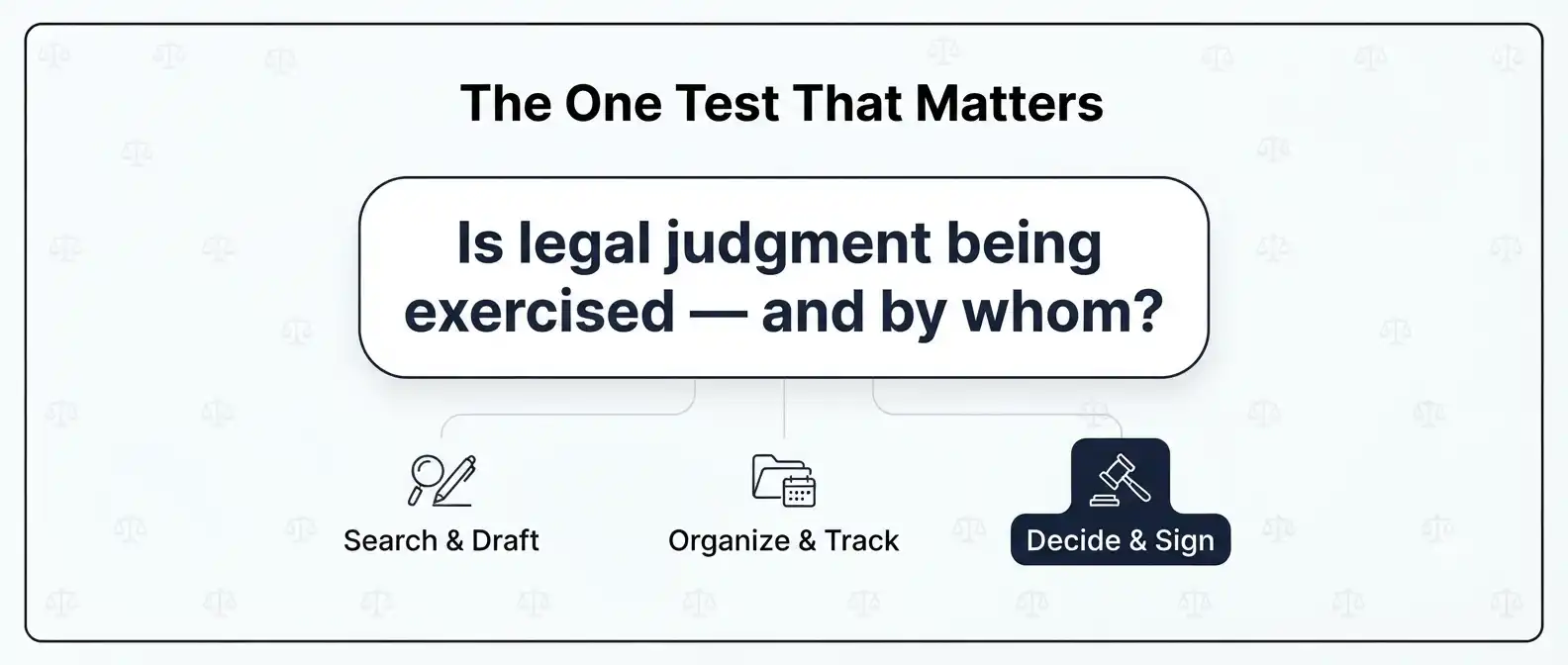
The question of what tasks a trademark paralegal can do without unauthorized practice of law ultimately comes down to one repeated test: is legal judgment being exercised, and if so, is a licensed attorney the one exercising it? Searches, drafts, docketing entries, and status updates all pass that test comfortably. Legal opinions, signed filings, and TTAB appearances do not. Firms that build their workflows around this single test, rather than trying to memorize an exhaustive list of dos and don’ts, tend to navigate UPL boundaries with far more confidence and far fewer surprises.
Frequently Asked Questions
What tasks can a trademark paralegal do without unauthorized practice of law?
A trademark paralegal can conduct clearance searches, draft applications and Office Action responses for attorney review, manage docketing and renewals, prepare TTAB exhibits, and handle non-substantive client communication, provided every substantive step is reviewed and approved by a supervising attorney.
Can a trademark paralegal give legal advice to a client?
No. Giving legal advice, meaning applying legal judgment to a client’s specific situation and recommending a course of action, is reserved for licensed attorneys. A paralegal who tells a client whether to file, settle, or abandon a mark is engaging in unauthorized practice of law.
Can a paralegal sign a trademark application or Office Action response?
No. Only an attorney qualified under 37 C.F.R. § 11.14, or the applicant acting pro se, may sign as the representative of record before the USPTO. A paralegal can prepare the document, but the attorney must review, approve, and authorize the filing.
Can a trademark paralegal represent a client at the TTAB?
No. Paralegals can prepare discovery, organize exhibits, and calendar deadlines for TTAB proceedings, but they cannot sign pleadings, argue motions, or appear as the representative in a hearing.
Is running a trademark clearance search considered practicing law?
Running the search itself is not practicing law. Interpreting the results and rendering a legal opinion on registrability or infringement risk is. Paralegals commonly perform the former under attorney supervision.
What happens if a paralegal accidentally engages in unauthorized practice of law?
Consequences can include disciplinary action against the supervising attorney under rules like ABA Model Rule 5.5, potential civil or criminal liability for the paralegal depending on the state, and malpractice exposure for the firm. This is why written supervision protocols and documented review matter so much.
Do trademark paralegal UPL rules differ from patent paralegal rules?
Yes, to some degree. Both fall under the broader USPTO representation framework in 37 C.F.R. Part 11, but the specific tasks and registration pathways differ. Patent paralegals often support registered patent agents or attorneys through technical drafting and prior art organization, while trademark paralegals focus more heavily on clearance searches, classification, and Office Action support. In both cases, the same core principle applies: substantive legal judgment stays with a licensed, qualified practitioner.
Can an in-house corporate paralegal handle trademark filings without outside counsel?
An in-house paralegal can prepare and manage the administrative side of filings, but the application still needs to be filed and represented by an attorney qualified under 37 C.F.R. § 11.14, whether that attorney is in-house counsel or outside counsel. The in-house paralegal cannot independently sign as the representative of record.
How can a firm document proper attorney supervision of paralegal work?
Common methods include requiring attorney initials or digital approval on every substantive draft before filing, maintaining a task matrix that assigns responsibility by task type, logging review dates in the practice management system, and conducting periodic file audits to confirm that documented review actually occurred rather than being assumed.
Conclusion
So, what tasks can a trademark paralegal do without unauthorized practice of law? The honest answer is: a great deal, as long as every substantive legal judgment stays with a licensed attorney. Trademark paralegals can search, draft, docket, organize, and communicate on procedural matters. What they cannot do is advise, sign as counsel, or appear before the USPTO or TTAB in a representative capacity. Firms that draw this line clearly, document their supervision practices, and invest in properly trained paralegal support get the best of both worlds: faster turnaround and lower cost, without stepping anywhere near UPL risk.
If your firm needs experienced, attorney-supervised trademark paralegal support that understands exactly where this line sits, Teak IP Services can help you scale your trademark practice safely and efficiently. Contact our team today to discuss your portfolio’s needs.


2 Responses