
A missed renewal deadline does not send a warning email to your entire team. It simply expires quietly, and by the time anyone notices, the client’s brand protection is gone. This is the exact risk that keeps IP directors, trademark attorneys, and law firm administrators awake at night, and it is why the debate over the benefits of managed trademark docketing vs software has become one of the most important operational decisions in intellectual property practice today.

Docketing software promises automation, dashboards, and deadline calculators. However, software alone cannot catch a misfiled foreign associate instruction, question an unusual USPTO Office Action, or flag a client instruction that contradicts the file history. That is where managed trademark docketing enters the picture, combining trained paralegals, attorney oversight, and proven workflows with the technology itself.
In this guide, we will break down exactly what managed trademark docketing means, how it compares to a software-only approach, and why so many law firms and corporate IP departments are shifting toward a hybrid, human-supervised model. Whether you manage ten trademarks or ten thousand, understanding the benefits of managed trademark docketing vs software will help you protect your portfolio, control costs, and avoid the deadline disasters that no algorithm can fully prevent.
The High-Stakes cost of a Missed Trademark Deadline (benefits of managed trademark docketing vs software)
What is Trademark Docketing?
Trademark docketing is the ongoing process of tracking every date, deadline, and procedural requirement tied to a trademark application or registration.
This includes:
- Office Action response deadlines
- Statement of Use and Extension deadlines
- Section 8 and Section 15 Declarations of Use
- Section 9 renewal filings
- Opposition and cancellation proceeding timelines
- International filing deadlines under the Madrid Protocol
Trademark Deadline Types at a Glance
Office Action Response
typically a 3-6 month window
Statement of Use
/ Extension requests
Section 8 Declaration
grace period ends registration
Section 15 Incontestability
strengthens rights status
Section 9 Renewal
10-year recurring cycle
Madrid Protocol Filing
jurisdiction-specific rules
Because trademark law involves strict statutory deadlines, even a single missed date can result in the abandonment of an application or the cancellation of a registration. According to the <cite index=”2-1″>United States Patent and Trademark Office</cite>, trademark owners are responsible for maintaining their registrations through timely post-registration filings, and there is no guaranteed grace period once a hard deadline lapses in most circumstances.
Managed Trademark Docketing vs Software: The Core Difference
The fundamental distinction comes down to one question: who is actually watching the calendar?
Docketing software is a technology platform. It stores dates, sends automated reminders, and generates reports. It performs exactly the tasks it is programmed to perform, and nothing more.
Managed trademark docketing is a service model. It pairs the same (or similar) software infrastructure with trained IP paralegals and attorney-reviewed workflows who actively monitor the docket, interpret unusual filings, catch data entry errors, and communicate proactively with your team.
Where Managed Docketing Adds a Layer Software Cannot
Put simply, software tells you a date exists. A managed docketing team tells you what that date means, why it matters, and what could go wrong if it is handled incorrectly.
Quick Answer: What Is the Main Benefit of Managed Trademark Docketing?
The primary benefit of managed trademark docketing vs software is human oversight. Trained paralegals catch errors, ambiguities, and anomalies in the docket that automated systems are not designed to recognize, significantly reducing the risk of missed deadlines and abandoned trademarks.
Key Benefits of Managed Trademark Docketing vs Software
1. Human Verification Catches What Automation Misses
Software is only as accurate as the data entered into it. If a paralegal mistypes a filing date, or if a foreign associate sends an ambiguous instruction, standalone software will simply calculate deadlines based on the flawed input. It has no ability to question the data.
How Errors Get Caught Before They Become Missed Deadlines
Common Errors Caught
- Mistyped filing date
- Ambiguous foreign associate instruction
- Duplicate matter entry
Managed trademark docketing solves this through:
- Dual-entry verification by trained staff
- Cross-checking against official USPTO and international IP office records
- Flagging inconsistencies before they become missed deadlines
This human layer is often what separates a clean trademark portfolio from one riddled with silent errors.
2. Proactive Communication, Not Just Automated Alerts
A software reminder is a passive notification sitting in an inbox among hundreds of other emails. A managed docketing team, however, actively follows up when a deadline approaches and a client has not responded, calls attention to unusual filings, and escalates urgent matters directly to the responsible attorney.
Passive Reminder vs Active Follow-Up
Average response time reduced by X hours.
This proactive layer matters enormously during busy periods, when automated emails are the easiest thing to overlook.
3. Expertise in Complex and Unusual Filings
Trademark prosecution is rarely a straight line. Office Actions, oppositions, and international filings under the Madrid Protocol often involve nuanced procedural requirements that a generic docketing system cannot interpret.
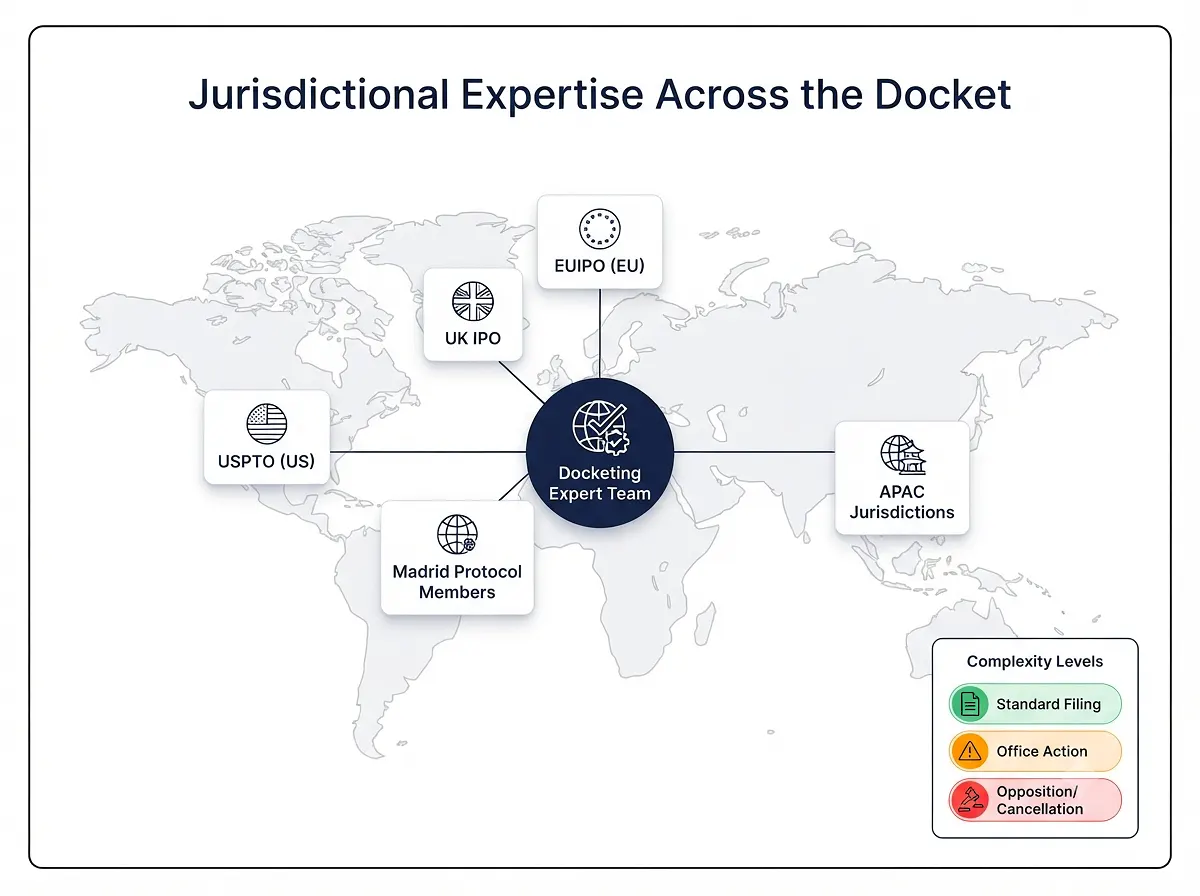
Managed docketing teams bring:
- Familiarity with USPTO TEAS filing requirements
- Experience coordinating with foreign associates across multiple jurisdictions
- Knowledge of jurisdiction-specific renewal and maintenance rules
Software cannot advise you on how to respond to a nuanced procedural issue. A trained docketing professional often can, or will know exactly who on your team should.
4. Reduced Risk of Malpractice Exposure
Missed trademark deadlines are one of the leading causes of legal malpractice claims in IP practice. A managed docketing service functions as an additional layer of risk management, providing:
- Redundant deadline verification (not a single point of failure)
- Documented audit trails for every docket entry
- Clear accountability structures if an issue arises
Deadline Risk Positioning
Likelihood of Error →Defense-in-Depth Architecture
Firms that rely solely on software carry the full risk internally. If the system is misconfigured or a reminder is dismissed, there is no additional safety net.
5. Scalability Without Increasing Headcount
As a trademark portfolio grows, so does the administrative burden of managing it. Managed docketing services allow law firms and corporate legal departments to scale their docketing capacity without hiring, training, and retaining additional in-house staff.
Scaling a Trademark Portfolio: Headcount vs Managed Capacity
Scalable Growth
Add capacity without adding payroll.
This is particularly valuable for boutique firms and corporate IP departments facing budget constraints, a challenge we explored in depth in our guide on IP support services for boutique IP law firms.
6. Cost Predictability and Efficiency
The Real Cost of Docketing Software
Managed Docketing
One Predictable Service Fee
Many assume software is automatically cheaper than a managed service. In reality, when you factor in licensing fees, IT support, staff training, and the hidden cost of errors, managed trademark docketing often delivers a lower total cost of ownership. We break down real pricing models in our trademark docketing outsourcing cost guide, which compares per-matter, flat-fee, and hybrid pricing structures.
7. Attorney-Level Oversight Built Into the Workflow
Quality Gates in a Managed Docketing Workflow
Rigorous Verification
Every filing passes through independent review before submission.
Reputable managed docketing providers structure their processes so that every deliverable passes through multiple layers of review, often including attorney-level sign-off for critical filings. This mirrors best practices across other outsourced IP functions, including how firms handle trademark Office Action responses and paralegal support more broadly.
Managed Trademark Docketing vs Software: Side-by-Side Comparison
| Feature | Docketing Software Only | Managed Trademark Docketing |
|---|---|---|
| Deadline calculation | Automated, rules-based | Automated plus human review |
| Data entry verification | None (relies on user input) | Dual-checked by trained staff |
| Handling ambiguous instructions | Not possible | Escalated to a professional |
| Proactive follow-up | Passive email reminders | Active phone/email outreach |
| International filing expertise | Limited to system rules | Hands-on jurisdictional knowledge |
| Scalability during growth | Requires internal staffing | Scales with the service provider |
| Error accountability | Falls entirely on internal staff | Shared, documented accountability |
| Cost structure | Licensing plus internal labor | Predictable service fees |
Common Mistakes Firms Make With Trademark Docketing
Even experienced legal teams fall into predictable traps when managing their trademark portfolios. Avoid these common mistakes:
- Assuming software eliminates human error. Software only processes the data it receives; it cannot verify accuracy on its own.
- Failing to build in redundancy. Relying on a single staff member to monitor the docket creates a dangerous single point of failure.
- Ignoring international deadline nuances. Not every jurisdiction follows USPTO timelines, and Madrid Protocol filings have their own procedural quirks.
- Underestimating renewal complexity. Section 8, Section 9, and Section 15 filings each carry distinct deadlines and grace periods that are easy to confuse.
- Delaying a docket audit after switching systems. Migrating data without a full audit often carries forward existing errors instead of catching them.
If your team is unsure how your current portfolio stacks up, our article on how to manage an international trademark portfolio walks through a practical audit framework.
Expert Tips for Choosing Between Managed Docketing and Software
5 Expert Recommendations for Evaluating Docketing Solutions
Audit First
Assess Bandwidth
Prioritize Redundancy
Confirm Review Layers
Compare Total Cost
Based on years of supporting IP law firms and corporate legal departments, here are practical recommendations:
- Start with a docket audit. Before choosing a solution, understand the current accuracy of your data. Migrating flawed information into new software will not fix underlying problems.
- Evaluate your team’s bandwidth honestly. If your paralegals are already stretched across prosecution, drafting, and client communication, adding docketing oversight to their plate increases risk.
- Prioritize redundancy over convenience. A system with a single point of failure, whether human or automated, is a liability.
- Ask about attorney review layers. Confirm whether critical filings pass through a qualified reviewer before submission.
- Compare total cost, not just sticker price. Factor in training time, IT overhead, and the potential cost of a single missed deadline when comparing options.
Step-by-Step Guide: Transitioning to Managed Trademark Docketing
Transitioning to Managed Trademark Docketing
Portfolio Audit
Compare Providers
Data Migration Plan
Set Communication Protocols
Parallel Testing Period
Review Reporting Cadence
If you are considering moving from software-only docketing to a managed service, follow this general process:
- Conduct a full portfolio audit. Identify every active matter, deadline, and jurisdiction currently on file.
- Compare providers based on experience. Look for demonstrated expertise specifically in trademark law, not general legal administrative support. Our guide on evaluating and comparing IP outsourcing companies offers a detailed scorecard approach.
- Request a data migration plan. Ensure the provider verifies existing data rather than simply importing it as-is.
- Establish clear communication protocols. Define escalation paths for urgent deadlines and unusual filings.
- Run a parallel testing period. Many firms maintain their existing software briefly alongside the managed service to confirm accuracy before fully transitioning.
- Review reporting cadence. Set expectations for how often you will receive docket status updates and audit reports.
Managed Docketing and Broader IP Portfolio Strategy
Trademark Docketing as Part of a Larger IP Strategy.
Trademark docketing rarely exists in isolation. It is one piece of a larger IP portfolio management strategy that often includes patent deadlines, licensing obligations, and cross-border coordination. If your organization is weighing outsourcing more broadly, our resources on IP portfolio management outsourcing and best trademark portfolio management services provide useful context for building a comprehensive strategy rather than addressing docketing in a silo.
Frequently Asked Questions
What are the main benefits of managed trademark docketing vs software?
The main benefits of managed trademark docketing vs software include human error detection, proactive deadline follow-up, expertise in complex filings, reduced malpractice risk, and easier scalability as your portfolio grows.
Is managed trademark docketing more expensive than software alone?
Not necessarily. While software licensing fees may appear lower upfront, managed trademark docketing often reduces hidden costs like internal staff training, IT maintenance, and the financial impact of missed deadlines.
Can small firms benefit from managed trademark docketing?
Yes. Small and boutique firms often benefit the most, since managed docketing allows them to access enterprise-level oversight without hiring additional full-time staff.
Does managed trademark docketing replace the need for software entirely?
No. Most managed docketing services still use robust software as the underlying infrastructure. The service adds trained human oversight, verification, and communication on top of that technology.
How often should a trademark docket be audited?
Best practice is to conduct a full docket audit at least annually, and immediately after switching software providers or docketing service providers.
Conclusion
Choosing between managed trademark docketing and standalone software is not really a choice between old-fashioned and modern approaches. It is a choice about risk tolerance. Software alone offers speed and automation, but it cannot question ambiguous data, catch human error, or apply legal judgment to an unusual filing. Managed trademark docketing combines that same technological backbone with trained professionals who actively protect your portfolio.
Decision Snapshot
Core Differentiators of Managed Docketing
Choose Oversight Over Automation Alone.
For law firms and corporate IP departments managing high-value trademark assets, the benefits of managed trademark docketing vs software consistently favor the managed approach: fewer missed deadlines, reduced malpractice exposure, and the peace of mind that comes from knowing a real person is reviewing your docket, not just an algorithm.
If you are ready to strengthen your trademark portfolio management strategy, contact the Teak IP team to discuss how managed docketing can fit into your workflow.

