
A single unvetted vendor can put an entire patent or trademark portfolio at risk. That is why every IP director, general counsel, and legal operations leader eventually needs a formal IP vendor due diligence checklist before signing an outsourcing agreement. Whether you are evaluating a docketing provider, a patent drawing vendor, or an offshore paralegal support team, the stakes are the same: missed deadlines, mishandled confidential data, or non-compliant filings can undo years of prosecution work in a single oversight.

This guide walks through a complete, procurement-ready due diligence process built specifically for law firms and corporate legal teams. It goes beyond a simple list of questions to ask a vendor. Instead, it provides a documented, repeatable framework that legal operations and procurement teams can attach directly to a vendor approval file, satisfy internal audit requirements, and reuse every time a new IP service provider comes up for review.
If you already know the basic red flags to watch for, you may want the companion piece on evaluating and comparing IP outsourcing companies. This article focuses specifically on the formal, documented vetting process that procurement and legal ops teams need before a vendor contract is approved.
What is IP Vendor Due Diligence?
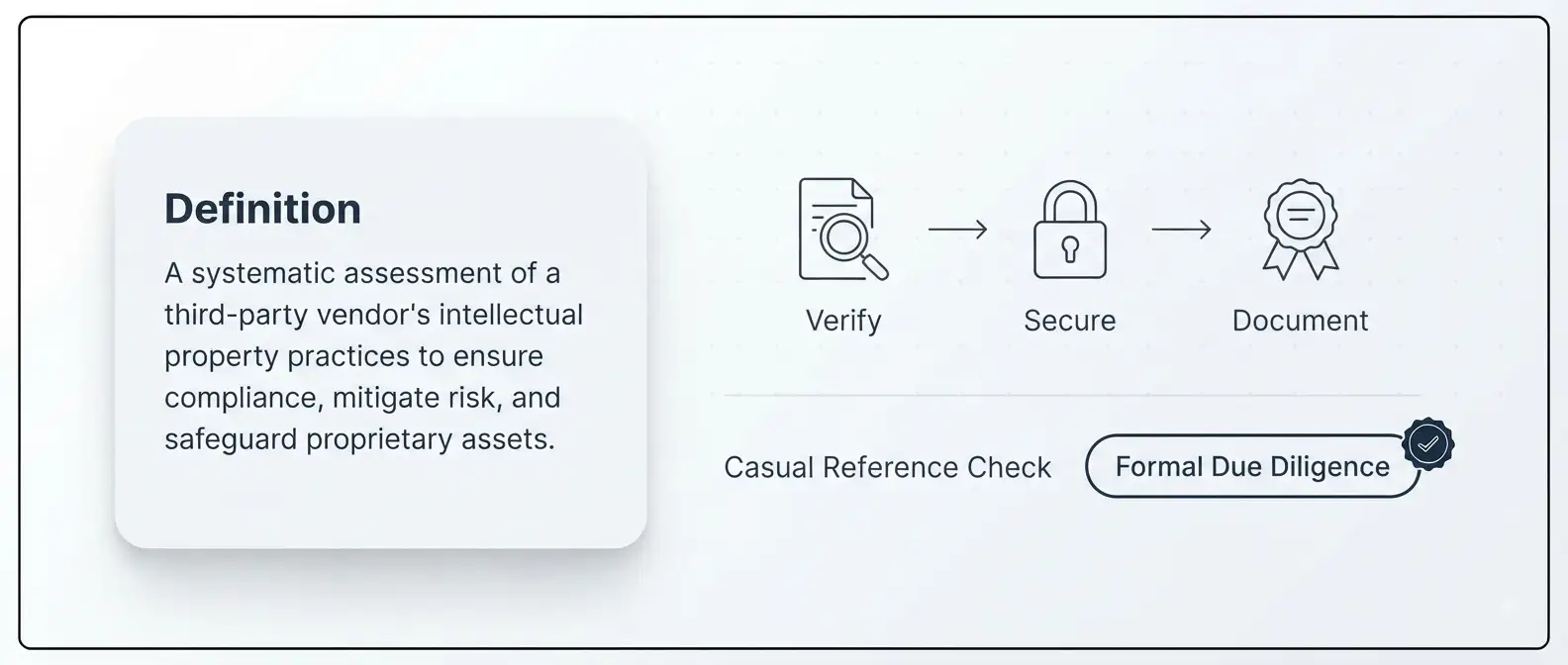
IP vendor due diligence is the structured process of verifying an intellectual property service provider’s security practices, compliance posture, operational quality, financial stability, and contractual terms before entrusting them with confidential patent, trademark, or portfolio management work.
Unlike a casual reference check, formal due diligence produces a documented record: signed questionnaires, security certifications, insurance certificates, and a defined risk score. That documentation matters because most law firms and corporate legal departments now face internal audit requirements, client outside-counsel guidelines, or corporate procurement policies that mandate proof of vendor vetting before any engagement letter or master services agreement is signed.
In short, due diligence answers one question with evidence, not assumptions: can this vendor be trusted with our clients’ intellectual property?
Why an IP Vendor Due Diligence Checklist Matters for Legal Teams
Intellectual property work involves some of the most sensitive information a company owns: unpublished patent applications, trade secret filings, litigation strategy, and unregistered trademarks that have not yet been publicly disclosed. Consequently, a vendor relationship in this space carries a different risk profile than a typical business process outsourcing arrangement.
A documented IP vendor due diligence checklist matters for several concrete reasons:
- Client outside-counsel guidelines increasingly require it. Corporate clients now routinely ask law firms to disclose which vendors touch their matters and to prove those vendors meet defined security standards.
- Confidentiality obligations extend to subcontractors. If a docketing vendor mishandles data, the law firm or in-house team, not the vendor, is typically the party that answers to the client.
- Missed deadlines are irreversible in IP law. A blown statutory bar date or an abandoned application because of a vendor’s quality control failure cannot always be fixed after the fact.
- Procurement and legal ops teams need auditable records. A checklist converts due diligence from a verbal conversation into a defensible, documented process.
- Budget owners need comparability. A consistent checklist allows IP directors to score multiple vendors against the same criteria rather than relying on subjective impressions from a sales call.
Firms that have already outsourced parts of their docket, such as patent lifecycle management or trademark renewals, generally learn this lesson the hard way if due diligence was skipped at the outset. Building the checklist upfront avoids that outcome.
Who Should Own the IP Vendor Due Diligence Process
In most organizations, IP vendor due diligence is not a one-person task. It typically involves a small cross-functional group, and assigning clear ownership prevents gaps.
| Role | Primary Responsibility in the Due Diligence Process |
|---|---|
| IP Director / General Counsel | Defines risk tolerance, approves final vendor selection, signs off on scope |
| Legal Operations / Procurement | Runs the formal RFP or questionnaire process, tracks documentation |
| IT / Information Security | Reviews data security controls, certifications, and infrastructure |
| Docketing / Paralegal Lead | Assesses operational fit, quality control workflow, and turnaround times |
| Finance / Accounts Payable | Confirms vendor financial stability and reviews billing structure |
| Outside Privacy Counsel (if applicable) | Reviews data transfer agreements and jurisdictional compliance |
Smaller firms and solo practitioners often collapse several of these roles into one person, frequently a senior paralegal or office manager. Even then, working through each category below in sequence keeps the process consistent and defensible.
The Complete IP Vendor Due Diligence Checklist
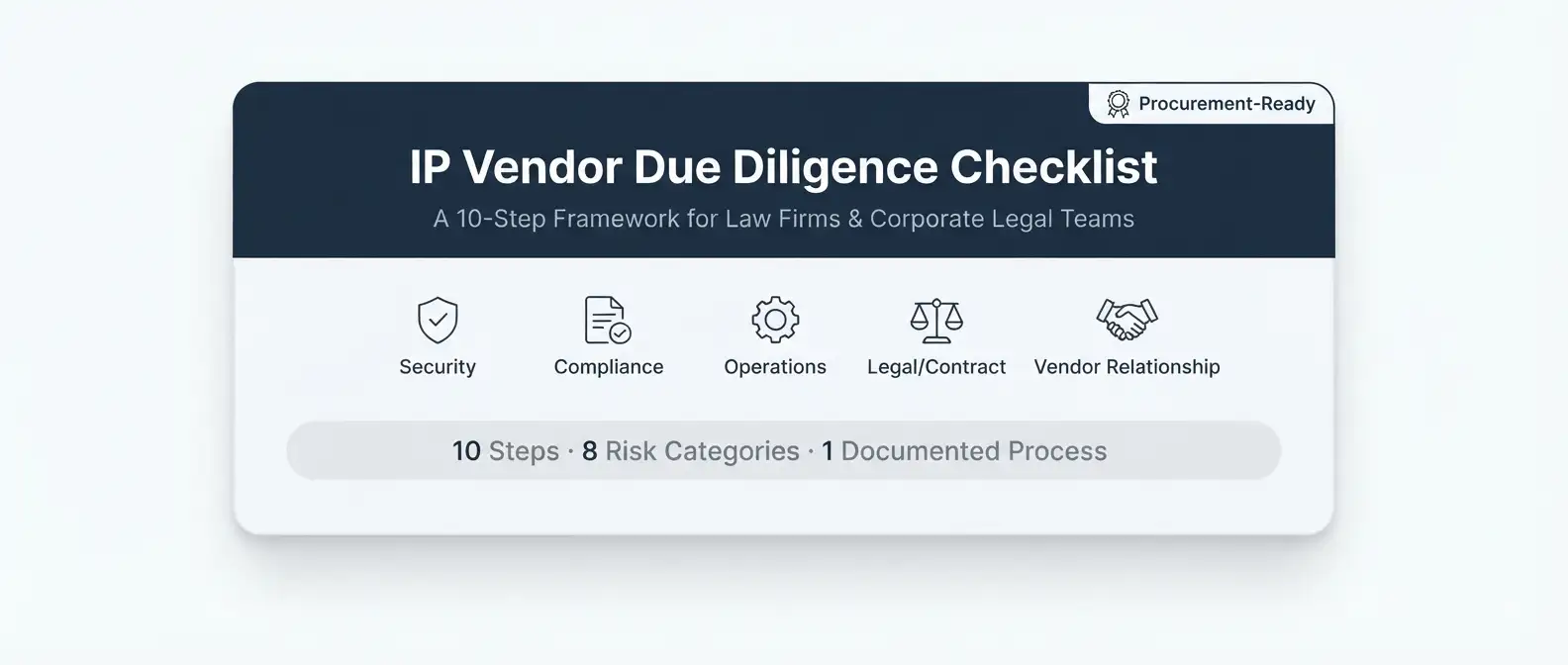
Below is the full, step-by-step IP vendor due diligence checklist, organized into ten categories. Each section includes the specific documentation to request and the questions procurement or legal ops teams should be asking during the vetting process.
Step 1: Define Scope and Risk Tolerance Before You Contact a Vendor
Before reaching out to any provider, define what the vendor will actually touch. A vendor handling patent drawings carries a different risk profile than one handling docketing deadlines or trademark portfolio management.
- Document which IP functions will be outsourced (docketing, paralegal support, drawings, IDS preparation, PCT filings, trademark monitoring, etc.)
- Identify whether the vendor will have direct access to your docketing or IP management system
- Determine whether unpublished or trade secret material will be shared
- Set an internal risk tier (low, medium, high) based on data sensitivity and deadline criticality
- Confirm whether the engagement requires client or outside-counsel guideline approval first
Step 2: Security and Data Protection Review
Data security sits at the center of nearly every IP vendor due diligence checklist, and for good reason. Patent applications and trademark filings often include confidential business information well before public disclosure.
- Request the vendor’s current SOC 2 Type II report or equivalent independent audit
- Confirm whether the vendor holds an ISO/IEC 27001 information security certification
- Ask for the vendor’s data encryption standards, both at rest and in transit
- Review access control policies, including role-based permissions and multi-factor authentication
- Request the vendor’s incident response and breach notification procedures, including notification timelines
- Confirm whether employee background checks are conducted before staff are assigned to client work
- Ask how long client data is retained after an engagement ends, and how it is destroyed
Independent frameworks such as the AICPA’s SOC 2 reporting standard and the ISO/IEC 27001 information security management standard remain the two most widely accepted benchmarks for evaluating a service provider’s security controls, and most reputable IP support vendors can produce documentation against at least one of them.
Step 3: Compliance and Regulatory Documentation
IP vendors that touch USPTO or WIPO filings need to understand the procedural rules governing those systems, not just general legal knowledge.
- Confirm the vendor’s familiarity with current USPTO rules and electronic filing requirements
- For international work, confirm familiarity with WIPO PCT procedures and Madrid System requirements
- Ask whether the vendor’s staff includes licensed attorneys, registered patent agents, or certified paralegals
- Request confirmation of any professional liability requirements tied to the vendor’s jurisdiction
- Verify the vendor maintains current knowledge of fee schedule changes and rule updates
Vendors that regularly reference primary sources such as the USPTO’s official rules of practice or WIPO’s PCT applicant’s guide tend to demonstrate stronger procedural discipline than those relying only on internal templates.
Step 4: Operational and Quality Control Verification
This is where many otherwise-promising vendors fall short. A vendor can pass every security and compliance check and still fail on execution.
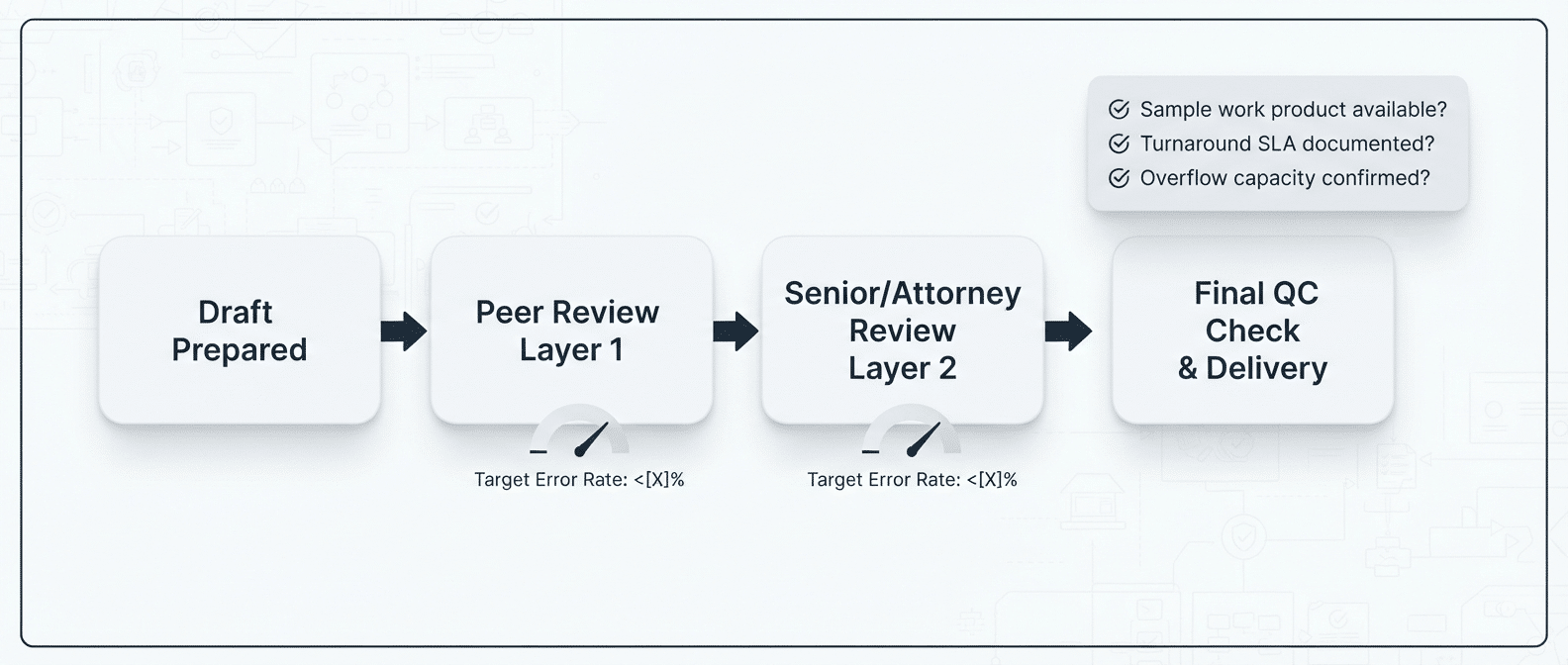
- Ask the vendor to describe its quality control workflow in writing, including how many review layers exist before a deliverable is sent
- Request average and peak turnaround times for the specific services you need
- Ask how the vendor handles overflow capacity during high-volume periods
- Confirm the vendor’s error rate tracking and how errors are corrected and reported
- Request a sample deliverable or work product, redacted as needed
- Ask about staff training programs and ongoing education for docketing rule changes
For a deeper look at what a strong multi-layer review process looks like in practice, the checklist can be compared against the workflow outlined in multi-layered quality control for patent docketing, which breaks down how review layers reduce single-point-of-failure risk.
Step 5: Financial and Business Stability Checks
A vendor that is financially unstable creates continuity risk, regardless of how strong its security posture looks on paper.
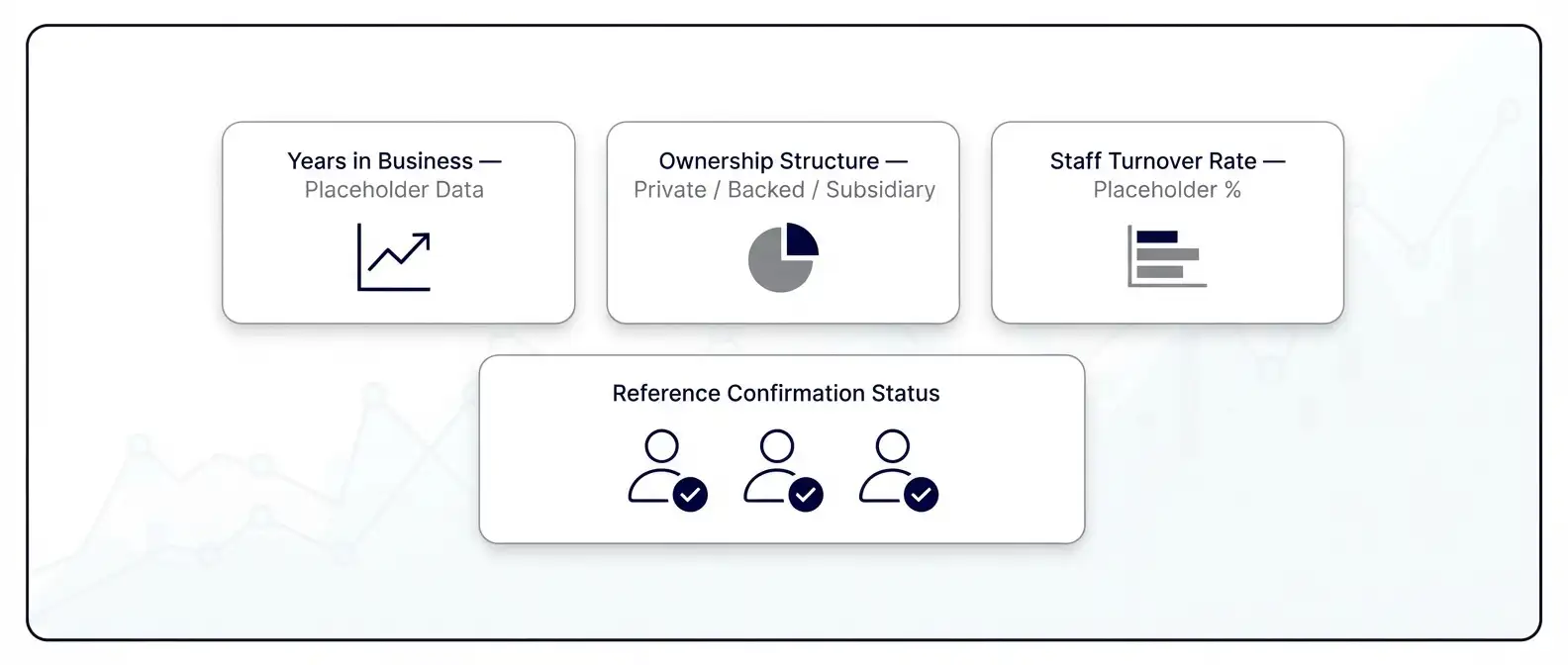
- Request confirmation of years in business and ownership structure
- Ask whether the vendor is privately held, venture-backed, or part of a larger holding company
- Review client references from firms of similar size and portfolio complexity
- Ask about staff turnover rates, particularly among senior paralegals or account managers
- Confirm whether the vendor has undergone any recent mergers, acquisitions, or leadership changes
Step 6: Contractual and SLA Review
Every point above should ultimately be reflected in the master services agreement, not just a sales conversation.
- Confirm the contract includes a defined service level agreement (SLA) with measurable turnaround commitments
- Verify confidentiality and non-disclosure terms extend to all subcontracted staff
- Review indemnification language related to missed deadlines or filing errors
- Confirm data ownership and portability terms, including what happens to your data if the contract ends
- Check for termination rights, notice periods, and any early-termination penalties
- Verify pricing structure matches what was quoted, and confirm there is no minimum-commitment lock-in unless intentionally negotiated
Step 7: References and Track Record Verification
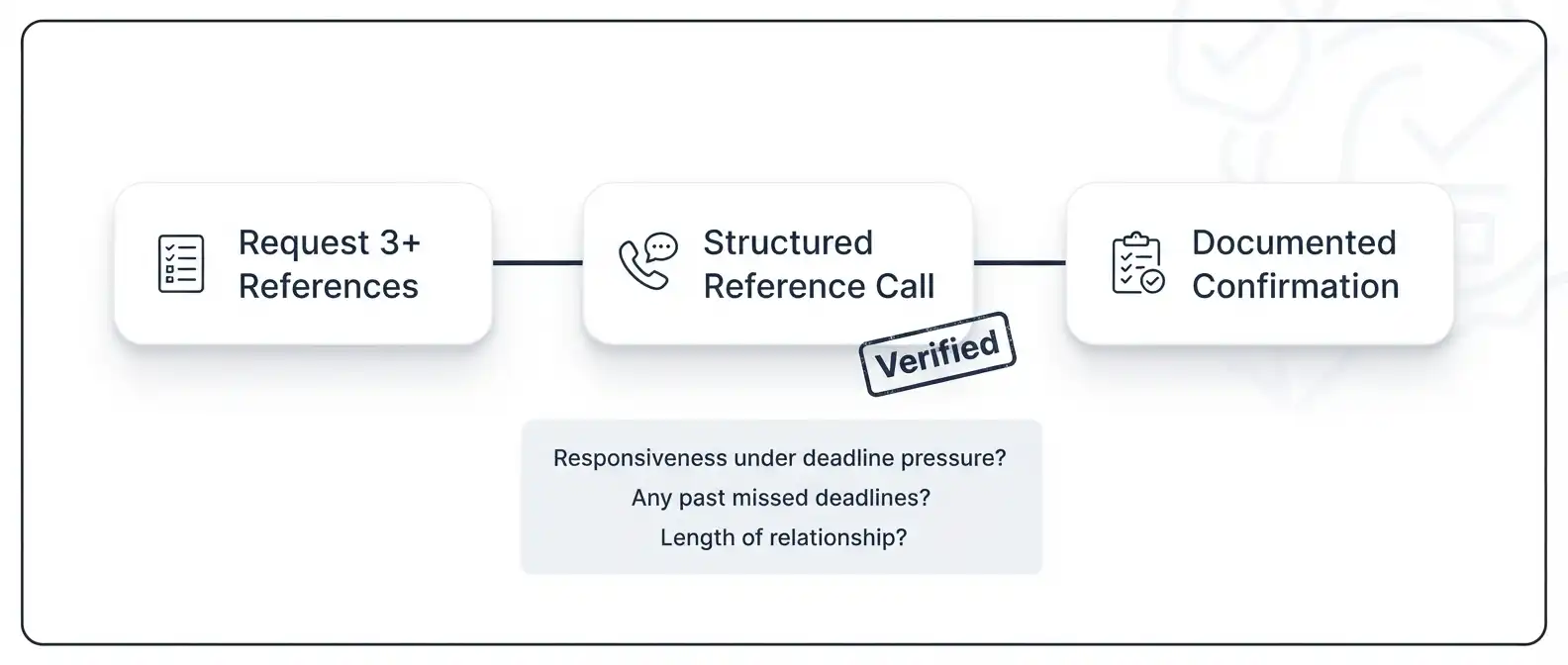
Written documentation only tells part of the story. Direct conversations with existing clients often surface details a proposal will not.
- Request at least three references from firms with comparable portfolio size or practice focus
- Ask references specifically about responsiveness during deadline-critical situations
- Ask whether the reference has ever experienced a missed deadline or filing error, and how it was resolved
- Confirm how long the reference has worked with the vendor
Step 8: Insurance and Liability Coverage
- Request a certificate of insurance showing professional liability (errors and omissions) coverage
- Confirm coverage limits are appropriate for the size and value of the portfolio being managed
- Ask whether cyber liability insurance is maintained separately from general professional liability
Step 9: Data Residency and Offshore Considerations
Many IP support vendors, including hybrid U.S. and offshore providers, operate across multiple jurisdictions. This is not automatically a risk, but it does require specific verification.
- Confirm exactly where data is physically stored and processed
- Ask whether any offshore staff have direct access to client docketing systems, and under what supervision
- Review any cross-border data transfer agreements required under applicable privacy law
- Confirm whether U.S.-based attorney oversight exists for offshore-processed work
Step 10: Exit Strategy and Transition Planning
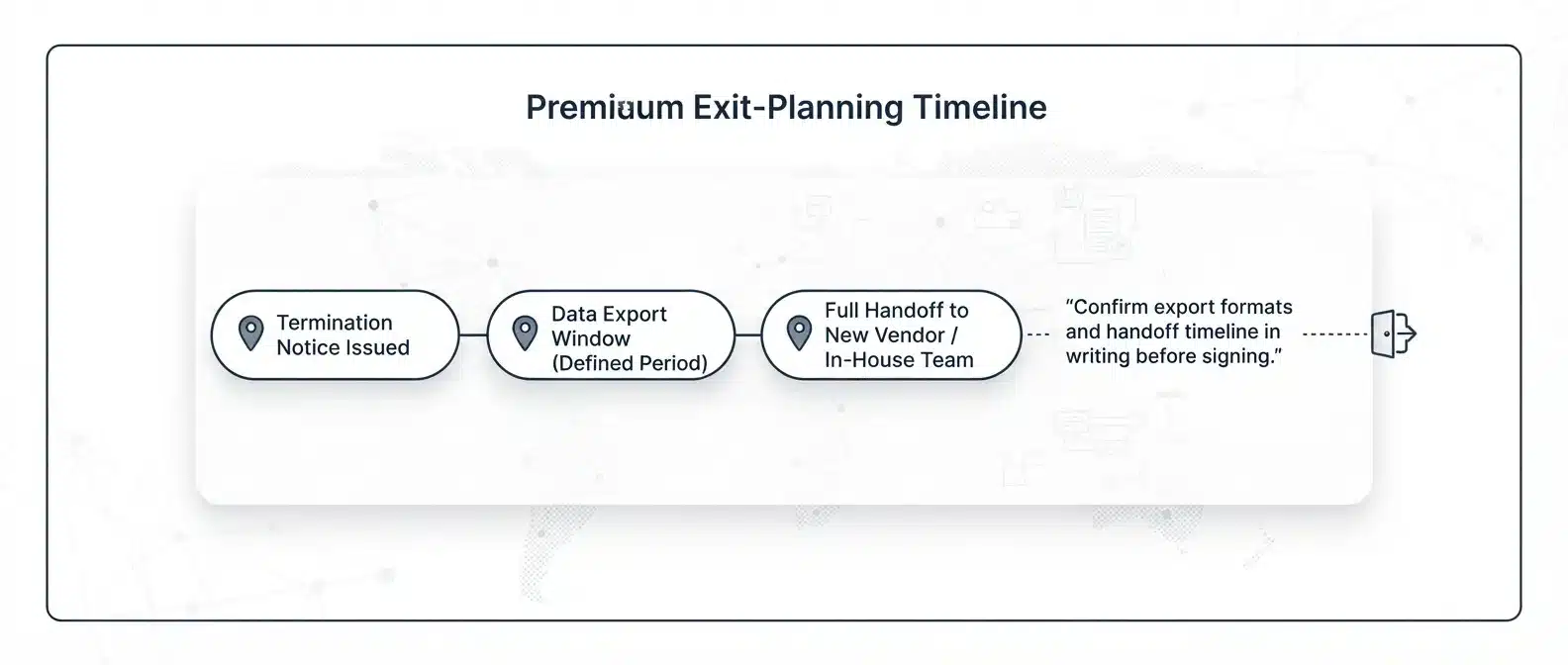
Due diligence should not stop at onboarding. A responsible checklist also plans for the relationship’s end before it begins.
- Confirm data export formats and timelines in the event of termination
- Ask how a transition to a new vendor or in-house team would be handled
- Verify there is a defined handoff period built into the contract terms
Quick-Reference IP Vendor Due Diligence Checklist Table
| Category | Key Documentation to Request | Owner |
|---|---|---|
| Security | SOC 2 Type II report, ISO 27001 certificate, encryption policy | IT / InfoSec |
| Compliance | USPTO/WIPO procedural competency, staff credentials | IP Director |
| Operations | Quality control workflow, turnaround SLAs, error rate data | Docketing Lead |
| Financial | Business history, ownership structure, references | Finance |
| Contract | MSA, SLA, indemnification, termination terms | Legal Ops |
| Insurance | E&O certificate, cyber liability coverage | Legal Ops |
| Data Residency | Data storage location, cross-border transfer agreements | Privacy Counsel |
| Exit Planning | Data export terms, transition timeline | Legal Ops |
In-House Review vs. Formal Vendor Due Diligence Process
Many smaller teams start with an informal review and later formalize it once volume increases or a client requires proof of vetting. The table below compares both approaches.
| Factor | Informal In-House Review | Formal IP Vendor Due Diligence Checklist |
|---|---|---|
| Documentation | Verbal notes or email threads | Signed questionnaires and certifications on file |
| Audit readiness | Difficult to reconstruct later | Ready for internal or client audit |
| Consistency across vendors | Varies by reviewer | Same criteria applied every time |
| Time investment upfront | Lower | Moderate, but reusable as a template |
| Risk visibility | Limited, often reactive | Documented risk tier before signing |
| Client guideline compliance | Often insufficient | Typically satisfies outside-counsel requirements |
Red Flags That Should Pause the Process Immediately
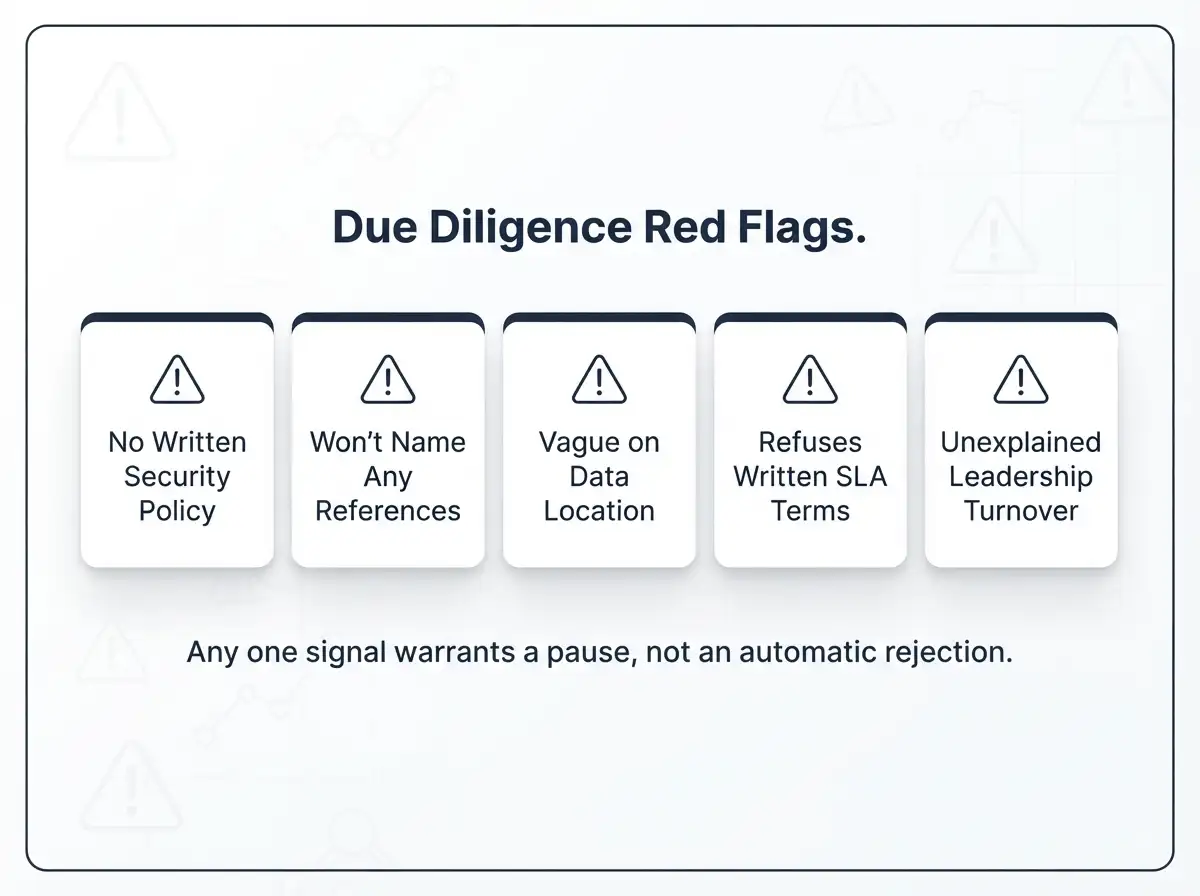
While most of this checklist is about gathering documentation methodically, a few responses during the review process should stop the conversation regardless of how far along the engagement is.
- No written security policy exists at all. A vendor handling confidential IP filings without any documented security policy is not simply behind on paperwork; it suggests security has not been treated as a priority.
- Reluctance to name existing clients as references. Confidentiality can explain a vendor’s hesitation to name specific matters, but reputable providers can usually still offer at least general references without disclosing client-privileged details.
- No clear answer on where data is physically stored. A vague or shifting answer about data location is one of the more common warning signs during the security review stage.
- Refusal to put SLA commitments in writing. Verbal assurances about turnaround time carry no weight if the signed agreement is silent on the subject.
- Recent, unexplained leadership or ownership turnover with no transition plan. This does not automatically disqualify a vendor, but it does warrant closer questioning before moving forward.
Any one of these should trigger a pause, not necessarily an outright rejection. The goal of the checklist is to surface these issues early, while there is still room to ask follow-up questions before a contract is signed.
Common Mistakes Legal Teams Make During Vendor Due Diligence
Even experienced legal operations teams run into predictable pitfalls. Recognizing these in advance saves time during the review process.
- Treating the sales pitch as the due diligence record. A polished proposal is not a substitute for a signed security questionnaire.
- Skipping reference calls because references look good on paper. A five-minute call often reveals more than a written testimonial.
- Failing to define risk tolerance before starting the review. Without a defined scope, every vendor conversation drifts.
- Assuming offshore automatically means higher risk, or lower risk, without verifying it. Location alone does not determine quality; documented oversight does.
- Not revisiting due diligence after the contract is signed. Vendor risk profiles change over time, especially after mergers or leadership turnover.
- Letting procurement and the legal team work from different checklists. Misalignment here creates duplicate work and inconsistent scoring.
Expert Tips for Streamlining the Due Diligence Process
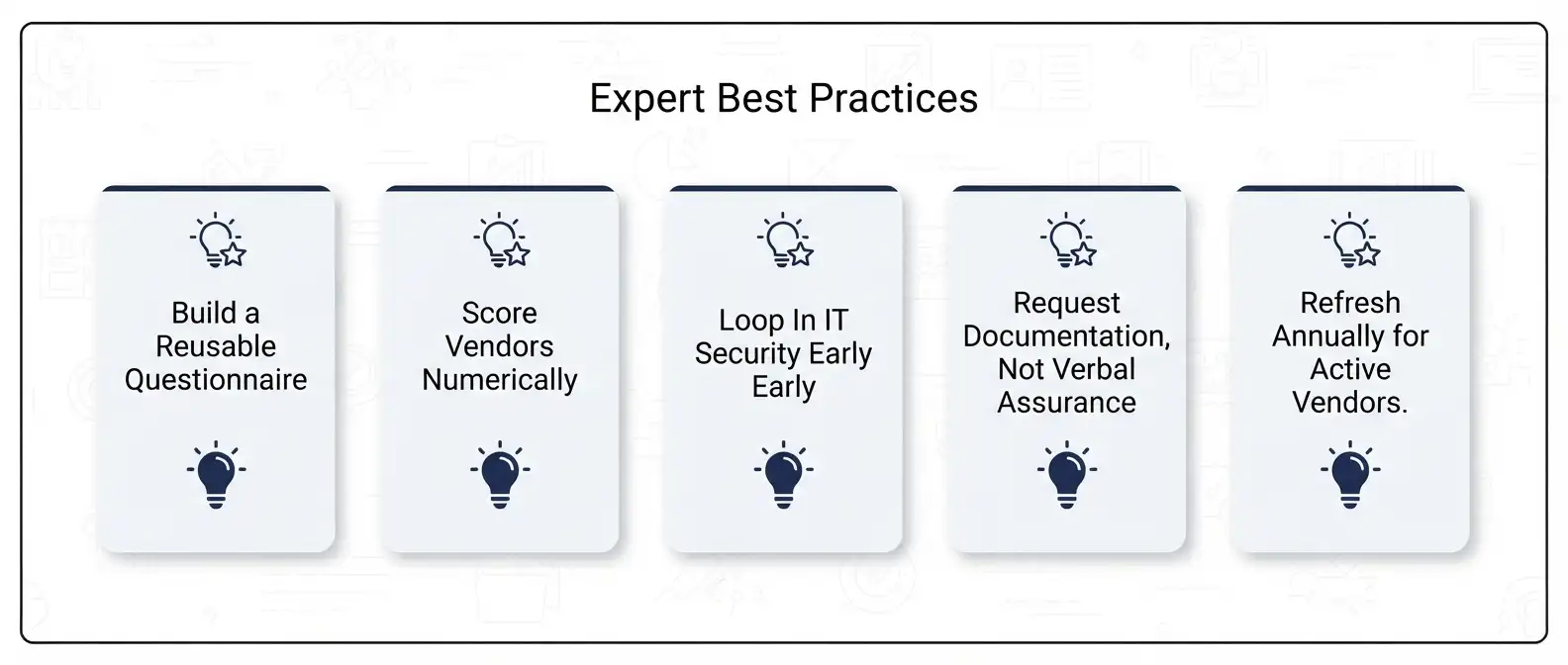
- Build a reusable questionnaire template. Once a checklist is created, the same document can be sent to every prospective vendor, which shortens review cycles significantly.
- Score vendors numerically, not just qualitatively. A simple 1-to-5 scale across each category in the table above makes side-by-side comparison faster for decision-makers.
- Loop in IT security early, not at the contract stage. Waiting until a contract is nearly finalized to review security documentation often causes delays or renegotiation.
- Ask for documentation, not just verbal assurance. Certifications, SLAs, and insurance certificates should always be requested in writing.
- Revisit the checklist annually for active vendors. A single onboarding review is not enough for a long-term relationship, particularly one involving ongoing patent portfolio management or continuous trademark monitoring.
Building a Vendor Scorecard from the Checklist
Once the ten-step checklist has been used to gather documentation, the next challenge is turning that raw information into a decision. A written questionnaire response is useful, but it does not automatically tell a busy IP director which vendor is the stronger fit. This is where a simple scorecard becomes valuable, particularly when more than one vendor is under consideration for the same engagement.
Start by assigning each of the eight categories from the quick-reference table a weight based on what matters most for your specific engagement. A firm outsourcing only patent drawings, for example, may weight operational quality control more heavily than data residency. A corporate legal department handling unpublished trade secret filings, on the other hand, will likely weight security and compliance far above cost or turnaround speed.
A practical scoring approach looks like this:
- Assign a 1-to-5 score for each category, based on the documentation collected during the checklist review.
- Apply a weighting percentage to each category that reflects its importance to your specific engagement.
- Calculate a weighted total for each vendor under consideration.
- Document the rationale behind any score below a 3, since this becomes useful evidence if a client or auditor later asks why a particular vendor was selected.
- Set a minimum threshold below which a vendor is automatically disqualified, regardless of overall score, such as failing to provide any security certification at all.
This approach accomplishes two things simultaneously. First, it removes some of the subjectivity that creeps into vendor selection when decisions are made after a single sales call. Second, it produces a paper trail that legal operations and procurement teams can point to later, which matters considerably if a client asks how a particular vendor was chosen or if an internal audit reviews the vendor approval file.
It is worth noting that a scorecard is only as reliable as the documentation behind it. If a vendor cannot produce a SOC 2 report, an insurance certificate, or a written quality control process, that gap should be reflected honestly in the score rather than assumed away based on reputation or price. Vendors evaluating boutique IP law firm support or larger trademark portfolio management providers should be held to the same documentation standard regardless of firm size, since the underlying risk to client data does not shrink just because the vendor relationship is smaller.
How Often Should You Conduct IP Vendor Due Diligence?
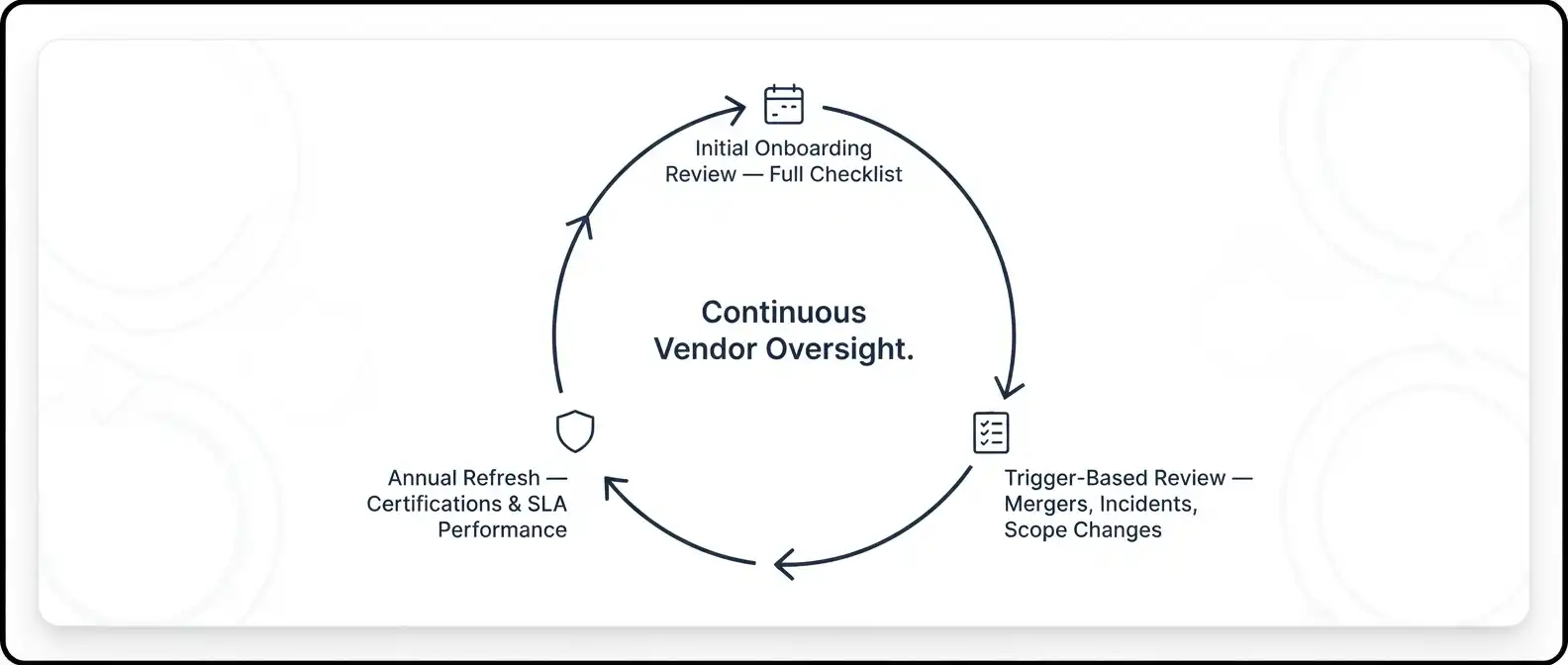
Most legal operations teams should conduct a full due diligence review at three points in the relationship:
- Before the initial engagement, using the full checklist above.
- Annually, with a lighter refresh focused on security certifications, insurance renewals, and SLA performance.
- After any material change, such as a vendor merger, leadership turnover, security incident, or significant scope expansion.
Firms managing a large, actively growing docket, such as those evaluating patent paralegal outsourcing for corporate IP departments, often build this cadence directly into their vendor management calendar rather than treating it as a one-time event.
Frequently Asked Questions
What is included in an IP vendor due diligence checklist?
A complete IP vendor due diligence checklist typically covers data security certifications, regulatory and procedural compliance, operational quality control, financial stability, contractual terms, insurance coverage, data residency, and an exit or transition plan.
Who should be responsible for IP vendor due diligence at a law firm?
Responsibility is usually shared between the IP director or general counsel, legal operations or procurement, IT security, and the docketing or paralegal lead who understands day-to-day operational requirements.
How long does IP vendor due diligence typically take?
For a formal review using a documented checklist, most organizations complete the process in two to four weeks, depending on how quickly the vendor can produce security certifications, references, and sample work product.
Do small law firms and solo practitioners need a formal due diligence checklist?
Yes. While the process can be scaled down, even a smaller firm benefits from documenting basic security, compliance, and reference checks before handing off confidential IP work to any outside vendor.
What is the difference between vendor due diligence and simply asking a vendor questions?
Due diligence produces a documented, auditable record such as signed questionnaires and certifications, while an informal conversation typically leaves no paper trail and cannot be reconstructed later for audit or client review purposes.
How does IP vendor due diligence differ from general IT vendor due diligence?
IP vendor due diligence includes IT security considerations but adds intellectual property-specific requirements, such as USPTO and WIPO procedural competency, docketing deadline management, and confidentiality obligations tied to unpublished patent and trademark filings.
Should the same checklist be used for a new vendor and an existing vendor renewal?
Not entirely. A new vendor should go through the full ten-step checklist before onboarding. An existing vendor renewal can typically use a shortened version focused on updated security certifications, insurance renewals, SLA performance over the prior year, and any changes in ownership or staffing, since the operational and compliance history is already on file.
Building a Repeatable IP Vendor Due Diligence Process
A strong IP vendor due diligence checklist turns vendor selection from a subjective judgment call into a documented, defensible process. For law firms and corporate legal teams alike, that documentation matters just as much as the outcome. It protects the organization during a client audit, supports internal procurement policy, and creates a consistent standard for comparing vendors over time.
The ten-step framework above, covering scope definition, security, compliance, operations, financial stability, contracts, references, insurance, data residency, and exit planning, gives IP directors, general counsel, and legal operations teams a complete starting point. Treat it as a living document: review it before onboarding, refresh it annually, and revisit it any time a vendor’s risk profile changes.
Ready to put this into practice? Download the free IP Vendor Due Diligence Checklist and bring a documented, procurement-ready framework to your next vendor review.

