
Missing a USPTO deadline is not just stressful – it can be catastrophic for your patent or trademark application. If you’ve received an office action and need more time to respond, understanding the office action response extension fee system is critical. Fortunately, the USPTO offers a formal process for requesting additional time, but it comes with specific fees, rules, and risks that every applicant needs to understand before making a move.

This guide walks you through everything you need to know: what extensions are, how much they cost, when to request one, and how to avoid common mistakes that could jeopardize your application.
What is an Office Action Response Extension Fee?
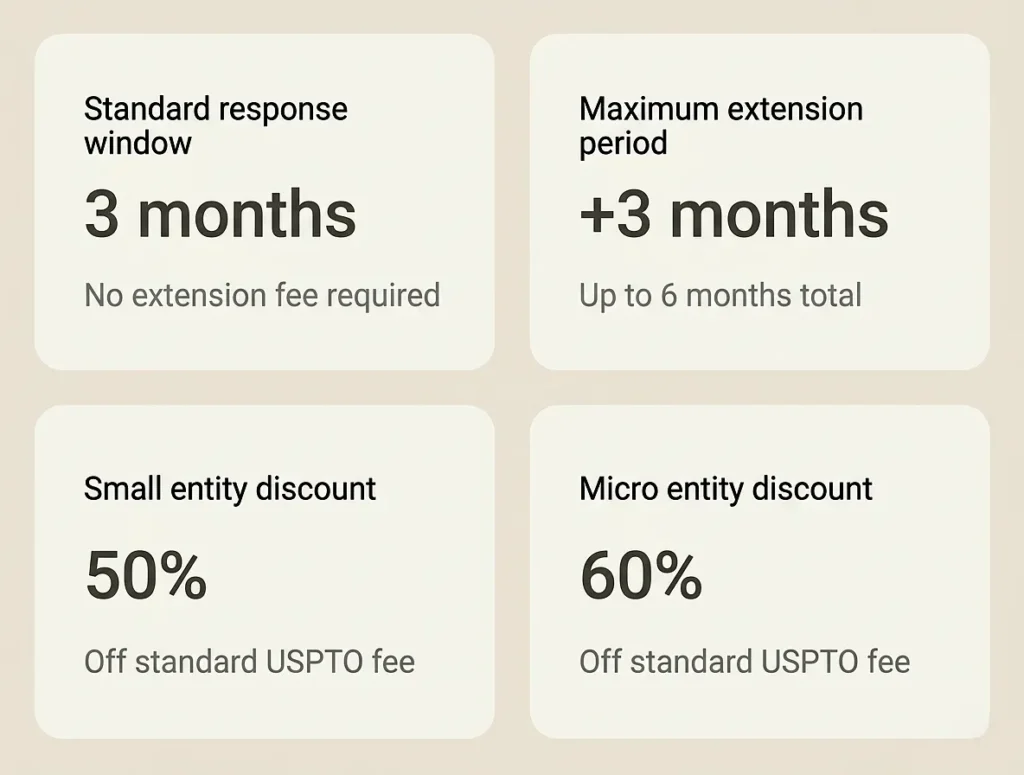
When the USPTO issues an office action – a formal communication outlining rejections, objections, or requirements – applicants generally have three months to respond without paying extra fees. However, the USPTO allows applicants to extend this window by up to three additional months, for a maximum total response period of six months.
Quick Definition: An office action response extension fee is a USPTO surcharge paid by applicants who need additional time beyond the standard three-month period to file a complete response to an office action.
This fee structure is not a penalty for being unprepared – it’s an administrative tool that gives applicants more flexibility when facing complex legal issues, expert availability challenges, or business considerations that require more time.
USPTO Extension Fee Schedule: What It Actually Costs
Before requesting an extension, you need to know exactly what you’re paying. The USPTO updates its fee schedule periodically, so always verify current amounts on the official USPTO fee schedule page.
Patent Application Extension Fees (Per Month)
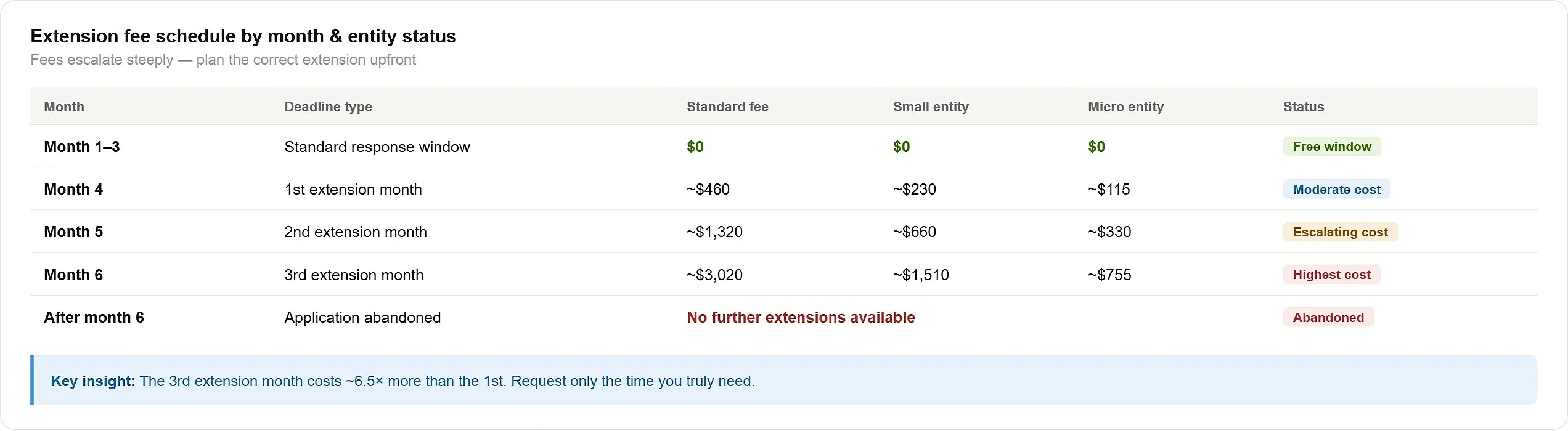
Note: These are approximate figures based on recent USPTO schedules. Always verify current fees at USPTO.gov before submitting your extension request.
Trademark Application Extension Fees
Trademark extension fees work differently. Instead of monthly increments with escalating costs, trademark applicants are generally subject to a flat extension fee structure. However, the maximum response period is still six months from the date of the office action. Late responses – even by one day – can result in abandonment of the application.
The USPTO’s Trademark Fee Schedule provides the most current trademark-specific extension amounts.
When Should You Request a USPTO Response Extension?
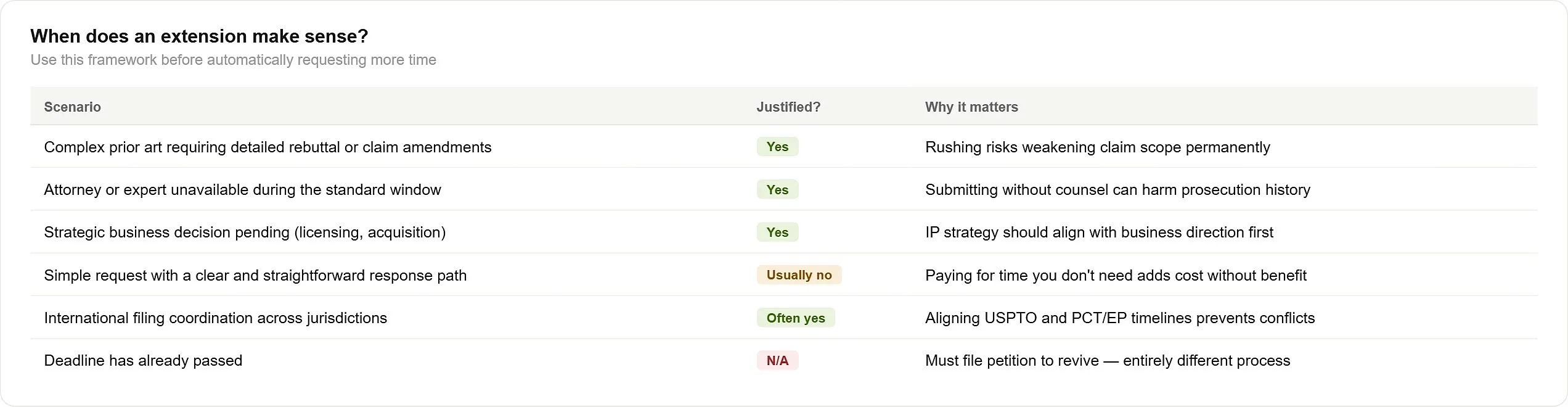
Requesting an extension is sometimes unavoidable, but you should approach it strategically. Here are the most common – and legitimate – reasons to request additional time.
1. Complex Technical or Legal Issues
Some office action rejections involve highly technical prior art references or complex legal arguments. If your patent attorney needs additional time to analyze the prior art, draft claim amendments, or prepare expert declarations, an extension is often justified.
2. Expert or Attorney Availability
IP attorneys and technical experts are often in high demand. If your primary counsel is unavailable during the three-month window due to scheduling conflicts or workload, an extension buys time without waiving your rights.
3. Business or Strategic Decisions
Sometimes the decision to respond, abandon, or pivot the application strategy depends on internal business factors – like whether a product is moving forward, whether licensing negotiations are underway, or whether a merger is affecting IP strategy. Extensions give decision-makers the breathing room they need.
4. New Information or Prior Art Discovery
If new information surfaces after the office action is issued – such as a newly published prior art reference or a licensing agreement – you may need additional time to incorporate this into your response.
5. International Filing Coordination
For applicants managing both U.S. and international patent filings, coordinating responses across jurisdictions can be time-consuming. An extension can help align domestic and international timelines.
How to Request an Office Action Response Extension
Requesting an extension is relatively straightforward, but you must follow the correct procedure. Here’s a step-by-step breakdown.
Step 1: Identify your current deadline. Locate the mailing date of the office action. Your standard three-month response window begins on this date.
Step 2: Determine how many months of extension you need. Be realistic – requesting only the time you genuinely need saves money and keeps the process moving.
Step 3: Calculate the applicable fee. Use the USPTO fee schedule to determine the cost of the extension you’re requesting. Remember that fees escalate significantly with each additional month.
Step 4: File the extension request with payment. For patents, submit a petition for extension of time via the USPTO’s Electronic Filing System (EFS-Web/Patent Center). For trademarks, use the Trademark Electronic Application System (TEAS).
Step 5: Submit your actual response before the extended deadline. The extension only buys you additional time – you must still file a complete, substantive response before the new deadline expires.
Understanding the full USPTO process is essential here. If you’re unfamiliar with how office actions work or what the response process involves, review this detailed guide to the office action response process before proceeding.
Extension Fees vs. Petitions to Revive: Understanding the Difference
Many applicants confuse extension fees with petitions to revive an abandoned application. These are two very different mechanisms.
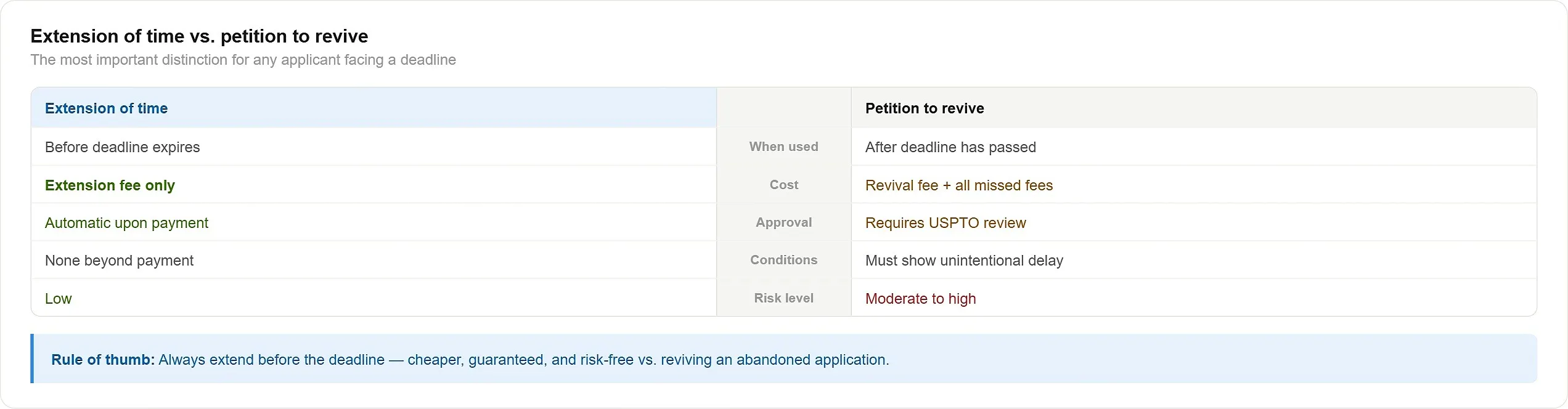
The bottom line is simple: it’s always better – and cheaper – to request an extension before your deadline expires than to attempt to revive an abandoned application afterward.
If you’ve already missed your deadline, understand what happens when you miss the six-month USPTO window and what options remain available to you.
Small Entity and Micro Entity Discounts: Are You Eligible?
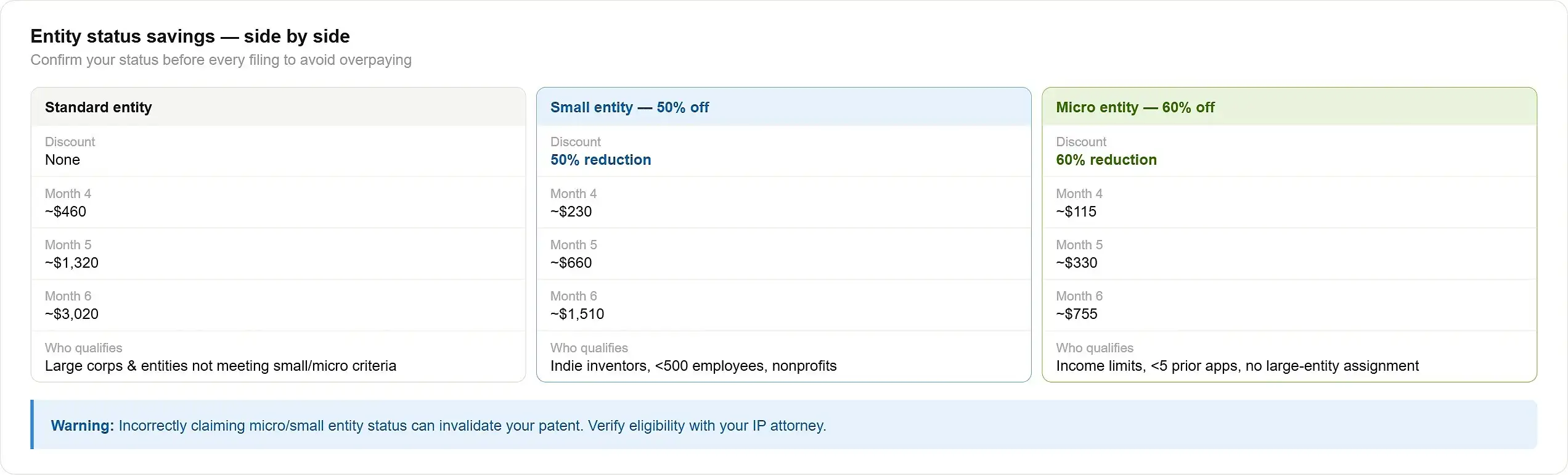
One of the most important – and frequently overlooked – aspects of office action response extension fees is entity status. The USPTO offers significant fee reductions for qualifying small entities and micro entities.
Small Entity Status
The Small entities include:
- Independent inventors
- Small businesses with fewer than 500 employees
- Nonprofit organizations
Small entities pay 50% of the standard USPTO fee for most patent-related charges, including extension fees.
Micro Entity Status
Micro entity status provides even greater savings – a 60% reduction from the standard fee. To qualify, an applicant must meet income thresholds, have filed fewer than five previous patent applications, and not be under an obligation to assign the application to a larger entity.
Important: Incorrectly claiming small or micro entity status can result in penalties and potentially invalidate your patent. Confirm your eligibility carefully or consult a qualified patent attorney.
For the most current eligibility criteria, visit the USPTO’s entity status page.
Common Mistakes to Avoid When Requesting an Extension
Even experienced applicants make avoidable errors when dealing with extension fees. Here are the most costly mistakes to watch out for.
1. Waiting Until the Last Minute While extensions can technically be filed on the deadline date, waiting until the last day creates unnecessary risk. Technical issues with USPTO filing systems, payment processing delays, or incorrect fee calculations can result in a missed deadline.
2. Underestimating the Time Needed Requesting a one-month extension when you actually need two months means paying for a first extension, then paying the higher rate for a second extension separately. Calculating the correct extension upfront is more cost-effective.
3. Confusing the Response Deadline With the Extension Deadline The extension only modifies the time available to file your response – it does not automatically extend any other deadlines associated with your application. Stay organized.
4. Forgetting to Actually Respond This sounds obvious, but some applicants request extensions and then fail to file their response before the extended deadline. The extension fee is non-refundable, and the application will still go abandoned.
5. Overlooking Fee Schedule Updates The USPTO periodically updates its fees. Using outdated fee schedules can result in underpayment, which may not immediately notify you of the error but could cause problems later.
If you’re unsure what a proper response looks like, reviewing an office action response example for patent applicants can help you understand the scope of work before committing to a timeline.
How Extension Fees Fit Into Your Overall IP Strategy
Paying for extensions is a business decision, not just an administrative one. Before automatically requesting the maximum extension available, consider the following strategic factors.
Weighing the Cost Against the Application’s Value
For a high-value patent or trademark – one tied to a core product, brand, or licensing revenue – paying $1,500 or more for a third-month extension is often well worth it. For a lower-priority application, it may be more cost-effective to work quickly with existing resources.
Communicating With Your Attorney Early
If you know you’re going to need an extension, tell your IP attorney or agent as early as possible. Late communication often leads to rushed work, which ironically increases the risk of errors in your response.
Planning Across a Patent Portfolio
For applicants managing multiple applications, extension fees can add up quickly. A well-organized IP calendar that tracks all deadlines helps prevent the need for extensions in the first place.
For those preparing their response document, using a solid office action response template can significantly reduce preparation time and help you stay within your response window without needing extensions at all.
Trademark-Specific Considerations for Extension Fees
Trademark office actions carry their own nuances. While the USPTO extension framework applies broadly to both patents and trademarks, trademark applicants should be aware of a few important distinctions.
Response Periods for Trademark Office Actions
The USPTO issues trademark office actions with a three-month response deadline, with the ability to extend to six months for a fee. This is similar to the patent process but operates under the Trademark Manual of Examining Procedure (TMEP) rather than the Manual of Patent Examining Procedure (MPEP).
Types of Trademark Office Actions
Trademark office actions commonly include:
- Non-final office actions – initial rejections requiring a response
- Final office actions – issued after the examiner has reviewed a response and maintained the rejection
- Requests for information – less formal, but still subject to deadlines
The response requirements differ by type, and extensions may be handled differently depending on the stage of examination. For a complete breakdown of trademark office actions, review this guide to handling USPTO trademark refusals.
Expert Tips for Managing Office Action Deadlines Efficiently
Years of experience in IP practice reveal a few best practices that consistently help applicants manage office action timelines more effectively.
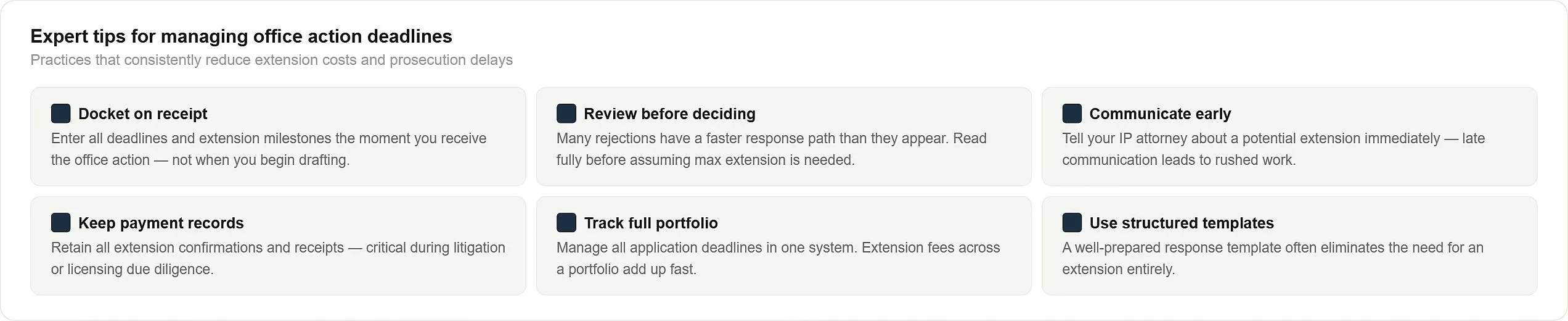
- Docket immediately. The moment you receive an office action, enter the deadline and all extension deadlines into your docketing or calendar system.
- Review the office action thoroughly before requesting an extension. Sometimes what looks complex is actually straightforward – and you may not need as much time as you think.
- Use extensions as a last resort, not a first option. Extensions cost money and delay prosecution. Move quickly when the response path is clear.
- Confirm entity status before filing. If your entity status has changed – such as after a company grows beyond 500 employees – update it before paying extension fees to avoid incorrect filings.
- Keep records of all extension requests and payments. This documentation becomes important if there are any questions about prosecution history during litigation or licensing discussions.
What Happens After You File Your Response?
Once you submit your response – whether within the standard window or after an extension – the examiner reviews your arguments, amendments, and any supporting evidence. Depending on the outcome, you may receive:
- A Notice of Allowance – the examiner has accepted your response and the application is approved
- A non-final office action – the examiner has raised new or different objections
- A final office action – the examiner maintains the rejection after reviewing your response
Understanding each of these outcomes helps you plan your next steps. For detailed guidance on navigating the full response process, this comprehensive office action response guide covers what applicants should know at every stage.
Conclusion
Navigating the office action response extension fee system requires both procedural knowledge and strategic judgment. Extensions can be genuinely valuable tools when you face complex rejections, expert availability challenges, or business decisions that require additional time. However, they come at a real cost — one that escalates with each additional month you request.
The smartest approach is to plan proactively, docket your deadlines immediately, assess the complexity of your office action early, and communicate clearly with your IP counsel. When extensions are necessary, request only the time you need, verify the current fee schedule, and confirm your entity status to take advantage of any available discounts.
Most importantly, remember that the extension only buys you time – the quality of your response ultimately determines whether your application succeeds. Invest the extra time wisely.
Frequently Asked Questions (FAQs)
1. What is an office action response extension fee?
An office action response extension fee is a charge paid to the USPTO to extend the standard three-month response deadline for an office action. Applicants can extend the response period by up to three additional months, for a maximum total of six months, with fees increasing for each additional month requested.
2. How much does a USPTO extension of time cost?
The cost depends on entity status and the number of months requested. For a standard (undiscounted) filer, fees range from approximately $460 for the first additional month to over $3,000 for the third additional month. Small entities pay 50% of these amounts, and micro entities pay 40%.
3. Can I request an extension after my deadline has already passed?
No. Extensions of time must be requested before the response deadline expires. If you’ve already missed the deadline, you may need to file a petition to revive an abandoned application, which involves a different process, higher fees, and is not guaranteed to succeed.
4. Do extension fees apply to both patents and trademarks?
Yes, both patent and trademark applicants can request extensions of time to respond to office actions. However, the specific fee amounts, procedures, and rules differ between patent and trademark prosecution at the USPTO.
5. Is the office action response extension fee refundable?
No. Once you pay an extension fee and the USPTO processes it, the fee is non-refundable – even if you later decide to abandon the application or file your response early.
6. Can I extend the deadline beyond six months?
No. Six months is the absolute maximum response period for a USPTO office action. No further extensions are available beyond this point. If no response is filed within six months, the application is abandoned.
7. Do I need an attorney to request an extension of time?
You are not legally required to use an attorney to request an extension. However, given the potential consequences of missing deadlines or paying incorrect fees, working with a qualified patent or trademark attorney is strongly recommended, especially for complex applications.
8. How do I know if I qualify for small entity or micro entity fees?
Small entity status generally applies to independent inventors, businesses with fewer than 500 employees, and nonprofit organizations. Micro entity status requires meeting additional income and filing history requirements. You can review the detailed eligibility criteria on the USPTO’s entity status page.
Ready to Respond to Your Office Action? Teak IP Can Help.
Dealing with USPTO office actions and response deadlines is time-sensitive and high-stakes. Whether you need guidance on requesting an extension, preparing a substantive response, or developing a broader IP prosecution strategy, the team at Teak IP is here to help.
We work with inventors, startups, and established businesses to navigate the patent and trademark process efficiently – protecting your intellectual property without unnecessary delays or costly mistakes.

