
The Clock is Ticking on Your Trademark or Patent Application: You’ve invested significant time, money, and effort into your intellectual property. You filed your trademark or patent application with the USPTO, and then – you received an Office Action. Now there’s a deadline staring you in the face. Missing your office action response deadline is one of the most costly and avoidable mistakes an applicant can make. It can result in the outright abandonment of your application, loss of your priority filing date, and in some cases, the permanent loss of your intellectual property rights.

In this comprehensive guide, Teak IP walks you through everything you need to know about the six-month USPTO response window – what it means, what happens if you miss it, and how you can recover if you already have.
What is an Office Action?
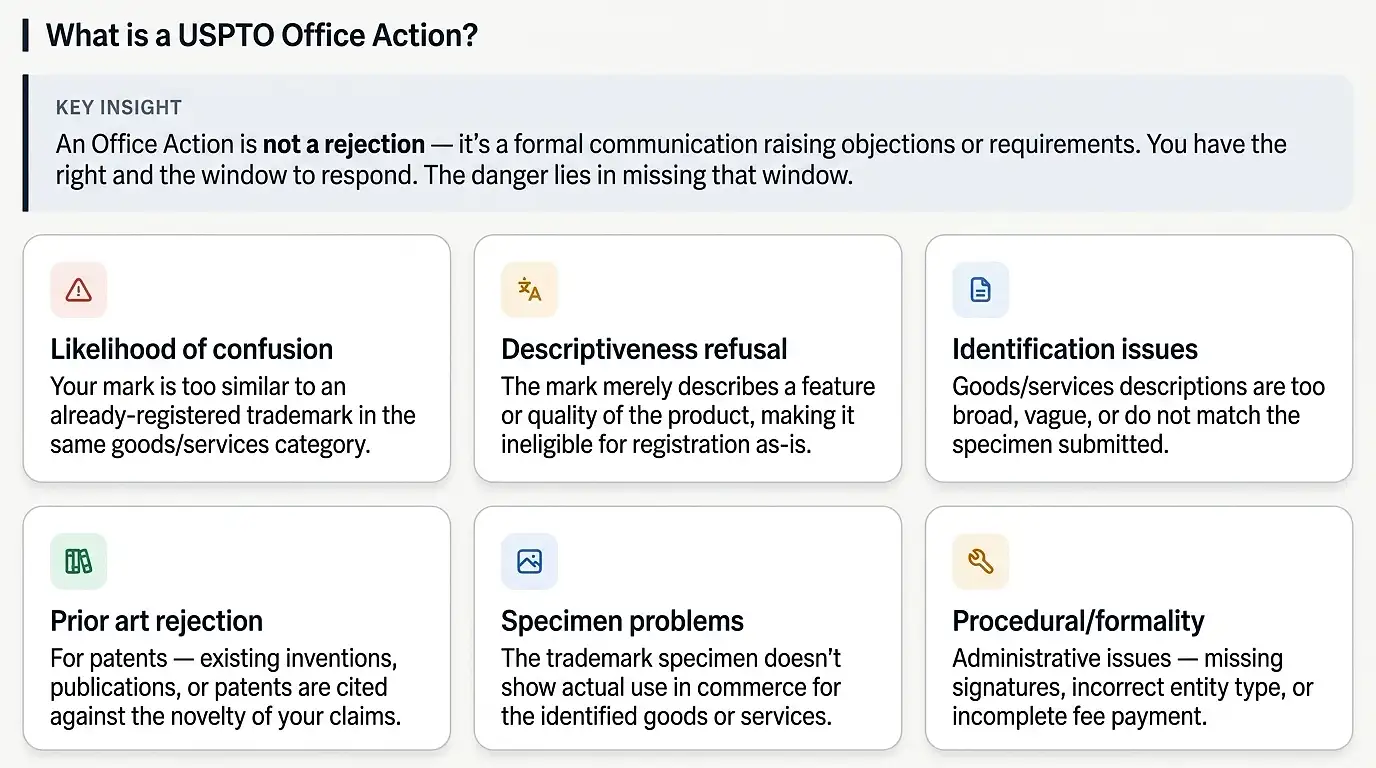
An Office Action is an official written communication from a USPTO examining attorney that raises objections, refusals, or requirements regarding your trademark or patent application. It is not a rejection – it is an opportunity to respond and clarify, amend, or argue your case.
Office Actions are issued for a variety of reasons, including:
- Likelihood of confusion with an existing registered mark
- Descriptiveness or genericness of the mark
- Identification of goods and services issues
- Specimen problems (for trademarks)
- Prior art rejections (for patents)
- Procedural or formality issues
There are two primary types of Office Actions:
| Type | Description |
|---|---|
| Non-Final Office Action | The first official rejection or objection; you have the opportunity to respond and continue prosecution |
| Final Office Action | Issued after your response to a Non-Final OA; options become more limited at this stage |
Also, Read: Office Action Response Trademark: How to Handle USPTO Refusals and Keep Your Mark Alive
The Six-Month USPTO Response Window: What You Need to Know
The Standard Deadline
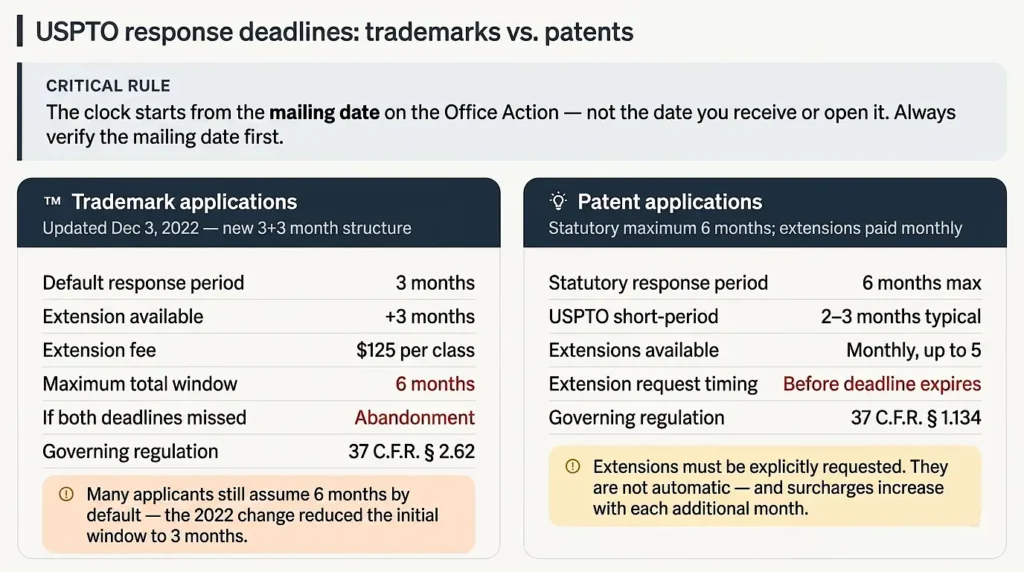
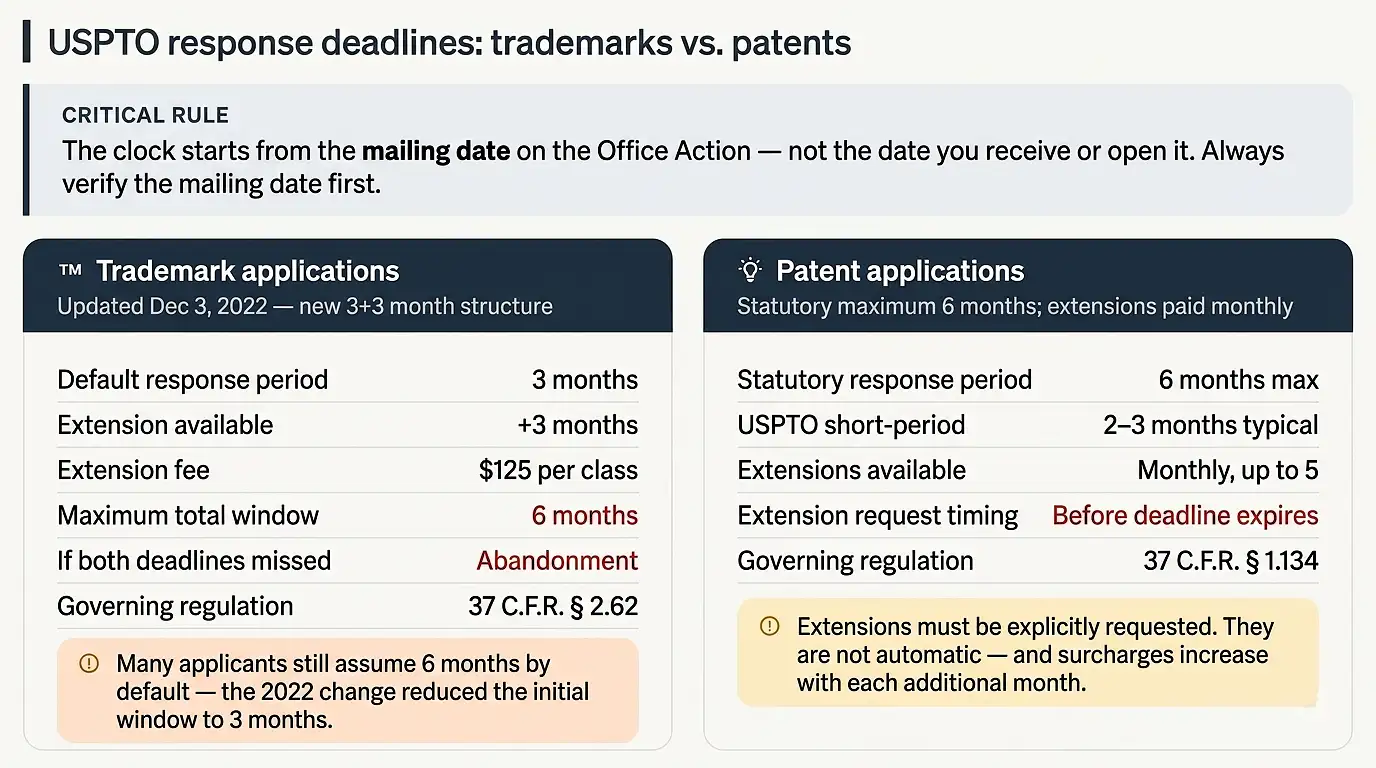
Under USPTO rules, applicants are generally given six months from the date of the Office Action to file a complete and substantive response. This applies to both:
- Trademark applications (governed by 37 C.F.R. § 2.62)
- Patent applications (governed by 37 C.F.R. § 1.134 and § 1.136)
Key Rule: The six-month deadline is not flexible by default. The clock starts ticking from the mailing date of the Office Action – not from the date you receive or read it.
USPTO Trademark Applications: Specific Deadlines
For trademark applicants, the USPTO issues Office Actions with response deadlines that have undergone recent changes:
- As of December 3, 2022, the USPTO changed the response period for most Office Actions from six months to three months, with the option to request a three-month extension (for a fee).
- The maximum total response period remains six months.
What this means for you:
- You now have 3 months by default to respond
- You can request a 3-month extension for a fee of $125 per class
- The total window remains 6 months from the Office Action date
- Missing both the initial and extended deadline results in abandonment
USPTO Patent Applications: The Six-Month Window
For patent applicants, the standard response period set by statute is six months from the mailing date. However:
- The USPTO may set a shortened statutory period (commonly 2 or 3 months)
- You can extend this period by paying surcharges – up to the six-month statutory maximum
- Extensions of time must be requested before the deadline expires
Patent Extension Fees (as of 2024):
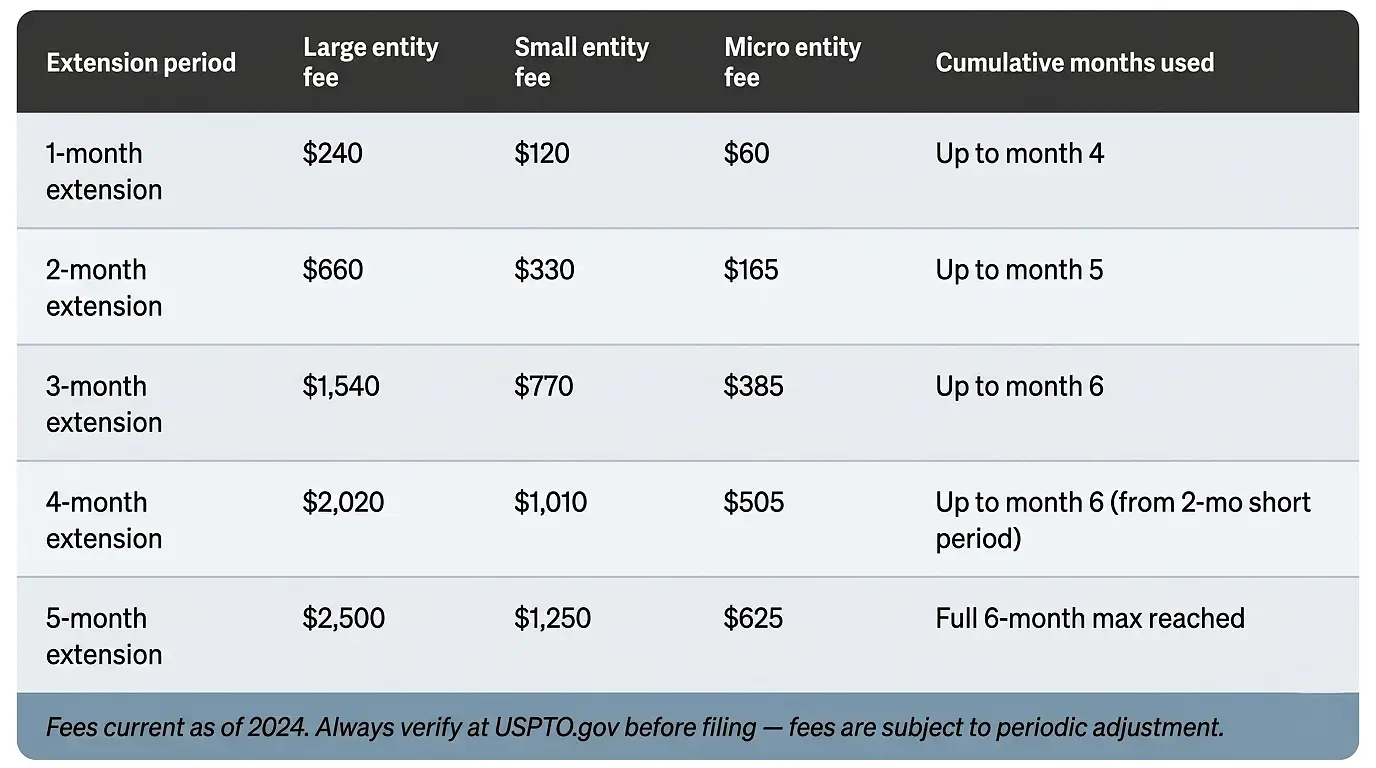
Note: Always verify current fees at USPTO.gov as they are subject to change.
What Happens If You Miss the Office Action Response Deadline?
This is the critical question – and the answer depends on how far past the deadline you are.
1. Your Application Goes Abandoned
If you fail to respond within the allotted period (including any purchased extensions), the USPTO will issue a Notice of Abandonment. Your application is officially dead.
Consequences of abandonment include:
- ✖ Loss of your filing date and priority date
- ✖ Loss of the application fees already paid
- ✖ Competitors may now file for the same trademark or patent
- ✖ Your mark or invention loses USPTO protection
- ✖ You may lose the ability to stop infringing uses going forward
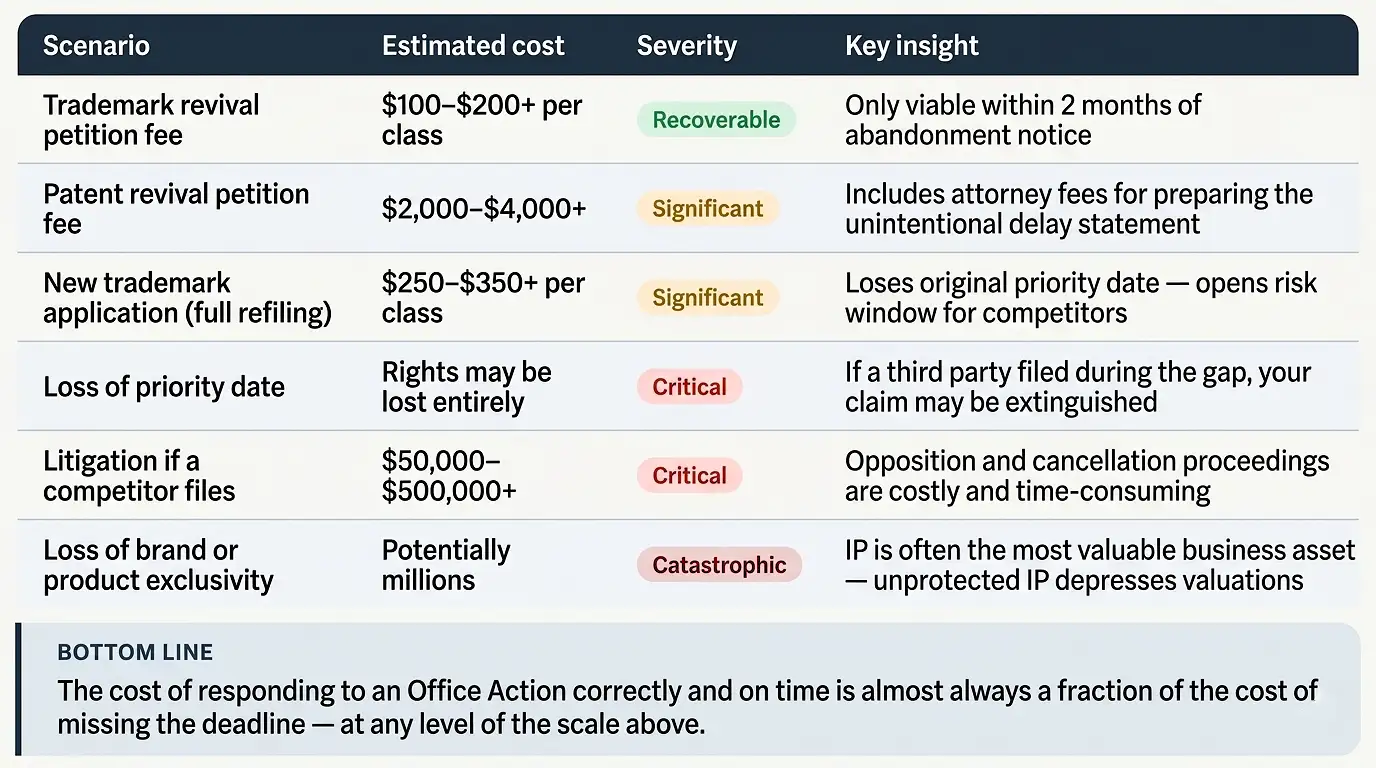
2. For Trademarks: You May Petition to Revive (Within 2 Months)
If your trademark application is abandoned due to a missed Office Action deadline, you may file a Petition to Revive – but only under strict conditions:
Requirements:
- The abandonment must have been unintentional
- The petition must be filed within 2 months of the Notice of Abandonment
- You must pay a petition fee (currently $100 per class)
- You must include a complete response to the Office Action
Important: If more than 2 months have passed since the Notice of Abandonment, revival becomes significantly more difficult and may require a full petition to the Director of the USPTO.
3. For Patents: Revival Under “Unintentional Delay”
For patent applications, you may petition to revive under two standards:
a) Unavoidable Delay (37 C.F.R. § 1.137(a))
- High burden of proof required
- Must show the delay was truly beyond your control
- Requires detailed explanation and evidence
b) Unintentional Delay (37 C.F.R. § 1.137(b))
- Lower threshold – the delay simply must not have been intentional
- Must be filed within 12 months of the abandonment date (in most cases)
- Requires a statement that the delay was unintentional
- Requires payment of the revival fee
- Requires submission of the response to the Office Action
Warning: Filing a petition with a false statement of “unintentional delay” can constitute fraud on the USPTO, with serious legal consequences. Always work with a qualified IP attorney.
Also, Read: Office Action Response Example: A Real-World Walkthrough for Patent Applicants
Common Reasons Applicants Miss Office Action Deadlines
Understanding why deadlines are missed helps you avoid the same pitfalls:
- Outdated correspondence address – The USPTO mails Office Actions to the address on file; if you’ve moved or changed attorneys, you may never receive it
- Spam filters – USPTO email notifications sometimes land in spam or junk folders
- Attorney transitions -m Switching IP counsel without updating the USPTO record
- Misreading the deadline – Confusing the mailing date with the receipt date
- Underestimating complexity – Assuming you’ll have time to respond and delaying action
- Lack of docketing systems – Not maintaining a proper IP docket to track deadlines
- Misunderstanding the 3-month vs. 6-month rule – Especially common after the 2022 trademark deadline change
Also, Read: Office Action Response Form: How to Complete and Submit It Correctly to the USPTO
How to Avoid Missing Your Office Action Response Deadline
Best Practices for Applicants
1. Maintain Accurate USPTO Correspondence Records Always keep your email address and correspondence address updated with the USPTO. For trademark applicants, this is managed through the TEAS system. For patent applicants, it’s updated through USPTO.gov.
2. Use a Professional IP Docketing System A proper docketing system automatically flags:
- Office Action receipt dates
- Initial response deadlines
- Extension request deadlines
- Maximum statutory deadlines
3. Respond Early – Never Wait Until the Last Minute Begin drafting your response as soon as you receive the Office Action. Office Actions often require:
- Substantive legal arguments
- Amendment of claims or descriptions
- Submission of evidence (declarations, specimens, surveys)
- Coordination with your IP attorney
4. Work with a Qualified IP Attorney or Agent Responding to an Office Action is not a DIY task. An experienced IP professional can:
- Identify the strongest grounds for response
- Draft persuasive arguments and amendments
- Meet procedural requirements correctly
- Avoid costly errors that trigger further rejections
5. Set Multiple Calendar Reminders Set reminders at:
- 30 days after receiving the OA
- 60 days after receiving the OA
- 30 days before the initial deadline
- 14 days before the initial deadline
- 7 days before the maximum deadline
Also, Read: Office Action Response USPTO: Rules, Process & What to Expect at Every Stage
Step-by-Step: What to Do When You Receive an Office Action
1st Step: Note the Mailing Date Immediately The mailing date is printed on the first page of the Office Action. This is your starting point for all deadline calculations.
2nd Step: Identify the Type of Office Action Determine if it’s a Non-Final or Final Office Action, as your response options differ significantly.
3rd Step: Understand the Specific Refusals or Requirements Carefully read each refusal, objection, or requirement. For complex applications, have an IP attorney analyze the OA.
4th Step : Determine Your Deadline and Extension Options Calculate your initial deadline. For trademarks, check if you need a 3-month extension. For patents, assess whether you need extensions and calculate the associated fees.
5th Step: Draft a Comprehensive Response Your response must:
- Address every refusal and requirement
- Provide clear arguments and/or amendments
- Include any required evidence or specimens
- Be formatted according to USPTO requirements
6th Step: File Your Response Before the Deadline File through the appropriate online system:
- Trademarks: TEAS (Trademark Electronic Application System)
- Patents: EFS-Web / Patent Center
7th Step: Confirm Receipt Always save your confirmation receipt and track the application through the USPTO’s online portal.
Also, Read: What is an Office Action Response? A Complete Guide for Patent & Trademark Applicants
What If Your Application is Already Abandoned? A Recovery Roadmap
If you’ve already missed your deadline, here’s your immediate action plan:
IMMEDIATE ACTION CHECKLIST - Abandoned Application Recovery

□ Step 1: Confirm abandonment status on USPTO TSDR (trademarks) or Patent Center (patents)
□ Step 2: Note the exact date of the Notice of Abandonment
□ Step 3: Contact a qualified IP attorney IMMEDIATELY
□ Step 4: Assess eligibility for Petition to Revive
□ Step 5: Gather evidence that the abandonment was unintentional
□ Step 6: Prepare and file the Petition with the response to the Office Action
□ Step 7: If outside revival window, assess options for new application
When Revival is No Longer Possible
If the revival window has closed, you may need to consider:
- Filing a new application – This means losing your original priority date
- Negotiating with third parties who may have filed similar marks/patents in the interim
- Evaluating common law rights (for trademarks) that may still exist based on actual use
- Pursuing continuation applications (for patents, if the parent is still active)
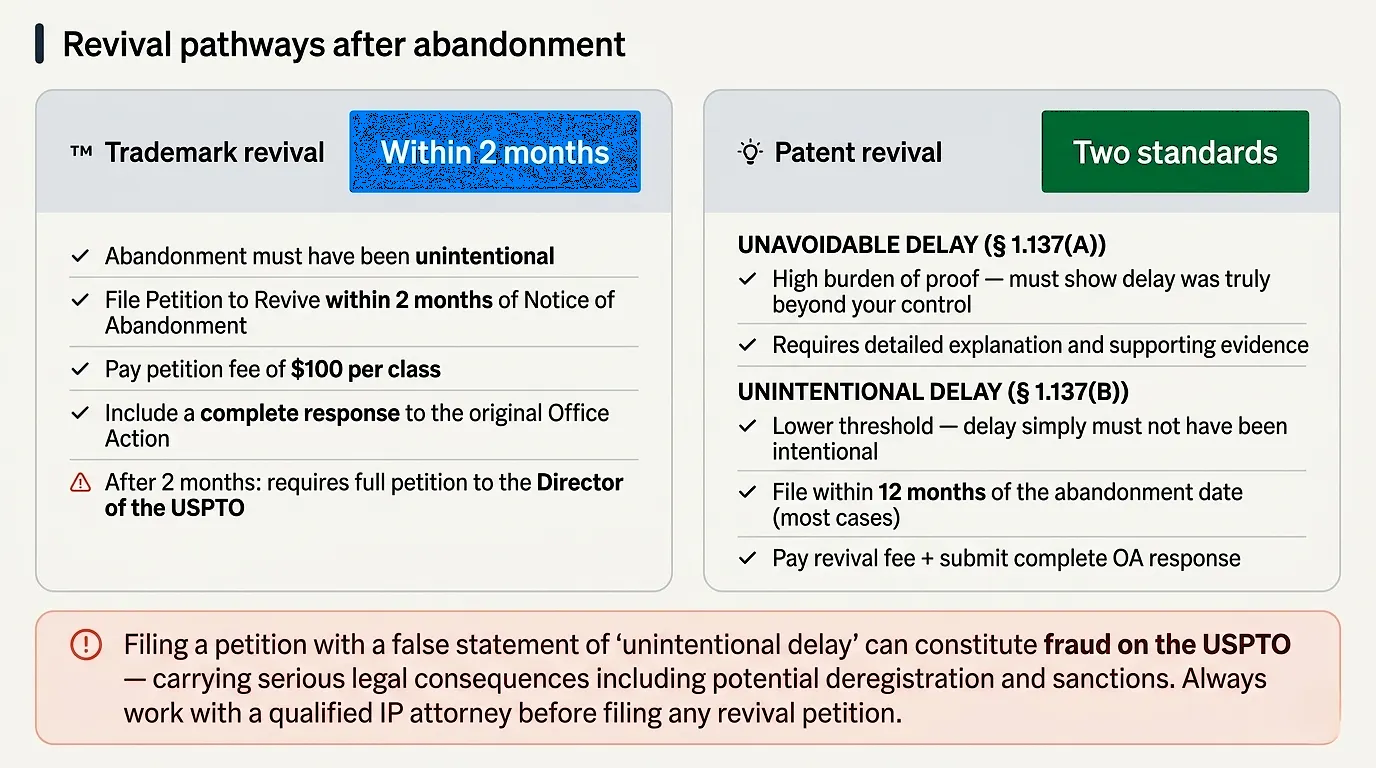
Real Costs of Missing an Office Action Response Deadline
Let’s put the stakes in concrete terms:
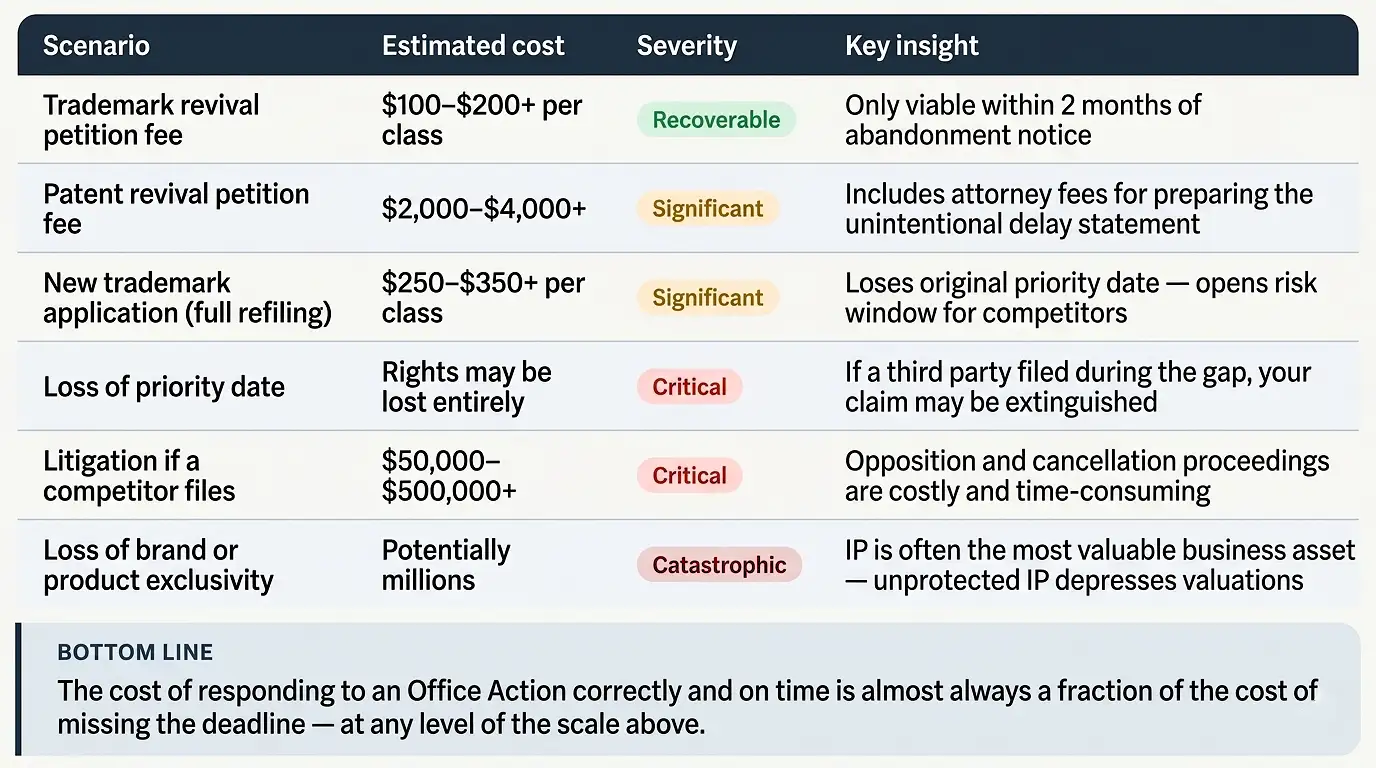
The cost of missing an office action response deadline almost always far exceeds the cost of responding correctly and on time.
How Teak IP Can Help You Meet Every Deadline
At Teak IP Services, we understand that managing intellectual property deadlines is a high-stakes responsibility. Our team provides:
- Comprehensive Office Action analysis – We review every refusal and requirement in detail
- Strategic response drafting – We craft persuasive, legally sound responses tailored to your application
- Deadline management and docketing – We track all USPTO deadlines on your behalf
- Extension request filing – When more time is needed, we file extension requests promptly
- Revival petition support – If you’ve missed a deadline, we assess your options and act fast
- Ongoing USPTO monitoring – We keep watch on your applications so nothing falls through the cracks
Whether you’re a startup protecting your first brand, an established business managing a large IP portfolio, or an inventor navigating the patent process, Teak IP is your trusted partner at every stage.
Frequently Asked Questions (FAQs)
Q: What is the office action response deadline for trademarks? A: As of December 2022, the USPTO gives trademark applicants 3 months to respond to most Office Actions, with an option to extend by 3 months (for a fee), for a total maximum of 6 months.
Q: Can I respond to a Final Office Action? A: Yes. After a Final Office Action, you can file a Request for Reconsideration, appeal to the Trademark Trial and Appeal Board (TTAB) for trademarks, or file an appeal to the Patent Trial and Appeal Board (PTAB) for patents.
Q: How long do I have to revive an abandoned trademark application? A: You must file a Petition to Revive within 2 months of the Notice of Abandonment. After that, revival becomes significantly more difficult.
Q: Is missing an office action deadline the end of my IP rights? A: Not necessarily. Depending on how much time has passed, you may be able to file a Petition to Revive. However, the sooner you act, the better your chances.
Q: Do I need an attorney to respond to a USPTO Office Action? A: You are not legally required to use an attorney, but it is strongly recommended. Office Action responses involve substantive legal arguments and procedural requirements that can significantly impact the outcome of your application.
Q: What if I never received the Office Action? A: The USPTO sends Office Actions to the correspondence address on file. If you didn’t receive it, update your address with the USPTO and contact them. For trademarks, you can check your application status on TSDR at any time.
Don’t Let a Deadline Derail Your IP Journey
Your trademark or patent represents real value – your brand identity, your innovation, your competitive edge. The office action response deadline is one of the most consequential dates in your entire IP journey.
Missing it doesn’t just cost you fees. It can cost you everything you’ve worked to protect.
The good news? With the right knowledge, a reliable IP partner, and proactive deadline management, missing the six-month USPTO window is entirely avoidable.
Learn More About Office Action Response & Shell Preparation Services

