
A single missed deadline in a patent portfolio does not announce itself. It sits quietly in a spreadsheet or a docketing system until the day it becomes irreversible, and by then, the damage to patent rights is already done. This is exactly why a dependable patent docketing quality control workflow is not optional for any firm or in-house IP department; it is the backbone that keeps deadlines, filings, and client trust intact.

If you are a junior attorney building your first docketing checklist, or a solo practitioner trying to figure out whether one review pass is enough, this guide breaks down what a genuinely reliable, multi-layered quality control workflow looks like in practice. You will find the exact structure, common failure points, and practical steps you can apply this week.
What is a Patent Docketing Quality Control Workflow?
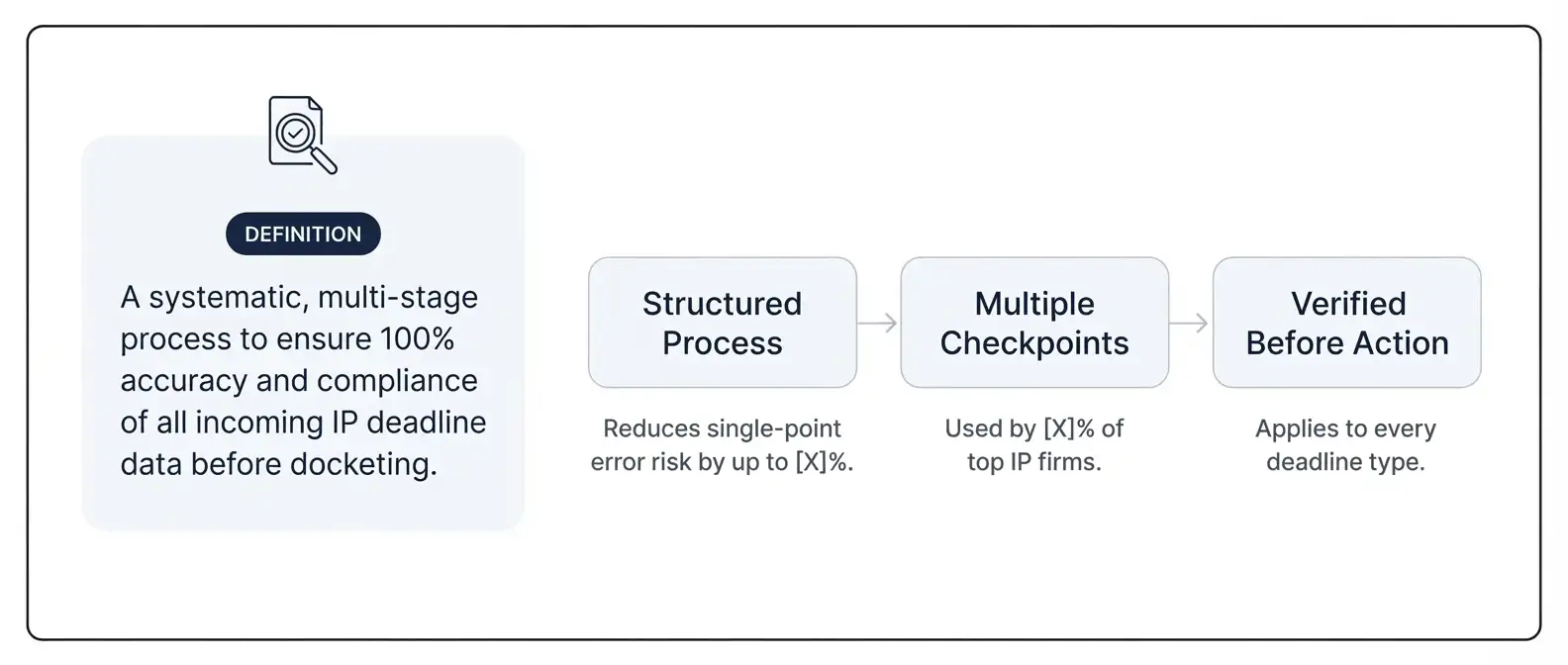
A patent docketing quality control workflow is a structured, repeatable process used to verify that every date, deadline, filing detail, and status update entered into a docketing system is accurate before it becomes actionable. Rather than relying on a single person to catch every error, the workflow distributes verification across multiple checkpoints, so that a mistake made at one stage has a real chance of being caught at the next.
In simple terms, it answers one question at every step: has this data been checked by more than one set of eyes, using more than one method? If the answer is no, the workflow is incomplete.
Why This Definition Matters
Docketing is not simply “data entry.” Every entry connects to a legal deadline governed by statute, treaty, or a specific patent office’s rules. A transposed digit in a priority date or a missed national phase entry deadline can permanently affect patent rights. That is why quality control cannot be an afterthought bolted onto the end of the process; it has to be built into every stage of it.
Why a Single-Layer Review Is Not Enough
Many small firms and solo practices start with a simple approach: one paralegal enters the data, and the same paralegal (or the attorney) glances over it before moving on. This works, until it does not.
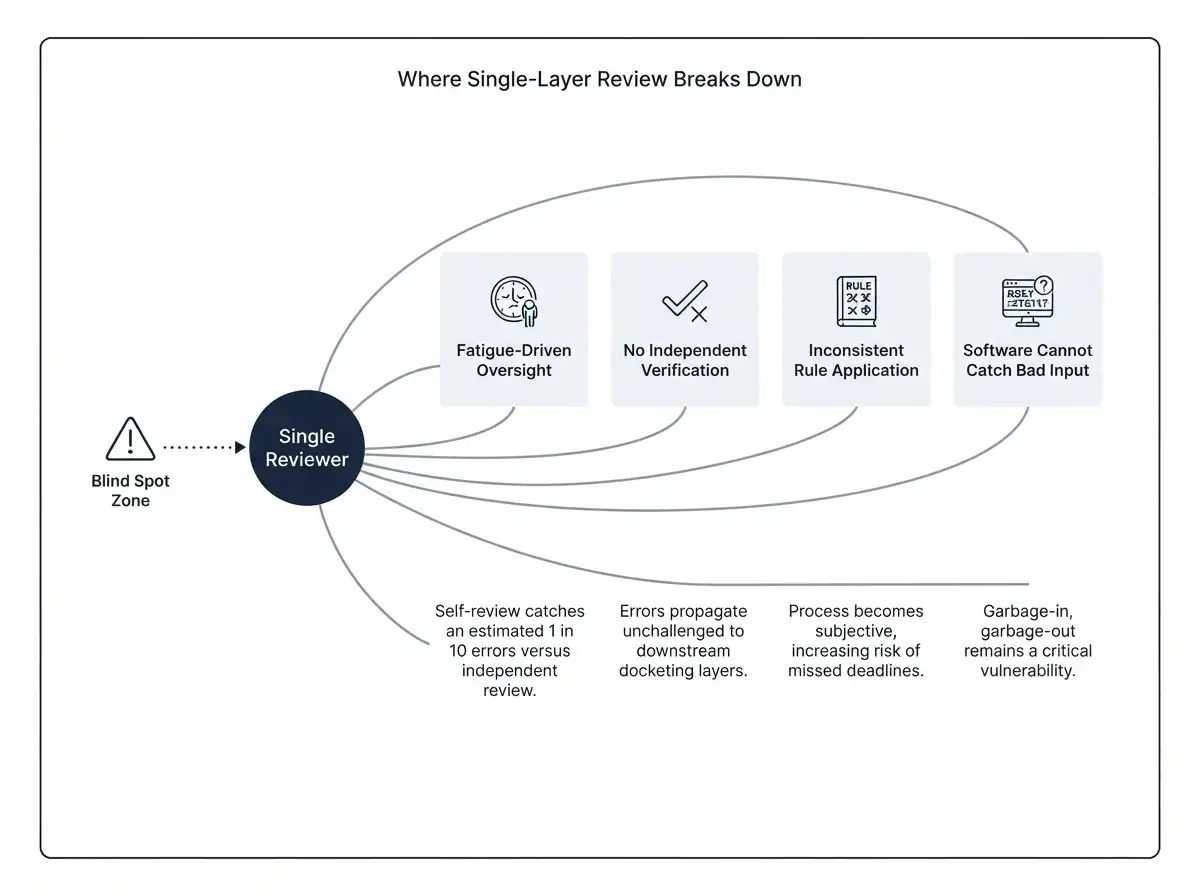
Here is why single-layer review consistently fails over time:
- Fatigue-driven blind spots: The person who entered the data is the least likely to catch their own transcription error, because their brain automatically “fills in” what it expects to see.
- No independent verification: Without a second reviewer using a different method (cross-referencing against the official correspondence, for instance), errors compound silently.
- Inconsistent triggers: Rules-based deadlines, such as a six-month PCT national phase entry window, require calculation logic that a single reviewer may apply inconsistently across matters.
- Software is not infallible: Even the best docketing platforms rely on correct manual input; a garbage-in scenario produces a garbage-out deadline, regardless of how sophisticated the underlying rules engine is.
A multi-layered quality control workflow solves these problems by design, not by hoping everyone stays alert all day.
The Anatomy of a Multi-Layered Patent Docketing Quality Control Workflow
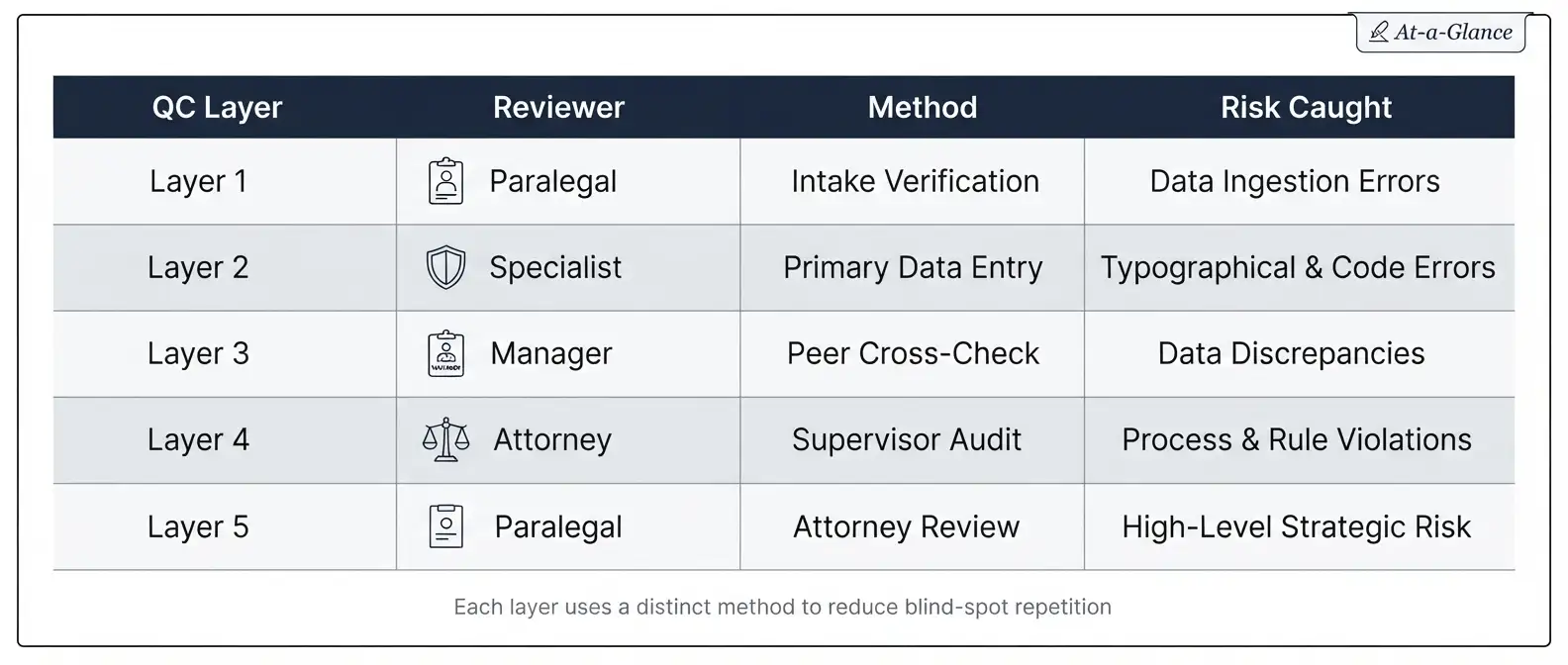
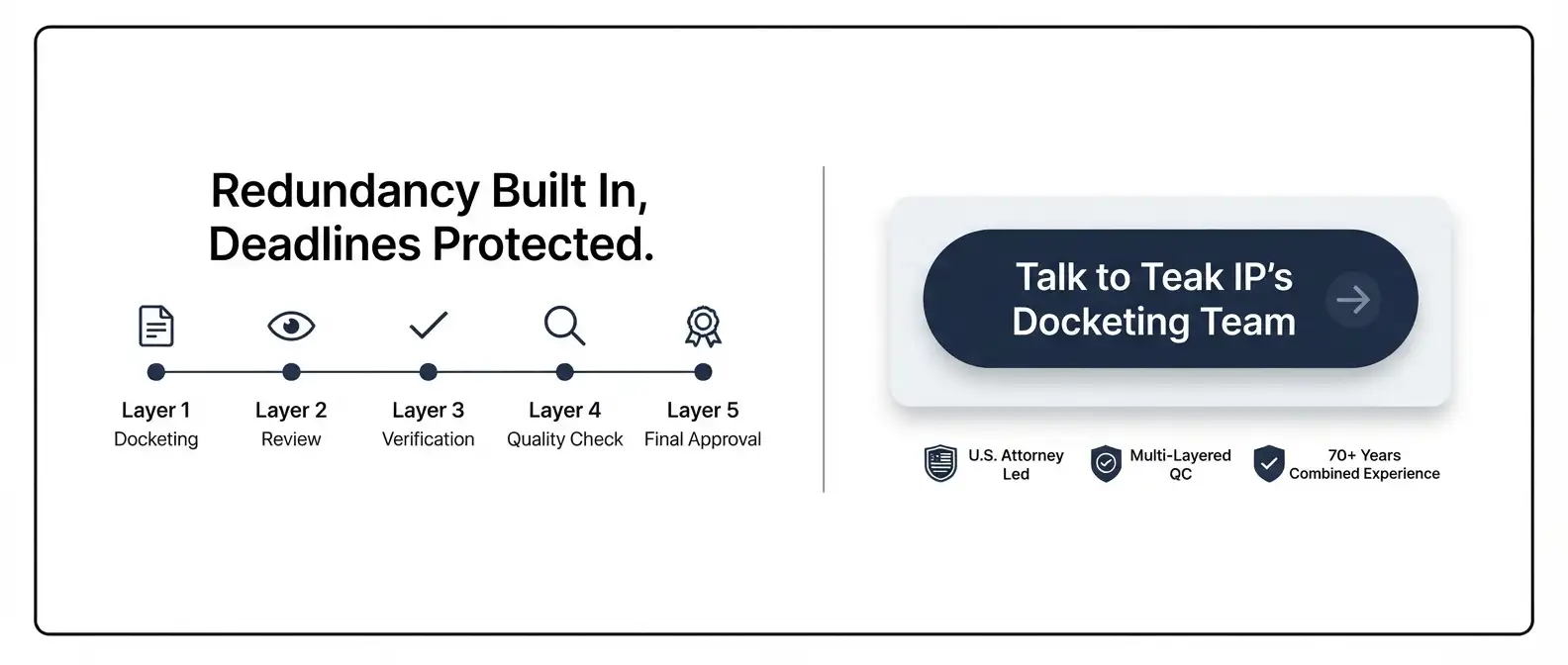
The strongest docketing QC systems typically include four to five distinct layers, each with a different reviewer, method, or trigger. Below is the structure that consistently produces the fewest errors across high-volume patent portfolios.
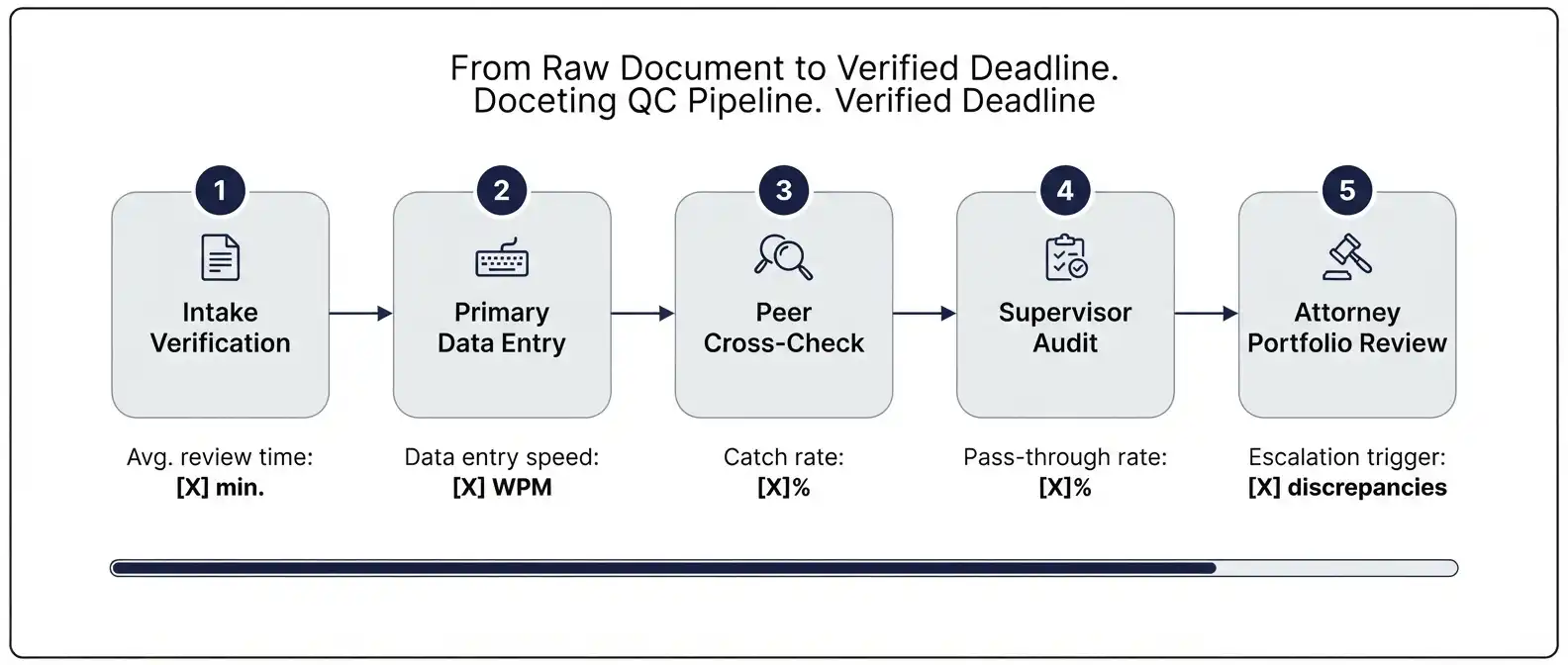
Layer 1: Source Document Verification at Intake
Before any date is entered, the underlying source document, whether it’s a filing receipt, an Office Action, a foreign associate letter, or a notice of allowance, needs to be verified against the matter it is being attached to. This includes confirming:
- The correct application or matter number
- The correct client and inventor names
- The document type and issuing authority
- The date of the document itself, not just the date received
Skipping this step means every downstream calculation inherits an error at the root.
Layer 2: Primary Data Entry With Rule-Based Calculation
The docketing professional enters the relevant dates and lets the docketing software calculate dependent deadlines automatically wherever possible. Manual calculation should be the exception, not the default, because rules-based engines reduce the risk of human math errors on statutory periods.
Layer 3: Independent Peer Cross-Check
A second docketing professional, who did not perform the original entry, reviews the matter independently. This reviewer should not simply glance at the screen; they should pull the original source document and re-verify each critical date against it. This is the single most important layer in catching transcription and interpretation errors.
Layer 4: Docketing Manager or Supervisor Audit
A supervising docketing manager reviews a sample (or, for high-risk matters, all) of the newly entered and cross-checked data before it is finalized. This layer typically focuses on:
- Confirming statutory deadline logic was applied correctly
- Spot-checking foreign filing deadlines and treaty-based calculations
- Ensuring internal firm-specific reminder buffers were applied correctly
Layer 5: Attorney Review and Periodic Portfolio Audit
The attorney of record has final oversight responsibility. This does not mean the attorney manually re-checks every date; it means the attorney relies on a system that has already passed through three prior checks, combined with periodic portfolio-wide audits (often quarterly) that look for patterns, gaps, or outliers across the entire docket.
Step-by-Step Guide to Building the Workflow
If you are setting this up from scratch, here is a practical, sequential approach:
- Map every deadline type in your practice area. List statutory deadlines, treaty-based deadlines (PCT, Paris Convention), office-specific deadlines (USPTO, EPO, foreign national offices), and internal firm buffers.
- Assign a distinct owner to each QC layer. No single person should perform intake, entry, and cross-check for the same matter.
- Standardize source-document handling. Require every incoming document to be logged, timestamped, and linked to a matter number before data entry begins.
- Configure your docketing software’s rules engine. Use automated calculation wherever the software supports it, and disable free-text date entry for statutory deadlines when possible.
- Build a cross-check checklist. Give the second reviewer a standardized checklist rather than a vague “double check this” instruction.
- Set escalation triggers. Define what happens when the cross-checker finds a discrepancy: does it go back to the original entrant, or straight to the docketing manager?
- Schedule recurring portfolio audits. Quarterly or semi-annual audits catch drift that day-to-day checks miss, such as clients that were merged incorrectly or matters with stale statuses.
- Document every QC layer for compliance purposes. If your firm is ever audited or a malpractice question arises, a documented QC trail is your strongest evidence of diligence.
Comparing QC Layers at a Glance
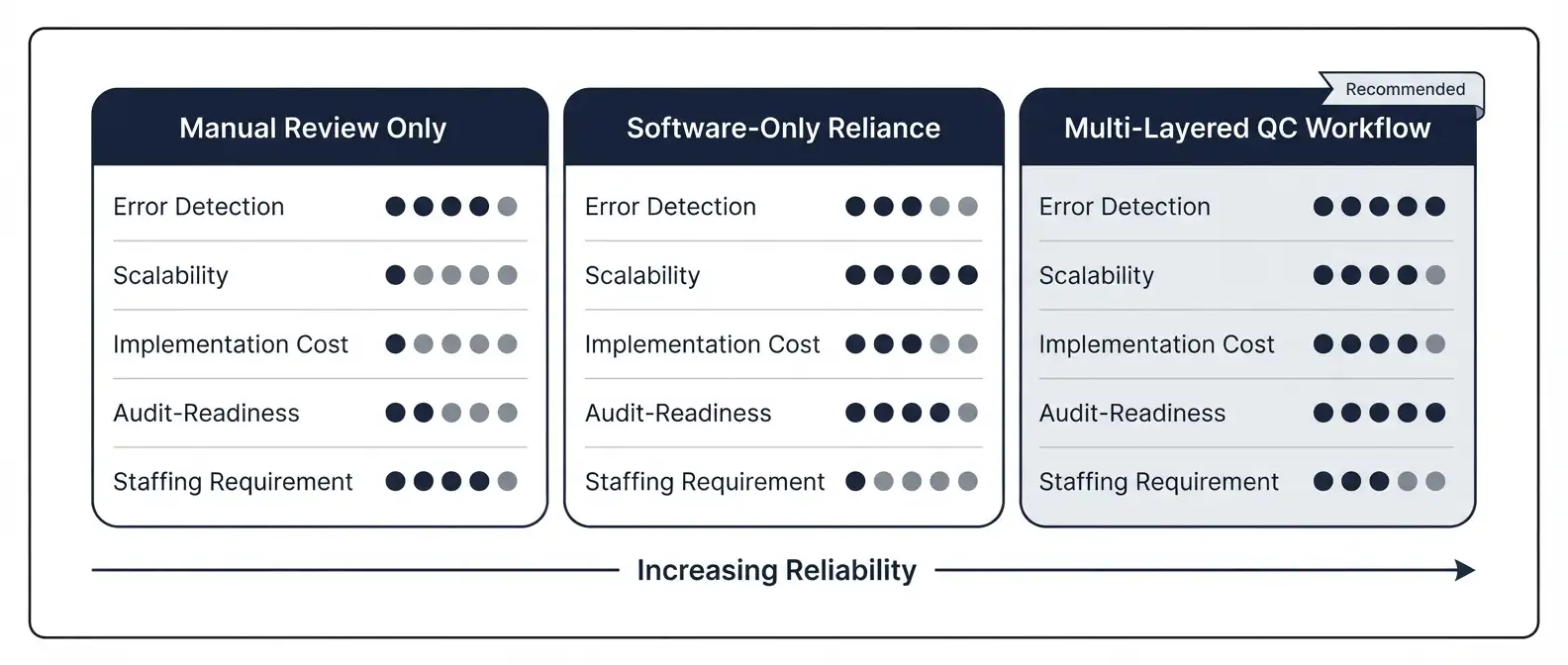
Manual vs. Software-Only vs. Multi-Layered QC: A Comparison
Choosing the right approach depends on portfolio size, risk tolerance, and available staffing. Here is how the three common models compare.
Common Mistakes in Patent Docketing Quality Control
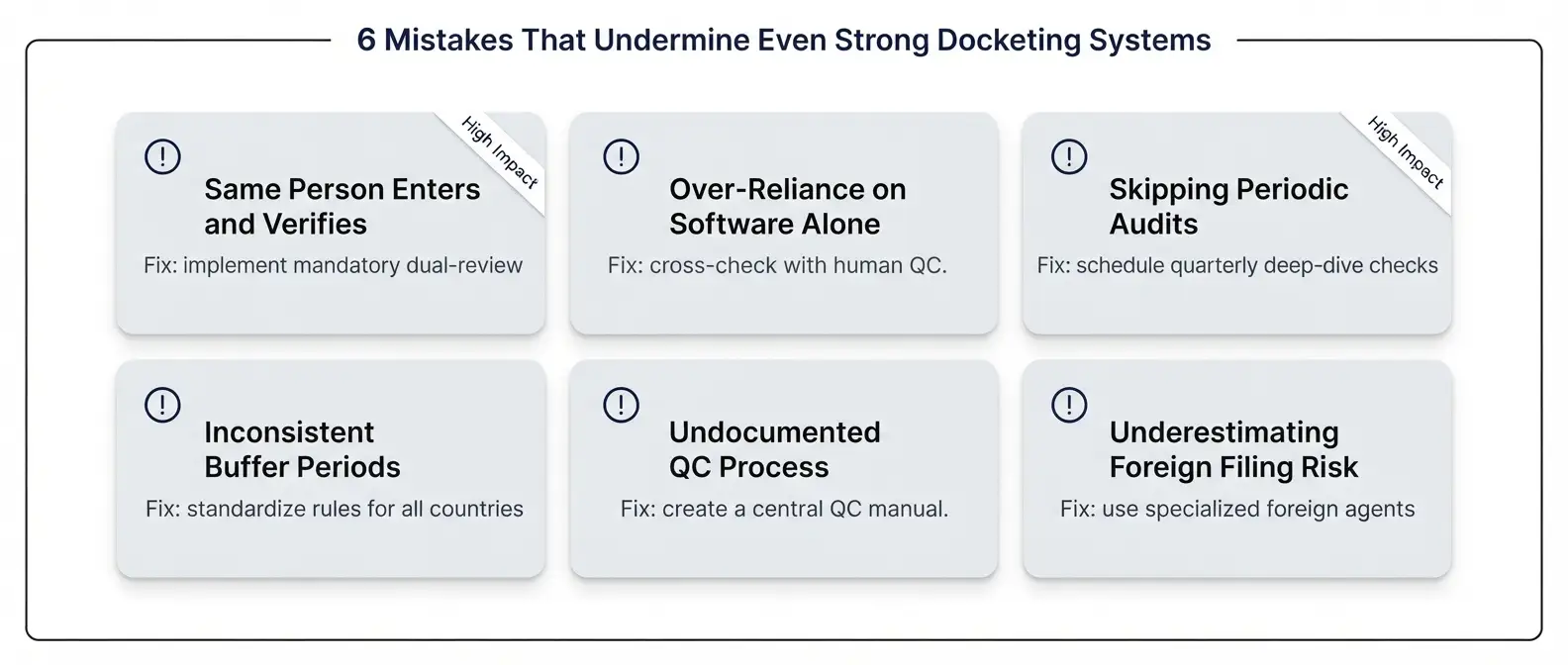
Even well-intentioned firms fall into predictable traps. Watch for these specifically:
- Treating the docketing software as the entire QC system. Software calculates what it is told; it cannot verify that the input itself was correct.
- Letting the same person enter and verify data. This defeats the purpose of a second layer entirely.
- Skipping periodic portfolio audits because “nothing has gone wrong yet.” Errors often surface only when a deadline is missed, which is far too late.
- Failing to standardize buffer periods. Internal reminder dates should be set consistently ahead of true statutory deadlines, not left to individual discretion.
- Not documenting the QC process itself. Without records, it is nearly impossible to demonstrate diligence if a dispute arises later.
- Underestimating foreign filing complexity. Coordinating deadlines across foreign associates introduces additional translation and communication risk that domestic-only workflows are not built to catch.
Expert Tips to Strengthen Your Docketing QC Workflow
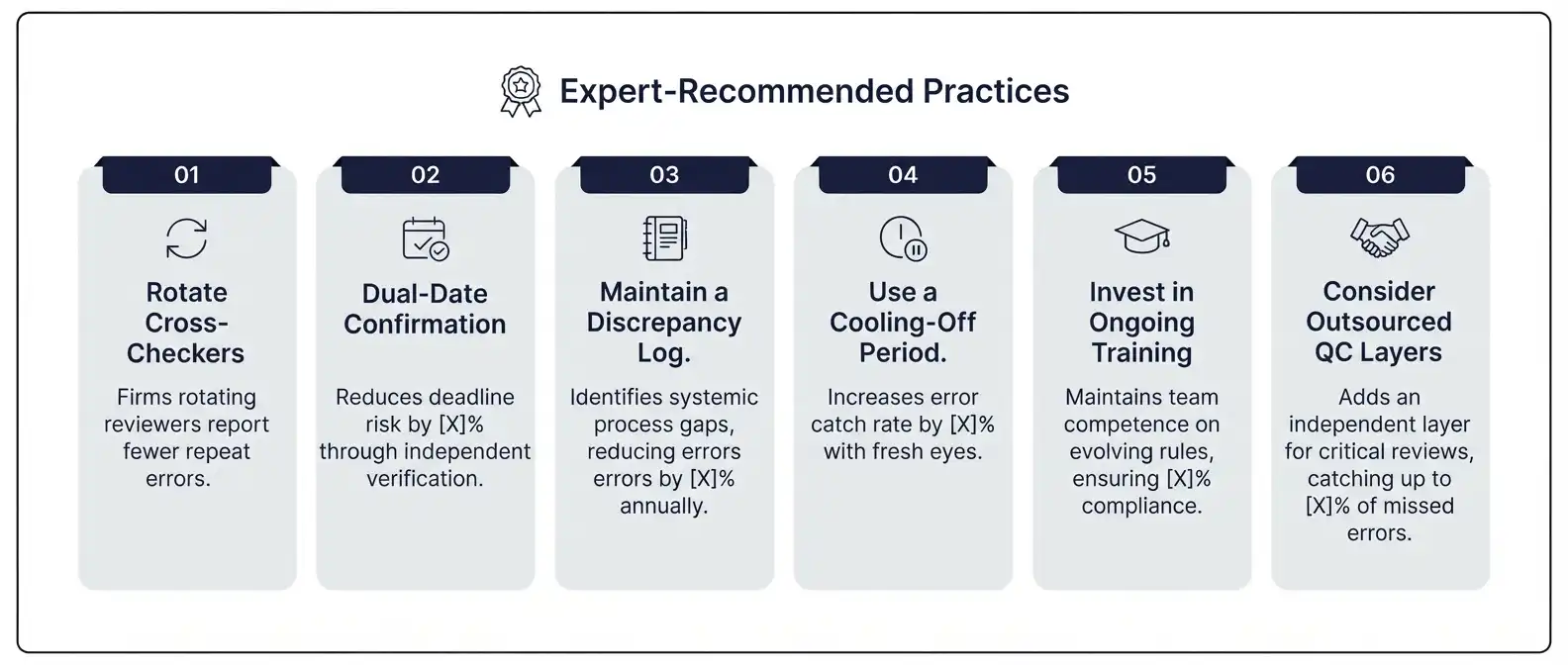
- Rotate cross-checking assignments. Fresh eyes catch more than the same reviewer pairing repeatedly.
- Use dual-date confirmation for treaty deadlines. Have both the primary entrant and cross-checker independently calculate PCT and Paris Convention deadlines, then compare results before finalizing.
- Build a discrepancy log. Track every error caught at each layer; patterns in this log tell you exactly where additional training or process changes are needed.
- Set a “cooling-off” period for self-review. If a single reviewer must check their own entry temporarily, have them wait at least a few hours before re-checking; this reduces the fatigue-driven blind spot.
- Invest in ongoing docketing training. Deadline rules change, and treaty amendments happen. A workflow is only as strong as the knowledge of the people running it.
- Consider dedicated paralegal support for QC layers. Firms without the internal headcount to run a full multi-layered system often outsource specific QC layers to maintain rigor without adding permanent staff.
The Role of Technology in a Multi-Layered QC Workflow
Docketing software is a critical tool, but it plays a supporting role rather than a replacement role in a genuinely reliable patent docketing quality control workflow. The most effective firms configure their platforms to:
- Auto-calculate statutory and treaty deadlines wherever rules permit
- Flag matters missing required data fields before they can be marked complete
- Require a second user’s login credentials for the cross-check step, creating a built-in audit trail
- Generate automated discrepancy reports comparing entered dates against expected deadline ranges
Even with strong automation, human verification at each layer remains essential, because software cannot independently confirm that a source document was correctly interpreted in the first place.
When to Bring in Outsourced Docketing and Paralegal Support
Solo practitioners and smaller firms frequently lack the headcount to staff four or five distinct QC layers internally. This is one of the most common reasons firms turn to dedicated docketing and IP management support or broader paralegal support services to fill specific layers of the workflow without the cost of full-time hires.
Outsourcing a QC layer, such as the independent peer cross-check or the periodic portfolio audit, is often more cost-effective than trying to build the same redundancy entirely in-house, particularly for firms managing growing patent portfolios across multiple jurisdictions. If you are weighing whether outsourcing makes sense for your firm, it helps to first understand how to evaluate and compare IP outsourcing companies before committing to a vendor.
Firms that already work with foreign associates on international filings should also pay close attention to how correspondence and deadline coordination is handled between offices, since this is a frequent point of breakdown; our guide on who prepares response correspondence for foreign patent filings covers this in detail.
Setting Escalation Protocols When Errors Are Found
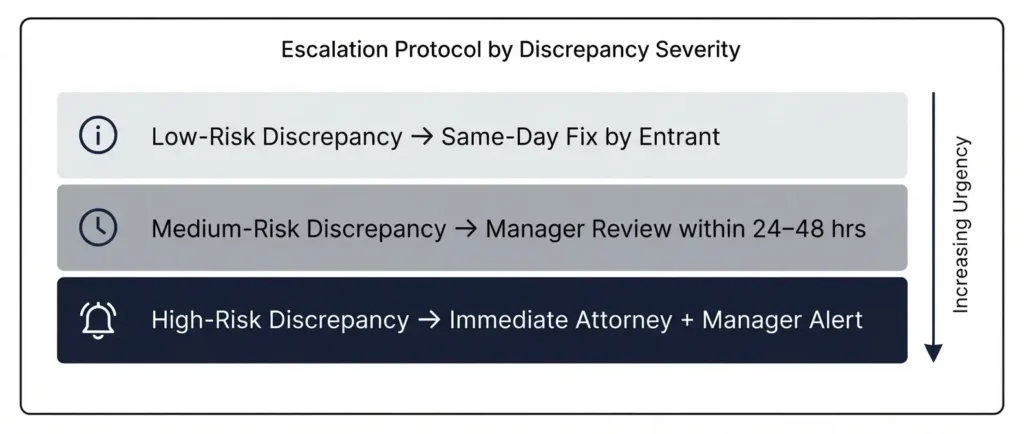
A quality control workflow is incomplete without a clear answer to the question: what happens the moment an error is discovered? Firms that skip this step often let discrepancies sit for days while staff figure out, informally, who should fix it and how urgently.
A well-defined escalation protocol typically follows this pattern:
- Low-risk discrepancies (formatting issues, non-critical field errors) are routed back to the original entrant for same-day correction.
- Medium-risk discrepancies (incorrect but non-imminent deadline dates) are routed to the docketing manager for review within 24 to 48 hours.
- High-risk discrepancies (deadlines within 30 days, or statutory deadlines with no revival option) trigger immediate notification to both the docketing manager and the attorney of record, regardless of time of day.
Writing this protocol down, and making sure every team member knows it without needing to ask, removes the guesswork that causes delays at exactly the moment speed matters most.
Special Considerations for High-Risk Deadline Categories
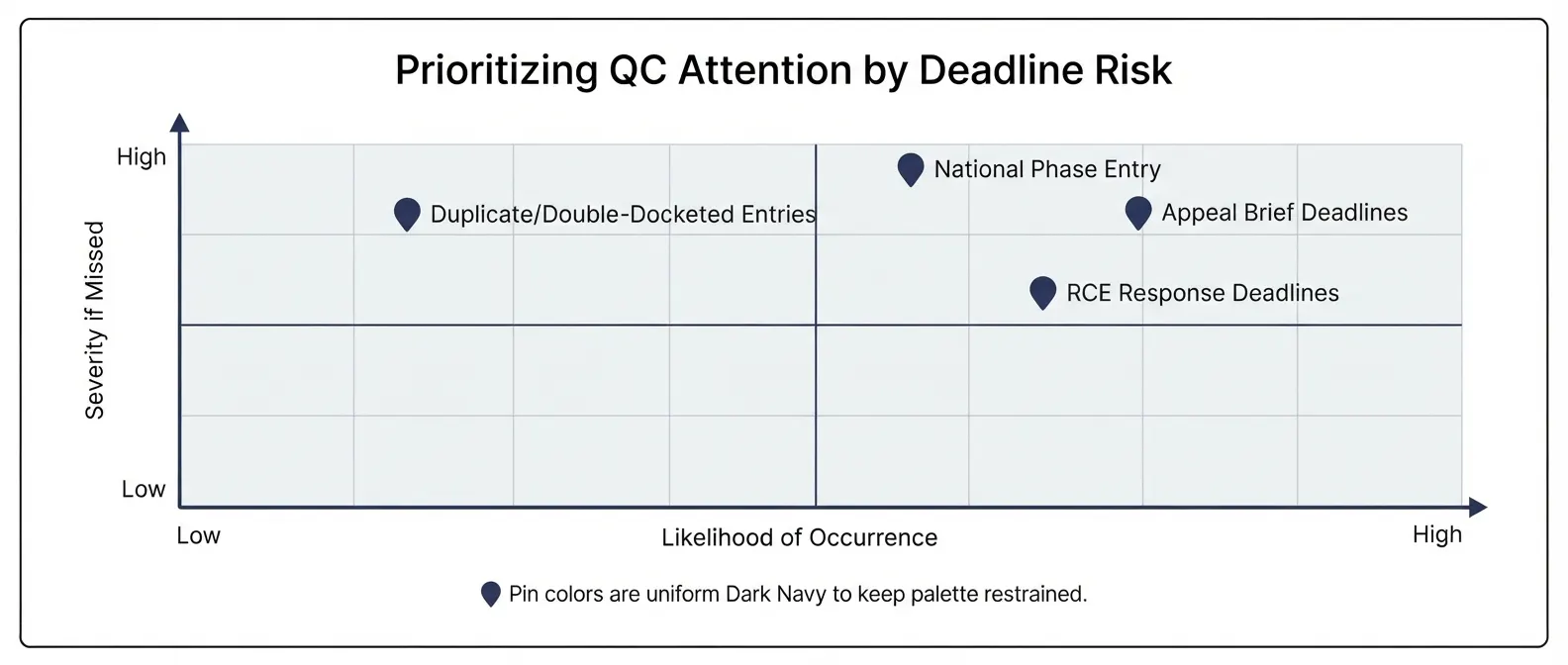
Not every deadline carries equal risk. Certain categories deserve extra QC attention because the consequences of an error are severe and often irreversible:
- National phase entry deadlines under the Patent Cooperation Treaty, where a missed 30 or 31-month deadline typically cannot be revived in most jurisdictions.
- Appeal brief deadlines, where timelines can shift quickly depending on procedural history; see our detailed breakdown on managing timelines for patent appeal briefs for a closer look at this specific risk area.
- Response deadlines to Office Actions, particularly when a Request for Continued Examination is involved, since these carry their own layered deadline logic.
- Duplicate or conflicting docket entries, a scenario closely related to what practitioners call double-docketing, where the same matter is tracked inconsistently across systems and creates confusion about which deadline actually controls.
For firms managing larger dockets, it is also worth reviewing what dedicated patent docketing services for mid-size and large IP firms typically include, since the QC expectations scale meaningfully with portfolio size.
Building KPIs to Measure Your QC Workflow
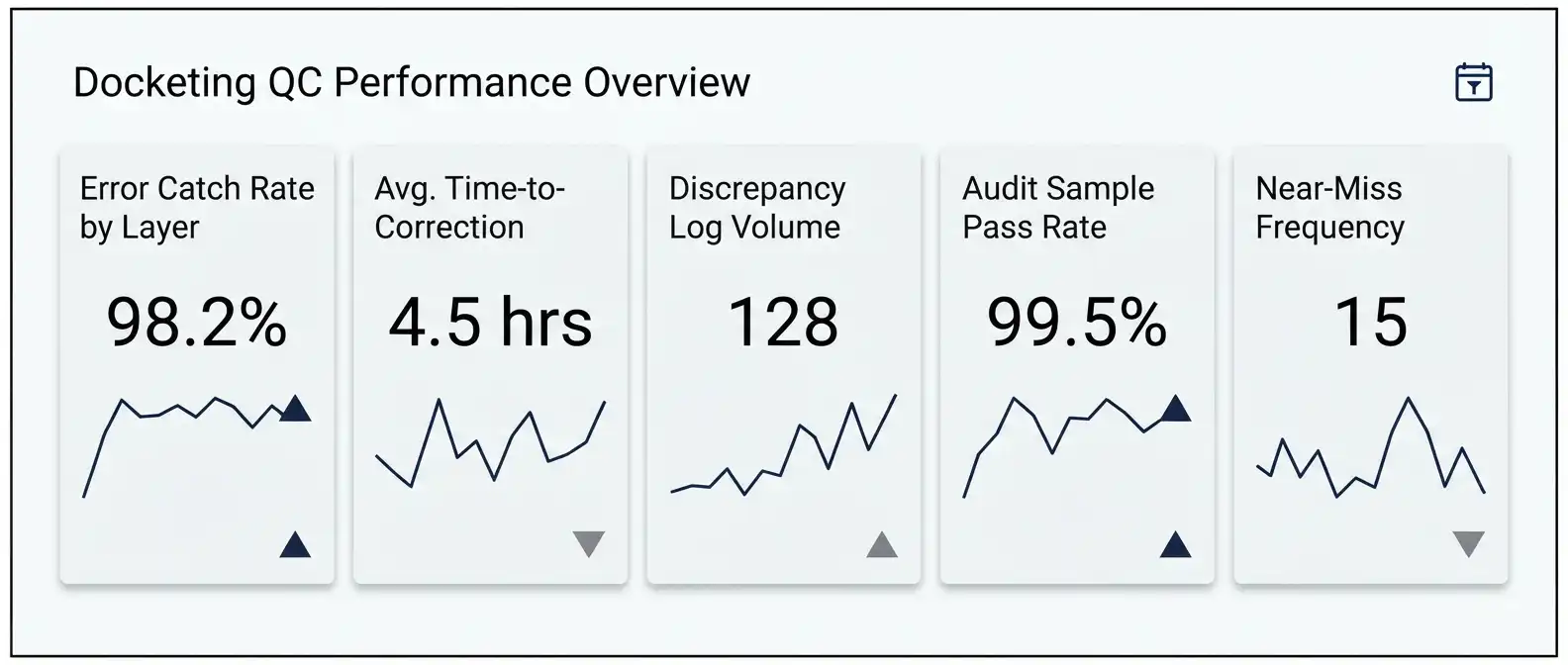
A patent docketing quality control workflow is only as good as your ability to measure whether it is actually working. Without metrics, “quality control” becomes a vague promise rather than a verifiable process. Firms that get this right typically track a small set of consistent indicators over time.
Consider tracking these key performance indicators on a monthly or quarterly basis:
- Error catch rate by layer: What percentage of total errors are caught at Layer 3 versus Layer 4? If your supervisor audit is catching errors that the peer cross-check should have caught, that signals a training gap, not just a data problem.
- Time-to-correction: How long does it take from when an error is flagged to when it is fully corrected in the system? Long correction windows increase the risk that a deadline slips through before the fix is applied.
- Discrepancy log volume over time: A rising trend in discrepancies, even minor ones, often precedes a more serious missed deadline. Treat this log as an early warning system, not just a record-keeping exercise.
- Audit sample pass rate: During quarterly portfolio audits, what percentage of sampled matters pass with zero findings? A declining pass rate is a clear signal that a QC layer needs reinforcement.
- Near-miss frequency: Track cases where a deadline was corrected close to the actual due date rather than well in advance. Frequent near-misses suggest your buffer periods or escalation triggers need adjustment.
Reviewing these numbers as a team, rather than treating them as one person’s responsibility, keeps the workflow accountable and gives attorneys real visibility into how well the underlying system is performing.
Training and Onboarding for a Reliable QC Workflow
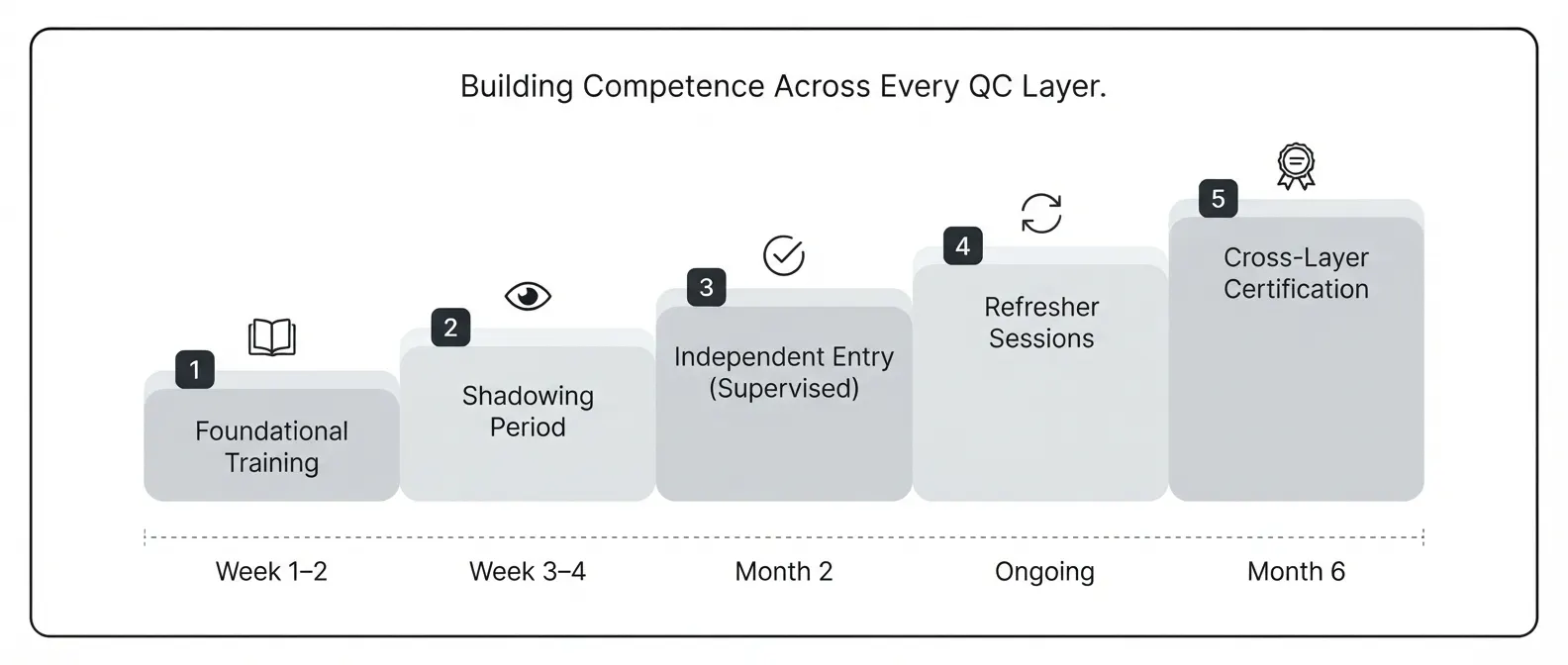
Even the most well-designed multi-layered workflow breaks down if the people running it are not properly trained. Docketing rules are detailed, jurisdiction-specific, and subject to periodic change, which makes ongoing training a core part of quality control rather than a one-time onboarding task.
A strong training approach for docketing staff generally includes the following elements:
- Foundational statutory and treaty training. New docketing staff should understand not just how to enter a date, but why that date matters and what happens if it is missed.
- Shadowing before independent entry. New team members should shadow an experienced docketing specialist through several full cycles, from intake through cross-check, before handling matters independently.
- Regular refresher sessions on rule changes. Treaty amendments, changes to national phase entry rules, and updates to a specific patent office’s procedures should trigger a mandatory refresher, not just an email notice that may go unread.
- Error review sessions, not blame sessions. When the discrepancy log shows a pattern, walk through it as a team so everyone learns from it, rather than singling out the individual who made the entry.
- Cross-training across QC layers. Staff who understand every layer of the workflow, not just their own assigned step, are better equipped to catch errors that fall outside their usual role.
Practical Insights From Real-World Docketing Operations
In practice, firms that run a genuinely effective multi-layered QC workflow share a few common habits that go beyond the formal process on paper.
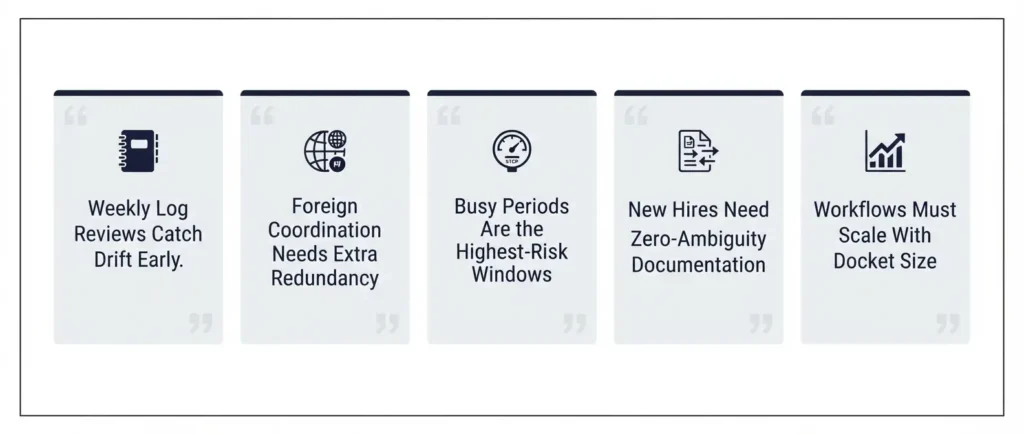
- They treat the discrepancy log as a living document, reviewed weekly rather than filed away and forgotten.
- They build in redundancy for foreign filing coordination specifically, since translation and time-zone gaps between firms and foreign associates are a recurring source of errors that domestic-only checklists miss.
- They resist the temptation to skip layers during busy filing periods, even though this is precisely when the pressure to cut corners is highest, and precisely when errors are most likely to occur.
- They keep the workflow documented in a format new hires can follow without needing to ask a colleague for clarification at every step.
- They revisit the workflow itself periodically, not just the data running through it, since a process that worked well for a 200-matter docket may not scale cleanly to a 2,000-matter docket.
Compliance and Malpractice Risk Considerations
A documented, multi-layered quality control workflow serves a purpose beyond simply catching errors before they happen; it also creates a defensible record if a deadline dispute or malpractice question ever arises. Firms that can demonstrate a consistent, documented QC process, including who reviewed each matter and when, are in a materially stronger position than firms relying on informal or undocumented checks.
At minimum, your documentation should capture:
- Who performed each layer of review, with a timestamp
- What method was used to verify the data (source document comparison, software calculation, or both)
- Any discrepancies found and how they were resolved
- The date of the most recent portfolio-wide audit for each matter category
This documentation does not need to be elaborate, but it does need to be consistent and retrievable on short notice.
Adapting Docketing QC for an AI-Assisted Legal Environment
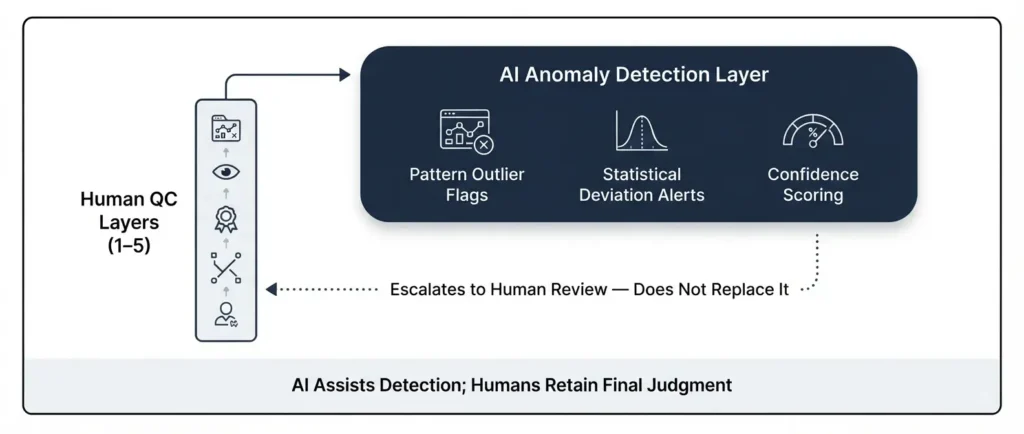
Docketing software increasingly incorporates rules engines and automated flagging, and some platforms are beginning to layer in AI-assisted anomaly detection to flag entries that fall outside expected patterns. This is a useful addition to a multi-layered workflow, not a replacement for it. AI-assisted flagging works best as an additional checkpoint sitting alongside human review, catching statistical outliers that a busy reviewer might overlook, while the human layers continue to handle the nuanced interpretation of source documents that automated systems are not yet equipped to fully replace.
Firms evaluating new docketing technology should ask vendors specifically how automated flagging integrates with, rather than replaces, the human cross-check layers described earlier in this guide.
Frequently Asked Questions
What is the best patent docketing quality control workflow for a small firm?
The best patent docketing quality control workflow for a small firm typically combines automated rules-based calculation in the docketing software with at least one independent human cross-check per matter, supplemented by periodic portfolio audits. Firms without enough internal staff to run this in-house often outsource specific QC layers to maintain the same level of rigor.
How many people should review a patent docketing entry?
At minimum, two people should be involved: the person who enters the data and an independent reviewer who cross-checks it against the original source document. Larger firms typically add a third layer through a docketing manager audit, and a fourth through periodic attorney-level portfolio review.
What is the difference between docketing software and a docketing QC workflow?
Docketing software is a tool that stores data and calculates deadlines based on rules you configure; a docketing QC workflow is the human process that verifies the data entered into that software is accurate in the first place. Software alone cannot catch an incorrectly interpreted source document.
How often should a law firm audit its patent docket?
Most firms benefit from a full portfolio audit at least once per quarter, in addition to the ongoing matter-by-matter cross-checks that happen as new documents are docketed. High-volume or high-risk portfolios sometimes warrant monthly spot audits.
Can outsourcing patent docketing improve quality control?
Yes. Outsourcing specific quality control layers, such as independent cross-checks or periodic audits, to an experienced IP support provider can add redundancy without the overhead of hiring additional full-time staff, particularly for solo practitioners and smaller firms.
Conclusion
A dependable patent docketing quality control workflow is not built around a single diligent person; it is built around layered redundancy that assumes even skilled professionals make occasional mistakes. From intake verification through periodic portfolio audits, each layer exists to catch what the previous one might have missed. For junior attorneys and solo practitioners in particular, adopting this structure early, whether staffed internally or supported through outsourced paralegal and docketing services, is one of the most reliable ways to protect patent rights and client trust over the long run.
If your firm needs help building or strengthening a multi-layered docketing QC system, Teak IP’s docketing and IP management team can help you design a workflow that fits your portfolio size and risk profile. Contact Teak IP Services today to discuss your docketing needs.
Docketing & IP Management Services for Law Firms and Corporate IP Teams

