
A single vague instruction letter can delay a foreign patent application by months. That is the quiet risk hiding inside every international filing program: the response correspondence for foreign patent filings that shuttles between a US applicant, their domestic counsel, and a network of foreign associates around the world.
If you manage a global patent portfolio, you already know that filing abroad is never a single event. It is an ongoing conversation, office actions, instruction letters, translation queries, and deadline confirmations, all of which depend on someone drafting clear, accurate, and timely correspondence. Get this wrong, and a client’s foreign rights can lapse before anyone notices.

This guide breaks down exactly who prepares response correspondence for foreign patent filings, how the responsibility shifts between US attorneys, in-house counsel, foreign associates, and outsourced paralegal teams, and what a well-run correspondence workflow actually looks like in practice.
Quick Answer: Who Prepares Response Correspondence for Foreign Patent Filings?
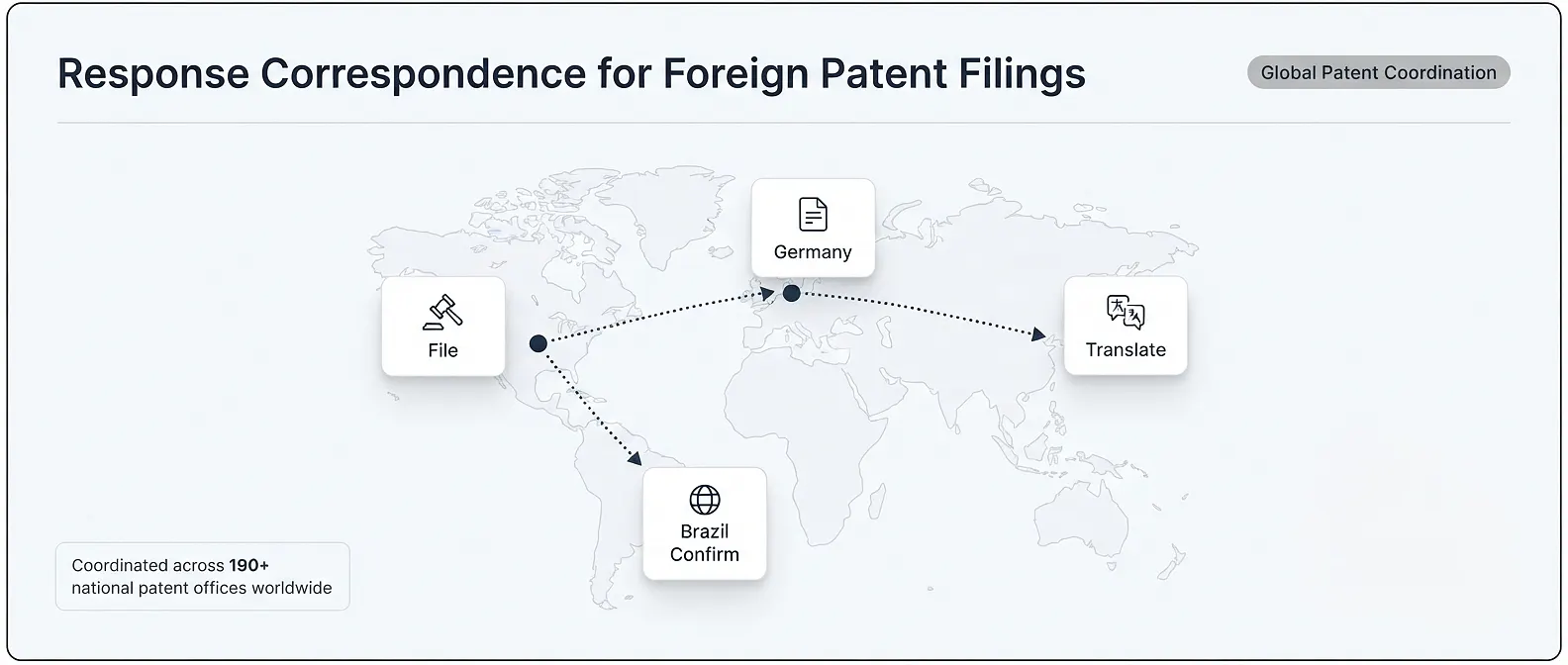
In most international filing programs, the US patent attorney or their supervised paralegal team drafts the substantive response correspondence, while the foreign associate reviews it for local compliance, translates it if needed, and files it with the relevant foreign IP office. Larger firms and corporations frequently outsource the drafting and coordination workload to specialized IP paralegal support providers to keep deadlines on track across dozens of jurisdictions.
That single sentence answers the headline question, but the real value is in understanding why the work is split this way, who actually touches each document, and how firms keep the process from breaking down when a portfolio spans 20, 50, or 100 countries.
What is Response Correspondence in Foreign Patent Filings?
Response correspondence refers to the written communications exchanged between a US-based applicant or attorney and a foreign associate law firm during the prosecution of a patent application outside the United States.
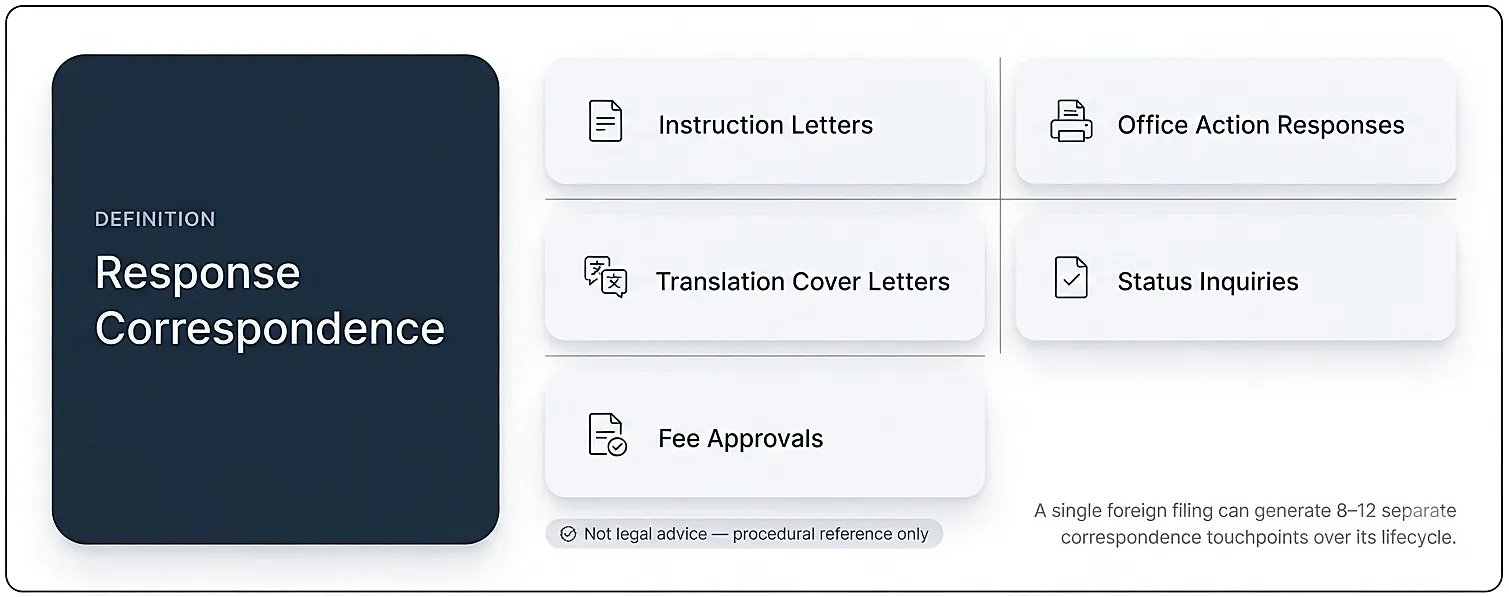
It typically includes:
- Instruction letters authorizing the foreign associate to file, respond, or take a specific action
- Substantive responses to foreign office actions, examination reports, or objections
- Cover letters accompanying translations, powers of attorney, or assignment documents
- Status inquiries and deadline confirmations
- Cost estimates, fee approvals, and invoice-related correspondence
Because foreign patent offices operate under different procedural rules than the USPTO, this correspondence is rarely a simple copy-paste of the US prosecution history. Consequently, every letter needs to be tailored to the receiving jurisdiction’s legal framework, language requirements, and formatting conventions. The USPTO’s own guidance on international patent protection makes clear that applicants seeking rights abroad must work through the procedures of each destination country, which is precisely why response correspondence for foreign patent filings looks so different from routine domestic prosecution paperwork.
For applications entering the national phase through the Patent Cooperation Treaty, the correspondence obligations multiply further. The WIPO PCT Applicant’s Guide sets out country-by-country requirements that foreign associates must follow, and much of that guidance ends up embedded directly into the instruction letters and cover correspondence that US teams send abroad.
The Core Players in Foreign Patent Correspondence
Before diving into the workflow itself, it helps to understand who sits at each stage of the process. Coordinating patent filings with foreign associates typically involves four distinct roles, and each one has a different responsibility when it comes to response correspondence.
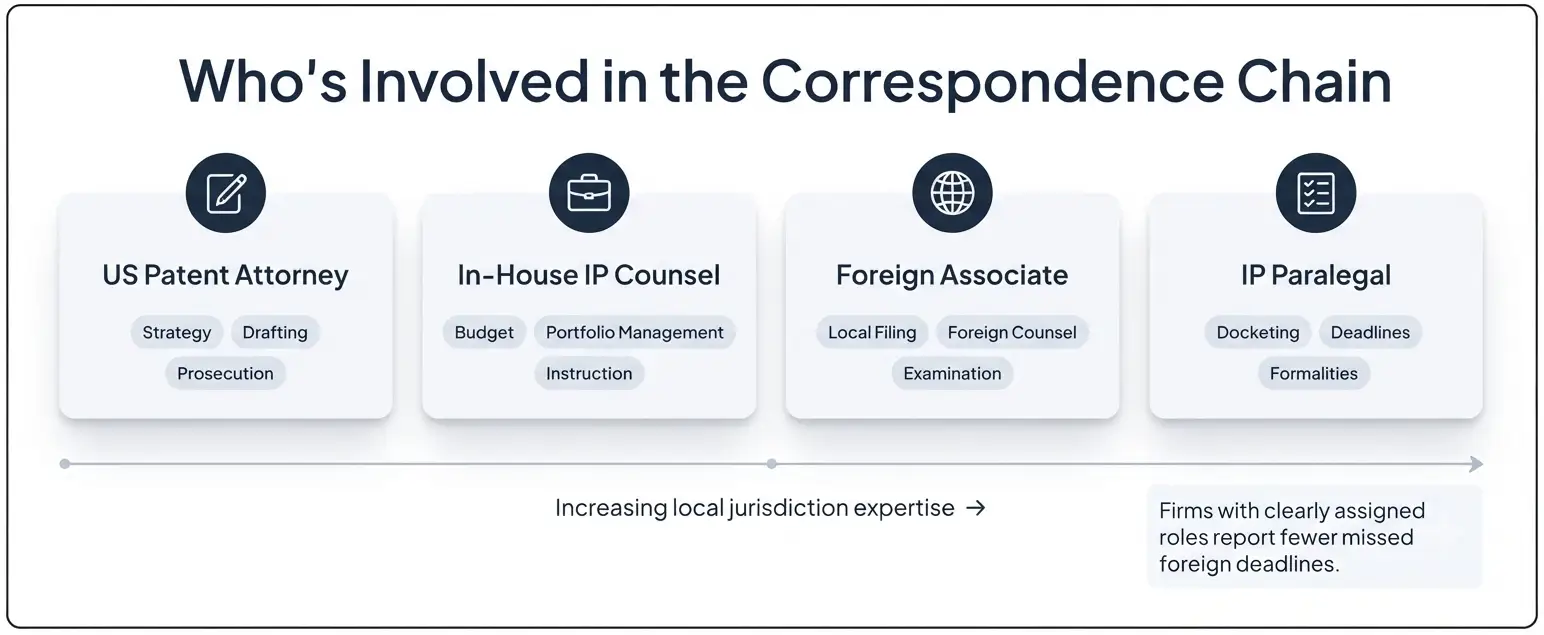
1. The US Patent Attorney or Agent
The US attorney of record usually owns the overall prosecution strategy. Since they know the invention, the prior art, and the client’s business goals better than anyone else, they are typically the first to draft or approve substantive responses before they go abroad.
Their responsibilities generally include:
- Reviewing the underlying US prosecution history for consistency
- Approving claim amendments or arguments that will be forwarded internationally
- Signing off on instruction letters sent to foreign associates
- Making the final call on strategic decisions like claim scope narrowing
2. In-House IP Counsel or Corporate Patent Managers
For corporations with large global portfolios, in-house counsel often sets the correspondence policy. They decide which matters get escalated for detailed review and which can move through a more standardized, templated process. In-house teams also tend to manage budget approvals tied to foreign associate invoices, which is a frequent subject of response correspondence.
3. The Foreign Associate
The foreign associate, meaning local counsel admitted to practice in the destination country, plays a dual role. First, they translate or adapt the substantive arguments the US attorney provides into a filing that satisfies local procedural rules. Second, they generate their own correspondence back to the US side: status updates, fee schedules, and questions about ambiguous instructions.
In Europe, for example, the European Patent Office’s Guidelines for Examination dictate strict formatting and substantive requirements for responses to examination reports. A foreign associate practicing before the EPO has to reconcile the US attorney’s underlying arguments with these guidelines before anything gets filed, which is one reason foreign associate correspondence so often includes clarifying questions rather than a simple confirmation of receipt.
Foreign associates typically bill by the letter or by the hour for this coordination work, and larger firms often negotiate flat-rate arrangements for routine, templated correspondence to keep costs predictable across a large portfolio.
4. IP Paralegals and Docketing Specialists
This is where much of the practical, day-to-day correspondence work actually happens. Paralegals draft the routine instruction letters, track incoming office actions, prepare cover correspondence for translations, and flag deadlines before they become emergencies. Many firms rely on outsourced paralegal teams for exactly this reason. If you are weighing whether that model fits your firm, our guide on Patent Paralegal Outsourcing for Corporate IP Departments walks through how the responsibility typically gets divided.
Who Actually Drafts Response Correspondence for Foreign Patent Filings?
Now that the players are clear, here is how the drafting responsibility typically breaks down across the most common types of correspondence.
| Correspondence Type | Primary Drafter | Secondary Reviewer | Typical Turnaround |
|---|---|---|---|
| Instruction letter to file abroad | US attorney or paralegal | Foreign associate | 3-5 business days |
| Substantive office action response | US attorney (technical arguments) | Foreign associate (local compliance) | 2-4 weeks |
| Formal objection response (non-substantive) | Paralegal, per firm template | US attorney (spot check) | 1-2 weeks |
| Translation cover letter | Paralegal or foreign associate | US attorney (final approval) | 3-7 business days |
| Fee estimate and budget approval | Foreign associate | In-house counsel | 5-10 business days |
| Deadline confirmation | Docketing team | US attorney | 1-2 business days |
As the table shows, no single person prepares every piece of correspondence. Instead, responsibility shifts depending on whether the content is legally substantive or administratively procedural.
Step-by-Step: How Response Correspondence Moves Through the Process
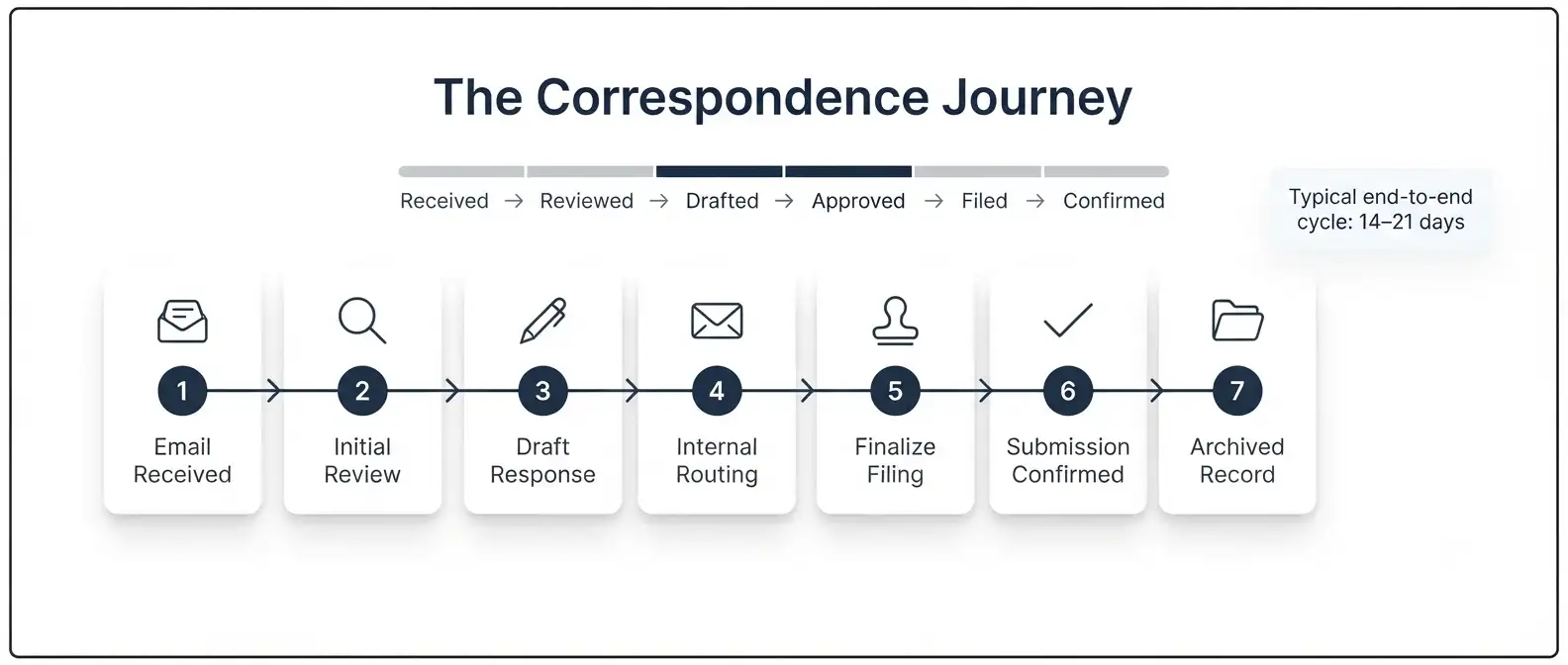
Understanding the mechanics of a typical exchange makes it easier to see where bottlenecks tend to form. Here is the general sequence most firms follow when coordinating patent filings with foreign associates.
- The foreign office issues an action. A patent office in, say, Japan, Germany, or India sends an examination report or office action to the local foreign associate.
- The foreign associate forwards it with a summary. Rather than sending a raw, untranslated document, a competent associate typically includes a brief English-language summary and their recommended response strategy.
- The US attorney reviews and drafts substantive instructions. This is where the technical and legal arguments get built, often by the attorney with paralegal support drafting the first pass.
- The instruction letter goes back to the foreign associate. This letter authorizes the specific response, whether that means amending claims, arguing patentability, or requesting an extension.
- The foreign associate finalizes and files the response. They adapt the language to satisfy local formatting rules and submit it to the relevant patent office within the deadline.
- Docketing confirms the filing and updates the record. A confirmation letter or filing receipt closes the loop and gets logged into the firm’s docketing system.
Each of these steps generates its own correspondence trail, and missing even one confirmation can create a compliance gap that is hard to catch later.
Common Mistakes in Foreign Patent Correspondence
Even experienced IP teams run into predictable problems when managing correspondence across borders. Here are the mistakes that show up most often.
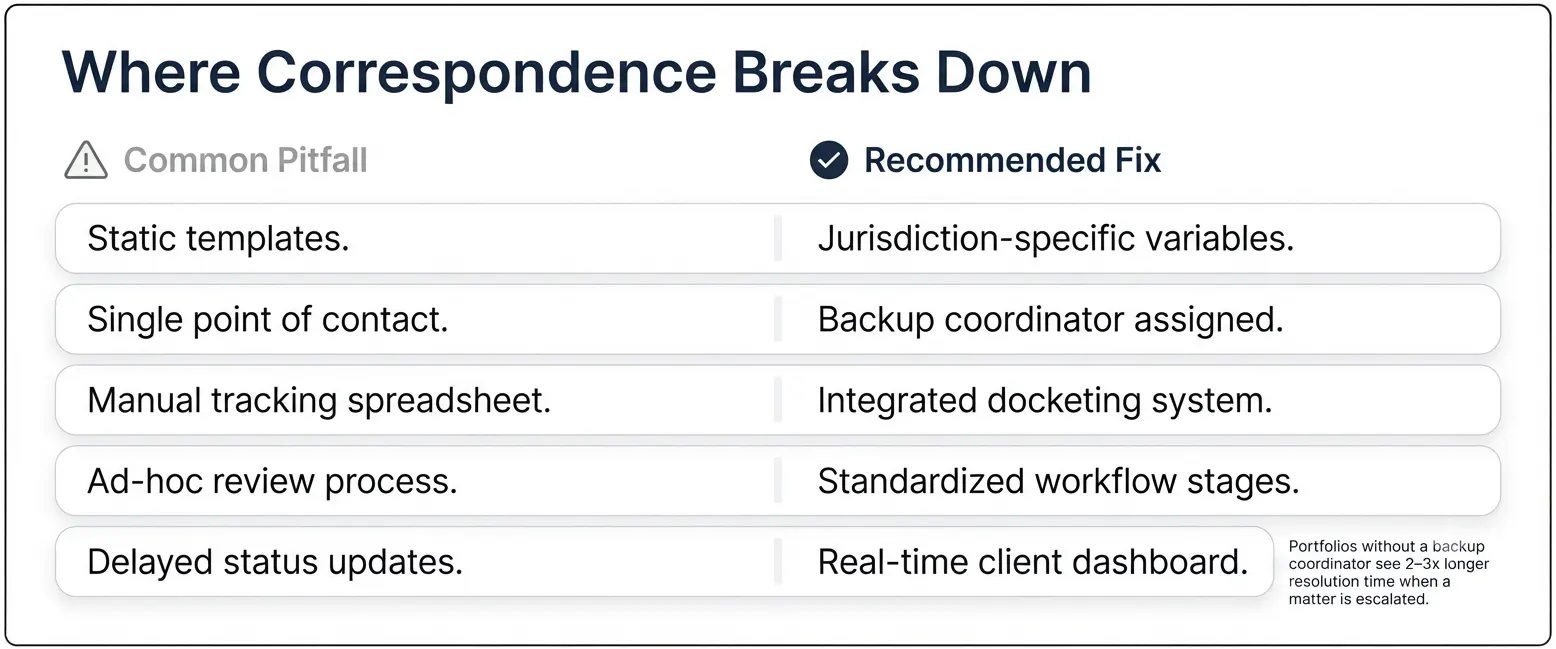
- Treating instruction letters as boilerplate. Generic templates that do not account for jurisdiction-specific rules frequently cause avoidable rejections.
- Missing the deadline calculation nuance. Many countries calculate response deadlines differently than the USPTO, and failing to account for that difference is one of the most common causes of missed foreign deadlines.
- Skipping the foreign associate’s clarifying questions. When a foreign associate flags an ambiguity in the instructions, ignoring or delaying that question often forces a rushed, lower-quality response later.
- No centralized correspondence log. Without a shared tracking system, it becomes difficult to know who last touched a matter, which increases the risk of duplicate or conflicting instructions.
- Underestimating translation lead time. Substantive responses often need professional translation before filing, and this step is frequently left out of internal deadline calculations.
- Relying on a single point of contact. If the one person managing correspondence for a matter is unavailable, the file can stall entirely. This is closely related to the risks discussed in our article on double-docketing in patent law.
Expert Tips for Managing Response Correspondence Efficiently
Based on how experienced IP paralegal teams structure their workflows, a few best practices consistently separate smooth foreign filing programs from chaotic ones.
- Standardize instruction letter templates by jurisdiction. Building country-specific templates reduces drafting time while still capturing local requirements.
- Set internal deadlines ahead of the real ones. Many firms build in a buffer of 10-15 days before the actual foreign deadline to leave room for translation and review.
- Assign a dedicated coordinator per region. Rather than one person handling every jurisdiction, regional specialists tend to catch nuances faster.
- Use a shared docketing platform. Centralized tracking prevents the kind of dropped-ball scenario that occurs when correspondence lives only in individual inboxes.
- Loop in paralegal support early. Because so much of this correspondence is procedural rather than strategic, delegating it to trained paralegals frees up attorney time for higher-value legal analysis. Our overview of the PCT patent process explains how this division of labor plays out specifically for PCT national phase entries.
A Practical Example: How a Correspondence Chain Actually Unfolds
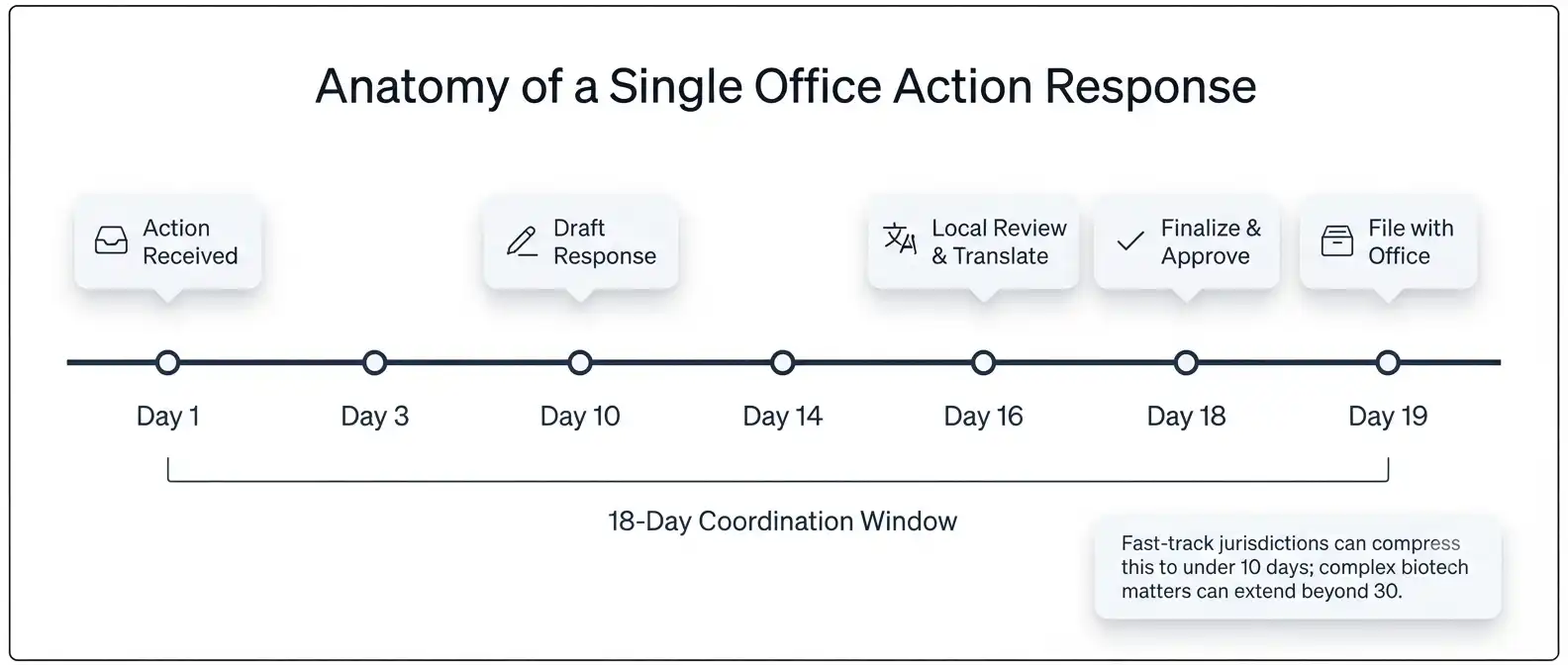
To make this less abstract, consider a common scenario. A US company holds a granted US patent and has filed corresponding applications in Germany, Japan, and Brazil. The German examiner issues an office action citing a prior art reference.
- Day 1: The German foreign associate receives the office action and forwards it to the US team with a short summary and a proposed response deadline.
- Day 3: The US attorney reviews the cited reference alongside the paralegal team and drafts a preliminary response strategy, distinguishing the claims from the prior art.
- Day 10: The paralegal finalizes the instruction letter, incorporating the attorney’s arguments, and sends it to the foreign associate for review.
- Day 14: The foreign associate confirms the arguments comply with German patent practice, translates the response, and requests final sign-off.
- Day 16: The US attorney approves the final translated response.
- Day 18: The foreign associate files the response with the German Patent and Trade Mark Office, well ahead of the deadline.
- Day 19: The docketing team logs the confirmation and updates the portfolio management system.
Notice how many separate pieces of correspondence this single office action generated, and how many different people touched the file along the way. Multiply this by dozens of active matters across multiple countries, and it becomes clear why so many firms invest in dedicated correspondence coordination rather than leaving it to ad hoc attorney time.
Why Outsourcing Correspondence Support Makes Sense for Growing Portfolios
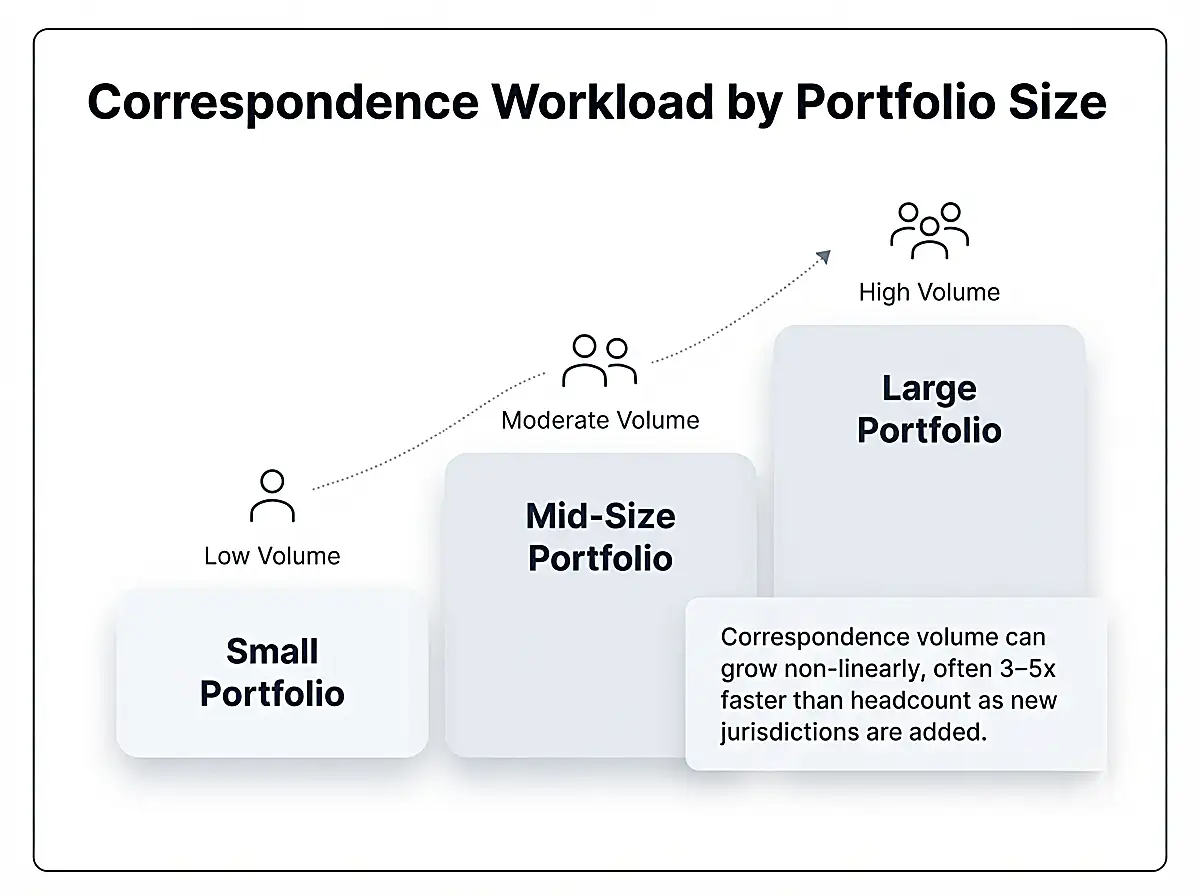
As a portfolio expands into new countries, the correspondence workload grows non-linearly. A portfolio with filings in five countries might generate a manageable volume of letters, but the same portfolio in 30 countries can produce hundreds of pieces of correspondence a month, each with its own deadline, format, and reviewer.
This is precisely why many firms and corporate IP departments turn to outsourced IP paralegal teams to handle the drafting and coordination workload.
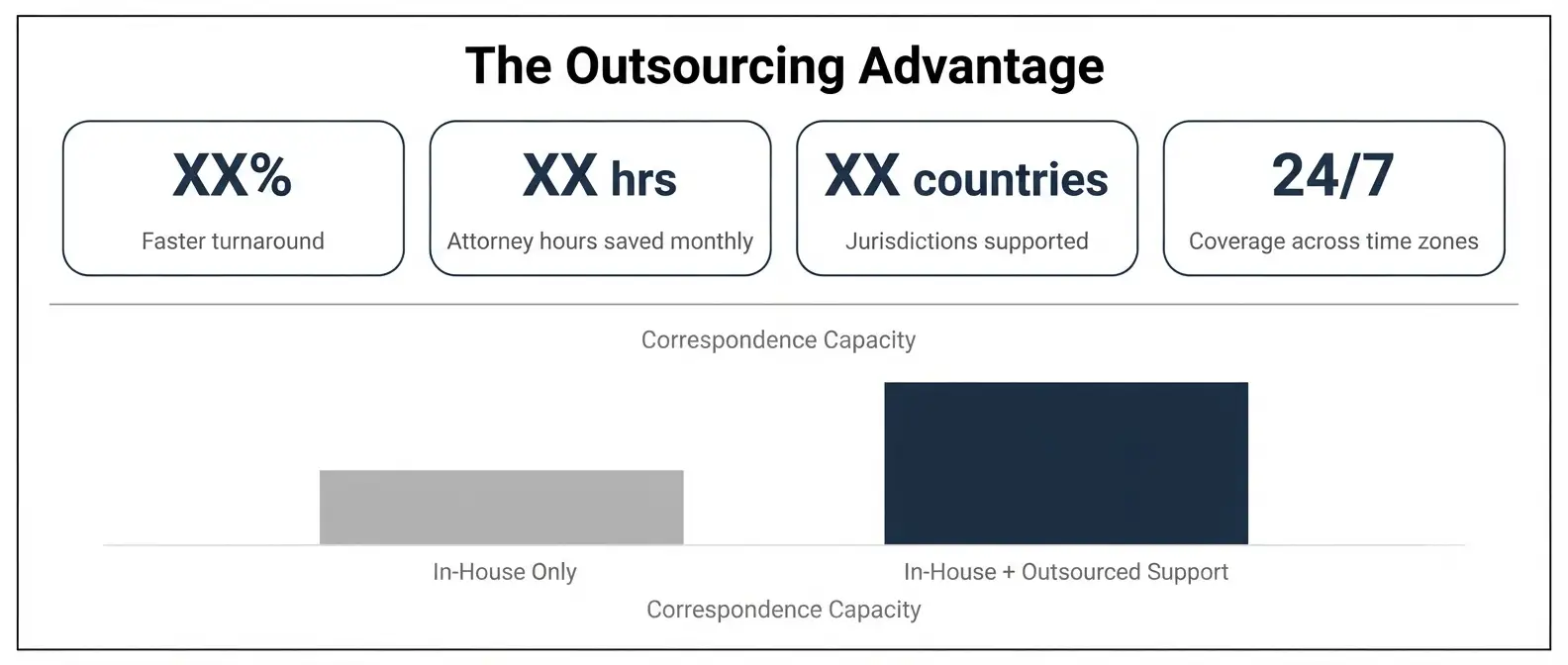
An experienced outsourcing partner can:
- Draft instruction letters and routine correspondence under attorney supervision
- Track incoming foreign office actions and flag response deadlines
- Coordinate translation vendors and manage the associated cover correspondence
- Maintain a centralized correspondence log across every jurisdiction in the portfolio
- Escalate substantive legal questions to the attorney of record while handling procedural matters independently
If you are trying to decide whether to build this capability in-house or bring in outside support, our comparison of in-house versus virtual patent paralegals lays out the cost and scalability tradeoffs in detail. For portfolios managing the full lifecycle of a patent, from filing through maintenance, our guide to patent lifecycle management outsourcing offers a broader view of where correspondence support fits into the bigger picture.
Domestic vs. Foreign Correspondence: What Changes
It is worth pausing on how foreign correspondence actually differs from the domestic USPTO correspondence most US-based teams are used to handling. The table below compares the two side by side.
| Factor | Domestic (USPTO) Correspondence | Foreign Associate Correspondence |
|---|---|---|
| Language | English only | Often requires translation |
| Deadline calculation | Standardized USPTO rules | Varies significantly by country |
| Filing party | Attorney of record files directly | Local foreign associate files on behalf of applicant |
| Extension procedures | Well-defined, per 37 CFR | Varies; some countries offer no extensions |
| Format requirements | USPTO-specific forms and formatting | Local patent office formatting rules |
| Communication layers | Direct attorney-to-office | Attorney to foreign associate to office |
This added layer of complexity is exactly why extension requests, when available, are treated as high-priority correspondence. Our article on office action response extensions explains how extension strategy works domestically, and the same underlying pressure applies internationally, often with far less flexibility.
The Role of IDS and Prior Art Correspondence
Foreign filing programs frequently intersect with Information Disclosure Statement obligations, especially when related applications are pending in multiple countries simultaneously. When a foreign associate uncovers new prior art during prosecution, that discovery typically needs to be communicated back to the US team so it can be disclosed to the USPTO if a duty of disclosure applies. This cross-referencing process depends heavily on accurate, timely correspondence between jurisdictions. For a deeper look at how this works, see our guide on patent family cross-referencing in IDS preparation.
Legal and Compliance Considerations in Foreign Correspondence
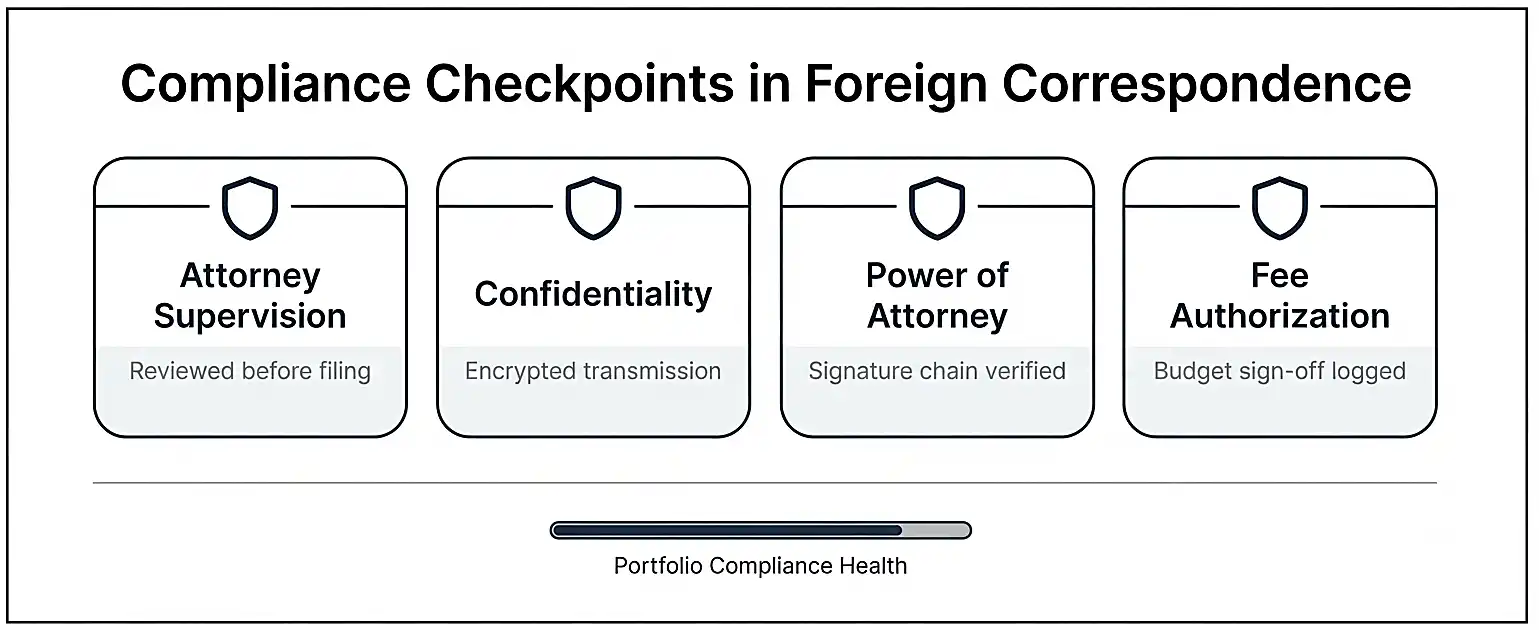
Beyond drafting quality, there are several compliance issues that shape how response correspondence for foreign patent filings gets handled inside a well-run IP department.
Attorney Supervision Requirements
Because patent prosecution involves the practice of law, paralegals and outsourced support staff who draft correspondence must work under the direct supervision of a licensed attorney. This is true whether the paralegal is in-house or part of an outsourced team. Reputable outsourcing providers build this supervision requirement directly into their workflow, routing every substantive draft through attorney review before it leaves the building.
Confidentiality Across Borders
Patent applications often contain sensitive technical and business information, so correspondence involving foreign associates has to account for data security across multiple jurisdictions. Firms should confirm that any outsourced support team, and any foreign associate, follows strict confidentiality protocols and secure document transmission practices.
Power of Attorney and Authorization Chains
Many foreign jurisdictions require a valid power of attorney before a foreign associate can act on an applicant’s behalf. Correspondence coordinating these authorizations, meaning the letters that confirm who is permitted to sign, file, and respond on a given matter, needs to be tracked just as carefully as substantive prosecution correspondence. A gap in this authorization chain can delay a filing even when the substantive response itself is ready.
Currency and Fee Approval Correspondence
International filings involve foreign associate fees, official government fees, and often currency conversion. Correspondence approving these costs typically flows through in-house counsel or a designated budget approver, and delays in this step are a common, avoidable cause of missed foreign deadlines.
How Portfolio Size Changes the Correspondence Workload
A useful way to think about response correspondence for foreign patent filings is to consider how the workload scales as a portfolio grows. A single application filed in three countries might generate a handful of letters over its lifetime. A portfolio of several hundred active families filed across 25 or 30 jurisdictions can generate correspondence on a near-daily basis.
- Small portfolios (1-25 active foreign families): Correspondence is usually manageable by a single attorney with light paralegal support, using largely manual tracking.
- Mid-size portfolios (25-150 active foreign families): Firms typically need a dedicated docketing system and at least one paralegal focused primarily on foreign correspondence coordination.
- Large portfolios (150+ active foreign families): Correspondence volume generally requires either a dedicated internal team or an outsourced paralegal partner working across multiple time zones to keep pace with incoming foreign office actions.
This scaling effect is one of the main reasons corporate IP departments revisit their staffing model as their international filing footprint expands. Rather than hiring additional in-house paralegals for every jurisdiction, many departments find it more cost-effective to bring in a support partner who already has processes built for high-volume, multi-jurisdictional correspondence.
Building an Internal Correspondence Playbook
Firms that manage foreign correspondence well tend to formalize their process into a written playbook rather than relying on institutional memory. A solid playbook typically covers:
- Jurisdiction-specific deadline rules, including how each country calculates response periods and whether extensions are available.
- Escalation triggers, meaning the specific circumstances under which a paralegal-drafted letter must be reviewed by the attorney of record before it goes out.
- Standard templates, organized by correspondence type and jurisdiction, so drafting time stays consistent regardless of who is handling the matter.
- A single source of truth for status tracking, whether that is a docketing platform or a shared portfolio management tool.
- Vendor and translator contacts, pre-vetted for each language pair the portfolio regularly requires.
Documenting this process not only speeds up day-to-day drafting, it also protects the firm when staff turnover occurs, since a new paralegal or attorney can step into an established workflow rather than reconstructing it from scratch.
Featured Snippet Summary: Response Correspondence for Foreign Patent Filings
Definition: Response correspondence for foreign patent filings is the set of written communications, including instruction letters, office action responses, and status updates, exchanged between a US applicant or attorney and a foreign associate to prosecute a patent application in a country outside the United States.
Who prepares it:
- US patent attorney: drafts substantive legal arguments and strategy
- Paralegal or outsourced support team: drafts routine and procedural correspondence
- Foreign associate: adapts correspondence to local rules and files it
- In-house counsel: approves budget and escalation decisions
Frequently Asked Questions
Who is responsible for response correspondence for foreign patent filings?
Responsibility is shared. The US attorney typically drafts or approves substantive legal arguments, while paralegals or outsourced support teams prepare routine correspondence, and the foreign associate adapts and files the final documents according to local rules.
Can a paralegal draft response correspondence for foreign patent filings?
Yes. Paralegals frequently draft instruction letters, cover correspondence, and procedural communications under attorney supervision, which allows attorneys to focus on substantive legal strategy.
How long does it take to prepare response correspondence for a foreign office action?
Substantive responses typically take two to four weeks to prepare, factoring in attorney review, drafting, and translation, though this varies by jurisdiction and complexity.
What happens if a foreign associate does not receive timely instructions?
Some foreign patent offices have strict, non-extendable deadlines, so late instructions can result in an abandoned application. This is why many firms build internal deadlines well ahead of the actual filing deadline.
Is outsourcing response correspondence for foreign patent filings safe?
Yes, provided the outsourcing partner works under attorney supervision and follows established quality control procedures. Reputable IP paralegal providers maintain strict confidentiality and review protocols to protect client matters.
Does the foreign associate ever draft the substantive legal arguments themselves?
Occasionally, yes. When a US team is unfamiliar with a particular jurisdiction’s examination practices, the foreign associate may propose the substantive arguments, and the US attorney reviews and approves them rather than drafting from scratch. This is more common in jurisdictions with highly specialized local practice, such as certain patentability standards in Japan or China.
How does a firm know if its foreign correspondence process needs improvement?
Common warning signs include recurring missed deadlines, frequent last-minute scrambles for translations, foreign associate invoices that arrive with no matching approval trail, and attorneys spending significant time on routine drafting that could be delegated. If several of these patterns show up repeatedly, it is usually a sign that the correspondence workflow needs a structural fix rather than a one-off correction.
Conclusion
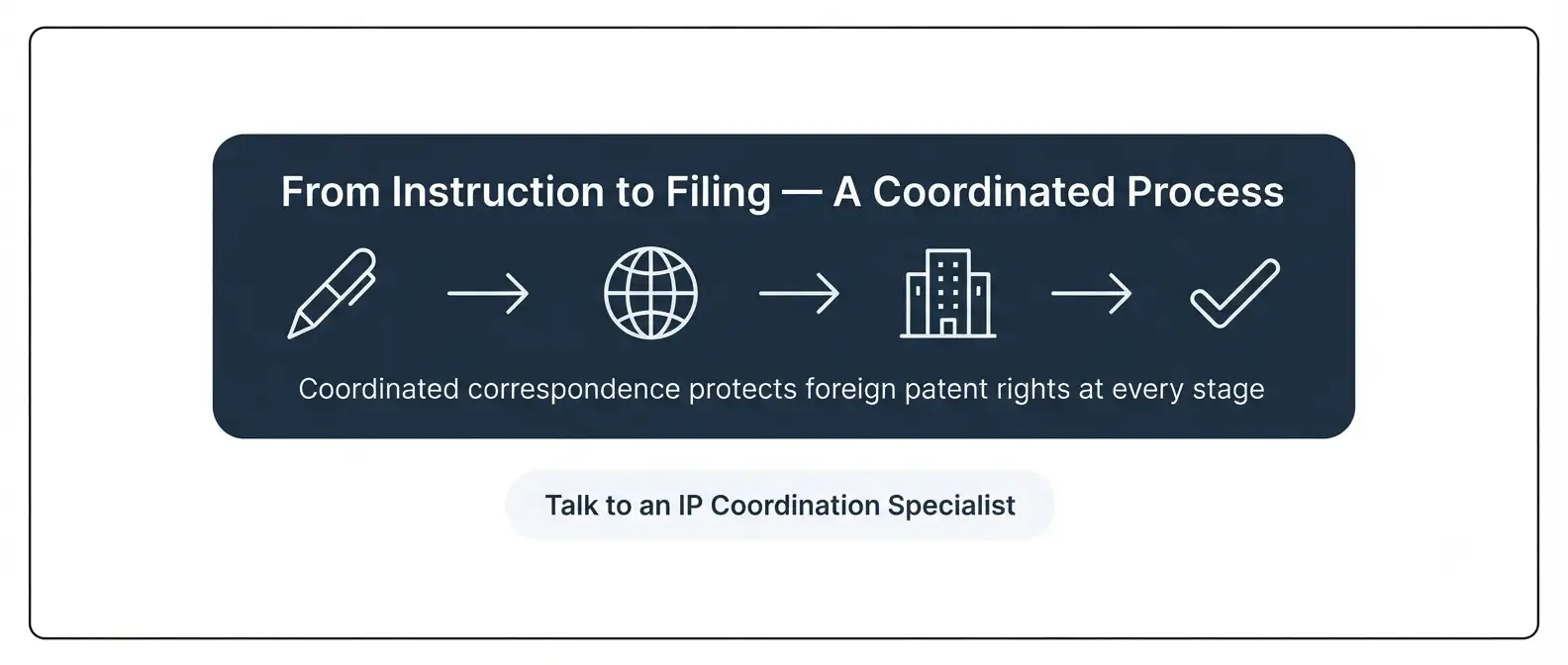
Coordinating patent filings with foreign associates is never the work of a single person. Response correspondence for foreign patent filings moves through several hands: the US attorney who sets legal strategy, the paralegal who handles the procedural drafting, the foreign associate who adapts it for local compliance, and the in-house counsel who approves the budget behind it all. When each role is clearly defined and well-coordinated, deadlines get met and foreign rights stay protected.
If your firm or corporate IP department is struggling to keep up with the volume of correspondence a growing international portfolio demands, working with an experienced paralegal support partner can make the difference between a smooth filing program and a missed deadline. Contact Teak IP Services to learn how our US-attorney-led team can support your foreign patent correspondence workflow.

