
When you file a patent application, your duty of disclosure doesn’t stop at a single case. Every related application in your patent family – continuations, divisionals, CIPs, and foreign counterparts – can generate prior art that you must disclose to the USPTO. Managing this across an entire patent portfolio is where patent family cross-referencing in IDS preparation becomes absolutely critical.
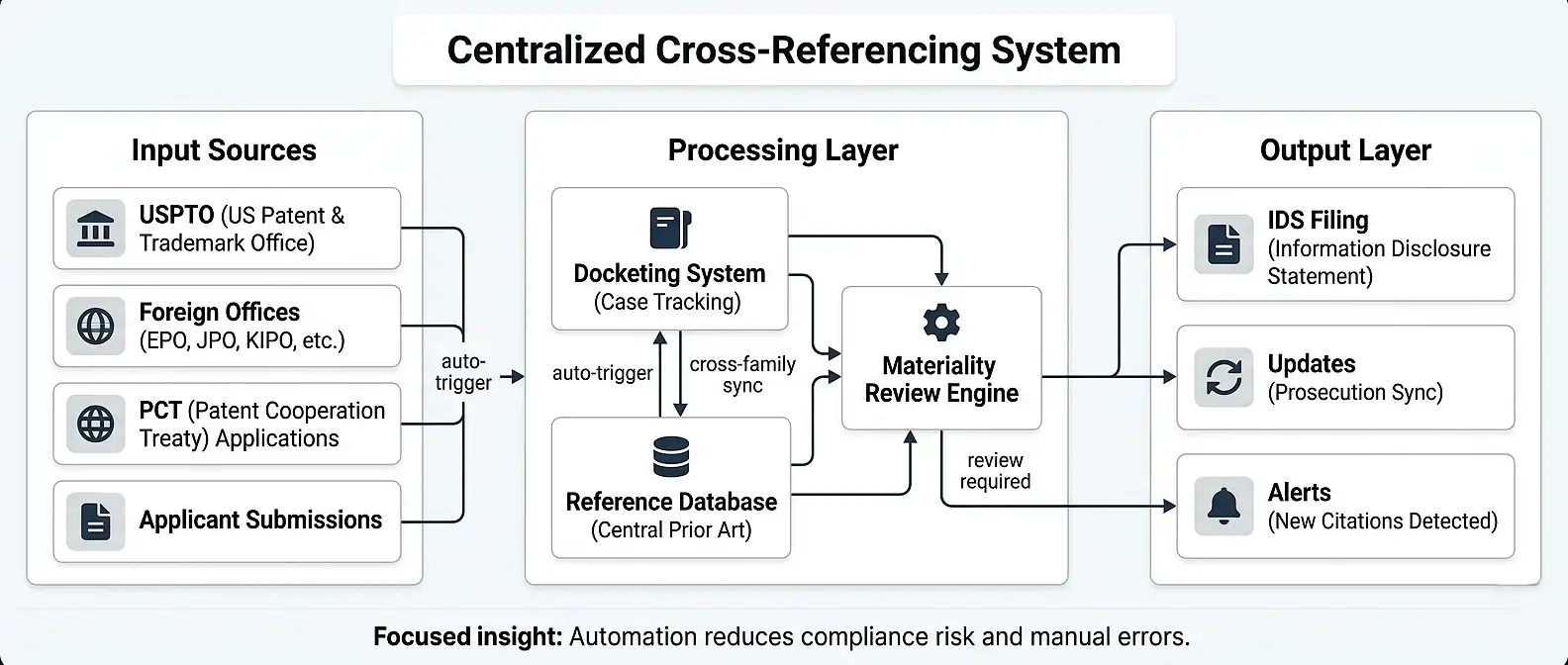

Most patent practitioners know that an Information Disclosure Statement (IDS) requires listing relevant prior art. However, far fewer appreciate just how complex this process becomes when multiple applications share a common family lineage. References cited in one application may be directly material to another, and failing to track them properly can create serious legal vulnerabilities down the line.
This guide breaks down exactly how patent family cross-referencing works in IDS preparation, why it matters, common mistakes to avoid, and best practices to protect your patent rights. Whether you’re new to IDS management or a seasoned practitioner looking to tighten your process, this article will give you actionable guidance.
What is Patent Family Cross-Referencing in IDS Preparation?
Before diving into the mechanics, it helps to define the concept clearly.
Patent family cross-referencing is the practice of systematically tracking and transferring prior art references – cited patents, publications, and other materials – across all related applications in a patent family to ensure complete and accurate IDS disclosures.
A patent family typically includes the original application and all its descendants: continuation applications, continuation-in-part (CIP) filings, divisional applications, and foreign counterparts filed under the Patent Cooperation Treaty (PCT) or directly in national offices. Each of these applications may receive office actions from examiners who cite prior art – and that prior art may be material to sibling or parent applications as well.
The USPTO’s Rule 56 duty of candor requires applicants to disclose all information they are aware of that is material to patentability. When references are cited in one family member, they frequently become material to others. Ignoring this relationship creates a disclosure gap that can lead to inequitable conduct allegations or invalidity challenges.
For a solid foundation on what an IDS is and why it matters, see our IDS overview guide.
Why Patent Family Cross-Referencing is Essential
Cross-referencing across a patent family isn’t just good practice – it’s a legal necessity under USPTO rules. Here’s why practitioners take this step seriously:
1. The Duty of Disclosure Applies to Every Application Independently
Each application in a patent family is treated as a separate proceeding at the USPTO. This means the duty of disclosure applies separately to every application. References cited in a parent case don’t automatically transfer to a continuation or divisional – the applicant must actively disclose them.
2. Examiner Citations in One Case Are Often Material in Related Cases
When a USPTO examiner cites a reference during prosecution of Application A, that same reference may be highly material to the claims in Application B, especially when both share a common specification. Tracking this relationship proactively is the core value of patent family cross-referencing.
3. International Counterparts Generate Additional References
Foreign patent offices – including the EPO, JPO, CNIPA, and others – frequently cite prior art during examination that is not found in the US prosecution file. Under MPEP § 2001.06(a), references cited by foreign offices examining counterpart applications must be disclosed in related US applications if they are material to patentability.
4. Failure to Cross-Reference Exposes Patents to Invalidity
A patent that was granted while the applicant withheld or overlooked material references from a sibling application faces serious risks. Accused infringers regularly challenge patents on invalidity and inequitable conduct grounds. Our guide on how IDS management protects your patent from invalidity challenges explains this risk in more detail.
How the Cross-Referencing Process Works Step by Step
Effective patent family cross-referencing in IDS preparation follows a structured, repeatable process. Here is a detailed walkthrough:
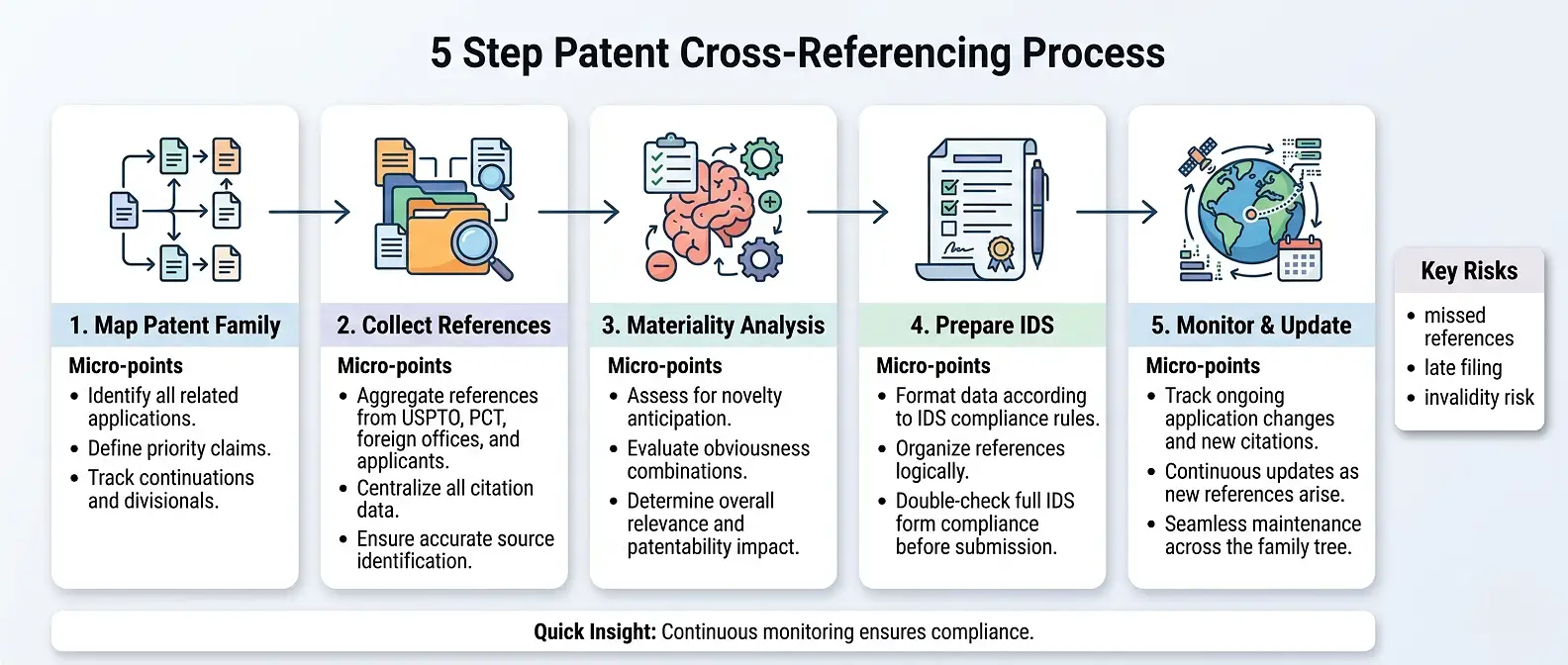
Step 1: Map the Entire Patent Family
Start by identifying every application that belongs to the family – US and foreign. This typically includes:
- Parent applications – the original application from which others claim priority
- Continuation applications – same disclosure, different or narrower claims
- Continuation-in-Part (CIP) applications – partially new disclosure plus parent content
- Divisional applications – claims to an invention distinct from the parent
- PCT applications – international filings under the Patent Cooperation Treaty
- National phase entries – foreign counterparts in EPO, JPO, CNIPA, and other jurisdictions
Document this family map in a centralized tracking system before moving to the next step.
Step 2: Compile All Cited References from Every Family Member
Gather every reference that has been cited in any family member, from any source:
- Office actions issued by the USPTO and foreign patent offices
- Prior art submitted by applicants in previous IDS filings
- Search reports from PCT international searches
- References cited by examiners in parent or sibling applications
- Third-party prior art submissions or opposition proceedings
At this stage, the goal is completeness. Every reference from every family member enters the tracking pool.
Step 3: Analyze Materiality Across Applications
Not every reference from one application needs to be disclosed in every other. The standard is whether the reference is material to patentability in the target application. This requires comparing the claims of the target application against the substance of each candidate reference.
Factors to consider during materiality analysis:
- Does the reference anticipate any claim of the target application?
- Does the reference, alone or in combination, render any claim obvious?
- Does the reference relate to the same or substantially the same subject matter?
- Was the reference cited in a closely related application with similar claims?
Step 4: Prepare and Format the IDS
Once materiality is assessed, prepare the IDS using USPTO Form PTO/SB/08 for patents and publications. Each reference must be properly cited with complete bibliographic data. For a complete walkthrough of IDS preparation, review our step-by-step IDS preparation guide.
Step 5: Monitor Ongoing Prosecution and Update Accordingly
Patent family cross-referencing isn’t a one-time task. As prosecution continues, new references surface – and each one must be re-evaluated across the entire family. Build a monitoring protocol into your practice to handle this ongoing obligation.
Stay alert to IDS filing deadlines at each stage of prosecution. Missing these can trigger compliance issues. Our IDS filing deadlines guide covers the critical timing rules in detail.
Patent Family Cross-Referencing: Key Reference Sources Compared
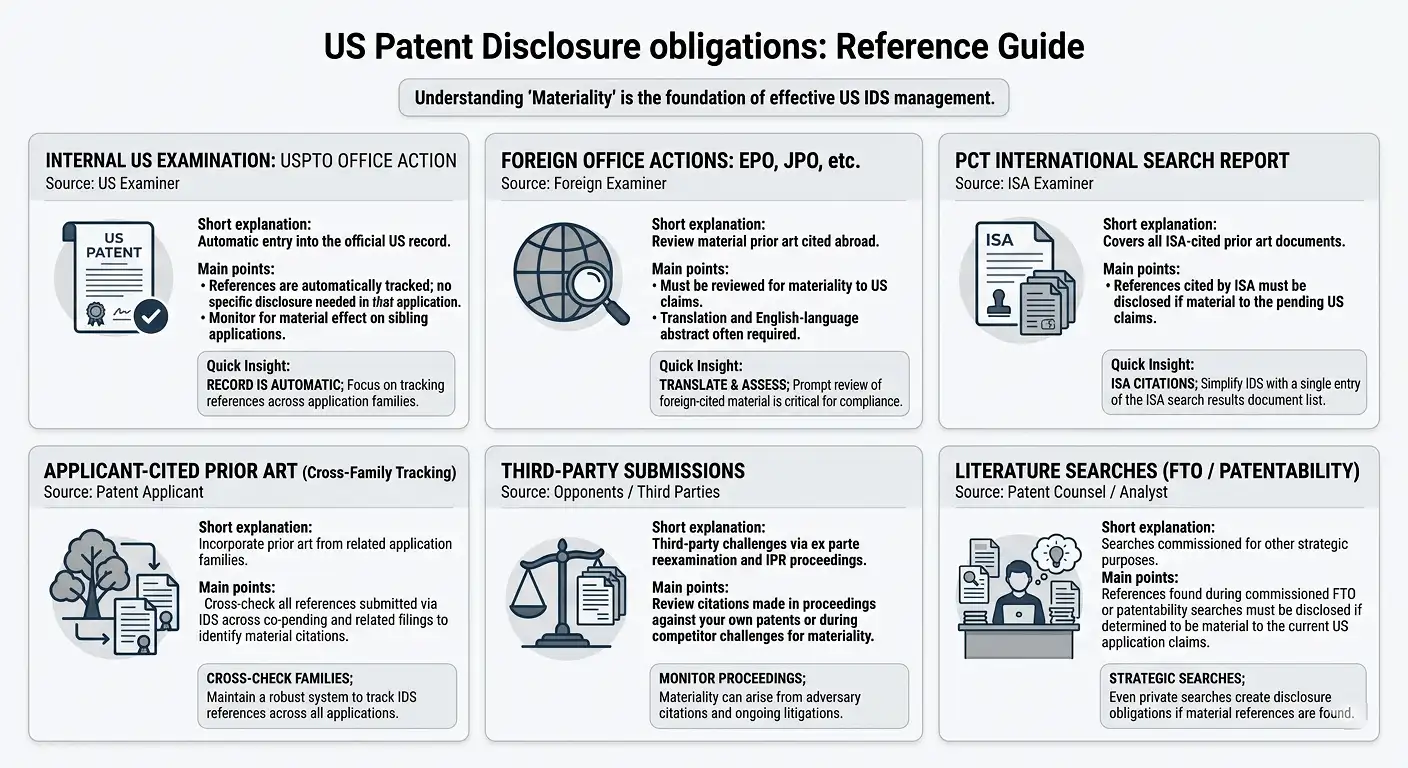
| Reference Source | Who Generates It | Must Disclose in US? | Notes |
| USPTO Office Action | US Examiner | Yes – automatic | Already in the US record; still track for sibling apps |
| Foreign Office Action (EPO, JPO, etc.) | Foreign Examiner | Yes – if material | Must be translated and reviewed for materiality |
| PCT International Search Report | ISA Examiner | Yes – if material to US claims | Covers all ISA-cited documents |
| Applicant-cited Prior Art (other family) | Patent Applicant | Yes – if material | Cross-check all applicant-submitted IDS references |
| Third-Party Submissions | Opponents/Third Parties | Yes – if material | Includes ex parte reexamination and IPR proceedings |
| Literature Search (FTO/Patentability) | Patent Counsel / Analyst | Yes – if material | Searches commissioned for related purposes |
Note: The standard is materiality to patentability under Rule 56 – not certainty of impact. When in doubt, disclose.
Common Mistakes in Patent Family Cross-Referencing
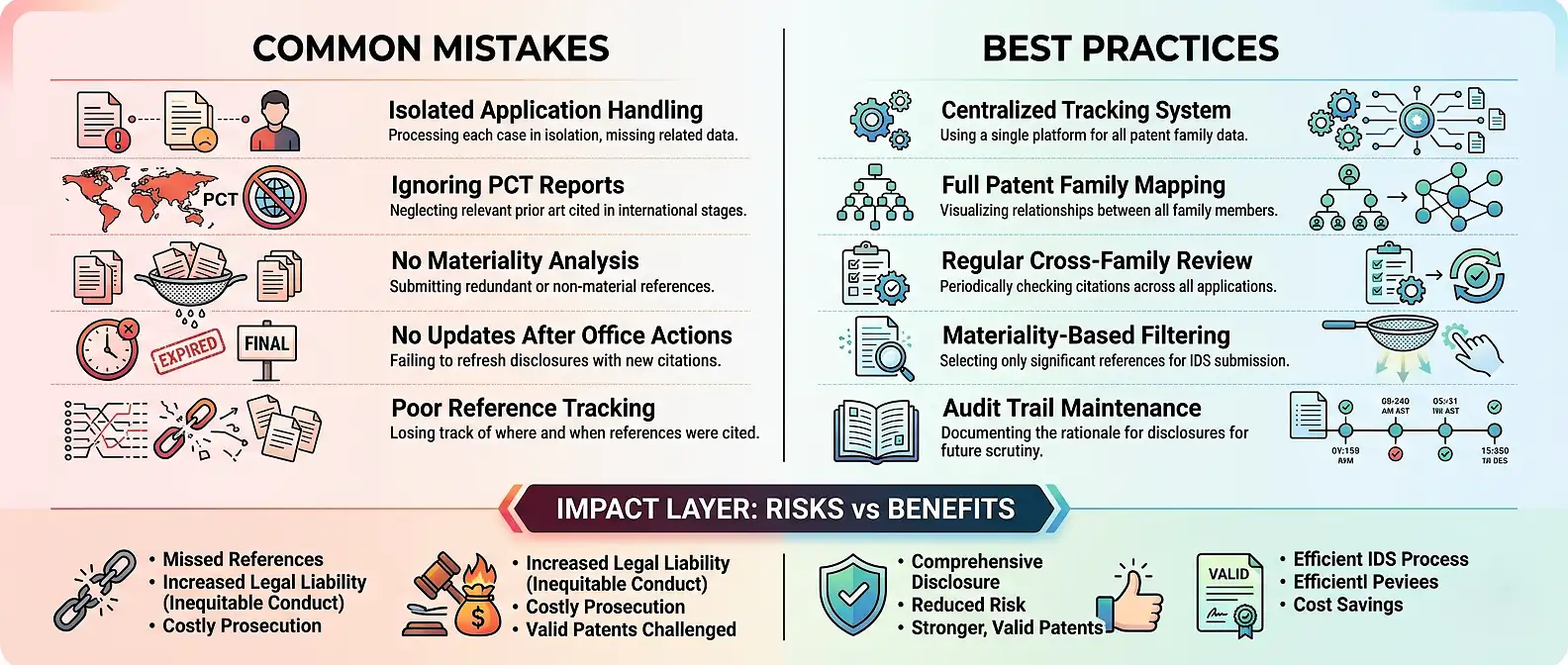
Even experienced practitioners make avoidable errors in this process. Understanding these mistakes helps you design a more resilient workflow.
Mistake 1: Treating Each Application as Isolated
The most common error is managing each application in a silo. Teams that don’t link their family members in a centralized docketing system almost always miss cross-referencing opportunities. Every application must be linked to its parent, siblings, and foreign counterparts from day one.
Mistake 2: Overlooking PCT Search Reports
PCT international search reports regularly surface high-quality prior art from a broader field than US examination alone. Failing to review these reports – and evaluate each cited reference for materiality to US applications – is a significant compliance gap.
Mistake 3: Skipping Materiality Analysis
Some practitioners simply dump all references from every family member into every related IDS without analyzing materiality. While this approach errs on the side of over-disclosure, it can create excessively long IDS lists that examiners struggle to review and may draw unnecessary claim rejections based on tangential art.
Mistake 4: Failing to Update After New Office Actions
References cited in an office action on a continuation must be evaluated for their materiality to the parent or any pending sibling. Failing to loop back and update other family members is one of the most frequent – and dangerous – oversights in patent prosecution. For more context, read our article on USPTO Rule 56 duty of disclosure.
Mistake 5: Poor Reference Management and Duplicate Citations
Without a systematic approach to reference tracking, teams frequently cite duplicate references in slightly different formats or miss references because they’re stored in inconsistent systems. Our guide on accurate IDS reference management explains why precise record-keeping is foundational to compliance.
Tools and Systems That Support Effective Cross-Referencing
Managing patent family cross-referencing at scale requires structured systems, not manual spreadsheets. Leading patent teams use the following approaches:
| Recommended Tools and Methods: Centralized docketing systems that link all family members and trigger alerts when new references appearReference tracking databases that store and tag every cited document by family applicationAutomated workflow rules that flag new office actions and require cross-family reviewPrior art monitoring services that watch newly published applications in related technology areasOutsourced IDS management with cross-referencing expertise built into the service |
Many law firms have found that outsourcing IDS preparation – including cross-referencing – significantly reduces error rates and administrative burden. Our article on why law firms prefer to outsource IDS filing breaks down the cost-benefit analysis clearly.
Best Practices for Patent Family Cross-Referencing in IDS
| Best Practice | What It Prevents | Priority |
| Build a full family map at application filing | Missing sibling or descendant applications | High |
| Centralize all reference tracking in one system | Duplicates, omissions, version confusion | High |
| Review every foreign office action for US materiality | Undisclosed material prior art from foreign examiners | High |
| Set calendar triggers after every office action | Late IDS filings, missed deadlines | High |
| Conduct materiality analysis before each IDS filing | Unnecessary over-disclosure or fatal omissions | Medium |
| Use standardized bibliographic citation formats | Examiner-rejected or incomplete references | Medium |
| Maintain audit trails for every cross-referencing decision | Inability to defend disclosure decisions post-grant | Medium |
Before filing, use our IDS preparation checklist to confirm you haven’t overlooked any critical element.
Expert Tips for Stronger Cross-Referencing Workflows
Beyond the basics, experienced IP professionals use these advanced strategies to keep cross-referencing tight:
- Assign family-level ownership. Designate one attorney or paralegal as the cross-referencing coordinator for each patent family. This reduces the risk of communication gaps between team members.
- Use IDS management software with automatic family linking. Systems that auto-link related applications ensure that when a new reference is cited in one case, the system immediately flags it for review in all related cases.
- Date-stamp every cross-referencing decision. Document when you reviewed each reference for each family member and the outcome of your materiality analysis. This audit trail is invaluable if the patent faces an inequitable conduct challenge.
- Reconcile IDS lists quarterly for active families. Rather than only checking at office action milestones, periodic reviews catch references that may have entered the public record between office actions.
- Consider the IDS vs. prior art disclosure distinction. Not all references require an IDS – understanding the boundary helps you prioritize accurately. Our article on IDS vs. prior art disclosure explains this distinction clearly.
Patent Family Cross-Referencing is a Strategic Investment
Patent family cross-referencing in IDS preparation is one of the most technically demanding – and most important – aspects of patent prosecution. Done well, it protects your patent from invalidity challenges, satisfies the USPTO’s duty of disclosure, and demonstrates the kind of candor that supports strong, defensible IP rights.
The process requires building a complete family map, systematically collecting references from every related application and foreign counterpart, assessing materiality to each pending case, and building workflows that automatically update as prosecution evolves.
Firms that treat cross-referencing as a checklist item rather than an ongoing strategic obligation consistently face more risk. Those that invest in proper systems – or partner with experienced IDS specialists – protect not just individual patents but entire portfolios.
Managing this complexity across dozens or hundreds of related applications is where specialist support makes a real difference. Teak IP’s IDS preparation team brings deep experience in patent family cross-referencing, helping law firms reduce errors, meet deadlines, and maintain airtight disclosure records.
| Ready to Simplify Your IDS Patent Family Cross-Referencing? Teak IP helps law firms and patent applicants manage complex patent family cross-referencing with precision and speed. Our experienced IDS preparation specialists ensure complete, compliant, and timely filings – so you never miss a reference or a deadline. Contact Teak IP today for a free consultation on your IDS and patent family management needs. Visit teakipservices.com to get started → |
Frequently Asked Questions About Patent Family Cross-Referencing in IDS
Q1: What does patent family cross-referencing mean in IDS preparation?
Patent family cross-referencing in IDS preparation means systematically identifying and evaluating prior art references cited in any related application – including continuations, divisionals, CIPs, and foreign counterparts – and determining whether those references must also be disclosed in other pending family members. It ensures that each application satisfies its independent duty of disclosure under USPTO Rule 56.
Q2: Does every reference cited in a parent application need to go into a continuation’s IDS?
Not necessarily. The standard is materiality to patentability, not automatic transfer. However, in practice, references cited in a parent application are frequently material to continuation claims because the applications share a common specification and often similar subject matter. A proper materiality analysis should be conducted for each reference.
Q3: Do foreign examiner citations need to be cross-referenced into US applications?
Yes. Under MPEP § 2001.06(a), references cited by foreign patent offices in counterpart applications must be disclosed in related US applications if they are material to patentability. This includes citations from EPO, JPO, CNIPA, KIPO, and other national offices.
Q4: How does PCT international search report affect IDS cross-referencing?
A PCT international search report (ISR) cites prior art found during the international phase. All references cited in an ISR should be reviewed for materiality to the US national phase application and to any related US family members. The ISR is issued before US examination begins, making it one of the earliest and most comprehensive sources of cross-referencing material.
Q5: What happens if I fail to cross-reference material references in an IDS?
Failure to disclose material information can support an inequitable conduct defense, which can render the affected patent unenforceable. Accused infringers regularly raise this defense in litigation. Beyond unenforceability, a patent with disclosure gaps faces credibility challenges in licensing negotiations and licensing disputes.
Q6: How frequently should I update cross-referencing during prosecution?
Cross-referencing should be updated every time a material event occurs in any family member – specifically when an office action is issued, a new IDS is filed in a sibling application, or a foreign office action is received. For complex families with multiple active applications, monthly reviews are a practical best practice.
Q7: Is there a USPTO form specifically for cross-referenced IDS references?
IDS references are submitted on USPTO Form PTO/SB/08 for patents and publications, and PTO/SB/08b for foreign patent documents. There is no separate USPTO form specifically for cross-referenced references – they are listed on the same forms with complete bibliographic information. Proper formatting and completeness are essential to avoid return by the USPTO.
Q8: Can outsourcing IDS preparation help with patent family cross-referencing?
Yes. Many law firms outsource IDS preparation – including cross-referencing – to specialized service providers that have structured workflows, dedicated reference tracking systems, and experienced staff who handle these processes daily. This reduces risk, lowers cost, and ensures consistent quality across large patent portfolios. See our analysis of the true cost of DIY vs. outsourcing IDS filing for a detailed comparison.
Our Services: Access IDS Preparation & Filing Services Page

