
Patent prosecution is a complex, high-stakes process – and one of its most underestimated responsibilities is managing your Information Disclosure Statement references. Accurate IDS reference management in patent prosecution is not just a procedural formality. It directly determines whether your patent survives validity challenges, litigation scrutiny, and USPTO review. Get it wrong, and the consequences can be severe: an unenforceable patent, unenforceability findings, or allegations of inequitable conduct.

Yet, despite its importance, many patent applicants and even some practitioners treat IDS management as an afterthought. This guide explores why accurate reference management is critical, what the risks of poor practices look like, and how you can build a reliable process that protects your IP from day one.
What is IDS Reference Management in Patent Prosecution?
Before diving into best practices, it helps to understand exactly what we mean by IDS reference management.
An Information Disclosure Statement (IDS) is a document filed with the USPTO to disclose all known prior art and material information relevant to your patent application. Every applicant, inventor, and attorney involved in the prosecution has a legal duty to disclose this information under USPTO Rule 56.
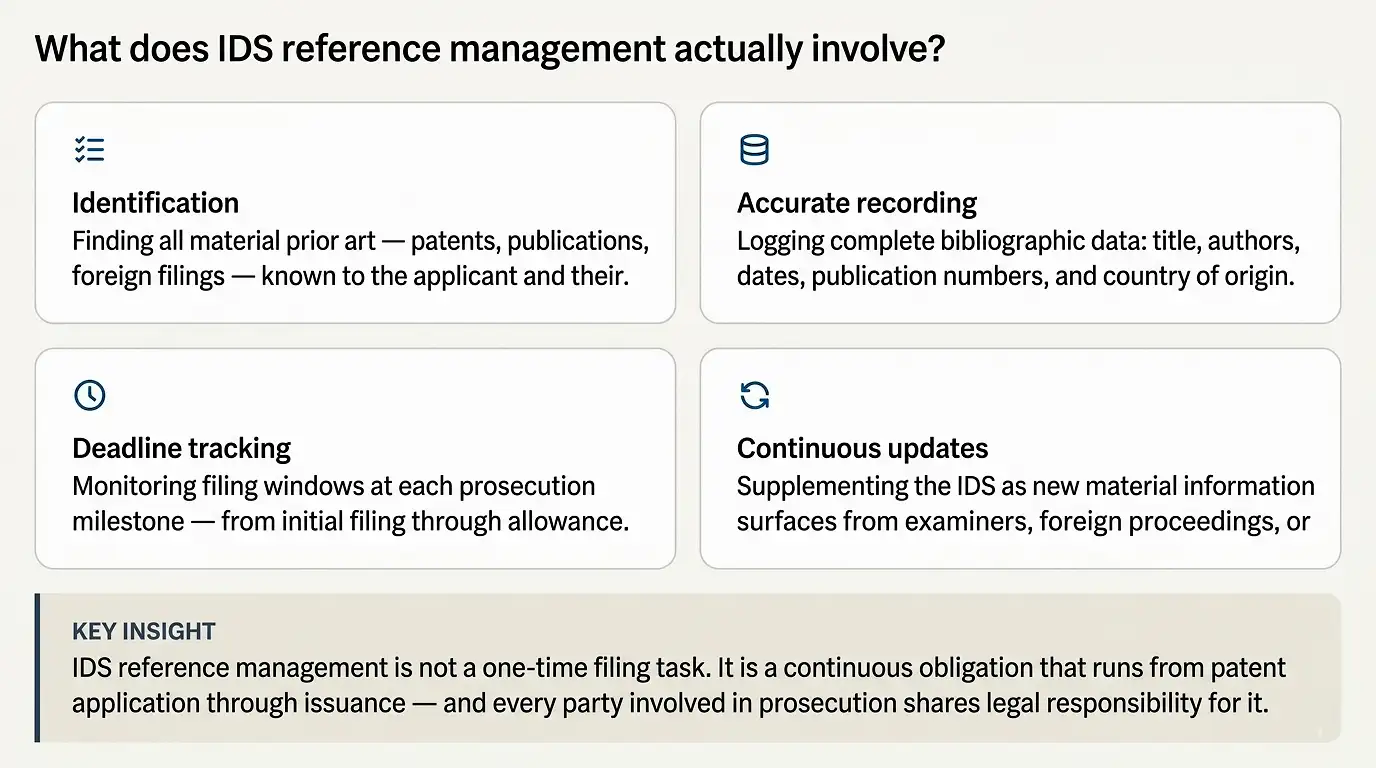
IDS reference management refers to the systematic process of:
- Identifying all material prior art references
- Accurately recording bibliographic data for each reference
- Tracking submission deadlines at each prosecution stage
- Filing references in the correct format using the right USPTO forms
- Monitoring related applications and foreign prosecution for new references
- Updating disclosures as new information becomes available
When done well, IDS reference management ensures full compliance with USPTO disclosure requirements. When done poorly, it creates legal vulnerabilities that can haunt your patent for its entire lifespan.
To understand the foundational role of an IDS in patent prosecution, read our detailed overview: What Is an Information Disclosure Statement (IDS) and Why Does It Matter for Your Patent?
Why Accuracy in IDS Reference Management Matters So Much
1. The Legal Duty of Candor Is Non-Negotiable
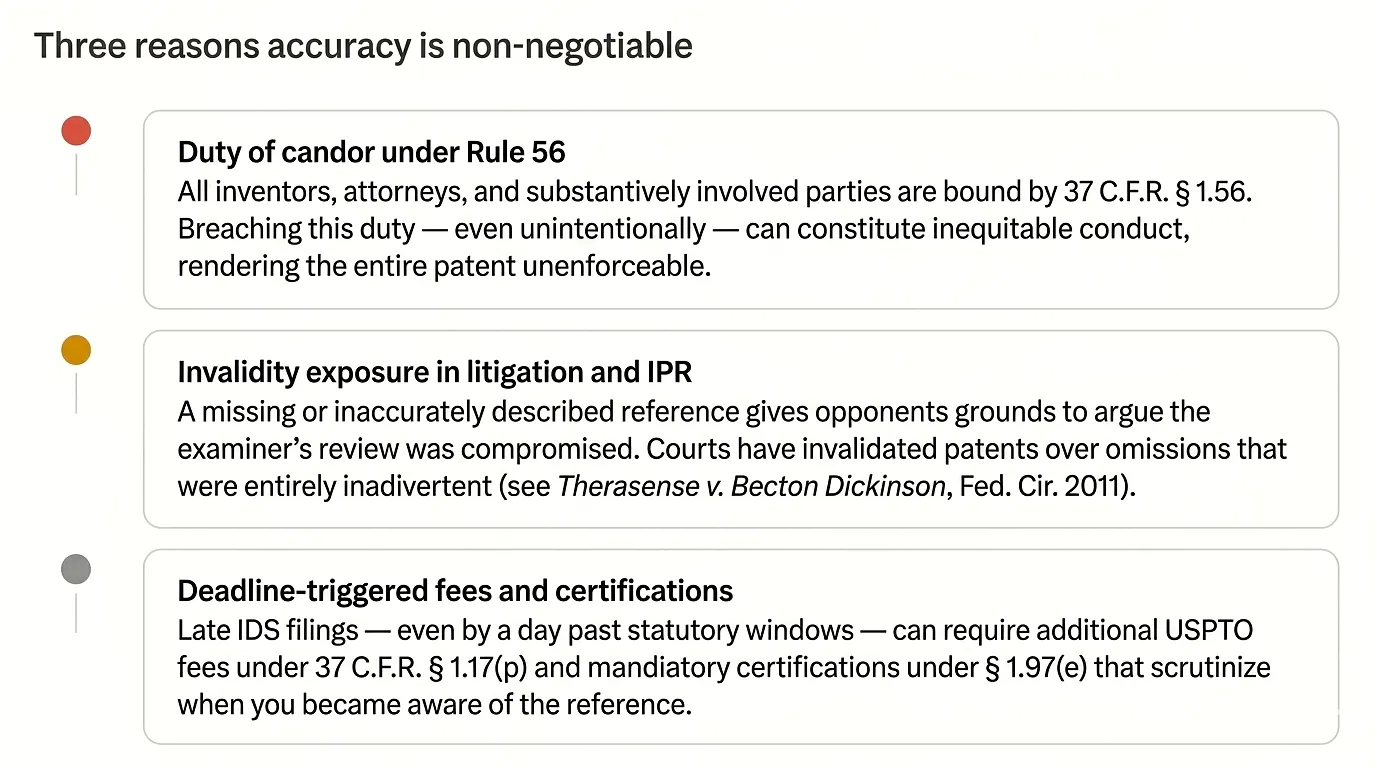
The USPTO imposes a strict duty of candor and good faith on all parties involved in patent prosecution. Under 37 C.F.R. § 1.56, inventors, attorneys, and agents must disclose all information they know to be material to patentability.
This duty continues throughout prosecution. It applies to:
- The named inventors
- All prosecuting attorneys and agents
- Any other individuals who are substantively involved
Failing to meet this duty – whether through carelessness, omission, or deliberate withholding – can constitute inequitable conduct. A court finding of inequitable conduct renders the entire patent unenforceable. That is not just one claim. That is every claim in the patent.
For a full breakdown of this legal requirement, see our guide: USPTO Rule 56: Duty of Disclosure Explained for Patent Practitioners
2. Inaccurate References Invite Validity Challenges
Errors in reference management – whether a missing citation number, a wrong publication date, or a misspelled inventor name – can open the door to invalidity attacks during litigation or inter partes review (IPR) proceedings.
When an opponent discovers that a material reference was not properly disclosed, they can argue that:
- The applicant withheld relevant prior art intentionally
- The examiner’s review was compromised by incomplete information
- The granted claims would not have issued had the reference been considered
These arguments can succeed even when the original omission was entirely unintentional. The standard for inequitable conduct was clarified in Therasense, Inc. v. Becton, Dickinson and Co. (Fed. Cir. 2011), but the risk remains very real. Accurate IDS reference management is your first line of defense.
Learn more about protecting your patent from these challenges: How IDS Management Can Protect Your Patent from Invalidity Challenges
3. Missed Deadlines Trigger Fees and Complications
Beyond accuracy of the references themselves, when you file your IDS is just as important. The USPTO has strict timing rules that determine whether your IDS is considered without additional requirements. Filing late – even by a single day past a statutory deadline – can trigger:
- Additional fees under 37 C.F.R. § 1.17(p)
- Certification requirements under § 1.97(e)
- Potential challenges to patent enforceability
Tracking deadlines across multiple applications, continuation filings, and foreign counterpart proceedings demands a systematic, consistent approach. For a detailed breakdown of these timing rules, refer to our resource: IDS Filing Deadlines: How to Avoid Costly USPTO Penalties
The Hidden Risks of Poor IDS Reference Management
Many practitioners underestimate how easily reference management errors can arise – and how costly they can become.
Common IDS Reference Errors That Cause Problems
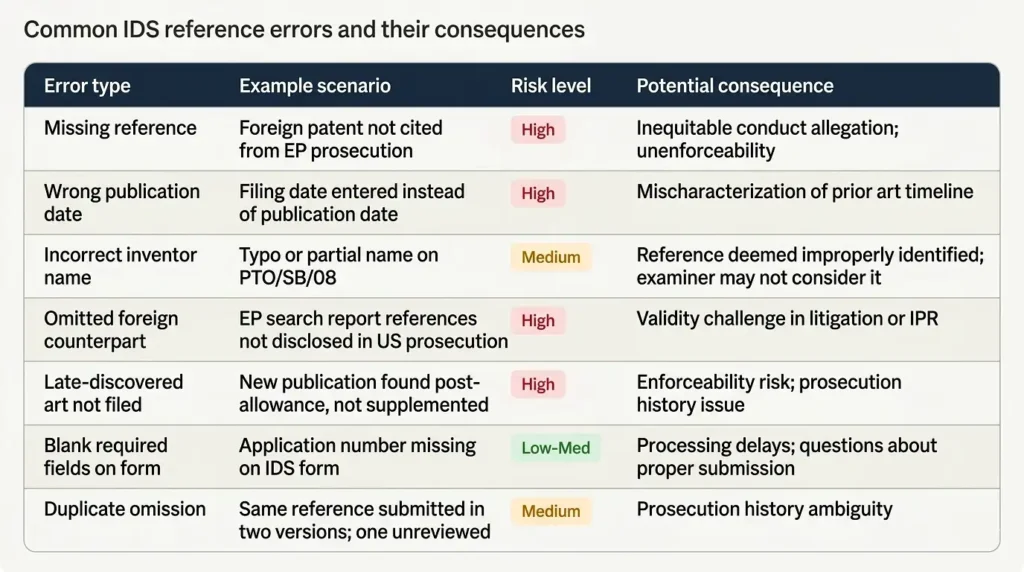
Each of these errors, individually, may seem minor. Collectively, they represent serious weaknesses in your patent’s chain of validity.
The Downstream Impact on Patent Portfolios
For companies managing large patent portfolios, reference management errors in one application can ripple across related applications. Continuation applications, divisionals, and continuations-in-part all share prosecution history. An error in the parent application can infect the entire family.
This is particularly problematic during:
- Mergers and acquisitions: Due diligence often uncovers IDS deficiencies that reduce a portfolio’s valuation or kill deals entirely.
- Patent licensing negotiations: Licensees and their counsel will scrutinize prosecution histories before signing agreements.
- Litigation: Opposing counsel will mine every IDS for errors to argue non-disclosure.
Best Practices for Accurate IDS Reference Management
Build a Systematic Reference Tracking Process
The most effective way to manage IDS references accurately is to implement a structured tracking system from the very beginning of prosecution. This system should:
- Centralize all reference data in a single, searchable database or docketing platform
- Log each reference immediately when identified – do not rely on memory or informal notes
- Record complete bibliographic data including title, authors, publication date, publication number, and country of origin
- Cross-reference related applications to ensure references disclosed in one application are reviewed for disclosure in related cases
- Set deadline alerts tied to each prosecution milestone (filing date, first office action, allowance, etc.)
Conduct Regular Reference Audits
Reference management is not a one-time task. As prosecution progresses, new prior art may surface through:
- Examiner searches and office actions
- Parallel foreign prosecution in other jurisdictions
- Competitor patent publications
- New scientific literature in the relevant field
Schedule regular audits – at minimum at each major prosecution milestone – to ensure your IDS reflects all currently known material information.
For a comprehensive preparation guide, review our checklist: IDS Preparation Checklist: Everything You Need Before Filing with USPTO
Understand What “Material” Means
Not every reference needs to be disclosed – only those that are “material to patentability.” Under Rule 56, a reference is material if it:
- Establishes or refutes a claim of patentability
- Contradicts a position taken during prosecution
- Is inconsistent with an inventor’s own statements about the invention
When in doubt, err on the side of disclosure. The risk of over-disclosure is minimal (a slightly longer IDS review by the examiner). The risk of under-disclosure, as outlined above, can be catastrophic.
Standardize Your Form Completion
The USPTO requires IDS submissions on specific forms – primarily PTO/SB/08 for domestic references and PTO/SB/08b for foreign references. Common form errors include:
- Leaving required fields blank
- Using incorrect date formats
- Failing to include the application number
- Not signing or dating the IDS form
These may seem trivial, but they can delay processing and create questions about whether the reference was properly submitted. Follow a consistent form-completion protocol on every filing.
For a full walkthrough of the process, see: How to Prepare an IDS: A Step-by-Step Guide for Patent Applicants
IDS Reference Management vs. Prior Art Disclosure: Understanding the Distinction
A common point of confusion among patent applicants is the relationship between IDS filing and prior art disclosure in the patent specification itself.
These are distinct obligations:
- IDS filing is a procedural duty to inform the USPTO examiner of known material references so they can be considered during examination.
- Prior art disclosure in the specification is a technical and strategic practice of describing the state of the art to contextualize the invention.
Both are important. However, disclosing a reference in the specification does not satisfy your IDS obligation. You must also formally submit it on the IDS form. Conversely, including a reference on your IDS does not mean you have adequately described how your invention distinguishes from it.
Understand the full distinction here: IDS vs. Prior Art Disclosure: Key Points for Patent Owners
Comparison: In-House IDS Management vs. Outsourced IDS Management
Which Approach Delivers Better Accuracy?
Many law firms and corporate IP departments face a practical question: should IDS reference management be handled internally or outsourced to specialists?
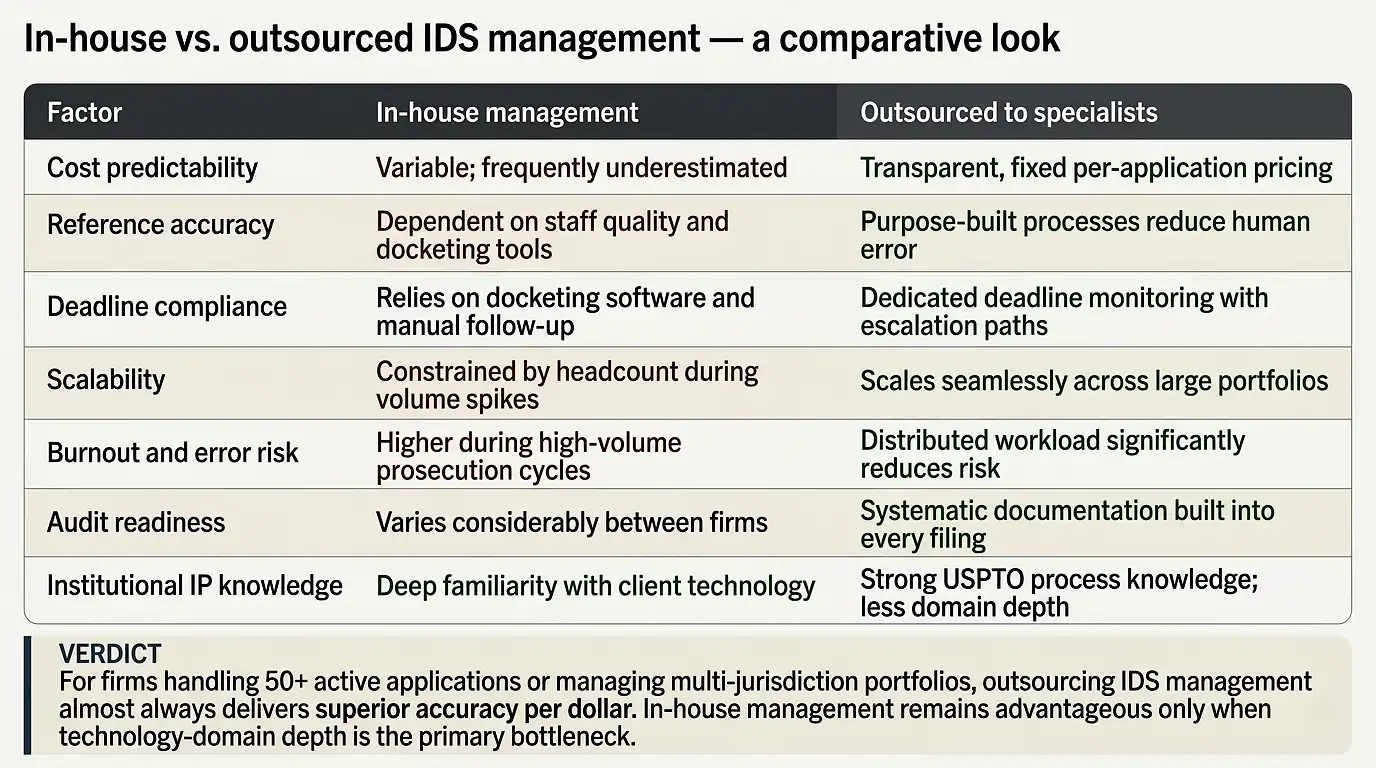
For high-volume prosecution environments, outsourcing IDS management to specialists often delivers superior accuracy at a lower effective cost than in-house handling. The right partner also brings institutional knowledge about USPTO requirements, formatting standards, and evolving best practices.
Explore the full cost analysis: Outsource IDS Filing: Why Law Firms Prefer True Cost DIY
Step-by-Step: Implementing a Reliable IDS Reference Management Workflow
Here is a practical workflow you can implement immediately to improve your IDS reference management during patent prosecution:
1st Step : Create a reference intake protocol Establish a formal process for how new references enter your tracking system. Every team member should know where to log new references, what data is required, and how to flag urgent items.
2nd Step : Assign clear ownership Designate a responsible individual (or team) for IDS management on each application. Ambiguous ownership is one of the leading causes of missed references and deadlines.
3rd Step : Map your prosecution milestones For each application, map out the key prosecution dates and the IDS deadlines tied to each. Use your docketing system to trigger reminders well in advance.
4th Step : Conduct a foreign prosecution review at each stage If you have corresponding foreign applications, review new office actions, search reports, and examiner citations in those proceedings for references that may need US disclosure.
5th Step : Perform a pre-filing quality check Before submitting any IDS, run through a standardized checklist covering completeness of references, accuracy of bibliographic data, correct form usage, and deadline compliance.
6th Step : Retain all documentation Keep records of every IDS filed, including confirmation receipts, submission timestamps, and the scope of the references included. This documentation becomes critical if your patent faces a validity challenge later.
Expert Tips for IDS Reference Management Excellence
Drawing on experience with high-stakes patent prosecution, here are key insights that consistently separate excellent IDS management from average practice:
- Never batch-process references at the last minute. Urgency breeds errors. Continuous logging throughout prosecution is far safer than a pre-deadline scramble.
- Cross-reference every related application. A reference cited by a foreign examiner in your European application almost certainly needs to be disclosed in your US prosecution as well.
- Keep an eye on co-pending applications. References material to a co-pending case in the same family may be material to your application too.
- Document your materiality analysis. When you decide a reference is not material enough to disclose, write down why. If your patent is ever challenged, that contemporaneous record is valuable.
- Watch for post-allowance developments. Your duty of disclosure continues until the patent issues. New material information discovered after a Notice of Allowance must still be disclosed.
- Train everyone on the team. The duty extends to inventors and anyone substantively involved. A well-informed inventor who promptly reports new references is a crucial part of your compliance system.
According to WIPO’s guidance on disclosure obligations in international applications, the duty of disclosure is a cornerstone principle that most major patent systems share – reinforcing that this is not a US-specific formality but a global best practice in IP management.
The Role of Technology in Modern IDS Reference Management
Technology has dramatically improved the accuracy and efficiency of IDS reference management. Modern patent docketing and IP management platforms offer features such as:
- Automated prior art monitoring that alerts you when new patents or publications match your technology space
- Reference deduplication to avoid multiple submissions of the same prior art
- Integrated deadline tracking synchronized with prosecution calendars
- Form auto-population that reduces manual data entry errors
- Audit trails showing when references were identified, logged, and submitted
Leveraging these tools does not eliminate the need for expert judgment – but it dramatically reduces the risk of human error in high-volume environments. The USPTO’s Patent Center also provides digital tools to track filed IDS submissions and review prosecution history in real time.
Protect Your Patent With Rigorous IDS Reference Management
Every patent you prosecute represents significant investment – in research, development, time, and legal fees. Accurate IDS reference management during patent prosecution is the foundation that protects that investment.
From maintaining the duty of candor to surviving litigation scrutiny, every aspect of your patent’s enforceability connects back to how well you managed your IDS references throughout prosecution. The risks of inaccuracy are real and costly. The solution, however, is achievable: systematic processes, dedicated ownership, regular audits, and the right expertise on your team.
Whether you manage a single application or a global portfolio of hundreds, the principles of accurate IDS reference management remain the same. Build them into your prosecution practice now – before an overlooked reference becomes an expensive problem.
Frequently Asked Questions (FAQ)
1. What is IDS reference management in patent prosecution?
IDS reference management in patent prosecution refers to the systematic process of identifying, tracking, accurately recording, and timely filing all material prior art references with the USPTO as part of your Information Disclosure Statement obligations during patent examination.
2. Why is accurate IDS reference management critical?
Accurate IDS reference management is critical because errors or omissions can result in allegations of inequitable conduct, which can render a patent entirely unenforceable. Additionally, inaccuracies create vulnerabilities during litigation, IPR proceedings, and patent portfolio due diligence.
3. What happens if you miss an IDS filing deadline?
Missing an IDS filing deadline can result in additional USPTO fees, certification requirements, and potential questions about whether the patent was prosecuted in full compliance with the duty of candor. In some cases, late disclosures may need to be accompanied by a statement under 37 C.F.R. § 1.97(e).
4. Do all references need to be listed in an IDS?
No – only references that are “material to patentability” as defined under USPTO Rule 56 need to be disclosed. However, when materiality is uncertain, practitioners generally recommend erring on the side of disclosure to minimize risk.
5. Does the duty to disclose end when a patent is allowed?
No. The duty of disclosure continues until the patent issues. If new material information is identified after receiving a Notice of Allowance but before issuance, it must still be disclosed.
6. How does IDS reference management differ across related applications?
References cited in foreign counterpart applications, co-pending US applications, or continuation proceedings may all be material to your application and need to be reviewed for inclusion. Effective IDS management tracks cross-application reference obligations systematically.
7. What are the most common IDS reference management mistakes?
The most common mistakes include: missing foreign counterpart citations, entering incorrect publication dates, failing to update the IDS after an allowance, not disclosing references found in related applications, and relying on informal tracking methods prone to human error.
8. Should law firms outsource IDS reference management?
Many law firms find that outsourcing IDS management to specialized service providers delivers greater accuracy, consistent compliance, and lower effective costs – especially for high-volume prosecution practices. Specialists bring dedicated processes and institutional knowledge that are difficult to replicate in-house.
Ready to Strengthen Your IDS Reference Management Process?
At Teak IP, we specialize in accurate, compliant, and efficient IDS management for patent practitioners and IP teams of all sizes. From meticulous reference tracking to deadline-driven filing support, our team ensures that your Information Disclosure Statements are complete, accurate, and properly filed – every time.
Don’t leave your patent’s enforceability to chance. Contact Teak IP today to learn how our IDS management services can protect your patent portfolio and give you confidence throughout prosecution.
👉Explore our IDS Preparation & Filing Services

