
A trademark registration is not a permanent asset. It is a right that a company must actively maintain, and in most countries, that maintenance comes down to one recurring task: renewal. For any junior attorney, in-house counsel, or solo practitioner tasked with global brand protection, learning how to manage corporate trademark renewals globally is one of the first and most important procedural skills to master, because a single missed deadline can permanently strip a company of rights it spent years and thousands of dollars building.

Unlike a single-jurisdiction renewal, global renewal management involves tracking dozens, sometimes hundreds, of marks across countries with different renewal terms, grace periods, use requirements, and filing formats. There is no universal deadline and no single portal that covers every office. That complexity is exactly why so many corporate IP departments and law firms turn to structured systems, dedicated docketing software, or outsourced paralegal support to keep renewals on track.
This guide breaks down, step by step, what it actually takes to manage corporate trademark renewals globally, including the jurisdictional differences, the common pitfalls, and the practical workflow that experienced IP teams use to protect a portfolio at scale.
What Does It Mean to Manage Corporate Trademark Renewals Globally?
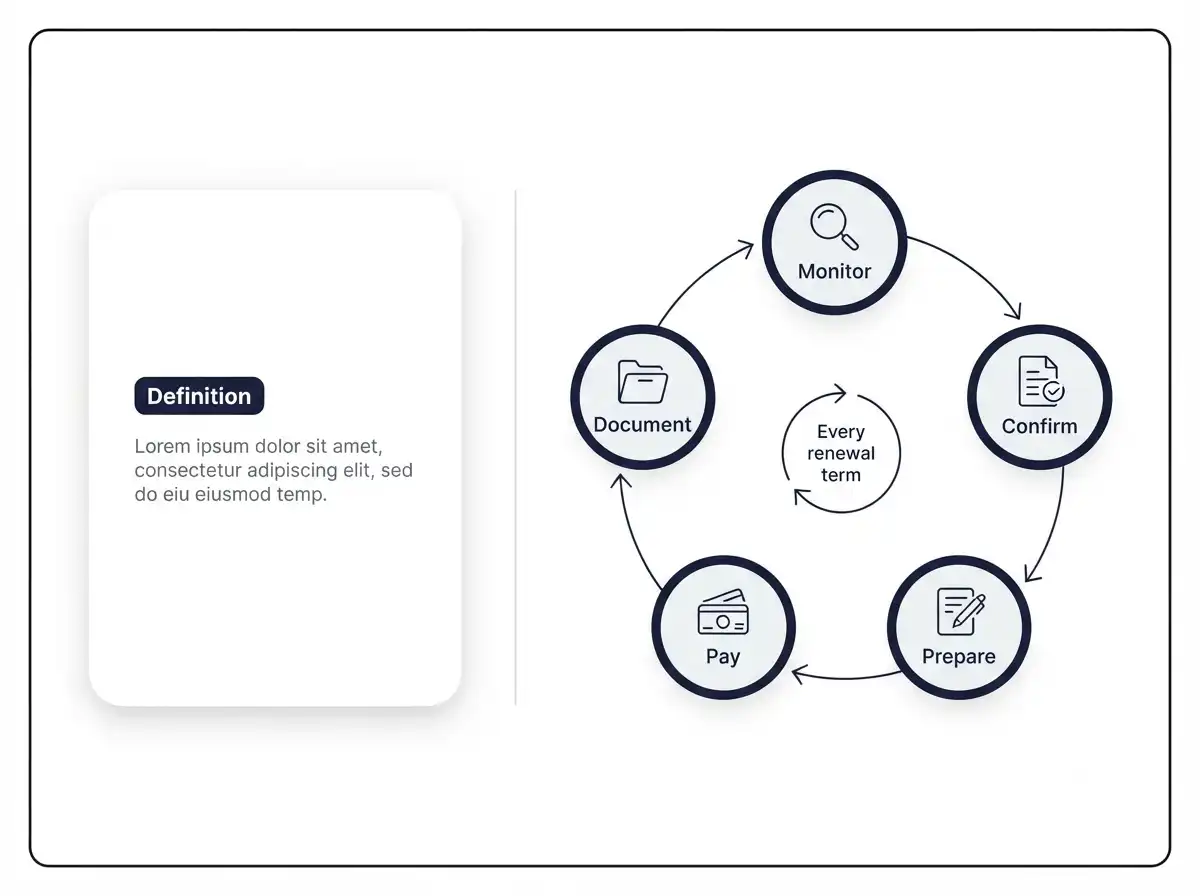
Managing corporate trademark renewals globally means tracking, filing, and paying for the periodic renewal of every registered trademark a company owns, across every country or region where that mark is registered, before each jurisdiction’s specific deadline expires.
In short, it involves:
- Monitoring renewal dates across multiple national and regional trademark offices
- Confirming continued use or intent-to-use requirements where applicable
- Preparing and filing renewal applications, declarations, or affidavits
- Paying the correct government and, if applicable, agent fees in local currency
- Documenting proof of filing and confirming successful renewal
Because trademark law is territorial, a company that owns a mark in the United States, the European Union, India, and Japan is really managing four separate renewal systems, each with its own rules, forms, and timelines, not one global process.
Why Global Trademark Renewal Management Is Different From Domestic Renewals
A domestic trademark renewal is a relatively contained task. You track one office, one set of rules, and one currency. Global trademark renewal management multiplies every one of those variables.
Here is what changes when a portfolio expands beyond one country:
- Jurisdiction-specific renewal terms. Some countries renew every 10 years, others every 7, and a handful still use shorter cycles.
- Use requirements vary. The United States requires proof of use or excusable non-use at renewal; many other countries do not.
- Grace periods differ. A late renewal might be accepted for six months with a surcharge in one country and rejected outright in another.
- Local counsel or agents may be mandatory. Several jurisdictions require a locally admitted attorney or agent to file the renewal on the owner’s behalf.
- Currency and payment logistics. Government fees must often be paid in local currency, sometimes through country-specific payment portals.
- Language requirements. Renewal declarations or evidence of use may need certified translations.
Because of these layered differences, companies that try to manage renewals with a single spreadsheet or generic calendar reminder frequently discover gaps only after a deadline has already passed.
Building the Foundation: A Centralized Trademark Renewal System
Before diving into jurisdiction-specific steps, it helps to understand the foundation every reliable renewal system is built on: centralized, accurate data. Without this, even the most experienced legal team will eventually miss something.
Core Elements of a Renewal Tracking System
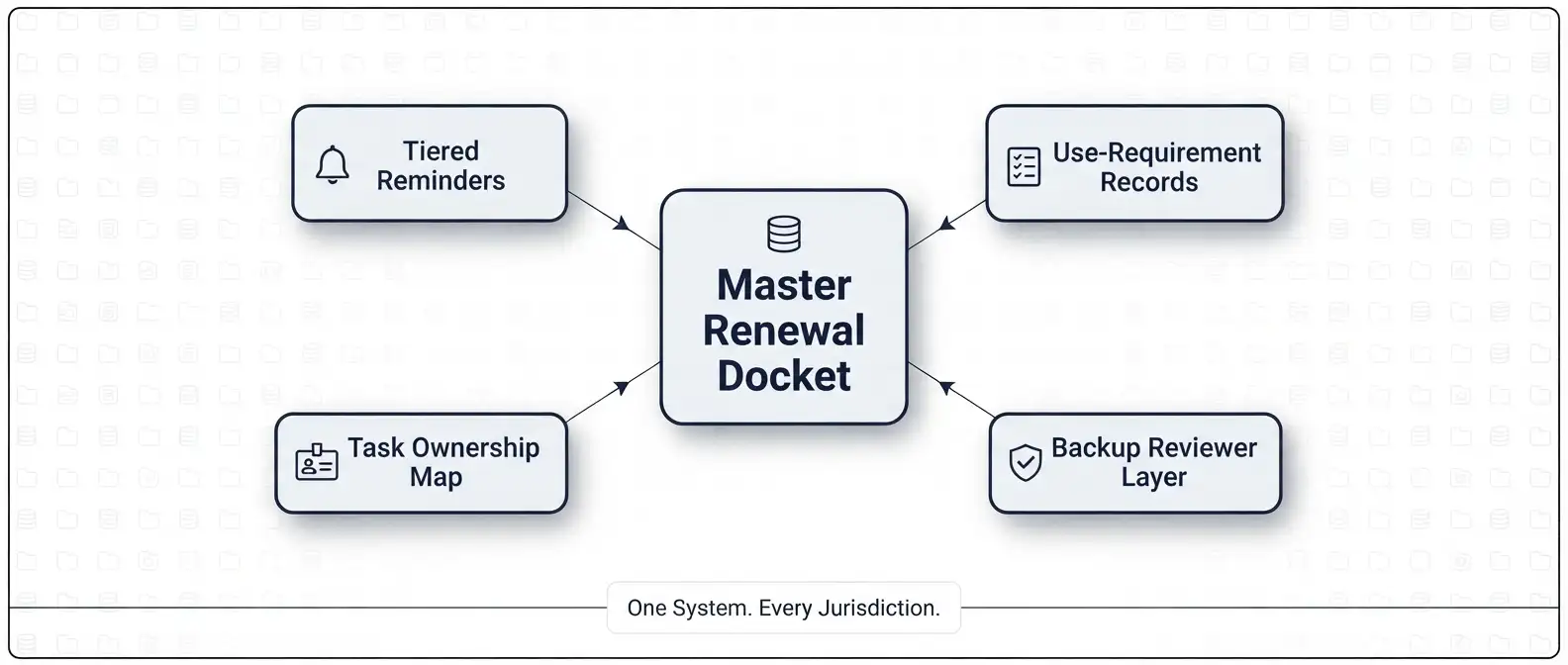
A dependable system to manage corporate trademark renewals globally typically includes:
- A master docket listing every registered mark, jurisdiction, registration number, and renewal due date
- Automated reminders set well ahead of each deadline, not just on the due date itself
- A record of use requirements and evidentiary documents required per country
- A clear owner or responsible party assigned to each renewal task
- A backup or secondary reviewer to catch errors before deadlines arrive
Many corporate IP departments rely on dedicated docketing software for this, while others outsource the docketing function entirely to specialized providers. If your organization is weighing the pros and cons of software-only tracking, this comparison on the benefits of managed trademark docketing versus software walks through where automation alone tends to fall short.
Step-by-Step: How to Manage Corporate Trademark Renewals Globally
Once the foundation is in place, the actual renewal process follows a fairly consistent sequence, even though the specific requirements shift by country. Here is the step-by-step workflow experienced IP teams use.
Step 1: Audit the Full Trademark Portfolio
Start by confirming that every registered mark, in every jurisdiction, is accounted for. Portfolios grow through mergers, acquisitions, and organic filing over years, and older registrations are sometimes never properly transferred into a central docket. An audit should confirm the registration number, class coverage, owner of record, and current renewal due date for each mark.
Step 2: Calculate Renewal Windows for Each Jurisdiction
Every country sets its own renewal window, meaning the earliest and latest dates a renewal can be filed. Some offices accept early filing up to a year in advance, while others open the window only a few months before expiration. Building a jurisdiction-by-jurisdiction calendar, rather than relying on one universal countdown, prevents both premature and late filings.
Step 3: Confirm Use and Evidentiary Requirements
Certain jurisdictions, most notably the United States, require a sworn declaration of continued use (or excusable non-use) along with specimen evidence at renewal. Others require nothing beyond the renewal fee. Before filing, confirm exactly what supporting documentation each office expects, since a missing specimen can delay or jeopardize an otherwise timely renewal.
Step 4: Engage Local Counsel or Agents Where Required
Many trademark offices outside the mark owner’s home country require filings to go through a locally admitted attorney or authorized agent. Identify which jurisdictions in the portfolio have this requirement and confirm the local agent relationship is active well before the deadline, not the week of filing.
Step 5: Prepare and File the Renewal
With use evidence gathered and local representation confirmed, prepare the renewal application, declaration, or affidavit according to each office’s specific format. File electronically wherever the jurisdiction supports it, since electronic filing typically provides an immediate, time-stamped confirmation of submission.
Step 6: Pay Government and Agent Fees
Fees must be paid in the currency and through the payment method each office accepts. For portfolios spanning many countries, this step alone can involve dozens of individual transactions, so maintaining a clear fee schedule and budget forecast in advance avoids last-minute payment delays.
Step 7: Confirm and Document Successful Renewal
After filing, confirm that the trademark office has accepted the renewal and updated the register accordingly. Store the confirmation, the renewed certificate, and the new expiration date in the central docket immediately, so the next renewal cycle starts from accurate data.
Step 8: Reassess the Portfolio Before the Next Cycle
Renewal is also a natural checkpoint to reassess whether a mark is still commercially relevant. Marks that are no longer in use, or that cover classes the business has exited, may not be worth the cost of continued global renewal, particularly across dozens of jurisdictions.
Cross-Border Compliance Challenges That Complicate Global Renewals
Beyond deadlines and fees, several structural challenges make it harder for legal teams to manage corporate trademark renewals globally without a dedicated process. Understanding these challenges upfront helps teams design a system that anticipates problems instead of reacting to them.
Fragmented Ownership Records

Large companies often register trademarks under different subsidiaries, holding companies, or historical entity names. Over time, these ownership records can become inconsistent with the company’s current corporate structure. A renewal filed under an outdated entity name may be rejected or, worse, may create a title gap that surfaces later during litigation or licensing negotiations. Before any renewal cycle, it is worth confirming that the registered owner matches the current legal entity, and if not, addressing that discrepancy through a formal assignment or name change recordal.
Inconsistent Class and Goods Descriptions

Some jurisdictions require renewal filings to precisely match the goods and services description from the original registration, while others allow limited updates. Companies that have rebranded or expanded product lines sometimes discover, only at renewal, that their registered classes no longer reflect current business operations. Deciding whether to renew as-is, narrow the scope, or let certain classes lapse is a decision best made with enough lead time to consult local counsel.
Currency Volatility and Payment Processing Delays

Government renewal fees are typically payable in the local currency of the filing jurisdiction. For companies renewing marks across a dozen or more countries, currency fluctuations can meaningfully affect the total renewal budget from one cycle to the next. In addition, some trademark offices require payment through country-specific banking or online systems that can take several business days to process, which is another reason to file well ahead of the actual deadline rather than on it.
Coordinating Multiple External Agents

When a portfolio spans many countries, a company may work with a different local agent or foreign associate in each jurisdiction. Coordinating renewal instructions, confirming receipt, and tracking responses across a dozen or more external contacts introduces its own administrative burden. Centralizing this communication, ideally through a single internal point of contact or outsourced docketing partner, reduces the risk that an instruction is lost in translation or delayed by a change in agent staffing.
Setting Up a Renewal Budget and Fee Forecast
A frequently overlooked part of learning how to manage corporate trademark renewals globally is financial planning. Renewal fees are recurring, predictable expenses, yet many companies still treat them as unexpected costs that appear only when a deadline notice arrives.
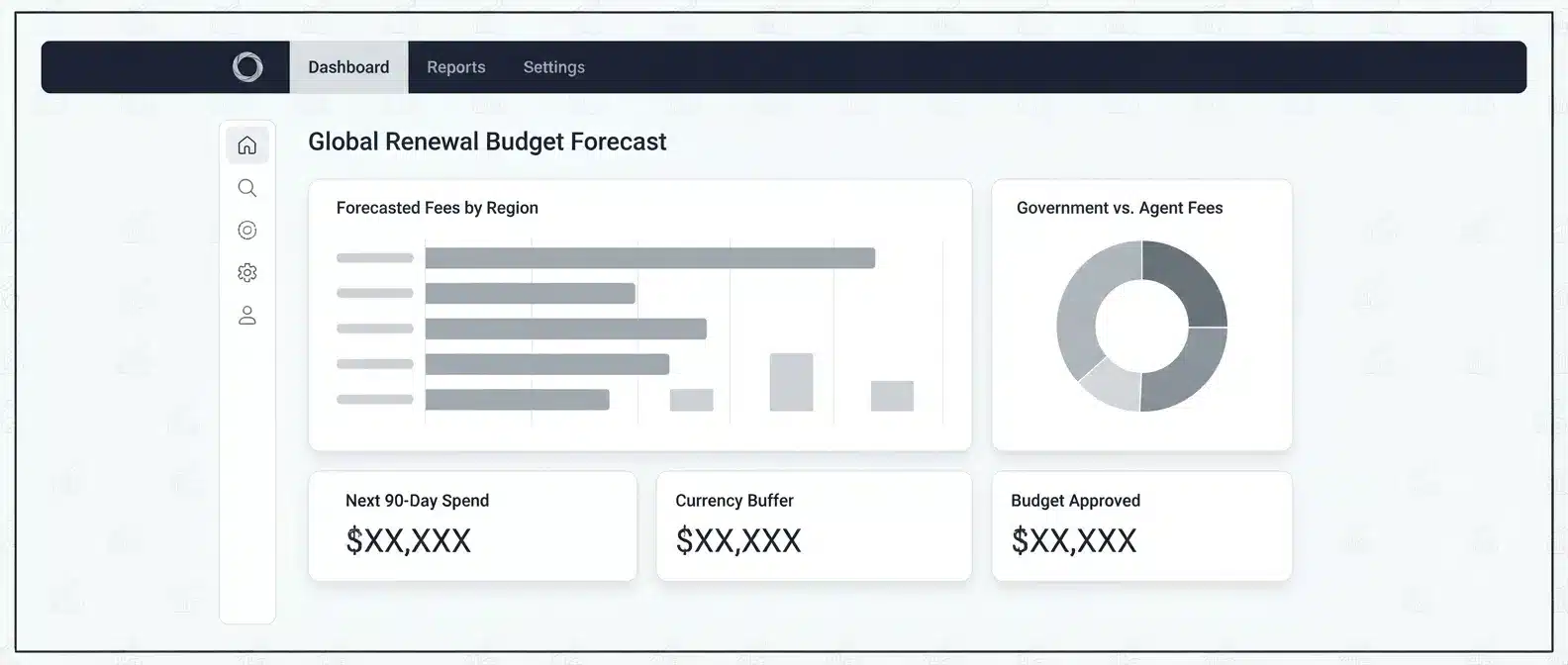
A practical renewal budget process includes:
- Mapping renewal dates two to three years ahead, since most 10-year cycles are entirely predictable once the original registration date is known.
- Estimating government fees per jurisdiction, factoring in per-class charges where offices bill by the number of registered classes.
- Adding local agent or foreign associate fees, which are separate from government fees and vary by country and by provider.
- Building in a currency buffer, particularly for portfolios with significant exposure to jurisdictions with volatile exchange rates.
- Reviewing the forecast against the annual legal budget cycle, so renewal costs are approved and available well before filing windows open.
Finance and legal teams that build this forecast together, rather than in isolation, tend to avoid the last-minute budget approval delays that can push a filing dangerously close to a deadline.
Renewal Terms by Jurisdiction: A Quick Reference Table
Renewal cycles and requirements differ significantly from country to country. The table below summarizes some of the most commonly encountered systems for companies that manage corporate trademark renewals globally.
| Jurisdiction | Standard Renewal Term | Use Declaration Required | Typical Grace Period |
|---|---|---|---|
| United States (USPTO) | 10 years | Yes, at renewal | 6 months (with surcharge) |
| European Union (EUIPO) | 10 years | No | 6 months (with surcharge) |
| United Kingdom (UKIPO) | 10 years | No | 6 months (with surcharge) |
| India | 10 years | No | 6 months (with surcharge) |
| Japan | 10 years | No | 6 months (with surcharge) |
| China | 10 years | No | 6 months (with surcharge) |
| Madrid Protocol (International Registration) | 10 years | Depends on designated country | Varies by designation |
Because timelines above are general norms and individual offices periodically update their rules, always confirm current requirements directly with the relevant trademark office, such as the USPTO’s trademark maintenance and renewal guidance, before filing.
National Filing vs. Madrid Protocol: A Comparison for Global Renewals
Companies with international portfolios generally maintain marks through one of two structures: separate national registrations in each country, or a single International Registration under the Madrid Protocol that designates multiple member countries. Each structure changes how renewals are managed.
| Factor | National Filings (Country-by-Country) | Madrid Protocol (International Registration) |
|---|---|---|
| Number of renewal filings | One per country, filed separately | One centralized renewal through WIPO covering all designated countries |
| Local agent requirement | Often required per country | Generally not required for the renewal itself |
| Cost predictability | Fees vary widely by country and currency | Single fee structure through WIPO, plus individual country fees |
| Flexibility to drop coverage | Straightforward; simply do not renew in that country | Possible, but requires formally reducing designated countries |
| Best suited for | Companies with a few key markets or unique local requirements | Companies with broad, multi-country coverage and centralized management preference |
For companies weighing which structure fits their global footprint, the World Intellectual Property Organization’s Madrid System overview explains eligibility and renewal mechanics in more detail. Teams already managing an international portfolio may also find it useful to review this guide on how to manage an international trademark portfolio for a broader look at ongoing maintenance beyond renewals alone.
Common Mistakes Companies Make When Managing Global Trademark Renewals
Even well-resourced legal departments make avoidable errors when trying to manage corporate trademark renewals globally. Recognizing these patterns early helps prevent costly lapses.
- Relying on a single calendar reminder instead of a tiered reminder system that flags deadlines at 12, 6, 3, and 1 months out.
- Assuming all jurisdictions follow the same use requirements as the home country, which leads to either missing US-specific declarations or over-preparing unnecessary evidence elsewhere.
- Losing track of ownership after a merger or rebrand, so the renewal notice goes to an outdated legal entity or contact.
- Underestimating local agent lead time, especially in jurisdictions where a new power of attorney must be executed before filing.
- Treating renewal as purely administrative, and skipping the opportunity to prune outdated marks or classes that no longer serve the business.
- Failing to reconcile portfolios after an acquisition, leaving newly acquired marks undocketed until a renewal is already overdue.
- Not confirming actual government acceptance, and assuming a filing was successful without verifying the updated registry entry.
A single missed Section 8 affidavit in the United States, for example, can result in cancellation of an otherwise valid registration. If your team is unsure when these US-specific filings come due, this breakdown of when to file a Trademark Section 8 and 15 affidavit is a useful companion resource.
Expert Tips to Streamline Global Trademark Renewal Management
Experienced IP professionals rely on a few consistent practices to keep large, multi-country portfolios compliant without constant firefighting.
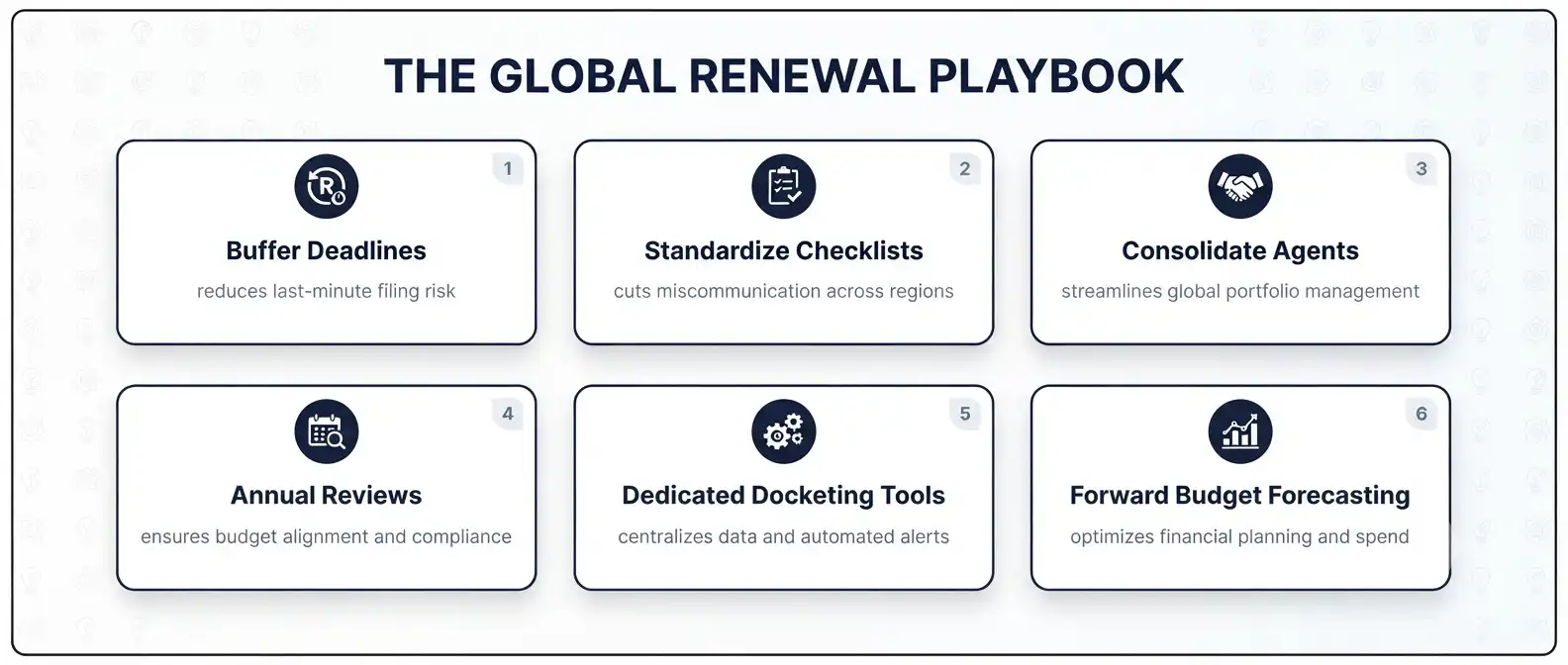
- Set internal deadlines earlier than the legal deadline. A 30- to 60-day internal buffer absorbs unexpected delays in local counsel response or payment processing.
- Standardize a renewal checklist per jurisdiction. Once built, this checklist becomes reusable for every future cycle in that country.
- Consolidate local agent relationships. Working with fewer, trusted agents across regions reduces communication gaps and improves response time near deadlines.
- Review the portfolio annually, not just at renewal. Annual reviews catch ownership changes, class relevance issues, and use gaps long before a renewal deadline forces a decision.
- Use a docketing system built specifically for IP deadlines, rather than a general project management tool, since IP docketing software typically accounts for jurisdiction-specific rules automatically.
- Keep a renewal budget forecast updated at least two quarters ahead, since currency fluctuations and agent fee changes can affect planning.
In-House vs. Outsourced Renewal Management: Which Approach Fits?
Companies generally choose between three models to manage corporate trademark renewals globally: a fully in-house team, dedicated renewal software, or outsourced paralegal and docketing support. Each comes with trade-offs.
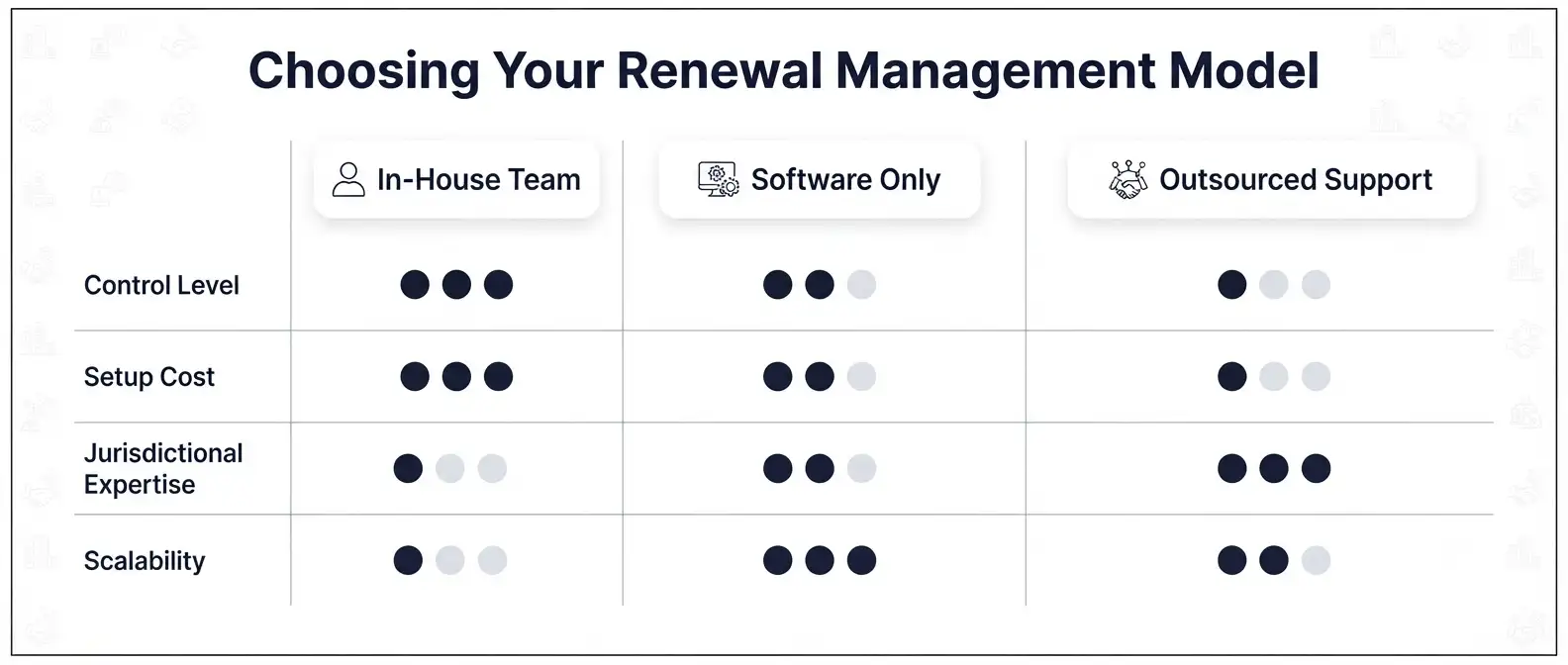
In-house management offers direct control and institutional knowledge but requires ongoing investment in staff training on jurisdiction-specific rules, which can be difficult to justify for smaller portfolios.
Software-only management automates reminders and centralizes data but still requires a knowledgeable person to interpret jurisdiction-specific nuances, review filings, and manage exceptions.
Outsourced renewal and docketing support combines dedicated staff experience with established processes, often at a lower cost than maintaining an equivalent in-house team, particularly for firms and companies managing renewals across many countries at once. Firms evaluating this option often start by comparing providers using a resource like this guide to evaluate and compare IP outsourcing companies, or by reviewing what trademark paralegal services typically include.
For organizations specifically weighing cost, this related trademark docketing outsourcing cost guide breaks down typical pricing structures across different portfolio sizes.
Renewals After a Merger, Acquisition, or Corporate Restructuring
Corporate transactions are one of the most common sources of renewal errors. When a company acquires another business, the acquired trademark portfolio often arrives with its own docketing history, renewal dates, and, sometimes, outdated contact information tied to the previous owner’s legal team.
To avoid gaps immediately after a transaction, IP teams should:
- Request the full trademark docket from the seller or acquired entity as part of due diligence, not after closing.
- Reconcile every mark against public trademark registries in each relevant jurisdiction to confirm the docket is complete and accurate.
- File assignment or ownership change recordals promptly, since an unrecorded assignment can complicate a subsequent renewal filing.
- Merge the acquired portfolio into the existing central docket with the same tiered reminder structure used for legacy marks.
- Flag any renewals due within the first 12 months post-close for immediate review, since these are the most likely to be missed during transition.
Because a change of ownership must typically be reflected in the official register before or alongside a renewal filing, confirming the assignment is properly recorded should never be treated as a lower priority than the renewal itself.
How Technology and Paralegal Support Work Together
The most reliable systems to manage corporate trademark renewals globally rarely rely on technology or human expertise alone. Docketing software captures dates and sends alerts, but a trained paralegal or attorney interprets edge cases, such as a jurisdiction changing its filing portal, a use requirement being waived temporarily, or an acquisition that shifts ownership mid-cycle.
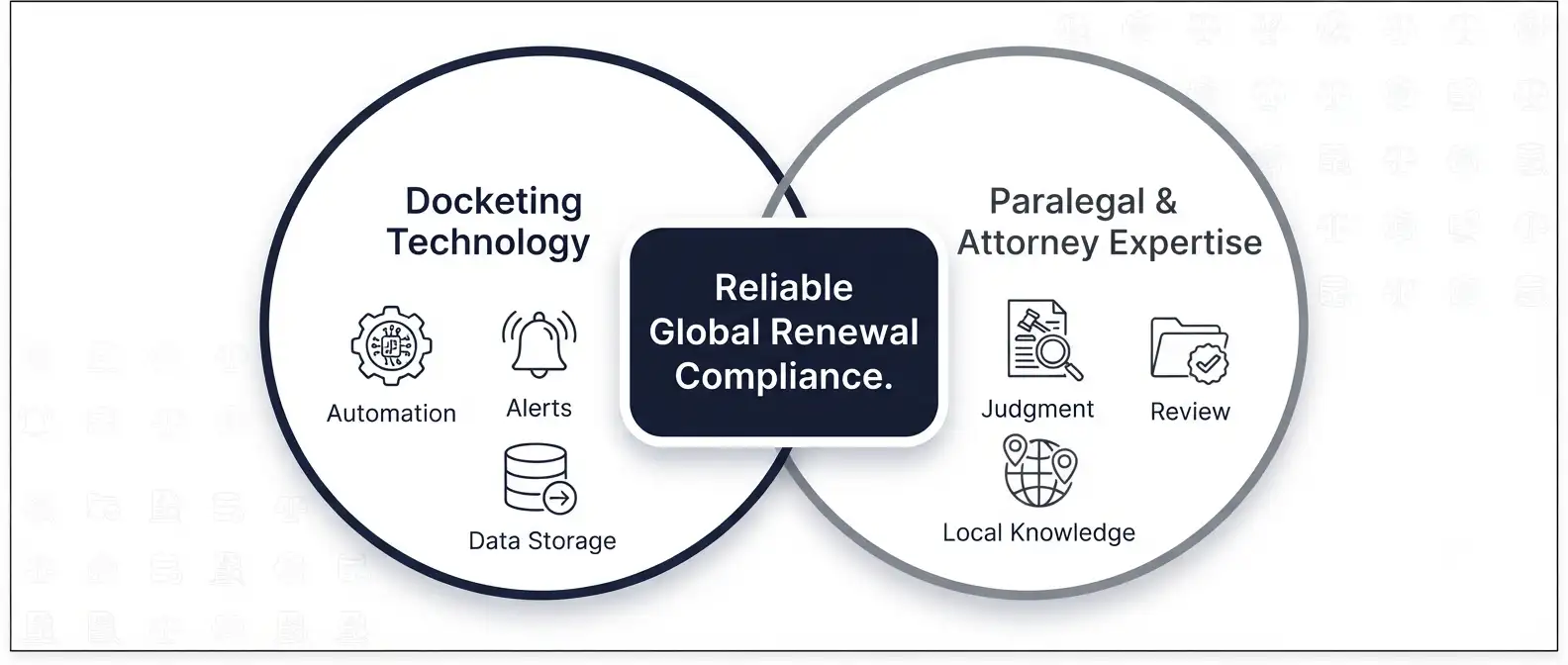
This combination becomes especially important after any change in corporate structure. If a trademark has recently changed hands through a merger or sale, confirming the assignment is properly recorded is a prerequisite to a clean renewal. For US-registered marks, this overview on how to record a trademark assignment with the USPTO explains that process in detail.
Frequently Asked Questions
What does it mean to manage corporate trademark renewals globally?
It means tracking and filing renewal applications for every registered trademark a company owns across all jurisdictions, before each country’s specific deadline, while meeting local use, documentation, and payment requirements.
How often do trademarks need to be renewed internationally?
Most jurisdictions use a 10-year renewal cycle, though the specific rules, grace periods, and required documentation differ by country, so it is important to confirm each office’s current requirements rather than assuming uniformity.
What happens if a company misses a trademark renewal deadline?
Consequences vary by jurisdiction. Many offices allow a grace period, typically around six months, with an additional late fee. After the grace period expires, the registration is generally cancelled or removed from the register, which can require a costly new application to re-establish rights.
Is the Madrid Protocol a good option to simplify global renewals?
For companies with marks in multiple Madrid Protocol member countries, filing a single International Registration can significantly simplify renewal management, since one centralized renewal through WIPO can cover all designated countries, though individual country requirements should still be verified.
Should a company manage global trademark renewals in-house or outsource them?
The right choice depends on portfolio size and internal resources. Smaller portfolios may be manageable in-house with strong docketing software, while larger, multi-country portfolios often benefit from outsourced paralegal support that already understands jurisdiction-specific renewal rules.
Who can help a company set up a system to manage corporate trademark renewals globally?
Specialized IP paralegal and docketing providers, as well as experienced trademark counsel, can help design and run a renewal tracking system, particularly for companies expanding into new markets or managing renewals after a merger or acquisition.
How far in advance should renewal deadlines be tracked?
Best practice is to map renewal dates two to three years in advance, since most jurisdictions use predictable 10-year cycles. Layering reminders at the 12-month, 6-month, 3-month, and 1-month marks gives legal and finance teams enough runway to gather use evidence, confirm budgets, and engage local agents without last-minute pressure.
Does a change in company name or ownership affect a trademark renewal?
Yes. If the registered owner of a trademark no longer matches the company’s current legal name, due to a merger, acquisition, or internal restructuring, that discrepancy should be corrected through a formal assignment or name change recordal before or alongside the renewal filing. Renewing under an outdated entity name can create ownership disputes or filing rejections later on.
Conclusion
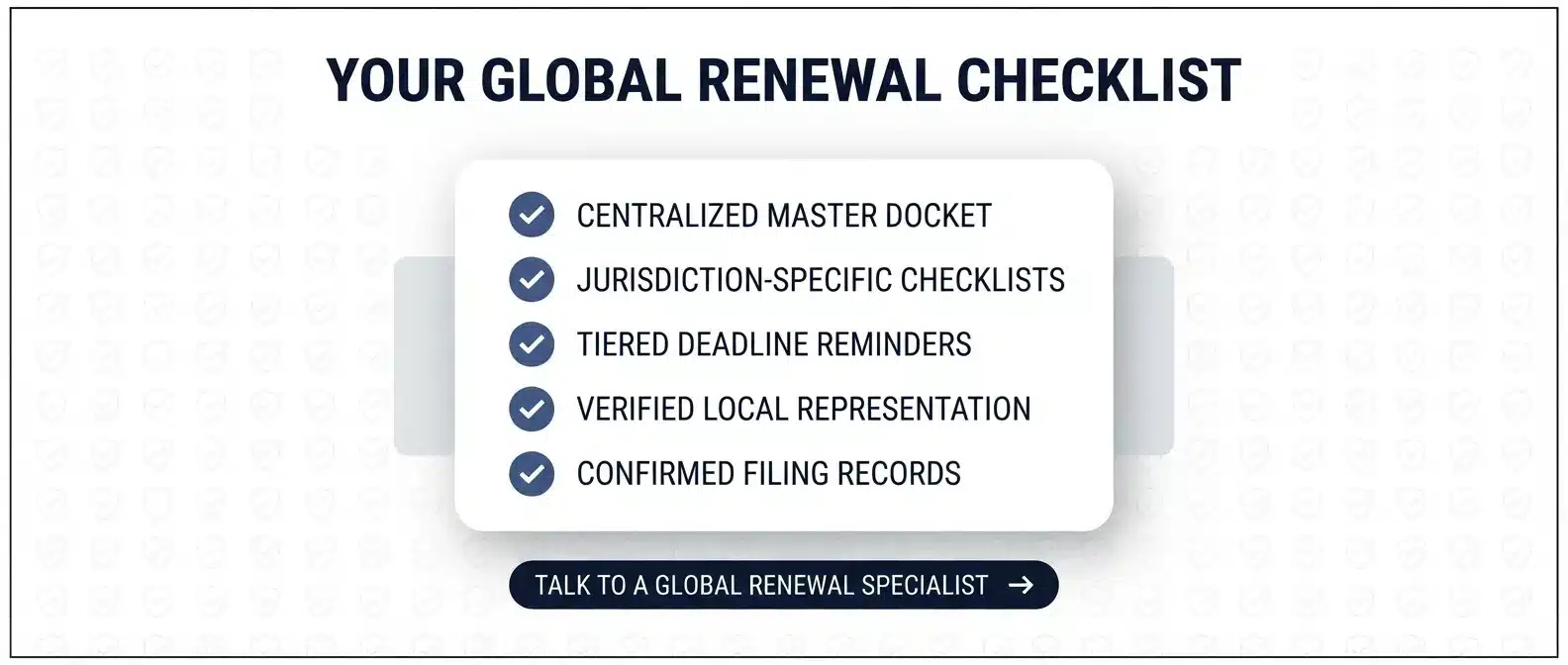
Learning how to manage corporate trademark renewals globally comes down to building a system that accounts for jurisdictional differences rather than assuming one process fits every country. A centralized docket, jurisdiction-specific checklists, tiered deadline reminders, and reliable local representation form the backbone of that system. Companies that treat renewal as a routine administrative task, rather than a strategic checkpoint, often miss the chance to prune outdated marks or catch ownership gaps before they become expensive problems.
Whether your organization manages a handful of marks or a sprawling international portfolio, the fundamentals remain the same: know every deadline, understand every jurisdiction’s requirements, and confirm every filing before assuming it is done. For teams that need additional support keeping pace with a growing global portfolio, working with an experienced trademark paralegal and docketing partner, such as Teak IP Services, can help ensure no renewal deadline is ever left to chance. Contact Teak IP Services to discuss how a dedicated docketing and renewal support team can protect your global trademark portfolio.

