
Office Action Response Template: Receiving an Office Action from the USPTO can feel overwhelming – especially for first-time applicants or those navigating a complex examination. But here’s the truth: an Office Action is not a rejection letter. It’s an invitation to respond.
How you respond matters enormously. A well-structured, legally precise Office Action response can be the difference between a patent being granted and an application going abandoned. That’s why having a reliable office action response template is not just convenient – it’s strategically essential for every patent practitioner and applicant.

In this guide, we break down exactly what to include in an Office Action response, how to structure it for maximum clarity and legal impact, and how USPTO Rule 56 (the Duty of Disclosure) fits into your overall prosecution strategy.
Whether you’re a seasoned patent attorney, a registered agent, or an inventor managing your own application, this article is your definitive reference.
What is an Office Action ?
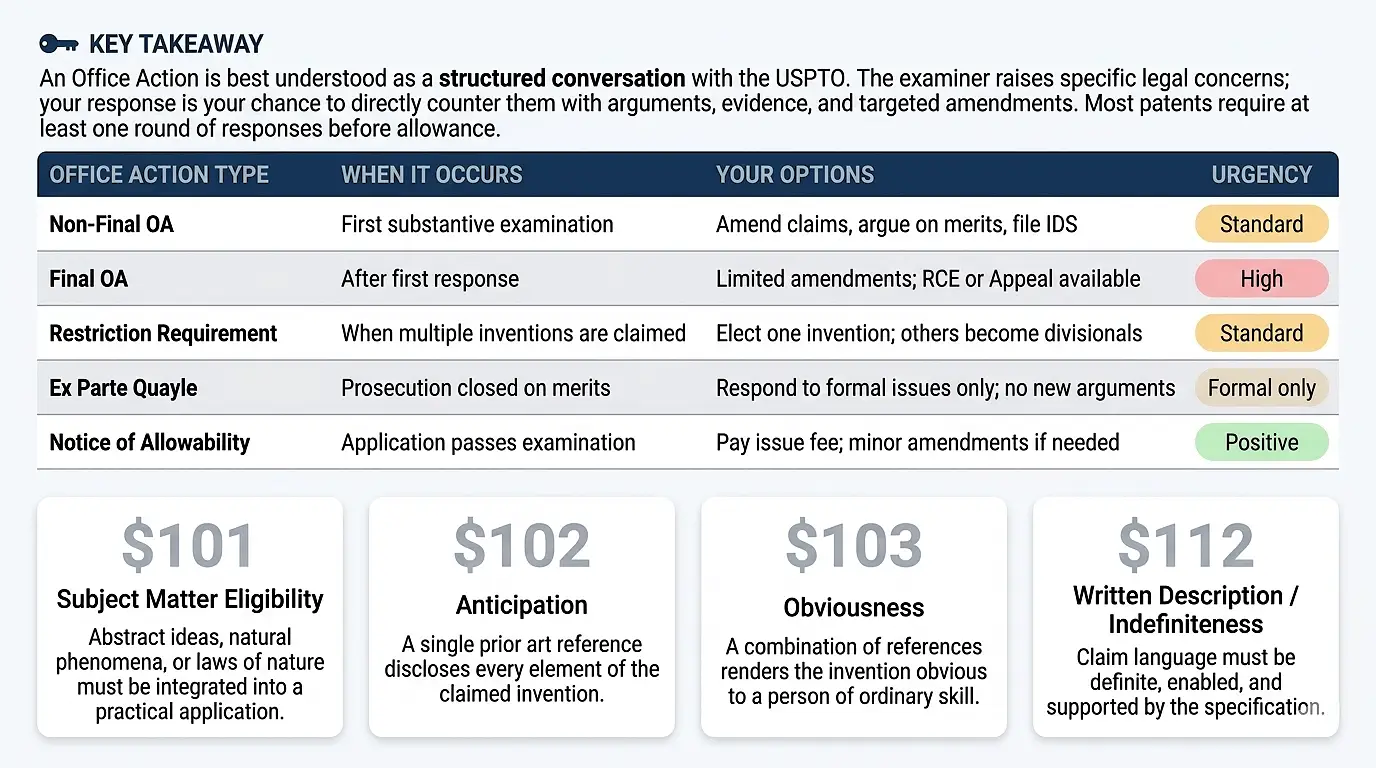
An Office Action (OA) is an official written communication issued by a USPTO patent examiner during the examination of a patent application. It typically includes:
- Rejections – based on prior art (35 U.S.C. § 102, § 103), indefiniteness (§ 112), or subject matter eligibility (§ 101)
- Objections – to the specification, drawings, or claim language
- Requirements – for restriction or election between distinct inventions
- Notices – regarding informalities, missing parts, or formal issues
There are several types of Office Actions you may encounter:
Why Your Office Action Response Template Matters
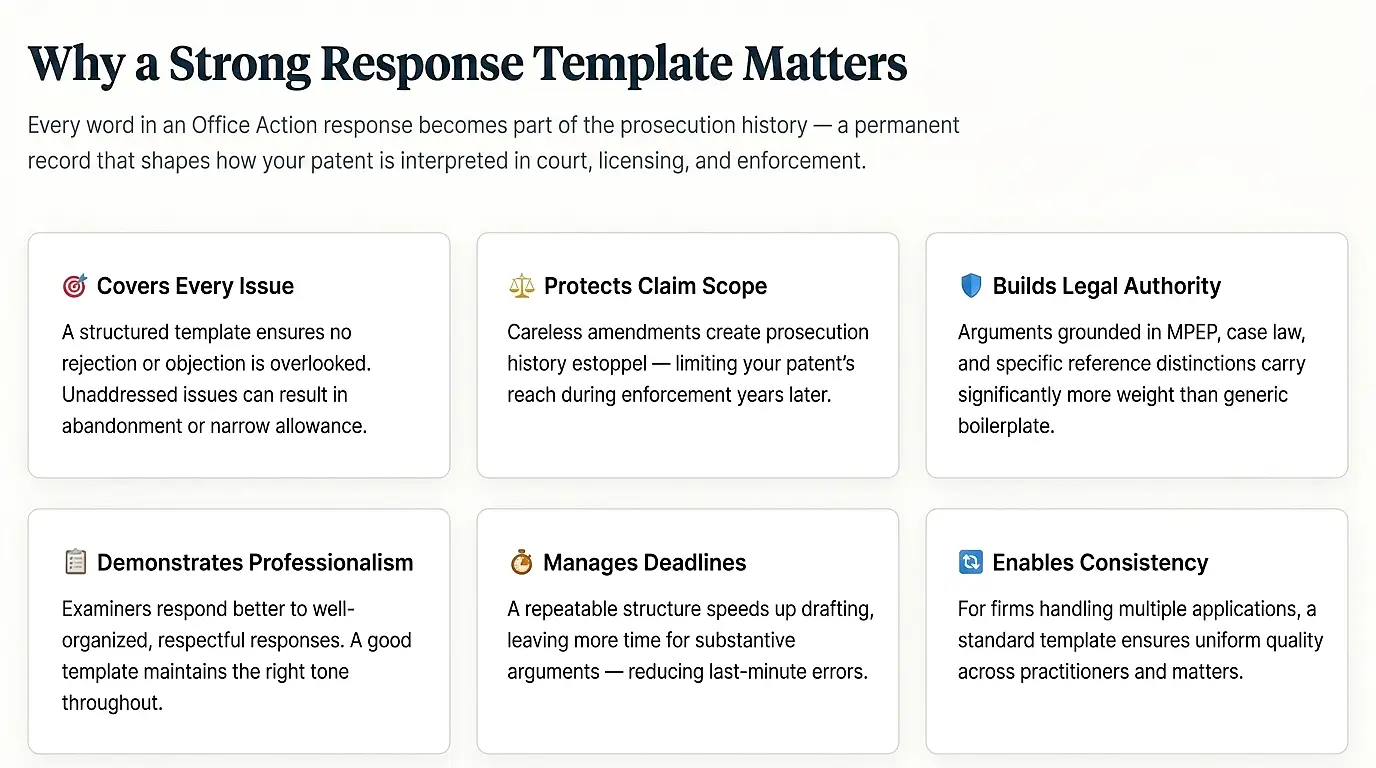
A poorly structured response wastes the examiner’s time, creates prosecution history estoppel, and may inadvertently concede claim scope you didn’t intend to give up. A strong office action response template does the following:
- ✅ Addresses every rejection and objection on record
- ✅ Presents claim amendments clearly and without ambiguity
- ✅ Provides persuasive legal arguments rooted in case law and USPTO guidelines
- ✅ Maintains a professional, respectful tone toward the examiner
- ✅ Protects prosecution history for future litigation or licensing scenarios
- ✅ Complies with all USPTO formal requirements and deadlines
USPTO Rule 56: Duty of Disclosure – Why It’s Relevant to Your Response
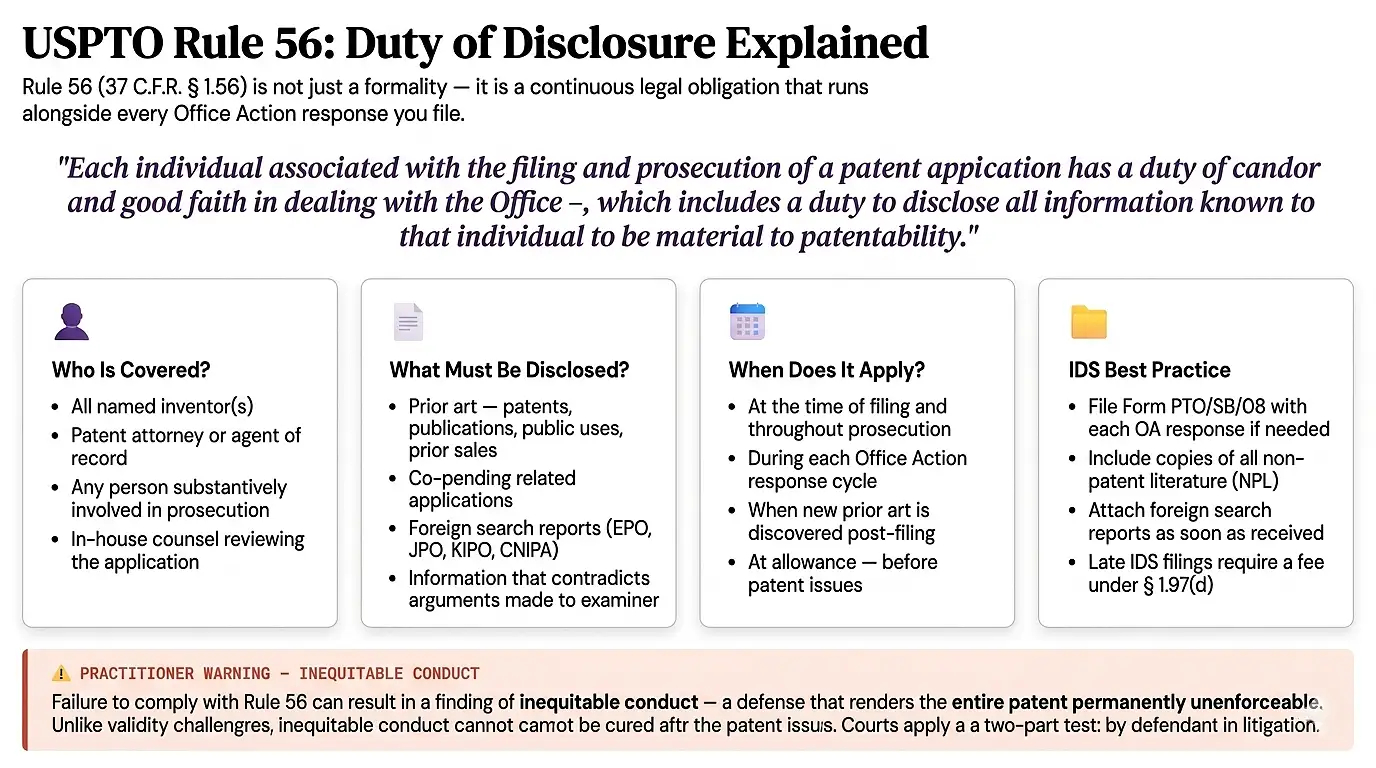
Before diving into the response template, it’s critical to understand USPTO Rule 56 (37 C.F.R. § 1.56) – the Duty of Candor and Good Faith, commonly known as the Duty of Disclosure.
What Does Rule 56 Require?
“Each individual associated with the filing and prosecution of a patent application has a duty of candor and good faith in dealing with the Office, which includes a duty to disclose to the Office all information known to that individual to be material to patentability.” – 37 C.F.R. § 1.56(a)
Who is covered under Rule 56?
- The inventor(s)
- The patent attorney or agent of record
- Every other person who is substantively involved in the preparation or prosecution of the application
What Must Be Disclosed?
Under Rule 56, you must disclose any information that is material to patentability, including:
- Prior art – patents, publications, public uses, or sales that anticipate or render obvious the claimed invention
- Prior applications – related co-pending applications and their prosecution history
- Prior art cited in foreign counterparts – search reports from EPO, JPO, KIPO, CNIPA, etc.
- Conflicting information – any information that would undermine arguments made to the examiner
When Does Rule 56 Apply During an Office Action Response?
Rule 56 is ongoing – it applies throughout the entire prosecution. During an Office Action response, practitioners must:
- File an IDS (Information Disclosure Statement) if any new material prior art has come to your attention since the last IDS filing
- Not misrepresent facts about the prior art or the invention in arguments
- Disclose related litigation or inter partes proceedings, if applicable
- Correct any material misstatements made in prior responses
⚠️ Practitioner Warning: Failure to comply with Rule 56 can result in inequitable conduct – a defense that, if proven, can render the entire patent unenforceable. This is a severe consequence that cannot be cured post-issuance.
Best Practice: IDS Filing with Your Response
When filing an Office Action response, always ask:
- Have I received any foreign search reports (e.g., EPO Written Opinion) since my last IDS?
- Has any new prior art been identified through litigation, licensing discussions, or independent searches?
- Have I cited all prior art I’m aware of that the examiner may not have found?
If the answer to any of these is yes, file a concurrent IDS with your Office Action response.
The Complete Office Action Response Template
Below is a professionally structured, court-tested office action response template you can adapt for USPTO patent prosecution.
SECTION 1: HEADER INFORMATION
IN THE UNITED STATES PATENT AND TRADEMARK OFFICE

Application No.:        [Application Number]
Filing Date:            [Filing Date]
Applicant(s):           [Inventor Name(s)]
Title of Invention:     [Title]
Art Unit:               [Art Unit Number]
Examiner:               [Examiner Name]
Docket No.:             [Firm/Applicant Docket Number]
Mail Stop:              Amendment

Commissioner for Patents
P.O. Box 1450
Alexandria, VA 22313-1450

Date of Office Action:  [Date of OA]
Response Due Date:      [Deadline - include any extensions]
Why this matters: Proper header information ensures the USPTO routes your response to the correct application and examiner without delay.
SECTION 2: INTRODUCTORY STATEMENT
Begin with a brief introductory paragraph that:
- Acknowledges receipt of the Office Action and its date
- States your intent to respond fully and timely
- Notes the extended deadline if applicable (under 37 C.F.R. § 1.136)
Template Language:
“In response to the Office Action dated [DATE], Applicant respectfully submits the following amendments and remarks. Applicant believes that the present application is in condition for allowance and respectfully requests reconsideration and withdrawal of all pending rejections and objections in view of the following.”
SECTION 3: CLAIM AMENDMENTS
This is often the most critical section. Present claim amendments using the USPTO’s required clean copy and marked-up copy format.
Key Rules for Claim Amendments:
- Underline all added text
- Strike through (bracket in paper) all deleted text
- List each amended, cancelled, or new claim explicitly
- Retain original claim numbering; new claims get the next available number
- Never present amended claims without corresponding remarks
Template Format:
AMENDMENTS TO THE CLAIMS

Please amend the claims as follows:

Claim 1 (amended):
A [device/method/system] comprising:
[underlined new limitation];
wherein [underlined new condition].

Claim 5 (cancelled).

Claim 12 (new):
The [device] of claim 1, wherein [additional limitation].
Best Practices for Claim Amendments:
- Narrow only as much as necessary – over-narrowing limits future enforcement
- Ensure support in the specification for every new limitation (§ 112 new matter prohibition)
- Consider claim differentiation – each claim should add distinct value
- Amend independent claims first, then dependent claims as needed
- Do not add limitations that are not supported in the original disclosure
SECTION 4: REMARKS / ARGUMENTS
This is the persuasive heart of your Office Action response. Structure your remarks systematically, addressing every rejection and objection in the order they appear in the Office Action.
4A. Introductory Remarks
Briefly summarize the invention and the technical field. Remind the examiner of the core problem being solved and the inventive concept.
“The present invention relates to [technical field] and provides a novel [solution/approach] to [problem]. The following remarks are respectfully submitted in support of patentability.”
4B. Response to § 101 Rejection (Subject Matter Eligibility)
If the examiner has rejected claims under 35 U.S.C. § 101 (patent-ineligible subject matter), address the two-step Alice/Mayo framework:
1st Step: Is the claim directed to patent-eligible subject matter?
- Argue the claim is directed to a machine, manufacture, composition of matter, or process
2nd Step A – Prong 1: iFs the claim directed to a judicial exception?
- Address whether the examiner has correctly identified an abstract idea, law of nature, or natural phenomenon
Step A – Prong 2: Does the claim integrate the exception into a practical application?
- Identify concrete, real-world limitations that apply the exception in a meaningful way
- Cite MPEP § 2106 and relevant Federal Circuit cases (e.g., Enfish v. Microsoft, McRO v. Bandai Namco)
Step B: Does the claim add “significantly more” than the exception?
- Identify unconventional steps or combinations that go beyond well-understood, routine, conventional activity
Template Language:
“The Examiner has rejected claims [X-Y] under 35 U.S.C. § 101. Applicant respectfully traverses this rejection. The claimed invention is directed to [specific technical improvement], which the Federal Circuit has recognized as patent-eligible subject matter. Specifically, claim [X] recites [concrete limitation], which represents a specific improvement to [technology area] – not merely an abstract idea.”
4C. Response to § 102 Rejection (Anticipation)
To overcome an anticipation rejection, you must demonstrate that the cited reference does not disclose every element of the claimed invention.
Structured Approach:
- Restate the claim elements in dispute
- Identify the specific limitation(s) missing from the cited reference
- Point to specific column/line numbers in the reference to show the distinction
- Avoid relying solely on arguments – amend claims where necessary
Template Language:
“The Examiner has rejected claim [X] under 35 U.S.C. § 102(a)(1) as being anticipated by [Reference]. Applicant respectfully disagrees. Claim [X] requires [specific limitation]. The cited reference discloses [what the reference says], which does not teach or suggest [the missing limitation] because [technical explanation]. Therefore, [Reference] does not anticipate claim [X], and withdrawal of this rejection is respectfully requested.”
4D. Response to § 103 Rejection (Obviousness)
Obviousness rejections are the most common and often most difficult to overcome. Use a multi-pronged approach:
Arguments to Consider:
- Teaching Away: The cited references teach away from the claimed combination
- No Motivation to Combine: The examiner has not articulated a sufficient reason to combine the references (post-KSR)
- Secondary Considerations (Objective Indicia):
- Commercial success
- Long-felt unmet need
- Failure of others
- Unexpected results
- Industry praise or copying by competitors
- Improper Hindsight: The combination was only possible with knowledge of the invention itself
Template Language:
“The Examiner has rejected claims [X-Z] under 35 U.S.C. § 103 as being obvious over [Primary Reference] in view of [Secondary Reference]. Applicant respectfully traverses this rejection for the following reasons:
First, [Primary Reference] does not disclose [limitation A]. Second, [Secondary Reference] teaches away from the claimed [element B] by disclosing [contradictory teaching]. Third, the Examiner has not provided articulated reasoning with a rational underpinning to support the motivation to combine these references as required by KSR Int’l Co. v. Teleflex Inc., 550 U.S. 398 (2007).”
4E. Response to § 112 Rejection (Written Description / Enablement / Indefiniteness)
| Type | How to Respond |
|---|---|
| Written Description | Point to specific passages in the specification that support the claimed limitation |
| Enablement | Argue that a PHOSITA could make and use the invention without undue experimentation; cite working examples |
| Indefiniteness | Amend claim language for clarity; cite intrinsic evidence (spec, prosecution history) to define terms |
Template Language (Indefiniteness):
“The Examiner has rejected claim [X] under 35 U.S.C. § 112(b) as being indefinite. Applicant respectfully disagrees. The term ‘[term]’ is clearly defined in the specification at [page/paragraph reference], where the Applicant expressly states ‘[paraphrased definition].’ A person of ordinary skill in the art would understand the scope of this claim with reasonable certainty, as required by Nautilus, Inc. v. Biosig Instruments, Inc., 572 U.S. 898 (2014).”
4F. Response to Objections (Drawings, Specification, Abstract)
For objections (not rejections), the standard is lower – you typically need to:
- Acknowledge the objection
- Submit corrected drawings or amended specification language
- Provide a brief explanation of the correction made
Template Language:
“The Examiner has objected to [drawings/specification/abstract] for [reason]. In response, Applicant has [amended/corrected/clarified] [specific element]. Applicant respectfully requests that this objection be withdrawn.”
Also, Read: Office Action Response Trademark: How to Handle USPTO Refusals and Keep Your Mark Alive
SECTION 5: CONCLUSION
Close your response with a clear, professional conclusion that:
- Summarizes what has been done (amendments + arguments)
- Asserts the application is in condition for allowance
- Requests an Examiner’s Interview if continued prosecution is anticipated
Template Language:
“In view of the foregoing amendments and remarks, Applicant respectfully submits that all pending rejections and objections have been fully addressed and overcome. The amended claims are believed to be patentable over the cited art, and the application is believed to be in condition for allowance. Early and favorable action is respectfully requested.
Should the Examiner have any questions or wish to discuss the application further, Applicant’s representative would welcome an Examiner’s Interview pursuant to MPEP § 713.
Respectfully submitted, [Attorney/Agent Name] Registration No.: [USPTO Reg. No.] [Firm Name] [Address, Phone, Email] Date: [Date of Signing]“*
Also, Read: Office Action Response Example: A Real-World Walkthrough for Patent Applicants
SECTION 6: IDS (If Required Under Rule 56)
If new material prior art has come to your attention, attach a completed Form PTO/SB/08 (Information Disclosure Statement) with:
- A list of all references being disclosed
- Copies of non-patent literature (NPL)
- A brief explanation of relevance (optional but recommended)
- The filing fee, if applicable (for late IDS filings under 37 C.F.R. § 1.97(d))
Common Mistakes to Avoid in Office Action Responses
Even experienced practitioners fall into these traps. Here’s what to watch out for:
| ❌ Mistake | ✅ Best Practice |
|---|---|
| Ignoring one or more rejections | Address every rejection and objection explicitly |
| Over-narrowing claims on the first response | Amend conservatively; preserve claim scope |
| Using boilerplate arguments | Tailor arguments to the specific reference and examiner’s reasoning |
| Missing the IDS obligation under Rule 56 | Always check for new prior art before filing a response |
| Failing to request an interview | Examiner interviews often resolve issues faster than written responses |
| Leaving prosecution history vulnerable | Every word in your response can be used against you in litigation |
| Waiting until the last minute | File with adequate time to address any USPTO technical issues |
Also, Read: Office Action Response Form: How to Complete and Submit It Correctly to the USPTO
Office Action Response Deadlines: A Quick Reference
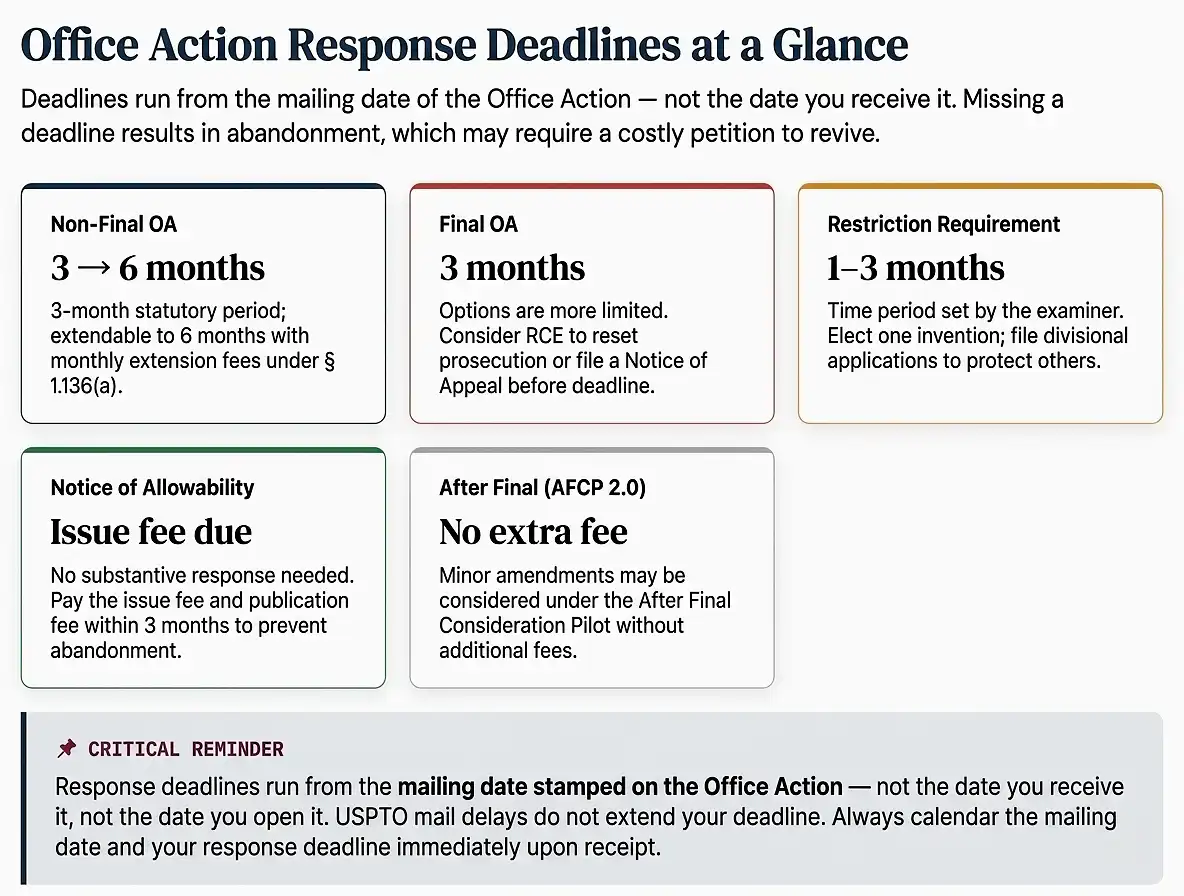
📌 Important: Response deadlines run from the mailing date of the Office Action, not the date you receive it.
Also, Read: Office Action Response USPTO: Rules, Process & What to Expect at Every Stage
When to Consider These Alternatives to a Standard Response
Sometimes a direct response isn’t the only or best path:
- Request for Continued Examination (RCE) – After a Final OA; resets prosecution with new fees
- Appeal to the Patent Trial and Appeal Board (PTAB) – When the examiner’s rejection is legally untenable
- After Final Consideration Pilot (AFCP 2.0) -For minor amendments after a Final OA with no additional fee
- Pre-Appeal Brief Conference – A quick, informal review before a full appeal
- Examiner Interview – Often the fastest way to resolve a stalemate
Also, Read: What is an Office Action Response? A Complete Guide for Patent & Trademark Applicants
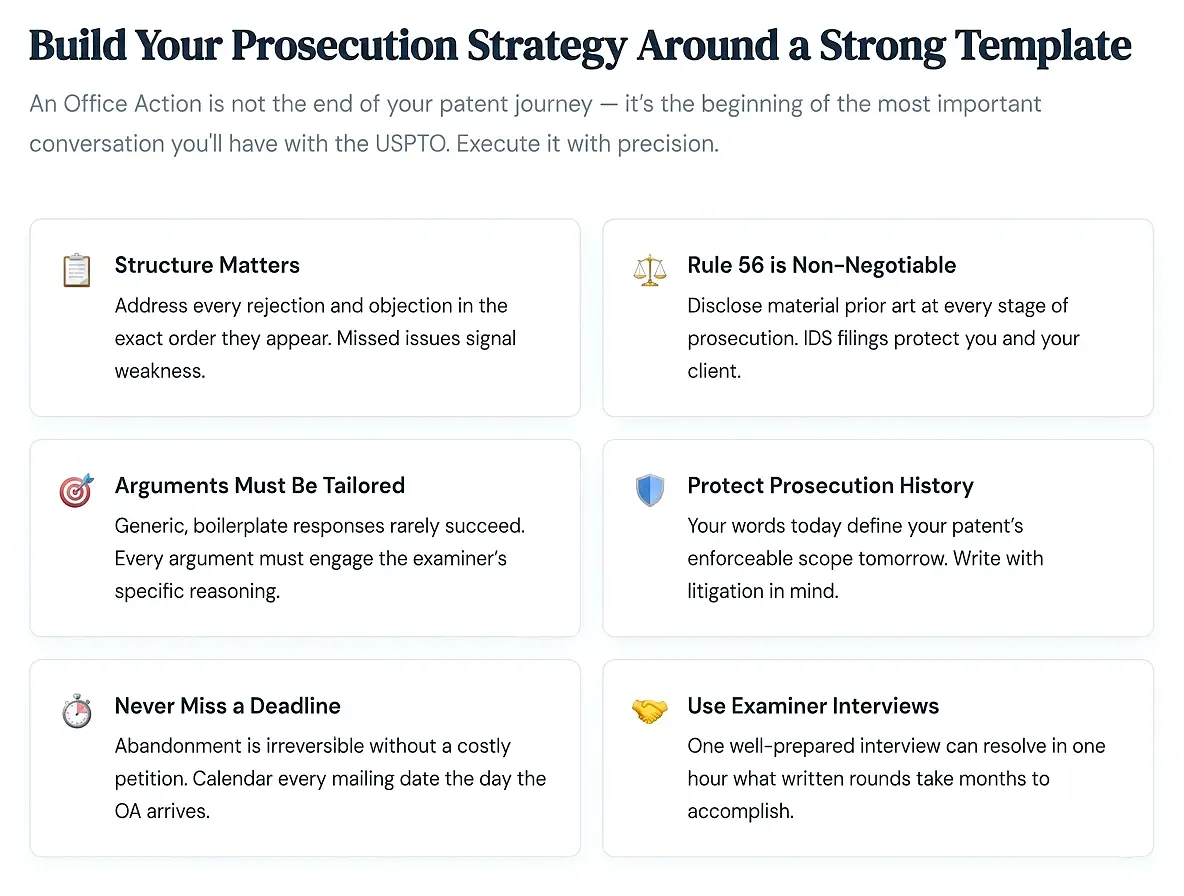
Build Your Prosecution Strategy Around a Strong Template
An Office Action is not the end of your patent journey – it’s often just the beginning of the most important conversation you’ll have with the USPTO. A well-crafted office action response template gives you the structural foundation to respond with confidence, precision, and legal authority.
Remember these core principles:
- 📋 Structure matters – Address every rejection systematically
- ⚖️ Rule 56 compliance is non-negotiable – Disclose material prior art at every stage
- 🎯 Arguments must be tailored – Generic responses rarely move the needle
- 🛡️ Protect prosecution history – Your words today define your patent’s scope tomorrow
- ⏱️ Never miss a deadline – Abandonment is irreversible without petition
At Teak IP Services, our team of experienced patent professionals helps inventors, startups, and enterprises navigate USPTO prosecution with clarity and strategy. Whether you need help responding to a complex Office Action, ensuring Rule 56 compliance, or building a robust patent portfolio, we’re here to guide you.
Discover Office Action Response & Shell Preparation Services

