
how data entry errors compound into missed deadlines: A missed patent deadline never announces itself. It surfaces months later as an abandoned application, an expired patent, or a lost priority claim, and by then nobody remembers which side of the deal owned the problem.
Acquisitions raise that risk sharply. Ownership changes hands, correspondence addresses change, systems change, and the people who knew the portfolio often leave. That is why transferring patent docket during acquisition deserves its own project plan, its own owner, and its own checklist.

This guide walks through the full process. You will learn what to verify before signing, how to move records and deadlines safely, how to record the ownership change in the United States, at WIPO, and at the EPO, and how to avoid the mistakes that cause real losses.
Quick answer: How do you transfer a patent docket during an acquisition without missing a deadline? Freeze and export the seller’s docket, reconcile it against official patent office records, record every assignment, rebuild the deadlines in the buyer’s system, run both dockets in parallel for 60 to 90 days, and assign one accountable owner to each deadline until the buyer’s system is verified.
Key Takeaways
- Transferring patent docket during acquisition is a data migration, a legal ownership update, and a deadline control project at the same time.
- Patent office records, not the seller’s spreadsheet, are the source of truth.
- Recording assignments quickly matters because an unrecorded assignment can be void against a later purchaser for value without notice.
- Maintenance fees, annuities, and national phase entries are the deadlines most likely to slip during a handover.
- Parallel dockets for 60 to 90 days catch errors before they become lapses.
- A written transition plan with named owners beats good intentions every time.
What Does Transferring a Patent Docket During an Acquisition Actually Mean?
Transferring a patent docket during an acquisition is the process of moving every patent deadline, matter record, and responsible-party assignment from the seller (or target company) into the buyer’s docketing system and workflows, while keeping every statutory and procedural date alive throughout the handover.
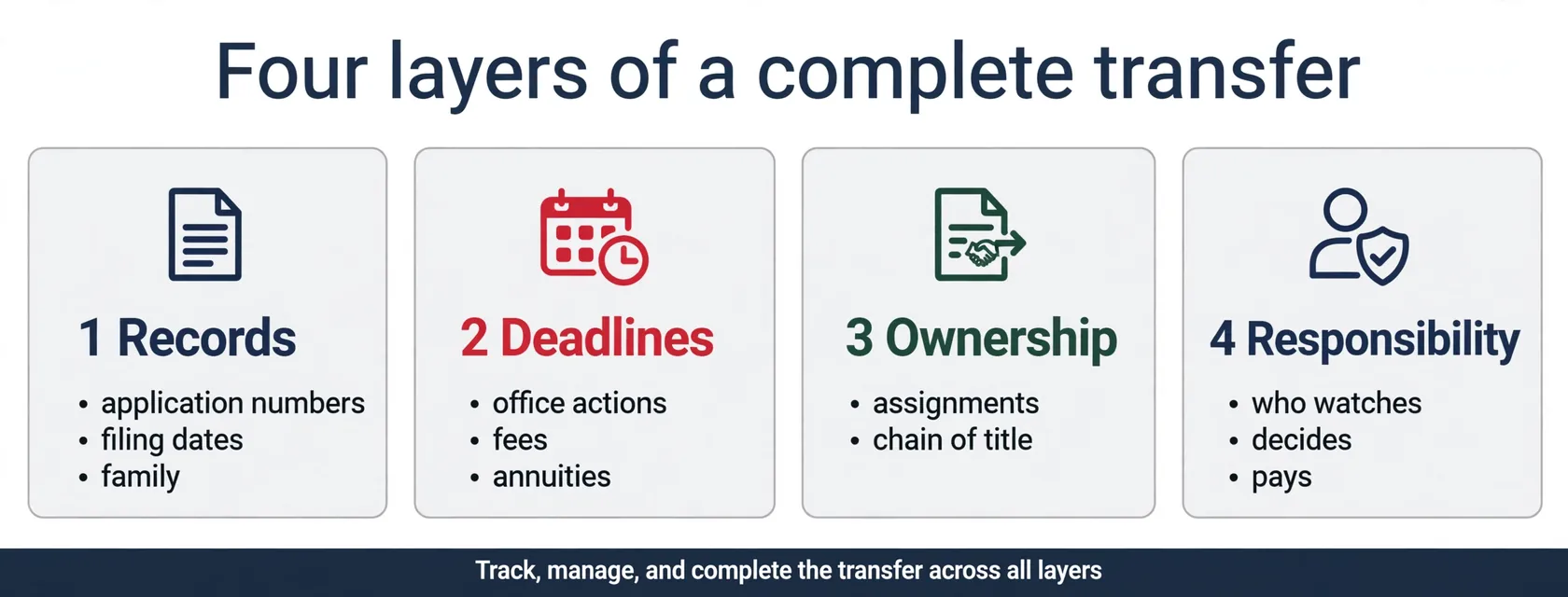
In practical terms, the work has four layers:
- Records: matter data such as application numbers, filing dates, priority claims, status, and family relationships.
- Deadlines: office action responses, maintenance fees, annuities, national phase entries, and continuation or divisional windows.
- Ownership: assignments, name changes, and chain of title recorded at each patent office.
- Responsibility: who watches, who decides, who pays, and who files.
Many teams treat the first layer as the whole job. As a result, they copy rows from one system to another and assume the dates came along. However, a row is not a deadline. A deadline is a date, a rule that produced it, a person who owns it, and evidence that the owner has seen it.
If you want a refresher on the fundamentals before you plan the transfer, the Complete Patent Docketing Guide from Teak IP Services covers the lifecycle and the main deadline types.
Why Deadlines Go Missing During M&A Docket Transfers
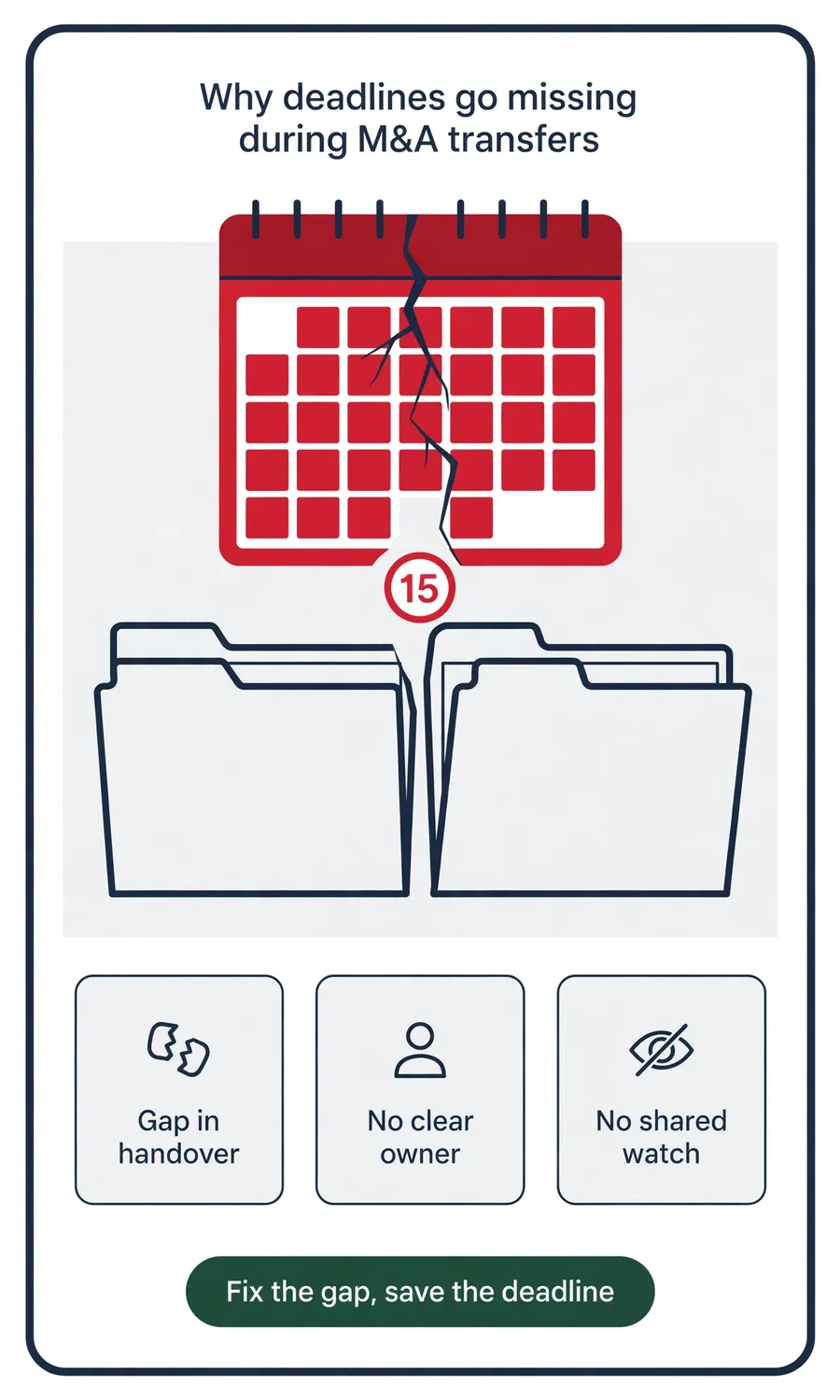
Deadlines rarely vanish because someone ignored them. Instead, they vanish in the gaps between two organizations, and transferring patent docket during acquisition exposes those gaps all at once. Understanding those gaps helps you design controls around them.
The Most Common Failure Points
- Seller-side attrition: The paralegal or docketing specialist who knew every quirk of the portfolio resigns after the deal is announced.
- Stale correspondence addresses: Patent office notices keep going to the seller’s address or the former law firm.
- Spreadsheet-only dockets: Dates live in a personal file with no audit trail and no reminders.
- Rule-based errors: A date entered manually uses the wrong trigger, such as filing date instead of priority date.
- Unclear ownership of tasks: Both teams assume the other team is watching a maintenance fee window.
- Entity status changes: The buyer is a large entity, but the portfolio still carries small entity fee assumptions.
- Missing foreign counsel instructions: Local agents continue to take instructions from the seller.
A Realistic Illustration
Consider a hypothetical mid-size software company that acquires a startup with 60 patent assets across the United States, Europe, and a PCT filing. The startup tracked everything in a shared spreadsheet maintained by one operations manager. She left two weeks after closing.
Three weeks later, a European annuity reminder went to the startup’s old mailbox. Meanwhile, the buyer’s docketing team had loaded only the U.S. matters. Nobody noticed until a foreign associate emailed a late-payment notice. That kind of scenario is entirely preventable, and it happens because the transfer plan covered data but not ownership of the watch.
Teak IP’s article on Best Patent Docketing Companies for Corporate IP Departments includes a growth and M&A scenario comparison that shows how portfolio expansion stresses a docket.
Asset Deal vs. Stock Deal: How Deal Structure Changes Your Docket Transfer
The deal structure decides which legal steps you must take. Therefore, confirm the structure before you design the plan, because transferring patent docket during acquisition looks different in each deal type.
In a stock purchase (or merger where the target survives), the patent owner generally stays the same legal entity. In an asset purchase, ownership of each patent and application moves to the buyer by written assignment.
| Factor | Asset Purchase | Stock Purchase or Merger |
|---|---|---|
| Legal owner of patents after closing | Buyer (by assignment) | Target entity (or successor by operation of law) |
| Assignments to record | Yes, for every patent and application | Often a change of name or merger document, depending on the structure |
| Correspondence and power of attorney | Must be updated to the buyer’s counsel | Often updated, but the owner name may stay the same |
| Entity status review | Required for the new owner | Required if control or size changes |
| Maintenance fee payor | Changes at closing | May change by internal agreement |
| Docket migration risk | High: data and title both move | Medium: title stays, but systems and people change |
| Typical failure point | Missed recordation or unrecorded chain of title | Outdated addresses and ownership data in foreign offices |

Because structures vary, ask deal counsel to give the docketing team a plain-language summary that lists the legal owner before and after closing for each country. That single page prevents a surprising number of errors.
Before Signing: Pre-Closing Docket Due Diligence
Docket review should begin during the due diligence phase, rather than waiting until after the acquisition is completed. Starting early makes transferring a patent docket during an acquisition much safer and more efficient. It helps identify upcoming deadlines, pending filings, and potential compliance issues in advance, allowing both parties to address risks that may affect the purchase price, indemnities, and closing conditions.
Build the Master Asset List
Start with a complete list of every patent asset the seller is transferring. Include:
- Issued patents and pending applications
- Provisional applications still within their 12-month window
- PCT applications and national phase entries
- Continuations, divisionals, and continuations-in-part
- Foreign counterparts and validated European patents
Then compare the seller’s list with the patent offices’ public records. If the seller claims 60 assets and the records show 57 or 64, find out why before closing.
Reconcile Against Official Records
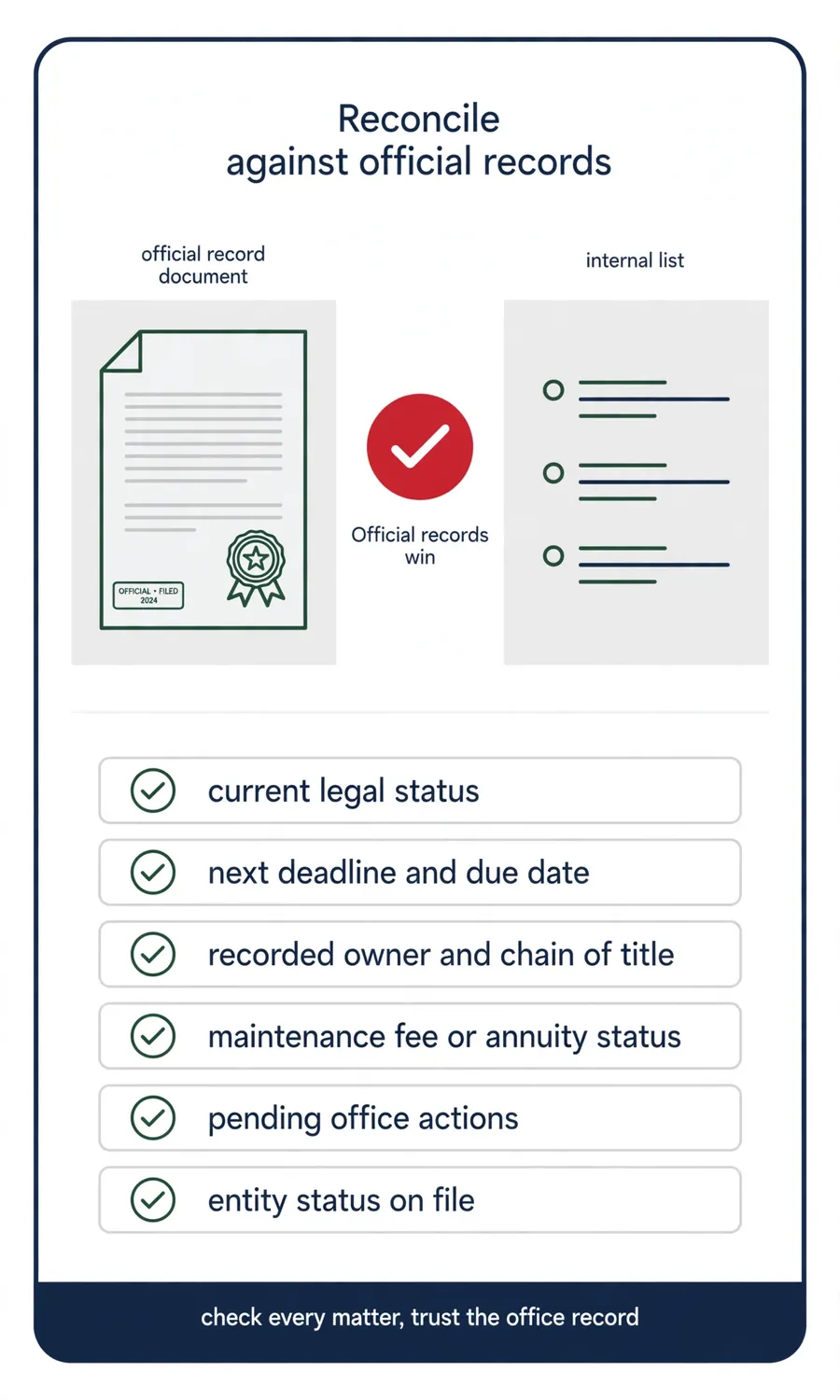
Official records win every disagreement. Check the following for each matter:
- Current legal status
- Next deadline and its due date
- Recorded owner and chain of title
- Maintenance fee or annuity status
- Pending office actions and response dates
- Entity status on file
The U.S. Patent and Trademark Office publishes the rules on ownership and recording in MPEP Chapter 300, Section 301. Reviewing it gives your team a shared reference for what counts as a valid transfer.
Red Flags to Escalate Before Closing
| Red Flag | Why It Matters | Suggested Action |
|---|---|---|
| Maintenance fee window already open or in grace period | Patent may expire if the payment is missed | Require payment before closing or assign a funded owner |
| Office action due inside 30 days of closing | Response may fall into the handover gap | Assign one attorney of record and confirm in writing |
| Unrecorded prior assignments | Chain of title may be broken | Record missing documents before or at closing |
| Foreign annuities paid by a vendor under the seller’s account | Payments may stop at closing | Transfer vendor instructions in writing |
| Small entity claims | Buyer may not qualify | Review entity status before the next fee |
| Pending PCT national phase deadline | Rights in many countries can be lost at once | Escalate to the top of the transition list |
For a deeper look at screening outside providers who will touch your data, see Teak IP’s IP Vendor Due Diligence Checklist for Law Firms and Corporate Legal Teams.
Step-by-Step: Transferring Patent Docket During Acquisition
Use the sequence below as your core playbook. Each step has a clear output, so you can tell when you are done.
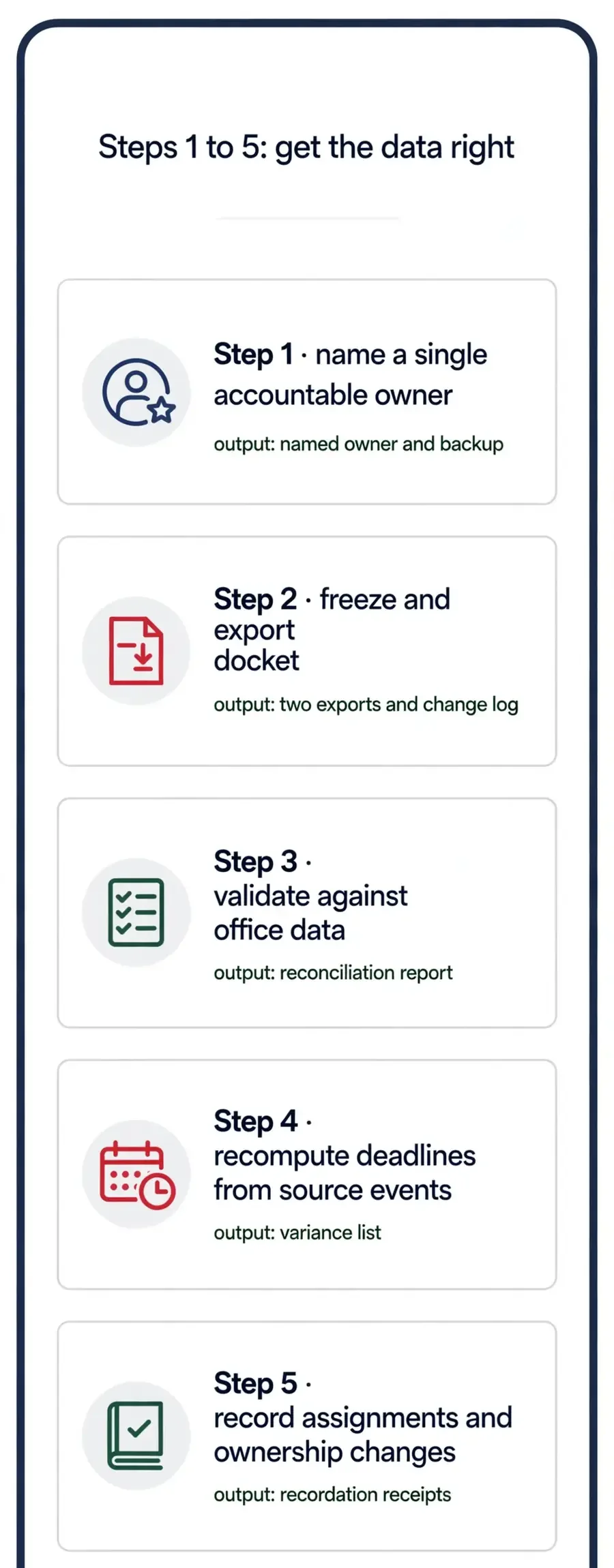
Step 1: Name a Single Accountable Owner
Assign one person on the buyer’s side who owns the entire transfer. That person does not need to enter every date. However, they must have authority to chase seller staff, outside counsel, and vendors.
Output: a named owner and a backup.
Step 2: Freeze and Export the Seller’s Docket
Ask the seller to export the full docket at a fixed date, ideally in a structured file. Request a second export on the closing date. Comparing the two shows what changed during the final weeks.
Output: two time-stamped exports and a change log.
Step 3: Validate Against Patent Office Data
Check every matter against the official record. Look for abandoned matters the seller still shows as live, and live matters the seller forgot to list.
Output: a reconciliation report with every discrepancy resolved or flagged.
Step 4: Recompute Deadlines From Source Events
Do not trust imported due dates blindly. Instead, recompute them from trigger events such as filing date, priority date, grant date, or mailing date of an office action. Then compare your results to the seller’s dates.
Output: a deadline variance list.
Step 5: Record Assignments and Ownership Changes
For asset deals, execute and record the assignments. For stock deals or mergers, record the relevant name change or merger documents where required. The next section covers the U.S., PCT, and EPO specifics.
Output: recordation receipts for every jurisdiction.
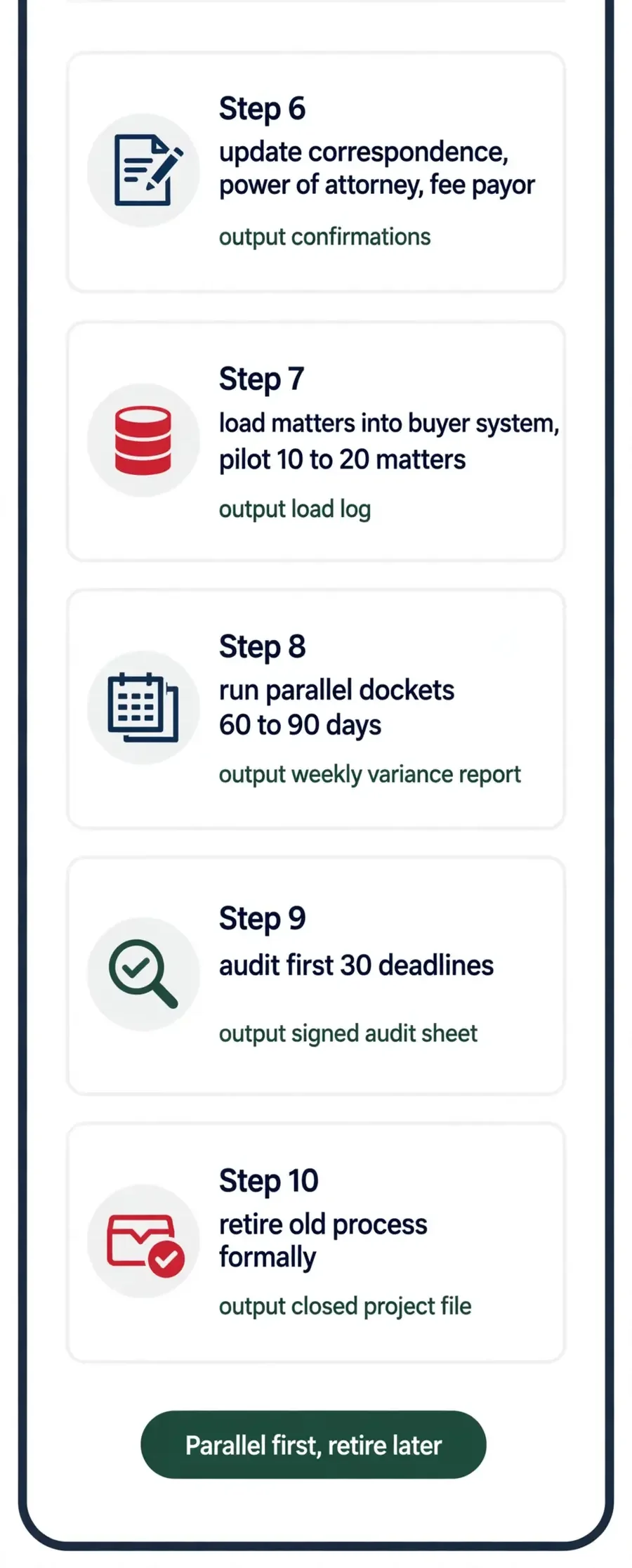
Step 6: Update Correspondence, Power of Attorney, and Fee Payors
Change the correspondence address, attorney of record, Customer Number, and fee payor so that notices reach the buyer’s team. In addition, send written instructions to every foreign associate and annuity vendor.
Output: confirmation from each office, associate, and vendor.
Step 7: Load Matters Into the Buyer’s System
Map the seller’s fields to the buyer’s fields. Load a pilot batch of 10 to 20 matters first, and verify them by hand. Then load the rest.
Output: a verified pilot and a full load log.
Step 8: Run Parallel Dockets for 60 to 90 Days
Keep the seller’s docket (or an export) alive while the buyer’s system runs live. Compare upcoming deadlines weekly. Any mismatch triggers an investigation.
Output: a weekly variance report that trends toward zero.
Step 9: Audit the First Wave of Deadlines
Pick the first 30 deadlines that fall after closing and confirm each one end to end: date, owner, task, and evidence of completion.
Output: an audit sheet signed off by the owner.
Step 10: Retire the Old Process Formally
Close the seller’s docket only after the parallel period ends with clean results. Archive the exports, the reconciliation reports, and the approval record.
Output: a closed project file that supports future diligence.
For a detailed look at how a docket workflow should operate end to end, Teak IP’s Legal Docketing Workflow: A Step-by-Step Framework offers a useful checklist you can adapt.
Recording the Ownership Change Without Missing a Deadline
Ownership records should be treated as important deadline-driven tasks, not just routine administrative paperwork. Recordation must be properly tracked in the docket with a clearly defined due date, an assigned responsible owner, and documented proof of completion. This ensures ownership changes are officially recorded on time, reduces the risk of missed filings, and helps maintain accurate and reliable patent records.
United States: Record Within Three Months
Under 35 U.S.C. 261, an assignment may be void against a later purchaser or mortgagee who gives valuable consideration and has no notice of the earlier assignment, unless the assignment is recorded with the USPTO within three months of its date or before the date of the later purchase or mortgage.
This requirement makes timely recordation essential for protecting ownership rights and avoiding potential legal complications. You can review the full statutory provision directly on GovInfo.
As a result, internal recordation deadlines should be set well before the three-month statutory limit to allow sufficient time for processing and any required corrections. Many teams aim to complete the recording within days of closing rather than waiting until the deadline approaches.
Follow these practical rules:
- Record every assignment, including intermediate links in the chain of title.
- Match each document to the correct application or patent number.
- Verify that the recorded owner name matches the owner name in your docket.
- Confirm that the assignee has the right to act in the application, which may require an additional statement establishing ownership when the assignee takes action.
- Download the recordation notice and attach it to the matter.
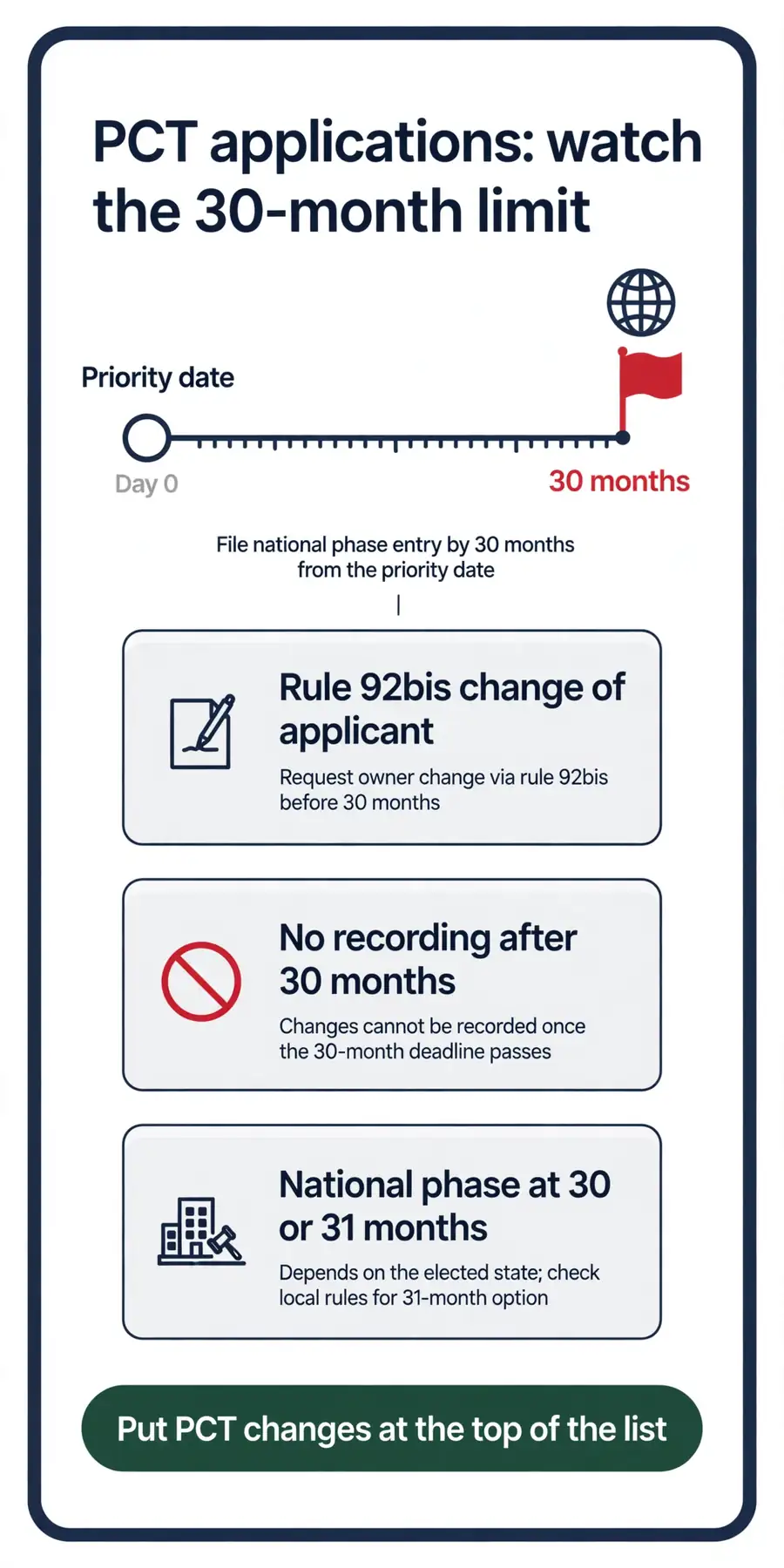
PCT Applications: Watch the 30-Month Limit
For international applications, the change of applicant is handled under PCT Rule 92bis. The International Bureau records changes in the person of the applicant on request, and it will not record a requested change if the request arrives after 30 months from the priority date. The full text is on the WIPO PCT Rule 92bis page.
That limit matters because national phase entry usually occurs at 30 or 31 months. Therefore, if a PCT application is in the final stretch, put the change-of-applicant request at the top of the transition list. Teak IP also supports this work through its PCT application services.
European Applications: Evidence, Fee, and Timing
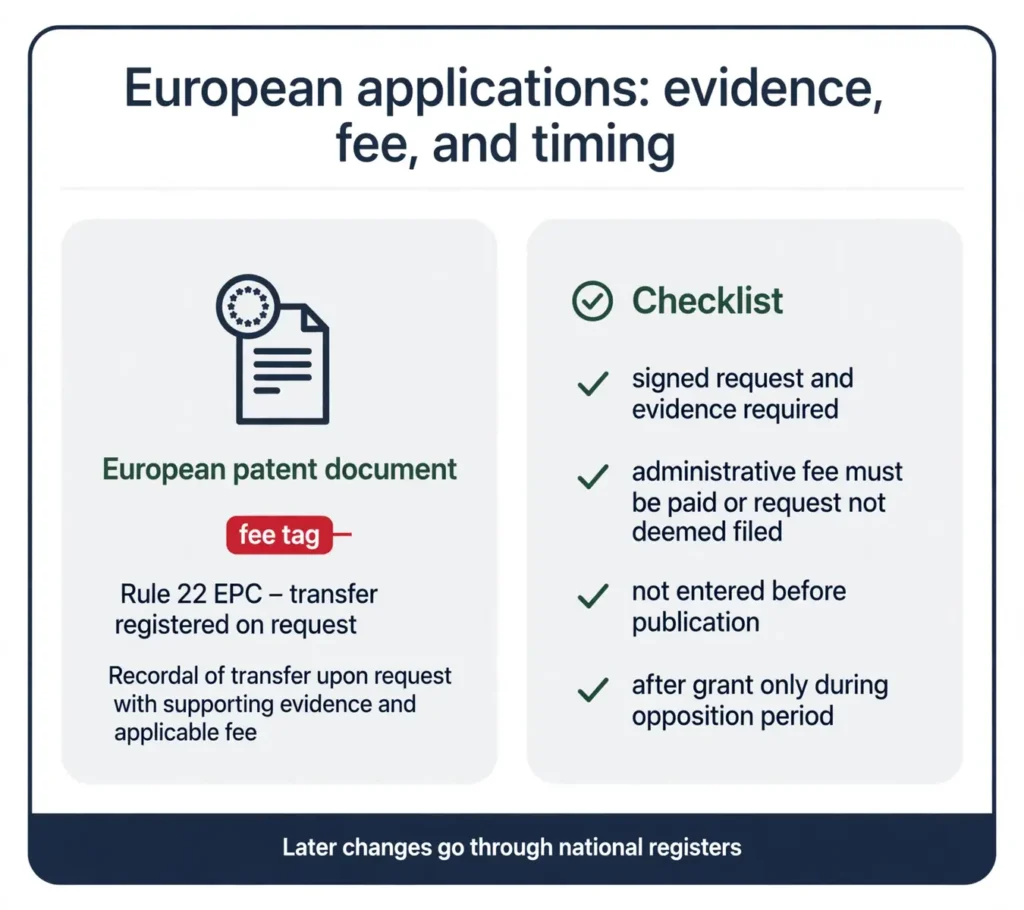
The EPO registers a transfer of a European patent application upon request, provided that all the applicable requirements under Rule 22 EPC have been properly fulfilled. This process ensures that changes in ownership are formally recorded in the EPO register in accordance with the established legal procedure. The EPO’s Rule 22 page outlines the relevant legal basis and requirements, while the EPO FAQ on registering a transfer provides practical guidance on the registration process and key points to consider.
Keep these points in mind:
- A duly signed request and documents that evidence the transfer are required.
- An administrative fee may be due, and where it is due the request is not deemed filed until it is paid.
- A transfer is not entered in the register before the application is published.
- After grant, transfers can generally be registered at the EPO only during the opposition period or pending opposition proceedings, so later changes usually go through national registers.
Quick Comparison of Recording Rules
| Office | Governing Rule | Key Timing Point | Practical Watch Item |
|---|---|---|---|
| USPTO | 35 U.S.C. 261 | Record within three months of the assignment date, or before a later purchase | Match owner names and numbers exactly |
| WIPO (PCT) | PCT Rule 92bis | Request must reach the IB before 30 months from priority | Coordinate with national phase entry |
| EPO | Rule 22 EPC | Registration after publication; post-grant only during opposition | Pay any administrative fee and supply evidence |
| National offices | Local law | Varies by country | Use local counsel and confirm in writing |
Maintenance Fees and Annuities: The Deadlines Most Likely to Slip
Periodic fees are predictable, which is exactly why teams assume they are safe. When transferring patent docket during acquisition, however, predictable deadlines lose their owner.
U.S. Maintenance Fees
The USPTO states that maintenance fees are due three times in the life of a utility patent. You may pay without surcharge at 3 to 3.5 years, 7 to 7.5 years, and 11 to 11.5 years after the date of issue, and you cannot pay early. You may also pay with a surcharge during the grace periods that follow. Review the official guidance on the USPTO maintain your patent page.
| Fee | Window Opens | Due Without Surcharge | Grace Period Ends |
|---|---|---|---|
| First | 3 years after grant | 3.5 years after grant | 4 years after grant |
| Second | 7 years after grant | 7.5 years after grant | 8 years after grant |
| Third | 11 years after grant | 11.5 years after grant | 12 years after grant |
Always confirm current fee amounts on the USPTO fee schedule before paying, because amounts change.
Foreign Annuities
Foreign renewal fees follow local rules. For European patent applications, renewal fees fall due beginning with the third year counted from the filing date, and they continue while the application is pending or the patent stays in force. Each country that validates a European patent adds its own annuity schedule after grant.
Consequently, your transition plan should answer these questions for every country:
- Who paid the last annuity, and through which vendor or agent?
- When is the next payment due, and what is the grace period?
- Whose account will pay it, and is that account active after closing?
- Who approves a decision to abandon or maintain?
Entity Status After the Deal
The buyer’s size and control can change the entity status that applies to the portfolio. A small entity or micro entity claim that was proper for the seller may no longer be proper after closing. Ask deal counsel and patent counsel to review entity status early, and record the review in the matter file. Paying the wrong fee amount can create avoidable corrections later.
Migrating Data Into the New Docketing System
Data migration is where careful plans meet messy reality. Fields do not match, formats differ, and legacy notes contain critical context. Data quality decides whether transferring patent docket during acquisition succeeds or quietly fails.
Map the Fields Before You Load Anything
| Seller Field (Example) | Buyer Field (Example) | Common Problem |
|---|---|---|
| Docket No. | Matter ID | Different numbering schemes cause duplicates |
| Filing Date | Filing Date | Date formats flip between day-month and month-day |
| Priority Date | Earliest Priority Date | Missing for continuations |
| Status | Status | Free-text values do not match picklists |
| Next Action | Open Deadline | Seller entered text, buyer needs a date and a rule |
| Responsible Attorney | Attorney of Record | Departed staff remain assigned |
| Notes | Matter Notes | Critical context buried in long text |
Protect Data Quality With Three Controls
- Pilot load: Test 10 to 20 matters and verify every field by hand.
- Deadline recomputation: Let your system calculate dates from triggers, and compare them with imported dates.
- Sampling audit: Review a random sample of matters from every jurisdiction after the full load.
If your team lacks capacity for a large clean-up, outside support can help. Teak IP offers data digitization and migration services and docketing and IP management services built for this kind of project.
Choosing Systems and Integrations
Your new platform should compute deadlines from rules, store source documents, and send alerts to more than one person. For a feature-by-feature view, read Teak IP’s Comprehensive Guide to Patent Docketing Systems. In addition, review Best Patent Docketing Services for Mid-Size and Large IP Firms if you expect to bring in an outside provider.
Automated monitoring helps as well. The post on whether an external docketing service can handle automated USPTO status monitoring explains what to expect from outside vendors.
A 30-60-90 Day Timeline for Transferring Patent Docket During Acquisition
Use the table below as a starting template. Adjust it for portfolio size, deal structure, and the number of countries involved.
| Window | Main Goals | Key Deliverables |
|---|---|---|
| Pre-closing (diligence) | Build the master asset list, reconcile with official records, flag red flags | Asset list, reconciliation report, red flag log |
| Closing day | Export final docket, execute assignments, send instructions | Final export, signed assignments, instruction letters |
| Days 1 to 30 | Record assignments, update addresses and powers of attorney, load pilot data | Recordation receipts, address confirmations, verified pilot |
| Days 31 to 60 | Load the full portfolio, run parallel dockets, audit first-wave deadlines | Load log, weekly variance report, audit sheet |
| Days 61 to 90 | Resolve variances, finalize ownership of every task, retire the old process | Clean variance report, closed project file |
Common Mistakes When Transferring Patent Docket During Acquisition
Teams make the same errors again and again. Fortunately, each one has a simple countermeasure.
- Trusting the seller’s spreadsheet as the source of truth. Always verify against official records.
- Skipping the parallel run. A clean-looking migration can still hide wrong dates.
- Waiting to record assignments. Delays create unnecessary exposure under the three-month rule.
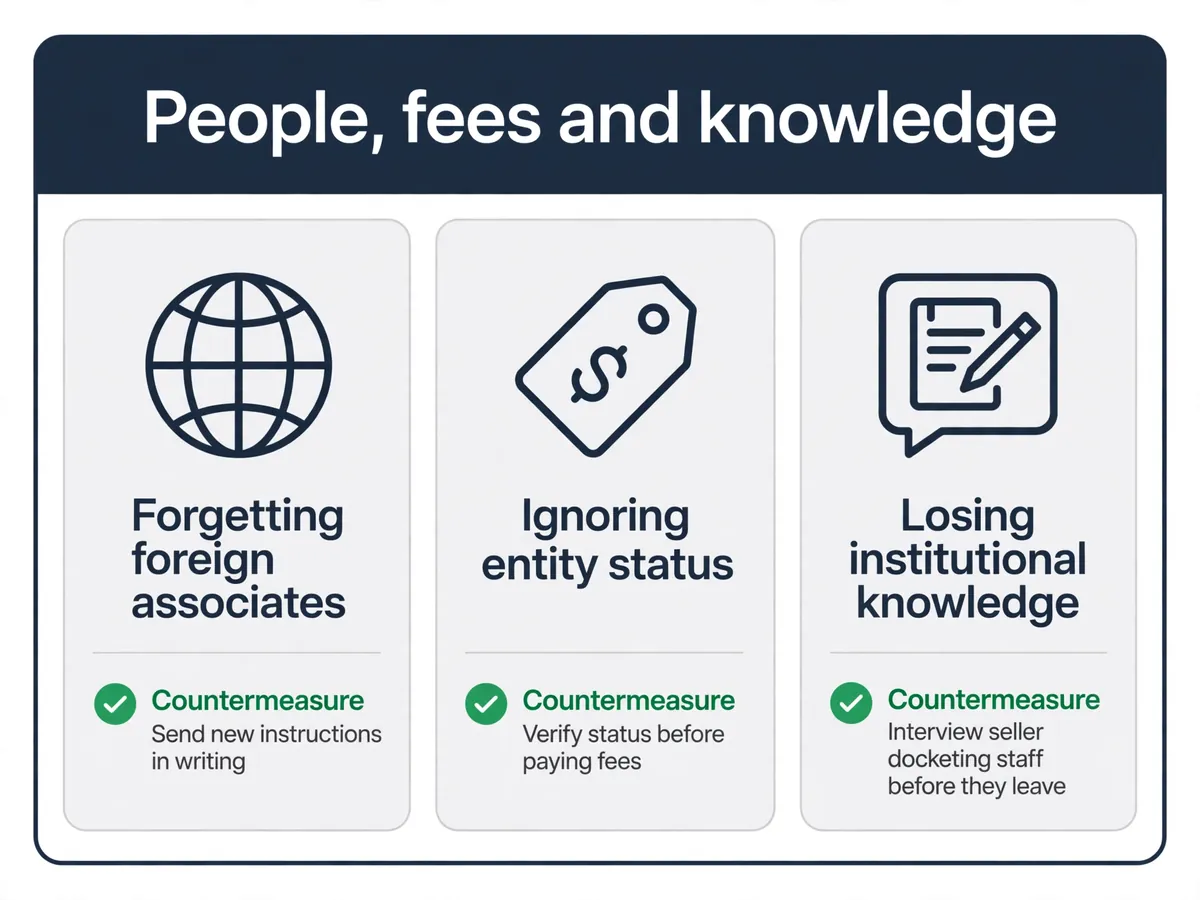
- Forgetting foreign associates. Local agents keep following old instructions until they receive new ones in writing.
- Ignoring entity status. Fee errors cause corrections and administrative work.
- Losing institutional knowledge. Interview the seller’s docketing staff before they leave.
- Treating the transfer as an IT task. Legal ownership, responsibility, and communication are equally important.
- Leaving pending matters without an owner. Open office actions, pending continuations, and post-grant matters need a named attorney immediately.
- Not documenting decisions. A future buyer will ask who decided to abandon a family, and why.
Pending prosecution strategy also needs attention during the handover. For example, the choice between a continued examination request and a continuation filing can change which dates matter. Teak IP’s explainer on the difference between an RCE and a continuation application shows why that decision should have an owner.
Expert Tips for Transferring Patent Docket During Acquisition
These practices come from the kinds of problems that docketing teams see repeatedly in portfolio transitions.
- Hold a kickoff call with both docket teams. Walk through the top 20 deadlines by date.
- Create a “next 120 days” list. Highlight every deadline in that window and assign it a named owner.
- Use two reminders per deadline. One goes to the owner, and one goes to a supervisor.
- Keep an assumptions log. Record every date that you could not verify and who accepted the risk.
- Request written confirmations from foreign associates. Ask them to confirm new instructions and current deadlines.
- Set a rule for abandoning assets. No asset is abandoned or allowed to lapse without a documented decision from a named decision-maker.
- Protect confidential data. Portfolios contain unpublished inventions, so choose vendors with strong security controls. Teak IP explains why in Why SOC 2 Compliance Matters When Choosing an IP Services Vendor.
- Plan the long-term structure. If the acquisition doubles your portfolio, revisit how your IP function is organized. The article on how to structure a corporate IP department from scratch offers a useful roadmap.
Build It In-House or Bring in a Docketing Partner?
Some buyers have the capacity to run the work of transferring patent docket during acquisition internally. Others do not. The right answer depends on volume, geography, and timing.
| Consideration | In-House Team | Outsourced Docketing Partner |
|---|---|---|
| Speed to start | Slower if hiring is needed | Faster with an established team |
| Cost structure | Fixed salaries and software | Flexible, often per action or hourly |
| Capacity for a one-time surge | Limited | Scalable |
| Institutional knowledge of the deal | High | Needs onboarding |
| Quality control | Depends on internal process | Often multi-layered review |
| Best fit | Small, well-documented portfolios | Large, multi-jurisdiction, or time-pressured transfers |
A hybrid model often works best. The buyer’s attorneys keep strategy and decisions, while a docketing partner handles reconciliation, data entry, deadline computation, and monitoring.
If you notice that deadlines are stacking up faster than your team can manage, read Signs Your Firm Needs Additional Patent Paralegal Support for a quick self-assessment.
How Teak IP Services Can Help
Teak IP Services supports law firms and corporate IP departments with docketing, data migration, PCT work, IDS preparation, and paralegal support. The team combines U.S. attorney oversight with U.S. and India-based professionals, and the work passes through multi-layered quality checks. If your acquisition is on the calendar, contact Teak IP to discuss a transition plan before closing.
Frequently Asked Questions About Transferring a Patent Docket During an Acquisition
What is the first step in transferring patent docket during acquisition?
The first step is to name one accountable owner and then export the seller’s docket at a fixed date. Next, reconcile that export against official patent office records so you know which matters are live, which are abandoned, and which dates are real.
How long does transferring patent docket during acquisition take?
Timing depends on portfolio size and the number of countries. Many teams plan for a 90-day transition: about 30 days to record ownership and update addresses, 30 days to load and verify data, and 30 days to run and retire the parallel dockets. Large international portfolios can take longer.
Do you have to record patent assignments with the USPTO after an acquisition?
Recording is not required for an assignment to bind the parties, but it protects the buyer. Under 35 U.S.C. 261, an unrecorded assignment can be void against a later purchaser or mortgagee for value without notice unless it is recorded within three months of its date or before that later transaction. For that reason, most buyers record promptly.
What deadlines are most at risk when a patent docket changes hands?
Maintenance fees, foreign annuities, office action responses, and PCT national phase entries carry the highest risk. They depend on dates that must be recalculated and on payors or agents who must receive new instructions.
Who is responsible for deadlines during the transition period?
The contract should say. In practice, the seller usually remains responsible until closing, and the buyer takes over afterward. However, the safest approach is to assign a named owner for every deadline in the first 120 days and to confirm it in writing.
Can you outsource the docket transfer to a service provider?
Yes. Many buyers outsource reconciliation, data entry, deadline computation, and monitoring while attorneys retain strategic decisions. When you evaluate vendors, review security practices, quality controls, and experience with multi-jurisdiction portfolios.
How does a change in ownership affect foreign patent annuities?
Each country has its own rules for recording a transfer and for paying renewal fees. In Europe, for example, the EPO registers transfers of pending applications on request under Rule 22 EPC, while after grant most changes move to national registers. Always confirm the local requirements and send written instructions to each foreign agent.
Conclusion: Make the Handover a Controlled Project
Transferring patent docket during acquisition is not a clerical task that happens in the background. It is a controlled project with legal, operational, and financial consequences.

To recap, verify the seller’s data against official records, record every assignment promptly, update every address and instruction, load data in stages, and run parallel dockets until the results are clean. Above all, make sure every deadline in the first 120 days has a named owner.
Teams that follow this process protect the value they paid for. Teams that skip it often discover the damage after a right has already been lost.
If you are preparing for a deal and want expert help with docket reconciliation, data migration, or ongoing monitoring, reach out to the Teak IP Services team and build the transition plan before closing day.
Transferring Patent Docket During Acquisition?
Ensure a smooth and secure patent docket transfer during business acquisitions. Our professional IP support helps maintain accurate records, continuity, and effective docket management throughout the transition.

