
Receiving an office action from the USPTO can feel like a ticking clock suddenly appeared above your patent application. Deadlines tighten. Questions multiply. And sometimes, despite your best efforts, you simply need more time to respond properly. That’s where an office action response extension becomes one of the most valuable – and most misunderstood – tools available to patent applicants and their counsel.

In this guide, you’ll learn exactly what an extension of time is, how to request one correctly, how much it costs, and the strategic pitfalls you absolutely need to avoid. Whether you’re a first-time applicant or a seasoned patent practitioner, understanding this process can mean the difference between a well-crafted response and a costly mistake.
What is an Office Action Response Extension?
An office action response extension is a formal request to the USPTO for additional time beyond the initial response deadline to reply to an office action. Under 37 C.F.R. § 1.136, applicants may petition for up to five months of extra time, on top of the standard three-month shortened statutory period – bringing the maximum total response window to six months from the mailing date of the office action.
Simply put: if you need more time to respond to a USPTO examiner’s rejection or objection, you can officially request it – but you must pay for it, and you must do so before the original deadline passes.
Why You Might Need More Time to Respond
Not every office action is straightforward. Some situations genuinely demand extra preparation time. Common reasons applicants seek extensions include:
- Complex technical rejections requiring detailed claim amendments or new arguments
- Needing expert declarations (such as Rule 132 affidavits) that take time to prepare
- Coordinating with foreign counsel on international patent families
- Reviewing prior art that the examiner has cited, including conducting new searches
- Business decisions that affect whether to continue prosecution or modify claim scope
- Changes in legal representation mid-prosecution
- Preparing an Information Disclosure Statement (IDS) alongside the response – something that demands careful attention, as explained in our guide on what is an IDS and why it matters for your patent
None of these reasons are weaknesses. They are simply the realities of thorough patent prosecution. Rushing a response to meet an artificial deadline is almost always the wrong choice.
Understanding the USPTO’s Extension of Time Rules
Before you request an extension, you need to understand the framework that governs them.
The Shortened Statutory Period
Most non-final and final office actions set a shortened statutory period (SSP) of three months from the mailing date for the applicant to respond. This is not the same as the absolute statutory maximum – it’s a shorter window chosen by the USPTO to keep prosecution moving.
How Extensions Work
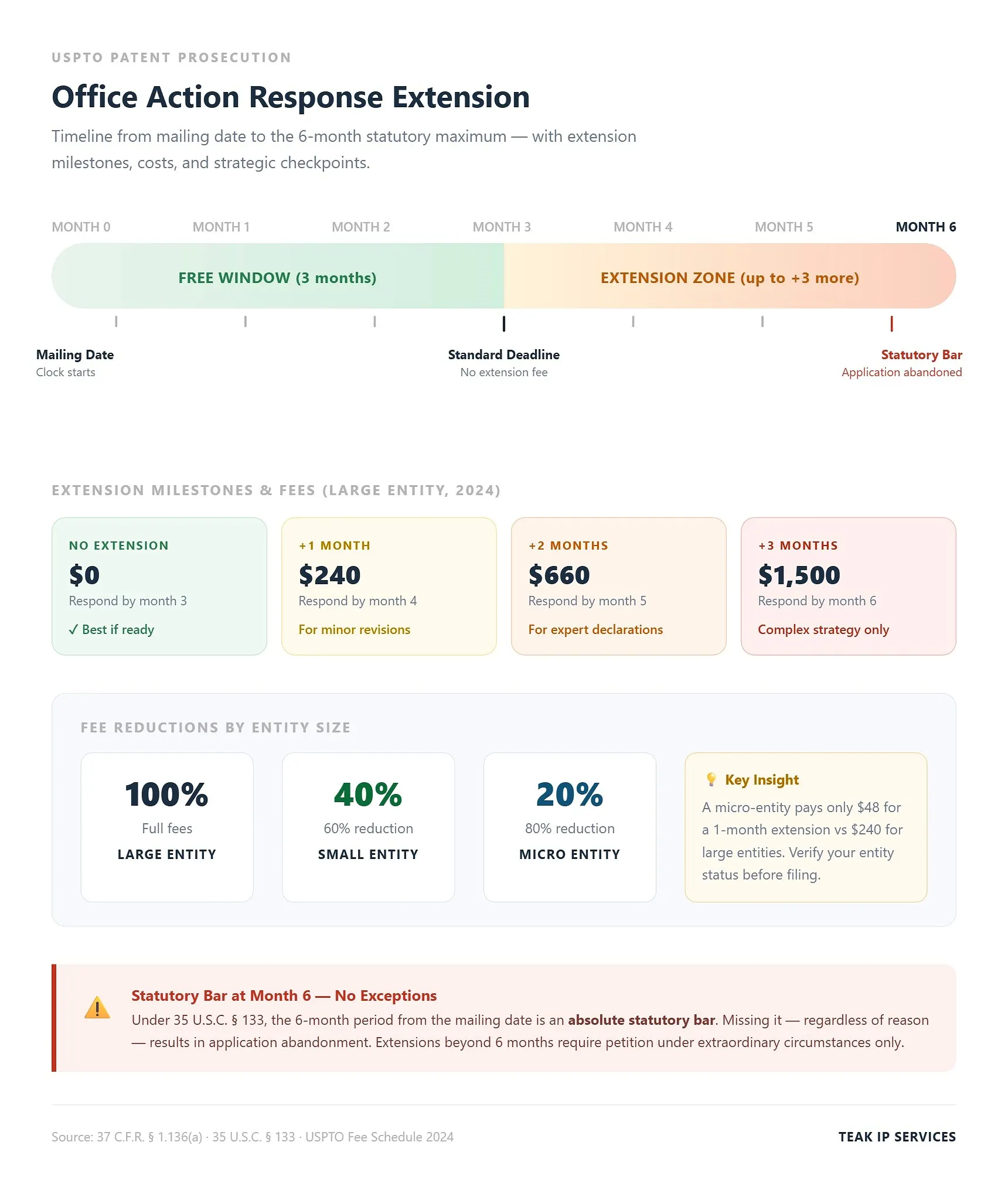
Under 37 C.F.R. § 1.136(a), an applicant can extend the response deadline by up to five additional months, one month at a time (or more). This brings the maximum response period to six months from the mailing date of the office action – which is the absolute statutory maximum under 35 U.S.C. § 133.
Here’s a quick breakdown of how extension periods stack:
| Extension Request | Total Response Period | USPTO Fee (Large Entity, 2024) |
|---|---|---|
| No extension needed | 3 months | $0 |
| 1-month extension | 4 months | $240 |
| 2-month extension | 5 months | $660 |
| 3-month extension | 6 months | $1,500 |
| 4-month extension | 7 months* | $2,120 |
| 5-month extension | 8 months* | $2,900 |
*Note: Extensions beyond 6 months are only available under special petition-based circumstances and may not apply to all application types. Always verify current fees at the USPTO Fee Schedule.
Small entities receive a 60% reduction, and micro entities receive an 80% reduction on these fees.
Two Types of Extension Requests: Auto-Extension vs. Petition
Not all extensions work the same way. The USPTO provides two distinct pathways:
1. Automatic Extension (37 C.F.R. § 1.136(a))
This is the most common route. You simply pay the extension fee and file your response within the extended period. No petition, no explanation required – the extension is granted automatically upon timely payment.
Key requirements:
- The application must be pending
- The response must be filed within the extended period
- The fee must accompany or precede the response
2. Petition-Based Extension (37 C.F.R. § 1.136(b))
This route applies when you’ve missed the six-month absolute deadline or need an extension for reasons beyond those covered by the automatic extension rules. These petitions are granted only in extraordinary circumstances – think documented emergencies, serious illness, or other unforeseeable events.
Petition-based extensions are not a backup plan. The USPTO scrutinizes them closely, and denial is common without compelling evidence. You should never rely on this route as a safety net.
Step-by-Step: How to Request an Office Action Response Extension
Here’s a practical walkthrough for requesting an automatic extension under 37 C.F.R. § 1.136(a):
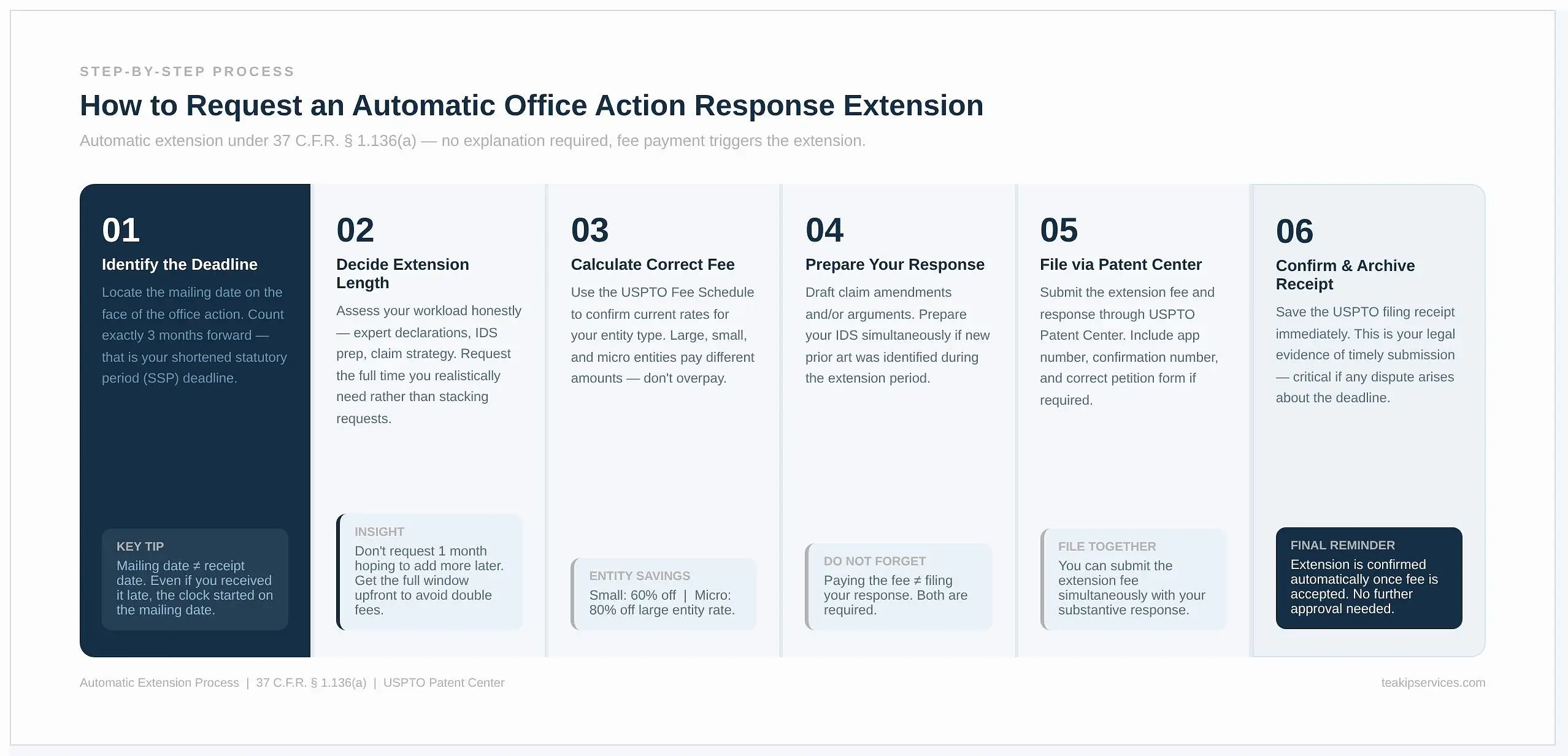
Step 1: Identify the response deadline Check the mailing date on the office action. Your shortened statutory period starts from this date. Count three months forward to find your initial deadline.
Step 2: Determine how much extra time you need Be honest about your workload and strategy. If you need two months to prepare a thorough response, request two months upfront – don’t file a one-month extension and then scramble.
Step 3: Calculate the correct fee Use the USPTO’s current fee schedule to find the applicable extension fee for your entity size (large, small, or micro).
Step 4: Prepare your response or extension request You can file the extension simultaneously with your substantive response, or you can file just the extension request first to buy time. However, filing the extension without a response does not extend the deadline indefinitely – you still must respond before the extended deadline.
Step 5: File via USPTO’s EFS-Web/Patent Center Submit your extension request (and fee) through USPTO Patent Center. Include the application number, confirmation number, and the appropriate petition/extension form if required.
Step 6: Confirm receipt Always save the USPTO acknowledgment. If something goes wrong, this receipt is your evidence of timely filing.
Common Mistakes That Can Cost You Your Patent
Even experienced practitioners make errors with extension requests. Here are the most critical mistakes to avoid:
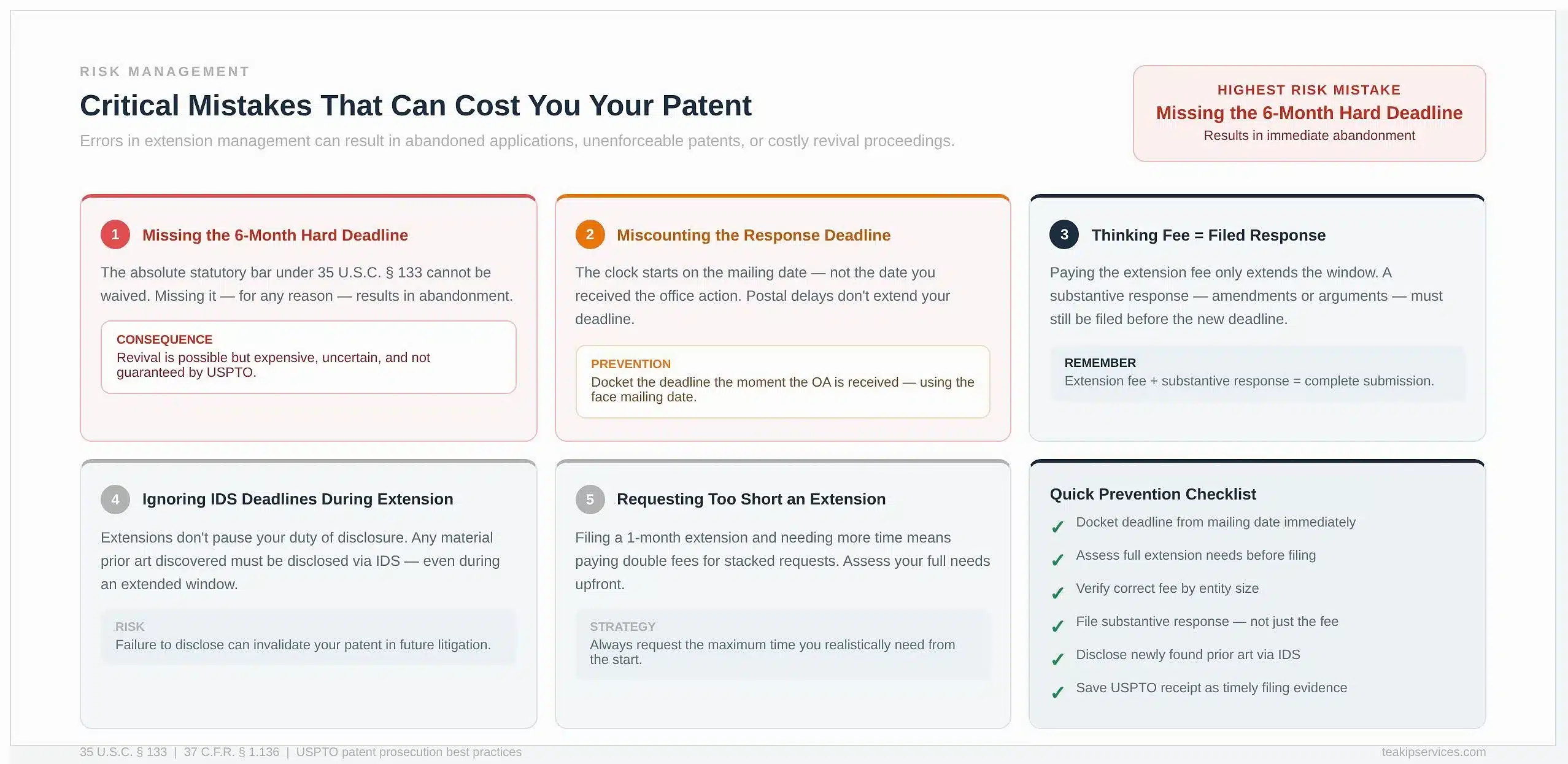
Missing the Six-Month Hard Deadline
This is the most dangerous mistake. The six-month period from the office action mailing date is an absolute statutory bar under 35 U.S.C. § 133. If you miss it – regardless of the reason – the application goes abandoned. Revival is possible but expensive, time-consuming, and not guaranteed.
Miscounting the Response Deadline
The clock starts from the mailing date on the office action, not the date you received it. If you received the office action two weeks late due to a postal delay, you’ve already lost two weeks of your response window.
Assuming Extensions Are Free
Extensions cost money, and those fees add up quickly. A three-month extension for a large entity currently costs $1,500. Applicants who routinely file late responses end up paying thousands in avoidable extension fees across a patent portfolio.
Conflating Extension Fees With Filing the Response
Paying the extension fee does not mean your response is filed. You still need to submit a substantive response – claim amendments, arguments, or both – before the extended deadline expires.
Forgetting IDS Deadlines During Extensions
If you are relying on an extension while also preparing an IDS, be careful about the timing. IDS filing deadlines have their own rules and consequences, as detailed in our article on IDS filing deadlines and how to avoid costly USPTO penalties. Missing an IDS window during an extension period can compromise your patent’s enforceability.
Strategic Considerations: When to Use Extensions Wisely
Not every extension request is the same. Here’s how to think about them strategically:
Use Extensions to Improve Response Quality – Not to Delay
The best reason to request an extension is to deliver a higher-quality response. A rushed argument often weakens your prosecution history and can create file wrapper estoppel problems down the road. More time spent on strategy upfront saves significant time and money in subsequent office actions.
Coordinate Extensions With Business Timelines
Sometimes business realities – funding rounds, product launches, licensing negotiations – affect whether and how you want to prosecute claims. An extension can give your client time to align patent strategy with business goals.
Monitor Your Portfolio for Upcoming Deadlines
If you manage a large patent portfolio, it’s easy for individual deadlines to slip through the cracks. Robust docketing systems and deadline monitoring are essential. Firms that outsource IDS filing often cite deadline management as one of the key reasons – and the same logic applies to extension tracking.
Extensions in International Cases
If your U.S. application is part of a patent family, responses to U.S. office actions sometimes need to be coordinated with foreign prosecution. Extensions can provide the buffer needed to align claim language across jurisdictions. Our guide on patent family cross-referencing in IDS preparation offers useful context for managing these situations.
How Extensions Affect Final Office Actions
One area where many applicants stumble is misunderstanding how extensions work differently after a Final Office Action (FOA).
After a final rejection, the applicant’s options are more limited. While extensions of time still apply to the six-month response window, the types of amendments permitted are restricted under 37 C.F.R. § 1.116. After a final rejection, you can still:
- Request continued examination (RCE)
- File a Notice of Appeal
- Submit an after-final amendment (subject to examiner discretion)
- Request a pre-appeal brief conference
An extension after a final office action simply gives you more time to pursue one of these options – it doesn’t reopen the prosecution as if it were a non-final rejection.
Extension of Time and the Duty of Disclosure
It’s worth noting that extensions of time don’t pause your duty of disclosure under USPTO Rule 56. If you become aware of material prior art during an extended response period, you are still obligated to disclose it to the USPTO. Failing to do so can expose your patent to invalidity challenges even after it grants.
This is especially relevant if you are actively conducting prior art searches during the extension period. Any material references discovered must be disclosed, typically via an IDS, before or with the response. Understanding how IDS management protects your patent from invalidity challenges is critical during any extended prosecution period.
Expert Tips for Handling Office Action Responses Efficiently
Beyond the mechanics of extensions, here are some practical recommendations from patent prosecution professionals:
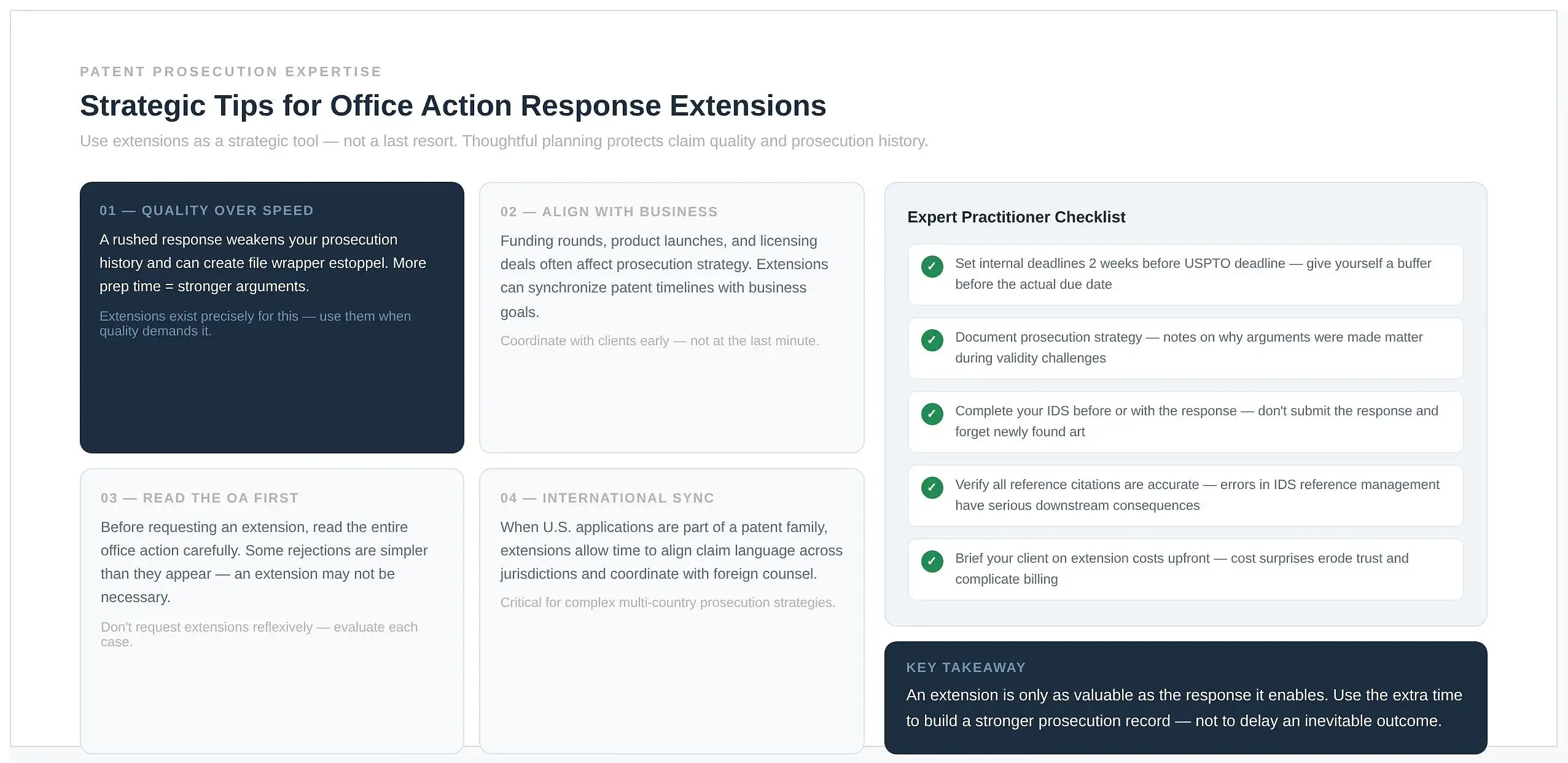
- Read the office action carefully and completely before deciding whether to extend. Sometimes a response is simpler than it first appears.
- Discuss extension needs with your client early. Surprises about costs and timelines erode trust.
- Set internal deadlines earlier than the USPTO deadline. Give yourself a buffer before the actual due date.
- Document your prosecution strategy. Clear notes on why certain arguments were made – and why certain claims were amended – matter enormously if the patent is later challenged.
- Use your IDS preparation checklist. Before filing the response, confirm all material references have been cited. See our IDS preparation checklist for a complete walkthrough.
- Verify accuracy of reference management. As explained in our article on why accurate IDS reference management matters, errors in citations can have serious downstream consequences.
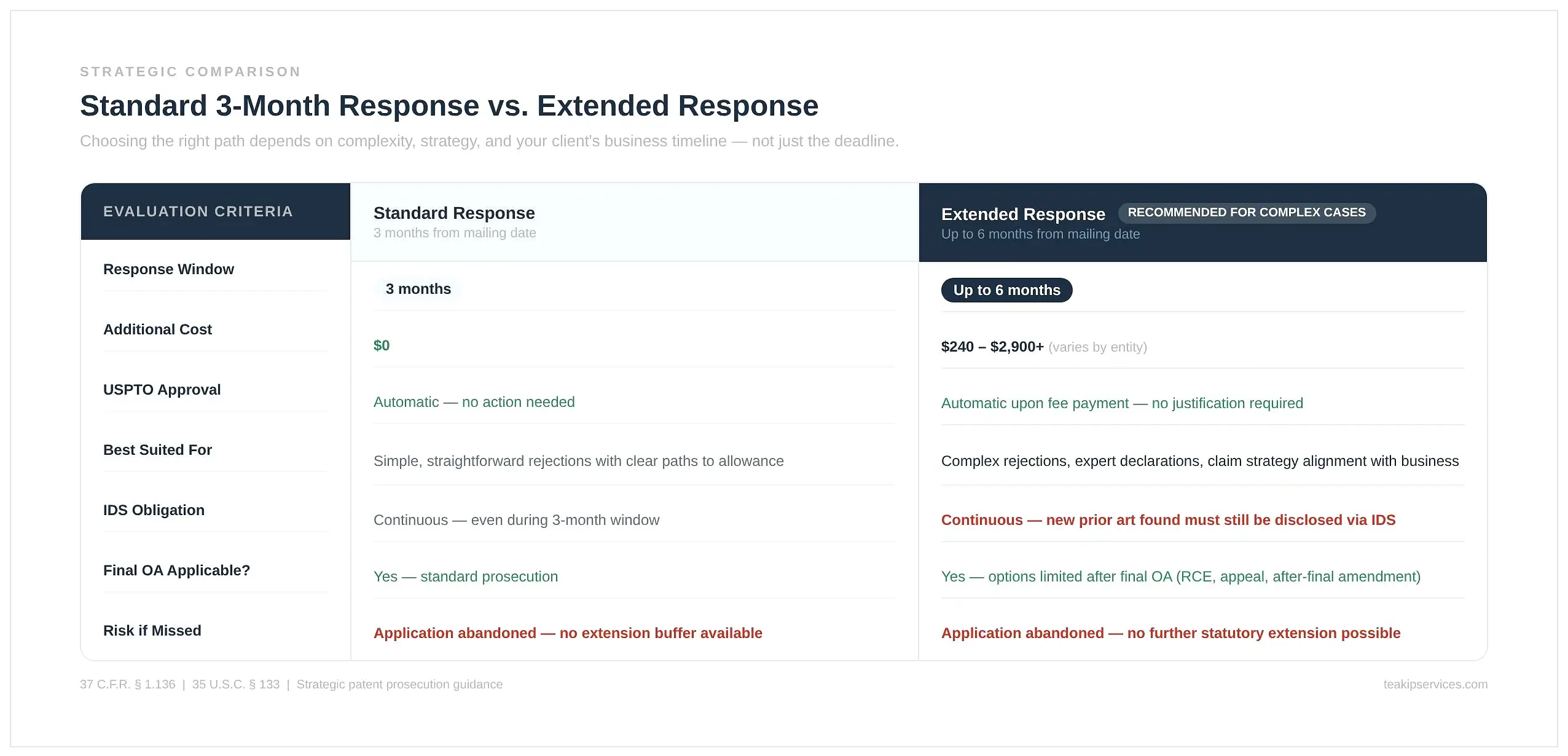
Comparison: Standard Response vs. Extended Response
What Happens If You Miss the Deadline Entirely?
If you fail to respond within the six-month statutory period – even with available extensions – your application will be considered abandoned. At that point, you have limited options:
- Petition to Revive (Unintentional Abandonment): Under 37 C.F.R. § 1.137(a), you may petition to revive the application by showing the abandonment was unintentional. This requires a petition fee and a statement that the delay was unintentional.
- Petition to Revive (Unavoidable Abandonment): This is a higher bar, requiring proof that the delay was unavoidable – not merely unintentional. Approved rarely.
- Refiling: You could refile the application, but you would lose your original filing date, which could be devastating if prior art emerged in the interim.
Neither revival nor refiling is a substitute for timely prosecution. As the USPTO’s official guidance on abandoned applications makes clear, prevention is always preferable.
Conclusion
An office action response extension is a legitimate, valuable tool – but only when used thoughtfully. It gives you the time to mount a stronger defense of your claims, coordinate complex strategy, and ensure your response is complete and accurate. Used correctly, it protects your patent without unnecessary risk.
Used carelessly – or ignored until it’s too late – it can lead to missed deadlines, abandoned applications, and lost patent rights that can never be recovered.
The key takeaways are simple: know your deadlines, understand the costs, plan your strategy early, and never assume you have more time than you actually do. And if you’re managing multiple applications or a complex portfolio, don’t try to do it all alone.
Frequently Asked Questions (FAQ)
Q1: What is an office action response extension, and how does it work?
An office action response extension is a formal request to the USPTO for additional time – beyond the standard three-month shortened statutory period – to respond to an office action. Under 37 C.F.R. § 1.136(a), applicants may request up to five additional months by paying the applicable fee, extending the total response window to a maximum of six months from the office action mailing date.
Q2: How much does an office action response extension cost?
Extension fees depend on the length of the extension and your entity size. For large entities, fees range from approximately $240 for a one-month extension to $2,900 for a five-month extension. Small entities receive a 60% fee reduction, and micro entities receive an 80% reduction. Always verify current fees on the official USPTO Fee Schedule.
Q3: Can I request an office action response extension after the deadline has passed?
No. Automatic extensions under 37 C.F.R. § 1.136(a) must be filed before the deadline expires. If you’ve missed the deadline, you may petition for revival under 37 C.F.R. § 1.137, but revival requires proving the abandonment was unintentional or unavoidable, and it is neither guaranteed nor inexpensive.
Q4: Does requesting an extension hurt my patent application?
No. Requesting an extension is a routine part of patent prosecution and does not signal weakness or reflect negatively on your application. Examiners regularly grant them because they are automatic upon fee payment – the USPTO does not evaluate your reasons for requesting extra time under § 1.136(a).
Q5: What is the maximum time I can get to respond to an office action?
The absolute statutory maximum under 35 U.S.C. § 133 is six months from the mailing date of the office action. No automatic extension can take you beyond this point. Extensions under § 1.136(b) (petition-based) exist for extraordinary circumstances but are rarely granted.
Q6: Do I have to explain why I need an office action response extension?
No explanation is required for an automatic extension under 37 C.F.R. § 1.136(a). You simply pay the fee and file within the extended period. A petition under § 1.136(b) does require a showing of extraordinary circumstances, but this route is rarely needed.
Q7: Does an extension affect my IDS filing obligations?
No – your duty of disclosure continues throughout any extension period. If you discover material prior art while preparing your response, you must disclose it via an IDS before or with your response. The extension only affects your response deadline, not your disclosure obligations.
Q8: Can I request an extension after a Final Office Action?
Yes, extensions of time apply to responses after final office actions as well. However, the types of substantive actions available after a final rejection are more limited. Extensions after a final action give you more time to file an RCE, a Notice of Appeal, or an after-final amendment – but they do not convert the final rejection into a non-final one.
Need help managing office action deadlines and extensions?
At Teak IP, we specialize in supporting patent practitioners and law firms with the precise, detail-oriented work that successful patent prosecution demands – from IDS preparation and reference management to deadline tracking and prosecution support.
Don’t let a missed deadline cost you a valuable patent. Contact the Teak IP team today to discuss how we can support your practice and protect your clients’ IP rights.
Discover Office Action Response & Shell Preparation Services

