
The Strategic Imperative of Intellectual Property Management: In today’s hyper-competitive global economy, the most valuable assets a business owns are often invisible. They are the ideas, inventions, innovations, and brand identities that drive commerce, command premium pricing, and build lasting market position. Yet, without a deliberate, structured approach to intellectual property management, these assets – worth billions in the aggregate – remain exposed to infringement, unauthorized use, competitive duplication, and ultimately total loss of legal enforceability. Businesses that want to move beyond reactive protection and build a proactive strategy can benefit from dedicated IP management solutions that align IP administration with broader commercial objectives.

Intellectual property (IP) protection is not simply a legal checkbox. It is a dynamic, ongoing business function that requires strategic alignment, disciplined administration, and expert legal counsel. For companies of every size – from a single-inventor startup to a Fortune 500 enterprise – the ability to identify, secure, maintain, enforce, and commercialize IP assets is what separates organizations that merely create value from those that capture and sustain that value over decades.
Within the vast landscape of intellectual property, two categories demand the most meticulous management attention: patents and trademarks. Both are subject to strict statutory frameworks, government examination processes, ongoing maintenance obligations, and enforcement responsibilities. Both carry severe consequences for neglect – missed deadlines can result in permanent loss of rights, and failure to monitor can allow infringers to build legally defensible positions against you.
What is Intellectual Property Management?
Intellectual property management is the systematic, strategic discipline of identifying, protecting, maintaining, enforcing, and commercializing the intangible assets created by an organization’s human capital and creative output. It is the intersection of law, business strategy, technology management, and financial planning.
Effective IP management is not reactive – it is proactive. It is not an event that occurs once at founding or product launch. It is a continuous cycle of assessment, action, and adaptation.
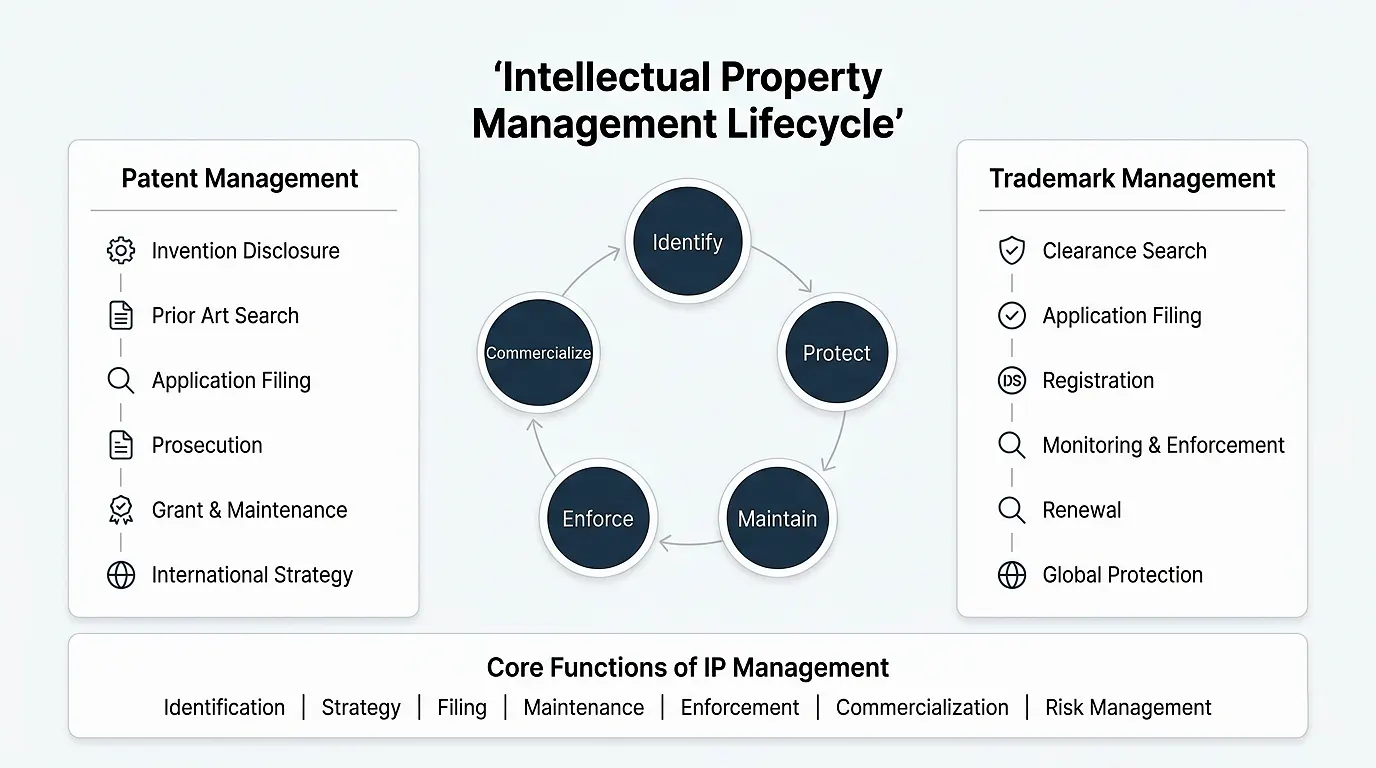
The Core Functions of IP Management
- IP Identification and Auditing – Systematically reviewing all organizational outputs to identify what is potentially protectable and what is already protected
- IP Strategy Formulation – Aligning IP decisions with business goals, product roadmaps, geographic expansion plans, and competitive positioning
- IP Filing and Prosecution – Engaging qualified counsel to prepare, file, and prosecute patent and trademark applications before domestic and international IP offices
- Portfolio Maintenance – Ensuring timely payment of official fees and required declarations to keep rights in force
- IP Enforcement and Defense – Monitoring for infringement, responding to threats, and enforcing rights through administrative and judicial proceedings
- IP Commercialization – Maximizing economic return through licensing, assignments, joint ventures, and IP-backed financing
- IP Risk Management – Clearing new products and brands before launch, managing litigation exposure, and ensuring freedom to operate
Why Intellectual Property Management Matters for Your Business
Understanding what intellectual property management is represents only the starting point. The more pressing question for any business owner, entrepreneur, or executive is: why does it matter – and what is at stake if it is neglected?
The answer is straightforward. Every business, regardless of size or industry, generates intellectual property. A software company’s codebase, a manufacturer’s proprietary process, a retailer’s brand name, a consultant’s methodology, a pharmaceutical company’s compound – all of these are forms of IP that have real, measurable commercial value. Without a structured management approach, that value is unprotected, unmonitored, and ultimately unenforceable.
Consider the practical consequences of poor intellectual property management:
- A competitor launches a product nearly identical to yours – but because you failed to file a patent application in time, you have no legal basis to stop them
- Your brand name, built over years of marketing investment, is registered as a trademark by a third party in a key export market – and you are forced to rebrand or pay to buy it back
- An employee who developed a core technology at your company leaves and claims ownership – because no IP assignment agreement was in place
- A licensee uses your trademark on inferior products – and because you failed to include quality control provisions, a court finds you have abandoned your trademark rights
None of these scenarios are hypothetical. They happen to businesses of every size, in every industry, every year. Effective intellectual property management is the systematic discipline that prevents them.
Beyond risk prevention, IP management actively creates business value. A well-maintained patent portfolio can be licensed to generate royalty income, used as leverage in cross-licensing negotiations to resolve disputes without costly litigation, or presented to investors as evidence of technological differentiation and defensible market position. Registered trademarks appreciate in value as brands grow – and they are among the most transferable assets a business can hold. In acquisition transactions, acquirers routinely pay significant premiums for companies with clean, well-managed IP portfolios and discount or walk away from those with IP gaps, title defects, or unresolved encumbrances.
The Scope of Intellectual Property Management – What It Covers
Intellectual property management is a broad discipline, and it is important to understand its full scope before narrowing into the specific domains of patents and trademarks. IP law recognizes several distinct categories of protectable intellectual property, and a comprehensive management program must address each category that is relevant to the business’s operations and competitive strategy.
The primary categories of intellectual property are:
- Patents – Legal rights granted by a government that give the owner exclusive control over a defined invention – a product, process, machine, or composition of matter – for a limited term, typically 20 years from the filing date. Patents are the primary tool for protecting functional innovations and technical R&D outputs.
- Trademarks – Rights in words, names, symbols, logos, slogans, colors, sounds, or trade dress that identify and distinguish the source of goods or services in commerce. Trademark rights can last indefinitely with proper use and maintenance, making them among the most durable and appreciating forms of IP.
- Copyrights – Rights that automatically protect original works of authorship – including literary, artistic, musical, software, and architectural works – from the moment of creation. Copyright protection lasts for the author’s lifetime plus 70 years in the U.S.
- Trade Secrets – Confidential business information that derives economic value from its secrecy – including formulas, processes, customer lists, pricing strategies, and technical know-how. Trade secret protection depends entirely on maintaining confidentiality; once publicly disclosed, the protection is gone permanently.
- Industrial Designs – Rights protecting the ornamental or aesthetic aspects of a product’s appearance, distinct from its functional features. Covered by design patents in the U.S. and by registered design rights in many other jurisdictions.
- Domain Names – Online identifiers that, while not traditional IP assets, intersect critically with trademark rights and require coordinated management alongside trademark portfolios.
Among these, patents and trademarks demand the most active, process-intensive management – involving government examination, official deadlines, prosecution proceedings, maintenance filings, enforcement obligations, and international filing strategies. This is why a dedicated intellectual property management program almost always places patent and trademark matters at its operational core. The following sections of this guide address each in comprehensive detail.
The Intellectual Property Management Lifecycle
One of the most important conceptual frameworks in intellectual property management is understanding that IP protection is not a single event – it is a lifecycle. From the moment an invention is conceived or a brand name is chosen, a sequence of management decisions and actions must follow, each building on the last, across a timeframe that can span decades.
The IP management lifecycle consists of five interconnected phases that apply across both patent and trademark matters:
Phase 1 — Identify The lifecycle begins with systematic identification. For patents, this means establishing internal processes – such as invention disclosure programs – that surface patentable innovations before they are publicly disclosed or commercially deployed. For trademarks, it means identifying all marks in use and assessing which have sufficient commercial value to warrant formal protection. Many organizations fail at this first phase simply because there is no structured mechanism for employees to recognize and report protectable IP to the relevant decision-makers.
Phase 2 — Protect Once IP is identified, the protection phase begins – prior art searches for patents, clearance searches for trademarks, and the filing and prosecution of applications before the relevant government IP offices. This phase is where legal rights are formally acquired. It requires expert counsel, precise attention to statutory deadlines, and strategic decision-making about the scope of protection to pursue and the jurisdictions in which to pursue it.
Phase 3 — Maintain IP rights do not automatically persist once granted. Both patents and trademarks require ongoing affirmative action to stay in force – maintenance fee payments for patents, and use declarations and renewal applications for trademarks. The maintenance phase is operationally demanding; a missed deadline can permanently extinguish rights that took years and significant investment to obtain. Robust docketing systems and calendar management are the operational backbone of this phase.
Phase 4 — Enforce IP rights that are not enforced are worth little in practice. The enforcement phase involves proactive monitoring of the competitive marketplace for potential infringement, assessment of detected conflicts, and appropriate response – ranging from a cease-and-desist letter to opposition proceedings, administrative complaints, or litigation. For trademarks in particular, consistent enforcement is not merely advisable – it is legally necessary to preserve the strength and validity of the mark.
Phase 5 — Commercialize The final phase transforms legal rights into economic returns. Patent licensing, trademark brand licensing, IP assignments, cross-licensing arrangements, IP-backed financing, and the leveraging of IP assets in M&A transactions all represent commercialization activities. This phase is where the full return on the investment made in all preceding phases is realized.
Understanding that these five phases operate continuously – and simultaneously across a portfolio of multiple assets – illustrates why intellectual property management is a sustained organizational capability, not a one-time legal service.
Also, Read: Comprehensive Guide to Patent Docketing Systems
Who is Responsible for Intellectual Property Management?
A question that arises frequently in organizations building or improving their IP function is: who should own intellectual property management? The answer depends significantly on the size and nature of the organization, but certain principles apply universally.
In large corporations with significant R&D and brand portfolios, intellectual property management is typically led by a dedicated Chief IP Counsel or VP of Intellectual Property, supported by a team of in-house patent attorneys, trademark counsel, IP paralegals, and IP operations specialists. This team works in close coordination with R&D, product development, marketing, legal, finance, and executive leadership to ensure that IP strategy is aligned with business strategy at every level.
In mid-sized companies, IP management responsibilities are often shared between outside patent and trademark counsel – who handle prosecution and filing – and an internal function (often the General Counsel’s office or a senior IP manager) that owns portfolio strategy, budgeting, docketing oversight, and enforcement decision-making.
For startups and small businesses, IP management is frequently handled entirely by outside counsel, with a founder or senior executive serving as the internal point of contact. This is a perfectly workable model in the early stages, provided the outside counsel relationship is proactive – not purely reactive – and includes regular portfolio reviews and strategic counsel, not just application filing.
Regardless of organizational size, effective intellectual property management requires clear allocation of the following responsibilities:
- IP Strategy – Who makes decisions about what to file, where to file, and how much to invest?
- Invention/Brand Disclosure – Who receives and evaluates internal disclosures of potentially patentable inventions or new marks?
- Outside Counsel Management – Who selects, instructs, and reviews the work of external patent and trademark attorneys?
- Docketing and Deadline Management – Who owns the docketing system and is accountable for ensuring no deadlines are missed?
- Enforcement Decisions – Who monitors the market for infringement and decides when and how to respond?
- Commercialization – Who identifies and pursues licensing, assignment, and other IP monetization opportunities?
Leaving any of these responsibilities unassigned – or implicitly assumed to be “someone else’s job” – is one of the most common and costly organizational failures in intellectual property management. The discipline requires clear ownership, adequate resources, and executive-level commitment to treating IP as the strategic asset it is.
Also, Read: Effective Trademark Portfolio Management: Key Components, Challenges & Practices
PART I – PATENT INTELLECTUAL PROPERTY MANAGEMENT
Patent Management: From Invention to Enforcement
Understanding Patents and Their Strategic Role
A patent is a government-granted exclusive right that enables an inventor – or their assignee – to prevent all others from making, using, selling, or importing the patented invention within the jurisdiction of grant. In exchange for this limited monopoly, the inventor must publicly disclose the invention in sufficient detail to enable a person skilled in the relevant field to reproduce it. This is the foundational bargain of patent law: public knowledge in exchange for private exclusivity.
The strategic significance of patents extends far beyond simple legal protection. A robust patent portfolio signals technological leadership to investors, partners, and competitors. It creates barriers to entry that protect market share, supports premium pricing by preventing commoditization, and generates independent revenue through licensing. In M&A contexts, patent portfolios are independently valued and can represent a significant – sometimes majority – portion of a company’s total enterprise value in technology-intensive industries.
Types of Patents
| Patent Type | What It Protects | Duration | Key Consideration |
|---|---|---|---|
| Utility Patent | New/useful processes, machines, articles of manufacture, compositions of matter | 20 years from filing | Most common; broadest protection |
| Design Patent | New, original, ornamental designs for an article of manufacture | 15 years (post-AIA) | Protects appearance, not function |
| Plant Patent | New varieties of asexually reproduced plants | 20 years from filing | Narrow applicability |
| Provisional Application | Establishes priority date only; not examined | 12-month pendency | Low cost; buys time before full filing |
Stage 1: Invention Disclosure and Prior Art Search
The management of a patent begins long before any application is filed. In organizations with active R&D programs, the process starts with a formal invention disclosure system – an internal mechanism by which inventors communicate their inventions to the IP management function for patentability evaluation.
The Invention Disclosure Form (IDF) should capture:
- Technical Description – A complete explanation of what the invention is, how it works, and what problem it solves
- Inventors – Full legal names and employment status of all individuals who contributed to conception
- Date of Conception – When the invention was first conceived, documented with supporting evidence
- Date of First Reduction to Practice – When the invention was first actually built or tested
- Prior Art Known to Inventors – Existing patents, publications, or products the inventors are aware of
- Public Disclosures – Any presentations, publications, product demonstrations, or offers for sale involving the invention – critical because these trigger statutory bars
Prior Art Search: The Foundation of a Sound Patent Strategy
A patentability search must systematically examine:
- USPTO Full-Text and Image Databases (PatFT and AppFT)
- European Patent Office Espacenet database
- WIPO PatentScope – covering PCT international applications
- Google Patents – broad aggregator with cross-lingual capability
- Non-patent literature: scientific journals, conference proceedings, technical standards, product catalogs
⚠ Critical Deadline: Under U.S. patent law, any public disclosure of an invention starts a 12-month grace period countdown. After 12 months, you are permanently barred from filing a U.S. patent application. In most other countries, there is NO grace period – any public disclosure before filing destroys novelty immediately.
Stage 2: Patent Application Drafting and Filing
Patent drafting is among the most technically demanding forms of professional legal writing. A patent application must simultaneously satisfy highly technical disclosure requirements while defining the legal boundaries of protection through carefully crafted claims. The quality of drafting directly determines the commercial value of the resulting patent.
Anatomy of a Complete Patent Application:
- Abstract – Brief summary (typically 150 words or fewer)
- Background of the Invention – Discussion of the technological field and existing problems – carefully drafted to avoid admissions that could limit claim scope
- Summary of the Invention – High-level description aligned with independent claims
- Detailed Description of Preferred Embodiments – Exhaustive, enabling description in all important embodiments and variations
- Claims – The legally operative portion defining exact scope of protection – independent and dependent claims
- Drawings – Formal technical illustrations prepared to patent office standards
Strategic Application Types:
| Application Type | Strategic Purpose | Key Benefit |
|---|---|---|
| Provisional Application | Establish early priority date at low cost | 12-month runway before full filing |
| Non-Provisional Utility | Full patent application initiating examination | Starts examination clock |
| Continuation | Add new claims on same disclosure as pending parent | Builds claim coverage as product/market evolves |
| PCT Application | Single filing covering 150+ countries via WIPO | Deferred national phase; cost-efficient international filing |
| Design Application | Protect ornamental appearance of a product | Fast, cost-effective; complements utility patents |
Stage 3: Patent Prosecution Management
Patent prosecution is the interactive process between applicant and patent office following initial filing. Most applications receive at least one Office Action – a written communication from the examiner raising objections or rejections.
Common Types of Examination Rejections:
- §102 Rejection (Lack of Novelty) – The examiner cites a prior art reference that discloses every element of the claimed invention – the claim is anticipated
- §103 Rejection (Obviousness) – The examiner combines multiple prior art references to argue the invention would have been obvious to a skilled person at the time of filing
- §112 Rejection (Written Description/Enablement) – The specification does not adequately describe or enable the invention as claimed
- §101 Rejection (Patent-Eligible Subject Matter) – Common in software, business method, and biotech applications – the claimed invention is directed to an abstract idea or natural phenomenon
Prosecution Best Practices:
- Maintain a robust IP docketing system with automated deadline reminders – missing prosecution deadlines can result in abandonment and permanent loss of rights
- Engage prosecution counsel with deep technical expertise in the specific technology domain, not just general patent law proficiency
- Request an Examiner Interview early in prosecution to establish direct dialogue and identify a path to allowance
- Develop a claims strategy at the drafting stage with fallback positions – multiple independent and dependent claims of varying scope
- File continuation applications to pursue additional claim coverage while the parent patent is in examination or after grant
Stage 4: Patent Grant and Post-Grant Management
USPTO Maintenance Fee Schedule:
| Maintenance Fee | Timing | Consequence of Non-Payment |
|---|---|---|
| 3.5-year Fee | Between 3rd and 4th anniversary of grant | Patent expires if not paid within 6-month grace period |
| 7.5-year Fee | Between 7th and 8th anniversary of grant | Patent expires if not paid within 6-month grace period |
| 11.5-year Fee | Between 11th and 12th anniversary of grant | Patent expires if not paid within 6-month grace period |
Post-Grant Proceedings (AIA):
- Inter Partes Review (IPR) – Trial before the PTAB challenging patent claims based on prior art. Must be filed within 1 year of being served with an infringement complaint
- Post-Grant Review (PGR) – Broader challenge available within 9 months of grant, permitting challenges on any ground of invalidity
- Ex Parte Reexamination – Request for USPTO to reexamine claims in light of new prior art; may be filed anonymously at any time
Patent Marking: Affixing patent numbers to covered products is critical for enforcement. Under 35 U.S.C. § 287, a patentee who fails to mark cannot recover damages for infringement that occurred before the infringer received actual notice.
Stage 5: International Patent Strategy
The Two Primary International Filing Routes:
Paris Convention Route: File corresponding applications in member countries within 12 months of first filing, claiming the benefit of the original priority date.
PCT Route: A single international application covering 150+ countries, with international search and optional preliminary examination before national phase entry. The PCT extends the national phase deadline to 30 months from priority date – a critical cost-management advantage.
Key Factors in Jurisdictional Selection:
- Markets where products are currently manufactured, sold, or distributed
- Countries where key competitors are based or manufacture products
- Countries with strong and reliable patent enforcement systems
- Cost of local prosecution, translation, and ongoing maintenance fees
- Technology-specific regulatory considerations
Patent Portfolio Management: The Strategic Overview
A strategically managed patent portfolio is exponentially more valuable than a collection of independent filings. Core portfolio management activities include:
- IP Audits – Annual structured reviews assessing scope, claim quality, relevance to current products, remaining life, and cost versus value
- Patent Mapping – Visual representation of portfolio coverage against a company’s technology landscape – identifying areas of strong coverage, gaps, and overlaps
- Competitive Landscape Analysis – Regular monitoring of competitor patent filings to understand their R&D direction and detect potential infringement
- Portfolio Pruning – Strategic abandonment or sale of patents that no longer align with business strategy or justify maintenance costs
- Licensing Program Development – Identifying patents with licensing potential; developing offensive (outbound) and defensive (cross-licensing) strategies
- IP Valuation – Periodic formal valuation for financial reporting, M&A due diligence, and licensing negotiations
Also, Read: Intellectual Property Docketing: A Complete Guide
PART II — TRADEMARK INTELLECTUAL PROPERTY MANAGEMENT
Trademark Management: Protecting the Commercial Identity of Your Business
The Nature and Strategic Importance of Trademarks
A trademark is any word, name, symbol, logo, slogan, color, sound, trade dress, or combination thereof that identifies and distinguishes the source of goods or services in commerce. Unlike patents, a trademark can theoretically last forever – provided it remains in active use and required maintenance filings are timely submitted. This makes trademarks one of the most enduring and potentially valuable forms of intellectual property.
Trademark management is inherently ongoing and relational – you are always managing marks in relation to a competitive marketplace of existing and newly filed marks. The commercial investment in a brand – years of advertising, product development, and consumer relationship building – is legally protected only if the trademark rights underlying that brand are systematically secured and actively defended.
The Trademark Strength Spectrum
| Category | Description | Examples | Protectability |
|---|---|---|---|
| Fanciful | Invented words with no prior meaning | Kodak, Xerox | Strongest — broadest protection |
| Arbitrary | Real words applied to unrelated goods | Apple (computers) | Very strong protection |
| Suggestive | Hints at quality without describing it | Netflix, Greyhound | Strong — protectable as-is |
| Descriptive | Directly describes a product feature | Cold and Creamy (ice cream) | Weak — needs secondary meaning |
| Generic | Common name for the product category | Escalator, Aspirin (formerly) | No protection — ever |
One of the most critical functions of trademark management is preserving distinctiveness. Trademarks that become generic through widespread, unpoliced use lose all legal protection – a phenomenon that has claimed formerly famous marks including Escalator, Aspirin, and Thermos.
Stage 1: Trademark Clearance – The Non-Negotiable First Step
The single most important preventive measure in trademark management is conducting a comprehensive clearance search before adopting any new mark. Failing to conduct proper clearance before launching a brand is among the most costly mistakes a business can make – companies have been forced to rebrand at costs of tens of millions of dollars, entirely avoidable by a search costing a fraction of that amount.
Levels of Trademark Clearance:
Level 1 – Knockout Search: Quick preliminary check of major trademark databases to identify any identical or near-identical marks. Not comprehensive enough for a filing decision.
Level 2 – Full Clearance Search: Comprehensive investigation covering:
- Federal trademark registrations and applications (USPTO)
- State trademark registrations across all 50 states
- Common law uses – unregistered marks in commerce
- Domain name registrations and major misspellings
- Social media handle availability across major platforms
- International trademark registers for all target jurisdictions
⚠ Best Practice: Never adopt a brand name, logo, product name, or service mark for commercial use without a full trademark clearance search and a written legal opinion. The cost of clearance is trivial compared to the cost of a forced rebrand or infringement litigation.
Stage 2: Trademark Application – Filing Strategy and Prosecution
Basis for Filing (USPTO):
- Section 1(a) – Use in Commerce – Mark is already in actual, bona fide use in interstate commerce; specimen of use required
- Section 1(b) – Intent to Use – Bona fide intention to use the mark in commerce; no specimen required at filing; provides up to 36 months to commence use after notice of allowance
- Section 44(e) – Foreign Registration Basis – Based on existing home country registration
- Section 66(a) – Madrid Protocol Extension – International registration extension into the U.S. via WIPO
Common Prosecution Refusals and Responses:
- Likelihood of Confusion (§2(d)) – Most common substantive refusal; argues confusing similarity to an existing registered mark. Response involves arguing distinctiveness, differences in appearance/sound/meaning, or distinct trade channels
- Mere Descriptiveness (§2(e)(1)) – Mark merely describes a feature or characteristic. Response argues suggestiveness, or amends to Supplemental Register with acquired distinctiveness evidence
- Disclaimer Requirements – Non-distinctive elements may require disclaimer of exclusive rights
- Identification Issues – Goods/services description is too broad, vague, or uses unacceptable language
Stage 3: Trademark Registration and Maintenance
USPTO Post-Registration Maintenance Schedule:
| Filing Window | Documents Required | Consequence of Failure |
|---|---|---|
| Years 5–6 post-registration | Section 8 Declaration of Continued Use + Specimen | Registration is cancelled |
| Years 9–10 post-registration | Section 8 Declaration + Section 9 Renewal + Specimen | Registration expires |
| Every 10 years thereafter | Combined Section 8 + Section 9 Renewal + Specimen | Registration expires |
Section 15 Declaration – Achieving Incontestability: After five consecutive years of continuous use following registration, filing a Section 15 Declaration confers incontestable status on the mark – significantly enhancing its legal strength and limiting invalidity challenges on descriptiveness grounds.
Stage 4: Trademark Watch, Monitoring, and Enforcement
A mark that is not actively defended can lose its distinctive character, its legal enforceability, and the commercial goodwill it represents. Courts have held that failure to take action against known infringers can result in acquiescence or implied license defenses that severely limit future enforcement options.
Comprehensive Trademark Monitoring Must Address:
- New trademark applications in relevant classes and jurisdictions (watch services)
- Unauthorized use of marks on e-commerce platforms – counterfeit and infringing product listings
- Social media impersonation accounts and unauthorized brand references
- Domain name abuse – cybersquatting and typosquatting
- Keyword advertising infringement by competitors in paid search
- Gray market and parallel imports
Enforcement Mechanisms:
- TTAB Opposition and Cancellation – Administrative proceedings; cost-effective alternative to federal court
- UDRP Proceedings – Fast, cost-effective mechanism for recovering cybersquatted domain names
- Federal Court Litigation – Under the Lanham Act for injunctions, damages, and attorneys’ fees
- CBP Recordation – Recording marks with U.S. Customs to seize counterfeit imports at the border
- Platform Takedowns – Amazon Brand Registry, Alibaba IP Protection Platform, eBay VeRO, and similar programs
Stage 5: International Trademark Strategy
The Madrid System – The Centerpiece of International Trademark Management: The Madrid Protocol, administered by WIPO, allows a single international application to seek trademark protection in 130+ member countries, with a single set of fees paid to WIPO. Each designated country examines the application under its own national law.
The Madrid System offers significant cost and administrative advantages but carries risk: a Madrid registration depends on the home country base registration for the first five years – if the home country mark is cancelled (a “central attack”), the entire international registration falls. Strategic managers mitigate this by filing independent national applications in the most commercially critical markets.
Also, Read: Outsource Patent Docketing: Key Reasons to Consider
PART III — INTEGRATED IP MANAGEMENT STRATEGY
Building an Integrated Patent and Trademark Management Framework
In practice, patents and trademarks rarely exist in isolation. A single commercial product may be simultaneously protected by utility patents covering function, design patents covering appearance, and trademarks identifying the brand. An integrated IP management strategy recognizes this overlap and builds coordinated processes, responsibilities, and budgets that maximize the collective value of all assets.
Building an IP-Conscious Organizational Culture
- IP Training Programs – Regular training for R&D, engineering, marketing, sales, and executive teams on IP identification, disclosure obligations, and confidentiality
- Invention Disclosure Incentive Programs – Formal recognition and financial rewards for employees who submit invention disclosures
- IP Ownership Agreements – All employment, contractor, and consulting agreements must contain clear, enforceable IP assignment provisions
- Pre-Publication Review Process – A formal internal review requirement for all papers, presentations, blog posts, and product demonstrations before public disclosure
- Confidentiality Protocols – Robust NDA policies covering all interactions with external parties to preserve trade secret protection and patent filing rights
IP Technology Infrastructure
- IP Docketing Software – Anaqua, CPA Global, Dennemeyer DIAMS – comprehensive deadline management, workflow automation, and portfolio reporting
- Patent Analytics Platforms – Derwent Innovation, PatSnap, Innography – portfolio analysis, competitive landscape, and freedom-to-operate research
- Trademark Watch Services – CompuMark, TrademarkNow, Corsearch – automated monitoring across domestic and international registers
- Online Brand Monitoring – MarkMonitor, Incopro, Red Points – counterfeit detection, domain monitoring, and social media surveillance
IP Budget and Cost Management
- Conduct annual IP budget reviews that align expenditure with portfolio value – prune assets where ongoing costs exceed strategic value
- Use provisional patent applications to defer prosecution costs while preserving priority dates
- Leverage PCT filings to extend the international filing window and defer national phase costs
- Develop preferred outside counsel relationships with competitive billing arrangements
- Consider IP insurance – both enforcement (offensive) and defense – to manage litigation financial exposure
IP Valuation Approaches
| Method | How It Works | Best Used For |
|---|---|---|
| Cost Approach | Values IP based on cost to create or replace (R&D spending, filing fees) | Early-stage companies; insurance purposes |
| Market Approach | Values IP based on comparable transactions | Active IP transaction markets; brand valuations |
| Income Approach | Values IP based on present value of future cash flows (royalties, incremental profits) | Licensing negotiations; M&A; financial reporting |
Common Intellectual Property Management Mistakes – and How to Avoid Them
Patent Management Pitfalls
- Missing Prosecution and Maintenance Deadlines – A missed response deadline typically results in abandonment; a missed maintenance fee results in permanent lapse. Robust docketing with multiple escalation layers is non-negotiable
- Inadequate Claim Drafting – Overly narrow claims provide illusory protection that competitors easily design around. Skilled, experienced drafting counsel pays compound dividends over the patent’s life
- Failing to File Before Public Disclosure – In most of the world, any public disclosure before filing destroys novelty permanently. Even in the U.S., failing to file within 12 months of first disclosure permanently bars filing
- Over-Reliance on Trade Secrets Without Patent Backup – Trade secrets can be independently discovered or reverse engineered; for commercially important innovations, patent protection is the appropriate primary tool
- Ignoring Post-Grant Proceedings Risk – Patents remain vulnerable to IPR, PGR, and reexamination. Over-reliance on a single patent without supporting portfolio protection creates serious strategic exposure
Trademark Management Pitfalls
- Skipping Clearance Before Launch – Launching a brand without trademark clearance exposes the business to infringement claims and forced rebranding at enormous cost
- Inconsistent Trademark Use – Varying spellings, punctuation, or stylization erodes distinctiveness and creates invalidity grounds. Consistent brand standards are legally, not just aesthetically, important
- Failure to Record Assignments – When trademark ownership changes hands, failing to record with the USPTO and foreign registries creates chain-of-title defects that complicate enforcement and transactions
- Naked Licensing – Licensing a trademark without adequate quality control over the licensee’s goods and services can result in complete loss of trademark rights
- Failure to Police the Mark – Allowing infringers to use confusingly similar marks without challenge can result in acquiescence or laches defenses that eliminate future enforcement options
- Missing Maintenance Deadlines – A failed Section 8 or Section 9 filing cancels or expires the registration, requiring a new application and creating vulnerability to intervening third-party filings
Also, Read: Trademark IP Management Best Practices for Multi-Jurisdiction Brand Protection
PART IV — Intellectual Property Management in the Age of Artificial Intelligence
Artificial intelligence is reshaping virtually every aspect of intellectual property management – from how inventions are conceived to how portfolios are analyzed to how infringement is detected. For IP professionals and business leaders, understanding AI’s intersection with IP law is no longer optional. It is a strategic imperative.
AI-Generated Inventions and Patent Eligibility
One of the most pressing questions in contemporary patent law is whether AI-generated inventions can be patented – and if so, who holds the rights. In 2022, the U.S. Court of Appeals for the Federal Circuit confirmed in Thaler v. Vidal that an AI system cannot be named as an inventor under U.S. patent law; inventorship requires a natural human person. Similar decisions have been reached in the UK, EU, and Australia.
However, this does not mean AI-assisted inventions are unpatentable. Where a human being makes a meaningful creative or inventive contribution – even if assisted substantially by AI tools – patent protection remains available. The challenge for IP managers is establishing clear documentation protocols that demonstrate human inventive contribution when AI tools are involved in the R&D process.
Best Practices for AI-Assisted Invention Management:
- Implement AI tool usage logging in R&D workflows to document human versus AI contributions
- Update invention disclosure forms to capture AI tool involvement in the inventive process
- Work with patent counsel to develop inventorship analysis protocols specific to AI-assisted development
- Monitor regulatory and judicial developments in your primary filing jurisdictions, as AI inventorship law is evolving rapidly
- Review and update IP assignment agreements and employment contracts to address AI-generated work product
AI Tools for IP Portfolio Management
AI is not merely creating new IP challenges – it is also providing powerful new tools for managing IP portfolios more effectively. AI-powered patent analytics platforms can now process millions of patent documents to identify prior art, map competitive landscapes, detect claim overlaps, and forecast prosecution outcomes with unprecedented speed and accuracy.
| AI Application | IP Management Use Case | Leading Platforms |
| Natural Language Processing | Prior art search across multi-language patent databases | Derwent Innovation, PatSnap AI |
| Machine Learning Classification | Automatic IPC/CPC classification of new filings | EPO’s CPC AI tools, USPTO CPC classifier |
| Predictive Analytics | Prosecution outcome prediction; grant probability scoring | Juristat, Patlytics |
| Computer Vision | Design patent similarity detection; trademark image search | Corsearch AI, TrademarkNow |
| LLM-Based Drafting Assistance | Patent claim drafting, office action response drafting | CoPilot, Specifio, Claim Miner |
Important Caveat: AI drafting tools supplement – they do not replace – experienced patent counsel. Final claim language requires the professional judgment of a registered patent attorney or agent. AI-generated drafts should always be thoroughly reviewed for accuracy, claim scope, and strategic alignment before filing.
Copyright Ownership of AI-Generated Content
For businesses that use AI tools to generate creative content – marketing copy, software code, design assets, training datasets – the copyright implications require careful analysis. In the U.S., the Copyright Office has consistently held that copyright protection requires human authorship; purely AI-generated content without human creative contribution is not protectable. However, where a human selects, arranges, or modifies AI outputs in a sufficiently original way, copyright may attach to those human contributions.
Practically, this means businesses using AI content generation tools should maintain clear records of human involvement in the creative process, review their licensing terms with AI platform providers carefully (which often include broad license grants over AI outputs), and consider trade secret protection as an alternative or complement to copyright for valuable AI-generated assets.
Intellectual Property Due Diligence in Mergers, Acquisitions, and Investments
For any transaction involving the acquisition of a company with significant intangible assets – whether a full merger, asset purchase, joint venture, or early-stage investment – intellectual property due diligence is one of the most consequential components of the deal process. IP issues discovered post-closing can dramatically reduce the value of an acquisition, trigger indemnification claims, and in severe cases, fundamentally undermine the strategic rationale for the transaction.
The Scope of IP Due Diligence
A comprehensive IP due diligence review encompasses all categories of intellectual property owned, used, or licensed by the target company. It involves both legal and technical analysis, and should be conducted by counsel with specific expertise in patent, trademark, copyright, and trade secret law.
Core Areas of IP Due Diligence Investigation:
- Ownership and Title – Are IP assets actually owned by the company, or are there gaps in chain of title due to missing inventor assignments, contractor agreements, or prior employer claims?
- Portfolio Scope and Quality – For patents: claim breadth, prosecution history estoppel, remaining life, maintenance status. For trademarks: registration status, renewal history, use evidence
- Third-Party IP Encumbrances – Are there in-licenses, out-licenses, security interests, or liens affecting any IP assets?
- Freedom to Operate – Can the target’s products/services operate without infringing third-party IP rights?
- IP in Employee and Contractor Agreements – Do all employment and consulting agreements contain enforceable IP assignment clauses covering work performed for the company?
- Open Source Compliance – For software companies: what open source licenses govern the codebase, and do any (e.g., GPL) create obligations that could compromise the acquirer’s IP strategy?
- Trade Secret Protection – Are confidentiality agreements in place with employees, contractors, and business partners? Has the company taken reasonable steps to maintain secrecy of its proprietary information?
Common IP Due Diligence Red Flags
| Red Flag | Risk | Mitigation in Transaction |
| Missing inventor assignments | Company may not own the patent; inventor could claim rights | Require executed assignments pre-closing; escrow holdback |
| Expired maintenance fees | Patent rights have lapsed; may be unrevivable | Exclude from IP representations; adjust purchase price |
| GPL-licensed core code | Copyleft obligations may require open-sourcing proprietary code | Code audit; legal opinion on license compliance |
| Unrecorded trademark assignments | Chain of title defect; enforcement risks | Record all assignments before closing |
| Pending IPR/PGR proceedings | Core patents may be invalidated post-closing | Representation and warranty; indemnification carve-out |
| No trade secret program | Key know-how may not qualify for legal protection | Post-closing remediation; adjust valuation |
IP Representations and Warranties in Transaction Documents
The results of IP due diligence directly inform the representations and warranties a buyer will require in the purchase agreement. Standard IP reps and warranties typically cover: ownership of all IP used in the business, no pending or threatened IP claims or litigation, no infringement of third-party IP rights, and adequacy of IP protection measures.
For transactions involving high-value IP portfolios, buyers often require additional protections including specific IP indemnification provisions, IP-specific escrow arrangements, and in some cases, representations and warranty insurance that provides coverage for IP title defects or undisclosed infringement claims.
IP Licensing Strategy – Monetizing Your Intellectual Property
Intellectual property licensing is one of the most powerful – and underutilized – mechanisms for extracting economic value from an IP portfolio. At its core, licensing involves granting permission to a third party to use your IP rights in exchange for financial consideration, subject to defined terms and conditions. Done strategically, licensing can transform a patent or trademark portfolio from a cost center into a significant revenue stream.
Types of IP Licenses
| License Type | Definition | Strategic Use Case |
| Exclusive License | Licensor grants rights to a single licensee; licensor may or may not retain rights to practice | Maximizing value with a single high-value partner; R&D joint ventures |
| Non-Exclusive License | Multiple licensees may receive the same rights simultaneously | Industry-wide licensing programs; defensive licensing |
| Sole License | Only the licensor and one licensee may practice the IP | Strategic partnership with preferred commercialization partner |
| Cross-License | Two parties exchange licenses to each other’s IP portfolios | Resolving patent disputes; clearing freedom to operate |
| Sublicense | Licensee grants rights to a third party (requires licensor approval) | Multi-tier distribution structures; technology platforms |
Essential Elements of an IP License Agreement
A well-drafted IP license agreement is the foundation of a successful licensing program. Vague or incomplete license terms are among the most common causes of licensing disputes.
Key License Agreement Provisions:
- Grant Clause – Precise definition of rights granted: exclusive vs. non-exclusive, field of use, territory, sublicensing rights
- IP Identification – Specific identification of licensed IP: patent numbers and claims, trademark registrations, software versions
- Royalty Structure – Whether based on running royalties (% of net sales), fixed per-unit fees, milestone payments, lump sum, or a combination
- Royalty Reporting and Audit Rights – Licensee’s obligation to provide periodic royalty reports; licensor’s right to audit licensee’s books
- Quality Control (Trademarks) – For trademark licenses, mandatory quality standards and licensor approval rights over licensed goods/services
- Term and Termination – License duration, renewal options, and termination triggers (breach, insolvency, non-use, challenge to validity)
- Representation and Warranties – IP ownership, no known infringement, validity of licensed rights
- Indemnification – Allocation of risk for third-party IP infringement claims
- Improvement and Grantback Clauses – How improvements to the licensed technology are handled; whether licensee must grant back rights to improvements
Royalty Rate Benchmarking and Valuation
Determining the appropriate royalty rate is one of the most analytically demanding aspects of licensing negotiations. Royalty rates vary significantly across industries and technology sectors – from below 1% in commodity technology markets to 25% or more in pharmaceutical licensing.
The Georgia-Pacific factors (from Georgia-Pacific Corp. v. U.S. Plywood Corp., 318 F. Supp. 1116 (S.D.N.Y. 1970)) remain the foundational framework for reasonable royalty analysis in U.S. patent infringement litigation and are widely used as a starting framework in licensing negotiations. Considerations include: the commercial relationship between licensor and licensee, the profitability of the licensed product, the established rate for comparable licenses, the utility and advantages of the patented property, and the portion of realizable profit attributable to the invention.
Building a Licensing Program: Operational Considerations
- Conduct a licensing opportunity audit: identify patents and trademarks with commercialization potential beyond core business
- Develop a licensing policy that defines objectives (revenue, cross-licensing, market development, enforcement deterrence)
- Build a licensing database tracking all license agreements, royalty obligations, audit rights, and termination dates
- Implement royalty collection and reporting systems with automated reminders for quarterly/annual reporting obligations
- Engage licensing-specialist counsel to structure and negotiate agreements – licensing negotiation is a distinct skill set from prosecution or litigation
Intellectual Property Management for Startups and Early-Stage Companies
For early-stage companies, intellectual property can be simultaneously the most valuable and the most neglected asset category. Founders are understandably focused on product development, customer acquisition, and fundraising – but IP mistakes made in the early stages can haunt a company for years and surface at the worst possible moment: during a funding round, an acquisition process, or when a competitor enters the market.
The good news is that a focused, strategic early-stage IP program does not require the resources of a large corporation. It requires prioritization, discipline, and expert advice applied to the areas of highest risk and highest value.
The Founder’s IP Checklist: Essential Early-Stage Actions
| Priority | Action | Why It Matters |
| Critical | Execute IP assignment agreements with all founders, employees, and contractors | Ensures the company – not individuals – owns all IP from day one |
| Critical | File provisional patent applications before any public disclosure of technology | Preserves patent rights at low cost; starts 12-month priority clock |
| Critical | Conduct trademark clearance search before finalizing company/product name | Prevents costly rebrand and infringement exposure |
| High | File trademark applications for core brand elements | Establishes federal rights; deters copycats as brand builds value |
| High | Implement trade secret protection: NDAs, access controls, confidentiality protocols | Protects IP that is not filed; preserves licensing value |
| High | Audit all open source dependencies in your codebase | Prevents license compliance issues that concern acquirers |
| Medium | Develop an invention disclosure process, even for small teams | Creates culture of IP awareness; captures patentable innovations systematically |
| Medium | File non-provisional patent applications on core innovations | Converts provisional priority into active prosecution |
IP and Startup Fundraising: What Investors Look For
Venture capital and private equity investors evaluate IP as a key component of a startup’s defensibility and enterprise value. Understanding what investors look for – and what concerns them – helps founders prioritize their IP program to align with fundraising objectives.
What investors want to see:
- Clean IP ownership: all IP assigned to the company from founders, employees, and contractors with no gaps
- Pending or granted patent applications covering core technology – demonstrating both IP awareness and a defensible competitive moat
- Registered or applied-for trademarks on the primary brand – showing brand equity protection
- No outstanding IP disputes, claims, or litigation
- A documented freedom-to-operate position on core products – particularly important in crowded technology spaces
Common investor concerns and how to address them:
- Founder IP brought from prior employer: Document that no prior employer technology was used; obtain counsel’s opinion if needed
- Co-founder who departed without signing IP assignment: Obtain retroactive assignment or engage counsel to assess risk
- University-developed IP: Confirm license terms; ensure the company has full commercialization rights
- Open source components under restrictive licenses: Complete a full open source audit and remediation plan
Managing IP on a Startup Budget
Cost is a genuine constraint for early-stage companies, but several strategies can deliver meaningful IP protection within realistic budgets:
- Prioritize provisionals: A provisional patent application costs a fraction of a non-provisional and can be prepared more cost-effectively. It buys 12 months to assess commercial viability before committing to full prosecution costs
- File trademark applications early: Trademark filing fees are relatively modest; the ROI of an early federal registration is substantial compared to the cost of a forced rebrand
- Leverage the USPTO’s Small Entity and Micro Entity fee reductions: Qualifying startups pay 40-80% less in official filing fees
- Use outside IP counsel strategically: Reserve attorney time for high-value tasks (drafting, prosecution strategy, agreements) and handle administrative coordination internally
- Consider IP audit services: An annual IP audit from a fixed-fee provider can surface issues early at predictable cost
Trade Secret Management – Protecting What You Cannot Patent
Trade secrets represent the largest and most diverse category of intellectual property by asset count – encompassing not just formulas and technical processes, but customer lists, pricing models, marketing strategies, supplier relationships, business methodologies, and virtually any confidential business information that derives value from its secrecy.
Unlike patents, trade secrets require no registration, no government examination, and no public disclosure. They can last indefinitely – the formula for Coca-Cola has been a trade secret for over 130 years. But they are also the most fragile form of IP: once disclosed, trade secret protection is permanently and irrevocably lost.
What Qualifies as a Trade Secret?
Under the Defend Trade Secrets Act (DTSA) – the primary federal trade secret statute in the U.S. — a trade secret is information that: (1) derives independent economic value from not being generally known or readily ascertainable; and (2) is subject to reasonable measures to maintain its secrecy.
Both elements are equally important. Valuable information that is not adequately protected does not qualify as a trade secret — courts have denied trade secret protection to companies that failed to take basic confidentiality measures including employee access controls, NDAs, and physical or electronic security.
Building a Trade Secret Protection Program
Step 1: Trade Secret Identification and Inventory
- Conduct a structured audit to identify all information assets that qualify for trade secret protection
- Categorize trade secrets by sensitivity level (e.g., highly confidential, confidential, internal use only)
- Document each trade secret in a trade secret register, including description, owner, access list, and protection measures in place
Step 2: Access Controls and Information Security
- Implement need-to-know access restrictions for sensitive information – not everyone needs access to everything
- Use technical controls: password protection, encryption, access logging, and data loss prevention (DLP) tools for digital assets
- Physically secure paper documents, lab notebooks, prototypes, and other tangible trade secret embodiments
- Maintain system access logs and conduct periodic access reviews – terminated employees should have access revoked immediately
Step 3: Contractual Protections
- Ensure all employees with access to trade secrets have signed enforceable confidentiality agreements as a condition of employment
- Use mutual NDAs with vendors, contractors, potential partners, and investors before sharing sensitive information
- Include trade secret and confidentiality provisions in all material commercial agreements
- Consider non-solicitation and non-compete agreements where enforceable under applicable state law
Step 4: Employee Departure Protocols
Employee departures – particularly to competitors – are one of the highest-risk events in trade secret management. A structured departure protocol significantly reduces the risk of post-employment misappropriation.
- Conduct exit interviews that remind departing employees of their ongoing confidentiality obligations
- Require return of all company property including devices, documents, and access credentials
- Conduct forensic review of the departing employee’s device activity in the period before departure where legally permissible
- Send a preservation and reminder letter to the employee and – if joining a direct competitor – to the new employer, putting them on notice of trade secret obligations
Trade Secrets vs. Patents: The Strategic Choice
| Factor | Trade Secret | Patent |
| Duration | Potentially indefinite – as long as secrecy is maintained | Limited – 20 years from filing date |
| Disclosure Requirement | None – secrecy is maintained | Full public disclosure required |
| Protection Against Independent Discovery | No – independent development is a complete defense | Yes – exclusive rights regardless of how others arrive at the invention |
| Protection Against Reverse Engineering | No – legitimate reverse engineering destroys protection | Yes – protection extends to all making/using/selling |
| Cost | Relatively low – no filing fees; program implementation costs | Significant – prosecution, maintenance, and international filing fees |
| Ideal For | Long-lived processes, formulas, know-how; customer data; business methods | Product innovations; commercially visible methods; high-value inventions worth public disclosure |
How Teak IP Services Supports Your IP Management Goals
At Teak IP Services, we provide comprehensive, end-to-end intellectual property management solutions tailored specifically to the needs of patent and trademark clients across industries. Our experienced team delivers the expertise, process discipline, and strategic insight your IP requires.
Our Core Service Capabilities:
- Patent Prior Art and Patentability Search – Comprehensive multi-database searches and expert analysis before you commit to filing
- Patent Application Drafting and Filing – Expert preparation of provisional, non-provisional, continuation, divisional, and PCT applications
- Patent Prosecution Management – Strategic prosecution before the USPTO and international patent offices including Office Action responses, examiner interviews, and appeals
- Trademark Clearance and Availability Search – Full clearance searches with attorney opinion letters identifying risk levels
- Trademark Application Filing and Prosecution – Filing across all relevant classes and jurisdictions with expert prosecution management
- International IP Filing – Strategic guidance and filing management for PCT applications, Madrid Protocol filings, and national/regional filings
- IP Portfolio Audits and Strategic Counseling – Comprehensive portfolio reviews with actionable recommendations
- IP Maintenance and Deadline Management – Complete maintenance services including docketing, fee management, and renewal applications
- Trademark Watch and Enforcement Support – Monitoring programs, opposition and cancellation proceedings, and enforcement strategy advisory
- IP Licensing and Commercialization Advisory – Licensing structures, royalty frameworks, and IP-backed financing guidance
Also, Read: Outsource Trademark Docketing: Strong Reasons to Consider
Intellectual Property Management as a Core Business Competency
Intellectual property management is not a peripheral legal concern – it is a core business competency that directly determines a company’s ability to sustain innovation, protect market position, generate licensing revenue, and build durable enterprise value.
The companies that win in the long run are not always those with the most inventions or the most recognizable brands – they are the ones that manage their intellectual property with the same rigor, strategic intelligence, and operational discipline they apply to every other critical business function. They build portfolios systematically. They monitor their competitive landscape continuously. They enforce their rights consistently. And they extract commercial value from their IP assets strategically.
The addition of these comprehensive sections – covering AI and IP, M&A due diligence, licensing strategy, startup-specific IP management, and trade secret protection – reflects the full breadth of what modern intellectual property management demands. No single guide can substitute for expert counsel tailored to your specific business situation, but understanding these frameworks equips business leaders, in-house counsel, and IP professionals to ask better questions, make better decisions, and protect the value of what they create.
Protect what you create. Manage what you protect. Maximize what you own.
Our Services Explore IP Management Services.

