
Every corporate IP department eventually hits the same wall: patent filings keep growing, deadlines keep multiplying, and headcount approvals move at the speed of a fiscal year. When that gap becomes unmanageable, patent paralegal outsourcing for corporations is usually the fastest, lowest-risk way to close it. Instead of waiting months to fill an open requisition, an in-house legal team can bring on trained, attorney-supervised paralegal support within weeks and scale that support up or down as the portfolio changes.

For general counsel and IP directors, the decision is not just about cost. It is about protecting the company’s patent rights while keeping the legal department lean, auditable, and responsive to the business. This guide walks through what patent paralegal outsourcing actually involves, how it compares with hiring in-house, what it costs, and how to select a partner your department can trust with mission-critical deadlines.
What is Patent Paralegal Outsourcing?
Patent paralegal outsourcing is the practice of engaging an external, specialized team to perform patent-related paralegal functions that would otherwise be handled by in-house staff. This typically includes docketing, Information Disclosure Statement (IDS) preparation, application filing support, office action tracking, and portfolio data management.
Patent Support Terms, Clarified
| Term | Who Performs It | Typical Employer | Best For |
|---|---|---|---|
| Patent Paralegal Outsourcing | Trained external team | Outsourcing provider | Fluctuating or growing dockets |
| In-House Patent Paralegal | Single dedicated employee | The corporation | Stable high-volume dockets |
| Contract/Freelance Paralegal | One independent individual | Self-employed | Short-term coverage gaps |
| Patent Prosecution Support (attorney-level) | Licensed patent attorney | Law firm or in-house | Substantive legal strategy |
In short, it lets a corporate IP department:
- Access trained patent paralegals without adding permanent headcount.
- Scale support up during filing surges and down during quieter periods.
- Maintain attorney oversight while offloading repetitive, deadline-driven work.
- Reduce the risk of missed deadlines caused by understaffing or turnover.
The model differs from simply hiring a contractor. A reputable outsourcing partner provides a full team, quality-control layers, and continuity, so the department is never dependent on a single person’s availability.
Why Corporate IP Departments Are Turning to Patent Paralegal Outsourcing
The shift toward outsourced patent support is not a passing trend. It reflects structural pressure inside corporate legal departments that shows no sign of easing.
Rising In-House Legal Costs
Corporate legal budgets are under constant scrutiny, and every new hire competes with outside counsel spend, software licenses, and litigation reserves. A single experienced in-house patent paralegal can cost well over $90,000 annually once salary, benefits, training, and overhead are included. Multiply that across a growing portfolio, and the math quickly favors a flexible outsourced model.
Talent Shortage in Patent Support Roles
Experienced patent paralegals, particularly those comfortable with complex docketing systems and multi-jurisdictional filings, are difficult to recruit and even harder to retain. Departments that lose a senior paralegal often face months of vacancy while deadlines continue to accrue. Outsourcing removes that single point of failure entirely.
Scalability Needs
Patent filing volume rarely moves in a straight line. A merger, a new product line, or a licensing push can double IDS or docketing workload overnight. Rather than over-hiring for peak demand,

corporate IP departments increasingly rely on outsourced teams that flex with the business.
Growing Complexity of Global Portfolios
As companies file across more jurisdictions, docketing and compliance requirements multiply. Teams managing international families often lean on structured processes like those described in our guide on patent family cross-referencing in IDS preparation, which becomes far easier to maintain with a dedicated outsourced paralegal bench.
Signs Your Corporate IP Department Needs Patent Paralegal Outsourcing
Not every department needs to outsource immediately, but certain warning signs tend to show up consistently before a team makes the switch. If any of the following sound familiar, it is worth evaluating patent paralegal outsourcing for corporations sooner rather than later.
- Deadlines are being tracked in spreadsheets outside the primary docketing system. This usually signals that internal staff are already overwhelmed and improvising workarounds.
- A single paralegal holds most of the institutional knowledge. If that person leaves, takes extended leave, or is simply out sick during a filing crunch, the department has no backup plan.
- Attorneys are spending meaningful time on administrative filing tasks. When licensed counsel is doing data entry instead of legal analysis, the cost of that misallocation adds up quickly.
- Recruiting for open paralegal roles has stalled for more than 60 days. In a tight talent market, waiting for the “perfect” internal hire can cost the department months of exposure.
- IDS preparation is falling behind due to volume. Missed or late Information Disclosure Statements carry real compliance risk under the duty of candor.
- The department just absorbed a merger, acquisition, or new product line. Sudden portfolio growth almost always outpaces existing headcount.

(0-1 checked) Moderate
Urgency
(2-3 checked) High Urgency
(4+ checked)
Departments experiencing even two or three of these signs typically see the fastest return on an outsourcing engagement, since the pain points are already actively costing time, money, or risk exposure.
Core Services Included in Patent Paralegal Outsourcing for Corporations
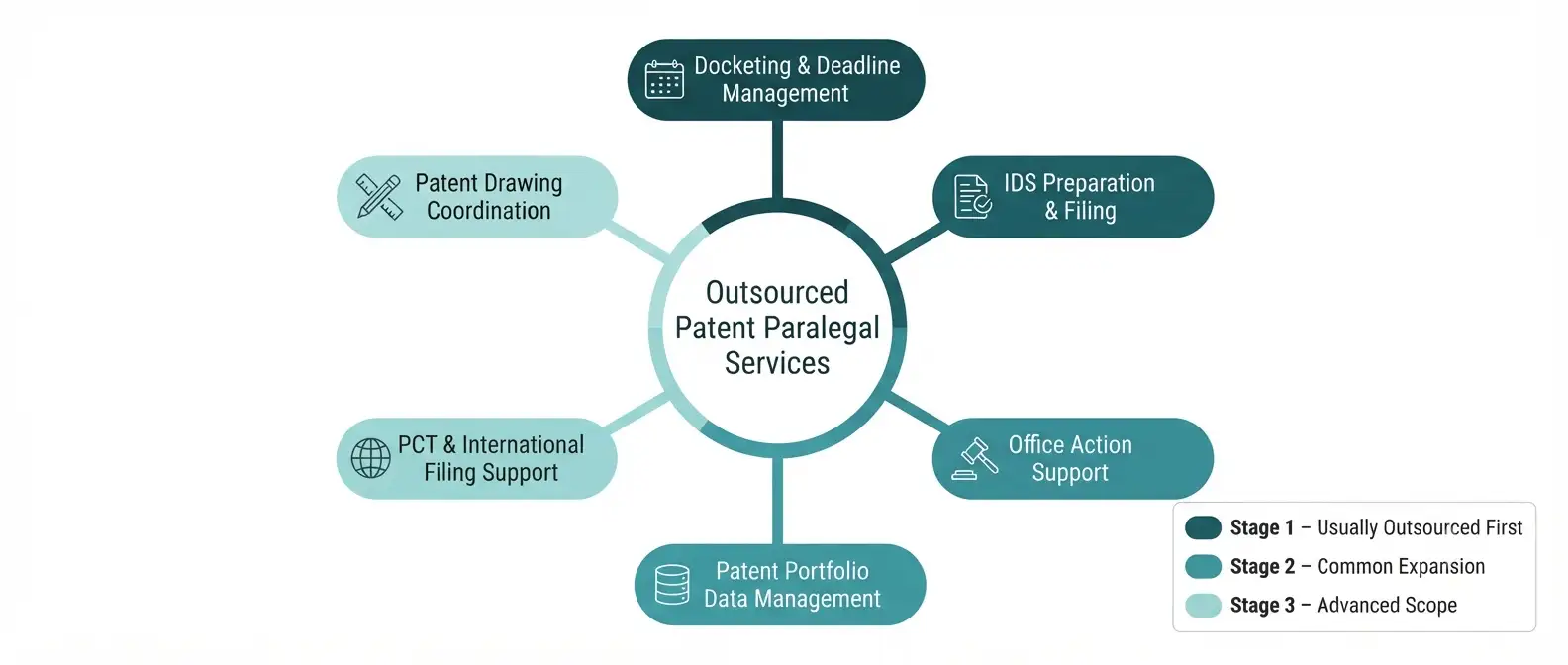
Not every outsourcing engagement looks the same, but most corporate-focused providers offer a consistent set of core services:
- Docketing and deadline management: Tracking statutory and internal deadlines across the full patent lifecycle.
- IDS preparation and filing: Compiling, cross-referencing, and submitting Information Disclosure Statements in compliance with USPTO Rule 56.
- Office action support: Preparing response shells, tracking response windows, and coordinating with prosecuting attorneys.
- PCT and international filing support: Managing national phase entry deadlines and country-specific requirements.
- Patent portfolio data management: Maintaining accurate, audit-ready records inside the department’s docketing system.
- Patent drawing coordination: Managing formal drawing requirements and USPTO compliance checks.
Corporate departments generally do not need every service at once. Most start with docketing and IDS support, then expand into office action coordination as trust builds with the outsourcing partner.
Docketing Depth: What “Deadline Management” Actually Covers
Docketing sounds simple from the outside, but a mature outsourced program covers far more than calendar entries. It typically includes duplicate-entry auditing, jurisdiction-specific rule updates, annuity and maintenance fee tracking, and reconciliation against outside counsel invoices to confirm that billed work actually matches docketed deadlines. Corporate departments with global portfolios especially benefit from this level of detail, since a single missed national-phase deadline can mean losing rights in an entire country.
IDS Preparation as a Compliance Function, Not Just Paperwork
IDS preparation is often treated as clerical work, but it directly supports the applicant’s duty of disclosure to the USPTO. An experienced outsourced team cross-references prior art across related family members, formats references correctly, and confirms nothing material has been left out before filing. Getting this wrong does not just create rework; it can expose a patent to later inequitable conduct challenges.
Office Action Support Without Losing Attorney Control
Good outsourcing partners never draft legal arguments or make substantive prosecution decisions. Instead, they prepare the administrative shell, track response deadlines, organize cited references, and hand off a clean, organized file to the attorney of record. This division of labor keeps legal judgment firmly in-house while removing the time-consuming setup work from an attorney’s plate.
In-House vs. Outsourced Patent Paralegal: A Side-by-Side Comparison
Choosing between building an internal team and outsourcing is rarely all-or-nothing. Still, it helps to see the trade-offs laid out directly. For a deeper breakdown of this decision, see our related analysis on whether it is better to hire an in-house or virtual patent paralegal.
| Factor | In-House Patent Paralegal | Outsourced Patent Paralegal Team |
|---|---|---|
| Time to onboard | 2–4 months, including recruiting | Typically 1–3 weeks |
| Cost structure | Fixed salary, benefits, overhead | Variable, à la carte or scoped pricing |
| Scalability | Limited by headcount approvals | Flexible, adjusts with filing volume |
| Continuity risk | High if one person leaves | Low; backed by a full team |
| Specialized expertise | Depends on individual experience | Broad bench across docketing, IDS, PCT |
| Direct oversight | Full, day-to-day | Attorney-led with regular reporting |
| Best suited for | Large, stable, high-volume dockets | Growing, fluctuating, or lean legal teams |
Neither model is universally “better.” Many corporate IP departments ultimately land on a hybrid structure, discussed later in this guide.
How Patent Paralegal Outsourcing Works: A Step-by-Step Guide
Corporate legal teams considering outsourcing usually follow a fairly predictable path. Here is what that process typically looks like:
- Portfolio assessment. The outsourcing partner reviews existing docketing data, filing volume, and pain points.
- Scope definition. The department and the provider agree on which services to outsource first, whether that is docketing, IDS prep, or both.
- System access and security setup. The provider is granted controlled access to the department’s docketing platform under confidentiality agreements.
- Team assignment. A dedicated paralegal team, backed by attorney oversight, is assigned to the account.
- Parallel run or pilot phase. Many departments run a short pilot period to validate accuracy before full transition.
- Full transition. Ongoing work moves entirely to the outsourced team, with regular status reporting to in-house counsel.
- Continuous quality review. Periodic audits confirm deadline accuracy and data integrity as the relationship matures.
This phased approach lets general counsel maintain full visibility while reducing the operational burden on internal staff.
Key Benefits for General Counsel and Corporate IP Leaders
For decision-makers evaluating patent paralegal outsourcing for corporations, the benefits tend to fall into four categories:
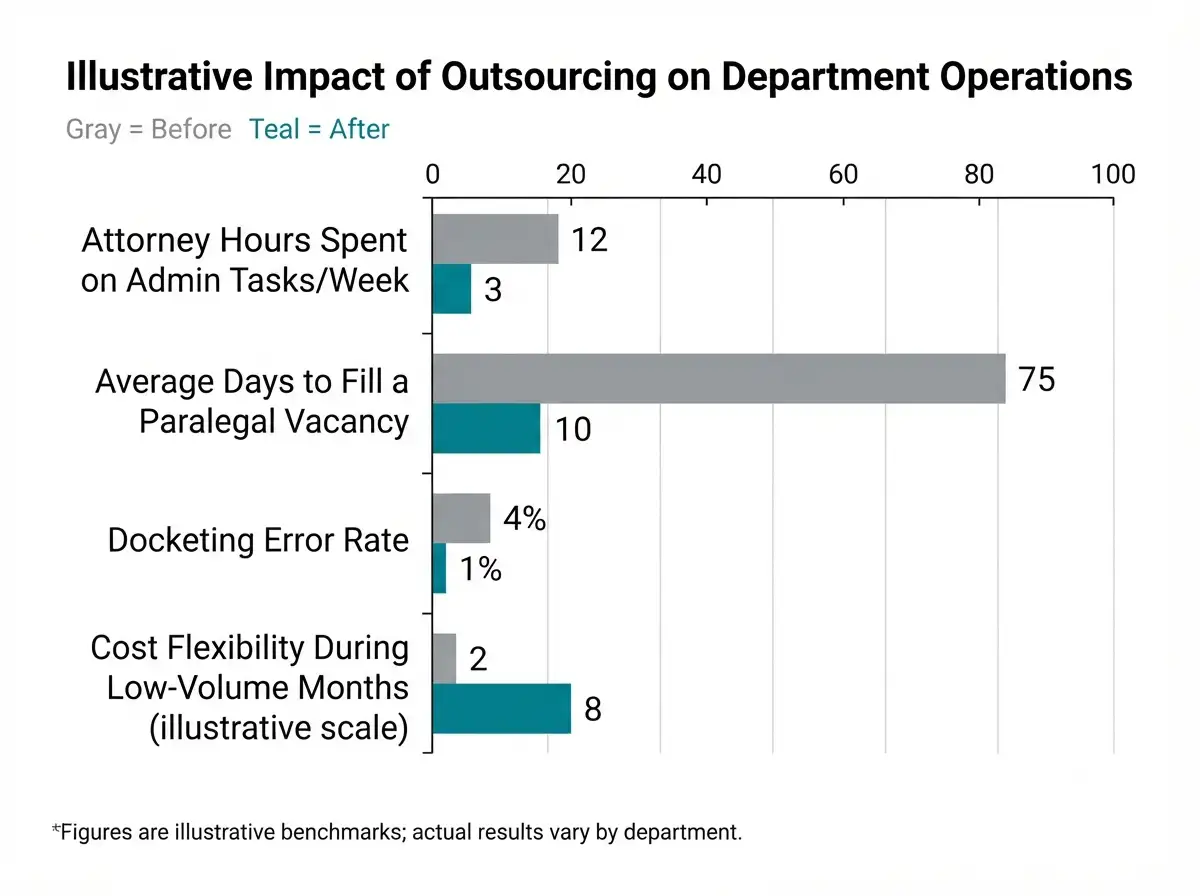
- Predictable, scalable cost. À la carte pricing means departments pay for actual work performed rather than a fixed salary regardless of workload.
- Reduced deadline risk. Multi-layered quality control catches errors before they become missed statutory deadlines.
- Faster response to business changes. Support can expand quickly around an acquisition, product launch, or licensing initiative.
- Freed-up attorney capacity. In-house counsel spend more time on strategy and less on administrative filing tasks.
These advantages compound over time, particularly for departments managing sprawling, multi-jurisdictional patent portfolios where consistent docketing accuracy is non-negotiable.
Common Mistakes Corporate IP Departments Make When Outsourcing
Even well-run legal departments run into avoidable problems when they outsource patent paralegal work. Watch for these missteps:
- Outsourcing everything at once. Moving the entire docket to a new provider on day one leaves no room to validate accuracy before deadlines hit.
- Skipping the security review. Failing to confirm data handling, access controls, and confidentiality protocols before granting system access.
- Underestimating the need for attorney oversight. Treating outsourced paralegals as a fully autonomous function rather than an attorney-supervised extension of the team.
- Ignoring communication cadence. Not establishing clear reporting rhythms, which leads to visibility gaps on deadline status.
- Choosing price over process. Selecting the cheapest provider without confirming quality-control systems, leading to costly docketing errors later.
Avoiding these mistakes usually comes down to running a structured pilot phase and asking detailed process questions before signing an agreement.
Expert Tips for Choosing the Right Patent Paralegal Outsourcing Partner
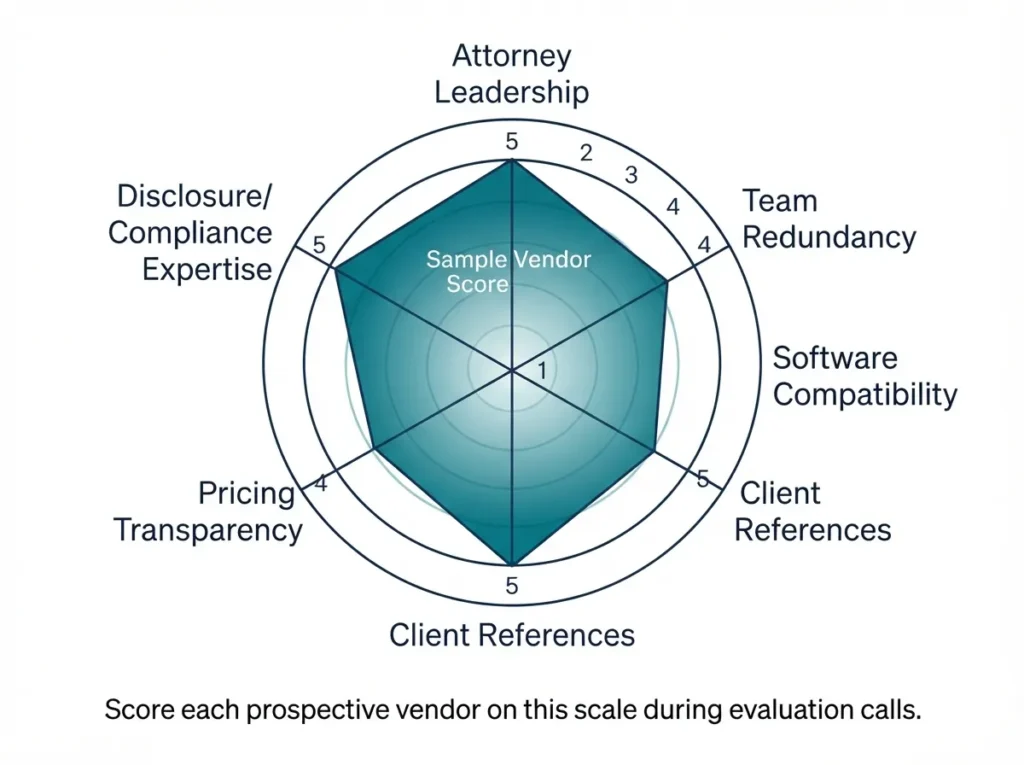
Selecting a provider is where most of the long-term risk lives. Consider these expert tips before committing:
- Confirm attorney leadership. Providers led or reviewed by licensed IP attorneys generally offer stronger quality assurance than purely administrative vendors.
- Ask about redundancy. A strong partner assigns a team, not a single individual, so vacations or turnover never threaten deadlines.
- Review their docketing software compatibility. Confirm the provider can work directly inside your existing platform rather than forcing a costly migration.
- Request references from similarly sized corporate departments. A firm’s experience with law firms does not always translate to in-house corporate workflows.
- Clarify the pricing model upfront. À la carte pricing avoids paying for unused capacity, which matters most for departments with fluctuating filing volume.
- Understand their handling of complex disclosure obligations. Since accurate IDS work is central to compliance, ask how the provider approaches IDS reference management in patent prosecution.
What to Include in a Patent Paralegal Outsourcing Service Agreement
Once a department chooses a provider, the service agreement itself does most of the work in preventing future disputes. General counsel reviewing an outsourcing contract should look for the following elements:
- Defined scope of services, spelled out by task type rather than vague language like “paralegal support.”
- Turnaround time commitments for each service category, including standard and rush-response windows.
- Escalation procedures for urgent, time-sensitive deadlines that fall outside normal business hours.
- Data security and confidentiality terms, including breach notification obligations.
- Quality-control standards, such as double-review requirements for docketing entries.
- Termination and transition provisions, so the department retains full data portability if the relationship ends.
- Pricing structure clarity, distinguishing between flat-fee, per-task, and hourly billing where applicable.
Departments that negotiate these terms upfront, rather than relying on a generic vendor template, avoid the vast majority of friction that can arise later in the relationship.
Cost Considerations: What Corporate IP Departments Should Budget
Budgeting for patent paralegal outsourcing looks different from budgeting for a full-time hire. Instead of a flat salary line, most corporate departments plan around scoped, per-service pricing.
| Cost Factor | Full-Time In-House Hire | Outsourced Patent Paralegal Support |
|---|---|---|
| Base compensation | $70,000–$110,000+ annually | Billed per service or scope, no fixed salary |
| Benefits and overhead | 25–35% added cost | Included in service pricing |
| Recruiting and training | Ongoing, recurring cost | Minimal; provider absorbs training |
| Ramp-up time | 60–90 days to full productivity | Days to a few weeks |
| Cost during low-volume periods | Fixed, regardless of workload | Scales down with demand |
Most corporate departments find that outsourcing becomes especially cost-effective once filing volume fluctuates seasonally or during periods of business growth, since fixed in-house costs cannot flex the same way.
Security, Confidentiality, and Compliance in Patent Paralegal Outsourcing
Corporate IP departments handle sensitive, pre-publication invention data, so security cannot be an afterthought. Before engaging any outsourcing partner, general counsel should confirm:
- Confidentiality agreements that meet or exceed internal corporate legal standards.
- Controlled, auditable system access rather than broad, unrestricted permissions.
- Compliance with USPTO disclosure obligations, including the duty of candor under Rule 56, which is detailed on the official USPTO website.
- Clear data residency and storage practices, particularly for departments with cross-border filing programs.
- Documented quality-control checkpoints, so errors are caught before they affect filed documents.
Departments that skip this diligence step expose themselves to unnecessary risk, regardless of how strong the provider’s pricing or turnaround times look on paper.
The Case for Hybrid Models: Blending In-House and Outsourced Support
Few corporate IP departments move to a fully outsourced model overnight, and many never do. A hybrid structure, where a smaller internal team handles strategic priorities while an outsourced partner manages high-volume, deadline-driven tasks, is increasingly common. This approach mirrors broader trends in corporate legal operations, where the Association of Corporate Counsel has documented growing reliance on flexible legal support models across in-house departments.
A hybrid model works particularly well when:
- The department wants to retain a senior in-house paralegal for institutional knowledge and strategic docketing decisions.
- Filing volume is unpredictable and does not justify a second or third full-time hire.
- Leadership wants a lower-risk way to test outsourcing before committing to a larger transition.
For departments managing both patent and trademark dockets, it also helps to understand how these roles differ. Our article on the difference between an IP paralegal and a trademark paralegal outlines where responsibilities diverge and where outsourcing can cover both functions efficiently.
Departments managing large or complex dockets may also benefit from reviewing our overview of patent docketing services built for larger IP operations, since many of the same quality-control principles apply inside a corporate legal department.
How Outsourcing Fits Into Broader IP Management Strategy
Patent paralegal outsourcing rarely exists in isolation. It is usually one part of a larger IP management strategy that also includes docketing systems, portfolio analytics, and cross-functional reporting to business units. Corporate IP leaders building or refining that strategy may find it useful to start with our complete guide to intellectual property management, which covers how docketing, prosecution support, and portfolio oversight fit together.
Departments should also be mindful of common structural risks, such as duplicate or conflicting deadline entries across systems. Our guide on double-docketing in patent law explains why this matters and how outsourced teams typically prevent it through cross-checked calendars.
A Real-World Scenario: Scaling Through a Filing Surge
Consider a mid-size technology company whose corporate IP department manages roughly 400 active patent applications across the United States, Europe, and Asia. For years, a single in-house paralegal handled docketing and IDS preparation without issue. Then the company acquired a smaller competitor, absorbing 150 additional pending applications almost overnight.
(Post-Acquisition, Week 0)
(Week 3)
IDS Preparation
Expanded Portfolio-Wide
Within weeks, the existing paralegal was working nights and weekends just to keep deadlines current, and the department’s general counsel faced a choice: post an urgent job requisition and wait out a multi-month hiring cycle, or bring in outsourced support immediately.
The department chose to pilot patent paralegal outsourcing on the newly acquired portfolio first, keeping the original paralegal focused on legacy filings. Within three weeks, the outsourced team had audited the acquired docket, corrected several duplicate entries, and brought every deadline current inside the existing docketing platform. Six months later, the department expanded the engagement to cover IDS preparation across the entire combined portfolio, freeing the in-house paralegal to take on higher-value docketing strategy work instead of routine data entry.
This kind of scenario illustrates why outsourcing tends to work best as a scoped, phased engagement rather than an all-or-nothing switch. It also shows how quickly an outsourced team can absorb sudden portfolio growth that would otherwise overwhelm a lean in-house staff.
Measuring Success: KPIs Corporate IP Departments Should Track
Once an outsourcing engagement is live, general counsel and IP directors need a way to confirm it is actually working. The most useful metrics tend to be operational rather than anecdotal:
- On-time filing rate, measured against internal deadlines rather than just statutory bars.
- Docketing error rate, tracked through periodic internal or third-party audits.
- Average turnaround time for IDS preparation and office action shell requests.
- Cost per filing or per docketed matter, compared against prior in-house benchmarks.
- Attorney hours reclaimed from administrative tasks, redirected toward strategic work.
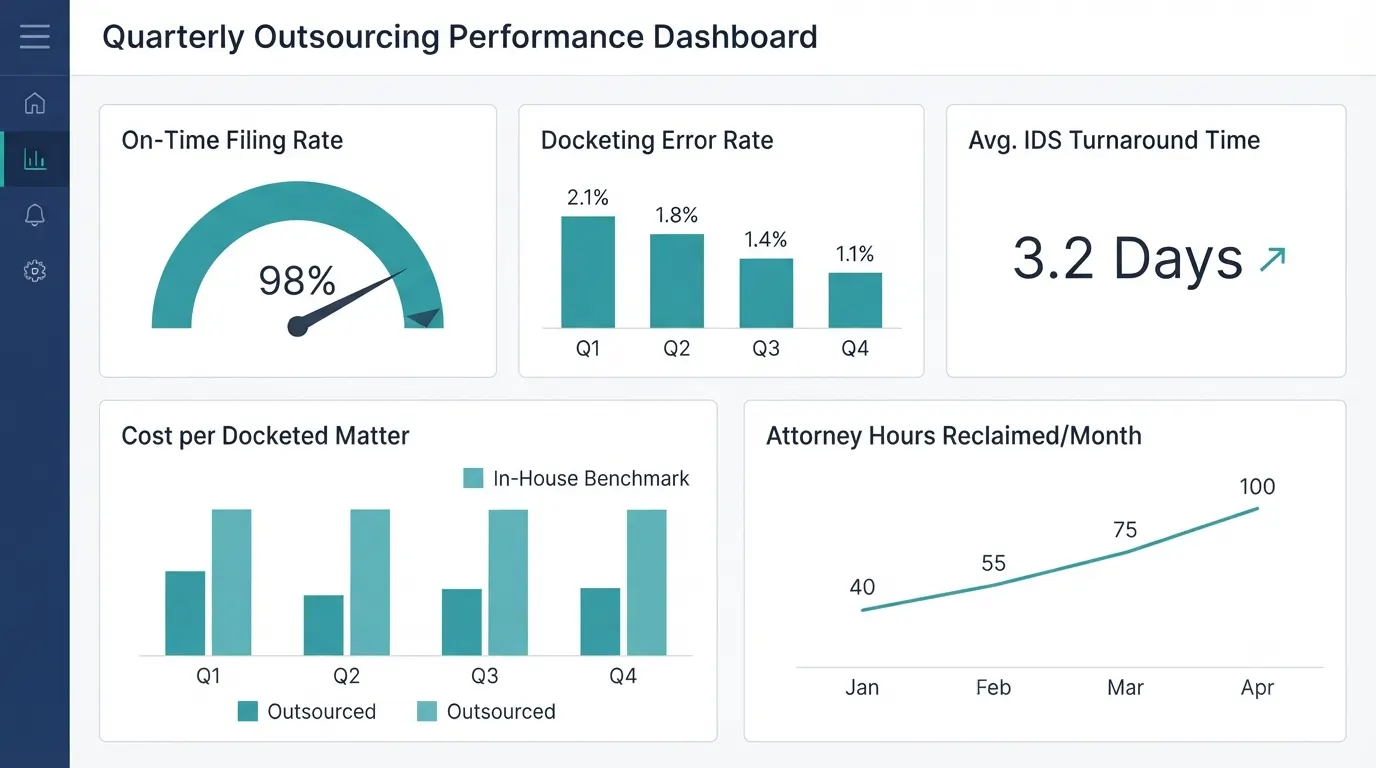
Reviewing these metrics quarterly gives the department an objective basis for deciding whether to expand, adjust, or scale back the outsourcing relationship, rather than relying on a general sense of whether things “feel” better.
Frequently Asked Questions
What is patent paralegal outsourcing for corporations?
Patent paralegal outsourcing for corporations is the practice of engaging an external, attorney-supervised team to handle patent docketing, IDS preparation, and related paralegal functions on behalf of an in-house legal department, instead of hiring full-time internal staff for every task.
Is patent paralegal outsourcing safe for confidential invention data?
Yes, provided the outsourcing partner uses signed confidentiality agreements, controlled system access, and documented quality-control processes. General counsel should confirm these safeguards before granting any data or system access.
How much does patent paralegal outsourcing cost compared to hiring in-house?
Costs vary by scope, but most à la carte outsourcing models cost less than a full-time salary plus benefits, especially for departments with fluctuating filing volume that would otherwise pay for unused in-house capacity during slower periods.
Can outsourced patent paralegals work inside our existing docketing software?
Reputable providers typically work directly inside the department’s existing docketing platform rather than requiring a migration, though this should always be confirmed during the vendor selection process.
Does outsourcing replace the need for in-house attorneys?
Patent paralegal outsourcing supports, rather than replaces, in-house counsel. Attorneys retain decision-making authority while the outsourced team handles the administrative and deadline-driven workload.
How quickly can a corporate IP department start outsourcing patent paralegal work?
Most departments can onboard an outsourced patent paralegal team within one to three weeks, compared to two to four months for a traditional in-house hire, since there is no recruiting or extended training period involved.
Should a corporate IP department outsource its entire docket or start with a pilot?
Most legal operations professionals recommend starting with a defined pilot scope, such as one business unit’s docket or one service category like IDS preparation, before expanding. This mirrors standard vendor-management guidance from organizations such as the American Bar Association on evaluating outside legal service providers, and it lets the department validate accuracy and communication quality before committing the full portfolio.
Conclusion
Patent paralegal outsourcing for corporations has moved from a cost-saving workaround to a core operating strategy for well-run IP departments. It closes staffing gaps faster than traditional hiring, scales with fluctuating filing volume, and reduces the deadline risk that comes with relying on a single in-house employee. Whether a department chooses a fully outsourced model or a hybrid approach, the decision ultimately comes down to finding a partner with strong attorney oversight, proven quality-control processes, and pricing that matches actual workload.
If your corporate IP department is weighing whether outsourcing makes sense for your portfolio, the next step is a direct conversation about your specific filing volume and docketing needs.
Schedule an In-House Team Consultation with Teak IP Services today to see how a dedicated patent paralegal team can support your department.

