
You receive a USPTO office action. The clock is already ticking. Your supervising attorney is stretched thin across a dozen active matters – and the question hits the desk fast: can a trademark paralegal file an office action response, or does the attorney have to handle every step?
It is a question that IP law firms, in-house legal departments, and solo practitioners ask regularly. The answer is nuanced, practically important, and often misunderstood. Understanding exactly what a trademark paralegal can and cannot do in the office action process can mean the difference between an efficient, cost-effective response and a response that puts the client’s mark – or the firm’s license – at risk.

This article breaks down the legal framework, the practical workflow, the risks to avoid, and exactly how experienced IP paralegal support can accelerate your office action response process without crossing any ethical or regulatory lines.
What is a Trademark Office Action?
Before addressing the paralegal’s role, it helps to understand what a trademark office action actually is.
A USPTO office action is an official communication from a USPTO examining attorney identifying one or more issues with a trademark application. The examining attorney issues the office action when the application does not meet the requirements for registration – either on substantive grounds (such as likelihood of confusion with an existing mark or descriptiveness) or procedural grounds (such as an identification of goods/services that is too broad or a specimen deficiency).
Types of Trademark Office Actions
There are two primary categories:
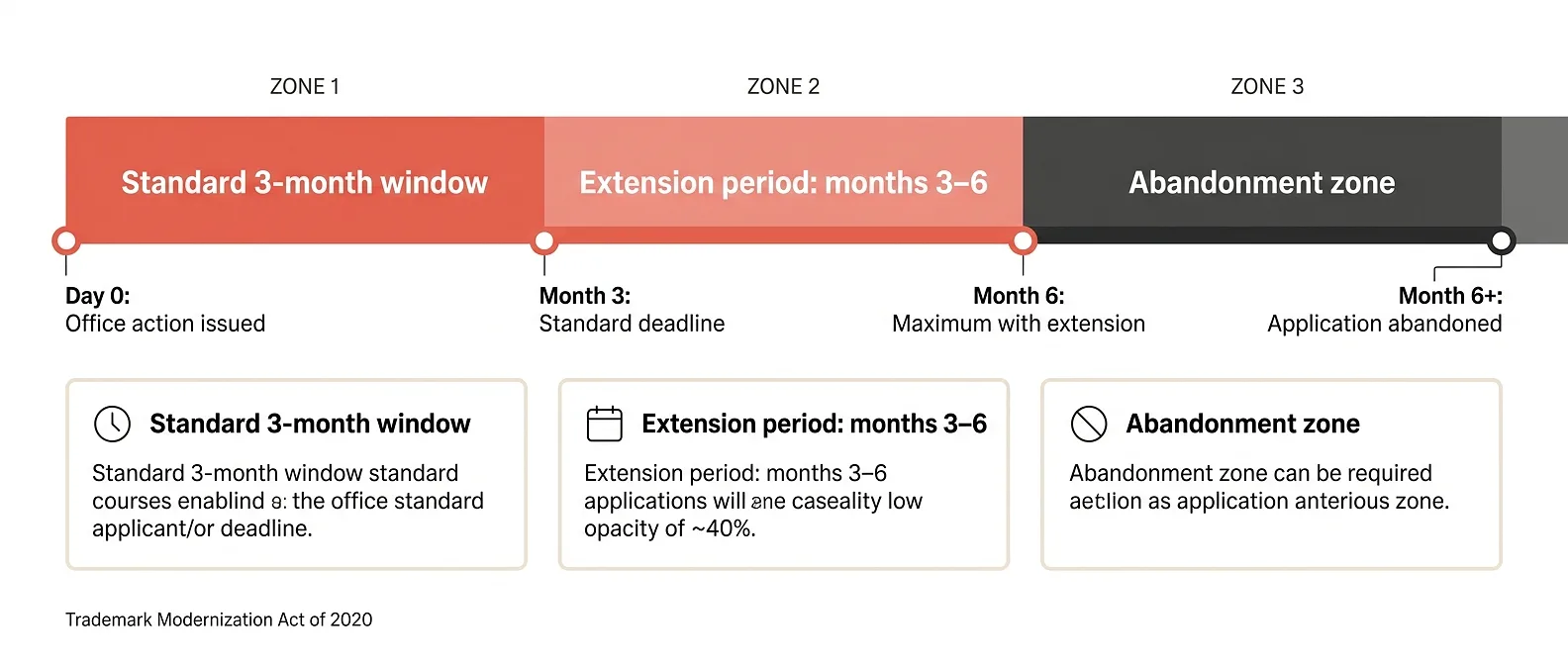
- Non-Final Office Action: The first substantive refusal or requirement. The applicant has three months to respond (with the option to extend up to six months for a fee).
- Final Office Action: Issued when the examining attorney maintains a refusal after the applicant’s first response. Options here are more limited and typically involve filing a Request for Reconsideration, a Notice of Appeal to the Trademark Trial and Appeal Board (TTAB), or abandoning the application.
Additionally, office actions may be procedural (requiring a minor fix, such as an amended identification) or substantive (involving a legal argument against a refusal based on Section 2(d) likelihood of confusion, Section 2(e)(1) mere descriptiveness, or similar grounds).
Understanding this distinction matters directly for the paralegal’s role, because the nature of the office action determines what level of legal judgment the response requires.
The Core Question: Can a Trademark Paralegal File an Office Action Response?
Here is the direct answer:
A trademark paralegal can prepare, draft, and file certain components of a trademark office action response – but only under the supervision of a licensed attorney, and only to the extent permitted by USPTO rules and state bar regulations.
A paralegal acting independently – without attorney supervision – cannot file a trademark office action response on behalf of a client. Doing so would constitute the unauthorized practice of law (UPL), which carries serious legal and professional consequences for both the individual and the firm.
That said, within a properly supervised structure, trademark paralegals perform a substantial and valuable portion of the office action response workflow. Let us look at what that means in practice.
What the USPTO Rules Say About Paralegal Practice
The USPTO has clear rules governing who may practice before it in trademark matters.
Under 37 C.F.R. § 11.14, practice before the USPTO in trademark matters is limited to:
- Attorneys who are members in good standing of the bar of any U.S. state, territory, or the District of Columbia.
- Individuals who were already recognized to practice before the USPTO in trademark matters prior to the enactment of current rules (a narrow historical category).
The USPTO does not recognize trademark paralegals or agents as independent practitioners in the same way that patent practitioners may be registered as non-attorney patent agents. There is no equivalent “trademark agent” registration for non-attorneys at the USPTO.
This means that a trademark paralegal cannot:
- File a response to a USPTO office action as the applicant’s authorized representative
- Sign an office action response as the attorney of record
- Appear before the TTAB independently
However, paralegals may – and routinely do – assist licensed attorneys in preparing and filing responses. The attorney remains responsible, supervises the work, and signs off on all filings.
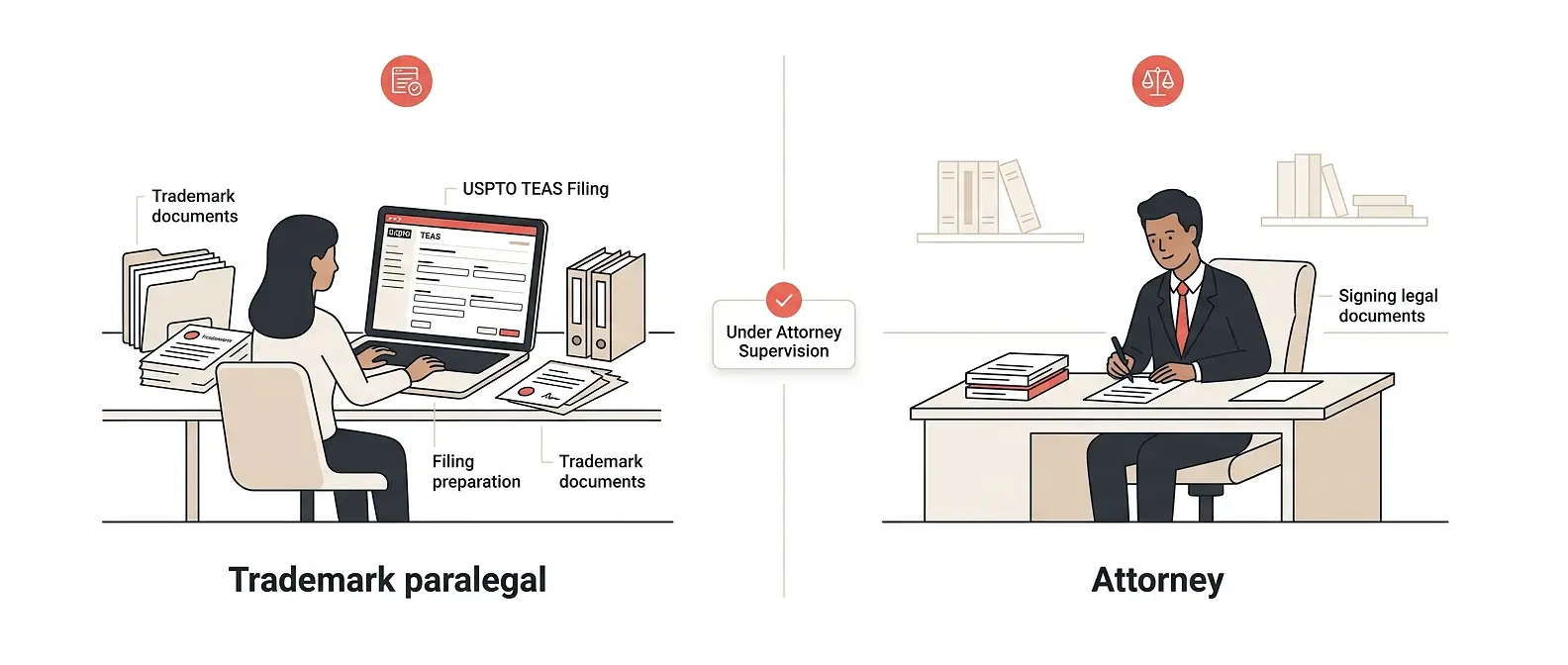
For further reference, the USPTO’s guidelines on trademark practice before the Office outline what authorized representatives may do in trademark prosecution.
What a Trademark Paralegal Can Do in the Office Action Response Process
Within proper attorney supervision, a trademark paralegal’s contribution to the office action response process is extensive. Here is what a skilled trademark paralegal typically handles:
1. Reviewing the Office Action
- Reading and categorizing the type of office action (procedural vs. substantive)
- Identifying all requirements and refusals cited by the examining attorney
- Flagging the response deadline and any extension options
- Summarizing the office action issues for the supervising attorney
2. Preliminary Research and Analysis
- Conducting USPTO TESS searches to identify cited conflicting marks
- Pulling TSDR file histories of cited marks for prosecution history analysis
- Researching relevant case law or TTAB precedents for the attorney’s review
- Gathering third-party use evidence to support acquired distinctiveness or coexistence arguments
3. Drafting Response Components
- Drafting standard arguments for procedural office actions (e.g., amended identifications of goods/services, disclaimer responses, specimen substitutions)
- Preparing amendments to the identification of goods/services under the attorney’s direction
- Drafting boilerplate sections of the response such as background recitations
- Compiling evidence attachments (consent agreements, declarations, third-party registrations)
4. Filing Through TEAS
- Preparing and uploading the response through the USPTO’s Trademark Electronic Application System (TEAS) on behalf of the attorney
- Confirming all required fields and attachments are complete
- Submitting the response under the attorney’s credentials and with the attorney’s authorization
5. Docketing and Deadline Management
- Updating docketing records to reflect the filed response
- Setting follow-up reminders for any subsequent office actions or TTAB proceedings
- Monitoring the USPTO TSDR for examination updates
The key principle throughout: the attorney reviews, approves, and takes responsibility for all substantive legal judgments before anything is submitted.
What a Trademark Paralegal Cannot Do Without Direct Attorney Oversight
Even the most experienced trademark paralegal must not cross into independent legal practice. The following tasks require direct attorney judgment – not just paralegal preparation:
- Independently crafting legal arguments responding to a Section 2(d) likelihood of confusion refusal, a Section 2(e)(1) descriptiveness refusal, or other substantive grounds
- Advising the client directly on whether to respond, appeal, or abandon the application
- Signing the office action response as the authorized representative
- Determining the legal strategy without attorney direction (e.g., whether to submit a consent agreement vs. a coexistence agreement vs. a legal argument distinguishing the marks)
- Making amendments to the application that have strategic implications without attorney approval
The line is between execution and legal judgment. Paralegals execute; attorneys judge. When that line blurs, unauthorized practice of law risk enters the picture.
The Risk of Unauthorized Practice of Law (UPL) in Trademark Matters
Understanding UPL risk is essential for any IP firm or legal department that relies on paralegal support.
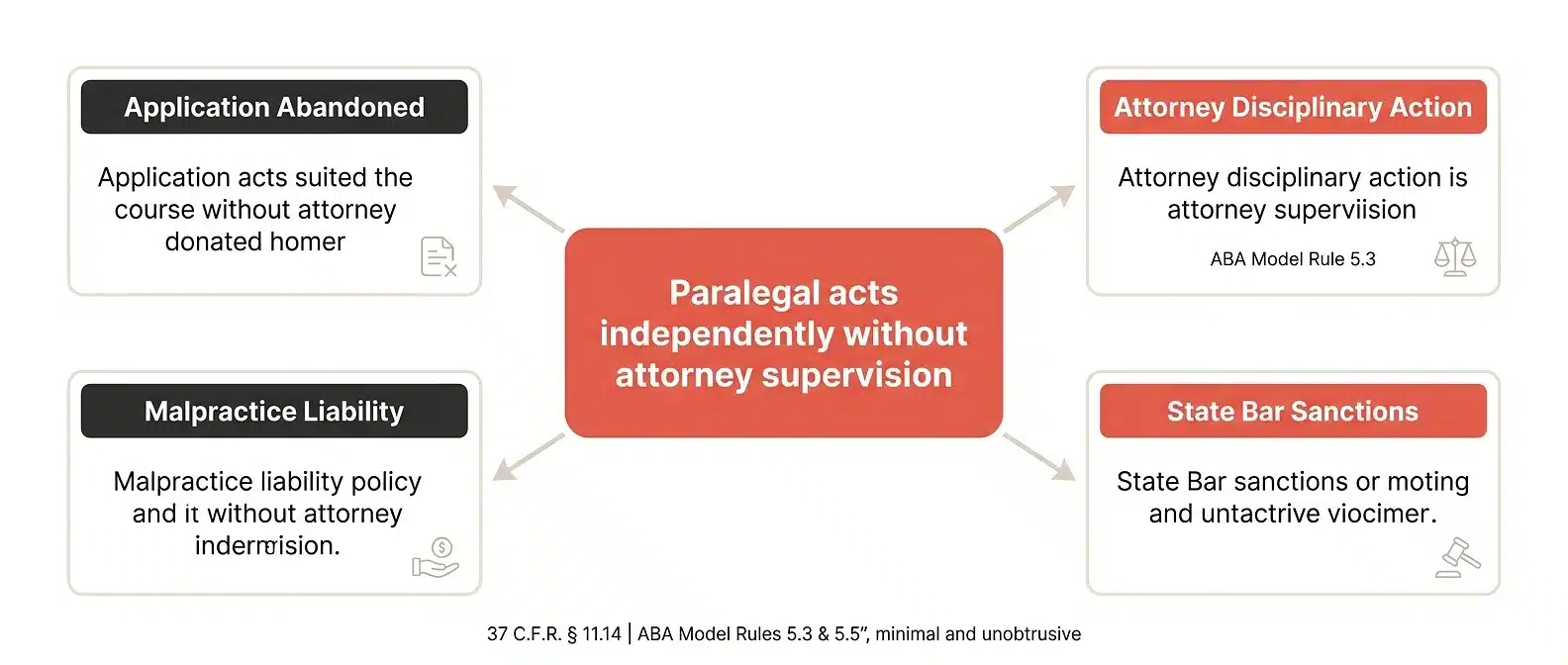
Unauthorized practice of law occurs when a non-attorney provides legal services that require the exercise of legal judgment, without the supervision of a licensed attorney. In trademark matters, UPL can arise when:
- A paralegal independently files an office action response without attorney involvement
- A paralegal provides direct legal advice to the client about how to overcome a refusal
- A non-attorney signs correspondence with the USPTO as the applicant’s representative
- An outsourced paralegal service files responses without an attorney of record
The consequences of UPL can include:
- Invalidation of the response or abandonment of the trademark application
- Disciplinary action against the supervising attorney
- Malpractice liability for the firm
- State bar sanctions
To learn more about how attorneys and paralegals should structure trademark prosecution work, see the American Bar Association’s Model Rules of Professional Conduct, particularly Rules 5.3 and 5.5.
How to Structure the Attorney-Paralegal Workflow for Office Action Responses
The most effective IP firms treat the attorney-paralegal relationship in office action responses as a structured workflow – not an ad hoc arrangement. Here is a proven model:
Step 1: Paralegal Reviews and Categorizes the Office Action
As soon as the office action arrives, the paralegal reads it in full, identifies every requirement and refusal, flags the deadline, and prepares a summary memo for the attorney. This alone saves the attorney significant time.
Step 2: Attorney Reviews the Summary and Sets Strategy
The attorney reviews the paralegal’s summary, determines the legal strategy, and communicates clear instructions. For a straightforward procedural issue (such as an overly broad identification), the instructions may be brief. For a substantive refusal, the attorney provides detailed guidance on the arguments to develop.
Step 3: Paralegal Drafts the Response
The paralegal drafts the response – including amended identifications, evidence compilations, and the structural framework of any legal argument – according to the attorney’s directions.
Step 4: Attorney Reviews, Revises, and Approves
The attorney reviews the draft in full, makes any necessary revisions to the legal arguments, and approves the final response. This is a non-delegable step.
Step 5: Paralegal Files Through TEAS
With the attorney’s authorization, the paralegal accesses the USPTO TEAS system, inputs the response, uploads all attachments, and submits. The filing is made under the attorney’s credentials.
Step 6: Paralegal Updates Docketing Records
After filing, the paralegal updates all docketing entries, confirms the USPTO receipt, and sets reminders for any follow-up deadlines.
This workflow gives attorneys maximum leverage on their time while keeping all legal responsibility exactly where it belongs.
Comparison: What Paralegals Can vs. Cannot Do in Trademark Office Action Responses
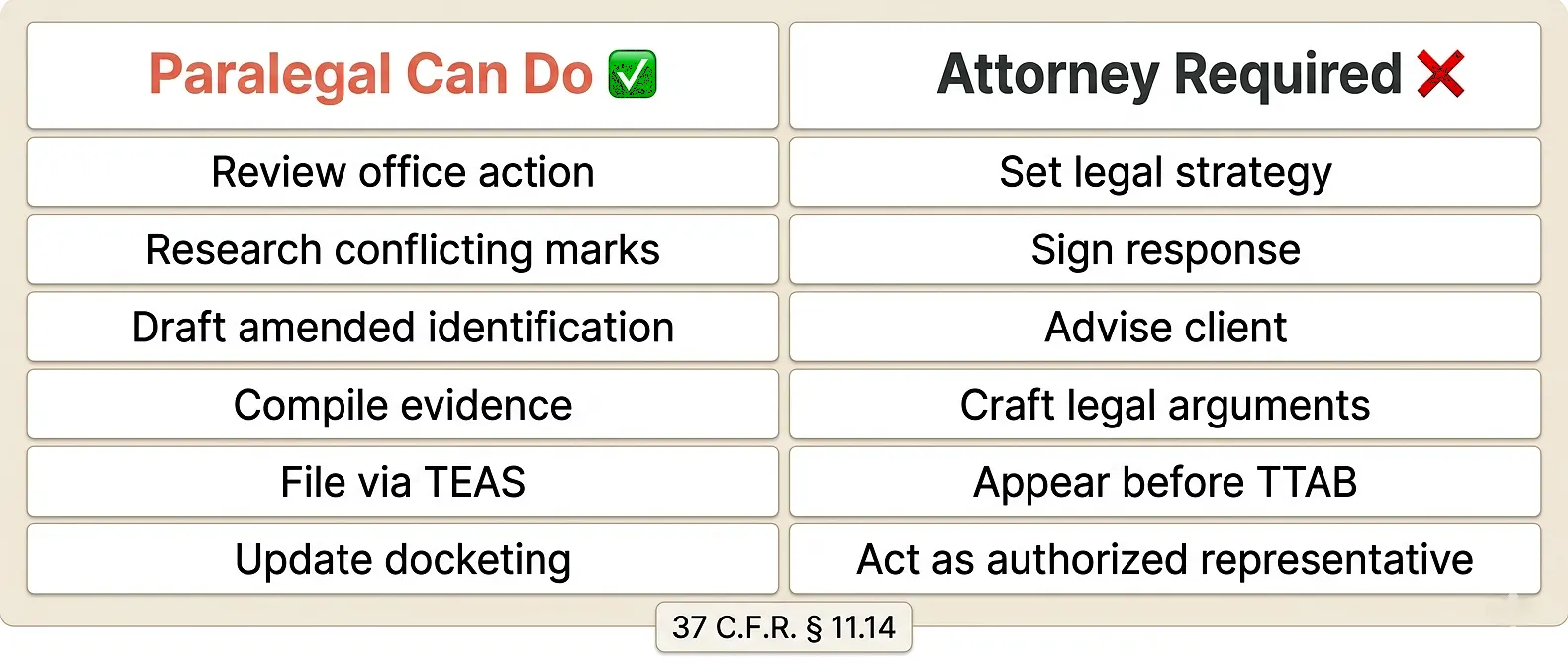
| Task | Paralegal Can Do | Attorney Required |
|---|---|---|
| Review and summarize the office action | Yes | No |
| Research cited conflicting marks (TESS) | Yes | No |
| Research TTAB precedents for attorney review | Yes | No |
| Draft amended identification of goods/services | Yes (with guidance) | Approval required |
| Draft procedural response arguments | Yes (with guidance) | Approval required |
| Craft independent legal strategy | No | Yes |
| Sign the response as authorized representative | No | Yes |
| Advise client on strategy independently | No | Yes |
| File through TEAS under attorney authorization | Yes | Oversight required |
| Update docketing records | Yes | No |
| Appear before TTAB independently | No | Yes |
Common Mistakes in Paralegal-Handled Office Action Responses
Even well-intentioned trademark teams make mistakes in paralegal-handled office action workflows. Watch for these:
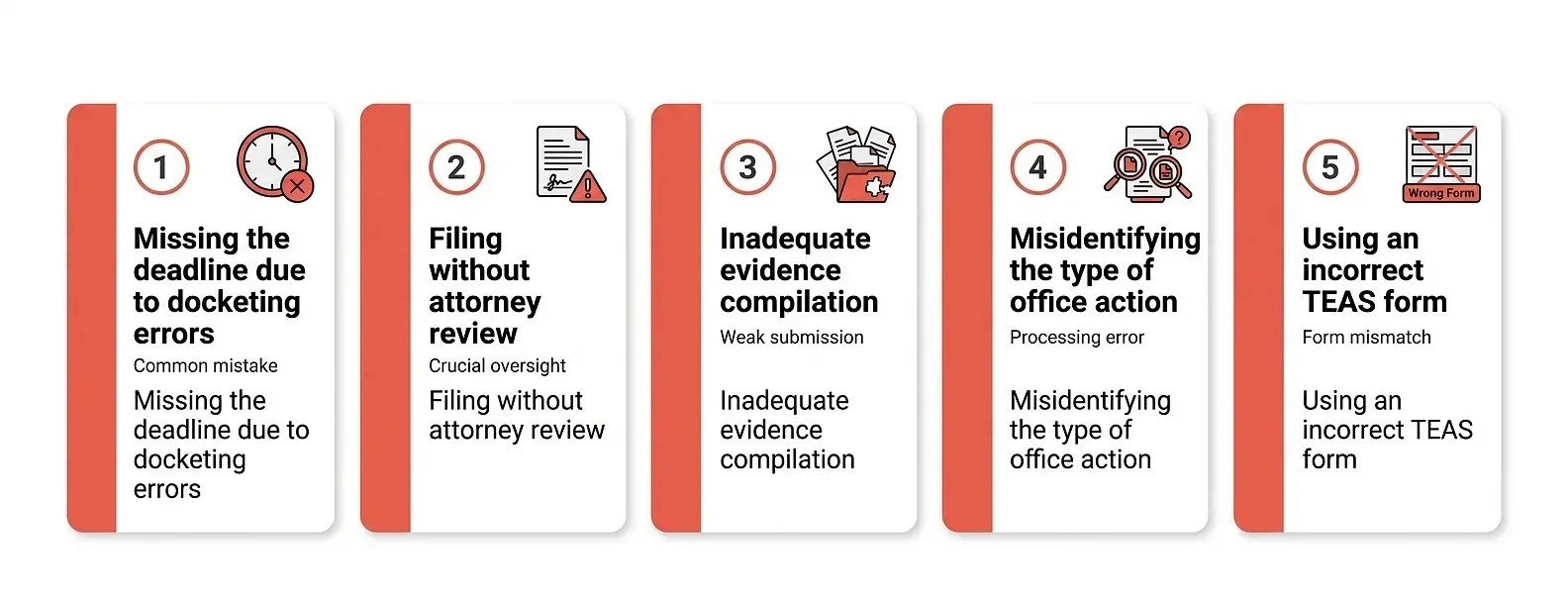
1. Missing the Deadline Due to Docketing Errors
One of the most common – and most damaging – errors is a miscalculated or mis-docketed response deadline. Under the Trademark Modernization Act of 2020, non-final office action response periods are now three months (extendable to six). Miscalculating this window can result in abandonment. For a detailed breakdown, see our article on office action response deadlines and what happens when you miss them.
2. Filing Without Attorney Review
Paralegals who draft responses without attorney review and approval – even for seemingly straightforward issues – expose the firm to UPL risk and malpractice liability.
3. Inadequate Evidence Compilation
For refusals based on mere descriptiveness or acquired distinctiveness, evidence quality is critical. A paralegal who compiles evidence without attorney direction on what to include may submit an incomplete evidentiary record.
4. Misidentifying the Type of Office Action
Confusing a non-final office action with a final office action changes the available response options entirely. Paralegals should flag this distinction clearly in their summary memo for the attorney.
5. Using an Incorrect TEAS Form
The USPTO has different TEAS forms for different response types. Filing through the wrong form can delay or complicate the examination process.
Expert Tips for Trademark Paralegals Handling Office Action Matters
If you are a trademark paralegal – or an attorney managing paralegal staff – these best practices will strengthen your office action workflow:
- Build a response template library. Standardized templates for common procedural issues (overly broad IDs, specimen deficiencies, disclaimers) reduce drafting time and improve consistency. See our office action response template guide for structural guidance.
- Use a purpose-built docketing system. Manual deadline tracking is a liability. A proper trademark docketing system with automated alerts is essential. Our complete guide to trademark docketing systems walks through the key features to look for.
- Document every instruction from the attorney. Written directions – even brief email confirmations – create a clear record of what the attorney authorized and reduce ambiguity about the division of work.
- Stay current on USPTO procedural changes. The USPTO periodically updates its rules, forms, and fee schedules. Our article on the USPTO trademark fee schedule is a useful reference for staying current on filing costs.
- Know when to escalate. If an office action raises an issue you have not encountered before, escalate to the attorney immediately rather than attempting to handle it independently.
The Value of Professional IP Paralegal Support for Office Action Responses
For small and mid-size IP firms – and for in-house trademark teams with limited bandwidth – outsourced IP paralegal support offers a cost-effective and compliant way to handle office action response workflows at scale.
A professional IP paralegal services provider, operating under attorney supervision, can:
- Handle the full administrative and drafting workflow for straightforward office actions
- Maintain rigorous docketing and deadline management across large trademark portfolios
- Provide consistent quality control on all response documents before attorney review
- Free attorney time for the high-value legal judgment tasks that only attorneys can perform
This model is especially effective for law firms managing trademark IP across multiple jurisdictions, where the volume and variety of office actions can quickly overwhelm in-house capacity.
For firms that want to go deeper on the strategic side of USPTO refusals, our article on how to handle USPTO refusals and keep your mark alive provides a comprehensive overview of the response strategies available.
Can a Trademark Paralegal File an Office Action Response?
The answer, put plainly: yes – within the boundaries of proper attorney supervision, and no – if acting independently without a licensed attorney’s oversight and authorization.
A trademark paralegal can file an office action response through the USPTO TEAS system, can draft response components, and can manage the procedural workflow from start to finish. What a paralegal cannot do is provide independent legal judgment, sign the response as the authorized representative, or advise the client on legal strategy without attorney direction.
Firms that get this right – that build structured, supervised paralegal workflows into their office action processes – gain a significant efficiency advantage. They deliver faster, more consistent responses, reduce attorney workload on routine tasks, and keep full legal accountability exactly where it belongs.
If your firm is looking for experienced, attorney-supervised trademark paralegal support for office action responses and broader trademark prosecution matters, Teak IP Services offers proven IP paralegal solutions tailored to IP law firms, in-house teams, and trademark practitioners.
Frequently Asked Questions
Can a trademark paralegal file an office action response without an attorney?
No. A trademark paralegal cannot independently file an office action response with the USPTO. Under 37 C.F.R. § 11.14, only licensed attorneys may practice before the USPTO in trademark matters. A paralegal may prepare and submit a response through TEAS, but only under the supervision and with the authorization of a licensed attorney who reviews and approves all content before filing.
What is the difference between a trademark paralegal and a trademark attorney in an office action?
A trademark attorney provides legal judgment: determining the response strategy, analyzing refusals, crafting legal arguments, and signing the response as the authorized representative. A trademark paralegal handles the procedural and administrative tasks: reviewing and summarizing the office action, researching cited marks, drafting response components, and filing through TEAS, all under attorney supervision.
Can a paralegal draft a response to a Section 2(d) likelihood of confusion refusal?
A paralegal can assist in drafting the structural elements and compiling evidence for a Section 2(d) response, but the substantive legal argument must be developed, reviewed, and approved by the supervising attorney. Independent legal argumentation by a non-attorney constitutes unauthorized practice of law.
How long does a trademark applicant have to respond to an office action?
Under the Trademark Modernization Act of 2020, applicants have three months from the office action issue date to respond to a non-final office action. The deadline can be extended to six months by paying an extension fee. Missing the six-month deadline results in abandonment of the application.
What happens if a paralegal files a trademark office action response without attorney supervision?
This constitutes unauthorized practice of law (UPL). Consequences can include abandonment of the trademark application if the response is later challenged, disciplinary action against the supervising attorney for failure to properly supervise non-attorney staff, potential malpractice liability, and state bar sanctions. The USPTO may also take action if it determines an unauthorized individual acted as the applicant’s representative.
Is there a USPTO registration for non-attorney trademark practitioners?
No. Unlike the patent field – where non-attorneys may become registered patent agents by passing the USPTO registration exam – there is no equivalent “trademark agent” registration for non-attorneys at the USPTO. All trademark practice before the USPTO must be conducted by, or under the supervision of, a licensed attorney.
How can outsourced trademark paralegal support help with office action responses?
An experienced outsourced IP paralegal service, working under attorney supervision, handles the full administrative and drafting workflow for office action responses. This includes reviewing and summarizing the office action, researching cited marks, drafting response components, managing deadlines through a robust docketing system, and filing through TEAS. This frees attorney time for high-value legal judgment tasks while maintaining compliance and quality control.

