
Patent Docketing: In the complex world of intellectual property (IP), missing a single deadline can mean the permanent loss of patent rights – rights that may represent years of research, innovation, and significant financial investment. This is precisely why patent docketing has become one of the most critical functions in any IP practice.
Whether you are a solo inventor, a growing startup, a large corporation, or a law firm managing hundreds of patent cases, a robust patent docketing system is not optional – it is the backbone of your IP protection strategy. Whether you are building your first docketing process or scaling an existing one, our patent docketing services provide the infrastructure, expertise, and reliability that IP practices of all sizes depend on to protect their clients’ rights.

This comprehensive guide by Teak IP Services covers everything you need to know about patent docketing – from its definition and importance to best practices, software tools, and how outsourcing can transform your IP management.
What is Patent Docketing?
Patent docketing is the systematic process of recording, tracking, and managing all critical dates, deadlines, actions, and information related to patent applications and granted patents throughout their lifecycle. It is a subset of intellectual property docketing
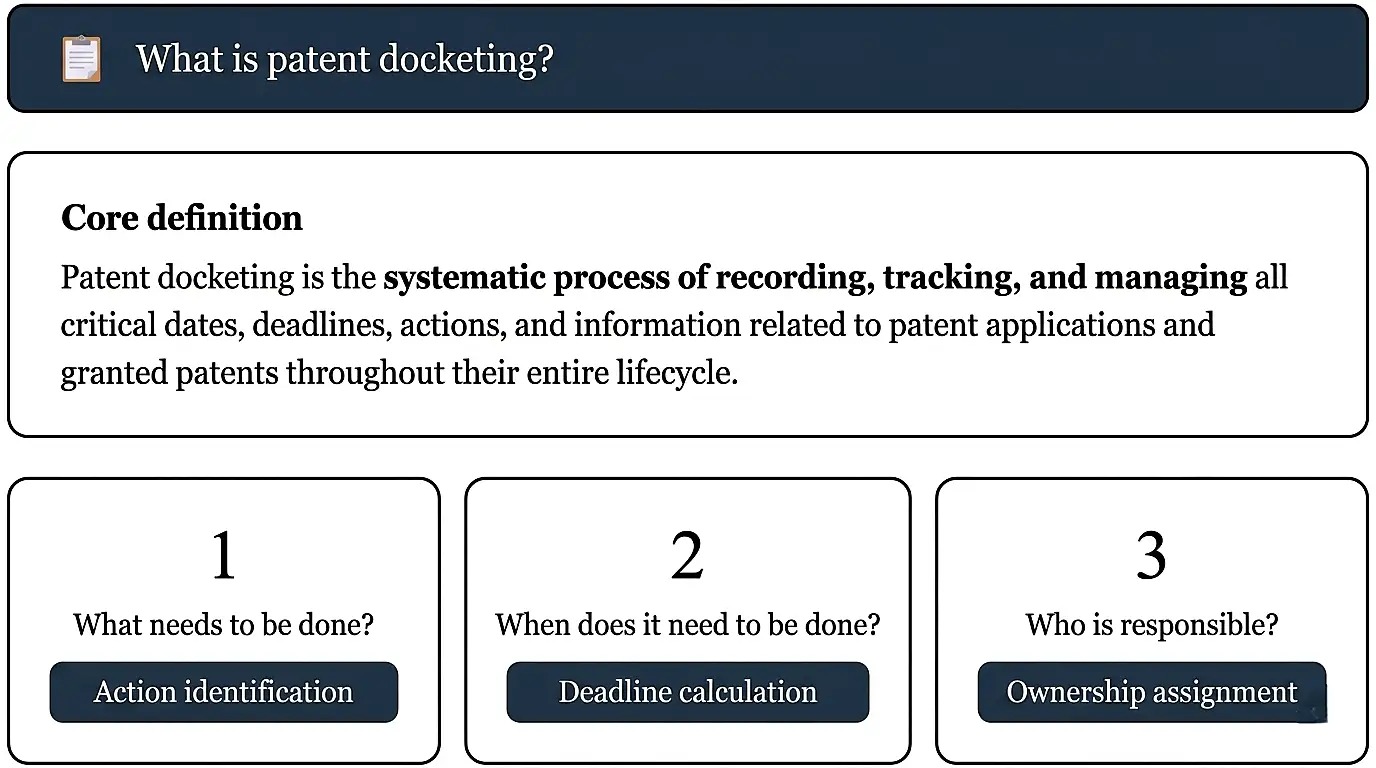
At its core, patent docketing answers three fundamental questions:
- 1. What needs to be done?
- 2. When does it need to be done?
- 3. Who is responsible for doing it?
The Full Scope of Patent Docketing
Patent docketing is far more than a simple reminder system. It encompasses a wide range of activities:
- Recording all relevant dates from patent office actions, filings, and communications
- Calculating response deadlines based on jurisdiction-specific rules and regulations
- Monitoring maintenance fee due dates across multiple countries
- Tracking prosecution history and status of each patent application
- Managing priority dates and PCT (Patent Cooperation Treaty) national phase entries
- Coordinating with foreign associates for international patent applications
- Generating reminder alerts well in advance of critical deadlines
- Maintaining a comprehensive database of all patent assets
- Reporting to clients, management, and stakeholders on IP portfolio status
The Patent Docketing Lifecycle
Patent docketing begins at the moment an invention disclosure is received and continues through every stage of the patent’s life:
| Stage | Key Docketing Activities |
| Invention Disclosure | Record inventor details, invention date, prior art notes, filing decision deadlines |
| Provisional Application | Track 12-month deadline to file non-provisional application, record filing date |
| Non-Provisional Filing | Record serial number, filing date, calculate examination response periods |
| PCT Application | Track national phase entry deadlines for each designated country (typically 30/31 months) |
| Office Action Response | Calculate response deadline (3–6 months typically), record extensions available |
| Publication | Record publication date, monitor for third-party observations |
| Allowance & Issue | Track issue fee payment deadline, record grant date |
| Post-Grant | Schedule maintenance fee payments (3.5, 7.5, 11.5 years in USA), monitor for challenges |
| Abandonment / Expiry | Record lapse, assess revival options, update portfolio records |
Why is Patent Docketing Critical?
The consequences of poor patent docketing can be catastrophic. Here is why every IP professional must treat docketing as a top priority:
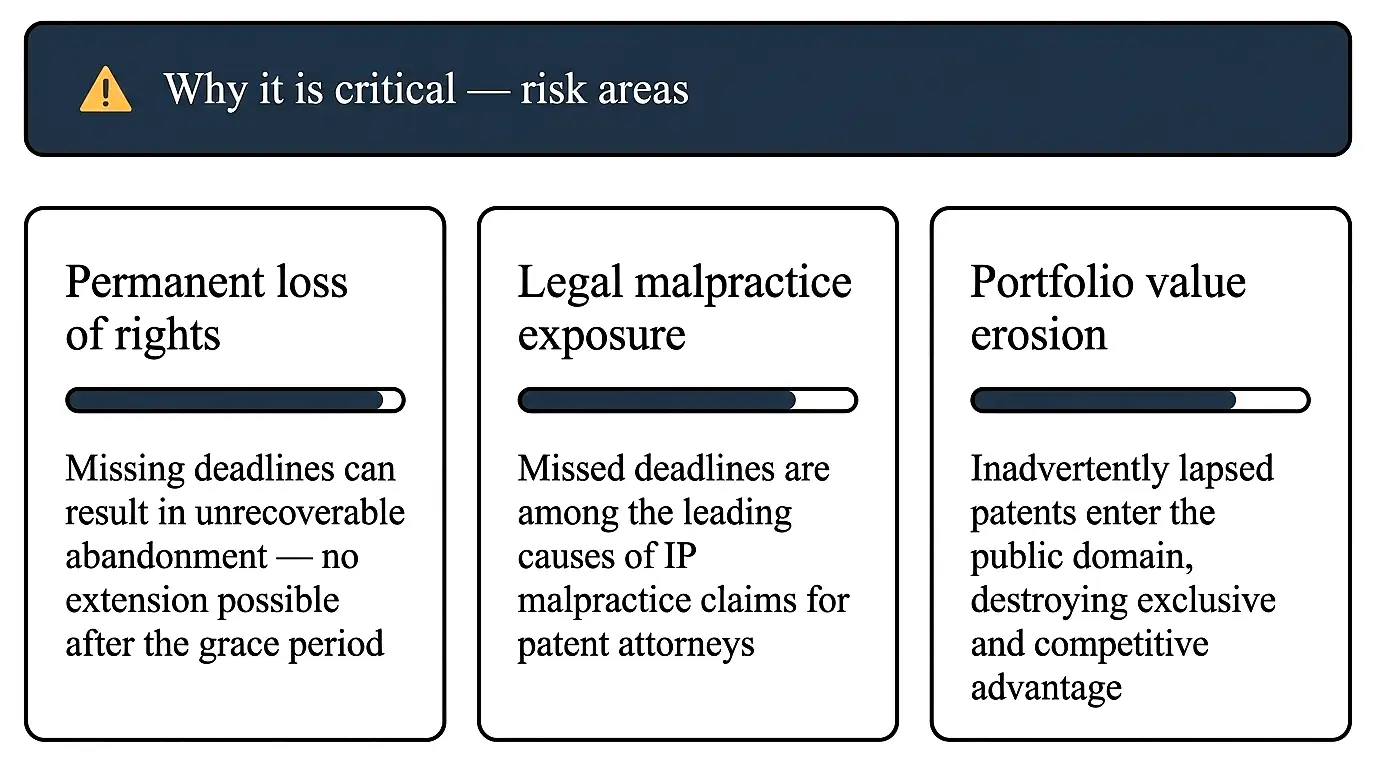
1. Missing Deadlines = Permanent Loss of Rights
Patent law is unforgiving. Unlike many legal matters where missed deadlines can be corrected, many patent deadlines are absolute. Missing them means:
- An application may go abandoned and cannot be revived
- A patent can lapse due to unpaid maintenance fees, entering the public domain
- Priority rights may be permanently lost, affecting international filing strategy
- Third parties may file on the same invention and receive patent protection first
2. Legal Malpractice Risk
For patent attorneys and agents, missed deadlines represent one of the leading causes of legal malpractice claims. Robust docketing systems serve as a critical layer of professional protection.
3. Portfolio Value Preservation
A company’s patent portfolio often represents its most valuable intangible asset. Systematic docketing ensures that this value is preserved and that no patent inadvertently lapses.
4. Strategic IP Management
Good docketing provides management and business decision-makers with real-time visibility into the IP portfolio, enabling informed decisions about:
- Which patents to maintain or abandon based on business relevance
- Timing of licensing negotiations relative to patent expiry
- Budget forecasting for maintenance fees across jurisdictions
- Identifying gaps in IP protection that require new filings
| ⚠ Key Statistic |
| Studies suggest that missed patent deadlines account for a significant portion of IP malpractice |
| claims in the United States. In many cases, these losses are entirely preventable with a proper |
| patent docketing system in place – making docketing one of the highest ROI investments in IP management. |
Types of Deadlines Managed in Patent Docketing
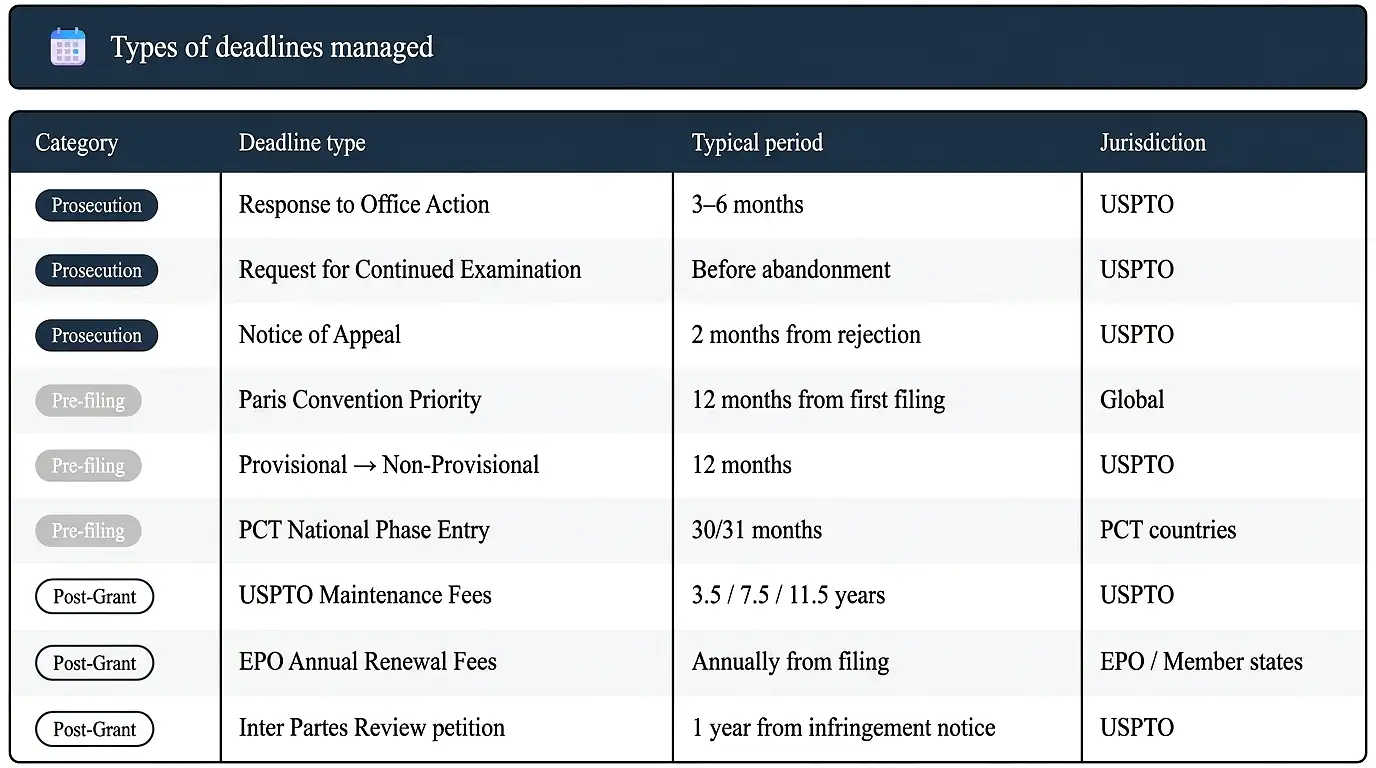
Patent docketing involves tracking dozens of different types of deadlines. Here is a comprehensive breakdown:
A. Prosecution Deadlines (During Application Process)
- Response to Office Action – Typically 3 months (extendable to 6 months in USPTO with fee)
- Request for Continued Examination (RCE) – Filed before final abandonment
- Notice of Appeal – 2 months from final rejection (USPTO)
- Appeal Brief – 2 months from filing notice of appeal
- Response to Restriction Requirement – Set period to elect which claims to pursue
- Information Disclosure Statement (IDS) – Filed before certain triggering events
- Reply to Examiner’s Answer – 2 months from examiner’s answer
B. Filing Deadlines (Pre-Application)
- Paris Convention Priority Deadline – 12 months from first filing date for utility patents
- Provisional to Non-Provisional Conversion – 12 months from provisional filing date
- PCT International Phase Deadline – 12 months from priority date
- PCT National Phase Entry – 30 months from priority date (31 months in some countries)
- Statutory Bar Deadlines – 1-year grace period from public disclosure (in the USA)
C. Post-Grant Deadlines
- USPTO Maintenance Fees – Due at 3.5, 7.5, and 11.5 years from grant date (with 6-month grace period)
- EPO Renewal Fees – Annual fees due on anniversary of filing date
- Inter Partes Review (IPR) Petition – 1 year from service of infringement complaint
- Post-Grant Review (PGR) – 9 months from grant date
- Certificate of Correction – Filed to correct minor errors in granted patent
D. International & PCT Deadlines
| Jurisdiction | Key Deadline Notes |
| USPTO (USA) | Maintenance fees: 3.5, 7.5, 11.5 years; 6-month grace available |
| EPO (Europe) | Annual renewal fees; varies by member state after grant |
| India (IPO) | Annual renewal fees from grant date; strict deadlines |
| China (CNIPA) | Annual fees due from filing date; no grace period in many cases |
| Japan (JPO) | Annual fees; request for examination within 3 years of filing |
| PCT | National phase by 30/31 months; Chapter II deadline at 22 months |
| Canada (CIPO) | Maintenance fees; examination request within 4 years of PCT filing |
Also, Read: Effective Trademark Portfolio Management: Key Components, Challenges & Practices
Key Components of an Effective Patent Docketing System
A best-in-class patent docketing system goes well beyond a simple calendar. Here are the essential components:
1. Centralized Case Management Database
Every patent asset – application or granted patent – should have a dedicated docket record that includes:
- Application/patent number for each jurisdiction
- Filing date, priority date, and publication date
- Applicant/assignee details and any change of ownership history
- Inventor names and contact information
- Technology classification and business unit assignment
- Current prosecution status and history of all actions
- All correspondence with patent offices and foreign associates
2. Automated Deadline Calculation
Modern docketing systems automatically calculate deadlines based on:
- Jurisdiction-specific rules (different countries have different statutory periods)
- USPTO rules for extensions, continuations, and divisional applications
- Holiday and weekend adjustments (deadlines falling on weekends shift to the next business day)
- Custom internal reminders set well before the actual statutory deadline
3. Multi-Level Reminder System
Best practice is to implement a tiered reminder system:
- First reminder: 3–6 months before deadline (for major deadlines like national phase entry)
- Second reminder: 4–6 weeks before deadline
- Third reminder: 1–2 weeks before deadline
- Final reminder: 3–5 business days before deadline
- Escalation alert: If no action confirmed by deadline day
4. Workflow and Task Assignment
Docketing systems should support team workflows including:
- Assignment of docketing tasks to specific attorneys, paralegals, or docketers
- Status tracking from task creation to completion and confirmation
- Escalation protocols when a responsible party does not confirm action
- Integration with billing systems to record time spent on docketing-related tasks
5. Reporting and Analytics
Powerful docketing systems provide management-level reporting on:
- Upcoming deadlines for the next 30, 60, and 90 days
- Portfolio size by jurisdiction, technology area, and business unit
- Maintenance fee expenditure forecasting
- Abandoned and lapsed patents with reasons documented
- Docketing team workload and productivity metrics
The Step-by-Step Patent Docketing Process
This process follows a structured legal docketing workflow How does patent docketing work in practice? Here is a detailed walkthrough of the typical process in a law firm or IP department:
1st Step: Intake and Docket Opening
When a new matter is opened – whether a new filing instruction, an assignment from a client, or receipt of a foreign application – a docketeer creates a new docket record. This includes entering all known case information: client name, inventors, filing country, technology area, and any known critical dates.
2nd Step: Recording Triggering Events
When a patent office action or correspondence is received (e.g., an Office Action, a Notice of Allowance, an Examination Report), the docketeer records the date received and the document type. This triggers automatic calculation of associated deadlines.
3rd Step: Deadline Verification
A critical quality-control step: a second person (attorney or senior docketeer) verifies that deadlines have been correctly entered and calculated. Double-checking is essential because a data entry error at this stage can have the same catastrophic consequences as missing the deadline entirely.
4th Step: Attorney Review and Instruction
The responsible attorney is notified of the upcoming action. The attorney reviews the matter, determines the appropriate course of action (respond, extend, abandon, appeal), and provides instructions to the team.
5th Step: Action Preparation and Filing
The appropriate response or filing is prepared – typically by a patent attorney or agent – and submitted to the relevant patent office. All filing confirmations, receipt numbers, and acknowledgments are recorded in the docket system.
6th Step: Docket Closing / Next Action
Once the action is complete and confirmed, the current deadline is closed and any next action triggered by the filing is entered (e.g., filing an appeal brief after a notice of appeal). The cycle continues through the patent’s life.
Also, Read: Outsource Trademark Docketing: Strong Reasons to Consider
Patent Docketing Software: Key Features to Look For
The right patent docketing software is essential for accuracy, efficiency, and scalability. Here are the key features every IP team should look for:
| Feature | Why It Matters |
| Jurisdiction-specific deadline rules | Ensures accurate deadline calculation across all patent offices worldwide |
| Automated reminder emails | Reduces manual effort and prevents deadlines from slipping through the cracks |
| Office action intake integration | Automatically creates docket entries when patent office documents are received |
| Custom reporting dashboards | Gives management real-time visibility into the IP portfolio |
| Document management | Stores all correspondence, filings, and responses linked to each case |
| Foreign associate portal | Streamlines communication with international patent agents |
| Billing/time tracking integration | Connects docketing with financial management for accurate cost tracking |
| Audit trail / change log | Documents every change made to a docket record for compliance purposes |
| Client portal access | Allows clients to view their own portfolio status securely |
| Cloud-based & mobile access | Enables remote access for distributed teams and traveling attorneys |
Also, Read: Trademark IP Management Best Practices for Multi-Jurisdiction Brand Protection
Patent Docketing Best Practices
Adopting the following best practices will dramatically reduce risk and improve the quality of your patent docketing:
The Double-Check Rule
Every deadline must be independently verified by at least two people. The person who enters the deadline should not be the same person who verifies it. This is the single most important practice in docketing.
Maintain Internal Deadlines Earlier Than Statutory Deadlines
Set internal ‘action required’ dates at least 30–60 days before the actual statutory deadline. This provides a buffer for attorney review, action preparation, and unexpected delays.
Document Everything
Every decision, communication, and action related to a docket entry should be documented. If a patent is abandoned on client instruction, that instruction should be in writing and recorded in the docket.
Regular Docket Audits
Conduct periodic audits of your docket – weekly, monthly, and quarterly – to identify any cases that may have been overlooked, have inconsistent data, or where a deadline is approaching without a confirmed action plan.
Clear Assignment of Responsibility
Every deadline in the docket system must have a named individual responsible for it. ‘The team’ or ‘the firm’ is not an acceptable owner. Named accountability prevents items from falling through the cracks.
Formal Abandonment Protocols
When a client decides not to pursue or maintain a patent, there must be a formal protocol for recording and confirming this decision – including written client authorization and documented removal from the active docket.
| 💡 Pro Tip from Teak IP Services |
| One of the most overlooked aspects of patent docketing is the foreign associate management workflow. |
| When relying on foreign agents to handle national phase entries and annuities, establish clear reporting |
| timelines and confirmation protocols — don’t assume action has been taken until you have written confirmation. |
Also, Read: IP Docketing Best Practices: A Practical Guide for IP Firms & Attorneys
Outsourcing Patent Docketing: is it Right for You?
The Outsourcing Patent Docketing: Many law firms and corporate IP departments are turning to specialized outsourcing partners for patent docketing services. Here is what you need to know:
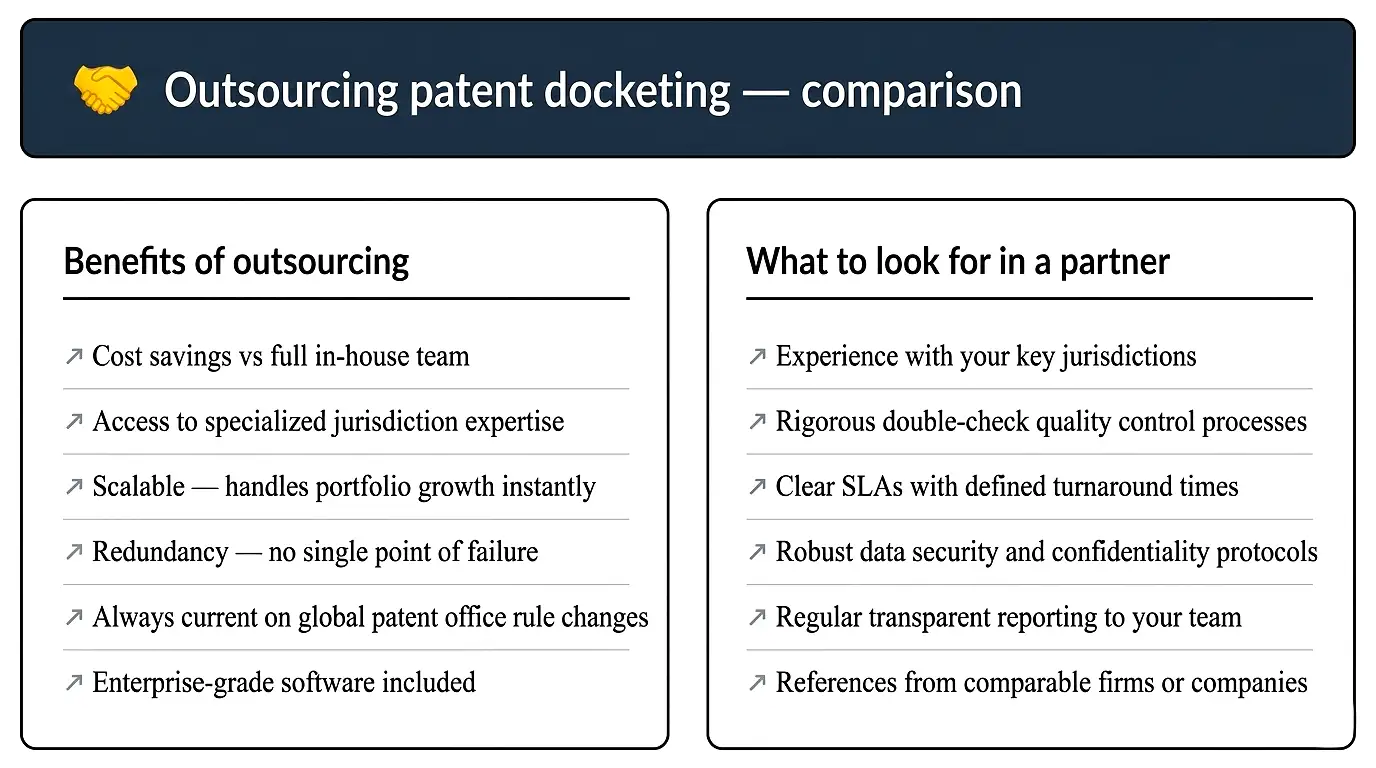
Benefits of Outsourcing Patent Docketing
- Cost savings compared to maintaining a full in-house docketing team with benefits and training
- Access to specialized expertise – professional docketing firms are experts in nothing but IP docketing
- Scalability – easily handle portfolio growth or seasonal spikes without hiring
- Redundancy and backup – dedicated teams ensure no single point of failure
- Up-to-date jurisdiction knowledge – specialized firms stay current on global patent office rule changes
- Advanced software – outsourcing partners typically use enterprise-grade docketing platforms
What to Look for in a Patent Docketing Partner
- Experience with your portfolio’s key jurisdictions (USPTO, EPO, India, China, etc.)
- Rigorous quality control processes, including the double-check rule
- Clear SLAs (Service Level Agreements) with defined turnaround times
- Data security protocols – your IP data is among your most sensitive business information
- Transparent communication and regular reporting to your team
- Familiarity with your preferred docketing software or willingness to work in yours
- References from law firms or companies similar to yours in size and practice area
Teak IP Services: Your Trusted Patent Docketing Partner
Teak IP Services offers comprehensive patent docketing support designed to meet the highest standards of accuracy and reliability. Our team of experienced IP professionals provides:
- End-to-end docketing support for U.S. and international patent portfolios
- Rigorous multi-level deadline verification processes
- Seamless integration with your existing docketing software and workflows
- Detailed reporting and portfolio analytics
- Flexible engagement models – from project-based support to full portfolio management
Common Patent Docketing Mistakes to Avoid
Even experienced IP teams can fall into these traps. Awareness is the first step to prevention:
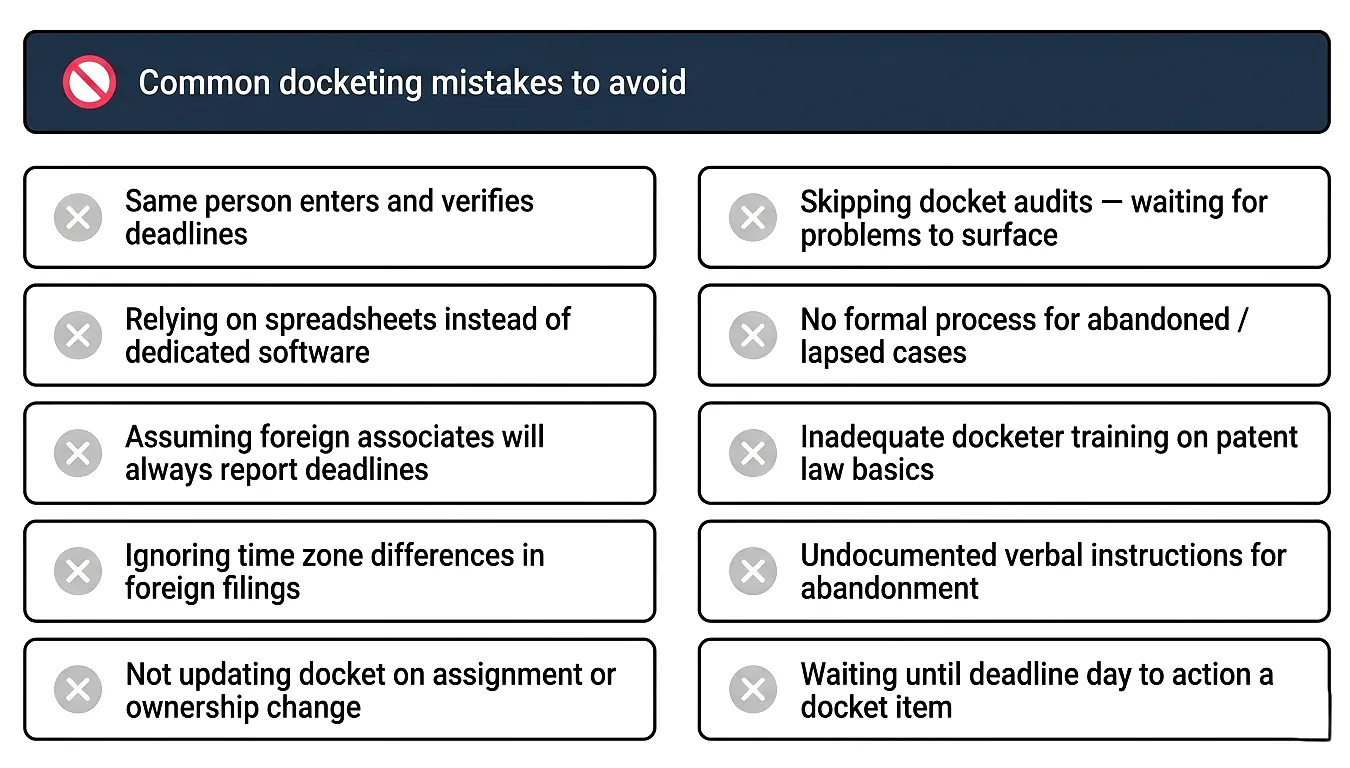
- Relying on a single person to both enter and verify deadlines
- Using spreadsheets or manual calendars instead of dedicated docketing software
- Failing to update the docket when an application changes hands or is reassigned
- Not accounting for time zone differences when calculating deadlines for foreign filings
- Assuming foreign associates will always report deadlines – they must be proactively managed
- Not having a formal process for abandoned cases – lapsed matters still need to be properly closed
- Skipping internal deadline reviews – waiting until the last day to action a docket item
- Inadequate training – docketing staff must understand patent law basics to catch errors
- Poor documentation of client instructions regarding abandonment or non-maintenance
- Not conducting regular docket audits to identify inconsistencies or open items
Frequently Asked Questions About Patent Docketing
1st Q: What is the difference between patent docketing and patent prosecution?
Patent prosecution refers to the legal process of filing and negotiating a patent application with a patent office. Patent docketing is the administrative function that tracks and manages all deadlines and actions within that process. Prosecution is the legal work; docketing is the management system that ensures the legal work gets done on time.
2nd Q: Can small law firms or solo practitioners do patent docketing without software?
While a very small practice managing only a handful of patents might use spreadsheets initially, this approach carries significant risk and is not recommended. Even a modest portfolio of 20–50 active patents will generate dozens of deadlines requiring careful tracking – and missing even one can have severe consequences. Affordable docketing software designed for small practices is readily available and worth the investment.
3rd Q: What happens if a patent maintenance fee is missed?
In the United States, a missed maintenance fee results in the patent lapsing. However, there is typically a 6-month grace period after the due date during which the fee can be paid with a surcharge. After this grace period, a petition for revival may be possible if the delay was unintentional. The rules and revival options vary significantly by jurisdiction, which is why proactive docketing is essential.
4th Q: How far in advance should docketing reminders be set?
Best practice is to set the first reminder at least 3–6 months before major deadlines (such as national phase entries) and 4–6 weeks before standard prosecution deadlines. The final reminder should be sent 3–5 business days before the deadline, with escalation protocols if the responsible party has not confirmed action.
5th Q: Is patent docketing a specialized profession?
Yes. Dedicated patent docketing specialists – often called patent docketers or IP docketing administrators — are trained professionals with deep knowledge of patent office rules across jurisdictions, docketing software, and IP workflow management. Many hold specialized certifications and are integral members of law firm and corporate IP teams.
Patent Docketing is the Foundation of IP Success
Patent docketing is not a back-office function – it is a mission-critical discipline that sits at the heart of every successful IP practice. Without it, even the most well-drafted patent applications and the most diligent attorneys cannot prevent the loss of valuable patent rights.
From understanding what patent docketing is at a foundational level, to implementing best practices and choosing the right software or outsourcing partner, every IP professional needs to take docketing seriously.
At Teak IP Services, we have built our practice around the principle that exceptional patent docketing is the foundation on which all IP success is built. Whether you are looking to strengthen your internal processes or explore the benefits of outsourcing, our team is ready to help.
Our Services: Expert Patent Docketing Services

