
Quick answer: A federal register search only shows marks that someone has filed or registered with the USPTO. A common law trademark search finds unregistered brands that are already in real use, and those users can still block, challenge, or force you to abandon your name. That gap is the core of common law trademark search importance.
A company spends six months building a brand. The logo is finished, the domain is live, and the packaging is printed. Then a cease-and-desist letter arrives from a small business in another state that has used the same name for eight years. That business never filed anything with the USPTO. The federal register showed a clean path, yet the legal risk was real all along.

This scenario explains common law trademark search importance better than any definition. The federal register is a useful starting point, but it is only a partial map of who owns rights in a brand name. Rights in the United States begin with use, not with registration. Therefore, a search that stops at the register leaves out the businesses most likely to surprise you.
In this guide, you will learn what common law trademark rights are, where the federal register falls short, and how a proper common law search works step by step. You will also see a comparison table, a risk matrix, common mistakes, and expert tips that our team applies when clearing brand names for clients.
What is a Common Law Trademark?
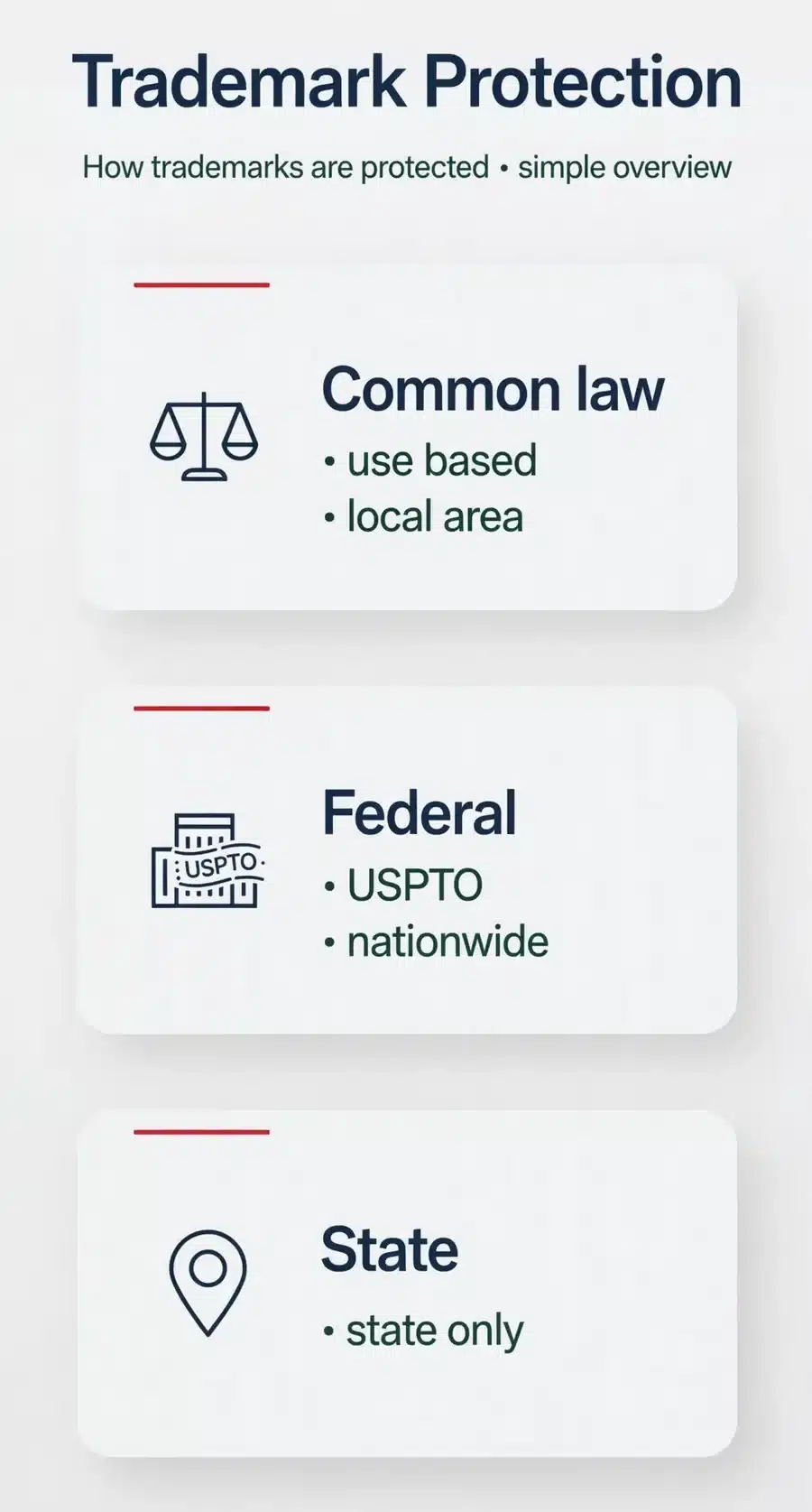
A common law trademark is a trademark right that arises from actual use of a mark in commerce, without any registration. In the United States, the first party to use a mark in connection with goods or services generally gains priority in the geographic area where that use occurs.
Here is a short definition you can quote:
- Common law trademark: an unregistered trademark right based on real-world use of a name, logo, or slogan to identify the source of goods or services.
- Federal registration: a recorded claim at the USPTO that gives nationwide constructive priority from the filing date, subject to earlier users.
- State registration: a registration with a state office that covers that state only.
Common law rights are real rights. Courts enforce them under state law and under Section 43(a) of the Lanham Act, which protects unregistered marks against false designation of origin. You can read the statute on the Cornell Legal Information Institute page for 15 U.S.C. 1125.
How Common Law Rights Are Created
Common law rights do not require a form, a fee, or a filing. They develop through consistent use. Typically, several signals show that a business has built them:
- Selling products or services under the mark
- Advertising the mark to customers in a defined area
- Using the mark on packaging, signage, invoices, or websites
- Building customer recognition and goodwill over time
How Far Common Law Rights Reach
Common law rights are generally limited to the geographical area where a trademark is used and has become known to customers. For example, a bakery operating in Ohio does not automatically gain control over the same name in Oregon simply because it uses that name first in its local market. However, the local owner can still take action against a later user operating within its established trading area. In some situations, the earlier user may also challenge a federal registration if it conflicts with their existing trademark rights.
For this reason, geographical limitations do not mean that an earlier user can be ignored or treated as harmless. Even a small local business with an earlier start date can create challenges for a company planning to expand its brand nationally. This can become particularly important when your marketing activities reach customers in that local area through online platforms.
What the Federal Register Does Not Show
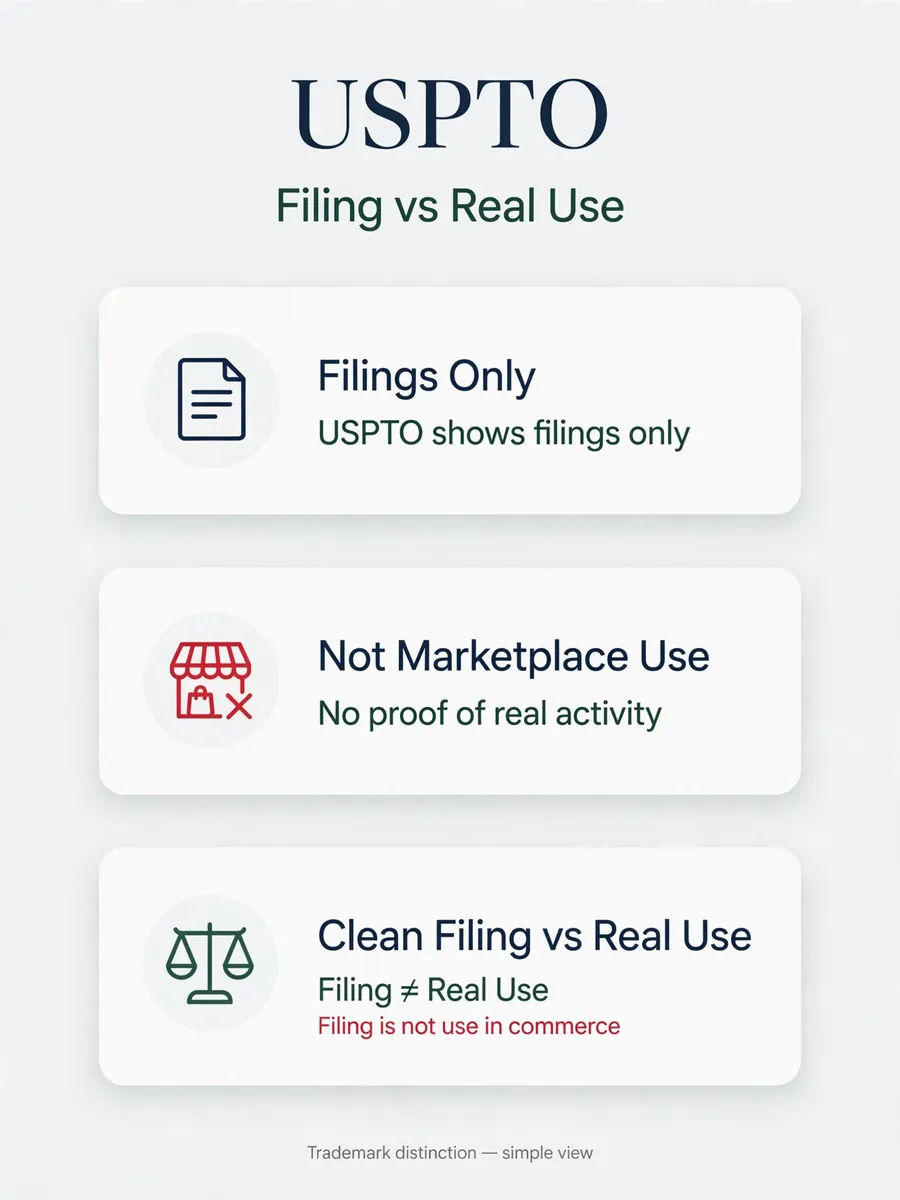
The USPTO database is a record of filings. It is not a record of the marketplace. Consequently, a clean result there only tells you that no one has filed a conflicting application, not that no one is using a conflicting mark.
According to the USPTO trademark search guidance, the official search system covers federal applications and registrations. It does not search unregistered names, business directories, domain names, or social media handles.
Here is what stays invisible when you only check the federal register:
- Unregistered brands: small businesses that never filed
- State registrations: marks recorded with a Secretary of State
- Business entity names: companies registered as LLCs or corporations
- Trade names and DBAs: names used locally under assumed-name filings
- Domain names: websites trading under a similar name
- Social media handles: brands that live on Instagram, TikTok, or Amazon storefronts
- App store listings: software and apps that never reached the USPTO
- Pending foreign filings: priority claims that may reach the United States
The Examiner Does Not Search for Common Law Users
This point surprises many founders. A USPTO examining attorney reviews your application against the federal register.
The examiner does not typically search for unregistered users. As a result, your application can pass examination, get published, and even register, while an earlier common law user remains free to challenge it.
In other words, a registration is not proof that your name is safe. It simply shows that the examiner found no conflict on the register. A prior user can still oppose your application during the opposition period or petition to cancel the registration late
A Practical Example
Consider a hypothetical skincare startup. Its name returns zero hits on the federal register. A common law sweep, however, turns up a salon in Texas that has sold skincare products under a nearly identical name for six years, plus an active Etsy store using the same word. Neither one ever filed. Both are legitimate prior users, and both can cause trouble.
Why Common Law Trademark Search Importance Is Growing
Fifteen years ago, a local business might never cross paths with a national brand. Today, search engines, marketplaces, and social platforms put every brand in front of every customer. Therefore, the odds of a collision keep rising.
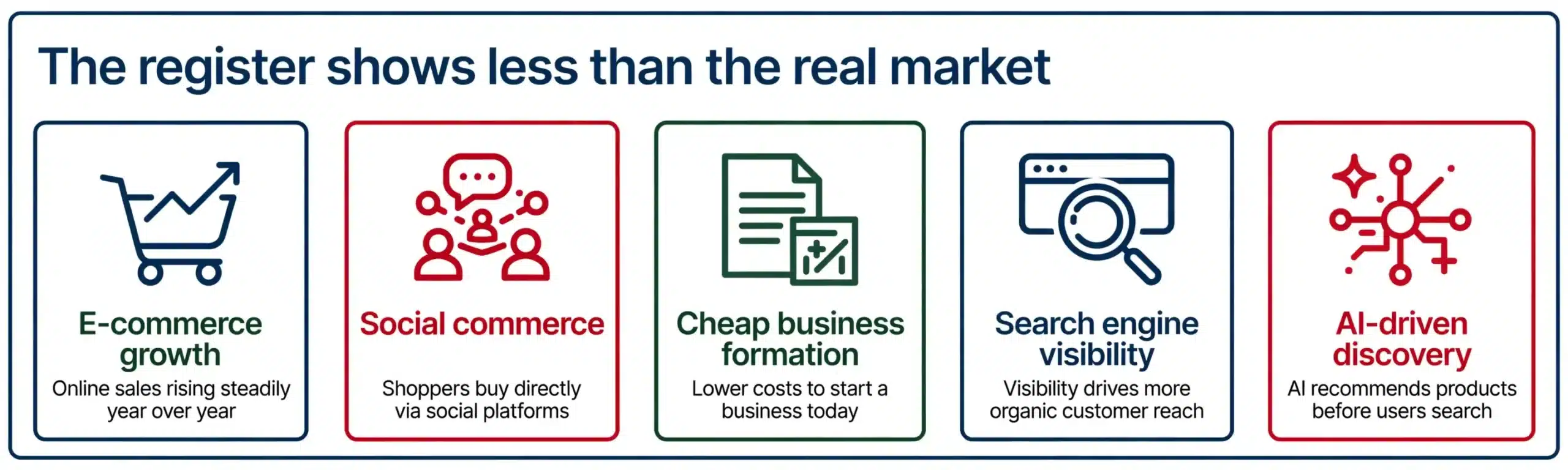
Several trends make common law trademark search importance greater than ever:
- E-commerce growth. Small sellers launch on Amazon, Shopify, and Etsy without filing anything.
- Social commerce. Brands build real goodwill on social platforms long before they consider registration.
- Cheap business formation. Anyone can form an LLC or register a domain in minutes.
- Search engine visibility. Customers find confusingly similar brands side by side in results.
- AI-driven discovery. Answer engines surface brand names from anywhere on the web, not only from official registers. Consequently, a conflict that once stayed local becomes visible to everyone.
Because of these trends, the register shows a shrinking share of the true brand landscape. Meanwhile, the cost of a rebrand grows with every month you operate under a risky name.
The Business Cost of Getting It Wrong
A name conflict rarely stays small. Typical consequences include:
- Legal fees for responding to a demand letter
- Lost inventory, packaging, and signage
- Domain and social handle changes
- Delays to product launches
- Damage to customer trust and search visibility
Furthermore, investors and acquirers often ask for clearance evidence during due diligence. A missing common law search can slow a funding round or reduce a company’s valuation.
Federal Register Search vs. Common Law Search
Both searches matter, but they answer different questions. The table below compares them side by side.
| Feature | Federal Register Search | Common Law Search |
|---|---|---|
| What it covers | USPTO applications and registrations | Unregistered marks in real-world use |
| Main sources | USPTO trademark search system | Web, social media, marketplaces, business records, state databases |
| Who can be found | Parties that filed with the USPTO | Parties that never filed anything |
| Geographic scope | National records | Local, regional, and online use |
| Speed | Fast, often minutes | Slower, requires analysis |
| Structure of results | Clean, standardized records | Unstructured, needs judgment |
| Main risk it reduces | Examiner refusal under Section 2(d) | Opposition, cancellation, infringement claims |
| Typical blind spot | Marks in use but not filed | Marks filed but not yet used |
| Best used | As a first knockout screen | Before launch and before filing |

As the table shows, neither search replaces the other. A smart clearance strategy layers them. First, you screen the federal register for obvious conflicts. Then, you run a common law search to find the risks that the register cannot reveal.
For a closer look at how search types differ in depth, see our guide on what a pre-filing trademark clearance search involves.
Which Search Matters More?
For avoiding an examiner refusal, the federal register matters more. For avoiding a lawsuit, an opposition, or a forced rebrand, the common law search often matters more. Since lawsuits cost far more than refusals, many practitioners treat the common law search as the higher-stakes step.
That is the reason behind the title of this article. The federal register tells you whether the USPTO will approve your application. A common law search tells you whether you can safely use the brand.
The Legal Risks of Skipping a Common Law Search
Understanding the legal risks makes the case for common law trademark search importance concrete. Each risk below traces back to a prior user who never registered.
Risk 1: Opposition to Your Application
After the USPTO publishes your application, any party who believes they will be damaged can file a notice of opposition at the Trademark Trial and Appeal Board (TTAB). A common law user with earlier rights can bring that challenge. You can review the process on the USPTO TTAB page.
Risk 2: Cancellation of Your Registration
Even after registration, a prior user can petition to cancel your mark within certain time limits. Early challenges are more flexible. As the registration ages, grounds narrow, and incontestability under 15 U.S.C. 1065 can limit some claims. Nevertheless, the cost of defending a cancellation proceeding can be significant.
Risk 3: Infringement and Unfair Competition Claims
A senior common law user can sue under state law and under Section 43(a) of the Lanham Act. The claim does not depend on a registration. It depends on priority and likelihood of confusion.
Risk 4: The Limited Area Defense and Its Consequences
A federal registration generally gives you nationwide rights, yet earlier users keep certain protections. Under 15 U.S.C. 1115(b)(5), a prior user can keep using a mark in the area where it used the mark before the registrant’s filing date. You can read that provision on the Cornell Legal Information Institute page for 15 U.S.C. 1115.
In practice, this means you may own a national registration but still share the market with a local senior user. That outcome can fragment your brand, complicate expansion, and weaken enforcement.
Risk 5: Loss of Expansion Territory
Constructive use priority under 15 U.S.C. 1057(c) gives you nationwide priority from your filing date, but it does not override earlier users. Accordingly, a common law user can block your entry into its territory. This matters most for franchises, retail chains, and consumer brands planning national growth.
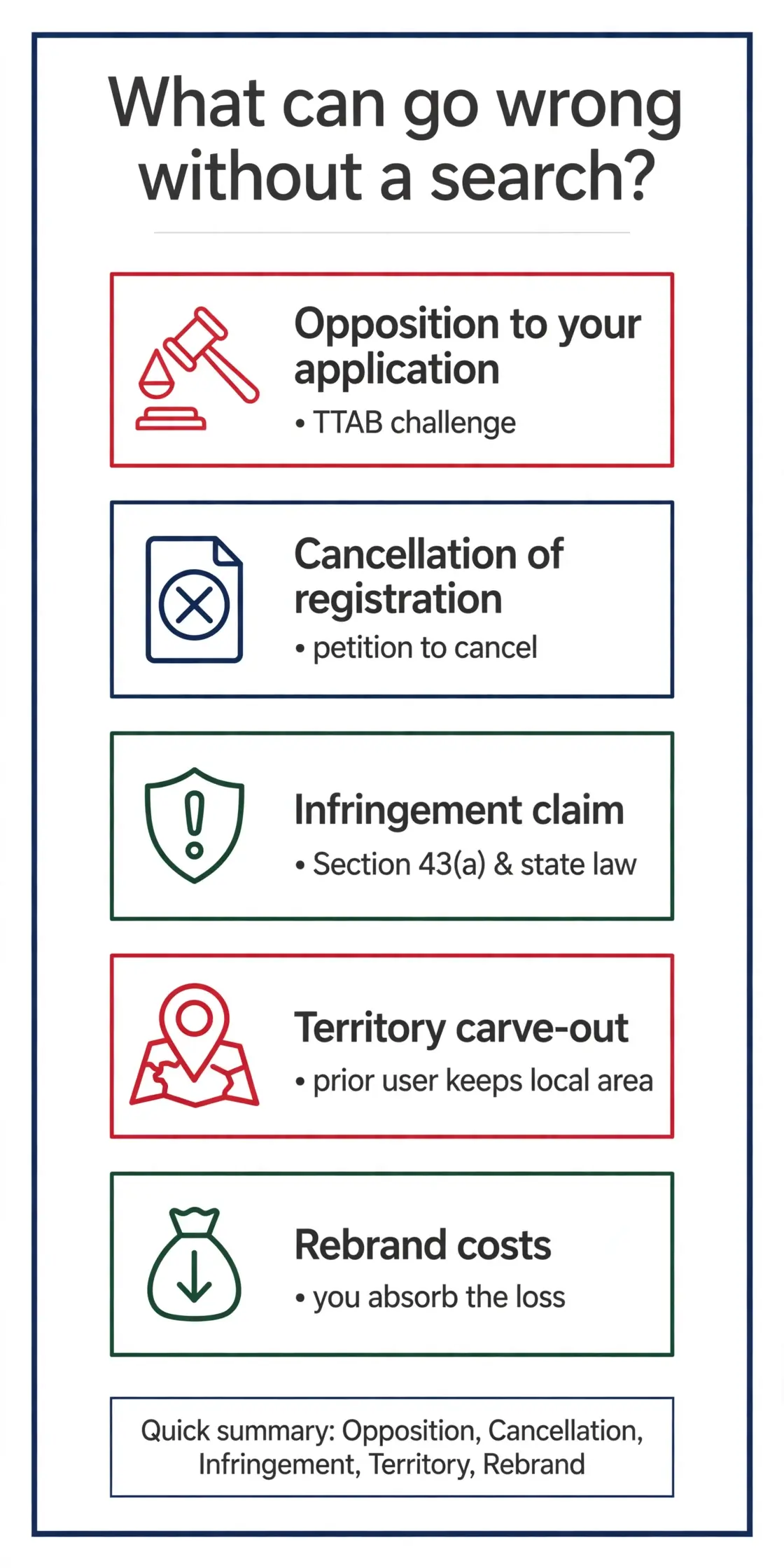
Quick Risk Summary
- Opposition: a prior user stops the application
- Cancellation: a prior user attacks the registration
- Infringement: a prior user sues for damages or an injunction
- Territory carve-out: a prior user keeps its local market
- Rebrand costs: you absorb the loss of the investment
Where to Run a Common Law Trademark Search
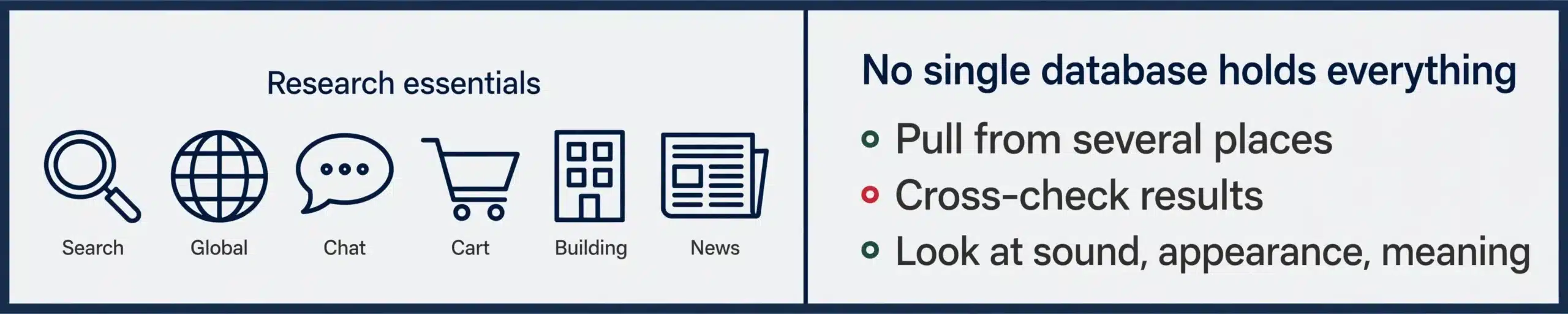
A thorough common law search checks many sources. No single database holds everything. Therefore, a methodical approach pulls from several places and cross-checks the results.
Core Sources to Check
Variations to Search
- Search engines: Google and Bing for exact and similar names
- Domain registries: WHOIS records and live websites
- Social media: Instagram, Facebook, TikTok, LinkedIn, X, and YouTube
- Marketplaces: Amazon, Etsy, eBay, Shopify stores, and app stores
- State trademark databases: each Secretary of State office
- State business entity records: LLC and corporation names
- Trade name filings: county and city assumed-name records
- Industry directories: trade associations, review sites, and local listings
- News and press releases: product launches and funding announcements
- Trade publications: niche magazines and catalogs
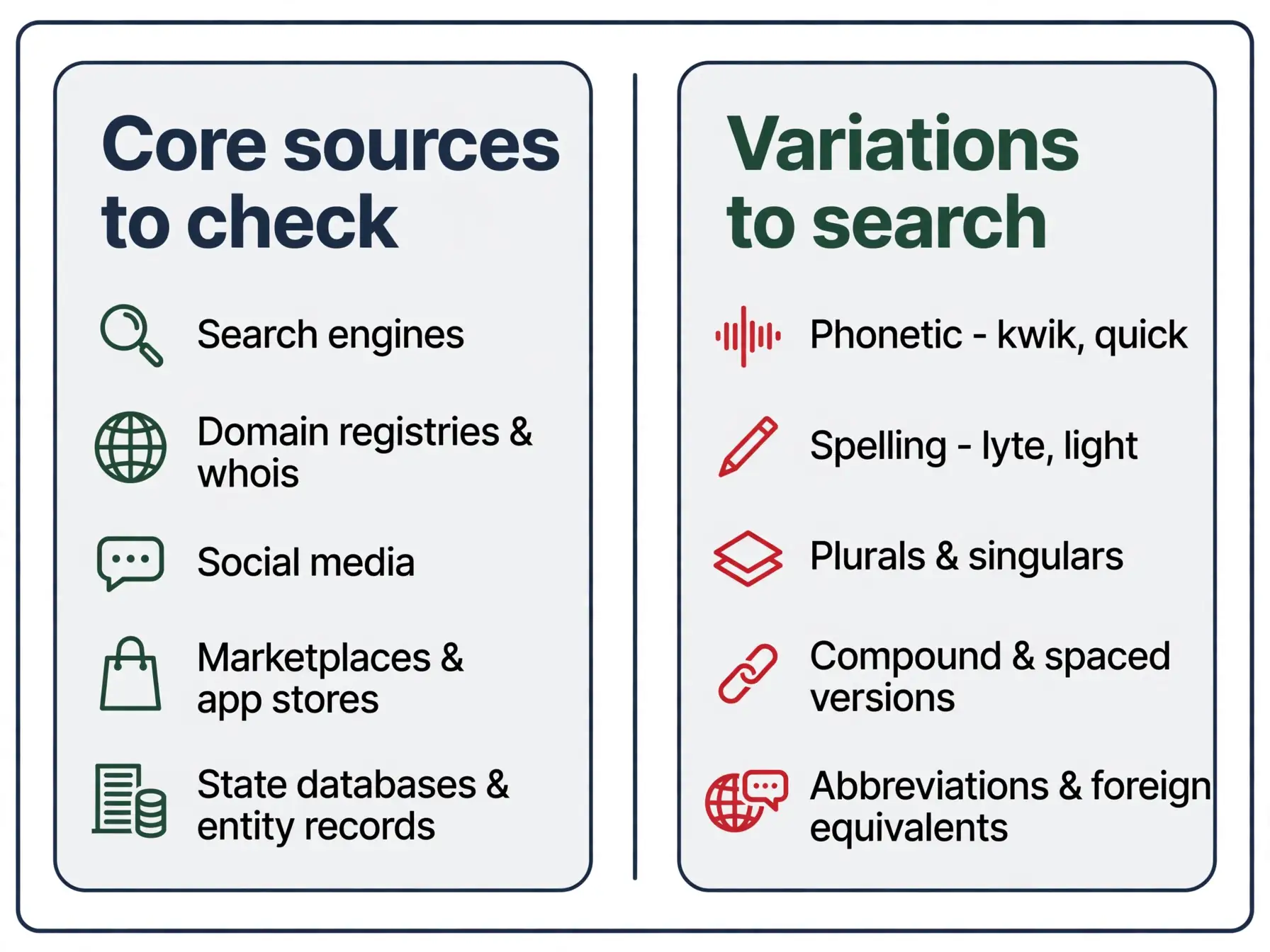
Exact matches are usually easy to identify during a trademark search. However, the real risk often lies in similar variations that may not look identical at first. Search for:
- Phonetic equivalents (Kwik, Quick)
- Spelling changes (Lyte, Light)
- Plurals and singular forms
- Compound words and spaced versions
- Foreign language equivalents
- Abbreviations and acronyms
- Design elements and logo similarities
Because confusion turns on sound, appearance, meaning, and commercial impression, a good search looks at all four. Our team explains this analysis further in the article on what is inside a comprehensive trademark search report.
Step-by-Step: How to Conduct a Common Law Trademark Search
Follow this numbered process to run a practical search. Each step builds on the last, and the full sequence can take a few hours for a simple name or several days for a complex one.
- Define the mark and the goods or services. Write down the exact name, any logo, and the products or services you will offer. Likelihood of confusion depends on relatedness, so detail matters.
- Identify related fields. List the industries that overlap with yours. A coffee brand should also check bakery, restaurant, and beverage names.
- Run a federal register knockout search. Use the USPTO system to find identical and similar filings. This step removes obvious conflicts early.
- Search the open web. Query the exact name, spelling variants, and phonetic versions. Review at least the first several pages of results, not only the first page.
- Check domains and websites. Look for live sites using the name in related fields. Capture screenshots and dates.
- Review social platforms and marketplaces. Search handles, store names, and product listings. Record follower counts and sales indicators where visible.
- Search state trademark and business records. Check each state where you plan to operate, starting with your home state and your largest markets.
- Search trade names and local records. Local assumed-name filings often reveal small operators the web hides.
- Document each potential conflict. Record the owner, location, goods or services, first-use evidence, and URLs.
- Rank each conflict by risk. Score similarity of the marks, relatedness of the goods, and strength of the other user’s rights.
- Decide: proceed, modify, or abandon. Choose a clear action for each high-risk finding.
- Repeat before launch. New users appear constantly, so refresh the search close to your filing and launch dates.
For many businesses, this process sits alongside a formal pre-filing clearance review. Our article on the difference between a trademark search and trademark monitoring explains how the one-time search and the ongoing watch fit together.
How to Read and Score Your Results
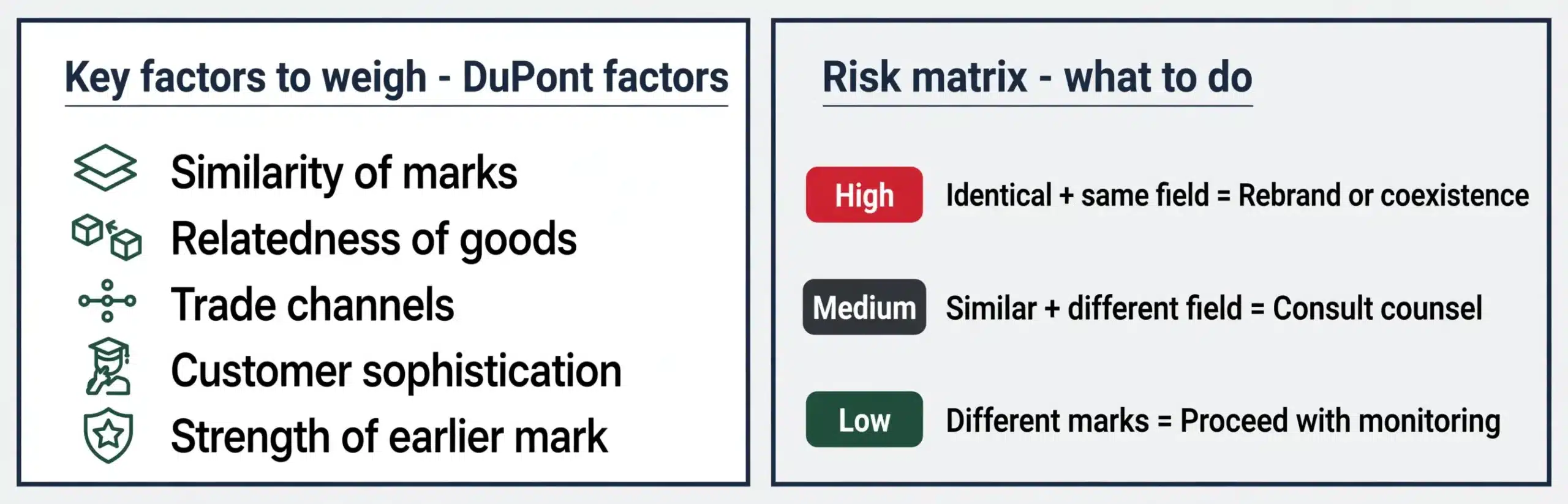
Finding a similar mark does not mean you must abandon yours. Instead, you weigh the facts. Practitioners typically use factors drawn from the case law on likelihood of confusion, often called the DuPont factors after In re E. I. du Pont de Nemours & Co.
Key Factors to Weigh
- Similarity of the marks: sound, appearance, meaning, and impression
- Relatedness of the goods or services: do customers expect one source for both?
- Trade channels: do both brands reach customers in the same places?
- Customer sophistication: do buyers pay careful attention, or buy on impulse?
- Strength of the earlier mark: distinctive names deserve broader protection
- Evidence of actual confusion: misdirected emails and mistaken reviews count
- Crowded field: many similar marks in use can narrow protection for each
Risk Matrix
Use this simple matrix to prioritize what you find.
| Mark similarity | Goods relatedness | Prior user strength | Suggested risk level | Typical action |
|---|---|---|---|---|
| Identical | Same or closely related | Long use, strong presence | High | Rebrand or seek a coexistence agreement |
| Identical | Different field | Moderate use | Medium | Consult counsel, review expansion plans |
| Similar | Same field | Strong presence | High | Modify the mark or negotiate |
| Similar | Different field | Minimal use | Low to Medium | Proceed with monitoring |
| Different | Any | Any | Low | Proceed |
For a visual example of how similarity and relatedness combine, our guide on trademark search report samples shows what professional reports look like in practice.
Documenting Your Decision
Keep a written record of the search date, sources checked, findings, and your reasoning. Good documentation supports a good-faith defense if a dispute arises later. It also helps investors and acquirers who ask for clearance evidence.
Common Mistakes in Common Law Trademark Searches
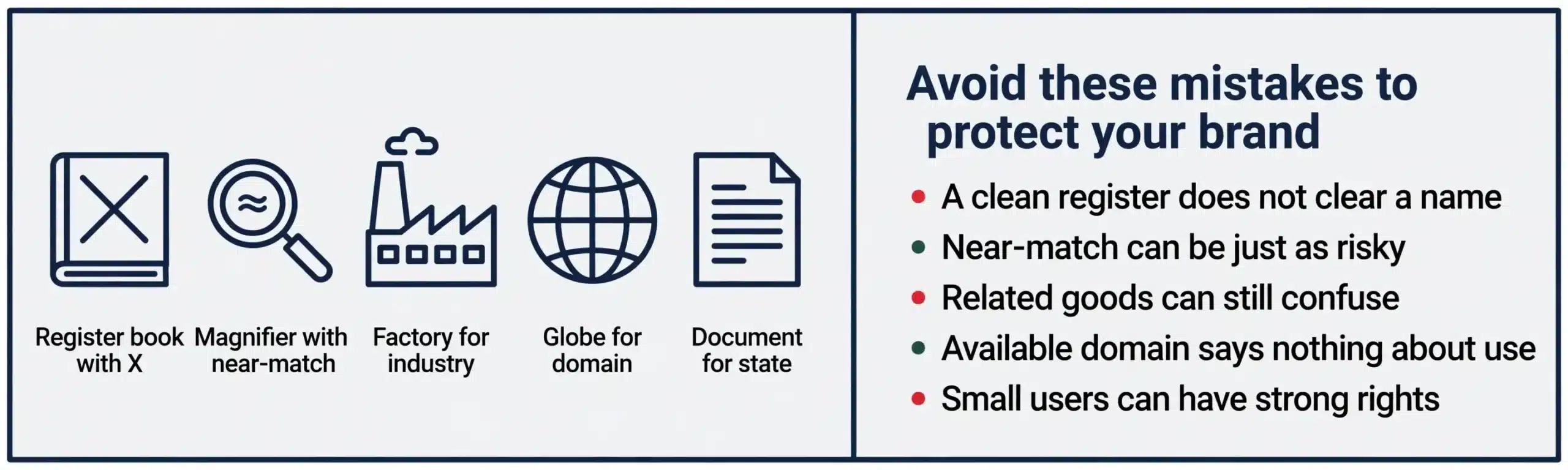
Even careful founders make errors. Our team sees the same patterns again and again. Avoid these mistakes to protect your brand.
- Stopping at the federal register. This is the most common mistake and the central point of this article. A clean register does not clear a name.
- Searching only for exact matches. Confusing similarity matters more than identity. A near-match can be just as risky.
- Ignoring different industries. Related goods and services can still trigger confusion, even when the industries seem separate.
- Relying on domain availability. An available domain says nothing about prior use. Many businesses operate without owning their exact domain.
- Skipping state and local records. Many small senior users appear only in state databases or county filings.
- Overlooking social media and marketplaces. Modern brands often live on platforms, not on websites.
- Treating a free tool as a full search. Automated tools can miss phonetic variations and unstructured sources.
- Failing to document findings. Without records, you cannot demonstrate diligence later.
- Searching once and never again. New users enter the market daily, so an old search loses value.
- Assuming small users are harmless. A small business with earlier use can still carry strong legal rights in its area.
A Related Pitfall: Keyword Use in Online Search
Brand conflicts also show up in advertising. Competitors sometimes bid on another brand’s name as a keyword. Our article on trademark infringement of keywords in an online search covers how courts have approached that issue, which is useful context when you review how similar brands appear in search results.
Expert Tips From Practitioners
Experience shapes how professionals approach clearance. These tips come from the patterns that matter most in real searches.
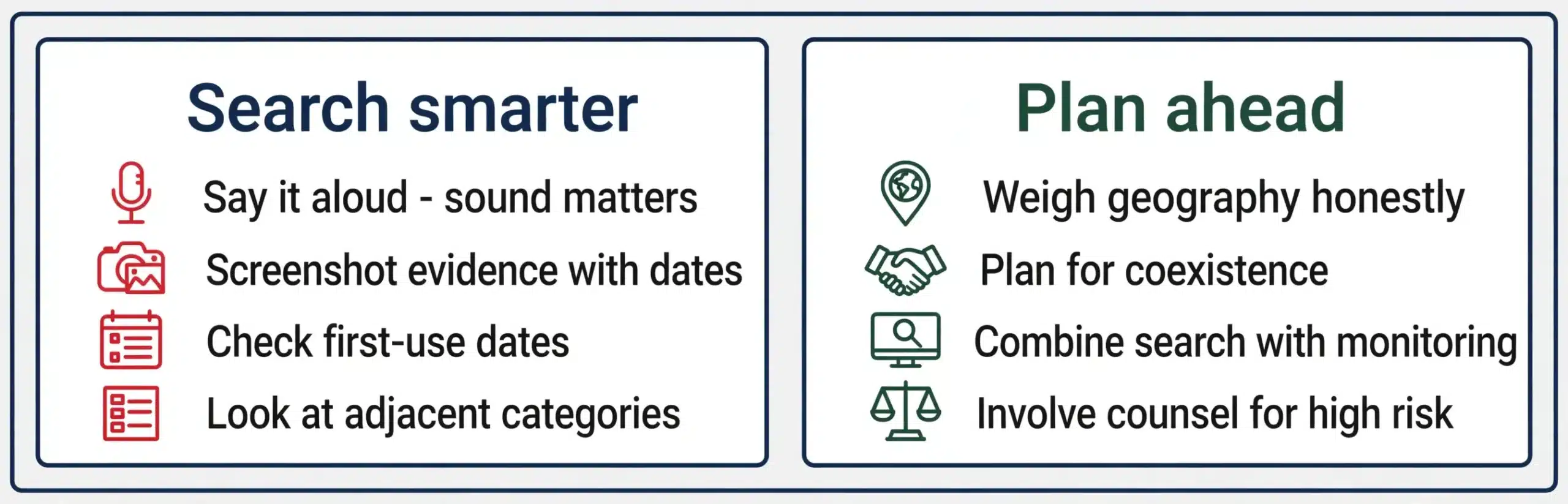
- Search by sound, not only spelling. Say the name aloud, then list every way a customer could spell or mishear it.
- Capture evidence as you search. Take dated screenshots of websites, listings, and profiles. Pages change or disappear quickly.
- Look at first-use dates. Priority depends on who used the mark first. Archive services, press releases, and early reviews can help establish dates.
- Check adjacent categories. Consumers often expect related products to share a source. Therefore, brands in neighboring fields deserve attention.
- Weigh geography honestly. A local user in a market you plan to enter is a bigger risk than a distant one.
- Plan for coexistence. Some conflicts end well. A coexistence agreement can define territories and fields, and it can be cheaper than a fight.
- Combine search with monitoring. A one-time search gives a snapshot. A watch service flags new conflicts as they appear.
- Involve counsel for high-risk results. A search report informs a decision, but a licensed attorney should advise on legal strategy.
Experience From the Docket
Teams that manage large portfolios see the downstream cost of weak clearance. A conflict found late often triggers office actions, oppositions, or renewals that depend on unclear facts. For an inside view of how those deadlines pile up, read our look at a day in the life of a trademark portfolio manager.
When to Hire a Professional Search Provider
A do-it-yourself search is a reasonable first pass for a simple, low-stakes name. However, several situations justify professional help.
Signs You Need Professional Support
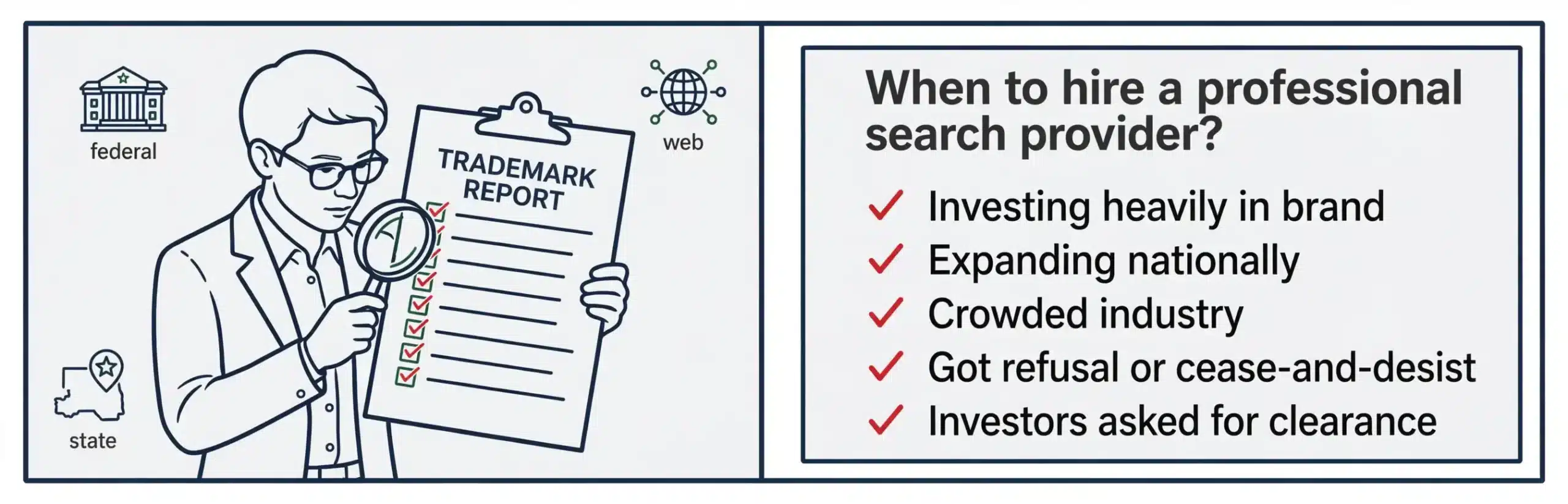
- You are investing heavily in the brand, packaging, or marketing
- You plan to expand nationally or internationally
- Your industry is crowded with similar names
- You received a cease-and-desist or a USPTO refusal
- Investors or acquirers have asked for clearance evidence
- Your team lacks time to review dozens of results
What a Professional Search Adds
A trained search professional brings tools, access to proprietary databases, and judgment. Specifically, a professional report typically offers:
- Federal, state, and common law coverage in one document
- Analysis of phonetic and visual variations
- Ranked results with explanations
- Documentation you can use for diligence
Our trademark search services cover federal, state, and common law sources with a structured report your attorney can review. If you want to keep watching for new conflicts after launch, our trademark monitoring services help flag them early.
Law firms and in-house teams that outsource clearance work should also vet their partners carefully. Our guide to choosing a virtual trademark paralegal partner explains what to look for.
Quick Reference: Common Law Search Checklist
Use this bullet summary as a final pre-launch check.
- [ ] Federal register knockout search completed
- [ ] Exact, phonetic, and spelling variants searched
- [ ] State trademark and business records checked
- [ ] Domains, social media, and marketplaces reviewed
- [ ] Trade names and local records searched
- [ ] Evidence captured with dates and URLs
- [ ] Conflicts ranked by risk
- [ ] Decision documented
- [ ] Search refreshed before filing and launch
- [ ] Monitoring planned after launch
FAQ
What is the importance of a common law trademark search?
Common law trademark search importance comes from one fact: rights in the United States arise from use, not only from registration. A common law search finds unregistered users who could oppose your application, challenge your registration, or sue you. Without it, you only see part of the risk.
Is a federal trademark search enough before launching a brand?
No. A federal search shows USPTO filings only. It misses unregistered brands, state registrations, business names, domains, and social media accounts. For a safe launch, add a common law search to the federal search.
Does a USPTO registration protect me from prior common law users?
Not completely. A registration gives nationwide priority from your filing date, but earlier users keep certain rights, including in their local trading area. A prior user may also challenge your application or registration through opposition or cancellation.
How do I search for common law trademarks?
Search the open web, domain records, social media, marketplaces, state trademark databases, state business records, and local trade name filings. Include spelling and sound variations. Record each potential conflict with the owner, location, goods or services, and evidence of use. Our step-by-step process above lists the full sequence.
Can a small local business stop a national company from using a name?
Sometimes. A local business with earlier use can protect its trading area and may oppose or challenge a later federal filing. The outcome depends on priority, the relatedness of goods, and the strength of the local user’s rights. Because the facts vary, you should consult a trademark attorney.
How long does a common law trademark search take?
A simple do-it-yourself screen can take a few hours. A comprehensive professional search often takes several business days because analysts review many sources and analyze variations. Timing also depends on how crowded your industry is.
What is the difference between a common law search and a trademark watch?
A common law search is a one-time review of existing use before you adopt or file a mark. A trademark watch is an ongoing service that flags new filings or uses after launch. Many brands use both; you can read more in our guide to search versus monitoring.
Should I do a common law search before or after filing?
Before. Searching first lets you change the name cheaply. After filing, a conflict can lead to refusals, oppositions, wasted fees, and a rebrand. Therefore, run the search before you commit to branding and file only after you review the results.
Are state trademark registrations part of a common law search?
Yes, practitioners usually include them. A state registration is not a federal registration, but it shows a party that claims rights in a state. Checking state databases helps you find local senior users who may be invisible on the federal register.
Do I need a lawyer to read the results?
You can gather and organize results yourself, but a trademark attorney should interpret high-risk findings. Likelihood-of-confusion analysis involves legal judgment, and the right strategy depends on your facts. This article is general information, not legal advice.
Conclusion
The federal register answers an important question: will the USPTO approve this application? It does not answer a more important one: can you safely build a business under this name? That second question is where common law trademark search importance becomes clear.
Because trademark rights begin with use, unregistered brands can hold legitimate rights that the register never shows. A prior user can oppose your application, challenge your registration, limit your territory, or force a rebrand. Each of those outcomes costs far more than a thorough search.
To protect your investment, follow a layered approach:
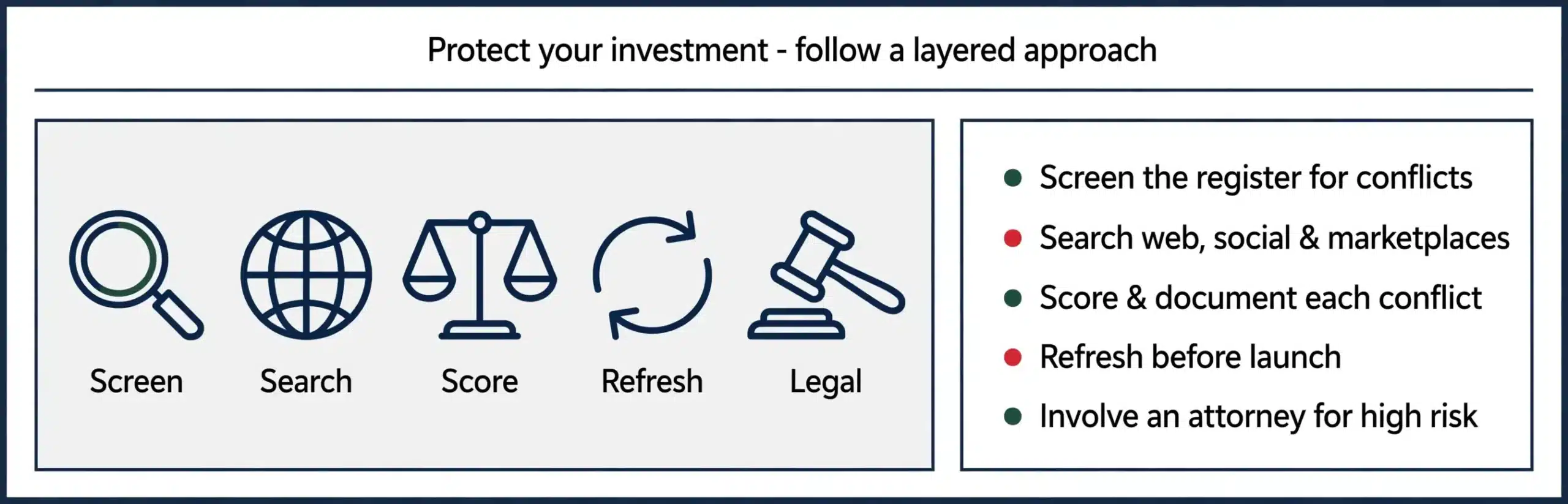
- Screen the federal register for obvious conflicts.
- Run a full common law search across the web, social media, marketplaces, and state records.
- Score each conflict and document your decision.
- Refresh the search before launch and monitor afterward.
- Involve a trademark attorney for any high-risk result.
Teak IP Services supports law firms, in-house teams, and businesses with structured trademark search and monitoring work. If you want a clearer picture of your brand’s risk before you file, contact the Teak IP team to discuss a federal, state, and common law search.
Know Your Brand Risk Before You File
Teak IP Services supports law firms, in-house teams, and businesses with structured trademark search and monitoring work. If you want a clearer picture of your brand’s risk before you file, talk to the Teak IP team about a federal, state, and common law search.
Federal, State & Common Law Search | For law firms, in-house teams & businesses

