
Every IP director eventually asks the same question during budget season: is the in-house team still the most cost-effective way to manage a growing patent and trademark portfolio? The honest answer, for most mid-size and large IP departments, is no. The IP portfolio management outsourcing cost conversation has moved from a nice-to-have line item to a board-level decision, and finance leaders want numbers, not vague promises.

This guide breaks down exactly what outsourcing IP portfolio management costs in 2026, how the transition process actually works, and the ROI math that IP directors, CFOs, and general counsel can use to justify (or challenge) the investment. Rather than generic marketing claims, you will find pricing structures, comparison tables, common mistakes, and a step-by-step framework you can bring straight into your next budget meeting.
By the end, you should be able to answer three questions with confidence: what will this cost my organization, what does the transition process actually involve, and how quickly will the investment pay for itself.
What is IP Portfolio Management Outsourcing?
IP portfolio management outsourcing is the practice of delegating some or all of the administrative, docketing, and lifecycle-management functions of a patent and trademark portfolio to a specialized third-party provider, rather than staffing those functions entirely in-house.
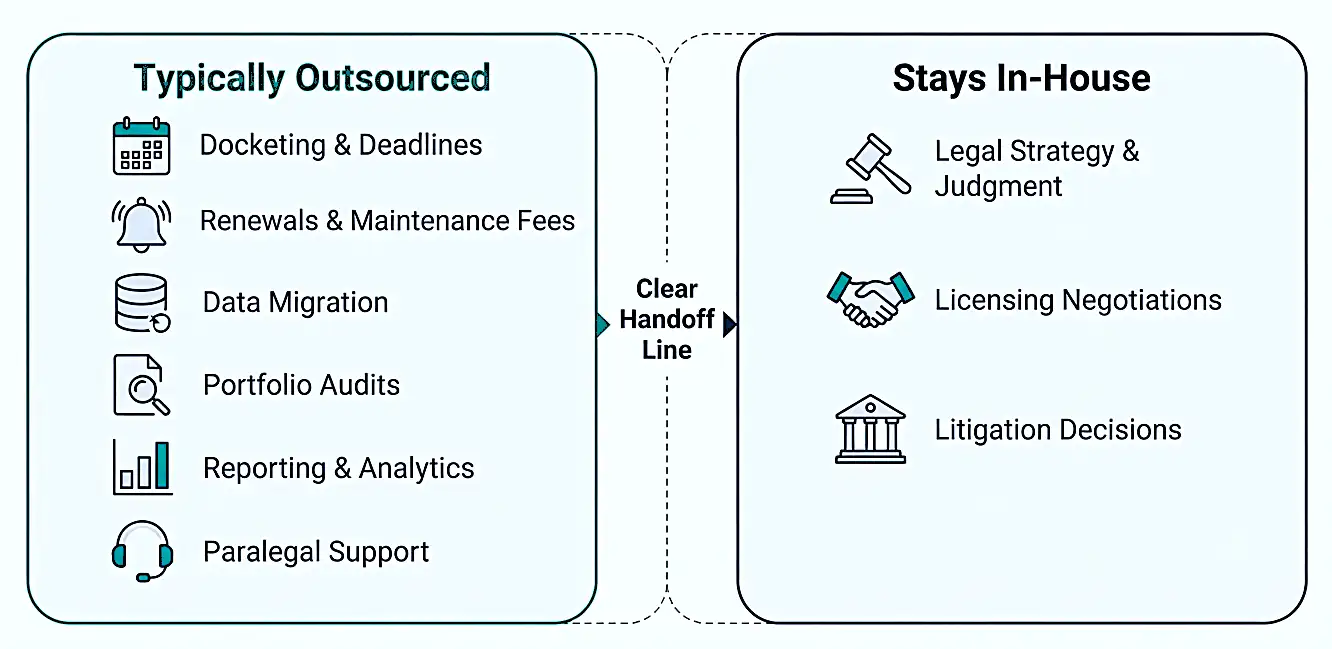
In practice, this usually covers:
- Docketing and deadline tracking across jurisdictions
- Renewal and maintenance fee management
- Data migration between docketing systems
- Portfolio audits and data cleanup
- Reporting and analytics for budget forecasting
- Paralegal support for prosecution and office action logistics
Outsourcing does not typically replace outside counsel or in-house attorneys who make substantive legal decisions. Instead, it replaces (or supplements) the operational backbone that keeps a portfolio compliant, current, and audit-ready.
Why the Cost Conversation Matters Now
Corporate IP portfolios have grown faster than most legal department budgets. Filing volumes tracked by the World Intellectual Property Organization have continued climbing globally in recent years, which means more docketed matters, more renewal deadlines, and more administrative overhead for every IP department, regardless of headcount.
At the same time, hiring and retaining experienced IP paralegals and docketing specialists has become harder and more expensive. That combination, rising filing volume and rising labor costs, is exactly why the IP portfolio management outsourcing cost question keeps landing on CFO desks.
Three forces are driving this conversation in 2026:
- Headcount freezes. Many legal departments cannot add full-time staff even as portfolio size grows.
- Deadline risk exposure. A single missed renewal or response deadline can cost far more than a year of outsourcing fees.
- Budget scrutiny. Finance leaders now expect legal operations to justify spend with the same rigor as any other department.
How Much Does IP Portfolio Management Outsourcing Cost?
There is no single number that applies to every organization, but most providers price IP portfolio management outsourcing using one of four models. Understanding each model is the fastest way to compare quotes accurately.
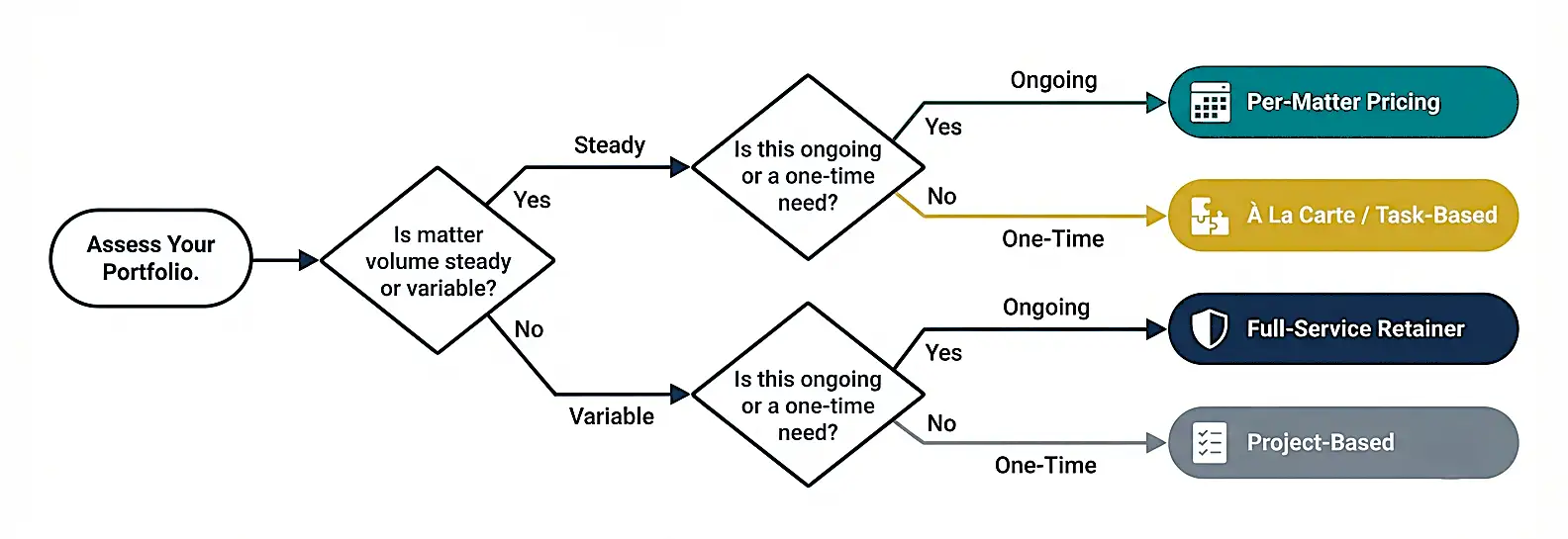
1. Per-Matter or Per-Docket Pricing
You pay a flat fee per patent or trademark matter managed, typically ranging from $8 to $35 per matter per month, depending on jurisdiction complexity and service scope. This model works well for portfolios with predictable, steady matter counts.
2. À La Carte / Task-Based Pricing
You pay only for the specific tasks performed, such as a docketing entry, a renewal filing, or a data migration project. Hourly rates for experienced IP paralegals in this model generally fall between $25 and $65 per hour, depending on whether the work is performed onshore, offshore, or through a blended U.S./India delivery model.
3. Full-Service Retainer
A flat monthly or annual fee covers comprehensive portfolio management, including docketing, renewals, reporting, and a dedicated account team. Retainers commonly range from $3,000 to $25,000+ per month, scaling with portfolio size and complexity.
4. Project-Based Pricing
Used for one-time initiatives such as portfolio audits, docketing system migrations, or data cleanup projects. Pricing is quoted per project based on scope, often $5,000 to $75,000, depending on the number of matters and data quality issues involved.
IP Portfolio Management Outsourcing Cost Comparison Table
| Pricing Model | Typical Cost Range | Best For | Billing Frequency |
|---|---|---|---|
| Per-Matter/Docket | $8–$35 per matter/month | Steady, predictable portfolios | Monthly |
| À La Carte/Task-Based | $25–$65 per hour | Variable workloads, overflow support | As-needed |
| Full-Service Retainer | $3,000–$25,000+/month | Full outsourcing of docketing function | Monthly/Annual |
| Project-Based | $5,000–$75,000 | Audits, migrations, cleanup projects | One-time |
Note: Ranges reflect market benchmarks as of 2026 and vary by portfolio size, jurisdiction mix, and provider location. These figures are broadly consistent with staffing and rate benchmarks published in the AIPLA Report of the Economic Survey, which many legal operations teams use for budget planning. Request a detailed quote for your specific portfolio.
Key Factors That Influence IP Portfolio Management Outsourcing Cost
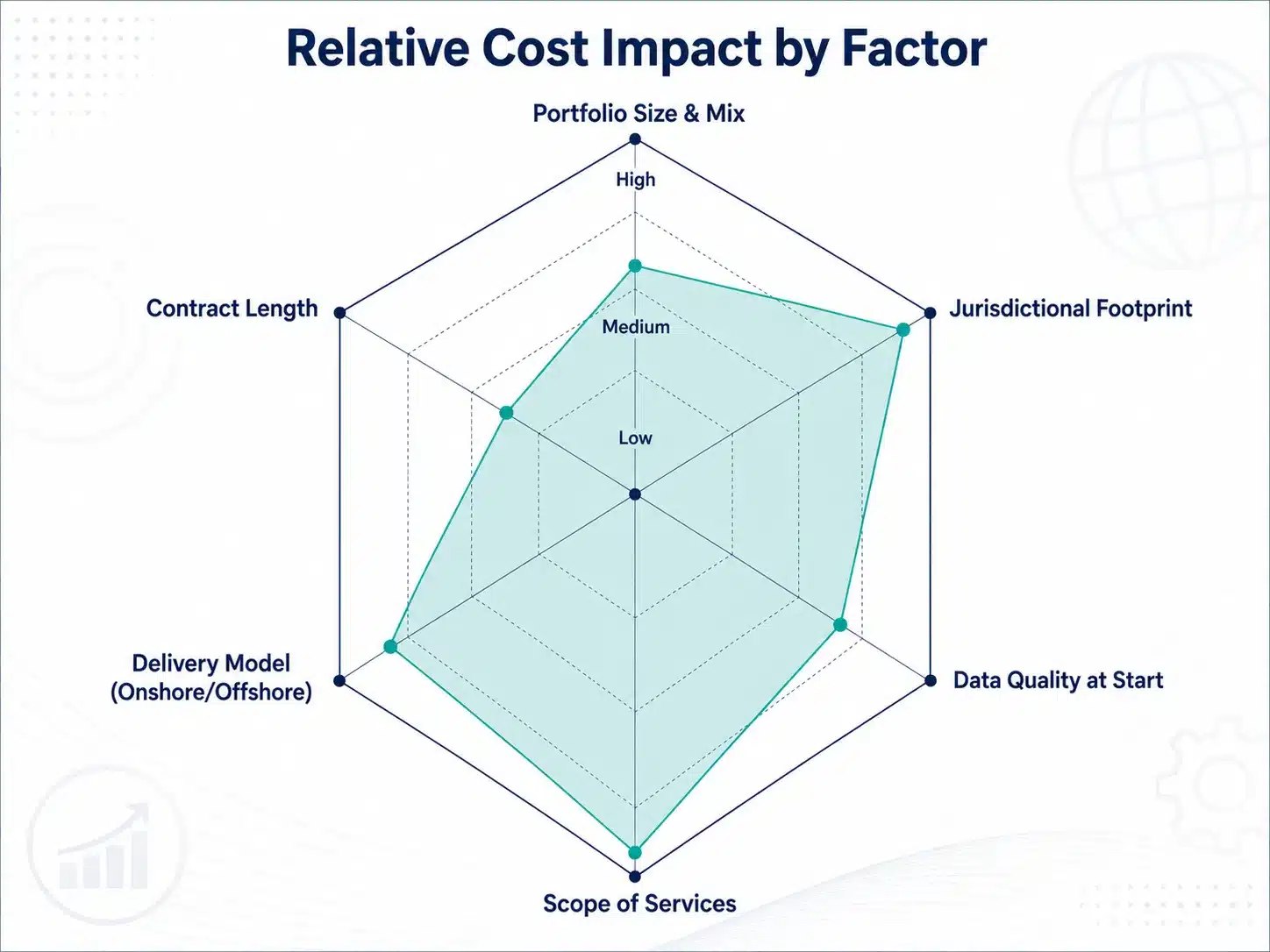
Two companies with similarly sized portfolios can receive very different quotes from the same provider. That is because pricing is not driven by matter count alone; it depends on several underlying variables. Understanding these factors helps you evaluate whether a quote is fair, high, or unusually low.
1. Portfolio Size and Matter Mix
A portfolio with 500 patents behaves very differently than one with 500 trademarks. Patents generally carry more complex deadline structures, including office action responses, IDS filings, and maintenance fee schedules, while trademarks involve renewal cycles and use-based filings like Section 8 and 15 affidavits. Providers typically price patent-heavy portfolios slightly higher due to this added complexity.
2. Jurisdictional Footprint
Domestic-only portfolios cost less to manage than portfolios spanning the United States, Europe, and Asia. Each jurisdiction has its own deadline rules, local agent requirements, and currency considerations, all of which add administrative overhead. A portfolio filed only through the USPTO will almost always cost less to outsource than one managed through the PCT patent process across multiple national phases.
3. Data Quality at the Start of the Engagement
Clean, well-organized docketing data migrates quickly and cheaply. Portfolios with duplicate entries, missing deadlines, or years of inconsistent recordkeeping require additional audit and cleanup hours, which increases upfront project costs even if ongoing management fees stay the same.
4. Scope of Services Included
Some organizations only need deadline tracking and renewal management. Others want full paralegal support, including office action logistics, IDS preparation, and reporting dashboards. Broader scope naturally increases cost, but it also reduces the burden on in-house staff.
5. Onshore, Offshore, or Blended Delivery Model
Providers using a blended U.S./India delivery model, where U.S.-based attorneys and account managers oversee offshore paralegal teams, typically offer lower rates than fully U.S.-based teams without sacrificing quality or oversight. This blended structure is one of the primary reasons outsourcing can cost 30 to 50 percent less than an equivalent in-house team.
6. Contract Length and Volume Commitments
Annual or multi-year retainers often come with better per-matter rates than month-to-month arrangements, since providers can allocate dedicated staff more efficiently when volume is predictable.
Hidden Costs of Keeping IP Portfolio Management In-House
When IP directors compare outsourcing quotes against internal budgets, they often underestimate the true, fully-loaded cost of an in-house team. Consider these frequently overlooked expenses:
- Recruiting and training costs. Replacing an experienced IP paralegal can take three to six months and cost thousands of dollars in recruiting fees and lost productivity.
- Software licensing and IT support. Docketing platforms, along with the IT infrastructure to support them, add recurring costs that outsourcing providers often absorb into their service fee.
- Coverage gaps during leave or turnover. A single-person docketing team creates a single point of failure; when that person is out, deadlines can slip.
- Malpractice and liability exposure. Missed deadlines caused by understaffed internal teams can lead to abandoned applications, malpractice claims, or client relationship damage for law firms.
- Opportunity cost of attorney time. When in-house attorneys spend hours on administrative docketing tasks instead of strategic portfolio decisions, that time carries a real, if indirect, cost.
Once these hidden costs are quantified, the case for outsourcing frequently becomes stronger than the sticker price alone would suggest.
In-House vs. Outsourced IP Portfolio Management: A Cost Comparison
Finance leaders often want a direct side-by-side view before approving a change in operating model. Here is how the two approaches typically compare.
| Cost Factor | In-House Team | Outsourced Provider |
|---|---|---|
| Average fully-loaded paralegal salary | $70,000–$110,000/year | Included in service fee |
| Benefits, training, overhead | 25–40% additional cost | Not applicable |
| Docketing software licensing | $10,000–$50,000+/year | Often included |
| Scalability during filing surges | Requires new hires | Flexible, on-demand |
| Coverage during vacation/turnover | Gaps in coverage | Built-in redundancy |
| Deadline-miss liability exposure | Concentrated in fewer staff | Distributed, quality-controlled |
| Time to scale up or down | Weeks to months | Days to weeks |
This is not an argument that in-house teams are inferior. Rather, it illustrates why so many IP departments now use a hybrid model: strategic decisions stay in-house, while high-volume administrative work moves to a specialized outsourcing partner. For a deeper look at how this decision plays out for individual roles, see our comparison of hiring an in-house versus virtual patent paralegal.
The IP Portfolio Management Outsourcing Process: Step-by-Step
Outsourcing IP portfolio management is not a single event; it is a structured transition. Understanding each phase helps you budget accurately and avoid disruption to active deadlines.
Step 1: Portfolio Audit and Data Assessment
Before any transition begins, a reputable provider audits your current portfolio data. This step identifies:
- Missing or inconsistent docketing entries
- Duplicate matters
- Incorrect deadline calculations
- Data quality issues that could create risk after migration
Skipping this step is one of the most common (and costly) mistakes companies make when outsourcing.
Deadline rules themselves are also non-negotiable. The USPTO’s official patent and trademark timelines set the framework every docketing system must follow, which is why data accuracy during migration is so critical.
Step 2: Docketing System Migration
Your existing data, whether in a legacy system, spreadsheets, or a docketing platform, is migrated into the provider’s system or your preferred platform. This typically includes:
- Matter-by-matter data validation
- Deadline recalculation and cross-checking
- Parallel-running the old and new systems during transition
Step 3: Process Mapping and SLA Definition
Your provider should document exactly how work flows between your team and theirs, including:
- Response time expectations for urgent deadlines
- Escalation procedures for high-risk matters
- Reporting cadence and format
- Quality control checkpoints
Step 4: Onboarding and Team Alignment
Your internal team is introduced to the outsourced team’s structure, including dedicated points of contact, account managers, and subject-matter specialists for patents versus trademarks.
Step 5: Go-Live and Parallel Monitoring
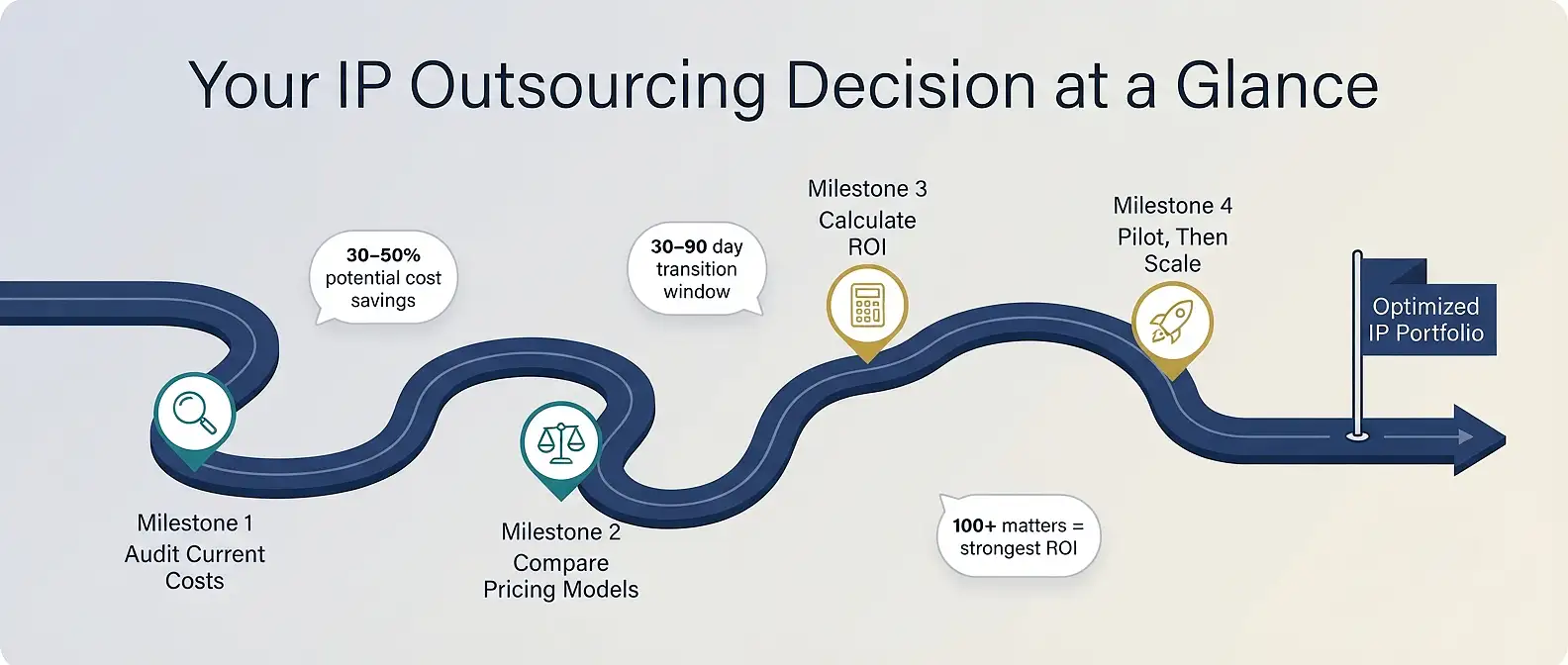
Most providers run a monitored transition period, often 30 to 90 days, where both teams verify that no deadlines fall through the cracks during handoff.
Step 6: Ongoing Reporting and Optimization
Once stable, the relationship shifts to regular reporting, budget forecasting, and periodic portfolio reviews to identify further efficiency gains.
For portfolios that also need international coverage, this process closely mirrors what we outline in our guide on how to manage an international trademark portfolio, where jurisdiction-specific deadline rules add another layer of complexity.
Calculating ROI: What CFOs and IP Directors Should Measure
The IP portfolio management outsourcing cost only tells half the story. The other half is return on investment, and this is where the business case gets made or lost.
Quick Answer: How to Calculate IP Outsourcing ROI
A simple ROI formula for IP portfolio management outsourcing is:
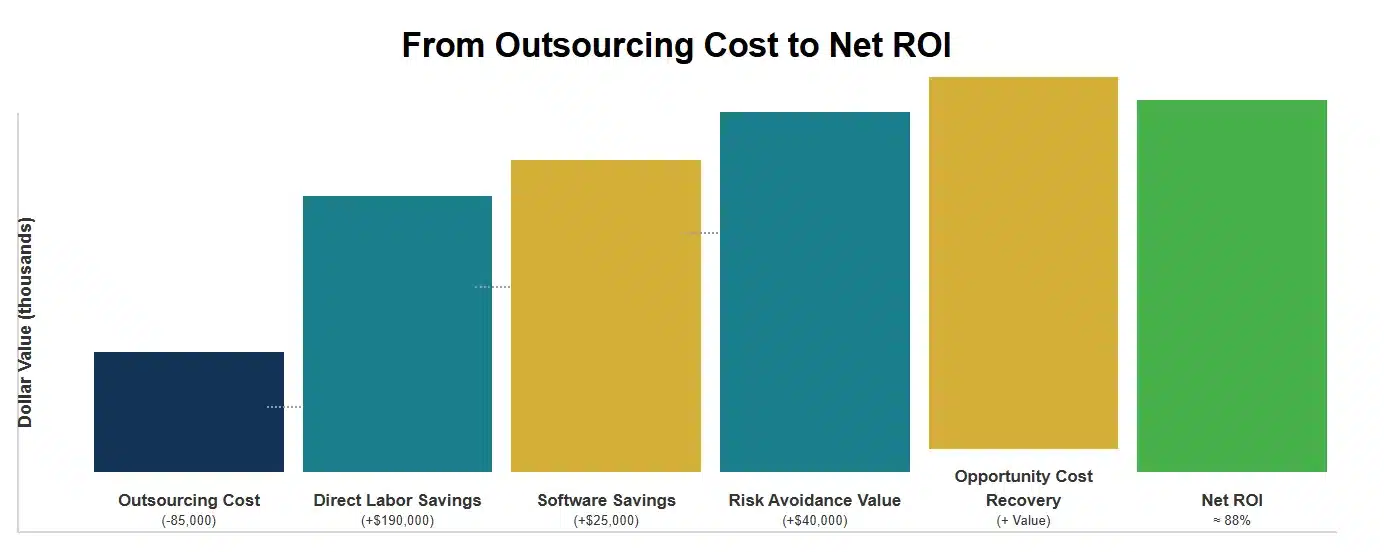
ROI = (Cost Savings + Risk Avoidance Value – Outsourcing Cost) ÷ Outsourcing Cost × 100
Key ROI Components to Measure
- Direct labor cost savings. Compare fully-loaded in-house staffing costs against outsourcing fees.
- Deadline-miss risk reduction. Estimate the potential cost of a lapsed patent or abandoned trademark application, then factor in the reduced probability of error with dedicated quality control.
- Software and infrastructure savings. Many outsourcing arrangements include docketing software access, eliminating separate licensing costs.
- Opportunity cost recovery. Time freed up for in-house attorneys to focus on strategic work, licensing negotiations, and litigation support rather than administrative tasks.
- Scalability value. The ability to handle filing surges (such as post-acquisition portfolio integration) without permanent headcount increases.
Illustrative ROI Example
| Metric | In-House Only | Outsourced Model |
|---|---|---|
| Annual staffing cost (2 FTE paralegals) | $190,000 | $0 |
| Docketing software licensing | $25,000 | Included |
| Outsourcing service fee | $0 | $85,000 |
| Estimated risk-avoidance value | Baseline | +$40,000 |
| Net annual cost/benefit | $215,000 | $85,000 (with $40,000 risk offset) |
| Estimated first-year ROI | – | ~88% |
Figures are illustrative and should be adjusted to reflect your actual portfolio size, salary benchmarks, and risk tolerance.
This is precisely the kind of calculation that turns a legal operations request into a finance-approved initiative. If you want a customized version of this model, you can calculate your potential ROI with our team.
Common Mistakes IP Departments Make When Outsourcing
Even well-intentioned outsourcing initiatives can go wrong. These are the most frequent, and avoidable, mistakes.
- Choosing price over process maturity. The cheapest quote often reflects fewer quality-control layers, which raises deadline-miss risk.
- Skipping the data audit. Migrating flawed data into a new system simply moves the problem, it does not solve it.
- Underestimating transition time. Rushed go-live dates increase the chance of missed deadlines during handoff.
- No defined escalation path. Without clear SLAs, urgent matters can stall between teams.
- Treating outsourcing as “set and forget.” The best outcomes come from ongoing collaboration, not a one-time handoff.
- Ignoring double-docketing safeguards. Redundant deadline tracking is a feature, not a flaw; see our explainer on double-docketing in patent law for why this matters.

Expert Tips for Evaluating an IP Outsourcing Provider
Before signing a contract, IP directors and general counsel should confirm the following:
- Attorney oversight. Is the provider’s work reviewed or led by licensed IP attorneys, or purely by administrative staff?
- Quality control layers. Ask specifically how many checkpoints exist between data entry and deadline confirmation.
- Transparent pricing. Favor providers offering à la carte options over rigid bundled packages that force you to pay for unused services.
- Data security practices. Confirm encryption standards, access controls, and confidentiality agreements, especially for cross-border data transfer.
- References from similarly-sized portfolios. A provider excelling with 200-matter portfolios may not scale well to 5,000 matters, or vice versa.
- Onshore/offshore blend. A U.S.-based point of contact paired with offshore delivery teams often balances cost and communication quality effectively.
For a deeper dive into vendor evaluation criteria specifically for larger portfolios, our guide to patent paralegal outsourcing for corporate IP departments walks through a full scorecard approach.
Full-Service vs. À La Carte: Which Model Fits Your Portfolio?
Not every organization needs the same outsourcing structure. Use this quick framework to identify your fit:
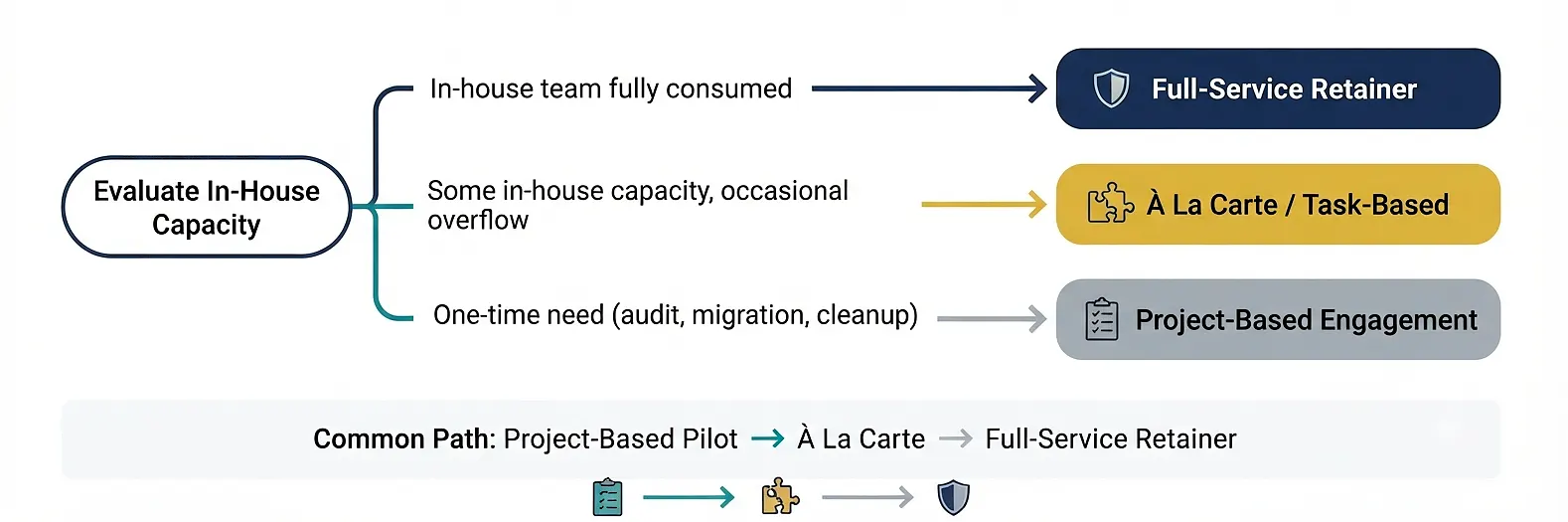
- Choose full-service retainer if: Your in-house team is fully consumed by strategic work and you want to fully offload docketing and lifecycle management.
- Choose à la carte pricing if: You have some in-house capacity but need overflow support during filing surges or staff turnover.
- Choose project-based pricing if: You need a one-time audit, migration, or cleanup rather than ongoing management.
Many organizations start with a project-based engagement, such as a portfolio audit, before committing to a full retainer. This lets finance and legal leadership evaluate provider quality before scaling the relationship. This staged approach is common among firms that first explored outsourcing through our guide on trademark docketing outsourcing costs before expanding into full patent and trademark portfolio management.
Pre-Contract Checklist: Questions to Ask Before You Sign
Before finalizing any agreement, walk through this checklist with your prospective provider and your internal finance stakeholders:
- Is pricing itemized or bundled? Itemized pricing makes it easier to forecast costs as your portfolio changes.
- What happens if matter volume spikes mid-contract? Confirm whether rates adjust automatically or require renegotiation.
- Who owns the data if you switch providers later? Your docketing data should remain fully portable and exportable at any time.
- What is the average tenure of the paralegal team? High turnover on the provider’s side can undermine the consistency you are paying for.
- How are urgent, near-deadline matters escalated? Ask for a documented escalation path, not just a verbal assurance.
- Is there a trial period or pilot engagement available? Piloting with a subset of your portfolio, such as a single jurisdiction, reduces risk before a full transition.
Running through this checklist alongside your CFO or finance partner ensures the IP portfolio management outsourcing cost you agree to is fully transparent, with no surprise fees down the road.
A Practical Scenario: Mid-Size IP Department Weighing Its Options
To make this less abstract, consider a common scenario. A mid-size technology company manages roughly 350 active patent matters across the United States, Europe, and Japan, plus 120 trademark registrations. The in-house team consists of two paralegals and one docketing coordinator, all stretched thin as filing volume grows 15 percent year over year.
Leadership faces three options:
- Hire a third paralegal. This adds roughly $95,000 in fully-loaded annual cost, plus recruiting time and a three-to-six-month ramp-up period before the new hire is fully productive.
- Do nothing and absorb the risk. The existing team continues stretching to cover growing volume, increasing the likelihood of a missed deadline during peak filing periods.
- Outsource docketing and lifecycle management. A full-service retainer, priced around $9,500 per month based on matter count and jurisdictional mix, replaces the need for a third hire entirely.
In this scenario, outsourcing costs approximately $114,000 annually, comparable to the cost of hiring a third paralegal, but without the recruiting lag, training time, or single-point-of-failure risk. The provider’s built-in redundancy also means vacation coverage and turnover no longer threaten deadline compliance. For finance leaders comparing near-identical costs, the deciding factor often becomes risk reduction and speed to full capacity, both of which favor the outsourced model.
This kind of scenario planning is exactly what IP directors should walk through before presenting a recommendation to their CFO or general counsel, since it reframes the decision from “cost versus no cost” to “which option delivers more value per dollar.”
How AI and Automation Are Changing IP Portfolio Management Costs
Docketing technology has evolved significantly, and providers now increasingly use automation to cross-check deadline calculations, flag data inconsistencies, and generate reporting dashboards in real time. This shift has two direct effects on the IP portfolio management outsourcing cost equation:
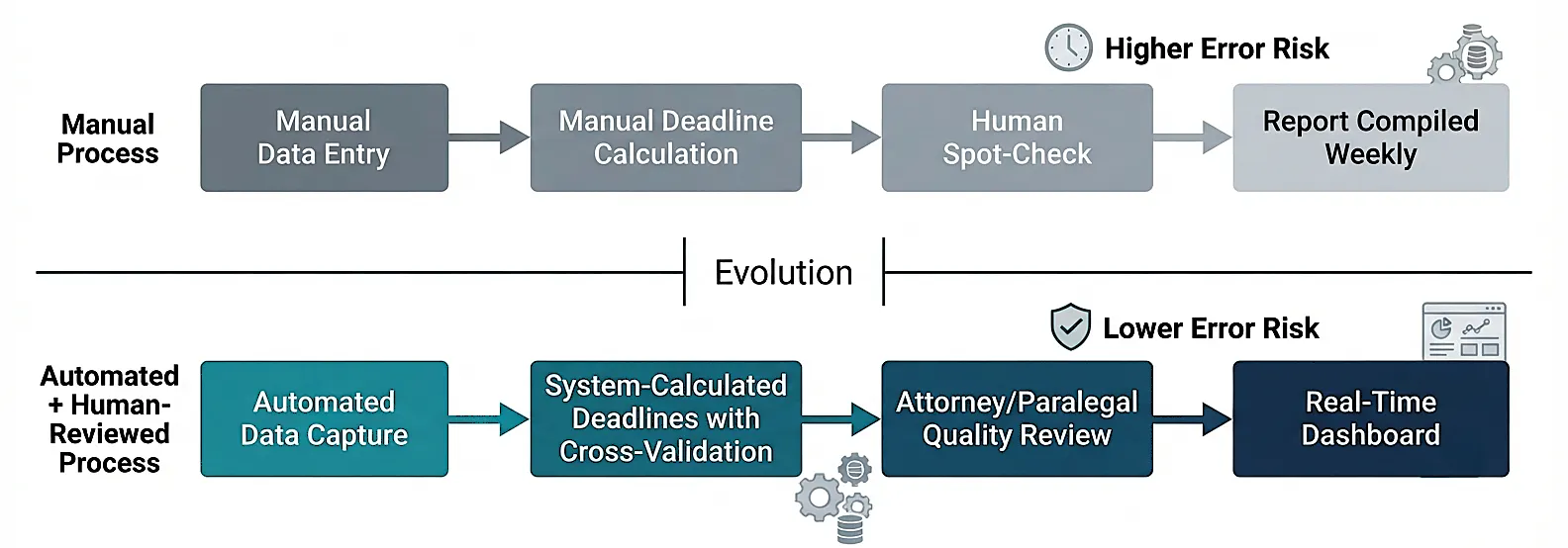
- Lower error rates. Automated deadline validation catches discrepancies that manual processes might miss, reducing the risk exposure discussed earlier in this guide.
- More predictable pricing. As routine tasks become automated, providers can offer more competitive per-matter pricing while reallocating human expertise toward higher-value oversight and quality control.
That said, automation works best when paired with experienced attorney and paralegal oversight, not as a replacement for it. When evaluating providers, ask specifically how technology and human review work together, rather than assuming automation alone guarantees accuracy.
explore our related guide on best patent docketing services for mid-size and large IP firms for additional benchmarking data.
Frequently Asked Questions
What is the average IP portfolio management outsourcing cost per matter?
Most providers charge between $8 and $35 per matter per month for docketing and lifecycle management, depending on jurisdiction complexity and the level of service included.
Is outsourcing IP portfolio management cheaper than hiring in-house staff?
In most cases, yes. Once fully-loaded salary, benefits, software licensing, and turnover costs are factored in, outsourcing typically costs 30 to 50 percent less than maintaining an equivalent in-house team, while also reducing deadline-miss risk.
How long does it take to transition to an outsourced IP management provider?
A typical transition, including data audit, migration, and parallel monitoring, takes 30 to 90 days depending on portfolio size and data quality.
Does outsourcing IP portfolio management increase risk of missed deadlines?
When managed by a provider with strong quality-control processes, outsourcing generally reduces deadline-miss risk compared to understaffed in-house teams, since dedicated providers build in redundant checks and coverage for staff absences.
Can IP portfolio management outsourcing be combined with in-house staff?
Yes. Hybrid models, where strategic decisions remain in-house and administrative docketing moves to an outsourced partner, are among the most common and cost-effective structures for mid-size and large IP departments.
What size portfolio benefits most from outsourcing?
Portfolios with 100 or more active matters typically see the strongest ROI from outsourcing, though smaller portfolios can benefit from à la carte or project-based engagements during specific high-volume periods.
What is included in a full-service IP portfolio management outsourcing retainer?
A full-service retainer typically includes docketing and deadline tracking, renewal and maintenance fee management, reporting and analytics, a dedicated account team, and access to docketing software, all bundled into one predictable monthly fee.
How do I know if my current IP portfolio management costs are too high?
Compare your fully-loaded in-house costs, including salaries, benefits, software, and training, against per-matter or retainer quotes from established outsourcing providers. If your internal cost per matter exceeds $35 to $40 per month, an outsourced model is likely to offer meaningful savings.
Making the Business Case for Outsourcing
The conversation around IP portfolio management outsourcing costs ultimately comes down to a straightforward comparison: the predictable, scalable investment of partnering with a specialized IP service provider versus the often-overlooked, fluctuating costs of maintaining an in-house team that must keep pace with increasing filing volumes, expanding global portfolios, and evolving compliance requirements. While internal staffing may appear cost-effective at first glance, hidden expenses such as recruitment, onboarding, training, employee turnover, software management, quality control, and the risk of costly docketing or compliance errors can significantly increase the true cost of ownership over time.
By contrast, an experienced outsourcing partner provides dedicated expertise, standardized workflows, and the flexibility to scale resources as your portfolio grows without requiring additional internal hiring. When you also account for reduced compliance risk, improved operational efficiency, faster turnaround times, and the ability for attorneys and IP professionals to focus on higher-value strategic work instead of administrative tasks, the long-term return on investment becomes compelling for most mid-size and large IP departments.
Rather than relying on estimates or assumptions, the best way to evaluate outsourcing is through a tailored analysis based on your organization’s unique portfolio size, filing activity, jurisdictional coverage, current staffing costs, and operational risk profile. Every IP portfolio has different requirements, and a customized assessment provides a far more accurate picture of potential savings and efficiency gains.
If you’re ready to understand where your department stands, connect with Teak IP’s IP management services team to calculate your potential ROI and identify opportunities for cost optimization. You can also explore our related guide on the best patent docketing services for mid-size and large IP firms to compare industry benchmarks, evaluate service models, and make a more informed outsourcing decision.
The next step is not guesswork, it is a tailored calculation based on your actual portfolio size, current staffing costs, and risk exposure. If you are ready to see where your department stands, calculate your potential ROI with Teak IP’s IP management services team, or
View Full IP Management Services for Law Firms and Corporate IP Teams Details

