
A single missed Section 8 deadline can strip a client of a trademark they built a brand around. That is the risk every managing partner accepts when trademark paralegal support is stretched too thin, staffed inconsistently, or handled without attorney oversight. Finding the best trademark paralegal services is no longer a back-office decision; it is a client-retention decision, a malpractice-risk decision, and, increasingly, a growth decision.

This guide breaks down exactly what separates dependable trademark paralegal support from the kind that quietly erodes a firm’s reputation. You will find a practical evaluation framework, a comparison of staffing models, real cost considerations, and the mistakes that even experienced firms make when they outsource or hire for this role. Whether you are scaling a boutique trademark practice or managing a national IP portfolio, this article will help you choose a partner with confidence.
What Are Trademark Paralegal Services?
Trademark paralegal services cover the procedural, administrative, and substantive support work required to file, prosecute, register, and maintain trademarks on behalf of attorneys and their clients. Unlike general legal support, this work demands fluency in USPTO trademark rules, the Trademark Manual of Examining Procedure (TMEP), the Trademark Trial and Appeal Board (TTAB) process, and international filing systems such as the Madrid Protocol.
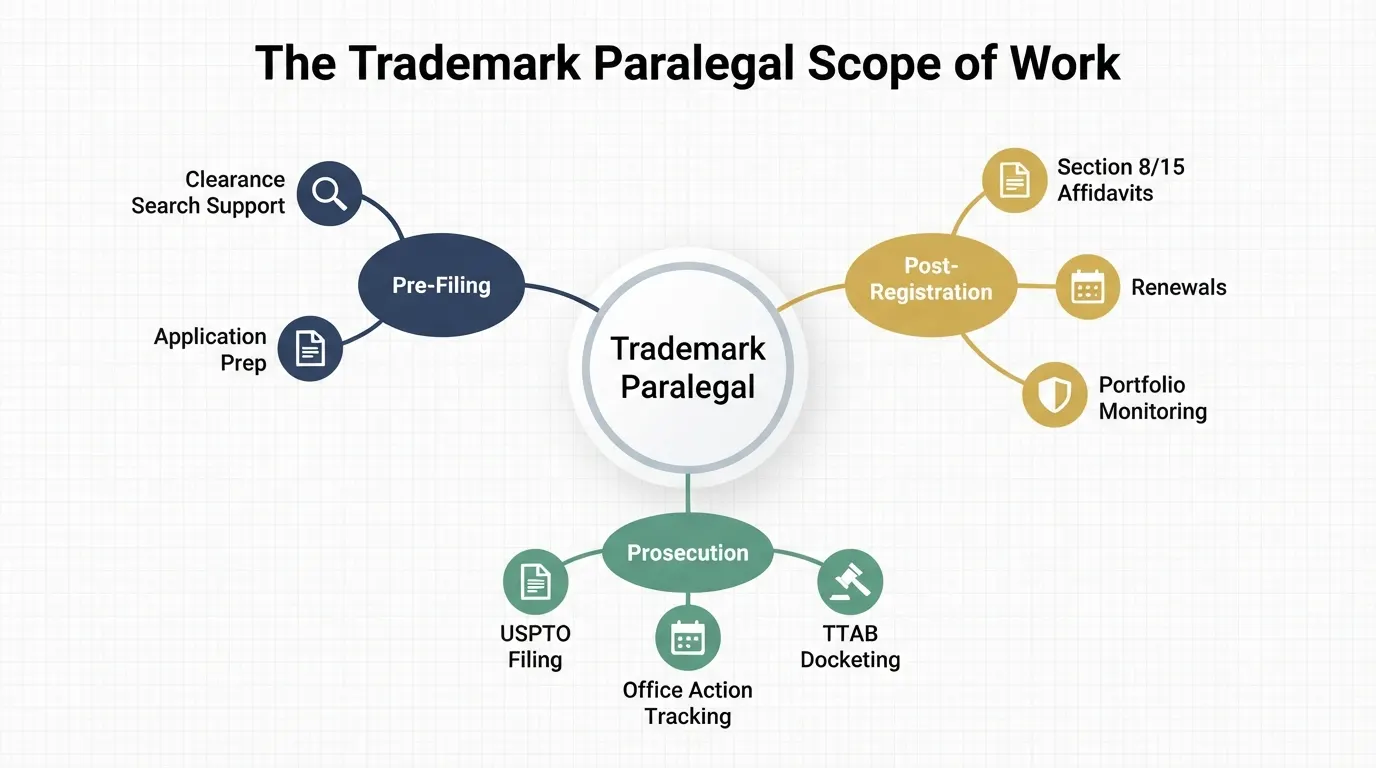
At a baseline, the best trademark paralegal services typically include:
- Trademark clearance and preliminary search support
- Application preparation and USPTO filing
- Docketing and deadline management across the full trademark lifecycle
- Office action tracking and response drafting support
- Statement of Use and extension filings
- Section 8, 9, and 15 affidavit preparation
- Trademark portfolio monitoring and renewal management
- International and Madrid Protocol coordination
Every one of these tasks is deadline-driven. A trademark paralegal is not simply an administrative assistant; the role functions as the operational backbone that keeps an attorney’s docket accurate and a client’s brand protected.
Why Law Firms Are Rethinking Trademark Paralegal Support
Trademark filing volume has climbed steadily for years, and firms are prosecuting more marks with leaner support staff than they had a decade ago. At the same time, client expectations around turnaround time and transparency have risen. Consequently, many firms find that a single in-house paralegal, however capable, cannot absorb overflow during renewal season, litigation surges, or unexpected staff turnover.
*Illustrative trend, not sourced data.
This is why more managing partners are exploring blended or fully outsourced staffing models instead of relying solely on traditional in-house hires. A flexible model gives a firm access to trademark-specific expertise on demand, without the fixed overhead of a full-time salary, benefits, and training ramp-up. Additionally, firms that outsource strategically often report faster turnaround because a well-structured provider can work across time zones, processing overnight submissions before the next business day begins.
Naturally, this shift raises the central question this article answers: how do you separate the best trademark paralegal services from providers who simply process paperwork without accountability?
Core Trademark Paralegal Services Law Firms Should Expect
Before evaluating any provider, it helps to know precisely what “full-service” trademark paralegal support should include. Below is the baseline scope that a capable team should be able to handle without hand-holding.
1. Docketing and Deadline Management
Docketing sits at the center of trademark practice. The best trademark paralegal services maintain a docketing system that flags every filing deadline, office action response window, opposition period, and renewal date well before it becomes urgent. For a deeper look at how firms prevent gaps in this process, see our guide on how to prevent missed deadlines in trademark docketing.
2. Application Preparation and Filing
This includes preparing and submitting new applications, verifying specimen compliance, classifying goods and services correctly under the Nice Classification system, and ensuring the application aligns with USPTO formatting requirements before submission.
3. Office Action Support
While a licensed attorney must sign and file substantive legal arguments, a skilled paralegal can draft preliminary responses, organize supporting evidence, and track response deadlines. Firms often ask how much of this work a paralegal can legitimately handle; our article on whether a trademark paralegal can file an office action response walks through where the line sits.
4. Post-Registration Maintenance
Trademarks require ongoing upkeep. Section 8 and Section 15 affidavits, Section 9 renewals, and specimen updates all carry hard USPTO deadlines. Our detailed breakdown of when you need to file a trademark Section 8 and 15 affidavit explains this maintenance cycle in full.
5. International Trademark Coordination
For firms managing multi-jurisdictional brands, a paralegal team must coordinate Madrid Protocol filings, monitor foreign associate deadlines, and reconcile currency and translation requirements. This is a specialized skill set on its own; see our guide on how to manage an international trademark portfolio for the operational detail.
6. Trademark Monitoring and Watch Services
Beyond prosecution, ongoing monitoring alerts firms to conflicting applications and potential infringement before they become costly disputes.
In-House vs. Outsourced vs. Virtual Trademark Paralegal: Which Model Wins?
There is no universal answer here; the right model depends on filing volume, budget, and how predictable your workload is. The table below compares the three most common staffing approaches.
| Factor | In-House Paralegal | Outsourced / Virtual Paralegal | Hybrid Model |
|---|---|---|---|
| Cost structure | Fixed salary + benefits | Pay-per-service or FTE, scalable | Blend of fixed and flexible costs |
| Scalability during peak filing season | Limited | High – overflow absorbed easily | Moderate to high |
| USPTO specialization depth | Varies by hire | Typically deep, team-based expertise | Deep, with in-house continuity |
| Turnaround during off-hours | Standard business hours | Often 24-hour coverage across time zones | Extended coverage |
| Onboarding time | Weeks to months | Days to weeks | Days to weeks |
| Best suited for | Firms with steady, predictable volume | Firms with variable or growing volume | Firms wanting both control and flexibility |
Many managing partners assume outsourcing means losing oversight. In practice, the best trademark paralegal services build in direct attorney supervision and multi-layer quality review, so the firm retains control of every deliverable while gaining flexibility on staffing.
How to Evaluate the Best Trademark Paralegal Services: A Step-by-Step Checklist
Use this sequence when vetting a provider or an in-house candidate. It mirrors the due diligence process experienced managing partners already apply to other vendor relationships.
Confirm USPTO-specific experience. Ask for examples of docketing systems used (Anaqua, CPA Global, PATTSY WAVE, IP Folio, Foundation IP) and how many active trademark matters the team currently manages.
Verify attorney oversight. The strongest providers route every deliverable through a licensed IP attorney before it reaches your desk.
Test responsiveness under pressure. Ask how the team handles a same-week office action deadline or a sudden staffing gap.
Review quality control processes. Look for a second-reviewer system, not a single point of failure.
Ask about pricing flexibility. The best trademark paralegal services typically offer à la carte or FTE-based pricing rather than forcing a rigid retainer.
Check platform compatibility. A capable provider should integrate with your existing docketing software without requiring a costly migration.
Request references from similarly sized firms. A provider comfortable with a boutique trademark practice may not be equipped for a national portfolio, and vice versa.
Clarify data security protocols. Client trademark data is sensitive; confirm encryption standards and confidentiality agreements upfront.
Key Qualities That Separate the Best Trademark Paralegal Services From the Rest
Not every provider that claims trademark expertise actually delivers it. The table below outlines the differentiators worth probing during your evaluation.
| Quality | What It Looks Like in Practice | Why It Matters |
|---|---|---|
| Attorney-led review | Every filing reviewed by a licensed IP attorney before submission | Reduces malpractice exposure |
| Multi-layer QC | Second-reviewer sign-off on docketing and filings | Catches errors before they reach the USPTO |
| Specialized (not general) staff | Team trained specifically in trademark, not general legal support | Prevents costly procedural mistakes |
| Transparent, flexible pricing | À la carte or FTE options, no minimum commitments | Aligns cost with actual filing volume |
| Time-zone coverage | Overnight processing across U.S./international teams | Faster turnaround without added headcount |
| Platform fluency | Experience across major docketing systems | Seamless onboarding, no workflow disruption |
Common Mistakes Law Firms Make When Choosing Trademark Paralegal Support
Even experienced firms fall into predictable traps when hiring or outsourcing this function. Watch for these patterns:
- Treating trademark and patent paralegal work as interchangeable. The rules, deadlines, and terminology differ substantially. If you are unsure how the two roles diverge, our article on the difference between an IP paralegal and a trademark paralegal is a useful starting point.
- Relying on a single point of failure. One paralegal managing an entire docket without backup creates unnecessary risk during vacations, illness, or turnover.
- Choosing the lowest-cost provider without checking quality controls. Cheap docketing errors are far more expensive than the fee saved upfront.
- Skipping a trial period. Firms that commit to a long-term contract without testing responsiveness on a smaller matter often discover gaps too late.
- Underestimating international complexity. Firms with only domestic experience frequently mismanage Madrid Protocol deadlines and foreign associate coordination.
- Ignoring the cost of outsourcing versus in-house hiring. Many firms never actually run the numbers. Our trademark docketing outsourcing cost guide walks through a realistic budget comparison.
Expert Tips for Getting the Most From Trademark Paralegal Services
- Start with a capacity assessment before committing. A short audit of your current docket reveals exactly where support is needed most, whether that is filing volume, renewal backlog, or office action turnaround.
- Set clear escalation protocols. Define upfront which decisions require attorney sign-off versus paralegal-level handling.
- Standardize your intake process. Consistent new-matter intake reduces docketing errors and speeds onboarding for any paralegal team, in-house or outsourced.
- Review turnaround metrics quarterly. Track average response time on office actions and renewal filings to confirm the provider is meeting its commitments.
- Cross-train for redundancy. Even with an outsourced team, ensure at least two people understand each major client’s portfolio.
(1–15 filings/mo)
(16–40 filings/mo)
(40+ filings/mo)
*Illustrative comparison, not actual pricing.
Cost Considerations: What Should You Budget?
Trademark paralegal costs vary based on filing volume, jurisdictional complexity, and staffing model. Generally, firms weigh three cost structures:
- Hourly billing: Common for smaller firms with unpredictable volume, though costs can climb quickly during peak filing periods.
- Per-action pricing: A predictable, à la carte model where firms pay only for completed tasks such as a filing, a docket entry, or an affidavit preparation.
- Full-time equivalent (FTE) pricing: Best suited for firms with steady, high-volume dockets that need dedicated, ongoing support.
In-house hiring introduces additional fixed costs beyond salary, including benefits, training time, software licensing, and turnover risk. Outsourced models typically shift these costs into a single, predictable line item. For a full breakdown of realistic numbers, our trademark docketing outsourcing cost guide offers a side-by-side comparison you can bring directly into a budget conversation.
Why Teak IP Is Among the Best Trademark Paralegal Services for Law Firms
Teak IP structures its trademark paralegal support around three principles that matter most to managing partners: attorney oversight, flexible staffing, and multi-layer quality control.
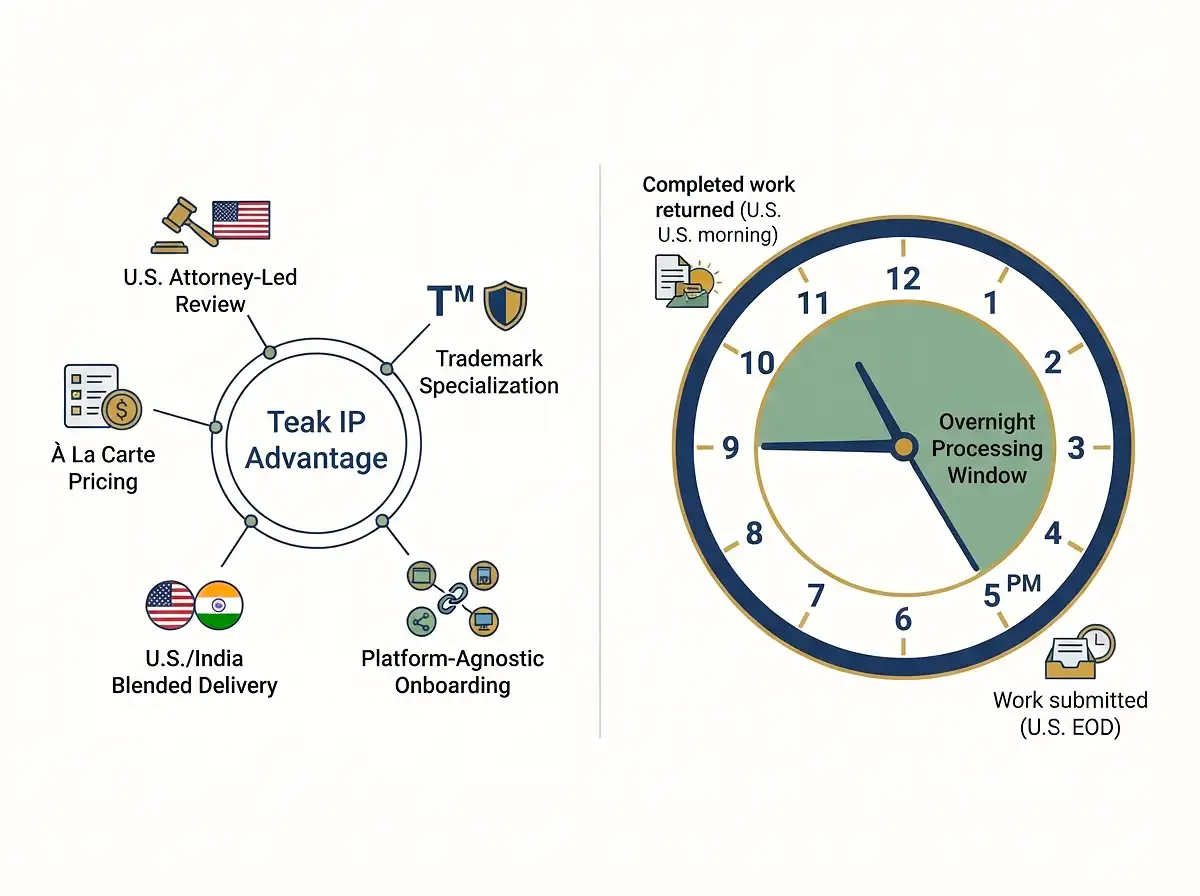
- U.S. attorney-led review. Every deliverable passes through direct attorney oversight before it reaches your firm.
- À la carte pricing. Firms pay only for the services they need, without minimum commitments or rigid retainers.
- U.S./India blended delivery. This model provides overnight processing and next-morning turnaround, combined with the accountability of a U.S.-based point of contact.
- Platform-agnostic onboarding. The team works within your existing docketing system, whether that is Anaqua, CPA Global, PATTSY WAVE, IP Folio, or Foundation IP, avoiding disruptive migrations.
- Deep trademark specialization. Paralegals are trained specifically in trademark prosecution, not repurposed from general legal support queues.
If your firm is weighing whether to hire, outsource, or restructure its current trademark support, a capacity assessment is the most direct way to see where the gaps actually are.
Ready to see where your trademark docket needs support? Request a Free Capacity Assessment from Teak IP today.
Frequently Asked Questions
What are the best trademark paralegal services for a small law firm?
The best trademark paralegal services for a small firm are typically flexible, à la carte providers that scale support up or down based on filing volume, rather than requiring a full-time hire or a rigid retainer.
How do I know if a trademark paralegal service is qualified?
Confirm the provider has USPTO-specific experience, uses a multi-layer quality control process, and routes deliverables through attorney oversight before they reach your desk.
Is outsourcing trademark paralegal work more affordable than hiring in-house?
In most cases, outsourcing reduces fixed costs like salary, benefits, and training, though the right choice depends on your firm’s filing volume and predictability. A direct cost comparison is the best way to confirm.
Can a trademark paralegal legally file an office action response?
A paralegal can draft and organize a response, but a licensed attorney must review and file substantive legal arguments. See our full explanation of what a trademark paralegal can and cannot file.
What is the difference between a trademark paralegal and a general IP paralegal?
A trademark paralegal specializes specifically in USPTO trademark procedure, TTAB rules, and brand portfolio management, while a general IP paralegal may split time across both patent and trademark work. Our comparison of the two roles covers this in detail.
How quickly can a trademark paralegal service onboard a new client?
Established providers with platform-agnostic processes can typically onboard within days to a couple of weeks, depending on portfolio size and docketing system compatibility.
Conclusion
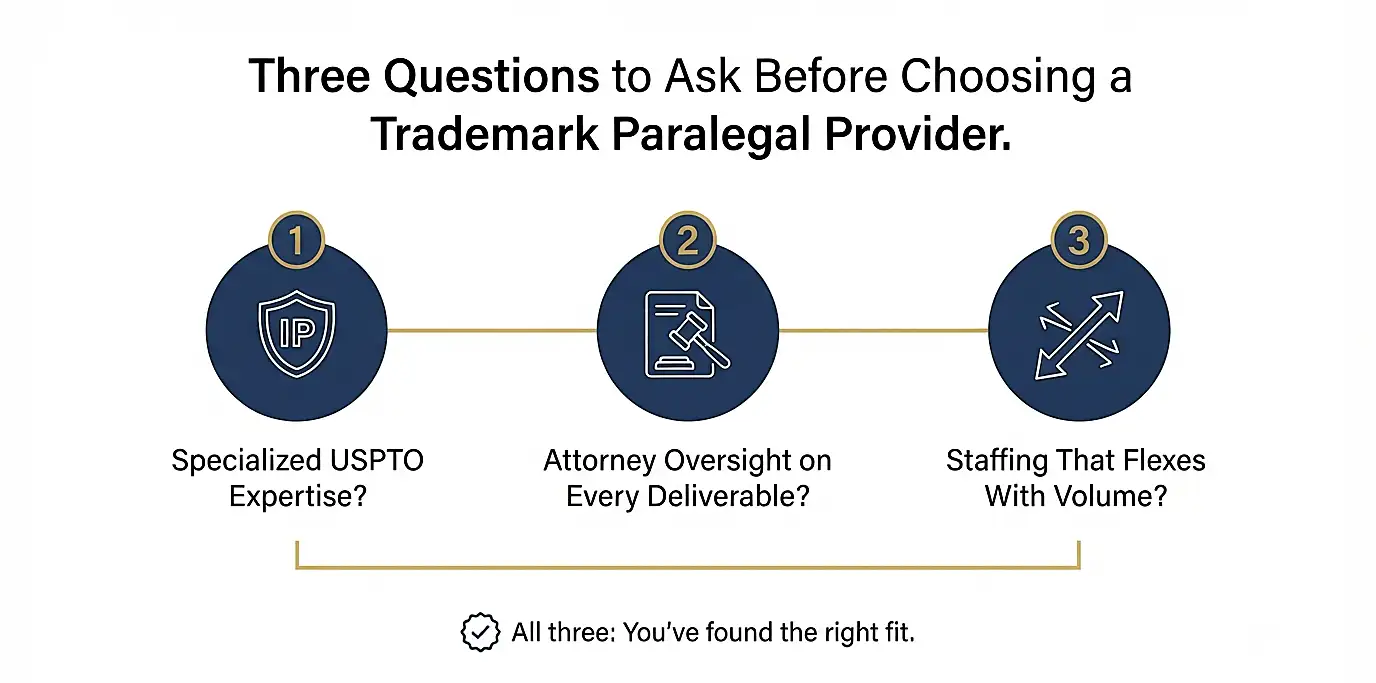
Choosing the best trademark paralegal services comes down to three questions: does the provider understand USPTO trademark procedure at a specialized level, does attorney oversight sit behind every deliverable, and can the staffing model flex with your firm’s actual workload? Firms that get this right reduce docketing risk, protect client relationships, and free their attorneys to focus on higher-value legal strategy instead of administrative overflow.
If your trademark docket is stretched thin, understaffed during peak season, or simply due for a second opinion, the fastest way to find out is to have it reviewed by a specialized team.

