
A final Office action lands in your inbox, and the deadline clock starts ticking immediately. For a junior attorney or a solo practitioner juggling a full docket, that moment often triggers the same question: is a Request for Continued Examination the right move, and if so, how do you actually prepare one without missing a technicality that costs your client time and money?

A Request for Continued Examination, commonly shortened to RCE, is one of the most frequently filed documents in U.S. patent prosecution. Yet despite how routine it has become, small errors in RCE preparation, such as filing a bare RCE with no real submission or miscalculating the entity-status fee, still cause unnecessary delays. This guide walks through exactly what an RCE is, when to use one, and how to prepare the PTO/SB/30 transmittal form correctly, step by step, so you can file with confidence the first time.
Whether you are prosecuting your first application after a final rejection or refreshing your process after years away from RCE practice, this article gives you a practical, procedurally accurate roadmap grounded in 37 CFR 1.114 and current USPTO fee schedules.
What is a Request for Continued Examination (RCE)?
Quick answer: A Request for Continued Examination is a procedural filing under 37 CFR 1.114 that allows a patent applicant to reopen prosecution of a pending, non-provisional utility or plant application after the USPTO has issued a final Office action, a notice of allowance, or another action that closes prosecution.
RCE = A Reset, Not a Restart
Filing an RCE does not create a new application and does not change the application’s filing date. Instead, it withdraws the finality of the previous office action and puts the application back in front of the examiner for another round of review. In practical terms, an RCE is a reset button, not a new game. The examiner reopens the case, considers your new submission, and typically issues a fresh Office action.
Why the RCE Exists
Before an RCE was available, applicants facing a final rejection had limited options: file a continuation application, appeal to the Patent Trial and Appeal Board (PTAB), or abandon the case. The RCE gives applicants a faster, less expensive way to keep prosecution alive in the same application when they believe an amendment, additional argument, or new evidence can overcome the rejection.
Legal Basis: 37 CFR 1.114
The controlling regulation is 37 CFR 1.114, which governs Request for Continued Examination practice. Importantly, every RCE must include a “submission” that gives the examiner something new to evaluate and RCE practice under this rule does not apply to any utility or plant application filed prior to June 8, 1995, or to any design application. This eligibility window matters, because filing a defective RCE on an ineligible application wastes the filing fee and delays the case further.
When is a Request for Continued Examination Available?
Featured-snippet answer: An RCE becomes available once prosecution in a patent application is formally closed. Under 37 CFR 1.114(b), prosecution is closed if the application:
- Received a final Office action
- Received a notice of allowance
- Received an action that otherwise closes prosecution (for example, an Ex parte Quayle action)
- Is under appeal before the Patent Trial and Appeal Board (PTAB)
Notably, the cutoff that actually prevents an RCE is an appeal to the Federal Circuit, not the PTAB. That means even after you have filed a notice of appeal to the PTAB, you can generally still withdraw from appeal and file an RCE instead, provided the case has not advanced to the Court of Appeals for the Federal Circuit.
Applications That Do NOT Qualify for RCE Treatment
Not every application is eligible. Per the official PTO/SB/30 instructions, RCE practice cannot be filed for a provisional application, a utility or plant application filed before June 8, 1995, a design application, or a patent under reexamination.
| Application Type | RCE Eligible? |
|---|---|
| Utility application filed on or after June 8, 1995 | Yes |
| Plant application filed on or after June 8, 1995 | Yes |
| Provisional application | No |
| Design application | No |
| Application filed before June 8, 1995 | No |
| Patent already under reexamination | No |
| Application under appeal at the Federal Circuit | No |
What Goes Into the RCE Submission?
This is the section junior attorneys most often overlook. Filing Form PTO/SB/30 alone, without accompanying substantive content, does not satisfy the RCE requirements. According to 37 CFR 1.114(c), a proper submission includes, but is not limited to, an information disclosure statement, an amendment to the written description, claims, or drawings, new arguments, or new evidence in support of patentability.
Anatomy of a Valid RCE Submission
Overcoming the “Fee Alone” Misconception via Structural Integration
Fee Alone ≠ Submission
Filing Form PTO/SB/30 without substantive content fails to trigger examination.
In other words, the RCE transmittal form is only the cover sheet. The real substance is whatever you attach alongside it.
Acceptable Submission Types
- Claim amendments narrowing or clarifying the rejected claims
- Specification or drawing amendments correcting informalities noted by the examiner
- Remarks or arguments responding substantively to the final rejection
- An Information Disclosure Statement (IDS) citing newly discovered prior art
- New evidence, such as a declaration under 37 CFR 1.132, supporting patentability
A Fee Alone Is Not a Submission
A common misconception among newer practitioners is that paying the RCE fee is itself sufficient. It is not. Without a qualifying submission, the USPTO will treat the filing as improper, and prosecution will not actually reopen the way the applicant intended. Always pair the transmittal with substantive content.
Why This Procedure Matters for Junior Attorneys and Paralegals
If you are a junior associate or a solo practitioner handling your own prosecution docket, the Request for Continued Examination is likely one of the first “final action” tools you will use regularly. It shows up constantly because most patent applications receive at least one non-final and one final rejection before allowance, and a well-prepared RCE is often the fastest, least expensive way to keep an application alive after that final rejection lands.
For a paralegal supporting several attorneys across a busy docket, RCE preparation is also one of the more template-friendly filings in patent prosecution. Once you understand the eligibility rules, the required submission content, and the fee structure, the transmittal form itself becomes largely mechanical. That is precisely why so many firms lean on dedicated patent paralegal outsourcing support for this task: the legal judgment (what argument or amendment will actually overcome the rejection) stays with the attorney, while the procedural execution (form completion, fee calculation, docketing) can be handled reliably by trained support staff.
Understanding this division of labor early in your career, or building it into your solo practice workflow, pays off. A consistent, checklist-driven approach to Request for Continued Examination filings reduces the chance that a rushed Friday-afternoon filing turns into a Monday-morning problem.
Understanding Entity Status Before You File
USPTO Entity Status & Qualification Hierarchy
Select the appropriate filing status based on organizational size, income thresholds, and prior filing history.
Standard Entity
No discount applied
Small Entity
Qualifying organizational conditions
Micro Entity
Strict income & filing caps
Because RCE fees scale directly with entity status, it is worth pausing on what these categories actually mean before you fill out the transmittal form.
- Standard (undiscounted) entity applies to any applicant that does not qualify for small or micro entity status, including most large corporations.
- Small entity status (37 CFR 1.27) generally applies to independent inventors, nonprofit organizations, and businesses with fewer than 500 employees that have not assigned, licensed, or otherwise conveyed rights to a non-qualifying entity.
- Micro entity status (37 CFR 1.29) is a further discount available to applicants who meet the small entity requirements, have not been named as an inventor on more than four previously filed patent applications, and fall under specific gross income limits, among other conditions.
Before completing the RCE transmittal form, confirm which certification is already on file for the application. If circumstances have changed since the original filing, such as a licensing deal that would disqualify small entity status, that change needs to be reflected before you rely on the discounted RCE fee. Filing with an outdated entity-status certification is a common, and entirely avoidable, error.
A Closer Look at the Information Disclosure Statement Option
One RCE submission type deserving special attention is the Information Disclosure Statement, or IDS. If new prior art surfaces after a final rejection, whether from a foreign counterpart application, an examiner’s citation in a related case, or the applicant’s own ongoing research, an IDS filed with the RCE ensures that art is properly disclosed to the examiner.
Filing an IDS with an RCE is often more efficient than filing it as a standalone submission, because it becomes part of the same continued examination cycle rather than triggering a separate certification or fee analysis. That said, IDS timing rules under 37 CFR 1.97 still apply, and fees may be owed depending on when the information became known to the applicant. Coordinate closely with the attorney of record to confirm whether a fee is required and whether the required certification statement can be truthfully made.
Step-by-Step: How to Prepare and File Form PTO/SB/30
Here is the practical workflow paralegals and junior associates can follow when preparing a Request for Continued Examination.
Step 1: Confirm Prosecution Is Closed and the Application Is Eligible
Before drafting anything, verify that the case has received a final rejection, notice of allowance, or other prosecution-closing action, and confirm the application type qualifies (see the eligibility chart above).
Step 2: Decide on Your Substantive Strategy
Work with the supervising attorney to determine what will accompany the RCE:
- Will claims be amended to overcome the rejection?
- Are new arguments enough, without amendment?
- Does new prior art need to be disclosed through an IDS?
- Is a declaration or additional evidence needed to rebut an examiner’s factual finding?
Step 3: Draft the Submission Documents
Prepare the amendment, remarks, IDS, or declaration as separate documents. These should mirror the formatting conventions used in your firm’s standard Office action responses, with clean and marked-up claim listings if claims are amended.
Step 4: Complete the PTO/SB/30 Transmittal Form
The transmittal form asks for the application number, filing date, and examiner name, and it lets you indicate what type of submission accompanies the request. Fill in each field carefully:
- Application number and filing date
- First named inventor and title of invention
- Examiner name and art unit (if known)
- Checkbox indicating the submission type (previously filed unentered amendment, amendment filed herewith, IDS, or other)
- Instructions on entry of any previously unentered amendments
- Fee calculation section (entity status and fee amount)
- Signature block
RCE Filing Workflow
Step-by-step process & time investment
If the case has any previously filed but unentered amendments (for example, an amendment submitted after final rejection that the examiner did not enter), the RCE will automatically cause those to be entered in the order filed, unless you affirmatively instruct otherwise on the form.
Step 5: Calculate and Pay the Correct RCE Fee
Fee amounts depend on whether this is the first RCE filed in the application and on the applicant’s entity status. Getting this wrong is one of the most common, and most easily avoidable, mistakes in RCE preparation. See the fee table below for current amounts.
Step 6: File Electronically Through Patent Center
The standard way to file an RCE is through the USPTO’s Patent Center electronic filing system, where you upload the completed Form PTO/SB/30 along with your substantive submission as separate PDF attachments and then pay the RCE fee via the electronic payment system using a credit card, deposit account, or other accepted method. Filing electronically avoids paper-processing delays and gives you an immediate, time-stamped confirmation.
Step 7: Calendar the Response and Monitor for the New Office Action
Once the RCE is filed and accepted, the application returns to the examiner’s active queue. Docket the case for a new Office action and monitor Patent Center for updates, since RCE-driven Office actions follow the same statutory response deadlines as any other action. Missed deadlines at this stage carry the same real-world consequences described in our guide on what double-docketing is in patent law, so it is worth applying the same redundancy checks to RCE-related deadlines that you would to any other Office action response.
Current USPTO Fees for a Request for Continued Examination
RCE fees changed under the USPTO’s fee schedule effective January 19, 2025, and they remain in effect at the time of this writing. The fee owed depends on whether it is the applicant’s first RCE in the application or a second or subsequent RCE, and on entity status.
RCE Fee Comparison — Effective Jan 19, 2025 Schedule
Second RCE fees increase by roughly 90% over the first — a key budgeting checkpoint for patent portfolio management.
| RCE Filing | Fee Code | Standard (Undiscounted) Fee | Small Entity Fee | Micro Entity Fee |
|---|---|---|---|---|
| 1st RCE (37 CFR 1.17(e)(1)) | 1801/2801/3801 | $1,500.00 | $600.00 | $300.00 |
| 2nd and subsequent RCE (37 CFR 1.17(e)(2)) | 1820/2820/3820 | $2,860.00 | $1,144.00 | $572.00 |
A few practical notes on entity status and fees:
- Small entity status generally applies to independent inventors, small businesses, and nonprofits that meet USPTO thresholds.
- Micro entity status has additional income and prior-filing limitations beyond small entity status.
- Filing a second RCE in the same application costs significantly more than the first, which is one reason many practitioners try to resolve rejections thoroughly on the first RCE submission rather than filing serial RCEs.
- Always confirm current fees directly with the USPTO fee schedule before filing, since fee amounts are subject to periodic adjustment.
Request for Continued Examination vs. Continuation Application vs. Appeal
Junior attorneys frequently ask how an RCE compares to the alternatives available after a final rejection. Here is a side-by-side comparison to help frame the strategic decision.
STRATEGIC PROSECUTION PATHWAYS: COMPARATIVE ANALYSIS
Evaluate key metrics and best-fit scenarios for continued prosecution.
RCE (Request for Continued Examination)
Continuation Application
Appeal to PTAB
| Factor | RCE | Continuation Application | Appeal to PTAB |
|---|---|---|---|
| New filing date? | No, same application | Yes, new application | No, same application |
| Typical cost | Lower (RCE fee only) | Filing, search, and examination fees | Notice of appeal and brief fees |
| Speed to next action | Moderate | Slower (new application queue) | Slower (PTAB review timeline) |
| Best used when | New argument, amendment, or evidence can likely overcome rejection | Applicant wants to pursue different claim scope or keep the parent alive while pursuing new claims | Applicant believes the rejection is legally or factually wrong and wants Board review |
| Examiner discretion | Same examiner typically continues examination | New examiner may be assigned | PTAB panel reviews, not the examiner |
There is no universally “correct” choice among these three paths. The decision depends on claim strategy, budget, how strong the examiner’s rejection is on the merits, and how much runway remains before statutory deadlines. If the case does proceed to appeal instead of an RCE, managing the resulting briefing timeline becomes its own critical workstream.
Practical Insight: Building an RCE Checklist Your Team Can Reuse
Because the Request for Continued Examination is filed so frequently, it is one of the best candidates for a standardized internal checklist. A simple, reusable checklist reduces reliance on any one person’s memory and helps new team members ramp up quickly. Consider including:
- Eligibility confirmation – Application type, filing date, and current prosecution status.
- Submission content sign-off – Attorney confirmation of what will accompany the RCE (amendment, arguments, IDS, evidence).
- Entity status verification – Cross-check against the application’s current certification on file.
- Fee calculation – First versus second-and-subsequent RCE fee, applied against the correct entity status.
- Form completion – Application number, filing date, inventor, examiner, art unit, and entry instructions for any unentered amendments.
- Attachment audit – Confirm every referenced document (amendment, remarks, IDS, declaration) is actually attached before submission.
- Filing confirmation – Save the Patent Center acknowledgment receipt to the file.
- Docketing – Calendar the expected response window for the forthcoming Office action.
Firms that formalize this kind of checklist, whether in a docketing system, a shared document, or a practice-management tool, tend to see fewer rejected or defective RCE filings and faster turnaround on routine prosecution work.
Critical Warnings
Practical Insight: What Happens If the RCE Is Filed Improperly
If an RCE is filed without a proper submission, without the correct fee, or on an ineligible application, the USPTO will generally notify the applicant of the defect rather than simply rejecting the filing outright. However, this notification process consumes time. Depending on the deadline posture of the case, a defective RCE can eat into the window available to correct the problem, occasionally leading to unintended abandonment if the correction is not made promptly.
This is precisely why the eligibility and submission-content checks described earlier in this guide belong at the very start of the process, not as an afterthought. Catching a problem before filing costs nothing. Catching it after filing can cost real prosecution time.
Common Mistakes When Preparing an RCE
Even experienced filers occasionally trip on these issues. Watch for:
- Filing an RCE without a real submission. Paying the fee alone does not satisfy 37 CFR 1.114(c).
- Filing on an ineligible application, such as a design application or a provisional application.
- Miscalculating the fee by applying the wrong entity status or forgetting that a second RCE costs more than the first.
- Missing the transmittal form’s entry instructions, resulting in unintended entry (or non-entry) of previously filed amendments.
- Filing after the case has already gone to the Federal Circuit, at which point RCE practice is no longer available.
- Failing to docket the resulting Office action deadline, treating the RCE filing itself as the end of the task rather than the start of a new response cycle.
- Submitting incomplete signature or authorization information on the transmittal form, which can trigger processing delays.
Expert Tips for a Clean RCE Filing
BEST PRACTICE FRAMEWORK
Strategic execution guidelines for efficient patent prosecution.
Align Strategy Early
Auto-Verify Fees
Maintain a Firm Checklist
Track RCE Count Per Case
Double-Check Examiner Details
- Front-load your strategy conversation. Before drafting the transmittal form, confirm with the attorney exactly what will accompany the RCE, since the form’s checkboxes need to match the actual submission.
- Use Patent Center’s built-in fee calculator to confirm the exact amount due before submitting payment, especially when entity status has changed since the last filing in that application.
- Keep a firm-wide RCE checklist covering eligibility, submission type, entity status, and docketing, so paralegals and junior associates can self-verify before a filing goes out.
- Track RCE count per application. Because the second and subsequent RCE fee is substantially higher, flagging when an application is heading toward a second RCE gives the attorney time to consider whether an appeal or continuation might be more cost-effective.
- Double-check the examiner and art unit fields. These are minor details, but inaccurate information can slow down USPTO processing on the administrative side.
Frequently Asked Questions About the Request for Continued Examination
What is Form PTO/SB/30 used for?
Form PTO/SB/30 is the official RCE Transmittal form used to request continued examination of a patent application after a final rejection or other prosecution-closing action. It is the cover document; the actual substantive content (amendment, arguments, or evidence) is filed alongside it.
Can I file a Request for Continued Examination electronically?
Yes. The standard and recommended method is to file through the USPTO’s Patent Center, uploading the transmittal form and submission as separate PDF attachments and paying the fee online.
Does filing an RCE give my application a new filing date?
No. An RCE is not a new application, and filing an RCE will not result in an application being accorded a new filing date. The application retains its original filing date throughout continued examination.
How many times can I file an RCE on the same application?
There is no statutory cap on the number of RCEs an applicant may file, but each subsequent RCE requires a separate fee, and the second and later RCE fee is substantially higher than the first.
Can I withdraw a Request for Continued Examination after filing it?
Yes, an applicant can generally request withdrawal of an RCE by submitting a request to the USPTO, though the specific procedural posture of the case should be reviewed before doing so.
What happens after I file an RCE?
The USPTO reopens prosecution and typically issues a new Office action addressing the amendments, arguments, or evidence submitted with the RCE.
Is an RCE the same as an appeal?
No. An RCE keeps prosecution open with the same examiner and application, while an appeal sends the case to the Patent Trial and Appeal Board for review of the examiner’s rejection.
How RCE Practice Fits Into the Broader Patent Prosecution Lifecycle
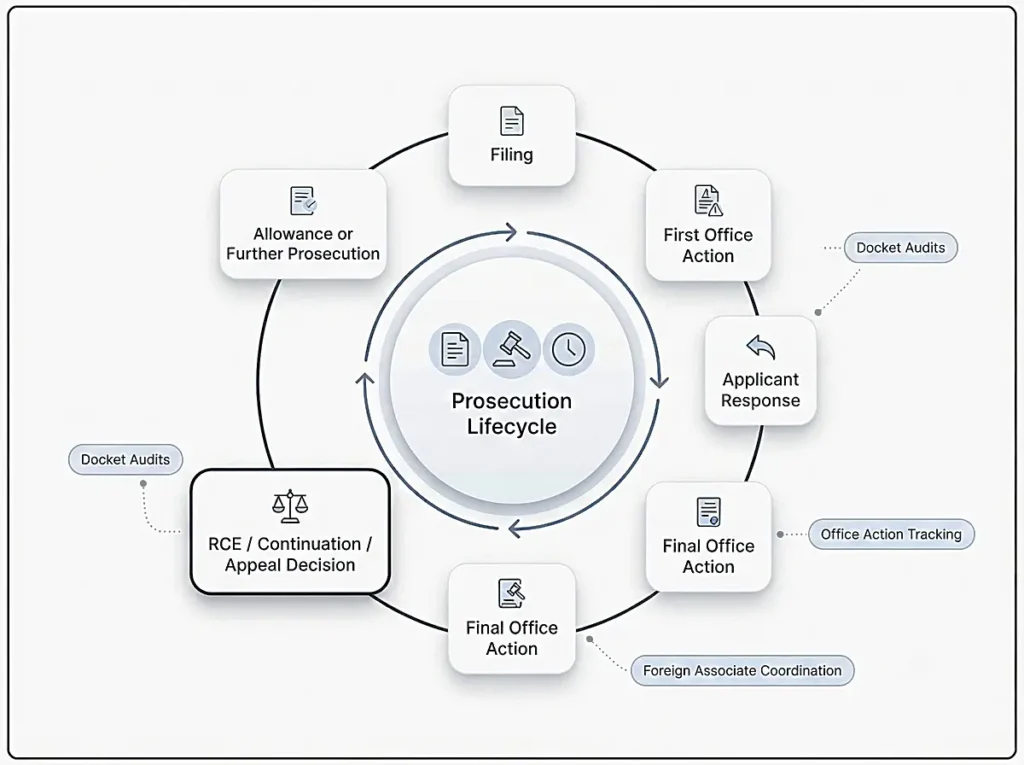
It helps to zoom out and see where the Request for Continued Examination sits within the full arc of patent prosecution. An application typically moves through filing, a first Office action (often non-final), a response from the applicant, and then, if the examiner remains unpersuaded, a final Office action. At that final-rejection stage, the applicant generally has three realistic paths forward: file an RCE, file a continuation application, or appeal to the PTAB. Each of those paths keeps the underlying invention alive in some form, but they diverge sharply in cost, timeline, and strategic effect, as outlined in the comparison table above.
Because RCEs directly affect docketing, deadlines, and fee budgeting, they also intersect with several adjacent workflows that IP teams manage on an ongoing basis, including Office action tracking, docket audits, and coordinating response correspondence with foreign associates on related international filings. Treating the RCE as an isolated, one-off task rather than part of this larger lifecycle, one that also spans broader patent lifecycle management from filing through maintenance, is a common reason firms lose track of downstream deadlines after the filing goes out.
Final Thoughts on Preparing a Request for Continued Examination
A Request for Continued Examination is one of the more procedurally simple tools in patent prosecution, but simple does not mean automatic. Confirming eligibility, assembling a genuine substantive submission, completing the PTO/SB/30 transmittal accurately, and paying the correct fee are all steps that deserve careful attention rather than a rushed, boilerplate approach. Getting the RCE right the first time keeps prosecution moving forward and protects your client from avoidable costs and delays.
If your firm is managing a growing docket of RCEs, Office action responses, and other patent prosecution filings, experienced paralegal support can help keep every deadline, form, and fee calculation accurate. Teak IP’s patent paralegal outsourcing services are built specifically for firms and corporate IP departments that need reliable, attorney-reviewed support on filings like these.

